Doroluman,Arakan,Cotabato
GraduateSchool
Doctorof Education
Reporter:
IRISHJOHND.ROMBAOA
Ed.D.1–C
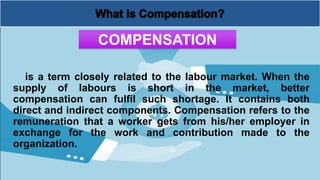
is a term closely related to the labour market. When the
supply of labours is short in the market, better
compensation can fulfil such shortage. It contains both
direct and indirect components. Compensation refers to the
remuneration that a worker gets from his/her employer in
exchange for the work and contribution made to the
organization.
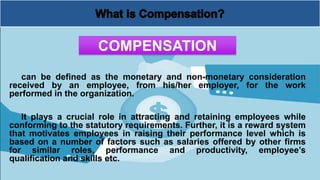
COMPENSATION
can be defined as the monetary and non-monetary consideration
received by an employee, from his/her employer, for the work
performed in the organization.
It plays a crucial role in attracting and retaining employees while
conforming to the statutory requirements. Further, it is a reward system
that motivates employees in raising their performance level which is
based on a number of factors such as salaries offered by other firms
for similar roles, performance and productivity, employee’s
qualification and skills etc.
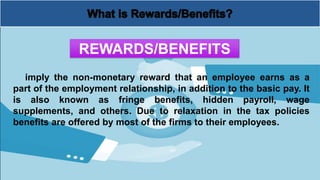
COMPENSATION
imply the non-monetary reward that an employee earns as a
part of the employment relationship, in addition to the basic pay. It
is also known as fringe benefits, hidden payroll, wage
supplements, and others. Due to relaxation in the tax policies
benefits are offered by most of the firms to their employees.
REWARDS/BENEFITS
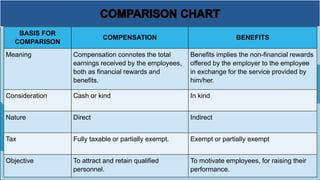
BASIS FOR
COMPARISON
COMPENSATION BENEFITS
Meaning Compensation connotes the total
earnings received by the employees,
both as financial rewards and
benefits.
Benefits implies the non-financial rewards
offered by the employer to the employee
in exchange for the service provided by
him/her.
Consideration Cash or kind In kind
Nature Direct Indirect
Tax Fully taxable or partially exempt. Exempt or partially exempt
Objective To attract and retain qualified
personnel.
To motivate employees, for raising their
performance.
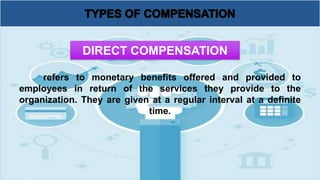
refers to monetary benefits offered and provided to
employees in return of the services they provide to the
organization. They are given at a regular interval at a definite
time.
DIRECT COMPENSATION
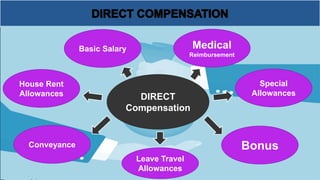
DIRECT
Compensation
Medical
Reimbursement
Special
Allowances
Bonus
Leave Travel
Allowances
Conveyance
House Rent
Allowances
Basic Salary
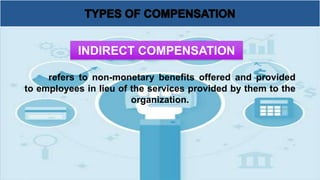
refers to non-monetary benefits offered and provided
to employees in lieu of the services provided by them to the
organization.
INDIRECT COMPENSATION
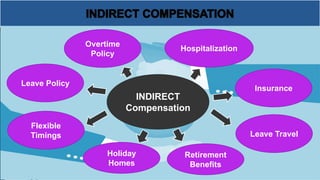
INDIRECT
Compensation
Hospitalization
Insurance
Leave Travel
Holiday
Homes
Flexible
Timings
Leave Policy
Overtime
Policy
Retirement
Benefits
Compensation
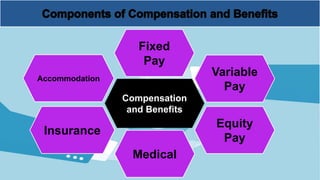
and Benefits
Fixed
Pay
Variable
Pay
Equity
Pay
Medical
Insurance
Accommodation
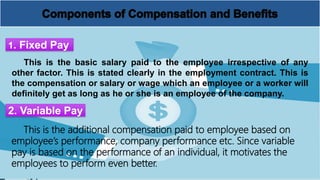
This is the basic salary paid to the employee irrespective of any
other factor. This is stated clearly in the employment contract. This is
the compensation or salary or wage which an employee or a worker will
definitely get as long as he or she is an employee of the company.
1. Fixed Pay
2. Variable Pay
This is the additional compensation paid to employee based on
employee’s performance, company performance etc. Since variable
pay is based on the performance of an individual, it motivates the
employees to perform even better.
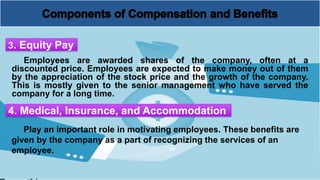
Employees are awarded shares of the company, often at a
discounted price. Employees are expected to make money out of them
by the appreciation of the stock price and the growth of the company.
This is mostly given to the senior management who have served the
company for a long time.
3. Equity Pay
4. Medical, Insurance, and Accommodation
Play an important role in motivating employees. These benefits are
given by the company as a part of recognizing the services of an
employee.
Rai University states that one of the primary goals of compensation
should be to recruit qualified talent. When you have a competitive
compensation plan in place, you’ll be better able to attract top industry talent.
1. To Attract Top Talent
2. To Retain & Reward Personnel
Don’t lose your top talent to your competitors because employees believe
that the grass will be greener elsewhere. Find out market values for your
employees and pay accordingly. You can also set up pay-for-performance
models to drive performance by encouraging associates to reach new goals
and push farther.
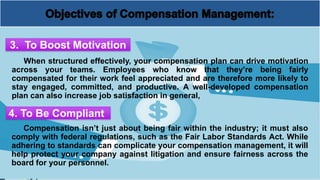
When structured effectively, your compensation plan can drive motivation
across your teams. Employees who know that they’re being fairly
compensated for their work feel appreciated and are therefore more likely to
stay engaged, committed, and productive. A well-developed compensation
plan can also increase job satisfaction in general,
3. To Boost Motivation
4. To Be Compliant
Compensation isn’t just about being fair within the industry; it must also
comply with federal regulations, such as the Fair Labor Standards Act. While
adhering to standards can complicate your compensation management, it will
help protect your company against litigation and ensure fairness across the
board for your personnel.
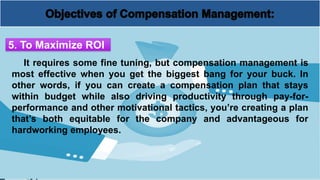
It requires some fine tuning, but compensation management is
most effective when you get the biggest bang for your buck. In
other words, if you can create a compensation plan that stays
within budget while also driving productivity through pay-for-
performance and other motivational tactics, you’re creating a plan
that’s both equitable for the company and advantageous for
hardworking employees.
5. To Maximize ROI
The Philippine government has remained steadfast with its
commitment in ensuring that education will always be a top priority. In
fact under the law as stated in Article XIV, Section 5 (5) of the 1987
Constitution, it expressly provides that: “The State shall assign the
highest budgetary priority to education and ensure that teaching will
attract and retain its rightful share of the best available talents through
adequate remuneration and other means of job satisfaction and
fulfilment.”
The Department of Education (DepEd) has also worked hand in hand with
teachers to ensure that their welfare and rights are upheld. Thus, for the
year 2019, teachers under DepEd get to enjoy several benefits,
allowances and perks as mandated by the law.
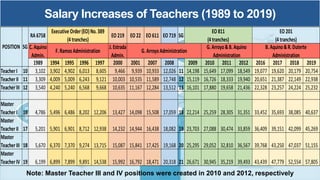
Salary Increases of Teachers (1989 to 2019)
RA 6758 EO 219 EO 22 EO 611 EO 719 SG
C.Aquino
Admin.
J.Estrada
Admin.
1989 1994 1995 1996 1997 2000 2001 2007 2008 2009 2010 2011 2012 2016 2017 2018 2019
TeacherI 10 3,102 3,902 4,902 6,013 8,605 9,466 9,939 10,933 12,026 11 14,198 15,649 17,099 18,549 19,077 19,620 20,179 20,754
TeacherII 11 3,309 4,009 5,009 6,243 9,121 10,003 10,535 11,589 12,748 12 15,119 16,726 18,333 19,940 20,651 21,387 22,149 22,938
TeacherIII 12 3,540 4,240 5,240 6,568 9,668 10,635 11,167 12,284 13,512 13 16,101 17,880 19,658 21,436 22,328 23,257 24,224 25,232
Master
TeacherI 16 4,786 5,496 6,486 8,202 12,206 13,427 14,098 15,508 17,059 18 22,214 25,259 28,305 31,351 33,452 35,693 38,085 40,637
Master
TeacherII 17 5,201 5,901 6,901 8,712 12,938 14,232 14,944 16,438 18,082 19 23,703 27,088 30,474 33,859 36,409 39,151 42,099 45,269
Master
TeacherIII 18 5,670 6,370 7,370 9,274 13,715 15,087 15,841 17,425 19,168 20 25,295 29,052 32,810 36,567 39,768 43,250 47,037 51,155
Master
TeacherIV 19 6,199 6,899 7,899 9,891 14,538 15,992 16,792 18,471 20,318 21 26,671 30,945 35,219 39,493 43,439 47,779 52,554 57,805
Executive Order(EO)No.389
(4 tranches)
EO 811
(4 tranches)
EO 201
(4 tranches)
F.RamosAdministration
B.Aquino&R.Duterte
Administration
POSITION SG G.Arroyo&B.Aquino
Administration
G.ArroyoAdministration
Note: Master Teacher III and IV positions were created in 2010 and 2012, respectively
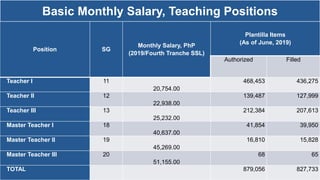
Basic Monthly Salary, Teaching Positions
Position SG
Monthly Salary, PhP
(2019/Fourth Tranche SSL)
Plantilla Items
(As of June, 2019)
Authorized Filled
Teacher I 11
20,754.00
468,453 436,275
Teacher II 12
22,938.00
139,487 127,999
Teacher III 13
25,232.00
212,384 207,613
Master Teacher I 18
40,637.00
41,854 39,950
Master Teacher II 19
45,269.00
16,810 15,828
Master Teacher III 20
51,155.00
68 65
TOTAL 879,056 827,733
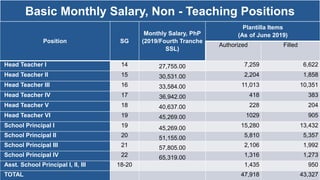
Basic Monthly Salary, Non - Teaching Positions
Position SG
Monthly Salary, PhP
(2019/Fourth Tranche
SSL)
Plantilla Items
(As of June 2019)
Authorized Filled
Head Teacher I 14 27,755.00 7,259 6,622
Head Teacher II 15 30,531.00 2,204 1,858
Head Teacher III 16 33,584.00 11,013 10,351
Head Teacher IV 17 36,942.00 418 383
Head Teacher V 18 40,637.00 228 204
Head Teacher VI 19 45,269.00 1029 905
School Principal I 19 45,269.00 15,280 13,432
School Principal II 20 51,155.00 5,810 5,357
School Principal III 21 57,805.00 2,106 1,992
School Principal IV 22 65,319.00 1,316 1,273
Asst. School Principal I, II, III 18-20 1,435 950
TOTAL 47,918 43,327
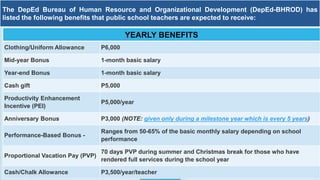
The DepEd Bureau of Human Resource and Organizational Development (DepEd-BHROD) has
listed the following benefits that public school teachers are expected to receive:
YEARLY BENEFITS
Clothing/Uniform Allowance P6,000
Mid-year Bonus 1-month basic salary
Year-end Bonus 1-month basic salary
Cash gift P5,000
Productivity Enhancement
Incentive (PEI)
P5,000/year
Anniversary Bonus P3,000 (NOTE: given only during a milestone year which is every 5 years)
Performance-Based Bonus -
Ranges from 50-65% of the basic monthly salary depending on school
performance
Proportional Vacation Pay (PVP)
70 days PVP during summer and Christmas break for those who have
rendered full services during the school year
Cash/Chalk Allowance P3,500/year/teacher
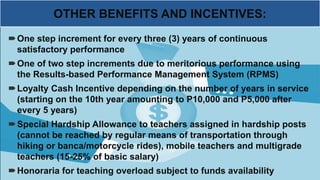
One step increment for every three (3) years of continuous
satisfactory performance
One of two step increments due to meritorious performance using
the Results-based Performance Management System (RPMS)
Loyalty Cash Incentive depending on the number of years in service
(starting on the 10th year amounting to P10,000 and P5,000 after
every 5 years)
Special Hardship Allowance to teachers assigned in hardship posts
(cannot be reached by regular means of transportation through
hiking or banca/motorcycle rides), mobile teachers and multigrade
teachers (15-25% of basic salary)
Honoraria for teaching overload subject to funds availability
OTHER BENEFITS AND INCENTIVES:
GSIS Benefits: Retirement and Life Insurance Premiums (RLIP)
PhilHealth Benefits: Hospitalization, Annual Physical Exam
Employees Compensation Program (ECP) Benefits
SOCIAL SECURITY BENEFITS
Update:
DepEd: Public school teachers not entitled to anniversary
bonus this 2019, PBB not yet confirmed
Rewards and Compensation

Rewards and Compensation

  • 1.
  • 2.
    is a termclosely related to the labour market. When the supply of labours is short in the market, better compensation can fulfil such shortage. It contains both direct and indirect components. Compensation refers to the remuneration that a worker gets from his/her employer in exchange for the work and contribution made to the organization. COMPENSATION
  • 3.
    can be definedas the monetary and non-monetary consideration received by an employee, from his/her employer, for the work performed in the organization. It plays a crucial role in attracting and retaining employees while conforming to the statutory requirements. Further, it is a reward system that motivates employees in raising their performance level which is based on a number of factors such as salaries offered by other firms for similar roles, performance and productivity, employee’s qualification and skills etc. COMPENSATION
  • 4.
    imply the non-monetaryreward that an employee earns as a part of the employment relationship, in addition to the basic pay. It is also known as fringe benefits, hidden payroll, wage supplements, and others. Due to relaxation in the tax policies benefits are offered by most of the firms to their employees. REWARDS/BENEFITS
  • 5.
    BASIS FOR COMPARISON COMPENSATION BENEFITS MeaningCompensation connotes the total earnings received by the employees, both as financial rewards and benefits. Benefits implies the non-financial rewards offered by the employer to the employee in exchange for the service provided by him/her. Consideration Cash or kind In kind Nature Direct Indirect Tax Fully taxable or partially exempt. Exempt or partially exempt Objective To attract and retain qualified personnel. To motivate employees, for raising their performance.
  • 6.
    refers to monetarybenefits offered and provided to employees in return of the services they provide to the organization. They are given at a regular interval at a definite time. DIRECT COMPENSATION
  • 7.
  • 8.
    refers to non-monetarybenefits offered and provided to employees in lieu of the services provided by them to the organization. INDIRECT COMPENSATION
  • 9.
  • 10.
  • 11.
    This is thebasic salary paid to the employee irrespective of any other factor. This is stated clearly in the employment contract. This is the compensation or salary or wage which an employee or a worker will definitely get as long as he or she is an employee of the company. 1. Fixed Pay 2. Variable Pay This is the additional compensation paid to employee based on employee’s performance, company performance etc. Since variable pay is based on the performance of an individual, it motivates the employees to perform even better.
  • 12.
    Employees are awardedshares of the company, often at a discounted price. Employees are expected to make money out of them by the appreciation of the stock price and the growth of the company. This is mostly given to the senior management who have served the company for a long time. 3. Equity Pay 4. Medical, Insurance, and Accommodation Play an important role in motivating employees. These benefits are given by the company as a part of recognizing the services of an employee.
  • 13.
    Rai University statesthat one of the primary goals of compensation should be to recruit qualified talent. When you have a competitive compensation plan in place, you’ll be better able to attract top industry talent. 1. To Attract Top Talent 2. To Retain & Reward Personnel Don’t lose your top talent to your competitors because employees believe that the grass will be greener elsewhere. Find out market values for your employees and pay accordingly. You can also set up pay-for-performance models to drive performance by encouraging associates to reach new goals and push farther.
  • 14.
    When structured effectively,your compensation plan can drive motivation across your teams. Employees who know that they’re being fairly compensated for their work feel appreciated and are therefore more likely to stay engaged, committed, and productive. A well-developed compensation plan can also increase job satisfaction in general, 3. To Boost Motivation 4. To Be Compliant Compensation isn’t just about being fair within the industry; it must also comply with federal regulations, such as the Fair Labor Standards Act. While adhering to standards can complicate your compensation management, it will help protect your company against litigation and ensure fairness across the board for your personnel.
  • 15.
    It requires somefine tuning, but compensation management is most effective when you get the biggest bang for your buck. In other words, if you can create a compensation plan that stays within budget while also driving productivity through pay-for- performance and other motivational tactics, you’re creating a plan that’s both equitable for the company and advantageous for hardworking employees. 5. To Maximize ROI
  • 16.
    The Philippine governmenthas remained steadfast with its commitment in ensuring that education will always be a top priority. In fact under the law as stated in Article XIV, Section 5 (5) of the 1987 Constitution, it expressly provides that: “The State shall assign the highest budgetary priority to education and ensure that teaching will attract and retain its rightful share of the best available talents through adequate remuneration and other means of job satisfaction and fulfilment.” The Department of Education (DepEd) has also worked hand in hand with teachers to ensure that their welfare and rights are upheld. Thus, for the year 2019, teachers under DepEd get to enjoy several benefits, allowances and perks as mandated by the law.
  • 17.
    Salary Increases ofTeachers (1989 to 2019) RA 6758 EO 219 EO 22 EO 611 EO 719 SG C.Aquino Admin. J.Estrada Admin. 1989 1994 1995 1996 1997 2000 2001 2007 2008 2009 2010 2011 2012 2016 2017 2018 2019 TeacherI 10 3,102 3,902 4,902 6,013 8,605 9,466 9,939 10,933 12,026 11 14,198 15,649 17,099 18,549 19,077 19,620 20,179 20,754 TeacherII 11 3,309 4,009 5,009 6,243 9,121 10,003 10,535 11,589 12,748 12 15,119 16,726 18,333 19,940 20,651 21,387 22,149 22,938 TeacherIII 12 3,540 4,240 5,240 6,568 9,668 10,635 11,167 12,284 13,512 13 16,101 17,880 19,658 21,436 22,328 23,257 24,224 25,232 Master TeacherI 16 4,786 5,496 6,486 8,202 12,206 13,427 14,098 15,508 17,059 18 22,214 25,259 28,305 31,351 33,452 35,693 38,085 40,637 Master TeacherII 17 5,201 5,901 6,901 8,712 12,938 14,232 14,944 16,438 18,082 19 23,703 27,088 30,474 33,859 36,409 39,151 42,099 45,269 Master TeacherIII 18 5,670 6,370 7,370 9,274 13,715 15,087 15,841 17,425 19,168 20 25,295 29,052 32,810 36,567 39,768 43,250 47,037 51,155 Master TeacherIV 19 6,199 6,899 7,899 9,891 14,538 15,992 16,792 18,471 20,318 21 26,671 30,945 35,219 39,493 43,439 47,779 52,554 57,805 Executive Order(EO)No.389 (4 tranches) EO 811 (4 tranches) EO 201 (4 tranches) F.RamosAdministration B.Aquino&R.Duterte Administration POSITION SG G.Arroyo&B.Aquino Administration G.ArroyoAdministration Note: Master Teacher III and IV positions were created in 2010 and 2012, respectively
  • 18.
    Basic Monthly Salary,Teaching Positions Position SG Monthly Salary, PhP (2019/Fourth Tranche SSL) Plantilla Items (As of June, 2019) Authorized Filled Teacher I 11 20,754.00 468,453 436,275 Teacher II 12 22,938.00 139,487 127,999 Teacher III 13 25,232.00 212,384 207,613 Master Teacher I 18 40,637.00 41,854 39,950 Master Teacher II 19 45,269.00 16,810 15,828 Master Teacher III 20 51,155.00 68 65 TOTAL 879,056 827,733
  • 19.
    Basic Monthly Salary,Non - Teaching Positions Position SG Monthly Salary, PhP (2019/Fourth Tranche SSL) Plantilla Items (As of June 2019) Authorized Filled Head Teacher I 14 27,755.00 7,259 6,622 Head Teacher II 15 30,531.00 2,204 1,858 Head Teacher III 16 33,584.00 11,013 10,351 Head Teacher IV 17 36,942.00 418 383 Head Teacher V 18 40,637.00 228 204 Head Teacher VI 19 45,269.00 1029 905 School Principal I 19 45,269.00 15,280 13,432 School Principal II 20 51,155.00 5,810 5,357 School Principal III 21 57,805.00 2,106 1,992 School Principal IV 22 65,319.00 1,316 1,273 Asst. School Principal I, II, III 18-20 1,435 950 TOTAL 47,918 43,327
  • 20.
    The DepEd Bureauof Human Resource and Organizational Development (DepEd-BHROD) has listed the following benefits that public school teachers are expected to receive: YEARLY BENEFITS Clothing/Uniform Allowance P6,000 Mid-year Bonus 1-month basic salary Year-end Bonus 1-month basic salary Cash gift P5,000 Productivity Enhancement Incentive (PEI) P5,000/year Anniversary Bonus P3,000 (NOTE: given only during a milestone year which is every 5 years) Performance-Based Bonus - Ranges from 50-65% of the basic monthly salary depending on school performance Proportional Vacation Pay (PVP) 70 days PVP during summer and Christmas break for those who have rendered full services during the school year Cash/Chalk Allowance P3,500/year/teacher
  • 21.
    One step incrementfor every three (3) years of continuous satisfactory performance One of two step increments due to meritorious performance using the Results-based Performance Management System (RPMS) Loyalty Cash Incentive depending on the number of years in service (starting on the 10th year amounting to P10,000 and P5,000 after every 5 years) Special Hardship Allowance to teachers assigned in hardship posts (cannot be reached by regular means of transportation through hiking or banca/motorcycle rides), mobile teachers and multigrade teachers (15-25% of basic salary) Honoraria for teaching overload subject to funds availability OTHER BENEFITS AND INCENTIVES:
  • 22.
    GSIS Benefits: Retirementand Life Insurance Premiums (RLIP) PhilHealth Benefits: Hospitalization, Annual Physical Exam Employees Compensation Program (ECP) Benefits SOCIAL SECURITY BENEFITS Update: DepEd: Public school teachers not entitled to anniversary bonus this 2019, PBB not yet confirmed