"Creating Value through Competencies"
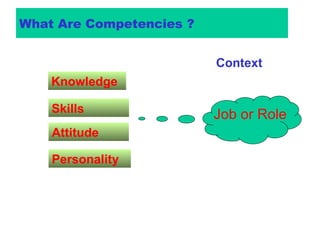
What Are Competencies ? Knowledge   Skills  Attitude  Personality  Context Job or Role
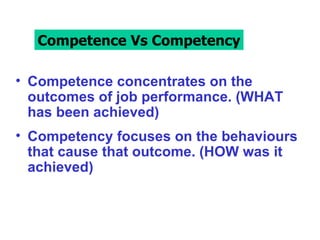
CccCompetence  Competency Competence concentrates on the outcomes of job performance. (WHAT has been achieved) Competency focuses on the behaviours that cause that outcome. (HOW was it achieved) Competence Vs Competency
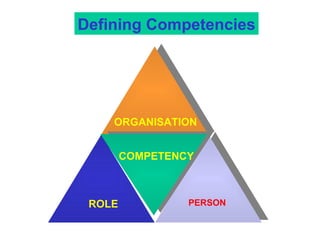
Competencies Defining Competencies ROLE PERSON ORGANISATION COMPETENCY
Why Competencies ? If people know what the success factors are, they attempt to develop them. Competencies offer a more specific and objective basis to define personal factors. Competencies can be used to integrate the various processes on a common objective platform.
f Competencies Behaviorally anchored Specific and observable Reflect organizational culture and vocabulary Visionary and forward looking Few and critical (Not more than 8) Discrete Characteristics of Good Competency
Empirical – Bespoke - Tailored Off the Shelf – Ready made Customized - Adjusted AAAA Approaches
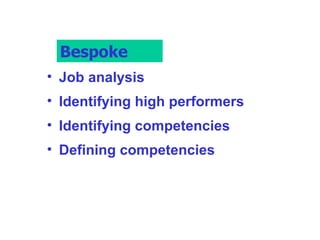
Bespoke Job analysis Identifying high performers Identifying competencies Defining competencies Bespoke
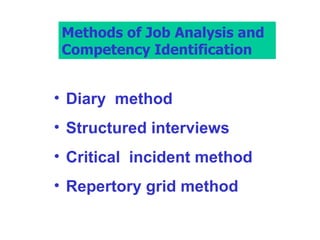
MM Of Job Analysis And Competency  Identification Diary  method Structured interviews Critical  incident method Repertory grid method Methods of Job Analysis and  Competency Identification
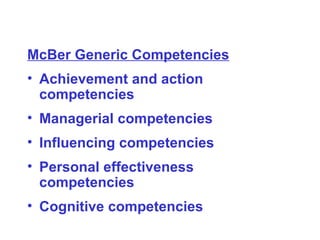
McBer Generic Competencies Achievement and action competencies Managerial competencies Influencing competencies Personal effectiveness competencies Cognitive competencies
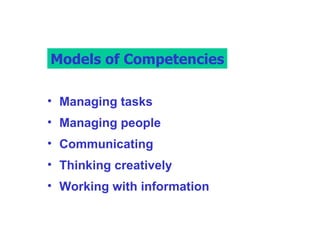
MModels Of Competencies Managing tasks Managing people Communicating Thinking creatively Working with information Models of Competencies
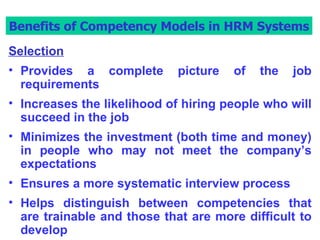
Benefits of Competency Models in HRM Systems Selection Provides a complete picture of the job requirements  Increases the likelihood of hiring people who will succeed in the job Minimizes the investment (both time and money) in people who may not meet the company’s expectations Ensures a more systematic interview process Helps distinguish between competencies that are trainable and those that are more difficult to develop Benefits of Competency Models in HRM Systems
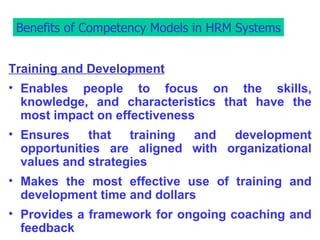
Benefits of Competency Models in HRM Systems Training and Development Enables people to focus on the skills, knowledge, and characteristics that have the most impact on effectiveness Ensures that training and development opportunities are aligned with organizational values and strategies Makes the most effective use of training and development time and dollars Provides a framework for ongoing coaching and feedback Benefits of Competency Models in HRM Systems
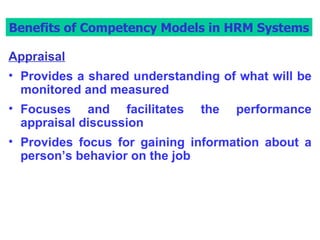
Benefits of Competency Models in HRM Systems Appraisal Provides a shared understanding of what will be monitored and measured Focuses and facilitates the performance appraisal discussion Provides focus for gaining information about a person’s behavior on the job Benefits of Competency Models in HRM Systems
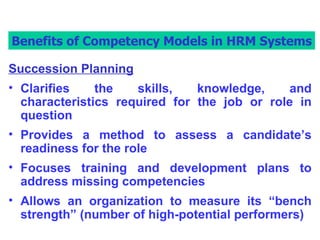
Benefits of Competency Models in HRM Systems Succession Planning Clarifies the skills, knowledge, and characteristics required for the job or role in question Provides a method to assess a candidate’s readiness for the role Focuses training and development plans to address missing competencies Allows an organization to measure its “bench strength” (number of high-potential performers) Benefits of Competency Models in HRM Systems
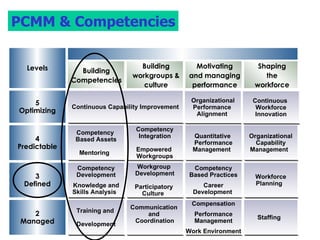
KPAs of Level 2 Work Environment Communication Staffing Performance Mgmt Training Compensation Organizational Performance  Alignment  Competency  Based Assets Mentoring  Competency Development Knowledge and Skills Analysis  Training and  Development Competency Integration Empowered  Workgroups Workgroup  Development Participatory  Culture  Communication  and  Coordination Quantitative  Performance Management  Competency Based Practices Career Development  Compensation Performance Management Work Environment  Organizational Capability Management  Workforce Planning  Staffing  Continuous  Workforce Innovation Continuous Capability Improvement PCMM & Competencies PCMM & Competencies Levels 5 Optimizing 4 Predictable 3 Defined 2 Managed Building  Competencies  Building workgroups & culture Motivating and managing performance Shaping the workforce

Creating value through competencies

  • 1.
    "Creating Value throughCompetencies"
  • 2.
    What Are Competencies? Knowledge Skills Attitude Personality Context Job or Role
  • 3.
    CccCompetence CompetencyCompetence concentrates on the outcomes of job performance. (WHAT has been achieved) Competency focuses on the behaviours that cause that outcome. (HOW was it achieved) Competence Vs Competency
  • 4.
    Competencies Defining CompetenciesROLE PERSON ORGANISATION COMPETENCY
  • 5.
    Why Competencies ?If people know what the success factors are, they attempt to develop them. Competencies offer a more specific and objective basis to define personal factors. Competencies can be used to integrate the various processes on a common objective platform.
  • 6.
    f Competencies Behaviorallyanchored Specific and observable Reflect organizational culture and vocabulary Visionary and forward looking Few and critical (Not more than 8) Discrete Characteristics of Good Competency
  • 7.
    Empirical – Bespoke- Tailored Off the Shelf – Ready made Customized - Adjusted AAAA Approaches
  • 8.
    Bespoke Job analysisIdentifying high performers Identifying competencies Defining competencies Bespoke
  • 9.
    MM Of JobAnalysis And Competency Identification Diary method Structured interviews Critical incident method Repertory grid method Methods of Job Analysis and Competency Identification
  • 10.
    McBer Generic CompetenciesAchievement and action competencies Managerial competencies Influencing competencies Personal effectiveness competencies Cognitive competencies
  • 11.
    MModels Of CompetenciesManaging tasks Managing people Communicating Thinking creatively Working with information Models of Competencies
  • 12.
    Benefits of CompetencyModels in HRM Systems Selection Provides a complete picture of the job requirements Increases the likelihood of hiring people who will succeed in the job Minimizes the investment (both time and money) in people who may not meet the company’s expectations Ensures a more systematic interview process Helps distinguish between competencies that are trainable and those that are more difficult to develop Benefits of Competency Models in HRM Systems
  • 13.
    Benefits of CompetencyModels in HRM Systems Training and Development Enables people to focus on the skills, knowledge, and characteristics that have the most impact on effectiveness Ensures that training and development opportunities are aligned with organizational values and strategies Makes the most effective use of training and development time and dollars Provides a framework for ongoing coaching and feedback Benefits of Competency Models in HRM Systems
  • 14.
    Benefits of CompetencyModels in HRM Systems Appraisal Provides a shared understanding of what will be monitored and measured Focuses and facilitates the performance appraisal discussion Provides focus for gaining information about a person’s behavior on the job Benefits of Competency Models in HRM Systems
  • 15.
    Benefits of CompetencyModels in HRM Systems Succession Planning Clarifies the skills, knowledge, and characteristics required for the job or role in question Provides a method to assess a candidate’s readiness for the role Focuses training and development plans to address missing competencies Allows an organization to measure its “bench strength” (number of high-potential performers) Benefits of Competency Models in HRM Systems
  • 16.
    KPAs of Level2 Work Environment Communication Staffing Performance Mgmt Training Compensation Organizational Performance Alignment Competency Based Assets Mentoring Competency Development Knowledge and Skills Analysis Training and Development Competency Integration Empowered Workgroups Workgroup Development Participatory Culture Communication and Coordination Quantitative Performance Management Competency Based Practices Career Development Compensation Performance Management Work Environment Organizational Capability Management Workforce Planning Staffing Continuous Workforce Innovation Continuous Capability Improvement PCMM & Competencies PCMM & Competencies Levels 5 Optimizing 4 Predictable 3 Defined 2 Managed Building Competencies Building workgroups & culture Motivating and managing performance Shaping the workforce