Human
Resource
Planning
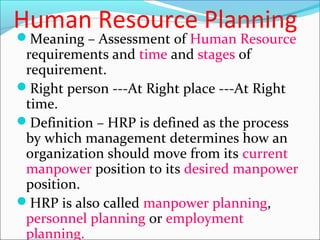
Human Resource Planning
Meaning – Assessment of Human Resource
requirements and time and stages of
requirement.
ď‚—Right person ---At Right place ---At Right
time.
Definition – HRP is defined as the process
by which management determines how an
organization should move from its current
manpower position to its desired manpower
position.
ď‚—HRP is also called manpower planning,
personnel planning or employment
planning.
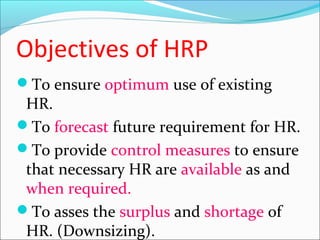
Objectives of HRP
ď‚—To ensure optimum use of existing
HR.
ď‚—To forecast future requirement for HR.
ď‚—To provide control measures to ensure
that necessary HR are available as and
when required.
ď‚—To asses the surplus and shortage of
HR. (Downsizing).
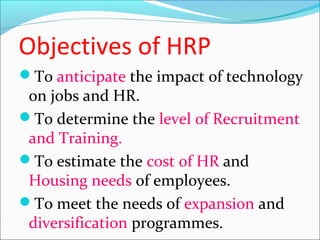
Objectives of HRP
ď‚—To anticipate the impact of technology
on jobs and HR.
ď‚—To determine the level of Recruitment
and Training.
ď‚—To estimate the cost of HR and
Housing needs of employees.
ď‚—To meet the needs of expansion and
diversification programmes.
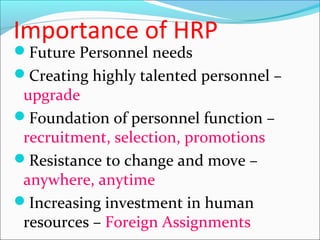
Importance of HRP
ď‚—Future Personnel needs
Creating highly talented personnel –
upgrade
Foundation of personnel function –
recruitment, selection, promotions
Resistance to change and move –
anywhere, anytime
ď‚—Increasing investment in human
resources – Foreign Assignments
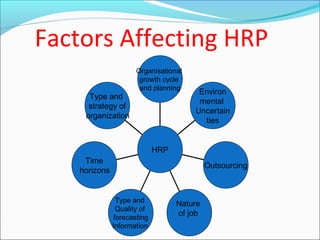
Factors Affecting HRP
Type and
strategy of
organization
Time
horizons
Type and
Quality of
forecasting
Information
Nature
of job
Outsourcing
Environ
mental
Uncertain
ties
Organisational
growth cycle
and planning
HRP
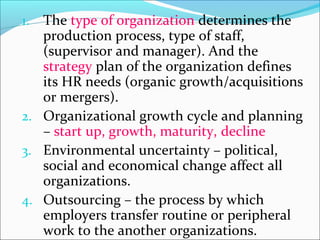
1. The type of organization determines the
production process, type of staff,
(supervisor and manager). And the
strategy plan of the organization defines
its HR needs (organic growth/acquisitions
or mergers).
2. Organizational growth cycle and planning
– start up, growth, maturity, decline
3. Environmental uncertainty – political,
social and economical change affect all
organizations.
4. Outsourcing – the process by which
employers transfer routine or peripheral
work to the another organizations.
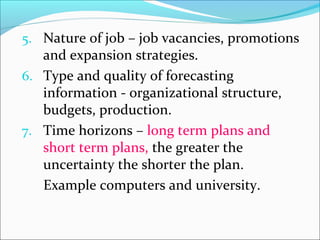
5. Nature of job – job vacancies, promotions
and expansion strategies.
6. Type and quality of forecasting
information - organizational structure,
budgets, production.
7. Time horizons – long term plans and
short term plans, the greater the
uncertainty the shorter the plan.
Example computers and university.
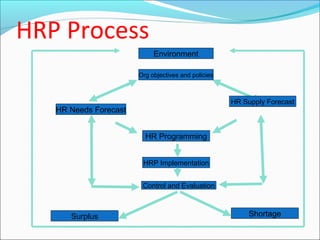
HRP Process
HR Needs Forecast
HR Programming
HRP Implementation
Control and Evaluation
ShortageSurplus
Environment
Org objectives and policies
HR Supply Forecast
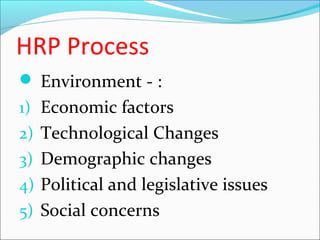
HRP Process
ď‚— Environment - :
1) Economic factors
2) Technological Changes
3) Demographic changes
4) Political and legislative issues
5) Social concerns
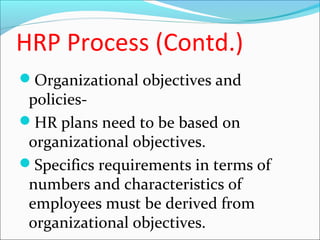
HRP Process (Contd.)
ď‚—Organizational objectives and
policies-
ď‚—HR plans need to be based on
organizational objectives.
ď‚—Specifics requirements in terms of
numbers and characteristics of
employees must be derived from
organizational objectives.
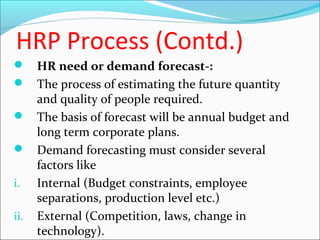
HRP Process (Contd.)
ď‚— HR need or demand forecast-:
ď‚— The process of estimating the future quantity
and quality of people required.
ď‚— The basis of forecast will be annual budget and
long term corporate plans.
ď‚— Demand forecasting must consider several
factors like
i. Internal (Budget constraints, employee
separations, production level etc.)
ii. External (Competition, laws, change in
technology).
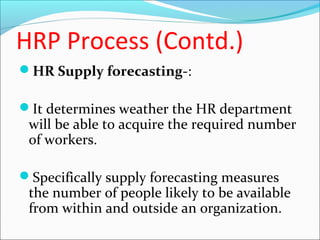
HRP Process (Contd.)
ď‚—HR Supply forecasting-:
ď‚—It determines weather the HR department
will be able to acquire the required number
of workers.
ď‚—Specifically supply forecasting measures
the number of people likely to be available
from within and outside an organization.
HRP Process
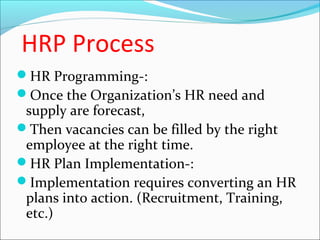
ď‚—HR Programming-:
Once the Organization’s HR need and
supply are forecast,
ď‚—Then vacancies can be filled by the right
employee at the right time.
ď‚—HR Plan Implementation-:
ď‚—Implementation requires converting an HR
plans into action. (Recruitment, Training,
etc.)
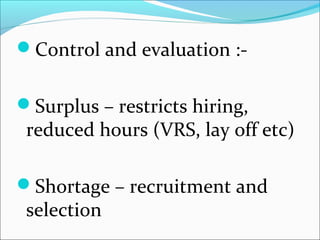
ď‚—Control and evaluation :-
Surplus – restricts hiring,
reduced hours (VRS, lay off etc)
Shortage – recruitment and
selection

Hr planning

  • 1.
  • 2.
    Human Resource Planning Meaning– Assessment of Human Resource requirements and time and stages of requirement. Right person ---At Right place ---At Right time. Definition – HRP is defined as the process by which management determines how an organization should move from its current manpower position to its desired manpower position. HRP is also called manpower planning, personnel planning or employment planning.
  • 3.
    Objectives of HRP ď‚—Toensure optimum use of existing HR. ď‚—To forecast future requirement for HR. ď‚—To provide control measures to ensure that necessary HR are available as and when required. ď‚—To asses the surplus and shortage of HR. (Downsizing).
  • 4.
    Objectives of HRP ď‚—Toanticipate the impact of technology on jobs and HR. ď‚—To determine the level of Recruitment and Training. ď‚—To estimate the cost of HR and Housing needs of employees. ď‚—To meet the needs of expansion and diversification programmes.
  • 5.
    Importance of HRP FuturePersonnel needs Creating highly talented personnel – upgrade Foundation of personnel function – recruitment, selection, promotions Resistance to change and move – anywhere, anytime Increasing investment in human resources – Foreign Assignments
  • 6.
    Factors Affecting HRP Typeand strategy of organization Time horizons Type and Quality of forecasting Information Nature of job Outsourcing Environ mental Uncertain ties Organisational growth cycle and planning HRP
  • 7.
    1. The typeof organization determines the production process, type of staff, (supervisor and manager). And the strategy plan of the organization defines its HR needs (organic growth/acquisitions or mergers). 2. Organizational growth cycle and planning – start up, growth, maturity, decline 3. Environmental uncertainty – political, social and economical change affect all organizations. 4. Outsourcing – the process by which employers transfer routine or peripheral work to the another organizations.
  • 8.
    5. Nature ofjob – job vacancies, promotions and expansion strategies. 6. Type and quality of forecasting information - organizational structure, budgets, production. 7. Time horizons – long term plans and short term plans, the greater the uncertainty the shorter the plan. Example computers and university.
  • 9.
    HRP Process HR NeedsForecast HR Programming HRP Implementation Control and Evaluation ShortageSurplus Environment Org objectives and policies HR Supply Forecast
  • 10.
    HRP Process ď‚— Environment- : 1) Economic factors 2) Technological Changes 3) Demographic changes 4) Political and legislative issues 5) Social concerns
  • 11.
    HRP Process (Contd.) ď‚—Organizationalobjectives and policies- ď‚—HR plans need to be based on organizational objectives. ď‚—Specifics requirements in terms of numbers and characteristics of employees must be derived from organizational objectives.
  • 12.
    HRP Process (Contd.) ď‚—HR need or demand forecast-: ď‚— The process of estimating the future quantity and quality of people required. ď‚— The basis of forecast will be annual budget and long term corporate plans. ď‚— Demand forecasting must consider several factors like i. Internal (Budget constraints, employee separations, production level etc.) ii. External (Competition, laws, change in technology).
  • 13.
    HRP Process (Contd.) ď‚—HRSupply forecasting-: ď‚—It determines weather the HR department will be able to acquire the required number of workers. ď‚—Specifically supply forecasting measures the number of people likely to be available from within and outside an organization.
  • 14.
    HRP Process HR Programming-: Oncethe Organization’s HR need and supply are forecast, Then vacancies can be filled by the right employee at the right time. HR Plan Implementation-: Implementation requires converting an HR plans into action. (Recruitment, Training, etc.)
  • 15.
    Control and evaluation:- Surplus – restricts hiring, reduced hours (VRS, lay off etc) Shortage – recruitment and selection