AFRICA MEDICAL COLLEGE
Microbiology for MD
Dr. Alem A. (PhD, Medical Microbiology)
Dec, 2024
Course content
2
1. Chapter 1: General Microbiology
2. Chapter 2: Systematic Bacteriology
3. Chapter 3: Systematic Virology
4. Chapter 4: Systematic Mycology
5. Chapter 5: System based microbial infections
(Group Seminar)
Assessement
3
1. Tests: 1, 2, 3
2. Lab report
3. Attendance
4. Individual presentation
5. Group presentation
6. Final Exam
7. Oral Exam
What is Microbiology?
4
• Microbiology is the study of all living organisms that are too small
to be visible with the naked eye
• Bacteria
• Protozoa
• Fungi
• Viruses
• Prions
• Archaea
• Algae
• Collectively known as microbes or Microorganisms
• There are thousands of different types of microbes that live
in, on, and around us—and hundreds that cause serious
human diseases
What is Microbiology…
5
• Microbiology
• Medical Microbiology
• Food Microbiology
• Veterinary Microbiology
• Plant Microbiology
• Pharmaceutical
Microbiology
• Applied Microbiology
• Industrial Microbiology
• Soil Microbiology
• Etc.
• Microbiology
• Bacteriology
• Virology
• Mycology
• Immunology
• Parasitology
What is Microbiology…
6
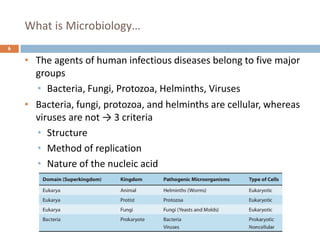
• The agents of human infectious diseases belong to five major
groups
• Bacteria, Fungi, Protozoa, Helminths, Viruses
• Bacteria, fungi, protozoa, and helminths are cellular, whereas
viruses are not → 3 criteria
• Structure
• Method of replication
• Nature of the nucleic acid
Viruses are not cellular…
7
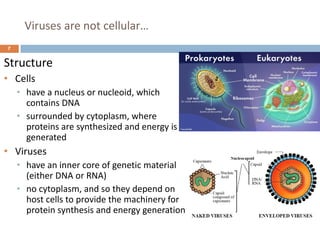
Structure
• Cells
• have a nucleus or nucleoid, which
contains DNA
• surrounded by cytoplasm, where
proteins are synthesized and energy is
generated
• Viruses
• have an inner core of genetic material
(either DNA or RNA)
• no cytoplasm, and so they depend on
host cells to provide the machinery for
protein synthesis and energy generation
Viruses are not cellular…
8
Method of replication
• Cells replicate either by binary fission or by mitosis
• one parent cell divides to make two progeny cells while retaining
its cellular structure
• Prokaryotic cells (e.g., bacteria) replicate by binary fission
• Eukaryotic cells replicate by mitosis
• Viruses
• disassemble, produce many copies of their nucleic acid and
protein, and then reassemble into multiple progeny viruses
• Viruses must replicate within host cells because they lack
protein-synthesizing and energy-generating systems
Viruses are not cellular…
9
Nature of the nucleic acid
• Cells
• contain both DNA and RNA,
• Viruses
• contain either DNA or RNA, but not both
Eukaryotes and Prokaryotes
10
• Based on their structure and the complexity of their
organization, cells are classified in to
A. Eukaryotic
B. prokaryotic
• Fungi, protozoa, and helminths are eukaryotic
• Bacteria are prokaryotic
• Viruses are neither eukaryotic nor prokaryotic
Eukaryotes and Prokaryotes…
11
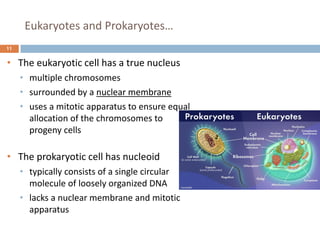
• The eukaryotic cell has a true nucleus
• multiple chromosomes
• surrounded by a nuclear membrane
• uses a mitotic apparatus to ensure equal
allocation of the chromosomes to
progeny cells
• The prokaryotic cell has nucleoid
• typically consists of a single circular
molecule of loosely organized DNA
• lacks a nuclear membrane and mitotic
apparatus
Eukaryotes and Prokaryotes…
12
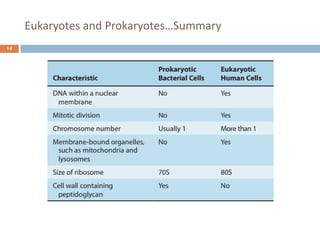
• Eukaryotic cells contain organelles, such as mitochondria and
lysosomes
• Prokaryotes contain no organelles
• Eukaryotic cells contain larger ribosomes (80S) compared to
prokaryotes (70S)
• Most prokaryotes have a rigid external cell wall that contains
peptidoglycan (a polymer of amino acids and sugars)
• Eukaryotes do not contain peptidoglycan
• Eukaryotes are either bound by a flexible cell membrane, or,
in the case of fungi, they have a rigid cell wall with chitin
Eukaryotes and Prokaryotes…
13
• The eukaryotic cell membrane contains sterols, whereas no
prokaryote, except the wall-less Mycoplasma, has sterols in
its membranes
• Most protozoa and some bacteria are motile, whereas fungi
and viruses are non-motile
• The protozoa are a heterogeneous group that possesses three
different organs of locomotion: flagella, cilia, and pseudopods
• The motile bacteria move only by means of flagella
Eukaryotes and Prokaryotes…Summary
14
Scientific nomenclature of Microbes
15
• Bacteria, fungi, protozoa, and helminths are named according
to the binomial Linnean system that uses genus and species
• Example: Escherichia coli, Escherichia is the genus and coli
is the species name
• Viruses typically have a single name, such as poliovirus,
measles virus, or rabies virus.
• Some viruses have names with two words, such as herpes
simplex virus, but those do not represent genus and species
Microorganisms
16
• Are small living things which are too small to be seen with
our necked eye
• Includes bacteria, fungi, protozoa
• Viruses, which are microscopic but not cellular, are also
included in this group
Bacteria
17
• Relatively simple in structure
• They are prokaryotic organisms; i.e. simple unicellular organisms
with no nuclear membrane, mitochondria, Golgi bodies,
endoplasmic reticulum
• Reproduce by asexual division; i.e. by dividing into two equal cells
called binary fission
• Are enclosed in cell walls except Mycoplasma species
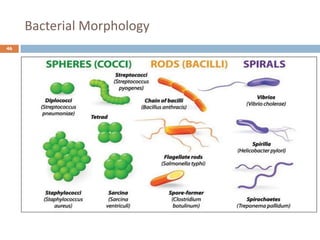
• Classified by size (1 to 20 µm or larger), shape (spheres, rods,
spirals), and arrangement (single cells, chains, clusters)
• The human body is inhabited by thousands of different bacterial
species: as commensal or pathogen
• Bacteria also exist in the environment: air, water, food
• Most are avirulent
Fungi
18
• The cellular structure of fungi is more complex compared to
bacteria
• Fungi are eukaryotic organisms that contain a well-defined
nucleus, mitochondria, Golgi bodies, and endoplasmic
reticulum
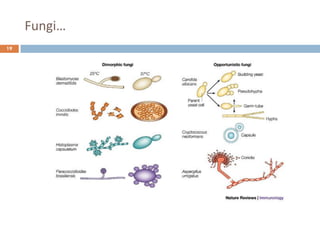
• Fungi can exist either in a unicellular form (yeast) that can
replicate asexually or in a filamentous form (mold) that can
replicate asexually and sexually
• Most fungi exist as either yeasts or molds; however, some
fungi can assume either morphology (dimorphic fungi)
Fungi…
19
Parasites
20
• Parasites are the most complex microbes
• All parasites are eukaryotic
• some are unicellular and others are multicellular
• Parasites range in size from tiny protozoa as small as 4 to 5 µm
in diameter to tapeworms that can measure up to 10 meters in
length and arthropods (bugs)
• Reproduce sexually or asexually
Viruses
21
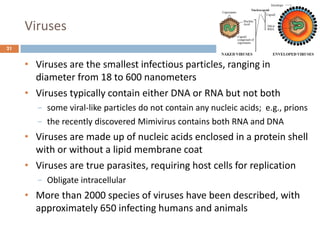
• Viruses are the smallest infectious particles, ranging in
diameter from 18 to 600 nanometers
• Viruses typically contain either DNA or RNA but not both
− some viral-like particles do not contain any nucleic acids; e.g., prions
− the recently discovered Mimivirus contains both RNA and DNA
• Viruses are made up of nucleic acids enclosed in a protein shell
with or without a lipid membrane coat
• Viruses are true parasites, requiring host cells for replication
− Obligate intracellular
• More than 2000 species of viruses have been described, with
approximately 650 infecting humans and animals
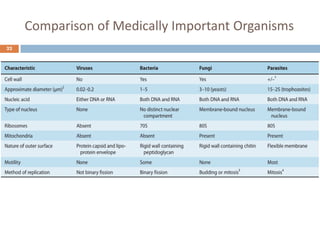
Comparison of Medically Important Organisms
22
History of Microbiology
23
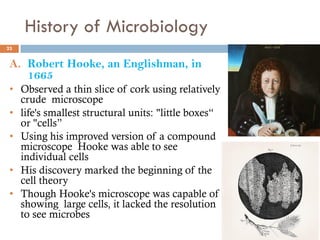
A. Robert Hooke, an Englishman, in
1665
• Observed a thin slice of cork using relatively
crude microscope
• life's smallest structural units: "little boxes“
or "cells”
• Using his improved version of a compound
microscope Hooke was able to see
individual cells
• His discovery marked the beginning of the
cell theory
• Though Hooke's microscope was capable of
showing large cells, it lacked the resolution
to see microbes
History…
24
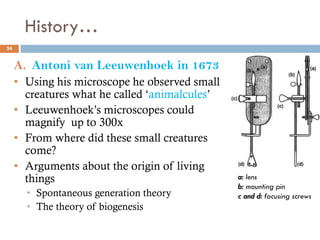
A. Antoni van Leeuwenhoek in 1673
• Using his microscope he observed small
creatures what he called ‘animalcules’
• Leeuwenhoek’s microscopes could
magnify up to 300x
• From where did these small creatures
come?
• Arguments about the origin of living
things
• Spontaneous generation theory
• The theory of biogenesis
a: lens
b: mounting pin
c and d: focusing screws
History…
25
Spontaneous generation theory
• Living organisms could arise spontaneously from
non-living matter
• snakes and mice could be born of moist soil
• Flies could emerge from manure
• maggots, the larvae of flies, could arise from decaying
corpses
The theory of biogenesis
• life arises only from already existing life
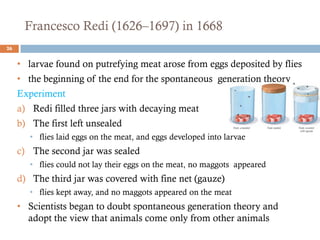
Francesco Redi (1626–1697) in 1668
26
• larvae found on putrefying meat arose from eggs deposited by flies
• the beginning of the end for the spontaneous generation theory
Experiment
a) Redi filled three jars with decaying meat
b) The first left unsealed
• flies laid eggs on the meat, and eggs developed into larvae
c) The second jar was sealed
• flies could not lay their eggs on the meat, no maggots appeared
d) The third jar was covered with fine net (gauze)
• flies kept away, and no maggots appeared on the meat
• Scientists began to doubt spontaneous generation theory and
adopt the view that animals come only from other animals
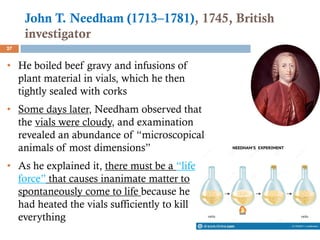
John T. Needham (1713–1781), 1745, British
investigator
27
• He boiled beef gravy and infusions of
plant material in vials, which he then
tightly sealed with corks
• Some days later, Needham observed that
the vials were cloudy, and examination
revealed an abundance of “microscopical
animals of most dimensions”
• As he explained it, there must be a “life
force” that causes inanimate matter to
spontaneously come to life because he
had heated the vials sufficiently to kill
everything
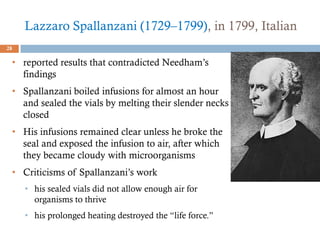
Lazzaro Spallanzani (1729–1799), in 1799, Italian
28
• reported results that contradicted Needham’s
findings
• Spallanzani boiled infusions for almost an hour
and sealed the vials by melting their slender necks
closed
• His infusions remained clear unless he broke the
seal and exposed the infusion to air, after which
they became cloudy with microorganisms
• Criticisms of Spallanzani’s work
• his sealed vials did not allow enough air for
organisms to thrive
• his prolonged heating destroyed the “life force.”
The theory of biogenesis…
Louis Pasteur (1822–1895)
• He disproved the theory of spontaneous
generation once and for all
• Done a series of experiments that led to the
acceptance of biogenesis
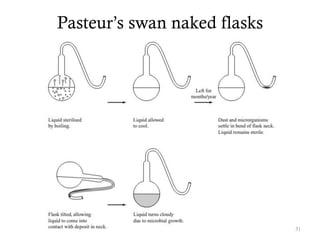
• experiment using his swan-necked flasks in
1861
29
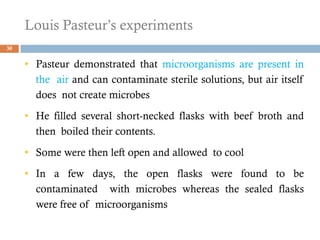
Louis Pasteur’s experiments
30
• Pasteur demonstrated that microorganisms are present in
the air and can contaminate sterile solutions, but air itself
does not create microbes
• He filled several short-necked flasks with beef broth and
then boiled their contents.
• Some were then left open and allowed to cool
• In a few days, the open flasks were found to be
contaminated with microbes whereas the sealed flasks
were free of microorganisms
Pasteur’s swan naked flasks
31
The Germ Theory of Disease
32
Pasteur’s observation on wine spoilage
• when lactic acid was produced in wine (spoiled), rod-
shaped bacteria were always present, as well as the
expected yeast cells
• This led him to believe “while the yeast produced the
alcohol the bacteria were responsible for the spoilage”
• This led to “microorganisms may also be responsible for
diseases in humans, animals and plants”
The germ theory of disease…
33
Joseph Lister
• indirect, evidence on the involvement of
microorganisms in infections of humans
• The use of heat-treated instruments and spraying
phenol on dressings and over the surgical area
reduced the number of fatalities following surgery
The germ theory of disease…
34
Friedrich Henle in 1840 (German pathologist)
• proposed criteria for proving that microorganisms
were responsible for causing human disease (the
"germ theory" of disease)
The germ theory of disease…
35
Robert Koch (1843-1910)
• Definitive proof of the Germ Theory of
Disease in 1876
• Did an experiment on cattle disease
anthrax and Bacillus anthracis
• Koch discovered the rod-shaped
bacteria Bacillus anthracis Robert Koch (1843-1910)
Robert Koch’s Experiment
36
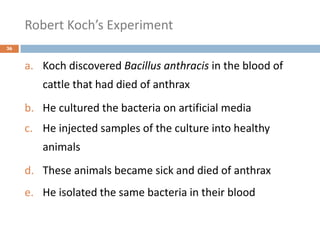
a. Koch discovered Bacillus anthracis in the blood of
cattle that had died of anthrax
b. He cultured the bacteria on artificial media
c. He injected samples of the culture into healthy
animals
d. These animals became sick and died of anthrax
e. He isolated the same bacteria in their blood
Robert Koch’s Experiment…
2018
37
Koch’s postulates
38
1. The microorganism must be present in every instance
of the disease and absent from healthy individuals
2. The microorganism must be capable of being isolated
and grown in pure culture
3. When the microorganism is inoculated into a healthy
host, the same disease condition must result
4. The same microorganism must be re-isolated from the
experimentally infected host
Exceptions to Koch’s postulates
39
• Many healthy people carry pathogens but do not exhibit
symptoms of the disease
• Some microbes are very difficult or impossible to grow in
artificial media. E.g. Treponema pallidum
• Many species are species specific. E.g. Brucella abortus
cause abortion in animals but not in humans
• Certain diseases develop only when an opportunistic
pathogen invades immuno-compromised host
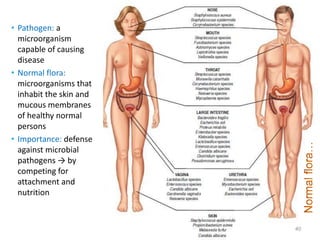
• Pathogen: a
microorganism
capable of causing
disease
• Normal flora:
microorganisms that
inhabit the skin and
mucous membranes
of healthy normal
persons
• Importance: defense
against microbial
pathogens → by
competing for
attachment and
nutrition
40
General Bacteriology
41
Bacteria
• Are prokaryotic unicellular organisms
• Are relatively simple in structure
• Have no membrane bound organelles: mitochondria, Golgi
bodies, or endoplasmic reticulum
• Most of them fall within a range of 0.2-2 μm
• The smallest bacteria (Chlamydia and Rickettsia) are 0.1-0.2 μm
in diameter
42
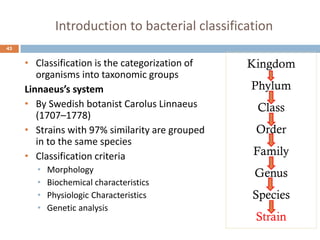
Introduction to bacterial classification
• Classification is the categorization of
organisms into taxonomic groups
Linnaeus’s system
• By Swedish botanist Carolus Linnaeus
(1707–1778)
• Strains with 97% similarity are grouped
in to the same species
• Classification criteria
• Morphology
• Biochemical characteristics
• Physiologic Characteristics
• Genetic analysis
Kingdom
Phylum
Class
Order
Family
Genus
Species
Strain
43
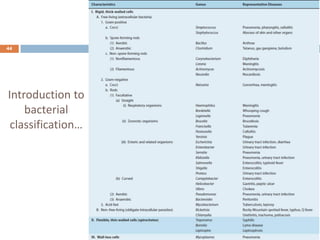
Introduction to
bacterial
classification…
44
Bacterial morphology, structures and function
45
Bacterial Morphology
46
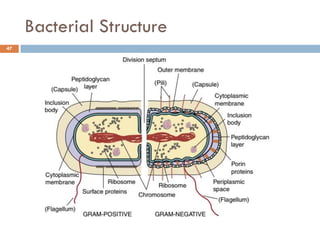
Bacterial Structure
47
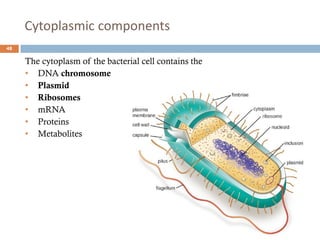
Cytoplasmic components
48
The cytoplasm of the bacterial cell contains the
• DNA chromosome
• Plasmid
• Ribosomes
• mRNA
• Proteins
• Metabolites
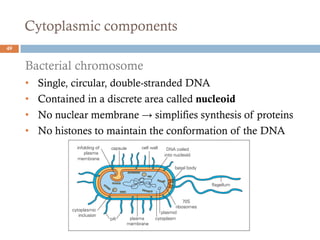
Cytoplasmic components
49
Bacterial chromosome
• Single, circular, double-stranded DNA
• Contained in a discrete area called nucleoid
• No nuclear membrane → simplifies synthesis of proteins
• No histones to maintain the conformation of the DNA
Cytoplasmic components…
50
Plasmids
• extrachromosomal, double-stranded, circular DNA
molecules that are capable of replicating independently
• are usually extrachromosomal, but can be integrated into
the bacterial chromosome
• may occur in both gram-positive and gram-negative
• Transmissible vs Non-transmissible plasmids
• not usually essential for cellular survival, often provide a
selective advantage
• Antibiotic resistance • Resistance to ultraviolet light
• Exotoxins • Bacteriocins
• Pili (fimbriae)
• Resistance to heavy metals, such as mercury
Cytoplasmic components…
51
Transposons
• are pieces of DNA that move readily from one site to another
either within or between the DNAs of bacteria, plasmids, and
bacteriophages → nicknamed “jumping genes”
• Replicative transposition
− move by replicating their DNA and inserting the new copy into
another site
• Direct transposition
− excised from the site without replicating and then inserted into the
new site
• Transposons can code for
− drug-resistant enzymes, toxins, or a variety of metabolic enzymes
− can either cause mutations in the gene into which they insert or
alter the expression of nearby genes
Cytoplasmic components…
52
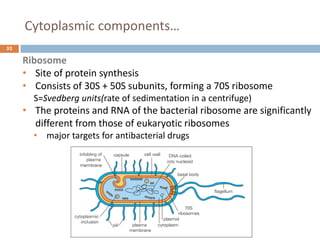
Ribosome
• Site of protein synthesis
• Consists of 30S + 50S subunits, forming a 70S ribosome
S=Svedberg units(rate of sedimentation in a centrifuge)
• The proteins and RNA of the bacterial ribosome are significantly
different from those of eukaryotic ribosomes
• major targets for antibacterial drugs
Cytoplasmic components…
53
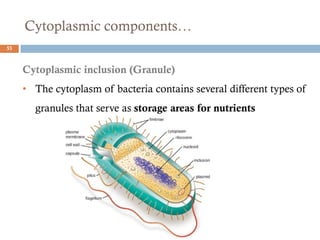
Cytoplasmic inclusion (Granule)
• The cytoplasm of bacteria contains several different types of
granules that serve as storage areas for nutrients
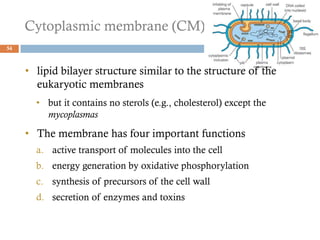
Cytoplasmic membrane (CM)
54
• lipid bilayer structure similar to the structure of the
eukaryotic membranes
• but it contains no sterols (e.g., cholesterol) except the
mycoplasmas
• The membrane has four important functions
a. active transport of molecules into the cell
b. energy generation by oxidative phosphorylation
c. synthesis of precursors of the cell wall
d. secretion of enzymes and toxins
Cell wall
55
• All bacteria except Mycoplasma posses a thick, rigid cell
wall external to the cytoplasmic membrane
• Bacteria possess Peptidoglycan (murein) as major cell
wall component → unique to bacteria
• Functions
• maintain the shape of a bacterium
• serves as a point of anchorage for flagella
• Protects the interior of the cell from adverse changes in the
outside environment
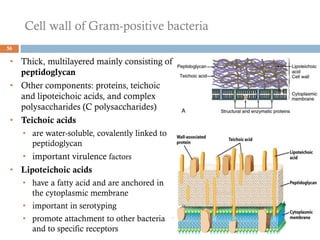
Cell wall of Gram-positive bacteria
56
• Thick, multilayered mainly consisting of
peptidoglycan
• Other components: proteins, teichoic
and lipoteichoic acids, and complex
polysaccharides (C polysaccharides)
• Teichoic acids
• are water-soluble, covalently linked to
peptidoglycan
• important virulence factors
• Lipoteichoic acids
• have a fatty acid and are anchored in
the cytoplasmic membrane
• important in serotyping
• promote attachment to other bacteria
and to specific receptors
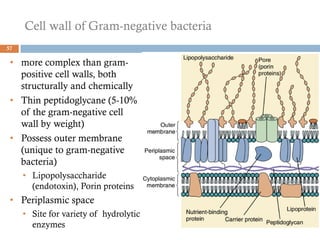
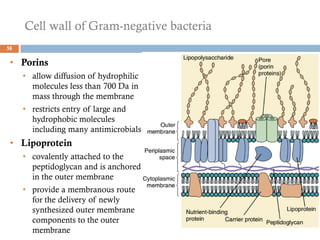
Cell wall of Gram-negative bacteria
57
• more complex than gram-
positive cell walls, both
structurally and chemically
• Thin peptidoglycane (5-10%
of the gram-negative cell
wall by weight)
• Possess outer membrane
(unique to gram-negative
bacteria)
• Lipopolysaccharide
(endotoxin), Porin proteins
• Periplasmic space
• Site for variety of hydrolytic
enzymes
Cell wall of Gram-negative bacteria
58
• Porins
• allow diffusion of hydrophilic
molecules less than 700 Da in
mass through the membrane
• restricts entry of large and
hydrophobic molecules
including many antimicrobials
• Lipoprotein
• covalently attached to the
peptidoglycan and is anchored
in the outer membrane
• provide a membranous route
for the delivery of newly
synthesized outer membrane
components to the outer
membrane
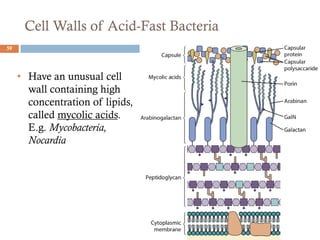
Cell Walls of Acid-Fast Bacteria
59
• Have an unusual cell
wall containing high
concentration of lipids,
called mycolic acids.
E.g. Mycobacteria,
Nocardia
External structures
60
Glycocalyx
• Viscous, gelatinous polymer external to the cell wall
• For the most part, it is made inside and secreted to cell surface
• If organized and is firmly attached to the cell wall → capsule
• If unorganized and loosely attached to the cell wall → slime layer
• Capsule
• important bacterial virulence factor
• prevent phagocytosis
• Slime layer
• adherence of bacteria to other bacteria and surfaces in their
environment → Biofilm
i. Glycocalyx
ii. Flagella
iii. Pili and Fimbriae
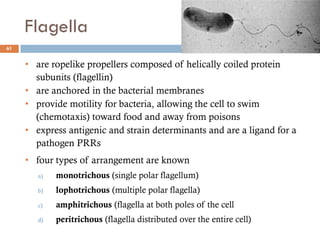
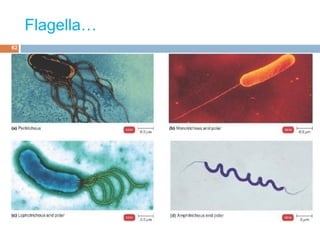
Flagella
61
• are ropelike propellers composed of helically coiled protein
subunits (flagellin)
• are anchored in the bacterial membranes
• provide motility for bacteria, allowing the cell to swim
(chemotaxis) toward food and away from poisons
• express antigenic and strain determinants and are a ligand for a
pathogen PRRs
• four types of arrangement are known
a) monotrichous (single polar flagellum)
b) lophotrichous (multiple polar flagella)
c) amphitrichous (flagella at both poles of the cell
d) peritrichous (flagella distributed over the entire cell)
Flagella…
62
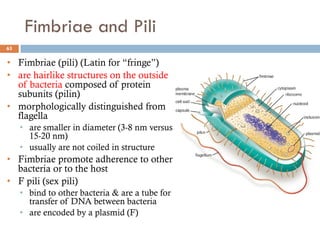
Fimbriae and Pili
63
• Fimbriae (pili) (Latin for “fringe”)
• are hairlike structures on the outside
of bacteria composed of protein
subunits (pilin)
• morphologically distinguished from
flagella
• are smaller in diameter (3-8 nm versus
15-20 nm)
• usually are not coiled in structure
• Fimbriae promote adherence to other
bacteria or to the host
• F pili (sex pili)
• bind to other bacteria & are a tube for
transfer of DNA between bacteria
• are encoded by a plasmid (F)
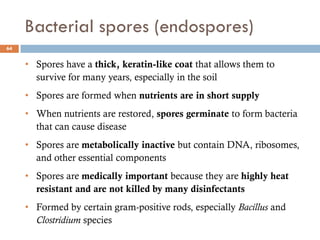
Bacterial spores (endospores)
64
• Spores have a thick, keratin-like coat that allows them to
survive for many years, especially in the soil
• Spores are formed when nutrients are in short supply
• When nutrients are restored, spores germinate to form bacteria
that can cause disease
• Spores are metabolically inactive but contain DNA, ribosomes,
and other essential components
• Spores are medically important because they are highly heat
resistant and are not killed by many disinfectants
• Formed by certain gram-positive rods, especially Bacillus and
Clostridium species
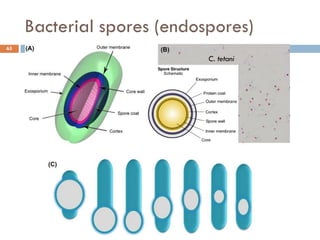
Bacterial spores (endospores)
65
C. tetani
Bacterial exceptions
66
Mycobacteria
• have a peptidoglycan layer (slightly different structure)
surrounded by a wax like lipid coat of mycolic acid
Mycoplasma
• have no peptidoglycan cell wall
• incorporate sterols from the host into their
membranes
Bacterial growth
1. Physical requirements
• Temperature
• pH
• osmotic pressure
2. Chemical requirements
• sources of carbon, nitrogen,
Sulfur, Phosphorus, Oxygen
• trace elements
• organic growth factors
• Growth in bacteria refers to increase in number of cells
• Bacteria reproduce by binary fission, a process by which one
parent cell divides to form two progeny cells
• An increase in number of microbes from a single parent cell,
gives to a single colony of cells
Requirements for microbial growth
67
Generation Time (G)
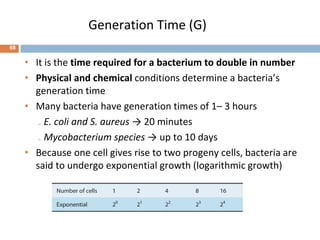
• It is the time required for a bacterium to double in number
• Physical and chemical conditions determine a bacteria’s
generation time
• Many bacteria have generation times of 1– 3 hours
₋ E. coli and S. aureus → 20 minutes
₋ Mycobacterium species → up to 10 days
• Because one cell gives rise to two progeny cells, bacteria are
said to undergo exponential growth (logarithmic growth)
68
Growth Curve
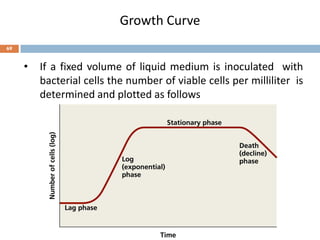
• If a fixed volume of liquid medium is inoculated with
bacterial cells the number of viable cells per milliliter is
determined and plotted as follows
69
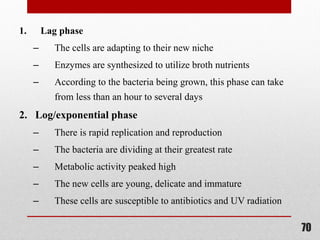
1. Lag phase
– The cells are adapting to their new niche
– Enzymes are synthesized to utilize broth nutrients
– According to the bacteria being grown, this phase can take
from less than an hour to several days
2. Log/exponential phase
– There is rapid replication and reproduction
– The bacteria are dividing at their greatest rate
– Metabolic activity peaked high
– The new cells are young, delicate and immature
– These cells are susceptible to antibiotics and UV radiation
70
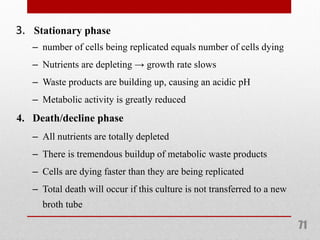
3. Stationary phase
71
– number of cells being replicated equals number of cells dying
– Nutrients are depleting → growth rate slows
– Waste products are building up, causing an acidic pH
– Metabolic activity is greatly reduced
4. Death/decline phase
– All nutrients are totally depleted
– There is tremendous buildup of metabolic waste products
– Cells are dying faster than they are being replicated
– Total death will occur if this culture is not transferred to a new
broth tube
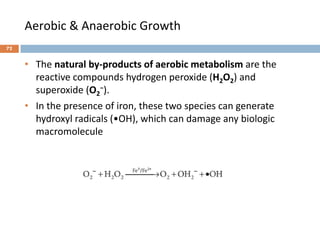
Aerobic & Anaerobic Growth
• The natural by-products of aerobic metabolism are the
reactive compounds hydrogen peroxide (H2O2) and
superoxide (O2
−).
• In the presence of iron, these two species can generate
hydroxyl radicals (•OH), which can damage any biologic
macromolecule
72
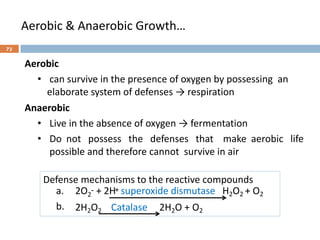
Aerobic & Anaerobic Growth…
Aerobic
• can survive in the presence of oxygen by possessing an
elaborate system of defenses → respiration
Anaerobic
• Live in the absence of oxygen → fermentation
• Do not possess the defenses that make aerobic life
possible and therefore cannot survive in air
Defense mechanisms to the reactive compounds
- +
a. 2O2 + 2H superoxide dismutase H2O2 + O2
b. 2H2O2 Catalase 2H2O + O2
73
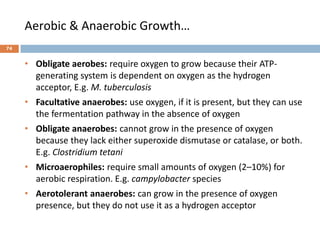
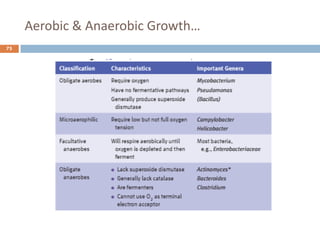
Aerobic & Anaerobic Growth…
• Obligate aerobes: require oxygen to grow because their ATP-
generating system is dependent on oxygen as the hydrogen
acceptor, E.g. M. tuberculosis
• Facultative anaerobes: use oxygen, if it is present, but they can use
the fermentation pathway in the absence of oxygen
• Obligate anaerobes: cannot grow in the presence of oxygen
because they lack either superoxide dismutase or catalase, or both.
E.g. Clostridium tetani
• Microaerophiles: require small amounts of oxygen (2–10%) for
aerobic respiration. E.g. campylobacter species
• Aerotolerant anaerobes: can grow in the presence of oxygen
presence, but they do not use it as a hydrogen acceptor
74
Aerobic & Anaerobic Growth…
75
Cultivation of Bacteria
76
Cultivation
77
• Cultivation is the process of propagating organisms by
providing proper environmental conditions
• Bacteria divide by binary fission, asexual reproduction where
a single cell divides giving rise to two cells → Those two cells
give rise to four cells and so on
• Because one cell gives rise to two progeny cells, bacteria are
said to undergo exponential (logarithmic) growth → 2n
• E.g. How many bacteria will a single bacterium produce after
4 generations?
• 24 = 16 bacteria
Cultivation…
78
• A suitable growth medium must contain all the nutrients
required by the organism to be cultivated, and such factors as
pH, temperature, and aeration must be carefully controlled
• Requirements for growth
• Organic matter containing the elements carbon, hydrogen,
nitrogen, oxygen, phosphorus, and sulfur
• inorganic ions such as potassium, sodium, iron, magnesium,
calcium, and chloride are required to facilitate enzymatic catalysis
and to maintain chemical gradients across the cell membrane
• Sources of metabolic energy
• Fermentation
• Respiration
Cultivation…
79
• Carbon
• Autotrophs: bacteria that do not require organic nutrients for
growth → use photosynthetic energy to reduce carbon dioxide
• Heterotrophs: require organic carbon for growth, and the
organic carbon must be in a form that can be assimilated
• Temperature
• Different microbial species vary widely in their optimal
temperature ranges for growth
• Psychrophilic: grow best at low temperatures (–5 to 15°C)
• Psychrotrophs: prefer cooler environments, 25 °C to
refrigeration temperature. E.g. Listeria monocytogenes
• Mesophilic: grow best at 30–37°C
• Thermophilic: grow best at 50–60°C
Cultivation of Bacteria…
80
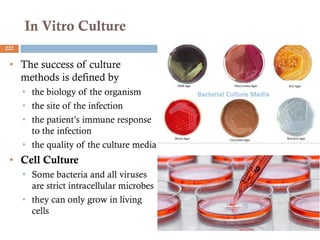
• Culture media: artificial media containing the
required nutrients for bacterial growth
• Culturing/cultivation: the process of growing
Bacteria on a culture media
• Purpose of culturing:
- Isolation and identification of micro-organisms
- Performing anti-microbial sensitivity tests
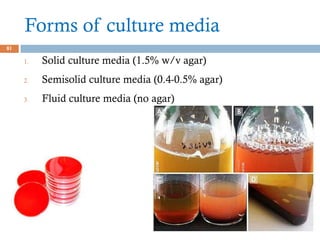
Forms of culture media
81
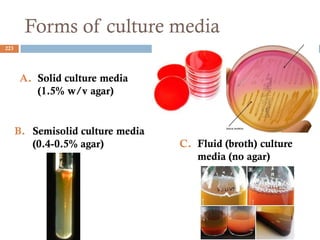
1. Solid culture media (1.5% w/v agar)
2. Semisolid culture media (0.4-0.5% agar)
3. Fluid culture media (no agar)
Types of culture media
82
1. Basic media
2. Enriched media
3. Enrichment media
4. Selective media
5. Differential (Indicator)
media
6. Transport media
7. Identification media
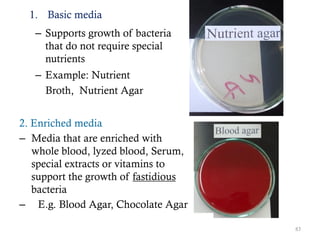
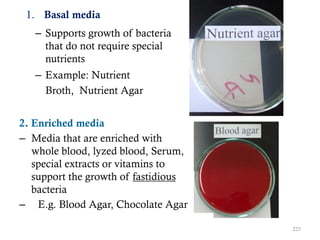
1. Basic media
– Supports growth of bacteria
that do not require special
nutrients
– Example: Nutrient
Broth, Nutrient Agar
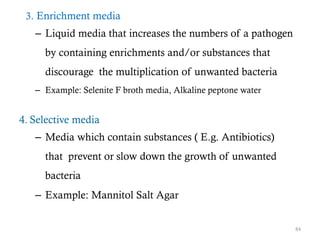
2. Enriched media
– Media that are enriched with
whole blood, lyzed blood, Serum,
special extracts or vitamins to
support the growth of fastidious
bacteria
– E.g. Blood Agar, Chocolate Agar
83
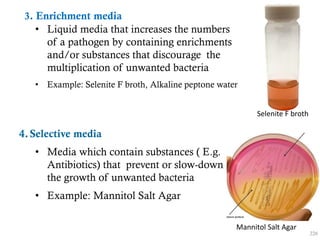
3. Enrichment media
– Liquid media that increases the numbers of a pathogen
by containing enrichments and/or substances that
discourage the multiplication of unwanted bacteria
– Example: Selenite F broth media, Alkaline peptone water
4. Selective media
– Media which contain substances ( E.g. Antibiotics)
that prevent or slow down the growth of unwanted
bacteria
– Example: Mannitol Salt Agar
84
5. Differential media
85
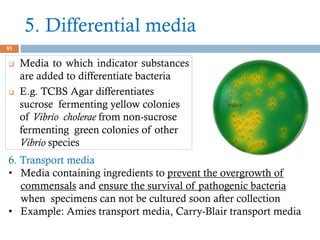
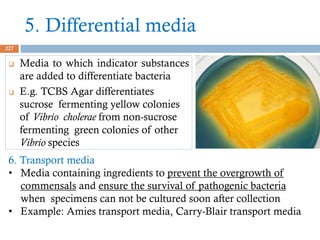
 Media to which indicator substances
are added to differentiate bacteria
 E.g. TCBS Agar differentiates
sucrose fermenting yellow colonies
of Vibrio cholerae from non-sucrose
fermenting green colonies of other
Vibrio species
6. Transport media
• Media containing ingredients to prevent the overgrowth of
commensals and ensure the survival of pathogenic bacteria
when specimens can not be cultured soon after collection
• Example: Amies transport media, Carry-Blair transport media
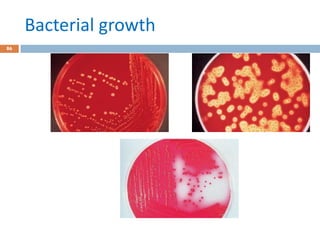
Bacterial growth
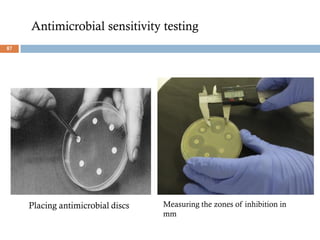
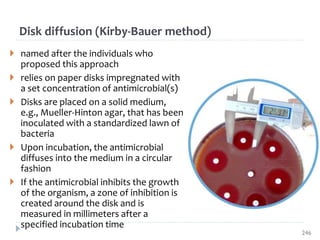
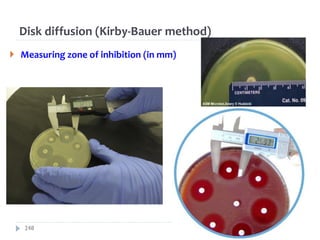
86
Placing antimicrobial discs Measuring the zones of inhibition in
mm
Antimicrobial sensitivity testing
87
Bacterial Genetics
88
2
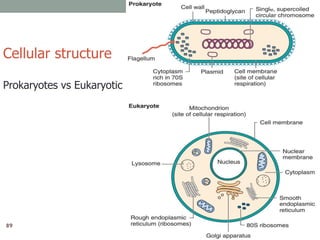
Cellular structure
Prokaryotes vs Eukaryotic
89
3
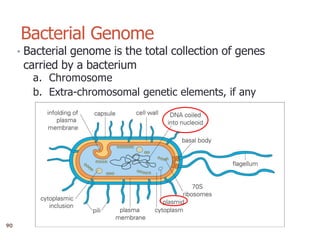
Bacterial Genome
• Bacterial genome is the total collection of genes
carried by a bacterium
a. Chromosome
b. Extra-chromosomal genetic elements, if any
90
4
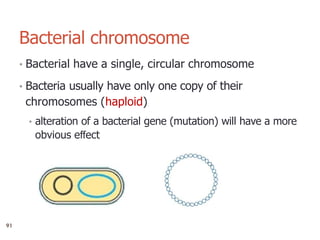
Bacterial chromosome
• Bacterial have a single, circular chromosome
• Bacteria usually have only one copy of their
chromosomes (haploid)
• alteration of a bacterial gene (mutation) will have a more
obvious effect
91
5
Extra-chromosomal genetic elements
• Can be transfered from one bacterium to another
• Include
1. Plasmids
2. Prophages
3. Transposons
92
Plasmids
Small, circular, self-replicating pieces of DNA (separate
from the bacterial chromosome)
Plasmids are not required for bacterial cells to survive
under normal conditions
Under stress, genes on plasmids can confer advantages
(e.g. drug resistance, virulence factor)
mayexist freely inthecytoplasm or integratedinthebacterial
chromosome
Plasmids that can incorporate themselves into the
bacterial chromosome are called Episomes
Plasmids increase geneticvariation andthusthelikelihood of
survival inbacteria
•
•
•
•
•
•
93
8
Phages
• Bacteriophages are viruses that can infect bacteria
• Bacteriophages infect bacterial cells either
• replicate to large numbers and cause the cell to lyse
(lytic infection) or
• integrate into the host genome without killing the host
(the lysogenic state)
• Some lysogenic bacteriophages carry toxin genes
(e.g., gene for the diphtheria toxin)
94
9
Transposons (jumping genes)
• are mobile genetic elements that can transfer DNA
within a cell
• from one position to another in the genome, or
• between different molecules of DNA (e.g., plasmid to
plasmid or plasmid to chromosome)
• They do so by synthesizing a copy of their DNA and
inserting the copy at another site in the bacterial
chromosome or the plasmid
95
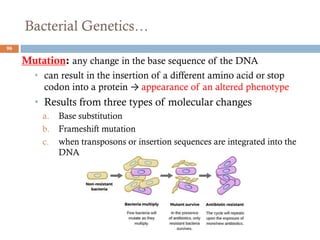
Bacterial Genetics…
Mutation: any change in the base sequence of the DNA
• can result in the insertion of a different amino acid or stop
codon into a protein → appearance of an altered phenotype
• Results from three types of molecular changes
a. Base substitution
b. Frameshift mutation
c. when transposons or insertion sequences are integrated into the
DNA
96
Bacterial Genetics…
• Silent mutation
• change at the DNA level that does not result in any
change of amino acid in the encoded protein
• This type of mutation occurs because more than one
codon may encode an amino acid
97
Bacterial Genetics…
A. Base substitution: occurs when one base is inserted in
place of another
• Missense mutation: When the base substitution results in a
codon that simply causes a different amino acid to be inserted
• Nonsense mutation: when the base substitution generates a
termination codon that stops protein synthesis prematurely
98
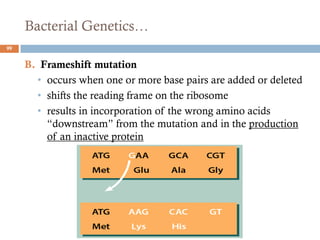
Bacterial Genetics…
B. Frameshift mutation
• occurs when one or more base pairs are added or deleted
• shifts the reading frame on the ribosome
• results in incorporation of the wrong amino acids
“downstream” from the mutation and in the production
of an inactive protein
99
Bacterial Genetics…
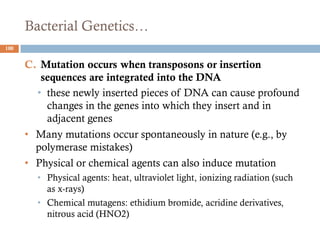
C. Mutation occurs when transposons or insertion
sequences are integrated into the DNA
• these newly inserted pieces of DNA can cause profound
changes in the genes into which they insert and in
adjacent genes
• Many mutations occur spontaneously in nature (e.g., by
polymerase mistakes)
• Physical or chemical agents can also induce mutation
• Physical agents: heat, ultraviolet light, ionizing radiation (such
as x-rays)
• Chemical mutagens: ethidium bromide, acridine derivatives,
nitrous acid (HNO2)
100
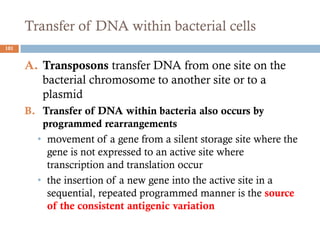
Transfer of DNA within bacterial cells
A. Transposons transfer DNA from one site on the
bacterial chromosome to another site or to a
plasmid
B. Transfer of DNA within bacteria also occurs by
programmed rearrangements
• movement of a gene from a silent storage site where the
gene is not expressed to an active site where
transcription and translation occur
• the insertion of a new gene into the active site in a
sequential, repeated programmed manner is the source
of the consistent antigenic variation
101
Transfer of DNA between bacterial cells
• The transfer of genetic information from one cell to
another can occur by three methods:
• Conjugation
• Transduction
• Transformation
• Consequences of DNA transfer
• antibiotic resistance genes are spread from one
bacterium to another primarily by conjugation
• Several important exotoxins are encoded by
bacteriophage genes and are transferred by transduction
102
11
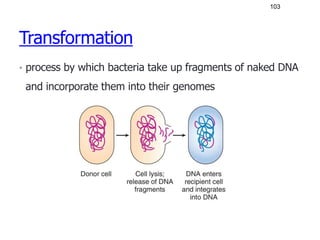
Transformation
• process by which bacteria take up fragments of naked DNA
and incorporate them into their genomes
103
104
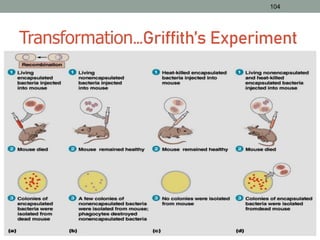
Transformation…Griffith’s Experiment
105
Transduction
• transfer of bacterial DNA from one cell to another
by means of a bacteriophage infection
• Two types
a. generalized transduction
b. specialized transduction
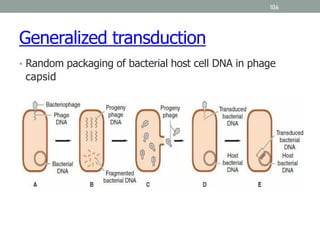
106
Generalized transduction
• Random packaging of bacterial host cell DNA in phage
capsid
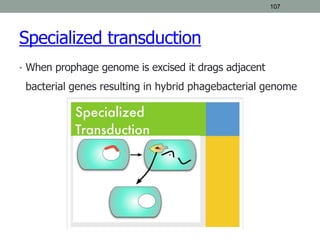
107
Specialized transduction
• When prophage genome is excised it drags adjacent
bacterial genes resulting in hybrid phagebacterial genome
108
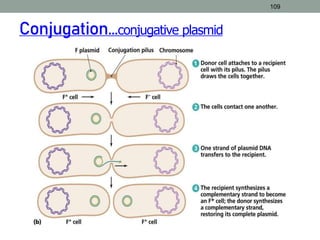
Conjugation
• is the mating of two bacterial cells
• DNA is transferred from donor (male) to recipient (female)
cell through sex pilus
• Mating is controlled by an F (fertility) plasmid (F factor)
carries the genes for the proteins required for conjugation
• Conjugation is unidirectional F+ → F-
• Conjugation occurs usually between members of the same
or related species
• conjugation can transfer
conjugative plasmid or
plasmid with bacterial genes to which it is integrated
109
Conjugation…conjugative plasmid
110
Conjugation…chromosome integrated plasmid
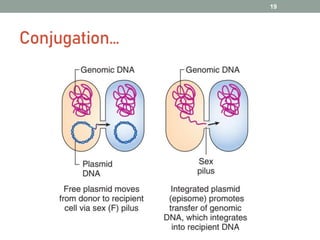
Some F+ cells have their F plasmid integrated into the bacterial
DNA → can transfer part of the chromosome into another cell
These cells are called Hfr (high-frequency recombination) cells
the single strand of DNA that enters the recipient F– cell contains
a piece of the F factor at the leading end followed by the bacterial
chromosome and then by the remainder of the F factor
The time required for complete transfer of the bacterial DNA is
approximately 100 minutes
Most matings result in the transfer of only a portion of the donor
chromosome b/c the attachment b/n the two cells can break
•
•
•
•
•
19
Conjugation…
General Virology
General properties of viruses
113
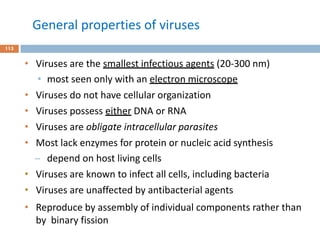
• Viruses are the smallest infectious agents (20-300 nm)
• most seen only with an electron microscope
• Viruses do not have cellular organization
• Viruses possess either DNA or RNA
• Viruses are obligate intracellular parasites
• Most lack enzymes for protein or nucleic acid synthesis
̶ depend on host living cells
• Viruses are known to infect all cells, including bacteria
• Viruses are unaffected by antibacterial agents
• Reproduce by assembly of individual components rather than
by binary fission
General properties of viruses…
114
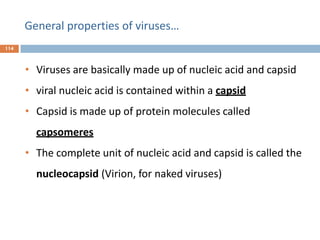
• Viruses are basically made up of nucleic acid and capsid
• viral nucleic acid is contained within a capsid
• Capsid is made up of protein molecules called
capsomeres
• The complete unit of nucleic acid and capsid is called the
nucleocapsid (Virion, for naked viruses)
General properties of viruses…
115
Viral nucleic acids
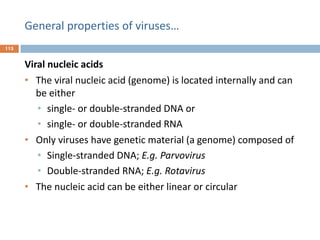
• The viral nucleic acid (genome) is located internally and can
be either
• single- or double-stranded DNA or
• single- or double-stranded RNA
• Only viruses have genetic material (a genome) composed of
• Single-stranded DNA; E.g. Parvovirus
• Double-stranded RNA; E.g. Rotavirus
• The nucleic acid can be either linear or circular
General properties of viruses…
116
Viral nucleic acids…
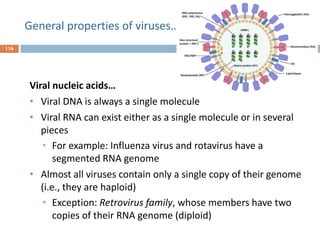
• Viral DNA is always a single molecule
• Viral RNA can exist either as a single molecule or in several
pieces
• For example: Influenza virus and rotavirus have a
segmented RNA genome
• Almost all viruses contain only a single copy of their genome
(i.e., they are haploid)
• Exception: Retrovirus family, whose members have two
copies of their RNA genome (diploid)
General properties of viruses…
117
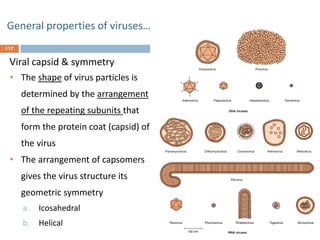
Viral capsid & symmetry
• The shape of virus particles is
determined by the arrangement
of the repeating subunits that
form the protein coat (capsid) of
the virus
• The arrangement of capsomers
gives the virus structure its
geometric symmetry
a. Icosahedral
b. Helical
General properties of viruses…
118
2018
• Icosahedral
̶ capsomers are arranged in triangles
that form a symmetric figure with
the approximate outline of a sphere
̶ can be either enveloped or naked
• Helical
̶ capsomers are arranged in a hollow
coil that appears rod-shaped
̶ All human viruses with helical
nucleocapsid are enveloped
General properties of viruses…
119
• The advantage of building the virus particle from
identical protein subunits is twofold:
a. It reduces the need for genetic information
b. It promotes self-assembly (i.e., no enzyme or energy is
required)
• Functional virus particles have been assembled in the
test tube by combining purified nucleic acid with purified
proteins in the absence of cells, energy source, and
enzymes
General properties of viruses…
120
Viral proteins
• Viral proteins serve several important functions
• Capsid proteins: protect the viral genome from degradation by
nucleases
• Surface proteins: mediate the attachment of the virus to specific
receptors on the host cell surface
• The interaction of the viral proteins with the cell receptor is the
major determinant of species and organ specificity
• Outer viral proteins are also important antigens that induce
neutralizing antibody and activate cytotoxic T cells
• The term “serotype” is used to describe a subcategory of a virus
based on its surface antigens
Viral classification
121
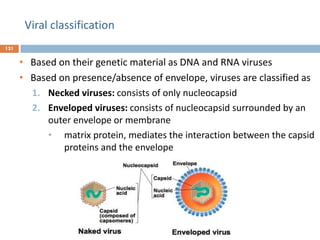
• Based on their genetic material as DNA and RNA viruses
• Based on presence/absence of envelope, viruses are classified as
1. Necked viruses: consists of only nucleocapsid
2. Enveloped viruses: consists of nucleocapsid surrounded by an
outer envelope or membrane
• matrix protein, mediates the interaction between the capsid
proteins and the envelope
Viral classification
122
Naked (un-enveloped) viruses
• Capsid is a rigid structure → withstand harsh environmental
conditions → survive well in the outside world
• Environmentally stable to: temperature, acid, proteases,
detergents and drying
• Released from cell by lysis
Viral classification…
123
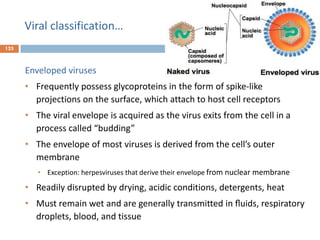
Enveloped viruses
• Frequently possess glycoproteins in the form of spike-like
projections on the surface, which attach to host cell receptors
• The viral envelope is acquired as the virus exits from the cell in a
process called “budding”
• The envelope of most viruses is derived from the cell’s outer
membrane
• Exception: herpesviruses that derive their envelope from nuclear membrane
• Readily disrupted by drying, acidic conditions, detergents, heat
• Must remain wet and are generally transmitted in fluids, respiratory
droplets, blood, and tissue
Atypical virus-like agents
124
Defective viruses
• composed of viral nucleic acid and proteins but cannot
replicate without a “helper” virus, which provides the
missing function
• Defective viruses usually have a mutation or a deletion of
part of their genetic material
Pseudovirions
• contain host cell DNA instead of viral DNA within capsid
• Formed during infection with certain viruses when the host
cell DNA is fragmented and pieces of it are incorporated
within the capsid protein
• can infect cells, but do not replicate
Atypical virus-like agents…
125
Viroids
• consist solely of a single molecule of circular RNA without a
protein coat or envelope
• The RNA is quite small and apparently does not code for any
protein
• Can replicate, but the mechanism is unclear
• Cause several plant diseases but are not implicated in any
human disease
Atypical virus-like agents…
126
Prions
• are infectious particles that are composed solely of protein
• they contain no detectable nucleic acid
• implicated as the cause of certain “slow” diseases called
transmissible spongiform encephalopathies
• Different from viruses b/c posses neither DNA nor RNA
• Much more resistant to inactivation by ultraviolet light and heat
than are viruses
• remarkably resistant to formaldehyde and nucleases.
• inactivated by hypochlorite, NaOH, and autoclaving
• no immune response is formed against this protein
• there is no inflammatory response in infected brain tissue
Viral Replication
127
• Viruses should infect cells in order to replicate
• The cell acts as a factory, providing the substrates, energy,
and machinery necessary for the synthesis of viral proteins
and replication of the genome
• Processes not provided by the cell must be encoded in the
genome of the virus
• Each infected cell may produce as many as 100,000
particles
• only 1-10% of these particles may be infectious
• The noninfectious particles (defective particles) result from
mutations and errors in the manufacture and assembly of
the virion
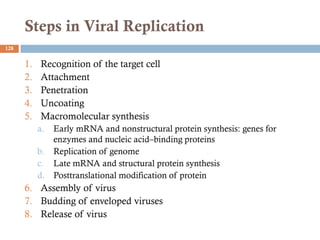
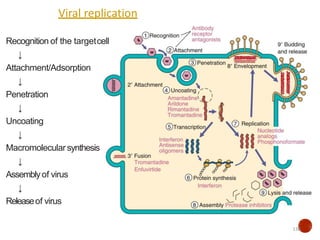
Steps in Viral Replication
128
1. Recognition of the target cell
2. Attachment
3. Penetration
4. Uncoating
5. Macromolecular synthesis
a. Early mRNA and nonstructural protein synthesis: genes for
enzymes and nucleic acid–binding proteins
b. Replication of genome
c. Late mRNA and structural protein synthesis
d. Posttranslational modification of protein
6. Assembly of virus
7. Budding of enveloped viruses
8. Release of virus
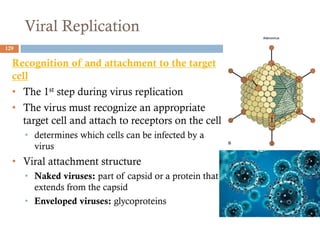
Viral Replication
129
Recognition of and attachment to the target
cell
• The 1st step during virus replication
• The virus must recognize an appropriate
target cell and attach to receptors on the cell
• determines which cells can be infected by a
virus
• Viral attachment structure
• Naked viruses: part of capsid or a protein that
extends from the capsid
• Enveloped viruses: glycoproteins
Viral Replication
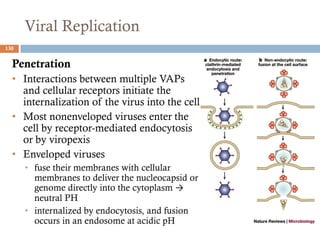
130
Penetration
• Interactions between multiple VAPs
and cellular receptors initiate the
internalization of the virus into the cell
• Most nonenveloped viruses enter the
cell by receptor-mediated endocytosis
or by viropexis
• Enveloped viruses
• fuse their membranes with cellular
membranes to deliver the nucleocapsid or
genome directly into the cytoplasm →
neutral PH
• internalized by endocytosis, and fusion
occurs in an endosome at acidic pH
Viral Replication
131
Uncoating
• Once internalized
• nucleocapsid delivered to the site of replication within
the cell and the capsid or envelope removed
• The genome of DNA viruses, except for poxviruses, must
be delivered to the nucleus
• Most RNA viruses remain in the cytoplasm
• except for orthomyxoviruses and retroviruses
Viral Replication
132
Macromolecular synthesis
• Once inside the cell, the genome must direct
• the synthesis of viral mRNA and protein
• generate identical copies of itself
• Transcription of the DNA virus genome (except for
poxviruses) occurs in the nucleus, using host cell
polymerases and other enzymes for viral mRNA synthesis
• RNA viruses must encode the necessary enzymes for
transcription and replication
Viral Replication
133
• Positive-strand RNA viral genomes
• act as mRNA, bind to ribosomes, and direct protein
synthesis
• The naked ps-RNA viral genome is sufficient to initiate
infection by itself
• E.g. picornaviruses, caliciviruses, coronaviruses,
flaviviruses, and togaviruses
Viral Replication
134
• Negative-strand RNA viral genomes
• are the templates for production of individual mRNAs
• The negative-strand RNA genome is not infectious nor
can it bind to the ribosome
• a polymerase must be carried into the cell with the
genome to make mRNAs
• Rhabdoviruses, orthomyxoviruses, paramyxoviruses,
filoviruses, and bunyaviruses
Viral Replication
135
Assembly
• The assembly process begins when the necessary pieces are
synthesized
• Assembly of DNA viruses other than poxviruses occurs in
the nucleus and requires transport of the virion proteins
into the nucleus
• RNA virus and poxvirus assemblies occur in the cytoplasm
Release
• Viruses can be released from cells after lysis of the cell, by
exocytosis, or by budding from the plasma membrane
Viral replication
Recognition of the targetcell
↓
Attachment/Adsorption
↓
Penetration
↓
Uncoating
↓
Macromolecularsynthesis
↓
Assemblyof virus
↓
Releaseof virus
136
Outcomes of viral infection of a cell
137
1. Death
2. Fusion of cells to form multinucleated cells
3. Malignant transformation
4. No apparent morphologic or functional change
General Mycology
Introduction
139
• Mycology is the study of fungi
• There are ~80,000 species of fungi
• fewer than 400 are medically important
• less than 50 species cause more than 90% of the fungal
infections of humans and other animals
• Fungi are ubiquitous as free-living organisms
• Important commercially in baking, brewing and in
pharmaceuticals
Characteristics of Fungi
140
• Fungi are classified into their own separate kingdom,
Kingdom Fungi (Myceteae)
• They are eukaryotic organisms but are distinguished from
other eukaryotes by possession of:
• rigid cell wall composed of chitin and glucan
• cell membrane in which ergosterol is substituted for cholesterol
as the major sterol component
• Relative to bacteria, fungi are slow growing with cell-
doubling times in terms of hours rather than minutes
• Fungi have emerged in the past three decades as major
causes of human disease
Characteristics of Fungi…
141
• Most fungi are obligate aerobes; some are facultative
anaerobes; but none are obligate anaerobes
• All fungi require a preformed organic source of carbon
• hence their frequent association with decaying matter
• The natural habitat of most fungi is, therefore, the
environment
• An important exception is Candida albicans, which is part of
the normal human flora
Characteristics of Fungi…
142
• Some fungi reproduce sexually by mating and forming
sexual spores (e.g., zygospores, ascospores, and
basidiospores)
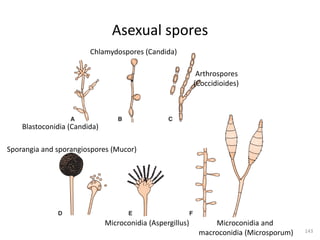
• Most fungi of medical interest propagate asexually by forming
conidia (asexual spores) from the sides or ends of specialized
structures
A. Arthrospores: arise by fragmentation of the ends of hyphae and are the
mode of transmission of Coccidioides immitis
B. Chlamydospores: are rounded, thick-walled, and quite resistant
C. Blastospores: are formed by the budding process by which yeasts
reproduce asexually
D. Sporangiospores: are formed within a sac (sporangium)
Asexual spores
143
Blastoconidia (Candida)
Chlamydospores (Candida)
Arthrospores
(Coccidioides)
Sporangia and sporangiospores (Mucor)
Microconidia (Aspergillus) Microconidia and
macroconidia (Microsporum)
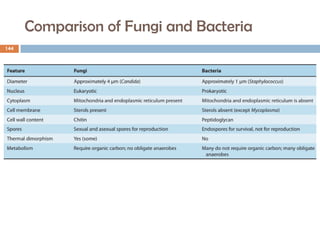
Comparison of Fungi and Bacteria
144
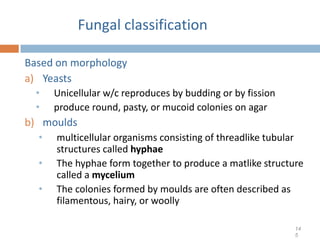
Fungal classification
Based on morphology
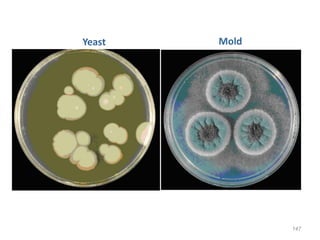
a) Yeasts
• Unicellular w/c reproduces by budding or by fission
• produce round, pasty, or mucoid colonies on agar
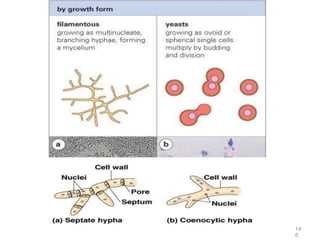
b) moulds
• multicellular organisms consisting of threadlike tubular
structures called hyphae
• The hyphae form together to produce a matlike structure
called a mycelium
• The colonies formed by moulds are often described as
filamentous, hairy, or woolly
14
5
14
6
147
Yeast Mold
Fungal classification…
c. Dimorphic fungi
• exhibit thermal dimorphism (i.e., exist as yeast
at body temperature [37°C] and mould at room
temperature [25°C])
• Example
o Histoplasma capsulatum
o Blastomyces dermatitidis
o Coccidioides immitis
o Paracoccidioides brasiliensis
14
8
Classification of Human Mycoses
1) Superficial mycoses
 Infections limited to the very superficial surfaces of the
skin and hair
2) Cutaneous mycoses
 infections of the keratinized layer of skin, hair, and nails
 These infections may elicit a host response and become
symptomatic
3) Subcutaneous mycoses
 involve the deeper layers of the skin, including the
cornea, muscle, and connective tissue
14
9
Classification of Human Mycoses…
4) Endemic mycoses (systemic mycoses)
• Are caused by the classic dimorphic fungal pathogens
• these organisms are true pathogens and can cause
infection in healthy individuals
• All of these agents produce a primary infection in the
lung, with subsequent dissemination to other organs and
tissues
5) Opportunistic mycoses
• infections caused by fungi that are normally found as
human commensals or in the environment
15
0
Fungal Toxins & Allergies
151
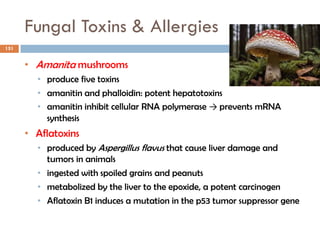
• Amanita mushrooms
• produce five toxins
• amanitin and phalloidin: potent hepatotoxins
• amanitin inhibit cellular RNA polymerase → prevents mRNA
synthesis
• Aflatoxins
• produced by Aspergillus flavus that cause liver damage and
tumors in animals
• ingested with spoiled grains and peanuts
• metabolized by the liver to the epoxide, a potent carcinogen
• Aflatoxin B1 induces a mutation in the p53 tumor suppressor gene
Fungal Toxins & Allergies
152
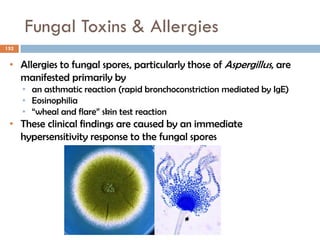
• Allergies to fungal spores, particularly those of Aspergillus, are
manifested primarily by
• an asthmatic reaction (rapid bronchoconstriction mediated by IgE)
• Eosinophilia
• “wheal and flare” skin test reaction
• These clinical findings are caused by an immediate
hypersensitivity response to the fungal spores
Host-parasite relationship
153
Symbiotic Associations
154
• All living animals are used as habitats by other
organisms
• None is exempt from such invasion
• Bacteria are invaded by viruses (bacteriophages)
• Amoebas are natural hosts for Legionella pneumophila
infection
• Symbiosis
• Interaction between two different organisms living in
close physical association
Symbiotic Associations…
155
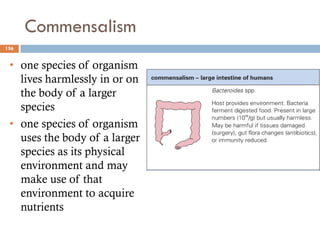
Commensalism
156
• one species of organism
lives harmlessly in or on
the body of a larger
species
• one species of organism
uses the body of a larger
species as its physical
environment and may
make use of that
environment to acquire
nutrients
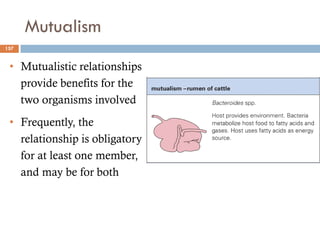
Mutualism
157
• Mutualistic relationships
provide benefits for the
two organisms involved
• Frequently, the
relationship is obligatory
for at least one member,
and may be for both
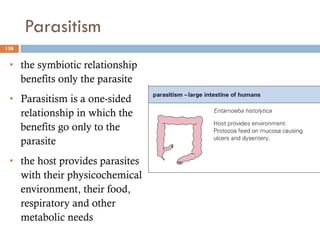
Parasitism
158
• the symbiotic relationship
benefits only the parasite
• Parasitism is a one-sided
relationship in which the
benefits go only to the
parasite
• the host provides parasites
with their physicochemical
environment, their food,
respiratory and other
metabolic needs
The bacterial flora of human
159
The bacterial flora…
160
• Up until the time of birth, the human fetus lives in a
remarkably protected and for the most part sterile
environment
• Then, the infant is exposed to bacteria, archaea, fungi, and
viruses from the mother, other close contacts, and the
environment
• Over the next few years, communities of organisms
(microbiota or normal flora) form on the surfaces of the
skin, nares, oral cavity, intestines, and genitourinary tract
The bacterial flora…
161
Microbiota (normal flora)
• Community of microbes that live in and on an individual
Microbiome
• Aggregate collection of microbial genomes in the
microbiota
The bacterial flora…
162
Core Microbiome
• Most individuals share a core microbiome
• species that are present at a specific site in 95% or more of
individuals
Secondary microbiome
• The remaining portion of the population (<5%)
• consists of small numbers of many species that may not
be widely shared by individuals
The bacterial flora…
163
• Although there is tremendous variation of species
among individuals, there is less variation in the genetic
composition at each site
• The taxonomic diversity of a population is great, but
the functional properties are highly conserved
(functional redundancy) in microbiomes associated
with health
The bacterial flora…
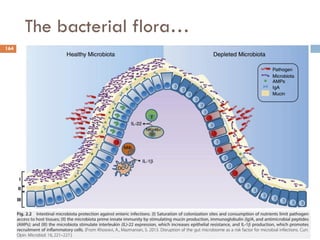
164
The bacterial flora…
165
• The normal flora of a particular site of the body
• consists of a unique community of core and secondary
microbiota
• evolved through a symbiotic relationship with the host and
a competitive relationship with other species
• The host provides a place to colonize, nutrients, and
some protection from unwanted species (innate immune
responses)
• The microbes provide needed metabolic functions,
stimulate innate and regulatory immunity, and prevent
colonization with unwanted pathogens
The bacterial flora…
166
• Metabolism of nutrients plays a major role in the symbiotic
relationship between the human host and microbe
• Bacteria in the human gut are responsible for metabolizing
complex carbohydrates (including cellulose) to provide small-
chain fatty acids such as acetate, propionate, and butyrate
• that can be readily transported and used by the cells of our
body
• these acids also limit the growth of undesirable bacteria
• Bacteroidetes and Firmicutes are more efficient than others
at breaking down complex carbohydrates
The bacterial flora…
167
• The composition of the microbiota is influenced by personal
hygiene, diet, water source, medicines (especially antibiotics),
and exposure to environmental toxins
• Disruption of normal microflora (dysbiosis) can lead to
disease by
• the elimination of needed organisms or
• allowing the growth of inappropriate bacteria
• E.g. following exposure to antibiotics and suppression of the
intestinal normal flora, C. difficile is able to proliferate and
express enterotoxins, leading to inflammation of the colon
(antibiotic-associated colitis)
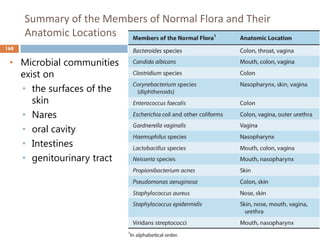
Summary of the Members of Normal Flora and Their
Anatomic Locations
168
• Microbial communities
exist on
• the surfaces of the
skin
• Nares
• oral cavity
• Intestines
• genitourinary tract
Probiotics
169
Prebiotic
• Food ingredient that supports the growth of one or more
members of the microbiota
Probiotics
• are mixtures of bacteria or yeast that when ingested colonize
and proliferate, even temporarily, the intestine
• Consumers of probiotics believe they act by rebalancing the
microbiome and its functions, such as
• enhancing digestion of food and
• modulating the individual’s innate and immune response
Probiotics…
170
• The most common reason people use probiotics is
• to promote and maintain regular bowel function and
• improve tolerance to lactose
• Probiotics are commonly gram-positive bacteria (e.g.,
Bifidobacterium, Lactobacillus) and yeasts (e.g.,
Saccharomyces)
• Many of these microbes are found in ingestible capsules and
as food supplements (e.g., yogurt, kefir)
Probiotics…
171
• Probiotics have been used to treat
• C. difficile–associated diarrhea and inflammatory bowel disease
• to provide protection from Salmonella and H. pylori disease
• as therapy for pediatric atopic dermatitis and autoimmune
diseases, and even for reduction in dental caries
• Although probiotics are generally safe dietary supplements,
many probiotics are ineffective
• The species, mixture of species, and dose and viability of the
probiotic organisms within a probiotic formulation influence
its potency, efficacy, and therapeutic potential
Microbial pathogenicity
172
Pathogenicity
173
Microorganisms can be
• Normal flora (commensal)
• usually do not produce disease
• Opportunistic
• rarely, if ever, cause disease in immunocompetent
• cause serious infection in immunocompromised
• Pathogen
• capable of causing disease
Pathogenicity
174
• The pathogenesis of microbial infection includes
• initiation of the infectious process
• mechanisms that lead to the development of signs
and symptoms of disease
Pathogenicity
175
• Colonization
• refers to the presence of a new organism that is neither a
member of the normal flora nor the cause of symptoms
• Infection
• an organism has infected the person (entered the body of
that person)
• Symptoms may or may not develop
• Invasion
• The process whereby microorganisms enter host cells or
tissues and spread in the body
Pathogenicity
176
• Pathogenicity
• The ability of an infectious agent to cause disease
• Virulence
• is a quantitative measure of pathogenicity and is measured by
the number of organisms required to cause disease
• Virulence factors
• enhance the ability of a pathogen to remain in and harm the
body to cause disease
• Infective dose (ID)
• quantity of a pathogen necessary to cause infection in a
susceptible host
Why do people get infectious diseases?
177
• People get infectious diseases when
• microorganisms overpower our host defenses
• when the balance between the organism and the
host shifts in favor of the organism
• The organism or its products are then present in
sufficient amount to induce various symptoms, such
as fever and inflammation
Why do people get infectious diseases?
178
From the organism’s perspective
• the two critical determinants in overpowering the host are
• number of organisms to which the host, or person, is exposed
• virulence of these organisms
• The greater the number of organisms, the greater is the
likelihood of infection
• However, a small number of highly virulent organisms can
cause disease
• The virulence of an organism is determined by its ability to
produce various virulence factors
Why do people get infectious diseases?
179
Bacterial Virulence Mechanisms
• Capsule and Biofilm
• Adherence
• Invasion
• By-products of growth (gas, acid)
• Toxins
• Degradative enzymes
• Cytotoxic proteins
• Endotoxin
• Superantigen
• Induction of excess inflammation
• Evasion of phagocytic and immune clearance
• Resistance to antibiotics
• Intracellular growth
Why do people get infectious diseases?
180
From the host’s perspective
• A reduction in the functioning of any component
of our host defenses
• shifts the balance in favor of the organism
• increases the chance that an infectious disease will
occur
• E.g. AIDS, Drug-induced immunosuppression in
patients with organ transplants, and cancer patients
who are receiving chemotherapy
Why do people get infectious diseases?
181
• Disease results from the combination of
• damage or loss of tissue or organ function caused by the
organism
• consequences of the immune responses (inflammation) to the
infection
• The signs and symptoms of a disease are determined by
the change to the affected tissue
• Systemic responses are produced by toxins and the
cytokines produced in response to the infection
• The seriousness of the disease depends on the importance
of the affected organ and the extent of the damage
caused by the infection
• Infections of the central nervous system are especially serious
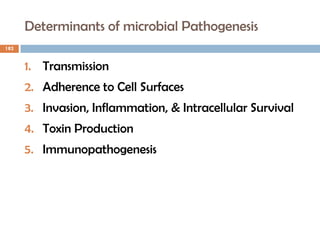
Determinants of microbial Pathogenesis
182
1. Transmission
2. Adherence to Cell Surfaces
3. Invasion, Inflammation, & Intracellular Survival
4. Toxin Production
5. Immunopathogenesis
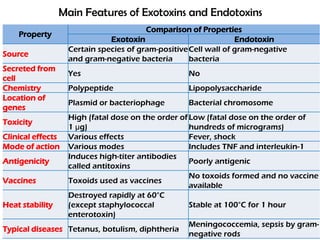
Main Features of Exotoxins and Endotoxins
183
Property
Comparison of Properties
Exotoxin Endotoxin
Source
Certain species of gram-positive
and gram-negative bacteria
Cell wall of gram-negative
bacteria
Secreted from
cell
Yes No
Chemistry Polypeptide Lipopolysaccharide
Location of
genes
Plasmid or bacteriophage Bacterial chromosome
Toxicity
High (fatal dose on the order of
1 μg)
Low (fatal dose on the order of
hundreds of micrograms)
Clinical effects Various effects Fever, shock
Mode of action Various modes Includes TNF and interleukin-1
Antigenicity
Induces high-titer antibodies
called antitoxins
Poorly antigenic
Vaccines Toxoids used as vaccines
No toxoids formed and no vaccine
available
Heat stability
Destroyed rapidly at 60°C
(except staphylococcal
enterotoxin)
Stable at 100°C for 1 hour
Typical diseases Tetanus, botulism, diphtheria
Meningococcemia, sepsis by gram-
negative rods
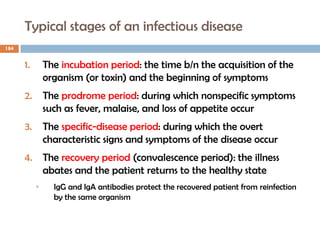
Typical stages of an infectious disease
184
1. The incubation period: the time b/n the acquisition of the
organism (or toxin) and the beginning of symptoms
2. The prodrome period: during which nonspecific symptoms
such as fever, malaise, and loss of appetite occur
3. The specific-disease period: during which the overt
characteristic signs and symptoms of the disease occur
4. The recovery period (convalescence period): the illness
abates and the patient returns to the healthy state
• IgG and IgA antibodies protect the recovered patient from reinfection
by the same organism
Principle of disinfection and Sterilization
Principles of infection prevention
185
Introduction
• The purpose of sterilization and disinfection procedures is
to prevent transmission of microbes
• In addition to sterilization and disinfection, other
important measures to prevent transmission are included in
the protocol of “standard precautions”
• Standard precautions include
a. hand hygiene
b. respiratory hygiene and cough etiquette
c. safe injection practices
d. proper disposal of needles and scalpels
186
Introduction…
Sterilization
• is the killing or removal of all microorganisms, including
bacterial spores
Disinfection
• is the killing of many, but not all, microorganisms
• For adequate disinfection, pathogens must be killed, but
some organisms and bacterial spores may survive
Antisepsis
• Use of chemical agents on skin or other living tissue to
inhibit or eliminate microbes; no sporicidal action is
implied
187
Sterilization
• This can be accomplished using physical, gas vapor, or
chemical sterilants
• Moist heat: Autoclave
• Dry heat: hot air oven, incineration, Fleming
• Radiation
• Filtration
• Ethylene oxide
• Hydrogen peroxide vapors
• Peracetic acid
• Glutaraldehyde
188
A. Dry heat---Hot air oven
• Sterilize by denaturing proteins
• Less efficient and requires high temperature and long
period heating than moist heat₋
189
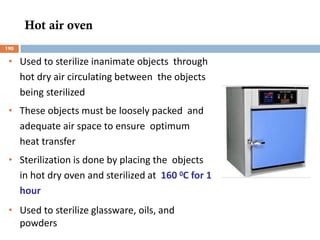
Hot air oven
• Used to sterilize inanimate objects through
hot dry air circulating between the objects
being sterilized
• These objects must be loosely packed and
adequate air space to ensure optimum
heat transfer
• Sterilization is done by placing the objects
in hot dry oven and sterilized at 160 0C for 1
hour
• Used to sterilize glassware, oils, and
powders
190
B. Moist Heat
• Sterilize by denaturing and coagulating proteins
• Preferred to dry heat due to more and rapid killing
• This can be achieved using an autoclave
• Steam under pressure aids penetration of heat into the
material to be sterilized
191
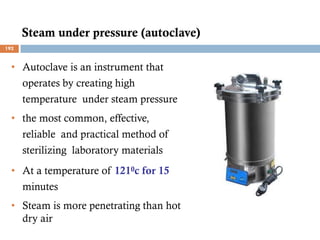
Steam under pressure (autoclave)
• Autoclave is an instrument that
operates by creating high
temperature under steam pressure
• the most common, effective,
reliable and practical method of
sterilizing laboratory materials
• At a temperature of 1210c for 15
minutes
• Steam is more penetrating than hot
dry air
192
C. Gamma irradiation
• Is used to sterilize large batches of small volume items
• The killing mechanism involves the production of free
radicals, which break the bonds in DNA
• Used to sterilize industrial products, i.e. needles, syringes,
intravenous lines, catheters and gloves
• It can also be used for vaccines and to prevent food
spoilage
• Articles are sterilized while sealed in their final packaging,
without any heat gain
193
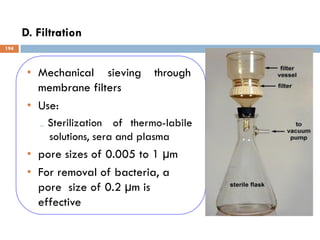
D. Filtration
through
• Mechanical sieving
membrane filters
• Use:
₋ Sterilization of thermo-labile
solutions, sera and plasma
• pore sizes of 0.005 to 1 µm
• For removal of bacteria, a
pore size of 0.2 µm is
effective
194
Ethylene oxide (450-1200 mg/L)
• used to sterilize temperature- or pressure-sensitive
items
• Treatment is generally for 4 hours
• Sterilized items must be aerated for an additional 12
hours to eliminate the toxic gas before the items are
used
• Although ethylene oxide is highly efficient, strict
regulations limit its use because it is flammable,
explosive, and carcinogenic to laboratory animals
195
Hydrogen peroxide vapors(30%)
• effective sterilants because of the oxidizing nature of
the gas
• used for the sterilization of instruments
• A variation is plasma gas sterilization, in which
H2O2 is vaporized, and then reactive free radicals are
produced
• Because this is an efficient sterilizing method that does
not produce toxic by-products, plasma gas sterilization
has replaced many of the applications for ethylene
oxide
196
Other chemical sterilants
• Peracetic acid (0.2%)
• an oxidizing agent, has excellent activity, and its end
products (i.e., acetic acid and oxygen) are nontoxic
• Glutaraldehyde (2%)
• used to sterilize respiratory therapy equipment,
endoscopes, and hemodialysis equipment
• In contrast, safety is a concern with, and care must be used
when handling this chemical
197
Disinfection
• Disinfection processes categorized as high level,
intermediate level, and low level
• High-level disinfection can generally approach
sterilization in effectiveness
• Spore forms can survive intermediate-level disinfection
• Many microbes can remain viable when exposed to
low-level disinfection
198
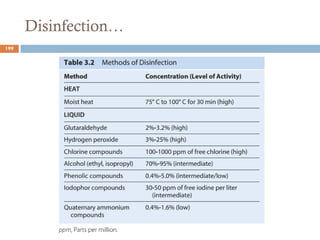
Disinfection…
199
Disinfectants…
• Alcohol: 70-95% alcohol
• Rapidly kill vegetative bacteria by denaturing protein
• Iodine: 2% tincture iodine, Iodophors
• kills more rapidly and effectively than alcohol
• widely used in preparation of skin before surgery
• Chlorine: Cl2, 5% hypochlorite solution
• lethal to most bacteria, and inactivates most viruses
• H2O2: useful in disinfecting items such as contact lenses that are
not susceptible to its corrosive effect
• Phenol: is a potent protein denaturant andbactericidal agent
200
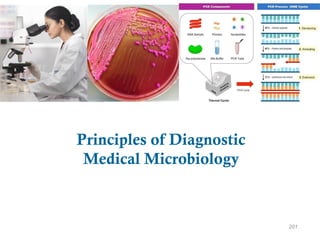
Principles of Diagnostic
Medical Microbiology
201
Introduction
 Many of the diagnostic tests require viable samples,
and the quality of the results depends on
• quality of the specimen collected from the patient
• means by which it is transported from the patient to the
laboratory
• techniques used to demonstrate the microbe in the
sample
202
Introduction
 Detection of pathogens in clinical specimens is
accomplished by five general procedures:
1. Microscopy
2. Culture
3. Detection of bacterial antigens
4. Detection of an antibody response to the bacteria
5. Detection of specific bacterial nucleic acids
203
Microscopy
 Microscopy is used in Microbiologyfor
two basic purposes
• initial detection of bacteria
• preliminary or definitive identification
• Identification of parasites
• Identification of fungi
 Morphologic properties can be used
for preliminary identification of most
bacteria
 Microscopic detection of bacteria
stained with antibodies labeled with
fluorescent dyes very useful for the
specific identification
204
Microscopy
 If a specimen is collected from a
sterile body site (e.g. sterile tissues,
CSF, joint fluid) a sample of the
specimen can be prepared for
microscopic examination using
 Wet mount (direct examination)
 Staining methods
205
Microscopy
 Microscopic examination can provide
• Shape of the organisms
• Relative size
• Arrangement (e.g., chains or
clusters)
• whether the bacteria are gram-
positive, gram-negative, or acid-
fast
• whether only one or more than
one type of bacteria is present
 The microscopic appearance is
typically not sufficient to definitively
identify a bacteria
• Guides empiric therapy
206
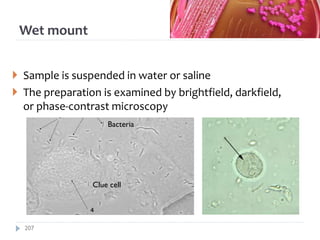
Wet mount
 Sample is suspended in water or saline
 The preparation is examined by brightfield, darkfield,
or phase-contrast microscopy
Clue cell
Bacteria
207
Wet mount
208
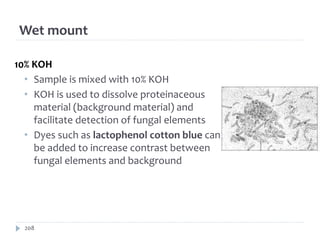
10% KOH
• Sample is mixed with 10% KOH
• KOH is used to dissolve proteinaceous
material (background material) and
facilitate detection of fungal elements
• Dyes such as lactophenol cotton blue can
be added to increase contrast between
fungal elements and background
Wet mount (Direct Examination)
209
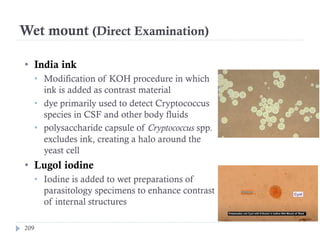
• India ink
• Modification of KOH procedure in which
ink is added as contrast material
• dye primarily used to detect Cryptococcus
species in CSF and other body fluids
• polysaccharide capsule of Cryptococcus spp.
excludes ink, creating a halo around the
yeast cell
• Lugol iodine
• Iodine is added to wet preparations of
parasitology specimens to enhance contrast
of internal structures
Stains
 Smears can be made from relevant
tissues and body fluids
 Smears are fixed to the slides with
either heat or methanol
 Methanol fixation is preferred since
heating may
• produce artifacts
• create aerosols
• not adhere the specimen
adequately to the slide
 A variety of stains can then be used to
help visualize and differentiate
bacteria from the specimen
210
• First described by Hans Christian Joachim
Gram in 1884
• Based on differences in cell wall structure
• Bacteria are classified as
– Gram-positive: retain the primary crystal
violet dye and appear deep blue or purple
– Gram negative: decolorized subsequently
taking up the counterstain safranin and
appear red or pink
• Not useful for bacteria that are too small or
lack a cell wall, e.g., Treponema, Mycoplasma,
Chlamydia, and Rickettsia; *Mycobacteria
• Francisella, Legionella, and Brucella difficult to
visualize due to their tiny size
– Substitution of safranin with basic fuchsin
as a counterstain stain effectively
Gram stain
211
1. The smear is flooded with crystal violet (10 stain)
2. After ~15 s, the slide is washed with water
3. flooded with the mordant Gram’s iodine for 15 s
 increases the affinity of the primary stain to the
bacterial cell
4. The slide is washed with water
5. Flooded with decolorizing agent acetone-alcohol
 remove the primary stain from a Gram-
negative cell
 Gram-positive bacterial cells retain the primary
stain
6. The slide is washed immediately
7. counterstained with safranin for at least 15 s
8. This slide is then washed, blotted dry, and
examined by light microscopy at ×1,000
magnification
Gram stain
212
213
Ziehl-Neelsen procedure
 Smear is heat fixed
 The slide is then flooded with filtered
carbol fuchsin
 The slide is slowly heated to steaming
and maintained for 3-5 min
 After cooling, the slide is washed with
water and decolorized with acid-
alcohol
 The slide is counterstained for 20-30 s
with methylene blue
 An acid-fast organism will stain red
 the background of cellular elements
and other bacteria will be blue
214
Acid-fast stain
215
Modification of the Z-N
staining (Kinyoun)
 Heating during staining with carbol
fuchsin is eliminated and a higher
concentration of phenol is used in
the primary stain
 The Z-N and Kinyoun stains have the
same sensitivity and specificity
 However, the Kinyoun (cold)
staining procedure is less time-
consuming and is easier to perform
216
Modification of the Z-N
staining
 uses a weaker decolorizing agent
(0.5-1.0% sulfuric acid) in place of
the 3% acid-alcohol
 helps differentiate those organisms
known to be partially or weakly
acid-fast, particularly Nocardia
 These organisms do not stain well
with the Z-N or Kinyoun stain
217
Immunofluorescent
antibody stain
 Immunofluorescent staining consists of
1. labeling antibodies with a
fluorescent dye
2. Allowing the labeled antibodies to
react with their specific antigens
3. Observing the stained bacterial
cells under a fluorescence
microscope
 These methods allow the identification
of specific bacterial species and
subtypes based upon the specificity of
the antibody reaction, e.g., for
Legionella species
218
In Vitro Culture
219
Cultivation
220
• Cultivation is the process of propagating organisms by
providing proper nutrients and environmental conditions
• A suitable growth medium
• must contain all the nutrients required by the organism to be
cultivated
• pH, temperature, and aeration must be carefully controlled
• Requirements for growth
• Organic matter containing the elements carbon, hydrogen,
nitrogen, oxygen, phosphorus, and sulfur
• inorganic ions such as potassium, sodium, iron, magnesium,
calcium, and chloride are required to facilitate enzymatic catalysis
and to maintain chemical gradients across the cell membrane
• Sources of metabolic energy: Fermentation, Respiration
Cultivation of Bacteria
221
• Culturing/cultivation
• the process of growing Bacteria on a culture media
• Culture media
• artificial media containing the required nutrients for
bacterial growth
• Purpose of culturing:
• Isolation and identification of micro-organisms
• Performing anti-microbial sensitivity tests
In Vitro Culture
222
• The success of culture
methods is defined by
• the biology of the organism
• the site of the infection
• the patient’s immune response
to the infection
• the quality of the culture media
• Cell Culture
• Some bacteria and all viruses
are strict intracellular microbes
• they can only grow in living
cells
Forms of culture media
223
A. Solid culture media
(1.5% w/v agar)
B. Semisolid culture media
(0.4-0.5% agar) C. Fluid (broth) culture
media (no agar)
Types of culture media
224
1. Basal media (General Purpose Media)
2. Enriched media
3. Enrichment media
4. Selective media
5. Differential (Indicator) media
6. Transport media
7. Identification media
1. Basal media
– Supports growth of bacteria
that do not require special
nutrients
– Example: Nutrient
Broth, Nutrient Agar
2. Enriched media
– Media that are enriched with
whole blood, lyzed blood, Serum,
special extracts or vitamins to
support the growth of fastidious
bacteria
– E.g. Blood Agar, Chocolate Agar
225
3. Enrichment media
• Liquid media that increases the numbers
of a pathogen by containing enrichments
and/or substances that discourage the
multiplication of unwanted bacteria
• Example: Selenite F broth, Alkaline peptone water
4.Selective media
• Media which contain substances ( E.g.
Antibiotics) that prevent or slow-down
the growth of unwanted bacteria
• Example: Mannitol Salt Agar
226
Selenite F broth
Mannitol Salt Agar
5. Differential media
227
 Media to which indicator substances
are added to differentiate bacteria
 E.g. TCBS Agar differentiates
sucrose fermenting yellow colonies
of Vibrio cholerae from non-sucrose
fermenting green colonies of other
Vibrio species
6. Transport media
• Media containing ingredients to prevent the overgrowth of
commensals and ensure the survival of pathogenic bacteria
when specimens can not be cultured soon after collection
• Example: Amies transport media, Carry-Blair transport media
Culture Media preparation
228
229
Culturing and identification of bacteria
1. Inoculate the specimen on appropriate
media
2. Label the inoculated media
3. Incubate the inoculated media at an
appropriate temperature and period
(mostly 35-370C)
4. Read colony characteristics after
incubation
5. Sub-culture to get pure culture
6. Perform Gram staining
7. Perform Biochemical testing for
identification of the bacteria
230
Bacterial growth
231
Biochemical identification
232
Automated Identification Assays
233
Automated Blood Culture System
Bacterial Identification & AST
Molecular Diagnostic methods
Molecular Diagnosis of Bacteria
• Conventional methods to detect and identify bacterial
pathogens in a timely fashion is limited
• Low number of organisms present; e.g. <5 CFU of a
bacterium are usually present per ml of blood in patients
with septicemia
• some pathogens grow slowly due to their unique
metabolic requirements, which causes their
identification to be delayed; e.g Mycobacterium sp. can
take up to 8 weeks to be detected on culture media
• Common methods
• Whole genome sequencing, PCR, MALDI TOF MS
235
Polymerase chain Reaction (PCR)
Requirements
• target dsDNA, two oligonucleotides (primers), heat‐stable
DNA polymerase, the four dNTPs in a buffer solution
• The two primers are complementary to opposite strands of
the target and are usually at a distance of 100-500 bp from
each other
1. Denaturation: temperature increased to ~95°C to
denature the target dsDNA
2. Annealing: followed by cooling to approximately 60-
65°C to allow the primers to anneal to the target DNA
3. Extension: The DNA polymerase then initiates the
extension of the primers, producing new dsDNA
copies
• The amplified DNA can be detected by various methods
• use of fluorescent dyes, such as ethidium bromide, after
running a gel
• by using labeled oligonucleotides complementary to the
amplified target
236
PCR (Conventional)
237
Real‐time PCR
• Amplification of the target and detection
of the amplified product occur
simultaneously
• Using different dyes, fluorescence
emission is generated proportional to the
amount of the amplified product
• The cycle threshold (CT) is the cycle
number at which fluorescence passes the
fixed threshold
• The number of copies in the sample is
calculated by determining the CT and
using a standard curve to determine the
starting number of nucleic acid copies
238
Real‐time PCR
239
Serologic Diagnosis
240
Serologic Diagnosis
241
• Immunologic techniques are used
• to detect, identify, and quantitate antigen in clinical samples
• to evaluate the antibody response to infection and a person’s
history of exposure to infectious agents
• The specificity of the antibody-antigen interaction and the
sensitivity of many of the immunologic techniques make
them powerful laboratory tools
• Quantitation of the antibody strength is obtained as a titer
• The titer of an antibody is defined as the greatest dilution
of the sample that retains a detectable activity
Serologic Diagnosis
Methods of Detection
• Antibody-antigen complexes
can be detected
• directly, by precipitation
techniques, or by labeling the
antibody with a radioactive,
fluorescent, or enzyme probe
• indirectly through
measurement of an antibody-
directed reaction, such as
complement fixation
242
RPR
Antimicrobial Susceptibility
Testing (AST)
243
Antimicrobial Susceptibility
Testing (AST)
 provides information to the
clinician to guide selection of
appropriate antimicrobial therapy
 Are in vitro tests
• simply a measurement of the effect
of the antibiotic against the organism
under specific conditions
244
Antimicrobial Susceptibility Testing
(AST)
Methods
 Disk diffusion
 Broth dilution
 Antimicrobial gradient
 Automated instrument methods
 molecular methods for resistance genes
245
Disk diffusion (Kirby‐Bauer method)
 named after the individuals who
proposed this approach
 relies on paper disks impregnated with
a set concentration of antimicrobial(s)
 Disks are placed on a solid medium,
e.g., Mueller‐Hinton agar, that has been
inoculated with a standardized lawn of
bacteria
 Upon incubation, the antimicrobial
diffuses into the medium in a circular
fashion
 If the antimicrobial inhibits the growth
of the organism, a zone of inhibition is
created around the disk and is
measured in millimeters after a
specified incubation time
246
Disk diffusion (Kirby‐Bauer method)
 Placement of discs manual
Manual
Disc Dispenser
247
Disk diffusion (Kirby‐Bauer method)
 Measuring zone of inhibition (in mm)
248
Minimal inhibitory concentration
(MIC)
 MIC can be determined by
• Broth dilution assay
• Agar dilution assay
 Test principle
• antimicrobials are diluted in broth or in agar and
inoculated with a standard concentration of organism
• The lowest antimicrobial concentration at which the
growth of the organism is macroscopically inhibited is
defined as the MIC (micrograms per milliliter)
249
Minimal inhibitory concentration
(MIC)
250
Antimicrobial Susceptibility Testing
(AST)
 Published guidelines
• Clinical and Laboratory Standards Institute (CLSI)
• European Committee on Antimicrobial Susceptibility Testing
 Breakpoints are set for each antimicrobial as MIC (in µg/ml) or
Zone diameter (in mm) that corresponds to the likelihood that
the antimicrobial will be effective in vivo
 Interpretation of the MIC or zone diameter
• Susceptible: there is a high likelihood of therapeutic success
• Intermediate: a zone b/n susceptible and resistant where, if the
drug is used for treatment in some settings, it may be adequate
but caution must be taken to monitor for treatment failure
• Resistant: the antimicrobial has a high probability of clinical failure
* Nonsusceptible: a term used for isolates where only
susceptibility breakpoints have been established due to a lack
of resistant strains
251
Antimicrobial Susceptibility Testing
(AST)
Molecular testing
 limited mainly by the complexity of genes that code for
resistance to certain antimicrobials
 Detect genes responsible for selected resistance
mechanisms expressed by a particular organism toward an
antimicrobial or class of antimicrobials
 Common resistance genes tested
• the mecA gene in methicillin‐resistant S. aureus
• vanA and vanB genes in Enterococcus species
• ESBL genes in members of the Enterobacterales
• carbapenemase genes in Gram‐negative organisms
• the rhoB gene in rifampin‐resistant M. tuberculosis
252
END
253

General Microbiology-AMC-2024_Complete.pdf

  • 1.
    AFRICA MEDICAL COLLEGE Microbiologyfor MD Dr. Alem A. (PhD, Medical Microbiology) Dec, 2024
  • 2.
    Course content 2 1. Chapter1: General Microbiology 2. Chapter 2: Systematic Bacteriology 3. Chapter 3: Systematic Virology 4. Chapter 4: Systematic Mycology 5. Chapter 5: System based microbial infections (Group Seminar)
  • 3.
    Assessement 3 1. Tests: 1,2, 3 2. Lab report 3. Attendance 4. Individual presentation 5. Group presentation 6. Final Exam 7. Oral Exam
  • 4.
    What is Microbiology? 4 •Microbiology is the study of all living organisms that are too small to be visible with the naked eye • Bacteria • Protozoa • Fungi • Viruses • Prions • Archaea • Algae • Collectively known as microbes or Microorganisms • There are thousands of different types of microbes that live in, on, and around us—and hundreds that cause serious human diseases
  • 5.
    What is Microbiology… 5 •Microbiology • Medical Microbiology • Food Microbiology • Veterinary Microbiology • Plant Microbiology • Pharmaceutical Microbiology • Applied Microbiology • Industrial Microbiology • Soil Microbiology • Etc. • Microbiology • Bacteriology • Virology • Mycology • Immunology • Parasitology
  • 6.
    What is Microbiology… 6 •The agents of human infectious diseases belong to five major groups • Bacteria, Fungi, Protozoa, Helminths, Viruses • Bacteria, fungi, protozoa, and helminths are cellular, whereas viruses are not → 3 criteria • Structure • Method of replication • Nature of the nucleic acid
  • 7.
    Viruses are notcellular… 7 Structure • Cells • have a nucleus or nucleoid, which contains DNA • surrounded by cytoplasm, where proteins are synthesized and energy is generated • Viruses • have an inner core of genetic material (either DNA or RNA) • no cytoplasm, and so they depend on host cells to provide the machinery for protein synthesis and energy generation
  • 8.
    Viruses are notcellular… 8 Method of replication • Cells replicate either by binary fission or by mitosis • one parent cell divides to make two progeny cells while retaining its cellular structure • Prokaryotic cells (e.g., bacteria) replicate by binary fission • Eukaryotic cells replicate by mitosis • Viruses • disassemble, produce many copies of their nucleic acid and protein, and then reassemble into multiple progeny viruses • Viruses must replicate within host cells because they lack protein-synthesizing and energy-generating systems
  • 9.
    Viruses are notcellular… 9 Nature of the nucleic acid • Cells • contain both DNA and RNA, • Viruses • contain either DNA or RNA, but not both
  • 10.
    Eukaryotes and Prokaryotes 10 •Based on their structure and the complexity of their organization, cells are classified in to A. Eukaryotic B. prokaryotic • Fungi, protozoa, and helminths are eukaryotic • Bacteria are prokaryotic • Viruses are neither eukaryotic nor prokaryotic
  • 11.
    Eukaryotes and Prokaryotes… 11 •The eukaryotic cell has a true nucleus • multiple chromosomes • surrounded by a nuclear membrane • uses a mitotic apparatus to ensure equal allocation of the chromosomes to progeny cells • The prokaryotic cell has nucleoid • typically consists of a single circular molecule of loosely organized DNA • lacks a nuclear membrane and mitotic apparatus
  • 12.
    Eukaryotes and Prokaryotes… 12 •Eukaryotic cells contain organelles, such as mitochondria and lysosomes • Prokaryotes contain no organelles • Eukaryotic cells contain larger ribosomes (80S) compared to prokaryotes (70S) • Most prokaryotes have a rigid external cell wall that contains peptidoglycan (a polymer of amino acids and sugars) • Eukaryotes do not contain peptidoglycan • Eukaryotes are either bound by a flexible cell membrane, or, in the case of fungi, they have a rigid cell wall with chitin
  • 13.
    Eukaryotes and Prokaryotes… 13 •The eukaryotic cell membrane contains sterols, whereas no prokaryote, except the wall-less Mycoplasma, has sterols in its membranes • Most protozoa and some bacteria are motile, whereas fungi and viruses are non-motile • The protozoa are a heterogeneous group that possesses three different organs of locomotion: flagella, cilia, and pseudopods • The motile bacteria move only by means of flagella
  • 14.
  • 15.
    Scientific nomenclature ofMicrobes 15 • Bacteria, fungi, protozoa, and helminths are named according to the binomial Linnean system that uses genus and species • Example: Escherichia coli, Escherichia is the genus and coli is the species name • Viruses typically have a single name, such as poliovirus, measles virus, or rabies virus. • Some viruses have names with two words, such as herpes simplex virus, but those do not represent genus and species
  • 16.
    Microorganisms 16 • Are smallliving things which are too small to be seen with our necked eye • Includes bacteria, fungi, protozoa • Viruses, which are microscopic but not cellular, are also included in this group
  • 17.
    Bacteria 17 • Relatively simplein structure • They are prokaryotic organisms; i.e. simple unicellular organisms with no nuclear membrane, mitochondria, Golgi bodies, endoplasmic reticulum • Reproduce by asexual division; i.e. by dividing into two equal cells called binary fission • Are enclosed in cell walls except Mycoplasma species • Classified by size (1 to 20 µm or larger), shape (spheres, rods, spirals), and arrangement (single cells, chains, clusters) • The human body is inhabited by thousands of different bacterial species: as commensal or pathogen • Bacteria also exist in the environment: air, water, food • Most are avirulent
  • 18.
    Fungi 18 • The cellularstructure of fungi is more complex compared to bacteria • Fungi are eukaryotic organisms that contain a well-defined nucleus, mitochondria, Golgi bodies, and endoplasmic reticulum • Fungi can exist either in a unicellular form (yeast) that can replicate asexually or in a filamentous form (mold) that can replicate asexually and sexually • Most fungi exist as either yeasts or molds; however, some fungi can assume either morphology (dimorphic fungi)
  • 19.
  • 20.
    Parasites 20 • Parasites arethe most complex microbes • All parasites are eukaryotic • some are unicellular and others are multicellular • Parasites range in size from tiny protozoa as small as 4 to 5 µm in diameter to tapeworms that can measure up to 10 meters in length and arthropods (bugs) • Reproduce sexually or asexually
  • 21.
    Viruses 21 • Viruses arethe smallest infectious particles, ranging in diameter from 18 to 600 nanometers • Viruses typically contain either DNA or RNA but not both − some viral-like particles do not contain any nucleic acids; e.g., prions − the recently discovered Mimivirus contains both RNA and DNA • Viruses are made up of nucleic acids enclosed in a protein shell with or without a lipid membrane coat • Viruses are true parasites, requiring host cells for replication − Obligate intracellular • More than 2000 species of viruses have been described, with approximately 650 infecting humans and animals
  • 22.
    Comparison of MedicallyImportant Organisms 22
  • 23.
    History of Microbiology 23 A.Robert Hooke, an Englishman, in 1665 • Observed a thin slice of cork using relatively crude microscope • life's smallest structural units: "little boxes“ or "cells” • Using his improved version of a compound microscope Hooke was able to see individual cells • His discovery marked the beginning of the cell theory • Though Hooke's microscope was capable of showing large cells, it lacked the resolution to see microbes
  • 24.
    History… 24 A. Antoni vanLeeuwenhoek in 1673 • Using his microscope he observed small creatures what he called ‘animalcules’ • Leeuwenhoek’s microscopes could magnify up to 300x • From where did these small creatures come? • Arguments about the origin of living things • Spontaneous generation theory • The theory of biogenesis a: lens b: mounting pin c and d: focusing screws
  • 25.
    History… 25 Spontaneous generation theory •Living organisms could arise spontaneously from non-living matter • snakes and mice could be born of moist soil • Flies could emerge from manure • maggots, the larvae of flies, could arise from decaying corpses The theory of biogenesis • life arises only from already existing life
  • 26.
    Francesco Redi (1626–1697)in 1668 26 • larvae found on putrefying meat arose from eggs deposited by flies • the beginning of the end for the spontaneous generation theory Experiment a) Redi filled three jars with decaying meat b) The first left unsealed • flies laid eggs on the meat, and eggs developed into larvae c) The second jar was sealed • flies could not lay their eggs on the meat, no maggots appeared d) The third jar was covered with fine net (gauze) • flies kept away, and no maggots appeared on the meat • Scientists began to doubt spontaneous generation theory and adopt the view that animals come only from other animals
  • 27.
    John T. Needham(1713–1781), 1745, British investigator 27 • He boiled beef gravy and infusions of plant material in vials, which he then tightly sealed with corks • Some days later, Needham observed that the vials were cloudy, and examination revealed an abundance of “microscopical animals of most dimensions” • As he explained it, there must be a “life force” that causes inanimate matter to spontaneously come to life because he had heated the vials sufficiently to kill everything
  • 28.
    Lazzaro Spallanzani (1729–1799),in 1799, Italian 28 • reported results that contradicted Needham’s findings • Spallanzani boiled infusions for almost an hour and sealed the vials by melting their slender necks closed • His infusions remained clear unless he broke the seal and exposed the infusion to air, after which they became cloudy with microorganisms • Criticisms of Spallanzani’s work • his sealed vials did not allow enough air for organisms to thrive • his prolonged heating destroyed the “life force.”
  • 29.
    The theory ofbiogenesis… Louis Pasteur (1822–1895) • He disproved the theory of spontaneous generation once and for all • Done a series of experiments that led to the acceptance of biogenesis • experiment using his swan-necked flasks in 1861 29
  • 30.
    Louis Pasteur’s experiments 30 •Pasteur demonstrated that microorganisms are present in the air and can contaminate sterile solutions, but air itself does not create microbes • He filled several short-necked flasks with beef broth and then boiled their contents. • Some were then left open and allowed to cool • In a few days, the open flasks were found to be contaminated with microbes whereas the sealed flasks were free of microorganisms
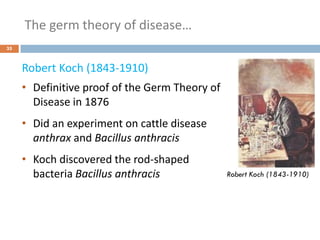
  • 31.
  • 32.
    The Germ Theoryof Disease 32 Pasteur’s observation on wine spoilage • when lactic acid was produced in wine (spoiled), rod- shaped bacteria were always present, as well as the expected yeast cells • This led him to believe “while the yeast produced the alcohol the bacteria were responsible for the spoilage” • This led to “microorganisms may also be responsible for diseases in humans, animals and plants”
  • 33.
    The germ theoryof disease… 33 Joseph Lister • indirect, evidence on the involvement of microorganisms in infections of humans • The use of heat-treated instruments and spraying phenol on dressings and over the surgical area reduced the number of fatalities following surgery
  • 34.
    The germ theoryof disease… 34 Friedrich Henle in 1840 (German pathologist) • proposed criteria for proving that microorganisms were responsible for causing human disease (the "germ theory" of disease)
  • 35.
    The germ theoryof disease… 35 Robert Koch (1843-1910) • Definitive proof of the Germ Theory of Disease in 1876 • Did an experiment on cattle disease anthrax and Bacillus anthracis • Koch discovered the rod-shaped bacteria Bacillus anthracis Robert Koch (1843-1910)
  • 36.
    Robert Koch’s Experiment 36 a.Koch discovered Bacillus anthracis in the blood of cattle that had died of anthrax b. He cultured the bacteria on artificial media c. He injected samples of the culture into healthy animals d. These animals became sick and died of anthrax e. He isolated the same bacteria in their blood
  • 37.
  • 38.
    Koch’s postulates 38 1. Themicroorganism must be present in every instance of the disease and absent from healthy individuals 2. The microorganism must be capable of being isolated and grown in pure culture 3. When the microorganism is inoculated into a healthy host, the same disease condition must result 4. The same microorganism must be re-isolated from the experimentally infected host
  • 39.
    Exceptions to Koch’spostulates 39 • Many healthy people carry pathogens but do not exhibit symptoms of the disease • Some microbes are very difficult or impossible to grow in artificial media. E.g. Treponema pallidum • Many species are species specific. E.g. Brucella abortus cause abortion in animals but not in humans • Certain diseases develop only when an opportunistic pathogen invades immuno-compromised host
  • 40.
    • Pathogen: a microorganism capableof causing disease • Normal flora: microorganisms that inhabit the skin and mucous membranes of healthy normal persons • Importance: defense against microbial pathogens → by competing for attachment and nutrition 40
  • 41.
  • 42.
    Bacteria • Are prokaryoticunicellular organisms • Are relatively simple in structure • Have no membrane bound organelles: mitochondria, Golgi bodies, or endoplasmic reticulum • Most of them fall within a range of 0.2-2 μm • The smallest bacteria (Chlamydia and Rickettsia) are 0.1-0.2 μm in diameter 42
  • 43.
    Introduction to bacterialclassification • Classification is the categorization of organisms into taxonomic groups Linnaeus’s system • By Swedish botanist Carolus Linnaeus (1707–1778) • Strains with 97% similarity are grouped in to the same species • Classification criteria • Morphology • Biochemical characteristics • Physiologic Characteristics • Genetic analysis Kingdom Phylum Class Order Family Genus Species Strain 43
  • 44.
  • 45.
  • 46.
  • 47.
  • 48.
    Cytoplasmic components 48 The cytoplasmof the bacterial cell contains the • DNA chromosome • Plasmid • Ribosomes • mRNA • Proteins • Metabolites
  • 49.
    Cytoplasmic components 49 Bacterial chromosome •Single, circular, double-stranded DNA • Contained in a discrete area called nucleoid • No nuclear membrane → simplifies synthesis of proteins • No histones to maintain the conformation of the DNA
  • 50.
    Cytoplasmic components… 50 Plasmids • extrachromosomal,double-stranded, circular DNA molecules that are capable of replicating independently • are usually extrachromosomal, but can be integrated into the bacterial chromosome • may occur in both gram-positive and gram-negative • Transmissible vs Non-transmissible plasmids • not usually essential for cellular survival, often provide a selective advantage • Antibiotic resistance • Resistance to ultraviolet light • Exotoxins • Bacteriocins • Pili (fimbriae) • Resistance to heavy metals, such as mercury
  • 51.
    Cytoplasmic components… 51 Transposons • arepieces of DNA that move readily from one site to another either within or between the DNAs of bacteria, plasmids, and bacteriophages → nicknamed “jumping genes” • Replicative transposition − move by replicating their DNA and inserting the new copy into another site • Direct transposition − excised from the site without replicating and then inserted into the new site • Transposons can code for − drug-resistant enzymes, toxins, or a variety of metabolic enzymes − can either cause mutations in the gene into which they insert or alter the expression of nearby genes
  • 52.
    Cytoplasmic components… 52 Ribosome • Siteof protein synthesis • Consists of 30S + 50S subunits, forming a 70S ribosome S=Svedberg units(rate of sedimentation in a centrifuge) • The proteins and RNA of the bacterial ribosome are significantly different from those of eukaryotic ribosomes • major targets for antibacterial drugs
  • 53.
    Cytoplasmic components… 53 Cytoplasmic inclusion(Granule) • The cytoplasm of bacteria contains several different types of granules that serve as storage areas for nutrients
  • 54.
    Cytoplasmic membrane (CM) 54 •lipid bilayer structure similar to the structure of the eukaryotic membranes • but it contains no sterols (e.g., cholesterol) except the mycoplasmas • The membrane has four important functions a. active transport of molecules into the cell b. energy generation by oxidative phosphorylation c. synthesis of precursors of the cell wall d. secretion of enzymes and toxins
  • 55.
    Cell wall 55 • Allbacteria except Mycoplasma posses a thick, rigid cell wall external to the cytoplasmic membrane • Bacteria possess Peptidoglycan (murein) as major cell wall component → unique to bacteria • Functions • maintain the shape of a bacterium • serves as a point of anchorage for flagella • Protects the interior of the cell from adverse changes in the outside environment
  • 56.
    Cell wall ofGram-positive bacteria 56 • Thick, multilayered mainly consisting of peptidoglycan • Other components: proteins, teichoic and lipoteichoic acids, and complex polysaccharides (C polysaccharides) • Teichoic acids • are water-soluble, covalently linked to peptidoglycan • important virulence factors • Lipoteichoic acids • have a fatty acid and are anchored in the cytoplasmic membrane • important in serotyping • promote attachment to other bacteria and to specific receptors
  • 57.
    Cell wall ofGram-negative bacteria 57 • more complex than gram- positive cell walls, both structurally and chemically • Thin peptidoglycane (5-10% of the gram-negative cell wall by weight) • Possess outer membrane (unique to gram-negative bacteria) • Lipopolysaccharide (endotoxin), Porin proteins • Periplasmic space • Site for variety of hydrolytic enzymes
  • 58.
    Cell wall ofGram-negative bacteria 58 • Porins • allow diffusion of hydrophilic molecules less than 700 Da in mass through the membrane • restricts entry of large and hydrophobic molecules including many antimicrobials • Lipoprotein • covalently attached to the peptidoglycan and is anchored in the outer membrane • provide a membranous route for the delivery of newly synthesized outer membrane components to the outer membrane
  • 59.
    Cell Walls ofAcid-Fast Bacteria 59 • Have an unusual cell wall containing high concentration of lipids, called mycolic acids. E.g. Mycobacteria, Nocardia
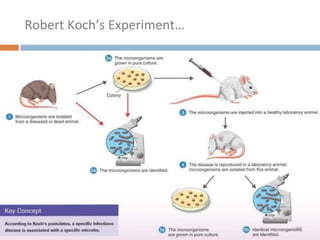
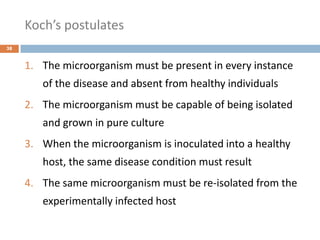
  • 60.
    External structures 60 Glycocalyx • Viscous,gelatinous polymer external to the cell wall • For the most part, it is made inside and secreted to cell surface • If organized and is firmly attached to the cell wall → capsule • If unorganized and loosely attached to the cell wall → slime layer • Capsule • important bacterial virulence factor • prevent phagocytosis • Slime layer • adherence of bacteria to other bacteria and surfaces in their environment → Biofilm i. Glycocalyx ii. Flagella iii. Pili and Fimbriae
  • 61.
    Flagella 61 • are ropelikepropellers composed of helically coiled protein subunits (flagellin) • are anchored in the bacterial membranes • provide motility for bacteria, allowing the cell to swim (chemotaxis) toward food and away from poisons • express antigenic and strain determinants and are a ligand for a pathogen PRRs • four types of arrangement are known a) monotrichous (single polar flagellum) b) lophotrichous (multiple polar flagella) c) amphitrichous (flagella at both poles of the cell d) peritrichous (flagella distributed over the entire cell)
  • 62.
  • 63.
    Fimbriae and Pili 63 •Fimbriae (pili) (Latin for “fringe”) • are hairlike structures on the outside of bacteria composed of protein subunits (pilin) • morphologically distinguished from flagella • are smaller in diameter (3-8 nm versus 15-20 nm) • usually are not coiled in structure • Fimbriae promote adherence to other bacteria or to the host • F pili (sex pili) • bind to other bacteria & are a tube for transfer of DNA between bacteria • are encoded by a plasmid (F)
  • 64.
    Bacterial spores (endospores) 64 •Spores have a thick, keratin-like coat that allows them to survive for many years, especially in the soil • Spores are formed when nutrients are in short supply • When nutrients are restored, spores germinate to form bacteria that can cause disease • Spores are metabolically inactive but contain DNA, ribosomes, and other essential components • Spores are medically important because they are highly heat resistant and are not killed by many disinfectants • Formed by certain gram-positive rods, especially Bacillus and Clostridium species
  • 65.
  • 66.
    Bacterial exceptions 66 Mycobacteria • havea peptidoglycan layer (slightly different structure) surrounded by a wax like lipid coat of mycolic acid Mycoplasma • have no peptidoglycan cell wall • incorporate sterols from the host into their membranes
  • 67.
    Bacterial growth 1. Physicalrequirements • Temperature • pH • osmotic pressure 2. Chemical requirements • sources of carbon, nitrogen, Sulfur, Phosphorus, Oxygen • trace elements • organic growth factors • Growth in bacteria refers to increase in number of cells • Bacteria reproduce by binary fission, a process by which one parent cell divides to form two progeny cells • An increase in number of microbes from a single parent cell, gives to a single colony of cells Requirements for microbial growth 67
  • 68.
    Generation Time (G) •It is the time required for a bacterium to double in number • Physical and chemical conditions determine a bacteria’s generation time • Many bacteria have generation times of 1– 3 hours ₋ E. coli and S. aureus → 20 minutes ₋ Mycobacterium species → up to 10 days • Because one cell gives rise to two progeny cells, bacteria are said to undergo exponential growth (logarithmic growth) 68
  • 69.
    Growth Curve • Ifa fixed volume of liquid medium is inoculated with bacterial cells the number of viable cells per milliliter is determined and plotted as follows 69
  • 70.
    1. Lag phase –The cells are adapting to their new niche – Enzymes are synthesized to utilize broth nutrients – According to the bacteria being grown, this phase can take from less than an hour to several days 2. Log/exponential phase – There is rapid replication and reproduction – The bacteria are dividing at their greatest rate – Metabolic activity peaked high – The new cells are young, delicate and immature – These cells are susceptible to antibiotics and UV radiation 70
  • 71.
    3. Stationary phase 71 –number of cells being replicated equals number of cells dying – Nutrients are depleting → growth rate slows – Waste products are building up, causing an acidic pH – Metabolic activity is greatly reduced 4. Death/decline phase – All nutrients are totally depleted – There is tremendous buildup of metabolic waste products – Cells are dying faster than they are being replicated – Total death will occur if this culture is not transferred to a new broth tube
  • 72.
    Aerobic & AnaerobicGrowth • The natural by-products of aerobic metabolism are the reactive compounds hydrogen peroxide (H2O2) and superoxide (O2 −). • In the presence of iron, these two species can generate hydroxyl radicals (•OH), which can damage any biologic macromolecule 72
  • 73.
    Aerobic & AnaerobicGrowth… Aerobic • can survive in the presence of oxygen by possessing an elaborate system of defenses → respiration Anaerobic • Live in the absence of oxygen → fermentation • Do not possess the defenses that make aerobic life possible and therefore cannot survive in air Defense mechanisms to the reactive compounds - + a. 2O2 + 2H superoxide dismutase H2O2 + O2 b. 2H2O2 Catalase 2H2O + O2 73
  • 74.
    Aerobic & AnaerobicGrowth… • Obligate aerobes: require oxygen to grow because their ATP- generating system is dependent on oxygen as the hydrogen acceptor, E.g. M. tuberculosis • Facultative anaerobes: use oxygen, if it is present, but they can use the fermentation pathway in the absence of oxygen • Obligate anaerobes: cannot grow in the presence of oxygen because they lack either superoxide dismutase or catalase, or both. E.g. Clostridium tetani • Microaerophiles: require small amounts of oxygen (2–10%) for aerobic respiration. E.g. campylobacter species • Aerotolerant anaerobes: can grow in the presence of oxygen presence, but they do not use it as a hydrogen acceptor 74
  • 75.
    Aerobic & AnaerobicGrowth… 75
  • 76.
  • 77.
    Cultivation 77 • Cultivation isthe process of propagating organisms by providing proper environmental conditions • Bacteria divide by binary fission, asexual reproduction where a single cell divides giving rise to two cells → Those two cells give rise to four cells and so on • Because one cell gives rise to two progeny cells, bacteria are said to undergo exponential (logarithmic) growth → 2n • E.g. How many bacteria will a single bacterium produce after 4 generations? • 24 = 16 bacteria
  • 78.
    Cultivation… 78 • A suitablegrowth medium must contain all the nutrients required by the organism to be cultivated, and such factors as pH, temperature, and aeration must be carefully controlled • Requirements for growth • Organic matter containing the elements carbon, hydrogen, nitrogen, oxygen, phosphorus, and sulfur • inorganic ions such as potassium, sodium, iron, magnesium, calcium, and chloride are required to facilitate enzymatic catalysis and to maintain chemical gradients across the cell membrane • Sources of metabolic energy • Fermentation • Respiration
  • 79.
    Cultivation… 79 • Carbon • Autotrophs:bacteria that do not require organic nutrients for growth → use photosynthetic energy to reduce carbon dioxide • Heterotrophs: require organic carbon for growth, and the organic carbon must be in a form that can be assimilated • Temperature • Different microbial species vary widely in their optimal temperature ranges for growth • Psychrophilic: grow best at low temperatures (–5 to 15°C) • Psychrotrophs: prefer cooler environments, 25 °C to refrigeration temperature. E.g. Listeria monocytogenes • Mesophilic: grow best at 30–37°C • Thermophilic: grow best at 50–60°C
  • 80.
    Cultivation of Bacteria… 80 •Culture media: artificial media containing the required nutrients for bacterial growth • Culturing/cultivation: the process of growing Bacteria on a culture media • Purpose of culturing: - Isolation and identification of micro-organisms - Performing anti-microbial sensitivity tests
  • 81.
    Forms of culturemedia 81 1. Solid culture media (1.5% w/v agar) 2. Semisolid culture media (0.4-0.5% agar) 3. Fluid culture media (no agar)
  • 82.
    Types of culturemedia 82 1. Basic media 2. Enriched media 3. Enrichment media 4. Selective media 5. Differential (Indicator) media 6. Transport media 7. Identification media
  • 83.
    1. Basic media –Supports growth of bacteria that do not require special nutrients – Example: Nutrient Broth, Nutrient Agar 2. Enriched media – Media that are enriched with whole blood, lyzed blood, Serum, special extracts or vitamins to support the growth of fastidious bacteria – E.g. Blood Agar, Chocolate Agar 83
  • 84.
    3. Enrichment media –Liquid media that increases the numbers of a pathogen by containing enrichments and/or substances that discourage the multiplication of unwanted bacteria – Example: Selenite F broth media, Alkaline peptone water 4. Selective media – Media which contain substances ( E.g. Antibiotics) that prevent or slow down the growth of unwanted bacteria – Example: Mannitol Salt Agar 84
  • 85.
    5. Differential media 85 Media to which indicator substances are added to differentiate bacteria  E.g. TCBS Agar differentiates sucrose fermenting yellow colonies of Vibrio cholerae from non-sucrose fermenting green colonies of other Vibrio species 6. Transport media • Media containing ingredients to prevent the overgrowth of commensals and ensure the survival of pathogenic bacteria when specimens can not be cultured soon after collection • Example: Amies transport media, Carry-Blair transport media
  • 86.
  • 87.
    Placing antimicrobial discsMeasuring the zones of inhibition in mm Antimicrobial sensitivity testing 87
  • 88.
  • 89.
  • 90.
    3 Bacterial Genome • Bacterialgenome is the total collection of genes carried by a bacterium a. Chromosome b. Extra-chromosomal genetic elements, if any 90
  • 91.
    4 Bacterial chromosome • Bacterialhave a single, circular chromosome • Bacteria usually have only one copy of their chromosomes (haploid) • alteration of a bacterial gene (mutation) will have a more obvious effect 91
  • 92.
    5 Extra-chromosomal genetic elements •Can be transfered from one bacterium to another • Include 1. Plasmids 2. Prophages 3. Transposons 92
  • 93.
    Plasmids Small, circular, self-replicatingpieces of DNA (separate from the bacterial chromosome) Plasmids are not required for bacterial cells to survive under normal conditions Under stress, genes on plasmids can confer advantages (e.g. drug resistance, virulence factor) mayexist freely inthecytoplasm or integratedinthebacterial chromosome Plasmids that can incorporate themselves into the bacterial chromosome are called Episomes Plasmids increase geneticvariation andthusthelikelihood of survival inbacteria • • • • • • 93
  • 94.
    8 Phages • Bacteriophages areviruses that can infect bacteria • Bacteriophages infect bacterial cells either • replicate to large numbers and cause the cell to lyse (lytic infection) or • integrate into the host genome without killing the host (the lysogenic state) • Some lysogenic bacteriophages carry toxin genes (e.g., gene for the diphtheria toxin) 94
  • 95.
    9 Transposons (jumping genes) •are mobile genetic elements that can transfer DNA within a cell • from one position to another in the genome, or • between different molecules of DNA (e.g., plasmid to plasmid or plasmid to chromosome) • They do so by synthesizing a copy of their DNA and inserting the copy at another site in the bacterial chromosome or the plasmid 95
  • 96.
    Bacterial Genetics… Mutation: anychange in the base sequence of the DNA • can result in the insertion of a different amino acid or stop codon into a protein → appearance of an altered phenotype • Results from three types of molecular changes a. Base substitution b. Frameshift mutation c. when transposons or insertion sequences are integrated into the DNA 96
  • 97.
    Bacterial Genetics… • Silentmutation • change at the DNA level that does not result in any change of amino acid in the encoded protein • This type of mutation occurs because more than one codon may encode an amino acid 97
  • 98.
    Bacterial Genetics… A. Basesubstitution: occurs when one base is inserted in place of another • Missense mutation: When the base substitution results in a codon that simply causes a different amino acid to be inserted • Nonsense mutation: when the base substitution generates a termination codon that stops protein synthesis prematurely 98
  • 99.
    Bacterial Genetics… B. Frameshiftmutation • occurs when one or more base pairs are added or deleted • shifts the reading frame on the ribosome • results in incorporation of the wrong amino acids “downstream” from the mutation and in the production of an inactive protein 99
  • 100.
    Bacterial Genetics… C. Mutationoccurs when transposons or insertion sequences are integrated into the DNA • these newly inserted pieces of DNA can cause profound changes in the genes into which they insert and in adjacent genes • Many mutations occur spontaneously in nature (e.g., by polymerase mistakes) • Physical or chemical agents can also induce mutation • Physical agents: heat, ultraviolet light, ionizing radiation (such as x-rays) • Chemical mutagens: ethidium bromide, acridine derivatives, nitrous acid (HNO2) 100
  • 101.
    Transfer of DNAwithin bacterial cells A. Transposons transfer DNA from one site on the bacterial chromosome to another site or to a plasmid B. Transfer of DNA within bacteria also occurs by programmed rearrangements • movement of a gene from a silent storage site where the gene is not expressed to an active site where transcription and translation occur • the insertion of a new gene into the active site in a sequential, repeated programmed manner is the source of the consistent antigenic variation 101
  • 102.
    Transfer of DNAbetween bacterial cells • The transfer of genetic information from one cell to another can occur by three methods: • Conjugation • Transduction • Transformation • Consequences of DNA transfer • antibiotic resistance genes are spread from one bacterium to another primarily by conjugation • Several important exotoxins are encoded by bacteriophage genes and are transferred by transduction 102
  • 103.
    11 Transformation • process bywhich bacteria take up fragments of naked DNA and incorporate them into their genomes 103
  • 104.
  • 105.
    105 Transduction • transfer ofbacterial DNA from one cell to another by means of a bacteriophage infection • Two types a. generalized transduction b. specialized transduction
  • 106.
    106 Generalized transduction • Randompackaging of bacterial host cell DNA in phage capsid
  • 107.
    107 Specialized transduction • Whenprophage genome is excised it drags adjacent bacterial genes resulting in hybrid phagebacterial genome
  • 108.
    108 Conjugation • is themating of two bacterial cells • DNA is transferred from donor (male) to recipient (female) cell through sex pilus • Mating is controlled by an F (fertility) plasmid (F factor) carries the genes for the proteins required for conjugation • Conjugation is unidirectional F+ → F- • Conjugation occurs usually between members of the same or related species • conjugation can transfer conjugative plasmid or plasmid with bacterial genes to which it is integrated
  • 109.
  • 110.
    110 Conjugation…chromosome integrated plasmid SomeF+ cells have their F plasmid integrated into the bacterial DNA → can transfer part of the chromosome into another cell These cells are called Hfr (high-frequency recombination) cells the single strand of DNA that enters the recipient F– cell contains a piece of the F factor at the leading end followed by the bacterial chromosome and then by the remainder of the F factor The time required for complete transfer of the bacterial DNA is approximately 100 minutes Most matings result in the transfer of only a portion of the donor chromosome b/c the attachment b/n the two cells can break • • • • •
  • 111.
  • 112.
  • 113.
    General properties ofviruses 113 • Viruses are the smallest infectious agents (20-300 nm) • most seen only with an electron microscope • Viruses do not have cellular organization • Viruses possess either DNA or RNA • Viruses are obligate intracellular parasites • Most lack enzymes for protein or nucleic acid synthesis ̶ depend on host living cells • Viruses are known to infect all cells, including bacteria • Viruses are unaffected by antibacterial agents • Reproduce by assembly of individual components rather than by binary fission
  • 114.
    General properties ofviruses… 114 • Viruses are basically made up of nucleic acid and capsid • viral nucleic acid is contained within a capsid • Capsid is made up of protein molecules called capsomeres • The complete unit of nucleic acid and capsid is called the nucleocapsid (Virion, for naked viruses)
  • 115.
    General properties ofviruses… 115 Viral nucleic acids • The viral nucleic acid (genome) is located internally and can be either • single- or double-stranded DNA or • single- or double-stranded RNA • Only viruses have genetic material (a genome) composed of • Single-stranded DNA; E.g. Parvovirus • Double-stranded RNA; E.g. Rotavirus • The nucleic acid can be either linear or circular
  • 116.
    General properties ofviruses… 116 Viral nucleic acids… • Viral DNA is always a single molecule • Viral RNA can exist either as a single molecule or in several pieces • For example: Influenza virus and rotavirus have a segmented RNA genome • Almost all viruses contain only a single copy of their genome (i.e., they are haploid) • Exception: Retrovirus family, whose members have two copies of their RNA genome (diploid)
  • 117.
    General properties ofviruses… 117 Viral capsid & symmetry • The shape of virus particles is determined by the arrangement of the repeating subunits that form the protein coat (capsid) of the virus • The arrangement of capsomers gives the virus structure its geometric symmetry a. Icosahedral b. Helical
  • 118.
    General properties ofviruses… 118 2018 • Icosahedral ̶ capsomers are arranged in triangles that form a symmetric figure with the approximate outline of a sphere ̶ can be either enveloped or naked • Helical ̶ capsomers are arranged in a hollow coil that appears rod-shaped ̶ All human viruses with helical nucleocapsid are enveloped
  • 119.
    General properties ofviruses… 119 • The advantage of building the virus particle from identical protein subunits is twofold: a. It reduces the need for genetic information b. It promotes self-assembly (i.e., no enzyme or energy is required) • Functional virus particles have been assembled in the test tube by combining purified nucleic acid with purified proteins in the absence of cells, energy source, and enzymes
  • 120.
    General properties ofviruses… 120 Viral proteins • Viral proteins serve several important functions • Capsid proteins: protect the viral genome from degradation by nucleases • Surface proteins: mediate the attachment of the virus to specific receptors on the host cell surface • The interaction of the viral proteins with the cell receptor is the major determinant of species and organ specificity • Outer viral proteins are also important antigens that induce neutralizing antibody and activate cytotoxic T cells • The term “serotype” is used to describe a subcategory of a virus based on its surface antigens
  • 121.
    Viral classification 121 • Basedon their genetic material as DNA and RNA viruses • Based on presence/absence of envelope, viruses are classified as 1. Necked viruses: consists of only nucleocapsid 2. Enveloped viruses: consists of nucleocapsid surrounded by an outer envelope or membrane • matrix protein, mediates the interaction between the capsid proteins and the envelope
  • 122.
    Viral classification 122 Naked (un-enveloped)viruses • Capsid is a rigid structure → withstand harsh environmental conditions → survive well in the outside world • Environmentally stable to: temperature, acid, proteases, detergents and drying • Released from cell by lysis
  • 123.
    Viral classification… 123 Enveloped viruses •Frequently possess glycoproteins in the form of spike-like projections on the surface, which attach to host cell receptors • The viral envelope is acquired as the virus exits from the cell in a process called “budding” • The envelope of most viruses is derived from the cell’s outer membrane • Exception: herpesviruses that derive their envelope from nuclear membrane • Readily disrupted by drying, acidic conditions, detergents, heat • Must remain wet and are generally transmitted in fluids, respiratory droplets, blood, and tissue
  • 124.
    Atypical virus-like agents 124 Defectiveviruses • composed of viral nucleic acid and proteins but cannot replicate without a “helper” virus, which provides the missing function • Defective viruses usually have a mutation or a deletion of part of their genetic material Pseudovirions • contain host cell DNA instead of viral DNA within capsid • Formed during infection with certain viruses when the host cell DNA is fragmented and pieces of it are incorporated within the capsid protein • can infect cells, but do not replicate
  • 125.
    Atypical virus-like agents… 125 Viroids •consist solely of a single molecule of circular RNA without a protein coat or envelope • The RNA is quite small and apparently does not code for any protein • Can replicate, but the mechanism is unclear • Cause several plant diseases but are not implicated in any human disease
  • 126.
    Atypical virus-like agents… 126 Prions •are infectious particles that are composed solely of protein • they contain no detectable nucleic acid • implicated as the cause of certain “slow” diseases called transmissible spongiform encephalopathies • Different from viruses b/c posses neither DNA nor RNA • Much more resistant to inactivation by ultraviolet light and heat than are viruses • remarkably resistant to formaldehyde and nucleases. • inactivated by hypochlorite, NaOH, and autoclaving • no immune response is formed against this protein • there is no inflammatory response in infected brain tissue
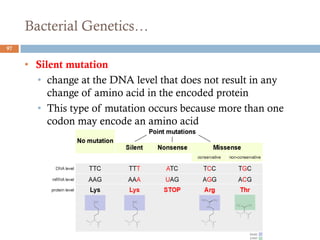
  • 127.
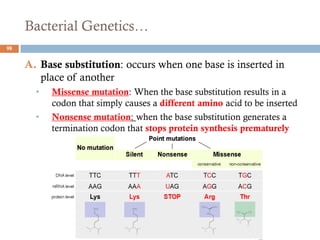
    Viral Replication 127 • Virusesshould infect cells in order to replicate • The cell acts as a factory, providing the substrates, energy, and machinery necessary for the synthesis of viral proteins and replication of the genome • Processes not provided by the cell must be encoded in the genome of the virus • Each infected cell may produce as many as 100,000 particles • only 1-10% of these particles may be infectious • The noninfectious particles (defective particles) result from mutations and errors in the manufacture and assembly of the virion
  • 128.
    Steps in ViralReplication 128 1. Recognition of the target cell 2. Attachment 3. Penetration 4. Uncoating 5. Macromolecular synthesis a. Early mRNA and nonstructural protein synthesis: genes for enzymes and nucleic acid–binding proteins b. Replication of genome c. Late mRNA and structural protein synthesis d. Posttranslational modification of protein 6. Assembly of virus 7. Budding of enveloped viruses 8. Release of virus
  • 129.
    Viral Replication 129 Recognition ofand attachment to the target cell • The 1st step during virus replication • The virus must recognize an appropriate target cell and attach to receptors on the cell • determines which cells can be infected by a virus • Viral attachment structure • Naked viruses: part of capsid or a protein that extends from the capsid • Enveloped viruses: glycoproteins
  • 130.
    Viral Replication 130 Penetration • Interactionsbetween multiple VAPs and cellular receptors initiate the internalization of the virus into the cell • Most nonenveloped viruses enter the cell by receptor-mediated endocytosis or by viropexis • Enveloped viruses • fuse their membranes with cellular membranes to deliver the nucleocapsid or genome directly into the cytoplasm → neutral PH • internalized by endocytosis, and fusion occurs in an endosome at acidic pH
  • 131.
    Viral Replication 131 Uncoating • Onceinternalized • nucleocapsid delivered to the site of replication within the cell and the capsid or envelope removed • The genome of DNA viruses, except for poxviruses, must be delivered to the nucleus • Most RNA viruses remain in the cytoplasm • except for orthomyxoviruses and retroviruses
  • 132.
    Viral Replication 132 Macromolecular synthesis •Once inside the cell, the genome must direct • the synthesis of viral mRNA and protein • generate identical copies of itself • Transcription of the DNA virus genome (except for poxviruses) occurs in the nucleus, using host cell polymerases and other enzymes for viral mRNA synthesis • RNA viruses must encode the necessary enzymes for transcription and replication
  • 133.
    Viral Replication 133 • Positive-strandRNA viral genomes • act as mRNA, bind to ribosomes, and direct protein synthesis • The naked ps-RNA viral genome is sufficient to initiate infection by itself • E.g. picornaviruses, caliciviruses, coronaviruses, flaviviruses, and togaviruses
  • 134.
    Viral Replication 134 • Negative-strandRNA viral genomes • are the templates for production of individual mRNAs • The negative-strand RNA genome is not infectious nor can it bind to the ribosome • a polymerase must be carried into the cell with the genome to make mRNAs • Rhabdoviruses, orthomyxoviruses, paramyxoviruses, filoviruses, and bunyaviruses
  • 135.
    Viral Replication 135 Assembly • Theassembly process begins when the necessary pieces are synthesized • Assembly of DNA viruses other than poxviruses occurs in the nucleus and requires transport of the virion proteins into the nucleus • RNA virus and poxvirus assemblies occur in the cytoplasm Release • Viruses can be released from cells after lysis of the cell, by exocytosis, or by budding from the plasma membrane
  • 136.
    Viral replication Recognition ofthe targetcell ↓ Attachment/Adsorption ↓ Penetration ↓ Uncoating ↓ Macromolecularsynthesis ↓ Assemblyof virus ↓ Releaseof virus 136
  • 137.
    Outcomes of viralinfection of a cell 137 1. Death 2. Fusion of cells to form multinucleated cells 3. Malignant transformation 4. No apparent morphologic or functional change
  • 138.
  • 139.
    Introduction 139 • Mycology isthe study of fungi • There are ~80,000 species of fungi • fewer than 400 are medically important • less than 50 species cause more than 90% of the fungal infections of humans and other animals • Fungi are ubiquitous as free-living organisms • Important commercially in baking, brewing and in pharmaceuticals
  • 140.
    Characteristics of Fungi 140 •Fungi are classified into their own separate kingdom, Kingdom Fungi (Myceteae) • They are eukaryotic organisms but are distinguished from other eukaryotes by possession of: • rigid cell wall composed of chitin and glucan • cell membrane in which ergosterol is substituted for cholesterol as the major sterol component • Relative to bacteria, fungi are slow growing with cell- doubling times in terms of hours rather than minutes • Fungi have emerged in the past three decades as major causes of human disease
  • 141.
    Characteristics of Fungi… 141 •Most fungi are obligate aerobes; some are facultative anaerobes; but none are obligate anaerobes • All fungi require a preformed organic source of carbon • hence their frequent association with decaying matter • The natural habitat of most fungi is, therefore, the environment • An important exception is Candida albicans, which is part of the normal human flora
  • 142.
    Characteristics of Fungi… 142 •Some fungi reproduce sexually by mating and forming sexual spores (e.g., zygospores, ascospores, and basidiospores) • Most fungi of medical interest propagate asexually by forming conidia (asexual spores) from the sides or ends of specialized structures A. Arthrospores: arise by fragmentation of the ends of hyphae and are the mode of transmission of Coccidioides immitis B. Chlamydospores: are rounded, thick-walled, and quite resistant C. Blastospores: are formed by the budding process by which yeasts reproduce asexually D. Sporangiospores: are formed within a sac (sporangium)
  • 143.
    Asexual spores 143 Blastoconidia (Candida) Chlamydospores(Candida) Arthrospores (Coccidioides) Sporangia and sporangiospores (Mucor) Microconidia (Aspergillus) Microconidia and macroconidia (Microsporum)
  • 144.
    Comparison of Fungiand Bacteria 144
  • 145.
    Fungal classification Based onmorphology a) Yeasts • Unicellular w/c reproduces by budding or by fission • produce round, pasty, or mucoid colonies on agar b) moulds • multicellular organisms consisting of threadlike tubular structures called hyphae • The hyphae form together to produce a matlike structure called a mycelium • The colonies formed by moulds are often described as filamentous, hairy, or woolly 14 5
  • 146.
  • 147.
  • 148.
    Fungal classification… c. Dimorphicfungi • exhibit thermal dimorphism (i.e., exist as yeast at body temperature [37°C] and mould at room temperature [25°C]) • Example o Histoplasma capsulatum o Blastomyces dermatitidis o Coccidioides immitis o Paracoccidioides brasiliensis 14 8
  • 149.
    Classification of HumanMycoses 1) Superficial mycoses  Infections limited to the very superficial surfaces of the skin and hair 2) Cutaneous mycoses  infections of the keratinized layer of skin, hair, and nails  These infections may elicit a host response and become symptomatic 3) Subcutaneous mycoses  involve the deeper layers of the skin, including the cornea, muscle, and connective tissue 14 9
  • 150.
    Classification of HumanMycoses… 4) Endemic mycoses (systemic mycoses) • Are caused by the classic dimorphic fungal pathogens • these organisms are true pathogens and can cause infection in healthy individuals • All of these agents produce a primary infection in the lung, with subsequent dissemination to other organs and tissues 5) Opportunistic mycoses • infections caused by fungi that are normally found as human commensals or in the environment 15 0
  • 151.
    Fungal Toxins &Allergies 151 • Amanita mushrooms • produce five toxins • amanitin and phalloidin: potent hepatotoxins • amanitin inhibit cellular RNA polymerase → prevents mRNA synthesis • Aflatoxins • produced by Aspergillus flavus that cause liver damage and tumors in animals • ingested with spoiled grains and peanuts • metabolized by the liver to the epoxide, a potent carcinogen • Aflatoxin B1 induces a mutation in the p53 tumor suppressor gene
  • 152.
    Fungal Toxins &Allergies 152 • Allergies to fungal spores, particularly those of Aspergillus, are manifested primarily by • an asthmatic reaction (rapid bronchoconstriction mediated by IgE) • Eosinophilia • “wheal and flare” skin test reaction • These clinical findings are caused by an immediate hypersensitivity response to the fungal spores
  • 153.
  • 154.
    Symbiotic Associations 154 • Allliving animals are used as habitats by other organisms • None is exempt from such invasion • Bacteria are invaded by viruses (bacteriophages) • Amoebas are natural hosts for Legionella pneumophila infection • Symbiosis • Interaction between two different organisms living in close physical association
  • 155.
  • 156.
    Commensalism 156 • one speciesof organism lives harmlessly in or on the body of a larger species • one species of organism uses the body of a larger species as its physical environment and may make use of that environment to acquire nutrients
  • 157.
    Mutualism 157 • Mutualistic relationships providebenefits for the two organisms involved • Frequently, the relationship is obligatory for at least one member, and may be for both
  • 158.
    Parasitism 158 • the symbioticrelationship benefits only the parasite • Parasitism is a one-sided relationship in which the benefits go only to the parasite • the host provides parasites with their physicochemical environment, their food, respiratory and other metabolic needs
  • 159.
    The bacterial floraof human 159
  • 160.
    The bacterial flora… 160 •Up until the time of birth, the human fetus lives in a remarkably protected and for the most part sterile environment • Then, the infant is exposed to bacteria, archaea, fungi, and viruses from the mother, other close contacts, and the environment • Over the next few years, communities of organisms (microbiota or normal flora) form on the surfaces of the skin, nares, oral cavity, intestines, and genitourinary tract
  • 161.
    The bacterial flora… 161 Microbiota(normal flora) • Community of microbes that live in and on an individual Microbiome • Aggregate collection of microbial genomes in the microbiota
  • 162.
    The bacterial flora… 162 CoreMicrobiome • Most individuals share a core microbiome • species that are present at a specific site in 95% or more of individuals Secondary microbiome • The remaining portion of the population (<5%) • consists of small numbers of many species that may not be widely shared by individuals
  • 163.
    The bacterial flora… 163 •Although there is tremendous variation of species among individuals, there is less variation in the genetic composition at each site • The taxonomic diversity of a population is great, but the functional properties are highly conserved (functional redundancy) in microbiomes associated with health
  • 164.
  • 165.
    The bacterial flora… 165 •The normal flora of a particular site of the body • consists of a unique community of core and secondary microbiota • evolved through a symbiotic relationship with the host and a competitive relationship with other species • The host provides a place to colonize, nutrients, and some protection from unwanted species (innate immune responses) • The microbes provide needed metabolic functions, stimulate innate and regulatory immunity, and prevent colonization with unwanted pathogens
  • 166.
    The bacterial flora… 166 •Metabolism of nutrients plays a major role in the symbiotic relationship between the human host and microbe • Bacteria in the human gut are responsible for metabolizing complex carbohydrates (including cellulose) to provide small- chain fatty acids such as acetate, propionate, and butyrate • that can be readily transported and used by the cells of our body • these acids also limit the growth of undesirable bacteria • Bacteroidetes and Firmicutes are more efficient than others at breaking down complex carbohydrates
  • 167.
    The bacterial flora… 167 •The composition of the microbiota is influenced by personal hygiene, diet, water source, medicines (especially antibiotics), and exposure to environmental toxins • Disruption of normal microflora (dysbiosis) can lead to disease by • the elimination of needed organisms or • allowing the growth of inappropriate bacteria • E.g. following exposure to antibiotics and suppression of the intestinal normal flora, C. difficile is able to proliferate and express enterotoxins, leading to inflammation of the colon (antibiotic-associated colitis)
  • 168.
    Summary of theMembers of Normal Flora and Their Anatomic Locations 168 • Microbial communities exist on • the surfaces of the skin • Nares • oral cavity • Intestines • genitourinary tract
  • 169.
    Probiotics 169 Prebiotic • Food ingredientthat supports the growth of one or more members of the microbiota Probiotics • are mixtures of bacteria or yeast that when ingested colonize and proliferate, even temporarily, the intestine • Consumers of probiotics believe they act by rebalancing the microbiome and its functions, such as • enhancing digestion of food and • modulating the individual’s innate and immune response
  • 170.
    Probiotics… 170 • The mostcommon reason people use probiotics is • to promote and maintain regular bowel function and • improve tolerance to lactose • Probiotics are commonly gram-positive bacteria (e.g., Bifidobacterium, Lactobacillus) and yeasts (e.g., Saccharomyces) • Many of these microbes are found in ingestible capsules and as food supplements (e.g., yogurt, kefir)
  • 171.
    Probiotics… 171 • Probiotics havebeen used to treat • C. difficile–associated diarrhea and inflammatory bowel disease • to provide protection from Salmonella and H. pylori disease • as therapy for pediatric atopic dermatitis and autoimmune diseases, and even for reduction in dental caries • Although probiotics are generally safe dietary supplements, many probiotics are ineffective • The species, mixture of species, and dose and viability of the probiotic organisms within a probiotic formulation influence its potency, efficacy, and therapeutic potential
  • 172.
  • 173.
    Pathogenicity 173 Microorganisms can be •Normal flora (commensal) • usually do not produce disease • Opportunistic • rarely, if ever, cause disease in immunocompetent • cause serious infection in immunocompromised • Pathogen • capable of causing disease
  • 174.
    Pathogenicity 174 • The pathogenesisof microbial infection includes • initiation of the infectious process • mechanisms that lead to the development of signs and symptoms of disease
  • 175.
    Pathogenicity 175 • Colonization • refersto the presence of a new organism that is neither a member of the normal flora nor the cause of symptoms • Infection • an organism has infected the person (entered the body of that person) • Symptoms may or may not develop • Invasion • The process whereby microorganisms enter host cells or tissues and spread in the body
  • 176.
    Pathogenicity 176 • Pathogenicity • Theability of an infectious agent to cause disease • Virulence • is a quantitative measure of pathogenicity and is measured by the number of organisms required to cause disease • Virulence factors • enhance the ability of a pathogen to remain in and harm the body to cause disease • Infective dose (ID) • quantity of a pathogen necessary to cause infection in a susceptible host
  • 177.
    Why do peopleget infectious diseases? 177 • People get infectious diseases when • microorganisms overpower our host defenses • when the balance between the organism and the host shifts in favor of the organism • The organism or its products are then present in sufficient amount to induce various symptoms, such as fever and inflammation
  • 178.
    Why do peopleget infectious diseases? 178 From the organism’s perspective • the two critical determinants in overpowering the host are • number of organisms to which the host, or person, is exposed • virulence of these organisms • The greater the number of organisms, the greater is the likelihood of infection • However, a small number of highly virulent organisms can cause disease • The virulence of an organism is determined by its ability to produce various virulence factors
  • 179.
    Why do peopleget infectious diseases? 179 Bacterial Virulence Mechanisms • Capsule and Biofilm • Adherence • Invasion • By-products of growth (gas, acid) • Toxins • Degradative enzymes • Cytotoxic proteins • Endotoxin • Superantigen • Induction of excess inflammation • Evasion of phagocytic and immune clearance • Resistance to antibiotics • Intracellular growth
  • 180.
    Why do peopleget infectious diseases? 180 From the host’s perspective • A reduction in the functioning of any component of our host defenses • shifts the balance in favor of the organism • increases the chance that an infectious disease will occur • E.g. AIDS, Drug-induced immunosuppression in patients with organ transplants, and cancer patients who are receiving chemotherapy
  • 181.
    Why do peopleget infectious diseases? 181 • Disease results from the combination of • damage or loss of tissue or organ function caused by the organism • consequences of the immune responses (inflammation) to the infection • The signs and symptoms of a disease are determined by the change to the affected tissue • Systemic responses are produced by toxins and the cytokines produced in response to the infection • The seriousness of the disease depends on the importance of the affected organ and the extent of the damage caused by the infection • Infections of the central nervous system are especially serious
  • 182.
    Determinants of microbialPathogenesis 182 1. Transmission 2. Adherence to Cell Surfaces 3. Invasion, Inflammation, & Intracellular Survival 4. Toxin Production 5. Immunopathogenesis
  • 183.
    Main Features ofExotoxins and Endotoxins 183 Property Comparison of Properties Exotoxin Endotoxin Source Certain species of gram-positive and gram-negative bacteria Cell wall of gram-negative bacteria Secreted from cell Yes No Chemistry Polypeptide Lipopolysaccharide Location of genes Plasmid or bacteriophage Bacterial chromosome Toxicity High (fatal dose on the order of 1 μg) Low (fatal dose on the order of hundreds of micrograms) Clinical effects Various effects Fever, shock Mode of action Various modes Includes TNF and interleukin-1 Antigenicity Induces high-titer antibodies called antitoxins Poorly antigenic Vaccines Toxoids used as vaccines No toxoids formed and no vaccine available Heat stability Destroyed rapidly at 60°C (except staphylococcal enterotoxin) Stable at 100°C for 1 hour Typical diseases Tetanus, botulism, diphtheria Meningococcemia, sepsis by gram- negative rods
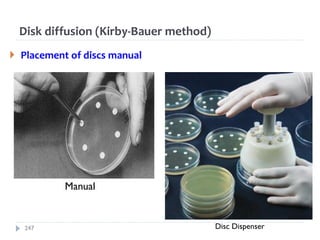
  • 184.
    Typical stages ofan infectious disease 184 1. The incubation period: the time b/n the acquisition of the organism (or toxin) and the beginning of symptoms 2. The prodrome period: during which nonspecific symptoms such as fever, malaise, and loss of appetite occur 3. The specific-disease period: during which the overt characteristic signs and symptoms of the disease occur 4. The recovery period (convalescence period): the illness abates and the patient returns to the healthy state • IgG and IgA antibodies protect the recovered patient from reinfection by the same organism
  • 185.
    Principle of disinfectionand Sterilization Principles of infection prevention 185
  • 186.
    Introduction • The purposeof sterilization and disinfection procedures is to prevent transmission of microbes • In addition to sterilization and disinfection, other important measures to prevent transmission are included in the protocol of “standard precautions” • Standard precautions include a. hand hygiene b. respiratory hygiene and cough etiquette c. safe injection practices d. proper disposal of needles and scalpels 186
  • 187.
    Introduction… Sterilization • is thekilling or removal of all microorganisms, including bacterial spores Disinfection • is the killing of many, but not all, microorganisms • For adequate disinfection, pathogens must be killed, but some organisms and bacterial spores may survive Antisepsis • Use of chemical agents on skin or other living tissue to inhibit or eliminate microbes; no sporicidal action is implied 187
  • 188.
    Sterilization • This canbe accomplished using physical, gas vapor, or chemical sterilants • Moist heat: Autoclave • Dry heat: hot air oven, incineration, Fleming • Radiation • Filtration • Ethylene oxide • Hydrogen peroxide vapors • Peracetic acid • Glutaraldehyde 188
  • 189.
    A. Dry heat---Hotair oven • Sterilize by denaturing proteins • Less efficient and requires high temperature and long period heating than moist heat₋ 189
  • 190.
    Hot air oven •Used to sterilize inanimate objects through hot dry air circulating between the objects being sterilized • These objects must be loosely packed and adequate air space to ensure optimum heat transfer • Sterilization is done by placing the objects in hot dry oven and sterilized at 160 0C for 1 hour • Used to sterilize glassware, oils, and powders 190
  • 191.
    B. Moist Heat •Sterilize by denaturing and coagulating proteins • Preferred to dry heat due to more and rapid killing • This can be achieved using an autoclave • Steam under pressure aids penetration of heat into the material to be sterilized 191
  • 192.
    Steam under pressure(autoclave) • Autoclave is an instrument that operates by creating high temperature under steam pressure • the most common, effective, reliable and practical method of sterilizing laboratory materials • At a temperature of 1210c for 15 minutes • Steam is more penetrating than hot dry air 192
  • 193.
    C. Gamma irradiation •Is used to sterilize large batches of small volume items • The killing mechanism involves the production of free radicals, which break the bonds in DNA • Used to sterilize industrial products, i.e. needles, syringes, intravenous lines, catheters and gloves • It can also be used for vaccines and to prevent food spoilage • Articles are sterilized while sealed in their final packaging, without any heat gain 193
  • 194.
    D. Filtration through • Mechanicalsieving membrane filters • Use: ₋ Sterilization of thermo-labile solutions, sera and plasma • pore sizes of 0.005 to 1 µm • For removal of bacteria, a pore size of 0.2 µm is effective 194
  • 195.
    Ethylene oxide (450-1200mg/L) • used to sterilize temperature- or pressure-sensitive items • Treatment is generally for 4 hours • Sterilized items must be aerated for an additional 12 hours to eliminate the toxic gas before the items are used • Although ethylene oxide is highly efficient, strict regulations limit its use because it is flammable, explosive, and carcinogenic to laboratory animals 195
  • 196.
    Hydrogen peroxide vapors(30%) •effective sterilants because of the oxidizing nature of the gas • used for the sterilization of instruments • A variation is plasma gas sterilization, in which H2O2 is vaporized, and then reactive free radicals are produced • Because this is an efficient sterilizing method that does not produce toxic by-products, plasma gas sterilization has replaced many of the applications for ethylene oxide 196
  • 197.
    Other chemical sterilants •Peracetic acid (0.2%) • an oxidizing agent, has excellent activity, and its end products (i.e., acetic acid and oxygen) are nontoxic • Glutaraldehyde (2%) • used to sterilize respiratory therapy equipment, endoscopes, and hemodialysis equipment • In contrast, safety is a concern with, and care must be used when handling this chemical 197
  • 198.
    Disinfection • Disinfection processescategorized as high level, intermediate level, and low level • High-level disinfection can generally approach sterilization in effectiveness • Spore forms can survive intermediate-level disinfection • Many microbes can remain viable when exposed to low-level disinfection 198
  • 199.
  • 200.
    Disinfectants… • Alcohol: 70-95%alcohol • Rapidly kill vegetative bacteria by denaturing protein • Iodine: 2% tincture iodine, Iodophors • kills more rapidly and effectively than alcohol • widely used in preparation of skin before surgery • Chlorine: Cl2, 5% hypochlorite solution • lethal to most bacteria, and inactivates most viruses • H2O2: useful in disinfecting items such as contact lenses that are not susceptible to its corrosive effect • Phenol: is a potent protein denaturant andbactericidal agent 200
  • 201.
  • 202.
    Introduction  Many ofthe diagnostic tests require viable samples, and the quality of the results depends on • quality of the specimen collected from the patient • means by which it is transported from the patient to the laboratory • techniques used to demonstrate the microbe in the sample 202
  • 203.
    Introduction  Detection ofpathogens in clinical specimens is accomplished by five general procedures: 1. Microscopy 2. Culture 3. Detection of bacterial antigens 4. Detection of an antibody response to the bacteria 5. Detection of specific bacterial nucleic acids 203
  • 204.
    Microscopy  Microscopy isused in Microbiologyfor two basic purposes • initial detection of bacteria • preliminary or definitive identification • Identification of parasites • Identification of fungi  Morphologic properties can be used for preliminary identification of most bacteria  Microscopic detection of bacteria stained with antibodies labeled with fluorescent dyes very useful for the specific identification 204
  • 205.
    Microscopy  If aspecimen is collected from a sterile body site (e.g. sterile tissues, CSF, joint fluid) a sample of the specimen can be prepared for microscopic examination using  Wet mount (direct examination)  Staining methods 205
  • 206.
    Microscopy  Microscopic examinationcan provide • Shape of the organisms • Relative size • Arrangement (e.g., chains or clusters) • whether the bacteria are gram- positive, gram-negative, or acid- fast • whether only one or more than one type of bacteria is present  The microscopic appearance is typically not sufficient to definitively identify a bacteria • Guides empiric therapy 206
  • 207.
    Wet mount  Sampleis suspended in water or saline  The preparation is examined by brightfield, darkfield, or phase-contrast microscopy Clue cell Bacteria 207
  • 208.
    Wet mount 208 10% KOH •Sample is mixed with 10% KOH • KOH is used to dissolve proteinaceous material (background material) and facilitate detection of fungal elements • Dyes such as lactophenol cotton blue can be added to increase contrast between fungal elements and background
  • 209.
    Wet mount (DirectExamination) 209 • India ink • Modification of KOH procedure in which ink is added as contrast material • dye primarily used to detect Cryptococcus species in CSF and other body fluids • polysaccharide capsule of Cryptococcus spp. excludes ink, creating a halo around the yeast cell • Lugol iodine • Iodine is added to wet preparations of parasitology specimens to enhance contrast of internal structures
  • 210.
    Stains  Smears canbe made from relevant tissues and body fluids  Smears are fixed to the slides with either heat or methanol  Methanol fixation is preferred since heating may • produce artifacts • create aerosols • not adhere the specimen adequately to the slide  A variety of stains can then be used to help visualize and differentiate bacteria from the specimen 210
  • 211.
    • First describedby Hans Christian Joachim Gram in 1884 • Based on differences in cell wall structure • Bacteria are classified as – Gram-positive: retain the primary crystal violet dye and appear deep blue or purple – Gram negative: decolorized subsequently taking up the counterstain safranin and appear red or pink • Not useful for bacteria that are too small or lack a cell wall, e.g., Treponema, Mycoplasma, Chlamydia, and Rickettsia; *Mycobacteria • Francisella, Legionella, and Brucella difficult to visualize due to their tiny size – Substitution of safranin with basic fuchsin as a counterstain stain effectively Gram stain 211
  • 212.
    1. The smearis flooded with crystal violet (10 stain) 2. After ~15 s, the slide is washed with water 3. flooded with the mordant Gram’s iodine for 15 s  increases the affinity of the primary stain to the bacterial cell 4. The slide is washed with water 5. Flooded with decolorizing agent acetone-alcohol  remove the primary stain from a Gram- negative cell  Gram-positive bacterial cells retain the primary stain 6. The slide is washed immediately 7. counterstained with safranin for at least 15 s 8. This slide is then washed, blotted dry, and examined by light microscopy at ×1,000 magnification Gram stain 212
  • 213.
  • 214.
    Ziehl-Neelsen procedure  Smearis heat fixed  The slide is then flooded with filtered carbol fuchsin  The slide is slowly heated to steaming and maintained for 3-5 min  After cooling, the slide is washed with water and decolorized with acid- alcohol  The slide is counterstained for 20-30 s with methylene blue  An acid-fast organism will stain red  the background of cellular elements and other bacteria will be blue 214
  • 215.
  • 216.
    Modification of theZ-N staining (Kinyoun)  Heating during staining with carbol fuchsin is eliminated and a higher concentration of phenol is used in the primary stain  The Z-N and Kinyoun stains have the same sensitivity and specificity  However, the Kinyoun (cold) staining procedure is less time- consuming and is easier to perform 216
  • 217.
    Modification of theZ-N staining  uses a weaker decolorizing agent (0.5-1.0% sulfuric acid) in place of the 3% acid-alcohol  helps differentiate those organisms known to be partially or weakly acid-fast, particularly Nocardia  These organisms do not stain well with the Z-N or Kinyoun stain 217
  • 218.
    Immunofluorescent antibody stain  Immunofluorescentstaining consists of 1. labeling antibodies with a fluorescent dye 2. Allowing the labeled antibodies to react with their specific antigens 3. Observing the stained bacterial cells under a fluorescence microscope  These methods allow the identification of specific bacterial species and subtypes based upon the specificity of the antibody reaction, e.g., for Legionella species 218
  • 219.
  • 220.
    Cultivation 220 • Cultivation isthe process of propagating organisms by providing proper nutrients and environmental conditions • A suitable growth medium • must contain all the nutrients required by the organism to be cultivated • pH, temperature, and aeration must be carefully controlled • Requirements for growth • Organic matter containing the elements carbon, hydrogen, nitrogen, oxygen, phosphorus, and sulfur • inorganic ions such as potassium, sodium, iron, magnesium, calcium, and chloride are required to facilitate enzymatic catalysis and to maintain chemical gradients across the cell membrane • Sources of metabolic energy: Fermentation, Respiration
  • 221.
    Cultivation of Bacteria 221 •Culturing/cultivation • the process of growing Bacteria on a culture media • Culture media • artificial media containing the required nutrients for bacterial growth • Purpose of culturing: • Isolation and identification of micro-organisms • Performing anti-microbial sensitivity tests
  • 222.
    In Vitro Culture 222 •The success of culture methods is defined by • the biology of the organism • the site of the infection • the patient’s immune response to the infection • the quality of the culture media • Cell Culture • Some bacteria and all viruses are strict intracellular microbes • they can only grow in living cells
  • 223.
    Forms of culturemedia 223 A. Solid culture media (1.5% w/v agar) B. Semisolid culture media (0.4-0.5% agar) C. Fluid (broth) culture media (no agar)
  • 224.
    Types of culturemedia 224 1. Basal media (General Purpose Media) 2. Enriched media 3. Enrichment media 4. Selective media 5. Differential (Indicator) media 6. Transport media 7. Identification media
  • 225.
    1. Basal media –Supports growth of bacteria that do not require special nutrients – Example: Nutrient Broth, Nutrient Agar 2. Enriched media – Media that are enriched with whole blood, lyzed blood, Serum, special extracts or vitamins to support the growth of fastidious bacteria – E.g. Blood Agar, Chocolate Agar 225
  • 226.
    3. Enrichment media •Liquid media that increases the numbers of a pathogen by containing enrichments and/or substances that discourage the multiplication of unwanted bacteria • Example: Selenite F broth, Alkaline peptone water 4.Selective media • Media which contain substances ( E.g. Antibiotics) that prevent or slow-down the growth of unwanted bacteria • Example: Mannitol Salt Agar 226 Selenite F broth Mannitol Salt Agar
  • 227.
    5. Differential media 227 Media to which indicator substances are added to differentiate bacteria  E.g. TCBS Agar differentiates sucrose fermenting yellow colonies of Vibrio cholerae from non-sucrose fermenting green colonies of other Vibrio species 6. Transport media • Media containing ingredients to prevent the overgrowth of commensals and ensure the survival of pathogenic bacteria when specimens can not be cultured soon after collection • Example: Amies transport media, Carry-Blair transport media
  • 228.
  • 229.
  • 230.
    Culturing and identificationof bacteria 1. Inoculate the specimen on appropriate media 2. Label the inoculated media 3. Incubate the inoculated media at an appropriate temperature and period (mostly 35-370C) 4. Read colony characteristics after incubation 5. Sub-culture to get pure culture 6. Perform Gram staining 7. Perform Biochemical testing for identification of the bacteria 230
  • 231.
  • 232.
  • 233.
    Automated Identification Assays 233 AutomatedBlood Culture System Bacterial Identification & AST
  • 234.
  • 235.
    Molecular Diagnosis ofBacteria • Conventional methods to detect and identify bacterial pathogens in a timely fashion is limited • Low number of organisms present; e.g. <5 CFU of a bacterium are usually present per ml of blood in patients with septicemia • some pathogens grow slowly due to their unique metabolic requirements, which causes their identification to be delayed; e.g Mycobacterium sp. can take up to 8 weeks to be detected on culture media • Common methods • Whole genome sequencing, PCR, MALDI TOF MS 235
  • 236.
    Polymerase chain Reaction(PCR) Requirements • target dsDNA, two oligonucleotides (primers), heat‐stable DNA polymerase, the four dNTPs in a buffer solution • The two primers are complementary to opposite strands of the target and are usually at a distance of 100-500 bp from each other 1. Denaturation: temperature increased to ~95°C to denature the target dsDNA 2. Annealing: followed by cooling to approximately 60- 65°C to allow the primers to anneal to the target DNA 3. Extension: The DNA polymerase then initiates the extension of the primers, producing new dsDNA copies • The amplified DNA can be detected by various methods • use of fluorescent dyes, such as ethidium bromide, after running a gel • by using labeled oligonucleotides complementary to the amplified target 236
  • 237.
  • 238.
    Real‐time PCR • Amplificationof the target and detection of the amplified product occur simultaneously • Using different dyes, fluorescence emission is generated proportional to the amount of the amplified product • The cycle threshold (CT) is the cycle number at which fluorescence passes the fixed threshold • The number of copies in the sample is calculated by determining the CT and using a standard curve to determine the starting number of nucleic acid copies 238
  • 239.
  • 240.
  • 241.
    Serologic Diagnosis 241 • Immunologictechniques are used • to detect, identify, and quantitate antigen in clinical samples • to evaluate the antibody response to infection and a person’s history of exposure to infectious agents • The specificity of the antibody-antigen interaction and the sensitivity of many of the immunologic techniques make them powerful laboratory tools • Quantitation of the antibody strength is obtained as a titer • The titer of an antibody is defined as the greatest dilution of the sample that retains a detectable activity
  • 242.
    Serologic Diagnosis Methods ofDetection • Antibody-antigen complexes can be detected • directly, by precipitation techniques, or by labeling the antibody with a radioactive, fluorescent, or enzyme probe • indirectly through measurement of an antibody- directed reaction, such as complement fixation 242 RPR
  • 243.
  • 244.
    Antimicrobial Susceptibility Testing (AST) provides information to the clinician to guide selection of appropriate antimicrobial therapy  Are in vitro tests • simply a measurement of the effect of the antibiotic against the organism under specific conditions 244
  • 245.
    Antimicrobial Susceptibility Testing (AST) Methods Disk diffusion  Broth dilution  Antimicrobial gradient  Automated instrument methods  molecular methods for resistance genes 245
  • 246.
    Disk diffusion (Kirby‐Bauermethod)  named after the individuals who proposed this approach  relies on paper disks impregnated with a set concentration of antimicrobial(s)  Disks are placed on a solid medium, e.g., Mueller‐Hinton agar, that has been inoculated with a standardized lawn of bacteria  Upon incubation, the antimicrobial diffuses into the medium in a circular fashion  If the antimicrobial inhibits the growth of the organism, a zone of inhibition is created around the disk and is measured in millimeters after a specified incubation time 246
  • 247.
    Disk diffusion (Kirby‐Bauermethod)  Placement of discs manual Manual Disc Dispenser 247
  • 248.
    Disk diffusion (Kirby‐Bauermethod)  Measuring zone of inhibition (in mm) 248
  • 249.
    Minimal inhibitory concentration (MIC) MIC can be determined by • Broth dilution assay • Agar dilution assay  Test principle • antimicrobials are diluted in broth or in agar and inoculated with a standard concentration of organism • The lowest antimicrobial concentration at which the growth of the organism is macroscopically inhibited is defined as the MIC (micrograms per milliliter) 249
  • 250.
  • 251.
    Antimicrobial Susceptibility Testing (AST) Published guidelines • Clinical and Laboratory Standards Institute (CLSI) • European Committee on Antimicrobial Susceptibility Testing  Breakpoints are set for each antimicrobial as MIC (in µg/ml) or Zone diameter (in mm) that corresponds to the likelihood that the antimicrobial will be effective in vivo  Interpretation of the MIC or zone diameter • Susceptible: there is a high likelihood of therapeutic success • Intermediate: a zone b/n susceptible and resistant where, if the drug is used for treatment in some settings, it may be adequate but caution must be taken to monitor for treatment failure • Resistant: the antimicrobial has a high probability of clinical failure * Nonsusceptible: a term used for isolates where only susceptibility breakpoints have been established due to a lack of resistant strains 251
  • 252.
    Antimicrobial Susceptibility Testing (AST) Moleculartesting  limited mainly by the complexity of genes that code for resistance to certain antimicrobials  Detect genes responsible for selected resistance mechanisms expressed by a particular organism toward an antimicrobial or class of antimicrobials  Common resistance genes tested • the mecA gene in methicillin‐resistant S. aureus • vanA and vanB genes in Enterococcus species • ESBL genes in members of the Enterobacterales • carbapenemase genes in Gram‐negative organisms • the rhoB gene in rifampin‐resistant M. tuberculosis 252
  • 253.