 Greek word- Glycos meaning sweet/sugar and lysis meaning dissolution
 Glycolysis is the first step in the breakdown of glucose to extract energy
for cellular metabolism. Glycolysis consists of an energy-requiring phase
followed by an energy-releasing phase.
 Glycolysis is a series of reactions that extract energy from glucose by
splitting it into two three-carbon molecules called pyruvates.
 Sequence of reactions converting glucose/ glycogen to pyruvate/lactate
with production of ATP.
 Embden-Meyerhof-Parnas pathway (Gustav Embden, Otto Meyerhof
and Jakub Karol Parnas)
 In organisms that perform cellular respiration, glycolysis is the first stage of
this process. However, glycolysis doesn’t require oxygen, and many
anaerobic organisms—organisms that do not use oxygen—also have this
pathway.
 Glycolysis takes place in the cytosol of a cell, and it can be broken down into
three main phases:
 Energy-requiring phase,
 Splitting phase
 Energy-releasing phase,
 Reversal of glycolysis along with the alternate arrangement at the irreversible
steps will result in the synthesis of glucose (Gluconeogenesis)
 Energy-requiring phase- In this phase, the starting molecule of glucose gets
rearranged, and two phosphate groups are attached to it. The phosphate groups
make the modified sugar—now called fructose-1,6-bisphosphate—unstable,
allowing it to split in half and form two phosphate-bearing three-carbon
sugars. Because the phosphates used in these steps come from ATP, 2
ATP molecules get used up.
 Splitting phase- In this step, fructose – 1,6-diphosphate get dissociated to get
glyceraldehyde-3-phosphate and dihydroxyacetone phosphate
 Energy-releasing phase- In this phase, each three-carbon sugar is converted
into another three-carbon molecule, pyruvate, through a series of reactions. In
these reactions, two ATP molecules and one NADH molecule are made.
Because this phase takes place twice, once for each of the two three-carbon
sugars, it makes four ATP and two NADH overall.
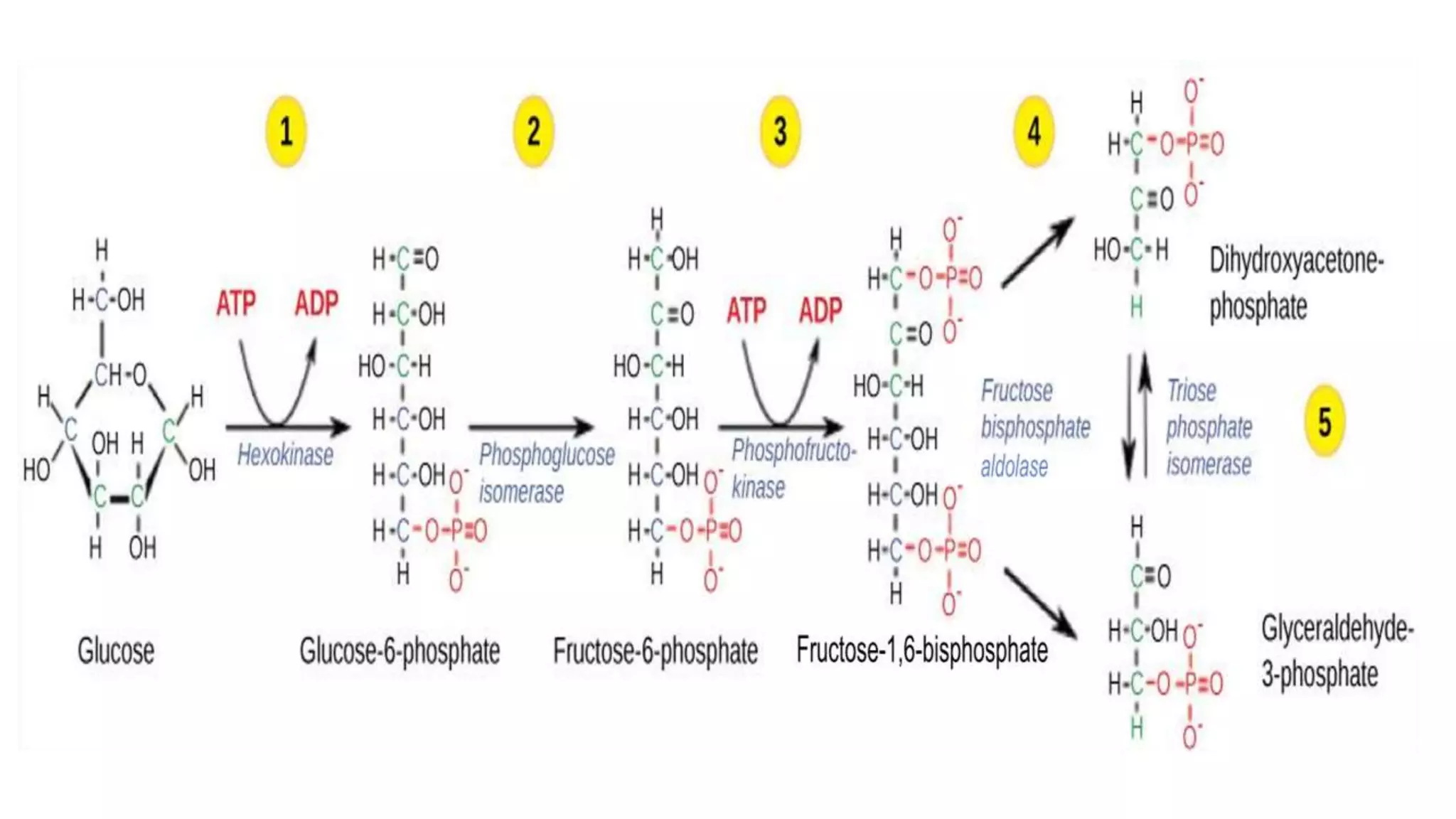
Step 1. A phosphate group is transferred from {ATP to glucose, making
glucose-6-phosphate. Glucose-6-phosphate is more reactive than glucose,
and the addition of the phosphate also traps glucose inside the cell since
glucose with a phosphate can’t readily cross the membrane.
Step 2. Glucose-6-phosphate is converted into its isomer, fructose-6-
phosphate.
Step 3. A phosphate group is transferred from ATP to fructose-6-
phosphate, producing fructose-1,6-bisphosphate. This step is catalysed by
the enzyme phosphofructokinase, which can be regulated to speed up or
slow down the glycolysis pathway.
Step 4. Fructose-1,6-bisphosphate splits to form two three-carbon
sugars: dihydroxyacetone phosphate DHAP and glyceraldehyde-3-
phosphate. They are isomers of each other, but only one—
glyceraldehyde-3-phosphate—can directly continue through the next
steps of glycolysis.
Step 5. DHAP is converted into glyceraldehyde-3-phosphate. The two
molecules exist in equilibrium, but the equilibrium is “pulled” strongly
downward, in the scheme of the diagram above, as glyceraldehyde-3-
phosphate is used up. Thus, all of DHAP is eventually converted.
Step 6. Two half reactions occur simultaneously: 1) Glyceraldehyde-3-
phosphate (one of the three-carbon sugars formed in the initial phase) is
oxidized, and NAD+ is reduced to NADH and H+. The overall reaction is
exergonic, releasing energy that is then used to phosphorylate the molecule,
forming 1,3-bisphosphoglycerate.
Step 7. 1,3-bisphosphoglycerate donates one of its phosphate groups to ADP,
making a molecule of ATP start and turning into 3-phosphoglycerate in the
process.
Step 8. 3-phosphoglycerate is converted into its isomer, 2-phosphoglycerate.
Step 9. 2-phosphoglycerate loses a molecule of water, becoming phospho-
enolpyruvate PEP. PEP is an unstable molecule, poised to lose its phosphate
group in the final step of glycolysis.
Step 10. PEP readily donates its phosphate group to ADP , making a
second molecule of ATP. As it loses its phosphate, PEP is converted
to pyruvate, the end product of glycolysis.
 Overall, glycolysis converts one six-carbon molecule of
glucose into two three-carbon molecules of pyruvate. The net
products of this process are two molecules of ATP and two
molecules of NADH.
6. Glycolysis (Biochemistry)

6. Glycolysis (Biochemistry)

  • 2.
     Greek word-Glycos meaning sweet/sugar and lysis meaning dissolution  Glycolysis is the first step in the breakdown of glucose to extract energy for cellular metabolism. Glycolysis consists of an energy-requiring phase followed by an energy-releasing phase.  Glycolysis is a series of reactions that extract energy from glucose by splitting it into two three-carbon molecules called pyruvates.  Sequence of reactions converting glucose/ glycogen to pyruvate/lactate with production of ATP.  Embden-Meyerhof-Parnas pathway (Gustav Embden, Otto Meyerhof and Jakub Karol Parnas)
  • 3.
     In organismsthat perform cellular respiration, glycolysis is the first stage of this process. However, glycolysis doesn’t require oxygen, and many anaerobic organisms—organisms that do not use oxygen—also have this pathway.  Glycolysis takes place in the cytosol of a cell, and it can be broken down into three main phases:  Energy-requiring phase,  Splitting phase  Energy-releasing phase,  Reversal of glycolysis along with the alternate arrangement at the irreversible steps will result in the synthesis of glucose (Gluconeogenesis)
  • 4.
     Energy-requiring phase-In this phase, the starting molecule of glucose gets rearranged, and two phosphate groups are attached to it. The phosphate groups make the modified sugar—now called fructose-1,6-bisphosphate—unstable, allowing it to split in half and form two phosphate-bearing three-carbon sugars. Because the phosphates used in these steps come from ATP, 2 ATP molecules get used up.  Splitting phase- In this step, fructose – 1,6-diphosphate get dissociated to get glyceraldehyde-3-phosphate and dihydroxyacetone phosphate  Energy-releasing phase- In this phase, each three-carbon sugar is converted into another three-carbon molecule, pyruvate, through a series of reactions. In these reactions, two ATP molecules and one NADH molecule are made. Because this phase takes place twice, once for each of the two three-carbon sugars, it makes four ATP and two NADH overall.
  • 7.
    Step 1. Aphosphate group is transferred from {ATP to glucose, making glucose-6-phosphate. Glucose-6-phosphate is more reactive than glucose, and the addition of the phosphate also traps glucose inside the cell since glucose with a phosphate can’t readily cross the membrane. Step 2. Glucose-6-phosphate is converted into its isomer, fructose-6- phosphate. Step 3. A phosphate group is transferred from ATP to fructose-6- phosphate, producing fructose-1,6-bisphosphate. This step is catalysed by the enzyme phosphofructokinase, which can be regulated to speed up or slow down the glycolysis pathway.
  • 8.
    Step 4. Fructose-1,6-bisphosphatesplits to form two three-carbon sugars: dihydroxyacetone phosphate DHAP and glyceraldehyde-3- phosphate. They are isomers of each other, but only one— glyceraldehyde-3-phosphate—can directly continue through the next steps of glycolysis. Step 5. DHAP is converted into glyceraldehyde-3-phosphate. The two molecules exist in equilibrium, but the equilibrium is “pulled” strongly downward, in the scheme of the diagram above, as glyceraldehyde-3- phosphate is used up. Thus, all of DHAP is eventually converted.
  • 9.
    Step 6. Twohalf reactions occur simultaneously: 1) Glyceraldehyde-3- phosphate (one of the three-carbon sugars formed in the initial phase) is oxidized, and NAD+ is reduced to NADH and H+. The overall reaction is exergonic, releasing energy that is then used to phosphorylate the molecule, forming 1,3-bisphosphoglycerate. Step 7. 1,3-bisphosphoglycerate donates one of its phosphate groups to ADP, making a molecule of ATP start and turning into 3-phosphoglycerate in the process. Step 8. 3-phosphoglycerate is converted into its isomer, 2-phosphoglycerate. Step 9. 2-phosphoglycerate loses a molecule of water, becoming phospho- enolpyruvate PEP. PEP is an unstable molecule, poised to lose its phosphate group in the final step of glycolysis.
  • 10.
    Step 10. PEPreadily donates its phosphate group to ADP , making a second molecule of ATP. As it loses its phosphate, PEP is converted to pyruvate, the end product of glycolysis.
  • 13.
     Overall, glycolysisconverts one six-carbon molecule of glucose into two three-carbon molecules of pyruvate. The net products of this process are two molecules of ATP and two molecules of NADH.