MICROORGANSIMS
FARHAT ULLAH
MICROORGANSIMS
• All living beings can be classified into three kingdoms:
• Plant, Animal, and Protista
• Microorganisms are a heterogeneous group of several distinct living
structures of microscopic size, classified under the kingdom Protista.
The kingdom Protista includes unicellular organisms, such as
bacteria, fungi, protozoa, and algae.
• Based on the differences in cellular organization and biochemistry, the
kingdom Protista has been divided into three groups:
• Prokaryotes, eukaryotes, and the most recently described
archaebacteria.
Prokaryotes
• Bacteria and blue green algae are prokaryotes
• Bacteria are unicellular free-living organisms having both DNA and
RNA
• They are capable of performing all essential processes of life, e.g.,
growth, reproduction, and metabolism
• They do not show any true branching except Actinomycetales, the
higher bacteria
• Bacteria lack chlorophyll unlike blue green algae, which contain
chlorophyll
Eukaryotes
• Fungi, algae other than blue green, protozoa, and slime
moulds are eukaryotes
• Archaebacteria
• These are more closely related to eukaryotes than prokaryotes
• They however do not include any human pathogens
Size of Bacteria
• Bacteria are microscopic and very small in size
• The size of bacteria is measured in units of length called microns
• A micron (micrometer, µm) is the unit of measurement used in
bacteriology.
• 1 micron (µm) = 1/1000 millimeter (mm).
• 1 nanometer (nm) = 1/1000 micron ( mm).
• 1 Angstrom unit (Ao) = 1/10 nm (nanometer).
• Bacteria of medical importance measure 2–5 µm (length) x 0.2–1.5
µm (width)
Microscopy
• Microscopy is an important component of diagnostic microbiology
• Bacteria being very small cannot be visualized by the naked eye,
because the limit of resolution with the unaided eye is about 200
microns
• So, the study of bacteria requires the use of microscopes
• A microscope is an instrument that uses one or more lenses to
produce a magnified image of an object that is invisible to the
unaided eye
Shape of Bacteria
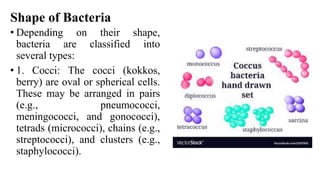
• Depending on their shape,
bacteria are classified into
several types:
• 1. Cocci: The cocci (kokkos,
berry) are oval or spherical cells.
These may be arranged in pairs
(e.g., pneumococci,
meningococci, and gonococci),
tetrads (micrococci), chains (e.g.,
streptococci), and clusters (e.g.,
staphylococci).
Bacilli
• The bacilli (bacillus, rod) are rod
shaped. These bacilli may show
either of the following
arrangement
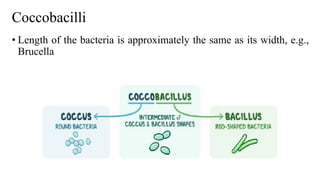
Coccobacilli
• Length of the bacteria is approximately the same as its width, e.g.,
Brucella
Streptobacilli
• These are arranged in chains, e.g., Streptobacillus
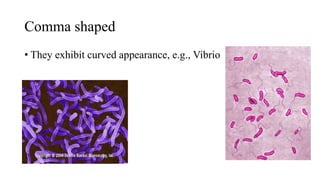
Comma shaped
• They exhibit curved appearance, e.g., Vibrio
Spirilla
• They exhibit rigid spiral forms, e.g., Spirillum
Spirochetes
• Spirochetes (spira, coil; chaite, hair) are slender, flexuous spiral
forms, e.g., Treponema.
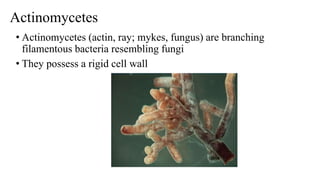
Actinomycetes
• Actinomycetes (actin, ray; mykes, fungus) are branching
filamentous bacteria resembling fungi
• They possess a rigid cell wall
Structure and Functions of Bacterial Cell Envelope
• The outer layer or cell envelope provides a structural and physiological barrier
between the protoplasm (inside) of the cell and the external environment
• The cell envelope protects bacteria against osmotic lysis and gives bacteria
rigidity and shape
• The cell envelope primarily consists of two components: a cell wall and
cytoplasmic or plasma membrane
• It encloses the protoplasm, which consists of (i) cytoplasm, (ii) cytoplasmic
inclusions (mesosomes, ribosomes, inclusion granules, vacuoles), and (iii) a single
circular DNA
Cell Wall
• Prokaryotic cells almost always are bounded by a rigid and
chemically complex structure present between the cell membrane
and capsule/slime layer called the cell wall
• Peptidoglycan is the main component of the cell wall and is
responsible for the shape and strength of the cell
• It is a disaccharide and contains two sugar derivatives—N-
acetylglucosamine and N-acetylmuramic acid—joined together by
short peptide chains
• N-acetylmuramic acid carries a tetrapeptide side chain consisting of
D- and L-amino acids (D-glutamic acid and L-alanine) with
mesodiaminopimelic acid (Gram-negative bacteria) or L-lysine
(Gram-positive bacteria)

Bacteria lec

  • 1.
  • 2.
    MICROORGANSIMS • All livingbeings can be classified into three kingdoms: • Plant, Animal, and Protista • Microorganisms are a heterogeneous group of several distinct living structures of microscopic size, classified under the kingdom Protista. The kingdom Protista includes unicellular organisms, such as bacteria, fungi, protozoa, and algae. • Based on the differences in cellular organization and biochemistry, the kingdom Protista has been divided into three groups: • Prokaryotes, eukaryotes, and the most recently described archaebacteria.
  • 3.
    Prokaryotes • Bacteria andblue green algae are prokaryotes • Bacteria are unicellular free-living organisms having both DNA and RNA • They are capable of performing all essential processes of life, e.g., growth, reproduction, and metabolism • They do not show any true branching except Actinomycetales, the higher bacteria • Bacteria lack chlorophyll unlike blue green algae, which contain chlorophyll
  • 4.
    Eukaryotes • Fungi, algaeother than blue green, protozoa, and slime moulds are eukaryotes • Archaebacteria • These are more closely related to eukaryotes than prokaryotes • They however do not include any human pathogens
  • 5.
    Size of Bacteria •Bacteria are microscopic and very small in size • The size of bacteria is measured in units of length called microns • A micron (micrometer, µm) is the unit of measurement used in bacteriology. • 1 micron (µm) = 1/1000 millimeter (mm). • 1 nanometer (nm) = 1/1000 micron ( mm). • 1 Angstrom unit (Ao) = 1/10 nm (nanometer). • Bacteria of medical importance measure 2–5 µm (length) x 0.2–1.5 µm (width)
  • 6.
    Microscopy • Microscopy isan important component of diagnostic microbiology • Bacteria being very small cannot be visualized by the naked eye, because the limit of resolution with the unaided eye is about 200 microns • So, the study of bacteria requires the use of microscopes • A microscope is an instrument that uses one or more lenses to produce a magnified image of an object that is invisible to the unaided eye
  • 8.
    Shape of Bacteria •Depending on their shape, bacteria are classified into several types: • 1. Cocci: The cocci (kokkos, berry) are oval or spherical cells. These may be arranged in pairs (e.g., pneumococci, meningococci, and gonococci), tetrads (micrococci), chains (e.g., streptococci), and clusters (e.g., staphylococci).
  • 9.
    Bacilli • The bacilli(bacillus, rod) are rod shaped. These bacilli may show either of the following arrangement
  • 10.
    Coccobacilli • Length ofthe bacteria is approximately the same as its width, e.g., Brucella
  • 11.
    Streptobacilli • These arearranged in chains, e.g., Streptobacillus
  • 12.
    Comma shaped • Theyexhibit curved appearance, e.g., Vibrio
  • 13.
    Spirilla • They exhibitrigid spiral forms, e.g., Spirillum
  • 14.
    Spirochetes • Spirochetes (spira,coil; chaite, hair) are slender, flexuous spiral forms, e.g., Treponema.
  • 15.
    Actinomycetes • Actinomycetes (actin,ray; mykes, fungus) are branching filamentous bacteria resembling fungi • They possess a rigid cell wall
  • 16.
    Structure and Functionsof Bacterial Cell Envelope • The outer layer or cell envelope provides a structural and physiological barrier between the protoplasm (inside) of the cell and the external environment • The cell envelope protects bacteria against osmotic lysis and gives bacteria rigidity and shape • The cell envelope primarily consists of two components: a cell wall and cytoplasmic or plasma membrane • It encloses the protoplasm, which consists of (i) cytoplasm, (ii) cytoplasmic inclusions (mesosomes, ribosomes, inclusion granules, vacuoles), and (iii) a single circular DNA
  • 18.
    Cell Wall • Prokaryoticcells almost always are bounded by a rigid and chemically complex structure present between the cell membrane and capsule/slime layer called the cell wall • Peptidoglycan is the main component of the cell wall and is responsible for the shape and strength of the cell • It is a disaccharide and contains two sugar derivatives—N- acetylglucosamine and N-acetylmuramic acid—joined together by short peptide chains • N-acetylmuramic acid carries a tetrapeptide side chain consisting of D- and L-amino acids (D-glutamic acid and L-alanine) with mesodiaminopimelic acid (Gram-negative bacteria) or L-lysine (Gram-positive bacteria)