Microbiology is thestudy of
microorganisms.
Microorganisms can be classified
into:
1.Eukaryotes
2.Prokaryotes
3.
Eukaryotes are microorganisms
containingtrue intracellular nucleus.
Eg. Fungi, Other Algae, Moulds and
Protozoa
Prokaryotes are microorganisms that
contain nucleic material but lack well
defined membrane bound true nucleus.
e.g. Bacteria, Blue Green Algae
4.
Commensal flora
These arethe microorganisms that live in our various
body surfaces without causing any harm.
In fact these microorganism benefit us by protecting us
from other pathogenic microorganisms.
In return human being provide them food and shelter.
These are the microbes that live in and on our various
body parts.
Commensals that get into the “wrong” place can do
untold damage.
Urinary tract infections are most frequently caused
when gut organisms or the skin flora gain access to the
bladder.
5.
Pathogenic Organisms
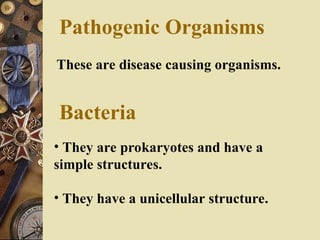
These aredisease causing organisms.
Bacteria
• They are prokaryotes and have a
simple structures.
• They have a unicellular structure.
6.
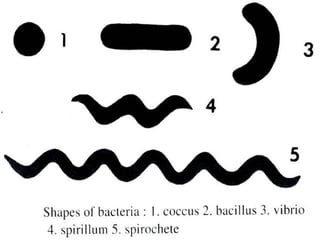
Bacterial shapes:
Bacteria isclassified according to its shape or
appearance.
Cocci - spiral or oval.
Bacilli - rod shaped.
Vibrio – comma shaped curved rods.
Spirilla - rigid spiral shaped.
Spirochetes – flexible spiral forms.
Actinomycetes – branching filamentous like
radiating sun rays with rigid cell wall.
Mycoplasm – no stable morphology i.e. no cell
wall.
9.
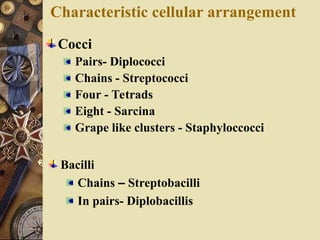
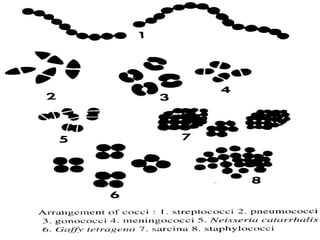
Characteristic cellular arrangement
Cocci
Pairs-Diplococci
Chains - Streptococci
Four - Tetrads
Eight - Sarcina
Grape like clusters - Staphyloccocci
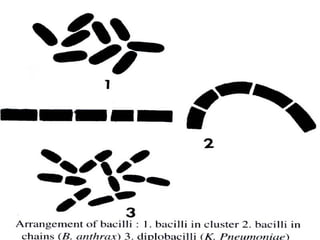
Bacilli
Chains – Streptobacilli
In pairs- Diplobacillis
12.
Bacterial Cell Wall
Bacteriahave a cell wall containing a
special polymer called peptidoglycan.
The cell wall lies outside the cell
membrane.
The rigid peptidoglycan is important in
defining the shape of the cell, and gives
the cell strength.
13.
The cellwall of Gram-positive bacteria is
largely made up of peptidoglycan. There may
be up to 40 layers of this polymer, giving
enormous strength to the cell wall.
The cell envelope of Gram- negative bacteria
is complex. It consist of various lipid layers
like phospholipids, lipoprotein and lipo
polysaccharide.
One or two layers of peptidoglycan lie beyond
the lipid layer.
Gram-ve bacteria are thus mechanically much
weaker than Gram+ve ones.
14.
Gram Staining
Primary stain–crystal violet
Fixation - Dilute iodine
Decolourisation with organic
solvent: Ethanol, acetone
Safranine or neutral red
15.
Cells with manylayers of
peptidoglycan can retain a crystal
violet-iodine complex when treated
with acetone.
Hence, Gram-positive bacteria appear
blue-black or purple when stained
using Gram's method.
16.
Due to thepresence of lipid layers in
Gram-negative bacteria, the crystal
violet is washed away by decolorizing
agent along with the lipid layer.
Hence cannot retain the crystal violet-
iodine complex.
These need counterstaining with another
dye to be seen using Gram's method. A
red dye such as safranine is often used.
17.
The Genetic Makeupof Bacteria
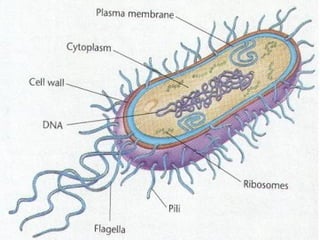
The bacterial chromosomal DNA is
located in nucleoid in cytoplasm.
Bacteria is a prokaryote hence does not
have true, membrane bound nucleus.
Cytoplasmic Membrane
A thinmembrane layer lining the inner
surface of the cell wall separating it
from the cytoplasm.
Semi permeable membrane which
permits the passage of selected
materials.
21.
Cytoplasm
It is asystem of variety of organic and
inorganic solutes in a viscous watery
solution.
Absence of endoplasmic reticulum and
mitochondria like the prokaryotes
Bacterial Appendages
Flagella
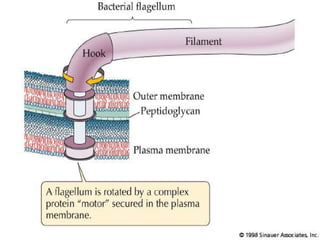
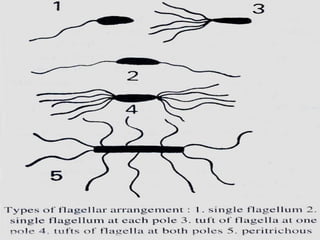
Flagella
Responsiblefor the motility of bacteria
specially in pathogenic bacteria.
Flagella are inserted through the cell walls
of bacteria.
At their base can be found wheel-like
structures.
26.
Fimbriae
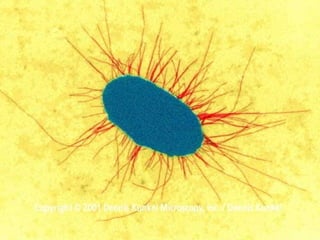
Gram-negative pathogenic bacteriamay
be covered in fine hairs called Fimbriae
(singular: fimbria).
These are important in adhesion.
If a microbe is to cause an infection, first
it must attach to its surface.
28.
Pilli
Bacteria haveadditional structures called Pilli.
Pilli can attach two bacterial cells together: sex
pilli are necessary for the transfer genetic
materials between bacteria.
They exchange genetic material in a process of
conjugation that involves cells being joined by
sex pilli, tube-like structures through which
DNA is passed.
29.
A viscid materialis secreted by the
bacteria around the cell surface
If it is organized into a sharply defined
structure it is called Capsules.
When it a loose secretion, it is called
slime layer.
30.
Encapsulated bacteria arehighly
resistant to the lytic effect of the
phagocytes and hence are not
susceptible to killing as easily as bacteria
that lack capsules
Slime to help bacteria to stick to
surfaces. Slime is produced by several
types of pathogenic microbes, and is
usually made up from polysaccharides.
31.
Bacterial spores
A fewspecies of bacteria have the
ability to produce highly resistant
structures known as endospores (or
simply spores).
These resist a range of hazardous
environment, and protect against heat,
radiation, and desiccation.
Obligate Aerobes
These bacteriahave an absolute
requirement for oxygen.
Facultative Anaerobes
These can survive in the absence as
well as the presence of oxygen.
Obligate Anaerobes
These are killed by traces of oxygen
34.
Psychrotrophs
Bacteria that growat very low
temperature.
Thermophiles
Bacteria that are found to grow at
high temperatures.
Mesophiles
Those that grow at moderate
temperatures .
35.
Viruses
They entirely relyupon other cells for
their replication.
Viruses are obligate intracellular
parasites which require to live within a
cell in its host.
36.
They comprise anucleic acid core,
(either DNA or RNA but not both)
wrapped in a protein coat.
Some viruses have an envelope, made of
lipid and usually derived from the cell
in which they grow. Other viruses are
naked.
There is a special class of virus that
attacks bacteria - BACTERIOPHAGE.
37.
Fungi
All fungi areeukaryotic.
Most possess a rigid cell wall made of
chitin (Insoluble Polysaccharide)
They reproduce both sexually or
asexually.
Multicellular or unicellular.
Moulds
Fungi thatgrow in mats of tiny filaments are
known as hyphae (singular: hypha, Greek for
a thread) or mycelia (singular: mycelium, from
the Greek mukes, meaning a mushroom).
These may or may not be subdivided into
separate compartments by cross walls known
as septa (singular: septum).
Moulds are multicellular organisms and are in
some degree related to the mushrooms.
40.
Unicellular fungi: theyeasts.
Most familiar of the yeasts is
Saccharomyces cerevisiae. Baker's yeast,
used in the production of leavened bread,
or brewer's yeast, used in alcohol
production
Yeasts grow and multiply by budding
daughter cells off from a mother cell.
41.
Moulds cause avariety of common,
superficial infections such as
ringworm and athlete's foot.
The most common yeast infection is
"thrush" caused by Candida albicans.
42.
One of themost important of fungi is
Penicillium.
It is from this fungi that penicillins is
derived.
These were the first antibiotics and are
still among the most used antimicrobial
agents world-wide
43.
Protozoa
Protozoa areunicellular eukaryotes.
Many protozoa are free living, but others
cause serious infections.
Protozoa can infect any human tissue, and are
the cause of a variety of diseases.
They spread using a variety of strategies.
Some produce cysts to survive outside the
body, others are spread by insects, and yet
others spread during human sexual contact.
44.
Infections caused byprotozoa include
Amoebic Meningitis
Malaria by Plasmodium vivax
Trypanosomiasis
Leishmaniasis (Kala-Azar)
Amoebic Dysentery
Diarrhoa caused by Cryptosporidium
Vaginal infections may be caused by
Trichomonas vaginalis
Amoebiasis
45.
A pathogen:This is an organism that is able
to invade the various normal defenses of the
human host to cause infection.
Infection: This is when an organism enters
the body, increases in number and causes
damage to the host in the process.
Stages of Infection
The incubation period - The time between the exposure to
an agent and the first appearance of clinical symptoms.
Although there are no symptoms, the organism may be
causing substantial damage during this interval.
Prodrome, - where non-specific signs and symptoms such
as headache, fever and lethargy are noted.
46.
Clinical Illness -Development of a
specific symptom, typical acute or
chronic, suggestive of a classical
infectious disease such as pneumonia,
diarrhoea.
Period of resolution - the severity of
the symptoms gradually decreases
Convalescence - where the symptoms
have largely gone, but the body is still
recovering.
47.
Nosocomial infection: infections
thatare transmitted in hospitals.
Some of these may be opportunistic
infections mentioned above
affecting seriously ill patients,
others, for example infections with
Methicillin-Resistant
Staphylococcus aureus (MRSA),
may occur because of the special
nature of the hospital environment.
48.
Acute infection:
o RapidOnset (Hours or days);
o Brief duration (Days or weeks)
o Diptheria
Chronic Infection:
o Prolonged duration (Month or Years)
o Tuberculosis, leprosy
49.
Re-infections
Renewed occurrenceof a certain illness
caused by a different type of pathogen from
the first infection. For e.g. a first infection of
the upper urinary tract can be caused by E.
coli and the re-infection by Klebsiella. This is
typical of recurrent urinary tract infections
in females.
A 'relapse' is a renewed occurrence of a
certain illness caused by the same species of
pathogen as in the first infection. Example of
relapses, when latent infections (whose
pathogens can persist in the body for years
and decades) recur. E.g. viral herpes simplex
infection.
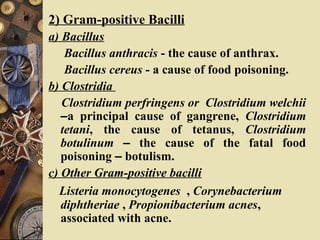
2) Gram-positive Bacilli
a)Bacillus
Bacillus anthracis - the cause of anthrax.
Bacillus cereus - a cause of food poisoning.
b) Clostridia
Clostridium perfringens or Clostridium welchii
–a principal cause of gangrene, Clostridium
tetani, the cause of tetanus, Clostridium
botulinum – the cause of the fatal food
poisoning – botulism.
c) Other Gram-positive bacilli
Listeria monocytogenes , Corynebacterium
diphtheriae , Propionibacterium acnes,
associated with acne.
53.
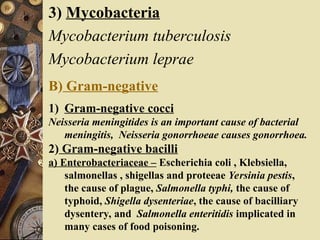
3) Mycobacteria
Mycobacterium tuberculosis
Mycobacteriumleprae
B) Gram-negative
1) Gram-negative cocci
Neisseria meningitides is an important cause of bacterial
meningitis, Neisseria gonorrhoeae causes gonorrhoea.
2) Gram-negative bacilli
a) Enterobacteriaceae – Escherichia coli , Klebsiella,
salmonellas , shigellas and proteeae Yersinia pestis,
the cause of plague, Salmonella typhi, the cause of
typhoid, Shigella dysenteriae, the cause of bacilliary
dysentery, and Salmonella enteritidis implicated in
many cases of food poisoning.
54.
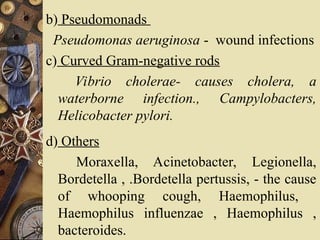
b) Pseudomonads
Pseudomonas aeruginosa- wound infections
c) Curved Gram-negative rods
Vibrio cholerae- causes cholera, a
waterborne infection., Campylobacters,
Helicobacter pylori.
d) Others
Moraxella, Acinetobacter, Legionella,
Bordetella , .Bordetella pertussis, - the cause
of whooping cough, Haemophilus,
Haemophilus influenzae , Haemophilus ,
bacteroides.
Chemotherapy:
The treatmentof disease by means of chemicals that have a
specific toxic effect upon the disease-producing
microorganisms or that selectively destroy cancerous
tissue
Antimicrobial Agents:
Are those agents which are produced naturally, synthetically
or semisynthetically and are active against
microorganisms are called antimicrobial agent.
Antibiotics:
Substances produced by some microorganisms which
inhibits the growth of or kill other microorganisms
selectively at very low concentrations.
Antibacterials refer to substances that act against bacteria
57.
Chemotherapy
Chemotherapy
Chemo-chemical
Therapy-treatment
The treatment of systemic infections is done
using specific chemical agents or drugs
(Chemotherapeutic agents) that selectively
suppress the infecting micro-organism
without significantly affecting the host.
e. g. : Drugs used in Cancer Treatment
5-Fluorouracil(5-FU),Vinblastine
58.
Antibiotic
Substances producedby microorganism
which suppresses the growth and kill the
other microorganism , usually at very low
concentrations.
Eg: (Cefixime is derived from
Cephalosporin C which is obtained from
fungus Cephalosporium
Cephalosporium)
59.
These chemicals arenot included
as antimicrobials because they
are needed in high concentration:
*Ethanol
*Lactic Acid,
*H2
O2
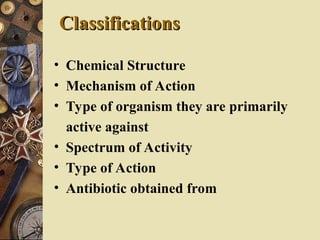
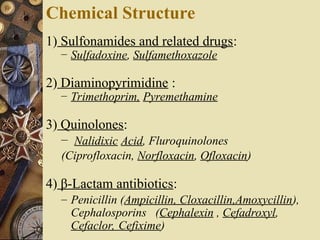
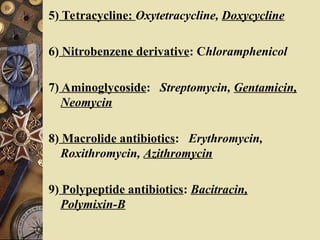
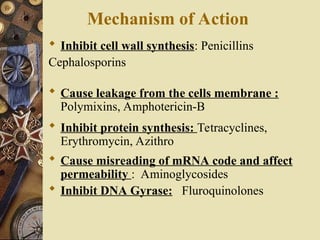
Mechanism of Action
Inhibit cell wall synthesis: Penicillins
Cephalosporins
Cause leakage from the cells membrane :
Polymixins, Amphotericin-B
Inhibit protein synthesis: Tetracyclines,
Erythromycin, Azithro
Cause misreading of mRNA code and affect
permeability : Aminoglycosides
Inhibit DNA Gyrase: Fluroquinolones
65.
Interfere withDNA function: Rifampicin,
Metronidazole
Interfere with DNA synthesis: Acyclovir,
Zidovudin
Interfere with Intermediatory metabolism:
Sulfonamides, Sulphadoxine, Trimethoprim,
Pyremethamine, Ethambutol
.
Mechanism of Action cont..
66.
Type of organismsthey are
primarily active against
ANTIBACTERIAL: They are active against bacteria
Penicillins
Aminoglycosides,
Fluroquinolones
Cephalosporins
67.
ANTIFUNGAL: Theyare active against fungi.
Griseofulvin
Ketoconazole, Fluconazole
ANTIVIRAL: Zidovudin, Acyclovir
ANTIPROTOZOAL: Pyremethamine, Metronidazole,
Diloxanide
ANTHELMINTIC: Mebendazole, Pyrantel
Type of organisms they are primarily
active against cont..
Type of Action
Typeof Action
Primarily Bacteriostatic:
Stasis - fixed, no further movement or growth
Inhibit the growth of bacteria but do not kill
bacteria.
Sulfonamides, Tetracycline, Chloramphenicol
Primarily Bactericidal:
Cide – kill
Kill bacteria.
Penicillins, Cephalosporins, Nalidixic Acid,
Ciprofloxacin, Cotrimoxazole
70.
Antibiotics Obtained From
Fungi: Penicillin, Cephalosporin
Bacteria: Bacitracin, Polymixin B
Actinomycetes: Aminoglycosides,
Macrolides, Chloramphenicol
71.
Failure of AntimicrobialTherapy???
Improper selection of Drug, dose, route or
duration of treatment
Treatment begun too late
Failure to take necessary adjuvant measures:
E.g.: Adjustment of urinary pH in case of UTI
72.
Infecting organismpresent behind barriers
Trying to treat untreatable infection or
other cause of fever (malignancy)
Presence of resistant dormant or altered
organism, which later give rise to a
relapse.
NATURAL:
Lack Of MetabolicProcess Or Target
Site
Does Not Pose Clinical Problems
ACQUIRED :
Development of resistance by an
organism (which was sensitive before)
due to use of an AMA over a period of
time.
75.
ACQUIRED
. Depends uponthe microorganism as well the drug.
. Some bacteria are notorious for rapid acquisition of
resistance, e.g. Staphylococci, Coliform, Tubercle bacilli,
Gonococci.
. But other like Strep. pyogenes ans Spirochetes have not
significant resistance to penicillin despite of its wide use
for more than 40 years.
Mutation
Mutation Genes transfer
Genes transfer Cross resistance
Cross resistance
76.
GENES TRANSFER: (infectious resistance)
from one organism to another can occur by:
Conjugation: through the formation of bridge (sex
pilus) e.g. Gram negative bacilli of the same or another
species.
This may be due to chromosomal or extra
chromosomal (plasmid) DNA. This is very important of
clinical problem.
E.g.. Chloramphenicol to Typhoid bacilli
Streptomycin to E. coli, Penicillin to Gonococcal
77.
Transduction: Transfer ofgene
carrying resistance through the
agency of bacteriophage. “R” factor
is taken up by the phage and
delivered to another bacteria which
it infects. E.g. Penicillin,
erythromycin and chloramphenicol.
78.
TRANSFORMATION:
May release resistancecarrying
DNA into medium and this may be
imbeded by another sensitive
organism and become unresponsive
to the drug.
It is not of clinical significance.
79.
BY TRANSFER METHOD,RESISTANT
ORGANISM CAN BE:
Drug tolerant: loss of affinity of the target
Drug destroying: Enzyme inactivate the
drug. E.g. Beta lactamases produced by
Staphylococcus,
Drug impermeable: Disturbance in the
transport mechanism.
80.
CROSS RESISTANCE
Acquisition ofresistance of one AMA
conferring resistance to another AMA,
to which the organism has not been
exposed. More commonly in chemically
or mechanistically related drug.
E.g. Resistance to one Sulfonamide
means resistance to all other.
81.
PREVENTION OF RESISTANCE
1.No indiscriminate and inadequate or unduly
prolonged use of AMAs.
2 Prefer rapidly acting and selective (narrow) AMA.
Broad spectrum – when specific cannot be
determined.
3 Use combination of AMAs wherever prolonged
therapy is undertaken. E.g.. Tuberculosis, Sub Acute
Bacterial Endocarditis
Notorious organism( Staph. aureus, E.coli, M.
tuberculosis, proteus etc) must be treated intensively.
82.
Natural Resistance
They maylack a target for the antibiotic:
Chlamydiae do not have peptidoglycan
and are not susceptible to the action of
penicillins.
83.
The antibiotic targetmay be inaccessible:
Peptidoglycan in Gram-negative bacteria
is inaccessible to penicillins that cannot
penetrate the Gram-negative outer
membrane.
Efflux pumps can actively pump out
antibiotics from cells. Gram-negative
bacteria resist the activity of tetracyclines
by this important mechanism.
84.
The antibiotic targetmay be modified
to prevent the action of the drug
Trimethoprim resistance is manifested
by alterations in the DHFR target
enzyme
Quinolone resistance is affected by
point mutations in the DNA gyrase,
which prevent binding of the drug to its
target.
85.
The antibioticmay be chemically modified or
destroyed
Important examples include the huge range of β-
lactamases and the various aminoglycosides-
modifying enzymes.
Chloramphenicol resistance is most often
manifested by acetylation by the
chloramphenicol acetyl transferase enzyme
86.
Bacteria mayelaborate alternative
pathways, avoiding the drug target
Methicillin resistance in methicillin-
resistant Staphylococcus aureus results
from the production of an additional
penicillin binding protein: PBP2, which
is not susceptible to inhibition by
penicillins.