BASIC MICROBIOLOGY
BY RUBINA AKBAR
MICROBIOLOGY ???
• Micro means (Small), Bio means(Life) , Logy means(Study)
• Microbiology is the study of all kinds of micro-organisms which can’t be seen by naked eyes.
• Either pathogenic or non-pathogenic which are only visible by the microscope.
Examples; Bacteria, Viruses, Protozoa or Fungus etc.
CLASSIFICATION OF MICRO-ORGANISMS:
1. BACTERIA (BACTERIOLOGY)
2. VIRUSES ( VIROLOGY)
3. PROTOZOA (PHYCOLOGY OR PROTOZOALOGY)
4. FUNGI (MYCOLOGY)
Importance Of Microbiology for Nurses:
• Gain the knowledge of prevention from diseases by sterilization etc.
• Gain the knowledge of Handling the patient from the communicable diseases.
• Gain the knowledge in keeping the vaccine against the various diseases.
• Understand the importance of microbiology to a nurse as individual, family, community &
country benefits.
BRIEF HISTORY:
• A.Van leeu wen Hook(1676) founder of Microbiology.
• Robert Kock (1882) Tubercle & Mycobacterium .
• Louis Pasteur (1884) Rabies & pasteurization.
• Alexender Fleming (1929) founder of Pencilline.
• Joseph lord Lister (1827) Antiseptic techniques.
TERMINOLOGY
• Pathogen: is such organism which produces disease (as Salmonella bacteria produce the Typhoid
fever)
• Epidemic : is an infectious disease which attacks a number of people in the same area at some
time as Cholera, Measles etc
• Endemic: a disease that exists permanently in a particular region or population as Chicken pox &
Malaria etc.
• Pandemic: when epidemic spreads all over world as Chikungunya, Cholera, Ebola virus disease,
influenza etc.
• Anti-septic: Prevent our self from bacteria as dettol, spirit,savlon etc
• Infection: entrance of bacteria into the body and capable of causing disease is called infection.
• Nosocomial Infection: is a hospital acquired infection.
• Communicable disease: disease that can transmitted from one person to other person
• Infection: the process of infecting or the state of being infected as micro organism enter in our
body, multiple and symptoms appear
• Disease: disorder of structure or function in a human one that produces specific symptoms
• Commensal Organisms: it lives in association with another without giving any benefits or harm
and living in specific sites of the body if move to other part of body then act as pathogen and
cause infection as E.coli lives in gut if transfer to urinary tract cause infection.
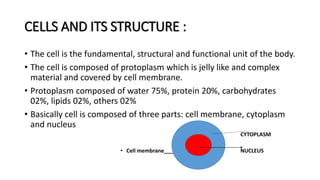
CELLS AND ITS STRUCTURE :
• The cell is the fundamental, structural and functional unit of the body.
• The cell is composed of protoplasm which is jelly like and complex
material and covered by cell membrane.
• Protoplasm composed of water 75%, protein 20%, carbohydrates
02%, lipids 02%, others 02%
• Basically cell is composed of three parts: cell membrane, cytoplasm
and nucleus
CYTOPLASM
• Cell membrane___________________ NUCLEUS
Types of cells:
unicellular and multicellular cells:
• Unicellular cells are made up of one cell. e.g. Prokaryotic cells &
protozoa
• Multicellular cells are made up of more than one cells. e.g. Eukaryotic
cells( Animals & plants)
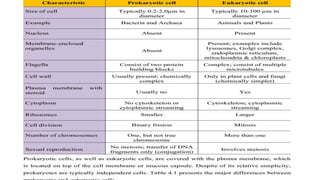
PROKARYOTIC CELLS
PROKARYOTIC CELLS
Prokaryote is an organism that does not have a nucleus (like
bacteria), It still has DNA of course, but not enclosed in a neat little
sack.
Prokaryotes consist of different organelles with specific functions:
1. Cell Wall
5.Ribosomes
2. Cytoplasm
3. Plasma membrane
4. Genetic material
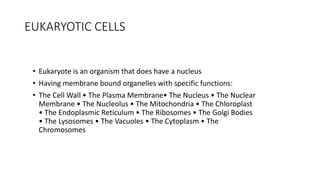
EUKARYOTIC CELLS
• Eukaryote is an organism that does have a nucleus
• Having membrane bound organelles with specific functions:
• The Cell Wall • The Plasma Membrane• The Nucleus • The Nuclear
Membrane • The Nucleolus • The Mitochondria • The Chloroplast
• The Endoplasmic Reticulum • The Ribosomes • The Golgi Bodies
• The Lysosomes • The Vacuoles • The Cytoplasm • The
Chromosomes
Functions:
oCells helps in ingestion and respiratory function by mitochondria.
oCells helps in excretory function by Golgi bodies.
oReproductive function by chromosomes, centrosomes and cytoplasm.
oHelps in conversion of glucose to glycogen by endoplasmic reticulum.
oForming lipids and hormones
oProduces power house by mitochondria.
oCells transmit the genetic material by DNA chromosomes.
REPRODUCTION OF CELLS IN HIGHER ANIMALS
According to reproduction, there are three types of cell division as:
Amitosis , Mitosis and meiosis.
Amitosis: it is asexual production which occurs in unicellular cell like
bacteria & protozoa.
*It is simple cell division.
*It is without proper formation of chromosomes.
*In this process first the nucleus division occurs then cytoplasm
division occurs.
DIFFERENCE B/W MITOSIS & MEIOSIS
MITOSIS MEIOSIS
It is ordinary type of cell division. It is special and complicated type of cell division.
Occurs in all organs expect sex organ. Occurs only in sex organ.
During mitosis the number of chromosomes remains
constant.
During meiosis the number of chromosomes is
reduced to haploid number.
The process of mitosis becomes complete after single
cell division.
The process of meiosis becomes complete after twice
cell divisions.
In the result of mitosis 2 diploid somatic cells are
produced.
In the result of meiosis 4 haploid gametes are
produced.
Pairing of homologous chromosomes doesn’t occur. Pairing of homologous chromosomes occurs.
Crossing over doesn’t occur. Crossing over occurs.
Mitosis consists of 5 stages as: Prophase, Metaphase,
Anaphase, Telophase and Karyokinesis.
Meiosis consists of 5 stages as : Prophase , Metaphase
, Anaphase , Telophase and Cytokinesis.
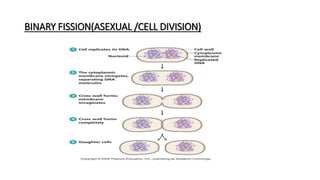
BINARY FISSION(ASEXUAL /CELL DIVISION)
SEXUAL / FISSION REPRODUCTION
In transformation, a bacterium takes up a piece of DNA floating in its
environment.
In transduction, DNA is accidentally moved from one bacterium
to another by a virus.
In conjugation, DNA is transferred between bacteria through a tube
between cells.
Viruses
• Previous I have done in slide
Viral replication
• Replication involves 6 steps: adsorption, penetration, uncoating , biosynthesis , maturation &
release.
• During eclipse there are no intact
virions
• Maturation begins with packaging of
nucleic acid
• Latent period begins at entry and
ends with release
• Lysis results in one-step growth
• Burst size = yield
CLASSIFICATION OF VIRUSES;
• Classified into 2 main classes based on the types of nucleic acid they possess:
• Riboviruses (containing RNA )
• Deoxyriboviruses (containing DNA)
RNA viruses:
• Enteroviruses (Poliovirus)
• Hepatovirus (hepatitis A , C virus)
• Influenza virus, mumps virus, rabies virus, coronavirus , HIV ,
• DNA viruses:
• Poxvirus, herpes virus, hepatitis B , etc
FLAGELLA
• A large number of bacteria are motile.
• Most possess one or more flagella on their surface that allow them to swim.
• Bacterial flagella are tiny hair like organelles of locomotion.
• The straight line movement is called a run and the turn is called a tumble.
• Their fine protein structure requires special staining techniques for
demonstrating them with the light microscope.
• The pattern of flagellation is an important feature in identification of motile
bacteria.
Protozoa, Helminthes & Algae
• Parasite is an organism that is dependent on another living organism
for its survival.
• It infects other living beings, lives in or on the body of another living
being and obtains benefits from it.
Ectoparasite : It is a parasite that lives outside on the surface of the
body without penetrating into the tissues, e.g. lice, ticks & mites.
Endoparasites : It is a parasite that lives within the body of the host; in
blood, tissues, body cavities, and other organs, e.g. all protozoan and
helminthic parasites of man.
Classification of protozoa & helminthes
• Photocopy from book MICROBIOLOGY FOR NURSES 3RD EDITION
By BS Nagoba & Wolters Kluwer
FUNGI HANDOUT FROM BOOK
FACTORS AFFECTING GROWTH AND SURVIVAL OF MICRO
ORGANISMS
• Water
• Gases
• pH
• Temperature
• Energy
• Inorganic salts
• Growth factors in some cases
1. Water
• Water is the most important factor for bacterial growth.
• It is a vehicle for entry of all nutrients into the cell & for elimination of all waste
products.
• It participates in metabolic reactions.
• It forms an integral part of the protoplasm.
2. Gaseous requirements:
Bacteria require oxygen for their growth.
Based on their oxygen requirement, they are categorized into 4 types as follows:
• Obligate or strict Aerobe; grow in the presence of oxygen only
• Micro aerophilic : require low oxygen concentration
• Obligate or strict anaerobe: grow only in the absence of oxygen
• Facultative anaerobe : grow in the absence as well as in the presence
of oxygen
• Bacteria also require carbon dioxide for their growth as well,
produced by bacteria themselves during metabolism.
• A few bacteria may require additional carbon dioxide (5-10 %) for
their growth e.g. Neisseria
3.pH : Most pathogenic bacteria grow best at a neutral or slightly
alkaline pH (7.2-7.6 )
While growth is poor at pH < 6.0 and > 7.8 , it stops at pH below 5.0 &
above 9.0
Temperature
• Bacteria can be classified by their optimal growth temperature. The following are
the five classifications:
• Hyper thermophile (60 degrees C and upwards)
• Thermophile (optimal growth between 45 and 122 degrees)
• Mesophile (20 and 45 degrees C)
• Psychrotrophs (will survive at 0 degrees C, but prefer mesophilic temperature
• Psychrophiles (-15 and 10 degrees C or lower)
• Methanopyrus kandleri can survive and reproduce at 122 °C.
Bacterial growth phase:
• When a bacterium is inoculated into a suitable liquid media &
incubated at suitable temperature & pH , its growth in culture passes
through 4 different phases:
• Lag phase , Log phase , Stationary phase & Decline phase.
• Further explanations handouts from book….
INFECTION(SOURCES,MODES AND CONTROL)
Entrance of the bacteria into the body & capable of causing disease is
called infection.
Infectious: state which is capable of being transmitted with or
without contact e. g; T.B , Malaria (spreading disease)
Healthy carrier : After recovery from an infectious disease , patient
himself feels perfectly well and may contain to excrete the pathogenic
organism, so they become source of infection for other person.
Hepatitis B , Tuberculosis etc
Types of infection
• Primary infection: initial infection or fresh infection by a microorganism is called
primary infection.
• Reinfection : subsequent infections by the same pathogen in the same host are
termed reinfection.
• Secondary infection: infection by a new pathogen after the host loses its
resistance due to a pre-existing infectious disease is termed secondary infection.
• Mixed infection : when infection is caused by more then one microorganism
simultaneously, it is known as mixed infection.
• Cross infection: In a person already suffering from a disease, a new
microorganism sets up a new infection from another external source.
• Nosocomial infection: Cross infections occurring in hospitalized patients are
termed nosocomial infection or hospital acquired infections.
• Iatrogenic infections: infections acquired during diagnostic or therapeutic
procedures are termed iatrogenic infection.
CLASSIFICATION OF INFECTIONS BASED ON CLINICAL EFFECTS
• Subclinical infections: infections in which clinical effects are not apparent
• Atypical infections: in which typical or characteristics manifestations of the
particular disease are not present
• Latent infections: in which microbes remain in the tissue in a latent or hidden
form that proliferate & produce clinical disease & symptoms when the host
resistance is lowered.
Other main types of infections:
• Endogenous or auto-infections: infections in which the source of the
organism(s) is from the host’s own body. The causative agent comes
from another part of the host’s own body( esp. normal flora )
• Exogenous infections : infections in which the source of organism(s) is
external and not from the host’s own body.
• Acute infection: an infection which appears severe & suddenly (may
be dangerous) for short time.
• Chronic infection: an infection which appears slow and since long
time.
• Direct contact infection: an infection which is transferred from one
person to another person by direct contact as by touching (Scabies) ,
kissing (tuberculosis or other), eating (T.B) , sexual contact (AIDS , Hep
B) .
• In direct contact infection : an infection which is transferred from one
person to another person by indirect contacts as by usage of the
infected objects as patients towel, utensils , syringe.
• General infection : infection present all over the body even circulating
in the blood.
• Local infection: infection present at one point in a tissue or particular
area as Boils, Abscess etc.
• Common vehicle infection : an infection which is carried out or
transmitted by contamination water & food to a person such as
cholera-Dysentery , Gastroenteritis by flies etc.
Sources of infection:
• Human sources: (a) Droplet infection: as by coughing , sneezing
(b) Blood borne infection : Hepatitis B , AIDS etc.
© Sexual contact infection : Syphilis , Hepatitis B ,
AIDS , Gonohorrea etc.
• Carrier : is a person who harbours pathogen but displays no
symptoms.
Pathogen originates from Patient------- Reach carrier ------- Act as a
source of infection for a Susceptible individual
• Animals sources : transfer infection from animals to man ( Zoonotic
diseases)
• These infections are transmitted by: contact with animals, animal bite
, injection of milk , meat or other animal products
e.g. Plague , Rabies, T.B, Brucellosis etc.
• Insects: such as mosquitoes, ticks, mites, flies, lice and bugs may
transmit pathogens to humans.
• Insects that transmit infections to humans are known as vectors and
diseases that are transmitted are known as arthropods- borne
diseases.
Two types of vectors: (1) Mechanical vectors: carry pathogens on their
legs, wings and body & transmit them to food materials, which then act
as a source of infection, e.g. transmission of Salmonella & Shigella by
domestic flies.
(2) Biological vectors: carry pathogens in their body.
The pathogens undergo development inside the body of the vector,
with or without multiplication. For example, Malarial parasite
• Soil: Tetanus , Anthrax, Hookworm disease, Mycetoma ,
Histoplasmosis
• Water : contaminated water with pathogens e.g. Vibrio cholera &
hepatitis A
• Food : contaminated food with pathogenic organisms. Food materials
may be contaminated externally or organisms may be present due to
pre-existing infection in meat or other animal products.
Portals of entry
• Skin
• Respiratory tract
• Eyes or Mouth
• Gastrointestinal tract
• Genitourinary tract
• Parenteral or Peritoneal cavity
Portal of exit:
• Respiratory tract
• Gastrointestinal tract
• By insects
• Through pus, urine, body fluids, etc.
Routes of infection entry (in human body)
Transmission:
• Nose (inhalation):as common cold, T.B, Influenza, measles.
• Mouth (ingestion): intestinal infections are transmitted by injection of
contaminated food or drinks.
• Infection transmitted by ingestion may be:
-Water-borne infection (cholera)
-Food-borne infection ( food poisoning )
-Hand-borne infection ( dysentery in which hands contaminated with
organisms in faecal matters are transmitted during feeding, if proper care is not
taken.
• Blood: (Wound) Tetanus, AIDS, Hepatitis-B etc.
• Contact : two types of contact are direct & indirect;
• Direct contact: Contagious diseases (diseases transmitted by direct
contact) such as syphilis & gonorrhea )
• Indirect contact (clothing, bedding or all fomites (inanimate objects)
e.g. transmission of diphtheria in school children by sharing of pencils
& transmission of trachoma by sharing of face towels.
• Transmission by inoculation
• Transmission by insects
• Congenital transfer
• Iatrogenic transfer( unsterile equipment are used for admitted
patients)
Spread of infections:
• By water
• By sewage
• By milk
• By food
• By air
Reference from book (microbiology for nurses by BS Nagoba)
SOURCES OF INFECTION
• MAN (PATIENT OR CARRIER)
• ANIMALS
• INSECTS
• SOIL
• WATER
• FOOD
TRANSMISSION
• INHALATION
• CONTACT
• INGESTION
• BY INSECTS
• INOCULATION
• CONGENTIAL TRANSFER
• IATROGENIC SPREAD
PORTALS OF EXIT
. RESPIRATORY TRACT
. GASTROINTESTINAL TRACT
. BY INSECTS
. THROUGH PUS, URINE, BODY FLUIDS
PORTAL OF ENTRY
. SKIN
. RESPIRATORY TRACT
. EYES OR MOUTH
. GASTROINTESTINAL TRACT
.GENITOURINARY TRACT
. PERITONEAL CAVITY
Types of organisms harmful to man:
• Bacterial pathogens caused these common diseases:
• Typhoid fever: Salmonella typhi
• Tuberculosis : Mycobacterium tubercle bacillus bacteria
• Cholera : Vibro cholera bacteria
• Gonorrhoea : Gonococcus bacteria (Neisseria gonorrhoeae ,)
• Syphilis : Treponema pallidum / Neisseria spp.
• Pneumonia & Rheumatic fever : Streptococcus pneumoniae
• Dysentery : Shigella spp. & Entamoeba histolytica or other protozoa etc.
• Osteomyelitis : Staphylococcus bacteria
• Diphtheria : Corynebacterium diphtheriae
• Tetanus : Clostridium tetani
• Gas Gangrene: Clostridium perfringens
• Whooping Cough : Bordetella pertussis
• Diseases caused by viruses:
Common cold (Rhinovirus )
Influenza (influenza virus)
Gastroenteritis , Diarrhea ( Rota virus)
AIDS (HIV )
Hepatitis viruses ( hepatitis A, B, C, D etc.)
Rabies ( dog bite) Rabies Virus
Herpes simplex virus ( Skin disease)
German measles ( Rubella RNA virus )
Fungi as causative agents:
• Superficial mycoses
• Subcutaneous mycoses
• Systemic & opportunistic mycoses
Protozoa & helminthes:
• Amoebic Dysentery
• Diarrhoea
• Malaria
• Trichomonas Vaginalis
• Ascariasis ( Ascaris lumricoides ( round worm)
• Hook worm disease
• Enterobiasis ( Enterobius vermicularis)
• Taeniasis ( T. solium , T. saginata) Tape worm infections.
Sterilization:
• Sterilization is the process by which an article. Surface or medium is
made free of all microorganisms.
• It is the process of destruction or complete removal of all kinds of
microorganisms, including spores.
• Methods of sterilization : 2 types Physical methods, Chemical
methods
• Physical methods of sterilization include the following:
1. Heat ( Dry heat & Moist heat )
2. Radiation
3. Filtration
• Dry heat: temperature 160°C (320 °F) for 1 hour to 3 hours period.
• Uses : used for Disposal syringe, Instrument, Powders etc.
• Types of dry heat physical methods: 1. Flame physical method( by
heating to redness) burner flame
2. Hot air oven : contain a fan to ensure air circulation & by this to
keep the temperature at all levels within the oven/autoclave. The
standard temperature 160°C for 1 hour to 3 hours.
Uses : used for dressing and laboratory purpose.
3. Infra Red : It is a series of infra-red heating elements by large
apparatus but it is more difficult to regulate than a Hot air oven.
Temperature 180°C for 7.5 minutes
Uses : used for needles, metals instruments , glass syringes etc.
Moist heat:
• It sterilizes the articles at boiling temperature 100°C to 121°C (212° F)
for 15 minutes. There are 2 types:
1. Steam under pressure: in this process, low temperature will destroy
microorganism in the presence of moisture (steam) under pressure
at >21°C for 15 minutes or 134°C for 3 minutes
Uses : used for dressing , linen, instrument and equipment .
2. Low temperature Steam: method killing all vegetative organisms
Temperature above 80°C for 30 min to 2 hours. Used for catheters &
plastic materials
Radiation physical method:
• Advancement of medical technology
• Recommended dose 2.5 mega rads for 1 hour to three hours.
• Two sources ( Gamma rays and Linear accelerators )
• Uses : used for Nylon, Cotton, papers, wood products, disposal plastic
items, syringes, Catheters, hypodermic needles etc.
Filtration Physical method: in which substances or chemicals are passed
through filters to remove micro-organisms.
Uses: Glass , fiber or mask etc.
• Disinfection and sterilization are both decontamination processes.
While disinfection is the process of eliminating or reducing harmful
microorganisms from inanimate objects and surfaces, sterilization is
the process of killing all microorganisms.
• Liquid chemical methods :
• Quaternary ammonium compound liquids used as antiseptics, for
Savlon etc.
• Liquid iodine is good germicide
• Alcohols , formaldehyde liquid as formalin
• Gaseous chemical methods as ethylene oxide gas , formaldehyde
vapors used for room terminals disinfectant , disinfecting mechanical
apparatus such as patient’s ventilators
Normal flora
• Is the community of microbes that’s colonizes a body surface ( living on the body
with benefiting the body)
• Founds in skin, nasopharynx, GIT, genitalia.
• Functions:
1. Synthesizes vit K in human body
2. Helps in absorption of nutrient in human body
3. Helps in food fermentation
4. Prevents from colonization of pathogens in human body (prevents the growth
of harmful micro organisms in human body).
Classification/Type of normal flora
• Bacterial, normal flora sites/places for normal flora in human body
are nose, mouth , stomach , intestine & genital organ.
• Fungus or virus as same as above.
About normal flora chapter 13 normal flora pdf attached….
IMMUNITY & TYPES
• DEFINITION: Is the body defense system against infectious agents like bacteria or virus etc.
There are two types of immunity :
A. Specific immunity: (ANTIGEN, ANTIBODY, B-CELLS AND T-CELLS)
1.HUMORAL IMMUNITY: (a) Antigen: substance as protein , carbohydrates, fats, nucleic acid.
(b) Antibody: Protein substance in blood as immunoglobulin.
2.CELL MEDIATED IMMUNITY: (a) B-Lymphocytes: preprocessed in fetus, liver, bone marrow,
G.I.M(mucous) this was first developed in bone marrow. They produced antibodies against
infections
(b) T-Lymphocytes: they are responsible to activate macrophage
which engulf the antigen or micro organisms.
ACTIVE IMMUNITY: develops by vaccine or having diseases as after small pox or measles.
PASSIVE IMMUNITY: transfer from mother to fetus through placenta or serum taken from person
or animal to other person.
NATURAL IMMUNITY: which is permanent transfer from species, diet or temperature factor
• B:NON-SPECIFIC IMMUNITY:
1.SKIN:contain skin follicles, sweat & sebaceous glands
2.Mucous surface: contain nose secretion, mouth secretion and vaginal secretion.
3.SECRETION: Such as sweat, nasal and mouth secretion.
Diseases causing organisms & parasites:
• Viruses:
1. Common cold due to Rhino virus
2. Influenza due to influenza virus
3. Covid-19 due to novel coronavirus
4. Gastro enteritis (Rota virus)
5. AIDS due to HIV
6. HEPITATIS B (HBV DNA )
7. Mumps & Measles (paramyxovirus family), German measles by
Rubella virus
8. Rabies (dog bite), herpes (H.S.V)
• Bacteria:
1. Typhoid fever (Salmonella spp.)
2. Tuberculosis ( Mycobacterium tubercle bacilli bacteria)
3. Cholera ( Vibrio cholera bacteria )
4. Pneumonia ( streptococcus pneumoniae)
5. Dysentery ( Shigella spp., Entameoba spp.)
6. Gas gangrene ( Clostridium perfringens)
7. Tetanus ( Clostridium tetani)
8. Osteomyelitis ( Staphylococcus spp.)
9. Rheumatic fever , Rheumatic arthritis, Plague, Whooping cough,
Tonsillitis , Gonorrhea, Syphilis
• Protozoa ;
Amoebic Dysentery, Amoebic liver abscess , Diarrhoea, Trichomonas
Vaginalis, Malaria
• Fungus:
• Skin ,nail & hairs fungal infection, Oral moniliasis, Athletes foot fungal
infection, ring worm fungal infection, nappy rashes fungal infection, vaginal
candidosis, systemic mycotic infection , dhobi itching fungal infection.
• Helminths infection:
intestinal helminths, ascariasis, trichuriasis, and hookworm infection
• Common gastrointestinal complaints associated with helminth infection
include abdominal pain, nausea, and diarrhea. The larvae of several
worms, such as Ascaris migrate from the intestines via the portal vein to
the lungs and can cause asthma-like symptoms (e.g., dry cough, wheezing).
Eosinophilia

Basic microbiology aid nurses

  • 1.
  • 2.
    MICROBIOLOGY ??? • Micromeans (Small), Bio means(Life) , Logy means(Study) • Microbiology is the study of all kinds of micro-organisms which can’t be seen by naked eyes. • Either pathogenic or non-pathogenic which are only visible by the microscope. Examples; Bacteria, Viruses, Protozoa or Fungus etc. CLASSIFICATION OF MICRO-ORGANISMS: 1. BACTERIA (BACTERIOLOGY) 2. VIRUSES ( VIROLOGY) 3. PROTOZOA (PHYCOLOGY OR PROTOZOALOGY) 4. FUNGI (MYCOLOGY)
  • 3.
    Importance Of Microbiologyfor Nurses: • Gain the knowledge of prevention from diseases by sterilization etc. • Gain the knowledge of Handling the patient from the communicable diseases. • Gain the knowledge in keeping the vaccine against the various diseases. • Understand the importance of microbiology to a nurse as individual, family, community & country benefits.
  • 4.
    BRIEF HISTORY: • A.Vanleeu wen Hook(1676) founder of Microbiology. • Robert Kock (1882) Tubercle & Mycobacterium . • Louis Pasteur (1884) Rabies & pasteurization. • Alexender Fleming (1929) founder of Pencilline. • Joseph lord Lister (1827) Antiseptic techniques.
  • 5.
    TERMINOLOGY • Pathogen: issuch organism which produces disease (as Salmonella bacteria produce the Typhoid fever) • Epidemic : is an infectious disease which attacks a number of people in the same area at some time as Cholera, Measles etc • Endemic: a disease that exists permanently in a particular region or population as Chicken pox & Malaria etc. • Pandemic: when epidemic spreads all over world as Chikungunya, Cholera, Ebola virus disease, influenza etc. • Anti-septic: Prevent our self from bacteria as dettol, spirit,savlon etc • Infection: entrance of bacteria into the body and capable of causing disease is called infection. • Nosocomial Infection: is a hospital acquired infection.
  • 6.
    • Communicable disease:disease that can transmitted from one person to other person • Infection: the process of infecting or the state of being infected as micro organism enter in our body, multiple and symptoms appear • Disease: disorder of structure or function in a human one that produces specific symptoms • Commensal Organisms: it lives in association with another without giving any benefits or harm and living in specific sites of the body if move to other part of body then act as pathogen and cause infection as E.coli lives in gut if transfer to urinary tract cause infection.
  • 7.
    CELLS AND ITSSTRUCTURE : • The cell is the fundamental, structural and functional unit of the body. • The cell is composed of protoplasm which is jelly like and complex material and covered by cell membrane. • Protoplasm composed of water 75%, protein 20%, carbohydrates 02%, lipids 02%, others 02% • Basically cell is composed of three parts: cell membrane, cytoplasm and nucleus CYTOPLASM • Cell membrane___________________ NUCLEUS
  • 8.
    Types of cells: unicellularand multicellular cells: • Unicellular cells are made up of one cell. e.g. Prokaryotic cells & protozoa • Multicellular cells are made up of more than one cells. e.g. Eukaryotic cells( Animals & plants)
  • 9.
  • 10.
    PROKARYOTIC CELLS Prokaryote isan organism that does not have a nucleus (like bacteria), It still has DNA of course, but not enclosed in a neat little sack. Prokaryotes consist of different organelles with specific functions: 1. Cell Wall 5.Ribosomes 2. Cytoplasm 3. Plasma membrane 4. Genetic material
  • 12.
    EUKARYOTIC CELLS • Eukaryoteis an organism that does have a nucleus • Having membrane bound organelles with specific functions: • The Cell Wall • The Plasma Membrane• The Nucleus • The Nuclear Membrane • The Nucleolus • The Mitochondria • The Chloroplast • The Endoplasmic Reticulum • The Ribosomes • The Golgi Bodies • The Lysosomes • The Vacuoles • The Cytoplasm • The Chromosomes
  • 14.
    Functions: oCells helps iningestion and respiratory function by mitochondria. oCells helps in excretory function by Golgi bodies. oReproductive function by chromosomes, centrosomes and cytoplasm. oHelps in conversion of glucose to glycogen by endoplasmic reticulum. oForming lipids and hormones oProduces power house by mitochondria. oCells transmit the genetic material by DNA chromosomes.
  • 15.
    REPRODUCTION OF CELLSIN HIGHER ANIMALS According to reproduction, there are three types of cell division as: Amitosis , Mitosis and meiosis. Amitosis: it is asexual production which occurs in unicellular cell like bacteria & protozoa. *It is simple cell division. *It is without proper formation of chromosomes. *In this process first the nucleus division occurs then cytoplasm division occurs.
  • 16.
    DIFFERENCE B/W MITOSIS& MEIOSIS MITOSIS MEIOSIS It is ordinary type of cell division. It is special and complicated type of cell division. Occurs in all organs expect sex organ. Occurs only in sex organ. During mitosis the number of chromosomes remains constant. During meiosis the number of chromosomes is reduced to haploid number. The process of mitosis becomes complete after single cell division. The process of meiosis becomes complete after twice cell divisions. In the result of mitosis 2 diploid somatic cells are produced. In the result of meiosis 4 haploid gametes are produced. Pairing of homologous chromosomes doesn’t occur. Pairing of homologous chromosomes occurs. Crossing over doesn’t occur. Crossing over occurs.
  • 17.
    Mitosis consists of5 stages as: Prophase, Metaphase, Anaphase, Telophase and Karyokinesis. Meiosis consists of 5 stages as : Prophase , Metaphase , Anaphase , Telophase and Cytokinesis.
  • 18.
  • 19.
    SEXUAL / FISSIONREPRODUCTION In transformation, a bacterium takes up a piece of DNA floating in its environment.
  • 20.
    In transduction, DNAis accidentally moved from one bacterium to another by a virus.
  • 21.
    In conjugation, DNAis transferred between bacteria through a tube between cells.
  • 22.
    Viruses • Previous Ihave done in slide
  • 23.
    Viral replication • Replicationinvolves 6 steps: adsorption, penetration, uncoating , biosynthesis , maturation & release. • During eclipse there are no intact virions • Maturation begins with packaging of nucleic acid • Latent period begins at entry and ends with release • Lysis results in one-step growth • Burst size = yield
  • 24.
    CLASSIFICATION OF VIRUSES; •Classified into 2 main classes based on the types of nucleic acid they possess: • Riboviruses (containing RNA ) • Deoxyriboviruses (containing DNA) RNA viruses: • Enteroviruses (Poliovirus) • Hepatovirus (hepatitis A , C virus) • Influenza virus, mumps virus, rabies virus, coronavirus , HIV , • DNA viruses: • Poxvirus, herpes virus, hepatitis B , etc
  • 25.
    FLAGELLA • A largenumber of bacteria are motile. • Most possess one or more flagella on their surface that allow them to swim. • Bacterial flagella are tiny hair like organelles of locomotion. • The straight line movement is called a run and the turn is called a tumble. • Their fine protein structure requires special staining techniques for demonstrating them with the light microscope. • The pattern of flagellation is an important feature in identification of motile bacteria.
  • 26.
    Protozoa, Helminthes &Algae • Parasite is an organism that is dependent on another living organism for its survival. • It infects other living beings, lives in or on the body of another living being and obtains benefits from it. Ectoparasite : It is a parasite that lives outside on the surface of the body without penetrating into the tissues, e.g. lice, ticks & mites. Endoparasites : It is a parasite that lives within the body of the host; in blood, tissues, body cavities, and other organs, e.g. all protozoan and helminthic parasites of man.
  • 29.
    Classification of protozoa& helminthes • Photocopy from book MICROBIOLOGY FOR NURSES 3RD EDITION By BS Nagoba & Wolters Kluwer FUNGI HANDOUT FROM BOOK
  • 30.
    FACTORS AFFECTING GROWTHAND SURVIVAL OF MICRO ORGANISMS • Water • Gases • pH • Temperature • Energy • Inorganic salts • Growth factors in some cases
  • 31.
    1. Water • Wateris the most important factor for bacterial growth. • It is a vehicle for entry of all nutrients into the cell & for elimination of all waste products. • It participates in metabolic reactions. • It forms an integral part of the protoplasm. 2. Gaseous requirements: Bacteria require oxygen for their growth. Based on their oxygen requirement, they are categorized into 4 types as follows: • Obligate or strict Aerobe; grow in the presence of oxygen only
  • 32.
    • Micro aerophilic: require low oxygen concentration • Obligate or strict anaerobe: grow only in the absence of oxygen • Facultative anaerobe : grow in the absence as well as in the presence of oxygen • Bacteria also require carbon dioxide for their growth as well, produced by bacteria themselves during metabolism. • A few bacteria may require additional carbon dioxide (5-10 %) for their growth e.g. Neisseria 3.pH : Most pathogenic bacteria grow best at a neutral or slightly alkaline pH (7.2-7.6 ) While growth is poor at pH < 6.0 and > 7.8 , it stops at pH below 5.0 & above 9.0
  • 33.
    Temperature • Bacteria canbe classified by their optimal growth temperature. The following are the five classifications: • Hyper thermophile (60 degrees C and upwards) • Thermophile (optimal growth between 45 and 122 degrees) • Mesophile (20 and 45 degrees C) • Psychrotrophs (will survive at 0 degrees C, but prefer mesophilic temperature • Psychrophiles (-15 and 10 degrees C or lower) • Methanopyrus kandleri can survive and reproduce at 122 °C.
  • 34.
    Bacterial growth phase: •When a bacterium is inoculated into a suitable liquid media & incubated at suitable temperature & pH , its growth in culture passes through 4 different phases: • Lag phase , Log phase , Stationary phase & Decline phase. • Further explanations handouts from book….
  • 35.
    INFECTION(SOURCES,MODES AND CONTROL) Entranceof the bacteria into the body & capable of causing disease is called infection. Infectious: state which is capable of being transmitted with or without contact e. g; T.B , Malaria (spreading disease) Healthy carrier : After recovery from an infectious disease , patient himself feels perfectly well and may contain to excrete the pathogenic organism, so they become source of infection for other person. Hepatitis B , Tuberculosis etc
  • 36.
    Types of infection •Primary infection: initial infection or fresh infection by a microorganism is called primary infection. • Reinfection : subsequent infections by the same pathogen in the same host are termed reinfection. • Secondary infection: infection by a new pathogen after the host loses its resistance due to a pre-existing infectious disease is termed secondary infection. • Mixed infection : when infection is caused by more then one microorganism simultaneously, it is known as mixed infection. • Cross infection: In a person already suffering from a disease, a new microorganism sets up a new infection from another external source.
  • 37.
    • Nosocomial infection:Cross infections occurring in hospitalized patients are termed nosocomial infection or hospital acquired infections. • Iatrogenic infections: infections acquired during diagnostic or therapeutic procedures are termed iatrogenic infection. CLASSIFICATION OF INFECTIONS BASED ON CLINICAL EFFECTS • Subclinical infections: infections in which clinical effects are not apparent • Atypical infections: in which typical or characteristics manifestations of the particular disease are not present • Latent infections: in which microbes remain in the tissue in a latent or hidden form that proliferate & produce clinical disease & symptoms when the host resistance is lowered.
  • 38.
    Other main typesof infections: • Endogenous or auto-infections: infections in which the source of the organism(s) is from the host’s own body. The causative agent comes from another part of the host’s own body( esp. normal flora ) • Exogenous infections : infections in which the source of organism(s) is external and not from the host’s own body. • Acute infection: an infection which appears severe & suddenly (may be dangerous) for short time. • Chronic infection: an infection which appears slow and since long time.
  • 39.
    • Direct contactinfection: an infection which is transferred from one person to another person by direct contact as by touching (Scabies) , kissing (tuberculosis or other), eating (T.B) , sexual contact (AIDS , Hep B) . • In direct contact infection : an infection which is transferred from one person to another person by indirect contacts as by usage of the infected objects as patients towel, utensils , syringe. • General infection : infection present all over the body even circulating in the blood. • Local infection: infection present at one point in a tissue or particular area as Boils, Abscess etc. • Common vehicle infection : an infection which is carried out or transmitted by contamination water & food to a person such as cholera-Dysentery , Gastroenteritis by flies etc.
  • 40.
    Sources of infection: •Human sources: (a) Droplet infection: as by coughing , sneezing (b) Blood borne infection : Hepatitis B , AIDS etc. © Sexual contact infection : Syphilis , Hepatitis B , AIDS , Gonohorrea etc. • Carrier : is a person who harbours pathogen but displays no symptoms. Pathogen originates from Patient------- Reach carrier ------- Act as a source of infection for a Susceptible individual • Animals sources : transfer infection from animals to man ( Zoonotic diseases)
  • 41.
    • These infectionsare transmitted by: contact with animals, animal bite , injection of milk , meat or other animal products e.g. Plague , Rabies, T.B, Brucellosis etc. • Insects: such as mosquitoes, ticks, mites, flies, lice and bugs may transmit pathogens to humans. • Insects that transmit infections to humans are known as vectors and diseases that are transmitted are known as arthropods- borne diseases. Two types of vectors: (1) Mechanical vectors: carry pathogens on their legs, wings and body & transmit them to food materials, which then act as a source of infection, e.g. transmission of Salmonella & Shigella by domestic flies. (2) Biological vectors: carry pathogens in their body.
  • 42.
    The pathogens undergodevelopment inside the body of the vector, with or without multiplication. For example, Malarial parasite • Soil: Tetanus , Anthrax, Hookworm disease, Mycetoma , Histoplasmosis • Water : contaminated water with pathogens e.g. Vibrio cholera & hepatitis A • Food : contaminated food with pathogenic organisms. Food materials may be contaminated externally or organisms may be present due to pre-existing infection in meat or other animal products.
  • 43.
    Portals of entry •Skin • Respiratory tract • Eyes or Mouth • Gastrointestinal tract • Genitourinary tract • Parenteral or Peritoneal cavity
  • 44.
    Portal of exit: •Respiratory tract • Gastrointestinal tract • By insects • Through pus, urine, body fluids, etc.
  • 45.
    Routes of infectionentry (in human body) Transmission: • Nose (inhalation):as common cold, T.B, Influenza, measles. • Mouth (ingestion): intestinal infections are transmitted by injection of contaminated food or drinks. • Infection transmitted by ingestion may be: -Water-borne infection (cholera) -Food-borne infection ( food poisoning ) -Hand-borne infection ( dysentery in which hands contaminated with organisms in faecal matters are transmitted during feeding, if proper care is not taken. • Blood: (Wound) Tetanus, AIDS, Hepatitis-B etc.
  • 46.
    • Contact :two types of contact are direct & indirect; • Direct contact: Contagious diseases (diseases transmitted by direct contact) such as syphilis & gonorrhea ) • Indirect contact (clothing, bedding or all fomites (inanimate objects) e.g. transmission of diphtheria in school children by sharing of pencils & transmission of trachoma by sharing of face towels. • Transmission by inoculation • Transmission by insects • Congenital transfer • Iatrogenic transfer( unsterile equipment are used for admitted patients)
  • 47.
    Spread of infections: •By water • By sewage • By milk • By food • By air Reference from book (microbiology for nurses by BS Nagoba)
  • 48.
    SOURCES OF INFECTION •MAN (PATIENT OR CARRIER) • ANIMALS • INSECTS • SOIL • WATER • FOOD TRANSMISSION • INHALATION • CONTACT • INGESTION • BY INSECTS • INOCULATION • CONGENTIAL TRANSFER • IATROGENIC SPREAD PORTALS OF EXIT . RESPIRATORY TRACT . GASTROINTESTINAL TRACT . BY INSECTS . THROUGH PUS, URINE, BODY FLUIDS PORTAL OF ENTRY . SKIN . RESPIRATORY TRACT . EYES OR MOUTH . GASTROINTESTINAL TRACT .GENITOURINARY TRACT . PERITONEAL CAVITY
  • 49.
    Types of organismsharmful to man: • Bacterial pathogens caused these common diseases: • Typhoid fever: Salmonella typhi • Tuberculosis : Mycobacterium tubercle bacillus bacteria • Cholera : Vibro cholera bacteria • Gonorrhoea : Gonococcus bacteria (Neisseria gonorrhoeae ,) • Syphilis : Treponema pallidum / Neisseria spp. • Pneumonia & Rheumatic fever : Streptococcus pneumoniae • Dysentery : Shigella spp. & Entamoeba histolytica or other protozoa etc. • Osteomyelitis : Staphylococcus bacteria • Diphtheria : Corynebacterium diphtheriae • Tetanus : Clostridium tetani • Gas Gangrene: Clostridium perfringens • Whooping Cough : Bordetella pertussis
  • 50.
    • Diseases causedby viruses: Common cold (Rhinovirus ) Influenza (influenza virus) Gastroenteritis , Diarrhea ( Rota virus) AIDS (HIV ) Hepatitis viruses ( hepatitis A, B, C, D etc.) Rabies ( dog bite) Rabies Virus Herpes simplex virus ( Skin disease) German measles ( Rubella RNA virus )
  • 51.
    Fungi as causativeagents: • Superficial mycoses • Subcutaneous mycoses • Systemic & opportunistic mycoses Protozoa & helminthes: • Amoebic Dysentery • Diarrhoea • Malaria • Trichomonas Vaginalis
  • 52.
    • Ascariasis (Ascaris lumricoides ( round worm) • Hook worm disease • Enterobiasis ( Enterobius vermicularis) • Taeniasis ( T. solium , T. saginata) Tape worm infections.
  • 53.
    Sterilization: • Sterilization isthe process by which an article. Surface or medium is made free of all microorganisms. • It is the process of destruction or complete removal of all kinds of microorganisms, including spores. • Methods of sterilization : 2 types Physical methods, Chemical methods • Physical methods of sterilization include the following: 1. Heat ( Dry heat & Moist heat ) 2. Radiation 3. Filtration
  • 54.
    • Dry heat:temperature 160°C (320 °F) for 1 hour to 3 hours period. • Uses : used for Disposal syringe, Instrument, Powders etc. • Types of dry heat physical methods: 1. Flame physical method( by heating to redness) burner flame 2. Hot air oven : contain a fan to ensure air circulation & by this to keep the temperature at all levels within the oven/autoclave. The standard temperature 160°C for 1 hour to 3 hours. Uses : used for dressing and laboratory purpose. 3. Infra Red : It is a series of infra-red heating elements by large apparatus but it is more difficult to regulate than a Hot air oven. Temperature 180°C for 7.5 minutes Uses : used for needles, metals instruments , glass syringes etc.
  • 55.
    Moist heat: • Itsterilizes the articles at boiling temperature 100°C to 121°C (212° F) for 15 minutes. There are 2 types: 1. Steam under pressure: in this process, low temperature will destroy microorganism in the presence of moisture (steam) under pressure at >21°C for 15 minutes or 134°C for 3 minutes Uses : used for dressing , linen, instrument and equipment . 2. Low temperature Steam: method killing all vegetative organisms Temperature above 80°C for 30 min to 2 hours. Used for catheters & plastic materials
  • 56.
    Radiation physical method: •Advancement of medical technology • Recommended dose 2.5 mega rads for 1 hour to three hours. • Two sources ( Gamma rays and Linear accelerators ) • Uses : used for Nylon, Cotton, papers, wood products, disposal plastic items, syringes, Catheters, hypodermic needles etc. Filtration Physical method: in which substances or chemicals are passed through filters to remove micro-organisms. Uses: Glass , fiber or mask etc.
  • 57.
    • Disinfection andsterilization are both decontamination processes. While disinfection is the process of eliminating or reducing harmful microorganisms from inanimate objects and surfaces, sterilization is the process of killing all microorganisms. • Liquid chemical methods : • Quaternary ammonium compound liquids used as antiseptics, for Savlon etc. • Liquid iodine is good germicide • Alcohols , formaldehyde liquid as formalin • Gaseous chemical methods as ethylene oxide gas , formaldehyde vapors used for room terminals disinfectant , disinfecting mechanical apparatus such as patient’s ventilators
  • 58.
    Normal flora • Isthe community of microbes that’s colonizes a body surface ( living on the body with benefiting the body) • Founds in skin, nasopharynx, GIT, genitalia. • Functions: 1. Synthesizes vit K in human body 2. Helps in absorption of nutrient in human body 3. Helps in food fermentation 4. Prevents from colonization of pathogens in human body (prevents the growth of harmful micro organisms in human body).
  • 59.
    Classification/Type of normalflora • Bacterial, normal flora sites/places for normal flora in human body are nose, mouth , stomach , intestine & genital organ. • Fungus or virus as same as above. About normal flora chapter 13 normal flora pdf attached….
  • 60.
    IMMUNITY & TYPES •DEFINITION: Is the body defense system against infectious agents like bacteria or virus etc. There are two types of immunity : A. Specific immunity: (ANTIGEN, ANTIBODY, B-CELLS AND T-CELLS) 1.HUMORAL IMMUNITY: (a) Antigen: substance as protein , carbohydrates, fats, nucleic acid. (b) Antibody: Protein substance in blood as immunoglobulin. 2.CELL MEDIATED IMMUNITY: (a) B-Lymphocytes: preprocessed in fetus, liver, bone marrow, G.I.M(mucous) this was first developed in bone marrow. They produced antibodies against infections (b) T-Lymphocytes: they are responsible to activate macrophage which engulf the antigen or micro organisms.
  • 61.
    ACTIVE IMMUNITY: developsby vaccine or having diseases as after small pox or measles. PASSIVE IMMUNITY: transfer from mother to fetus through placenta or serum taken from person or animal to other person. NATURAL IMMUNITY: which is permanent transfer from species, diet or temperature factor • B:NON-SPECIFIC IMMUNITY: 1.SKIN:contain skin follicles, sweat & sebaceous glands 2.Mucous surface: contain nose secretion, mouth secretion and vaginal secretion. 3.SECRETION: Such as sweat, nasal and mouth secretion.
  • 62.
    Diseases causing organisms& parasites: • Viruses: 1. Common cold due to Rhino virus 2. Influenza due to influenza virus 3. Covid-19 due to novel coronavirus 4. Gastro enteritis (Rota virus) 5. AIDS due to HIV 6. HEPITATIS B (HBV DNA ) 7. Mumps & Measles (paramyxovirus family), German measles by Rubella virus 8. Rabies (dog bite), herpes (H.S.V)
  • 63.
    • Bacteria: 1. Typhoidfever (Salmonella spp.) 2. Tuberculosis ( Mycobacterium tubercle bacilli bacteria) 3. Cholera ( Vibrio cholera bacteria ) 4. Pneumonia ( streptococcus pneumoniae) 5. Dysentery ( Shigella spp., Entameoba spp.) 6. Gas gangrene ( Clostridium perfringens) 7. Tetanus ( Clostridium tetani) 8. Osteomyelitis ( Staphylococcus spp.) 9. Rheumatic fever , Rheumatic arthritis, Plague, Whooping cough, Tonsillitis , Gonorrhea, Syphilis
  • 64.
    • Protozoa ; AmoebicDysentery, Amoebic liver abscess , Diarrhoea, Trichomonas Vaginalis, Malaria • Fungus: • Skin ,nail & hairs fungal infection, Oral moniliasis, Athletes foot fungal infection, ring worm fungal infection, nappy rashes fungal infection, vaginal candidosis, systemic mycotic infection , dhobi itching fungal infection. • Helminths infection: intestinal helminths, ascariasis, trichuriasis, and hookworm infection • Common gastrointestinal complaints associated with helminth infection include abdominal pain, nausea, and diarrhea. The larvae of several worms, such as Ascaris migrate from the intestines via the portal vein to the lungs and can cause asthma-like symptoms (e.g., dry cough, wheezing). Eosinophilia