


1
PREPARED BY : ASST. PROF. VATSAL D. PATEL
MAHATMA GANDHI INSTITUTE OF
TECHNICAL EDUCATION &
RESEARCH CENTRE, NAVSARI.
2
 Caisson is derived from French word “caisse” meaning a box.
 It is relatively large deep foundation.
 It is a box structure in shape of rectangular, round which is sunk from the surface of
water or land to the desire depth.
 It is permanent structure and part of the sub- structure.
 Transferring the load of structure to the hard strata.
 Used for foundation of bridges, piers, abutments in river or lake.
 Used as impervious core wall of earth dams.
 Toprovide an access to a deep shaft ortunnel.
3
4
 Following materials are used for caissons:
1) RCC
2) Steel
3) Timber
4) Cast iron
5
 Box caisson (open at top and closed at bottom)
 Open or well type (open at top and bottom)
 Pneumatic type ( closed at top and open at bottom)
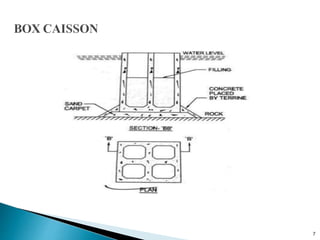
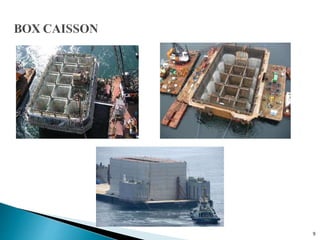
 It is strong water tight vessel openat top and closed at bottom and made of timber,
steel or RCC.
 It is build on land, cured and then float or launched to pier site where it is placed
in position.
 Mainly it is used for shallow depth andfor light weight.
6
7
8
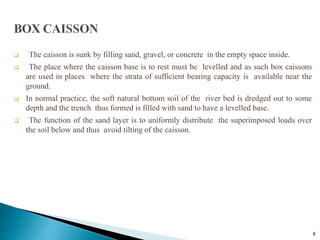
 The caisson is sunk by filling sand, gravel, or concrete in the empty space inside.
 The place where the caisson base is to rest must be levelled and as such box caissons
are used in places where the strata of sufficient bearing capacity is available near the
ground.
 In normal practice, the soft natural bottom soil of the river bed is dredged out to some
depth and the trench thus formed is filled with sand to have a levelled base.
 The function of the sand layer is to uniformly distribute the superimposed loads over
the soil below and thus avoid tilting of the caisson.
9
10
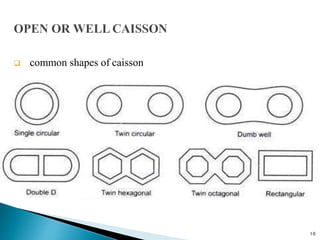
 common shapes of caisson
11
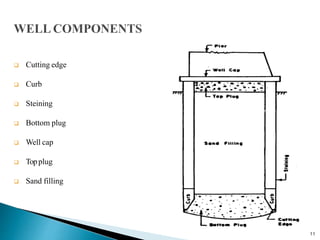
 Cutting edge
 Curb
 Steining
 Bottom plug
 Well cap
 Topplug
 Sand filling
12
 Cutting edge : provides sharp edge to cut the soil below during sinking operation.
 Curb : during sinking it acts as extension of cutting edge and provide support the well. It
is made of RCC.
 Steining : it is main body of the well. Made of RCC or masonry with minimum thickness
of 45 cm.
 Bottom plug : made of concrete and designed for an upward load equal to the soil
pressure minus self weight of the bottom plug and sand filling.
13
 Topplug : it supports the well cap.
 Well cap : it transfers the load from pier to the well.
 Sand filling : it transfers a portion of load from well cap to the bottom plug.
 This is a box type structure having no top pr bottom(during construction) and mainly
consists of vertical walls.
 The method of construction of a typical single wall open caisson is describe below:
 Wherever necessary the site is made dry by dewatering the area by adopting
suitable method (By constructing cofferdam, sheet piling etc.).
 A pit of suitable size and about 3 to 4 meter deep is excavated
at the site where the caisson is to be sunk.
 The cutting edge is then placed at the bottom of the pit. Above the cutting edge, the
wall reinforcements are suitably tied up and the shuttering for casting the concrete
wall is erected.
 The caisson walls are then concreted in lifts to a suitable.
 When the freshly laid concrete has gained sufficient strength, sinking operation is
started. The caisson sinks due to its own weight when the soil from the space inside
removed by use of clam shell or any other method.
 As sinking proceeds, additional sections of the caisson walls are successively cast.
 Sinking is stopped while each section is concreted and it is resumed only after the
concreted section has gained sufficientstrength.
 When the caisson is sunk to the required depth, its base is plugged by providing 15
to 45 m thick layer of concrete (concreteseal).
 The concrete for the seal is placed by use of a tremie pipe or by a bottom dump
bucket.
 After the concrete seal has set, the water inside the caisson is pumped out
and theempty space is filled with sand,gravel.
 The rate of sinking of the caisson is always slow because the downward moment of the
caisson is resisted by the skin friction of the ground on its walls.
 At times the skin friction becomes so great that the caisson does not sink even after all
the earth has been dredged out from the inside clean down to the cutting edge.
 In such situations, sinking is resorted to by loading the caisson with additional weights
in the form of rails, ingots (block of steel) etc. which are removed afterwards.
18
 This may be defined as a cylindrical shell made up of timber, masonry, steel or reinforced
concrete shod with a cutting edge and which is sunk by excavating the soil within the
shell.
 The thickness of the caisson wall must be adequate so that when the inside soil is
dredged out, it sinks under its own weight. To facilitate sinking of the caisson water jets
are sometimes used around the sides which decrease the skin friction.
 Cylindrical open caisson is also known as well caisson. This type of caisson is similar in
all respect to the single wall open caisson except that its wall is circular in plan.
 The method of construction of well caisson is exactly similar to that of a single wall
open caisson described earlier. After the well is sunk to the desired depth its bottom is
sealed with concrete. This type of caisson is commonly adopted for providing
foundation for bridges.
 This type of caisson is closed at top and open (during construction) at the bottom. The
water is excluded from the caisson chamber by means of compressed air.
 The construction of the pneumatic caisson is similar to the types described above, except
that, the working chamber and shaft are made air-tight. In order that the workmen may
carry out excavation work underneath the caisson and the water may not find its way
inside from below, the pressure of the compressed air in the shaft is kept just higher than
that of the water at thatdepth.
 Each caisson has two air locks. Through one air lock workmen go down for working
while through the other excavated material is taken out. An air lock essentially consists
of a steel chamber having two air-tight.
 One door of this chamber serves as an entry for men and material from outside
into the steel chamber and the other door leads to the air shaft.
 When a workman enters the airlock from outside, the pressure inside the airlock is the
same as that of outside atmosphere.
 Thereafter the outside door is closed and the pressure inside the airlock is raised slowly.
When the pressure inside the airlock becomes equal to the pressure in the caisson, the
door of the airlock which leads to the air shaft is opened and the workman goes down the
air-shaft with the help of a ladder installed therein.
 Exactly reverse procedure is followed when the workman comes out of the caisson. Air-
shaft provides means of access for the worker from airlock down to check.
20
 This method of providing foundation is complicated, expensive and very slow.
However, in places where it is rather difficult to use bulky equipment required for
alternative method, pneumatic caissons appear to be the only choice.
 The chief advantage of this method is that entire operation of sinking the caisson
can be carried out under controlled conditions.
 This method provides better facilities for removing obstructions, inspection of work and
concreting of foundations bed.
 This type of caisson is suitable for depths ranging from 25 m to 40 m. At higher depths,
the persons working inside the caisson for sinking operation are liable to get caisson
disease.
21
22
 When workers working under compressed air inside theworking
chamber, they suffer certain type of disease when they return to the atmospheric
pressure. This disease is known as “Caisson Sickness”or “Caisson Disease”.
 The main symptoms of the diseases are:
1) Dizziness (vertigo)
2) Double vision
3) Headache
4) Trouble to speaking
5) Pain in body
23
1) No person should work for more than one shift in a day.
2) Shift should not exceed 12 hours.
3) Temperature of the working chamber should be maintain 25 degree centigrade.
4) The main locks should be well ventilated.
5) Persons with strong heart, low blood pressure and good circulation
should be employed on the work.
6) Use of alcoholic drinks should be prohibited.
7) Medical facility or chamber should be provided nearer to the work.
24
8) The workers should take enough meal before the shift starts.
9) All the passages, shafts etc. of the caisson should be well ventilated and properly
lighted.
10) The worker use man locks for entry, interval and exit.
25
 Mainly following methods are adopted:
1) Air and water jets
2) Blasting
3) Loading
4) Sand island
26
 Air and water jets:
 In this method, water jets are provided near the cutting edge level to reduce the skin
friction.
 The air or water is forced through the jets which facilitates the sinking of caisson.
 Blasting :
 In this method, the explosives are used to remove any obstruction such as rock,
boulder, etc. and facilitate the sinking of caisson.
 The cutting edge is cleared and suitable charge of explosive is provided at a depth
of about one or two meter below the curb level.
27
 Loading :
 Applied uniform load on the top of the caisson to facilitate sinking.
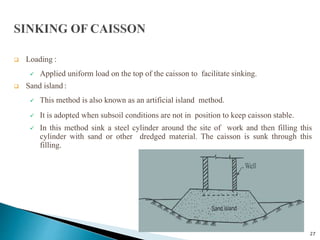
 Sand island :
 This method is also known as an artificial island method.
 It is adopted when subsoil conditions are not in position to keep caisson stable.
 In this method sink a steel cylinder around the site of work and then filling this
cylinder with sand or other dredged material. The caisson is sunk through this
filling.
28
 The major problems in well sinking are:
1) Sand blowing
2) Tilting of wells
3) Shifting of wells
 Sand blowing :
The trouble of sand blowing takes place during theprocess of dewatering of the well
passing through sandy strata.
 The ground around the well starts breaking up and wide cracks are formed.
 The fall of sand in the caisson is so sudden and huge in amounts to a depth of about 3 to
15m of sand. This may result in fatal accident.
 When sand blowing occurs, dewatering of caisson should immediately discontinued and
bundles of grass or some such filling materials should be placed all around the staining
to control the sand blowing.
33
 Tilting of wells:
 When a well sinks more or one side than the other, then it is known to have tilted.
The tilting is mainly due to unequal dredging and non-uniform bearing power of
soil.
 Following methods are used to control the tilting :
 Control of dredging
 Eccentric loading
 Water jetting
 Pulling the well
 Pushing by jacks
34
31
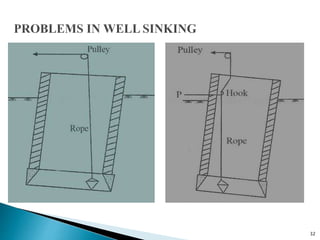
 Control of dredging :
 Dredging is done only near to the portion which has tilted. The portion which is
higher than other is termed as tilted edge.
 This method is not very effective when the well has been sunk to a great depth. In
such case, a hole is made in steining and by hooks, the rope of the dredge is pulled
towards higher side to the maximum possible extent. The hole is made near the
ground level.
32
33
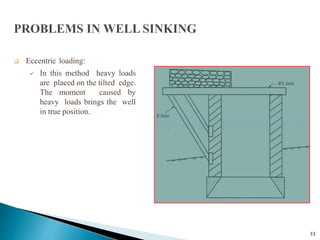
 Eccentric loading:
 In this method heavy loads
are placed on the tilted edge.
The moment caused by
heavy loads brings the well
in true position.
34
 Water jetting :
 In this method, water jet is forced on the outer faces of the well towards the higher
side so that skin friction is reduced towards the higher side. This method is effective
in case the well is being sunk in sandy strata.
35
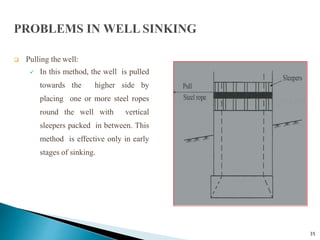
 Pulling the well:
 In this method, the well is pulled
towards the higher side by
placing one or more steel ropes
round the well with vertical
sleepers packed in between. This
method is effective only in early
stages of sinking.
36
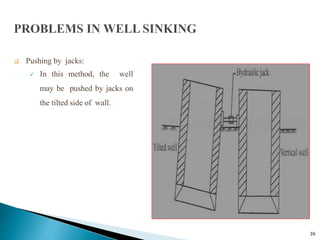
 Pushing by jacks:
 In this method, the well
may be pushed by jacks on
the tilted side of wall.
37
 Shifting of wells:
 If a simple tilt is occurs at a certain depth and the sinking continued till designed
foundation depth is reached, the shift at the bottom could be greater than a top.
38

2. CAISSONS (ACE) 2160601 GTU

  • 1.
    1 PREPARED BY :ASST. PROF. VATSAL D. PATEL MAHATMA GANDHI INSTITUTE OF TECHNICAL EDUCATION & RESEARCH CENTRE, NAVSARI.
  • 2.
    2  Caisson isderived from French word “caisse” meaning a box.  It is relatively large deep foundation.  It is a box structure in shape of rectangular, round which is sunk from the surface of water or land to the desire depth.  It is permanent structure and part of the sub- structure.
  • 3.
     Transferring theload of structure to the hard strata.  Used for foundation of bridges, piers, abutments in river or lake.  Used as impervious core wall of earth dams.  Toprovide an access to a deep shaft ortunnel. 3
  • 4.
    4  Following materialsare used for caissons: 1) RCC 2) Steel 3) Timber 4) Cast iron
  • 5.
    5  Box caisson(open at top and closed at bottom)  Open or well type (open at top and bottom)  Pneumatic type ( closed at top and open at bottom)
  • 6.
     It isstrong water tight vessel openat top and closed at bottom and made of timber, steel or RCC.  It is build on land, cured and then float or launched to pier site where it is placed in position.  Mainly it is used for shallow depth andfor light weight. 6
  • 7.
  • 8.
    8  The caissonis sunk by filling sand, gravel, or concrete in the empty space inside.  The place where the caisson base is to rest must be levelled and as such box caissons are used in places where the strata of sufficient bearing capacity is available near the ground.  In normal practice, the soft natural bottom soil of the river bed is dredged out to some depth and the trench thus formed is filled with sand to have a levelled base.  The function of the sand layer is to uniformly distribute the superimposed loads over the soil below and thus avoid tilting of the caisson.
  • 9.
  • 10.
  • 11.
    11  Cutting edge Curb  Steining  Bottom plug  Well cap  Topplug  Sand filling
  • 12.
    12  Cutting edge: provides sharp edge to cut the soil below during sinking operation.  Curb : during sinking it acts as extension of cutting edge and provide support the well. It is made of RCC.  Steining : it is main body of the well. Made of RCC or masonry with minimum thickness of 45 cm.  Bottom plug : made of concrete and designed for an upward load equal to the soil pressure minus self weight of the bottom plug and sand filling.
  • 13.
    13  Topplug :it supports the well cap.  Well cap : it transfers the load from pier to the well.  Sand filling : it transfers a portion of load from well cap to the bottom plug.
  • 14.
     This isa box type structure having no top pr bottom(during construction) and mainly consists of vertical walls.  The method of construction of a typical single wall open caisson is describe below:  Wherever necessary the site is made dry by dewatering the area by adopting suitable method (By constructing cofferdam, sheet piling etc.).  A pit of suitable size and about 3 to 4 meter deep is excavated at the site where the caisson is to be sunk.  The cutting edge is then placed at the bottom of the pit. Above the cutting edge, the wall reinforcements are suitably tied up and the shuttering for casting the concrete wall is erected.  The caisson walls are then concreted in lifts to a suitable.
  • 15.
     When thefreshly laid concrete has gained sufficient strength, sinking operation is started. The caisson sinks due to its own weight when the soil from the space inside removed by use of clam shell or any other method.  As sinking proceeds, additional sections of the caisson walls are successively cast.  Sinking is stopped while each section is concreted and it is resumed only after the concreted section has gained sufficientstrength.  When the caisson is sunk to the required depth, its base is plugged by providing 15 to 45 m thick layer of concrete (concreteseal).  The concrete for the seal is placed by use of a tremie pipe or by a bottom dump bucket.  After the concrete seal has set, the water inside the caisson is pumped out and theempty space is filled with sand,gravel.
  • 16.
     The rateof sinking of the caisson is always slow because the downward moment of the caisson is resisted by the skin friction of the ground on its walls.  At times the skin friction becomes so great that the caisson does not sink even after all the earth has been dredged out from the inside clean down to the cutting edge.  In such situations, sinking is resorted to by loading the caisson with additional weights in the form of rails, ingots (block of steel) etc. which are removed afterwards. 18
  • 17.
     This maybe defined as a cylindrical shell made up of timber, masonry, steel or reinforced concrete shod with a cutting edge and which is sunk by excavating the soil within the shell.  The thickness of the caisson wall must be adequate so that when the inside soil is dredged out, it sinks under its own weight. To facilitate sinking of the caisson water jets are sometimes used around the sides which decrease the skin friction.  Cylindrical open caisson is also known as well caisson. This type of caisson is similar in all respect to the single wall open caisson except that its wall is circular in plan.  The method of construction of well caisson is exactly similar to that of a single wall open caisson described earlier. After the well is sunk to the desired depth its bottom is sealed with concrete. This type of caisson is commonly adopted for providing foundation for bridges.
  • 18.
     This typeof caisson is closed at top and open (during construction) at the bottom. The water is excluded from the caisson chamber by means of compressed air.  The construction of the pneumatic caisson is similar to the types described above, except that, the working chamber and shaft are made air-tight. In order that the workmen may carry out excavation work underneath the caisson and the water may not find its way inside from below, the pressure of the compressed air in the shaft is kept just higher than that of the water at thatdepth.  Each caisson has two air locks. Through one air lock workmen go down for working while through the other excavated material is taken out. An air lock essentially consists of a steel chamber having two air-tight.
  • 19.
     One doorof this chamber serves as an entry for men and material from outside into the steel chamber and the other door leads to the air shaft.  When a workman enters the airlock from outside, the pressure inside the airlock is the same as that of outside atmosphere.  Thereafter the outside door is closed and the pressure inside the airlock is raised slowly. When the pressure inside the airlock becomes equal to the pressure in the caisson, the door of the airlock which leads to the air shaft is opened and the workman goes down the air-shaft with the help of a ladder installed therein.  Exactly reverse procedure is followed when the workman comes out of the caisson. Air- shaft provides means of access for the worker from airlock down to check.
  • 20.
    20  This methodof providing foundation is complicated, expensive and very slow. However, in places where it is rather difficult to use bulky equipment required for alternative method, pneumatic caissons appear to be the only choice.  The chief advantage of this method is that entire operation of sinking the caisson can be carried out under controlled conditions.  This method provides better facilities for removing obstructions, inspection of work and concreting of foundations bed.  This type of caisson is suitable for depths ranging from 25 m to 40 m. At higher depths, the persons working inside the caisson for sinking operation are liable to get caisson disease.
  • 21.
  • 22.
    22  When workersworking under compressed air inside theworking chamber, they suffer certain type of disease when they return to the atmospheric pressure. This disease is known as “Caisson Sickness”or “Caisson Disease”.  The main symptoms of the diseases are: 1) Dizziness (vertigo) 2) Double vision 3) Headache 4) Trouble to speaking 5) Pain in body
  • 23.
    23 1) No personshould work for more than one shift in a day. 2) Shift should not exceed 12 hours. 3) Temperature of the working chamber should be maintain 25 degree centigrade. 4) The main locks should be well ventilated. 5) Persons with strong heart, low blood pressure and good circulation should be employed on the work. 6) Use of alcoholic drinks should be prohibited. 7) Medical facility or chamber should be provided nearer to the work.
  • 24.
    24 8) The workersshould take enough meal before the shift starts. 9) All the passages, shafts etc. of the caisson should be well ventilated and properly lighted. 10) The worker use man locks for entry, interval and exit.
  • 25.
    25  Mainly followingmethods are adopted: 1) Air and water jets 2) Blasting 3) Loading 4) Sand island
  • 26.
    26  Air andwater jets:  In this method, water jets are provided near the cutting edge level to reduce the skin friction.  The air or water is forced through the jets which facilitates the sinking of caisson.  Blasting :  In this method, the explosives are used to remove any obstruction such as rock, boulder, etc. and facilitate the sinking of caisson.  The cutting edge is cleared and suitable charge of explosive is provided at a depth of about one or two meter below the curb level.
  • 27.
    27  Loading : Applied uniform load on the top of the caisson to facilitate sinking.  Sand island :  This method is also known as an artificial island method.  It is adopted when subsoil conditions are not in position to keep caisson stable.  In this method sink a steel cylinder around the site of work and then filling this cylinder with sand or other dredged material. The caisson is sunk through this filling.
  • 28.
    28  The majorproblems in well sinking are: 1) Sand blowing 2) Tilting of wells 3) Shifting of wells
  • 29.
     Sand blowing: The trouble of sand blowing takes place during theprocess of dewatering of the well passing through sandy strata.  The ground around the well starts breaking up and wide cracks are formed.  The fall of sand in the caisson is so sudden and huge in amounts to a depth of about 3 to 15m of sand. This may result in fatal accident.  When sand blowing occurs, dewatering of caisson should immediately discontinued and bundles of grass or some such filling materials should be placed all around the staining to control the sand blowing. 33
  • 30.
     Tilting ofwells:  When a well sinks more or one side than the other, then it is known to have tilted. The tilting is mainly due to unequal dredging and non-uniform bearing power of soil.  Following methods are used to control the tilting :  Control of dredging  Eccentric loading  Water jetting  Pulling the well  Pushing by jacks 34
  • 31.
    31  Control ofdredging :  Dredging is done only near to the portion which has tilted. The portion which is higher than other is termed as tilted edge.  This method is not very effective when the well has been sunk to a great depth. In such case, a hole is made in steining and by hooks, the rope of the dredge is pulled towards higher side to the maximum possible extent. The hole is made near the ground level.
  • 32.
  • 33.
    33  Eccentric loading: In this method heavy loads are placed on the tilted edge. The moment caused by heavy loads brings the well in true position.
  • 34.
    34  Water jetting:  In this method, water jet is forced on the outer faces of the well towards the higher side so that skin friction is reduced towards the higher side. This method is effective in case the well is being sunk in sandy strata.
  • 35.
    35  Pulling thewell:  In this method, the well is pulled towards the higher side by placing one or more steel ropes round the well with vertical sleepers packed in between. This method is effective only in early stages of sinking.
  • 36.
    36  Pushing byjacks:  In this method, the well may be pushed by jacks on the tilted side of wall.
  • 37.
    37  Shifting ofwells:  If a simple tilt is occurs at a certain depth and the sinking continued till designed foundation depth is reached, the shift at the bottom could be greater than a top.
  • 38.