PROTON PUMP INHIBITORS
(PPI)
ADINA INSTITUTE OF PHARMACEUTICAL SCIENCESSAGAR INDIA
ASSO.PROF.IMRAN KHAN
INTRODUCTION
 Proton pump inhibitors are widely prescribed for the treatment of
gastric acid related disorders and the eradication of Helicobacter pylori.
 The most commonly and effectively used agents to combat acid peptic
diseases at present are the Proton Pump inhibitor drugs and were
introduced in 1980. These are the substituted benzimidazoles and act by
inhibiting (H+/K+)-ATPase pump. Proton pump inhibitor (PPI) drug
include Omeprazole, Lansoprazole, Rabeprazole, Pantoprazole and
Esomeprazole.
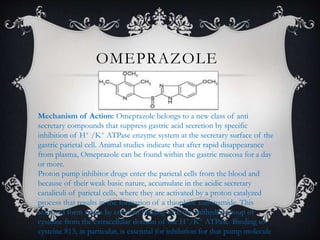
OMEPRAZOLE
Mechanism of Action: Omeprazole belongs to a new class of anti
secretary compounds that suppress gastric acid secretion by specific
inhibition of H+ /K+ ATPase enzyme system at the secretary surface of the
gastric parietal cell. Animal studies indicate that after rapid disappearance
from plasma, Omeprazole can be found within the gastric mucosa for a day
or more.
Proton pump inhibitor drugs enter the parietal cells from the blood and
because of their weak basic nature, accumulate in the acidic secretary
canaliculi of parietal cells, where they are activated by a proton catalyzed
process that results in the formation of a thiophilic sulfonamide. This
activated form reacts by covalent binding with the sulfhydryl group of
cysteine from the extracellular domain of the H+/K+ ATPase. Binding to
cysteine 813, in particular, is essential for inhibition for that pump molecule
 Side Effects: The most common adverse effects are head ache, diarrhea, abdominal
pain, and nausea. Of the oldest agents, Omeprazole and Lansoprazole have been well
established in short – term safety. PPIs are only contraindicated if the patient has a known
history of hypersensitivity to them, and they should be used with caution with severe
hepatic disease.
 Drug Interactions: Omeprazole interacts with the drugs that are substrates of
CYP2C19, including diazepam, Warfarin and Phenytoin (Saltiel and Fask, 1999)
LANSOPRAZOLE
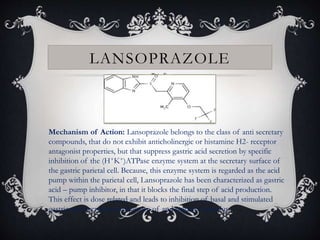
Mechanism of Action: Lansoprazole belongs to the class of anti secretary
compounds, that do not exhibit anticholinergic or histamine H2- receptor
antagonist properties, but that suppress gastric acid secretion by specific
inhibition of the (H+K+)ATPase enzyme system at the secretary surface of
the gastric parietal cell. Because, this enzyme system is regarded as the acid
pump within the parietal cell, Lansoprazole has been characterized as gastric
acid – pump inhibitor, in that it blocks the final step of acid production.
This effect is dose related and leads to inhibition of basal and stimulated
gastric acid secretion irrespective of and negative stimulus.
 Indications: Lansoprazole is used for the treatment of duodenal ulcer (DU), both
Helicobacter pylori positive and negative benign gastric ulcer, gastroesophageal reflux disease,
erosive esophagitis and pathological hyper secretary conditions, including Zollinger- Ellision
syndrome.
 This is used in the eradication of Helicobacter pyroli in triple therapy with Clarithromycin and
Amoxicillin, or in double therapy with Amoxicillin only.
 Side Effects: The most common adverse effects are headache, diarrhea, (Reilly, 1999),
(Franko, 1998) abdominal pain and nausea.
 Drug Interactions: The proton pump inhibitors are metabolized by cytochrome P450
isoenzymes and therefore expected to interact with other drugs that are substrate for that
enzyme system. Lansporazole interacts with theophylline through CYPI isoenzyme induction
(Welage and Berardi, 2000).
PANTOPRAZOLE
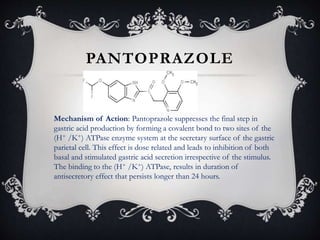
Mechanism of Action: Pantoprazole suppresses the final step in
gastric acid production by forming a covalent bond to two sites of the
(H+ /K+) ATPase enzyme system at the secretary surface of the gastric
parietal cell. This effect is dose related and leads to inhibition of both
basal and stimulated gastric acid secretion irrespective of the stimulus.
The binding to the (H+ /K+) ATPase, results in duration of
antisecretory effect that persists longer than 24 hours.
 Indications: Pantoprazole is used in the treatment of erosive esophagitis associated
with GERD. The manufacturer of Pantoprazole IV is also pursuing the GERD indication
for this formation.
 Side Effects: The most common adverse effects are headache, diarrhea, abdominal
pain, and nausea. The side effects are similar to almost all proton pump inhibitors.
 Drug Interaction: Pantoprazole does not significantly affect the kinetics of the
drugs as in the case of other proton pump inhibitor drugs. In vivo studies, ethanol,
glyduride, antipyrine and caffeine had no clinically relevant interactions with pantoprazole.
Pantoprazole in contrast to Omeprazole and Lansoprazole (Graham L .Patrick, 2006) is
also metabolized by the conjugating enzyme sulftransferase.
RABEPRAZOLE
Mechanism of Action: Rabeprazole enter the parietal cells from the blood
and because of their weak basic nature accumulate in the acidic secretary
canaliculi of the parietal cell, where they are activated by a proton catalyzed
process that results in the formation of a thiophilic sulfonamide. This
activated form reacts by covalent binding with the sulfhydroxyl group of
cystine from the extracellular domain of the H+K+ATPase. Binding to
Cystein 813 (Good man and Gilman’S, 2001) in particular, this is irreversible
for the pump molecule.
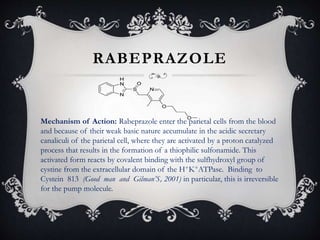
 Chemistry: Rabeprazole Sodium is a substituted benzimidazole that inhibits
gastric acid secretion. Rabeprazole is known as chemically as 2-(((4-(3-
methoxypropoxy)-3-Methyl-2- pyridinyle)-methly)sulfinyl)-)4-benzimidazole
sodium salt. It has an empirical formula of C18H2ON3NaO3S. The molecular
strucuture regarding Rabeprazole is given in Fig: (3.4).
 Properties: Rabeprazole Sodium is a white to slightly yellowish white solid. It
is very soluble in water and methanol, freely soluble in ethanol, chloroform and
ethyl, Chloroform and ethyl acetate and insoluble in ether and n-hexane.
THANKS
 ADINA INSTITUTE OF PHARMACEUTICAL SCIENCES
SAGAR INDIA
 Asso.Prof. IMRAN KHAN
imrankhanaips@gmail.com

1.proton pump.pptx

  • 1.
    PROTON PUMP INHIBITORS (PPI) ADINAINSTITUTE OF PHARMACEUTICAL SCIENCESSAGAR INDIA ASSO.PROF.IMRAN KHAN
  • 2.
    INTRODUCTION  Proton pumpinhibitors are widely prescribed for the treatment of gastric acid related disorders and the eradication of Helicobacter pylori.  The most commonly and effectively used agents to combat acid peptic diseases at present are the Proton Pump inhibitor drugs and were introduced in 1980. These are the substituted benzimidazoles and act by inhibiting (H+/K+)-ATPase pump. Proton pump inhibitor (PPI) drug include Omeprazole, Lansoprazole, Rabeprazole, Pantoprazole and Esomeprazole.
  • 3.
    OMEPRAZOLE Mechanism of Action:Omeprazole belongs to a new class of anti secretary compounds that suppress gastric acid secretion by specific inhibition of H+ /K+ ATPase enzyme system at the secretary surface of the gastric parietal cell. Animal studies indicate that after rapid disappearance from plasma, Omeprazole can be found within the gastric mucosa for a day or more. Proton pump inhibitor drugs enter the parietal cells from the blood and because of their weak basic nature, accumulate in the acidic secretary canaliculi of parietal cells, where they are activated by a proton catalyzed process that results in the formation of a thiophilic sulfonamide. This activated form reacts by covalent binding with the sulfhydryl group of cysteine from the extracellular domain of the H+/K+ ATPase. Binding to cysteine 813, in particular, is essential for inhibition for that pump molecule
  • 4.
     Side Effects:The most common adverse effects are head ache, diarrhea, abdominal pain, and nausea. Of the oldest agents, Omeprazole and Lansoprazole have been well established in short – term safety. PPIs are only contraindicated if the patient has a known history of hypersensitivity to them, and they should be used with caution with severe hepatic disease.  Drug Interactions: Omeprazole interacts with the drugs that are substrates of CYP2C19, including diazepam, Warfarin and Phenytoin (Saltiel and Fask, 1999)
  • 5.
    LANSOPRAZOLE Mechanism of Action:Lansoprazole belongs to the class of anti secretary compounds, that do not exhibit anticholinergic or histamine H2- receptor antagonist properties, but that suppress gastric acid secretion by specific inhibition of the (H+K+)ATPase enzyme system at the secretary surface of the gastric parietal cell. Because, this enzyme system is regarded as the acid pump within the parietal cell, Lansoprazole has been characterized as gastric acid – pump inhibitor, in that it blocks the final step of acid production. This effect is dose related and leads to inhibition of basal and stimulated gastric acid secretion irrespective of and negative stimulus.
  • 6.
     Indications: Lansoprazoleis used for the treatment of duodenal ulcer (DU), both Helicobacter pylori positive and negative benign gastric ulcer, gastroesophageal reflux disease, erosive esophagitis and pathological hyper secretary conditions, including Zollinger- Ellision syndrome.  This is used in the eradication of Helicobacter pyroli in triple therapy with Clarithromycin and Amoxicillin, or in double therapy with Amoxicillin only.  Side Effects: The most common adverse effects are headache, diarrhea, (Reilly, 1999), (Franko, 1998) abdominal pain and nausea.  Drug Interactions: The proton pump inhibitors are metabolized by cytochrome P450 isoenzymes and therefore expected to interact with other drugs that are substrate for that enzyme system. Lansporazole interacts with theophylline through CYPI isoenzyme induction (Welage and Berardi, 2000).
  • 7.
    PANTOPRAZOLE Mechanism of Action:Pantoprazole suppresses the final step in gastric acid production by forming a covalent bond to two sites of the (H+ /K+) ATPase enzyme system at the secretary surface of the gastric parietal cell. This effect is dose related and leads to inhibition of both basal and stimulated gastric acid secretion irrespective of the stimulus. The binding to the (H+ /K+) ATPase, results in duration of antisecretory effect that persists longer than 24 hours.
  • 8.
     Indications: Pantoprazoleis used in the treatment of erosive esophagitis associated with GERD. The manufacturer of Pantoprazole IV is also pursuing the GERD indication for this formation.  Side Effects: The most common adverse effects are headache, diarrhea, abdominal pain, and nausea. The side effects are similar to almost all proton pump inhibitors.  Drug Interaction: Pantoprazole does not significantly affect the kinetics of the drugs as in the case of other proton pump inhibitor drugs. In vivo studies, ethanol, glyduride, antipyrine and caffeine had no clinically relevant interactions with pantoprazole. Pantoprazole in contrast to Omeprazole and Lansoprazole (Graham L .Patrick, 2006) is also metabolized by the conjugating enzyme sulftransferase.
  • 9.
    RABEPRAZOLE Mechanism of Action:Rabeprazole enter the parietal cells from the blood and because of their weak basic nature accumulate in the acidic secretary canaliculi of the parietal cell, where they are activated by a proton catalyzed process that results in the formation of a thiophilic sulfonamide. This activated form reacts by covalent binding with the sulfhydroxyl group of cystine from the extracellular domain of the H+K+ATPase. Binding to Cystein 813 (Good man and Gilman’S, 2001) in particular, this is irreversible for the pump molecule.
  • 10.
     Chemistry: RabeprazoleSodium is a substituted benzimidazole that inhibits gastric acid secretion. Rabeprazole is known as chemically as 2-(((4-(3- methoxypropoxy)-3-Methyl-2- pyridinyle)-methly)sulfinyl)-)4-benzimidazole sodium salt. It has an empirical formula of C18H2ON3NaO3S. The molecular strucuture regarding Rabeprazole is given in Fig: (3.4).  Properties: Rabeprazole Sodium is a white to slightly yellowish white solid. It is very soluble in water and methanol, freely soluble in ethanol, chloroform and ethyl, Chloroform and ethyl acetate and insoluble in ether and n-hexane.
  • 11.
    THANKS  ADINA INSTITUTEOF PHARMACEUTICAL SCIENCES SAGAR INDIA  Asso.Prof. IMRAN KHAN imrankhanaips@gmail.com