AIPS
IMRAN KHAN
imrankhanaips@gmail.com
https://www.slideshare.net/ImranKhan34
47/1antibiotics
 An antibiotic is a type of antimicrobial substance
active against bacteria It is the most important type
of antibacterial agent for fighting bacterial infections
and antibiotic medications are widely used in
the treatment and prevention of such infections. They
may either kill or inhibit the growth of bacteria. A limited
number of antibiotics also
possess antiprotozoal activity. Antibiotics are not
effective against viruses such as the common
cold or influenza drugs which inhibit viruses are
termed antiviral drugs or antiviral rather than
antibiotics.
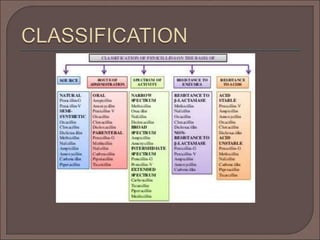
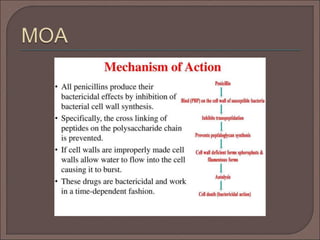
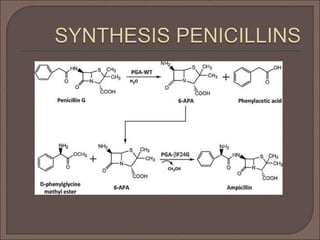
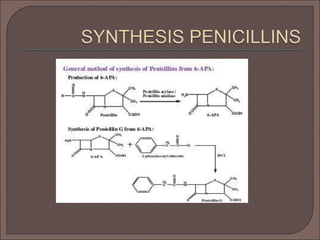
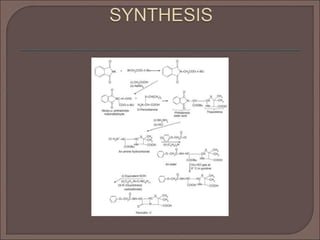
 Penicillin's (P, PCN or PEN) are a group
of antibiotics originally obtained from Penicillium moulds,
principally P. chrysogenum and P. rubens. Most penicillins in
clinical use are chemically synthesized from naturally-
produced penicillins. A number of natural penicillins have been
discovered, but only two purified compounds are in clinical
use: penicillin G (intramuscular or intravenous use)
and penicillin V(given by mouth). Penicillins were among the
first medications to be effective against many bacterial
infections caused by staphylococci and streptococci. They are
members of the β-lactam antibiotics. They are still widely used
today for different bacterial infections, though many types
of bacteria have developed resistance following extensive
use.
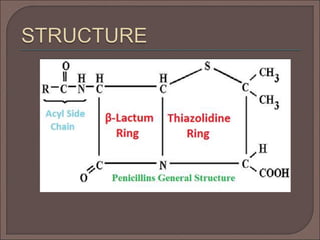
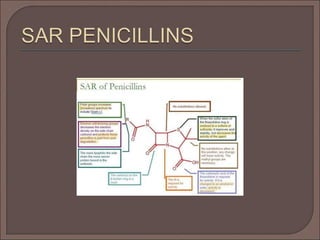
 6-Acyl side chain: The substitution of R on the primary amine with an
electron withdrawing group decreases the electron density on the side
chain and protects from acid degradation. Substituent's on the α-carbon
of the side chain, such as amino (ampicillin), chloro, and guanidine
exerts good resistance to inactivation by acids. Benzyl penicillin
undergoes acid and alkali degradation and is susceptible to all known β-
lactamase. The increased latitude in varying the acyl amino side chain
through acylation of 6APA results with superior biological activity.
Substitution of α-aryl of the alkyl group in the side chain gives increased
stability and oral absorption.
 1. Substitution of bulky groups on α-carbon of the side chain
confers β-lactamase resistance. Examples: methicillin, nafcillin, oxacillin,
etc. In all these penicillins, an aromatic ring is attached directly to the
side chain amide carbonyl, and there is substitution at both positions
ortho to the point of attachment. The size of the ring systems play an
important role in determining the ability of the ortho substitutent to
confer penicillinase resistance.
 2. The isomeric forms of penicillins differs in their activity.
Example: D-isomer is 2–8 times more active than L-isomer of
amoxicillin. The introduction of polar group or ionized molecule into
the α-position of the side chain in the benzyl carbon atom of
penicillin-G confers against the gram-negative bacilli. Amino,
hydroxyl, carboxyl, and sulphonyl increases gram-negative activity.
Example: ampicillin and carbenicillin.
 Replacement of acryl side chain with hydroxymethyl groups shows
improved gram-negative activity and introduction of C-6 α-methoxy
group produces greater stability against β-lactamase. N-acylated
ampicillins (ureidopenicillins) have increased activity against
Pseudomonas.
 4. Many esters of the carboxyl group attached to C-3 have been
prepared as prodrugs to increase lipophilicity and acid stability.
Example: Acetoxymethyl ester derivatives are used for preparing
prodrugs.
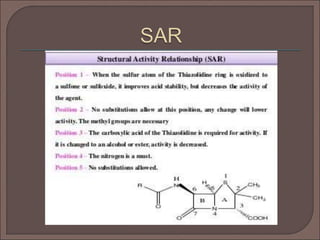
 5.The sulphur of the thiazolidine ring with O, CH , and CH-β-
CH3 gives broad-spectrum antibacterial activity. The geminal
dimethyl group at C-2 position is a characteristic of the
penicillin. In general, derivatization of the C-3 carboxylic acid
functionality is not tolerated unless the free penicillin
carboxylic acid can be generated in vivo. Doubly activated
penicillin esters, undergo rapid cleavage in vivo to generate
active penicillin. Example: pivampicillin and becampicillin. The
antibacterial activity is evidented by N-4 atom at ring junction.
 6. In vitro degradation is retarded by keeping the pH of the
solution between 6.0 and 8.0. More lipophilic side chain
increases the plasma protein binding. Example: Ampicillin:
25% plasma protein bound and phenoxy methyl penicillin:
75% plasma protein bound.
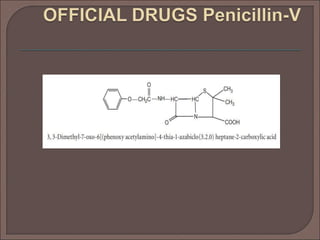
 Properties and uses: Penicillin V is a white, odourless,
crystalline powder with slightly bitter taste and soluble in
water. It is more resistant to inactivation by gastric juice than
penicillin G and better absorbed from the gastro intestinal (GI)
tract. Equivalent oral doses provide two or five times greater
plasma concentration than penicillin G. Penicillin V is given to
treat ‘trench mouth’. It is useful in the treatment of
streptococcal pharyngitis, pneumonia, arthritis, meningitis, and
endocarditis caused by S. pyrogenes.
 Dose: Dose of penicillin V by oral route is 125–500 mg six
times daily for 10 days. For prophylaxis of rheumatic fever, the
dose is 125–250 mg twice daily.
 Assay: It is assayed by adopting liquid chromatography
technique.
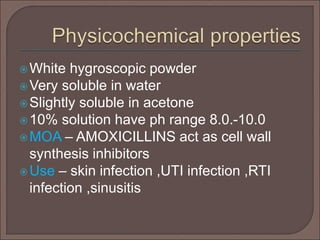
White hygroscopic powder
Very soluble in water
Slightly soluble in acetone
10% solution have ph range 8.0.-10.0
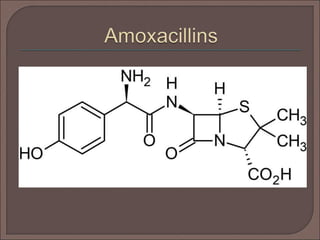
MOA – AMOXICILLINS act as cell wall
synthesis inhibitors
Use – skin infection ,UTI infection ,RTI
infection ,sinusitis
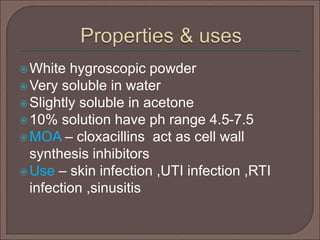
White hygroscopic powder
Very soluble in water
Slightly soluble in acetone
10% solution have ph range 4.5-7.5
MOA – cloxacillins act as cell wall
synthesis inhibitors
Use – skin infection ,UTI infection ,RTI
infection ,sinusitis
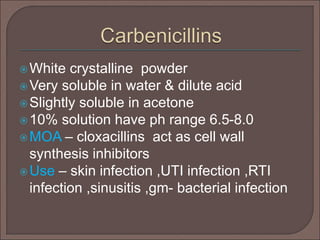
White crystalline powder
Very soluble in water & dilute acid
Slightly soluble in acetone
10% solution have ph range 6.5-8.0
MOA – cloxacillins act as cell wall
synthesis inhibitors
Use – skin infection ,UTI infection ,RTI
infection ,sinusitis ,gm- bacterial infection
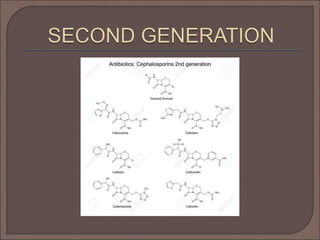
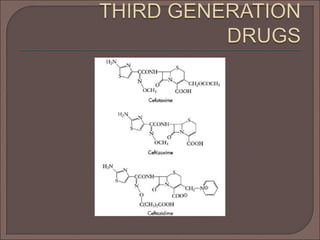
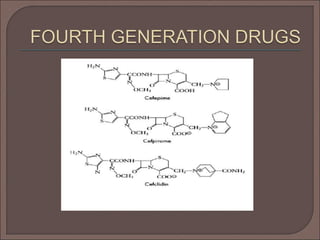
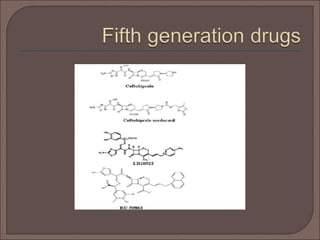
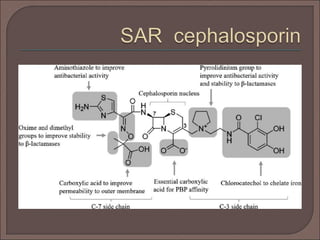
The cephalosporins are a class of β-lactam
antibiotics originally derived from the
fungus Acremonium, which was previously
known as "Cephalosporium". Together with
cephamycins, they constitute a subgroup
of β-lactam antibiotics called cephems.
Cephalosporins were discovered in 1945,
and first sold in 1964.
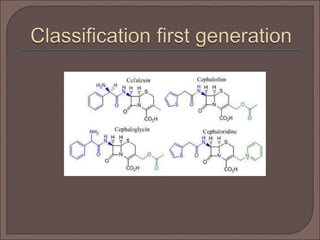
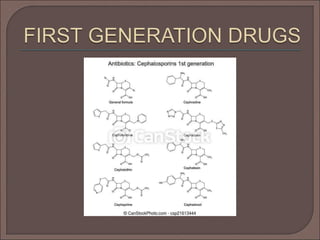
 Cefalexin, cephalothin (cefalotin),
cephaloglycin, and cephaloridine are examples
of first-generation cephalosporins. The methyl
group in cephalexin is a poor leaving group, which
is bad for activity. However, the use of a methyl
group appears to improve absorption. Cefalexin
may be synthesized through an acid-catalysed
 ring expansion of a penicillin. Cephalothin has an
acetoxy as a leaving group and a 1-(thiophen-2-
yl)propan-2-one in its acylamino side chain
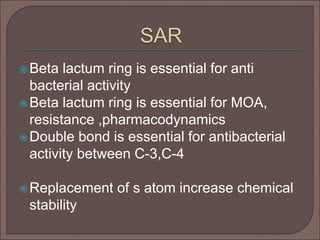
Beta lactum ring is essential for anti
bacterial activity
Beta lactum ring is essential for MOA,
resistance ,pharmacodynamics
Double bond is essential for antibacterial
activity between C-3,C-4
Replacement of s atom increase chemical
stability
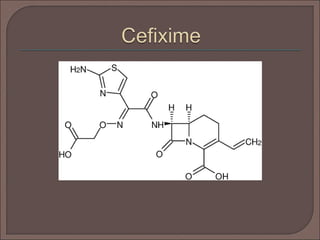
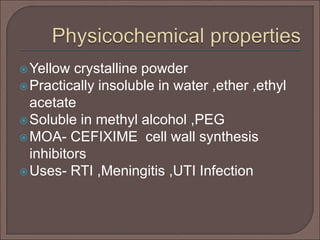
Yellow crystalline powder
Practically insoluble in water ,ether ,ethyl
acetate
Soluble in methyl alcohol ,PEG
MOA- CEFIXIME cell wall synthesis
inhibitors
Uses- RTI ,Meningitis ,UTI Infection
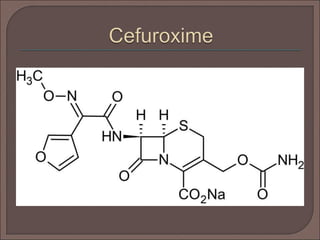
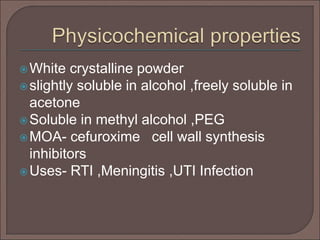
White crystalline powder
slightly soluble in alcohol ,freely soluble in
acetone
Soluble in methyl alcohol ,PEG
MOA- cefuroxime cell wall synthesis
inhibitors
Uses- RTI ,Meningitis ,UTI Infection
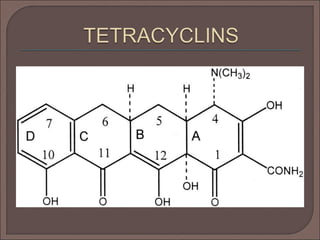
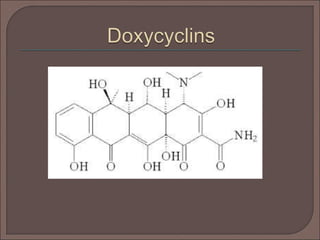
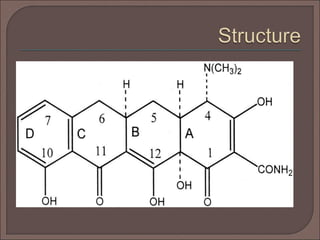
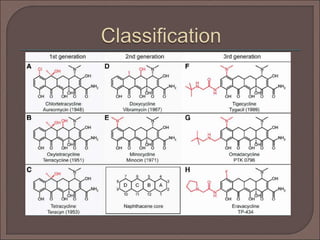
 Tetracycline, sold under the brand
name Sumycin among others, is an
oral antibiotic in the tetracycline's family of
medications, used to treat a number
of infections, including acne, cholera, brucellosis, p
lague, malaria, and syphilis
 Common side effects include vomiting, diarrhea,
rash, and loss of appetite. Other side effects
include poor tooth development if used by children
less than eight years of age, kidney problems,
and sunburning easily Use during pregnancy may
harm the baby. It works by inhibiting protein
synthesis in bacteria.
Yellow crystalline powder
Very slightly soluble in water ,soluble in
alcohol,
1% suspension in water has ph 3.5 -6.0
Should store in airtight container
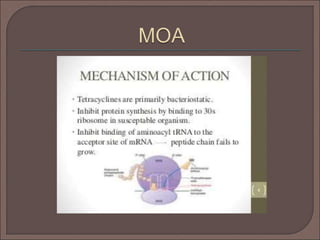
Moa- tetracycline binds to 30s subunit at A
site to prevent attachment of aminoacyl t-
RNA
Use-UTI,RTI,infections ear infection
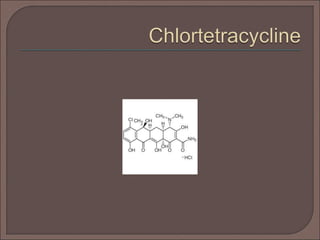
Yellow crystalline powder
Very slightly soluble in water ,soluble in
alcohol,
1% suspension in water has ph 2.3 -3.3
Should store in airtight container
Moa- tetracycline binds to 30s subunit at A
site to prevent attachment of aminoacyl t-
RNA
Use-UTI,RTI,infections ear infection
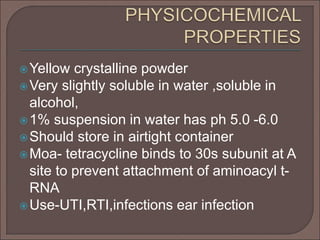
Yellow crystalline powder
Very slightly soluble in water ,soluble in
alcohol,
1% suspension in water has ph 5.0 -6.0
Should store in airtight container
Moa- tetracycline binds to 30s subunit at A
site to prevent attachment of aminoacyl t-
RNA
Use-UTI,RTI,infections ear infection
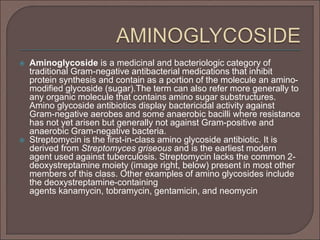
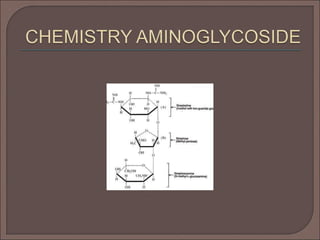
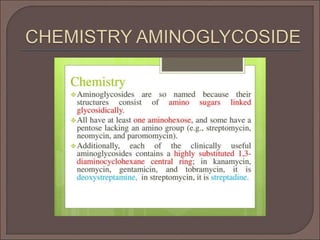
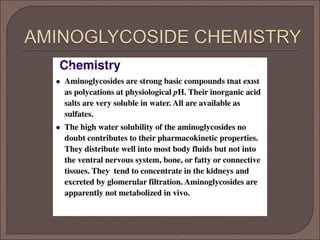
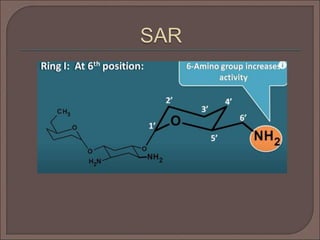
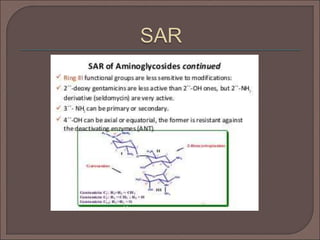
 Aminoglycoside is a medicinal and bacteriologic category of
traditional Gram-negative antibacterial medications that inhibit
protein synthesis and contain as a portion of the molecule an amino-
modified glycoside (sugar).The term can also refer more generally to
any organic molecule that contains amino sugar substructures.
Amino glycoside antibiotics display bactericidal activity against
Gram-negative aerobes and some anaerobic bacilli where resistance
has not yet arisen but generally not against Gram-positive and
anaerobic Gram-negative bacteria.
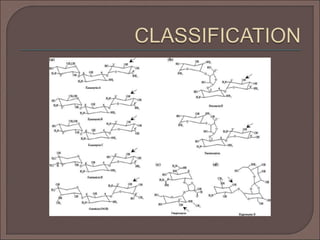
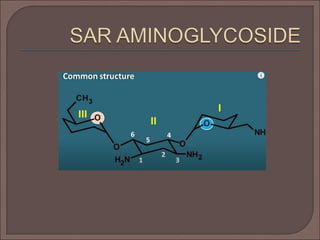
 Streptomycin is the first-in-class amino glycoside antibiotic. It is
derived from Streptomyces griseous and is the earliest modern
agent used against tuberculosis. Streptomycin lacks the common 2-
deoxystreptamine moiety (image right, below) present in most other
members of this class. Other examples of amino glycosides include
the deoxystreptamine-containing
agents kanamycin, tobramycin, gentamicin, and neomycin
AIPS
IMRAN KHAN
https://www.slideshare.net/ImranKhan3447
/1antibiotics

1.ANTIBIOTICS

  • 1.
  • 2.
     An antibioticis a type of antimicrobial substance active against bacteria It is the most important type of antibacterial agent for fighting bacterial infections and antibiotic medications are widely used in the treatment and prevention of such infections. They may either kill or inhibit the growth of bacteria. A limited number of antibiotics also possess antiprotozoal activity. Antibiotics are not effective against viruses such as the common cold or influenza drugs which inhibit viruses are termed antiviral drugs or antiviral rather than antibiotics.
  • 3.
     Penicillin's (P,PCN or PEN) are a group of antibiotics originally obtained from Penicillium moulds, principally P. chrysogenum and P. rubens. Most penicillins in clinical use are chemically synthesized from naturally- produced penicillins. A number of natural penicillins have been discovered, but only two purified compounds are in clinical use: penicillin G (intramuscular or intravenous use) and penicillin V(given by mouth). Penicillins were among the first medications to be effective against many bacterial infections caused by staphylococci and streptococci. They are members of the β-lactam antibiotics. They are still widely used today for different bacterial infections, though many types of bacteria have developed resistance following extensive use.
  • 8.
     6-Acyl sidechain: The substitution of R on the primary amine with an electron withdrawing group decreases the electron density on the side chain and protects from acid degradation. Substituent's on the α-carbon of the side chain, such as amino (ampicillin), chloro, and guanidine exerts good resistance to inactivation by acids. Benzyl penicillin undergoes acid and alkali degradation and is susceptible to all known β- lactamase. The increased latitude in varying the acyl amino side chain through acylation of 6APA results with superior biological activity. Substitution of α-aryl of the alkyl group in the side chain gives increased stability and oral absorption.  1. Substitution of bulky groups on α-carbon of the side chain confers β-lactamase resistance. Examples: methicillin, nafcillin, oxacillin, etc. In all these penicillins, an aromatic ring is attached directly to the side chain amide carbonyl, and there is substitution at both positions ortho to the point of attachment. The size of the ring systems play an important role in determining the ability of the ortho substitutent to confer penicillinase resistance.
  • 9.
     2. Theisomeric forms of penicillins differs in their activity. Example: D-isomer is 2–8 times more active than L-isomer of amoxicillin. The introduction of polar group or ionized molecule into the α-position of the side chain in the benzyl carbon atom of penicillin-G confers against the gram-negative bacilli. Amino, hydroxyl, carboxyl, and sulphonyl increases gram-negative activity. Example: ampicillin and carbenicillin.  Replacement of acryl side chain with hydroxymethyl groups shows improved gram-negative activity and introduction of C-6 α-methoxy group produces greater stability against β-lactamase. N-acylated ampicillins (ureidopenicillins) have increased activity against Pseudomonas.  4. Many esters of the carboxyl group attached to C-3 have been prepared as prodrugs to increase lipophilicity and acid stability. Example: Acetoxymethyl ester derivatives are used for preparing prodrugs.
  • 10.
     5.The sulphurof the thiazolidine ring with O, CH , and CH-β- CH3 gives broad-spectrum antibacterial activity. The geminal dimethyl group at C-2 position is a characteristic of the penicillin. In general, derivatization of the C-3 carboxylic acid functionality is not tolerated unless the free penicillin carboxylic acid can be generated in vivo. Doubly activated penicillin esters, undergo rapid cleavage in vivo to generate active penicillin. Example: pivampicillin and becampicillin. The antibacterial activity is evidented by N-4 atom at ring junction.  6. In vitro degradation is retarded by keeping the pH of the solution between 6.0 and 8.0. More lipophilic side chain increases the plasma protein binding. Example: Ampicillin: 25% plasma protein bound and phenoxy methyl penicillin: 75% plasma protein bound.
  • 15.
     Properties anduses: Penicillin V is a white, odourless, crystalline powder with slightly bitter taste and soluble in water. It is more resistant to inactivation by gastric juice than penicillin G and better absorbed from the gastro intestinal (GI) tract. Equivalent oral doses provide two or five times greater plasma concentration than penicillin G. Penicillin V is given to treat ‘trench mouth’. It is useful in the treatment of streptococcal pharyngitis, pneumonia, arthritis, meningitis, and endocarditis caused by S. pyrogenes.  Dose: Dose of penicillin V by oral route is 125–500 mg six times daily for 10 days. For prophylaxis of rheumatic fever, the dose is 125–250 mg twice daily.  Assay: It is assayed by adopting liquid chromatography technique.
  • 17.
    White hygroscopic powder Verysoluble in water Slightly soluble in acetone 10% solution have ph range 8.0.-10.0 MOA – AMOXICILLINS act as cell wall synthesis inhibitors Use – skin infection ,UTI infection ,RTI infection ,sinusitis
  • 19.
    White hygroscopic powder Verysoluble in water Slightly soluble in acetone 10% solution have ph range 4.5-7.5 MOA – cloxacillins act as cell wall synthesis inhibitors Use – skin infection ,UTI infection ,RTI infection ,sinusitis
  • 20.
    White crystalline powder Verysoluble in water & dilute acid Slightly soluble in acetone 10% solution have ph range 6.5-8.0 MOA – cloxacillins act as cell wall synthesis inhibitors Use – skin infection ,UTI infection ,RTI infection ,sinusitis ,gm- bacterial infection
  • 21.
    The cephalosporins area class of β-lactam antibiotics originally derived from the fungus Acremonium, which was previously known as "Cephalosporium". Together with cephamycins, they constitute a subgroup of β-lactam antibiotics called cephems. Cephalosporins were discovered in 1945, and first sold in 1964.
  • 23.
     Cefalexin, cephalothin(cefalotin), cephaloglycin, and cephaloridine are examples of first-generation cephalosporins. The methyl group in cephalexin is a poor leaving group, which is bad for activity. However, the use of a methyl group appears to improve absorption. Cefalexin may be synthesized through an acid-catalysed  ring expansion of a penicillin. Cephalothin has an acetoxy as a leaving group and a 1-(thiophen-2- yl)propan-2-one in its acylamino side chain
  • 30.
    Beta lactum ringis essential for anti bacterial activity Beta lactum ring is essential for MOA, resistance ,pharmacodynamics Double bond is essential for antibacterial activity between C-3,C-4 Replacement of s atom increase chemical stability
  • 32.
    Yellow crystalline powder Practicallyinsoluble in water ,ether ,ethyl acetate Soluble in methyl alcohol ,PEG MOA- CEFIXIME cell wall synthesis inhibitors Uses- RTI ,Meningitis ,UTI Infection
  • 34.
    White crystalline powder slightlysoluble in alcohol ,freely soluble in acetone Soluble in methyl alcohol ,PEG MOA- cefuroxime cell wall synthesis inhibitors Uses- RTI ,Meningitis ,UTI Infection
  • 35.
     Tetracycline, soldunder the brand name Sumycin among others, is an oral antibiotic in the tetracycline's family of medications, used to treat a number of infections, including acne, cholera, brucellosis, p lague, malaria, and syphilis  Common side effects include vomiting, diarrhea, rash, and loss of appetite. Other side effects include poor tooth development if used by children less than eight years of age, kidney problems, and sunburning easily Use during pregnancy may harm the baby. It works by inhibiting protein synthesis in bacteria.
  • 42.
    Yellow crystalline powder Veryslightly soluble in water ,soluble in alcohol, 1% suspension in water has ph 3.5 -6.0 Should store in airtight container Moa- tetracycline binds to 30s subunit at A site to prevent attachment of aminoacyl t- RNA Use-UTI,RTI,infections ear infection
  • 44.
    Yellow crystalline powder Veryslightly soluble in water ,soluble in alcohol, 1% suspension in water has ph 2.3 -3.3 Should store in airtight container Moa- tetracycline binds to 30s subunit at A site to prevent attachment of aminoacyl t- RNA Use-UTI,RTI,infections ear infection
  • 46.
    Yellow crystalline powder Veryslightly soluble in water ,soluble in alcohol, 1% suspension in water has ph 5.0 -6.0 Should store in airtight container Moa- tetracycline binds to 30s subunit at A site to prevent attachment of aminoacyl t- RNA Use-UTI,RTI,infections ear infection
  • 47.
     Aminoglycoside isa medicinal and bacteriologic category of traditional Gram-negative antibacterial medications that inhibit protein synthesis and contain as a portion of the molecule an amino- modified glycoside (sugar).The term can also refer more generally to any organic molecule that contains amino sugar substructures. Amino glycoside antibiotics display bactericidal activity against Gram-negative aerobes and some anaerobic bacilli where resistance has not yet arisen but generally not against Gram-positive and anaerobic Gram-negative bacteria.  Streptomycin is the first-in-class amino glycoside antibiotic. It is derived from Streptomyces griseous and is the earliest modern agent used against tuberculosis. Streptomycin lacks the common 2- deoxystreptamine moiety (image right, below) present in most other members of this class. Other examples of amino glycosides include the deoxystreptamine-containing agents kanamycin, tobramycin, gentamicin, and neomycin
  • 56.