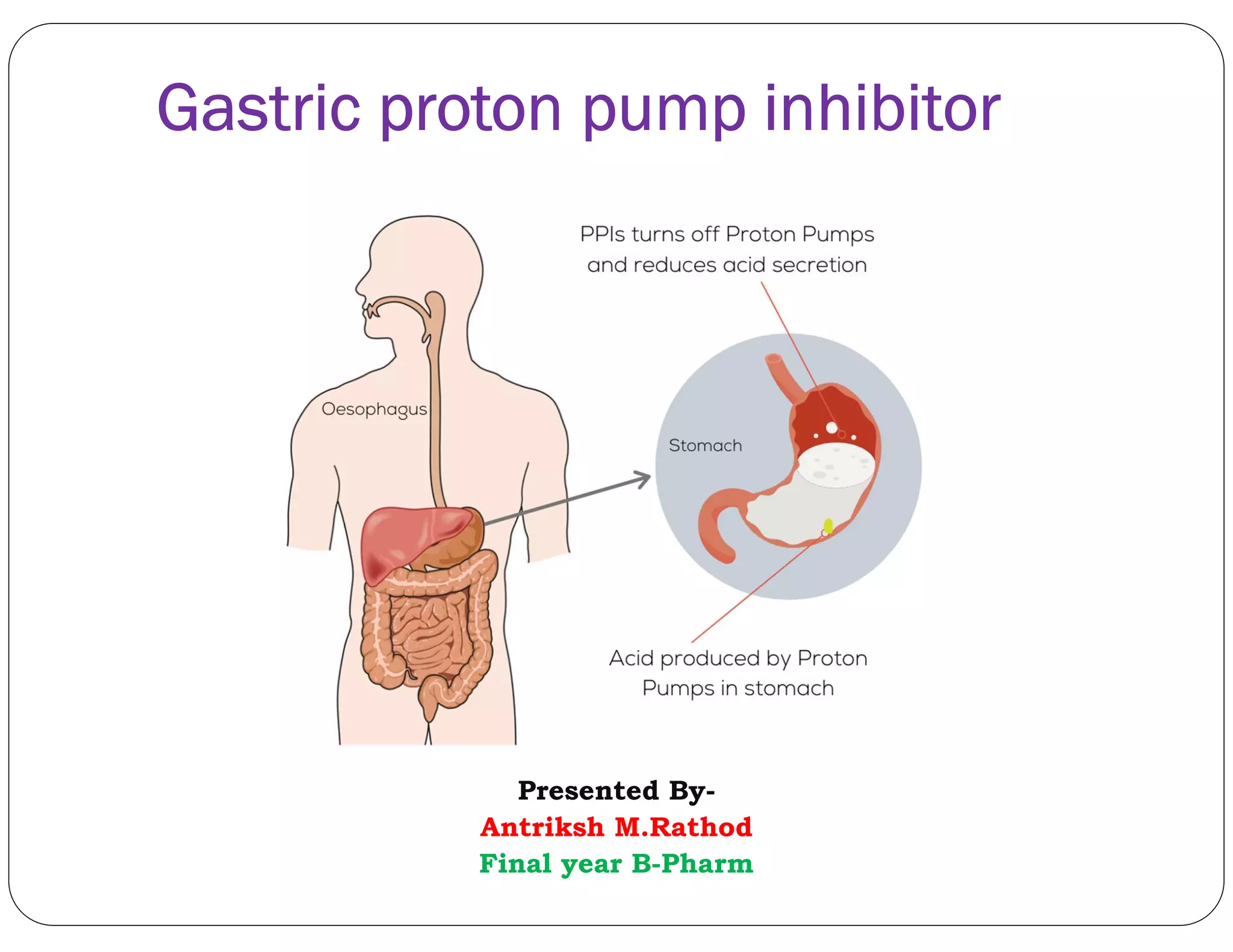
Gastric proton pump inhibitor
Presented By-
Antriksh M.Rathod
Final year B-Pharm
Content
๏ถIntroduction
๏ถMechanism of action
๏ถClassification of PPIs
๏ถDrugs of PPIs
๏‚ง Omeprazole
๏‚ง Lansoprazole
๏‚ง Rabeprazole
๏‚ง Pantoprazole
๏ถ Introduction
๏‚— They are the class of drugs which are used to control the
gastric acidity and duodenal ulcer
๏‚— These agents are of benzimidazole class which selectively
inhibit the functioning of proton pump by getting
accumulated in the parietal cell- membrane
๏‚— All the PPI contain a sulphonyl group in a bridge between
substituted benzimidazole pyridine rings.
๏ถ Mechanism of Action
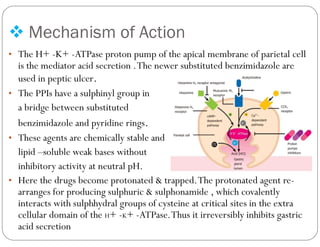
โ€ข The H+ -K+ -ATPase proton pump of the apical membrane of parietal cell
is the mediator acid secretion .The newer substituted benzimidazole are
used in peptic ulcer.
โ€ข The PPIs have a sulphinyl group in
a bridge between substituted
benzimidazole and pyridine rings.
โ€ข These agents are chemically stable and
lipid โ€“soluble weak bases without
inhibitory activity at neutral pH.
โ€ข Here the drugs become protonated & trapped.The protonated agent re-
arranges for producing sulphuric & sulphonamide , which covalently
interacts with sulphhydral groups of cysteine at critical sites in the extra
cellular domain of the H+ -K+ -ATPase.Thus it irreversibly inhibits gastric
acid secretion
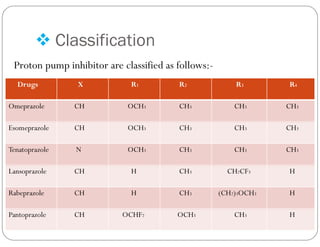
๏ถ Classification
Proton pump inhibitor are classified as follows:-
Drugs X R1 R2 R3 R4
Omeprazole CH OCH3 CH3 CH3 CH3
Esomeprazole CH OCH3 CH3 CH3 CH3
Tenatoprazole N OCH3 CH3 CH3 CH3
Lansoprazole CH H CH3 CH2CF3 H
Rabeprazole CH H CH3 (CH2)3OCH3 H
Pantoprazole CH OCHF2 OCH3 CH3 H
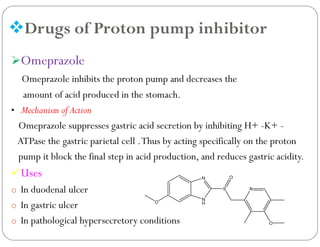
๏ถDrugs of Proton pump inhibitor
๏ƒ˜Omeprazole
Omeprazole inhibits the proton pump and decreases the
amount of acid produced in the stomach.
โ€ข Mechanism of Action
Omeprazole suppresses gastric acid secretion by inhibiting H+ -K+ -
ATPase the gastric parietal cell .Thus by acting specifically on the proton
pump it block the final step in acid production, and reduces gastric acidity.
๏ƒผUses
o In duodenal ulcer
o In gastric ulcer
o In pathological hypersecretory conditions
N
H
N
S N
O
O
O
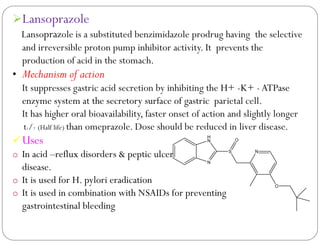
๏ƒ˜Lansoprazole
Lansoprazole is a substituted benzimidazole prodrug having the selective
and irreversible proton pump inhibitor activity. It prevents the
production of acid in the stomach.
โ€ข Mechanism of action
It suppresses gastric acid secretion by inhibiting the H+ -K+ -ATPase
enzyme system at the secretory surface of gastric parietal cell.
It has higher oral bioavailability, faster onset of action and slightly longer
t1/2 (Half life) than omeprazole. Dose should be reduced in liver disease.
๏ƒผUses
o In acid โ€“reflux disorders & peptic ulcer
disease.
o It is used for H. pylori eradication
o It is used in combination with NSAIDs for preventing
gastrointestinal bleeding
N
H
N
S
O
N
O
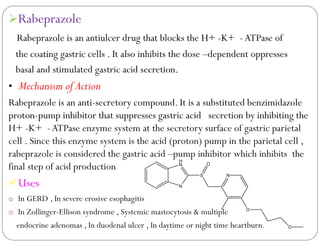
๏ƒ˜Rabeprazole
Rabeprazole is an antiulcer drug that blocks the H+ -K+ -ATPase of
the coating gastric cells . It also inhibits the dose โ€“dependent oppresses
basal and stimulated gastric acid secretion.
โ€ข Mechanism of Action
Rabeprazole is an anti-secretory compound. It is a substituted benzimidazole
proton-pump inhibitor that suppresses gastric acid secretion by inhibiting the
H+ -K+ -ATPase enzyme system at the secretory surface of gastric parietal
cell . Since this enzyme system is the acid (proton) pump in the parietal cell ,
rabeprazole is considered the gastric acid โ€“pump inhibitor which inhibits the
final step of acid production
๏ƒผUses
o In GERD , In severe erosive esophagitis
o In Zollinger-Ellison syndrome , Systemic mastocytosis & multiple
endocrine adenomas , In duodenal ulcer , In daytime or night time heartburn.
N
H
N
S N
O
O
O
๏ƒ˜Pantoprazole
Pantoprazole is a first generation PPI.
It is also used for treating other disorders where in gastric acid secretion
needs to be reduced.
pantoprazole is available in many forms, such as a delayed โ€“ release oral
capsule, and intravenous injection
โ€ข Mechanism of action
Pantoprazole suppresses the final step in gastric acid production by
formation a covalent bond to two sites of the (H+,K+) -ATPase
enzyme system at the secretory surface of the gastric parietal cell.
This effect is dose-related and leads to inhibition of both basal and
stimulated gastric acid secretion irrespective of the stimulus
๏ƒผUses
o Pantoprazole injection is given to patients having GERD and history of
erosive esophagitis for short-treatment (7-10 days). It is given as an
alternate to pantoprazole delayed-release tablet in patients who are not
able to swallow the tablets.
o It is used in the treatment of pathological hypersecretory condition
related to Zollinger-Ellison syndrome or other neoplastic condition.
o Pantoprazole delayed-release oral suspension is used for short-term
treatment of erosive esophagitis related to GERD.
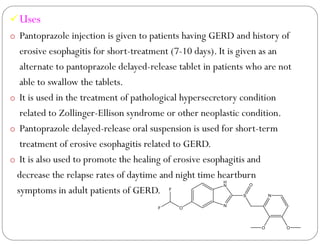
o It is also used to promote the healing of erosive esophagitis and
decrease the relapse rates of daytime and night time heartburn
symptoms in adult patients of GERD.
N
H
N
S N
O O
O
F
F
O

GPPI,PDF.pdf

  • 1.
    Gastric proton pumpinhibitor Presented By- Antriksh M.Rathod Final year B-Pharm
  • 2.
    Content ๏ถIntroduction ๏ถMechanism of action ๏ถClassificationof PPIs ๏ถDrugs of PPIs ๏‚ง Omeprazole ๏‚ง Lansoprazole ๏‚ง Rabeprazole ๏‚ง Pantoprazole
  • 3.
    ๏ถ Introduction ๏‚— Theyare the class of drugs which are used to control the gastric acidity and duodenal ulcer ๏‚— These agents are of benzimidazole class which selectively inhibit the functioning of proton pump by getting accumulated in the parietal cell- membrane ๏‚— All the PPI contain a sulphonyl group in a bridge between substituted benzimidazole pyridine rings.
  • 4.
    ๏ถ Mechanism ofAction โ€ข The H+ -K+ -ATPase proton pump of the apical membrane of parietal cell is the mediator acid secretion .The newer substituted benzimidazole are used in peptic ulcer. โ€ข The PPIs have a sulphinyl group in a bridge between substituted benzimidazole and pyridine rings. โ€ข These agents are chemically stable and lipid โ€“soluble weak bases without inhibitory activity at neutral pH. โ€ข Here the drugs become protonated & trapped.The protonated agent re- arranges for producing sulphuric & sulphonamide , which covalently interacts with sulphhydral groups of cysteine at critical sites in the extra cellular domain of the H+ -K+ -ATPase.Thus it irreversibly inhibits gastric acid secretion
  • 5.
    ๏ถ Classification Proton pumpinhibitor are classified as follows:- Drugs X R1 R2 R3 R4 Omeprazole CH OCH3 CH3 CH3 CH3 Esomeprazole CH OCH3 CH3 CH3 CH3 Tenatoprazole N OCH3 CH3 CH3 CH3 Lansoprazole CH H CH3 CH2CF3 H Rabeprazole CH H CH3 (CH2)3OCH3 H Pantoprazole CH OCHF2 OCH3 CH3 H
  • 6.
    ๏ถDrugs of Protonpump inhibitor ๏ƒ˜Omeprazole Omeprazole inhibits the proton pump and decreases the amount of acid produced in the stomach. โ€ข Mechanism of Action Omeprazole suppresses gastric acid secretion by inhibiting H+ -K+ - ATPase the gastric parietal cell .Thus by acting specifically on the proton pump it block the final step in acid production, and reduces gastric acidity. ๏ƒผUses o In duodenal ulcer o In gastric ulcer o In pathological hypersecretory conditions N H N S N O O O
  • 7.
    ๏ƒ˜Lansoprazole Lansoprazole is asubstituted benzimidazole prodrug having the selective and irreversible proton pump inhibitor activity. It prevents the production of acid in the stomach. โ€ข Mechanism of action It suppresses gastric acid secretion by inhibiting the H+ -K+ -ATPase enzyme system at the secretory surface of gastric parietal cell. It has higher oral bioavailability, faster onset of action and slightly longer t1/2 (Half life) than omeprazole. Dose should be reduced in liver disease. ๏ƒผUses o In acid โ€“reflux disorders & peptic ulcer disease. o It is used for H. pylori eradication o It is used in combination with NSAIDs for preventing gastrointestinal bleeding N H N S O N O
  • 8.
    ๏ƒ˜Rabeprazole Rabeprazole is anantiulcer drug that blocks the H+ -K+ -ATPase of the coating gastric cells . It also inhibits the dose โ€“dependent oppresses basal and stimulated gastric acid secretion. โ€ข Mechanism of Action Rabeprazole is an anti-secretory compound. It is a substituted benzimidazole proton-pump inhibitor that suppresses gastric acid secretion by inhibiting the H+ -K+ -ATPase enzyme system at the secretory surface of gastric parietal cell . Since this enzyme system is the acid (proton) pump in the parietal cell , rabeprazole is considered the gastric acid โ€“pump inhibitor which inhibits the final step of acid production ๏ƒผUses o In GERD , In severe erosive esophagitis o In Zollinger-Ellison syndrome , Systemic mastocytosis & multiple endocrine adenomas , In duodenal ulcer , In daytime or night time heartburn. N H N S N O O O
  • 9.
    ๏ƒ˜Pantoprazole Pantoprazole is afirst generation PPI. It is also used for treating other disorders where in gastric acid secretion needs to be reduced. pantoprazole is available in many forms, such as a delayed โ€“ release oral capsule, and intravenous injection โ€ข Mechanism of action Pantoprazole suppresses the final step in gastric acid production by formation a covalent bond to two sites of the (H+,K+) -ATPase enzyme system at the secretory surface of the gastric parietal cell. This effect is dose-related and leads to inhibition of both basal and stimulated gastric acid secretion irrespective of the stimulus
  • 10.
    ๏ƒผUses o Pantoprazole injectionis given to patients having GERD and history of erosive esophagitis for short-treatment (7-10 days). It is given as an alternate to pantoprazole delayed-release tablet in patients who are not able to swallow the tablets. o It is used in the treatment of pathological hypersecretory condition related to Zollinger-Ellison syndrome or other neoplastic condition. o Pantoprazole delayed-release oral suspension is used for short-term treatment of erosive esophagitis related to GERD. o It is also used to promote the healing of erosive esophagitis and decrease the relapse rates of daytime and night time heartburn symptoms in adult patients of GERD. N H N S N O O O F F O