Get Homework/Assignment Done
Homeworkping.com
Homework Help
https://www.homeworkping.com/
Research Paper help
https://www.homeworkping.com/
Online Tutoring
https://www.homeworkping.com/
click here for freelancing tutoring sites
Table of Contents
I. Introduction
-------------------------------------------------------------------------------------------------2
A. Background of the Study -----------------------------------------------------------------------------2
B. Significance of the Study -----------------------------------------------------------------------------3
II. Psychiatric Nursing Assessment
--------------------------------------------------------------------4
A. Patient’s Profile -----------------------------------------------------------------------------------------4
B. Chief Complaint -----------------------------------------------------------------------------------------4
C. History of Present Illness -----------------------------------------------------------------------------4
D. Past Medical History -----------------------------------------------------------------------------------4
E. Past Psychiatric History ------------------------------------------------------------------------------4
F. Familial History -----------------------------------------------------------------------------------------4
1
G. Personal History ----------------------------------------------------------------------------------------4
H. Mental Status Examination --------------------------------------------------------------------------5
I. Impression/Diagnosis ---------------------------------------------------------------------------------7
III. Clinical Discussion of the
Disease-------------------------------------------------------------------8
A. Psychodynamics ---------------------------------------------------------------------------------------8
B. Psychopathophysiology-------------------------------------------------------------------------------9
C. Laboratory and Diagnostic Examination --------------------------------------------------------10
D. Drug Study ---------------------------------------------------------------------------------------------12
IV. Nursing Care Plan
---------------------------------------------------------------------------------------14
A. Problem List ---------------------------------------------------------------------------------------14
B. Nursing Care Plan -------------------------------------------------------------------------------15
V. Process Recording
--------------------------------------------------------------------------------------17
VI. Psychotherapies
-----------------------------------------------------------------------------------------38
VII. Bibliography
-----------------------------------------------------------------------------------------------41
APPENDICES ---------------------------------------------------------------------------------------------------42
Mental Status Examination ---------------------------------------------------------------------------------A
2
Process Recording --------------------------------------------------------------------------------------------B
Reflection ---------------------------------------------------------------------------------------------------------C
I. INTRODUCTION
A. Background of the Study
Schizophrenia is a psychiatric diagnosis that describes a mental disorder
characterized by abnormalities in the perception or expression of reality. It most
commonly manifests as auditory hallucinations, paranoid or bizarre delusions or
disorganized speech and thinking in the context of significant social or occupational
dysfunction. Onset of symptoms typically occurs in young adulthood. Diagnosis is based
on the patient's self-reported experiences and observed behavior. No laboratory test for
schizophrenia currently exists.
The symptoms of schizophrenia are categorized into two major categories, the
positive or hard symptoms which include delusion, hallucinations, and grossly
disorganized thinking, speech, and behavior, and negative or soft symptoms as flat
affect, lack of volition, and social withdrawal or discomfort. There are 5 categories of
schizophrenia: Catatonic, Disorganized, Paranoid, Residual, and Undifferentiated.
Catatonic schizophrenia involves a disturbance in movement, voluntary movement for
prolonged periods of time. Disorganized schizophrenia involves, a disorganized
thought process – emotionally, mentally and verbally. Paranoid schizophrenia is
primarily characterized by hallucinations and delusions (perhaps about persecution or
conspiracies directed against the sufferer). Residual schizophrenia is diagnosed when
the patient isn't really displaying significant symptoms. The person is no longer in an
acute schizophrenic phase, but may experience symptoms that are either less frequent
or less severe than they were during the peak of the disorder. Undifferentiated
schizophrenia is characterized by mixed schizophrenic symptoms (of other types) along
with disturbances of thought, affect, and behavior. It is diagnosed when one doesn't
have the full symptoms of one of the other subtypes. In this study, undifferentiated
schizophrenia will be used for the case analysis.
Worldwide about 1 percent of the population is diagnosed with schizophrenia. About
1.5 million people will be diagnosed with schizophrenia this year around the world.
(mentalhelp.net). Ninety-five percent (95%) suffer a lifetime; thirty-three percent (33%)
3
of all homeless Americans suffer from schizophrenia; fifty percent (50%) experience
serious side effects from medications; and ten percent (10%) kill themselves (Keltner,
2007). According to study done 697,543 out of 86,241,697 of Filipinos or approximately
0.8% are suffering from schizophrenia (cureresearch.com).
 Undifferentiated Schizophrenia is manifested by pronounced delusions,
hallucinations, and disorganized thought processes and behavior. The undifferentiated
subtype is diagnosed when people have symptoms of schizophrenia that are not
sufficiently formed or specific enough to permit classification of the illness into one of
the other subtypes.
 Patients in this category have the characteristics of positive and negative symptoms
of schizophrenia but do not meet the specific criteria for the paranoid, disorganized or
catatonic subtypes. Onset of symptoms typically occurs in young adulthood with around
1.5% prevalence of the population affected. The disorder is thought to mainly affect
cognition, but it also usually contributes to chronic problems with behavior and emotion
 Undifferentiated schizophrenia is a difficult diagnosis to make with any confidence
because it depends on establishing the slowly progressive development of the
characteristic “negative” symptoms of schizophrenia without any history of
hallucinations, delusions, or other manifestations of an earlier psychotic episode, and
with significant changes in personal behavior, manifest as a marked loss of interest,
idleness, and social withdrawal. It can be also based on the self-reported experiences of
the person, and abnormalities in behavior reported by family members, friends, or co-
workers, followed by a clinical assessment by a mental health professional. Diagnosis of
undifferentiated subtype may best describe the mixed clinical syndrome.
B. Significance of the Study
General Objective: The main objective of this case study is to be able to present an
extensive and comprehensive case study of the chosen client that would present a
comprehensive discussion of Schizophrenia, Undifferentiated to yield important
information for this case analysis.
Specific Objective: In order to meet the general objective, the group aims to:
• Assess and interpret the pertinent data gathered from the patient
• Determine the etiology factors (precipitating and predisposing) of the mental
disorder
4
• Evaluate the presence or absence of signs and symptoms seen in the patient in
relation to the mental disorder
• Formulate effective, specific, measurable, attainable, realistic and time-bounded
nursing care plans base on identified actual and potential nursing problems
• Provide appropriate nursing care directed towards not only to the client’s
psychological but also his physical well-being
II. PSYCHIATRIC NURSING ASSESSMENT
A. Patient’s Profile
Sir J is a 47 year old, male, Filipino and Roman Catholic. He is single and was
born on April 4, 1963 in Occidental Mindoro. He lives at San Miguel Heights, Valenzuela
City. His educational attainment is Vocational. The date of his admission is December 4,
2006 (Re-admission) with an admitting Diagnosis of F20.3 Undifferentiated
Schizophrenia, unstable.
B. Chief Complaint
According to his sister in law, “Di natutulog, ayaw uminom ng gamot, nagwawala
at mainitin and ulo.”
C. History of Present Illness
The patient has been mentally ill since 1990. He was readmitted on December 4,
2006 in National Center for Mental Health with the same diagnosis. He had an irregular
check-up until his significant others noticed that he doesn’t sleeps, doesn’t want to take
medicines, became short tempered and showed irrational behavior.
D. Past Medical History
He has no history of seizure. Prior to admission, the patient was non-diabetic,
non-hypertensive, non-asthmatic.
E. Past Psychiatric History
He was mentally ill since the onset of attention of crisis during 1990’s. He had an
irregular check-up until he was observed to become non-functional at home and
became distracted. Hence, his family readmits him in the same institution.
F. Familial History
5
His father is deceased. There were no histories of diabetes mellitus, or suicide
attempts in the both side of his family. There is no trace of any mental disorders in the
client’s family.
G. Personal History
The patient is a vocational graduate. He smokes cigarette and drinks alcoholic
beverage but with no use of illegal drugs. He has no suicidal and homicidal tendencies.
According to the patient, he studied for 2 years and work as a seaman, radio operator,
guard, imprinting shirts and a magtatabako”. He was self-supporting student and he
said that his family is famous in their place though he is poor and he is ill.
H. Mental Status Examination
H.1 General Appearance and Behavior
The patient is tall and thin in terms of muscularity, with fair brown complexion, and
has short black hair with strands of white. He has wounds and lesions on right and left
elbow and has diabetic feet. On the first day of the nurse-patient interaction, he had his
clothes kept not that clean and pleasant. However on the second day, he had taken a
bath and his uniform was neatly pressed. He also shaved his beard. He has a hoarse,
husky and rough voice and intonation. He walks slowly with a shuffling gait. He sits with
his legs crossed and taps his one foot at times. When he hears his name, he looks to
his side and see who is calling. At times, he leans forward while talking, still maintaining
good and straight eye contact throughout the interaction. His eyes are dilated at times
but respond to light.
H.2 Affect
The patient displayed a blunted or restricted affect during the first minutes of the
interaction, and once in a while, showed generally appropriate affect. In an objective
manner, he appears to be serious but he was able to smile for a second especially if he
feels that way.
H.3 Mood
6
During the interview, he stated that he knows he has a problem and he is ill.
He was worried about his feet and kept repeating that he needs “bayabas”. He is used
to touch his head part and sometimes, his face. Objectively, he appears to be concern
on his situation while looking at his feet. Once in a while, he smiles especially if the topic
is worth smiling for.
H.4 Thought Processes
The patient speaks in a loud and spontaneous manner. He speaks Filipino all the
time. His speech is sometimes unclear and there are words that are poorly articulated
making it difficult to understand. His thoughts are generally logical, and answer the
questions being asked to him by the student nurse. He also manifests looseness of
association but he still manages to answer some questions. Sometimes, he also
manifest blocking but returns to function immediately. He is quite circumstantial,
answers questions but includes unnecessary details and skips one topic from another
having flight of ideas, looseness of association, perseveration and tangential thinking.
H.5 Thought Content
The client believes that his family is famous and well known by other people.
Moreover, he is also preoccupied with thought that he is infertile and he is not good on
making love, that’s why his past girlfriends left her. In addition, he feels unworthy of
himself especially regarding the condition of his feet. He likewise said that his father is
in Guam, when in fact his father already died. Furthermore, he is inconsistent in
remembering real situations that happened to him. (About his occupation: he graduated
7
on a vocational course). Other than that, there were no noted signs of hallucination or
any illusion.
H.6 Cognitive Evaluation
The patient is fully awake and alert throughout the interview and is oriented to
time, place where he is, person who is with him, and date of the interaction. He was
able to: spell the word Japan and Salamat, count 1 to 10 and count it backwards, and
recite the alphabet completely from A to Z. On the first day, the meaning of Konnichiwa
is interpreted to him. And on the second day, he was asked about its meaning again
and he was able to remember it. Patient has a recent memory intact for 2/3 words
(Langit, lupa, puno) given to him during the first minutes of interview. He forgot the last
word for two consecutive times. When he was asked about his favorite song, he said
that he loves many songs but was unable to enumerate even one. He is also able to
answer simple mathematical calculations such as addition. He was able to recite a
poem entitled “Tutubi” and interpret a proverb in accordance to his understanding. And
when he was already on his room, he was shouting the 3 words (Langit, lupa, puno)
correctly and in sequence. In addition, he was not able to recall 4 historical events and
forgot 1 past president in the Philippines.
H.7 Insight
Patient knows that he has problem that is why he was admitted at the hospital.
He also thinks that the reason why he is not allowed to leave the hospital and go home
is because the doctors there are studying him especially the condition of his feet.
According to him, he always asks the nurse to give him bayabas so that it will heal
immediately but he said that they always refuse. He knows that his wound is treated
with the use of medicine instead of herbal. He also made mentioned that he is more like
of a prisoner because he was in the hospital for 24 years already unlike the prisoner
8
who suffers only on the jail for 10 years. He is already tired of complying with his
medicines but he said that he needs to take his drugs everyday so that he can already
go home. He is also able to identify the reason why he was admitted in the institution by
saying “Nambabastos daw ako sabi ng hipag ko kaya pinasok nila ako dito”. He was
able to cope up in his stay in the hospital but still desire to be with his family.
H.8 Judgment
The patient has fair and sound decisions regarding his everyday activities in the
hospital. He cooperates well with the therapies he is engaging too. He is ready to
answer questions asked by the student nurse. He said that when he will be able to go
back in his home, he will just take a rest and have fun.
I. Admitting Diagnosis: F20.3 Undifferentiated Schizophrenia, unstable
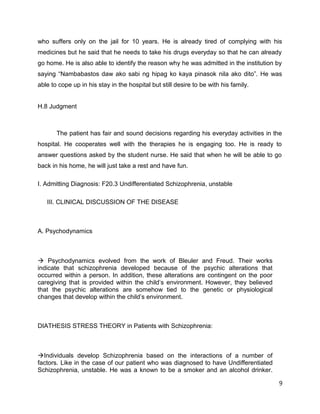
III. CLINICAL DISCUSSION OF THE DISEASE
A. Psychodynamics
 Psychodynamics evolved from the work of Bleuler and Freud. Their works
indicate that schizophrenia developed because of the psychic alterations that
occurred within a person. In addition, these alterations are contingent on the poor
caregiving that is provided within the child’s environment. However, they believed
that the psychic alterations are somehow tied to the genetic or physiological
changes that develop within the child’s environment.
DIATHESIS STRESS THEORY in Patients with Schizophrenia:
Individuals develop Schizophrenia based on the interactions of a number of
factors. Like in the case of our patient who was diagnosed to have Undifferentiated
Schizophrenia, unstable. He was a known to be a smoker and an alcohol drinker.
9
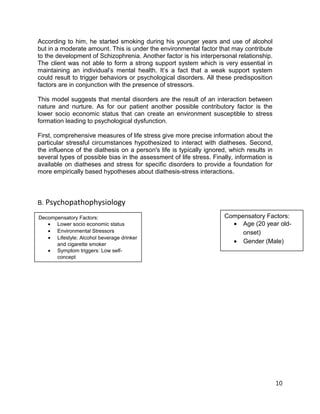
According to him, he started smoking during his younger years and use of alcohol
but in a moderate amount. This is under the environmental factor that may contribute
to the development of Schizophrenia. Another factor is his interpersonal relationship.
The client was not able to form a strong support system which is very essential in
maintaining an individual’s mental health. It’s a fact that a weak support system
could result to trigger behaviors or psychological disorders. All these predisposition
factors are in conjunction with the presence of stressors.
This model suggests that mental disorders are the result of an interaction between
nature and nurture. As for our patient another possible contributory factor is the
lower socio economic status that can create an environment susceptible to stress
formation leading to psychological dysfunction.
First, comprehensive measures of life stress give more precise information about the
particular stressful circumstances hypothesized to interact with diatheses. Second,
the influence of the diathesis on a person's life is typically ignored, which results in
several types of possible bias in the assessment of life stress. Finally, information is
available on diatheses and stress for specific disorders to provide a foundation for
more empirically based hypotheses about diathesis-stress interactions.
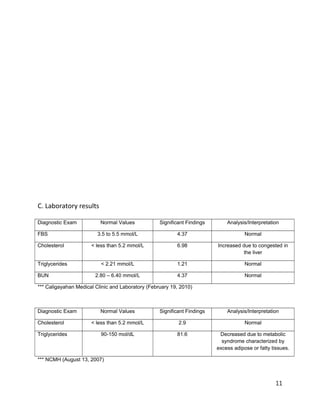
B. Psychopathophysiology
10
Decompensatory Factors:
• Lower socio economic status
• Environmental Stressors
• Lifestyle: Alcohol beverage drinker
and cigarette smoker
• Symptom triggers: Low self-
concept
Compensatory Factors:
• Age (20 year old-
onset)
• Gender (Male)
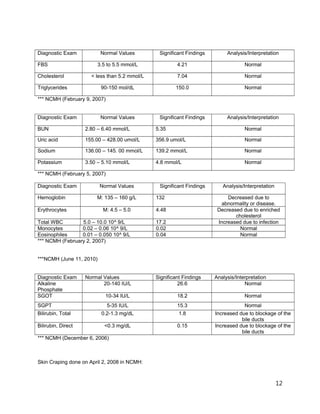
C. Laboratory results
Diagnostic Exam Normal Values Significant Findings Analysis/Interpretation
FBS 3.5 to 5.5 mmol/L 4.37 Normal
Cholesterol < less than 5.2 mmol/L 6.98 Increased due to congested in
the liver
Triglycerides < 2.21 mmol/L 1.21 Normal
BUN 2.80 – 6.40 mmol/L 4.37 Normal
*** Caligayahan Medical Clinic and Laboratory (February 19, 2010)
Diagnostic Exam Normal Values Significant Findings Analysis/Interpretation
Cholesterol < less than 5.2 mmol/L 2.9 Normal
Triglycerides 90-150 mol/dL 81.6 Decreased due to metabolic
syndrome characterized by
excess adipose or fatty tissues.
*** NCMH (August 13, 2007)
11
Diagnostic Exam Normal Values Significant Findings Analysis/Interpretation
FBS 3.5 to 5.5 mmol/L 4.21 Normal
Cholesterol < less than 5.2 mmol/L 7.04 Normal
Triglycerides 90-150 mol/dL 150.0 Normal
*** NCMH (February 9, 2007)
Diagnostic Exam Normal Values Significant Findings Analysis/Interpretation
BUN 2.80 – 6.40 mmol/L 5.35 Normal
Uric acid 155.00 – 428.00 umol/L 356.9 umol/L Normal
Sodium 136.00 – 145. 00 mmol/L 139.2 mmol/L Normal
Potassium 3.50 – 5.10 mmol/L 4.8 mmol/L Normal
*** NCMH (February 5, 2007)
Diagnostic Exam Normal Values Significant Findings Analysis/Interpretation
Hemoglobin M: 135 – 160 g/L 132 Decreased due to
abnormality or disease.
Erythrocytes M: 4.5 – 5.0 4.48 Decreased due to enriched
cholesterol
Total WBC 5.0 – 10.0 10^ 9/L 17.2 Increased due to infection
Monocytes 0.02 – 0.06 10^ 9/L 0.02 Normal
Eosinophiles 0.01 – 0.050 10^ 9/L 0.04 Normal
*** NCMH (February 2, 2007)
***NCMH (June 11, 2010)
Diagnostic Exam Normal Values Significant Findings Analysis/Interpretation
Alkaline
Phosphate
20-140 IU/L 26.6 Normal
SGOT 10-34 IU/L 18.2 Normal
SGPT 5-35 IU/L 15.3 Normal
Bilirubin, Total 0.2-1.3 mg/dL 1.8 Increased due to blockage of the
bile ducts
Bilirubin, Direct <0.3 mg/dL 0.15 Increased due to blockage of the
bile ducts
*** NCMH (December 6, 2006)
Skin Craping done on April 2, 2008 in NCMH:
12
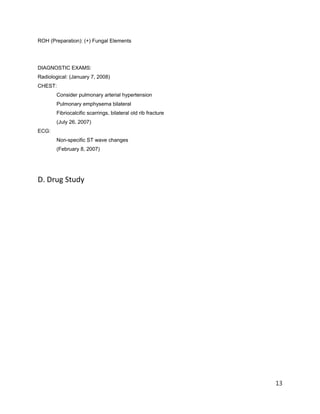
ROH (Preparation): (+) Fungal Elements
DIAGNOSTIC EXAMS:
Radiological: (January 7, 2008)
CHEST:
Consider pulmonary arterial hypertension
Pulmonary emphysema bilateral
Fibriocalcific scarrings, bilateral old rib fracture
(July 26, 2007)
ECG:
Non-specific ST wave changes
(February 8, 2007)
D. Drug Study
13
Generic/
Brand/
Mechanism
of Action
Indication Contra-
indication
Side Effects Nursing
Responsibilities
14
Generic/
Brand/
Dosage/
Classification
Mechanism
of Action
Indication Contra-
indication
Side Effects Nursing
Responsibilities
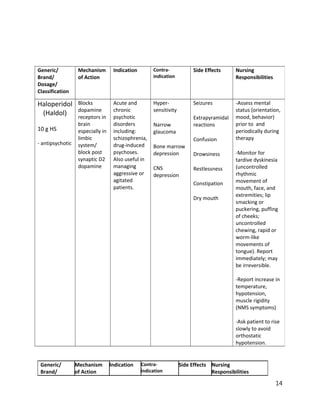
Haloperidol
(Haldol)
10 g HS
- antipsychotic
Blocks
dopamine
receptors in
brain
especially in
limbic
system/
block post
synaptic D2
dopamine
Acute and
chronic
psychotic
disorders
including:
schizophrenia,
drug-induced
psychoses.
Also useful in
managing
aggressive or
agitated
patients.
Hyper-
sensitivity
Narrow
glaucoma
Bone marrow
depression
CNS
depression
Seizures
Extrapyramidal
reactions
Confusion
Drowsiness
Restlessness
Constipation
Dry mouth
-Assess mental
status (orientation,
mood, behavior)
prior to and
periodically during
therapy
-Monitor for
tardive dyskinesia
(uncontrolled
rhythmic
movement of
mouth, face, and
extremities; lip
smacking or
puckering, puffing
of cheeks;
uncontrolled
chewing, rapid or
worm-like
movements of
tongue). Report
immediately; may
be irreversible.
-Report increase in
temperature,
hypotension,
muscle rigidity
(NMS symptoms)
-Ask patient to rise
slowly to avoid
orthostatic
hypotension.
Dosage/
Classification
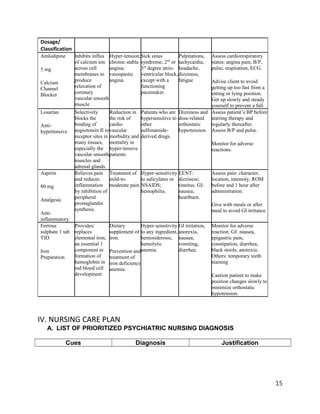
Amlodipine
5 mg
Calcium
Channel
Blocker
Inhibits influx
of calcium ion
across cell
membranes to
produce
relaxation of
coronary
vascular smooth
muscle
Hyper-tension;
chronic stable
angina;
vasospastic
angina.
Sick sinus
syndrome; 2nd
or
3rd
degree atrio-
ventricular block,
except with a
functioning
pacemaker.
Palpitations,
tachycardia,
headache,
dizziness,
fatigue
Assess cardiorespiratory
status: angina pain, B/P,
pulse, respiration, ECG.
Advise client to avoid
getting up too fast from a
sitting or lying position.
Get up slowly and steady
yourself to prevent a fall.
Losartan
Anti-
hypertensive
Selectively
blocks the
binding of
angiotensin II to
receptor sites in
many tissues,
especially the
vascular smooth
muscles and
adrenal glands.
Reduction in
the risk of
cardio
vascular
morbidity and
mortality in
hyper-tensive
patients
Patients who are
hypersensitive to
other
sulfonamide-
derived drugs.
Dizziness and
dose-related
orthostatic
hypertension.
Assess patient’s BP before
starting therapy and
regularly thereafter.
Assess B/P and pulse.
Monitor for adverse
reactions.
Aspirin
80 mg
Analgesic
Anti-
inflammatory
Relieves pain
and reduces
inflammation
by inhibition of
peripheral
prostaglandin
synthesis.
Treatment of
mild-to-
moderate pain.
Hyper-sensitivity
to salicylates or
NSAIDS;
hemophilia.
EENT:
dizziness;
tinnitus. GI:
nausea;
heartburn.
Assess pain: character,
location, intensity, ROM
before and 1 hour after
administration.
Give with meals or after
meal to avoid GI irritance.
Ferrous
sulphate 1 tab
TID
Iron
Preparation
Provides/
replaces
elemental iron,
an essential 1
component in
formation of
hemoglobin in
red blood cell
development
Dietary
supplement of
iron.
Prevention and
treatment of
iron deficiency
anemia.
Hyper-sensitivity
to any ingredient,
hemosiderosis,
hemolytic
anemia.
GI irritation,
anorexia,
nausea,
vomiting,
diarrhea.
Monitor for adverse
reaction: GI: nausea,
epigastric pain,
constipation, diarrhea,
black stools, anorexia.
Others: temporary teeth
staining
Caution patient to make
position changes slowly to
minimize orthostatic
hypotension.
IV. NURSING CARE PLAN
A. LIST OF PRIORITIZED PSYCHIATRIC NURSING DIAGNOSIS
Cues Diagnosis Justification
15
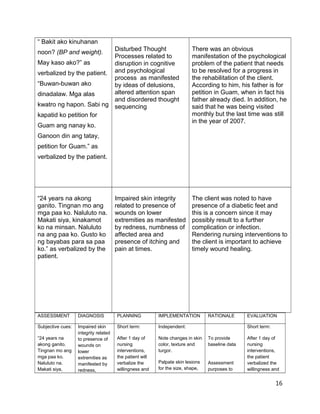
“ Bakit ako kinuhanan
noon? (BP and weight).
May kaso ako?” as
verbalized by the patient.
“Buwan-buwan ako
dinadalaw. Mga alas
kwatro ng hapon. Sabi ng
kapatid ko petition for
Guam ang nanay ko.
Ganoon din ang tatay,
petition for Guam.” as
verbalized by the patient.
Disturbed Thought
Processes related to
disruption in cognitive
and psychological
process as manifested
by ideas of delusions,
altered attention span
and disordered thought
sequencing
There was an obvious
manifestation of the psychological
problem of the patient that needs
to be resolved for a progress in
the rehabilitation of the client.
According to him, his father is for
petition in Guam, when in fact his
father already died. In addition, he
said that he was being visited
monthly but the last time was still
in the year of 2007.
“24 years na akong
ganito. Tingnan mo ang
mga paa ko. Naluluto na.
Makati siya, kinakamot
ko na minsan. Naluluto
na ang paa ko. Gusto ko
ng bayabas para sa paa
ko.” as verbalized by the
patient.
Impaired skin integrity
related to presence of
wounds on lower
extremities as manifested
by redness, numbness of
affected area and
presence of itching and
pain at times.
The client was noted to have
presence of a diabetic feet and
this is a concern since it may
possibly result to a further
complication or infection.
Rendering nursing interventions to
the client is important to achieve
timely wound healing.
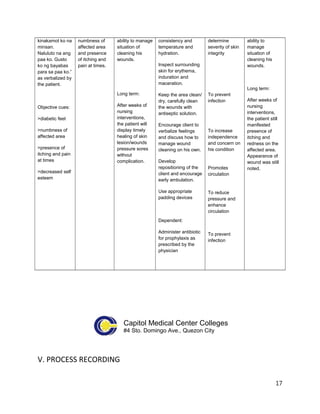
ASSESSMENT DIAGNOSIS PLANNING IMPLEMENTATION RATIONALE EVALUATION
Subjective cues:
“24 years na
akong ganito.
Tingnan mo ang
mga paa ko.
Naluluto na.
Makati siya,
Impaired skin
integrity related
to presence of
wounds on
lower
extremities as
manifested by
redness,
Short term:
After 1 day of
nursing
interventions,
the patient will
verbalize the
willingness and
Independent:
Note changes in skin
color, texture and
turgor.
Palpate skin lesions
for the size, shape,
To provide
baseline data
Assessment
purposes to
Short term:
After 1 day of
nursing
interventions,
the patient
verbalized the
willingness and
16
kinakamot ko na
minsan.
Naluluto na ang
paa ko. Gusto
ko ng bayabas
para sa paa ko.”
as verbalized by
the patient.
Objective cues:
>diabetic feet
>numbness of
affected area
>presence of
itching and pain
at times
>decreased self
esteem
numbness of
affected area
and presence
of itching and
pain at times.
ability to manage
situation of
cleaning his
wounds.
Long term:
After weeks of
nursing
interventions,
the patient will
display timely
healing of skin
lesion/wounds
pressure sores
without
complication.
consistency and
temperature and
hydration.
Inspect surrounding
skin for erythema,
induration and
maceration.
Keep the area clean/
dry, carefully clean
the wounds with
antiseptic solution.
Encourage client to
verbalize feelings
and discuss how to
manage wound
cleaning on his own.
Develop
repositioning of the
client and encourage
early ambulation.
Use appropriate
padding devices
Dependent:
Administer antibiotic
for prophylaxis as
prescribed by the
physician
determine
severity of skin
integrity
To prevent
infection
To increase
independence
and concern on
his condition
Promotes
circulation
To reduce
pressure and
enhance
circulation
To prevent
infection
ability to
manage
situation of
cleaning his
wounds.
Long term:
After weeks of
nursing
interventions,
the patient still
manifested
presence of
itching and
redness on the
affected area.
Appearance of
wound was still
noted.
Capitol Medical Center Colleges
#4 Sto. Domingo Ave., Quezon City
V. PROCESS RECORDING
17
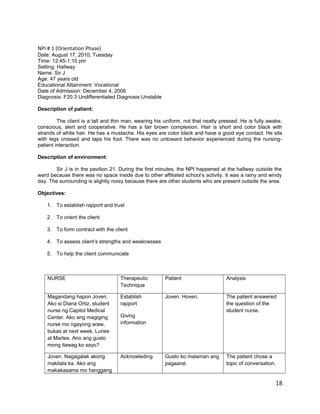
NPI # 1 (Orientation Phase)
Date: August 17, 2010; Tuesday
Time: 12:45-1:10 pm
Setting: Hallway
Name: Sir J
Age: 47 years old
Educational Attainment: Vocational
Date of Admission: December 4, 2006
Diagnosis: F20.3 Undifferentiated Diagnosis Unstable
Description of patient:
The client is a tall and thin man, wearing his uniform, not that neatly pressed. He is fully awake,
conscious, alert and cooperative. He has a fair brown complexion. Hair is short and color black with
strands of white hair. He has a mustache. His eyes are color black and have a good eye contact. He sits
with legs crossed and taps his foot. There was no untoward behavior experienced during the nursing-
patient interaction.
Description of environment:
Sir J is in the pavilion 21. During the first minutes, the NPI happened at the hallway outside the
ward because there was no space inside due to other affiliated school’s activity. It was a rainy and windy
day. The surrounding is slightly noisy because there are other students who are present outside the area.
Objectives:
1. To establish rapport and trust
2. To orient the client
3. To form contract with the client
4. To assess client’s strengths and weaknesses
5. To help the client communicate
NURSE Therapeutic
Technique
Patient Analysis
Magandang hapon Joven.
Ako si Diana Ortiz, student
nurse ng Capitol Medical
Center. Ako ang magiging
nurse mo ngayong araw,
bukas at next week, Lunes
at Martes. Ano ang gusto
mong itawag ko sayo?
Establish
rapport
Giving
information
Joven. Hoven. The patient answered
the question of the
student nurse.
Joven. Nagagalak akong
makilala ka. Ako ang
makakasama mo hanggang
Acknowleding Gusto ko malaman ang
pagaaral.
The patient chose a
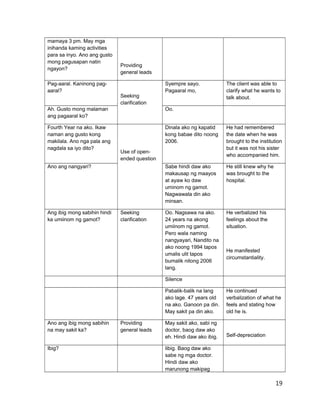
topic of conversation.
18
mamaya 3 pm. May mga
inihanda kaming activities
para sa inyo. Ano ang gusto
mong pagusapan natin
ngayon?
Providing
general leads
Pag-aaral. Kaninong pag-
aaral?
Seeking
clarification
Syempre sayo.
Pagaaral mo,
The client was able to
clarify what he wants to
talk about.
Ah. Gusto mong malaman
ang pagaaral ko?
Oo.
Fourth Year na ako. Ikaw
naman ang gusto kong
makilala. Ano nga pala ang
nagdala sa iyo dito?
Use of open-
ended question
Dinala ako ng kapatid
kong babae dito noong
2006.
He had remembered
the date when he was
brought to the institution
but it was not his sister
who accompanied him.
Ano ang nangyari? Sabe hindi daw ako
makausap ng maayos
at ayaw ko daw
uminom ng gamot.
Nagwawala din ako
minsan.
He still knew why he
was brought to the
hospital.
Ang ibig mong sabihin hindi
ka umiinom ng gamot?
Seeking
clarification
Oo. Nagsawa na ako.
24 years na akong
umiinom ng gamot.
Pero wala naming
nangyayari, Nandito na
ako noong 1994 tapos
umalis ulit tapos
bumalik nitong 2006
lang.
He verbalized his
feelings about the
situation.
He manifested
circumstantiality.
Silence
Pabalik-balik na lang
ako lage. 47 years old
na ako. Ganoon pa din.
May sakit pa din ako.
He continued
verbalization of what he
feels and stating how
old he is.
Ano ang ibig mong sabihin
na may sakit ka?
Providing
general leads
May sakit ako, sabi ng
doctor, baog daw ako
eh. Hindi daw ako ibig. Self-depreciation
Ibig? Iibig. Baog daw ako
sabe ng mga doctor.
Hindi daw ako
marunong makipag
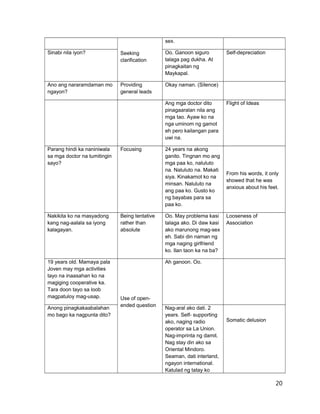
19
Seeking
clarification
sex.
Sinabi nila iyon? Oo. Ganoon siguro
talaga pag dukha. At
pinagkaitan ng
Maykapal.
Self-depreciation
Ano ang nararamdaman mo
ngayon?
Providing
general leads
Okay naman. (Silence)
Ang mga doctor dito
pinagaaralan nila ang
mga tao. Ayaw ko na
nga uminom ng gamot
eh pero kailangan para
uwi na.
Flight of Ideas
Parang hindi ka naniniwala
sa mga doctor na tumitingin
sayo?
Focusing 24 years na akong
ganito. Tingnan mo ang
mga paa ko, naluluto
na. Naluluto na. Makati
siya. Kinakamot ko na
minsan. Naluluto na
ang paa ko. Gusto ko
ng bayabas para sa
paa ko.
From his words, it only
showed that he was
anxious about his feet.
Nakikita ko na masyadong
kang nag-aalala sa iyong
kalagayan.
Being tentative
rather than
absolute
Oo. May problema kasi
talaga ako. Di daw kasi
ako marunong mag-sex
eh. Sabi din naman ng
mga naging girlfriend
ko. Ilan taon ka na ba?
Looseness of
Association
19 years old. Mamaya pala
Joven may mga activities
tayo na inaasahan ko na
magiging cooperative ka.
Tara doon tayo sa loob
magpatuloy mag-usap. Use of open-
ended question
Ah ganoon. Oo.
Anong pinagkakaabalahan
mo bago ka nagpunta dito?
Nag-aral ako dati. 2
years. Self- supporting
ako, naging radio
operator sa La Union.
Nag-imprinta ng damit.
Nag stay din ako sa
Oriental Mindoro.
Seaman, dati interland,
ngayon international.
Katulad ng tatay ko
Somatic delusion
20
pero patay na siya
ngayon.
Lahat ng binanggit mo ay
naging trabaho mo?
Seeking
clarification
Oo.
Silence Silence
Nga pala, may alam ka bang
ibang salita?
Meron. Arigato. He was able to
remember the true
meaning of the word
taught to him.
Ano ibig sabihin nun? Seeking
clarification
Salamat.
May isa pa akong alam.
Konnichiwa.
Giving
information
Ano yun?
Konnichiwa. Ibig sabihin,
magandang hapon.
Ah. Magandang hapon
pala.
He accepted new
information from the
student-nurse.
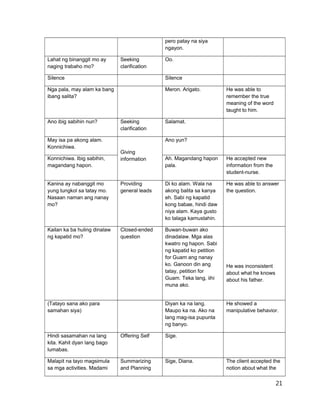
Kanina ay nabanggit mo
yung tungkol sa tatay mo.
Nasaan naman ang nanay
mo?
Providing
general leads
Di ko alam. Wala na
akong balita sa kanya
eh. Sabi ng kapatid
kong babae, hindi daw
niya alam. Kaya gusto
ko talaga kamustahin.
He was able to answer
the question.
Kailan ka ba huling dinalaw
ng kapatid mo?
Closed-ended
question
Buwan-buwan ako
dinadalaw. Mga alas
kwatro ng hapon. Sabi
ng kapatid ko petition
for Guam ang nanay
ko. Ganoon din ang
tatay, petition for
Guam. Teka lang, iihi
muna ako.
He was inconsistent
about what he knows
about his father.
(Tatayo sana ako para
samahan siya)
Diyan ka na lang.
Maupo ka na. Ako na
lang mag-isa pupunta
ng banyo.
He showed a
manipulative behavior.
Hindi sasamahan na lang
kita. Kahit dyan lang bago
lumabas.
Offering Self Sige.
Malapit na tayo magsimula
sa mga activities. Madami
Summarizing
and Planning
Sige, Diana. The client accepted the
notion about what the
21
na din tayong napagusapan
sa kalahating oras. Bukas
naman ay mas palalawakin
pa natin ang mga topic natin
ha? Upo ka na. Salamat.
student nurse told him.
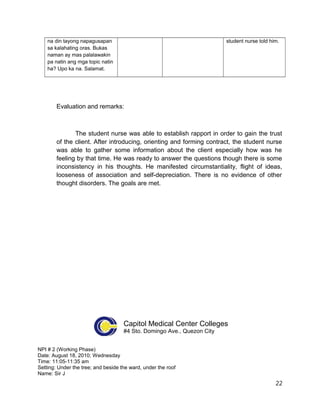
Evaluation and remarks:
The student nurse was able to establish rapport in order to gain the trust
of the client. After introducing, orienting and forming contract, the student nurse
was able to gather some information about the client especially how was he
feeling by that time. He was ready to answer the questions though there is some
inconsistency in his thoughts. He manifested circumstantiality, flight of ideas,
looseness of association and self-depreciation. There is no evidence of other
thought disorders. The goals are met.
Capitol Medical Center Colleges
#4 Sto. Domingo Ave., Quezon City
NPI # 2 (Working Phase)
Date: August 18, 2010; Wednesday
Time: 11:05-11:35 am
Setting: Under the tree; and beside the ward, under the roof
Name: Sir J
22
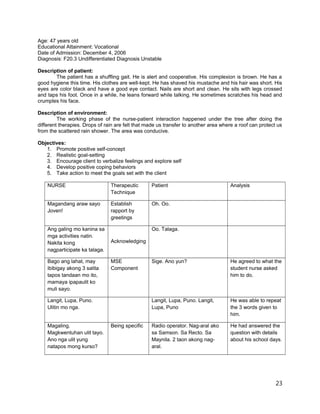
Age: 47 years old
Educational Attainment: Vocational
Date of Admission: December 4, 2006
Diagnosis: F20.3 Undifferentiated Diagnosis Unstable
Description of patient:
The patient has a shuffling gait. He is alert and cooperative. His complexion is brown. He has a
good hygiene this time. His clothes are well-kept. He has shaved his mustache and his hair was short. His
eyes are color black and have a good eye contact. Nails are short and clean. He sits with legs crossed
and taps his foot. Once in a while, he leans forward while talking. He sometimes scratches his head and
crumples his face.
Description of environment:
The working phase of the nurse-patient interaction happened under the tree after doing the
different therapies. Drops of rain are felt that made us transfer to another area where a roof can protect us
from the scattered rain shower. The area was conducive.
Objectives:
1. Promote positive self-concept
2. Realistic goal-setting
3. Encourage client to verbalize feelings and explore self
4. Develop positive coping behaviors
5. Take action to meet the goals set with the client
NURSE Therapeutic
Technique
Patient Analysis
Magandang araw sayo
Joven!
Establish
rapport by
greetings
Oh. Oo.
Ang galing mo kanina sa
mga activities natin.
Nakita kong
nagparticipate ka talaga.
Acknowledging
Oo. Talaga.
Bago ang lahat, may
ibibigay akong 3 salita
tapos tandaan mo ito,
mamaya ipapaulit ko
muli sayo.
MSE
Component
Sige. Ano yun? He agreed to what the
student nurse asked
him to do.
Langit, Lupa, Puno.
Ulitin mo nga.
Langit, Lupa, Puno. Langit,
Lupa, Puno
He was able to repeat
the 3 words given to
him.
Magaling.
Magkwentuhan ulit tayo.
Ano nga ulit yung
natapos mong kurso?
Being specific Radio operator. Nag-aral ako
sa Samson. Sa Recto. Sa
Maynila. 2 taon akong nag-
aral.
He had answered the
question with details
about his school days.
23
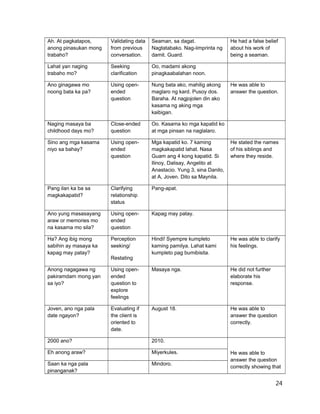
Ah. At pagkatapos,
anong pinasukan mong
trabaho?
Validating data
from previous
conversation.
Seaman, sa dagat.
Nagtatabako. Nag-iimprinta ng
damit. Guard.
He had a false belief
about his work of
being a seaman.
Lahat yan naging
trabaho mo?
Seeking
clarification
Oo, madami akong
pinagkaabalahan noon.
Ano ginagawa mo
noong bata ka pa?
Using open-
ended
question
Nung bata ako, mahilig akong
maglaro ng kard. Pusoy dos.
Baraha. At nagjojolen din ako
kasama ng aking mga
kaibigan.
He was able to
answer the question.
Naging masaya ba
childhood days mo?
Close-ended
question
Oo. Kasama ko mga kapatid ko
at mga pinsan na naglalaro.
Sino ang mga kasama
niyo sa bahay?
Using open-
ended
question
Mga kapatid ko. 7 kaming
magkakapatid lahat. Nasa
Guam ang 4 kong kapatid. Si
Ilinoy, Dalisay, Angelito at
Anastacio. Yung 3, sina Danilo,
at A, Joven. Dito sa Maynila.
He stated the names
of his siblings and
where they reside.
Pang ilan ka ba sa
magkakapatid?
Clarifying
relationship
status
Pang-apat.
Ano yung masasayang
araw or memories mo
na kasama mo sila?
Using open-
ended
question
Kapag may patay.
Ha? Ang ibig mong
sabihin ay masaya ka
kapag may patay?
Perception
seeking/
Restating
Hindi! Syempre kumpleto
kaming pamilya. Lahat kami
kumpleto pag bumibisita.
He was able to clarify
his feelings.
Anong nagagawa ng
pakiramdam mong yan
sa iyo?
Using open-
ended
question to
explore
feelings
Masaya nga. He did not further
elaborate his
response.
Joven, ano nga pala
date ngayon?
Evaluating if
the client is
oriented to
date.
August 18. He was able to
answer the question
correctly.
2000 ano? 2010.
He was able to
answer the question
correctly showing that
Eh anong araw? Miyerkules.
Saan ka nga pala
pinanganak?
Mindoro.
24
Exploring
client’s
important
thoughts about
his life
he’s aware and
capable to remember
events in his life. He is
comprehensible.
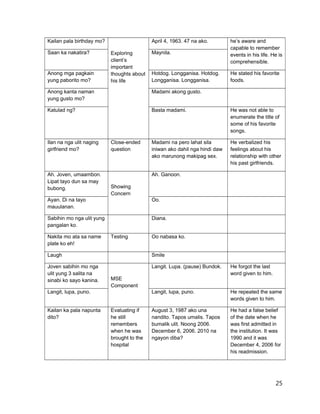
Kailan pala birthday mo? April 4, 1963. 47 na ako.
Saan ka nakatira? Maynila.
Anong mga pagkain
yung paborito mo?
Hotdog. Longganisa. Hotdog.
Longganisa. Longganisa.
He stated his favorite
foods.
Anong kanta naman
yung gusto mo?
Madami akong gusto.
Katulad ng? Basta madami. He was not able to
enumerate the title of
some of his favorite
songs.
Ilan na nga ulit naging
girlfriend mo?
Close-ended
question
Madami na pero lahat sila
iniwan ako dahil nga hindi daw
ako marunong makipag sex.
He verbalized his
feelings about his
relationship with other
his past girlfriends.
Ah. Joven, umaambon.
Lipat tayo dun sa may
bubong. Showing
Concern
Ah. Ganoon.
Ayan. Di na tayo
mauulanan.
Oo.
Sabihin mo nga ulit yung
pangalan ko.
Diana.
Nakita mo ata sa name
plate ko eh!
Testing Oo nabasa ko.
Laugh Smile
Joven sabihin mo nga
ulit yung 3 salita na
sinabi ko sayo kanina. MSE
Component
Langit. Lupa. (pause) Bundok. He forgot the last
word given to him.
Langit, lupa, puno. Langit, lupa, puno. He repeated the same
words given to him.
Kailan ka pala napunta
dito?
Evaluating if
he still
remembers
when he was
brought to the
hospital
August 3, 1987 ako una
nandito. Tapos umalis. Tapos
bumalik ulit. Noong 2006.
December 6, 2006. 2010 na
ngayon diba?
He had a false belief
of the date when he
was first admitted in
the institution. It was
1990 and it was
December 4, 2006 for
his readmission.
25
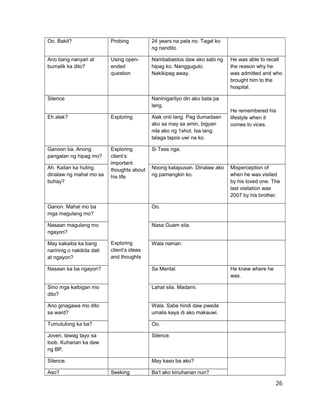
Oo. Bakit? Probing 24 years na pala no. Tagal ko
ng nandito.
Ano bang nanyari at
bumalik ka dito?
Using open-
ended
question
Nambabastos daw ako sabi ng
hipag ko. Nanggugulo.
Nakikipag away.
He was able to recall
the reason why he
was admitted and who
brought him to the
hospital.
Silence Naninigarilyo din ako bata pa
lang.
He remembered his
lifestyle when it
comes to vices.
Eh alak? Exploring Alak onti lang. Pag dumadaan
ako sa may sa amin, bigyan
nila ako ng 1shot. Isa lang
talaga tapos uwi na ko.
Ganoon ba. Anong
pangalan ng hipag mo?
Exploring
client’s
important
thoughts about
his life
Si Tess nga.
Ah. Kailan ka huling
dinalaw ng mahal mo sa
buhay?
Noong katapusan. Dinalaw ako
ng pamangkin ko.
Misperception of
when he was visited
by his loved one. The
last visitation was
2007 by his brother.
Ganon. Mahal mo ba
mga magulang mo?
Exploring
client’s ideas
and thoughts
Oo.
Nasaan magulang mo
ngayon?
Nasa Guam sila.
May kakaiba ka bang
naririnig o nakikita dati
at ngayon?
Wala naman.
Nasaan ka ba ngayon? Sa Mental. He knew where he
was.
Sino mga kaibigan mo
dito?
Lahat sila. Madami.
Ano ginagawa mo dito
sa ward?
Wala. Sabe hindi daw pwede
umalis kaya di ako makauwi.
Tumutulong ka ba? Oo.
Joven, tawag tayo sa
loob. Kuhanan ka daw
ng BP.
Silence.
Silence. May kaso ba ako?
Aso? Seeking Ba’t ako kinuhanan nun?
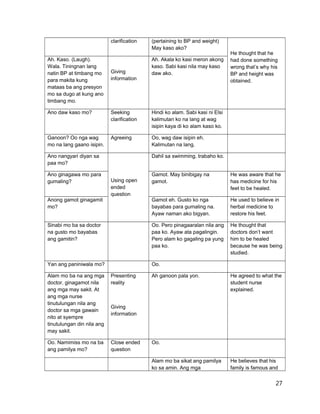
26
clarification (pertaining to BP and weight)
May kaso ako?
He thought that he
had done something
wrong that’s why his
BP and height was
obtained.
Ah. Kaso. (Laugh).
Wala. Tiningnan lang
natin BP at timbang mo
para makita kung
mataas ba ang presyon
mo sa dugo at kung ano
timbang mo.
Giving
information
Ah. Akala ko kasi meron akong
kaso. Sabi kasi nila may kaso
daw ako.
Ano daw kaso mo? Seeking
clarification
Hindi ko alam. Sabi kasi ni Elsi
kalimutan ko na lang at wag
isipin kaya di ko alam kaso ko.
Ganoon? Oo nga wag
mo na lang gaano isipin.
Agreeing Oo, wag daw isipin eh.
Kalimutan na lang.
Ano nangyari diyan sa
paa mo?
Using open
ended
question
Dahil sa swimming, trabaho ko.
Ano ginagawa mo para
gumaling?
Gamot. May binibigay na
gamot.
He was aware that he
has medicine for his
feet to be healed.
Anong gamot ginagamit
mo?
Gamot eh. Gusto ko nga
bayabas para gumaling na.
Ayaw naman ako bigyan.
He used to believe in
herbal medicine to
restore his feet.
Sinabi mo ba sa doctor
na gusto mo bayabas
ang gamitin?
Oo. Pero pinagaaralan nila ang
paa ko. Ayaw ata pagalingin.
Pero alam ko gagaling pa yung
paa ko.
He thought that
doctors don’t want
him to be healed
because he was being
studied.
Yan ang paniniwala mo? Oo.
Alam mo ba na ang mga
doctor, ginagamot nila
ang mga may sakit. At
ang mga nurse
tinutulungan nila ang
doctor sa mga gawain
nito at syempre
tinutulungan din nila ang
may sakit.
Presenting
reality
Giving
information
Ah ganoon pala yon. He agreed to what the
student nurse
explained.
Oo. Namimiss mo na ba
ang pamilya mo?
Close ended
question
Oo.
Alam mo ba sikat ang pamilya
ko sa amin. Ang mga
He believes that his
family is famous and
27
magulang ko. Ang tito ko, sikat
sa probinsiya.
known by many
people in their
province.
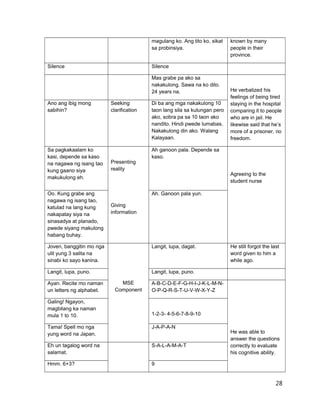
Silence Silence
Mas grabe pa ako sa
nakakulong. Sawa na ko dito.
24 years na. He verbalized his
feelings of being tired
staying in the hospital
comparing it to people
who are in jail. He
likewise said that he’s
more of a prisoner, no
freedom.
Ano ang ibig mong
sabihin?
Seeking
clarification
Di ba ang mga nakakulong 10
taon lang sila sa kulungan pero
ako, sobra pa sa 10 taon ako
nandito. Hindi pwede lumabas.
Nakakulong din ako. Walang
Kalayaan.
Sa pagkakaalam ko
kasi, depende sa kaso
na nagawa ng isang tao
kung gaano siya
makukulong eh.
Presenting
reality
Giving
information
Ah ganoon pala. Depende sa
kaso.
Agreeing to the
student nurse
Oo. Kung grabe ang
nagawa ng isang tao,
katulad na lang kung
nakapatay siya na
sinasadya at planado,
pwede siyang makulong
habang buhay.
Ah. Ganoon pala yun.
Joven, banggitin mo nga
ulit yung 3 salita na
sinabi ko sayo kanina.
MSE
Component
Langit, lupa, dagat. He still forgot the last
word given to him a
while ago.
Langit, lupa, puno. Langit, lupa, puno.
Ayan. Recite mo naman
un letters ng alphabet.
A-B-C-D-E-F-G-H-I-J-K-L-M-N-
O-P-Q-R-S-T-U-V-W-X-Y-Z
He was able to
answer the questions
correctly to evaluate
his cognitive ability.
Galing! Ngayon,
magbilang ka naman
mula 1 to 10. 1-2-3- 4-5-6-7-8-9-10
Tama! Spell mo nga
yung word na Japan.
J-A-P-A-N
Eh un tagalog word na
salamat.
S-A-L-A-M-A-T
Hmm. 6+3? 9
28
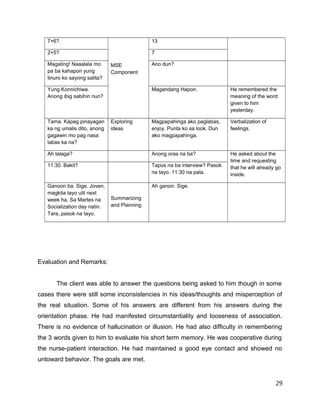
MSE
Component
7+6? 13
2+5? 7
Magaling! Naaalala mo
pa ba kahapon yung
tinuro ko sayong salita?
Ano dun?
Yung Konnichiwa.
Anong ibig sabihin nun?
Magandang Hapon. He remembered the
meaning of the word
given to him
yesterday.
Tama. Kapag pinayagan
ka ng umalis dito, anong
gagawin mo pag nasa
labas ka na?
Exploring
ideas
Magpapahinga ako paglabas,
enjoy. Punta ko sa look. Dun
ako magpapahinga.
Verbalization of
feelings.
Ah talaga? Anong oras na ba? He asked about the
time and requesting
that he will already go
inside.
11:30. Bakit? Tapos na ba interview? Pasok
na tayo. 11:30 na pala.
Ganoon ba. Sige. Joven,
magkita tayo ulit next
week ha. Sa Martes na
Socialization day natin.
Tara, pasok na tayo.
Summarizing
and Planning
Ah ganon. Sige.
Evaluation and Remarks:
The client was able to answer the questions being asked to him though in some
cases there were still some inconsistencies in his ideas/thoughts and misperception of
the real situation. Some of his answers are different from his answers during the
orientation phase. He had manifested circumstantiality and looseness of association.
There is no evidence of hallucination or illusion. He had also difficulty in remembering
the 3 words given to him to evaluate his short term memory. He was cooperative during
the nurse-patient interaction. He had maintained a good eye contact and showed no
untoward behavior. The goals are met.
29
Capitol Medical Center Colleges
#4 Sto. Domingo Ave., Quezon City
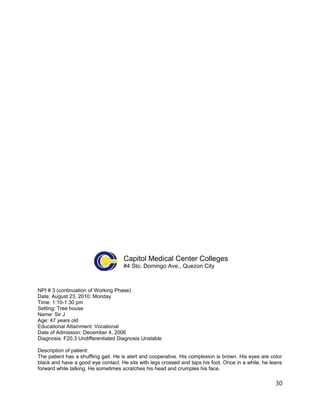
NPI # 3 (continuation of Working Phase)
Date: August 23, 2010; Monday
Time: 1:10-1:30 pm
Setting: Tree house
Name: Sir J
Age: 47 years old
Educational Attainment: Vocational
Date of Admission: December 4, 2006
Diagnosis: F20.3 Undifferentiated Diagnosis Unstable
Description of patient:
The patient has a shuffling gait. He is alert and cooperative. His complexion is brown. His eyes are color
black and have a good eye contact. He sits with legs crossed and taps his foot. Once in a while, he leans
forward while talking. He sometimes scratches his head and crumples his face.
30
Description of environment:
The continuation of the working phase of the nurse-patient interaction happened in the tree house in the
afternoon after he had eaten his lunch. The environment was conducive, quiet and comfortable.
Objectives:
1. Promote positive self-concept
2. Encourage client to verbalize feelings and explore self
3. Develop positive coping behaviors
4. Take action to meet the goals set with the client
NURSE Therapeutic
Technique
Patient Analysis
Hi. Kamusta Joven? Establish
rapport
Using open-
ended
question
Mabuti naman. Ano gagawin
naten? Magdadrawing?
He asked about the
activity.
Hindi. Mag NPI tayo at
pagkatapos mag games.
Pinoy Henyo.
Giving
information
Ah ganoon ba.
Oo. Last day na naming
ngayon. Bukas
socialization na natin. O
anong gusto mong food
natin?
Using open-
ended
question
Kahit ano.
He was able to
answer the question
of the student nurse.
Ah. Anong kinain mo sa
tanghalian?
Baboy. Paksiw.
Masarap ba? Oo.
Describe mo naman sa
akin famly mo. Nasaan
magulang mo?
Nasa Guam nanay at tatay ko.
Petition for United States. Sa
London din. Andon din mga
kapatid ko.
He manifested
delusion. His father
already died.
Anong dahilan bakit
hindi mo sila kasama?
Focusing and
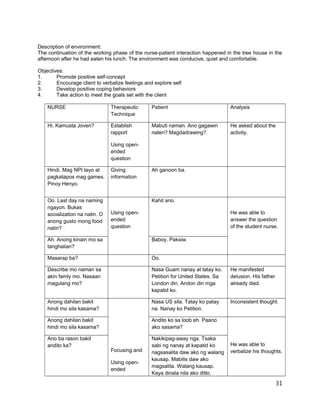
Using open-
ended
Nasa US sila. Tatay ko patay
na. Nanay ko Petition.
Inconsistent thought.
Anong dahilan bakit
hindi mo sila kasama?
Andito ko sa loob eh. Paano
ako sasama?
He was able to
verbalize his thoughts.
Ano ba rason bakit
andito ka?
Nakikipag-away nga. Tsaka
sabi ng nanay at kapatid ko
nagsasalita daw ako ng walang
kausap. Mabilis daw ako
magsalita. Walang kausap.
Kaya dinala nila ako ditto.
31
question Noong una, sila. Tapos yung
hipag ko nagdala sa akin.
Sino ba kinakausap mo? Wala nga. Mental nga diba.
Ano.. Kailan ka huling
dinalaw dito?
Noong katapusan. Ng kapatid
ko.
He manifested
delusion. He was last
visited 2007.
Anong nararamdaman
mo noong pinasok ka
nila dito?
Ayoko na dito.
He was able to
verbalize his feelings.
He doesn’t want to
take his medicines
anymore but still, he
complies to take it. He
is concerned about
his health.
Joven, iinom ka daw ulit
ng gamot.
Gamot ulit. Lagi na lang gamot.
Nagsasawa na ako.
*He took his medicine.
Buti at ininom mo pa din
ang gamot mo.
Ayoko na. Sawa na ako. 24
years na ako umiinom ng
gamot. Hindi naman ako
gumagaling. Sawa na ako.
Kailangan mo pa din
uminom ng gamot mo
para gumaling ka.
Ang tagal-tagal na eh. Dito na
ako sa mental matagal. May
sakit ako. Kaya nga pinasok
ako dito eh. May kapansanan
ako.
Anong kapansanan mo? May kapansanan ako. Kaya
nandito ako. Kaya nga nasa
Crossings eh. Sa
Mandaluyong.
He manifested
tangential thinking,
circumstantiality.
Crossings? Seeking
clarification
Oo mental nga. Ano ba naman
ito.
Ah. Crossings sa
Mandaluyong. Pasensya
Oo.
Saan ka nga ulit
nakatira?
Validation of
the
congruency of
his past
answers to
present
Sa Mindoro nga. Ano ba
naman ito.
He was slightly
annoyed of repeated
question asked.
Saan sa Mindoro? Look.
He was able to
answer the question
Probinsya yon? Oo. Taga Maynila ka ba?
Oo. Bakit? Nag stay din ako sa Maynila.
Grade 3 pa lang ako.
32
and he verbalized his
thoughts and feelings.
Ibig mong sabihin grade
3 ka pa lang, nag-aral ka
na dito sa Maynila?
Paraphrasing Hindi. Namamasyal lang ako
sa Maynila.
Sino kasama mo?
Focusing and
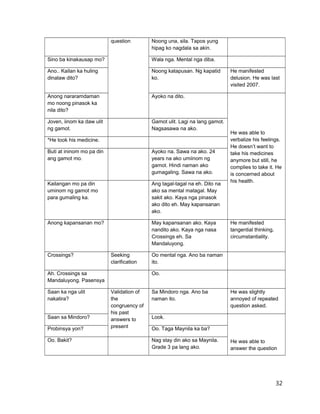
Using open
ended
question
Edi pamilya ko.Magulang. Mga
kapatid.
Anong ginagawa niyo
pag nandito kayo sa
Maynila?
Namamasya. Nagpupunta sa
mga kapitbahay. Kung saan-
saan,. Pero ayoko dito sa
Maynila.
Sa anong dahilan? Ayoko dito sa Maynila.
He manifested
perseveration.
May mga naging
karanasan ka ba habang
nasa Maynila ka pa?
Wala.
Kamusta naman
pagkabinata mo?
Okay lang. May sakit pa din.
Ayoko na ng gamot.
Naaalala mo si Kaye? Oo. Ayoko ng gamot.
Mukhang ayaw mo at
nagsasawa ka na talaga
uminom ng gamot ha.
Pero kailangan mong
uminom ng gamot mo.
Para sa ikabubuti mo din
yan.
Focusing
Ang tagal-tagal na eh. 24 years
na.
Sino ba ang doctor mo?
Using open
ended
question
Si Dr. Tamayo. Si Dr. Ho. Si
Dr. Kaligayahan.
He manifested
delusion.
Kailan ka huling
chineck-up?
Matagal na.
May mga bisyo ka ba? Oo. Nagyoyosi. Kanina yosi.
Ano? Nagyoyosi ka? Clarifying Hindi bawal. Walang batas.
Nagyosi.
Saan mo nakuha yung
yosi mo?
Focusing and
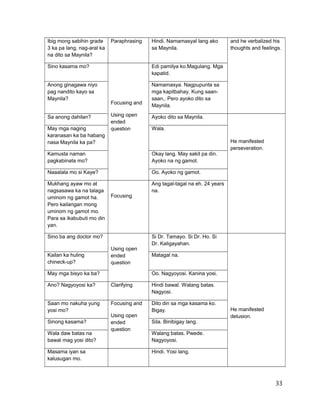
Using open
ended
question
Dito din sa mga kasama ko.
Bigay.
Sinong kasama? Sila. Binibigay lang.
Wala daw batas na
bawal mag yosi dito?
Walang batas. Pwede.
Nagyoyosi.
Masama iyan sa
kalusugan mo.
Hindi. Yosi lang.
33
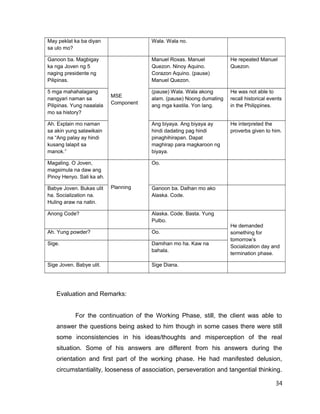
May peklat ka ba diyan
sa ulo mo?
Wala. Wala no.
Ganoon ba. Magbigay
ka nga Joven ng 5
naging presidente ng
Pilipinas.
MSE
Component
Manuel Roxas. Manuel
Quezon. Ninoy Aquino.
Corazon Aquino. (pause)
Manuel Quezon.
He repeated Manuel
Quezon.
5 mga mahahalagang
nangyari naman sa
Pilipinas. Yung naaalala
mo sa history?
(pause) Wala. Wala akong
alam. (pause) Noong dumating
ang mga kastila. Yon lang.
He was not able to
recall historical events
in the Philippines.
Ah. Explain mo naman
sa akin yung salawikain
na “Ang palay ay hindi
kusang lalapit sa
manok.”
Ang biyaya. Ang biyaya ay
hindi dadating pag hindi
pinaghihirapan. Dapat
maghirap para magkaroon ng
biyaya.
He interpreted the
proverbs given to him.
Magaling. O Joven,
magsimula na daw ang
Pinoy Henyo. Sali ka ah.
Planning
Oo.
Babye Joven. Bukas ulit
ha. Socialization na.
Huling araw na natin.
Ganoon ba. Dalhan mo ako
Alaska. Code.
Anong Code? Alaska. Code. Basta. Yung
Pulbo.
He demanded
something for
tomorrow’s
Socialization day and
termination phase.
Ah. Yung powder? Oo.
Sige. Damihan mo ha. Kaw na
bahala.
Sige Joven. Babye ulit. Sige Diana.
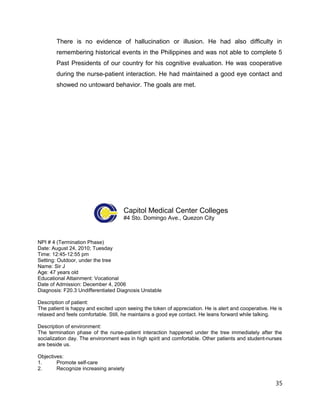
Evaluation and Remarks:
For the continuation of the Working Phase, still, the client was able to
answer the questions being asked to him though in some cases there were still
some inconsistencies in his ideas/thoughts and misperception of the real
situation. Some of his answers are different from his answers during the
orientation and first part of the working phase. He had manifested delusion,
circumstantiality, looseness of association, perseveration and tangential thinking.
34
There is no evidence of hallucination or illusion. He had also difficulty in
remembering historical events in the Philippines and was not able to complete 5
Past Presidents of our country for his cognitive evaluation. He was cooperative
during the nurse-patient interaction. He had maintained a good eye contact and
showed no untoward behavior. The goals are met.
Capitol Medical Center Colleges
#4 Sto. Domingo Ave., Quezon City
NPI # 4 (Termination Phase)
Date: August 24, 2010; Tuesday
Time: 12:45-12:55 pm
Setting: Outdoor, under the tree
Name: Sir J
Age: 47 years old
Educational Attainment: Vocational
Date of Admission: December 4, 2006
Diagnosis: F20.3 Undifferentiated Diagnosis Unstable
Description of patient:
The patient is happy and excited upon seeing the token of appreciation. He is alert and cooperative. He is
relaxed and feels comfortable. Still, he maintains a good eye contact. He leans forward while talking.
Description of environment:
The termination phase of the nurse-patient interaction happened under the tree immediately after the
socialization day. The environment was in high spirit and comfortable. Other patients and student-nurses
are beside us.
Objectives:
1. Promote self-care
2. Recognize increasing anxiety
35
3. Increase independence
4. Demonstrate emotional stability
5. Evaluate goals achieved by the patient
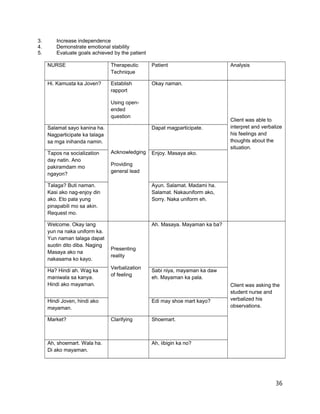
NURSE Therapeutic
Technique
Patient Analysis
Hi. Kamusta ka Joven? Establish
rapport
Using open-
ended
question
Okay naman.
Client was able to
interpret and verbalize
his feelings and
thoughts about the
situation.
Salamat sayo kanina ha.
Nagparticipate ka talaga
sa mga inihanda namin.
Acknowledging
Providing
general lead
Dapat magparticipate.
Tapos na socialization
day natin. Ano
pakiramdam mo
ngayon?
Enjoy. Masaya ako.
Talaga? Buti naman.
Kasi ako nag-enjoy din
ako. Eto pala yung
pinapabili mo sa akin.
Request mo.
Ayun. Salamat. Madami ha.
Salamat. Nakauniform ako,
Sorry. Naka uniform eh.
Welcome. Okay lang
yun na naka uniform ka.
Yun naman talaga dapat
suotin dito diba. Naging
Masaya ako na
nakasama ko kayo.
Presenting
reality
Verbalization
of feeling
Ah. Masaya. Mayaman ka ba?
Client was asking the
student nurse and
verbalized his
observations.
Ha? Hindi ah. Wag ka
maniwala sa kanya.
Hindi ako mayaman.
Sabi niya, mayaman ka daw
eh. Mayaman ka pala.
Hindi Joven, hindi ako
mayaman.
Edi may shoe mart kayo?
Market? Clarifying Shoemart.
Ah, shoemart. Wala ha.
Di ako mayaman.
Ah, iibigin ka no?
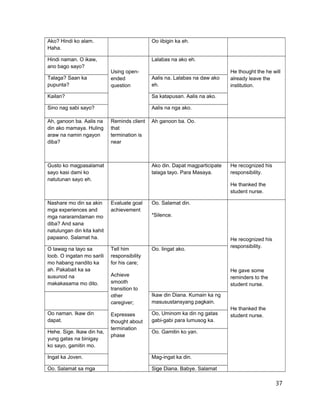
36
Ako? Hindi ko alam.
Haha.
Oo iibigin ka eh.
Hindi naman. O ikaw,
ano bago sayo?
Using open-
ended
question
Lalabas na ako eh.
He thought the he will
already leave the
institution.
Talaga? Saan ka
pupunta?
Aalis na. Lalabas na daw ako
eh.
Kailan? Sa katapusan. Aalis na ako.
Sino nag sabi sayo? Aalis na nga ako.
Ah, ganoon ba. Aalis na
din ako mamaya. Huling
araw na namin ngayon
diba?
Reminds client
that
termination is
near
Ah ganoon ba. Oo.
Gusto ko magpasalamat
sayo kasi dami ko
natutunan sayo eh.
Ako din. Dapat magparticipate
talaga tayo. Para Masaya.
He recognized his
responsibility.
He thanked the
student nurse.
Nashare mo din sa akin
mga experiences and
mga nararamdaman mo
diba? And sana
natulungan din kita kahit
papaano. Salamat ha.
Evaluate goal
achievement
Oo. Salamat din.
*Silence.
He recognized his
responsibility.
He gave some
reminders to the
student nurse.
He thanked the
student nurse.
O tawag na tayo sa
loob. O ingatan mo sarili
mo habang nandito ka
ah. Pakabait ka sa
susunod na
makakasama mo dito.
Tell him
responsibility
for his care;
Achieve
smooth
transition to
other
caregiver;
Expresses
thought about
termination
phase
Oo. Iingat ako.
Ikaw din Diana. Kumain ka ng
masusustansyang pagkain.
Oo naman. Ikaw din
dapat.
Oo, Uminom ka din ng gatas
gabi-gabi para lumusog ka.
Hehe. Sige. Ikaw din ha,
yung gatas na binigay
ko sayo, gamitin mo.
Oo. Gamitin ko yan.
Ingat ka Joven. Mag-ingat ka din.
Oo. Salamat sa mga Sige Diana. Babye. Salamat
37
paalala mo sa akin.
Babye Joven.
sayo ha. Sige pasok na.
Salamat.
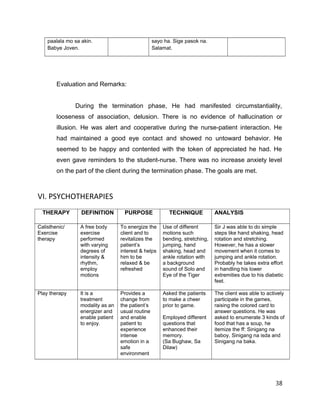
Evaluation and Remarks:
During the termination phase, He had manifested circumstantiality,
looseness of association, delusion. There is no evidence of hallucination or
illusion. He was alert and cooperative during the nurse-patient interaction. He
had maintained a good eye contact and showed no untoward behavior. He
seemed to be happy and contented with the token of appreciated he had. He
even gave reminders to the student-nurse. There was no increase anxiety level
on the part of the client during the termination phase. The goals are met.
VI. PSYCHOTHERAPIES
THERAPY DEFINITION PURPOSE TECHNIQUE ANALYSIS
Calisthenic/
Exercise
therapy
A free body
exercise
performed
with varying
degrees of
intensity &
rhythm,
employ
motions
To energize the
client and to
revitalizes the
patient’s
interest & helps
him to be
relaxed & be
refreshed
Use of different
motions such
bending, stretching,
jumping, hand
shaking, head and
ankle rotation with
a background
sound of Solo and
Eye of the Tiger
Sir J was able to do simple
steps like hand shaking, head
rotation and stretching.
However, he has a slower
movement when it comes to
jumping and ankle rotation.
Probably he takes extra effort
in handling his lower
extremities due to his diabetic
feet.
Play therapy It is a
treatment
modality as an
energizer and
enable patient
to enjoy.
Provides a
change from
the patient’s
usual routine
and enable
patient to
experience
intense
emotion in a
safe
environment
Asked the patients
to make a cheer
prior to game.
Employed different
questions that
enhanced their
memory.
(Sa Bughaw, Sa
Dilaw)
The client was able to actively
participate in the games,
raising the colored card to
answer questions. He was
asked to enumerate 3 kinds of
food that has a soup, he
itemize the ff: Sinigang na
baboy, Sinigang na isda and
Sinigang na baka.
38
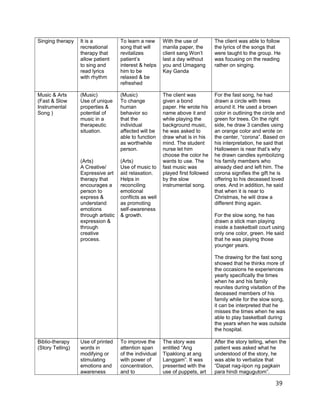
Singing therapy It is a
recreational
therapy that
allow patient
to sing and
read lyrics
with rhythm
To learn a new
song that will
revitalizes
patient’s
interest & helps
him to be
relaxed & be
refreshed
With the use of
manila paper, the
client sang Won’t
last a day without
you and Umagang
Kay Ganda
The client was able to follow
the lyrics of the songs that
were taught to the group. He
was focusing on the reading
rather on singing.
Music & Arts
(Fast & Slow
Instrumental
Song )
(Music)
Use of unique
properties &
potential of
music in a
therapeutic
situation.
(Arts)
A Creative/
Expressive art
therapy that
encourages a
person to
express &
understand
emotions
through artistic
expression &
through
creative
process.
(Music)
To change
human
behavior so
that the
individual
affected will be
able to function
as worthwhile
person.
(Arts)
Use of music to
aid relaxation.
Helps in
reconciling
emotional
conflicts as well
as promoting
self-awareness
& growth.
The client was
given a bond
paper. He wrote his
name above it and
while playing the
background music,
he was asked to
draw what is in his
mind. The student
nurse let him
choose the color he
wants to use. The
fast music was
played first followed
by the slow
instrumental song.
For the fast song, he had
drawn a circle with trees
around it. He used a brown
color in outlining the circle and
green for trees. On the right
side, he draw 3 candles using
an orange color and wrote on
the center, “corona”. Based on
his interpretation, he said that
Halloween is near that’s why
he drawn candles symbolizing
his family members who
already died and left him. The
corona signifies the gift he is
offering to his deceased loved
ones. And in addition, he said
that when it is near to
Christmas, he will draw a
different thing again.
For the slow song, he has
drawn a stick man playing
inside a basketball court using
only one color, green. He said
that he was playing those
younger years.
The drawing for the fast song
showed that he thinks more of
the occasions he experiences
yearly specifically the times
when he and his family
reunites during visitation of the
deceased members of his
family while for the slow song,
it can be interpreted that he
misses the times when he was
able to play basketball during
the years when he was outside
the hospital.
Biblio-therapy
(Story Telling)
Use of printed
words in
modifying or
stimulating
emotions and
awareness
To improve the
attention span
of the individual
with power of
concentration,
and to
The story was
entitled “Ang
Tipaklong at ang
Langgam”. It was
presented with the
use of puppets, art
After the story telling, when the
patient was asked what he
understood of the story, he
was able to verbalize that
“Dapat nag-iipon ng pagkain
para hindi magugutom”.
39
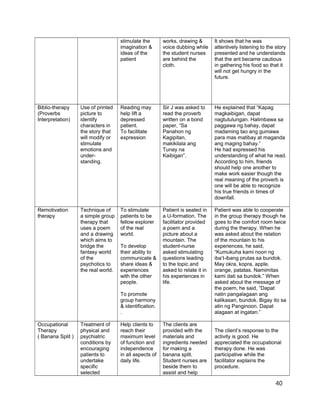
stimulate the
imagination &
ideas of the
patient
works, drawing &
voice dubbing while
the student nurses
are behind the
cloth.
It shows that he was
attentively listening to the story
presented and he understands
that the ant became cautious
in gathering his food so that it
will not get hungry in the
future.
Biblio-therapy
(Proverbs
Interpretation)
Use of printed
picture to
identify
characters in
the story that
will modify or
stimulate
emotions and
under-
standing.
Reading may
help lift a
depressed
patient.
To facilitate
expression
Sir J was asked to
read the proverb
written on a bond
paper, “Sa
Panahon ng
Kagipitan,
makikilala ang
Tunay na
Kaibigan”.
He explained that “Kapag
magkaibigan, dapat
nagtutulungan. Halimbawa sa
paggawa ng bahay, dapat
madaming tao ang gumawa
para mas matibay at maganda
ang maging bahay.”
He had expressed his
understanding of what he read.
According to him, friends
should help one another to
make work easier though the
real meaning of the proverb is
one will be able to recognize
his true friends in times of
downfall.
Remotivation
therapy
Technique of
a simple group
therapy that
uses a poem
and a drawing
which aims to
bridge the
fantasy world
of the
psychotics to
the real world.
To stimulate
patients to be
fellow explorer
of the real
world.
To develop
their ability to
communicate &
share ideas &
experiences
with the other
people.
To promote
group harmony
& identification.
.
Patient is seated in
a U-formation. The
facilitator provided
a poem and a
picture about a
mountain. The
student-nurse
asked stimulating
questions leading
to the topic and
asked to relate it in
his experiences in
life.
Patient was able to cooperate
in the group therapy though he
goes to the comfort room twice
during the therapy. When he
was asked about the relation
of the mountain to his
experiences, he said,
“Kumukuha kami noon ng
iba’t-ibang prutas sa bundok.
May okra, kopra, apple,
orange, patatas. Namimitas
kami dati sa bundok.” When
asked about the message of
the poem, he said, “Dapat
natin pangalagaan ang
kalikasan, bundok. Bigay ito sa
atin ng Panginoon. Dapat
alagaan at ingatan.”
Occupational
Therapy
( Banana Split )
Treatment of
physical and
psychiatric
conditions by
encouraging
patients to
undertake
specific
selected
Help clients to
reach their
maximum level
of function and
independence
in all aspects of
daily life.
The clients are
provided with the
materials and
ingredients needed
for making a
banana split.
Student nurses are
beside them to
assist and help
The client’s response to the
activity is good. He
appreciated the occupational
therapy done. He was
participative while the
facilitator explains the
procedure.
40
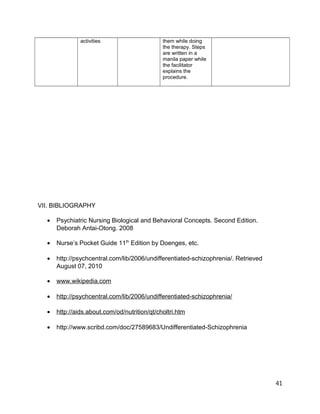
activities them while doing
the therapy. Steps
are written in a
manila paper while
the facilitator
explains the
procedure.
VII. BIBLIOGRAPHY
• Psychiatric Nursing Biological and Behavioral Concepts. Second Edition.
Deborah Antai-Otong. 2008
• Nurse’s Pocket Guide 11th
Edition by Doenges, etc.
• http://psychcentral.com/lib/2006/undifferentiated-schizophrenia/. Retrieved
August 07, 2010
• www.wikipedia.com
• http://psychcentral.com/lib/2006/undifferentiated-schizophrenia/
• http://aids.about.com/od/nutrition/qt/choltri.htm
• http://www.scribd.com/doc/27589683/Undifferentiated-Schizophrenia
41
42
43

196150292 casetudy-ncmh-doc

  • 1.
    Get Homework/Assignment Done Homeworkping.com HomeworkHelp https://www.homeworkping.com/ Research Paper help https://www.homeworkping.com/ Online Tutoring https://www.homeworkping.com/ click here for freelancing tutoring sites Table of Contents I. Introduction -------------------------------------------------------------------------------------------------2 A. Background of the Study -----------------------------------------------------------------------------2 B. Significance of the Study -----------------------------------------------------------------------------3 II. Psychiatric Nursing Assessment --------------------------------------------------------------------4 A. Patient’s Profile -----------------------------------------------------------------------------------------4 B. Chief Complaint -----------------------------------------------------------------------------------------4 C. History of Present Illness -----------------------------------------------------------------------------4 D. Past Medical History -----------------------------------------------------------------------------------4 E. Past Psychiatric History ------------------------------------------------------------------------------4 F. Familial History -----------------------------------------------------------------------------------------4 1
  • 2.
    G. Personal History----------------------------------------------------------------------------------------4 H. Mental Status Examination --------------------------------------------------------------------------5 I. Impression/Diagnosis ---------------------------------------------------------------------------------7 III. Clinical Discussion of the Disease-------------------------------------------------------------------8 A. Psychodynamics ---------------------------------------------------------------------------------------8 B. Psychopathophysiology-------------------------------------------------------------------------------9 C. Laboratory and Diagnostic Examination --------------------------------------------------------10 D. Drug Study ---------------------------------------------------------------------------------------------12 IV. Nursing Care Plan ---------------------------------------------------------------------------------------14 A. Problem List ---------------------------------------------------------------------------------------14 B. Nursing Care Plan -------------------------------------------------------------------------------15 V. Process Recording --------------------------------------------------------------------------------------17 VI. Psychotherapies -----------------------------------------------------------------------------------------38 VII. Bibliography -----------------------------------------------------------------------------------------------41 APPENDICES ---------------------------------------------------------------------------------------------------42 Mental Status Examination ---------------------------------------------------------------------------------A 2
  • 3.
    Process Recording --------------------------------------------------------------------------------------------B Reflection---------------------------------------------------------------------------------------------------------C I. INTRODUCTION A. Background of the Study Schizophrenia is a psychiatric diagnosis that describes a mental disorder characterized by abnormalities in the perception or expression of reality. It most commonly manifests as auditory hallucinations, paranoid or bizarre delusions or disorganized speech and thinking in the context of significant social or occupational dysfunction. Onset of symptoms typically occurs in young adulthood. Diagnosis is based on the patient's self-reported experiences and observed behavior. No laboratory test for schizophrenia currently exists. The symptoms of schizophrenia are categorized into two major categories, the positive or hard symptoms which include delusion, hallucinations, and grossly disorganized thinking, speech, and behavior, and negative or soft symptoms as flat affect, lack of volition, and social withdrawal or discomfort. There are 5 categories of schizophrenia: Catatonic, Disorganized, Paranoid, Residual, and Undifferentiated. Catatonic schizophrenia involves a disturbance in movement, voluntary movement for prolonged periods of time. Disorganized schizophrenia involves, a disorganized thought process – emotionally, mentally and verbally. Paranoid schizophrenia is primarily characterized by hallucinations and delusions (perhaps about persecution or conspiracies directed against the sufferer). Residual schizophrenia is diagnosed when the patient isn't really displaying significant symptoms. The person is no longer in an acute schizophrenic phase, but may experience symptoms that are either less frequent or less severe than they were during the peak of the disorder. Undifferentiated schizophrenia is characterized by mixed schizophrenic symptoms (of other types) along with disturbances of thought, affect, and behavior. It is diagnosed when one doesn't have the full symptoms of one of the other subtypes. In this study, undifferentiated schizophrenia will be used for the case analysis. Worldwide about 1 percent of the population is diagnosed with schizophrenia. About 1.5 million people will be diagnosed with schizophrenia this year around the world. (mentalhelp.net). Ninety-five percent (95%) suffer a lifetime; thirty-three percent (33%) 3
  • 4.
    of all homelessAmericans suffer from schizophrenia; fifty percent (50%) experience serious side effects from medications; and ten percent (10%) kill themselves (Keltner, 2007). According to study done 697,543 out of 86,241,697 of Filipinos or approximately 0.8% are suffering from schizophrenia (cureresearch.com).  Undifferentiated Schizophrenia is manifested by pronounced delusions, hallucinations, and disorganized thought processes and behavior. The undifferentiated subtype is diagnosed when people have symptoms of schizophrenia that are not sufficiently formed or specific enough to permit classification of the illness into one of the other subtypes.  Patients in this category have the characteristics of positive and negative symptoms of schizophrenia but do not meet the specific criteria for the paranoid, disorganized or catatonic subtypes. Onset of symptoms typically occurs in young adulthood with around 1.5% prevalence of the population affected. The disorder is thought to mainly affect cognition, but it also usually contributes to chronic problems with behavior and emotion  Undifferentiated schizophrenia is a difficult diagnosis to make with any confidence because it depends on establishing the slowly progressive development of the characteristic “negative” symptoms of schizophrenia without any history of hallucinations, delusions, or other manifestations of an earlier psychotic episode, and with significant changes in personal behavior, manifest as a marked loss of interest, idleness, and social withdrawal. It can be also based on the self-reported experiences of the person, and abnormalities in behavior reported by family members, friends, or co- workers, followed by a clinical assessment by a mental health professional. Diagnosis of undifferentiated subtype may best describe the mixed clinical syndrome. B. Significance of the Study General Objective: The main objective of this case study is to be able to present an extensive and comprehensive case study of the chosen client that would present a comprehensive discussion of Schizophrenia, Undifferentiated to yield important information for this case analysis. Specific Objective: In order to meet the general objective, the group aims to: • Assess and interpret the pertinent data gathered from the patient • Determine the etiology factors (precipitating and predisposing) of the mental disorder 4
  • 5.
    • Evaluate thepresence or absence of signs and symptoms seen in the patient in relation to the mental disorder • Formulate effective, specific, measurable, attainable, realistic and time-bounded nursing care plans base on identified actual and potential nursing problems • Provide appropriate nursing care directed towards not only to the client’s psychological but also his physical well-being II. PSYCHIATRIC NURSING ASSESSMENT A. Patient’s Profile Sir J is a 47 year old, male, Filipino and Roman Catholic. He is single and was born on April 4, 1963 in Occidental Mindoro. He lives at San Miguel Heights, Valenzuela City. His educational attainment is Vocational. The date of his admission is December 4, 2006 (Re-admission) with an admitting Diagnosis of F20.3 Undifferentiated Schizophrenia, unstable. B. Chief Complaint According to his sister in law, “Di natutulog, ayaw uminom ng gamot, nagwawala at mainitin and ulo.” C. History of Present Illness The patient has been mentally ill since 1990. He was readmitted on December 4, 2006 in National Center for Mental Health with the same diagnosis. He had an irregular check-up until his significant others noticed that he doesn’t sleeps, doesn’t want to take medicines, became short tempered and showed irrational behavior. D. Past Medical History He has no history of seizure. Prior to admission, the patient was non-diabetic, non-hypertensive, non-asthmatic. E. Past Psychiatric History He was mentally ill since the onset of attention of crisis during 1990’s. He had an irregular check-up until he was observed to become non-functional at home and became distracted. Hence, his family readmits him in the same institution. F. Familial History 5
  • 6.
    His father isdeceased. There were no histories of diabetes mellitus, or suicide attempts in the both side of his family. There is no trace of any mental disorders in the client’s family. G. Personal History The patient is a vocational graduate. He smokes cigarette and drinks alcoholic beverage but with no use of illegal drugs. He has no suicidal and homicidal tendencies. According to the patient, he studied for 2 years and work as a seaman, radio operator, guard, imprinting shirts and a magtatabako”. He was self-supporting student and he said that his family is famous in their place though he is poor and he is ill. H. Mental Status Examination H.1 General Appearance and Behavior The patient is tall and thin in terms of muscularity, with fair brown complexion, and has short black hair with strands of white. He has wounds and lesions on right and left elbow and has diabetic feet. On the first day of the nurse-patient interaction, he had his clothes kept not that clean and pleasant. However on the second day, he had taken a bath and his uniform was neatly pressed. He also shaved his beard. He has a hoarse, husky and rough voice and intonation. He walks slowly with a shuffling gait. He sits with his legs crossed and taps his one foot at times. When he hears his name, he looks to his side and see who is calling. At times, he leans forward while talking, still maintaining good and straight eye contact throughout the interaction. His eyes are dilated at times but respond to light. H.2 Affect The patient displayed a blunted or restricted affect during the first minutes of the interaction, and once in a while, showed generally appropriate affect. In an objective manner, he appears to be serious but he was able to smile for a second especially if he feels that way. H.3 Mood 6
  • 7.
    During the interview,he stated that he knows he has a problem and he is ill. He was worried about his feet and kept repeating that he needs “bayabas”. He is used to touch his head part and sometimes, his face. Objectively, he appears to be concern on his situation while looking at his feet. Once in a while, he smiles especially if the topic is worth smiling for. H.4 Thought Processes The patient speaks in a loud and spontaneous manner. He speaks Filipino all the time. His speech is sometimes unclear and there are words that are poorly articulated making it difficult to understand. His thoughts are generally logical, and answer the questions being asked to him by the student nurse. He also manifests looseness of association but he still manages to answer some questions. Sometimes, he also manifest blocking but returns to function immediately. He is quite circumstantial, answers questions but includes unnecessary details and skips one topic from another having flight of ideas, looseness of association, perseveration and tangential thinking. H.5 Thought Content The client believes that his family is famous and well known by other people. Moreover, he is also preoccupied with thought that he is infertile and he is not good on making love, that’s why his past girlfriends left her. In addition, he feels unworthy of himself especially regarding the condition of his feet. He likewise said that his father is in Guam, when in fact his father already died. Furthermore, he is inconsistent in remembering real situations that happened to him. (About his occupation: he graduated 7
  • 8.
    on a vocationalcourse). Other than that, there were no noted signs of hallucination or any illusion. H.6 Cognitive Evaluation The patient is fully awake and alert throughout the interview and is oriented to time, place where he is, person who is with him, and date of the interaction. He was able to: spell the word Japan and Salamat, count 1 to 10 and count it backwards, and recite the alphabet completely from A to Z. On the first day, the meaning of Konnichiwa is interpreted to him. And on the second day, he was asked about its meaning again and he was able to remember it. Patient has a recent memory intact for 2/3 words (Langit, lupa, puno) given to him during the first minutes of interview. He forgot the last word for two consecutive times. When he was asked about his favorite song, he said that he loves many songs but was unable to enumerate even one. He is also able to answer simple mathematical calculations such as addition. He was able to recite a poem entitled “Tutubi” and interpret a proverb in accordance to his understanding. And when he was already on his room, he was shouting the 3 words (Langit, lupa, puno) correctly and in sequence. In addition, he was not able to recall 4 historical events and forgot 1 past president in the Philippines. H.7 Insight Patient knows that he has problem that is why he was admitted at the hospital. He also thinks that the reason why he is not allowed to leave the hospital and go home is because the doctors there are studying him especially the condition of his feet. According to him, he always asks the nurse to give him bayabas so that it will heal immediately but he said that they always refuse. He knows that his wound is treated with the use of medicine instead of herbal. He also made mentioned that he is more like of a prisoner because he was in the hospital for 24 years already unlike the prisoner 8
  • 9.
    who suffers onlyon the jail for 10 years. He is already tired of complying with his medicines but he said that he needs to take his drugs everyday so that he can already go home. He is also able to identify the reason why he was admitted in the institution by saying “Nambabastos daw ako sabi ng hipag ko kaya pinasok nila ako dito”. He was able to cope up in his stay in the hospital but still desire to be with his family. H.8 Judgment The patient has fair and sound decisions regarding his everyday activities in the hospital. He cooperates well with the therapies he is engaging too. He is ready to answer questions asked by the student nurse. He said that when he will be able to go back in his home, he will just take a rest and have fun. I. Admitting Diagnosis: F20.3 Undifferentiated Schizophrenia, unstable III. CLINICAL DISCUSSION OF THE DISEASE A. Psychodynamics  Psychodynamics evolved from the work of Bleuler and Freud. Their works indicate that schizophrenia developed because of the psychic alterations that occurred within a person. In addition, these alterations are contingent on the poor caregiving that is provided within the child’s environment. However, they believed that the psychic alterations are somehow tied to the genetic or physiological changes that develop within the child’s environment. DIATHESIS STRESS THEORY in Patients with Schizophrenia: Individuals develop Schizophrenia based on the interactions of a number of factors. Like in the case of our patient who was diagnosed to have Undifferentiated Schizophrenia, unstable. He was a known to be a smoker and an alcohol drinker. 9
  • 10.
    According to him,he started smoking during his younger years and use of alcohol but in a moderate amount. This is under the environmental factor that may contribute to the development of Schizophrenia. Another factor is his interpersonal relationship. The client was not able to form a strong support system which is very essential in maintaining an individual’s mental health. It’s a fact that a weak support system could result to trigger behaviors or psychological disorders. All these predisposition factors are in conjunction with the presence of stressors. This model suggests that mental disorders are the result of an interaction between nature and nurture. As for our patient another possible contributory factor is the lower socio economic status that can create an environment susceptible to stress formation leading to psychological dysfunction. First, comprehensive measures of life stress give more precise information about the particular stressful circumstances hypothesized to interact with diatheses. Second, the influence of the diathesis on a person's life is typically ignored, which results in several types of possible bias in the assessment of life stress. Finally, information is available on diatheses and stress for specific disorders to provide a foundation for more empirically based hypotheses about diathesis-stress interactions. B. Psychopathophysiology 10 Decompensatory Factors: • Lower socio economic status • Environmental Stressors • Lifestyle: Alcohol beverage drinker and cigarette smoker • Symptom triggers: Low self- concept Compensatory Factors: • Age (20 year old- onset) • Gender (Male)
  • 11.
    C. Laboratory results DiagnosticExam Normal Values Significant Findings Analysis/Interpretation FBS 3.5 to 5.5 mmol/L 4.37 Normal Cholesterol < less than 5.2 mmol/L 6.98 Increased due to congested in the liver Triglycerides < 2.21 mmol/L 1.21 Normal BUN 2.80 – 6.40 mmol/L 4.37 Normal *** Caligayahan Medical Clinic and Laboratory (February 19, 2010) Diagnostic Exam Normal Values Significant Findings Analysis/Interpretation Cholesterol < less than 5.2 mmol/L 2.9 Normal Triglycerides 90-150 mol/dL 81.6 Decreased due to metabolic syndrome characterized by excess adipose or fatty tissues. *** NCMH (August 13, 2007) 11
  • 12.
    Diagnostic Exam NormalValues Significant Findings Analysis/Interpretation FBS 3.5 to 5.5 mmol/L 4.21 Normal Cholesterol < less than 5.2 mmol/L 7.04 Normal Triglycerides 90-150 mol/dL 150.0 Normal *** NCMH (February 9, 2007) Diagnostic Exam Normal Values Significant Findings Analysis/Interpretation BUN 2.80 – 6.40 mmol/L 5.35 Normal Uric acid 155.00 – 428.00 umol/L 356.9 umol/L Normal Sodium 136.00 – 145. 00 mmol/L 139.2 mmol/L Normal Potassium 3.50 – 5.10 mmol/L 4.8 mmol/L Normal *** NCMH (February 5, 2007) Diagnostic Exam Normal Values Significant Findings Analysis/Interpretation Hemoglobin M: 135 – 160 g/L 132 Decreased due to abnormality or disease. Erythrocytes M: 4.5 – 5.0 4.48 Decreased due to enriched cholesterol Total WBC 5.0 – 10.0 10^ 9/L 17.2 Increased due to infection Monocytes 0.02 – 0.06 10^ 9/L 0.02 Normal Eosinophiles 0.01 – 0.050 10^ 9/L 0.04 Normal *** NCMH (February 2, 2007) ***NCMH (June 11, 2010) Diagnostic Exam Normal Values Significant Findings Analysis/Interpretation Alkaline Phosphate 20-140 IU/L 26.6 Normal SGOT 10-34 IU/L 18.2 Normal SGPT 5-35 IU/L 15.3 Normal Bilirubin, Total 0.2-1.3 mg/dL 1.8 Increased due to blockage of the bile ducts Bilirubin, Direct <0.3 mg/dL 0.15 Increased due to blockage of the bile ducts *** NCMH (December 6, 2006) Skin Craping done on April 2, 2008 in NCMH: 12
  • 13.
    ROH (Preparation): (+)Fungal Elements DIAGNOSTIC EXAMS: Radiological: (January 7, 2008) CHEST: Consider pulmonary arterial hypertension Pulmonary emphysema bilateral Fibriocalcific scarrings, bilateral old rib fracture (July 26, 2007) ECG: Non-specific ST wave changes (February 8, 2007) D. Drug Study 13
  • 14.
    Generic/ Brand/ Mechanism of Action Indication Contra- indication SideEffects Nursing Responsibilities 14 Generic/ Brand/ Dosage/ Classification Mechanism of Action Indication Contra- indication Side Effects Nursing Responsibilities Haloperidol (Haldol) 10 g HS - antipsychotic Blocks dopamine receptors in brain especially in limbic system/ block post synaptic D2 dopamine Acute and chronic psychotic disorders including: schizophrenia, drug-induced psychoses. Also useful in managing aggressive or agitated patients. Hyper- sensitivity Narrow glaucoma Bone marrow depression CNS depression Seizures Extrapyramidal reactions Confusion Drowsiness Restlessness Constipation Dry mouth -Assess mental status (orientation, mood, behavior) prior to and periodically during therapy -Monitor for tardive dyskinesia (uncontrolled rhythmic movement of mouth, face, and extremities; lip smacking or puckering, puffing of cheeks; uncontrolled chewing, rapid or worm-like movements of tongue). Report immediately; may be irreversible. -Report increase in temperature, hypotension, muscle rigidity (NMS symptoms) -Ask patient to rise slowly to avoid orthostatic hypotension.
  • 15.
    Dosage/ Classification Amlodipine 5 mg Calcium Channel Blocker Inhibits influx ofcalcium ion across cell membranes to produce relaxation of coronary vascular smooth muscle Hyper-tension; chronic stable angina; vasospastic angina. Sick sinus syndrome; 2nd or 3rd degree atrio- ventricular block, except with a functioning pacemaker. Palpitations, tachycardia, headache, dizziness, fatigue Assess cardiorespiratory status: angina pain, B/P, pulse, respiration, ECG. Advise client to avoid getting up too fast from a sitting or lying position. Get up slowly and steady yourself to prevent a fall. Losartan Anti- hypertensive Selectively blocks the binding of angiotensin II to receptor sites in many tissues, especially the vascular smooth muscles and adrenal glands. Reduction in the risk of cardio vascular morbidity and mortality in hyper-tensive patients Patients who are hypersensitive to other sulfonamide- derived drugs. Dizziness and dose-related orthostatic hypertension. Assess patient’s BP before starting therapy and regularly thereafter. Assess B/P and pulse. Monitor for adverse reactions. Aspirin 80 mg Analgesic Anti- inflammatory Relieves pain and reduces inflammation by inhibition of peripheral prostaglandin synthesis. Treatment of mild-to- moderate pain. Hyper-sensitivity to salicylates or NSAIDS; hemophilia. EENT: dizziness; tinnitus. GI: nausea; heartburn. Assess pain: character, location, intensity, ROM before and 1 hour after administration. Give with meals or after meal to avoid GI irritance. Ferrous sulphate 1 tab TID Iron Preparation Provides/ replaces elemental iron, an essential 1 component in formation of hemoglobin in red blood cell development Dietary supplement of iron. Prevention and treatment of iron deficiency anemia. Hyper-sensitivity to any ingredient, hemosiderosis, hemolytic anemia. GI irritation, anorexia, nausea, vomiting, diarrhea. Monitor for adverse reaction: GI: nausea, epigastric pain, constipation, diarrhea, black stools, anorexia. Others: temporary teeth staining Caution patient to make position changes slowly to minimize orthostatic hypotension. IV. NURSING CARE PLAN A. LIST OF PRIORITIZED PSYCHIATRIC NURSING DIAGNOSIS Cues Diagnosis Justification 15
  • 16.
    “ Bakit akokinuhanan noon? (BP and weight). May kaso ako?” as verbalized by the patient. “Buwan-buwan ako dinadalaw. Mga alas kwatro ng hapon. Sabi ng kapatid ko petition for Guam ang nanay ko. Ganoon din ang tatay, petition for Guam.” as verbalized by the patient. Disturbed Thought Processes related to disruption in cognitive and psychological process as manifested by ideas of delusions, altered attention span and disordered thought sequencing There was an obvious manifestation of the psychological problem of the patient that needs to be resolved for a progress in the rehabilitation of the client. According to him, his father is for petition in Guam, when in fact his father already died. In addition, he said that he was being visited monthly but the last time was still in the year of 2007. “24 years na akong ganito. Tingnan mo ang mga paa ko. Naluluto na. Makati siya, kinakamot ko na minsan. Naluluto na ang paa ko. Gusto ko ng bayabas para sa paa ko.” as verbalized by the patient. Impaired skin integrity related to presence of wounds on lower extremities as manifested by redness, numbness of affected area and presence of itching and pain at times. The client was noted to have presence of a diabetic feet and this is a concern since it may possibly result to a further complication or infection. Rendering nursing interventions to the client is important to achieve timely wound healing. ASSESSMENT DIAGNOSIS PLANNING IMPLEMENTATION RATIONALE EVALUATION Subjective cues: “24 years na akong ganito. Tingnan mo ang mga paa ko. Naluluto na. Makati siya, Impaired skin integrity related to presence of wounds on lower extremities as manifested by redness, Short term: After 1 day of nursing interventions, the patient will verbalize the willingness and Independent: Note changes in skin color, texture and turgor. Palpate skin lesions for the size, shape, To provide baseline data Assessment purposes to Short term: After 1 day of nursing interventions, the patient verbalized the willingness and 16
  • 17.
    kinakamot ko na minsan. Nalulutona ang paa ko. Gusto ko ng bayabas para sa paa ko.” as verbalized by the patient. Objective cues: >diabetic feet >numbness of affected area >presence of itching and pain at times >decreased self esteem numbness of affected area and presence of itching and pain at times. ability to manage situation of cleaning his wounds. Long term: After weeks of nursing interventions, the patient will display timely healing of skin lesion/wounds pressure sores without complication. consistency and temperature and hydration. Inspect surrounding skin for erythema, induration and maceration. Keep the area clean/ dry, carefully clean the wounds with antiseptic solution. Encourage client to verbalize feelings and discuss how to manage wound cleaning on his own. Develop repositioning of the client and encourage early ambulation. Use appropriate padding devices Dependent: Administer antibiotic for prophylaxis as prescribed by the physician determine severity of skin integrity To prevent infection To increase independence and concern on his condition Promotes circulation To reduce pressure and enhance circulation To prevent infection ability to manage situation of cleaning his wounds. Long term: After weeks of nursing interventions, the patient still manifested presence of itching and redness on the affected area. Appearance of wound was still noted. Capitol Medical Center Colleges #4 Sto. Domingo Ave., Quezon City V. PROCESS RECORDING 17
  • 18.
    NPI # 1(Orientation Phase) Date: August 17, 2010; Tuesday Time: 12:45-1:10 pm Setting: Hallway Name: Sir J Age: 47 years old Educational Attainment: Vocational Date of Admission: December 4, 2006 Diagnosis: F20.3 Undifferentiated Diagnosis Unstable Description of patient: The client is a tall and thin man, wearing his uniform, not that neatly pressed. He is fully awake, conscious, alert and cooperative. He has a fair brown complexion. Hair is short and color black with strands of white hair. He has a mustache. His eyes are color black and have a good eye contact. He sits with legs crossed and taps his foot. There was no untoward behavior experienced during the nursing- patient interaction. Description of environment: Sir J is in the pavilion 21. During the first minutes, the NPI happened at the hallway outside the ward because there was no space inside due to other affiliated school’s activity. It was a rainy and windy day. The surrounding is slightly noisy because there are other students who are present outside the area. Objectives: 1. To establish rapport and trust 2. To orient the client 3. To form contract with the client 4. To assess client’s strengths and weaknesses 5. To help the client communicate NURSE Therapeutic Technique Patient Analysis Magandang hapon Joven. Ako si Diana Ortiz, student nurse ng Capitol Medical Center. Ako ang magiging nurse mo ngayong araw, bukas at next week, Lunes at Martes. Ano ang gusto mong itawag ko sayo? Establish rapport Giving information Joven. Hoven. The patient answered the question of the student nurse. Joven. Nagagalak akong makilala ka. Ako ang makakasama mo hanggang Acknowleding Gusto ko malaman ang pagaaral. The patient chose a topic of conversation. 18
  • 19.
    mamaya 3 pm.May mga inihanda kaming activities para sa inyo. Ano ang gusto mong pagusapan natin ngayon? Providing general leads Pag-aaral. Kaninong pag- aaral? Seeking clarification Syempre sayo. Pagaaral mo, The client was able to clarify what he wants to talk about. Ah. Gusto mong malaman ang pagaaral ko? Oo. Fourth Year na ako. Ikaw naman ang gusto kong makilala. Ano nga pala ang nagdala sa iyo dito? Use of open- ended question Dinala ako ng kapatid kong babae dito noong 2006. He had remembered the date when he was brought to the institution but it was not his sister who accompanied him. Ano ang nangyari? Sabe hindi daw ako makausap ng maayos at ayaw ko daw uminom ng gamot. Nagwawala din ako minsan. He still knew why he was brought to the hospital. Ang ibig mong sabihin hindi ka umiinom ng gamot? Seeking clarification Oo. Nagsawa na ako. 24 years na akong umiinom ng gamot. Pero wala naming nangyayari, Nandito na ako noong 1994 tapos umalis ulit tapos bumalik nitong 2006 lang. He verbalized his feelings about the situation. He manifested circumstantiality. Silence Pabalik-balik na lang ako lage. 47 years old na ako. Ganoon pa din. May sakit pa din ako. He continued verbalization of what he feels and stating how old he is. Ano ang ibig mong sabihin na may sakit ka? Providing general leads May sakit ako, sabi ng doctor, baog daw ako eh. Hindi daw ako ibig. Self-depreciation Ibig? Iibig. Baog daw ako sabe ng mga doctor. Hindi daw ako marunong makipag 19
  • 20.
    Seeking clarification sex. Sinabi nila iyon?Oo. Ganoon siguro talaga pag dukha. At pinagkaitan ng Maykapal. Self-depreciation Ano ang nararamdaman mo ngayon? Providing general leads Okay naman. (Silence) Ang mga doctor dito pinagaaralan nila ang mga tao. Ayaw ko na nga uminom ng gamot eh pero kailangan para uwi na. Flight of Ideas Parang hindi ka naniniwala sa mga doctor na tumitingin sayo? Focusing 24 years na akong ganito. Tingnan mo ang mga paa ko, naluluto na. Naluluto na. Makati siya. Kinakamot ko na minsan. Naluluto na ang paa ko. Gusto ko ng bayabas para sa paa ko. From his words, it only showed that he was anxious about his feet. Nakikita ko na masyadong kang nag-aalala sa iyong kalagayan. Being tentative rather than absolute Oo. May problema kasi talaga ako. Di daw kasi ako marunong mag-sex eh. Sabi din naman ng mga naging girlfriend ko. Ilan taon ka na ba? Looseness of Association 19 years old. Mamaya pala Joven may mga activities tayo na inaasahan ko na magiging cooperative ka. Tara doon tayo sa loob magpatuloy mag-usap. Use of open- ended question Ah ganoon. Oo. Anong pinagkakaabalahan mo bago ka nagpunta dito? Nag-aral ako dati. 2 years. Self- supporting ako, naging radio operator sa La Union. Nag-imprinta ng damit. Nag stay din ako sa Oriental Mindoro. Seaman, dati interland, ngayon international. Katulad ng tatay ko Somatic delusion 20
  • 21.
    pero patay nasiya ngayon. Lahat ng binanggit mo ay naging trabaho mo? Seeking clarification Oo. Silence Silence Nga pala, may alam ka bang ibang salita? Meron. Arigato. He was able to remember the true meaning of the word taught to him. Ano ibig sabihin nun? Seeking clarification Salamat. May isa pa akong alam. Konnichiwa. Giving information Ano yun? Konnichiwa. Ibig sabihin, magandang hapon. Ah. Magandang hapon pala. He accepted new information from the student-nurse. Kanina ay nabanggit mo yung tungkol sa tatay mo. Nasaan naman ang nanay mo? Providing general leads Di ko alam. Wala na akong balita sa kanya eh. Sabi ng kapatid kong babae, hindi daw niya alam. Kaya gusto ko talaga kamustahin. He was able to answer the question. Kailan ka ba huling dinalaw ng kapatid mo? Closed-ended question Buwan-buwan ako dinadalaw. Mga alas kwatro ng hapon. Sabi ng kapatid ko petition for Guam ang nanay ko. Ganoon din ang tatay, petition for Guam. Teka lang, iihi muna ako. He was inconsistent about what he knows about his father. (Tatayo sana ako para samahan siya) Diyan ka na lang. Maupo ka na. Ako na lang mag-isa pupunta ng banyo. He showed a manipulative behavior. Hindi sasamahan na lang kita. Kahit dyan lang bago lumabas. Offering Self Sige. Malapit na tayo magsimula sa mga activities. Madami Summarizing and Planning Sige, Diana. The client accepted the notion about what the 21
  • 22.
    na din tayongnapagusapan sa kalahating oras. Bukas naman ay mas palalawakin pa natin ang mga topic natin ha? Upo ka na. Salamat. student nurse told him. Evaluation and remarks: The student nurse was able to establish rapport in order to gain the trust of the client. After introducing, orienting and forming contract, the student nurse was able to gather some information about the client especially how was he feeling by that time. He was ready to answer the questions though there is some inconsistency in his thoughts. He manifested circumstantiality, flight of ideas, looseness of association and self-depreciation. There is no evidence of other thought disorders. The goals are met. Capitol Medical Center Colleges #4 Sto. Domingo Ave., Quezon City NPI # 2 (Working Phase) Date: August 18, 2010; Wednesday Time: 11:05-11:35 am Setting: Under the tree; and beside the ward, under the roof Name: Sir J 22
  • 23.
    Age: 47 yearsold Educational Attainment: Vocational Date of Admission: December 4, 2006 Diagnosis: F20.3 Undifferentiated Diagnosis Unstable Description of patient: The patient has a shuffling gait. He is alert and cooperative. His complexion is brown. He has a good hygiene this time. His clothes are well-kept. He has shaved his mustache and his hair was short. His eyes are color black and have a good eye contact. Nails are short and clean. He sits with legs crossed and taps his foot. Once in a while, he leans forward while talking. He sometimes scratches his head and crumples his face. Description of environment: The working phase of the nurse-patient interaction happened under the tree after doing the different therapies. Drops of rain are felt that made us transfer to another area where a roof can protect us from the scattered rain shower. The area was conducive. Objectives: 1. Promote positive self-concept 2. Realistic goal-setting 3. Encourage client to verbalize feelings and explore self 4. Develop positive coping behaviors 5. Take action to meet the goals set with the client NURSE Therapeutic Technique Patient Analysis Magandang araw sayo Joven! Establish rapport by greetings Oh. Oo. Ang galing mo kanina sa mga activities natin. Nakita kong nagparticipate ka talaga. Acknowledging Oo. Talaga. Bago ang lahat, may ibibigay akong 3 salita tapos tandaan mo ito, mamaya ipapaulit ko muli sayo. MSE Component Sige. Ano yun? He agreed to what the student nurse asked him to do. Langit, Lupa, Puno. Ulitin mo nga. Langit, Lupa, Puno. Langit, Lupa, Puno He was able to repeat the 3 words given to him. Magaling. Magkwentuhan ulit tayo. Ano nga ulit yung natapos mong kurso? Being specific Radio operator. Nag-aral ako sa Samson. Sa Recto. Sa Maynila. 2 taon akong nag- aral. He had answered the question with details about his school days. 23
  • 24.
    Ah. At pagkatapos, anongpinasukan mong trabaho? Validating data from previous conversation. Seaman, sa dagat. Nagtatabako. Nag-iimprinta ng damit. Guard. He had a false belief about his work of being a seaman. Lahat yan naging trabaho mo? Seeking clarification Oo, madami akong pinagkaabalahan noon. Ano ginagawa mo noong bata ka pa? Using open- ended question Nung bata ako, mahilig akong maglaro ng kard. Pusoy dos. Baraha. At nagjojolen din ako kasama ng aking mga kaibigan. He was able to answer the question. Naging masaya ba childhood days mo? Close-ended question Oo. Kasama ko mga kapatid ko at mga pinsan na naglalaro. Sino ang mga kasama niyo sa bahay? Using open- ended question Mga kapatid ko. 7 kaming magkakapatid lahat. Nasa Guam ang 4 kong kapatid. Si Ilinoy, Dalisay, Angelito at Anastacio. Yung 3, sina Danilo, at A, Joven. Dito sa Maynila. He stated the names of his siblings and where they reside. Pang ilan ka ba sa magkakapatid? Clarifying relationship status Pang-apat. Ano yung masasayang araw or memories mo na kasama mo sila? Using open- ended question Kapag may patay. Ha? Ang ibig mong sabihin ay masaya ka kapag may patay? Perception seeking/ Restating Hindi! Syempre kumpleto kaming pamilya. Lahat kami kumpleto pag bumibisita. He was able to clarify his feelings. Anong nagagawa ng pakiramdam mong yan sa iyo? Using open- ended question to explore feelings Masaya nga. He did not further elaborate his response. Joven, ano nga pala date ngayon? Evaluating if the client is oriented to date. August 18. He was able to answer the question correctly. 2000 ano? 2010. He was able to answer the question correctly showing that Eh anong araw? Miyerkules. Saan ka nga pala pinanganak? Mindoro. 24
  • 25.
    Exploring client’s important thoughts about his life he’saware and capable to remember events in his life. He is comprehensible. Kailan pala birthday mo? April 4, 1963. 47 na ako. Saan ka nakatira? Maynila. Anong mga pagkain yung paborito mo? Hotdog. Longganisa. Hotdog. Longganisa. Longganisa. He stated his favorite foods. Anong kanta naman yung gusto mo? Madami akong gusto. Katulad ng? Basta madami. He was not able to enumerate the title of some of his favorite songs. Ilan na nga ulit naging girlfriend mo? Close-ended question Madami na pero lahat sila iniwan ako dahil nga hindi daw ako marunong makipag sex. He verbalized his feelings about his relationship with other his past girlfriends. Ah. Joven, umaambon. Lipat tayo dun sa may bubong. Showing Concern Ah. Ganoon. Ayan. Di na tayo mauulanan. Oo. Sabihin mo nga ulit yung pangalan ko. Diana. Nakita mo ata sa name plate ko eh! Testing Oo nabasa ko. Laugh Smile Joven sabihin mo nga ulit yung 3 salita na sinabi ko sayo kanina. MSE Component Langit. Lupa. (pause) Bundok. He forgot the last word given to him. Langit, lupa, puno. Langit, lupa, puno. He repeated the same words given to him. Kailan ka pala napunta dito? Evaluating if he still remembers when he was brought to the hospital August 3, 1987 ako una nandito. Tapos umalis. Tapos bumalik ulit. Noong 2006. December 6, 2006. 2010 na ngayon diba? He had a false belief of the date when he was first admitted in the institution. It was 1990 and it was December 4, 2006 for his readmission. 25
  • 26.
    Oo. Bakit? Probing24 years na pala no. Tagal ko ng nandito. Ano bang nanyari at bumalik ka dito? Using open- ended question Nambabastos daw ako sabi ng hipag ko. Nanggugulo. Nakikipag away. He was able to recall the reason why he was admitted and who brought him to the hospital. Silence Naninigarilyo din ako bata pa lang. He remembered his lifestyle when it comes to vices. Eh alak? Exploring Alak onti lang. Pag dumadaan ako sa may sa amin, bigyan nila ako ng 1shot. Isa lang talaga tapos uwi na ko. Ganoon ba. Anong pangalan ng hipag mo? Exploring client’s important thoughts about his life Si Tess nga. Ah. Kailan ka huling dinalaw ng mahal mo sa buhay? Noong katapusan. Dinalaw ako ng pamangkin ko. Misperception of when he was visited by his loved one. The last visitation was 2007 by his brother. Ganon. Mahal mo ba mga magulang mo? Exploring client’s ideas and thoughts Oo. Nasaan magulang mo ngayon? Nasa Guam sila. May kakaiba ka bang naririnig o nakikita dati at ngayon? Wala naman. Nasaan ka ba ngayon? Sa Mental. He knew where he was. Sino mga kaibigan mo dito? Lahat sila. Madami. Ano ginagawa mo dito sa ward? Wala. Sabe hindi daw pwede umalis kaya di ako makauwi. Tumutulong ka ba? Oo. Joven, tawag tayo sa loob. Kuhanan ka daw ng BP. Silence. Silence. May kaso ba ako? Aso? Seeking Ba’t ako kinuhanan nun? 26
  • 27.
    clarification (pertaining toBP and weight) May kaso ako? He thought that he had done something wrong that’s why his BP and height was obtained. Ah. Kaso. (Laugh). Wala. Tiningnan lang natin BP at timbang mo para makita kung mataas ba ang presyon mo sa dugo at kung ano timbang mo. Giving information Ah. Akala ko kasi meron akong kaso. Sabi kasi nila may kaso daw ako. Ano daw kaso mo? Seeking clarification Hindi ko alam. Sabi kasi ni Elsi kalimutan ko na lang at wag isipin kaya di ko alam kaso ko. Ganoon? Oo nga wag mo na lang gaano isipin. Agreeing Oo, wag daw isipin eh. Kalimutan na lang. Ano nangyari diyan sa paa mo? Using open ended question Dahil sa swimming, trabaho ko. Ano ginagawa mo para gumaling? Gamot. May binibigay na gamot. He was aware that he has medicine for his feet to be healed. Anong gamot ginagamit mo? Gamot eh. Gusto ko nga bayabas para gumaling na. Ayaw naman ako bigyan. He used to believe in herbal medicine to restore his feet. Sinabi mo ba sa doctor na gusto mo bayabas ang gamitin? Oo. Pero pinagaaralan nila ang paa ko. Ayaw ata pagalingin. Pero alam ko gagaling pa yung paa ko. He thought that doctors don’t want him to be healed because he was being studied. Yan ang paniniwala mo? Oo. Alam mo ba na ang mga doctor, ginagamot nila ang mga may sakit. At ang mga nurse tinutulungan nila ang doctor sa mga gawain nito at syempre tinutulungan din nila ang may sakit. Presenting reality Giving information Ah ganoon pala yon. He agreed to what the student nurse explained. Oo. Namimiss mo na ba ang pamilya mo? Close ended question Oo. Alam mo ba sikat ang pamilya ko sa amin. Ang mga He believes that his family is famous and 27
  • 28.
    magulang ko. Angtito ko, sikat sa probinsiya. known by many people in their province. Silence Silence Mas grabe pa ako sa nakakulong. Sawa na ko dito. 24 years na. He verbalized his feelings of being tired staying in the hospital comparing it to people who are in jail. He likewise said that he’s more of a prisoner, no freedom. Ano ang ibig mong sabihin? Seeking clarification Di ba ang mga nakakulong 10 taon lang sila sa kulungan pero ako, sobra pa sa 10 taon ako nandito. Hindi pwede lumabas. Nakakulong din ako. Walang Kalayaan. Sa pagkakaalam ko kasi, depende sa kaso na nagawa ng isang tao kung gaano siya makukulong eh. Presenting reality Giving information Ah ganoon pala. Depende sa kaso. Agreeing to the student nurse Oo. Kung grabe ang nagawa ng isang tao, katulad na lang kung nakapatay siya na sinasadya at planado, pwede siyang makulong habang buhay. Ah. Ganoon pala yun. Joven, banggitin mo nga ulit yung 3 salita na sinabi ko sayo kanina. MSE Component Langit, lupa, dagat. He still forgot the last word given to him a while ago. Langit, lupa, puno. Langit, lupa, puno. Ayan. Recite mo naman un letters ng alphabet. A-B-C-D-E-F-G-H-I-J-K-L-M-N- O-P-Q-R-S-T-U-V-W-X-Y-Z He was able to answer the questions correctly to evaluate his cognitive ability. Galing! Ngayon, magbilang ka naman mula 1 to 10. 1-2-3- 4-5-6-7-8-9-10 Tama! Spell mo nga yung word na Japan. J-A-P-A-N Eh un tagalog word na salamat. S-A-L-A-M-A-T Hmm. 6+3? 9 28
  • 29.
    MSE Component 7+6? 13 2+5? 7 Magaling!Naaalala mo pa ba kahapon yung tinuro ko sayong salita? Ano dun? Yung Konnichiwa. Anong ibig sabihin nun? Magandang Hapon. He remembered the meaning of the word given to him yesterday. Tama. Kapag pinayagan ka ng umalis dito, anong gagawin mo pag nasa labas ka na? Exploring ideas Magpapahinga ako paglabas, enjoy. Punta ko sa look. Dun ako magpapahinga. Verbalization of feelings. Ah talaga? Anong oras na ba? He asked about the time and requesting that he will already go inside. 11:30. Bakit? Tapos na ba interview? Pasok na tayo. 11:30 na pala. Ganoon ba. Sige. Joven, magkita tayo ulit next week ha. Sa Martes na Socialization day natin. Tara, pasok na tayo. Summarizing and Planning Ah ganon. Sige. Evaluation and Remarks: The client was able to answer the questions being asked to him though in some cases there were still some inconsistencies in his ideas/thoughts and misperception of the real situation. Some of his answers are different from his answers during the orientation phase. He had manifested circumstantiality and looseness of association. There is no evidence of hallucination or illusion. He had also difficulty in remembering the 3 words given to him to evaluate his short term memory. He was cooperative during the nurse-patient interaction. He had maintained a good eye contact and showed no untoward behavior. The goals are met. 29
  • 30.
    Capitol Medical CenterColleges #4 Sto. Domingo Ave., Quezon City NPI # 3 (continuation of Working Phase) Date: August 23, 2010; Monday Time: 1:10-1:30 pm Setting: Tree house Name: Sir J Age: 47 years old Educational Attainment: Vocational Date of Admission: December 4, 2006 Diagnosis: F20.3 Undifferentiated Diagnosis Unstable Description of patient: The patient has a shuffling gait. He is alert and cooperative. His complexion is brown. His eyes are color black and have a good eye contact. He sits with legs crossed and taps his foot. Once in a while, he leans forward while talking. He sometimes scratches his head and crumples his face. 30
  • 31.
    Description of environment: Thecontinuation of the working phase of the nurse-patient interaction happened in the tree house in the afternoon after he had eaten his lunch. The environment was conducive, quiet and comfortable. Objectives: 1. Promote positive self-concept 2. Encourage client to verbalize feelings and explore self 3. Develop positive coping behaviors 4. Take action to meet the goals set with the client NURSE Therapeutic Technique Patient Analysis Hi. Kamusta Joven? Establish rapport Using open- ended question Mabuti naman. Ano gagawin naten? Magdadrawing? He asked about the activity. Hindi. Mag NPI tayo at pagkatapos mag games. Pinoy Henyo. Giving information Ah ganoon ba. Oo. Last day na naming ngayon. Bukas socialization na natin. O anong gusto mong food natin? Using open- ended question Kahit ano. He was able to answer the question of the student nurse. Ah. Anong kinain mo sa tanghalian? Baboy. Paksiw. Masarap ba? Oo. Describe mo naman sa akin famly mo. Nasaan magulang mo? Nasa Guam nanay at tatay ko. Petition for United States. Sa London din. Andon din mga kapatid ko. He manifested delusion. His father already died. Anong dahilan bakit hindi mo sila kasama? Focusing and Using open- ended Nasa US sila. Tatay ko patay na. Nanay ko Petition. Inconsistent thought. Anong dahilan bakit hindi mo sila kasama? Andito ko sa loob eh. Paano ako sasama? He was able to verbalize his thoughts. Ano ba rason bakit andito ka? Nakikipag-away nga. Tsaka sabi ng nanay at kapatid ko nagsasalita daw ako ng walang kausap. Mabilis daw ako magsalita. Walang kausap. Kaya dinala nila ako ditto. 31
  • 32.
    question Noong una,sila. Tapos yung hipag ko nagdala sa akin. Sino ba kinakausap mo? Wala nga. Mental nga diba. Ano.. Kailan ka huling dinalaw dito? Noong katapusan. Ng kapatid ko. He manifested delusion. He was last visited 2007. Anong nararamdaman mo noong pinasok ka nila dito? Ayoko na dito. He was able to verbalize his feelings. He doesn’t want to take his medicines anymore but still, he complies to take it. He is concerned about his health. Joven, iinom ka daw ulit ng gamot. Gamot ulit. Lagi na lang gamot. Nagsasawa na ako. *He took his medicine. Buti at ininom mo pa din ang gamot mo. Ayoko na. Sawa na ako. 24 years na ako umiinom ng gamot. Hindi naman ako gumagaling. Sawa na ako. Kailangan mo pa din uminom ng gamot mo para gumaling ka. Ang tagal-tagal na eh. Dito na ako sa mental matagal. May sakit ako. Kaya nga pinasok ako dito eh. May kapansanan ako. Anong kapansanan mo? May kapansanan ako. Kaya nandito ako. Kaya nga nasa Crossings eh. Sa Mandaluyong. He manifested tangential thinking, circumstantiality. Crossings? Seeking clarification Oo mental nga. Ano ba naman ito. Ah. Crossings sa Mandaluyong. Pasensya Oo. Saan ka nga ulit nakatira? Validation of the congruency of his past answers to present Sa Mindoro nga. Ano ba naman ito. He was slightly annoyed of repeated question asked. Saan sa Mindoro? Look. He was able to answer the question Probinsya yon? Oo. Taga Maynila ka ba? Oo. Bakit? Nag stay din ako sa Maynila. Grade 3 pa lang ako. 32
  • 33.
    and he verbalizedhis thoughts and feelings. Ibig mong sabihin grade 3 ka pa lang, nag-aral ka na dito sa Maynila? Paraphrasing Hindi. Namamasyal lang ako sa Maynila. Sino kasama mo? Focusing and Using open ended question Edi pamilya ko.Magulang. Mga kapatid. Anong ginagawa niyo pag nandito kayo sa Maynila? Namamasya. Nagpupunta sa mga kapitbahay. Kung saan- saan,. Pero ayoko dito sa Maynila. Sa anong dahilan? Ayoko dito sa Maynila. He manifested perseveration. May mga naging karanasan ka ba habang nasa Maynila ka pa? Wala. Kamusta naman pagkabinata mo? Okay lang. May sakit pa din. Ayoko na ng gamot. Naaalala mo si Kaye? Oo. Ayoko ng gamot. Mukhang ayaw mo at nagsasawa ka na talaga uminom ng gamot ha. Pero kailangan mong uminom ng gamot mo. Para sa ikabubuti mo din yan. Focusing Ang tagal-tagal na eh. 24 years na. Sino ba ang doctor mo? Using open ended question Si Dr. Tamayo. Si Dr. Ho. Si Dr. Kaligayahan. He manifested delusion. Kailan ka huling chineck-up? Matagal na. May mga bisyo ka ba? Oo. Nagyoyosi. Kanina yosi. Ano? Nagyoyosi ka? Clarifying Hindi bawal. Walang batas. Nagyosi. Saan mo nakuha yung yosi mo? Focusing and Using open ended question Dito din sa mga kasama ko. Bigay. Sinong kasama? Sila. Binibigay lang. Wala daw batas na bawal mag yosi dito? Walang batas. Pwede. Nagyoyosi. Masama iyan sa kalusugan mo. Hindi. Yosi lang. 33
  • 34.
    May peklat kaba diyan sa ulo mo? Wala. Wala no. Ganoon ba. Magbigay ka nga Joven ng 5 naging presidente ng Pilipinas. MSE Component Manuel Roxas. Manuel Quezon. Ninoy Aquino. Corazon Aquino. (pause) Manuel Quezon. He repeated Manuel Quezon. 5 mga mahahalagang nangyari naman sa Pilipinas. Yung naaalala mo sa history? (pause) Wala. Wala akong alam. (pause) Noong dumating ang mga kastila. Yon lang. He was not able to recall historical events in the Philippines. Ah. Explain mo naman sa akin yung salawikain na “Ang palay ay hindi kusang lalapit sa manok.” Ang biyaya. Ang biyaya ay hindi dadating pag hindi pinaghihirapan. Dapat maghirap para magkaroon ng biyaya. He interpreted the proverbs given to him. Magaling. O Joven, magsimula na daw ang Pinoy Henyo. Sali ka ah. Planning Oo. Babye Joven. Bukas ulit ha. Socialization na. Huling araw na natin. Ganoon ba. Dalhan mo ako Alaska. Code. Anong Code? Alaska. Code. Basta. Yung Pulbo. He demanded something for tomorrow’s Socialization day and termination phase. Ah. Yung powder? Oo. Sige. Damihan mo ha. Kaw na bahala. Sige Joven. Babye ulit. Sige Diana. Evaluation and Remarks: For the continuation of the Working Phase, still, the client was able to answer the questions being asked to him though in some cases there were still some inconsistencies in his ideas/thoughts and misperception of the real situation. Some of his answers are different from his answers during the orientation and first part of the working phase. He had manifested delusion, circumstantiality, looseness of association, perseveration and tangential thinking. 34
  • 35.
    There is noevidence of hallucination or illusion. He had also difficulty in remembering historical events in the Philippines and was not able to complete 5 Past Presidents of our country for his cognitive evaluation. He was cooperative during the nurse-patient interaction. He had maintained a good eye contact and showed no untoward behavior. The goals are met. Capitol Medical Center Colleges #4 Sto. Domingo Ave., Quezon City NPI # 4 (Termination Phase) Date: August 24, 2010; Tuesday Time: 12:45-12:55 pm Setting: Outdoor, under the tree Name: Sir J Age: 47 years old Educational Attainment: Vocational Date of Admission: December 4, 2006 Diagnosis: F20.3 Undifferentiated Diagnosis Unstable Description of patient: The patient is happy and excited upon seeing the token of appreciation. He is alert and cooperative. He is relaxed and feels comfortable. Still, he maintains a good eye contact. He leans forward while talking. Description of environment: The termination phase of the nurse-patient interaction happened under the tree immediately after the socialization day. The environment was in high spirit and comfortable. Other patients and student-nurses are beside us. Objectives: 1. Promote self-care 2. Recognize increasing anxiety 35
  • 36.
    3. Increase independence 4.Demonstrate emotional stability 5. Evaluate goals achieved by the patient NURSE Therapeutic Technique Patient Analysis Hi. Kamusta ka Joven? Establish rapport Using open- ended question Okay naman. Client was able to interpret and verbalize his feelings and thoughts about the situation. Salamat sayo kanina ha. Nagparticipate ka talaga sa mga inihanda namin. Acknowledging Providing general lead Dapat magparticipate. Tapos na socialization day natin. Ano pakiramdam mo ngayon? Enjoy. Masaya ako. Talaga? Buti naman. Kasi ako nag-enjoy din ako. Eto pala yung pinapabili mo sa akin. Request mo. Ayun. Salamat. Madami ha. Salamat. Nakauniform ako, Sorry. Naka uniform eh. Welcome. Okay lang yun na naka uniform ka. Yun naman talaga dapat suotin dito diba. Naging Masaya ako na nakasama ko kayo. Presenting reality Verbalization of feeling Ah. Masaya. Mayaman ka ba? Client was asking the student nurse and verbalized his observations. Ha? Hindi ah. Wag ka maniwala sa kanya. Hindi ako mayaman. Sabi niya, mayaman ka daw eh. Mayaman ka pala. Hindi Joven, hindi ako mayaman. Edi may shoe mart kayo? Market? Clarifying Shoemart. Ah, shoemart. Wala ha. Di ako mayaman. Ah, iibigin ka no? 36
  • 37.
    Ako? Hindi koalam. Haha. Oo iibigin ka eh. Hindi naman. O ikaw, ano bago sayo? Using open- ended question Lalabas na ako eh. He thought the he will already leave the institution. Talaga? Saan ka pupunta? Aalis na. Lalabas na daw ako eh. Kailan? Sa katapusan. Aalis na ako. Sino nag sabi sayo? Aalis na nga ako. Ah, ganoon ba. Aalis na din ako mamaya. Huling araw na namin ngayon diba? Reminds client that termination is near Ah ganoon ba. Oo. Gusto ko magpasalamat sayo kasi dami ko natutunan sayo eh. Ako din. Dapat magparticipate talaga tayo. Para Masaya. He recognized his responsibility. He thanked the student nurse. Nashare mo din sa akin mga experiences and mga nararamdaman mo diba? And sana natulungan din kita kahit papaano. Salamat ha. Evaluate goal achievement Oo. Salamat din. *Silence. He recognized his responsibility. He gave some reminders to the student nurse. He thanked the student nurse. O tawag na tayo sa loob. O ingatan mo sarili mo habang nandito ka ah. Pakabait ka sa susunod na makakasama mo dito. Tell him responsibility for his care; Achieve smooth transition to other caregiver; Expresses thought about termination phase Oo. Iingat ako. Ikaw din Diana. Kumain ka ng masusustansyang pagkain. Oo naman. Ikaw din dapat. Oo, Uminom ka din ng gatas gabi-gabi para lumusog ka. Hehe. Sige. Ikaw din ha, yung gatas na binigay ko sayo, gamitin mo. Oo. Gamitin ko yan. Ingat ka Joven. Mag-ingat ka din. Oo. Salamat sa mga Sige Diana. Babye. Salamat 37
  • 38.
    paalala mo saakin. Babye Joven. sayo ha. Sige pasok na. Salamat. Evaluation and Remarks: During the termination phase, He had manifested circumstantiality, looseness of association, delusion. There is no evidence of hallucination or illusion. He was alert and cooperative during the nurse-patient interaction. He had maintained a good eye contact and showed no untoward behavior. He seemed to be happy and contented with the token of appreciated he had. He even gave reminders to the student-nurse. There was no increase anxiety level on the part of the client during the termination phase. The goals are met. VI. PSYCHOTHERAPIES THERAPY DEFINITION PURPOSE TECHNIQUE ANALYSIS Calisthenic/ Exercise therapy A free body exercise performed with varying degrees of intensity & rhythm, employ motions To energize the client and to revitalizes the patient’s interest & helps him to be relaxed & be refreshed Use of different motions such bending, stretching, jumping, hand shaking, head and ankle rotation with a background sound of Solo and Eye of the Tiger Sir J was able to do simple steps like hand shaking, head rotation and stretching. However, he has a slower movement when it comes to jumping and ankle rotation. Probably he takes extra effort in handling his lower extremities due to his diabetic feet. Play therapy It is a treatment modality as an energizer and enable patient to enjoy. Provides a change from the patient’s usual routine and enable patient to experience intense emotion in a safe environment Asked the patients to make a cheer prior to game. Employed different questions that enhanced their memory. (Sa Bughaw, Sa Dilaw) The client was able to actively participate in the games, raising the colored card to answer questions. He was asked to enumerate 3 kinds of food that has a soup, he itemize the ff: Sinigang na baboy, Sinigang na isda and Sinigang na baka. 38
  • 39.
    Singing therapy Itis a recreational therapy that allow patient to sing and read lyrics with rhythm To learn a new song that will revitalizes patient’s interest & helps him to be relaxed & be refreshed With the use of manila paper, the client sang Won’t last a day without you and Umagang Kay Ganda The client was able to follow the lyrics of the songs that were taught to the group. He was focusing on the reading rather on singing. Music & Arts (Fast & Slow Instrumental Song ) (Music) Use of unique properties & potential of music in a therapeutic situation. (Arts) A Creative/ Expressive art therapy that encourages a person to express & understand emotions through artistic expression & through creative process. (Music) To change human behavior so that the individual affected will be able to function as worthwhile person. (Arts) Use of music to aid relaxation. Helps in reconciling emotional conflicts as well as promoting self-awareness & growth. The client was given a bond paper. He wrote his name above it and while playing the background music, he was asked to draw what is in his mind. The student nurse let him choose the color he wants to use. The fast music was played first followed by the slow instrumental song. For the fast song, he had drawn a circle with trees around it. He used a brown color in outlining the circle and green for trees. On the right side, he draw 3 candles using an orange color and wrote on the center, “corona”. Based on his interpretation, he said that Halloween is near that’s why he drawn candles symbolizing his family members who already died and left him. The corona signifies the gift he is offering to his deceased loved ones. And in addition, he said that when it is near to Christmas, he will draw a different thing again. For the slow song, he has drawn a stick man playing inside a basketball court using only one color, green. He said that he was playing those younger years. The drawing for the fast song showed that he thinks more of the occasions he experiences yearly specifically the times when he and his family reunites during visitation of the deceased members of his family while for the slow song, it can be interpreted that he misses the times when he was able to play basketball during the years when he was outside the hospital. Biblio-therapy (Story Telling) Use of printed words in modifying or stimulating emotions and awareness To improve the attention span of the individual with power of concentration, and to The story was entitled “Ang Tipaklong at ang Langgam”. It was presented with the use of puppets, art After the story telling, when the patient was asked what he understood of the story, he was able to verbalize that “Dapat nag-iipon ng pagkain para hindi magugutom”. 39
  • 40.
    stimulate the imagination & ideasof the patient works, drawing & voice dubbing while the student nurses are behind the cloth. It shows that he was attentively listening to the story presented and he understands that the ant became cautious in gathering his food so that it will not get hungry in the future. Biblio-therapy (Proverbs Interpretation) Use of printed picture to identify characters in the story that will modify or stimulate emotions and under- standing. Reading may help lift a depressed patient. To facilitate expression Sir J was asked to read the proverb written on a bond paper, “Sa Panahon ng Kagipitan, makikilala ang Tunay na Kaibigan”. He explained that “Kapag magkaibigan, dapat nagtutulungan. Halimbawa sa paggawa ng bahay, dapat madaming tao ang gumawa para mas matibay at maganda ang maging bahay.” He had expressed his understanding of what he read. According to him, friends should help one another to make work easier though the real meaning of the proverb is one will be able to recognize his true friends in times of downfall. Remotivation therapy Technique of a simple group therapy that uses a poem and a drawing which aims to bridge the fantasy world of the psychotics to the real world. To stimulate patients to be fellow explorer of the real world. To develop their ability to communicate & share ideas & experiences with the other people. To promote group harmony & identification. . Patient is seated in a U-formation. The facilitator provided a poem and a picture about a mountain. The student-nurse asked stimulating questions leading to the topic and asked to relate it in his experiences in life. Patient was able to cooperate in the group therapy though he goes to the comfort room twice during the therapy. When he was asked about the relation of the mountain to his experiences, he said, “Kumukuha kami noon ng iba’t-ibang prutas sa bundok. May okra, kopra, apple, orange, patatas. Namimitas kami dati sa bundok.” When asked about the message of the poem, he said, “Dapat natin pangalagaan ang kalikasan, bundok. Bigay ito sa atin ng Panginoon. Dapat alagaan at ingatan.” Occupational Therapy ( Banana Split ) Treatment of physical and psychiatric conditions by encouraging patients to undertake specific selected Help clients to reach their maximum level of function and independence in all aspects of daily life. The clients are provided with the materials and ingredients needed for making a banana split. Student nurses are beside them to assist and help The client’s response to the activity is good. He appreciated the occupational therapy done. He was participative while the facilitator explains the procedure. 40
  • 41.
    activities them whiledoing the therapy. Steps are written in a manila paper while the facilitator explains the procedure. VII. BIBLIOGRAPHY • Psychiatric Nursing Biological and Behavioral Concepts. Second Edition. Deborah Antai-Otong. 2008 • Nurse’s Pocket Guide 11th Edition by Doenges, etc. • http://psychcentral.com/lib/2006/undifferentiated-schizophrenia/. Retrieved August 07, 2010 • www.wikipedia.com • http://psychcentral.com/lib/2006/undifferentiated-schizophrenia/ • http://aids.about.com/od/nutrition/qt/choltri.htm • http://www.scribd.com/doc/27589683/Undifferentiated-Schizophrenia 41
  • 42.
  • 43.