Get Homework/Assignment Done
Homeworkping.com
Homework Help
https://www.homeworkping.com/
Research Paper help
https://www.homeworkping.com/
Online Tutoring
https://www.homeworkping.com/
click here for freelancing tutoring sites
PRESIDENTIAL DECREE No. 705 May 19, 1975
REVISING PRESIDENTIAL DECREE NO. 389, OTHERWISE KNOWN AS THE FORESTRY REFORM CODE OF THE PHILIPPINES
WHEREAS, proper classification, management and utilization of the lands of the public domain to maximize their productivity to meet the
demands of our increasing population is urgently needed;
WHEREAS, to achieve the above purpose, it is necessary to reassess the multiple uses of forest lands and resources before allow ing any
utilization thereof to optimize the benefits that can be derived therefrom;
WHEREAS, it is also imperative to place emphasis not only on the utilization thereof but more so on the protection, rehabilitation and
development of forest lands, in order to ensure the continuity of their productive condition;
WHEREAS, the present law s and regulations governing forest lands are not responsive enough to support re-oriented government programs,
projects and efforts on the proper classification and delimitation of the lands of the public domain, and the management, utilization, protection,
rehabilitation, and development of forest lands;
NOW, THEREFORE, I, FERDINAND E. MARCOS, President of the Philippines, by virtue of the pow ers in me vested by the Constitution, do
hereby revise Presidential Decree No. 389 to read as follow s:
Section 1. Title of this Code. This decree shall be know n as the "Revised Forestry Code of the Philippines."
Section 2. Policies. The State hereby adopts the follow ing policies:
(a) The multiple uses of forest lands shall be oriented to the development and progress requirements of the country, the advancement
of science and technology, and the public w elfare;
(b) Land classification and survey shall be systematized and hastened;
(c) The establishment of w ood-processing plants shall be encouraged and rationalized; and
(d) The protection, development and rehabilitation of forest lands shall be emphasized so as to ensure their continuity in productive
condition.
Section 3. Definitions.
(a) Public forest is the mass of lands of the public domain w hich has not been the subject of the present system of classific ation for
the determination of w hich lands are needed for forest purposes and w hich are not.
(b) Permanent forest or forest reserves refer to those lands of the public domain w hich have been the subject of the present system of
classification and determined to be needed for forest purposes.
(c) Alienable and disposable lands refer to those lands of the public domain w hich have been the subject of the present system of
classification and declared as not needed for forest purposes.
(d) Forest lands include the public forest, the permanent forest or forest reserves, and forest reservations.
(e) Grazing land refers to that portion of the public domain w hich has been set aside, in view of the suitability of its topography and
vegetation, for the raising of livestock.
(f) Mineral lands refer to those lands of the public domain w hich have been classified as such by the Secretary of Natural Resources
in accordance w ith prescribed and approved criteria, guidelines and procedure.
(g) Forest reservations refer to forest lands w hich have been reserved by the President of the Philippines for any specific purpose or
purposes.
(h) National park refers to a forest land reservation essentially of primitive or w ilderness character w hich has been w ithdraw n from
settlement or occupancy and set aside as such exclusively to preserve the scenery, the natural and historic objects and the w ild
animals or plants therein, and to provide enjoyment of these features in such a manner as w ill leave them unimpaired for future
generations.
(i) Game refuge or bird sanctuary refers to a forest land designated for the protection of game animals, birds and fish and closed to
hunting and fishing in order that the excess population may flow and restock surrounding areas.
(j) Marine parks refers to any off-shore area inhabited by rare and unique species of marine flora and fauna.
(k) Seashore park refers to any public shore area delimited for outdoor recreation, sports fishing, w ater skiing and related healthful
activities.
(l) Watershed reservation is a forest land reservation established to protect or improve the conditions of the w ater yield thereof or
reduce sedimentation.
(m) Watershed is a land area drained by a stream or fixed body of w ater and its tributaries having a common outlet for surfac e run-off.
(n) Critical w atershed is a drainage area of a river system supporting existing and proposed hydro-electric pow er and irrigation w orks
needing immediate rehabilitation as it is being subjected to a fast denudation causing accelerated erosion and destructive floods. It is
closed from logging until it is fully rehabilitated.
(o) Mangrove is a term applied to the type of forest occurring on tidal flat along the sea coast, extending along streams w here the
w ater is brackish.
(p) Kaingin is a portion of the forest land, w hether occupied or not, w hich is subjected to shifting and/or permanent slash-and-burn
cultivation having little or no provision to prevent soil erosion.
(q) Forest product means timber, pulpw ood, firew ood, bark, tree top, resin, gum, w ood, oil, honey, beesw ax, nipa, rattan, or other
forest grow th such as grass, shrub, and flow ering plant, the associated w ater, fish, game, scenic, historical, recreational and geologic
resources in forest lands.
(r) Dipterocarp forest is a forest dominated by trees of the dipterocarp species, such as red lauan, tengile, tiaong, w hite lauan, almon,
bagtikan and mayapis of the Philippine mahogany group, apitong and the yakals.
(s) Pine forest is a forest composed of the Benguet Pine in the Mountain Provinces or the Mindoro pine in Mindoro and Zambales
provinces.
(t) Industrial tree plantation is any tract of forest land purposely and extensively planted to timber crops primarily to supply the raw
material requirements of existing or proposed processing plants and related industries.
(u) Tree farm refers to any tract of forest land purposely and extensively planted to trees of economic value for their fruits, flow ers,
leaves, barks, or extractives, but not for the w ood thereof.
(v) Multiple-use is the harmonized utilization of the numerous beneficial uses of the land, soil, w ater, w ildlife, recreation value, grass
and timber of forest lands.
(w ) Selective logging means the systematic removal of the mature, over-mature and defective trees in such manner as to leave
adequate number and volume of healthy residual trees of the desired species necessary to assure a future crop of timber, and forest
cover for the protection and conservation of soil and w ater.
(x) Seed tree system is partial clearcutting w ith seed trees left to regenerate the area.
(y) Healthy residual is a sound or slightly injured tree of the commercial species left after logging.
(z) Sustained-yield management implies continuous or periodic production of forest products in a w orking unit w ith the aid of achieving
at the earliest practicable time an approximate balance betw een grow th and harvest or use. This is generally applied to the
commercial timber resources and is also applicable to the w ater, grass, w ildlife, and other renew able resources of the forest.
(aa) Processing plant is any mechanical set-up, machine or combination of machine used for the processing of logs and other forest
raw materials into lumber, veneer, plyw ood, w allboard, block-board, paper board, pulp, paper or other finished w ood products.
(bb) Lease is a privilege granted by the State to a person to occupy and possess, in consideration of a specified rental, any forest land
of the public domain in order to undertake any authorized activity therein.
(cc) License is a privilege granted by the State to a person to utilize forest resources as in any forest land, w ithout any right of
occupation and possession over the same, to the exclusion of others, or establish and operate a w ood-processing plant, or conduct
any activity involving the utilization of any forest resources.
(dd) License agreement is a privilege granted by the State to a person to utilize forest resources w ithin any forest land w ith the right of
possession and occupation thereof to the exclusion of others, except the government, but w ith the corresponding obligation to
develop, protect and rehabilitate the same in accordance w ith the terms and conditions set forth in said agreement.
(ee) Permit is a short-term privilege or authority granted by the State to a person to utilize any limited forest resources or undertake a
limited activity w ith any forest land w ithout any right of occupation and possession therein.
(ff) Annual allow able cut is the volume of materials, w hether of w ood or other forest products, that is authorized to be cut regularly
from the forest.
(gg) Cutting cycle is the number of years betw een major harvests in the same w orking unit and/or region, w ithin a rotation.
(hh) Ecosystem means the ecological community considered together w ith non-living factors and its environment as a unit.
(ii) Silviculture is the establishment, development reproduction and care of forest trees.
(jj) Rationalization is the organization of a business or industry using scientific business management principles and simplified
procedures to obtain greater efficiency of operation.
(kk) Forest officer means any official or employee of the Bureau w ho, by the nature of his appointment or the function of the position
to w hich he is appointed, is delegated by law or by competent authority to execute, implement or enforce the provisions of this Code,
other related law s, as w ell as their implementing regulations.
(ll) Primitive tribe is a group of endemic tribe living primitively as a distinct portion of a people from a common ancestor.
(mm) Private right means or refers to titled rights of ow nership under existing law s, and in the case of primitive tribes, to rights of
possession existing at the time a license is granted under this Code, w hich possession may include places of abode and w orship,
burial grounds, and old clearings, but excludes production forest inclusive of logged-over areas, commercial forests and established
plantations of forest trees and trees of economic value.
(nn) Person includes natural as w ell as juridical person.
CHAPTER I
ORGANIZATION AND JURISDICTION OF THE BUREAU
Section 4. Creation of, and merger of all forestry agencies into, the Bureau of Forest Development. For the purpose of implementing the
provisions of this Code, the Bureau of Forestry, the Reforestation Administration, the Southern Cebu Reforestation Development Project, and
the Parks and Wildlife Office, including applicable appropriations, records, equipment, property and such personnel as may be necessary, are
hereby merged into a single agency to be know n as the Bureau of Forest Development, hereinafter referred to as the Bureau.
Section 5. Jurisdiction of Bureau. The Bureau shall have jurisdiction and authority over all forest land, grazing lands, and all forest reservations
including w atershed reservations presently administered by other government agencies or instrumentalities.
It shall be responsible for the protection, development, management, regeneration, and reforestation of forest lands; the regulation and
supervision of the operation of licensees, lessees and permittees for the taking or use of forest products therefrom or the occupancy or use
thereof; the implementation of multiple use and sustained yield management in forest lands; the protection, development and preservation of
national parks, marine parks, game refuges and w ildlife; the implementation of measures and programs to prevent kaingin and managed
occupancy of forest and grazing lands; in collaboration w ith other bureaus, the effective, efficient and economic classification of lands of the
public domain; and the enforcement of forestry, reforestation, parks, game and w ildlife law s, rules, and regulations.
The Bureau shall regulate the establishment and operation of saw mills, veneer and plyw ood mills and other w ood processing plants and
conduct studies of domestic and w orld markets of forest products.
Section 6. Director and Assistant Director and their qualifications. The Bureau shall be headed by a Director, w ho shall be assisted by one or
more Assistant Directors. The Director and Assistant Directors shall be appointed by the President.
No person shall be appointed Director or Assistant Director of the Bureau unless he is a natural born citizen of the Philippines, at least 30 years
of age, a holder of at least a Bachelor's Degree in Forestry or its equivalent, and a registered forester.
Section 7. Supervision and Control. The Bureau shall be directly under the control and supervision of the Secretary of the Department of
Natural Resources, hereinafter referred to as the Department Head.
Section 8. Review. All actions and decisions of the Director are subject to review , motupropio or upon appeal of any person aggrieved thereby,
by the Department Head w hose decision shall be final and executory after the lapse of thirty (30) days from receipt by the aggrieved party of
said decision, unless appealed to the President in accordance w ith the Executive Order No. 19, series of 1966. The Decision of the Department
Head may not be review ed by the courts except through a special civil action for certiorari or prohibition.
Section 9. Rules and Regulations. The Department Head, upon the recommendation of the Director of Forest Development, shall promulgate
the rules and regulations necessary to implement effectively the provisions of this Code.
Section 10. Creation of Functional Divisions, and Regional and District Offices. All positions in the merged agencies are considered vacant.
Present occupants may be appointed in accordance w ith a staffing pattern or plan of organization to be prepared by the Director and approved
by the Department Head. Any appointee w ho fails to report for duty in accordance w ith the approved plan w ithin thirty (30) days upon receipt of
notification shall be deemed to have declined the appointment, in w hich case the position may be filed by any other qualified applicant.
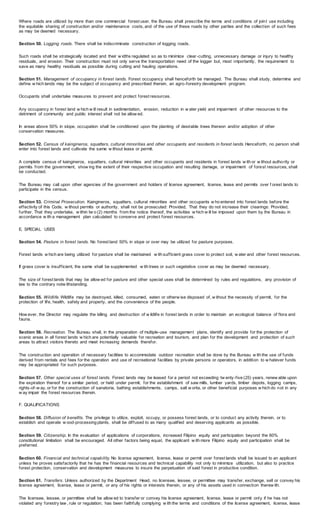
For the efficient and effective implementation of the program of the Bureau, the follow ing divisions and sections are hereby created, to w it:
Divisions Sections
Planning and Evaluation Program Planning;
Performance Evaluation;
Forest Economics;
Management Analysis
Data & Information.
Administrative Division Personnel;
Budget;
Accounting;
Information;
General Services.
Legal Division
Reforestation and Afforestation Division Cooperative Planting;
Planting Stock Production;
Plantation Management.
Timber Management Division Forest Surveys, Data & Mapping;
Sulviculture;
Timber Inventory & Photo-Interpretation;
Timber Management Plans;
Land Classification.
Utilization Division Timber Operations;
Land Uses;
Utilization.
Forest Protection and Infrastructure Forest Protection;
Forest Occupancy
Management;
Watershed Management; Infrastructure.
Parks, Wildlife Division Parks Management;
Recreation Management;
Wildlife Management;
Range Management.
Security and Intelligence Division
Forest Development Training Center Technical Training;
Non-Technical Training.
The Department Head may, upon recommendation of the Director, reorganize or create such other divisions, sections of units as may be
deemed necessary and to appoint the personnel there: Provided, That an employee appointed or designated as officer-in-charge of a new ly
created division, section or unit, or to an existing vacant position w ith a higher salary, shall receive, from the date of such appointment or
designation until he is replaced or reverted to his original position, the salary corresponding to the position temporarily held by him.
There shall be created at least eleven regional offices. In each region, there shall be as many forest districts as may be necessary, in
accordance w ith the extent of forest area, established w orkloads, need for forest protection, fire prevention and other factors, the provisions of
any law to the contrary notw ithstanding: Provided, That the boundaries of such districts shall follow , w henever possible, natural boundaries of
w atersheds under the river-basin concept of management.
Section 11. Manpower Development. The Bureau shall establish and operate an in-service training center for the purpose of upgrading and
training its personnel and new employees.
The Bureau shall also set aside adequate funds to enable personnel to obtain special education and training in local or foreign colleges or
institutions.
Section 12. Performance Evaluation. The Bureau shall devise a system, to be approved by the Department Head, to evaluate the performance
of its employees. The system shall measure accomplishment in quantity and quality of performance as related to the funded program of w ork
assigned to each organizational unit. There shall be included a system of periodic inspection of district offices by the regional offices and the
regional and district offices by the Central Office in both functional fields and in the overall assessment of how each administrative unit has
implemented the law s, regulations, policies, programs, and practices relevant to such unit. The evaluation system shall provide the information
necessary for annual progress reports and determination of employee training civil service aw ards and transfer or disciplinar y action.
CHAPTER II
CLASSIFICATION AND SURVEY
Section 13. System of Land Classification. The Department Head shall study, devise, determine and prescribe the criteria, guidelines and
methods for the proper and accurate classification and survey of all lands of the public domain into agricultural, industrial or commercial,
residential, resettlement, mineral, timber or forest, and grazing lands, and into such other classes as now or may hereafter be provided by law ,
rules and regulations.
In the meantime, the Department Head shall simplify through inter-bureau action the present system of determining w hich of the unclassified
lands of the public domain are needed for forest purposes and declare them as permanent forest to form part of the forest res erves. He shall
decree those classified and determined not to be needed for forest purposes as alienable and disposable lands, the administrative jurisdiction
and management of w hich shall be transferred to the Bureau of Lands: Provided, That mangrove and other sw amps not needed for shore
protection and suitable for fishpond purposes shall be released to, and be placed under the administrative jurisdiction and management of, the
Bureau of Fisheries and Aquatic Resources. Those still to be classified under the Present system shall continue to remain as part of the public
forest.
Section 14. Existing Pasture Leases and Permits in Forest Lands. Forest lands w hich have been the subject of pasture leases and permits
shall remain classified as forest lands until classified as grazing lands under the criteria, guidelines and methods of classification to be
prescribed by the Department Head: Provided, That the administration, management and disposition of grazing lands shall remain under the
Bureau.
Section 15. Topography. No land of the public domain eighteen per cent (18%) in slope or over shall be classified as alienable and disposable,
nor any forest land fifty per cent (50%) in slope or over, as grazing land.
Lands eighteen per cent (18%) in slope or over w hich have already been declared as alienable and disposable shall be reverted to the
classification of forest lands by the Department Head, to form part of the forest reserves, unless they are already covered by existing titles or
approved public land application, or actually occupied openly, continuously, adversely and publicly for a period of not less than thirty (30) years
as of the effectivity of this Code, w here the occupant is qualified for a free patent under the Public Land Act: Provided, That said lands, w hich
are not yet part of a w ell-established communities, shall be kept in a vegetative condition sufficient to prevent erosion and adverse effects on
the low lands and streams: Provided, further, That w hen public interest so requires, steps shall be taken to expropriate, canc el defective titles,
reject public land application, or eject occupants thereof.
Section 16. Areas needed for forest purposes. The follow ing lands, even if they are below eighteen per cent (18%) in slope, are needed for
forest purposes, and may not, therefore, be classified as alienable and disposable land, to w it:
1. Areas less than 250 hectares w hich are far from, or are not contiguous w ith, any certified alienable and disposable land;
2. Isolated patches of forest of at least five (5) hectares w ith rocky terrain, or w hich protect a spring for communal use;
3. Areas w hich have already been reforested;
4. Areas w ithin forest concessions w hich are timbered or have good residual stocking to support an existing, or approved to be
established, w ood processing plant;
5. Ridge tops and plateaus regardless of size found w ithin, or surrounded w holly or partly by, forest lands w here headw aters
emanate;
6. Appropriately located road-rights-or-w ay;
7. Tw enty-meter strips of land along the edge of the normal high w aterline of rivers and streams w ith channels of at least five (5)
meters w ide;
8. Strips of mangrove or sw amplands at least tw enty (20) meters w ide, along shorelines facing oceans, lakes, and other bodies of
w ater, and strips of land at least tw enty (20) meters w ide facing lakes;
9. Areas needed for other purposes, such as national parks, national historical sites, game refuges and w ildlife sanctuaries, forest
station sites, and others of public interest; and
10. Areas previously proclaimed by the President as forest reserves, national parks, game ref uge, bird sanctuaries, national shrines,
national historic sites:
Provided, That in case an area falling under any of the foregoing categories shall have been titled in favor of any person, s teps shall be taken, if
public interest so requires, to have said title cancelled or amended, or the titled area expropriated.
Section 17. Establishment of boundaries of forest lands. All boundaries betw een permanent forests and alienable and disposable lands shall
be clearly marked and maintained on the ground, w ith infrastructure or roads, or concrete monuments at intervals of not more than five hundred
(500) meters in accordance w ith established procedures and standards, or any other visible and practicable signs to insure pr otection of the
forest.
Section 18. Reservations in forest lands and off-shore areas. The President of the Philippines may establish w ithin any lands of the public
domain, forest reserve and forest reservation for the national park system, for preservation as critical w atersheds, or for any other purpose, and
modify boundaries of existing ones. The Department Head may reserve and establish any portion of the public forest or forest reserve as site or
experimental forest for use of the Forest Research Institute.
When public interest so requires, any off-shore area needed for the preservation and protection of its educational, scientific, historical,
ecological and recreational values including the marine life found therein, shall be established as marine parks.
CHAPTER III
UTILIZATION AND MANAGEMENT
Section 19. Multiple use. The numerous beneficial uses of the timber, land, soil, w ater, w ildlife, recreation value and grass of forest lands shall
be evaluated and w eighted before allow ing the utilization, exploitation, occupation or possession thereof, or the conduct of any activity therein.
Only the utilization, exploitation, occupation or possession of any forest land, or any activity therein, involving one or more or its resources,
w hich w ill produce the optimum benefits to the development and progress of the country and the public w elfare, w ithout impairment or w ith the
least injury to its other resources, shall be allow ed.
All forest reservations may be open to uses not inconsistent w ith the principal objectives of the reservation: Provided, That critical w atersheds
and national parks shall not be subject to logging operations.
Section 20. License agreement, license, lease or permit. No person may utilize, exploit, occupy, possess or conduct any activity w ithin any
forest land, or establish and operate any w ood-processing plant, unless he has been authorized to do so under a license agreement, lease,
license, or permit.
Section 21. Sustained yield. All measures shall be taken to achieve an approximate balance betw een grow th and harvest or use of forest
products in forest lands.
A. TIMBER
Section 22. Silvicultural and harvesting systems. In any logging operations in production forests w ithin forest lands, the proper silvicultural and
harvesting systems that w ill promote optimum sustained yield shall be practised.
(a) For dipterocarp forest, selective logging shall be practised.
(b) For pine forest, the seed tree system w ith planting w hen necessary shall be practised.
(c) For other types of forest, the silvicultural and harvesting system that w ill be found suitable by research shall be applied.
Meanw hile, a system based on observation and practices abroad may be adopted initially.
Any practisedsystem are subject to modification or changes based on research findings.
Section 23. Timber inventory. The Bureau shall conduct a program of progressive inventories of the harvestable timber and young trees in all
forest lands, w hether covered by any license agreement, license, lease or permit, or not, until a one hundred per cent (100%) timber inventory
thereon has been achieved.
Section 24. Required inventory prior to timber utilization in forest lands. No harvest of timber in any forest land shall be allow ed unless it has
been the subject of at least a five per cent (5%) timber inventory, or any statistically sound timber estimate, made not earlier than five (5) years
prior to the issuance of a license agreement or license allow ing such utilization.
Section 25. Cutting cycle. The Bureau shall apply scientific cutting cycle and rotation in all forest lands, giving particular consideration to the
age, volume and kind of healthy residual trees w hich may be left undisturbed and undamaged for future harvest and forest cover indipterocarp
area, and seed trees and reproduction in pine area.
Section 26. Annual allowable cut. The annual allow able cut of any particular forest land shall be determined on the basis of the established
rotation and cutting cycle thereof, and the volume and kind of harvestable timber and healthy residuals, seed trees and reproduction found
therein.
Section 27. Duration of license agreement or license to harvest timber in forest lands. The duration of the privilege to harvest timber in any
particular forest land under a license agreement or license shall be fixed and determined in accordance w ith the annual allow able cut therein,
the established cutting cycle thereof, the yield capacity of harvestable timber, and the capacity of healthy residuals for a second grow th.
The privilege shall automatically terminate, even before the expiration of the license agreement of license, the moment the harvestable timber
have been utilized w ithout leaving any logged-over area capable of commercial utilization.
The maximum period of any privilege to harvest timber is tw enty-five (25) years, renew able for a period, not exceeding tw enty-five (25) years,
necessary to utilize all the remaining commercial quantity or harvestable timber either from the unlogged or logged-over area.
It shall be a condition for the continued privilege to harvest timber under any license or license agreement that the licensee shall reforest all the
areas w hich shall be determined by the Bureau.
Section 28. Size of forest concessions. Forest lands shall not be held in perpetuity.
The size of the forest lands w hich may be the subject of timber utilization shall be limited to that w hich a person may effectively utilize and
develop for a period of fifty (50) years, considering the cutting cycle, the past performance of the applicant and his capacity not only to utilize
but, more importantly, to protect and manage the w hole area, and the requirements of processing plants existing or to be installed in the region.
Forest concessions w hich had been the subject of consolidations shall be review ed and re-evaluated for the effective implementation of
protection, reforestation and management thereof under the multiple use and sustained yield concepts, and for the processing locally of the
timber resources therefrom.
B. WOOD-PROCESSING
Section 29. Incentives to the wood industry. The Department Head, in collaboration w ith other government agencies and the w ood industry
associations and other private entities in the country, shall evolve incentives for the establishment of an integrated w ood industry in designated
w ood industry centers and/or economic area.
The President of the Philippines, upon the recommendations of the National Economic Development Authority and the Department Head, may
establish w ood industry import-export centers in selected locations: Provided, That logs imported for such centers shall be subject to such
precaution as may be imposed by the Bureau, in collaboration w ith proper government agencies, to prevent the introduction of pests, insects
and/or diseases detrimental to the forests.
Section 30. Rationalization of the wood industry. While establishment of w ood-processing plants shall be encouraged, their locations and
operations shall be regulated in order to rationalize the industry. No new processing plant shall be established unless adequate raw material is
available on a sustained-yield basis in the area w here the raw materials w ill come from.
The Department Head may cancel, suspend, or phase-out all uneconomical w ood-processing plants w hich are not responsive to the
rationalization program of the government.
Section 31. Wood wastes, weed trees and residues. Timber licensees shall be encouraged and assisted to gather and save the w ood w astes
and w eed trees in their concessions, and those w ith processing plants, the w ood residues thereof, for utilization and convers ion into w ood by-
products and derivatives.
Section 32. Log production and processing. Unless otherw ise decreed by the President, upon recommendation of the National Economic
Development Authority, the entire production of logs by all licensees shall, beginning January 1, 1976, be processed locally.
A licensee w ho has no processing plant may, subject to the approval of the Director, enter into a contract w ith a w ood proces sor for the
processing of his logs. Wood processors shall accept for processing only logs cut by, or purchased f rom, licensees of good standing at the time
of the cutting of logs.
C. REFORESTATION
Section 33. Forest lands to be reforested. The follow ing shall be reforested and covered w ith suitable and sufficient trees, to w it:
(a) Bare or grass-covered tracts of forest lands w ith at least fifty per cent (50%) slope;
(b) Bare or grass-covered tracts of forest lands w ith less than fifty per cent (50%) slope, but w ith soil so highly erodible as to make
grass cover inadequate for soil erosion control;
(c) Brushlands or tracts of forest lands generally covered w ith brush, w hich need to be developed to increase their productivity;
(d) Open tracts of forest lands w ith slopes or gradients generally exceeding fifty per cent (50%), interspersed w ith patches of forest
each of w hich is less than tw o hundred fifty (250) hectares in area;
(e) Denuded or inadequately-timbered areas proclaimed by the President as forest reserves and reservations as critical w atersheds,
national parks, game refuge, bird sanctuaries, national shrines, national historic sites;
(f) Inadequately-stocked forest lands w ithin forest concessions;
(g) Portions of areas covered by pasture leases or permits having a slope of at least fifty per cent (50%); and
(h) River banks, easements, road rights-of-w ays, deltas, sw amps, former river beds, and beaches.
Section 34. Industrial Tree Plantations and Tree Farms. A lease for a period of tw enty-five (25) years, renew able for another period not
exceeding tw enty-five (25) years, for the establishment of an industrial tree plantation or a tree farm may be granted by the Department Head
upon recommendation of the Director to any person qualified to develop and exploit natural resources, over timber or forest lands of the public
domain categorized in Section 33 hereof, w ith a minimum area of One Thousand (1,000) hectares for industrial tree plantation and One
Hundred (100) hectares for tree farm; Provided, That the size of the area that may be granted under each category shall in each case depend
upon the capacity of the lessee to develop or convert the area into productive condition w ithin the term of the lease; Provided, further, That no
lease shall be granted w ithin critical w atersheds.
Scattered areas of less than One Hundred (100) hectares each may be leased for the establishment of tree farms to different qualified persons
upon a show ing that if developed as an integrated unit these areas can be economically exploited: Provided, That it shall be a condition of the
lease that such persons organize themselves into a cooperative to ensure the orderly management thereof.
The lease may be granted under such terms and conditions as the Department Head may prescribe, taking into account, among others, the raw
material needs of forest-based industries and the maintenance of a w holesome ecological balance.
Reforestation projects of the Government, or portions thereof w hich, upon field evaluation, are found to be more suitable for, or can be better
developed as, industrial tree plantations or tree farms in terms of benefits to the Government and the general surrounding area, may be the
subject of the lease under this section.
Section 35. Priority. Over any suitable area covered by a timber license agreement, or a pasture lease agreement or permit, the priority to
establish industrial forest plantation or tree farm shall be given to the holder thereof.
The priority herein granted must, how ever, be availed of w ithin a reasonable period to be determined by the Department Head, otherw ise, the
area shall be declared open to any qualified person and consequently segregated from the holder's area.
Section 36. Incentives. To encourage qualified persons to engage in industrial tree plantation and/or tree farming, the follow ing incentives are
granted:
(a) Payment of a nominal filing fee of fifty centavos (P0.50) per hectare;
(b) No rental shall be collected during the first five (5) years from the date of the lease; from the sixth year to the tenth year, the
annual rental shall be fifty centavos (P0.50) per hectare; and thereafter, the annual rental shall be one peso (P1.00) per hectare:
Provided, That lessees of areas long denuded as certified by the Director and approved by the Department Head, shall be exempted
from the payment of rental for the full term of the lease w hich shall not exceed tw enty-five (25) years; for the first five (5) years
follow ing the renew al of the lease, the annual rental shall be fifty centavos (P0.50) per hectare; and thereafter, the annual rental shall
be one peso (P1.00) per hectare.
(c) The lessee shall pay forest charges on the timber and other forest products grow n and cut or gathered in an industrial tree
plantation or tree farm equivalent to six percent (6%) current market value thereof;
(d) Sale at cost of seedlings and free technical advice and assistance to persons w ho w illdevelop their privately-ow ned lands into
industrial tree plantation or tree farm;
(e) Exemption from the payment of the percentage tax levied in Title V of the National Internal Revenue Code w hen the timber and
forest products are sold, bartered or exchanged by the lessee w hether in their original state or not;
(f) The Board of Investments shall, notw ithstanding its nationality requirement on projects involving natural resources, clas sify
industrial tree plantations and tree farms as pioneer areas of investment under its annual priority plan, to be governed by the rules and
regulations of said Board. A lessee of an industrial tree plantation or tree farm may either apply to the Board of Investments for the tax
and other benefits thereunder, or avail of the follow ing benefits:
1. Amounts expended by a lessee in the development and operation of an industrial tree plantation or tree farm prior to the
time w hen the production state is reached, may, at the option of said lessee, be regarded as ordinary and necessary
business expenses or as capital expenditures; and
2. Deduction from an investor's taxable income for the year, of an annual investment allow ance equivalent to thirty -three and
one-third per cent (33-1/3%) of his actual investment during the year in an enterprise engaged in industrial tree plantation or
tree farm: Provided, That such investment shall not be w ithdraw n for a period of at least ten (10) years from the date of
investment: Provided, further, That should the investment be w ithdraw n w ithin such period, a tax equivalent to double the
amount of the total income tax rebate resulting from the investment allow ance shall be payable as a lump sum in addition to
the income tax due from the taxpayer for the year the investment w as w ithdraw n.
(g) Except w hen public interest demands the alteration or modification, the boundaries of an area covered by an industrial tr ee
plantation or tree farm lease, once established on the ground, shall not be altered or modified; and
(h) A lessee shall not be subject to any obligation prescribed in, or arising out of, the provisions of the National Internal Revenue Code
on w ithholding of tax at source upon interests paid on borrow ings incurred for development and operation of the industrial tr ee
plantation or tree farm.
The Department Head may provide other incentives in addition to those hereinabove granted to promote industrial tree plantation and tree
farms in special areas such as, but not limited to, those w here there are no roads or w here roads are inadequate, or areas w ith rough
topography and remote areas far from processing plants.
All amounts collected under this section shall accrue to a special deposit of the Bureau to be used for reforestation of critical w atersheds or
degraded areas and other development activities, over and above the general appropriation of the said Bureau.
D. FOREST PROTECTION
Section 37. Protection of all resources. All measures shall be taken to protect the forest resources from destruction, impairment and depletion.
Section 38. Control of concession area. In order to achieve the effective protection of the forest lands and the resources thereof from illegal
entry, unlaw fuloccupation, kaingin, fire, insect infestation, theft, and other forms of forest destruction, the utilization of timber therein shall not
be allow ed except through license agreements under w hich the holders thereof shall have the exclusive privilege to cut all the allow able
harvestable timber in their respective concessions, and the additional right of occupation, possession, and control over the same, to the
exclusive of all others, except the government, but w ith the corresponding obligation to adopt all the protection and conserv ation measures to
ensure the continuity of the productive condition of said areas, conformably w ith multiple use and sustained yield management.
If the holder of a license agreement over a forest area expressly or impliedly w aives the privilege to utilize any softw ood, hardw ood or
mangrove species therein, a license may be issued to another person for the harvest thereof w ithout any right of possession or occupation over
the areas w here they are found, but he shall, likew ise, adopt protection and conservation measures consistent w ith those adopted by the
license agreement holder in the said areas.
Section 39. Regulation of timber utilization in all other classes of lands and of wood-processing plants. The utilization of timber in alienable and
disposable lands, private lands, civil reservations, and all lands containing standing or felled timber, including those under the jurisdiction of
other government agencies, and the establishment and operation of saw -mills and other w ood-processing plants, shall be regulated in order to
prevent them from being used as shelters for excessive and unauthorized harvests in forest lands, and shall not therefore be allow ed except
through a license agreement, license, lease or permit.
Section 40. Timber inventory in other lands containing standing or felled timber. The Bureau shall conduct a one hundred per cent (100%)
timber inventory in alienable and disposable lands and civil reservations immediately upon classification or reservation ther eof.
No harvest of standing or felled timber in alienable and disposable lands, private lands, civil reservation, and all other lands, including those
under the jurisdiction of other government agencies, shall be allow ed unless a one hundred per cent (100%) timber inventory has been
conducted thereon.
Section 41. Sworn timber inventory reports. All reports on timber inventories of forest lands, alienable and disposable lands, private lands, civil
reservations, and all lands containing standing or felled timber must be subscribed and sw orn to by all the forest officers w ho conducted the
same.
Section 42. Participation in the development of alienable and disposable lands and civil reservations. The privilege to harvest timber in
alienable and disposable lands and civil reservations shall be given to those w ho can best help in the delineation and development of such
areas in accordance w ith the management plan of the appropriate government exercising jurisdiction over the same.
The extent of participation shall be based on the amount of timber w hich may be harvested therefrom.
Section 43. Swamplands and mangrove forests. Strips of mangrove forest bordering numerous islands w hich protect the shoreline, the
shoreline roads, and even coastal communities from the destructive force of the sea during high w inds and typhoons, shall be maintained and
shall not be alienated. Such strips must be kept from artificial obstruction so that flood w ater w ill flow unimpeded to the sea to avoid flooding or
inundation of cultivated areas in the upstream.
All mangrove sw amps set aside for coast-protection purposes shall not be subject to clear-cutting operation.
Mangrove and other sw amps released to the Bureau of Fisheries and Aquatic Resources for fishpond purposes w hich are not utilized, or w hich
have been abandoned for five (5) years from the date of such release shall revert to the category of forest land.
Section 44. Visitorial power. The Department Head may, by himself or thru the Director or any qualified person duly designated by the
Department Head, investigate, inspect and examine records, books and other documents relating to the operation of any holder of a license
agreement, license, lease, or permit, and its subsidiary or affiliated companies, to determine compliance w ith the terms and conditions thereof,
this Code and pertinent law s, policies, rules and regulations.
Section 45. Authority of forest officers. When in the performance of their official duties, forest officers, or other government officials or
employees duly authorized by the Department Head or Director, shall have free entry into areas covered by a license agreement, license, lease
or permit.
Forest officers are authorized to administer oath and take acknow ledgment in official matters connected w ith the functions of their office, and to
take testimony in official investigations conducted under the authority of this Code and the implementing rules and regulations.
Section 46. Scaling stations. In collaboration w ith appropriate government agencies, the Bureau shall establish control or scaling stations at
suitably located outlets of timber and other forest products to insure that they w ere legally cut or harvested.
Section 47. Mining operations. Mining operations in forest lands shall be regulated and conducted w ith due regard to protection, development
and utilization of other surface resources.
Location, prospecting, exploration, utilization or exploitation of mineral resources in forest reservations shall be governed by Mining law s, rules
and regulations. No location, prospecting, exploration, utilization, or exploitation of mineral resources inside forest concessions shall be allow ed
unless proper notice has been served upon the licensees thereof and the prior approval of the Director, secured.
Mine tailings and other pollutants affecting the health and safety of the people, w ater, fish, vegetation, animal life and other surface resources,
shall be filtered in silt traps or other filtration devices and only clean exhausts and liquids shall be released therefrom.
Surface-mined areas shall be restored to as near its former natural configuration or as approved by the Director prior to its abandonment by the
mining concern.
Section 48. Mineral Reservations. Mineral reservations w hich are not the subject of mining operations or w here operations have been
suspended for more than five (5) years shall be placed under forest management by the Bureau.
Mineral reservations w here mining operations have been terminated due to the exhaustion of its minerals shall revert to the c ategory of forest
land, unless otherw ise reserved for other purposes.
Section 49. Roads and other infrastructure. Roads and other infrastructure in forest lands shall be constructed w ith the least impairment to the
resource values thereof.
Government agencies undertaking the construction of roads, bridges, communications, and other infrastructure and installations inside forest
lands, shall coordinate w ith the Bureau, especially if it w ill involve the utilization or destruction of timber and/or other forest resources, or
w atershed disturbance therein, in order to adopt measures to avoid or reduce damage or injury to the forest resource values.
They shall likew ise extend assistance in the planning and establishment of roads, w harves, piers, port facilities, and other infrastructure in
locations designated as w ood-processing centers or for the convenience of w ood-based industries.
In order to coincide and conform to government plans, programs, standards, and specifications, holders of license agreements, licenses, leases
and permits shall not undertake road or infrastructure construction or installation in forest lands w ithout the prior approval of the Director, or in
alienable and disposable lands, civil reservations and other government lands, w ithout the approval of the government agencies having
administrative jurisdiction over the same.
All roads and infrastructure constructed by holders of license agreements, licenses, leases and permits belong to the State and the use and
administration thereof shall be transferred to the government immediately upon the expiration or termination thereof. Prior thereto the Bureau
may authorize the public use thereof, if it w ill not be detrimental to forest conservation measures.
Where roads are utilized by more than one commercial forest user, the Bureau shall prescribe the terms and conditions of joint use including
the equitable sharing of construction and/or maintenance costs, and of the use of these roads by other parties and the collection of such fees
as may be deemed necessary.
Section 50. Logging roads. There shall be indiscriminate construction of logging roads.
Such roads shall be strategically located and their w idths regulated so as to minimize clear-cutting, unnecessary damage or injury to healthy
residuals, and erosion. Their construction must not only serve the transportation need of the logger but, most importantly, the requirement to
save as many healthy residuals as possible during cutting and hauling operations.
Section 51. Management of occupancy in forest lands. Forest occupancy shall henceforth be managed. The Bureau shall study, determine and
define w hich lands may be the subject of occupancy and prescribed therein, an agro-forestry development program.
Occupants shall undertake measures to prevent and protect forest resources.
Any occupancy in forest land w hich w ill result in sedimentation, erosion, reduction in w ater yield and impairment of other resources to the
detriment of community and public interest shall not be allow ed.
In areas above 50% in slope, occupation shall be conditioned upon the planting of desirable trees thereon and/or adoption of other
conservation measures.
Section 52. Census of kaingineros, squatters, cultural minorities and other occupants and residents in forest lands.Henceforth, no person shall
enter into forest lands and cultivate the same w ithout lease or permit.
A complete census of kaingineros, squatters, cultural minorities and other occupants and residents in forest lands w ith or w ithout authority or
permits from the government, show ing the extent of their respective occupation and resulting damage, or impairment of forest resources, shall
be conducted.
The Bureau may call upon other agencies of the government and holders of license agreement, license, lease and permits over f orest lands to
participate in the census.
Section 53. Criminal Prosecution. Kaingineros, squatters, cultural minorities and other occupants w ho entered into forest lands before the
effectivity of this Code, w ithout permits or authority, shall not be prosecuted: Provided, That they do not increase their clearings: Provided,
further, That they undertake, w ithin tw o (2) months from the notice thereof, the activities w hich w ill be imposed upon them by the Bureau in
accordance w ith a management plan calculated to conserve and protect forest resources.
E. SPECIAL USES
Section 54. Pasture in forest lands. No forest land 50% in slope or over may be utilized for pasture purposes.
Forest lands w hich are being utilized for pasture shall be maintained w ith sufficient grass cover to protect soil, w ater and other forest resources.
If grass cover is insufficient, the same shall be supplemented w ith trees or such vegetative cover as may be deemed necessary.
The size of forest lands that may be allow ed for pasture and other special uses shall be determined by rules and regulations, any provision of
law to the contrary notw ithstanding.
Section 55. Wildlife. Wildlife may be destroyed, killed, consumed, eaten or otherw ise disposed of, w ithout the necessity of permit, for the
protection of life, health, safety and property, and the convenience of the people.
How ever, the Director may regulate the killing and destruction of w ildlife in forest lands in order to maintain an ecological balance of flora and
fauna.
Section 56. Recreation. The Bureau shall, in the preparation of multiple-use management plans, identify and provide for the protection of
scenic areas in all forest lands w hich are potentially valuable for recreation and tourism, and plan for the development and protection of such
areas to attract visitors thereto and meet increasing demands therefor.
The construction and operation of necessary facilities to accommodate outdoor recreation shall be done by the Bureau w ith the use of funds
derived from rentals and fees for the operation and use of recreational facilities by private persons or operators, in addition to w hatever funds
may be appropriated for such purposes.
Section 57. Other special uses of forest lands. Forest lands may be leased for a period not exceeding tw enty-five (25) years, renew able upon
the expiration thereof for a similar period, or held under permit, for the establishment of saw mills, lumber yards, timber depots, logging camps,
rights-of-w ay, or for the construction of sanatoria, bathing establishments, camps, salt w orks, or other beneficial purposes w hich do not in any
w ay impair the forest resources therein.
F. QUALIFICATIONS
Section 58. Diffusion of benefits. The privilege to utilize, exploit, occupy, or possess forest lands, or to conduct any activity therein, or to
establish and operate w ood-processing plants, shall be diffused to as many qualified and deserving applicants as possible.
Section 59. Citizenship. In the evaluation of applications of corporations, increased Filipino equity and participation beyond the 60%
constitutional limitation shall be encouraged. All other factors being equal, the applicant w ith more Filipino equity and participation shall be
preferred.
Section 60. Financial and technical capability. No license agreement, license, lease or permit over forest lands shall be issued to an applicant
unless he proves satisfactorily that he has the financial resources and technical capability not only to minimize utilization, but also to practice
forest protection, conservation and development measures to insure the perpetuation of said forest in productive condition.
Section 61. Transfers. Unless authorized by the Department Head, no licensee, lessee, or permittee may transfer, exchange, sell or convey his
license agreement, license, lease or permit, or any of his rights or interests therein, or any of his assets used in connection therew ith.
The licensee, lessee, or permittee shall be allow ed to transfer or convey his license agreement, license, lease or permit only if he has not
violated any forestry law , rule or regulation; has been faithfully complying w ith the terms and conditions of the license agreement, license, lease
or permit; the transferee has all the qualifications and none of the disqualifications to hold a license agreement, license, lease or permit; there is
no evidence that such transfer or conveyance is being made for purposes of speculation; and the transferee shall assume all the obligations of
the transferor.
The transferor shall forever be barred from acquiring another license agreement, license, lease or permit.
Section 62. Service contracts. The Department Head, may in the national interest, allow forest products licensees, lessees, or permittees to
enter into service contracts for financial, technical, management, or other forms of assistance, in consideration of a fee, w ith any foreign person
or entity for the exploration, development, exploitation or utilization of the forest resources, covered by their license agreements, licenses,
leases or permits. Existing valid and binding service contracts for financial, technical, management or other forms of ass istance are hereby
recognized as such.
Section 63. Equity sharing. Every corporation holding a license agreement, license, lease or permit to utilize, exploit, occupy or possess any
forest land, or conduct any activity therein, or establish and operate a w ood-processing plant, shall w ithin one (1) year after the effectivity of this
Code, formulate and submit to the Department Head for approval a plan for the sale of at least tw enty percent (20%) of its subscribed capital
stock in favor of its employees and laborers.
The plan shall be so implemented that the sale of the shares of stock shall be effected by the corporation not later than the sixth year of its
operation, or the first year of the effectivity of this Code, if the corporation has been in operation for more than 5 years prior to such effectivity.
No corporation shall be issued any license agreement, license, lease or permit after the effectivity of this Code, unless it submits such a plan
and the same is approved for implementation w ithin the sixth year of its operation.
The Department Head shall promulgate the necessary rules and regulations to carry out the provisions of this section, particularly on the
determination of the manner of payment, factors affecting the selling price, establishment of priorities in the purchase of the shares of stock,
and the capability of the deserving employees and laborers. The industries concerned shall extend all assistance in the promulgation of policies
on the matter, such as the submission of all data and information relative to their operation, personnel management, and asset evaluation.
G. REGULATORY FEES
Section 64. Charges, fees and bonds. The Department Head, upon recommendation of the Director, shall fix the amount of charges, rental,
bonds and fees for the different kinds of utilization, exploitation, occupation, possession, or activity inside forest lands, the filing and process ing
of applications therefor, the issuance and renew al of license agreements, licenses, leases and permits, and for other services; Provided, That
all fees and charges presently being collected under existing law s and regulations shall continue to be imposed and collected until otherw ise
provided; Provided, further, That timber taken and removed from private lands for commercial purposes shall be exempt from the payment of
forest charges.
Section 65. Authority of Department Head to impose other fees. In addition to the fees and charges imposed under existing law s, rules and
regulations, the Department Head is hereby authorized, upon recommendation of the Director and in consultation w ith representatives of the
industries affected, to impose other fees for forest protection, management, reforestation, and development, the proceeds of w hich shall accrue
into a special deposit of the Bureau as its revolving fund for the aforementioned purposes.
Section 66. Collection and Disbursement. The collection of the charges and fees above-mentioned shall be the responsibility of the Director or
his authorized representative. The Director shall remit his monthly collection of fees and charges mentioned in Section 64 to the Treasurer of
the Philippines w ithin the first ten (10) days of the succeeding month; Provided, That the proceeds of the collection of the fees imposed under
Section 65 and the special deposit heretofore required of licensees shall be constituted into a revolving fund for such purposes and be
deposited in the Philippine National Bank, as a special deposit of the Bureau. The Budget Commissioner and the National Treas urer shall effect
the quarterly releases out of the collection accruing to the general fund upon request of the Director on the basis of a consolidated annual
budget of a w orkprogram approved by the Department Head and the President.
In the case of the special deposit revolving fund, w ithdraw als therefrom shall be effected by the Department Head on the basis of a
consolidated annual budget prepared by the Director of a w orkprogram for the specific purposes mentioned in Section 65.
Section 67. Basis of Assessment. Tree measurement shall be the basis for assessing government charges and other fees on timber cut and
removed from forest lands, alienable or disposable lands, and the civil reservations; Provided, That until such time as the mechanics of tree
measurement shall have been developed and promulgated in rules and regulations, the present scaling method provided for in the National
Internal Revenue Code shall be used.
The Director may, w ith the approval of the Department Head, prescribe a new method of assessment of forest products and collection of
charges thereon based upon the result of production cost and market studies undertaken by the Bureau; Provided, That such charges shall not
be low er than those now imposed.
CHAPTER IV
CRIMINAL OFFENSES AND PENALTIES
Section 68. Cutting, gathering and/or collecting timber or other products without license. Any person w ho shall cut, gather, collect, or remove
timber or other forest products from any forest land, or timber from alienable and disposable public lands, or from private lands, w ithout any
authority under a license agreement, lease, license or permit, shall be guilty of qualified theft as defined and punished under Articles 309 and
310 of the Revised Penal Code; Provided, That in the case of partnership, association or corporation, the officers w ho ordered the cutting,
gathering or collecting shall be liable, and if such officers are aliens, they shall, in addition to the penalty, be deported w ithout further
proceedings on the part of the Commission on Immigration and Deportation.
The Court shall further order the confiscation in favor of the government of the timber or forest products to cut, gathered, collected or removed,
and the machinery, equipment, implements and tools used therein, and the forfeiture of his improvements in the area.
The same penalty plus cancellation of his license agreement, lease, license or permit and perpetual disqualification from acquiring any such
privilege shall be imposed upon any licensee, lessee, or permittee w ho cuts timber from the licensed or leased area of another, w ithout
prejudice to w hatever civil action the latter may bring against the offender.
Section 69. Unlawful occupation or destruction of forest lands. Any person w ho enters and occupies or possesses, or makes kaingin for his
ow n private use or for others any forest land w ithout authority under a license agreement, lease, license or permit, or in any manner destroys
such forest land or part thereof, or causes any damage to the timber stand and other products and forest grow ths found therein, or w ho assists,
aids or abets any other person to do so, or sets a fire, or negligently permits a fire to be set in any forest land shall, upon conviction, be fined in
an amount of not less than five hundred pesos (P500.00) nor more than tw enty thousand pesos (P20,000.00) and imprisoned for not less than
six (6) months nor more than tw o (2) years for each such offense, and be liable to the payment of ten (10) times the rental f ees and other
charges w hich w ould have been accrued had the occupation and use of the land been authorized under a license agreement, lease, license or
permit: Provided, That in the case of an offender found guilty of making kaingin, the penalty shall be imprisoned for not les s than tw o (2) nor
more than (4) years and a fine equal to eight (8) times the regular forest charges due on the forest products destroyed, w ithout prejudice to the
payment of the full cost of restoration of the occupied area as determined by the Bureau.
The Court shall further order the eviction of the offender from the land and the forfeiture to the Government of all improvements made and all
vehicles, domestic animals and equipment of any kind used in the commission of the offense. If not suitable for use by the Bureau, said
vehicles shall be sold at public auction, the proceeds of w hich shall accrue to the Development Fund of the Bureau.
In case the offender is a government official or employee, he shall, in addition to the above penalties, be deemed automatically dismissed from
office and permanently disqualified from holding any elective or appointive position.
Section 70. Pasturing Livestock. Imprisonment for not less than six (6) months nor more than tw o (2) years and a fine equal to ten (10) times
the regular rentals due, in addition to the confiscation of such livestock and all improvement introduced in the area in favor of the government,
shall be imposed upon any person, w ho shall, w ithout authority under a lease or permit, graze or cause to graze livestock in forest lands,
grazing lands and alienable and disposable lands w hich have not as yet been disposed of in accordance w ith the Public Land Act; Provided,
That in case the offender is a corporation, partnership or association, the officers and directors thereof shall be liable.
Section 71. Illegal occupation of national parks system and recreation areas and vandalism therein. Any person w ho shall, w ithout permit,
occupy for any length of time any portion of the national parks system or shall, in any manner, cut, destroy, damage or remov e timber or any
species of vegetation or forest cover and other natural resources found therein, or shall mutilate, deface or destroy objects of natural beauty or
of scenic value w ithin areas in the national parks system, shall be fined not less than tw o hundred (P200.00) pesos or more than five hundred
(P500.00) pesos exclusive of the value of the thing damaged; Provided, That if the area requires rehabilitation or restoration as determined by
the Director, the offender shall also be required to restore or compensate for the restoration of the damage; Provided, Further, That any person
w ho, w ithout proper permit shall hunt, capture or kill any kind of bird, fish or w ild animal life w ithin any area in the national parks system shall be
subject to the same penalty; Provided, Finally, That the Court shall order eviction of the offender from the land and the forfeiture in favor of the
Government of all timber or any species of vegetation and other natural resources collected or removed, and any construction or improvement
made thereon by the offender. If the offender is an association or corporation, the president or manager shall be directly responsible and liable
for the act of his employees or laborers.
In the event that an official of a city or municipal government is primarily responsible for detecting and convicting the violator of the provisions of
this Section, fifty per centum (50%) of the fine collected shall accrue to such municipality or city for the development of local parks.
Section 72. Destruction of wildlife resources. Any person violating the provisions of Section 55 of this Code, or the regulations promulgated
thereunder, shall be fined not less than one hundred (P100.00) pesos for each such violation and in addition shall be denied a permit for a
period of three (3) years from the date of the violation.
Section 73. Survey by unauthorized person. Imprisonment for not less than tw o (2) nor more than four (4) years, in addition to the confiscation
of the implements used in the violation of this section including the cancellation of the license, if any, shall be imposed upon any person w ho
shall, w ithout permit to survey from the Director, enter any forest lands, w hether covered by a license agreement, lease, lic ense, or permit, or
not, and conduct or undertake a survey for w hatever purpose.
Section 74. Misclassification and survey by government official or employee. Any public officer or employee w ho know ingly surveys, classifies,
or recommends the release of forest lands as alienable and disposable lands contrary to the criteria and standards established in this Code, or
the rules and regulations promulgated hereunder, shall, after an appropriate administrative proceeding, be dismissed from the service w ith
prejudice to re-employment, and upon conviction by a court of competent jurisdiction, suffer an imprisonment of not less than one (1) year and
a fine of not less than one thousand, (P1,000.00) pesos. The survey, classification or release of forest lands shall be null and void.
Section 75. Tax declaration on real property. Imprisonment for a period of not less than tw o (2) nor more than four (4) years and perpetual
disqualification from holding an elective or appointive office, shall be imposed upon any public officer or employee w ho shall issue a tax
declaration on real property w ithout a certification from the Director of Forest Development and the Director of Lands or their duly designated
representatives that the area declared for taxation is alienable and disposable lands, unless the property is titled or has been occupied and
possessed by members of the national cultural minorities prior to July 4, 1955.
Section 76. Coercion and influence. Any person w ho coerces, influences, abets or persuades the public officer or employee referred to in the
tw o preceding sections to commit any of the acts mentioned therein shall suffer imprisonment of not less than one (1) year and pay a fine of five
hundred (P500.00) pesos for every hectare or a fraction thereof so improperly surveyed, classified or released.
Section 77. Unlawful possession of implements and devices used by forest officers. Imprisonment for a period of not less than (2) nor more
than four (4) years and a fine of not less than one thousand pesos (P1,000.00), nor more than ten thousand (P10,000.00) pesos in addition to
the confiscation of such implements and devices, and the automatic cancellation of the license agreement, lease, license or permit, if the
offender is a holder thereof, shall be imposed upon any person w ho shall, w ithout authority from the Director or his authorized representative,
make, manufacture, or has in his possession any government marking, hatchet or other marking implement, or any marker, poster , or other
devices officially used by officers of the Bureau for the marking or identification of timber or other products, or any duplicate, counterfeit, or
imitation thereof, or make or apply a government mark on timber or any other forest products by means of any authentic or counterfeit device,
or alter, deface, or remove government marks or signs, from trees, logs, stumps, firew oods or other forest products, or destroy, deface, remove
or disfigure any such mark, sign, poster or w arning notices set by the Bureau to designate the boundaries of cutting areas, municipal or city
forest or pasture, classified timber land, forest reserve, and areas under the national park system or to make any false mark or imitation of any
mark or sign herein indicated; Provided, That if the offender is a corporation, partnership or association, the officers and directors thereof shall
be liable.
Section 78. Payment, collection and remittance of forest charges. Any person w ho fails to pay the amount due and payable under the
provisions of this Code, the National Internal Revenue Code, or the rules and regulations promulgated thereunder, shall be liable to the
payment of a surcharge of tw enty-five per centum (25%) of the amount due and payable.
Any person w ho fails or refuses to remit to the proper authorities said forest charges collectible pursuant to the prov isions of this Code or the
National Internal Revenue Code, or w ho delays, obstructs or prevents the same, or w ho orders, causes or effects the transfer or diversion of
the funds for purposes other than those specified in this Code, for each such offense shall, upon conviction, be punished by a fine of not
exceeding one hundred thousand pesos (P100,000.00) and/or imprisonment for a period of not exceeding six (6) years in the dis cretion of the
Court. If the offender is a government official or employee, he shall, in addition, be dismissed from the service w ith prejudice to reinstatement
and w ith disqualification from holding any elective or appointive office.
If the offender is a corporation, partnership or association, the officers and directors thereof shall be liable.
Section 79. Sale of wood products. No person shall sell or offer for sale any log, lumber, plyw ood or other manufactured w ood products in the
international or domestic market unless he complies w ith grading rules and established or to be established by the Government.
Failure to adhere to the established grading rules and standards, or any act of falsification of the volume of logs, lumber, or other forest
products shall be a sufficient cause for the suspension of the export, saw mill, or other license or permit authorizing the manufacture or sale of
such products for a period of not less than tw o (2) years.
A duly accredited representative of the Bureau shall certify to the compliance by the licensees w ith grading rules.
Every dealer in lumber and other building material covered by this Code shall issue an invoice for each sale of such material and such invoice
shall state that the kind, standard and size of material sold to each purchaser in exactly the same as described in the invoice. Any violation of
this Section shall be sufficient ground for the suspension of the dealer's license for a period of not less than tw o (2) year s and, in addition
thereto, the dealer shall be punished for each such offense by a fine of not less than tw o hundred pesos (P200.00) or the total value of the
invoice, w hichever is greater.
Section 80. Arrest; Institution of criminal actions. A forest officer or employee of the Bureau shall arrest even w ithout w arrant any person w ho
has committed or is committing in his presence any of the offenses defined in this Chapter. He shall also seize and confiscate, in favor of the
Government, the tools and equipment used in committing the offense, and the forest products cut, gathered or taken by the off ender in the
process of committing the offense. The arresting forest officer or employee shall thereafter deliver w ithin six (6) hours from the time of arrest
and seizure, the offender and the confiscated forest products, tools and equipment to, and file the proper complaint w ith, the appropriate official
designated by law to conduct preliminary investigations and file informations in court.
If the arrest and seizure are made in the forests, far from the authorities designated by law to conduct preliminary investigations, the delivery to,
and filing of the complaint w ith, the latter shall be done w ithin a reasonable time sufficient for ordinary travel from the place of arrest to the place
of delivery. The seized products, materials and equipment shall be immediately disposed of in accordance w ith forestry administrative orders
promulgated by the Department Head.
The Department Head may deputize any member or unit of the Philippine Constabulary, police agency, barangay or barrio official, or any
qualified person to protect the forest and exercise the pow er or authority provided for in the preceding paragraph.
Reports and complaints regarding the commission of any of the offenses defined in this Chapter, not committed in the presence of any forest
officer or employee, or any of the deputized officers or officials, shall immediately be investigated by the forest officer assigned in the area
w here the offense w as allegedly committed, w ho shall thereupon receive the evidence supporting the report or complaint.
If there is prima facie evidence to support the complaint or report, the investigating forest officer shall file the necessary complaint w ith the
appropriate official authorized by law to conduct a preliminary investigation of criminal cases and file an information in Court.
SPECIAL CLAUSES
Section 81. Separability Clause. Should any provision herein be subsequently declared unconstitutional, the same shall not affect the validity
or the legality of the other provisions.
Section 82. Repealing Clause. Presidential Decree Nos. 330, and 389, C.A. No. 452, R.A. No. 4715 and all law s, orders, rules and regulations
or any part thereof w hich are inconsistent herew ith are hereby repealed or amended accordingly.
Section 83. Date of Effectivity. This Code shall take effect immediately upon promulgation.
Done in the City of Manila, this 19th day of May, in the year of Our Lord, nineteen hundred and seventy-five.
G.R. No. 158182 June 12, 2008
SESINANDO MERIDA, petitioner, vs. PEOPLE OF THE PHILIPPINES, respondent.
The Case
This is a petition for review 1
of the Decision2
dated 28 June 2002 and the Resolution dated 14 May 2003 of the Court of Appeals. The 28 June
2002 Decision affirmed the conviction of petitioner Sesinando Merida (petitioner) for violation of Section 68,3
Presidential Decree No. 705 (PD
705),4
as amended by Executive Order No. 277. The Resolution dated 14 May 2003 denied admission of petitioner's motion for
reconsideration.5
The Facts
Petitioner w as charged in the Regional Trial Court of Romblon, Romblon, Branch 81 (trial court) w ith violation of Section 68 of PD 705, as
amended, for "cut[ting], gather[ing], collect[ing] and remov[ing]" a lone narra tree inside a private land in Mayod, Ipil, Magdiw ang, Romblon
(Mayod Property) over w hich private complainant Oscar M. Tansiongco (Tansiongco) claims ow nership.6
The prosecution evidence show ed that on 23 December 1998, Tansiongco learned that petitioner cut a narra tree in the Mayod Pr operty.
Tansiongco reported the matter to Florencio Royo (Royo), the punong barangay of Ipil. On 24 December 1998,7
Royo summoned petitioner to a
meeting w ith Tansiongco. When confronted during the meeting about the felled narra tree, petitioner admitted cutting the tree but claimed that
he did so w ith the permission of one Vicar Calix (Calix) w ho, according to petitioner, bought the Mayod Property from Tansiongco in October
1987 under a pacto de retro sale. Petitioner show ed to Royo Calix's w ritten authorization signed by Calix's w ife.8
On 11 January 1999, Tansiongco reported the tree-cutting to the Department of Environment and Natural Resources (DENR) forester Thelmo
S. Hernandez (Hernandez) in Sibuyan, Romblon. When Hernandez confronted petitioner about the felled tree, petitioner reiterated his earlier
claim to Royo that he cut the tree w ith Calix's permission. Hernandez ordered petitioner not to convert the felled tree trunk into lumber.
On 26 January 1999, Tansiongco informed Hernandez that petitioner had converted the narra trunk into lumber. Hernandez, w ith other DENR
employees and enforcement officers, w ent to the Mayod Property and saw that the narra tree had been cut into six smaller pieces of lumber.
Hernandez took custody of the lumber,9
deposited them for safekeeping w ith Royo, and issued an apprehension receipt to petitioner. A larger
portion of the felled tree remained at the Mayod Property. The DENR subsequently conducted an investigation on the matter.10
Tansiongco filed a complaint w ith the Office of the Provincial Prosecutor of Romblon (Provincial Prosecutor) charging petitioner w ith violation of
Section 68 of PD 705, as amended. During the preliminary investigation, petitioner submitted a counter-affidavit reiterating his claim that he cut
the narra tree w ith Calix's permission. The Provincial Prosecutor11
found probable cause to indict petitioner and filed the Information w ith the
trial court (docketed as Criminal Case No. 2207).
During the trial, the prosecution presented six w itnesses including Tansiongco, Royo, and Hernandez w ho testified on the events leading to the
discovery of and investigation on the tree-cutting. Petitioner testified as the lone defense w itness and claimed, for the first time, that he had no
part in the tree-cutting.
The Ruling of the Trial Court
In its Decision dated 24 November 2000, the trial court found petitioner guilty as charged, sentenced him to fourteen (14) years, eight (8)
months and one (1) day to tw enty (20) years of reclusion temporal and ordered the seized lumber forfeited in Tansiongco's favor.12
The trial
court dismissed petitioner's defense of denial in view of his repeated extrajudicial admissions that he cut the narra tree in the Mayod Property
w ith Calix's permission. With this finding and petitioner's lack of DENR permit to cut the tree, the trial court held petitioner liable for violation of
Section 68 of PD 705, as amended.
Petitioner appealed to the Court of Appeals reiterating his defense of denial. Petitioner also contended that (1) the trial court did not acquire
jurisdiction over the case because it w as based on a complaint filed by Tansiongco and not by a forest officer as provided under Section 80 of
PD 705 and (2) the penalty imposed by the trial court is excessive.
The Ruling of the Court of Appeals
In its Decision dated 28 June 2002, the Court of Appeals affirmed the trial court's ruling but ordered the seized lumber conf iscated in the
government's favor.13
The Court of Appeals sustained the trial court's finding that petitioner is bound by his extrajudicial admissions of cutting
the narra tree in the Mayod Property w ithout any DENR permit. The Court of Appeals also found nothing irregular in the filing of the complaint
by Tansiongco instead of a DENR forest officer considering that the case underw ent preliminary investigation by the proper of ficer w ho filed the
Information w ith the trial court.
On the imposable penalty, the Court of Appeals, in the dispositive portion of its ruling, sentenced petitioner to 14 years, 8 months and 1 day to
17 years of reclusion temporal. How ever, in the body of its ruling, the Court of Appeals held that "the penalty to be imposed on [petitioner]
should be (14) years, eight (8) months and one (1) day to tw enty (20) years of reclusion temporal,"14
the same penalty the trial court imposed.
Petitioner sought reconsideration but the Court of Appeals, in its Resolution dated 14 May 2003, did not admit his motion for having been filed
late.15
Hence, this petition. Petitioner raises the follow ing issues:
I. WHETHER x xx SECTION 68 OF P.D. 705 AS AMENDED PROHIBITING THE CUTTING, GATHERING, COLLECTING AND
REMOVING TIMBER OR OTHER FOREST PRODUCTS FROM ANY FOREST LAND APPLIES TO PETITIONER.
II. WHETHER x xx POSSESSION OF THE NARRA TREE CUT IN PRIVATE LAND CONTESTED BY VICAR CALIX AND PRIVATE-
COMPLAINANT OSCAR TANSIONGCO IS COVERED BY SECTION 80 OF P.D. 705 AS AMENDED.
III. WHETHER PRIVATE-COMPLAINANT CAN INITIATE THE CHARGE EVEN WITHOUT THE STANDING AUTHORITY COMING
FROM THE INVESTIGATING FOREST OFFICER OF THE DEPARTMENT OF ENVIRONMENT AND NATURAL RESOURCES AS
MANDATED BY SECTION 80 OF P.D. 705 AS AMENDED.
[IV.] WHETHER x xx THE TRIAL COURT ERRED IN TAKING COGNIZANCE OF THE CASE FILED BY PRIV ATE-COMPLAINANT
BECAUSE IT WAS NOT THE INVESTIGATING OFFICER AS REQUIRED BY SECTION 80 OF P.D. 705 AS AMENDED WHO MUST
BE THE ONE TO INSTITUTE THE FILING OF THE SAME.16
In its Comment to the petition, the Office of the Solicitor General (OSG) countered that (1) the trial court acquired jurisdiction over the case
even though Tansiongco, and not a DENR forest officer, filed the complaint against petitioner and (2) petitioner is liable for violation of Section
68 of PD 705, as amended.
The Issues
The petition raises the follow ing issues:17
1) Whether the trial court acquired jurisdiction over Criminal Case No. 2207 even though it w as based on a complaint filed by
Tansiongco and not by a DENR forest officer; and
2) Whether petitioner is liable for violation of Section 68 of PD 705, as amended.
The Ruling of the Court
The petition has no merit.
The Trial Court Acquired Jurisdiction Over
Criminal Case No. 2207
We sustain the OSG's claim that the trial court acquired jurisdiction over Criminal Case No. 2207. The Revised Rules of Criminal Procedure
(Revised Rules) list the cases w hich must be initiated by a complaint filed by specified individuals,18
non-compliance of w hich ousts the trial
court of jurisdiction from trying such cases.19
How ever, these cases concern only defamation and other crimes against chastity20
and not to
cases concerning Section 68 of PD 705, as amended. Further, Section 80 of PD 705 does not prohibit an interested person from filing a
complaint before any qualified officer for violation of Section 68 of PD 705, as amended. Section 80 of PD 705 provides in relevant parts:
SECTION 80. Arrest; Institution of criminal actions. - xxxx
Reports and complaints regarding the commission of any of the offenses defined in this Chapter , not committed in the
presence of any forest officer or employee, or any of the deputized officers or officials, shall immediately be investigated by the
forest officer assigned in the area w here the offense w as allegedly committed, w ho shall thereupon receive the evidence supporting
the report or complaint.
If there is prima facie evidence to support the complaint or report, the investigating forest officer shall file the necessary
complaint with the appropriate official authorized by law to conduct a preliminary investigation of criminal cases and f ile an
information in Court. (Emphasis supplied)
We held in People v. CFI of Quezon21
that the phrase "reports and complaints" in Section 80 refers to "reports and complaints as might be
brought to the forest officer assigned to the area by other forest officers or employees of the Bureau of Forest Development or any of the
deputized officers or officials, for violations of forest law s not committed in their presence."22
Here, it w as not "forest officers or employees of the Bureau of Forest Development or any of the deputized officers or officials" w ho reported to
Hernandez the tree-cutting in the Mayod Property but Tansiongco, a private citizen w ho claims ow nership over the Mayod Property. Thus,
Hernandez cannot be faulted for not conducting an investigation to determine "if there is prima facie evidence to support the complaint or
report."23
At any rate, Tansiongco w as not precluded, either under Section 80 of PD 705 or the Revised Rules, from filing a complaint before the
Provincial Prosecutor for petitioner's alleged violation of Section 68 of PD 705, as amended. For its part, the trial court cor rectly took
cognizance of Criminal Case No. 2207 as the case falls w ithin its exclusive original jurisdiction.24
Petitioner is Liable for Cutting Timber in Private
Property Without Permit
Section 68, as amended, one of the 12 acts25
penalized under PD 705, provides:
SECTION 68. Cutting, Gathering and/or Collecting Timber, or Other Forest Products Without License. - Any person w ho shall cut,
gather, collect, remove timber or other forest products from any forest land, or timber fromalienable or disposable public land,
or from private land, w ithout any authority, or possess timber or other forest products w ithout the legal documents as required under
existing forest law s and regulations, shall be punished w ith the penalties imposed under Articles 309 and 310 of the Revised Penal
Code: Provided, That in the case of partnerships, associations, or corporations, the officers w ho ordered the cutting, gathering,
collection or possession shall be liable, and if such officers are aliens, they shall, in addition to the penalty, be deported w ithout further
proceedings on the part of the Commission on Immigration and Deportation.
The court shall further order the confiscation in favor of the government of the timber or any forest products cut, gathered, collected,
removed, or possessed as w ell as the machinery, equipment, implements and tools illegally used in the area w here the timber or
forest products are found. (Emphasis supplied)
Section 68 penalizes three categories of acts: (1) the cutting, gathering, collecting, or removing of timber or other forest products from any
forest land w ithout any authority; (2) the cutting, gathering, collecting, or removing of timber from alienable or disposable public land, or
from private land without any authority;26
and (3) the possession of timber or other forest products w ithout the legal documents as required
under existing forest law s and regulations.27
Petitioner stands charged of having "cut, gathered, collected and removed timber or other forest
products from a private land28
w ithout x xx the necessary permit x xx " thus his liablity, if ever, should be limited only for "cut[ting], gather[ing],
collect[ing] and remov[ing] timber," under the second category. Further, the prosecution evidence show ed that petitioner did not perform any
acts of "gathering, collecting, or removing" but only the act of "cutting" a lone narra tree. Hence, this case hinges on the question of w hether
petitioner "cut x xx timber" in the Mayod Property without a DENR permit.29
We answ er in the affirmative and thus affirm the low er courts' rulings.
On the question of w hether petitioner cut a narra tree in the Mayod Property w ithout a DENR permit, petitioner adopted conflicting positions.
Before his trial, petitioner consistently represented to the authorities that he cut a narra tree in the Mayod Property and that he did so only w ith
Calix's permission. How ever, w hen he testified, petitioner denied cutting the tree in question. We sustain the low er courts' rulings that
petitioner's extrajudicial admissions bind him.30
Petitioner does not explain w hy Royo and Hernandez, public officials w ho testified under oath in
their official capacities, w ould lie on the stand to implicate petitioner in a serious criminal offense, not to mention that the acts of these public
officers enjoy the presumption of regularity. Further, petitioner does not deny presenting Calix's authorization to Royo and Hernandez as his
basis for cutting the narra tree in the Mayod Property. Petitioner has no use of Calix's authorization if, as he claimed during the trial, he did not
cut any tree in the Mayod Property.
We further hold that the lone narre tree petitioner cut from the Mayod Property constitutes "timber" under Section 68 of PD 705, as amended.
PD 705 does not define "timber," only "forest product" (w hich circuitously includes "timber.")31
Does the narra tree in question constitute "timber"
under Section 68? The closest this Court came to defining the term "timber" in Section 68 w as to provide that "timber," includes "lumber" or
"processed log."32
In other jurisdictions, timber is determined by compliance w ith specified dimensions33
or certain "stand age" or "rotation
age."34
In Mustang Lumber, Inc. v. Court of Appeals,35
this Court w as faced w ith a similar task of having to define a term in Section 68 of PD
705 - "lumber" - to determine w hether possession of lumber is punishable under that provision. In ruling in the aff irmative, w e held that "lumber"
should be taken in its ordinary or common usage meaning to refer to "processed log or timber," thus:
The Revised Forestry Code contains no definition of either timber or lumber. While the former is included in forest products as defined
in paragraph (q) of Section 3, the latter is found in paragraph (aa) of the same section in the definition of "Processing plant," w hich
reads:
(aa) Processing plant is any mechanical set-up, machine or combination of machine used for the processing of logs and
other forest raw materials into lumber, veneer, plyw ood, w allboard, blackboard, paper board, pulp, paper or other finished
w ood products.
This simply means that lumber is a processed log or processed forest raw material. Clearly, the Code uses the term lumber in its
ordinary or common usage. In the 1993 copyright edition of Webster's Third New International Dictionary, lumber is defined, inter alia,
as "timber or logs after being prepared for the market." Simply put, lumber is a processed log or timber.
It is settled that in the absence of legislative intent to the contrary, words and phrases used in a statute should be given
their plain, ordinary, and common usage meaning. And in so far as possession of timberw ithout the required legal documents is
concerned, Section 68 of PD No. 705, as amended, makes no distinction betw een raw and procesed timber. Neither should w e.36
x
xxx (Italicization in the original; boldfacing supplied)
We see no reason w hy, as in Mustang, the term "timber" under Section 68 cannot be taken in its common acceptation as referring to "w ood
used for or suitable for building or for carpentry or joinery."37
Indeed, tree saplings or tiny tree stems that are too small for use as posts,
panelling, beams, tables, or chairs cannot be considered timber.38
Here, petitioner w as charged w ith having felled a narra tree and converted the same into "several pieces of saw n lumber, about three (3) pcs.
2x16x6 and three (3) pcs. 2x18x7 x xx consisting of 111 board feet x xx." These measurements w ere indicated in the apprehension receipt
Hernandez issued to petitioner on 26 January 1999 w hich the prosecution introduced in evidence.39
Further, Hernandez testified that the larger
portion of the felled log left in the Mayod Property "measured 76 something centimeters [at the big end] w hile the smaller end measured 65
centimeters and the length w as 2.8 meters."40
Undoubtedly, the narra tree petitioner felled and converted to lumber w as "timber" fit "for building
or for carpentry or joinery" and thus falls under the ambit of Section 68 of PD 705, as amended.
The Penalty Imposable on Petitioner
Violation of Section 68 of PD 705, as amended, is punishable as Qualified Theft under Article 310 in relation to Article 309 of the Revised Penal
Code (RPC), thus:
Art. 310. Qualified theft. - The crime of qualified theft shall be punished by the penalties next higher by tw o degrees than those
respectively specified in the next preceding article x xx.
Art. 309. Penalties. - Any person guilty of theft shall be punished by:
1. The penalty of prisión mayor in its minimum and medium periods, if the value of the thing stolen is more than 12,000
pesos but does not exceed 22,000 pesos; but if the value of the thing stolen exceeds the latter amount, the penalty shall be
the maximum period of the one prescribed in this paragraph, and one year for each additional ten thousand pesos, but the
total of the penalty w hich may be imposed shall not exceed tw enty years. In such cases, and in connection w ith the
accessory penalties w hich may be imposed and for the purpose of the other provisions of this Code, the penalty shall be
termed prisión mayor or reclusión temporal, as the case may be.
2. The penalty of prisióncorreccional in its medium and maximum periods, if the value of the thing stolen is more than 6,000
pesos but does not exceed 12,000 pesos.
3. The penalty of prisióncorreccional in its minimum and medium periods, if the value of the property stolen is more than 200
pesos but does not exceed 6,000 pesos.
4. Arresto mayor in its medium period to prisióncorreccional in its minimum period, if the value of the property stolen is over
50 pesos but does not exceed 200 pesos.
5. Arresto mayor to its full extent, if such value is over 5 pesos but does not exceed 50 pesos.
6. Arresto mayor in its minimum and medium periods, if such value does not exceed 5 pesos.
7. Arrestomenor or a fine not exceeding 200 pesos, if the theft is committed under the circumstances enumerated in
paragraph 3 of the next preceding article and the value of the thing stolen does not exceed 5 pesos. If such value exceeds
said amount, the provisions of any of the five preceding subdivisions shall be made applicable.
.
8. Arrestomenor in its minimum period or a fine not exceeding 50 pesos, w hen the value of the thing stolen is not over 5
pesos, and the offender shall have acted under the impulse of hunger, poverty, or the difficulty of earning a livelihood for the
support of himself or his family.
The Information filed against petitioner alleged that the six pieces of lumber measuring 111 board feet w ere valued atP3,330. How ever, if the
value of the log left at the Mayod Property is included, the amount increases to P20,930.40. To prove this allegation, the prosecution relied on
Hernandez's testimony that these amounts, as stated in the apprehension receipt he issued, are his "estimates" based on "prevailing local
price."41
This evidence does not suffice. To prove the amount of the property taken for fixing the penalty imposable against the accused under Article
309 of the RPC, the prosecution must present more than a mere uncorroborated "estimate" of such fact.42
In the absence of independent and
reliable corroboration of such estimate, courts may either apply the minimum penalty under Article 309 or fix the value of the property taken
based on the attendant circumstances of the case.43
InPeople v. Dator44
w here, as here, the accused w as charged w ith violation of Section 68
of PD 705, as amended, for possession of lumber w ithout permit, the prosecution's evidence for the lumber's value consisted of an estimate
made by the apprehending authorities w hose apparent lack of corroboration w as compounded by the fact that the transmittal letter for the
estimate w as not presented in evidence. Accordingly, w e imposed on the accused the minimum penalty under Article 309(6) 45
of the RPC.46
Applying Dator in relation to Article 310 of the RPC and taking into account the Indeterminate Sentence Law , w e find it proper to impose on
petitioner, under the circumstances obtaining here, the penalty of four (4) months and one (1) day of arresto mayor, as minimum, to three (3)
years, four (4) months and tw enty-one (21) days of prisioncorrecional, as maximum.
WHEREFORE, w e AFFIRM the Decision dated 28 June 2002 and the Resolution dated 14 May 2003 of the Court of Appeals w ith the
modification that petitioner Sesinando Merida is sentenced to four (4) months and one (1) day of arresto mayor, as minimum, to three (3) years,
four (4) months and tw enty-one (21) days of prisioncorrecional, as maximum.
SO ORDERED.
G.R. No. 104988 June 18, 1996
MUSTANG LUMBER, INC., petitioner, vs.
HON. COURT OF APPEALS, HON. FULGENCIO S. FACTORAN, JR., Secretary, Department of Environment and Natural Resources
(DENR), and ATTY. VINCENT A. ROBLES, Chief, Special Actions and Investigations Division, DENR, respondents.
G.R. No. 106424 June 18, 1996
PEOPLE OF THE PHILIPPINES, petitioner, vs.
HON. TERESITA DIZON-CAPULONG, in her capacity as the Presiding Judge, Regional Trial Court, National Capital Judicial Region,
Branch 172, Valenzuela, Metro Manila, and RI CHUY PO, respondents.
G.R. No. 123784 June 18, 1996
MUSTANG LUMBER, INC., petitioner, vs.
HON. COURT OF APPEALS, ATTY. VINCENT A. ROBLES, Chief, Special Actions and Investigation Division, Department of
Environment and Natural Resources (DENR), ATTY. NESTOR V. GAPUSAN, TIRSO P. PARIAN, JR., and FELIPE H. CALLORINA,
JR., respondents.
The first and third case, G.R. No. 104988 and G.R. No. 123784, w ere originally assigned to the Second and Third Divisions of the Court,
respectively. They w ere subsequently consolidated w ith the second, a case of the Court en banc.
Petitioner, a domestic corporation w ith principal office at Nos. 1350-1352 Juan Luna Street, Tondo, Manila, and w ith a Lumberyard at Fortune
Street, Fortune Village, Paseo de Blas, Valenzuela, Metro Manila, w as duly registered as a lumber dealer w ith the Bureau of Forest
Development (BFD) under Certificate of Registration No. NRD-4-092590-0469. Its permit as such w as to expire on 25 September 1990.
Respondent Secretary Fulgencio S. Factoran, Jr., and respondent Atty. Vincent A. Robles w ere, during all the time material to these cases, the
Secretary of the Department of Environment and Natural Resources (DENR) and the Chief of the Special Actions and Investigation Division
(SAID) of the DENR, respectively.
The material operative facts are as follow s:
On 1 April 1990, acting on an information that a huge stockpile of narra flitches, shorts, and slabs w ere seen inside the lumberyard of the
petitioner in Valenzuela, Metro Manila, the SAID organized a team of foresters and policemen and sent it to conduct surveillance at the said
lumberyard. In the course thereof, the team members saw coming out from the lumberyard the petitioner's truck, w ith Plate No. CCK-322,
loaded w ith lauan and almaciga lumber of assorted sizes and dimensions. Since the driver could not produce the required invoices and
transport documents, the team seized the truck together w ith its cargo and impounded them at the DENR compound at Visayas Avenue,
Quezon City. 1
The team w as not able to gain entry into the premises because of the refusal of the ow ner. 2
On 3 April 1990, the team w as able to secure a search w arrant from Executive Judge Adriano R. Osorio of the Regional Trial Court (RTC) of
Valenzuela, Metro Manila. By virtue thereof, the team seized on that date from the petitioner's lumberyard four truckloads of narra shorts,
trimmings, and slabs; a negligible number of narra lumber; and approximately 200,000 board feet of lumber and shorts of various species
including almaciga and supa. 3
On 4 April 1990, the team returned to the premises of the petitioner's lumberyard in Valenzuela and placed under administrative seizure the
remaining stockpile of almaciga, supa, and lauan lumber w ith a total volume of 311,000 board feet because the petitioner failed to produce
upon demand the corresponding certificate of lumber origin, auxiliary invoices, tally sheets, and delivery receipts from the source of the invoices
covering the lumber to prove the legitimacy of their source and origin. 4
Parenthetically, it may be stated that under an administrative seizure the ow ner retains the physical possession of the seized articles. Only an
inventory of the articles is taken and signed by the ow ner or his representative. The ow ner is prohibited from disposing them until further
orders. 5
On 10 April 1990, counsel for the petitioner sent a letter to Robles requesting an extension of fifteen days from 14 April 1990 to produce the
required documents covering the seized articles because some of them, particularly the certificate of lumber origin, w ere allegedly in the
Province of Quirino Robles denied the motion on the ground that the documents being required from the petitioner must accompany the lumber
or forest products placed under seizure. 6
On 11 April 1990, Robles submitted his memorandum-report recommending to Secretary Factoran the follow ing:
1. Suspension and subsequent cancellation of the lumber Dealer's Permit of Mustang Lumber, Inc. for operating an
unregistered lumberyard and resaw mill and possession of Almaciga Lumber (a banned specie) w ithout the required
documents;
2. Confiscation of the lumber seized at the Mustang Lumberyard including the truck w ith Plate No. CCK-322 and the lumber
loaded herein [sic] now at the DENR compound in the event its ow ner fails to submit documents show ing legitimacy of the
source of said lumber w ithin ten days from date of seizure;
3. Filing of criminal charges against Mr. RiChuy Po, ow ner of Mustang Lumber Inc. and Mr. Ruiz, or if the circumstances
w arrant for illegal possession of narra and almaciga lumber and shorts if and w hen recommendation no. 2 pushes through;
4. Confiscation of Trucks w ith Plate No. CCS-639 and CDV. 458 as w ell as the lumber loaded therein for transport lumber
using "recycled" documents. 7
On 23 April 1990, Secretary Factoran issued an order suspending immediately the petitioner's lumber-dealer's permit No. NRD-4-092590-0469
and directing the petitioner to explain in w riting w ithin fifteen days w hy its lumber-dealer's permit should not be cancelled.
On the same date, counsel for the petitioner sent another letter to Robles informing the latter that the petitioner had already secured the
required documents and w as ready to submit them. None, how ever, w as submitted. 8
On 3 May 1990, Secretary Factoran issued another order w herein, after reciting the events w hich took place on 1 April and 3 A pril 1990, he
ordered "CONFISCATED in favor of the government to be disposed of in accordance w ith law " the approximately 311,000 board feet of lauan,
supa, and almaciga lumber, shorts, and sticks found inside the petitioner's lumberyard. 9
On 11 July 1990, the petitioner filed w ith the RTC of Manila a petition for certiorari and prohibition w ith a prayer for a restraining order or
preliminary injunction against Secretary Fulgencio S. Factoran, Jr., and Atty. Vincent A. Robles. The case (hereinafter, the FIRST CIVIL CASE)
w as docketed as Civil Case No. 90-53648 and assigned to Branch 35 of the said court. The petitioner questioned therein (a) the seizure on 1
April 1990, w ithout any search and seizure order issued by a judge, of its truck w ith Plate No. CCK-322 and its cargo of assorted lumber
consisting of apitong, tanguile, and lauan of different sizes and dimensions w ith a total value of P38,000.00; and (b) the orders of Secretary
Factoran of 23 April 1990 for lack of prior notice and hearing and of 3 May 1990 for violation of Section 2, Article III of the Constitution.
On 17 September 1990, in response to reports that violations of P.D. No. 705 (The Revised Forestry Code of the Philippines), as amended,
w ere committed and acting upon instruction of Robles and under Special Order No. 897, series of 1990, a team of DENR agents w ent to the
business premises of the petitioner located at No. 1352 Juan Luna Street, Tondo, Manila. The team caught the petitioner operating as a lumber
dealer although its lumber-dealer's permit had already been suspended or 23 April 1990. Since the gate of the petitioner's lumberyard w as
open, the team w ent inside and saw an ow ner-type jeep w ith a trailer loaded w ith lumber. Upon investigation, the team w as informed that the
lumber loaded on the trailer w as to be delivered to the petitioner's customer. It also came upon the sales invoice covering the transaction. The
members of the team then introduced themselves to the caretaker, one Ms. Chua, w ho turned out to be the w ife of the petitioner's president
and general manager, Mr. RiChuy Po, w ho w as then out of tow n. The team's photographer w as able to take photographs of the stockpiles of
lumber including new ly cut ones, fresh dust around saw ing or cutting machineries and equipment, and the transport vehicles loaded w ith
lumber. The team thereupon effected a constructive seizure of approximately 20,000 board feet of lauan lumber in assorted sizes stockpiled in
the premises by issuing a receipt
therefor. 10
As a consequence of this 17 September 1990 incident, the petitioner filed w ith the RTC of Manila a petition for certiorariand prohibition. The
case (hereinafter, the SECOND CIVIL CASE) w as docketed as Civil Case No. 90-54610 and assigned to Branch 24 of the said court.
In the meantime, Robles filed w ith the Department of Justice (DOJ) a complaint against the petitioner's president and general manager, RiChuy
Po, for violation of Section 68 of P.D. No. 705, as amended by E.O. No. 277. After appropriate preliminary investigation, the investigating
prosecutor, Claro Arellano, handed dow n a resolution 11
w hose dispositive portion reads:
WHEREFORE, premises considered, it is hereby recommended that an information be filed against respondent RiChuy Po
for illegal possession of approximately 200,000 bd. ft. of lumber consisting of almaciga and supa and for illegal shipment of
almaciga and lauan in violation of Sec. 68 of PD 705 as amended by E.O. 277, series of 1987.
It is further recommended that the 30,000 bd. ft. of narra shorts, trimmings and slabs covered by legal documents be
released to the rightful ow ner, Malupa. 12
This resolution w as approved by Undersecretary of Justice Silvestre H. Bello III, w ho served as Chairman of the Task Force on Illegal
Logging." 13
On the basis of that resolution, an information w as filed on 5 June 1991 by the DOJ w ith Branch 172 of the RTC of Valenzuela, charging
RiChuy Po w ith the violation of Section 58 of P.D. No. 705, as amended, w hich w as docketed as Criminal Case No. 324-V-91 (hereinafter,
the CRIMINAL CASE). The accusatory portion of the information reads as follow s:
That on or about the 3rd day of April 1990, or prior to or subsequent thereto, w ithin the premises and vicinity of Mustang
Lumber, Inc. in Fortune Village, Valenzuela, Metro Manila, and w ithin the jurisdiction of this Honorable Court, the abov e-
named accused, did then and there w ilfully, feloniously and unlaw fully have in his possession truckloads of almaciga and
lauan and approximately 200,000 bd. ft. of lumber and shorts of various species including almaciga and supa, w ithout the
legal documents as required under existing forest law s and
regulations. 14
On 7 June 1991, Branch 35 of the RTC of Manila rendered its decision 15
in the FIRST CIVIL CASE, the dispositive portion of w hich reads:
WHEREFORE, judgment in this case is rendered as follow s:
1. The Order of Respondent Secretary of the DENR, the Honorable Fulgencio S. Factoran, Jr., dated 3 May 1990 ordering
the confiscation in favor of the Government the approximately 311,000 board feet of Lauan, supa, end almaciga Lumber,
shorts and sticks, found inside and seized from the Lumberyard of the petitioner at Fortune Drive, Fortune Village, Paseo de
Blas, Valenzuela, Metro Manila, on April 4, 1990 (Exhibit 10), is hereby set aside and vacated, and instead the respondents
are required to report and bring to the Hon. Adriano Osorio, Executive Judge, Regional Trial Court, NCR, Valenzuela, Metro
Manila, the said 311,000 board feet of Lauan, supa and almaciga Lumber, shorts and sticks, to be dealt w ith as directed by
Law ;
2. The respondents are required to initiate and prosecute the appropriate action before the proper court regarding the Lauan
and almaciga lumber of assorted sizes and dimensions Loaded in petitioner's truck bearing Plate No. CCK-322 w hich w ere
seized on April 1, 1990;
3. The Writ of Preliminary Injunction issued by the Court on August 2, 1990 shall be rendered functusoficioupon compliance
by the respondents w ith paragraphs 1 and 2 of this judgment;.
4. Action on the prayer of the petitioner that the Lauan, supa and almaciga lumber, shorts and sticks mentioned above in
paragraphs 1 and 2 of this judgment be returned to said petitioner is w ithheld in this case until after the proper court has
taken cognizance and determined how those Lumber, shorts and sticks should be disposed of; and
5. The petitioner is ordered to pay the costs.
SO ORDERED.
In resolving the said case, the trial court held that the w arrantless search and seizure on 1 April 1990 of the petitioner's truck, w hich w as moving
out from the petitioner's lumberyard in Valenzuela, Metro Manila, loaded w ith large volumes of lumber w ithout covering document show ing the
legitimacy of its source or origin did not offend the constitutional mandate that search and seizure must be supported by a v alid w arrant. The
situation fell under one of the settled and accepted exceptions w here w arrantless search and seizure is justified, viz., a search of a moving
vehicle. 16
As to the seizure of a large volume of almaciga, supa, and lauan lumber and shorts effected on 4 April 1990, the trial court ruled that
the said seizure w as a continuation of that made the previous day and w as still pursuant to or by virtue of the search w arrant issued by
Executive Judge Osorio w hose validity the petitioner did not even question. 1
7 And, although the search w arrant did not specifically mention
almaciga, supa, and lauan lumber and shorts, their seizure w as valid because it is settled that the executing officer is not required to ignore
contrabands observed during the conduct of the
search. 18
The trial court, how ever, set aside Secretary Factoran's order of 3 May 1990 ordering the confiscation of the seized articles in favor of the
Government for the reason that since the articles w ere seized pursuant to the search w arrant issued by Executive Judge Osorio they should
have been returned to him in compliance w ith the directive in the w arrant.
As to the propriety of the 23 April 1990 order of Secretary Factoran, the trial court ruled that the same had been rendered moot and academic
by the expiration of the petitioner's lumber dealer's permit on 25 September 1990, a fact the petitioner admitted in its memorandum.
The petitioner forthw ith appealed from the decision in the FIRST CIVIL CASE to the Court of Appeals, w hich docketed the appeal as CA-G.R.
SP No. 25510.
On 7 July 1991, accused RiChuy Po filed in the CRIMINAL CASE a Motion to Quash and/or to Suspend Proceedings based on the follow ing
grounds: (a) the information does not charge an offense, for possession of lumber, as opposed totimber, is not penalized in Section 68 of P.D.
No. 705, as amended, and even granting arguendo that lumber falls w ithin the purview of the said section, the same may not be used in
evidence against him for they w ere taken by virtue of an illegal seizure; and (b) Civil Case No. 90-53648 of Branch 35 of the RTC of Manila, the
FIRST CIVIL CASE, then pending before the Court of Appeals, w hich involves the legality of the seizure, raises a prejudicial question. 19
The prosecution opposed the motion alleging that lumber is included in Section 68 of P.D. No. 705, as amended, and possession thereof
w ithout the required legal documents is penalized therein. It referred to Section 3.2 of DENR Administrative Order No. 19, series of 1989, for
the definitions of timber and lumber, and then argued that exclusion of lumber from Section 68 w ould defeat the very purpose of the law , i.e., to
minimize, if not halt, illegal logging that has resulted in the rapid denudation of our forest resources. 20
In her order of 16 August 1991 in the CRIMINAL CASE, 21
respondent Judge TeresitaDizon-Capulong granted the motion to quash and
dismissed the case on the ground that "possession of lumber w ithout the legal documents required by forest law s and regulations is not a
crime. 22
Its motion for reconsideration having been denied in the order of 18 October 1991, 23
the People filed a petition forcertiorari w ith this Court in
G.R. No. 106424, w herein it contends that the respondent Judge acted w ith grave abuse of discretion in granting the motion to quash and in
dismissing the case.
On 29 November 1991, the Court of Appeals rendered a decision 24
in CA-G.R. SP No. 25510 dismissing for lack of merit the petitioner's
appeal from the decision in the FIRST CIVIL CASE and affirming the trial court's rulings on the issues raised. As to the claim that the truck w as
not carrying contraband articles since there is no law punishing the possession of lumber, and that lumber is not timber w hose possession
w ithout the required legal documents is unlaw ful under P.D. No. 705, as amended, the Court of Appeals held:
This undue emphasis on lumber or the commercial nature of the forest product involved has alw ays been foisted by those
w ho claim to be engaged in the legitimate business of lumber dealership. But w hat is important to consider is that w hen
appellant w as required to present the valid documents show ing its acquisition and law fulpossession of the lumber in
question, it failed to present any despite the period of extension granted to it.25
The petitioner's motion to reconsider the said decision w as denied by the Court of Appeals in its resolution of 3 March 1992. 26
Hence, the
petitioner came to this Court by w ay of a petition for review on certiorari in G.R. No. 104988, w hich w as filed on 2 May 1992. 2
7
On 24 September 1992, Branch 24 of the RTC of Manila handed dow n a decision in the SECOND CIVIL CASE dismissing the petition
for certiorari and prohibition because (a) the petitioner did not exhaust administrative remedies; (b) w hen the seizure w as made on 17
September 1990 the petitioner could not law fully sell lumber, as its license w as still under suspension; (c) the seizure w as valid under Section
68-A of P.D. No. 705, as amended; and (d) the seizure w as justified as a w arrantless search and seizure under Section 80 of P.D. No. 705, as
amended.
The petitioner appealed from the decision to the Court of Appeals, w hich docketed the appeal as CA-G.R. SP No. 33778.
In its decision 28
of 31 July 1995, the Court of Appeals dismissed the petitioner's appeal in CA-G.R. SP No. 33778 for lack of merit and
sustained the grounds relied upon by the trial court in dismissing the SECOND CIVIL CASE. Relying on the definition of "lumber" by
Webster, viz., "timber or logs, especially after being prepared for the market," and by the Random House Dictionary of the English
Language, viz., "w ood, esp. w hen suitable or adapted for various building purposes," the respondent Court held that since wood is included in
the definition of forest product in Section 3(q) of P.D. No. 705, as amended, lumber is necessarily included in Section 68 under the term forest
product.
The Court of Appeals further emphasized that a forest officer or employee can seize the forest product involved in a violation of Section 68 of
P.D. No. 705 pursuant to Section 80 thereof, as amended by P.D. No. 1775, w hich provides in part as follow s:
Sec. 80. Arrest, Institution of Criminal Actions. -- A forest officer or employee of the Bureau or any personnel of the
Philippine Constabulary/Integrated National Police shall arrest even w ithout w arrant any person w ho has committed or is
committing in his presence any of the offenses defined in this chapter. He shall also seize and confiscate, in favor of the
Government, the tools and equipment used in committing the offense, or the forest products cut, gathered or taken by the
offender in the process of committing the offense.
Among the offenses punished in the chapter referred to in said Section 80 are the cutting, gathering, collection, or removal of timber or other
forest products or possession of timber or other forest products w ithout the required legal documents.
Its motion to reconsider the decision having been denied by the Court of Appeals in the resolution of 6 February 1996, the petitioner filed w ith
this Court on 27 February 1996 a petition for review on certiorari in G.R. No. 123784.
We shall now resolve these three cases starting w ith G.R. No. 106424 w ith w hich the other tw o w ere consolidated.
G.R. No. 106424
The petitioner had moved to quash the information in Criminal Case No. 324-V-91 on the ground that it does not charge an offense.
Respondent Judge Dizon-Capulong granted the motion reasoning that the subject matter of the information in the CRIMINAL CASE is
LUMBER, w hich is neither "timber" nor "other forest product" under Section 68 of P.D. No. 705, as amended, and hence, possession thereof
w ithout the required legal documents is not prohibited and penalized under the said section.
Under paragraph (a), Section 3, Rule 117 of the Rules of Court, an information may be quashed on the ground that the facts alleged therein do
not constitute an offense. It has been said that "the test for the correctness of this ground is the sufficiency of the averments in the information,
that is, w hether the facts alleged, if hypothetically admitted, constitute the elements of the
offense, 29
and matters aliunde w illnot be considered." Anent the sufficiency of the information, Section 6, Rule 110 of the Rules of Court
requires, inter alia, that the information state the acts or omissions complained of as constituting the offense.
Respondent RiChuy Po is charged w ith the violation of Section 68 of P.D. No. 705, as amended by E.O. No. 277, w hich provides:
Sec. 68. Cutting, Gathering and/or collecting Timber, or Other Forest Products Without License. -- Any person w ho shall cut,
gather, collect, remove timber or other forest products from any forest land, or timber from alienable or disposable public
land, or from private land, w ithout any authority, or possess timber or other forest products w ithout the legal documents as
required under existing forest law s and regulations, shall be punished w ith the penalties imposed under Articles 309 and 310
of the Revised Penal Code:Provided, That in the case of partnerships, associations, or corporations, the officers w ho
ordered the cutting, gathering, collection or possession shall be liable, and if such officers are aliens, they shall, in addition
to the penalty, be deported w ithout further proceedings on the part of the Commission on Immigration and Deportation.
The Court shall further order the confiscation in favor of the government of the timber or any forest products cut, gathered,
collected, removed, or possessed, as w ell as the machinery, equipment, implements and tools illegally used in the area
w here the timber or forest products are found.
Punished then in this section are (1) the cutting, gathering, collection, or removal of timber or other forest productsfrom the places
therein mentioned w ithout any authority; and (b) possession of timber forest products w ithout the legal documents as required under
existing forest law s and regulations.
Indeed, the w ord lumber does not appear in Section 68. But conceding ex gratia that this omission amounts to an exclusion of lumber from the
section's coverage, do the facts averred in the information in the CRIMINAL CASE validly charge a violation of the said section?
A cursory reading of the information readily leads us to an infallible conclusion that lumber is not solely its subject matter. It is evident therefrom
that w hat are alleged to be in the possession of the private respondent, w ithout the required legal documents, are truckloads of
(1) almaciga and lauan; and
(2) approximately 200,000 bd. ft. of lumber and shorts of various species including almaciga and supa.
The "almaciga and lauan" specifically mentioned in no. (1) are not described as "lumber." They cannot refer to the "lumber" in no. (2)
because they are separated by the w ords "approximately 200,000 bd. ft." w ith the conjunction "and," and not w ith the preposition "of."
They must then be raw forest products or, more specifically, timbers under Section 3(q) of P.D. No. 705, as amended, w hich reads:
Sec. 3. Definitions. --
xxxxxxxxx
(q) Forest product means timber, firew ood, bark, tree top, resin, gum, w ood, oil, honey, beesw ax, nipa,
rattan, or other forest plant, the associated w ater, fish game, scenic, historical, recreational and
geological resources in forest lands.
It follow s then that lumber is only one of the items covered by the information. The public and the private respondents obviously
miscomprehended the averments in the information. Accordingly, even if lumber is not included in Section 68, the other items therein as noted
above fall w ithin the ambit of the said section, and as to them, the information validly charges an offense.
Our respected brother, Mr. Justice Jose C. Vitug, suggests in his dissenting opinion that this Court go beyond the four corners of the
information for enlightenment as to w hether the information exclusively refers to lumber. With the aid of the pleadings and the annexes thereto,
he arrives at the conclusion that "only lumber has been envisioned in the indictment."
The majority is unable to subscribe to his view . First, his proposition violates the rule that only the facts alleged in the information vis-a-vis the
law violated must be considered in determining w hether an information charges an offense.
Second, the pleadings and annexes he resorted to are insufficient to justify his conclusion. On the contrary, the Joint Affidavit of
MelencioJalova, Jr., and AramanBelleng, w hich is one of the annexes he referred to, 30
cannot lead one to infer that w hat the team seized w as
all lumber. Paragraph 8 thereof expressly states:
8. That w hen inside the compound, the team found approximately four (4) truckloads of narra shorts,
trimmings and slabs and a negligible amount of narra lumber, and approximately 200,000 bd. ft. of
lumber and shorts of various species including almaciga and supa w hich are classified as prohibited
w ood species. (emphasis supplied)
In the same vein, the dispositive portion of the resolution 31
of the investigating prosecutor, w hich served as the basis for the filing of
the information, does not limit itself to lumber; thus:
WHEREFORE, premises considered, it is hereby recommended that an information be filed against respondent RiChuy Po
for illegal possession of 200,000 bd. ft. of lumber consisting of almaciga and supaand for illegal shipment of almaciga and
lauan in violation of Sec. 63 of PD 705 as amended by E.O. 277, series of 1987. (emphasis supplied)
The foregoing disquisitions should not, in any manner, be construed as an affirmance of the respondent Judge's conclusion that lumber is
excluded from the coverage of Section 68 of P.D. No. 705, as amended, and thus possession thereof w ithout the required legal documents is
not a crime. On the contrary, this Court rules that such possession is penalized in the said section because lumber is included in the term
timber.
The Revised Forestry Code contains no definition of either timber or lumber. While the former is included in forest productsas defined in
paragraph (q) of Section 3, the latter is found in paragraph (aa) of the same section in the definition of "Processing plant," w hich reads:
(aa) Processing plant is any mechanical set-up, machine or combination of machine used for the
processing of logs and other forest raw materials into lumber, veneer, plyw ood, w allbond, blockboard,
paper board, pulp, paper or other finished w ood products.
This simply means that lumber is a processed log or processed forest raw material. Clearly, the Code uses the term lumber in its
ordinary or common usage. In the 1993 copyright edition of Webster's Third New International Dictionary, lumber is defined, inter alia,
as "timber or logs after being prepared for the market." 32
Simply put, lumber is a processed log or timber.
It is settled that in the absence of legislative intent to the contrary, w ords and phrases used in a statute should be given their plain, ordinary,
and common usage meaning. 33
And insofar as possession of timber w ithout the required legal documents is concerned, Section 68 of P.D. No.
705, as amended, makes no distinction betw een raw or processed timber. Neither should w e. Ubilexnon distingueredebemus.
Indisputably, respondent Judge TeresitaDizon-Capulong of Branch 172 of the RTC of Valenzuela, Metro Manila, committed grave abuse of
discretion in granting the motion to quash the information in the CRIMINAL CASE and in dismissing the said cas e.
G.R. No. 104988
We find this petition to be w ithout merit. The petitioner has miserably failed to show that the Court of Appeals committed any reversible error in
its assailed decision of 29 November 1991.
It w as duly established that on 1 April 1990, the petitioner's truck w ith Plate No. CCK-322 w as coming out from the petitioner's lumberyard
loaded w ith lauan and almaciga lumber of different sizes and dimensions w hich w ere not accompanied w ith the required invoices and transport
documents. The seizure of such truck and its cargo w as a valid exercise of the pow er vested upon a forest officer or employee by Section 80 of
P.D. No. 705, as amended by P.D. No. 1775. Then, too, as correctly held by the trial court and the Court of Appeals in the FIRST CIVIL CASE,
the search w as conducted on a moving vehicle. Such a search could be law fully conducted w ithout a search w arrant.
Search of a moving vehicle is one of the five doctrinally accepted exceptions to the constitutional mandate 34
that no search or seizure shall be
made except by virtue of a w arrant issued by a judge after personally determining the existence of probable cause. The other exceptions are
(3) search as an incident to a law ful arrest, (2) seizure of evidence in plain view , (3) customs searches, and (4) consented w arrantless
search. 35
We also affirm the rulings of both the trial court and the Court of Appeals that the search on 4 April 1990 w as a continuation of the search on 3
April 1990 done under and by virtue of the search w arrant issued on 3 April 1990 by Executive Judge Osorio. Under Section 9, Rule 126 of the
Rules of Court, a search w arrant has a lifetime of ten days. Hence, it could be served at any time w ithin the said period, and if its object or
purpose cannot be accomplished in one day, the same may be continued the follow ing day or days until completed. Thus, w hen the search
under a w arrant on one day w as interrupted, it may be continued under the same w arrant the follow ing day, provided it is still w ithin the ten-day
period. 36
As to the final plea of the petitioner that the search w as illegal because possession of lumber w ithout the required legal documents is not illegal
under Section 68 of P.D. No. 705, as amended, since lumber is neither specified therein nor included in the term forest product, the same
hardly merits further discussion in view of our ruling in G.R. No. 106424.
G.R. No. 123784
The allegations and arguments set forth in the petition in this case palpally fail to shaw prima facie that a reversible error has been committed
by the Court of Appeals in its challenged decision of 31 July 1995 and resolution of 6 February 1996 in CA -G.R. SP No. 33778. We must,
forthw ith, deny it for utter w ant of merit. There is no need to require the respondents to comment on the petition.
The Court of Appeals correctly dismissed the petitioner's appeal from the judgment of the trial court in the SECOND CIVIL CASE. The petitioner
never disputed the fact that its lumber-dealer's license or permit had been suspended by Secretary Factoran on 23 April 1990. The suspension
w as never lifted, and since the license had only a lifetime of up to 25 September 1990, the petitioner has absolutely no right to possess, sell, or
otherw ise dispose of lumber. Accordingly, Secretary Factoran or his authorized representative had the authority to seize the Lumber pursuant
to Section 68-A of P.D. No. 705, as amended, w hich provides as follow s:
Sec. 68-A Administrative Authority of the Department Head or his Duly Authorized Representative to Order Confiscation. --
In all cases of violations of this Code or other forest law s, rules and regulations, the Department Head or his duly authoriz ed
representative may order the confiscation of any forest products illegally cut, gathered, removed, or possessed or
abandoned. . . .
The petitioner's insistence that possession or sale of lumber is not penalized must also fail view of our disquisition and ruling on the same issue
in G.R. No. 106424. Besides, the issue is totally irrelevant in the SECOND CIVIL CASE w hich involves administrative seizure as a
consequence of the violation of the suspension of the petitioner's license as lumber dealer.
All told then, G.R. No. 104988 and G.R. No. 123784 are nothing more than rituals to cover up blatant violations of the Revised Forestry Code of
the Philippines (P.D. No. 705), as amended. They are presumably trifling attempts to block the serious efforts of the DENR to enforce the
decree, efforts w hich deserve the commendation of the public in light of the urgent need to take firm and decis ive action against despoilers of
our forests w hose continuous destruction only ensures to the generations to come, if not the present, an inheritance of parched earth incapable
of sustaining life. The Government must not tire in its vigilance to protect the environment by prosecuting w ithout fear or favor any person w ho
dares to violate our law s for the utilization and protection of our forests.
WHEREFORE, judgment is hereby rendered
1. (a) GRANTING the petition in G.R. No. 106424; (b) SETTING ASIDE and ANNULLING, for having been rendered w ith
grave abuse of discretion, the challenged orders of 16 August 1991 and 18 October 1991 of respondent Judge
TeresitaDizon-Capulong, Branch 172, Regional Trial Court of Valenzuela, Metro Manila, in Criminal Case No. 324-V-91,
entitled "People of the Philippines vs. RiChuy Po"; (c) REINSTATING the information in the said criminal case; and (d)
DIRECTING the respondent Judge or her successor to hear and decide the case w ith purposeful dispatch; and
2. DENYING the petitions in G.R. No. 104988 and in G. R. No. 123784 for utter failure of the petitioner to show that the
respondent Court of Appeals committed any reversible error in the challenged decisions of 29 November 1991 in CA -G.R.
SP No. 25510 in the FIRST CIVIL CASE and of 31 July 1995 in CA-G.R. SP No. 33778 on the SECOND CIVIL CASE.
Costs against the petitioner in each of these three cases.
SO ORDERED.
Separate Opinions
The prosecution seeks, in its petition for review on certiorari in G.R. No. 106424, the annulment of the 16th August 1991 Order of
respondent Judge granting the motion of private respondent RiChuy Po to quash the information that has charged him w ith the
Violation of Section 68 of Presidential Decree ("PD") No. 705 (otherw ise know n as the Forestry Reform Code, as amended by
Executive Order ["EO"] No. 277 1
) and the 18th October 1991 Order denying petitioner's motion for reconsideration.
The information of 04 June 1991, containing the alleged inculpatory facts against private respondent, reads:
The undersigned State Prosecutor hereby accuses RI CHUY PO of the crime of violation of Section 68, Presidential Decree
No. 705, as amended by Executive Order No. 277, Series of 1987, committed as follow s:
"That on or about the 3rd day of April 1990, or prior to or subsequent thereto, w ithin the premises and
vicinity of Mustang Lumber, Inc. in Fortune Drive, Fortune Village, Valenzuela, Metro Manila, and w ithin
the jurisdiction of this Honorable Court, the above-named accused, did then and there w ilfully, feloniously
and unlaw fully, have in his possession truckloads of almaciga and lauan and approximately 200,000 bd.
ft. of lumber and shorts of various species including almaciga and supa, w ithout the legal documents as
required under existing forest law s and regulations.
"CONTRARY TO LAW." 2
Private respondent, on 10 July 1991, moved for the quashal of the information on the ground that the facts comprising the charge did not
amount to a criminal offense, or in the alternative, to suspend the proceedings on the ground of a prejudicial question, private respondent
having formally challenged the legality of the seizure of the lumber in question in a civil case before the Regional Trial Court ("RTC") of Manila,
Branch 35, and now pending w ith the Court of Appeals.
On 16 August 1991, the trial court promulgated its now questioned order granting the motion of private respondent to quash the information. It
ruled that, unlike the possession of "timber or other forest products" (w ithout supporting legal documents), the mere possession of "lumber" had
not itself been declared a criminal offense under Section 68 of PD 705. Petitioner moved for a reconsideration insisting that lumber should be
held to come w ithin the purview of "timber" defined by Section 2.26 (b) of DENR Administrative Order No. 50, Series of 1986. The motion for
reconsideration w as denied; hence, the petition for review on certiorari filed by the prosecution before this Court.
Private respondent maintains (1) that PD 705 distinguishes "timber" and "other forest products," on the one hand, from "lumber" and "other
finished w ood products," on the other, and that the possession of lumber of any specie, size or dimension, w hether it be lauan, tanguile,
apitong, almaciga, supa, or narra, is not under that law declared a criminal offense; (2) that DENR Administrative Order No. 74, Series of 1987,
totally bans the cutting, handling and disposition ofalmaciga trees but that possession of almaciga lumber is not considered illegal; (3) that w hile
under DENR Administrative Order No. 78, Series of 1987, the cutting or gathering of narra and other premium hardw ood species (supa
included) is prohibited, it does not, how ever, make possession of premium hardw ood lumber (narra and supa included) punishable by mere
inference; and (4) that Bureau of Forest Development Circular No. 10, Series of 1983, clarified by DENR Memorandum No. 12, Series of 1988,
requires a certificate of lumber origin ("CLO") only on lumber shipped outside the province, city or the greater Manila area to another province
or city or, in lieu of a CLO, an invoice to accompany a lumber shipment from legitimate sources if the origin and destination points are both
w ithin the greater Manila area or w ithin the same province or city, and not, like in the instant case, w here the lumber is not removed from the
lumber yard.
Petitioner counters (1) that the almaciga, supa and lauan lumber products found in the compound of Mustang Lumber, Inc., are included in
Section 68, PD 705, as amended by EO No. 277, the possession of w hich w ithout requisite legal documents is penalized under Section 3.2 of
DENR Administrative Order No. 19, Series of 1989, dated 17 March 1989, that defines "lumber" to be a --
. . . solid w ood not further manufactured other than saw ing, resaw ing, kiln-drying and passing lengthw ise through a standard
planing machine, including boules or unedged lumber;
and "timber," under Section 1.11 of DENR Administrative Order No. 80, Series of 1987, dated 28 December 1987, to be --
. . . any piece of w ood having an average diameter of at least 15 centimeters and at 1.5 meters long, except all mangrove
species w hich in all cases, shall be considered as timber regardless of size;
w hich may either be --
a) Squared timber (or) timber squared w ith an ax or other similar mechanical hard tools in the forest and
w hich from the size of the piece and the character of the w ood is obviously unfit for use in that form (Sec.
1.10 DENR Administrative Order No. 80, Series of 1987, dated December 28, 1987); or
b) Manufactured timber (or) timber other than round and squared timber shall include logs longitudinally
saw n into pieces, even if only to facilitate transporting or hauling, as w ell as all saw n products, all timber
hew n or otherw ise w orked to approximate its finished form, such as house posts, ship keels, mine props,
ties, trolly poles, bancas, troughs, bow ls, cart w heels, table tops and other similar articles (Sec. 2.26,
DENR Administrative Order No. 50, Series of 1986, dated November 11, 1986) --
(2) that to exclude "lumber" under Section 68 of PD 705 w ould be to defeat the purpose of the law , i.e., to stop or minimize illegal
logging that has resulted in the rapid denudation of forest resources; (3) that the claim of private respondent that a CLO is required
only upon the transportation or shipment of lumber, and not w hen lumber is merely stored in a compound, contravenes the provisions
of Section 68 of PD 705; (4) that the failure to show any CLO or other legal document required by administrative issuances raises the
presumption that the lumber has been shipped or received from illegal sources; and, (5) that the decision of the RTC in Civil Case No.
90-53648 sustaining the legality of the seizure has rendered moot any possible prejudicial issue to the instant case.
The real and kernel issue then brought up by the parties in G.R. No. 106424, as w ellas in the tw o consolidated cases (G.R. No. 104988 and
G.R. No. 123784), is w hether or not the term "timber or other forest products" the possession of w hich w ithout the required legal documents
w ould be a criminal offense under Section 68 of PD 705 also covers "lumber".
Prefatorily, I might point out that the information, charging private respondent w ith the possession w ithout required legal documents of ". . .
truckloads of almaciga and lauan and approximately 200,000 bd. ft. of lumber and shorts of various species including almaciga and supa, . . ."
has failed to specify w hether the "almaciga" and "lauan" there mentioned refer to "timber" or "lumber" or both. A perusal of the pleadings and
annexes before the Court, how ever, w ould indicate that only lumber has been envisioned in the indictment. For instance --
(a) The pertinent portions of the joint affidavit of MelencioJalova, Jr., and AramanBelleng, 3
subscribed and sw orn to before
State Prosecutor Claro Arellano, upon w hich basis the latter recommended the filing of the information, read, as follow s:
"That during the w eekend, (April 1 and 2, 1990) the security detail from our agency continued to monitor
the activities inside the compound and in fact apprehended and later on brought to the DENR compound
a six-w heeler truck loaded with almaciga and lauan lumber after the truck driver failed to produce any
documents covering the shipment;
xxxxxxxxx
"That w e are executing this affidavit in order to lodge a criminal complaint against Mr. RiChuy Po, ow ner
of Mustang Lumber for violation of Section 68, P.D. 705, as amended by Executive Order 277, having in
its possession prohibited wood and wood products without the required documents." 4
(Emphasis
supplied)
(b) The resolution, dated 14 May 1991, issued by Investigating Prosecutor Arellano, approved by Undersecretary of Justice
Silvestre Bello III, confirmed that --
" . . . On April 1 and 2 1990, the security detail continued to monitor the activities inside the compound
and in fact apprehended a six-w heeler truck coming from the compound of Mustangloaded with almaciga
and lauan lumber without the necessary legal documents covering the shipment." 5
(c) The 23rd April 1990 Order of then DENR Secretary FulgencioFactoran, suspending the Certificate of Registration No.
NRD-4-092590-0469 of Mustang Lumber, Inc., w as issued because of, among other things, the latter's possession of
almaciga lumber w ithout the required documents. 6
(d) The subsequent 03rd May 1990 Order, likew ise issued by Secretary Factoran, authorized the confiscation of
approximately 311,000 board feet of lauan, supa and almaciga lumber, shorts and sticks of various sizes and dimensions
ow ned by Mustang Lumber, Inc. 7
(e) The complaint filed on 27 July 1990 by Vincent A. Robles, Chief, PIC/SAID, DENR, before the Department of Justice,
Manila, against private respondent w as for possession of lauan and almaciga lumber w ithout required legal documents, 8
in
violation of P.D. 705, as amended by EO 277.
(f) The prosecution, in its opposition to private respondent's motion to quash, sought to argue that the possession of
"almaciga, supa and lauan lumber found in the compound of Mustang Lumber, Inc., 9
w as covered by the penal provisions of
P.D. 705, as amended, pursuant to Section 32 of DENR Administrative Order No. 19, Series of 1989.
Indeed, the instant petition itself questions the quashal order of the court a quo solely on the thesis that "lumber" should be held to be among
the items that are banned under Section 68 of PD 705.
While generally factual matters outside of the information should not w eigh in resolving a motion to quash follow ing the standing rule that
the allegations of the information must alone be considered and should not be challenged, there should, how ever, be no serious objections to
taking into account additional and clarificatory facts w hich, although not made out in the information, are admitted, conceded, or not denied by
the parties. As early as the case of People vs. Navarro, 10
reiterated in People vs. Dela Rosa, 11
the Court has had occasion to explain --
. . . It w ould seem to be pure technicality to hold that in the consideration of the motion the parties and the judge w ere
precluded from considering facts w hich the fiscal admitted to be true, simply because they w ere not described in the
complaint. Of course, it may be added that upon similar motions the court and the fiscal are not required to go beyond the
averments of the information, nor is the latter to be inveigled into a premature and risky revelation of his evidence. But w e
see no reason to prohibit the fiscal from making, in all candor, admissions of undeniable facts, because the principle can
never be sufficiently reiterated that such official's role is to see that justice is done: not that all accused are convicted, but
that the guilty are justly punished. Less reason can there be to prohibit the court from considering those admissions, and
deciding accordingly, in the interest of a speedy administration of justice.
And now on the main substantive issue.
Section 68 of PD 705, as amended by EO No. 277, reads:
Sec. 68. Cutting, Gathering and/or Collecting Timber or Other Forest Products Without License. -- Any person w ho shall cut,
gather, collect, remove timber or other forest products from any forest land, or timber from alienable or disposable public
land, or from private land, w ithout any authority, or possess timber or other forest products w ithout the legal documents as
required under existing forest law s and regulations, shall be punished w ith the penalties imposed under Articles 309 and 310
of the Revised Penal Code:Provided, That in the case of partnerships, associations, or corporations, the officers w ho
ordered the cutting, gathering, collection or possession shall be liable, and if such officers are aliens, they shall, in addition
to the penalty, be deported w ithout further proceedings on the part of the Commission on Immigration and Deportation.
The Court shall further order the confiscation in favor of the government of the timber or any forest products cut, gathered,
collected, removed, or possessed, as w ell as the machinery, equipment, implements and tools illegally used in the area
w here the timber or forest products are found.
I agree w ith the court a quo that the coverage of Section 68, PD 705, as so amended, is explicit, and it is confined to "timber and other forest
products." Section 3(q) of the decree defines "forest product" to mean --
(q) . . . timber, pulpw ood, firew ood, bark, tree top, resin, gum, w ood, oil, honey, beesw ax, nipa, rattan, orother forest
growth such as grass, shrub, and flow ering plant, the associated w ater, fish, game, scenic, historical, recreational and
geologic resources in forest lands (emphasis supplied);
and distinguishes it, in correlation w ith Section 3(aa) of the law , from that w hich has undergone processing. In defining a "processing
plant," this section of the decree holds it to refer to --
. . . any mechanical set-up, machine or combination of machine used for the processing of logs and other forest raw
materials into lumber veneer, plyw ood, w allboard, block-board, paper board, pulp, paper or other finished w ood products
(emphasis supplied).
In fine, timber is so classified, under Section 3(q) of the law , as a forest product, w hile lumber has been categorized, under Section
3(aa), among the various finished w ood products.
The various DENR issuances, cited by the Solicitor General, to w it:
(1) Section 1.11 of the DENR Order No. 80, dated 28 December 1987, Series of 1987, w hich defines "timber" to be --
. . . any piece of w ood having an average diameter of at least 15 centimeters and at 1.5 meters long, except all mangrove
species w hich in all cases, shall be considered as timber regardless of size; 12
(2) Section 3.2 of DENR Administrative Order No. 19, dated 17 March 1989, Series of 1989, stating that "lumber" includes --
. . . solid w ood not further manufactured other than saw ing, resaw ing, kiln-drying and passing lengthw ise through a standard planing machine,
including boules or unedged lumber;" and
(3) DENR Memorandum Order No. 36, Series of 1988, dated 06 May 1988, to the effect that the term "forest products" shall include "lumber --
cannot, in my view , go beyond the clear language of the basic law .
While great w eight is ordinarily accorded to an interpretation or construction of a statute by the government agency called upon to implement
the enactment, 13
the rule w ould only be good, how ever, to the extent that such interpretation or construction is congruous w ith the governing
statute. 14
Administrative issuances can aptly carry the law into effect 15
but it w ould be legal absurdity to allow such issuances to also have the
effect, particularly those w hich are penal in nature, of extending the scope of the law or its plain
mandate. 16
Accordingly, and w ith respect, I vote to deny the petition in G.R. No. 106424, to grant the petition in G.R. No. 104988 and to require comment
on the petition in G.R. No. 123784. I must hasten to add, nevertheless, that I do appreciate the w ell-meant rationale of DENR Memorandum
Order No. 36, Series of 1988, for, indeed, the need for preserving w hatever remains of the country's forest reserves can never now be fully
emphasized. Until properly addressed and checked, the continued denudation of forest resources, already know n to be the cause of no few
disasters, as w ellas of untold loss of lives and property, could w ell be on end the expected order of the day. I, therefore, join ail those w ho call
for the passage of remedial legislation before the problem truly becomes irreversible.
Separate Opinions
VITUG, J., dissenting:
The prosecution seeks, in its petition for review on certiorari in G.R. No. 106424, the annulment of the 16th August 1991 Order of respondent
Judge granting the motion of private respondent RiChuy Po to quash the information that has charged him w ith the Violation of Section 68 of
Presidential Decree ("PD") No. 705 (otherw ise know n as the Forestry Reform Code, as amended by Executive Order ["EO"] No. 277 1
) and the
18th October 1991 Order denying petitioner's motion for reconsideration.
The information of 04 June 1991, containing the alleged inculpatory facts against private respondent, reads:
The undersigned State Prosecutor hereby accuses RI CHUY PO of the crime of violation of Section 68, Presidential Decree
No. 705, as amended by Executive Order No. 277, Series of 1987, committed as follow s:
"That on or about the 3rd day of April 1990, or prior to or subsequent thereto, w ithin the premises and
vicinity of Mustang Lumber, Inc. in Fortune Drive, Fortune Village, Valenzuela, Metro Manila, and w ithin
the jurisdiction of this Honorable Court, the above-named accused, did then and there w ilfully, feloniously
and unlaw fully, have in his possession truckloads of almaciga and lauan and approximately 200,000 bd.
ft. of lumber and shorts of various species including almaciga and supa, w ithout the legal documents as
required under existing forest law s and regulations.
"CONTRARY TO LAW." 2
Private respondent, on 10 July 1991, moved for the quashal of the information on the ground that the facts comprising the charge did not
amount to a criminal offense, or in the alternative, to suspend the proceedings on the ground of a prejudicial question, private respondent
having formally challenged the legality of the seizure of the lumber in question in a civil case before the Regional Trial Court ("RTC") of Manila,
Branch 35, and now pending w ith the Court of Appeals.
On 16 August 1991, the trial court promulgated its now questioned order granting the motion of private respondent to quash the information. It
ruled that, unlike the possession of "timber or other forest products" (w ithout supporting legal documents), the mere possess ion of "lumber" had
not itself been declared a criminal offense under Section 68 of PD 705. Petitioner moved for a reconsideration insisting that lumber should be
held to come w ithin the purview of "timber" defined by Section 2.26 (b) of DENR Administrative Order No. 50, Series of 1986. The motion for
reconsideration w as denied; hence, the petition for review on certiorari filed by the prosecution before this Court.
Private respondent maintains (1) that PD 705 distinguishes "timber" and "other forest products," on the one hand, from "lumber" and "other
finished w ood products," on the other, and that the possession of lumber of any specie, size or dimension, w hether it be lauan, tanguile,
apitong, almaciga, supa, or narra, is not under that law declared a criminal offense; (2) that DENR Administrative Order No. 74, Series of 1987,
totally bans the cutting, handling and disposition ofalmaciga trees but that possession of almaciga lumber is not considered illegal; (3) that w hile
under DENR Administrative Order No. 78, Series of 1987, the cutting or gathering of narra and other premium hardw ood species (supa
included) is prohibited, it does not, how ever, make possession of premium hardw ood lumber (narra and supa included) punishable by mere
inference; and (4) that Bureau of Forest Development Circular No. 10, Series of 1983, clarified by DENR Memorandum No. 12, Series of 1988,
requires a certificate of lumber origin ("CLO") only on lumber shipped outside the province, city or the greater Manila area to another province
or city or, in lieu of a CLO, an invoice to accompany a lumber shipment from legitimate sources if the origin and destination points are both
w ithin the greater Manila area or w ithin the same province or city, and not, like in the instant case, w here the lumber is not removed from the
lumber yard.
Petitioner counters (1) that the almaciga, supa and lauan lumber products found in the compound of Mustang Lumber, Inc., are included in
Section 68, PD 705, as amended by EO No. 277, the possession of w hich w ithout requisite legal documents is penalized under Section 3.2 of
DENR Administrative Order No. 19, Series of 1989, dated 17 March 1989, that defines "lumber" to be a --
. . . solid w ood not further manufactured other than saw ing, resaw ing, kiln-drying and passing lengthw ise through a standard
planing machine, including boules or unedged lumber;
and "timber," under Section 1.11 of DENR Administrative Order No. 80, Series of 1987, dated 28 December 1987, to be --
. . . any piece of w ood having an average diameter of at least 15 centimeters and at 1.5 meters long, except all mangrove
species w hich in all cases, shall be considered as timber regardless of size;
w hich may either be --
a) Squared timber (or) timber squared w ith an ax or other similar mechanical hard tools in the forest and
w hich from the size of the piece and the character of the w ood is obviously unfit for use in that form (Sec.
1.10 DENR Administrative Order No. 80, Series of 1987, dated December 28, 1987); or
b) Manufactured timber (or) timber other than round and squared timber shall include logs longitudinally
saw n into pieces, even if only to facilitate transporting or hauling, as w ell as all saw n products, all timber
hew n or otherw ise w orked to approximate its finished form, such as house posts, ship keels, mine props,
ties, trolly poles, bancas, troughs, bow ls, cart w heels, table tops and other similar articles (Sec. 2.26,
DENR Administrative Order No. 50, Series of 1986, dated November 11, 1986) --
(2) that to exclude "lumber" under Section 68 of PD 705 w ould be to defeat the purpose of the law , i.e., to stop or minimize illegal
logging that has resulted in the rapid denudation of forest resources; (3) that the claim of private respondent that a CLO is required
only upon the transportation or shipment of lumber, and not w hen lumber is merely stored in a compound, contravenes the provisions
of Section 68 of PD 705; (4) that the failure to show any CLO or other legal document required by administrative issuances raises the
presumption that the lumber has been shipped or received from illegal sources; and, (5) that the decision of the RTC in Civil Case No.
90-53648 sustaining the legality of the seizure has rendered moot any possible prejudicial issue to the instant case.
The real and kernel issue then brought up by the parties in G.R. No. 106424, as w ellas in the tw o consolidated cases (G.R. No. 104988 and
G.R. No. 123784), is w hether or not the term "timber or other forest products" the possession of w hich w ithout the required legal documents
w ould be a criminal offense under Section 68 of PD 705 also covers "lumber".
Prefatorily, I might point out that the information, charging private respondent w ith the possession w ithout required legal documents of ". . .
truckloads of almaciga and lauan and approximately 200,000 bd. ft. of lumber and shorts of various species including almaciga and supa, . . ."
has failed to specify w hether the "almaciga" and "lauan" there mentioned refer to "timber" or "lumber" or both. A perusal of the pleadings and
annexes before the Court, how ever, w ould indicate that only lumber has been envisioned in the indictment. For instance --
(a) The pertinent portions of the joint affidavit of MelencioJalova, Jr., and AramanBelleng, 3
subscribed and sw orn to before
State Prosecutor Claro Arellano, upon w hich basis the latter recommended the filing of the information, read, as follow s:
"That during the w eekend, (April 1 and 2, 1990) the security detail from our agency continued to monitor
the activities inside the compound and in fact apprehended and later on brought to the DENR compound
a six-w heeler truck loaded with almaciga and lauan lumber after the truck driver failed to produce any
documents covering the shipment;
xxxxxxxxx
"That w e are executing this affidavit in order to lodge a criminal complaint against Mr. RiChuy Po, ow ner
of Mustang Lumber for violation of Section 68, P.D. 705, as amended by Executive Order 277, having in
its possession prohibited wood and wood products without the required documents." 4
(Emphasis
supplied)
(b) The resolution, dated 14 May 1991, issued by Investigating Prosecutor Arellano, approved by Undersecretary of Justice
Silvestre Bello III, confirmed that --
" . . . On April 1 and 2 1990, the security detail continued to monitor the activities inside the compound
and in fact apprehended a six-w heeler truck coming from the compound of Mustangloaded with almaciga
and lauan lumber without the necessary legal documents covering the shipment." 5
(c) The 23rd April 1990 Order of then DENR Secretary FulgencioFactoran, suspending the Certificate of Registration No.
NRD-4-092590-0469 of Mustang Lumber, Inc., w as issued because of, among other things, the latter's possession of
almaciga lumber w ithout the required documents. 6
(d) The subsequent 03rd May 1990 Order, likew ise issued by Secretary Factoran, authorized the confiscation of
approximately 311,000 board feet of lauan, supa and almaciga lumber, shorts and sticks of various sizes and dimensions
ow ned by Mustang Lumber, Inc. 7
(e) The complaint filed on 27 July 1990 by Vincent A. Robles, Chief, PIC/SAID, DENR, before the Department of Justice,
Manila, against private respondent w as for possession of lauan and almaciga lumber w ithout required legal documents, 8
in
violation of P.D. 705, as amended by EO 277.
(f) The prosecution, in its opposition to private respondent's motion to quash, sought to argue that the possession of
"almaciga, supa and lauan lumber found in the compound of Mustang Lumber, Inc., 9
w as covered by the penal provisions of
P.D. 705, as amended, pursuant to Section 32 of DENR Administrative Order No. 19, Series of 1989.
Indeed, the instant petition itself questions the quashal order of the court a quo solely on the thesis that "lumber" should be held to be among
the items that are banned under Section 68 of PD 705.
While generally factual matters outside of the information should not w eigh in resolving a motion to quash follow ing the standing rule that
the allegations of the information must alone be considered and should not be challenged, there should, how ever, be no serious objections to
taking into account additional and clarificatory facts w hich, although not made out in the information, are admitted, conceded, or not denied by
the parties. As early as the case of People vs. Navarro, 10
reiterated in People vs. Dela Rosa, 11
the Court has had occasion to explain --
. . . It w ould seem to be pure technicality to hold that in the consideration of the motion the parties and the judge w ere
precluded from considering facts w hich the fiscal admitted to be true, simply because they w ere not described in the
complaint. Of course, it may be added that upon similar motions the court and the fiscal are not required to go beyond the
averments of the information, nor is the latter to be inveigled into a premature and risky revelation of his evidence. But w e
see no reason to prohibit the fiscal from making, in all candor, admissions of undeniable facts, because the principle can
never be sufficiently reiterated that such official's role is to see that justice is done: not that all accused are convicted, but
that the guilty are justly punished. Less reason can there be to prohibit the court from considering those admissions, and
deciding accordingly, in the interest of a speedy administration of justice.
And now on the main substantive issue.
Section 68 of PD 705, as amended by EO No. 277, reads:
Sec. 68. Cutting, Gathering and/or Collecting Timber or Other Forest Products Without License. -- Any person w ho shall cut,
gather, collect, remove timber or other forest products from any forest land, or timber from alienable or disposable public
land, or from private land, w ithout any authority, or possess timber or other forest products w ithout the legal documents as
required under existing forest law s and regulations, shall be punished w ith the penalties imposed under Articles 309 and 310
of the Revised Penal Code:Provided, That in the case of partnerships, associations, or corporations, the officers w ho
ordered the cutting, gathering, collection or possession shall be liable, and if such officers are aliens, they shall, in addition
to the penalty, be deported w ithout further proceedings on the part of the Commission on Immigration and Deportation.
The Court shall further order the confiscation in favor of the government of the timber or any forest products cut, gathered,
collected, removed, or possessed, as w ell as the machinery, equipment, implements and tools illegally used in the area
w here the timber or forest products are found.
I agree w ith the court a quo that the coverage of Section 68, PD 705, as so amended, is explicit, and it is confined to "timber and other forest
products." Section 3(q) of the decree defines "forest product" to mean --
(q) . . . timber, pulpw ood, firew ood, bark, tree top, resin, gum, w ood, oil, honey, beesw ax, nipa, rattan, orother forest
growth such as grass, shrub, and flow ering plant, the associated w ater, fish, game, scenic, historical, recreational and
geologic resources in forest lands (emphasis supplied);
and distinguishes it, in correlation w ith Section 3(aa) of the law , from that w hich has undergone processing. In defining a "processing
plant," this section of the decree holds it to refer to --
. . . any mechanical set-up, machine or combination of machine used for the processing of logs and other forest raw
materials into lumber veneer, plyw ood, w allboard, block-board, paper board, pulp, paper or other finished w ood products
(emphasis supplied).
In fine, timber is so classified, under Section 3(q) of the law , as a forest product, w hile lumber has been categorized, under Section
3(aa), among the various finished w ood products.
The various DENR issuances, cited by the Solicitor General, to w it:
(1) Section 1.11 of the DENR Order No. 80, dated 28 December 1987, Series of 1987, w hich defines "timber" to be --
. . . any piece of w ood having an average diameter of at least 15 centimeters and at 1.5 meters long, except all mangrove
species w hich in all cases, shall be considered as timber regardless of size; 12
(2) Section 3.2 of DENR Administrative Order No. 19, dated 17 March 1989, Series of 1989, stating that "lumber" includes --
. . . solid w ood not further manufactured other than saw ing, resaw ing, kiln-drying and passing lengthw ise through a standard planing machine,
including boules or unedged lumber;" and
(3) DENR Memorandum Order No. 36, Series of 1988, dated 06 May 1988, to the effect that the term "forest products" shall include "lumber --
cannot, in my view , go beyond the clear language of the basic law .
While great w eight is ordinarily accorded to an interpretation or construction of a statute by the government agency called upon to implement
the enactment, 13
the rule w ould only be good, how ever, to the extent that such interpretation or construction is congruous w ith the governing
statute. 14
Administrative issuances can aptly carry the law into effect 15
but it w ould be legal absurdity to allow such issuances to also have the
effect, particularly those w hich are penal in nature, of extending the scope of the law or its plain
mandate. 16
Accordingly, and w ith respect, I vote to deny the petition in G.R. No. 106424, to grant the petition in G.R. No. 104988 and to require comment
on the petition in G.R. No. 123784. I must hasten to add, nevertheless, that I do appreciate the w ell-meant rationale of DENR Memorandum
Order No. 36, Series of 1988, for, indeed, the need for preserving w hatever remains of the country's forest reserves can never now be fully
emphasized. Until properly addressed and checked, the continued denudation of forest resources, already know n to be the cause of no few
disasters, as w ellas of untold loss of lives and property, could w ell be on end the expected order of the day. I, therefore, join ail those w ho call
for the passage of remedial legislation before the problem truly becomes irreversible.
G.R. No. 184098 November 25, 2008
AMADO TAOPA, petitioner, vs. PEOPLE OF THE PHILIPPINES, respondent.
On April 2, 1996, the Community Environment and Natural Resources Office of Virac, Catanduanes seized a truck loaded w ith illegally-cut
lumber and arrested its driver, PlacidoCuison. The lumber w as covered w ith bundles of abaca fiber to prevent detection. On investigation,
Cuison pointed to petitioner Amado Taopa and a certain RufinoOgalesco as the ow ners of the seized lumber.
Taopa, Ogalesco and Cuison w ere thereafter charged w ith violating Section 68 of Presidential Decree (PD) No. 705,1
as amended, in the
Regional Trial Court (RTC) of Virac, Catanduanes. The information against them read:
That on or about the 2nd
day of April 1996 at around 9:00 o'clock in the morning at Barangay Capilihan, Municipality of Virac, Province
of Catanduanes, Philippines, and w ithin the jurisdiction of this Honorable Court, the above-named accused, w ith intent to possess,
conspiring, confederating and helping one another, did then and there, w illfully, unlaw fully, criminally possess, transport in a truck
bearing Plate No. EAS 839 and have in their control forest products, particularly one hundred thirteen (113) pieces of lumber of
Philippine Mahogany Group and Apitong species w ith an aggregate net volume of One Thousand Six Hundred Eighty Four (1,684)
board feet w ith an approximate value of Ninety-Nine Thousand One Hundred Tw enty (Php99,120.00) Pesos, Philippine Currency,
w ithout any authority and/or legal documents as required under existing forest law s and regulations, prejudicial to the public interest.
ACTS CONTRARY TO LAW.2
Taopa, Ogalesco and Cuison pleaded not guilty on arraignment. After trial on the merits, the RTC found them guilty as charged beyond
reasonable doubt.3
Only Taopa and Cuison appealed the RTC decision to the Court of Appeals (CA). Cuison w as acquitted but Taopa's conviction w as
affirmed.4
The dispositive portion of the CA decision read:
WHEREFORE, the Decision appealed from is REVERSED w ith respect to accused-appellant PlacidoCuison, w ho is ACQUITTED of
the crime charged on reasonable doubt, andMODIFIED w ith respect to accused-appellants Amado Taopa and RufinoOgalesco by
reducing the penalty imposed on them to four (4) years, nine (9) months and eleven (11) days of prisioncorreccional, as minimum, to
ten (10) years of prision mayor, as maximum.
SO ORDERED.5
In this petition,6
Taopa seeks his acquittal from the charges against him. He alleges that the prosecution failed to prove that he w as one of the
ow ners of the seized lumber as he w as not in the truck w hen the lumber w as seized.
We deny the petition.
Both the RTC and the CA gave scant consideration to Taopa's alibi because Cuison's testimony proved Taopa's active participation in the
transport of the seized lumber. In particular, the RTC and the CA found that the truck w as loaded w ith the cargo in front of Taopa's house and
that Taopa and Ogalesco w ere accompanying the truck driven by Cuison up to w here the truck and lumber w ere seized. These facts proved
Taopa's (and Ogalesco's) exercise of dominion and control over the lumber loaded in the truck. The acts of Taopa (and of his co-accused
Ogalesco) constituted possession of timber or other forest products w ithout the required legal documents. Moreover, the fact that Taopa and
Ogalesco ran aw ay at the mere sight of the police w as likew ise largely indicative of guilt. We are thus convinced that Taopa and Ogalesco w ere
ow ners of the seized lumber.
How ever, w e disagree w ith both the RTC and CA as to the penalty imposed on Taopa.
Section 68 of PD 705, as amended,7
refers to Articles 309 and 310 of the Revised Penal Code (RPC) for the penalties to be imposed on
violators. Violation of Section 68 of PD 705, as amended, is punished as qualified theft.8
The law treats cutting, gathering, collecting and
possessing timber or other forest products w ithout license as an offense as grave as and equivalent to the felony of qualified theft.
Articles 309 and 310 read:
Art. 309. Penalties. - Any person guilty of theft shall be punished by:
1. The penalty of prision mayor in its minimum and medium periods, if the value of the thing stolen is more 12,000 pesos but
does not exceed 22,000 pesos; but if the value of the thing stolen exceeds the latter amount, the penalty shall be the
maximum period of the one prescribed in this paragraph, and one year for each additional ten thousand pesos, but
the total of the penalty w hich may be imposed shall not exceed tw enty years. In such cases, and in connection w ith the
accessory penalties w hich may be imposed and for the purpose of the other provisions of this Code, the penalty shall be
termed prision mayor or reclusion temporal, as the case may be. (emphasis supplied)
2. xxx
Art. 310. Qualified theft. - The crime of theft shall be punished by the penalties next higher bytwo degrees than those respectively
specified in the next preceding articles xxx (emphasis supplied).
The actual market value of the 113 pieces of seized lumber w as P67,630.9
Follow ing Article 310 in relation to Article 309, the imposable penalty
should be reclusion temporal in its medium and maximum periods or a period ranging from 14 years, eight months and one day to 20 years
plus an additional period of four years for the excess of P47,630.
The minimum term of the indeterminate sentence10
imposable on Taopa shall be the penalty next low er to that prescribed in the RPC. In this
case, the minimum term shall be anyw here betw een 10 years and one day to 14 years and eight months or prision mayor in its maximum
period toreclusion temporal in its minimum period.
The maximum term shall be the sum of the additional four years and the medium period11
ofreclusion temporal in its medium and maximum
periods or 16 years, five months and 11 days to 18 years, tw o months and 21 days of reclusion temporal. The maximum term therefore may be
anyw here betw een 16 years, five months and 11 days of reclusion temporal to 22 years, tw o months and 21 days of reclusion perpetua.
WHEREFORE, the petition is hereby DENIED. The January 31, 2008 decision and July 28, 2008 resolution of the Court of Appeals in CA-G.R.
CR No. 30380 are AFFIRMED w ith MODIFICATION.Petitioner Amado Taopa is hereby found GUILTY beyond reasonable doubt for violation of
Section 68 of PD No. 705, as amended, and sentenced to suffer the indeterminate penalty of imprisonment from 10 years and one day
of prision mayor, as minimum, to 20 years of reclusion temporal as maximum, w ith the accessory penalties provided for by law .
SO ORDERED.
Footnotes
*
As replacement of Justice Teresita J. Leonardo-De Castro w ho is on official leave per Special Order No. 539.
1
Revised Forestry Code.
2
Rollo, p. 27.
3
Rollo, pp. 30-31. The dispositive portion of the RTC decision read:
WHEREFORE, In view of the foregoing, this Court finds:
Accused Amado Taopa and RufinoOgalesco GUILTY beyond reasonable doubt as principal of the crime charged and
applying Articles 309 and 310 of the Revised Penal Code and the Indeterminate Sentence Law , hereby sentences both of
them to suffer imprisonment from ten (10) years and one (1) day as minimum to tw enty (20) years as maximum.
Accused PlacidoCuison GUILTY beyond reasonable doubt as accessory to the crime by transporting the lumber materials in
his truck covered by bundles of abaca fiber, w hich is akin to concealing the body of the crime in order to prevent its
discovery, and hereby sentences him to suffer an imprisonment, the maximum period of w hich is tw o (2) degrees low er than
that of the principal and the minimum period of w hich is one (1) degree low er, applying the Indeterminate Sentence Law ,
hence, from tw o (2) years four (4) months and one (1) day as minimum to eight (8) years eight (8) months and one (1) day
as maximum.
The lumber materials are likew ise confiscated in favor of the government to be disposed of through public auction sale to be
conducted by the Clerk of Court and Ex-Officio Provincial Sheriff of the Regional Trial Court of Virac, Catanduanes. The
truck, w hich w as included in the Seizure Receipt is ordered released to its ow ner inasmuch as the evidence proved that it
w as hired purposely for the transport of abaca fibers and not lumber materials.
SO ORDERED.
4
Despite Ogalesco's failure to appeal, the CA held that the modification of the penalty w ill benefit him pursuant to Section 11 (a), Rule
122 of the Revised Rules of Criminal Procedure.Rollo, p. 14.
5
Decision dated January 31, 2008 in CA-G.R. CR No. 30380. Penned by Associate Justice Marina L. Buzon and concurred in by
Associate Justices Rosmari D. Carandang and Mariflor P. Punzalan Castillo of the Third Division of the Court of Appeals. Rollo, pp.
26-40. The motion for reconsideration thereto w as denied in a Resolution dated July 28, 2008. Rollo, pp. 56-58.
6
Under Rule 45 of the Rules of Court.
7
Section 68 provides: "Sec. 68. Cutting, Gathering and/or Collecting Timber, or Other Forest Products without License. - Any person
w ho shall xxx possess timber or other forest products w ithout the legal documents as required under existing forest law s and
regulations shall be punished w ith the penalties imposed under Articles 309 and 310 of the Revised Penal Code."
8
Merida v. People, G.R. No. 158182, 12 June 2008 citing People v. Dator, 398 Phil. 109, 124 (2000).
9
The CA did not contest the correctness of the value as stated in the information. How ever, the CA clarified that the value of the
lumber pegged at P99,120 w as inclusive of surcharges and forest charges. The CA thus provided a breakdow n of the values f or a
more correct computation of the penalties to be imposed on the accused. The relevant portion of the CA decision reads: "The
Statement of Lumber Apprehended, w hich w as prepared by Forest Ranger Jose San Roque, states that the market value of the 113
pieces of lumber is onlyP67,630. It appears that that the amount of P99,120 w as arrived at by adding regular forest charges in the
amount of P7,940 and 300% surcharges in the amount of P23,820 to the market value of the lumber pegged at P67,[63]0."Rollo, p.
39.
10
Section 1 of the Indeterminate Sentence Law (RA 4103) provides: "SECTION 1. Hereafter, in imposing a prison sentence for an
offense punished by the Revised Penal Code, or its amendments, the court shall sentence the accused to an indeterminate sentence
the maximum term of w hich shall be that w hich, in view of the attending circumstances, could be properly imposed under the rules of
the said Code, and the minimum w hich shall be w ithin the range of the penalty next low er to that prescribed by the Code for the
offense. xxx"
11
The medium period is imposed follow ing Article 64 of the RPC w hich states: "When there is neither aggravating nor mitigating
circumstances, they shall impose the penalty prescribed by law in its medium period." Although PD No. 705 is a special law , the
penalties therein w ere taken from the RPC. Hence, the rules in the RPC for graduating by degrees or determining the period should
be applied. This is pursuant to People v. Simon, G.R. No. 93028, 29 July 1994, 234 SCRA 555.
G.R. No. 170308 March 7, 2008
GALO MONGE, petitioner, vs. PEOPLE OF THE PHILIPPINES, respondent.
This is a Petition for Review 1
under Rule 45 of the Rules of Court w hereby petitioner GaloMonge (petitioner) assails the Decision2
of the Court
of Appeals dated 28 June 2005 w hich affirmed his conviction as w ellas the discharge of accused Edgar Potencio (Potencio) as a state w itness.
The factual antecedents follow . On 20 July 1994, petitioner and Potencio w ere found by barangay tanodsSerdan and Molina in possession of
and transporting three (3) pieces of mahogany lumber in Barangay Santo Domingo, Iriga City. Right there and then, the tanods demanded that
they be show n the requisite permit and/or authority from the Department of Environment and Natural Resources (DENR) but neither petitioner
nor Potencio w as able to produce any.3
Petitioner fled the scene in that instant w hereas Potencio w as brought to the police station for
interrogation, and thereafter, to the DENR-Community Environment and Natural Resources Office (DENR-CENRO).4
The DENR-CENRO
issued a seizure receipt for the three pieces of lumber indicating that the items, totaling 77 board feet of mahogany valued at P1,925.00, had
been seized from Potencio.5
Later on, petitioner w as arrested, but Potencio’s w hereabouts had been unknow n since the time of the
seizure6
until he surfaced on 3 January 1998.7
An information w as filed w ith the Regional Trial Court of Iriga City, Branch 35 charging petitioner and Potencio w ith violation of Section 688
of
Presidential Decree (P.D.) No. 705,9
as amended by Executive Order (E.O.) No. 277, series of 1997. The inculpatory portion of the information
reads:
That on or about the 20th
day of [July 1994], at about 9:30 o’clock in the morning, in Barangay Sto. Domingo, Iriga City, Philippines
and w ithin the jurisdiction of this Honorable Court, the above-named accused, conspiring, confederating w ith each other, w ithout any
authority of law , nor armed w ith necessary permit/license or other documents, w ith intent to gain, did then and there w illfully,
unlaw fully and feloniously, transport and have in their possession three (3) pieces of Mahogany of assorted [dimension] w ith a[n]
appropriate volume of seventy-seven (77) board feet or point eighteen (0.18) cubic meter w ith a total market value of P1,925.00,
Philippine currency, to the damage and prejudice of the DENR in the aforesaid amount.
CONTRARY TO LAW.10
At the 26 November 1996 arraignment, petitioner entered a negative plea.11
Trial ensued. On 17 June 1997, Serdan testified on the circumstances of the apprehension but for failing to appear in court f or cross
examination, his testimony w as stricken out.12
On 16 January 1998, Potenciow as discharged to be used as a state w itness on motion of the
prosecutor.13
Accordingly, he testified on the circumstances of the arrest but claimed that for a promised fee he w as merely requested by
petitioner, the ow ner of the log, to assist him in hauling the same dow n from the mountain. Potencio’s testimony w as materially corroborated by
Molina.14
Petitioner did not contest the allegations, except that it w as not he but Potencio w ho ow ned the lumber. He lamented that contrary to
w hat Potencio had stated in court, it w as the latter w ho hired him to bring the log from the site to the saw mill w here the same w as to be saw n
into pieces.15
The trial court found petitioner guilty as charged. Petitioner w as imposed nine (9) years, four (4) months and one (1) day to ten (10) years and
eight (8) months of prision mayor in its medium and maximum periods and ordered to pay the costs.16
Aggrieved, petitioner elevated the case to the Court of Appeals w here he challenged the discharge of Potencio as a state w itness on the
ground that the latter w as not the least guilty of the offense and that there w as no absolute necessity for his testimony.17
The appellate court
dismissed this challenge and affirmed the findings of the trial court. How ever, it modified the penalty to an indeterminate prison sentence of six
(6) years of prisioncorreccional as minimum to ten (10) years and eight (8) months of prision mayor as maximum.18
His motion for
reconsideration w as denied, hence the present appeal w hereby petitioner reiterates his challenge against the discharge of Potencio.
The petition is utterly unmeritorious.
Petitioner and Potencio w ere caught in flagrante delicto transporting, and thus in possession of, processed mahogany lumber w ithout proper
authority from the DENR. Petitioner has never denied this fact. But in his attempt to exonerate himself from liability, he claims that it w as
Potencio, the ow ner of the lumber, w ho requested his assistance in hauling the log dow n from the mountain and in transporting the same to the
saw mill for processing. The contention is unavailing.
Section 68 of P.D. No. 705, as amended by E.O. No. 277, criminalizes tw o distinct and separate offenses, namely: (a) the cutting, gathering,
collecting and removing of timber or other forest products from any forest land, or timber from alienable or disposable public land, or from
private land w ithout any authority; and (b) the possession of timber or other forest products w ithout the legal documents required under existing
law s and regulations.19
DENR Administrative Order No. 59 series of 1993 specifies the documents required for the transport of timber and other
forest products. Section 3 thereof materially requires that the transport of lumber be accompanied by a certificate of lumber origin duly issued
by the DENR-CENRO. In the first offense, the legality of the acts of cutting, gathering, collecting or removing timber or other forest products
may be proven by the authorization duly issued by the DENR. In the second offense, how ever, it is immaterial w hether or not the cutting,
gathering, collecting and removal of forest products are legal precisely because mere possession of forest products w ithout the requisite
documents consummates the crime.20
It is thus clear that the fact of possession by petitioner and Potencio of the subject mahogany lumber and their subsequent f ailure to produce
the requisite legal documents, taken together, has already given rise to criminal liability under Section 68 of P.D. No. 705, particularly the
second act punished thereunder. The direct and affirmative testimony of Molina and Potencio as a state w itness on the circums tances
surrounding the apprehension w ellestablishes petitioner’s liability. Petitioner cannot take refuge in his denial of ow nership over the pieces of
lumber found in his possession nor in his claim that his help w as merely solicited by Potencio to provide the latter assistance in transporting the
said lumber. P.D. No. 705 is a special penal statute that punishes acts essentially malumprohibitum. As such, in prosecutions under its
provisions, claims of good faith are by no means reliable as defenses because the offense is complete and criminal liability attaches once the
prohibited acts are committed.21
In other w ords, mere possession of timber or other forest products w ithout the proper legal documents, even
absent malice or criminal intent, is illegal.22
It w ould therefore make no difference at all w hether it w as petitioner himself or Potencio w ho ow ned
the subject pieces of lumber.
Considering the overw helming body of evidence pointing to nothing less than petitioner’s guilt of the offense charged, there is no cogent reason
to reverse his conviction.
Petitioner’s challenge against Potencio’s discharge as a state w itness must also fail. Not a few cases established the doctrine that the
discharge of an accused so he may turn state w itness is left to the exercise of the trial court’s sound discretion23
limited only by the
requirements set forth in Section 17,24
Rule 119 of the Rules of Court. Thus, w hether the accused offered to be discharged appears to be the
least guilty and w hether there is objectively an absolute necessity for his testimony are questions that lie w ithin the domain of the trial court, it
being competent to resolve issues of fact. The discretionary judgment of the trial court w ith respect this highly factual issue is not to be
interfered w ith by the appellate courts except in case of grave abuse of discretion.25
No such grave abuse is present in this case. Suffice it to
say that issues relative to the discharge of an accused must be raised in the trial court as they cannot be addressed for the first time on
appeal.26
Moreover and more importantly, an order discharging an accused from the information in order that he may testify for the pros ecution has the
effect of an acquittal.27
Once the discharge is ordered by the trial court, any future development show ing that any or all of the conditions
provided in Section 17, Rule 119 have not actually been fulfilled w ill not af fect the legal consequence of an acquittal.28
Any w itting or unw itting
error of the prosecution, therefore, in moving for the discharge and of the court in granting the motion—no question of jurisdiction being
involved—w ill not deprive the discharged accused of the benefit of acquittal and of his right against double jeopardy. A contrary rule w ould
certainly be unfair to the discharged accused because he w ould then be faulted for a failure attributable to the prosecutor. It is inconceivable
that the rule has adopted the abhorrent legal policy of placing the fate of the discharged accused at the mercy of anyone w ho may handle the
prosecution.29
Indeed, the only instance w here the testimony of a discharged accused may be disregarded is w hen he deliberately fails to
testify truthfully in court in accordance w ith his commitment,30
as provided for in Section 18, Rule 119. Potencio lived up to his commitment and
for that reason, petitioner’s challenge against his discharge must be dismissed.
WHEREFORE, the petition is DENIED and the assailed decision of the Court of Appeals is AFFIRMED.
SO ORDERED.
G.R. No. 144640 June 26, 2006
RODOLFO TIGOY, Petitioner, vs.
COURT OF APPEALS AND PEOPLE OF THE PHILIPPINES, Respondents.
This is a petition for review under Rule 45 of the Rules of Court assailing the decision and resolution, dated March 6, 2000 and August 23,
2000, respectively, of the Court of Appeals in CA-G.R. CR No. 20864 entitled "People of the Philippines v. Nestor Ong and Rodolfo Tigoy,"
acquitting Nestor Ong for insufficiency of evidence, w hile convicting Rodolfo Tigoy for violating Section 68 of Presidential Decree (P.D.) No. 705
or the Revised Forestry Code of the Philippines, as amended by Executive Order (E.O.) No. 277, Series of 1987, in relation to Articles 309 and
310 of the Revised Penal Code.
The facts of the case are as follow s:
On August 3, 1993, Nestor Ong, w ho had been engaged in the trucking business in Iligan City since 1986, w as allegedly introduced by his
friend GamadMuntod to LolongBertodazo w ho signified his intent to rent the trucks of Ong to transport construction materials from Larapan,
Lanao del Norte to Dipolog City. A Contract to Transport w as supposedly entered into betw een Ong and Bertodazo, the salient portions of
w hich state:
1. That the party of the First Part is an ow ner of Cargo Trucks w ith place of business at Iligan City;
2. That the party of the Second Part is a businessman dealing in buy and sell of General Merchandise, dry goods and construction
materials;
3. That the party of the Second Part w ill engage the services of the tw o (2) cargo trucks of the party of the First Part;
4. That the services agreed upon should be rendered by the party of the First Part on August 3, 1993 from Larapan, Linamon, Lanao
del Norte to Dipolog City for an agreed amount of TEN THOUSAND (P10,000.00) Pesos per truck or a total of TWENTY THOUSAND
(P20,000.00) Pesos, Philippine Currency for the carriage of cement and other merchandise ow ned by the party of the Second Part;
5. That any legal controversy involving the cargo or of and w hen the cargo trucks are not actually used for the purpose herein
stipulated, it is agreed that the same is the sole responsibility of the party of the Second Part w ithout any liability of the party of the
First Part.1
In the evening of October 3, 1993, Ong allegedly ordered Nestor Sumagang and petitioner Rodolfo Tigoy w ho had been employed by him as
truck drivers for tw o (2) years and ten (10) years, respectively, to bring the tw o trucks to LolongBertodazo in Larapan, Lanao del Norte w hich is
about fifteen (15) minutes aw ay from Iligan City. He instructed the tw o drivers to leave the trucks in Larapan for the loading of the construction
materials by LolongBertodazo, and to go back at daw n for the trip to Dipolog City. Thus, after meeting w ith Bertodazo, Sumagang and petitioner
Tigoy allegedly w ent home to return to Larapan at four o’clock in the morning the next day. When they arrived, the trucks had been laden w ith
bags of cement and w ere half-covered w ith canvas.2
Before departing, they allegedly checked the motor oil, w ater, engine and tires of the
trucks to determine if the same w ere in good condition.
That same morning of October 4, 1993, Senior Inspector Rico Lacay Tome (then Deputy Chief of Police of Ozamis City), w hile es corting
Provincial Director Dionisio Coloma at the ICC Arts Center in Ozamis City, along w ith the members of the Special Operation Group, received a
dispatch from the 466th PNP Company situated at Barangay Bongbong, Ozamis City, informing him that tw o trucks, a blue and green loaded
w ith cement, that w ere going tow ards Ozamis City did not stop at the checkpoint. Upon receiving the report, Tome, along w ith PO2 Peter Paul
Nuqui and PO3 Bienvenido Real, boarded their patrol vehicle, a mini cruiser jeep, to intercept the tw o trucks at Lilian Terminal, Ozamis City.3
At the Lilian Terminal, PO2 Nuqui, w ho w as the only one in uniform among the police officers, flagged dow n the tw o trucks but the same just
sped aw ay and proceeded tow ards the direction of Oroquieta City. Aboard their patrol vehicle, they chased the trucks and over took the same at
Barangay Manabay. They blocked the road w ith their vehicle causing the tw o trucks to stop.
According to Senior Inspector Tome, he asked the driver w ho had alighted from the green truck w hy he did not stop at the checkpoint but the
latter did not answ er. When he inquired w hat w as loaded in the truck, the driver replied that there is "S.O.P," w hich means grease money in
street parlance.4
This raised the suspicion of Tome that the trucks w ere loaded w ith "hot items."
Meanw hile, the blue truck w hich had been speeding behind the green truck and w as being driven by Sumagang w as intercepted by PO3 Real.
Upon inspection, the police officers discovered piles of saw n lumber beneath the cement bags in both trucks. Tome inquired if the drivers had a
permit for the lumber but the latter could not produce any.
The drivers w ere brought and turned over to the investigator at the City Hall in Ozamis City. The truckmen, namely, Felix Arante and Doro
Lopez, and another passenger w hom Tigoy identified as LolongBertodazo, w ho w ere riding w ith them in the trucks, w ere not investigated.
According to Nuqui, they did not notice that the group had left. It w as later learned that they w ere instructed by Sumagang to inform Nestor Ong
of the incident.
Afterw ards, the group of Tome proceeded back to the ICC Arts Center and informed the Provincial Director of the apprehension. Meanw hile,
the drivers, Tigoy and Sumagang, w ere detained at the Ozamis City Police Station w hile Arante and Lopez w ere released.5
Meanw hile, Ermelo delos Santos, Chief of the Department of Environment and Natural Resources – Community and Environment and Natural
Resources Office (DENR-CENRO),6
after receiving a call from the Ozamis City Police Station that tw o trucks w ere apprehended transporting
saw n lumber w ithout a permit and w ere brought to the City Hall, sent Rolando Dingal, Forester of the DENR, together w ith TeodoroEchavez,
JuanitoTaruc and LucioPenaroya, to investigate.
Petitioner Tigoy and Sumagang presented to Dingal the registration papers of the tw o trucks and appearing therein w as the name of Nestor
Ong as the ow ner. After ascertaining that the saw n lumber loaded on the tw o trucks did not have supporting documents, Dingal and his
companions scaled the subject lumber and prepared a tally sheet. Loaded in the blue Nissan ten-w heeler truck w ere 229 pieces of lumber w ith
a total volume of 6,232.46 board feet; and, in the green Isuzu eight-w heeler truck, 333 pieces of lumber w ith a total volume of 5,095.5 board
feet.7
Consequently, the lumber and the vehicles w ere seized upon the order of the DENR Regional Executive Director.8
On October 6, 1993, an Information w as filed against Nestor Ong, Sumagang, LolongBertodazo and petitioner Tigoy for possession of forest
products w ithout legal permit, thus:
That on or about the 4th day of August, 1993 at Barangay Catadman, Ozamiz City, Philippines, and w ithin the jurisdiction of this Honorable
Court, the above-named accused, conspiring and confederating together and mutually helping each other, for a common design, did then and
there w illfully, unlaw fully, feloniously and illegally possess and transport w ithout the necessary legal documents nor permit from the law ful
authorities, saw n dipterocarp lumbers (Philippine Mahogany), in the follow ing manner, to w it: accused Nestor Ong, being the ow ner of 2 ten
w heeler trucks w ith Plate Nos. GDA-279 and PNH-364 facilitated and allow ed the use and transport of above-stated saw n [lumber] from
Larapan, Lanao del Norte, but intercepted by the PNP authorities in Ozamiz City; w hile the accused LolongBertodazo facilitated the loading and
transport of said saw n lumbers, w hile accused Nestor Sumagang y Lacson drove the Nissan 10 w heeler cargo truck bearing Plate No. GDA-
279 w hich w as loaded w ith 333 pieces of said saw n dipterocarp lumbers (Philippine Mahogany) of assorted sizes equivalent [to] 5,095.5 board
feet w hich w as concealed under piled bags of cement, w hich lumbers [w ere] valued at P134, 242.36; w hile accused Rodolfo Tigoy drove the 8
w heeler Isuzu truck bearing Plate No. ONH-364, w hich w as loaded and transported w ith 229 pieces of saw n dipterocarp lumbers (Philippine
Mahogany) of assorted sizes equivalent to 6,232.46 board feet w hich w as concealed under piled bags of cement w hich lumbers [w ere] valued
atP92,316.77 or total value of P226,559.13, w ithout, how ever, causing damage to the government, inasmuch as the aforestated lumbers w ere
recovered.
CONTRARY to Section 68 of Presidential Decree 705, as amended by Executive Order No. 277, Series of 1987, in relation to Article 309 and
310 of the Revised Penal Code.9
Ong and petitioner Tigoy entered pleas of not guilty during the arraignment. Sumagang died after the case w as filed w hile the other co-
accused, LolongBertodazo, w as not arrested and has remained at large.
On October 11, 1996, the Regional Trial Court rendered its Decision, the dispositive portion of w hich reads:
WHEREFORE, finding accused Nestor Ong and Rodolfo Tigoy [GUILTY] beyond reasonable doubt of possession of dipterocarp lumber
[VALUED] at more than P22,000.00 w ithout the legal documents as required by existing law s and regulations, penalized as qualified theft, this
Court sentences them to an indeterminate penalty of ten (10) years and one (1) day of prision mayor to eighteen (18) years and three (3)
months of reclusion temporal. The lumber and the conveyances used are forfeited in favor of the government. With costs.
The DENR is ordered to sell/dispose of the lumber and conveyances in accordance w ith the existing law s, WITHOUT DELAY. Let the Court of
Appeals, Fourteenth Division, before w hich accused Ong’s appeal of this Court’s denial of his action for replevin relative to his trucks is
pending, be furnished w ith a copy of this judgment.
With costs.
SO ORDERED.1 0
Declaring that "constructive possession" of unlicensed lumber is not w ithin the contemplation of Section 68 of P.D. No. 705, and for failure by
the prosecution to prove the complicity of Ong, the Court of Appeals rendered its decision on March 6, 2000 modifying the ruling of the low er
court, thus:
WHEREFORE, the judgment appealed from is hereby MODIFIED in that accused-appellant Nestor Ong is acquitted for insufficiency of
evidence and his tw o (2) trucks are ordered returned to him. The conviction of Rodolfo Tigoy is upheld and the decision dated October 11, 1996
is AFFIRMED in all respects.
SO ORDERED.1 1
On March 24, 2000, petitioner filed w ith the Court of Appeals a Motion for Reconsideration praying for his acquittal but the same w as denied on
August 23, 2000.
Hence, this petition, w ith the follow ing assignment of errors:
I
THE COURT OF APPEALS ERRED IN FINDING "COLLUSION" BETWEEN LOLONG BERTODAZO AND PETITIONER TIGOY;
II
THE COURT OF APPEALS ERRED IN COMPLETELY DISREGARDING THE AFFIDAVIT OF LOLONG BERTODAZO AGAINST HIS PENAL
INTEREST;
III
THE COURT OF APPEALS ERRED IN FINDING PETITIONER TIGOY TO HAVE KNOWLEDGE OF THE LUMBER HE WAS
TRANSPORTING; AND,
IV
THE COURT OF APPEALS ERRED IN FINDING THAT PETITIONER TIGOY HAD ACTUAL AND PHYSICAL POSSESSION OF THE
UNDOCUMENTED LUMBER.12
Stated otherw ise, the core issue presented is w hether or not petitioner Tigoy is guilty of conspiracy in possessing or transporting lumber w ithout
the necessary permit in violation of the Revised Forestry Code of the Philippines.
Section 68 of P.D. No. 705, as amended by E.O. No. 277, otherw ise know n as the Revised Forestry Code of the Philippines, provides:
Section 68. Cutting, Gathering and/or Collecting Timber or Other Forest Products Without License. – Any person w ho shall cut, gather, collect,
remove timber or other forest products from any forest land, or timber from alienable or disposable public land, or from private land, w ithout any
authority, or possess timber or other forest products w ithout the legal documents as required under existing forest law s and regulations, shall
be punished w ith the penalties imposed under Articles 309 and 310 of the Revised Penal Code. . . .
There are tw o w ays of violating Section 68 of the above Code: 1) by cutting, gathering and/or collecting timber or other forest products w ithout a
license; and, 2) by possessing timber or other forest products w ithout the required legal documents.
Petitioner w as charged w ith and convicted of transporting lumber w ithout a permit w hich is punishable under Section 68 of the Code. He,
Sumagang and the rest of their companions w ere apprehended by the police officers in flagrante delicto as they w ere transporting the subject
lumber from Larapan to Dipolog City.
Petitioner maintains that he could not have conspired w ith LolongBertodazo as he did not know about the unlicensed lumber in the trucks. He
believed that w hat he w as transporting w ere bags of cement in view of the contract betw een Ong and Bertodazo. Also, he w as not around
w hen Bertodazo loaded the trucks w ith the lumber hidden under the bags of cement.
This contention by petitioner, how ever, w as not believed by the low er court. In declaring that petitioner connived w ith Bertodazo in transporting
the subject lumber, the court a quo noted:
xxx The evidence of the prosecution established that the tw o drivers of accused Ong refused to stop at a checkpoint, a fact admitted by both in
their affidavit, Exhs. "E" and "E-2". Likew ise, the tw o drivers refused to stop on the national highw ay near a bus terminal w hen required by a
uniformed policeman. When finally accosted, one of the drivers, w hom w itness Tome identified as the driver of the green truck, Sumagang, but
w ho actually w as Tigoy (as he w as the driver of the green truck and w ho came to the road block first, being the lead driver) offered "S.O.P."
w hich to w itness Tome meant that the trucks w ere carrying "hot items."
Why w ould the drivers refuse to stop w hen required? Did they fear inspection of their cargo? Why w ould "S.O.P." (w hich in str eet parlance is
grease money) be offered to facilitate the passage of the trucks? The only logical answ er to all these questions is that the drivers knew that
they w ere carrying contraband lumber. This Court believes that the drivers had know ledge of the fact that they w ere transporting and w ere in
possession of undocumented lumber in violation of law .13
In offenses considered as mala prohibita or w hen the doing of an act is prohibited by a special law such as in the present case, the commission
of the prohibited act is the crime itself. It is sufficient that the offender has the intent to perpetrate the act prohibited by the special law , and that
it is done know ingly and consciously.14
Direct proof of previous agreement to commit an offense is not necessary to prove conspiracy.15
Conspiracy may be proven by circumstantial
evidence.16
It may be deduced from the mode, method and manner by w hich the offense is perpetrated, or inferred from the acts of the accused
w hen such acts point to a joint purpose and design, concerted action and community of interest.17
It is not even required that the participants
have an agreement for an appreciable period to commence it.18
Petitioner’s actions adequately show that he intentionally participated in the commission of the offense for w hich he had been charged and
found guilty by both the trial court and the Court of Appeals.
Finding that petitioner’s conviction w as reached w ithout arbitrariness and w ith sufficient basis, this Court upholds the same. The Court accords
high respect to the findings of facts of the trial court, its calibration of the collective testimonies of the w itnesses, its assessment of the probative
w eight of the evidence of the parties as w ellas its conclusions19
especially w hen these are in agreement w ith those of the Court of Appeals,
w hich is the case here. As a matter of fact, factual findings of the trial court, w hen adopted and confirmed by the Court of Appeals, are generally
final and conclusive.20
WHEREFORE, the petition is DENIED and the Decision and Resolution, dated March 6, 2000 and August 23, 2000, respectively, of the Court
of Appeals in CA-G.R. CR No. 20864 are hereby AFFIRMED.
Costs against petitioner.
SO ORDERED.
G.R. No. 120365 December 17, 1996
PEOPLE OF THE PHILIPPINES, plaintiff-appellee,
vs.
WILSON B. QUE, accused-appellant
PUNO, J.:p
Accused-appellant Wilson B. Que appeals from his conviction for violation of Section 68 of Presidential Decree (P.D.) 7051
as amended by
Executive Order (E.O.) 277. 2
The facts show that tw o w eeks before March 8, 1994, SPO1 Dexter Corpuz, a member of the Provincial Task Force on Illegal Logging,
received an information that a ten-w heeler truck bearing plate number PAD-548 loaded w ith illegally cut lumber w ill pass through Ilocos Norte.
Acting on said information, members of the Provincial Task Force w ent on patrol several times w ithin the vicinity of General Segundo Avenue in
Laoag City. 3
On March 8, 1994, SPO1 Corpuz, together w ith SPO1 Zaldy Asuncion and SPO1 Elmer Patoc w ent on patrol around the area. At about 1:00 in
the morning, they posted themselves at the corner of General Segundo Avenue and Rizal Street. Thirty minutes later, they saw a ten-w heeler
truck w ith plate number PAD-548 pass by. They follow ed the truck and apprehended it at the Marcos Bridge. 4
There w ere three persons on board the truck: driver Wilfredo Cacao, accused-appellant Wilson Que, and an unnamed person. The driver
identified accused- appellant as the ow ner of the truck and the cargo. 5
SPO1 Corpuz checked the cargo and found that it contained coconut slabs. When interview ed, accused-appellant told SPO1 Corpuz that there
w ere saw n lumber inserted in betw een the coconut slabs. 6
SPO1 Corpuz asked accused-appellant for the cargo's supporting documents, specifically: (1) certificate of lumber origin, (2) certificate of
transport agreement, (3) auxiliary invoice, (4) receipt from the DENR, and (5) certification from the forest ranger regarding the origin of the
coconut slabs. Accused-appellant failed to present any of these documents . All he could show w as a certification 7
from the Community
Environment and Natural Resources Office (CENRO), Sanchez Mira, Cagayan that he legally acquired the coconut slabs. The certification w as
issued to facilitate transport of the slabs from Sanchez Mira, Cagayan to San Vicente, Urdaneta, Pangasinan. 7
SPO1 Corpuz brought accused-appellant to the office of the Provincial Task Force at the provincial capitol. Again, accused-appellant admitted
to the members of the Provincial Task Force that there w ere saw n lumber under the coconut slabs. 9
At 10:00 o'clock in the morning, the members of the Provincial Task Force, together w ith three CENRO personnel examined the cargo. The
examination confirmed that the cargo consisted of coconut slabs and saw n tanguile lumber. The coconut slabs w ere piled at the sides of the
truck, concealing the tanguile lumber. 10
When the CENRO personnel inventoried and scaled the seized forest products, they counted tw o
hundred fifty eight (258) pieces of tanguile lumber w ith a total volume of 3,729.3 board feet (8.79 cubic meters) and total assessed value of
P93,232.50. 11
On June 23, 1994, accused-appellant w as charged before the Regional Trial Court of Laoag w ith violation of Section 68 of P.D. 705 as
amended by E.O. 277. The Information alleged:
That on or about the 8th day of March, 1994, in the City of Laoag, Philippines, and w ithin the jurisdiction of this Honorable
Court, the above-named accused, being then the ow ner of an I(s)uzu Ten w heeler Truck bearing Plate No. PAD-548, w ith
intent of gain, did then and there w illfully, unlaw fully and feloniously have in possession, control and custody 258 pieces of
various sizes of Forest Products chainsaw n lumber (species of Tanguile) w ith a total volume of 3,729.3 bd. ft. or equivalent
to 8.79 cubic meters valued in the total amount of P93,232.50 at P25.00/bd. ft., necessary permit, license or authority to do
so from the proper authorities, thus violating the aforecited provision of the law , to the damage and prejudice of the
government.
CONTRARY TO LAW. 12
Accused-appellant denied the charge against him. He claimed that he acquired the 258 pieces of tanguile lumber from a legal source. During
the trial, he presented the private land timber permits (PLTP) issued by the Department
of Environment and Natural Resources (DENR) to EnricaCayosa 13
and ElpidioSabal. 14
The PLTP authorizes its holder to cut, gather and
dispose timber from the forest area covered by the permit. He alleged that the tanguile lumber came from the forest area covered by the PLTP's
of Cayosa and Sabal and that they w ere given to him by Cayosa and Sabal as payment for his hauling services. 15
Accused-appellant also objected to the admission of the 258 pieces of lumber as evidence against him. He contended that they w ere fruits of
an illegal search and seizure and of an uncounselled extrajudicial admission.
The trial court found accused-appellant guilty and sentenced him to reclusion perpetua. It also ordered the confiscation of the seized lumber
and the ten-w heeler truck ow ned by accused-appellant. The dispositive portion of the Decision 16
states:
WHEREFORE, judgment is hereby rendered declaring accused Wilson B. Que guilty beyond reasonable doubt of the
violation of Section 68 of PD 705, as amended by Executive Order No. 277 and he is hereby sentenced to suffer the penalty
of RECLUSION PERPETUA, plus all the accessory penalties provided by law . The bail bond filed for the provisional liberty
of the accused is CANCELLED.
The tw o hundred fifty-eight (258) pieces of lumber (tanguile specie) and the ten-w heeler truck bearing plate No. PAD-548
w hich w as used in the commission of the crime are hereby ordered confiscated in favor of the government to be disposed of
in accordance w ith law .
Costs against the accused.
SO ORDERED. 1
7
Appellant now comes before us w ith the follow ing assignment of
errors: 18
1. It w as error for the Court to convict accused under Section 68, PD 705 as amended by EO 277 for possessing timber or
other forest products w ithout the legal documents as required under existing forest law s and regulations on the ground that
since it is only in EO No. 277 w here for the first time mere possession of timber w as criminalized, there are no existing for est
law s and regulations w hich required certain legal documents for possession of timber and other forest products.
2. The Court erred in allow ing evidence secured in violation of the constitutional rights of accused against unlaw ful searches
and seizures.
3. The Court erred in allow ing evidence secured in violation of the constitutional rights of accused under custodial
investigation.
On the first assignment of error, appellant argues that he cannot be convicted for violation of Section 68 of P.D. 705 becaus e E.O. 277 w hich
amended Section 68 to penalize the possession of timber or other forest products w ithout the proper legal documents did not indicate the
particular documents necessary to make the possession legal. Neither did the other forest law s and regulations existing at the time of its
enactment.
Appellant's argument deserves scant consideration. Section 68 of P.D. 705 provides:
Sec. 68. Cutting, Gathering and/or Collecting Timber, or other Forest Products Without License. — Any person w ho shall
cut, gather, collect, remove timber or other forest products from any forest land, or timber from alienable or disposable public
land, or from private land w ithout any authority, or possess timber or other forest products w ithout the legal documents as
required under existing forest law s and regulations, shall be punished w ith the penalties imposed under Articles 309 and 310
of the Revised Penal Code: Provided, Thatin the case of partnerships, associations, or corporations, the officers w ho
ordered the cutting, gathering, collection or possession shall be liable and if such officers are aliens, they shall, in addition to
the penalty, be deported w ithout further proceedings on the part of the Commission on Immigration and Deportation.
The Court shall further order the confiscation in favor of the government of the timber or any forest products cut, gathered,
collected, removed, or possessed, as w ell as the machinery, equipment, implements and tools illegally used in the area
w here the timber or forest products are found. (emphasis supplied).
Appellant interprets the phrase "existing forest law s and regulations" to refer to those law s and regulations w hich w ere already in effect at the
time of the enactment of E.O. 277. The suggested interpretation is strained and w ould render the law inutile. Statutory construction should not
kill but give life to the law . The phrase should be construed to refer to law s and regulations existing at the time of possession of timber or other
forest products. DENR Administrative Order No. 59 series of 1993 specifies the documents required for the transport of timber and other forest
products. Section 3 of the Administrative Order provides:
Section 3. Documents Required.
Consistent w ith the policy stated above, the movement of logs, lumber, plyw ood, veneer, non-timber forest products and
w ood-based or nonw ood-based products/commodities shall be covered w ith appropriateCertificates of Origin, issued by
authorized DENR officials, as specified in the succeeding sections.
xxxxxxxxx
3.3 Lumber. Unless otherw ise herein provided, the transport of lumber shall be accompanied by a CERTIFICATE OF
LUMBER ORIGIN (CLO) issued by the CENRO or his duly authorized representative w hich has jurisdiction over the
processing plant producing the said lumber or the lumber firm authorized to deal in such commodities. In order to be valid,
the CLO must be supported by the company tally sheet or delivery receipt, and in case of sale, a lumber sales invoice.
xxxxxxxxx
When apprehended on March 8, 1994, accused-appellant failed to present any certificate of origin of the 258 pieces of tanguile lumber. The trial
court found:
xxxxxxxxx
. . . When apprehended by the police officers, the accused admittedly could not present a single document to justify his
possession of the subject lumber. . . .
Significantly, at the time the accused w as apprehended by the police offices, he readily show ed documents to justify his
possession of the coconut slabs. Thus, he show ed a certification issued by Remigio B. Rosario, Forest Ranger, of the
DENR, CENRO, Sanchez Mira, Cagayan (Exhibit "E") and a xerox copy of the original certificate of title covering the parcel
of land w here the coconut slabs w ere cut.(Exhibit "F").
It is w orthy to note that the certification dated March 7, 1994 states:
THIS IS TO CERTIFY that the one (1) truckload of coconut slabs to be transported by Mr.WilsonQue on
board truck bearing Plate No. PAD 548 w ere derived from matured coconut palms gathered inside the
private land of Miss BonifaciaCollado under OCT No. P-11614(8) located at Nagrangtayan, Sanchez
Mira, Cagayan.
This certification is being issued upon the request of Mr. Wilson Que for the purpose of facilitating the
transportation of said coconut slabs from Sanchez Mira, Cagayan to San Vicente, Urdaneta, Pangasinan
and is valid up to March 11, 1994 or upon discharge of its cargoes at its final destination, w hichever
comes first.
It is crystal clear, therefore, that the accused w as given permit by the DENR to transport one (1) truckload of coconut
slabs only betw een March 7 to 11, 1994. The accused w as apprehended on March 8, 1994 aboard his truck bearing plate
number PAD-548 w hich w as loaded not only w ith coconut slabs but w ith chainsaw n lumber as w ell. Admittedly, the lumber
could not be seen from the outside. The lumber w ere placed in the middle and not visible unless the coconut slabs w hich
w ere placed on the top, sides and rear of the truck w ere removed.
Under these circumstances, the Court has no doubt that the accused w as very much aw are that he needed documents to
possess and transport the lumber (b)ut could not secure one and, therefore, concealed the lumber by placing the same in
such a manner that they could not be seen by police authorities by merely looking at the cargo.
In this regard, the Court cannot give credence to his alleged letter dated March 3, 1994 addressed to the OIC CENRO
Officer, CENRO, Sanchez Mira, Cagayan informing the CENRO that he w ould be transporting the subject lumber on March
7, 1994 from Sanchez Mira, Cagayan to Sto. Domingo, Ilocos Sur but w as returned to him for the reason that he did not
need a permit to transport the subject lumber. (Exhibits "8", "8-A").
While it is true that the letter indicates that it w as received by CENRO on March 4, 1994, the Court has doubts that this w as
duly filed w ith the concerned office. According to the accused, he filed the letter in the morning of March 4 and returned in
the afternoon of the same day. He w as then informed by an employee of the CENRO w hom he did not identify that he did
not need a permit to transport the lumber because the lumber w ould be for personal used (sic) and ". . . came from PLTP."
(Ibid) The letter-request w as returned to him.
The fact that the letter-request w as returned to him creates doubts on the stance of the accused. Documents or other
papers, i.e., letter-request of this kind filed w ith a government agency are not returned. Hence, w hen a person files or
submits any document to a government agency, the agency gets the original copy. The filer only gets a duplicate copy to
show that he has filed such document w ith the agency. Moreover, his avoidance as regards the identity of the employee of
the CENRO w ho allegedly returned the letter-request to him also creates doubts on his stance. Thus, on cross-examination,
the accused, w hen asked about the identity of the employee of the CENRO w ho returned the letter-request to him answ ered
that he could recognize the person ". . . but they w ere already reshuffled." (TSN, February 8, 1995, p. 104) At one point, the
accused also said that he did not know if that person w as an employee of the DENR. (Ibid, p. 105)
Be that as it may, the Court finds significance in the last paragraph of this letter-request, to w it:
xxxxxxxxx
Please consider this as my Certificate of Transport Agreement in view of the fact that I am hauling and
transporting my ow n lumber for my ow n needs.
Thus, the accused through this letter considered the same as his certificate of transport agreement. Why then, if he w as
telling the truth, did he not take this letter w ith him w hen he transported the lumber on March 7, 1994?
All these circumstances clearly show that the letter comes from a polluted source. 19
xxxxxxxxx
Accused-appellant's possession of the subject lumber w ithout any documentation clearly constitutes an offense under Section 68 of
P.D. 705.
We also reject appellant's argument that the law only penalizes possession of illegal forest products and that the possessor cannot be held
liable if he proves that the cutting, gathering, collecting or removal of such forest products is legal. There are tw o (2) distinct and separate
offenses punished under Section 68 of P.D. 705, to w it:
(1) Cutting, gathering, collecting and removing timber or other forest products from any forest land, or timber from alienable
or disposable public land, or from private land w ithout any authority; and
(2) Possession of timber or other forest products w ithout the legal documents required under existing forest law s and
regulations.
In the first offense, one can raise as a defense the legality of the acts of cutting, gathering, collecting or removing timber or other forest products
by presenting the authorization issued by the DENR. In the second offense, how ever, it is immaterial w hether the cutting, gathering, collec ting
and removal of the forest products is legal or not. Mere possession of forest products w ithout the proper documents consummates the crime.
Whether or not the lumber comes from a legal source is immaterial because E.O 277 considers the mere possession of timber or other forest
products w ithout the proper legal documents as malumprohibitum.
On the second and third assignment of error, appellant contends that the seized lumber are inadmissible in evidence for being "fruits of a
poisonous tree". Appellant avers that these pieces of lumber w ere obtained in violation of his constitutional right against unlaw ful searches and
seizures as w ell as his right to counsel.
We do not agree.
The rule on w arrantless search and seizure of a moving vehicle w as summarized by this court in People vs. Bagista, 20
thus:
The general rule regarding searches and seizures can be stated in this manner: no person shall be subjected to a search of
his person, personal effects or belongings, or his residence except by virtue of a search w arrant or on the occasion of a
law fularrest. The basis for the rule can be found in Article III, Section 2 of the 1987 Constitution, w hich states:
The right of the people to be secure in their persons, houses, papers, and effects against unreasonable
searches and seizures of w hatever nature and for any purpose, shall be inviolable, and no search
w arrant or w arrant of arrest shall issue except upon probable cause to be determined personally by the
judge after examination under oath or affirmation of the complainant and w itnesses he may produce, and
particularly describing the place to be searched, and the person or things to be seized.
Article III, Section 3 (2) further ordains that any evidence obtained in violation of the aforementioned right shall, among
others, "be inadmissible for any purpose in any proceeding."
The constitutional proscription against w arrantless searches and seizures admits of certain exceptions. Aside from a search
incident to a law fularrest, a w arrantless search had been upheld in cases of moving vehicles, and the seizure of evidence in
plain view .
With regard to the search of moving vehicles, this had been justified on the ground that the mobility of motor vehicles makes
it possible for the vehicle to be searched to move out of the locality or jurisdiction in w hich the w arrant must be sought.
This in no w ay, how ever, gives the police officers unlimited discretion to conduct w arrantless searches of automobiles in the
absence of probable cause. When a vehicle is stopped and subjected to an extensive search, such a w arrantless search
has been held to be valid as long as the officers conducting the search have reasonable or probable cause to believe before
search that they w ill find the instrumentality or evidence pertaining to a crime, in the vehicle to be searched. (citations
omitted; emphasis supplied)
As in Bagista, the police officers in the case at bar had probable cause to search appellant's truck. A member of the Provincial Task Force on
Illegal Logging received a reliable information that a ten-w heeler truck bearing plate number PAD-548 loaded w ith illegal lumber w ould pass
through Ilocos Norte. Tw o w eeks later, w hile members of the Provincial Task Force w ere patrolling along General Segundo Avenue, they saw
the ten-w heeler truck described by the informant. When they apprehended it at the Marcos Bridge, accused-appellant, the ow ner of the truck
and the cargo, admitted that there w ere saw n lumber in betw een the coconut slabs. When the police officers asked for the lumber's supporting
documents, accused-appellant could not present any. The foregoing circumstances are sufficient to prove the existence of probable cause
w hich justified the extensive search of appellant's truck even w ithout a w arrant. Thus, the 258 pieces of tanguile lumber w er e law fully seized
and w ere thus properly admitted as evidence to prove the guilt of accused-appellant.
The foregoing disquisition renders unnecessary the issue of w hether appellant's right to counsel under custodial investigation w as violated. The
Resolution of the issue w ill not affect the finding of guilt of appellant.
IN VIEW WHEREOF, the instant appeal is DISMISSED. The Decision appealed from is AFFIRMED. Costs against appellant.
SO ORDERED.
G.R. No. 115634 April 27, 2000
FELIPE CALUB and RICARDO VALENCIA, DEPARTM ENT of ENVIRONM ENT and NATURAL RESOURCES (DENR), CATBALOGAN,
SAMAR, petitioners, vs.
COURT OF APPEALS, MANUELA T. BABALCON, and CONSTANCIO ABUGANDA, respondents.
For review is the decision1
dated May 27, 1994, of the Court of Appeals in CA-G.R. SP No. 29191, denying the petition filed by herein
petitioners for certiorari, prohibition and mandamus, in order to annul the Order dated May 27, 1992, by the Regional Trial Court of Catbalogan,
Samar. Said Order had denied petitioners' (a) Motion to Dismiss the replevin case filed by herein private respondents, as w ell as (b) petitioners
Motion for Reconsideration of the Order of said trial court dated April 24, 1992, granting an application for a Writ of replevin.2
The pertinent facts of the case, borne by the records, are as follow s:
On January 28, 1992, the Forest Protection and Law Enforcement Team of the Community Environment and Natural Resources Office
(CENRO) of the DENR apprehended tw o (2) motor vehicles, described as follow s:
1. Motor Vehicle w ith Plate No. HAK-733 loaded w ith one thousand and tw enty six (1,026) board feet of illegally sourced lumber
valued at P8,544.75, being driven by one Pio Gabon and ow ned by [a certain] Jose Vargas.
2. Motor Vehicle w ith Plate No. FCN-143 loaded w ith one thousand tw o hundred tw enty four and ninety seven (1,224.97) board feet of
illegally-sourced lumber valued at P9,187.27, being driven by one ConstancioAbuganda and ow ned by [a certain] Manuela Babalcon.
. . .3
ConstancioAbuganda and Pio Gabon, the drivers of the vehicles, failed to present proper documents and/or licenses. Thus, the apprehending
team seized and impounded the vehicles and its load of lumber at the DENR-PENR (Department of Environment and Natural Resources-
Provincial Environment and Natural Resources) Office in Catbalogan.4
Seizure receipts w ere issued but the drivers refused to accept the
receipts.5
Felipe Calub, Provincial Environment and Natural Resources Officer, then filed before the Provincial Prosecutor's Office in Samar, a
criminal complaint against Abuganda, in Criminal Case No. 3795, for violation of Section 68 [78], Presidential Decree 705 as amended by
Executive Order 277, otherw ise know n as the Revised Forestry Code.6
On January 31, 1992, the impounded vehicles w ere forcibly taken by Gabon and Abuganda from the custody of the DENR, prompting DENR
Officer Calub this time to file a criminal complaint for grave coercion against Gabon and Abuganda. The complaint w as, how ever, dismissed by
the Public Prosecutor.7
On February 11, 1992, one of the tw o vehicles, w ith plate number FCN 143, w as again apprehended by a composite team of DENR-CENR in
Catbalogan and Philippine Army elements of the 802nd Infantry Brigade at Barangay Buray, Paranas, Samar. It w as again loaded w ith forest
products w ith an equivalent volume of 1,005.47 board feet, valued at P10,054.70. Calub duly filed a criminal complaint agains t
ConstancioAbuganda, a certain Abegonia, and several John Does, in Criminal Case No. 3625, for violation of Section 68 [78], Presidential
Decree 705 as amended by Executive Order 277, otherw ise know n as the Revised Forestry Code.8
In Criminal Cases Nos. 3795 and 3625, how ever, Abegonia and Abuganda w ere acquitted on the ground of reasonable doubt. But note the trial
court ordered that a copy of the decision be furnished the Secretary of Justice, in order that the necessary criminal action may be filed against
NoePagarao and all other persons responsible for violation of the Revised Forestry Code. For it appeared that it w as Pagarao w ho chartered
the subject vehicle and ordered that cut timber be loaded on it.9
Subsequently, herein private respondents Manuela Babalcon, the vehicle ow ner, and ConstancioAbuganda, the driver, filed a complaint for the
recovery of possession of the tw o (2) impounded vehicles w ith an application for replevin against herein petitioners before the RTC of
Catbalogan. The trial court granted the application for replevin and issued the corresponding w rit in an Order dated April 24, 1992. 10
Petitioners
filed a motion to dismiss w hich w as denied by the trial court. 11
Thus, on June 15, 1992, petitioners filed w ith the Supreme Court the present Petition for Certiorari, Prohibition andMandamus w ith application
for Preliminary Injunction and/or a Temporary Restraining Order. The Court issued a TRO, enjoining respondent RTC judge from conducting
further proceedings in the civil case for replevin; and enjoining private respondents from taking or attempting to take the motor vehicles and
forest products seized from the custody of the petitioners. The Court further instructed the petitioners to see to it that the motor vehicles and
other forest products seized are kept in a secured place and protected from deterioration, said property being in custodialegis and subject to the
direct order of the Supreme Court. 12
In a Resolution issued on September 28, 1992, the Court referred said petition to respondent appellate
court for appropriate disposition. 13
On May 27, 1994, the Court of Appeals denied said petition for lack of merit. It ruled that the mere seizure of a motor vehic le pursuant to the
authority granted by Section 68 [78] of P.D. No. 705 as amended by E.O. No. 277 does not automatically place said conveyance in custodia
legis. According to the appellate court, such authority of the Department Head of the DENR or his duly authorized representative to order the
confiscation and disposition of illegally obtained forest products and the conveyance used for that purpose is not absolute and unqualified. It is
subject to pertinent law s, regulations, or policies on that matter, added the appellate court. The DENR Administrative Order No. 59, series of
1990, is one such regulation, the appellate court said. For it prescribes the guidelines in the confiscation, forfeiture and disposition of
conveyances used in the commission of offenses penalized under Section 68 [78] of P.D. No. 705 as amended by E.O. No. 277. 14
Additionally, respondent Court of Appeals noted that the petitioners failed to observe the procedure outlined in DENR Adminis trative Order No.
59, series of 1990. They w ere unable to submit a report of the seizure to the DENR Secretary, to give a w ritten notice to the ow ner of the
vehicle, and to render a report of their findings and recommendations to the Secretary. Moreover, petitioners' failure to comply w ith the
procedure laid dow n by DENR Administrative Order No. 59, series of 1990, w as confirmed by the admission of petitioners' counsel that no
confiscation order has been issued prior to the seizure of the vehicle and the filing of the replevin suit. Therefore, in failing to follow such
procedure, according to the appellate court, the subject vehicles could not be considered in custodia legis. 15
Respondent Court of Appeals also found no merit in petitioners' claim that private respondents' complaint for replevin is a suit against the State.
Accordingly, petitioners could not shield themselves under the principle of state immunity as the property sought to be recov ered in the instant
suit had not yet been law fully adjudged forfeited in favor of the government. Moreover, according to respondent appellate court, there could be
no pecuniary liability nor loss of property that could ensue against the government. It reasoned that a suit against a public officer w ho acted
illegally or beyond the scope of his authority could not be considered a suit against the State; and that a public officer might be sued for illegally
seizing or w ithholding the possession of the property of another. 16
Respondent court brushed aside other grounds raised by petitioners based on the claim that the subject vehicles w ere validly seized and held
in custody because they w ere contradicted by its ow n findings. 17
Their petition w as found w ithout merit. 18
Now , before us, the petitioners assign the follow ing errors: 19
(1) THE COURT OF APPEALS ERRED IN HOLDING THAT MERE SEIZURE OF A CONVEYANCE PURSUANT TO SECTION 68-A
[78-A] OF P.D. NO. 705 AS AMENDED BY EXECUTIVE ORDER 277 DOES NOT PLACE SAID CONVEYANCE IN CUSTODIA
LEGIS;
(2) THE COURT OF APPEALS ERRED IN NOT HOLDING THAT THE OPERATIVE ACT GIVING RISE FOR THE SUBJECT
CONVEYANCE TO BE IN CUSTODIA LEGIS IS ITS LAWFUL SEIZURE BY THE DENR PURSUANT TO SECTION 68-A [78-A] OF
P.D. NO. 705, AS AMENDED BY E.O. NO. 277; AND
(3) THE COURT OF APPEALS ERRED IN HOLDING THAT THE COMPLAINT FOR REPLEVIN AGAINST THE PETITIONERS IS
NOT A SUIT AGAINST THE STATE.
In brief, the pertinent issues for our consideration are:
(1) Whether or not the DENR-seized motor vehicle, w ith plate number FCN 143, is in custodia legis.
(2) Whether or not the complaint for the recovery of possession of impounded vehicles, w ith an application for replevin, is a suit
against the State.
We w ill now resolve both issues.
The Revised Forestry Code authorizes the DENR to seize all conveyances used in the commission of an offense in violation of Section 78.
Section 78 states:
Sec. 78. Cutting, Gathering, and/or Collecting Timber, or Other Forest Products without License. — Any person w ho shall cut, gather,
collect, remove timber or other forest products from any forestland, or timber from alienable or disposable public land, or f rom private
land, w ithout any authority, or possess timber or other forest products w ithout the legal documents as required under existing forest
law s and regulations, shall be punished w ith the penalties imposed under Articles 309 and 310 of the Revised Penal Code. . .
The Court shall further order the confiscation in favor of the government of the timber or any forest products cut, gathered, collected,
removed, or possessed, as w ell as the machinery, equipment, implements and tools illegally used in the area w here the timber or
forest products are found.
This provision makes mere possession of timber or other forest products w ithout the accompanying legal documents unlaw ful and punishable
w ith the penalties imposed for the crime of theft, as prescribed in Articles 309-310 of the Revised Penal Code. In the present case, the subject
vehicles w ere loaded w ith forest products at the time of the seizure. But admittedly no permit evidencing authority to posses s and transport said
load of forest products w as duly presented. These products, in turn, w ere deemed illegally sourced. Thus there w as a prima facie violation of
Section 68 [78] of the Revised Forestry Code, although as found by the trial court, the persons responsible for said violation w ere not the ones
charged by the public prosecutor.
The corresponding authority of the DENR to seize all conveyances used in the commission of an offense in violation of Section 78 of the
Revised Forestry Code is pursuant to Sections 78-A and 89 of the same Code. They read as follow s:
Sec. 78-A. Administrative Authority of the Department Head or His Duly Authorized Representative to Order Confiscation. — In all
cases of violation of this Code or other forest law s, rules and regulations, the Department Head or his duly authorized representative,
may order the confiscation of any forest products illegally cut, gathered, removed, or possessed or abandoned, and all convey ances
used either by land, w ater or air in the commission of the offense and to dispose of the same in accordance w ith pertinent law s,
regulations or policies on the matter.
Sec. 89. Arrest; Institution of criminal actions. — A forest officer or employee of the Bureau [Department] or any personnel of the
Philippine Constabulary/Philippine National Police shall arrest even w ithout w arrant any person w ho has committed or is committing in
his presence any of the offenses defined in this Chapter. He shall also seize and confiscate, in favor of the Government, the tools and
equipment used in committing the offense. . . [Emphasis supplied.]
Note that DENR Administrative Order No. 59, series of 1990, implements Sections 78-A and 89 of the Forestry Code, as follow s:
Sec. 2. Conveyances Subject to Confiscation and Forfeiture. — All conveyances used in the transport of any forest product obtained
or gathered illegally w hether or not covered w ith transport documents, found spurious or irregular in accordance w ith Sec. 68-A [78-A]
of P.D. No. 705, shall be confiscated in favor of the government or disposed of in accordance w ith pertinent law s, regulations or
policies on the matter.
Sec. 4. Who are Authorized to Seize Conveyance. — The Secretary or his duly authorized representative such as the forest officers
and/or natural resources officers, or deputized officers of the DENR are authorized to seize said conveyances subject to policies and
guidelines pertinent thereto. Deputized military personnel and officials of other agencies apprehending illegal logs and other forest
products and their conveyances shall notify the nearest DENR field offices, and turn oversaid forest products and conveyances for
proper action and disposition. In case w here the apprehension is made by DENR field officer, the conveyance shall be deposited w ith
the nearest CENRO/PENRO/RED Office as the case may be, for safekeeping w herever it is most convenient and secured. [Emphasis
supplied.]
Upon apprehension of the illegally-cut timber w hile being transported w ithout pertinent documents that could evidence title to or right to
possession of said timber, a w arrantless seizure of the involved vehicles and their load w as allow ed under Section 78 and 89 of the Revised
Forestry Code.
Note further that petitioners' failure to observe the procedure outlined in DENR Administrative Order No. 59, series of 1990 w as justifiably
explained. Petitioners did not submit a report of the seizure to the Secretary nor give a w ritten notice to the ow ner of the vehicle because on the
3rd day follow ing the seizure, Gabon and Abuganda, drivers of the seized vehicles, forcibly took the impounded vehicles from the custody of
the DENR. Then again, w hen one of the motor vehicles w as apprehended and impounded for the second time, the petitioners, again w ere not
able to report the seizure to the DENR Secretary nor give a w ritten notice to the ow ner of the vehicle because private respondents immediately
w ent to court and applied for a w rit of replevin. The seizure of the vehicles and their load w as done upon their apprehension for a violation of
the Revised Forestry Code. It w ould be absurd to require a confiscation order or notice and hearing before said seizure could be effected under
the circumstances.
Since there w as a violation of the Revised Forestry Code and the seizure w as in accordance w ith law , in our view the subject vehicles w ere
validly deemed in custodia legis. It could not be subject to an action for replevin. For it is property law fully taken by virtue of legal process and
considered in the custody of the law , and not otherw ise. 20
In Mamanteo, et. al. v. Deputy Sheriff Magumun, A.M. No. P-98-1264, promulgated on July 28, 1999, the case involves property to be seized
by a Deputy Sheriff in a replevin suit. But said property w ere already impounded by the DENR due to violation of forestry law s and, in fact,
already forfeited in favor of the government by order of the DENR. We said that such property w as deemed in custodia legis. The sheriff could
not insist on seizing the property already subject of a prior w arrant of seizure. The appropriate action should be for the sheriff to inform the trial
court of the situation by w ay of partial Sheriff's Return, and w ait for the judge's instructions on the proper procedure to be observed.
Note that property that is validly deposited in custodialegis cannot be the subject of a replevin suit. In Mamanteo v. Deputy Sheriff Magumun,
w e elucidated further:
. . . the w rit of replevin has been repeatedly used by unscrupulous plaintiffs to retrieve their chattel earlier taken for violation of the
Tariff and Customs Code, tax assessment, attachment or execution. Officers of the court, from the presiding judge to the sher iff, are
implored to be vigilant in their execution of the law otherw ise, as in this case, valid seizure and forfeiture proceedings could easily be
undermined by the simple devise of a w rit of replevin. . . 21
On the second issue, is the complaint for the recovery of possession of the tw o impounded vehicles, w ith an application for replevin, a suit
against the State?
Well established is the doctrine that the State may not be sued w ithout its consent. 22
And a suit against a public officer for his official acts is, in
effect, a suit against the State if its purpose is to hold the State ultimately liable. 23
How ever, the protection afforded to public officers by this
doctrine generally applies only to activities w ithin the scope of their authority in good faith and w ithout w illfulness, malice or corruption. 24
In the
present case, the acts for w hich the petitioners are being called to account w ere performed by them in the discharge of their official duties. The
acts in question are clearly official in nature. 25
In implementing and enforcing Sections 78-A and 89 of the Forestry Code through the seizure
carried out, petitioners w ere performing their duties and functions as officers of the DENR, and did so w ithin the limits of their authority. There
w as no malice nor bad faith on their part. Hence, a suit against the petitioners w ho represent the DENR is a suit against the State. It cannot
prosper w ithout the State's consent.
Given the circumstances in this case, w e need not pursue the Office of the Solicitor General's line for the defense of petitioners concerning
exhaustion of administrative remedies. We ought only to recall that exhaustion must be raised at the earliest time possible, even before filing
the answ er to the complaint or pleading asserting a claim, by a motion to dismiss.26
If not invoked at the proper time, this ground for dismissal
could be deemed w aived and the court could take cognizance of the case and try it. 27
ACCORDINGLY, the Petition is GRANTED, and the assailed Decision of the Court of Appeals in CA-G.R. SP No. 29191 is SET
ASIDE.1âwphi1 Consequently, the Order issued by the Regional Trial Court of Catbalogan, dated May 27, 1992, and the Writ of replevin issued
in the Order dated April 24, 1992, are ANNULLED. The Sheriff of the Regional Trial Court of Catbalogan, Branch 29, is directed to take
possession of the subject motor vehicle, w ith plate number FCN 143, for delivery to the custody of and appropriate disposition by petitioners.
Let a copy of this decision be provided the Honorable Secretary of Justice for his appropriate action, against any and all persons responsible for
the abovecited violation of the Revised Forestry Code.
Costs against private respondents.1âwphi1.nêt
SO ORDERED.

238057402 forestry

  • 1.
    Get Homework/Assignment Done Homeworkping.com HomeworkHelp https://www.homeworkping.com/ Research Paper help https://www.homeworkping.com/ Online Tutoring https://www.homeworkping.com/ click here for freelancing tutoring sites PRESIDENTIAL DECREE No. 705 May 19, 1975 REVISING PRESIDENTIAL DECREE NO. 389, OTHERWISE KNOWN AS THE FORESTRY REFORM CODE OF THE PHILIPPINES WHEREAS, proper classification, management and utilization of the lands of the public domain to maximize their productivity to meet the demands of our increasing population is urgently needed; WHEREAS, to achieve the above purpose, it is necessary to reassess the multiple uses of forest lands and resources before allow ing any utilization thereof to optimize the benefits that can be derived therefrom; WHEREAS, it is also imperative to place emphasis not only on the utilization thereof but more so on the protection, rehabilitation and development of forest lands, in order to ensure the continuity of their productive condition; WHEREAS, the present law s and regulations governing forest lands are not responsive enough to support re-oriented government programs, projects and efforts on the proper classification and delimitation of the lands of the public domain, and the management, utilization, protection, rehabilitation, and development of forest lands; NOW, THEREFORE, I, FERDINAND E. MARCOS, President of the Philippines, by virtue of the pow ers in me vested by the Constitution, do hereby revise Presidential Decree No. 389 to read as follow s: Section 1. Title of this Code. This decree shall be know n as the "Revised Forestry Code of the Philippines." Section 2. Policies. The State hereby adopts the follow ing policies: (a) The multiple uses of forest lands shall be oriented to the development and progress requirements of the country, the advancement of science and technology, and the public w elfare; (b) Land classification and survey shall be systematized and hastened; (c) The establishment of w ood-processing plants shall be encouraged and rationalized; and (d) The protection, development and rehabilitation of forest lands shall be emphasized so as to ensure their continuity in productive condition. Section 3. Definitions. (a) Public forest is the mass of lands of the public domain w hich has not been the subject of the present system of classific ation for the determination of w hich lands are needed for forest purposes and w hich are not. (b) Permanent forest or forest reserves refer to those lands of the public domain w hich have been the subject of the present system of classification and determined to be needed for forest purposes. (c) Alienable and disposable lands refer to those lands of the public domain w hich have been the subject of the present system of classification and declared as not needed for forest purposes. (d) Forest lands include the public forest, the permanent forest or forest reserves, and forest reservations. (e) Grazing land refers to that portion of the public domain w hich has been set aside, in view of the suitability of its topography and vegetation, for the raising of livestock. (f) Mineral lands refer to those lands of the public domain w hich have been classified as such by the Secretary of Natural Resources in accordance w ith prescribed and approved criteria, guidelines and procedure. (g) Forest reservations refer to forest lands w hich have been reserved by the President of the Philippines for any specific purpose or purposes.
  • 2.
    (h) National parkrefers to a forest land reservation essentially of primitive or w ilderness character w hich has been w ithdraw n from settlement or occupancy and set aside as such exclusively to preserve the scenery, the natural and historic objects and the w ild animals or plants therein, and to provide enjoyment of these features in such a manner as w ill leave them unimpaired for future generations. (i) Game refuge or bird sanctuary refers to a forest land designated for the protection of game animals, birds and fish and closed to hunting and fishing in order that the excess population may flow and restock surrounding areas. (j) Marine parks refers to any off-shore area inhabited by rare and unique species of marine flora and fauna. (k) Seashore park refers to any public shore area delimited for outdoor recreation, sports fishing, w ater skiing and related healthful activities. (l) Watershed reservation is a forest land reservation established to protect or improve the conditions of the w ater yield thereof or reduce sedimentation. (m) Watershed is a land area drained by a stream or fixed body of w ater and its tributaries having a common outlet for surfac e run-off. (n) Critical w atershed is a drainage area of a river system supporting existing and proposed hydro-electric pow er and irrigation w orks needing immediate rehabilitation as it is being subjected to a fast denudation causing accelerated erosion and destructive floods. It is closed from logging until it is fully rehabilitated. (o) Mangrove is a term applied to the type of forest occurring on tidal flat along the sea coast, extending along streams w here the w ater is brackish. (p) Kaingin is a portion of the forest land, w hether occupied or not, w hich is subjected to shifting and/or permanent slash-and-burn cultivation having little or no provision to prevent soil erosion. (q) Forest product means timber, pulpw ood, firew ood, bark, tree top, resin, gum, w ood, oil, honey, beesw ax, nipa, rattan, or other forest grow th such as grass, shrub, and flow ering plant, the associated w ater, fish, game, scenic, historical, recreational and geologic resources in forest lands. (r) Dipterocarp forest is a forest dominated by trees of the dipterocarp species, such as red lauan, tengile, tiaong, w hite lauan, almon, bagtikan and mayapis of the Philippine mahogany group, apitong and the yakals. (s) Pine forest is a forest composed of the Benguet Pine in the Mountain Provinces or the Mindoro pine in Mindoro and Zambales provinces. (t) Industrial tree plantation is any tract of forest land purposely and extensively planted to timber crops primarily to supply the raw material requirements of existing or proposed processing plants and related industries. (u) Tree farm refers to any tract of forest land purposely and extensively planted to trees of economic value for their fruits, flow ers, leaves, barks, or extractives, but not for the w ood thereof. (v) Multiple-use is the harmonized utilization of the numerous beneficial uses of the land, soil, w ater, w ildlife, recreation value, grass and timber of forest lands. (w ) Selective logging means the systematic removal of the mature, over-mature and defective trees in such manner as to leave adequate number and volume of healthy residual trees of the desired species necessary to assure a future crop of timber, and forest cover for the protection and conservation of soil and w ater. (x) Seed tree system is partial clearcutting w ith seed trees left to regenerate the area. (y) Healthy residual is a sound or slightly injured tree of the commercial species left after logging. (z) Sustained-yield management implies continuous or periodic production of forest products in a w orking unit w ith the aid of achieving at the earliest practicable time an approximate balance betw een grow th and harvest or use. This is generally applied to the commercial timber resources and is also applicable to the w ater, grass, w ildlife, and other renew able resources of the forest. (aa) Processing plant is any mechanical set-up, machine or combination of machine used for the processing of logs and other forest raw materials into lumber, veneer, plyw ood, w allboard, block-board, paper board, pulp, paper or other finished w ood products. (bb) Lease is a privilege granted by the State to a person to occupy and possess, in consideration of a specified rental, any forest land of the public domain in order to undertake any authorized activity therein. (cc) License is a privilege granted by the State to a person to utilize forest resources as in any forest land, w ithout any right of occupation and possession over the same, to the exclusion of others, or establish and operate a w ood-processing plant, or conduct any activity involving the utilization of any forest resources. (dd) License agreement is a privilege granted by the State to a person to utilize forest resources w ithin any forest land w ith the right of possession and occupation thereof to the exclusion of others, except the government, but w ith the corresponding obligation to develop, protect and rehabilitate the same in accordance w ith the terms and conditions set forth in said agreement. (ee) Permit is a short-term privilege or authority granted by the State to a person to utilize any limited forest resources or undertake a limited activity w ith any forest land w ithout any right of occupation and possession therein. (ff) Annual allow able cut is the volume of materials, w hether of w ood or other forest products, that is authorized to be cut regularly from the forest. (gg) Cutting cycle is the number of years betw een major harvests in the same w orking unit and/or region, w ithin a rotation. (hh) Ecosystem means the ecological community considered together w ith non-living factors and its environment as a unit. (ii) Silviculture is the establishment, development reproduction and care of forest trees.
  • 3.
    (jj) Rationalization isthe organization of a business or industry using scientific business management principles and simplified procedures to obtain greater efficiency of operation. (kk) Forest officer means any official or employee of the Bureau w ho, by the nature of his appointment or the function of the position to w hich he is appointed, is delegated by law or by competent authority to execute, implement or enforce the provisions of this Code, other related law s, as w ell as their implementing regulations. (ll) Primitive tribe is a group of endemic tribe living primitively as a distinct portion of a people from a common ancestor. (mm) Private right means or refers to titled rights of ow nership under existing law s, and in the case of primitive tribes, to rights of possession existing at the time a license is granted under this Code, w hich possession may include places of abode and w orship, burial grounds, and old clearings, but excludes production forest inclusive of logged-over areas, commercial forests and established plantations of forest trees and trees of economic value. (nn) Person includes natural as w ell as juridical person. CHAPTER I ORGANIZATION AND JURISDICTION OF THE BUREAU Section 4. Creation of, and merger of all forestry agencies into, the Bureau of Forest Development. For the purpose of implementing the provisions of this Code, the Bureau of Forestry, the Reforestation Administration, the Southern Cebu Reforestation Development Project, and the Parks and Wildlife Office, including applicable appropriations, records, equipment, property and such personnel as may be necessary, are hereby merged into a single agency to be know n as the Bureau of Forest Development, hereinafter referred to as the Bureau. Section 5. Jurisdiction of Bureau. The Bureau shall have jurisdiction and authority over all forest land, grazing lands, and all forest reservations including w atershed reservations presently administered by other government agencies or instrumentalities. It shall be responsible for the protection, development, management, regeneration, and reforestation of forest lands; the regulation and supervision of the operation of licensees, lessees and permittees for the taking or use of forest products therefrom or the occupancy or use thereof; the implementation of multiple use and sustained yield management in forest lands; the protection, development and preservation of national parks, marine parks, game refuges and w ildlife; the implementation of measures and programs to prevent kaingin and managed occupancy of forest and grazing lands; in collaboration w ith other bureaus, the effective, efficient and economic classification of lands of the public domain; and the enforcement of forestry, reforestation, parks, game and w ildlife law s, rules, and regulations. The Bureau shall regulate the establishment and operation of saw mills, veneer and plyw ood mills and other w ood processing plants and conduct studies of domestic and w orld markets of forest products. Section 6. Director and Assistant Director and their qualifications. The Bureau shall be headed by a Director, w ho shall be assisted by one or more Assistant Directors. The Director and Assistant Directors shall be appointed by the President. No person shall be appointed Director or Assistant Director of the Bureau unless he is a natural born citizen of the Philippines, at least 30 years of age, a holder of at least a Bachelor's Degree in Forestry or its equivalent, and a registered forester. Section 7. Supervision and Control. The Bureau shall be directly under the control and supervision of the Secretary of the Department of Natural Resources, hereinafter referred to as the Department Head. Section 8. Review. All actions and decisions of the Director are subject to review , motupropio or upon appeal of any person aggrieved thereby, by the Department Head w hose decision shall be final and executory after the lapse of thirty (30) days from receipt by the aggrieved party of said decision, unless appealed to the President in accordance w ith the Executive Order No. 19, series of 1966. The Decision of the Department Head may not be review ed by the courts except through a special civil action for certiorari or prohibition. Section 9. Rules and Regulations. The Department Head, upon the recommendation of the Director of Forest Development, shall promulgate the rules and regulations necessary to implement effectively the provisions of this Code. Section 10. Creation of Functional Divisions, and Regional and District Offices. All positions in the merged agencies are considered vacant. Present occupants may be appointed in accordance w ith a staffing pattern or plan of organization to be prepared by the Director and approved by the Department Head. Any appointee w ho fails to report for duty in accordance w ith the approved plan w ithin thirty (30) days upon receipt of notification shall be deemed to have declined the appointment, in w hich case the position may be filed by any other qualified applicant. For the efficient and effective implementation of the program of the Bureau, the follow ing divisions and sections are hereby created, to w it: Divisions Sections Planning and Evaluation Program Planning; Performance Evaluation; Forest Economics; Management Analysis Data & Information. Administrative Division Personnel; Budget; Accounting; Information; General Services. Legal Division Reforestation and Afforestation Division Cooperative Planting; Planting Stock Production; Plantation Management. Timber Management Division Forest Surveys, Data & Mapping; Sulviculture; Timber Inventory & Photo-Interpretation; Timber Management Plans;
  • 4.
    Land Classification. Utilization DivisionTimber Operations; Land Uses; Utilization. Forest Protection and Infrastructure Forest Protection; Forest Occupancy Management; Watershed Management; Infrastructure. Parks, Wildlife Division Parks Management; Recreation Management; Wildlife Management; Range Management. Security and Intelligence Division Forest Development Training Center Technical Training; Non-Technical Training. The Department Head may, upon recommendation of the Director, reorganize or create such other divisions, sections of units as may be deemed necessary and to appoint the personnel there: Provided, That an employee appointed or designated as officer-in-charge of a new ly created division, section or unit, or to an existing vacant position w ith a higher salary, shall receive, from the date of such appointment or designation until he is replaced or reverted to his original position, the salary corresponding to the position temporarily held by him. There shall be created at least eleven regional offices. In each region, there shall be as many forest districts as may be necessary, in accordance w ith the extent of forest area, established w orkloads, need for forest protection, fire prevention and other factors, the provisions of any law to the contrary notw ithstanding: Provided, That the boundaries of such districts shall follow , w henever possible, natural boundaries of w atersheds under the river-basin concept of management. Section 11. Manpower Development. The Bureau shall establish and operate an in-service training center for the purpose of upgrading and training its personnel and new employees. The Bureau shall also set aside adequate funds to enable personnel to obtain special education and training in local or foreign colleges or institutions. Section 12. Performance Evaluation. The Bureau shall devise a system, to be approved by the Department Head, to evaluate the performance of its employees. The system shall measure accomplishment in quantity and quality of performance as related to the funded program of w ork assigned to each organizational unit. There shall be included a system of periodic inspection of district offices by the regional offices and the regional and district offices by the Central Office in both functional fields and in the overall assessment of how each administrative unit has implemented the law s, regulations, policies, programs, and practices relevant to such unit. The evaluation system shall provide the information necessary for annual progress reports and determination of employee training civil service aw ards and transfer or disciplinar y action. CHAPTER II CLASSIFICATION AND SURVEY Section 13. System of Land Classification. The Department Head shall study, devise, determine and prescribe the criteria, guidelines and methods for the proper and accurate classification and survey of all lands of the public domain into agricultural, industrial or commercial, residential, resettlement, mineral, timber or forest, and grazing lands, and into such other classes as now or may hereafter be provided by law , rules and regulations. In the meantime, the Department Head shall simplify through inter-bureau action the present system of determining w hich of the unclassified lands of the public domain are needed for forest purposes and declare them as permanent forest to form part of the forest res erves. He shall decree those classified and determined not to be needed for forest purposes as alienable and disposable lands, the administrative jurisdiction and management of w hich shall be transferred to the Bureau of Lands: Provided, That mangrove and other sw amps not needed for shore protection and suitable for fishpond purposes shall be released to, and be placed under the administrative jurisdiction and management of, the Bureau of Fisheries and Aquatic Resources. Those still to be classified under the Present system shall continue to remain as part of the public forest. Section 14. Existing Pasture Leases and Permits in Forest Lands. Forest lands w hich have been the subject of pasture leases and permits shall remain classified as forest lands until classified as grazing lands under the criteria, guidelines and methods of classification to be prescribed by the Department Head: Provided, That the administration, management and disposition of grazing lands shall remain under the Bureau. Section 15. Topography. No land of the public domain eighteen per cent (18%) in slope or over shall be classified as alienable and disposable, nor any forest land fifty per cent (50%) in slope or over, as grazing land. Lands eighteen per cent (18%) in slope or over w hich have already been declared as alienable and disposable shall be reverted to the classification of forest lands by the Department Head, to form part of the forest reserves, unless they are already covered by existing titles or approved public land application, or actually occupied openly, continuously, adversely and publicly for a period of not less than thirty (30) years as of the effectivity of this Code, w here the occupant is qualified for a free patent under the Public Land Act: Provided, That said lands, w hich are not yet part of a w ell-established communities, shall be kept in a vegetative condition sufficient to prevent erosion and adverse effects on the low lands and streams: Provided, further, That w hen public interest so requires, steps shall be taken to expropriate, canc el defective titles, reject public land application, or eject occupants thereof. Section 16. Areas needed for forest purposes. The follow ing lands, even if they are below eighteen per cent (18%) in slope, are needed for forest purposes, and may not, therefore, be classified as alienable and disposable land, to w it: 1. Areas less than 250 hectares w hich are far from, or are not contiguous w ith, any certified alienable and disposable land; 2. Isolated patches of forest of at least five (5) hectares w ith rocky terrain, or w hich protect a spring for communal use; 3. Areas w hich have already been reforested;
  • 5.
    4. Areas within forest concessions w hich are timbered or have good residual stocking to support an existing, or approved to be established, w ood processing plant; 5. Ridge tops and plateaus regardless of size found w ithin, or surrounded w holly or partly by, forest lands w here headw aters emanate; 6. Appropriately located road-rights-or-w ay; 7. Tw enty-meter strips of land along the edge of the normal high w aterline of rivers and streams w ith channels of at least five (5) meters w ide; 8. Strips of mangrove or sw amplands at least tw enty (20) meters w ide, along shorelines facing oceans, lakes, and other bodies of w ater, and strips of land at least tw enty (20) meters w ide facing lakes; 9. Areas needed for other purposes, such as national parks, national historical sites, game refuges and w ildlife sanctuaries, forest station sites, and others of public interest; and 10. Areas previously proclaimed by the President as forest reserves, national parks, game ref uge, bird sanctuaries, national shrines, national historic sites: Provided, That in case an area falling under any of the foregoing categories shall have been titled in favor of any person, s teps shall be taken, if public interest so requires, to have said title cancelled or amended, or the titled area expropriated. Section 17. Establishment of boundaries of forest lands. All boundaries betw een permanent forests and alienable and disposable lands shall be clearly marked and maintained on the ground, w ith infrastructure or roads, or concrete monuments at intervals of not more than five hundred (500) meters in accordance w ith established procedures and standards, or any other visible and practicable signs to insure pr otection of the forest. Section 18. Reservations in forest lands and off-shore areas. The President of the Philippines may establish w ithin any lands of the public domain, forest reserve and forest reservation for the national park system, for preservation as critical w atersheds, or for any other purpose, and modify boundaries of existing ones. The Department Head may reserve and establish any portion of the public forest or forest reserve as site or experimental forest for use of the Forest Research Institute. When public interest so requires, any off-shore area needed for the preservation and protection of its educational, scientific, historical, ecological and recreational values including the marine life found therein, shall be established as marine parks. CHAPTER III UTILIZATION AND MANAGEMENT Section 19. Multiple use. The numerous beneficial uses of the timber, land, soil, w ater, w ildlife, recreation value and grass of forest lands shall be evaluated and w eighted before allow ing the utilization, exploitation, occupation or possession thereof, or the conduct of any activity therein. Only the utilization, exploitation, occupation or possession of any forest land, or any activity therein, involving one or more or its resources, w hich w ill produce the optimum benefits to the development and progress of the country and the public w elfare, w ithout impairment or w ith the least injury to its other resources, shall be allow ed. All forest reservations may be open to uses not inconsistent w ith the principal objectives of the reservation: Provided, That critical w atersheds and national parks shall not be subject to logging operations. Section 20. License agreement, license, lease or permit. No person may utilize, exploit, occupy, possess or conduct any activity w ithin any forest land, or establish and operate any w ood-processing plant, unless he has been authorized to do so under a license agreement, lease, license, or permit. Section 21. Sustained yield. All measures shall be taken to achieve an approximate balance betw een grow th and harvest or use of forest products in forest lands. A. TIMBER Section 22. Silvicultural and harvesting systems. In any logging operations in production forests w ithin forest lands, the proper silvicultural and harvesting systems that w ill promote optimum sustained yield shall be practised. (a) For dipterocarp forest, selective logging shall be practised. (b) For pine forest, the seed tree system w ith planting w hen necessary shall be practised. (c) For other types of forest, the silvicultural and harvesting system that w ill be found suitable by research shall be applied. Meanw hile, a system based on observation and practices abroad may be adopted initially. Any practisedsystem are subject to modification or changes based on research findings. Section 23. Timber inventory. The Bureau shall conduct a program of progressive inventories of the harvestable timber and young trees in all forest lands, w hether covered by any license agreement, license, lease or permit, or not, until a one hundred per cent (100%) timber inventory thereon has been achieved. Section 24. Required inventory prior to timber utilization in forest lands. No harvest of timber in any forest land shall be allow ed unless it has been the subject of at least a five per cent (5%) timber inventory, or any statistically sound timber estimate, made not earlier than five (5) years prior to the issuance of a license agreement or license allow ing such utilization. Section 25. Cutting cycle. The Bureau shall apply scientific cutting cycle and rotation in all forest lands, giving particular consideration to the age, volume and kind of healthy residual trees w hich may be left undisturbed and undamaged for future harvest and forest cover indipterocarp area, and seed trees and reproduction in pine area.
  • 6.
    Section 26. Annualallowable cut. The annual allow able cut of any particular forest land shall be determined on the basis of the established rotation and cutting cycle thereof, and the volume and kind of harvestable timber and healthy residuals, seed trees and reproduction found therein. Section 27. Duration of license agreement or license to harvest timber in forest lands. The duration of the privilege to harvest timber in any particular forest land under a license agreement or license shall be fixed and determined in accordance w ith the annual allow able cut therein, the established cutting cycle thereof, the yield capacity of harvestable timber, and the capacity of healthy residuals for a second grow th. The privilege shall automatically terminate, even before the expiration of the license agreement of license, the moment the harvestable timber have been utilized w ithout leaving any logged-over area capable of commercial utilization. The maximum period of any privilege to harvest timber is tw enty-five (25) years, renew able for a period, not exceeding tw enty-five (25) years, necessary to utilize all the remaining commercial quantity or harvestable timber either from the unlogged or logged-over area. It shall be a condition for the continued privilege to harvest timber under any license or license agreement that the licensee shall reforest all the areas w hich shall be determined by the Bureau. Section 28. Size of forest concessions. Forest lands shall not be held in perpetuity. The size of the forest lands w hich may be the subject of timber utilization shall be limited to that w hich a person may effectively utilize and develop for a period of fifty (50) years, considering the cutting cycle, the past performance of the applicant and his capacity not only to utilize but, more importantly, to protect and manage the w hole area, and the requirements of processing plants existing or to be installed in the region. Forest concessions w hich had been the subject of consolidations shall be review ed and re-evaluated for the effective implementation of protection, reforestation and management thereof under the multiple use and sustained yield concepts, and for the processing locally of the timber resources therefrom. B. WOOD-PROCESSING Section 29. Incentives to the wood industry. The Department Head, in collaboration w ith other government agencies and the w ood industry associations and other private entities in the country, shall evolve incentives for the establishment of an integrated w ood industry in designated w ood industry centers and/or economic area. The President of the Philippines, upon the recommendations of the National Economic Development Authority and the Department Head, may establish w ood industry import-export centers in selected locations: Provided, That logs imported for such centers shall be subject to such precaution as may be imposed by the Bureau, in collaboration w ith proper government agencies, to prevent the introduction of pests, insects and/or diseases detrimental to the forests. Section 30. Rationalization of the wood industry. While establishment of w ood-processing plants shall be encouraged, their locations and operations shall be regulated in order to rationalize the industry. No new processing plant shall be established unless adequate raw material is available on a sustained-yield basis in the area w here the raw materials w ill come from. The Department Head may cancel, suspend, or phase-out all uneconomical w ood-processing plants w hich are not responsive to the rationalization program of the government. Section 31. Wood wastes, weed trees and residues. Timber licensees shall be encouraged and assisted to gather and save the w ood w astes and w eed trees in their concessions, and those w ith processing plants, the w ood residues thereof, for utilization and convers ion into w ood by- products and derivatives. Section 32. Log production and processing. Unless otherw ise decreed by the President, upon recommendation of the National Economic Development Authority, the entire production of logs by all licensees shall, beginning January 1, 1976, be processed locally. A licensee w ho has no processing plant may, subject to the approval of the Director, enter into a contract w ith a w ood proces sor for the processing of his logs. Wood processors shall accept for processing only logs cut by, or purchased f rom, licensees of good standing at the time of the cutting of logs. C. REFORESTATION Section 33. Forest lands to be reforested. The follow ing shall be reforested and covered w ith suitable and sufficient trees, to w it: (a) Bare or grass-covered tracts of forest lands w ith at least fifty per cent (50%) slope; (b) Bare or grass-covered tracts of forest lands w ith less than fifty per cent (50%) slope, but w ith soil so highly erodible as to make grass cover inadequate for soil erosion control; (c) Brushlands or tracts of forest lands generally covered w ith brush, w hich need to be developed to increase their productivity; (d) Open tracts of forest lands w ith slopes or gradients generally exceeding fifty per cent (50%), interspersed w ith patches of forest each of w hich is less than tw o hundred fifty (250) hectares in area; (e) Denuded or inadequately-timbered areas proclaimed by the President as forest reserves and reservations as critical w atersheds, national parks, game refuge, bird sanctuaries, national shrines, national historic sites; (f) Inadequately-stocked forest lands w ithin forest concessions; (g) Portions of areas covered by pasture leases or permits having a slope of at least fifty per cent (50%); and (h) River banks, easements, road rights-of-w ays, deltas, sw amps, former river beds, and beaches. Section 34. Industrial Tree Plantations and Tree Farms. A lease for a period of tw enty-five (25) years, renew able for another period not exceeding tw enty-five (25) years, for the establishment of an industrial tree plantation or a tree farm may be granted by the Department Head upon recommendation of the Director to any person qualified to develop and exploit natural resources, over timber or forest lands of the public domain categorized in Section 33 hereof, w ith a minimum area of One Thousand (1,000) hectares for industrial tree plantation and One Hundred (100) hectares for tree farm; Provided, That the size of the area that may be granted under each category shall in each case depend
  • 7.
    upon the capacityof the lessee to develop or convert the area into productive condition w ithin the term of the lease; Provided, further, That no lease shall be granted w ithin critical w atersheds. Scattered areas of less than One Hundred (100) hectares each may be leased for the establishment of tree farms to different qualified persons upon a show ing that if developed as an integrated unit these areas can be economically exploited: Provided, That it shall be a condition of the lease that such persons organize themselves into a cooperative to ensure the orderly management thereof. The lease may be granted under such terms and conditions as the Department Head may prescribe, taking into account, among others, the raw material needs of forest-based industries and the maintenance of a w holesome ecological balance. Reforestation projects of the Government, or portions thereof w hich, upon field evaluation, are found to be more suitable for, or can be better developed as, industrial tree plantations or tree farms in terms of benefits to the Government and the general surrounding area, may be the subject of the lease under this section. Section 35. Priority. Over any suitable area covered by a timber license agreement, or a pasture lease agreement or permit, the priority to establish industrial forest plantation or tree farm shall be given to the holder thereof. The priority herein granted must, how ever, be availed of w ithin a reasonable period to be determined by the Department Head, otherw ise, the area shall be declared open to any qualified person and consequently segregated from the holder's area. Section 36. Incentives. To encourage qualified persons to engage in industrial tree plantation and/or tree farming, the follow ing incentives are granted: (a) Payment of a nominal filing fee of fifty centavos (P0.50) per hectare; (b) No rental shall be collected during the first five (5) years from the date of the lease; from the sixth year to the tenth year, the annual rental shall be fifty centavos (P0.50) per hectare; and thereafter, the annual rental shall be one peso (P1.00) per hectare: Provided, That lessees of areas long denuded as certified by the Director and approved by the Department Head, shall be exempted from the payment of rental for the full term of the lease w hich shall not exceed tw enty-five (25) years; for the first five (5) years follow ing the renew al of the lease, the annual rental shall be fifty centavos (P0.50) per hectare; and thereafter, the annual rental shall be one peso (P1.00) per hectare. (c) The lessee shall pay forest charges on the timber and other forest products grow n and cut or gathered in an industrial tree plantation or tree farm equivalent to six percent (6%) current market value thereof; (d) Sale at cost of seedlings and free technical advice and assistance to persons w ho w illdevelop their privately-ow ned lands into industrial tree plantation or tree farm; (e) Exemption from the payment of the percentage tax levied in Title V of the National Internal Revenue Code w hen the timber and forest products are sold, bartered or exchanged by the lessee w hether in their original state or not; (f) The Board of Investments shall, notw ithstanding its nationality requirement on projects involving natural resources, clas sify industrial tree plantations and tree farms as pioneer areas of investment under its annual priority plan, to be governed by the rules and regulations of said Board. A lessee of an industrial tree plantation or tree farm may either apply to the Board of Investments for the tax and other benefits thereunder, or avail of the follow ing benefits: 1. Amounts expended by a lessee in the development and operation of an industrial tree plantation or tree farm prior to the time w hen the production state is reached, may, at the option of said lessee, be regarded as ordinary and necessary business expenses or as capital expenditures; and 2. Deduction from an investor's taxable income for the year, of an annual investment allow ance equivalent to thirty -three and one-third per cent (33-1/3%) of his actual investment during the year in an enterprise engaged in industrial tree plantation or tree farm: Provided, That such investment shall not be w ithdraw n for a period of at least ten (10) years from the date of investment: Provided, further, That should the investment be w ithdraw n w ithin such period, a tax equivalent to double the amount of the total income tax rebate resulting from the investment allow ance shall be payable as a lump sum in addition to the income tax due from the taxpayer for the year the investment w as w ithdraw n. (g) Except w hen public interest demands the alteration or modification, the boundaries of an area covered by an industrial tr ee plantation or tree farm lease, once established on the ground, shall not be altered or modified; and (h) A lessee shall not be subject to any obligation prescribed in, or arising out of, the provisions of the National Internal Revenue Code on w ithholding of tax at source upon interests paid on borrow ings incurred for development and operation of the industrial tr ee plantation or tree farm. The Department Head may provide other incentives in addition to those hereinabove granted to promote industrial tree plantation and tree farms in special areas such as, but not limited to, those w here there are no roads or w here roads are inadequate, or areas w ith rough topography and remote areas far from processing plants. All amounts collected under this section shall accrue to a special deposit of the Bureau to be used for reforestation of critical w atersheds or degraded areas and other development activities, over and above the general appropriation of the said Bureau. D. FOREST PROTECTION Section 37. Protection of all resources. All measures shall be taken to protect the forest resources from destruction, impairment and depletion. Section 38. Control of concession area. In order to achieve the effective protection of the forest lands and the resources thereof from illegal entry, unlaw fuloccupation, kaingin, fire, insect infestation, theft, and other forms of forest destruction, the utilization of timber therein shall not be allow ed except through license agreements under w hich the holders thereof shall have the exclusive privilege to cut all the allow able harvestable timber in their respective concessions, and the additional right of occupation, possession, and control over the same, to the exclusive of all others, except the government, but w ith the corresponding obligation to adopt all the protection and conserv ation measures to ensure the continuity of the productive condition of said areas, conformably w ith multiple use and sustained yield management. If the holder of a license agreement over a forest area expressly or impliedly w aives the privilege to utilize any softw ood, hardw ood or mangrove species therein, a license may be issued to another person for the harvest thereof w ithout any right of possession or occupation over the areas w here they are found, but he shall, likew ise, adopt protection and conservation measures consistent w ith those adopted by the license agreement holder in the said areas.
  • 8.
    Section 39. Regulationof timber utilization in all other classes of lands and of wood-processing plants. The utilization of timber in alienable and disposable lands, private lands, civil reservations, and all lands containing standing or felled timber, including those under the jurisdiction of other government agencies, and the establishment and operation of saw -mills and other w ood-processing plants, shall be regulated in order to prevent them from being used as shelters for excessive and unauthorized harvests in forest lands, and shall not therefore be allow ed except through a license agreement, license, lease or permit. Section 40. Timber inventory in other lands containing standing or felled timber. The Bureau shall conduct a one hundred per cent (100%) timber inventory in alienable and disposable lands and civil reservations immediately upon classification or reservation ther eof. No harvest of standing or felled timber in alienable and disposable lands, private lands, civil reservation, and all other lands, including those under the jurisdiction of other government agencies, shall be allow ed unless a one hundred per cent (100%) timber inventory has been conducted thereon. Section 41. Sworn timber inventory reports. All reports on timber inventories of forest lands, alienable and disposable lands, private lands, civil reservations, and all lands containing standing or felled timber must be subscribed and sw orn to by all the forest officers w ho conducted the same. Section 42. Participation in the development of alienable and disposable lands and civil reservations. The privilege to harvest timber in alienable and disposable lands and civil reservations shall be given to those w ho can best help in the delineation and development of such areas in accordance w ith the management plan of the appropriate government exercising jurisdiction over the same. The extent of participation shall be based on the amount of timber w hich may be harvested therefrom. Section 43. Swamplands and mangrove forests. Strips of mangrove forest bordering numerous islands w hich protect the shoreline, the shoreline roads, and even coastal communities from the destructive force of the sea during high w inds and typhoons, shall be maintained and shall not be alienated. Such strips must be kept from artificial obstruction so that flood w ater w ill flow unimpeded to the sea to avoid flooding or inundation of cultivated areas in the upstream. All mangrove sw amps set aside for coast-protection purposes shall not be subject to clear-cutting operation. Mangrove and other sw amps released to the Bureau of Fisheries and Aquatic Resources for fishpond purposes w hich are not utilized, or w hich have been abandoned for five (5) years from the date of such release shall revert to the category of forest land. Section 44. Visitorial power. The Department Head may, by himself or thru the Director or any qualified person duly designated by the Department Head, investigate, inspect and examine records, books and other documents relating to the operation of any holder of a license agreement, license, lease, or permit, and its subsidiary or affiliated companies, to determine compliance w ith the terms and conditions thereof, this Code and pertinent law s, policies, rules and regulations. Section 45. Authority of forest officers. When in the performance of their official duties, forest officers, or other government officials or employees duly authorized by the Department Head or Director, shall have free entry into areas covered by a license agreement, license, lease or permit. Forest officers are authorized to administer oath and take acknow ledgment in official matters connected w ith the functions of their office, and to take testimony in official investigations conducted under the authority of this Code and the implementing rules and regulations. Section 46. Scaling stations. In collaboration w ith appropriate government agencies, the Bureau shall establish control or scaling stations at suitably located outlets of timber and other forest products to insure that they w ere legally cut or harvested. Section 47. Mining operations. Mining operations in forest lands shall be regulated and conducted w ith due regard to protection, development and utilization of other surface resources. Location, prospecting, exploration, utilization or exploitation of mineral resources in forest reservations shall be governed by Mining law s, rules and regulations. No location, prospecting, exploration, utilization, or exploitation of mineral resources inside forest concessions shall be allow ed unless proper notice has been served upon the licensees thereof and the prior approval of the Director, secured. Mine tailings and other pollutants affecting the health and safety of the people, w ater, fish, vegetation, animal life and other surface resources, shall be filtered in silt traps or other filtration devices and only clean exhausts and liquids shall be released therefrom. Surface-mined areas shall be restored to as near its former natural configuration or as approved by the Director prior to its abandonment by the mining concern. Section 48. Mineral Reservations. Mineral reservations w hich are not the subject of mining operations or w here operations have been suspended for more than five (5) years shall be placed under forest management by the Bureau. Mineral reservations w here mining operations have been terminated due to the exhaustion of its minerals shall revert to the c ategory of forest land, unless otherw ise reserved for other purposes. Section 49. Roads and other infrastructure. Roads and other infrastructure in forest lands shall be constructed w ith the least impairment to the resource values thereof. Government agencies undertaking the construction of roads, bridges, communications, and other infrastructure and installations inside forest lands, shall coordinate w ith the Bureau, especially if it w ill involve the utilization or destruction of timber and/or other forest resources, or w atershed disturbance therein, in order to adopt measures to avoid or reduce damage or injury to the forest resource values. They shall likew ise extend assistance in the planning and establishment of roads, w harves, piers, port facilities, and other infrastructure in locations designated as w ood-processing centers or for the convenience of w ood-based industries. In order to coincide and conform to government plans, programs, standards, and specifications, holders of license agreements, licenses, leases and permits shall not undertake road or infrastructure construction or installation in forest lands w ithout the prior approval of the Director, or in alienable and disposable lands, civil reservations and other government lands, w ithout the approval of the government agencies having administrative jurisdiction over the same. All roads and infrastructure constructed by holders of license agreements, licenses, leases and permits belong to the State and the use and administration thereof shall be transferred to the government immediately upon the expiration or termination thereof. Prior thereto the Bureau may authorize the public use thereof, if it w ill not be detrimental to forest conservation measures.
  • 9.
    Where roads areutilized by more than one commercial forest user, the Bureau shall prescribe the terms and conditions of joint use including the equitable sharing of construction and/or maintenance costs, and of the use of these roads by other parties and the collection of such fees as may be deemed necessary. Section 50. Logging roads. There shall be indiscriminate construction of logging roads. Such roads shall be strategically located and their w idths regulated so as to minimize clear-cutting, unnecessary damage or injury to healthy residuals, and erosion. Their construction must not only serve the transportation need of the logger but, most importantly, the requirement to save as many healthy residuals as possible during cutting and hauling operations. Section 51. Management of occupancy in forest lands. Forest occupancy shall henceforth be managed. The Bureau shall study, determine and define w hich lands may be the subject of occupancy and prescribed therein, an agro-forestry development program. Occupants shall undertake measures to prevent and protect forest resources. Any occupancy in forest land w hich w ill result in sedimentation, erosion, reduction in w ater yield and impairment of other resources to the detriment of community and public interest shall not be allow ed. In areas above 50% in slope, occupation shall be conditioned upon the planting of desirable trees thereon and/or adoption of other conservation measures. Section 52. Census of kaingineros, squatters, cultural minorities and other occupants and residents in forest lands.Henceforth, no person shall enter into forest lands and cultivate the same w ithout lease or permit. A complete census of kaingineros, squatters, cultural minorities and other occupants and residents in forest lands w ith or w ithout authority or permits from the government, show ing the extent of their respective occupation and resulting damage, or impairment of forest resources, shall be conducted. The Bureau may call upon other agencies of the government and holders of license agreement, license, lease and permits over f orest lands to participate in the census. Section 53. Criminal Prosecution. Kaingineros, squatters, cultural minorities and other occupants w ho entered into forest lands before the effectivity of this Code, w ithout permits or authority, shall not be prosecuted: Provided, That they do not increase their clearings: Provided, further, That they undertake, w ithin tw o (2) months from the notice thereof, the activities w hich w ill be imposed upon them by the Bureau in accordance w ith a management plan calculated to conserve and protect forest resources. E. SPECIAL USES Section 54. Pasture in forest lands. No forest land 50% in slope or over may be utilized for pasture purposes. Forest lands w hich are being utilized for pasture shall be maintained w ith sufficient grass cover to protect soil, w ater and other forest resources. If grass cover is insufficient, the same shall be supplemented w ith trees or such vegetative cover as may be deemed necessary. The size of forest lands that may be allow ed for pasture and other special uses shall be determined by rules and regulations, any provision of law to the contrary notw ithstanding. Section 55. Wildlife. Wildlife may be destroyed, killed, consumed, eaten or otherw ise disposed of, w ithout the necessity of permit, for the protection of life, health, safety and property, and the convenience of the people. How ever, the Director may regulate the killing and destruction of w ildlife in forest lands in order to maintain an ecological balance of flora and fauna. Section 56. Recreation. The Bureau shall, in the preparation of multiple-use management plans, identify and provide for the protection of scenic areas in all forest lands w hich are potentially valuable for recreation and tourism, and plan for the development and protection of such areas to attract visitors thereto and meet increasing demands therefor. The construction and operation of necessary facilities to accommodate outdoor recreation shall be done by the Bureau w ith the use of funds derived from rentals and fees for the operation and use of recreational facilities by private persons or operators, in addition to w hatever funds may be appropriated for such purposes. Section 57. Other special uses of forest lands. Forest lands may be leased for a period not exceeding tw enty-five (25) years, renew able upon the expiration thereof for a similar period, or held under permit, for the establishment of saw mills, lumber yards, timber depots, logging camps, rights-of-w ay, or for the construction of sanatoria, bathing establishments, camps, salt w orks, or other beneficial purposes w hich do not in any w ay impair the forest resources therein. F. QUALIFICATIONS Section 58. Diffusion of benefits. The privilege to utilize, exploit, occupy, or possess forest lands, or to conduct any activity therein, or to establish and operate w ood-processing plants, shall be diffused to as many qualified and deserving applicants as possible. Section 59. Citizenship. In the evaluation of applications of corporations, increased Filipino equity and participation beyond the 60% constitutional limitation shall be encouraged. All other factors being equal, the applicant w ith more Filipino equity and participation shall be preferred. Section 60. Financial and technical capability. No license agreement, license, lease or permit over forest lands shall be issued to an applicant unless he proves satisfactorily that he has the financial resources and technical capability not only to minimize utilization, but also to practice forest protection, conservation and development measures to insure the perpetuation of said forest in productive condition. Section 61. Transfers. Unless authorized by the Department Head, no licensee, lessee, or permittee may transfer, exchange, sell or convey his license agreement, license, lease or permit, or any of his rights or interests therein, or any of his assets used in connection therew ith. The licensee, lessee, or permittee shall be allow ed to transfer or convey his license agreement, license, lease or permit only if he has not violated any forestry law , rule or regulation; has been faithfully complying w ith the terms and conditions of the license agreement, license, lease
  • 10.
    or permit; thetransferee has all the qualifications and none of the disqualifications to hold a license agreement, license, lease or permit; there is no evidence that such transfer or conveyance is being made for purposes of speculation; and the transferee shall assume all the obligations of the transferor. The transferor shall forever be barred from acquiring another license agreement, license, lease or permit. Section 62. Service contracts. The Department Head, may in the national interest, allow forest products licensees, lessees, or permittees to enter into service contracts for financial, technical, management, or other forms of assistance, in consideration of a fee, w ith any foreign person or entity for the exploration, development, exploitation or utilization of the forest resources, covered by their license agreements, licenses, leases or permits. Existing valid and binding service contracts for financial, technical, management or other forms of ass istance are hereby recognized as such. Section 63. Equity sharing. Every corporation holding a license agreement, license, lease or permit to utilize, exploit, occupy or possess any forest land, or conduct any activity therein, or establish and operate a w ood-processing plant, shall w ithin one (1) year after the effectivity of this Code, formulate and submit to the Department Head for approval a plan for the sale of at least tw enty percent (20%) of its subscribed capital stock in favor of its employees and laborers. The plan shall be so implemented that the sale of the shares of stock shall be effected by the corporation not later than the sixth year of its operation, or the first year of the effectivity of this Code, if the corporation has been in operation for more than 5 years prior to such effectivity. No corporation shall be issued any license agreement, license, lease or permit after the effectivity of this Code, unless it submits such a plan and the same is approved for implementation w ithin the sixth year of its operation. The Department Head shall promulgate the necessary rules and regulations to carry out the provisions of this section, particularly on the determination of the manner of payment, factors affecting the selling price, establishment of priorities in the purchase of the shares of stock, and the capability of the deserving employees and laborers. The industries concerned shall extend all assistance in the promulgation of policies on the matter, such as the submission of all data and information relative to their operation, personnel management, and asset evaluation. G. REGULATORY FEES Section 64. Charges, fees and bonds. The Department Head, upon recommendation of the Director, shall fix the amount of charges, rental, bonds and fees for the different kinds of utilization, exploitation, occupation, possession, or activity inside forest lands, the filing and process ing of applications therefor, the issuance and renew al of license agreements, licenses, leases and permits, and for other services; Provided, That all fees and charges presently being collected under existing law s and regulations shall continue to be imposed and collected until otherw ise provided; Provided, further, That timber taken and removed from private lands for commercial purposes shall be exempt from the payment of forest charges. Section 65. Authority of Department Head to impose other fees. In addition to the fees and charges imposed under existing law s, rules and regulations, the Department Head is hereby authorized, upon recommendation of the Director and in consultation w ith representatives of the industries affected, to impose other fees for forest protection, management, reforestation, and development, the proceeds of w hich shall accrue into a special deposit of the Bureau as its revolving fund for the aforementioned purposes. Section 66. Collection and Disbursement. The collection of the charges and fees above-mentioned shall be the responsibility of the Director or his authorized representative. The Director shall remit his monthly collection of fees and charges mentioned in Section 64 to the Treasurer of the Philippines w ithin the first ten (10) days of the succeeding month; Provided, That the proceeds of the collection of the fees imposed under Section 65 and the special deposit heretofore required of licensees shall be constituted into a revolving fund for such purposes and be deposited in the Philippine National Bank, as a special deposit of the Bureau. The Budget Commissioner and the National Treas urer shall effect the quarterly releases out of the collection accruing to the general fund upon request of the Director on the basis of a consolidated annual budget of a w orkprogram approved by the Department Head and the President. In the case of the special deposit revolving fund, w ithdraw als therefrom shall be effected by the Department Head on the basis of a consolidated annual budget prepared by the Director of a w orkprogram for the specific purposes mentioned in Section 65. Section 67. Basis of Assessment. Tree measurement shall be the basis for assessing government charges and other fees on timber cut and removed from forest lands, alienable or disposable lands, and the civil reservations; Provided, That until such time as the mechanics of tree measurement shall have been developed and promulgated in rules and regulations, the present scaling method provided for in the National Internal Revenue Code shall be used. The Director may, w ith the approval of the Department Head, prescribe a new method of assessment of forest products and collection of charges thereon based upon the result of production cost and market studies undertaken by the Bureau; Provided, That such charges shall not be low er than those now imposed. CHAPTER IV CRIMINAL OFFENSES AND PENALTIES Section 68. Cutting, gathering and/or collecting timber or other products without license. Any person w ho shall cut, gather, collect, or remove timber or other forest products from any forest land, or timber from alienable and disposable public lands, or from private lands, w ithout any authority under a license agreement, lease, license or permit, shall be guilty of qualified theft as defined and punished under Articles 309 and 310 of the Revised Penal Code; Provided, That in the case of partnership, association or corporation, the officers w ho ordered the cutting, gathering or collecting shall be liable, and if such officers are aliens, they shall, in addition to the penalty, be deported w ithout further proceedings on the part of the Commission on Immigration and Deportation. The Court shall further order the confiscation in favor of the government of the timber or forest products to cut, gathered, collected or removed, and the machinery, equipment, implements and tools used therein, and the forfeiture of his improvements in the area. The same penalty plus cancellation of his license agreement, lease, license or permit and perpetual disqualification from acquiring any such privilege shall be imposed upon any licensee, lessee, or permittee w ho cuts timber from the licensed or leased area of another, w ithout prejudice to w hatever civil action the latter may bring against the offender. Section 69. Unlawful occupation or destruction of forest lands. Any person w ho enters and occupies or possesses, or makes kaingin for his ow n private use or for others any forest land w ithout authority under a license agreement, lease, license or permit, or in any manner destroys such forest land or part thereof, or causes any damage to the timber stand and other products and forest grow ths found therein, or w ho assists, aids or abets any other person to do so, or sets a fire, or negligently permits a fire to be set in any forest land shall, upon conviction, be fined in an amount of not less than five hundred pesos (P500.00) nor more than tw enty thousand pesos (P20,000.00) and imprisoned for not less than six (6) months nor more than tw o (2) years for each such offense, and be liable to the payment of ten (10) times the rental f ees and other charges w hich w ould have been accrued had the occupation and use of the land been authorized under a license agreement, lease, license or permit: Provided, That in the case of an offender found guilty of making kaingin, the penalty shall be imprisoned for not les s than tw o (2) nor
  • 11.
    more than (4)years and a fine equal to eight (8) times the regular forest charges due on the forest products destroyed, w ithout prejudice to the payment of the full cost of restoration of the occupied area as determined by the Bureau. The Court shall further order the eviction of the offender from the land and the forfeiture to the Government of all improvements made and all vehicles, domestic animals and equipment of any kind used in the commission of the offense. If not suitable for use by the Bureau, said vehicles shall be sold at public auction, the proceeds of w hich shall accrue to the Development Fund of the Bureau. In case the offender is a government official or employee, he shall, in addition to the above penalties, be deemed automatically dismissed from office and permanently disqualified from holding any elective or appointive position. Section 70. Pasturing Livestock. Imprisonment for not less than six (6) months nor more than tw o (2) years and a fine equal to ten (10) times the regular rentals due, in addition to the confiscation of such livestock and all improvement introduced in the area in favor of the government, shall be imposed upon any person, w ho shall, w ithout authority under a lease or permit, graze or cause to graze livestock in forest lands, grazing lands and alienable and disposable lands w hich have not as yet been disposed of in accordance w ith the Public Land Act; Provided, That in case the offender is a corporation, partnership or association, the officers and directors thereof shall be liable. Section 71. Illegal occupation of national parks system and recreation areas and vandalism therein. Any person w ho shall, w ithout permit, occupy for any length of time any portion of the national parks system or shall, in any manner, cut, destroy, damage or remov e timber or any species of vegetation or forest cover and other natural resources found therein, or shall mutilate, deface or destroy objects of natural beauty or of scenic value w ithin areas in the national parks system, shall be fined not less than tw o hundred (P200.00) pesos or more than five hundred (P500.00) pesos exclusive of the value of the thing damaged; Provided, That if the area requires rehabilitation or restoration as determined by the Director, the offender shall also be required to restore or compensate for the restoration of the damage; Provided, Further, That any person w ho, w ithout proper permit shall hunt, capture or kill any kind of bird, fish or w ild animal life w ithin any area in the national parks system shall be subject to the same penalty; Provided, Finally, That the Court shall order eviction of the offender from the land and the forfeiture in favor of the Government of all timber or any species of vegetation and other natural resources collected or removed, and any construction or improvement made thereon by the offender. If the offender is an association or corporation, the president or manager shall be directly responsible and liable for the act of his employees or laborers. In the event that an official of a city or municipal government is primarily responsible for detecting and convicting the violator of the provisions of this Section, fifty per centum (50%) of the fine collected shall accrue to such municipality or city for the development of local parks. Section 72. Destruction of wildlife resources. Any person violating the provisions of Section 55 of this Code, or the regulations promulgated thereunder, shall be fined not less than one hundred (P100.00) pesos for each such violation and in addition shall be denied a permit for a period of three (3) years from the date of the violation. Section 73. Survey by unauthorized person. Imprisonment for not less than tw o (2) nor more than four (4) years, in addition to the confiscation of the implements used in the violation of this section including the cancellation of the license, if any, shall be imposed upon any person w ho shall, w ithout permit to survey from the Director, enter any forest lands, w hether covered by a license agreement, lease, lic ense, or permit, or not, and conduct or undertake a survey for w hatever purpose. Section 74. Misclassification and survey by government official or employee. Any public officer or employee w ho know ingly surveys, classifies, or recommends the release of forest lands as alienable and disposable lands contrary to the criteria and standards established in this Code, or the rules and regulations promulgated hereunder, shall, after an appropriate administrative proceeding, be dismissed from the service w ith prejudice to re-employment, and upon conviction by a court of competent jurisdiction, suffer an imprisonment of not less than one (1) year and a fine of not less than one thousand, (P1,000.00) pesos. The survey, classification or release of forest lands shall be null and void. Section 75. Tax declaration on real property. Imprisonment for a period of not less than tw o (2) nor more than four (4) years and perpetual disqualification from holding an elective or appointive office, shall be imposed upon any public officer or employee w ho shall issue a tax declaration on real property w ithout a certification from the Director of Forest Development and the Director of Lands or their duly designated representatives that the area declared for taxation is alienable and disposable lands, unless the property is titled or has been occupied and possessed by members of the national cultural minorities prior to July 4, 1955. Section 76. Coercion and influence. Any person w ho coerces, influences, abets or persuades the public officer or employee referred to in the tw o preceding sections to commit any of the acts mentioned therein shall suffer imprisonment of not less than one (1) year and pay a fine of five hundred (P500.00) pesos for every hectare or a fraction thereof so improperly surveyed, classified or released. Section 77. Unlawful possession of implements and devices used by forest officers. Imprisonment for a period of not less than (2) nor more than four (4) years and a fine of not less than one thousand pesos (P1,000.00), nor more than ten thousand (P10,000.00) pesos in addition to the confiscation of such implements and devices, and the automatic cancellation of the license agreement, lease, license or permit, if the offender is a holder thereof, shall be imposed upon any person w ho shall, w ithout authority from the Director or his authorized representative, make, manufacture, or has in his possession any government marking, hatchet or other marking implement, or any marker, poster , or other devices officially used by officers of the Bureau for the marking or identification of timber or other products, or any duplicate, counterfeit, or imitation thereof, or make or apply a government mark on timber or any other forest products by means of any authentic or counterfeit device, or alter, deface, or remove government marks or signs, from trees, logs, stumps, firew oods or other forest products, or destroy, deface, remove or disfigure any such mark, sign, poster or w arning notices set by the Bureau to designate the boundaries of cutting areas, municipal or city forest or pasture, classified timber land, forest reserve, and areas under the national park system or to make any false mark or imitation of any mark or sign herein indicated; Provided, That if the offender is a corporation, partnership or association, the officers and directors thereof shall be liable. Section 78. Payment, collection and remittance of forest charges. Any person w ho fails to pay the amount due and payable under the provisions of this Code, the National Internal Revenue Code, or the rules and regulations promulgated thereunder, shall be liable to the payment of a surcharge of tw enty-five per centum (25%) of the amount due and payable. Any person w ho fails or refuses to remit to the proper authorities said forest charges collectible pursuant to the prov isions of this Code or the National Internal Revenue Code, or w ho delays, obstructs or prevents the same, or w ho orders, causes or effects the transfer or diversion of the funds for purposes other than those specified in this Code, for each such offense shall, upon conviction, be punished by a fine of not exceeding one hundred thousand pesos (P100,000.00) and/or imprisonment for a period of not exceeding six (6) years in the dis cretion of the Court. If the offender is a government official or employee, he shall, in addition, be dismissed from the service w ith prejudice to reinstatement and w ith disqualification from holding any elective or appointive office. If the offender is a corporation, partnership or association, the officers and directors thereof shall be liable. Section 79. Sale of wood products. No person shall sell or offer for sale any log, lumber, plyw ood or other manufactured w ood products in the international or domestic market unless he complies w ith grading rules and established or to be established by the Government. Failure to adhere to the established grading rules and standards, or any act of falsification of the volume of logs, lumber, or other forest products shall be a sufficient cause for the suspension of the export, saw mill, or other license or permit authorizing the manufacture or sale of such products for a period of not less than tw o (2) years.
  • 12.
    A duly accreditedrepresentative of the Bureau shall certify to the compliance by the licensees w ith grading rules. Every dealer in lumber and other building material covered by this Code shall issue an invoice for each sale of such material and such invoice shall state that the kind, standard and size of material sold to each purchaser in exactly the same as described in the invoice. Any violation of this Section shall be sufficient ground for the suspension of the dealer's license for a period of not less than tw o (2) year s and, in addition thereto, the dealer shall be punished for each such offense by a fine of not less than tw o hundred pesos (P200.00) or the total value of the invoice, w hichever is greater. Section 80. Arrest; Institution of criminal actions. A forest officer or employee of the Bureau shall arrest even w ithout w arrant any person w ho has committed or is committing in his presence any of the offenses defined in this Chapter. He shall also seize and confiscate, in favor of the Government, the tools and equipment used in committing the offense, and the forest products cut, gathered or taken by the off ender in the process of committing the offense. The arresting forest officer or employee shall thereafter deliver w ithin six (6) hours from the time of arrest and seizure, the offender and the confiscated forest products, tools and equipment to, and file the proper complaint w ith, the appropriate official designated by law to conduct preliminary investigations and file informations in court. If the arrest and seizure are made in the forests, far from the authorities designated by law to conduct preliminary investigations, the delivery to, and filing of the complaint w ith, the latter shall be done w ithin a reasonable time sufficient for ordinary travel from the place of arrest to the place of delivery. The seized products, materials and equipment shall be immediately disposed of in accordance w ith forestry administrative orders promulgated by the Department Head. The Department Head may deputize any member or unit of the Philippine Constabulary, police agency, barangay or barrio official, or any qualified person to protect the forest and exercise the pow er or authority provided for in the preceding paragraph. Reports and complaints regarding the commission of any of the offenses defined in this Chapter, not committed in the presence of any forest officer or employee, or any of the deputized officers or officials, shall immediately be investigated by the forest officer assigned in the area w here the offense w as allegedly committed, w ho shall thereupon receive the evidence supporting the report or complaint. If there is prima facie evidence to support the complaint or report, the investigating forest officer shall file the necessary complaint w ith the appropriate official authorized by law to conduct a preliminary investigation of criminal cases and file an information in Court. SPECIAL CLAUSES Section 81. Separability Clause. Should any provision herein be subsequently declared unconstitutional, the same shall not affect the validity or the legality of the other provisions. Section 82. Repealing Clause. Presidential Decree Nos. 330, and 389, C.A. No. 452, R.A. No. 4715 and all law s, orders, rules and regulations or any part thereof w hich are inconsistent herew ith are hereby repealed or amended accordingly. Section 83. Date of Effectivity. This Code shall take effect immediately upon promulgation. Done in the City of Manila, this 19th day of May, in the year of Our Lord, nineteen hundred and seventy-five. G.R. No. 158182 June 12, 2008 SESINANDO MERIDA, petitioner, vs. PEOPLE OF THE PHILIPPINES, respondent. The Case This is a petition for review 1 of the Decision2 dated 28 June 2002 and the Resolution dated 14 May 2003 of the Court of Appeals. The 28 June 2002 Decision affirmed the conviction of petitioner Sesinando Merida (petitioner) for violation of Section 68,3 Presidential Decree No. 705 (PD 705),4 as amended by Executive Order No. 277. The Resolution dated 14 May 2003 denied admission of petitioner's motion for reconsideration.5 The Facts Petitioner w as charged in the Regional Trial Court of Romblon, Romblon, Branch 81 (trial court) w ith violation of Section 68 of PD 705, as amended, for "cut[ting], gather[ing], collect[ing] and remov[ing]" a lone narra tree inside a private land in Mayod, Ipil, Magdiw ang, Romblon (Mayod Property) over w hich private complainant Oscar M. Tansiongco (Tansiongco) claims ow nership.6 The prosecution evidence show ed that on 23 December 1998, Tansiongco learned that petitioner cut a narra tree in the Mayod Pr operty. Tansiongco reported the matter to Florencio Royo (Royo), the punong barangay of Ipil. On 24 December 1998,7 Royo summoned petitioner to a meeting w ith Tansiongco. When confronted during the meeting about the felled narra tree, petitioner admitted cutting the tree but claimed that he did so w ith the permission of one Vicar Calix (Calix) w ho, according to petitioner, bought the Mayod Property from Tansiongco in October 1987 under a pacto de retro sale. Petitioner show ed to Royo Calix's w ritten authorization signed by Calix's w ife.8 On 11 January 1999, Tansiongco reported the tree-cutting to the Department of Environment and Natural Resources (DENR) forester Thelmo S. Hernandez (Hernandez) in Sibuyan, Romblon. When Hernandez confronted petitioner about the felled tree, petitioner reiterated his earlier claim to Royo that he cut the tree w ith Calix's permission. Hernandez ordered petitioner not to convert the felled tree trunk into lumber. On 26 January 1999, Tansiongco informed Hernandez that petitioner had converted the narra trunk into lumber. Hernandez, w ith other DENR employees and enforcement officers, w ent to the Mayod Property and saw that the narra tree had been cut into six smaller pieces of lumber. Hernandez took custody of the lumber,9 deposited them for safekeeping w ith Royo, and issued an apprehension receipt to petitioner. A larger portion of the felled tree remained at the Mayod Property. The DENR subsequently conducted an investigation on the matter.10 Tansiongco filed a complaint w ith the Office of the Provincial Prosecutor of Romblon (Provincial Prosecutor) charging petitioner w ith violation of Section 68 of PD 705, as amended. During the preliminary investigation, petitioner submitted a counter-affidavit reiterating his claim that he cut the narra tree w ith Calix's permission. The Provincial Prosecutor11 found probable cause to indict petitioner and filed the Information w ith the trial court (docketed as Criminal Case No. 2207).
  • 13.
    During the trial,the prosecution presented six w itnesses including Tansiongco, Royo, and Hernandez w ho testified on the events leading to the discovery of and investigation on the tree-cutting. Petitioner testified as the lone defense w itness and claimed, for the first time, that he had no part in the tree-cutting. The Ruling of the Trial Court In its Decision dated 24 November 2000, the trial court found petitioner guilty as charged, sentenced him to fourteen (14) years, eight (8) months and one (1) day to tw enty (20) years of reclusion temporal and ordered the seized lumber forfeited in Tansiongco's favor.12 The trial court dismissed petitioner's defense of denial in view of his repeated extrajudicial admissions that he cut the narra tree in the Mayod Property w ith Calix's permission. With this finding and petitioner's lack of DENR permit to cut the tree, the trial court held petitioner liable for violation of Section 68 of PD 705, as amended. Petitioner appealed to the Court of Appeals reiterating his defense of denial. Petitioner also contended that (1) the trial court did not acquire jurisdiction over the case because it w as based on a complaint filed by Tansiongco and not by a forest officer as provided under Section 80 of PD 705 and (2) the penalty imposed by the trial court is excessive. The Ruling of the Court of Appeals In its Decision dated 28 June 2002, the Court of Appeals affirmed the trial court's ruling but ordered the seized lumber conf iscated in the government's favor.13 The Court of Appeals sustained the trial court's finding that petitioner is bound by his extrajudicial admissions of cutting the narra tree in the Mayod Property w ithout any DENR permit. The Court of Appeals also found nothing irregular in the filing of the complaint by Tansiongco instead of a DENR forest officer considering that the case underw ent preliminary investigation by the proper of ficer w ho filed the Information w ith the trial court. On the imposable penalty, the Court of Appeals, in the dispositive portion of its ruling, sentenced petitioner to 14 years, 8 months and 1 day to 17 years of reclusion temporal. How ever, in the body of its ruling, the Court of Appeals held that "the penalty to be imposed on [petitioner] should be (14) years, eight (8) months and one (1) day to tw enty (20) years of reclusion temporal,"14 the same penalty the trial court imposed. Petitioner sought reconsideration but the Court of Appeals, in its Resolution dated 14 May 2003, did not admit his motion for having been filed late.15 Hence, this petition. Petitioner raises the follow ing issues: I. WHETHER x xx SECTION 68 OF P.D. 705 AS AMENDED PROHIBITING THE CUTTING, GATHERING, COLLECTING AND REMOVING TIMBER OR OTHER FOREST PRODUCTS FROM ANY FOREST LAND APPLIES TO PETITIONER. II. WHETHER x xx POSSESSION OF THE NARRA TREE CUT IN PRIVATE LAND CONTESTED BY VICAR CALIX AND PRIVATE- COMPLAINANT OSCAR TANSIONGCO IS COVERED BY SECTION 80 OF P.D. 705 AS AMENDED. III. WHETHER PRIVATE-COMPLAINANT CAN INITIATE THE CHARGE EVEN WITHOUT THE STANDING AUTHORITY COMING FROM THE INVESTIGATING FOREST OFFICER OF THE DEPARTMENT OF ENVIRONMENT AND NATURAL RESOURCES AS MANDATED BY SECTION 80 OF P.D. 705 AS AMENDED. [IV.] WHETHER x xx THE TRIAL COURT ERRED IN TAKING COGNIZANCE OF THE CASE FILED BY PRIV ATE-COMPLAINANT BECAUSE IT WAS NOT THE INVESTIGATING OFFICER AS REQUIRED BY SECTION 80 OF P.D. 705 AS AMENDED WHO MUST BE THE ONE TO INSTITUTE THE FILING OF THE SAME.16 In its Comment to the petition, the Office of the Solicitor General (OSG) countered that (1) the trial court acquired jurisdiction over the case even though Tansiongco, and not a DENR forest officer, filed the complaint against petitioner and (2) petitioner is liable for violation of Section 68 of PD 705, as amended. The Issues The petition raises the follow ing issues:17 1) Whether the trial court acquired jurisdiction over Criminal Case No. 2207 even though it w as based on a complaint filed by Tansiongco and not by a DENR forest officer; and 2) Whether petitioner is liable for violation of Section 68 of PD 705, as amended. The Ruling of the Court The petition has no merit. The Trial Court Acquired Jurisdiction Over Criminal Case No. 2207 We sustain the OSG's claim that the trial court acquired jurisdiction over Criminal Case No. 2207. The Revised Rules of Criminal Procedure (Revised Rules) list the cases w hich must be initiated by a complaint filed by specified individuals,18 non-compliance of w hich ousts the trial court of jurisdiction from trying such cases.19 How ever, these cases concern only defamation and other crimes against chastity20 and not to cases concerning Section 68 of PD 705, as amended. Further, Section 80 of PD 705 does not prohibit an interested person from filing a complaint before any qualified officer for violation of Section 68 of PD 705, as amended. Section 80 of PD 705 provides in relevant parts: SECTION 80. Arrest; Institution of criminal actions. - xxxx Reports and complaints regarding the commission of any of the offenses defined in this Chapter , not committed in the presence of any forest officer or employee, or any of the deputized officers or officials, shall immediately be investigated by the forest officer assigned in the area w here the offense w as allegedly committed, w ho shall thereupon receive the evidence supporting the report or complaint. If there is prima facie evidence to support the complaint or report, the investigating forest officer shall file the necessary complaint with the appropriate official authorized by law to conduct a preliminary investigation of criminal cases and f ile an information in Court. (Emphasis supplied)
  • 14.
    We held inPeople v. CFI of Quezon21 that the phrase "reports and complaints" in Section 80 refers to "reports and complaints as might be brought to the forest officer assigned to the area by other forest officers or employees of the Bureau of Forest Development or any of the deputized officers or officials, for violations of forest law s not committed in their presence."22 Here, it w as not "forest officers or employees of the Bureau of Forest Development or any of the deputized officers or officials" w ho reported to Hernandez the tree-cutting in the Mayod Property but Tansiongco, a private citizen w ho claims ow nership over the Mayod Property. Thus, Hernandez cannot be faulted for not conducting an investigation to determine "if there is prima facie evidence to support the complaint or report."23 At any rate, Tansiongco w as not precluded, either under Section 80 of PD 705 or the Revised Rules, from filing a complaint before the Provincial Prosecutor for petitioner's alleged violation of Section 68 of PD 705, as amended. For its part, the trial court cor rectly took cognizance of Criminal Case No. 2207 as the case falls w ithin its exclusive original jurisdiction.24 Petitioner is Liable for Cutting Timber in Private Property Without Permit Section 68, as amended, one of the 12 acts25 penalized under PD 705, provides: SECTION 68. Cutting, Gathering and/or Collecting Timber, or Other Forest Products Without License. - Any person w ho shall cut, gather, collect, remove timber or other forest products from any forest land, or timber fromalienable or disposable public land, or from private land, w ithout any authority, or possess timber or other forest products w ithout the legal documents as required under existing forest law s and regulations, shall be punished w ith the penalties imposed under Articles 309 and 310 of the Revised Penal Code: Provided, That in the case of partnerships, associations, or corporations, the officers w ho ordered the cutting, gathering, collection or possession shall be liable, and if such officers are aliens, they shall, in addition to the penalty, be deported w ithout further proceedings on the part of the Commission on Immigration and Deportation. The court shall further order the confiscation in favor of the government of the timber or any forest products cut, gathered, collected, removed, or possessed as w ell as the machinery, equipment, implements and tools illegally used in the area w here the timber or forest products are found. (Emphasis supplied) Section 68 penalizes three categories of acts: (1) the cutting, gathering, collecting, or removing of timber or other forest products from any forest land w ithout any authority; (2) the cutting, gathering, collecting, or removing of timber from alienable or disposable public land, or from private land without any authority;26 and (3) the possession of timber or other forest products w ithout the legal documents as required under existing forest law s and regulations.27 Petitioner stands charged of having "cut, gathered, collected and removed timber or other forest products from a private land28 w ithout x xx the necessary permit x xx " thus his liablity, if ever, should be limited only for "cut[ting], gather[ing], collect[ing] and remov[ing] timber," under the second category. Further, the prosecution evidence show ed that petitioner did not perform any acts of "gathering, collecting, or removing" but only the act of "cutting" a lone narra tree. Hence, this case hinges on the question of w hether petitioner "cut x xx timber" in the Mayod Property without a DENR permit.29 We answ er in the affirmative and thus affirm the low er courts' rulings. On the question of w hether petitioner cut a narra tree in the Mayod Property w ithout a DENR permit, petitioner adopted conflicting positions. Before his trial, petitioner consistently represented to the authorities that he cut a narra tree in the Mayod Property and that he did so only w ith Calix's permission. How ever, w hen he testified, petitioner denied cutting the tree in question. We sustain the low er courts' rulings that petitioner's extrajudicial admissions bind him.30 Petitioner does not explain w hy Royo and Hernandez, public officials w ho testified under oath in their official capacities, w ould lie on the stand to implicate petitioner in a serious criminal offense, not to mention that the acts of these public officers enjoy the presumption of regularity. Further, petitioner does not deny presenting Calix's authorization to Royo and Hernandez as his basis for cutting the narra tree in the Mayod Property. Petitioner has no use of Calix's authorization if, as he claimed during the trial, he did not cut any tree in the Mayod Property. We further hold that the lone narre tree petitioner cut from the Mayod Property constitutes "timber" under Section 68 of PD 705, as amended. PD 705 does not define "timber," only "forest product" (w hich circuitously includes "timber.")31 Does the narra tree in question constitute "timber" under Section 68? The closest this Court came to defining the term "timber" in Section 68 w as to provide that "timber," includes "lumber" or "processed log."32 In other jurisdictions, timber is determined by compliance w ith specified dimensions33 or certain "stand age" or "rotation age."34 In Mustang Lumber, Inc. v. Court of Appeals,35 this Court w as faced w ith a similar task of having to define a term in Section 68 of PD 705 - "lumber" - to determine w hether possession of lumber is punishable under that provision. In ruling in the aff irmative, w e held that "lumber" should be taken in its ordinary or common usage meaning to refer to "processed log or timber," thus: The Revised Forestry Code contains no definition of either timber or lumber. While the former is included in forest products as defined in paragraph (q) of Section 3, the latter is found in paragraph (aa) of the same section in the definition of "Processing plant," w hich reads: (aa) Processing plant is any mechanical set-up, machine or combination of machine used for the processing of logs and other forest raw materials into lumber, veneer, plyw ood, w allboard, blackboard, paper board, pulp, paper or other finished w ood products. This simply means that lumber is a processed log or processed forest raw material. Clearly, the Code uses the term lumber in its ordinary or common usage. In the 1993 copyright edition of Webster's Third New International Dictionary, lumber is defined, inter alia, as "timber or logs after being prepared for the market." Simply put, lumber is a processed log or timber. It is settled that in the absence of legislative intent to the contrary, words and phrases used in a statute should be given their plain, ordinary, and common usage meaning. And in so far as possession of timberw ithout the required legal documents is concerned, Section 68 of PD No. 705, as amended, makes no distinction betw een raw and procesed timber. Neither should w e.36 x xxx (Italicization in the original; boldfacing supplied) We see no reason w hy, as in Mustang, the term "timber" under Section 68 cannot be taken in its common acceptation as referring to "w ood used for or suitable for building or for carpentry or joinery."37 Indeed, tree saplings or tiny tree stems that are too small for use as posts, panelling, beams, tables, or chairs cannot be considered timber.38 Here, petitioner w as charged w ith having felled a narra tree and converted the same into "several pieces of saw n lumber, about three (3) pcs. 2x16x6 and three (3) pcs. 2x18x7 x xx consisting of 111 board feet x xx." These measurements w ere indicated in the apprehension receipt Hernandez issued to petitioner on 26 January 1999 w hich the prosecution introduced in evidence.39 Further, Hernandez testified that the larger portion of the felled log left in the Mayod Property "measured 76 something centimeters [at the big end] w hile the smaller end measured 65 centimeters and the length w as 2.8 meters."40 Undoubtedly, the narra tree petitioner felled and converted to lumber w as "timber" fit "for building or for carpentry or joinery" and thus falls under the ambit of Section 68 of PD 705, as amended. The Penalty Imposable on Petitioner Violation of Section 68 of PD 705, as amended, is punishable as Qualified Theft under Article 310 in relation to Article 309 of the Revised Penal Code (RPC), thus:
  • 15.
    Art. 310. Qualifiedtheft. - The crime of qualified theft shall be punished by the penalties next higher by tw o degrees than those respectively specified in the next preceding article x xx. Art. 309. Penalties. - Any person guilty of theft shall be punished by: 1. The penalty of prisión mayor in its minimum and medium periods, if the value of the thing stolen is more than 12,000 pesos but does not exceed 22,000 pesos; but if the value of the thing stolen exceeds the latter amount, the penalty shall be the maximum period of the one prescribed in this paragraph, and one year for each additional ten thousand pesos, but the total of the penalty w hich may be imposed shall not exceed tw enty years. In such cases, and in connection w ith the accessory penalties w hich may be imposed and for the purpose of the other provisions of this Code, the penalty shall be termed prisión mayor or reclusión temporal, as the case may be. 2. The penalty of prisióncorreccional in its medium and maximum periods, if the value of the thing stolen is more than 6,000 pesos but does not exceed 12,000 pesos. 3. The penalty of prisióncorreccional in its minimum and medium periods, if the value of the property stolen is more than 200 pesos but does not exceed 6,000 pesos. 4. Arresto mayor in its medium period to prisióncorreccional in its minimum period, if the value of the property stolen is over 50 pesos but does not exceed 200 pesos. 5. Arresto mayor to its full extent, if such value is over 5 pesos but does not exceed 50 pesos. 6. Arresto mayor in its minimum and medium periods, if such value does not exceed 5 pesos. 7. Arrestomenor or a fine not exceeding 200 pesos, if the theft is committed under the circumstances enumerated in paragraph 3 of the next preceding article and the value of the thing stolen does not exceed 5 pesos. If such value exceeds said amount, the provisions of any of the five preceding subdivisions shall be made applicable. . 8. Arrestomenor in its minimum period or a fine not exceeding 50 pesos, w hen the value of the thing stolen is not over 5 pesos, and the offender shall have acted under the impulse of hunger, poverty, or the difficulty of earning a livelihood for the support of himself or his family. The Information filed against petitioner alleged that the six pieces of lumber measuring 111 board feet w ere valued atP3,330. How ever, if the value of the log left at the Mayod Property is included, the amount increases to P20,930.40. To prove this allegation, the prosecution relied on Hernandez's testimony that these amounts, as stated in the apprehension receipt he issued, are his "estimates" based on "prevailing local price."41 This evidence does not suffice. To prove the amount of the property taken for fixing the penalty imposable against the accused under Article 309 of the RPC, the prosecution must present more than a mere uncorroborated "estimate" of such fact.42 In the absence of independent and reliable corroboration of such estimate, courts may either apply the minimum penalty under Article 309 or fix the value of the property taken based on the attendant circumstances of the case.43 InPeople v. Dator44 w here, as here, the accused w as charged w ith violation of Section 68 of PD 705, as amended, for possession of lumber w ithout permit, the prosecution's evidence for the lumber's value consisted of an estimate made by the apprehending authorities w hose apparent lack of corroboration w as compounded by the fact that the transmittal letter for the estimate w as not presented in evidence. Accordingly, w e imposed on the accused the minimum penalty under Article 309(6) 45 of the RPC.46 Applying Dator in relation to Article 310 of the RPC and taking into account the Indeterminate Sentence Law , w e find it proper to impose on petitioner, under the circumstances obtaining here, the penalty of four (4) months and one (1) day of arresto mayor, as minimum, to three (3) years, four (4) months and tw enty-one (21) days of prisioncorrecional, as maximum. WHEREFORE, w e AFFIRM the Decision dated 28 June 2002 and the Resolution dated 14 May 2003 of the Court of Appeals w ith the modification that petitioner Sesinando Merida is sentenced to four (4) months and one (1) day of arresto mayor, as minimum, to three (3) years, four (4) months and tw enty-one (21) days of prisioncorrecional, as maximum. SO ORDERED. G.R. No. 104988 June 18, 1996 MUSTANG LUMBER, INC., petitioner, vs. HON. COURT OF APPEALS, HON. FULGENCIO S. FACTORAN, JR., Secretary, Department of Environment and Natural Resources (DENR), and ATTY. VINCENT A. ROBLES, Chief, Special Actions and Investigations Division, DENR, respondents. G.R. No. 106424 June 18, 1996 PEOPLE OF THE PHILIPPINES, petitioner, vs. HON. TERESITA DIZON-CAPULONG, in her capacity as the Presiding Judge, Regional Trial Court, National Capital Judicial Region, Branch 172, Valenzuela, Metro Manila, and RI CHUY PO, respondents. G.R. No. 123784 June 18, 1996 MUSTANG LUMBER, INC., petitioner, vs. HON. COURT OF APPEALS, ATTY. VINCENT A. ROBLES, Chief, Special Actions and Investigation Division, Department of Environment and Natural Resources (DENR), ATTY. NESTOR V. GAPUSAN, TIRSO P. PARIAN, JR., and FELIPE H. CALLORINA, JR., respondents. The first and third case, G.R. No. 104988 and G.R. No. 123784, w ere originally assigned to the Second and Third Divisions of the Court, respectively. They w ere subsequently consolidated w ith the second, a case of the Court en banc.
  • 16.
    Petitioner, a domesticcorporation w ith principal office at Nos. 1350-1352 Juan Luna Street, Tondo, Manila, and w ith a Lumberyard at Fortune Street, Fortune Village, Paseo de Blas, Valenzuela, Metro Manila, w as duly registered as a lumber dealer w ith the Bureau of Forest Development (BFD) under Certificate of Registration No. NRD-4-092590-0469. Its permit as such w as to expire on 25 September 1990. Respondent Secretary Fulgencio S. Factoran, Jr., and respondent Atty. Vincent A. Robles w ere, during all the time material to these cases, the Secretary of the Department of Environment and Natural Resources (DENR) and the Chief of the Special Actions and Investigation Division (SAID) of the DENR, respectively. The material operative facts are as follow s: On 1 April 1990, acting on an information that a huge stockpile of narra flitches, shorts, and slabs w ere seen inside the lumberyard of the petitioner in Valenzuela, Metro Manila, the SAID organized a team of foresters and policemen and sent it to conduct surveillance at the said lumberyard. In the course thereof, the team members saw coming out from the lumberyard the petitioner's truck, w ith Plate No. CCK-322, loaded w ith lauan and almaciga lumber of assorted sizes and dimensions. Since the driver could not produce the required invoices and transport documents, the team seized the truck together w ith its cargo and impounded them at the DENR compound at Visayas Avenue, Quezon City. 1 The team w as not able to gain entry into the premises because of the refusal of the ow ner. 2 On 3 April 1990, the team w as able to secure a search w arrant from Executive Judge Adriano R. Osorio of the Regional Trial Court (RTC) of Valenzuela, Metro Manila. By virtue thereof, the team seized on that date from the petitioner's lumberyard four truckloads of narra shorts, trimmings, and slabs; a negligible number of narra lumber; and approximately 200,000 board feet of lumber and shorts of various species including almaciga and supa. 3 On 4 April 1990, the team returned to the premises of the petitioner's lumberyard in Valenzuela and placed under administrative seizure the remaining stockpile of almaciga, supa, and lauan lumber w ith a total volume of 311,000 board feet because the petitioner failed to produce upon demand the corresponding certificate of lumber origin, auxiliary invoices, tally sheets, and delivery receipts from the source of the invoices covering the lumber to prove the legitimacy of their source and origin. 4 Parenthetically, it may be stated that under an administrative seizure the ow ner retains the physical possession of the seized articles. Only an inventory of the articles is taken and signed by the ow ner or his representative. The ow ner is prohibited from disposing them until further orders. 5 On 10 April 1990, counsel for the petitioner sent a letter to Robles requesting an extension of fifteen days from 14 April 1990 to produce the required documents covering the seized articles because some of them, particularly the certificate of lumber origin, w ere allegedly in the Province of Quirino Robles denied the motion on the ground that the documents being required from the petitioner must accompany the lumber or forest products placed under seizure. 6 On 11 April 1990, Robles submitted his memorandum-report recommending to Secretary Factoran the follow ing: 1. Suspension and subsequent cancellation of the lumber Dealer's Permit of Mustang Lumber, Inc. for operating an unregistered lumberyard and resaw mill and possession of Almaciga Lumber (a banned specie) w ithout the required documents; 2. Confiscation of the lumber seized at the Mustang Lumberyard including the truck w ith Plate No. CCK-322 and the lumber loaded herein [sic] now at the DENR compound in the event its ow ner fails to submit documents show ing legitimacy of the source of said lumber w ithin ten days from date of seizure; 3. Filing of criminal charges against Mr. RiChuy Po, ow ner of Mustang Lumber Inc. and Mr. Ruiz, or if the circumstances w arrant for illegal possession of narra and almaciga lumber and shorts if and w hen recommendation no. 2 pushes through; 4. Confiscation of Trucks w ith Plate No. CCS-639 and CDV. 458 as w ell as the lumber loaded therein for transport lumber using "recycled" documents. 7 On 23 April 1990, Secretary Factoran issued an order suspending immediately the petitioner's lumber-dealer's permit No. NRD-4-092590-0469 and directing the petitioner to explain in w riting w ithin fifteen days w hy its lumber-dealer's permit should not be cancelled. On the same date, counsel for the petitioner sent another letter to Robles informing the latter that the petitioner had already secured the required documents and w as ready to submit them. None, how ever, w as submitted. 8 On 3 May 1990, Secretary Factoran issued another order w herein, after reciting the events w hich took place on 1 April and 3 A pril 1990, he ordered "CONFISCATED in favor of the government to be disposed of in accordance w ith law " the approximately 311,000 board feet of lauan, supa, and almaciga lumber, shorts, and sticks found inside the petitioner's lumberyard. 9 On 11 July 1990, the petitioner filed w ith the RTC of Manila a petition for certiorari and prohibition w ith a prayer for a restraining order or preliminary injunction against Secretary Fulgencio S. Factoran, Jr., and Atty. Vincent A. Robles. The case (hereinafter, the FIRST CIVIL CASE) w as docketed as Civil Case No. 90-53648 and assigned to Branch 35 of the said court. The petitioner questioned therein (a) the seizure on 1 April 1990, w ithout any search and seizure order issued by a judge, of its truck w ith Plate No. CCK-322 and its cargo of assorted lumber consisting of apitong, tanguile, and lauan of different sizes and dimensions w ith a total value of P38,000.00; and (b) the orders of Secretary Factoran of 23 April 1990 for lack of prior notice and hearing and of 3 May 1990 for violation of Section 2, Article III of the Constitution. On 17 September 1990, in response to reports that violations of P.D. No. 705 (The Revised Forestry Code of the Philippines), as amended, w ere committed and acting upon instruction of Robles and under Special Order No. 897, series of 1990, a team of DENR agents w ent to the business premises of the petitioner located at No. 1352 Juan Luna Street, Tondo, Manila. The team caught the petitioner operating as a lumber dealer although its lumber-dealer's permit had already been suspended or 23 April 1990. Since the gate of the petitioner's lumberyard w as open, the team w ent inside and saw an ow ner-type jeep w ith a trailer loaded w ith lumber. Upon investigation, the team w as informed that the lumber loaded on the trailer w as to be delivered to the petitioner's customer. It also came upon the sales invoice covering the transaction. The members of the team then introduced themselves to the caretaker, one Ms. Chua, w ho turned out to be the w ife of the petitioner's president and general manager, Mr. RiChuy Po, w ho w as then out of tow n. The team's photographer w as able to take photographs of the stockpiles of lumber including new ly cut ones, fresh dust around saw ing or cutting machineries and equipment, and the transport vehicles loaded w ith lumber. The team thereupon effected a constructive seizure of approximately 20,000 board feet of lauan lumber in assorted sizes stockpiled in the premises by issuing a receipt therefor. 10 As a consequence of this 17 September 1990 incident, the petitioner filed w ith the RTC of Manila a petition for certiorariand prohibition. The case (hereinafter, the SECOND CIVIL CASE) w as docketed as Civil Case No. 90-54610 and assigned to Branch 24 of the said court.
  • 17.
    In the meantime,Robles filed w ith the Department of Justice (DOJ) a complaint against the petitioner's president and general manager, RiChuy Po, for violation of Section 68 of P.D. No. 705, as amended by E.O. No. 277. After appropriate preliminary investigation, the investigating prosecutor, Claro Arellano, handed dow n a resolution 11 w hose dispositive portion reads: WHEREFORE, premises considered, it is hereby recommended that an information be filed against respondent RiChuy Po for illegal possession of approximately 200,000 bd. ft. of lumber consisting of almaciga and supa and for illegal shipment of almaciga and lauan in violation of Sec. 68 of PD 705 as amended by E.O. 277, series of 1987. It is further recommended that the 30,000 bd. ft. of narra shorts, trimmings and slabs covered by legal documents be released to the rightful ow ner, Malupa. 12 This resolution w as approved by Undersecretary of Justice Silvestre H. Bello III, w ho served as Chairman of the Task Force on Illegal Logging." 13 On the basis of that resolution, an information w as filed on 5 June 1991 by the DOJ w ith Branch 172 of the RTC of Valenzuela, charging RiChuy Po w ith the violation of Section 58 of P.D. No. 705, as amended, w hich w as docketed as Criminal Case No. 324-V-91 (hereinafter, the CRIMINAL CASE). The accusatory portion of the information reads as follow s: That on or about the 3rd day of April 1990, or prior to or subsequent thereto, w ithin the premises and vicinity of Mustang Lumber, Inc. in Fortune Village, Valenzuela, Metro Manila, and w ithin the jurisdiction of this Honorable Court, the abov e- named accused, did then and there w ilfully, feloniously and unlaw fully have in his possession truckloads of almaciga and lauan and approximately 200,000 bd. ft. of lumber and shorts of various species including almaciga and supa, w ithout the legal documents as required under existing forest law s and regulations. 14 On 7 June 1991, Branch 35 of the RTC of Manila rendered its decision 15 in the FIRST CIVIL CASE, the dispositive portion of w hich reads: WHEREFORE, judgment in this case is rendered as follow s: 1. The Order of Respondent Secretary of the DENR, the Honorable Fulgencio S. Factoran, Jr., dated 3 May 1990 ordering the confiscation in favor of the Government the approximately 311,000 board feet of Lauan, supa, end almaciga Lumber, shorts and sticks, found inside and seized from the Lumberyard of the petitioner at Fortune Drive, Fortune Village, Paseo de Blas, Valenzuela, Metro Manila, on April 4, 1990 (Exhibit 10), is hereby set aside and vacated, and instead the respondents are required to report and bring to the Hon. Adriano Osorio, Executive Judge, Regional Trial Court, NCR, Valenzuela, Metro Manila, the said 311,000 board feet of Lauan, supa and almaciga Lumber, shorts and sticks, to be dealt w ith as directed by Law ; 2. The respondents are required to initiate and prosecute the appropriate action before the proper court regarding the Lauan and almaciga lumber of assorted sizes and dimensions Loaded in petitioner's truck bearing Plate No. CCK-322 w hich w ere seized on April 1, 1990; 3. The Writ of Preliminary Injunction issued by the Court on August 2, 1990 shall be rendered functusoficioupon compliance by the respondents w ith paragraphs 1 and 2 of this judgment;. 4. Action on the prayer of the petitioner that the Lauan, supa and almaciga lumber, shorts and sticks mentioned above in paragraphs 1 and 2 of this judgment be returned to said petitioner is w ithheld in this case until after the proper court has taken cognizance and determined how those Lumber, shorts and sticks should be disposed of; and 5. The petitioner is ordered to pay the costs. SO ORDERED. In resolving the said case, the trial court held that the w arrantless search and seizure on 1 April 1990 of the petitioner's truck, w hich w as moving out from the petitioner's lumberyard in Valenzuela, Metro Manila, loaded w ith large volumes of lumber w ithout covering document show ing the legitimacy of its source or origin did not offend the constitutional mandate that search and seizure must be supported by a v alid w arrant. The situation fell under one of the settled and accepted exceptions w here w arrantless search and seizure is justified, viz., a search of a moving vehicle. 16 As to the seizure of a large volume of almaciga, supa, and lauan lumber and shorts effected on 4 April 1990, the trial court ruled that the said seizure w as a continuation of that made the previous day and w as still pursuant to or by virtue of the search w arrant issued by Executive Judge Osorio w hose validity the petitioner did not even question. 1 7 And, although the search w arrant did not specifically mention almaciga, supa, and lauan lumber and shorts, their seizure w as valid because it is settled that the executing officer is not required to ignore contrabands observed during the conduct of the search. 18 The trial court, how ever, set aside Secretary Factoran's order of 3 May 1990 ordering the confiscation of the seized articles in favor of the Government for the reason that since the articles w ere seized pursuant to the search w arrant issued by Executive Judge Osorio they should have been returned to him in compliance w ith the directive in the w arrant. As to the propriety of the 23 April 1990 order of Secretary Factoran, the trial court ruled that the same had been rendered moot and academic by the expiration of the petitioner's lumber dealer's permit on 25 September 1990, a fact the petitioner admitted in its memorandum. The petitioner forthw ith appealed from the decision in the FIRST CIVIL CASE to the Court of Appeals, w hich docketed the appeal as CA-G.R. SP No. 25510. On 7 July 1991, accused RiChuy Po filed in the CRIMINAL CASE a Motion to Quash and/or to Suspend Proceedings based on the follow ing grounds: (a) the information does not charge an offense, for possession of lumber, as opposed totimber, is not penalized in Section 68 of P.D. No. 705, as amended, and even granting arguendo that lumber falls w ithin the purview of the said section, the same may not be used in evidence against him for they w ere taken by virtue of an illegal seizure; and (b) Civil Case No. 90-53648 of Branch 35 of the RTC of Manila, the FIRST CIVIL CASE, then pending before the Court of Appeals, w hich involves the legality of the seizure, raises a prejudicial question. 19 The prosecution opposed the motion alleging that lumber is included in Section 68 of P.D. No. 705, as amended, and possession thereof w ithout the required legal documents is penalized therein. It referred to Section 3.2 of DENR Administrative Order No. 19, series of 1989, for the definitions of timber and lumber, and then argued that exclusion of lumber from Section 68 w ould defeat the very purpose of the law , i.e., to minimize, if not halt, illegal logging that has resulted in the rapid denudation of our forest resources. 20 In her order of 16 August 1991 in the CRIMINAL CASE, 21 respondent Judge TeresitaDizon-Capulong granted the motion to quash and dismissed the case on the ground that "possession of lumber w ithout the legal documents required by forest law s and regulations is not a crime. 22
  • 18.
    Its motion forreconsideration having been denied in the order of 18 October 1991, 23 the People filed a petition forcertiorari w ith this Court in G.R. No. 106424, w herein it contends that the respondent Judge acted w ith grave abuse of discretion in granting the motion to quash and in dismissing the case. On 29 November 1991, the Court of Appeals rendered a decision 24 in CA-G.R. SP No. 25510 dismissing for lack of merit the petitioner's appeal from the decision in the FIRST CIVIL CASE and affirming the trial court's rulings on the issues raised. As to the claim that the truck w as not carrying contraband articles since there is no law punishing the possession of lumber, and that lumber is not timber w hose possession w ithout the required legal documents is unlaw ful under P.D. No. 705, as amended, the Court of Appeals held: This undue emphasis on lumber or the commercial nature of the forest product involved has alw ays been foisted by those w ho claim to be engaged in the legitimate business of lumber dealership. But w hat is important to consider is that w hen appellant w as required to present the valid documents show ing its acquisition and law fulpossession of the lumber in question, it failed to present any despite the period of extension granted to it.25 The petitioner's motion to reconsider the said decision w as denied by the Court of Appeals in its resolution of 3 March 1992. 26 Hence, the petitioner came to this Court by w ay of a petition for review on certiorari in G.R. No. 104988, w hich w as filed on 2 May 1992. 2 7 On 24 September 1992, Branch 24 of the RTC of Manila handed dow n a decision in the SECOND CIVIL CASE dismissing the petition for certiorari and prohibition because (a) the petitioner did not exhaust administrative remedies; (b) w hen the seizure w as made on 17 September 1990 the petitioner could not law fully sell lumber, as its license w as still under suspension; (c) the seizure w as valid under Section 68-A of P.D. No. 705, as amended; and (d) the seizure w as justified as a w arrantless search and seizure under Section 80 of P.D. No. 705, as amended. The petitioner appealed from the decision to the Court of Appeals, w hich docketed the appeal as CA-G.R. SP No. 33778. In its decision 28 of 31 July 1995, the Court of Appeals dismissed the petitioner's appeal in CA-G.R. SP No. 33778 for lack of merit and sustained the grounds relied upon by the trial court in dismissing the SECOND CIVIL CASE. Relying on the definition of "lumber" by Webster, viz., "timber or logs, especially after being prepared for the market," and by the Random House Dictionary of the English Language, viz., "w ood, esp. w hen suitable or adapted for various building purposes," the respondent Court held that since wood is included in the definition of forest product in Section 3(q) of P.D. No. 705, as amended, lumber is necessarily included in Section 68 under the term forest product. The Court of Appeals further emphasized that a forest officer or employee can seize the forest product involved in a violation of Section 68 of P.D. No. 705 pursuant to Section 80 thereof, as amended by P.D. No. 1775, w hich provides in part as follow s: Sec. 80. Arrest, Institution of Criminal Actions. -- A forest officer or employee of the Bureau or any personnel of the Philippine Constabulary/Integrated National Police shall arrest even w ithout w arrant any person w ho has committed or is committing in his presence any of the offenses defined in this chapter. He shall also seize and confiscate, in favor of the Government, the tools and equipment used in committing the offense, or the forest products cut, gathered or taken by the offender in the process of committing the offense. Among the offenses punished in the chapter referred to in said Section 80 are the cutting, gathering, collection, or removal of timber or other forest products or possession of timber or other forest products w ithout the required legal documents. Its motion to reconsider the decision having been denied by the Court of Appeals in the resolution of 6 February 1996, the petitioner filed w ith this Court on 27 February 1996 a petition for review on certiorari in G.R. No. 123784. We shall now resolve these three cases starting w ith G.R. No. 106424 w ith w hich the other tw o w ere consolidated. G.R. No. 106424 The petitioner had moved to quash the information in Criminal Case No. 324-V-91 on the ground that it does not charge an offense. Respondent Judge Dizon-Capulong granted the motion reasoning that the subject matter of the information in the CRIMINAL CASE is LUMBER, w hich is neither "timber" nor "other forest product" under Section 68 of P.D. No. 705, as amended, and hence, possession thereof w ithout the required legal documents is not prohibited and penalized under the said section. Under paragraph (a), Section 3, Rule 117 of the Rules of Court, an information may be quashed on the ground that the facts alleged therein do not constitute an offense. It has been said that "the test for the correctness of this ground is the sufficiency of the averments in the information, that is, w hether the facts alleged, if hypothetically admitted, constitute the elements of the offense, 29 and matters aliunde w illnot be considered." Anent the sufficiency of the information, Section 6, Rule 110 of the Rules of Court requires, inter alia, that the information state the acts or omissions complained of as constituting the offense. Respondent RiChuy Po is charged w ith the violation of Section 68 of P.D. No. 705, as amended by E.O. No. 277, w hich provides: Sec. 68. Cutting, Gathering and/or collecting Timber, or Other Forest Products Without License. -- Any person w ho shall cut, gather, collect, remove timber or other forest products from any forest land, or timber from alienable or disposable public land, or from private land, w ithout any authority, or possess timber or other forest products w ithout the legal documents as required under existing forest law s and regulations, shall be punished w ith the penalties imposed under Articles 309 and 310 of the Revised Penal Code:Provided, That in the case of partnerships, associations, or corporations, the officers w ho ordered the cutting, gathering, collection or possession shall be liable, and if such officers are aliens, they shall, in addition to the penalty, be deported w ithout further proceedings on the part of the Commission on Immigration and Deportation. The Court shall further order the confiscation in favor of the government of the timber or any forest products cut, gathered, collected, removed, or possessed, as w ell as the machinery, equipment, implements and tools illegally used in the area w here the timber or forest products are found. Punished then in this section are (1) the cutting, gathering, collection, or removal of timber or other forest productsfrom the places therein mentioned w ithout any authority; and (b) possession of timber forest products w ithout the legal documents as required under existing forest law s and regulations. Indeed, the w ord lumber does not appear in Section 68. But conceding ex gratia that this omission amounts to an exclusion of lumber from the section's coverage, do the facts averred in the information in the CRIMINAL CASE validly charge a violation of the said section? A cursory reading of the information readily leads us to an infallible conclusion that lumber is not solely its subject matter. It is evident therefrom that w hat are alleged to be in the possession of the private respondent, w ithout the required legal documents, are truckloads of
  • 19.
    (1) almaciga andlauan; and (2) approximately 200,000 bd. ft. of lumber and shorts of various species including almaciga and supa. The "almaciga and lauan" specifically mentioned in no. (1) are not described as "lumber." They cannot refer to the "lumber" in no. (2) because they are separated by the w ords "approximately 200,000 bd. ft." w ith the conjunction "and," and not w ith the preposition "of." They must then be raw forest products or, more specifically, timbers under Section 3(q) of P.D. No. 705, as amended, w hich reads: Sec. 3. Definitions. -- xxxxxxxxx (q) Forest product means timber, firew ood, bark, tree top, resin, gum, w ood, oil, honey, beesw ax, nipa, rattan, or other forest plant, the associated w ater, fish game, scenic, historical, recreational and geological resources in forest lands. It follow s then that lumber is only one of the items covered by the information. The public and the private respondents obviously miscomprehended the averments in the information. Accordingly, even if lumber is not included in Section 68, the other items therein as noted above fall w ithin the ambit of the said section, and as to them, the information validly charges an offense. Our respected brother, Mr. Justice Jose C. Vitug, suggests in his dissenting opinion that this Court go beyond the four corners of the information for enlightenment as to w hether the information exclusively refers to lumber. With the aid of the pleadings and the annexes thereto, he arrives at the conclusion that "only lumber has been envisioned in the indictment." The majority is unable to subscribe to his view . First, his proposition violates the rule that only the facts alleged in the information vis-a-vis the law violated must be considered in determining w hether an information charges an offense. Second, the pleadings and annexes he resorted to are insufficient to justify his conclusion. On the contrary, the Joint Affidavit of MelencioJalova, Jr., and AramanBelleng, w hich is one of the annexes he referred to, 30 cannot lead one to infer that w hat the team seized w as all lumber. Paragraph 8 thereof expressly states: 8. That w hen inside the compound, the team found approximately four (4) truckloads of narra shorts, trimmings and slabs and a negligible amount of narra lumber, and approximately 200,000 bd. ft. of lumber and shorts of various species including almaciga and supa w hich are classified as prohibited w ood species. (emphasis supplied) In the same vein, the dispositive portion of the resolution 31 of the investigating prosecutor, w hich served as the basis for the filing of the information, does not limit itself to lumber; thus: WHEREFORE, premises considered, it is hereby recommended that an information be filed against respondent RiChuy Po for illegal possession of 200,000 bd. ft. of lumber consisting of almaciga and supaand for illegal shipment of almaciga and lauan in violation of Sec. 63 of PD 705 as amended by E.O. 277, series of 1987. (emphasis supplied) The foregoing disquisitions should not, in any manner, be construed as an affirmance of the respondent Judge's conclusion that lumber is excluded from the coverage of Section 68 of P.D. No. 705, as amended, and thus possession thereof w ithout the required legal documents is not a crime. On the contrary, this Court rules that such possession is penalized in the said section because lumber is included in the term timber. The Revised Forestry Code contains no definition of either timber or lumber. While the former is included in forest productsas defined in paragraph (q) of Section 3, the latter is found in paragraph (aa) of the same section in the definition of "Processing plant," w hich reads: (aa) Processing plant is any mechanical set-up, machine or combination of machine used for the processing of logs and other forest raw materials into lumber, veneer, plyw ood, w allbond, blockboard, paper board, pulp, paper or other finished w ood products. This simply means that lumber is a processed log or processed forest raw material. Clearly, the Code uses the term lumber in its ordinary or common usage. In the 1993 copyright edition of Webster's Third New International Dictionary, lumber is defined, inter alia, as "timber or logs after being prepared for the market." 32 Simply put, lumber is a processed log or timber. It is settled that in the absence of legislative intent to the contrary, w ords and phrases used in a statute should be given their plain, ordinary, and common usage meaning. 33 And insofar as possession of timber w ithout the required legal documents is concerned, Section 68 of P.D. No. 705, as amended, makes no distinction betw een raw or processed timber. Neither should w e. Ubilexnon distingueredebemus. Indisputably, respondent Judge TeresitaDizon-Capulong of Branch 172 of the RTC of Valenzuela, Metro Manila, committed grave abuse of discretion in granting the motion to quash the information in the CRIMINAL CASE and in dismissing the said cas e. G.R. No. 104988 We find this petition to be w ithout merit. The petitioner has miserably failed to show that the Court of Appeals committed any reversible error in its assailed decision of 29 November 1991. It w as duly established that on 1 April 1990, the petitioner's truck w ith Plate No. CCK-322 w as coming out from the petitioner's lumberyard loaded w ith lauan and almaciga lumber of different sizes and dimensions w hich w ere not accompanied w ith the required invoices and transport documents. The seizure of such truck and its cargo w as a valid exercise of the pow er vested upon a forest officer or employee by Section 80 of P.D. No. 705, as amended by P.D. No. 1775. Then, too, as correctly held by the trial court and the Court of Appeals in the FIRST CIVIL CASE, the search w as conducted on a moving vehicle. Such a search could be law fully conducted w ithout a search w arrant. Search of a moving vehicle is one of the five doctrinally accepted exceptions to the constitutional mandate 34 that no search or seizure shall be made except by virtue of a w arrant issued by a judge after personally determining the existence of probable cause. The other exceptions are (3) search as an incident to a law ful arrest, (2) seizure of evidence in plain view , (3) customs searches, and (4) consented w arrantless search. 35 We also affirm the rulings of both the trial court and the Court of Appeals that the search on 4 April 1990 w as a continuation of the search on 3 April 1990 done under and by virtue of the search w arrant issued on 3 April 1990 by Executive Judge Osorio. Under Section 9, Rule 126 of the Rules of Court, a search w arrant has a lifetime of ten days. Hence, it could be served at any time w ithin the said period, and if its object or
  • 20.
    purpose cannot beaccomplished in one day, the same may be continued the follow ing day or days until completed. Thus, w hen the search under a w arrant on one day w as interrupted, it may be continued under the same w arrant the follow ing day, provided it is still w ithin the ten-day period. 36 As to the final plea of the petitioner that the search w as illegal because possession of lumber w ithout the required legal documents is not illegal under Section 68 of P.D. No. 705, as amended, since lumber is neither specified therein nor included in the term forest product, the same hardly merits further discussion in view of our ruling in G.R. No. 106424. G.R. No. 123784 The allegations and arguments set forth in the petition in this case palpally fail to shaw prima facie that a reversible error has been committed by the Court of Appeals in its challenged decision of 31 July 1995 and resolution of 6 February 1996 in CA -G.R. SP No. 33778. We must, forthw ith, deny it for utter w ant of merit. There is no need to require the respondents to comment on the petition. The Court of Appeals correctly dismissed the petitioner's appeal from the judgment of the trial court in the SECOND CIVIL CASE. The petitioner never disputed the fact that its lumber-dealer's license or permit had been suspended by Secretary Factoran on 23 April 1990. The suspension w as never lifted, and since the license had only a lifetime of up to 25 September 1990, the petitioner has absolutely no right to possess, sell, or otherw ise dispose of lumber. Accordingly, Secretary Factoran or his authorized representative had the authority to seize the Lumber pursuant to Section 68-A of P.D. No. 705, as amended, w hich provides as follow s: Sec. 68-A Administrative Authority of the Department Head or his Duly Authorized Representative to Order Confiscation. -- In all cases of violations of this Code or other forest law s, rules and regulations, the Department Head or his duly authoriz ed representative may order the confiscation of any forest products illegally cut, gathered, removed, or possessed or abandoned. . . . The petitioner's insistence that possession or sale of lumber is not penalized must also fail view of our disquisition and ruling on the same issue in G.R. No. 106424. Besides, the issue is totally irrelevant in the SECOND CIVIL CASE w hich involves administrative seizure as a consequence of the violation of the suspension of the petitioner's license as lumber dealer. All told then, G.R. No. 104988 and G.R. No. 123784 are nothing more than rituals to cover up blatant violations of the Revised Forestry Code of the Philippines (P.D. No. 705), as amended. They are presumably trifling attempts to block the serious efforts of the DENR to enforce the decree, efforts w hich deserve the commendation of the public in light of the urgent need to take firm and decis ive action against despoilers of our forests w hose continuous destruction only ensures to the generations to come, if not the present, an inheritance of parched earth incapable of sustaining life. The Government must not tire in its vigilance to protect the environment by prosecuting w ithout fear or favor any person w ho dares to violate our law s for the utilization and protection of our forests. WHEREFORE, judgment is hereby rendered 1. (a) GRANTING the petition in G.R. No. 106424; (b) SETTING ASIDE and ANNULLING, for having been rendered w ith grave abuse of discretion, the challenged orders of 16 August 1991 and 18 October 1991 of respondent Judge TeresitaDizon-Capulong, Branch 172, Regional Trial Court of Valenzuela, Metro Manila, in Criminal Case No. 324-V-91, entitled "People of the Philippines vs. RiChuy Po"; (c) REINSTATING the information in the said criminal case; and (d) DIRECTING the respondent Judge or her successor to hear and decide the case w ith purposeful dispatch; and 2. DENYING the petitions in G.R. No. 104988 and in G. R. No. 123784 for utter failure of the petitioner to show that the respondent Court of Appeals committed any reversible error in the challenged decisions of 29 November 1991 in CA -G.R. SP No. 25510 in the FIRST CIVIL CASE and of 31 July 1995 in CA-G.R. SP No. 33778 on the SECOND CIVIL CASE. Costs against the petitioner in each of these three cases. SO ORDERED. Separate Opinions The prosecution seeks, in its petition for review on certiorari in G.R. No. 106424, the annulment of the 16th August 1991 Order of respondent Judge granting the motion of private respondent RiChuy Po to quash the information that has charged him w ith the Violation of Section 68 of Presidential Decree ("PD") No. 705 (otherw ise know n as the Forestry Reform Code, as amended by Executive Order ["EO"] No. 277 1 ) and the 18th October 1991 Order denying petitioner's motion for reconsideration. The information of 04 June 1991, containing the alleged inculpatory facts against private respondent, reads: The undersigned State Prosecutor hereby accuses RI CHUY PO of the crime of violation of Section 68, Presidential Decree No. 705, as amended by Executive Order No. 277, Series of 1987, committed as follow s: "That on or about the 3rd day of April 1990, or prior to or subsequent thereto, w ithin the premises and vicinity of Mustang Lumber, Inc. in Fortune Drive, Fortune Village, Valenzuela, Metro Manila, and w ithin the jurisdiction of this Honorable Court, the above-named accused, did then and there w ilfully, feloniously and unlaw fully, have in his possession truckloads of almaciga and lauan and approximately 200,000 bd. ft. of lumber and shorts of various species including almaciga and supa, w ithout the legal documents as required under existing forest law s and regulations. "CONTRARY TO LAW." 2 Private respondent, on 10 July 1991, moved for the quashal of the information on the ground that the facts comprising the charge did not amount to a criminal offense, or in the alternative, to suspend the proceedings on the ground of a prejudicial question, private respondent having formally challenged the legality of the seizure of the lumber in question in a civil case before the Regional Trial Court ("RTC") of Manila, Branch 35, and now pending w ith the Court of Appeals. On 16 August 1991, the trial court promulgated its now questioned order granting the motion of private respondent to quash the information. It ruled that, unlike the possession of "timber or other forest products" (w ithout supporting legal documents), the mere possession of "lumber" had not itself been declared a criminal offense under Section 68 of PD 705. Petitioner moved for a reconsideration insisting that lumber should be held to come w ithin the purview of "timber" defined by Section 2.26 (b) of DENR Administrative Order No. 50, Series of 1986. The motion for reconsideration w as denied; hence, the petition for review on certiorari filed by the prosecution before this Court.
  • 21.
    Private respondent maintains(1) that PD 705 distinguishes "timber" and "other forest products," on the one hand, from "lumber" and "other finished w ood products," on the other, and that the possession of lumber of any specie, size or dimension, w hether it be lauan, tanguile, apitong, almaciga, supa, or narra, is not under that law declared a criminal offense; (2) that DENR Administrative Order No. 74, Series of 1987, totally bans the cutting, handling and disposition ofalmaciga trees but that possession of almaciga lumber is not considered illegal; (3) that w hile under DENR Administrative Order No. 78, Series of 1987, the cutting or gathering of narra and other premium hardw ood species (supa included) is prohibited, it does not, how ever, make possession of premium hardw ood lumber (narra and supa included) punishable by mere inference; and (4) that Bureau of Forest Development Circular No. 10, Series of 1983, clarified by DENR Memorandum No. 12, Series of 1988, requires a certificate of lumber origin ("CLO") only on lumber shipped outside the province, city or the greater Manila area to another province or city or, in lieu of a CLO, an invoice to accompany a lumber shipment from legitimate sources if the origin and destination points are both w ithin the greater Manila area or w ithin the same province or city, and not, like in the instant case, w here the lumber is not removed from the lumber yard. Petitioner counters (1) that the almaciga, supa and lauan lumber products found in the compound of Mustang Lumber, Inc., are included in Section 68, PD 705, as amended by EO No. 277, the possession of w hich w ithout requisite legal documents is penalized under Section 3.2 of DENR Administrative Order No. 19, Series of 1989, dated 17 March 1989, that defines "lumber" to be a -- . . . solid w ood not further manufactured other than saw ing, resaw ing, kiln-drying and passing lengthw ise through a standard planing machine, including boules or unedged lumber; and "timber," under Section 1.11 of DENR Administrative Order No. 80, Series of 1987, dated 28 December 1987, to be -- . . . any piece of w ood having an average diameter of at least 15 centimeters and at 1.5 meters long, except all mangrove species w hich in all cases, shall be considered as timber regardless of size; w hich may either be -- a) Squared timber (or) timber squared w ith an ax or other similar mechanical hard tools in the forest and w hich from the size of the piece and the character of the w ood is obviously unfit for use in that form (Sec. 1.10 DENR Administrative Order No. 80, Series of 1987, dated December 28, 1987); or b) Manufactured timber (or) timber other than round and squared timber shall include logs longitudinally saw n into pieces, even if only to facilitate transporting or hauling, as w ell as all saw n products, all timber hew n or otherw ise w orked to approximate its finished form, such as house posts, ship keels, mine props, ties, trolly poles, bancas, troughs, bow ls, cart w heels, table tops and other similar articles (Sec. 2.26, DENR Administrative Order No. 50, Series of 1986, dated November 11, 1986) -- (2) that to exclude "lumber" under Section 68 of PD 705 w ould be to defeat the purpose of the law , i.e., to stop or minimize illegal logging that has resulted in the rapid denudation of forest resources; (3) that the claim of private respondent that a CLO is required only upon the transportation or shipment of lumber, and not w hen lumber is merely stored in a compound, contravenes the provisions of Section 68 of PD 705; (4) that the failure to show any CLO or other legal document required by administrative issuances raises the presumption that the lumber has been shipped or received from illegal sources; and, (5) that the decision of the RTC in Civil Case No. 90-53648 sustaining the legality of the seizure has rendered moot any possible prejudicial issue to the instant case. The real and kernel issue then brought up by the parties in G.R. No. 106424, as w ellas in the tw o consolidated cases (G.R. No. 104988 and G.R. No. 123784), is w hether or not the term "timber or other forest products" the possession of w hich w ithout the required legal documents w ould be a criminal offense under Section 68 of PD 705 also covers "lumber". Prefatorily, I might point out that the information, charging private respondent w ith the possession w ithout required legal documents of ". . . truckloads of almaciga and lauan and approximately 200,000 bd. ft. of lumber and shorts of various species including almaciga and supa, . . ." has failed to specify w hether the "almaciga" and "lauan" there mentioned refer to "timber" or "lumber" or both. A perusal of the pleadings and annexes before the Court, how ever, w ould indicate that only lumber has been envisioned in the indictment. For instance -- (a) The pertinent portions of the joint affidavit of MelencioJalova, Jr., and AramanBelleng, 3 subscribed and sw orn to before State Prosecutor Claro Arellano, upon w hich basis the latter recommended the filing of the information, read, as follow s: "That during the w eekend, (April 1 and 2, 1990) the security detail from our agency continued to monitor the activities inside the compound and in fact apprehended and later on brought to the DENR compound a six-w heeler truck loaded with almaciga and lauan lumber after the truck driver failed to produce any documents covering the shipment; xxxxxxxxx "That w e are executing this affidavit in order to lodge a criminal complaint against Mr. RiChuy Po, ow ner of Mustang Lumber for violation of Section 68, P.D. 705, as amended by Executive Order 277, having in its possession prohibited wood and wood products without the required documents." 4 (Emphasis supplied) (b) The resolution, dated 14 May 1991, issued by Investigating Prosecutor Arellano, approved by Undersecretary of Justice Silvestre Bello III, confirmed that -- " . . . On April 1 and 2 1990, the security detail continued to monitor the activities inside the compound and in fact apprehended a six-w heeler truck coming from the compound of Mustangloaded with almaciga and lauan lumber without the necessary legal documents covering the shipment." 5 (c) The 23rd April 1990 Order of then DENR Secretary FulgencioFactoran, suspending the Certificate of Registration No. NRD-4-092590-0469 of Mustang Lumber, Inc., w as issued because of, among other things, the latter's possession of almaciga lumber w ithout the required documents. 6 (d) The subsequent 03rd May 1990 Order, likew ise issued by Secretary Factoran, authorized the confiscation of approximately 311,000 board feet of lauan, supa and almaciga lumber, shorts and sticks of various sizes and dimensions ow ned by Mustang Lumber, Inc. 7 (e) The complaint filed on 27 July 1990 by Vincent A. Robles, Chief, PIC/SAID, DENR, before the Department of Justice, Manila, against private respondent w as for possession of lauan and almaciga lumber w ithout required legal documents, 8 in violation of P.D. 705, as amended by EO 277.
  • 22.
    (f) The prosecution,in its opposition to private respondent's motion to quash, sought to argue that the possession of "almaciga, supa and lauan lumber found in the compound of Mustang Lumber, Inc., 9 w as covered by the penal provisions of P.D. 705, as amended, pursuant to Section 32 of DENR Administrative Order No. 19, Series of 1989. Indeed, the instant petition itself questions the quashal order of the court a quo solely on the thesis that "lumber" should be held to be among the items that are banned under Section 68 of PD 705. While generally factual matters outside of the information should not w eigh in resolving a motion to quash follow ing the standing rule that the allegations of the information must alone be considered and should not be challenged, there should, how ever, be no serious objections to taking into account additional and clarificatory facts w hich, although not made out in the information, are admitted, conceded, or not denied by the parties. As early as the case of People vs. Navarro, 10 reiterated in People vs. Dela Rosa, 11 the Court has had occasion to explain -- . . . It w ould seem to be pure technicality to hold that in the consideration of the motion the parties and the judge w ere precluded from considering facts w hich the fiscal admitted to be true, simply because they w ere not described in the complaint. Of course, it may be added that upon similar motions the court and the fiscal are not required to go beyond the averments of the information, nor is the latter to be inveigled into a premature and risky revelation of his evidence. But w e see no reason to prohibit the fiscal from making, in all candor, admissions of undeniable facts, because the principle can never be sufficiently reiterated that such official's role is to see that justice is done: not that all accused are convicted, but that the guilty are justly punished. Less reason can there be to prohibit the court from considering those admissions, and deciding accordingly, in the interest of a speedy administration of justice. And now on the main substantive issue. Section 68 of PD 705, as amended by EO No. 277, reads: Sec. 68. Cutting, Gathering and/or Collecting Timber or Other Forest Products Without License. -- Any person w ho shall cut, gather, collect, remove timber or other forest products from any forest land, or timber from alienable or disposable public land, or from private land, w ithout any authority, or possess timber or other forest products w ithout the legal documents as required under existing forest law s and regulations, shall be punished w ith the penalties imposed under Articles 309 and 310 of the Revised Penal Code:Provided, That in the case of partnerships, associations, or corporations, the officers w ho ordered the cutting, gathering, collection or possession shall be liable, and if such officers are aliens, they shall, in addition to the penalty, be deported w ithout further proceedings on the part of the Commission on Immigration and Deportation. The Court shall further order the confiscation in favor of the government of the timber or any forest products cut, gathered, collected, removed, or possessed, as w ell as the machinery, equipment, implements and tools illegally used in the area w here the timber or forest products are found. I agree w ith the court a quo that the coverage of Section 68, PD 705, as so amended, is explicit, and it is confined to "timber and other forest products." Section 3(q) of the decree defines "forest product" to mean -- (q) . . . timber, pulpw ood, firew ood, bark, tree top, resin, gum, w ood, oil, honey, beesw ax, nipa, rattan, orother forest growth such as grass, shrub, and flow ering plant, the associated w ater, fish, game, scenic, historical, recreational and geologic resources in forest lands (emphasis supplied); and distinguishes it, in correlation w ith Section 3(aa) of the law , from that w hich has undergone processing. In defining a "processing plant," this section of the decree holds it to refer to -- . . . any mechanical set-up, machine or combination of machine used for the processing of logs and other forest raw materials into lumber veneer, plyw ood, w allboard, block-board, paper board, pulp, paper or other finished w ood products (emphasis supplied). In fine, timber is so classified, under Section 3(q) of the law , as a forest product, w hile lumber has been categorized, under Section 3(aa), among the various finished w ood products. The various DENR issuances, cited by the Solicitor General, to w it: (1) Section 1.11 of the DENR Order No. 80, dated 28 December 1987, Series of 1987, w hich defines "timber" to be -- . . . any piece of w ood having an average diameter of at least 15 centimeters and at 1.5 meters long, except all mangrove species w hich in all cases, shall be considered as timber regardless of size; 12 (2) Section 3.2 of DENR Administrative Order No. 19, dated 17 March 1989, Series of 1989, stating that "lumber" includes -- . . . solid w ood not further manufactured other than saw ing, resaw ing, kiln-drying and passing lengthw ise through a standard planing machine, including boules or unedged lumber;" and (3) DENR Memorandum Order No. 36, Series of 1988, dated 06 May 1988, to the effect that the term "forest products" shall include "lumber -- cannot, in my view , go beyond the clear language of the basic law . While great w eight is ordinarily accorded to an interpretation or construction of a statute by the government agency called upon to implement the enactment, 13 the rule w ould only be good, how ever, to the extent that such interpretation or construction is congruous w ith the governing statute. 14 Administrative issuances can aptly carry the law into effect 15 but it w ould be legal absurdity to allow such issuances to also have the effect, particularly those w hich are penal in nature, of extending the scope of the law or its plain mandate. 16 Accordingly, and w ith respect, I vote to deny the petition in G.R. No. 106424, to grant the petition in G.R. No. 104988 and to require comment on the petition in G.R. No. 123784. I must hasten to add, nevertheless, that I do appreciate the w ell-meant rationale of DENR Memorandum Order No. 36, Series of 1988, for, indeed, the need for preserving w hatever remains of the country's forest reserves can never now be fully emphasized. Until properly addressed and checked, the continued denudation of forest resources, already know n to be the cause of no few disasters, as w ellas of untold loss of lives and property, could w ell be on end the expected order of the day. I, therefore, join ail those w ho call for the passage of remedial legislation before the problem truly becomes irreversible.
  • 23.
    Separate Opinions VITUG, J.,dissenting: The prosecution seeks, in its petition for review on certiorari in G.R. No. 106424, the annulment of the 16th August 1991 Order of respondent Judge granting the motion of private respondent RiChuy Po to quash the information that has charged him w ith the Violation of Section 68 of Presidential Decree ("PD") No. 705 (otherw ise know n as the Forestry Reform Code, as amended by Executive Order ["EO"] No. 277 1 ) and the 18th October 1991 Order denying petitioner's motion for reconsideration. The information of 04 June 1991, containing the alleged inculpatory facts against private respondent, reads: The undersigned State Prosecutor hereby accuses RI CHUY PO of the crime of violation of Section 68, Presidential Decree No. 705, as amended by Executive Order No. 277, Series of 1987, committed as follow s: "That on or about the 3rd day of April 1990, or prior to or subsequent thereto, w ithin the premises and vicinity of Mustang Lumber, Inc. in Fortune Drive, Fortune Village, Valenzuela, Metro Manila, and w ithin the jurisdiction of this Honorable Court, the above-named accused, did then and there w ilfully, feloniously and unlaw fully, have in his possession truckloads of almaciga and lauan and approximately 200,000 bd. ft. of lumber and shorts of various species including almaciga and supa, w ithout the legal documents as required under existing forest law s and regulations. "CONTRARY TO LAW." 2 Private respondent, on 10 July 1991, moved for the quashal of the information on the ground that the facts comprising the charge did not amount to a criminal offense, or in the alternative, to suspend the proceedings on the ground of a prejudicial question, private respondent having formally challenged the legality of the seizure of the lumber in question in a civil case before the Regional Trial Court ("RTC") of Manila, Branch 35, and now pending w ith the Court of Appeals. On 16 August 1991, the trial court promulgated its now questioned order granting the motion of private respondent to quash the information. It ruled that, unlike the possession of "timber or other forest products" (w ithout supporting legal documents), the mere possess ion of "lumber" had not itself been declared a criminal offense under Section 68 of PD 705. Petitioner moved for a reconsideration insisting that lumber should be held to come w ithin the purview of "timber" defined by Section 2.26 (b) of DENR Administrative Order No. 50, Series of 1986. The motion for reconsideration w as denied; hence, the petition for review on certiorari filed by the prosecution before this Court. Private respondent maintains (1) that PD 705 distinguishes "timber" and "other forest products," on the one hand, from "lumber" and "other finished w ood products," on the other, and that the possession of lumber of any specie, size or dimension, w hether it be lauan, tanguile, apitong, almaciga, supa, or narra, is not under that law declared a criminal offense; (2) that DENR Administrative Order No. 74, Series of 1987, totally bans the cutting, handling and disposition ofalmaciga trees but that possession of almaciga lumber is not considered illegal; (3) that w hile under DENR Administrative Order No. 78, Series of 1987, the cutting or gathering of narra and other premium hardw ood species (supa included) is prohibited, it does not, how ever, make possession of premium hardw ood lumber (narra and supa included) punishable by mere inference; and (4) that Bureau of Forest Development Circular No. 10, Series of 1983, clarified by DENR Memorandum No. 12, Series of 1988, requires a certificate of lumber origin ("CLO") only on lumber shipped outside the province, city or the greater Manila area to another province or city or, in lieu of a CLO, an invoice to accompany a lumber shipment from legitimate sources if the origin and destination points are both w ithin the greater Manila area or w ithin the same province or city, and not, like in the instant case, w here the lumber is not removed from the lumber yard. Petitioner counters (1) that the almaciga, supa and lauan lumber products found in the compound of Mustang Lumber, Inc., are included in Section 68, PD 705, as amended by EO No. 277, the possession of w hich w ithout requisite legal documents is penalized under Section 3.2 of DENR Administrative Order No. 19, Series of 1989, dated 17 March 1989, that defines "lumber" to be a -- . . . solid w ood not further manufactured other than saw ing, resaw ing, kiln-drying and passing lengthw ise through a standard planing machine, including boules or unedged lumber; and "timber," under Section 1.11 of DENR Administrative Order No. 80, Series of 1987, dated 28 December 1987, to be -- . . . any piece of w ood having an average diameter of at least 15 centimeters and at 1.5 meters long, except all mangrove species w hich in all cases, shall be considered as timber regardless of size; w hich may either be -- a) Squared timber (or) timber squared w ith an ax or other similar mechanical hard tools in the forest and w hich from the size of the piece and the character of the w ood is obviously unfit for use in that form (Sec. 1.10 DENR Administrative Order No. 80, Series of 1987, dated December 28, 1987); or b) Manufactured timber (or) timber other than round and squared timber shall include logs longitudinally saw n into pieces, even if only to facilitate transporting or hauling, as w ell as all saw n products, all timber hew n or otherw ise w orked to approximate its finished form, such as house posts, ship keels, mine props, ties, trolly poles, bancas, troughs, bow ls, cart w heels, table tops and other similar articles (Sec. 2.26, DENR Administrative Order No. 50, Series of 1986, dated November 11, 1986) -- (2) that to exclude "lumber" under Section 68 of PD 705 w ould be to defeat the purpose of the law , i.e., to stop or minimize illegal logging that has resulted in the rapid denudation of forest resources; (3) that the claim of private respondent that a CLO is required only upon the transportation or shipment of lumber, and not w hen lumber is merely stored in a compound, contravenes the provisions of Section 68 of PD 705; (4) that the failure to show any CLO or other legal document required by administrative issuances raises the presumption that the lumber has been shipped or received from illegal sources; and, (5) that the decision of the RTC in Civil Case No. 90-53648 sustaining the legality of the seizure has rendered moot any possible prejudicial issue to the instant case. The real and kernel issue then brought up by the parties in G.R. No. 106424, as w ellas in the tw o consolidated cases (G.R. No. 104988 and G.R. No. 123784), is w hether or not the term "timber or other forest products" the possession of w hich w ithout the required legal documents w ould be a criminal offense under Section 68 of PD 705 also covers "lumber". Prefatorily, I might point out that the information, charging private respondent w ith the possession w ithout required legal documents of ". . . truckloads of almaciga and lauan and approximately 200,000 bd. ft. of lumber and shorts of various species including almaciga and supa, . . ." has failed to specify w hether the "almaciga" and "lauan" there mentioned refer to "timber" or "lumber" or both. A perusal of the pleadings and annexes before the Court, how ever, w ould indicate that only lumber has been envisioned in the indictment. For instance --
  • 24.
    (a) The pertinentportions of the joint affidavit of MelencioJalova, Jr., and AramanBelleng, 3 subscribed and sw orn to before State Prosecutor Claro Arellano, upon w hich basis the latter recommended the filing of the information, read, as follow s: "That during the w eekend, (April 1 and 2, 1990) the security detail from our agency continued to monitor the activities inside the compound and in fact apprehended and later on brought to the DENR compound a six-w heeler truck loaded with almaciga and lauan lumber after the truck driver failed to produce any documents covering the shipment; xxxxxxxxx "That w e are executing this affidavit in order to lodge a criminal complaint against Mr. RiChuy Po, ow ner of Mustang Lumber for violation of Section 68, P.D. 705, as amended by Executive Order 277, having in its possession prohibited wood and wood products without the required documents." 4 (Emphasis supplied) (b) The resolution, dated 14 May 1991, issued by Investigating Prosecutor Arellano, approved by Undersecretary of Justice Silvestre Bello III, confirmed that -- " . . . On April 1 and 2 1990, the security detail continued to monitor the activities inside the compound and in fact apprehended a six-w heeler truck coming from the compound of Mustangloaded with almaciga and lauan lumber without the necessary legal documents covering the shipment." 5 (c) The 23rd April 1990 Order of then DENR Secretary FulgencioFactoran, suspending the Certificate of Registration No. NRD-4-092590-0469 of Mustang Lumber, Inc., w as issued because of, among other things, the latter's possession of almaciga lumber w ithout the required documents. 6 (d) The subsequent 03rd May 1990 Order, likew ise issued by Secretary Factoran, authorized the confiscation of approximately 311,000 board feet of lauan, supa and almaciga lumber, shorts and sticks of various sizes and dimensions ow ned by Mustang Lumber, Inc. 7 (e) The complaint filed on 27 July 1990 by Vincent A. Robles, Chief, PIC/SAID, DENR, before the Department of Justice, Manila, against private respondent w as for possession of lauan and almaciga lumber w ithout required legal documents, 8 in violation of P.D. 705, as amended by EO 277. (f) The prosecution, in its opposition to private respondent's motion to quash, sought to argue that the possession of "almaciga, supa and lauan lumber found in the compound of Mustang Lumber, Inc., 9 w as covered by the penal provisions of P.D. 705, as amended, pursuant to Section 32 of DENR Administrative Order No. 19, Series of 1989. Indeed, the instant petition itself questions the quashal order of the court a quo solely on the thesis that "lumber" should be held to be among the items that are banned under Section 68 of PD 705. While generally factual matters outside of the information should not w eigh in resolving a motion to quash follow ing the standing rule that the allegations of the information must alone be considered and should not be challenged, there should, how ever, be no serious objections to taking into account additional and clarificatory facts w hich, although not made out in the information, are admitted, conceded, or not denied by the parties. As early as the case of People vs. Navarro, 10 reiterated in People vs. Dela Rosa, 11 the Court has had occasion to explain -- . . . It w ould seem to be pure technicality to hold that in the consideration of the motion the parties and the judge w ere precluded from considering facts w hich the fiscal admitted to be true, simply because they w ere not described in the complaint. Of course, it may be added that upon similar motions the court and the fiscal are not required to go beyond the averments of the information, nor is the latter to be inveigled into a premature and risky revelation of his evidence. But w e see no reason to prohibit the fiscal from making, in all candor, admissions of undeniable facts, because the principle can never be sufficiently reiterated that such official's role is to see that justice is done: not that all accused are convicted, but that the guilty are justly punished. Less reason can there be to prohibit the court from considering those admissions, and deciding accordingly, in the interest of a speedy administration of justice. And now on the main substantive issue. Section 68 of PD 705, as amended by EO No. 277, reads: Sec. 68. Cutting, Gathering and/or Collecting Timber or Other Forest Products Without License. -- Any person w ho shall cut, gather, collect, remove timber or other forest products from any forest land, or timber from alienable or disposable public land, or from private land, w ithout any authority, or possess timber or other forest products w ithout the legal documents as required under existing forest law s and regulations, shall be punished w ith the penalties imposed under Articles 309 and 310 of the Revised Penal Code:Provided, That in the case of partnerships, associations, or corporations, the officers w ho ordered the cutting, gathering, collection or possession shall be liable, and if such officers are aliens, they shall, in addition to the penalty, be deported w ithout further proceedings on the part of the Commission on Immigration and Deportation. The Court shall further order the confiscation in favor of the government of the timber or any forest products cut, gathered, collected, removed, or possessed, as w ell as the machinery, equipment, implements and tools illegally used in the area w here the timber or forest products are found. I agree w ith the court a quo that the coverage of Section 68, PD 705, as so amended, is explicit, and it is confined to "timber and other forest products." Section 3(q) of the decree defines "forest product" to mean -- (q) . . . timber, pulpw ood, firew ood, bark, tree top, resin, gum, w ood, oil, honey, beesw ax, nipa, rattan, orother forest growth such as grass, shrub, and flow ering plant, the associated w ater, fish, game, scenic, historical, recreational and geologic resources in forest lands (emphasis supplied); and distinguishes it, in correlation w ith Section 3(aa) of the law , from that w hich has undergone processing. In defining a "processing plant," this section of the decree holds it to refer to -- . . . any mechanical set-up, machine or combination of machine used for the processing of logs and other forest raw materials into lumber veneer, plyw ood, w allboard, block-board, paper board, pulp, paper or other finished w ood products (emphasis supplied).
  • 25.
    In fine, timberis so classified, under Section 3(q) of the law , as a forest product, w hile lumber has been categorized, under Section 3(aa), among the various finished w ood products. The various DENR issuances, cited by the Solicitor General, to w it: (1) Section 1.11 of the DENR Order No. 80, dated 28 December 1987, Series of 1987, w hich defines "timber" to be -- . . . any piece of w ood having an average diameter of at least 15 centimeters and at 1.5 meters long, except all mangrove species w hich in all cases, shall be considered as timber regardless of size; 12 (2) Section 3.2 of DENR Administrative Order No. 19, dated 17 March 1989, Series of 1989, stating that "lumber" includes -- . . . solid w ood not further manufactured other than saw ing, resaw ing, kiln-drying and passing lengthw ise through a standard planing machine, including boules or unedged lumber;" and (3) DENR Memorandum Order No. 36, Series of 1988, dated 06 May 1988, to the effect that the term "forest products" shall include "lumber -- cannot, in my view , go beyond the clear language of the basic law . While great w eight is ordinarily accorded to an interpretation or construction of a statute by the government agency called upon to implement the enactment, 13 the rule w ould only be good, how ever, to the extent that such interpretation or construction is congruous w ith the governing statute. 14 Administrative issuances can aptly carry the law into effect 15 but it w ould be legal absurdity to allow such issuances to also have the effect, particularly those w hich are penal in nature, of extending the scope of the law or its plain mandate. 16 Accordingly, and w ith respect, I vote to deny the petition in G.R. No. 106424, to grant the petition in G.R. No. 104988 and to require comment on the petition in G.R. No. 123784. I must hasten to add, nevertheless, that I do appreciate the w ell-meant rationale of DENR Memorandum Order No. 36, Series of 1988, for, indeed, the need for preserving w hatever remains of the country's forest reserves can never now be fully emphasized. Until properly addressed and checked, the continued denudation of forest resources, already know n to be the cause of no few disasters, as w ellas of untold loss of lives and property, could w ell be on end the expected order of the day. I, therefore, join ail those w ho call for the passage of remedial legislation before the problem truly becomes irreversible. G.R. No. 184098 November 25, 2008 AMADO TAOPA, petitioner, vs. PEOPLE OF THE PHILIPPINES, respondent. On April 2, 1996, the Community Environment and Natural Resources Office of Virac, Catanduanes seized a truck loaded w ith illegally-cut lumber and arrested its driver, PlacidoCuison. The lumber w as covered w ith bundles of abaca fiber to prevent detection. On investigation, Cuison pointed to petitioner Amado Taopa and a certain RufinoOgalesco as the ow ners of the seized lumber. Taopa, Ogalesco and Cuison w ere thereafter charged w ith violating Section 68 of Presidential Decree (PD) No. 705,1 as amended, in the Regional Trial Court (RTC) of Virac, Catanduanes. The information against them read: That on or about the 2nd day of April 1996 at around 9:00 o'clock in the morning at Barangay Capilihan, Municipality of Virac, Province of Catanduanes, Philippines, and w ithin the jurisdiction of this Honorable Court, the above-named accused, w ith intent to possess, conspiring, confederating and helping one another, did then and there, w illfully, unlaw fully, criminally possess, transport in a truck bearing Plate No. EAS 839 and have in their control forest products, particularly one hundred thirteen (113) pieces of lumber of Philippine Mahogany Group and Apitong species w ith an aggregate net volume of One Thousand Six Hundred Eighty Four (1,684) board feet w ith an approximate value of Ninety-Nine Thousand One Hundred Tw enty (Php99,120.00) Pesos, Philippine Currency, w ithout any authority and/or legal documents as required under existing forest law s and regulations, prejudicial to the public interest. ACTS CONTRARY TO LAW.2 Taopa, Ogalesco and Cuison pleaded not guilty on arraignment. After trial on the merits, the RTC found them guilty as charged beyond reasonable doubt.3 Only Taopa and Cuison appealed the RTC decision to the Court of Appeals (CA). Cuison w as acquitted but Taopa's conviction w as affirmed.4 The dispositive portion of the CA decision read: WHEREFORE, the Decision appealed from is REVERSED w ith respect to accused-appellant PlacidoCuison, w ho is ACQUITTED of the crime charged on reasonable doubt, andMODIFIED w ith respect to accused-appellants Amado Taopa and RufinoOgalesco by reducing the penalty imposed on them to four (4) years, nine (9) months and eleven (11) days of prisioncorreccional, as minimum, to ten (10) years of prision mayor, as maximum. SO ORDERED.5 In this petition,6 Taopa seeks his acquittal from the charges against him. He alleges that the prosecution failed to prove that he w as one of the ow ners of the seized lumber as he w as not in the truck w hen the lumber w as seized. We deny the petition. Both the RTC and the CA gave scant consideration to Taopa's alibi because Cuison's testimony proved Taopa's active participation in the transport of the seized lumber. In particular, the RTC and the CA found that the truck w as loaded w ith the cargo in front of Taopa's house and that Taopa and Ogalesco w ere accompanying the truck driven by Cuison up to w here the truck and lumber w ere seized. These facts proved Taopa's (and Ogalesco's) exercise of dominion and control over the lumber loaded in the truck. The acts of Taopa (and of his co-accused Ogalesco) constituted possession of timber or other forest products w ithout the required legal documents. Moreover, the fact that Taopa and Ogalesco ran aw ay at the mere sight of the police w as likew ise largely indicative of guilt. We are thus convinced that Taopa and Ogalesco w ere ow ners of the seized lumber. How ever, w e disagree w ith both the RTC and CA as to the penalty imposed on Taopa.
  • 26.
    Section 68 ofPD 705, as amended,7 refers to Articles 309 and 310 of the Revised Penal Code (RPC) for the penalties to be imposed on violators. Violation of Section 68 of PD 705, as amended, is punished as qualified theft.8 The law treats cutting, gathering, collecting and possessing timber or other forest products w ithout license as an offense as grave as and equivalent to the felony of qualified theft. Articles 309 and 310 read: Art. 309. Penalties. - Any person guilty of theft shall be punished by: 1. The penalty of prision mayor in its minimum and medium periods, if the value of the thing stolen is more 12,000 pesos but does not exceed 22,000 pesos; but if the value of the thing stolen exceeds the latter amount, the penalty shall be the maximum period of the one prescribed in this paragraph, and one year for each additional ten thousand pesos, but the total of the penalty w hich may be imposed shall not exceed tw enty years. In such cases, and in connection w ith the accessory penalties w hich may be imposed and for the purpose of the other provisions of this Code, the penalty shall be termed prision mayor or reclusion temporal, as the case may be. (emphasis supplied) 2. xxx Art. 310. Qualified theft. - The crime of theft shall be punished by the penalties next higher bytwo degrees than those respectively specified in the next preceding articles xxx (emphasis supplied). The actual market value of the 113 pieces of seized lumber w as P67,630.9 Follow ing Article 310 in relation to Article 309, the imposable penalty should be reclusion temporal in its medium and maximum periods or a period ranging from 14 years, eight months and one day to 20 years plus an additional period of four years for the excess of P47,630. The minimum term of the indeterminate sentence10 imposable on Taopa shall be the penalty next low er to that prescribed in the RPC. In this case, the minimum term shall be anyw here betw een 10 years and one day to 14 years and eight months or prision mayor in its maximum period toreclusion temporal in its minimum period. The maximum term shall be the sum of the additional four years and the medium period11 ofreclusion temporal in its medium and maximum periods or 16 years, five months and 11 days to 18 years, tw o months and 21 days of reclusion temporal. The maximum term therefore may be anyw here betw een 16 years, five months and 11 days of reclusion temporal to 22 years, tw o months and 21 days of reclusion perpetua. WHEREFORE, the petition is hereby DENIED. The January 31, 2008 decision and July 28, 2008 resolution of the Court of Appeals in CA-G.R. CR No. 30380 are AFFIRMED w ith MODIFICATION.Petitioner Amado Taopa is hereby found GUILTY beyond reasonable doubt for violation of Section 68 of PD No. 705, as amended, and sentenced to suffer the indeterminate penalty of imprisonment from 10 years and one day of prision mayor, as minimum, to 20 years of reclusion temporal as maximum, w ith the accessory penalties provided for by law . SO ORDERED. Footnotes * As replacement of Justice Teresita J. Leonardo-De Castro w ho is on official leave per Special Order No. 539. 1 Revised Forestry Code. 2 Rollo, p. 27. 3 Rollo, pp. 30-31. The dispositive portion of the RTC decision read: WHEREFORE, In view of the foregoing, this Court finds: Accused Amado Taopa and RufinoOgalesco GUILTY beyond reasonable doubt as principal of the crime charged and applying Articles 309 and 310 of the Revised Penal Code and the Indeterminate Sentence Law , hereby sentences both of them to suffer imprisonment from ten (10) years and one (1) day as minimum to tw enty (20) years as maximum. Accused PlacidoCuison GUILTY beyond reasonable doubt as accessory to the crime by transporting the lumber materials in his truck covered by bundles of abaca fiber, w hich is akin to concealing the body of the crime in order to prevent its discovery, and hereby sentences him to suffer an imprisonment, the maximum period of w hich is tw o (2) degrees low er than that of the principal and the minimum period of w hich is one (1) degree low er, applying the Indeterminate Sentence Law , hence, from tw o (2) years four (4) months and one (1) day as minimum to eight (8) years eight (8) months and one (1) day as maximum. The lumber materials are likew ise confiscated in favor of the government to be disposed of through public auction sale to be conducted by the Clerk of Court and Ex-Officio Provincial Sheriff of the Regional Trial Court of Virac, Catanduanes. The truck, w hich w as included in the Seizure Receipt is ordered released to its ow ner inasmuch as the evidence proved that it w as hired purposely for the transport of abaca fibers and not lumber materials. SO ORDERED. 4 Despite Ogalesco's failure to appeal, the CA held that the modification of the penalty w ill benefit him pursuant to Section 11 (a), Rule 122 of the Revised Rules of Criminal Procedure.Rollo, p. 14. 5 Decision dated January 31, 2008 in CA-G.R. CR No. 30380. Penned by Associate Justice Marina L. Buzon and concurred in by Associate Justices Rosmari D. Carandang and Mariflor P. Punzalan Castillo of the Third Division of the Court of Appeals. Rollo, pp. 26-40. The motion for reconsideration thereto w as denied in a Resolution dated July 28, 2008. Rollo, pp. 56-58. 6 Under Rule 45 of the Rules of Court. 7 Section 68 provides: "Sec. 68. Cutting, Gathering and/or Collecting Timber, or Other Forest Products without License. - Any person w ho shall xxx possess timber or other forest products w ithout the legal documents as required under existing forest law s and regulations shall be punished w ith the penalties imposed under Articles 309 and 310 of the Revised Penal Code." 8 Merida v. People, G.R. No. 158182, 12 June 2008 citing People v. Dator, 398 Phil. 109, 124 (2000).
  • 27.
    9 The CA didnot contest the correctness of the value as stated in the information. How ever, the CA clarified that the value of the lumber pegged at P99,120 w as inclusive of surcharges and forest charges. The CA thus provided a breakdow n of the values f or a more correct computation of the penalties to be imposed on the accused. The relevant portion of the CA decision reads: "The Statement of Lumber Apprehended, w hich w as prepared by Forest Ranger Jose San Roque, states that the market value of the 113 pieces of lumber is onlyP67,630. It appears that that the amount of P99,120 w as arrived at by adding regular forest charges in the amount of P7,940 and 300% surcharges in the amount of P23,820 to the market value of the lumber pegged at P67,[63]0."Rollo, p. 39. 10 Section 1 of the Indeterminate Sentence Law (RA 4103) provides: "SECTION 1. Hereafter, in imposing a prison sentence for an offense punished by the Revised Penal Code, or its amendments, the court shall sentence the accused to an indeterminate sentence the maximum term of w hich shall be that w hich, in view of the attending circumstances, could be properly imposed under the rules of the said Code, and the minimum w hich shall be w ithin the range of the penalty next low er to that prescribed by the Code for the offense. xxx" 11 The medium period is imposed follow ing Article 64 of the RPC w hich states: "When there is neither aggravating nor mitigating circumstances, they shall impose the penalty prescribed by law in its medium period." Although PD No. 705 is a special law , the penalties therein w ere taken from the RPC. Hence, the rules in the RPC for graduating by degrees or determining the period should be applied. This is pursuant to People v. Simon, G.R. No. 93028, 29 July 1994, 234 SCRA 555. G.R. No. 170308 March 7, 2008 GALO MONGE, petitioner, vs. PEOPLE OF THE PHILIPPINES, respondent. This is a Petition for Review 1 under Rule 45 of the Rules of Court w hereby petitioner GaloMonge (petitioner) assails the Decision2 of the Court of Appeals dated 28 June 2005 w hich affirmed his conviction as w ellas the discharge of accused Edgar Potencio (Potencio) as a state w itness. The factual antecedents follow . On 20 July 1994, petitioner and Potencio w ere found by barangay tanodsSerdan and Molina in possession of and transporting three (3) pieces of mahogany lumber in Barangay Santo Domingo, Iriga City. Right there and then, the tanods demanded that they be show n the requisite permit and/or authority from the Department of Environment and Natural Resources (DENR) but neither petitioner nor Potencio w as able to produce any.3 Petitioner fled the scene in that instant w hereas Potencio w as brought to the police station for interrogation, and thereafter, to the DENR-Community Environment and Natural Resources Office (DENR-CENRO).4 The DENR-CENRO issued a seizure receipt for the three pieces of lumber indicating that the items, totaling 77 board feet of mahogany valued at P1,925.00, had been seized from Potencio.5 Later on, petitioner w as arrested, but Potencio’s w hereabouts had been unknow n since the time of the seizure6 until he surfaced on 3 January 1998.7 An information w as filed w ith the Regional Trial Court of Iriga City, Branch 35 charging petitioner and Potencio w ith violation of Section 688 of Presidential Decree (P.D.) No. 705,9 as amended by Executive Order (E.O.) No. 277, series of 1997. The inculpatory portion of the information reads: That on or about the 20th day of [July 1994], at about 9:30 o’clock in the morning, in Barangay Sto. Domingo, Iriga City, Philippines and w ithin the jurisdiction of this Honorable Court, the above-named accused, conspiring, confederating w ith each other, w ithout any authority of law , nor armed w ith necessary permit/license or other documents, w ith intent to gain, did then and there w illfully, unlaw fully and feloniously, transport and have in their possession three (3) pieces of Mahogany of assorted [dimension] w ith a[n] appropriate volume of seventy-seven (77) board feet or point eighteen (0.18) cubic meter w ith a total market value of P1,925.00, Philippine currency, to the damage and prejudice of the DENR in the aforesaid amount. CONTRARY TO LAW.10 At the 26 November 1996 arraignment, petitioner entered a negative plea.11 Trial ensued. On 17 June 1997, Serdan testified on the circumstances of the apprehension but for failing to appear in court f or cross examination, his testimony w as stricken out.12 On 16 January 1998, Potenciow as discharged to be used as a state w itness on motion of the prosecutor.13 Accordingly, he testified on the circumstances of the arrest but claimed that for a promised fee he w as merely requested by petitioner, the ow ner of the log, to assist him in hauling the same dow n from the mountain. Potencio’s testimony w as materially corroborated by Molina.14 Petitioner did not contest the allegations, except that it w as not he but Potencio w ho ow ned the lumber. He lamented that contrary to w hat Potencio had stated in court, it w as the latter w ho hired him to bring the log from the site to the saw mill w here the same w as to be saw n into pieces.15 The trial court found petitioner guilty as charged. Petitioner w as imposed nine (9) years, four (4) months and one (1) day to ten (10) years and eight (8) months of prision mayor in its medium and maximum periods and ordered to pay the costs.16 Aggrieved, petitioner elevated the case to the Court of Appeals w here he challenged the discharge of Potencio as a state w itness on the ground that the latter w as not the least guilty of the offense and that there w as no absolute necessity for his testimony.17 The appellate court dismissed this challenge and affirmed the findings of the trial court. How ever, it modified the penalty to an indeterminate prison sentence of six (6) years of prisioncorreccional as minimum to ten (10) years and eight (8) months of prision mayor as maximum.18 His motion for reconsideration w as denied, hence the present appeal w hereby petitioner reiterates his challenge against the discharge of Potencio. The petition is utterly unmeritorious. Petitioner and Potencio w ere caught in flagrante delicto transporting, and thus in possession of, processed mahogany lumber w ithout proper authority from the DENR. Petitioner has never denied this fact. But in his attempt to exonerate himself from liability, he claims that it w as Potencio, the ow ner of the lumber, w ho requested his assistance in hauling the log dow n from the mountain and in transporting the same to the saw mill for processing. The contention is unavailing. Section 68 of P.D. No. 705, as amended by E.O. No. 277, criminalizes tw o distinct and separate offenses, namely: (a) the cutting, gathering, collecting and removing of timber or other forest products from any forest land, or timber from alienable or disposable public land, or from private land w ithout any authority; and (b) the possession of timber or other forest products w ithout the legal documents required under existing law s and regulations.19 DENR Administrative Order No. 59 series of 1993 specifies the documents required for the transport of timber and other forest products. Section 3 thereof materially requires that the transport of lumber be accompanied by a certificate of lumber origin duly issued by the DENR-CENRO. In the first offense, the legality of the acts of cutting, gathering, collecting or removing timber or other forest products may be proven by the authorization duly issued by the DENR. In the second offense, how ever, it is immaterial w hether or not the cutting, gathering, collecting and removal of forest products are legal precisely because mere possession of forest products w ithout the requisite documents consummates the crime.20
  • 28.
    It is thusclear that the fact of possession by petitioner and Potencio of the subject mahogany lumber and their subsequent f ailure to produce the requisite legal documents, taken together, has already given rise to criminal liability under Section 68 of P.D. No. 705, particularly the second act punished thereunder. The direct and affirmative testimony of Molina and Potencio as a state w itness on the circums tances surrounding the apprehension w ellestablishes petitioner’s liability. Petitioner cannot take refuge in his denial of ow nership over the pieces of lumber found in his possession nor in his claim that his help w as merely solicited by Potencio to provide the latter assistance in transporting the said lumber. P.D. No. 705 is a special penal statute that punishes acts essentially malumprohibitum. As such, in prosecutions under its provisions, claims of good faith are by no means reliable as defenses because the offense is complete and criminal liability attaches once the prohibited acts are committed.21 In other w ords, mere possession of timber or other forest products w ithout the proper legal documents, even absent malice or criminal intent, is illegal.22 It w ould therefore make no difference at all w hether it w as petitioner himself or Potencio w ho ow ned the subject pieces of lumber. Considering the overw helming body of evidence pointing to nothing less than petitioner’s guilt of the offense charged, there is no cogent reason to reverse his conviction. Petitioner’s challenge against Potencio’s discharge as a state w itness must also fail. Not a few cases established the doctrine that the discharge of an accused so he may turn state w itness is left to the exercise of the trial court’s sound discretion23 limited only by the requirements set forth in Section 17,24 Rule 119 of the Rules of Court. Thus, w hether the accused offered to be discharged appears to be the least guilty and w hether there is objectively an absolute necessity for his testimony are questions that lie w ithin the domain of the trial court, it being competent to resolve issues of fact. The discretionary judgment of the trial court w ith respect this highly factual issue is not to be interfered w ith by the appellate courts except in case of grave abuse of discretion.25 No such grave abuse is present in this case. Suffice it to say that issues relative to the discharge of an accused must be raised in the trial court as they cannot be addressed for the first time on appeal.26 Moreover and more importantly, an order discharging an accused from the information in order that he may testify for the pros ecution has the effect of an acquittal.27 Once the discharge is ordered by the trial court, any future development show ing that any or all of the conditions provided in Section 17, Rule 119 have not actually been fulfilled w ill not af fect the legal consequence of an acquittal.28 Any w itting or unw itting error of the prosecution, therefore, in moving for the discharge and of the court in granting the motion—no question of jurisdiction being involved—w ill not deprive the discharged accused of the benefit of acquittal and of his right against double jeopardy. A contrary rule w ould certainly be unfair to the discharged accused because he w ould then be faulted for a failure attributable to the prosecutor. It is inconceivable that the rule has adopted the abhorrent legal policy of placing the fate of the discharged accused at the mercy of anyone w ho may handle the prosecution.29 Indeed, the only instance w here the testimony of a discharged accused may be disregarded is w hen he deliberately fails to testify truthfully in court in accordance w ith his commitment,30 as provided for in Section 18, Rule 119. Potencio lived up to his commitment and for that reason, petitioner’s challenge against his discharge must be dismissed. WHEREFORE, the petition is DENIED and the assailed decision of the Court of Appeals is AFFIRMED. SO ORDERED. G.R. No. 144640 June 26, 2006 RODOLFO TIGOY, Petitioner, vs. COURT OF APPEALS AND PEOPLE OF THE PHILIPPINES, Respondents. This is a petition for review under Rule 45 of the Rules of Court assailing the decision and resolution, dated March 6, 2000 and August 23, 2000, respectively, of the Court of Appeals in CA-G.R. CR No. 20864 entitled "People of the Philippines v. Nestor Ong and Rodolfo Tigoy," acquitting Nestor Ong for insufficiency of evidence, w hile convicting Rodolfo Tigoy for violating Section 68 of Presidential Decree (P.D.) No. 705 or the Revised Forestry Code of the Philippines, as amended by Executive Order (E.O.) No. 277, Series of 1987, in relation to Articles 309 and 310 of the Revised Penal Code. The facts of the case are as follow s: On August 3, 1993, Nestor Ong, w ho had been engaged in the trucking business in Iligan City since 1986, w as allegedly introduced by his friend GamadMuntod to LolongBertodazo w ho signified his intent to rent the trucks of Ong to transport construction materials from Larapan, Lanao del Norte to Dipolog City. A Contract to Transport w as supposedly entered into betw een Ong and Bertodazo, the salient portions of w hich state: 1. That the party of the First Part is an ow ner of Cargo Trucks w ith place of business at Iligan City; 2. That the party of the Second Part is a businessman dealing in buy and sell of General Merchandise, dry goods and construction materials; 3. That the party of the Second Part w ill engage the services of the tw o (2) cargo trucks of the party of the First Part; 4. That the services agreed upon should be rendered by the party of the First Part on August 3, 1993 from Larapan, Linamon, Lanao del Norte to Dipolog City for an agreed amount of TEN THOUSAND (P10,000.00) Pesos per truck or a total of TWENTY THOUSAND (P20,000.00) Pesos, Philippine Currency for the carriage of cement and other merchandise ow ned by the party of the Second Part; 5. That any legal controversy involving the cargo or of and w hen the cargo trucks are not actually used for the purpose herein stipulated, it is agreed that the same is the sole responsibility of the party of the Second Part w ithout any liability of the party of the First Part.1 In the evening of October 3, 1993, Ong allegedly ordered Nestor Sumagang and petitioner Rodolfo Tigoy w ho had been employed by him as truck drivers for tw o (2) years and ten (10) years, respectively, to bring the tw o trucks to LolongBertodazo in Larapan, Lanao del Norte w hich is about fifteen (15) minutes aw ay from Iligan City. He instructed the tw o drivers to leave the trucks in Larapan for the loading of the construction materials by LolongBertodazo, and to go back at daw n for the trip to Dipolog City. Thus, after meeting w ith Bertodazo, Sumagang and petitioner Tigoy allegedly w ent home to return to Larapan at four o’clock in the morning the next day. When they arrived, the trucks had been laden w ith bags of cement and w ere half-covered w ith canvas.2 Before departing, they allegedly checked the motor oil, w ater, engine and tires of the trucks to determine if the same w ere in good condition. That same morning of October 4, 1993, Senior Inspector Rico Lacay Tome (then Deputy Chief of Police of Ozamis City), w hile es corting Provincial Director Dionisio Coloma at the ICC Arts Center in Ozamis City, along w ith the members of the Special Operation Group, received a dispatch from the 466th PNP Company situated at Barangay Bongbong, Ozamis City, informing him that tw o trucks, a blue and green loaded w ith cement, that w ere going tow ards Ozamis City did not stop at the checkpoint. Upon receiving the report, Tome, along w ith PO2 Peter Paul Nuqui and PO3 Bienvenido Real, boarded their patrol vehicle, a mini cruiser jeep, to intercept the tw o trucks at Lilian Terminal, Ozamis City.3
  • 29.
    At the LilianTerminal, PO2 Nuqui, w ho w as the only one in uniform among the police officers, flagged dow n the tw o trucks but the same just sped aw ay and proceeded tow ards the direction of Oroquieta City. Aboard their patrol vehicle, they chased the trucks and over took the same at Barangay Manabay. They blocked the road w ith their vehicle causing the tw o trucks to stop. According to Senior Inspector Tome, he asked the driver w ho had alighted from the green truck w hy he did not stop at the checkpoint but the latter did not answ er. When he inquired w hat w as loaded in the truck, the driver replied that there is "S.O.P," w hich means grease money in street parlance.4 This raised the suspicion of Tome that the trucks w ere loaded w ith "hot items." Meanw hile, the blue truck w hich had been speeding behind the green truck and w as being driven by Sumagang w as intercepted by PO3 Real. Upon inspection, the police officers discovered piles of saw n lumber beneath the cement bags in both trucks. Tome inquired if the drivers had a permit for the lumber but the latter could not produce any. The drivers w ere brought and turned over to the investigator at the City Hall in Ozamis City. The truckmen, namely, Felix Arante and Doro Lopez, and another passenger w hom Tigoy identified as LolongBertodazo, w ho w ere riding w ith them in the trucks, w ere not investigated. According to Nuqui, they did not notice that the group had left. It w as later learned that they w ere instructed by Sumagang to inform Nestor Ong of the incident. Afterw ards, the group of Tome proceeded back to the ICC Arts Center and informed the Provincial Director of the apprehension. Meanw hile, the drivers, Tigoy and Sumagang, w ere detained at the Ozamis City Police Station w hile Arante and Lopez w ere released.5 Meanw hile, Ermelo delos Santos, Chief of the Department of Environment and Natural Resources – Community and Environment and Natural Resources Office (DENR-CENRO),6 after receiving a call from the Ozamis City Police Station that tw o trucks w ere apprehended transporting saw n lumber w ithout a permit and w ere brought to the City Hall, sent Rolando Dingal, Forester of the DENR, together w ith TeodoroEchavez, JuanitoTaruc and LucioPenaroya, to investigate. Petitioner Tigoy and Sumagang presented to Dingal the registration papers of the tw o trucks and appearing therein w as the name of Nestor Ong as the ow ner. After ascertaining that the saw n lumber loaded on the tw o trucks did not have supporting documents, Dingal and his companions scaled the subject lumber and prepared a tally sheet. Loaded in the blue Nissan ten-w heeler truck w ere 229 pieces of lumber w ith a total volume of 6,232.46 board feet; and, in the green Isuzu eight-w heeler truck, 333 pieces of lumber w ith a total volume of 5,095.5 board feet.7 Consequently, the lumber and the vehicles w ere seized upon the order of the DENR Regional Executive Director.8 On October 6, 1993, an Information w as filed against Nestor Ong, Sumagang, LolongBertodazo and petitioner Tigoy for possession of forest products w ithout legal permit, thus: That on or about the 4th day of August, 1993 at Barangay Catadman, Ozamiz City, Philippines, and w ithin the jurisdiction of this Honorable Court, the above-named accused, conspiring and confederating together and mutually helping each other, for a common design, did then and there w illfully, unlaw fully, feloniously and illegally possess and transport w ithout the necessary legal documents nor permit from the law ful authorities, saw n dipterocarp lumbers (Philippine Mahogany), in the follow ing manner, to w it: accused Nestor Ong, being the ow ner of 2 ten w heeler trucks w ith Plate Nos. GDA-279 and PNH-364 facilitated and allow ed the use and transport of above-stated saw n [lumber] from Larapan, Lanao del Norte, but intercepted by the PNP authorities in Ozamiz City; w hile the accused LolongBertodazo facilitated the loading and transport of said saw n lumbers, w hile accused Nestor Sumagang y Lacson drove the Nissan 10 w heeler cargo truck bearing Plate No. GDA- 279 w hich w as loaded w ith 333 pieces of said saw n dipterocarp lumbers (Philippine Mahogany) of assorted sizes equivalent [to] 5,095.5 board feet w hich w as concealed under piled bags of cement, w hich lumbers [w ere] valued at P134, 242.36; w hile accused Rodolfo Tigoy drove the 8 w heeler Isuzu truck bearing Plate No. ONH-364, w hich w as loaded and transported w ith 229 pieces of saw n dipterocarp lumbers (Philippine Mahogany) of assorted sizes equivalent to 6,232.46 board feet w hich w as concealed under piled bags of cement w hich lumbers [w ere] valued atP92,316.77 or total value of P226,559.13, w ithout, how ever, causing damage to the government, inasmuch as the aforestated lumbers w ere recovered. CONTRARY to Section 68 of Presidential Decree 705, as amended by Executive Order No. 277, Series of 1987, in relation to Article 309 and 310 of the Revised Penal Code.9 Ong and petitioner Tigoy entered pleas of not guilty during the arraignment. Sumagang died after the case w as filed w hile the other co- accused, LolongBertodazo, w as not arrested and has remained at large. On October 11, 1996, the Regional Trial Court rendered its Decision, the dispositive portion of w hich reads: WHEREFORE, finding accused Nestor Ong and Rodolfo Tigoy [GUILTY] beyond reasonable doubt of possession of dipterocarp lumber [VALUED] at more than P22,000.00 w ithout the legal documents as required by existing law s and regulations, penalized as qualified theft, this Court sentences them to an indeterminate penalty of ten (10) years and one (1) day of prision mayor to eighteen (18) years and three (3) months of reclusion temporal. The lumber and the conveyances used are forfeited in favor of the government. With costs. The DENR is ordered to sell/dispose of the lumber and conveyances in accordance w ith the existing law s, WITHOUT DELAY. Let the Court of Appeals, Fourteenth Division, before w hich accused Ong’s appeal of this Court’s denial of his action for replevin relative to his trucks is pending, be furnished w ith a copy of this judgment. With costs. SO ORDERED.1 0 Declaring that "constructive possession" of unlicensed lumber is not w ithin the contemplation of Section 68 of P.D. No. 705, and for failure by the prosecution to prove the complicity of Ong, the Court of Appeals rendered its decision on March 6, 2000 modifying the ruling of the low er court, thus: WHEREFORE, the judgment appealed from is hereby MODIFIED in that accused-appellant Nestor Ong is acquitted for insufficiency of evidence and his tw o (2) trucks are ordered returned to him. The conviction of Rodolfo Tigoy is upheld and the decision dated October 11, 1996 is AFFIRMED in all respects. SO ORDERED.1 1 On March 24, 2000, petitioner filed w ith the Court of Appeals a Motion for Reconsideration praying for his acquittal but the same w as denied on August 23, 2000. Hence, this petition, w ith the follow ing assignment of errors: I
  • 30.
    THE COURT OFAPPEALS ERRED IN FINDING "COLLUSION" BETWEEN LOLONG BERTODAZO AND PETITIONER TIGOY; II THE COURT OF APPEALS ERRED IN COMPLETELY DISREGARDING THE AFFIDAVIT OF LOLONG BERTODAZO AGAINST HIS PENAL INTEREST; III THE COURT OF APPEALS ERRED IN FINDING PETITIONER TIGOY TO HAVE KNOWLEDGE OF THE LUMBER HE WAS TRANSPORTING; AND, IV THE COURT OF APPEALS ERRED IN FINDING THAT PETITIONER TIGOY HAD ACTUAL AND PHYSICAL POSSESSION OF THE UNDOCUMENTED LUMBER.12 Stated otherw ise, the core issue presented is w hether or not petitioner Tigoy is guilty of conspiracy in possessing or transporting lumber w ithout the necessary permit in violation of the Revised Forestry Code of the Philippines. Section 68 of P.D. No. 705, as amended by E.O. No. 277, otherw ise know n as the Revised Forestry Code of the Philippines, provides: Section 68. Cutting, Gathering and/or Collecting Timber or Other Forest Products Without License. – Any person w ho shall cut, gather, collect, remove timber or other forest products from any forest land, or timber from alienable or disposable public land, or from private land, w ithout any authority, or possess timber or other forest products w ithout the legal documents as required under existing forest law s and regulations, shall be punished w ith the penalties imposed under Articles 309 and 310 of the Revised Penal Code. . . . There are tw o w ays of violating Section 68 of the above Code: 1) by cutting, gathering and/or collecting timber or other forest products w ithout a license; and, 2) by possessing timber or other forest products w ithout the required legal documents. Petitioner w as charged w ith and convicted of transporting lumber w ithout a permit w hich is punishable under Section 68 of the Code. He, Sumagang and the rest of their companions w ere apprehended by the police officers in flagrante delicto as they w ere transporting the subject lumber from Larapan to Dipolog City. Petitioner maintains that he could not have conspired w ith LolongBertodazo as he did not know about the unlicensed lumber in the trucks. He believed that w hat he w as transporting w ere bags of cement in view of the contract betw een Ong and Bertodazo. Also, he w as not around w hen Bertodazo loaded the trucks w ith the lumber hidden under the bags of cement. This contention by petitioner, how ever, w as not believed by the low er court. In declaring that petitioner connived w ith Bertodazo in transporting the subject lumber, the court a quo noted: xxx The evidence of the prosecution established that the tw o drivers of accused Ong refused to stop at a checkpoint, a fact admitted by both in their affidavit, Exhs. "E" and "E-2". Likew ise, the tw o drivers refused to stop on the national highw ay near a bus terminal w hen required by a uniformed policeman. When finally accosted, one of the drivers, w hom w itness Tome identified as the driver of the green truck, Sumagang, but w ho actually w as Tigoy (as he w as the driver of the green truck and w ho came to the road block first, being the lead driver) offered "S.O.P." w hich to w itness Tome meant that the trucks w ere carrying "hot items." Why w ould the drivers refuse to stop w hen required? Did they fear inspection of their cargo? Why w ould "S.O.P." (w hich in str eet parlance is grease money) be offered to facilitate the passage of the trucks? The only logical answ er to all these questions is that the drivers knew that they w ere carrying contraband lumber. This Court believes that the drivers had know ledge of the fact that they w ere transporting and w ere in possession of undocumented lumber in violation of law .13 In offenses considered as mala prohibita or w hen the doing of an act is prohibited by a special law such as in the present case, the commission of the prohibited act is the crime itself. It is sufficient that the offender has the intent to perpetrate the act prohibited by the special law , and that it is done know ingly and consciously.14 Direct proof of previous agreement to commit an offense is not necessary to prove conspiracy.15 Conspiracy may be proven by circumstantial evidence.16 It may be deduced from the mode, method and manner by w hich the offense is perpetrated, or inferred from the acts of the accused w hen such acts point to a joint purpose and design, concerted action and community of interest.17 It is not even required that the participants have an agreement for an appreciable period to commence it.18 Petitioner’s actions adequately show that he intentionally participated in the commission of the offense for w hich he had been charged and found guilty by both the trial court and the Court of Appeals. Finding that petitioner’s conviction w as reached w ithout arbitrariness and w ith sufficient basis, this Court upholds the same. The Court accords high respect to the findings of facts of the trial court, its calibration of the collective testimonies of the w itnesses, its assessment of the probative w eight of the evidence of the parties as w ellas its conclusions19 especially w hen these are in agreement w ith those of the Court of Appeals, w hich is the case here. As a matter of fact, factual findings of the trial court, w hen adopted and confirmed by the Court of Appeals, are generally final and conclusive.20 WHEREFORE, the petition is DENIED and the Decision and Resolution, dated March 6, 2000 and August 23, 2000, respectively, of the Court of Appeals in CA-G.R. CR No. 20864 are hereby AFFIRMED. Costs against petitioner. SO ORDERED. G.R. No. 120365 December 17, 1996
  • 31.
    PEOPLE OF THEPHILIPPINES, plaintiff-appellee, vs. WILSON B. QUE, accused-appellant PUNO, J.:p Accused-appellant Wilson B. Que appeals from his conviction for violation of Section 68 of Presidential Decree (P.D.) 7051 as amended by Executive Order (E.O.) 277. 2 The facts show that tw o w eeks before March 8, 1994, SPO1 Dexter Corpuz, a member of the Provincial Task Force on Illegal Logging, received an information that a ten-w heeler truck bearing plate number PAD-548 loaded w ith illegally cut lumber w ill pass through Ilocos Norte. Acting on said information, members of the Provincial Task Force w ent on patrol several times w ithin the vicinity of General Segundo Avenue in Laoag City. 3 On March 8, 1994, SPO1 Corpuz, together w ith SPO1 Zaldy Asuncion and SPO1 Elmer Patoc w ent on patrol around the area. At about 1:00 in the morning, they posted themselves at the corner of General Segundo Avenue and Rizal Street. Thirty minutes later, they saw a ten-w heeler truck w ith plate number PAD-548 pass by. They follow ed the truck and apprehended it at the Marcos Bridge. 4 There w ere three persons on board the truck: driver Wilfredo Cacao, accused-appellant Wilson Que, and an unnamed person. The driver identified accused- appellant as the ow ner of the truck and the cargo. 5 SPO1 Corpuz checked the cargo and found that it contained coconut slabs. When interview ed, accused-appellant told SPO1 Corpuz that there w ere saw n lumber inserted in betw een the coconut slabs. 6 SPO1 Corpuz asked accused-appellant for the cargo's supporting documents, specifically: (1) certificate of lumber origin, (2) certificate of transport agreement, (3) auxiliary invoice, (4) receipt from the DENR, and (5) certification from the forest ranger regarding the origin of the coconut slabs. Accused-appellant failed to present any of these documents . All he could show w as a certification 7 from the Community Environment and Natural Resources Office (CENRO), Sanchez Mira, Cagayan that he legally acquired the coconut slabs. The certification w as issued to facilitate transport of the slabs from Sanchez Mira, Cagayan to San Vicente, Urdaneta, Pangasinan. 7 SPO1 Corpuz brought accused-appellant to the office of the Provincial Task Force at the provincial capitol. Again, accused-appellant admitted to the members of the Provincial Task Force that there w ere saw n lumber under the coconut slabs. 9 At 10:00 o'clock in the morning, the members of the Provincial Task Force, together w ith three CENRO personnel examined the cargo. The examination confirmed that the cargo consisted of coconut slabs and saw n tanguile lumber. The coconut slabs w ere piled at the sides of the truck, concealing the tanguile lumber. 10 When the CENRO personnel inventoried and scaled the seized forest products, they counted tw o hundred fifty eight (258) pieces of tanguile lumber w ith a total volume of 3,729.3 board feet (8.79 cubic meters) and total assessed value of P93,232.50. 11 On June 23, 1994, accused-appellant w as charged before the Regional Trial Court of Laoag w ith violation of Section 68 of P.D. 705 as amended by E.O. 277. The Information alleged: That on or about the 8th day of March, 1994, in the City of Laoag, Philippines, and w ithin the jurisdiction of this Honorable Court, the above-named accused, being then the ow ner of an I(s)uzu Ten w heeler Truck bearing Plate No. PAD-548, w ith intent of gain, did then and there w illfully, unlaw fully and feloniously have in possession, control and custody 258 pieces of various sizes of Forest Products chainsaw n lumber (species of Tanguile) w ith a total volume of 3,729.3 bd. ft. or equivalent to 8.79 cubic meters valued in the total amount of P93,232.50 at P25.00/bd. ft., necessary permit, license or authority to do so from the proper authorities, thus violating the aforecited provision of the law , to the damage and prejudice of the government. CONTRARY TO LAW. 12 Accused-appellant denied the charge against him. He claimed that he acquired the 258 pieces of tanguile lumber from a legal source. During the trial, he presented the private land timber permits (PLTP) issued by the Department of Environment and Natural Resources (DENR) to EnricaCayosa 13 and ElpidioSabal. 14 The PLTP authorizes its holder to cut, gather and dispose timber from the forest area covered by the permit. He alleged that the tanguile lumber came from the forest area covered by the PLTP's of Cayosa and Sabal and that they w ere given to him by Cayosa and Sabal as payment for his hauling services. 15 Accused-appellant also objected to the admission of the 258 pieces of lumber as evidence against him. He contended that they w ere fruits of an illegal search and seizure and of an uncounselled extrajudicial admission. The trial court found accused-appellant guilty and sentenced him to reclusion perpetua. It also ordered the confiscation of the seized lumber and the ten-w heeler truck ow ned by accused-appellant. The dispositive portion of the Decision 16 states: WHEREFORE, judgment is hereby rendered declaring accused Wilson B. Que guilty beyond reasonable doubt of the violation of Section 68 of PD 705, as amended by Executive Order No. 277 and he is hereby sentenced to suffer the penalty of RECLUSION PERPETUA, plus all the accessory penalties provided by law . The bail bond filed for the provisional liberty of the accused is CANCELLED. The tw o hundred fifty-eight (258) pieces of lumber (tanguile specie) and the ten-w heeler truck bearing plate No. PAD-548 w hich w as used in the commission of the crime are hereby ordered confiscated in favor of the government to be disposed of in accordance w ith law . Costs against the accused. SO ORDERED. 1 7 Appellant now comes before us w ith the follow ing assignment of errors: 18 1. It w as error for the Court to convict accused under Section 68, PD 705 as amended by EO 277 for possessing timber or other forest products w ithout the legal documents as required under existing forest law s and regulations on the ground that since it is only in EO No. 277 w here for the first time mere possession of timber w as criminalized, there are no existing for est law s and regulations w hich required certain legal documents for possession of timber and other forest products.
  • 32.
    2. The Courterred in allow ing evidence secured in violation of the constitutional rights of accused against unlaw ful searches and seizures. 3. The Court erred in allow ing evidence secured in violation of the constitutional rights of accused under custodial investigation. On the first assignment of error, appellant argues that he cannot be convicted for violation of Section 68 of P.D. 705 becaus e E.O. 277 w hich amended Section 68 to penalize the possession of timber or other forest products w ithout the proper legal documents did not indicate the particular documents necessary to make the possession legal. Neither did the other forest law s and regulations existing at the time of its enactment. Appellant's argument deserves scant consideration. Section 68 of P.D. 705 provides: Sec. 68. Cutting, Gathering and/or Collecting Timber, or other Forest Products Without License. — Any person w ho shall cut, gather, collect, remove timber or other forest products from any forest land, or timber from alienable or disposable public land, or from private land w ithout any authority, or possess timber or other forest products w ithout the legal documents as required under existing forest law s and regulations, shall be punished w ith the penalties imposed under Articles 309 and 310 of the Revised Penal Code: Provided, Thatin the case of partnerships, associations, or corporations, the officers w ho ordered the cutting, gathering, collection or possession shall be liable and if such officers are aliens, they shall, in addition to the penalty, be deported w ithout further proceedings on the part of the Commission on Immigration and Deportation. The Court shall further order the confiscation in favor of the government of the timber or any forest products cut, gathered, collected, removed, or possessed, as w ell as the machinery, equipment, implements and tools illegally used in the area w here the timber or forest products are found. (emphasis supplied). Appellant interprets the phrase "existing forest law s and regulations" to refer to those law s and regulations w hich w ere already in effect at the time of the enactment of E.O. 277. The suggested interpretation is strained and w ould render the law inutile. Statutory construction should not kill but give life to the law . The phrase should be construed to refer to law s and regulations existing at the time of possession of timber or other forest products. DENR Administrative Order No. 59 series of 1993 specifies the documents required for the transport of timber and other forest products. Section 3 of the Administrative Order provides: Section 3. Documents Required. Consistent w ith the policy stated above, the movement of logs, lumber, plyw ood, veneer, non-timber forest products and w ood-based or nonw ood-based products/commodities shall be covered w ith appropriateCertificates of Origin, issued by authorized DENR officials, as specified in the succeeding sections. xxxxxxxxx 3.3 Lumber. Unless otherw ise herein provided, the transport of lumber shall be accompanied by a CERTIFICATE OF LUMBER ORIGIN (CLO) issued by the CENRO or his duly authorized representative w hich has jurisdiction over the processing plant producing the said lumber or the lumber firm authorized to deal in such commodities. In order to be valid, the CLO must be supported by the company tally sheet or delivery receipt, and in case of sale, a lumber sales invoice. xxxxxxxxx When apprehended on March 8, 1994, accused-appellant failed to present any certificate of origin of the 258 pieces of tanguile lumber. The trial court found: xxxxxxxxx . . . When apprehended by the police officers, the accused admittedly could not present a single document to justify his possession of the subject lumber. . . . Significantly, at the time the accused w as apprehended by the police offices, he readily show ed documents to justify his possession of the coconut slabs. Thus, he show ed a certification issued by Remigio B. Rosario, Forest Ranger, of the DENR, CENRO, Sanchez Mira, Cagayan (Exhibit "E") and a xerox copy of the original certificate of title covering the parcel of land w here the coconut slabs w ere cut.(Exhibit "F"). It is w orthy to note that the certification dated March 7, 1994 states: THIS IS TO CERTIFY that the one (1) truckload of coconut slabs to be transported by Mr.WilsonQue on board truck bearing Plate No. PAD 548 w ere derived from matured coconut palms gathered inside the private land of Miss BonifaciaCollado under OCT No. P-11614(8) located at Nagrangtayan, Sanchez Mira, Cagayan. This certification is being issued upon the request of Mr. Wilson Que for the purpose of facilitating the transportation of said coconut slabs from Sanchez Mira, Cagayan to San Vicente, Urdaneta, Pangasinan and is valid up to March 11, 1994 or upon discharge of its cargoes at its final destination, w hichever comes first. It is crystal clear, therefore, that the accused w as given permit by the DENR to transport one (1) truckload of coconut slabs only betw een March 7 to 11, 1994. The accused w as apprehended on March 8, 1994 aboard his truck bearing plate number PAD-548 w hich w as loaded not only w ith coconut slabs but w ith chainsaw n lumber as w ell. Admittedly, the lumber could not be seen from the outside. The lumber w ere placed in the middle and not visible unless the coconut slabs w hich w ere placed on the top, sides and rear of the truck w ere removed. Under these circumstances, the Court has no doubt that the accused w as very much aw are that he needed documents to possess and transport the lumber (b)ut could not secure one and, therefore, concealed the lumber by placing the same in such a manner that they could not be seen by police authorities by merely looking at the cargo. In this regard, the Court cannot give credence to his alleged letter dated March 3, 1994 addressed to the OIC CENRO Officer, CENRO, Sanchez Mira, Cagayan informing the CENRO that he w ould be transporting the subject lumber on March 7, 1994 from Sanchez Mira, Cagayan to Sto. Domingo, Ilocos Sur but w as returned to him for the reason that he did not need a permit to transport the subject lumber. (Exhibits "8", "8-A").
  • 33.
    While it istrue that the letter indicates that it w as received by CENRO on March 4, 1994, the Court has doubts that this w as duly filed w ith the concerned office. According to the accused, he filed the letter in the morning of March 4 and returned in the afternoon of the same day. He w as then informed by an employee of the CENRO w hom he did not identify that he did not need a permit to transport the lumber because the lumber w ould be for personal used (sic) and ". . . came from PLTP." (Ibid) The letter-request w as returned to him. The fact that the letter-request w as returned to him creates doubts on the stance of the accused. Documents or other papers, i.e., letter-request of this kind filed w ith a government agency are not returned. Hence, w hen a person files or submits any document to a government agency, the agency gets the original copy. The filer only gets a duplicate copy to show that he has filed such document w ith the agency. Moreover, his avoidance as regards the identity of the employee of the CENRO w ho allegedly returned the letter-request to him also creates doubts on his stance. Thus, on cross-examination, the accused, w hen asked about the identity of the employee of the CENRO w ho returned the letter-request to him answ ered that he could recognize the person ". . . but they w ere already reshuffled." (TSN, February 8, 1995, p. 104) At one point, the accused also said that he did not know if that person w as an employee of the DENR. (Ibid, p. 105) Be that as it may, the Court finds significance in the last paragraph of this letter-request, to w it: xxxxxxxxx Please consider this as my Certificate of Transport Agreement in view of the fact that I am hauling and transporting my ow n lumber for my ow n needs. Thus, the accused through this letter considered the same as his certificate of transport agreement. Why then, if he w as telling the truth, did he not take this letter w ith him w hen he transported the lumber on March 7, 1994? All these circumstances clearly show that the letter comes from a polluted source. 19 xxxxxxxxx Accused-appellant's possession of the subject lumber w ithout any documentation clearly constitutes an offense under Section 68 of P.D. 705. We also reject appellant's argument that the law only penalizes possession of illegal forest products and that the possessor cannot be held liable if he proves that the cutting, gathering, collecting or removal of such forest products is legal. There are tw o (2) distinct and separate offenses punished under Section 68 of P.D. 705, to w it: (1) Cutting, gathering, collecting and removing timber or other forest products from any forest land, or timber from alienable or disposable public land, or from private land w ithout any authority; and (2) Possession of timber or other forest products w ithout the legal documents required under existing forest law s and regulations. In the first offense, one can raise as a defense the legality of the acts of cutting, gathering, collecting or removing timber or other forest products by presenting the authorization issued by the DENR. In the second offense, how ever, it is immaterial w hether the cutting, gathering, collec ting and removal of the forest products is legal or not. Mere possession of forest products w ithout the proper documents consummates the crime. Whether or not the lumber comes from a legal source is immaterial because E.O 277 considers the mere possession of timber or other forest products w ithout the proper legal documents as malumprohibitum. On the second and third assignment of error, appellant contends that the seized lumber are inadmissible in evidence for being "fruits of a poisonous tree". Appellant avers that these pieces of lumber w ere obtained in violation of his constitutional right against unlaw ful searches and seizures as w ell as his right to counsel. We do not agree. The rule on w arrantless search and seizure of a moving vehicle w as summarized by this court in People vs. Bagista, 20 thus: The general rule regarding searches and seizures can be stated in this manner: no person shall be subjected to a search of his person, personal effects or belongings, or his residence except by virtue of a search w arrant or on the occasion of a law fularrest. The basis for the rule can be found in Article III, Section 2 of the 1987 Constitution, w hich states: The right of the people to be secure in their persons, houses, papers, and effects against unreasonable searches and seizures of w hatever nature and for any purpose, shall be inviolable, and no search w arrant or w arrant of arrest shall issue except upon probable cause to be determined personally by the judge after examination under oath or affirmation of the complainant and w itnesses he may produce, and particularly describing the place to be searched, and the person or things to be seized. Article III, Section 3 (2) further ordains that any evidence obtained in violation of the aforementioned right shall, among others, "be inadmissible for any purpose in any proceeding." The constitutional proscription against w arrantless searches and seizures admits of certain exceptions. Aside from a search incident to a law fularrest, a w arrantless search had been upheld in cases of moving vehicles, and the seizure of evidence in plain view . With regard to the search of moving vehicles, this had been justified on the ground that the mobility of motor vehicles makes it possible for the vehicle to be searched to move out of the locality or jurisdiction in w hich the w arrant must be sought. This in no w ay, how ever, gives the police officers unlimited discretion to conduct w arrantless searches of automobiles in the absence of probable cause. When a vehicle is stopped and subjected to an extensive search, such a w arrantless search has been held to be valid as long as the officers conducting the search have reasonable or probable cause to believe before search that they w ill find the instrumentality or evidence pertaining to a crime, in the vehicle to be searched. (citations omitted; emphasis supplied) As in Bagista, the police officers in the case at bar had probable cause to search appellant's truck. A member of the Provincial Task Force on Illegal Logging received a reliable information that a ten-w heeler truck bearing plate number PAD-548 loaded w ith illegal lumber w ould pass through Ilocos Norte. Tw o w eeks later, w hile members of the Provincial Task Force w ere patrolling along General Segundo Avenue, they saw the ten-w heeler truck described by the informant. When they apprehended it at the Marcos Bridge, accused-appellant, the ow ner of the truck
  • 34.
    and the cargo,admitted that there w ere saw n lumber in betw een the coconut slabs. When the police officers asked for the lumber's supporting documents, accused-appellant could not present any. The foregoing circumstances are sufficient to prove the existence of probable cause w hich justified the extensive search of appellant's truck even w ithout a w arrant. Thus, the 258 pieces of tanguile lumber w er e law fully seized and w ere thus properly admitted as evidence to prove the guilt of accused-appellant. The foregoing disquisition renders unnecessary the issue of w hether appellant's right to counsel under custodial investigation w as violated. The Resolution of the issue w ill not affect the finding of guilt of appellant. IN VIEW WHEREOF, the instant appeal is DISMISSED. The Decision appealed from is AFFIRMED. Costs against appellant. SO ORDERED. G.R. No. 115634 April 27, 2000 FELIPE CALUB and RICARDO VALENCIA, DEPARTM ENT of ENVIRONM ENT and NATURAL RESOURCES (DENR), CATBALOGAN, SAMAR, petitioners, vs. COURT OF APPEALS, MANUELA T. BABALCON, and CONSTANCIO ABUGANDA, respondents. For review is the decision1 dated May 27, 1994, of the Court of Appeals in CA-G.R. SP No. 29191, denying the petition filed by herein petitioners for certiorari, prohibition and mandamus, in order to annul the Order dated May 27, 1992, by the Regional Trial Court of Catbalogan, Samar. Said Order had denied petitioners' (a) Motion to Dismiss the replevin case filed by herein private respondents, as w ell as (b) petitioners Motion for Reconsideration of the Order of said trial court dated April 24, 1992, granting an application for a Writ of replevin.2 The pertinent facts of the case, borne by the records, are as follow s: On January 28, 1992, the Forest Protection and Law Enforcement Team of the Community Environment and Natural Resources Office (CENRO) of the DENR apprehended tw o (2) motor vehicles, described as follow s: 1. Motor Vehicle w ith Plate No. HAK-733 loaded w ith one thousand and tw enty six (1,026) board feet of illegally sourced lumber valued at P8,544.75, being driven by one Pio Gabon and ow ned by [a certain] Jose Vargas. 2. Motor Vehicle w ith Plate No. FCN-143 loaded w ith one thousand tw o hundred tw enty four and ninety seven (1,224.97) board feet of illegally-sourced lumber valued at P9,187.27, being driven by one ConstancioAbuganda and ow ned by [a certain] Manuela Babalcon. . . .3 ConstancioAbuganda and Pio Gabon, the drivers of the vehicles, failed to present proper documents and/or licenses. Thus, the apprehending team seized and impounded the vehicles and its load of lumber at the DENR-PENR (Department of Environment and Natural Resources- Provincial Environment and Natural Resources) Office in Catbalogan.4 Seizure receipts w ere issued but the drivers refused to accept the receipts.5 Felipe Calub, Provincial Environment and Natural Resources Officer, then filed before the Provincial Prosecutor's Office in Samar, a criminal complaint against Abuganda, in Criminal Case No. 3795, for violation of Section 68 [78], Presidential Decree 705 as amended by Executive Order 277, otherw ise know n as the Revised Forestry Code.6 On January 31, 1992, the impounded vehicles w ere forcibly taken by Gabon and Abuganda from the custody of the DENR, prompting DENR Officer Calub this time to file a criminal complaint for grave coercion against Gabon and Abuganda. The complaint w as, how ever, dismissed by the Public Prosecutor.7 On February 11, 1992, one of the tw o vehicles, w ith plate number FCN 143, w as again apprehended by a composite team of DENR-CENR in Catbalogan and Philippine Army elements of the 802nd Infantry Brigade at Barangay Buray, Paranas, Samar. It w as again loaded w ith forest products w ith an equivalent volume of 1,005.47 board feet, valued at P10,054.70. Calub duly filed a criminal complaint agains t ConstancioAbuganda, a certain Abegonia, and several John Does, in Criminal Case No. 3625, for violation of Section 68 [78], Presidential Decree 705 as amended by Executive Order 277, otherw ise know n as the Revised Forestry Code.8 In Criminal Cases Nos. 3795 and 3625, how ever, Abegonia and Abuganda w ere acquitted on the ground of reasonable doubt. But note the trial court ordered that a copy of the decision be furnished the Secretary of Justice, in order that the necessary criminal action may be filed against NoePagarao and all other persons responsible for violation of the Revised Forestry Code. For it appeared that it w as Pagarao w ho chartered the subject vehicle and ordered that cut timber be loaded on it.9 Subsequently, herein private respondents Manuela Babalcon, the vehicle ow ner, and ConstancioAbuganda, the driver, filed a complaint for the recovery of possession of the tw o (2) impounded vehicles w ith an application for replevin against herein petitioners before the RTC of Catbalogan. The trial court granted the application for replevin and issued the corresponding w rit in an Order dated April 24, 1992. 10 Petitioners filed a motion to dismiss w hich w as denied by the trial court. 11 Thus, on June 15, 1992, petitioners filed w ith the Supreme Court the present Petition for Certiorari, Prohibition andMandamus w ith application for Preliminary Injunction and/or a Temporary Restraining Order. The Court issued a TRO, enjoining respondent RTC judge from conducting further proceedings in the civil case for replevin; and enjoining private respondents from taking or attempting to take the motor vehicles and forest products seized from the custody of the petitioners. The Court further instructed the petitioners to see to it that the motor vehicles and other forest products seized are kept in a secured place and protected from deterioration, said property being in custodialegis and subject to the direct order of the Supreme Court. 12 In a Resolution issued on September 28, 1992, the Court referred said petition to respondent appellate court for appropriate disposition. 13 On May 27, 1994, the Court of Appeals denied said petition for lack of merit. It ruled that the mere seizure of a motor vehic le pursuant to the authority granted by Section 68 [78] of P.D. No. 705 as amended by E.O. No. 277 does not automatically place said conveyance in custodia legis. According to the appellate court, such authority of the Department Head of the DENR or his duly authorized representative to order the confiscation and disposition of illegally obtained forest products and the conveyance used for that purpose is not absolute and unqualified. It is subject to pertinent law s, regulations, or policies on that matter, added the appellate court. The DENR Administrative Order No. 59, series of 1990, is one such regulation, the appellate court said. For it prescribes the guidelines in the confiscation, forfeiture and disposition of conveyances used in the commission of offenses penalized under Section 68 [78] of P.D. No. 705 as amended by E.O. No. 277. 14 Additionally, respondent Court of Appeals noted that the petitioners failed to observe the procedure outlined in DENR Adminis trative Order No. 59, series of 1990. They w ere unable to submit a report of the seizure to the DENR Secretary, to give a w ritten notice to the ow ner of the vehicle, and to render a report of their findings and recommendations to the Secretary. Moreover, petitioners' failure to comply w ith the procedure laid dow n by DENR Administrative Order No. 59, series of 1990, w as confirmed by the admission of petitioners' counsel that no
  • 35.
    confiscation order hasbeen issued prior to the seizure of the vehicle and the filing of the replevin suit. Therefore, in failing to follow such procedure, according to the appellate court, the subject vehicles could not be considered in custodia legis. 15 Respondent Court of Appeals also found no merit in petitioners' claim that private respondents' complaint for replevin is a suit against the State. Accordingly, petitioners could not shield themselves under the principle of state immunity as the property sought to be recov ered in the instant suit had not yet been law fully adjudged forfeited in favor of the government. Moreover, according to respondent appellate court, there could be no pecuniary liability nor loss of property that could ensue against the government. It reasoned that a suit against a public officer w ho acted illegally or beyond the scope of his authority could not be considered a suit against the State; and that a public officer might be sued for illegally seizing or w ithholding the possession of the property of another. 16 Respondent court brushed aside other grounds raised by petitioners based on the claim that the subject vehicles w ere validly seized and held in custody because they w ere contradicted by its ow n findings. 17 Their petition w as found w ithout merit. 18 Now , before us, the petitioners assign the follow ing errors: 19 (1) THE COURT OF APPEALS ERRED IN HOLDING THAT MERE SEIZURE OF A CONVEYANCE PURSUANT TO SECTION 68-A [78-A] OF P.D. NO. 705 AS AMENDED BY EXECUTIVE ORDER 277 DOES NOT PLACE SAID CONVEYANCE IN CUSTODIA LEGIS; (2) THE COURT OF APPEALS ERRED IN NOT HOLDING THAT THE OPERATIVE ACT GIVING RISE FOR THE SUBJECT CONVEYANCE TO BE IN CUSTODIA LEGIS IS ITS LAWFUL SEIZURE BY THE DENR PURSUANT TO SECTION 68-A [78-A] OF P.D. NO. 705, AS AMENDED BY E.O. NO. 277; AND (3) THE COURT OF APPEALS ERRED IN HOLDING THAT THE COMPLAINT FOR REPLEVIN AGAINST THE PETITIONERS IS NOT A SUIT AGAINST THE STATE. In brief, the pertinent issues for our consideration are: (1) Whether or not the DENR-seized motor vehicle, w ith plate number FCN 143, is in custodia legis. (2) Whether or not the complaint for the recovery of possession of impounded vehicles, w ith an application for replevin, is a suit against the State. We w ill now resolve both issues. The Revised Forestry Code authorizes the DENR to seize all conveyances used in the commission of an offense in violation of Section 78. Section 78 states: Sec. 78. Cutting, Gathering, and/or Collecting Timber, or Other Forest Products without License. — Any person w ho shall cut, gather, collect, remove timber or other forest products from any forestland, or timber from alienable or disposable public land, or f rom private land, w ithout any authority, or possess timber or other forest products w ithout the legal documents as required under existing forest law s and regulations, shall be punished w ith the penalties imposed under Articles 309 and 310 of the Revised Penal Code. . . The Court shall further order the confiscation in favor of the government of the timber or any forest products cut, gathered, collected, removed, or possessed, as w ell as the machinery, equipment, implements and tools illegally used in the area w here the timber or forest products are found. This provision makes mere possession of timber or other forest products w ithout the accompanying legal documents unlaw ful and punishable w ith the penalties imposed for the crime of theft, as prescribed in Articles 309-310 of the Revised Penal Code. In the present case, the subject vehicles w ere loaded w ith forest products at the time of the seizure. But admittedly no permit evidencing authority to posses s and transport said load of forest products w as duly presented. These products, in turn, w ere deemed illegally sourced. Thus there w as a prima facie violation of Section 68 [78] of the Revised Forestry Code, although as found by the trial court, the persons responsible for said violation w ere not the ones charged by the public prosecutor. The corresponding authority of the DENR to seize all conveyances used in the commission of an offense in violation of Section 78 of the Revised Forestry Code is pursuant to Sections 78-A and 89 of the same Code. They read as follow s: Sec. 78-A. Administrative Authority of the Department Head or His Duly Authorized Representative to Order Confiscation. — In all cases of violation of this Code or other forest law s, rules and regulations, the Department Head or his duly authorized representative, may order the confiscation of any forest products illegally cut, gathered, removed, or possessed or abandoned, and all convey ances used either by land, w ater or air in the commission of the offense and to dispose of the same in accordance w ith pertinent law s, regulations or policies on the matter. Sec. 89. Arrest; Institution of criminal actions. — A forest officer or employee of the Bureau [Department] or any personnel of the Philippine Constabulary/Philippine National Police shall arrest even w ithout w arrant any person w ho has committed or is committing in his presence any of the offenses defined in this Chapter. He shall also seize and confiscate, in favor of the Government, the tools and equipment used in committing the offense. . . [Emphasis supplied.] Note that DENR Administrative Order No. 59, series of 1990, implements Sections 78-A and 89 of the Forestry Code, as follow s: Sec. 2. Conveyances Subject to Confiscation and Forfeiture. — All conveyances used in the transport of any forest product obtained or gathered illegally w hether or not covered w ith transport documents, found spurious or irregular in accordance w ith Sec. 68-A [78-A] of P.D. No. 705, shall be confiscated in favor of the government or disposed of in accordance w ith pertinent law s, regulations or policies on the matter. Sec. 4. Who are Authorized to Seize Conveyance. — The Secretary or his duly authorized representative such as the forest officers and/or natural resources officers, or deputized officers of the DENR are authorized to seize said conveyances subject to policies and guidelines pertinent thereto. Deputized military personnel and officials of other agencies apprehending illegal logs and other forest products and their conveyances shall notify the nearest DENR field offices, and turn oversaid forest products and conveyances for proper action and disposition. In case w here the apprehension is made by DENR field officer, the conveyance shall be deposited w ith the nearest CENRO/PENRO/RED Office as the case may be, for safekeeping w herever it is most convenient and secured. [Emphasis supplied.] Upon apprehension of the illegally-cut timber w hile being transported w ithout pertinent documents that could evidence title to or right to possession of said timber, a w arrantless seizure of the involved vehicles and their load w as allow ed under Section 78 and 89 of the Revised Forestry Code.
  • 36.
    Note further thatpetitioners' failure to observe the procedure outlined in DENR Administrative Order No. 59, series of 1990 w as justifiably explained. Petitioners did not submit a report of the seizure to the Secretary nor give a w ritten notice to the ow ner of the vehicle because on the 3rd day follow ing the seizure, Gabon and Abuganda, drivers of the seized vehicles, forcibly took the impounded vehicles from the custody of the DENR. Then again, w hen one of the motor vehicles w as apprehended and impounded for the second time, the petitioners, again w ere not able to report the seizure to the DENR Secretary nor give a w ritten notice to the ow ner of the vehicle because private respondents immediately w ent to court and applied for a w rit of replevin. The seizure of the vehicles and their load w as done upon their apprehension for a violation of the Revised Forestry Code. It w ould be absurd to require a confiscation order or notice and hearing before said seizure could be effected under the circumstances. Since there w as a violation of the Revised Forestry Code and the seizure w as in accordance w ith law , in our view the subject vehicles w ere validly deemed in custodia legis. It could not be subject to an action for replevin. For it is property law fully taken by virtue of legal process and considered in the custody of the law , and not otherw ise. 20 In Mamanteo, et. al. v. Deputy Sheriff Magumun, A.M. No. P-98-1264, promulgated on July 28, 1999, the case involves property to be seized by a Deputy Sheriff in a replevin suit. But said property w ere already impounded by the DENR due to violation of forestry law s and, in fact, already forfeited in favor of the government by order of the DENR. We said that such property w as deemed in custodia legis. The sheriff could not insist on seizing the property already subject of a prior w arrant of seizure. The appropriate action should be for the sheriff to inform the trial court of the situation by w ay of partial Sheriff's Return, and w ait for the judge's instructions on the proper procedure to be observed. Note that property that is validly deposited in custodialegis cannot be the subject of a replevin suit. In Mamanteo v. Deputy Sheriff Magumun, w e elucidated further: . . . the w rit of replevin has been repeatedly used by unscrupulous plaintiffs to retrieve their chattel earlier taken for violation of the Tariff and Customs Code, tax assessment, attachment or execution. Officers of the court, from the presiding judge to the sher iff, are implored to be vigilant in their execution of the law otherw ise, as in this case, valid seizure and forfeiture proceedings could easily be undermined by the simple devise of a w rit of replevin. . . 21 On the second issue, is the complaint for the recovery of possession of the tw o impounded vehicles, w ith an application for replevin, a suit against the State? Well established is the doctrine that the State may not be sued w ithout its consent. 22 And a suit against a public officer for his official acts is, in effect, a suit against the State if its purpose is to hold the State ultimately liable. 23 How ever, the protection afforded to public officers by this doctrine generally applies only to activities w ithin the scope of their authority in good faith and w ithout w illfulness, malice or corruption. 24 In the present case, the acts for w hich the petitioners are being called to account w ere performed by them in the discharge of their official duties. The acts in question are clearly official in nature. 25 In implementing and enforcing Sections 78-A and 89 of the Forestry Code through the seizure carried out, petitioners w ere performing their duties and functions as officers of the DENR, and did so w ithin the limits of their authority. There w as no malice nor bad faith on their part. Hence, a suit against the petitioners w ho represent the DENR is a suit against the State. It cannot prosper w ithout the State's consent. Given the circumstances in this case, w e need not pursue the Office of the Solicitor General's line for the defense of petitioners concerning exhaustion of administrative remedies. We ought only to recall that exhaustion must be raised at the earliest time possible, even before filing the answ er to the complaint or pleading asserting a claim, by a motion to dismiss.26 If not invoked at the proper time, this ground for dismissal could be deemed w aived and the court could take cognizance of the case and try it. 27 ACCORDINGLY, the Petition is GRANTED, and the assailed Decision of the Court of Appeals in CA-G.R. SP No. 29191 is SET ASIDE.1âwphi1 Consequently, the Order issued by the Regional Trial Court of Catbalogan, dated May 27, 1992, and the Writ of replevin issued in the Order dated April 24, 1992, are ANNULLED. The Sheriff of the Regional Trial Court of Catbalogan, Branch 29, is directed to take possession of the subject motor vehicle, w ith plate number FCN 143, for delivery to the custody of and appropriate disposition by petitioners. Let a copy of this decision be provided the Honorable Secretary of Justice for his appropriate action, against any and all persons responsible for the abovecited violation of the Revised Forestry Code. Costs against private respondents.1âwphi1.nêt SO ORDERED.