BIOETHICS
DIGNITY IN DEATH
AND DYING
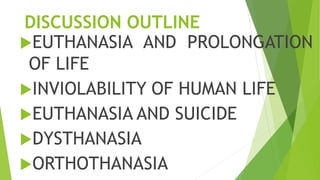
DISCUSSION OUTLINE
EUTHANASIA AND PROLONGATION
OF LIFE
INVIOLABILITY OF HUMAN LIFE
EUTHANASIA AND SUICIDE
DYSTHANASIA
ORTHOTHANASIA
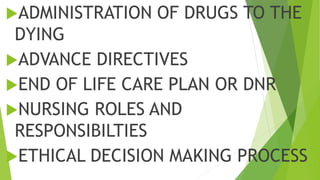
ADMINISTRATION OF DRUGS TO THE
DYING
ADVANCE DIRECTIVES
END OF LIFE CARE PLAN OR DNR
NURSING ROLES AND
RESPONSIBILTIES
ETHICAL DECISION MAKING PROCESS
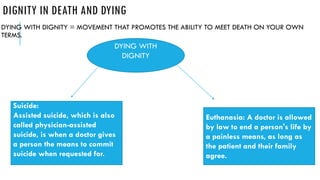
DIGNITY IN DEATH AND DYING
DYING WITH DIGNITY = MOVEMENT THAT PROMOTES THE ABILITY TO MEET DEATH ON YOUR OWN
TERMS.
DYING WITH
DIGNITY
Euthanasia: A doctor is allowed
by law to end a person's life by
a painless means, as long as
the patient and their family
agree.
Suicide:
Assisted suicide, which is also
called physician-assisted
suicide, is when a doctor gives
a person the means to commit
suicide when requested for.
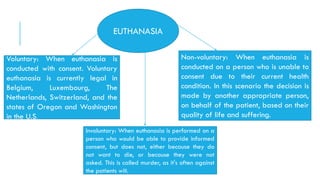
EUTHANASIA
Voluntary: When euthanasia is
conducted with consent. Voluntary
euthanasia is currently legal in
Belgium, Luxembourg, The
Netherlands, Switzerland, and the
states of Oregon and Washington
in the U.S.
Non-voluntary: When euthanasia is
conducted on a person who is unable to
consent due to their current health
condition. In this scenario the decision is
made by another appropriate person,
on behalf of the patient, based on their
quality of life and suffering.
Involuntary: When euthanasia is performed on a
person who would be able to provide informed
consent, but does not, either because they do
not want to die, or because they were not
asked. This is called murder, as it's often against
the patients will.
INVIOLABILITY OF HUMAN LIFE
The concept of inviolability is an important tie between the
ethics of religion and the ethics of law, as each seeks
justification for its principles as based on both purity and
natural concept, as well as in universality of application.
In religion and ethics, the inviolability or sanctity of life is a
principle of implied protection regarding aspects of sentient life
that are said to be holy, sacred, or otherwise of such value that
they are not to be violated
The phrase sanctity of life refers to the idea that human life is
sacred, holy, and precious, argued mainly by the pro-life side
in political and moral debates over such controversial issues as
abortion, contraception, euthanasia, embryonic stem-cell
research, and the "right to die" in the United States, Canada,
United Kingdom and other English-speaking countries.
DYSTHANASIA:
Dysthanasia is a term generally used when a person
is seen to be kept alive artificially in a condition
where, otherwise, they cannot survive; sometimes for
some sort of ulterior (intentionally hidden/fututre)
motive.
ORTHOTHANASIA:
A normal or natural manner of death and dying.
Sometimes used to denote the deliberate stopping
of artificial or heroic means of maintaining life
Passive euthanasia, see there.
ADMINISTRATION OF DRUGS TO THE DYING
In medicine, specifically in end-of-life care, palliative
sedation is the practice of relieving distress in a terminally
ill person in the last hours or days of a dying patient's life,
usually by means of a continuous intravenous or
subcutaneous infusion of a sedative drug, or by means of
a specialized catheter designed to provide comfortable
and discreet administration of ongoing medications via
the rectal route.
Palliative sedation is an option of last resort for patients
whose symptoms cannot be controlled by any other
means.
It is not a form of euthanasia, as the goal of palliative
sedation is to control symptoms, rather than to shorten
the patient's life.
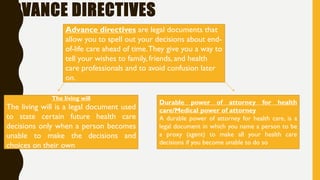
ADVANCE DIRECTIVES
The living will
The living will is a legal document used
to state certain future health care
decisions only when a person becomes
unable to make the decisions and
choices on their own
Durable power of attorney for health
care/Medical power of attorney
A durable power of attorney for health care, is a
legal document in which you name a person to be
a proxy (agent) to make all your health care
decisions if you become unable to do so
Advance directives are legal documents that
allow you to spell out your decisions about end-
of-life care ahead of time.They give you a way to
tell your wishes to family, friends, and health
care professionals and to avoid confusion later
on.
END OF LIFE CARE PLAN OR DNR
End of life care includes palliative care. If you have an
illness that can't be cured, based on the understanding
that death is inevitable. palliative care makes you as
comfortable as possible, by managing your pain and other
distressing symptoms.
It also involves psychological, social and spiritual support
for you and your family or careers.
WHEN DOES END OF LIFE CARE BEGIN?
•have an advanced incurable illness, such as cancer, dementia or
motor neurone disease are generally frail and have co-existing
conditions that mean they are expected to die within 12
months
•have existing conditions if they are at risk of dying from a
sudden crisis in their condition
•have a life-threatening acute condition caused by a sudden
catastrophic event, such as an accident or stroke
Nursing roles and responsibilities
treat people compassionately
listen to people
communicate clearly and sensitively
identify and meet the communication needs of
each individual
acknowledge pain and distress and take action
recognise when someone may be entering the last
few days and hours of life
involve people in decisions about their care and
respect their wishes
keep the person who is reaching the end of their life
and those important to them up to date with any
changes in condition
document a summary of conversations and decisions
seek further advice if needed
look after yourself and your colleagues and seek support
if you need it
Learning from complaints
Care of the person
choosing among alternatives in a manner consistent with ethical
principles. In making ethical decisions, it is necessary to perceive and
eliminate unethical options and select the best ethical alternative.
The process of making ethical decisions requires:
•Commitment: The desire to do the right thing regardless of
the cost
•Consciousness: The awareness to act consistently and apply
moral convictions to daily behavior
•Competency: The ability to collect and evaluate information,
develop alternatives, and foresee potential consequences and
risks
Good decisions are both ethical and effective:
•Ethical decisions generate and sustain trust; demonstrate
respect, responsibility, fairness and caring; and are consistent
with good citizenship.These behaviors provide a foundation
for making better decisions by setting the ground rules for our
behavior.
•Effective decisions are effective if they accomplish what we
want accomplished and if they advance our purposes.The key
to making effective decisions is to think about choices in
terms of their ability to accomplish our most important goals.
This means we have to understand the difference between
immediate and short-term goals and longer-range goals.
BIOETHICS. DIGNITY IN DEATH AND DYING

BIOETHICS. DIGNITY IN DEATH AND DYING

  • 1.
  • 2.
    DISCUSSION OUTLINE EUTHANASIA ANDPROLONGATION OF LIFE INVIOLABILITY OF HUMAN LIFE EUTHANASIA AND SUICIDE DYSTHANASIA ORTHOTHANASIA
  • 3.
    ADMINISTRATION OF DRUGSTO THE DYING ADVANCE DIRECTIVES END OF LIFE CARE PLAN OR DNR NURSING ROLES AND RESPONSIBILTIES ETHICAL DECISION MAKING PROCESS
  • 4.
    DIGNITY IN DEATHAND DYING DYING WITH DIGNITY = MOVEMENT THAT PROMOTES THE ABILITY TO MEET DEATH ON YOUR OWN TERMS. DYING WITH DIGNITY Euthanasia: A doctor is allowed by law to end a person's life by a painless means, as long as the patient and their family agree. Suicide: Assisted suicide, which is also called physician-assisted suicide, is when a doctor gives a person the means to commit suicide when requested for.
  • 5.
    EUTHANASIA Voluntary: When euthanasiais conducted with consent. Voluntary euthanasia is currently legal in Belgium, Luxembourg, The Netherlands, Switzerland, and the states of Oregon and Washington in the U.S. Non-voluntary: When euthanasia is conducted on a person who is unable to consent due to their current health condition. In this scenario the decision is made by another appropriate person, on behalf of the patient, based on their quality of life and suffering. Involuntary: When euthanasia is performed on a person who would be able to provide informed consent, but does not, either because they do not want to die, or because they were not asked. This is called murder, as it's often against the patients will.
  • 6.
    INVIOLABILITY OF HUMANLIFE The concept of inviolability is an important tie between the ethics of religion and the ethics of law, as each seeks justification for its principles as based on both purity and natural concept, as well as in universality of application. In religion and ethics, the inviolability or sanctity of life is a principle of implied protection regarding aspects of sentient life that are said to be holy, sacred, or otherwise of such value that they are not to be violated The phrase sanctity of life refers to the idea that human life is sacred, holy, and precious, argued mainly by the pro-life side in political and moral debates over such controversial issues as abortion, contraception, euthanasia, embryonic stem-cell research, and the "right to die" in the United States, Canada, United Kingdom and other English-speaking countries.
  • 7.
    DYSTHANASIA: Dysthanasia is aterm generally used when a person is seen to be kept alive artificially in a condition where, otherwise, they cannot survive; sometimes for some sort of ulterior (intentionally hidden/fututre) motive. ORTHOTHANASIA: A normal or natural manner of death and dying. Sometimes used to denote the deliberate stopping of artificial or heroic means of maintaining life Passive euthanasia, see there.
  • 8.
    ADMINISTRATION OF DRUGSTO THE DYING In medicine, specifically in end-of-life care, palliative sedation is the practice of relieving distress in a terminally ill person in the last hours or days of a dying patient's life, usually by means of a continuous intravenous or subcutaneous infusion of a sedative drug, or by means of a specialized catheter designed to provide comfortable and discreet administration of ongoing medications via the rectal route. Palliative sedation is an option of last resort for patients whose symptoms cannot be controlled by any other means. It is not a form of euthanasia, as the goal of palliative sedation is to control symptoms, rather than to shorten the patient's life.
  • 9.
    ADVANCE DIRECTIVES The livingwill The living will is a legal document used to state certain future health care decisions only when a person becomes unable to make the decisions and choices on their own Durable power of attorney for health care/Medical power of attorney A durable power of attorney for health care, is a legal document in which you name a person to be a proxy (agent) to make all your health care decisions if you become unable to do so Advance directives are legal documents that allow you to spell out your decisions about end- of-life care ahead of time.They give you a way to tell your wishes to family, friends, and health care professionals and to avoid confusion later on.
  • 10.
    END OF LIFECARE PLAN OR DNR End of life care includes palliative care. If you have an illness that can't be cured, based on the understanding that death is inevitable. palliative care makes you as comfortable as possible, by managing your pain and other distressing symptoms. It also involves psychological, social and spiritual support for you and your family or careers.
  • 11.
    WHEN DOES ENDOF LIFE CARE BEGIN? •have an advanced incurable illness, such as cancer, dementia or motor neurone disease are generally frail and have co-existing conditions that mean they are expected to die within 12 months •have existing conditions if they are at risk of dying from a sudden crisis in their condition •have a life-threatening acute condition caused by a sudden catastrophic event, such as an accident or stroke
  • 12.
    Nursing roles andresponsibilities treat people compassionately listen to people communicate clearly and sensitively identify and meet the communication needs of each individual acknowledge pain and distress and take action recognise when someone may be entering the last few days and hours of life involve people in decisions about their care and respect their wishes
  • 13.
    keep the personwho is reaching the end of their life and those important to them up to date with any changes in condition document a summary of conversations and decisions seek further advice if needed look after yourself and your colleagues and seek support if you need it Learning from complaints Care of the person
  • 14.
    choosing among alternativesin a manner consistent with ethical principles. In making ethical decisions, it is necessary to perceive and eliminate unethical options and select the best ethical alternative. The process of making ethical decisions requires: •Commitment: The desire to do the right thing regardless of the cost •Consciousness: The awareness to act consistently and apply moral convictions to daily behavior •Competency: The ability to collect and evaluate information, develop alternatives, and foresee potential consequences and risks
  • 15.
    Good decisions areboth ethical and effective: •Ethical decisions generate and sustain trust; demonstrate respect, responsibility, fairness and caring; and are consistent with good citizenship.These behaviors provide a foundation for making better decisions by setting the ground rules for our behavior. •Effective decisions are effective if they accomplish what we want accomplished and if they advance our purposes.The key to making effective decisions is to think about choices in terms of their ability to accomplish our most important goals. This means we have to understand the difference between immediate and short-term goals and longer-range goals.