
POST MORTEM
CARE
By Rommel Luis C. Israel III
Learning Objective
At the end of the lecture, the learners will be able to:
1. define loss and other associated concepts
2. gain an understanding of the different theories that have been used to describe the
process of grieving
3. to consider how grieving becomes problematic and the assessment of such
difficulties
4. to use loss and grief theory and research to support an integrative person-centred
approach to intervening with people experiencing loss.
4. identify the nursing measures for care of the body after death
DEATH
the cessation of all vital
functions of the body including
the heartbeat, brain activity
(including the brain stem), and
breathing.
It comes in many forms,
whether it be expected after a
diagnosis of terminal illness or
an unexpected accident or
medical condition.
SIGNS AND
SYMPTOMS OF
IMMINENT (about to
happer or near)
DEATH
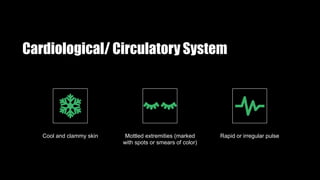
Cardiological/ Circulatory System
Cool and clammy skin Mottled extremities (marked
with spots or smears of color)
Rapid or irregular pulse
MUSCULOSKELETAL
Inability to
ambulate
Inability to
move/turn in bed
Increased lethargy
(lack of energy)
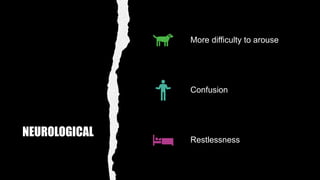
NEUROLOGICAL
More difficulty to arouse
Confusion
Restlessness
RESPIRATORY
Increased respiratory rate
Periods of apnea or Cheyne-Stokes respiration
pattern (an abnormal pattern of breathing,
oscillating between hyperventilation and apnoea )
Inability to cough or clear secretions
Presence of increased secretions (“death rattle”)
TWO
CLASSIFICATIONS
OF DEATH
• CLINICAL DEATH
• BIOILOGICAL DEATH
CLINICAL DEATH
• Clinical death comes first and is when a
person’s heart stops beating.
• Circulation of the blood and respiration also
stops once there is a cessation of heart beat. It
is during this time that individuals can be
revived by way of CPR. Oxygen can be given,
the blood can be kept circulated and the heart
beat could be potentially restored.
• Most patients who are at the end of life opt for
a do-not-resuscitate order, and therefore CPR
is rarely given.
BIOLOGICAL DEATH
• Biological Death is where the
victim’s brain is damaged and cells
in the victim’s heart, brain and other
organs die from a lack of oxygen.
• The damage caused by Biological
Death is irreversible.
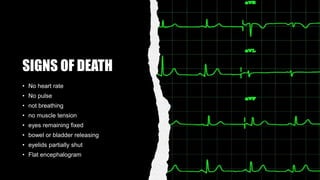
SIGNS OF DEATH
• No heart rate
• No pulse
• not breathing
• no muscle tension
• eyes remaining fixed
• bowel or bladder releasing
• eyelids partially shut
• Flat encephalogram
WHAT HAPPENS
TO OUR BODY
AFTER WE DIE?
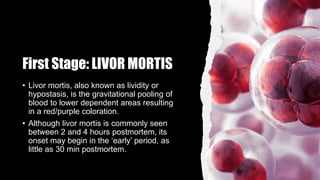
First Stage: LIVOR MORTIS
• Livor mortis, also known as lividity or
hypostasis, is the gravitational pooling of
blood to lower dependent areas resulting
in a red/purple coloration.
• Although livor mortis is commonly seen
between 2 and 4 hours postmortem, its
onset may begin in the ‘early’ period, as
little as 30 min postmortem.
PALLOR MORTIS
• Occurring 15 to 20 minutes after death, in which the body
begins to pale. Pallor mortis occurs because blood stops
moving through the capillaries, the smallest of the body’s
blood vessels.
• the body cools, decreasing in temperature about 1.5 °F (0.84
°C) per hour
• Autolysis, which begins the process of decomposition, is also
called “self-digestion”: enzymes begin to digest the
membranes of oxygen-deprived cells.
Second Stage: ALGOR
MORTIS
• the cooling of the body postmortem, is the
result of a cessation in thermoregulation.
• as body temperature is controlled by the
hypothalamus, this homeostatic feature can
no longer be maintained after death.
• Thus the body temperature will begin to
change toward the ambient temperature of
the room or surroundings in which the
remains are found.
Third Stage: RIGOR
MORTIS
• Rigor mortis or postmortem rigidity refers to the
stiffness of the muscles and joints of the body
after the death of an individual, which normally
endures between one to four days.
• It is the third stage and an observable indication
of death that occurs because of the chemical
changes in the muscles that realize a stiffening of
the muscles of limbs.
PUTREFACTION
• the decomposition of the body carried out by the
microbial action.
• After cessation of homeostasis, the natural flora of the
body migrates from the gut to the blood vessels and
spreads all over the body.
• External micro-organisms enter the body through the
alimentary canal, respiratory tract, and open wounds.
• In the absence of body defenses/immune mechanisms,
the microbes keep growing, as they feed upon the
proteins and carbohydrates of the blood and body parts.
BODY DECOMPOSITION TIMELINE
24-72 hours after death — the internal organs decompose.
3-5 days after death — the body starts to bloat and blood-containing
foam leaks from the mouth and nose.
8-10 days after death — the body turns from green to red as the
blood decomposes and the organs in the abdomen accumulate gas.
Several weeks after death — nails and teeth fall out.
1 month after death — the body starts to liquify.
WHAT DOES LOSS
MEANS IN DEATH?
• A Loss is the actual or potential situation in which
something valued is changed or no longer
available. Death is a fundamental loss,both for
the dying person and for those who who
survived.
• A loss occurs when an event is perceived to be
negative by individuals involved, and it results in
long-term changes in one's social situations,
relationships, or way of viewing the world and
oneself. Death is the event most often thought of
as a loss
GRIEF AND LOSS
Grief is a natural human response to
the loss of a loved one.
Grief moves in and out of stages from
disbelief and denial, to anger and guilt,
to finding a source of comfort, to
eventually adjusting to the loss.
It is normal for both the dying person
and the survivors to experience grief.
For survivors, the grieving process
can take many years. The challenge
of ACCEPTING death and dying as
the end stage of life is what the
grieving process is all about.
GRIEF AND
LOSS
Grief is the natural emotional
response to the loss of someone
close, such as a family member
or friend. Grief can also occur
after a serious illness, a divorce
or other significant losses.
Grief often involves intense
sadness, and sometimes
feelings of shock and numbness,
or even denial and anger. For
most people, the intensity of
grief eases over time and the
episodes of grief become less
frequent.
Grief is a process or journey that
affects everyone differently. It
can be exhausting and
emotionally draining. This can
make it hard to do simple things
or even leave the house. Some
people cope by becoming more
active.
GRIEF AND LOSS
• Grief has no set pattern. It is expressed differently
across different cultures. Some people like to be
expressive and public with their emotions, while others
like to keep their feelings private.
• Most people find that grief lessens with time. A person
who loses a loved one may always carry sadness and
miss the person who has died, but they are able to find
meaning and experience pleasure again. Some people
even find new wisdom and strength after experiences of
loss.
TYPES AND
SOURCES OF
LOSS
TWO
GENERAL
TYPES OF
LOSS
SUDDEN/SHOCKING/ACTUAL - losses due to
events like crimes, accidents, or suicide can be
traumatic. There is no way to prepare. They can
challenge your sense of security and confidence in
the predictability of life. You may experience
symptoms such as sleep disturbance, nightmares,
distressing thoughts, depressed mood, social
isolation, or severe anxiety.
PREDICTABLE - those due to terminal illness,
sometimes allow more time to prepare for the loss.
However, they create two layers of grief: the grief
related to the anticipation of the loss and the grief
related to the loss itself.
TWO TYPES
OF VIEW OF
LOSS
Situational
Developmental
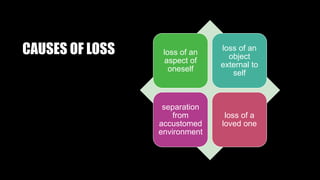
CAUSES OF
LOSS
Causes of loss are the
perils that can bring about
or trigger loss or damage.
CAUSES OF LOSS loss of an
aspect of
oneself
loss of an
object
external to
self
separation
from
accustomed
environment
loss of a
loved one
BEREAVEMENT
• Bereavement usually means losing someone we
love through death and also follows on from
change and loss.
• It is a devastating event, turning our world upside
down and changing our lives forever.
• The death of a loved one is probably the worst
loss we will ever experience.
MOURNING
• Mourning is an expression of grief
or a time of grieving that follows a
loved one's death or other serious
loss.
• Depression, confusion, even losing
interest in friends and social
activities all can occur when
someone is in mourning.
WHAT ARE THE
SYMPTOMS OF
GRIEF?
PHYSICAL
SYMPTOMS
OF GRIEF
Lack of energy or fatigue
Headaches and upset
stomach
Excessive sleeping or
overworking and excessive
activity
EMOTIONAL SYMPTOMS OF
GRIEF
• Memory lapses, distraction, and preoccupation
• Irritability
• Depression and feelings of euphoria
• Extreme anger or feelings of being resigned to the
situation
SPIRITUAL
SYMPTOMS OF GRIEF
• Feelings of being closer to God or
feelings of anger and outrage at
God
• Strengthening of faith or
questioning of faith
TYPES OF GRIEF RESPONSE
• Abbreviated grief is brief but genuinely
felt.
• Anticipatory grief is experience in
advance of the event
• disenfranchised grief occurs when a
person is unable to acknowledge the loss
to the person
• Complicated grief exist when the
strategies to cope with the loss are
maladaptive
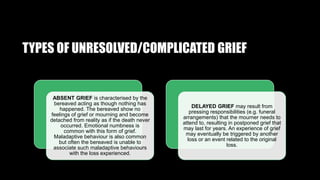
TYPES OF UNRESOLVED/COMPLICATED GRIEF
ABSENT GRIEF is characterised by the
bereaved acting as though nothing has
happened. The bereaved show no
feelings of grief or mourning and become
detached from reality as if the death never
occurred. Emotional numbness is
common with this form of grief.
Maladaptive behaviour is also common
but often the bereaved is unable to
associate such maladaptive behaviours
with the loss experienced.
DELAYED GRIEF may result from
pressing responsibilities (e.g. funeral
arrangements) that the mourner needs to
attend to, resulting in postponed grief that
may last for years. An experience of grief
may eventually be triggered by another
loss or an event related to the original
loss.
TYPES OF UNRESOLVED OR
COMPLICATED GRIEF
INHIBITED GRIEF involves inhibition of
the normal behaviours that are
associated with grief. Those who do not
allow themselves to experience the pain
of grief directly may develop some kind
of somatic complaints or illness. It is
common in this form of grief for the
mourner to choose mourning some
aspect of the deceased and not the
other.
TYPES OF
UNRESOLVED OR
COMPLICATED
GRIEF
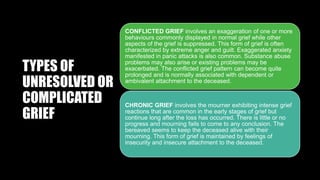
CONFLICTED GRIEF involves an exaggeration of one or more
behaviours commonly displayed in normal grief while other
aspects of the grief is suppressed. This form of grief is often
characterized by extreme anger and guilt. Exaggerated anxiety
manifested in panic attacks is also common. Substance abuse
problems may also arise or existing problems may be
exacerbated. The conflicted grief pattern can become quite
prolonged and is normally associated with dependent or
ambivalent attachment to the deceased.
CHRONIC GRIEF involves the mourner exhibiting intense grief
reactions that are common in the early stages of grief but
continue long after the loss has occurred. There is little or no
progress and mourning fails to come to any conclusion. The
bereaved seems to keep the deceased alive with their
mourning. This form of grief is maintained by feelings of
insecurity and insecure attachment to the deceased.
TYPES OF
UNRESOLVED OR
COMPLICATED
GRIEFS
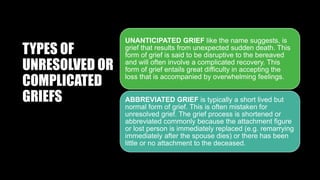
UNANTICIPATED GRIEF like the name suggests, is
grief that results from unexpected sudden death. This
form of grief is said to be disruptive to the bereaved
and will often involve a complicated recovery. This
form of grief entails great difficulty in accepting the
loss that is accompanied by overwhelming feelings.
ABBREVIATED GRIEF is typically a short lived but
normal form of grief. This is often mistaken for
unresolved grief. The grief process is shortened or
abbreviated commonly because the attachment figure
or lost person is immediately replaced (e.g. remarrying
immediately after the spouse dies) or there has been
little or no attachment to the deceased.
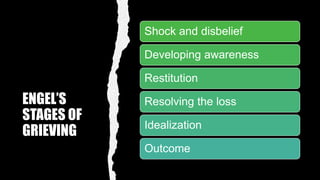
ENGEL’S
STAGES OF
GRIEVING
Shock and disbelief
Developing awareness
Restitution
Resolving the loss
Idealization
Outcome
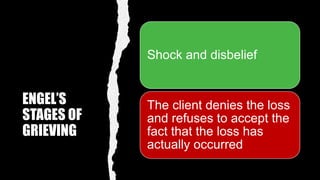
ENGEL’S
STAGES OF
GRIEVING
Shock and disbelief
The client denies the loss
and refuses to accept the
fact that the loss has
actually occurred
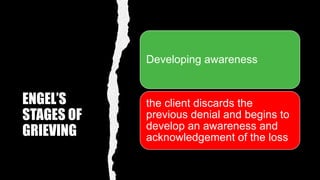
ENGEL’S
STAGES OF
GRIEVING
Developing awareness
the client discards the
previous denial and begins to
develop an awareness and
acknowledgement of the loss
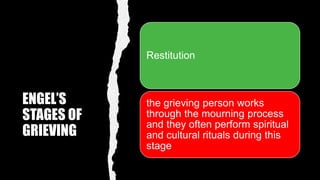
ENGEL’S
STAGES OF
GRIEVING
Restitution
the grieving person works
through the mourning process
and they often perform spiritual
and cultural rituals during this
stage
ENGEL’S
STAGES OF
GRIEVING
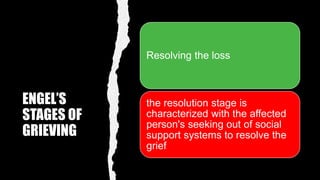
Resolving the loss
the resolution stage is
characterized with the affected
person's seeking out of social
support systems to resolve the
grief
ENGEL’S
STAGES OF
GRIEVING
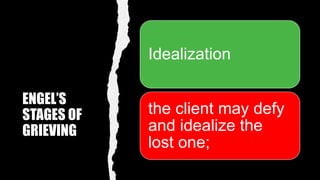
Idealization
the client may defy
and idealize the
lost one;
ENGEL’S
STAGES OF
GRIEVING
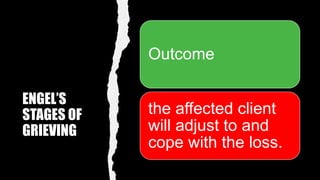
Outcome
the affected client
will adjust to and
cope with the loss.
KUBLER
ROSS’
STAGES OF
GRIEVING
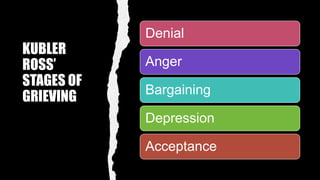
Denial
Anger
Bargaining
Depression
Acceptance
KUBLER
ROSS’
STAGES OF
GRIEVING
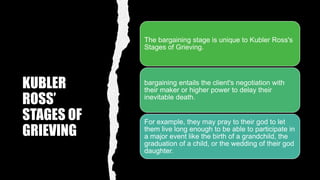
The bargaining stage is unique to Kubler Ross's
Stages of Grieving.
bargaining entails the client's negotiation with
their maker or higher power to delay their
inevitable death.
For example, they may pray to their god to let
them live long enough to be able to participate in
a major event like the birth of a grandchild, the
graduation of a child, or the wedding of their god
daughter.
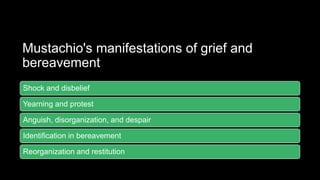
Mustachio's manifestations of grief and
bereavement
Shock and disbelief
Yearning and protest
Anguish, disorganization, and despair
Identification in bereavement
Reorganization and restitution
RANDO’S 3 PHASES OF
MOURNING
(3 Broad Categories)
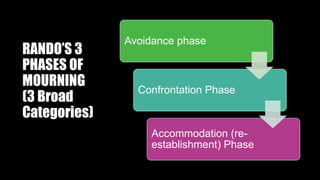
RANDO’S 3
PHASES OF
MOURNING
(3 Broad
Categories)
Avoidance phase
Confrontation Phase
Accommodation (re-
establishment) Phase
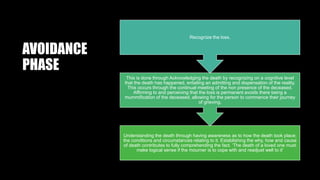
AVOIDANCE
PHASE
Understanding the death through having awareness as to how the death took place;
the conditions and circumstances relating to it. Establishing the why, how and cause
of death contributes to fully comprehending the fact. ‘The death of a loved one must
make logical sense if the mourner is to cope with and readjust well to it’
This is done through Acknowledging the death by recognizing on a cognitive level
that the death has happened, entailing an admitting and dispensation of the reality.
This occurs through the continual meeting of the non presence of the deceased.
Affirming to and perceiving that the loss is permanent avoids there being a
mummification of the deceased, allowing for the person to commence their journey
of grieving.
Recognize the loss.
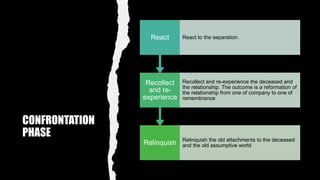
CONFRONTATION
PHASE
Relinquish Relinquish the old attachments to the deceased
and the old assumptive world
Recollect
and re-
experience
Recollect and re-experience the deceased and
the relationship. The outcome is a reformation of
the relationship from one of company to one of
remembrance
React React to the separation.
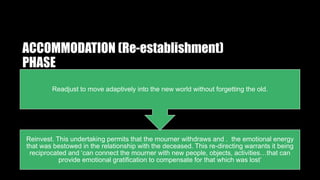
ACCOMMODATION (Re-establishment)
PHASE
Reinvest. This undertaking permits that the mourner withdraws and . the emotional energy
that was bestowed in the relationship with the deceased. This re-directing warrants it being
reciprocated and ‘can connect the mourner with new people, objects, activities…that can
provide emotional gratification to compensate for that which was lost’
Readjust to move adaptively into the new world without forgetting the old.
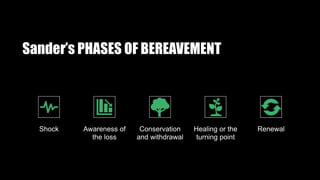
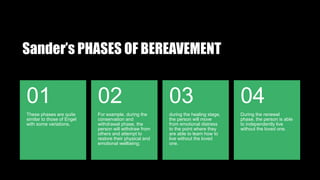
Sander’s PHASES OF BEREAVEMENT
Shock Awareness of
the loss
Conservation
and withdrawal
Healing or the
turning point
Renewal
Sander’s PHASES OF BEREAVEMENT
These phases are quite
similar to those of Engel
with some variations.
01
For example, during the
conservation and
withdrawal phase, the
person will withdraw from
others and attempt to
restore their physical and
emotional wellbeing;
02
during the healing stage,
the person will move
from emotional distress
to the point where they
are able to learn how to
live without the loved
one.
03
During the renewal
phase, the person is able
to independently live
without the loved one.
04
FACTORS
AFFECTING LOSS
AND GRIEF
FACTORS AFFECTING LOSS
AND GRIEF
• culture & religion
• intimacy level
• expected loss
• support system
• prior grief experience.
CULTURE AND RELIGION FACTOR
The concept of death
can mean different
things in different
cultures.
The religious beliefs of
a person can also be
pivotal. For instance,
believing in an afterlife
with a loved one can
help to deal with loss.
It is important to
remember the way a
person grieves is
personal and unique to
themselves.
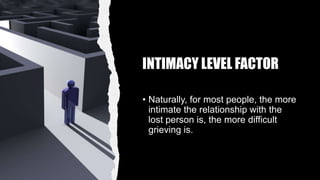
INTIMACY LEVEL FACTOR
• Naturally, for most people, the more
intimate the relationship with the
lost person is, the more difficult
grieving is.
EXPECTED LOSS FACTOR
How you react to a sudden loss is likely different from how you would respond to an expected death.
For instance, there might have been medical reports making predictions on a person's life expectancy.
Expecting loss will allow some people to deal with the loss and their feelings before any loss.
This can help some people to have a more peaceful grieving process.
However, for some people, expecting the loss of a loved one can cause them to suffer for a longer
period.
SUPPORT SYSTEM FACTOR
The support system of most people is usually filled by their Friends and family,
For instance, friends and family might offer support with meals or even provide financial help.
A good support system will help reduce the burdens on a grieving person.
A support system can also include seeking help from a professional.
It might help to visit a local hospital or seek a counselor to assist in processing grief.
PRIOR GRIEF
EXPERIENCE
FACTOR
PEOPLE WITH PREVIOUS
GRIEF EXPERIENCES MIGHT
UNDERSTAND HOW TO MOVE
PAST DEATH AND THE
GRIEVING PROCESS.
IT IS ALSO POSSIBLE THAT A
LOSS CAN ALSO CAUSE
RECOLLECTIONS OF PRIOR
GRIEF EXPERIENCES.
SUFFERING MULTIPLE
LOSSES IN A SIMILAR
MANNER CAN CAUSE
RELIVING DIFFICULT
MOMENTS.
LOSING MULTIPLE PEOPLE IN
A SHORT PERIOD CAN ALSO
CAUSE A VULNERABLE
RESPONSE TO GRIEF.
POST
MORTEM
CARE
POST MORTEM CARE
• Post-mortem care is how the client’s body is
cared for after their death.
• Postmortem care, which can be provided in the
home and in health care facilities, involves caring
for a deceased patient’s body with sensitivity and
in a manner that is consistent with the patient’s
religious or cultural beliefs.
NURSING RESPONSIBILITY
Nurses are responsible for the care
and transport of the deceased
body, documentation of all events
related to death (although they are
not responsible for determining the
cause of death), and providing
support to the family whenever
possible or necessary.
They must also treat the body
respectfully and coordinate all
actions in accordance with the
patient's religious or cultural
beliefs.
WHEN SHOULD POST MORTEM CARE BE
PERFORMED?
Post-mortem care is provided by an attending nurse following the pronunciation of death
and until the body is transferred to an attending funeral provider or medical provider.
The nurse must initially clean the body, dress it, apply documentation such as a toe tag,
and perform other methods of preparation before visitation by the family.
They may also provide the family with support or resources to cope before the body is
transferred to another location.
References
Grief and Loss. (2019). Johns Hopkins Medicine.
https://www.hopkinsmedicine.org/health/caregiving/grief-and-loss
death. (2019). TheFreeDictionary.com. https://medical-dictionary.thefreedictionary.com/death
Healthdirect Australia. (2020). Grief and loss. Www.healthdirect.gov.au.
https://www.healthdirect.gov.au/grief-loss
Grief and Loss. (n.d.). Cmhc.utexas.edu. Retrieved May 7, 2023, from
https://cmhc.utexas.edu/griefloss.html#:~:text=Different%20Kinds%20of%20Loss
Coping with bereavement | Family Lives. (n.d.). Www.familylives.org.uk.
https://www.familylives.org.uk/advice/your-family/family-life/coping-with-
References
• Mourning - Definition, Meaning & Synonyms. (n.d.). Vocabulary.com. Retrieved May 7, 2023, from
https://www.vocabulary.com/dictionary/mourning#:~:text=Mourning%20is%20an%20expression%20of
• Types of Unresolved/Complicated Grief. (2009, December 14). Counselling Connection.
https://www.counsellingconnection.com/index.php/2009/12/14/types-of-unresolvedcomplicated-grief/
• RegisteredNursing.org Staff Writers. (2016, July 5). Grief and Loss: NCLEX-RN. Registerednursing.org;
RegisteredNursing.org. https://www.registerednursing.org/nclex/grief-loss/
• Fitzsimons, K. (2020, May 21). Two Models for Understanding Grief. Mind & Body Works.
https://mindandbodyworks.com/two-models-for-understanding-
grief/#:~:text=Rando%20promoted%20the%20Six%20
Reference
• 5 Factors that Affect Grief Responses. (n.d.). Overcomers Counseling.
https://overcomewithus.com/grief-and-loss/5-factors-that-affect-grief-
responses#:~:text=Some%20factors%20that%20affect%20grief
• Lowey, S.E. (2015). Care at the Time of Death. [online] milnepublishing.geneseo.edu. Available
at: https://milnepublishing.geneseo.edu/nursingcare/chapter/care-at-the-time-of-
death/#:~:text=The%20role%20of%20the%20nurse%20during%20the%20active%20dying%20
phase.
• AEDCPR - Certified Online CPR Training. (2018). CPR Training - Heart Attacks. [online]
Available at: https://www.aedcpr.com/online-cpr/heart-
attack.php#:~:text=Biological%20Death%20is%20where%20the.
References
• Elsevier – Clinical Skills │ Postmortem Care Skill. (n.d.). Elsevier.health.
https://elsevier.health/en-US/preview/postmortem-care
• Anon, (2017). The Stages Of Human Decomposition [Updated June 2022] | Aftermath Services.
[online] Available at: https://www.aftermath.com/content/human-
decomposition/#:~:text=According%20to%20Dr.%20Arpad%20A.
• Matthias, M. (n.d.). What Happens to Our Bodies After We Die? | Britannica.
Www.britannica.com. https://www.britannica.com/story/what-happens-to-our-bodies-after-we-
die
•
References
• www.sciencedirect.com. (n.d.). Algor mortis - an overview | ScienceDirect Topics. [online]
Available at: https://www.sciencedirect.com/topics/medicine-and-dentistry/algor-
mortis#:~:text=Algor%20Mortis-.
• www.sciencedirect.com. (n.d.). Livor Mortis - an overview | ScienceDirect Topics. [online]
Available at: https://www.sciencedirect.com/topics/medicine-and-dentistry/livor-
mortis#:~:text=Livor%20mortis%2C%20also%20known%20as.
• Study.com. (2023). Available at: https://study.com/academy/lesson/providing-post-mortem-
care.html#:~:text=Nurses%20are%20responsible%20for%20the.

POST-MORTEM CARE

  • 1.
    POST MORTEM CARE By RommelLuis C. Israel III
  • 2.
    Learning Objective At theend of the lecture, the learners will be able to: 1. define loss and other associated concepts 2. gain an understanding of the different theories that have been used to describe the process of grieving 3. to consider how grieving becomes problematic and the assessment of such difficulties 4. to use loss and grief theory and research to support an integrative person-centred approach to intervening with people experiencing loss. 4. identify the nursing measures for care of the body after death
  • 3.
    DEATH the cessation ofall vital functions of the body including the heartbeat, brain activity (including the brain stem), and breathing. It comes in many forms, whether it be expected after a diagnosis of terminal illness or an unexpected accident or medical condition.
  • 4.
    SIGNS AND SYMPTOMS OF IMMINENT(about to happer or near) DEATH
  • 5.
    Cardiological/ Circulatory System Cooland clammy skin Mottled extremities (marked with spots or smears of color) Rapid or irregular pulse
  • 6.
    MUSCULOSKELETAL Inability to ambulate Inability to move/turnin bed Increased lethargy (lack of energy)
  • 7.
    NEUROLOGICAL More difficulty toarouse Confusion Restlessness
  • 8.
    RESPIRATORY Increased respiratory rate Periodsof apnea or Cheyne-Stokes respiration pattern (an abnormal pattern of breathing, oscillating between hyperventilation and apnoea ) Inability to cough or clear secretions Presence of increased secretions (“death rattle”)
  • 9.
    TWO CLASSIFICATIONS OF DEATH • CLINICALDEATH • BIOILOGICAL DEATH
  • 10.
    CLINICAL DEATH • Clinicaldeath comes first and is when a person’s heart stops beating. • Circulation of the blood and respiration also stops once there is a cessation of heart beat. It is during this time that individuals can be revived by way of CPR. Oxygen can be given, the blood can be kept circulated and the heart beat could be potentially restored. • Most patients who are at the end of life opt for a do-not-resuscitate order, and therefore CPR is rarely given.
  • 11.
    BIOLOGICAL DEATH • BiologicalDeath is where the victim’s brain is damaged and cells in the victim’s heart, brain and other organs die from a lack of oxygen. • The damage caused by Biological Death is irreversible.
  • 12.
    SIGNS OF DEATH •No heart rate • No pulse • not breathing • no muscle tension • eyes remaining fixed • bowel or bladder releasing • eyelids partially shut • Flat encephalogram
  • 13.
    WHAT HAPPENS TO OURBODY AFTER WE DIE?
  • 14.
    First Stage: LIVORMORTIS • Livor mortis, also known as lividity or hypostasis, is the gravitational pooling of blood to lower dependent areas resulting in a red/purple coloration. • Although livor mortis is commonly seen between 2 and 4 hours postmortem, its onset may begin in the ‘early’ period, as little as 30 min postmortem.
  • 15.
    PALLOR MORTIS • Occurring15 to 20 minutes after death, in which the body begins to pale. Pallor mortis occurs because blood stops moving through the capillaries, the smallest of the body’s blood vessels. • the body cools, decreasing in temperature about 1.5 °F (0.84 °C) per hour • Autolysis, which begins the process of decomposition, is also called “self-digestion”: enzymes begin to digest the membranes of oxygen-deprived cells.
  • 16.
    Second Stage: ALGOR MORTIS •the cooling of the body postmortem, is the result of a cessation in thermoregulation. • as body temperature is controlled by the hypothalamus, this homeostatic feature can no longer be maintained after death. • Thus the body temperature will begin to change toward the ambient temperature of the room or surroundings in which the remains are found.
  • 17.
    Third Stage: RIGOR MORTIS •Rigor mortis or postmortem rigidity refers to the stiffness of the muscles and joints of the body after the death of an individual, which normally endures between one to four days. • It is the third stage and an observable indication of death that occurs because of the chemical changes in the muscles that realize a stiffening of the muscles of limbs.
  • 18.
    PUTREFACTION • the decompositionof the body carried out by the microbial action. • After cessation of homeostasis, the natural flora of the body migrates from the gut to the blood vessels and spreads all over the body. • External micro-organisms enter the body through the alimentary canal, respiratory tract, and open wounds. • In the absence of body defenses/immune mechanisms, the microbes keep growing, as they feed upon the proteins and carbohydrates of the blood and body parts.
  • 19.
    BODY DECOMPOSITION TIMELINE 24-72hours after death — the internal organs decompose. 3-5 days after death — the body starts to bloat and blood-containing foam leaks from the mouth and nose. 8-10 days after death — the body turns from green to red as the blood decomposes and the organs in the abdomen accumulate gas. Several weeks after death — nails and teeth fall out. 1 month after death — the body starts to liquify.
  • 20.
    WHAT DOES LOSS MEANSIN DEATH? • A Loss is the actual or potential situation in which something valued is changed or no longer available. Death is a fundamental loss,both for the dying person and for those who who survived. • A loss occurs when an event is perceived to be negative by individuals involved, and it results in long-term changes in one's social situations, relationships, or way of viewing the world and oneself. Death is the event most often thought of as a loss
  • 21.
    GRIEF AND LOSS Griefis a natural human response to the loss of a loved one. Grief moves in and out of stages from disbelief and denial, to anger and guilt, to finding a source of comfort, to eventually adjusting to the loss. It is normal for both the dying person and the survivors to experience grief. For survivors, the grieving process can take many years. The challenge of ACCEPTING death and dying as the end stage of life is what the grieving process is all about.
  • 22.
    GRIEF AND LOSS Grief isthe natural emotional response to the loss of someone close, such as a family member or friend. Grief can also occur after a serious illness, a divorce or other significant losses. Grief often involves intense sadness, and sometimes feelings of shock and numbness, or even denial and anger. For most people, the intensity of grief eases over time and the episodes of grief become less frequent. Grief is a process or journey that affects everyone differently. It can be exhausting and emotionally draining. This can make it hard to do simple things or even leave the house. Some people cope by becoming more active.
  • 23.
    GRIEF AND LOSS •Grief has no set pattern. It is expressed differently across different cultures. Some people like to be expressive and public with their emotions, while others like to keep their feelings private. • Most people find that grief lessens with time. A person who loses a loved one may always carry sadness and miss the person who has died, but they are able to find meaning and experience pleasure again. Some people even find new wisdom and strength after experiences of loss.
  • 24.
  • 25.
    TWO GENERAL TYPES OF LOSS SUDDEN/SHOCKING/ACTUAL -losses due to events like crimes, accidents, or suicide can be traumatic. There is no way to prepare. They can challenge your sense of security and confidence in the predictability of life. You may experience symptoms such as sleep disturbance, nightmares, distressing thoughts, depressed mood, social isolation, or severe anxiety. PREDICTABLE - those due to terminal illness, sometimes allow more time to prepare for the loss. However, they create two layers of grief: the grief related to the anticipation of the loss and the grief related to the loss itself.
  • 26.
    TWO TYPES OF VIEWOF LOSS Situational Developmental
  • 27.
    CAUSES OF LOSS Causes ofloss are the perils that can bring about or trigger loss or damage.
  • 28.
    CAUSES OF LOSSloss of an aspect of oneself loss of an object external to self separation from accustomed environment loss of a loved one
  • 29.
    BEREAVEMENT • Bereavement usuallymeans losing someone we love through death and also follows on from change and loss. • It is a devastating event, turning our world upside down and changing our lives forever. • The death of a loved one is probably the worst loss we will ever experience.
  • 30.
    MOURNING • Mourning isan expression of grief or a time of grieving that follows a loved one's death or other serious loss. • Depression, confusion, even losing interest in friends and social activities all can occur when someone is in mourning.
  • 31.
  • 32.
    PHYSICAL SYMPTOMS OF GRIEF Lack ofenergy or fatigue Headaches and upset stomach Excessive sleeping or overworking and excessive activity
  • 33.
    EMOTIONAL SYMPTOMS OF GRIEF •Memory lapses, distraction, and preoccupation • Irritability • Depression and feelings of euphoria • Extreme anger or feelings of being resigned to the situation
  • 34.
    SPIRITUAL SYMPTOMS OF GRIEF •Feelings of being closer to God or feelings of anger and outrage at God • Strengthening of faith or questioning of faith
  • 35.
    TYPES OF GRIEFRESPONSE • Abbreviated grief is brief but genuinely felt. • Anticipatory grief is experience in advance of the event • disenfranchised grief occurs when a person is unable to acknowledge the loss to the person • Complicated grief exist when the strategies to cope with the loss are maladaptive
  • 36.
    TYPES OF UNRESOLVED/COMPLICATEDGRIEF ABSENT GRIEF is characterised by the bereaved acting as though nothing has happened. The bereaved show no feelings of grief or mourning and become detached from reality as if the death never occurred. Emotional numbness is common with this form of grief. Maladaptive behaviour is also common but often the bereaved is unable to associate such maladaptive behaviours with the loss experienced. DELAYED GRIEF may result from pressing responsibilities (e.g. funeral arrangements) that the mourner needs to attend to, resulting in postponed grief that may last for years. An experience of grief may eventually be triggered by another loss or an event related to the original loss.
  • 37.
    TYPES OF UNRESOLVEDOR COMPLICATED GRIEF INHIBITED GRIEF involves inhibition of the normal behaviours that are associated with grief. Those who do not allow themselves to experience the pain of grief directly may develop some kind of somatic complaints or illness. It is common in this form of grief for the mourner to choose mourning some aspect of the deceased and not the other.
  • 38.
    TYPES OF UNRESOLVED OR COMPLICATED GRIEF CONFLICTEDGRIEF involves an exaggeration of one or more behaviours commonly displayed in normal grief while other aspects of the grief is suppressed. This form of grief is often characterized by extreme anger and guilt. Exaggerated anxiety manifested in panic attacks is also common. Substance abuse problems may also arise or existing problems may be exacerbated. The conflicted grief pattern can become quite prolonged and is normally associated with dependent or ambivalent attachment to the deceased. CHRONIC GRIEF involves the mourner exhibiting intense grief reactions that are common in the early stages of grief but continue long after the loss has occurred. There is little or no progress and mourning fails to come to any conclusion. The bereaved seems to keep the deceased alive with their mourning. This form of grief is maintained by feelings of insecurity and insecure attachment to the deceased.
  • 39.
    TYPES OF UNRESOLVED OR COMPLICATED GRIEFS UNANTICIPATEDGRIEF like the name suggests, is grief that results from unexpected sudden death. This form of grief is said to be disruptive to the bereaved and will often involve a complicated recovery. This form of grief entails great difficulty in accepting the loss that is accompanied by overwhelming feelings. ABBREVIATED GRIEF is typically a short lived but normal form of grief. This is often mistaken for unresolved grief. The grief process is shortened or abbreviated commonly because the attachment figure or lost person is immediately replaced (e.g. remarrying immediately after the spouse dies) or there has been little or no attachment to the deceased.
  • 40.
    ENGEL’S STAGES OF GRIEVING Shock anddisbelief Developing awareness Restitution Resolving the loss Idealization Outcome
  • 41.
    ENGEL’S STAGES OF GRIEVING Shock anddisbelief The client denies the loss and refuses to accept the fact that the loss has actually occurred
  • 42.
    ENGEL’S STAGES OF GRIEVING Developing awareness theclient discards the previous denial and begins to develop an awareness and acknowledgement of the loss
  • 43.
    ENGEL’S STAGES OF GRIEVING Restitution the grievingperson works through the mourning process and they often perform spiritual and cultural rituals during this stage
  • 44.
    ENGEL’S STAGES OF GRIEVING Resolving theloss the resolution stage is characterized with the affected person's seeking out of social support systems to resolve the grief
  • 45.
    ENGEL’S STAGES OF GRIEVING Idealization the clientmay defy and idealize the lost one;
  • 46.
    ENGEL’S STAGES OF GRIEVING Outcome the affectedclient will adjust to and cope with the loss.
  • 47.
  • 48.
    KUBLER ROSS’ STAGES OF GRIEVING The bargainingstage is unique to Kubler Ross's Stages of Grieving. bargaining entails the client's negotiation with their maker or higher power to delay their inevitable death. For example, they may pray to their god to let them live long enough to be able to participate in a major event like the birth of a grandchild, the graduation of a child, or the wedding of their god daughter.
  • 49.
    Mustachio's manifestations ofgrief and bereavement Shock and disbelief Yearning and protest Anguish, disorganization, and despair Identification in bereavement Reorganization and restitution
  • 50.
    RANDO’S 3 PHASESOF MOURNING (3 Broad Categories)
  • 51.
    RANDO’S 3 PHASES OF MOURNING (3Broad Categories) Avoidance phase Confrontation Phase Accommodation (re- establishment) Phase
  • 52.
    AVOIDANCE PHASE Understanding the deaththrough having awareness as to how the death took place; the conditions and circumstances relating to it. Establishing the why, how and cause of death contributes to fully comprehending the fact. ‘The death of a loved one must make logical sense if the mourner is to cope with and readjust well to it’ This is done through Acknowledging the death by recognizing on a cognitive level that the death has happened, entailing an admitting and dispensation of the reality. This occurs through the continual meeting of the non presence of the deceased. Affirming to and perceiving that the loss is permanent avoids there being a mummification of the deceased, allowing for the person to commence their journey of grieving. Recognize the loss.
  • 53.
    CONFRONTATION PHASE Relinquish Relinquish theold attachments to the deceased and the old assumptive world Recollect and re- experience Recollect and re-experience the deceased and the relationship. The outcome is a reformation of the relationship from one of company to one of remembrance React React to the separation.
  • 54.
    ACCOMMODATION (Re-establishment) PHASE Reinvest. Thisundertaking permits that the mourner withdraws and . the emotional energy that was bestowed in the relationship with the deceased. This re-directing warrants it being reciprocated and ‘can connect the mourner with new people, objects, activities…that can provide emotional gratification to compensate for that which was lost’ Readjust to move adaptively into the new world without forgetting the old.
  • 55.
    Sander’s PHASES OFBEREAVEMENT Shock Awareness of the loss Conservation and withdrawal Healing or the turning point Renewal
  • 56.
    Sander’s PHASES OFBEREAVEMENT These phases are quite similar to those of Engel with some variations. 01 For example, during the conservation and withdrawal phase, the person will withdraw from others and attempt to restore their physical and emotional wellbeing; 02 during the healing stage, the person will move from emotional distress to the point where they are able to learn how to live without the loved one. 03 During the renewal phase, the person is able to independently live without the loved one. 04
  • 57.
  • 58.
    FACTORS AFFECTING LOSS ANDGRIEF • culture & religion • intimacy level • expected loss • support system • prior grief experience.
  • 59.
    CULTURE AND RELIGIONFACTOR The concept of death can mean different things in different cultures. The religious beliefs of a person can also be pivotal. For instance, believing in an afterlife with a loved one can help to deal with loss. It is important to remember the way a person grieves is personal and unique to themselves.
  • 60.
    INTIMACY LEVEL FACTOR •Naturally, for most people, the more intimate the relationship with the lost person is, the more difficult grieving is.
  • 61.
    EXPECTED LOSS FACTOR Howyou react to a sudden loss is likely different from how you would respond to an expected death. For instance, there might have been medical reports making predictions on a person's life expectancy. Expecting loss will allow some people to deal with the loss and their feelings before any loss. This can help some people to have a more peaceful grieving process. However, for some people, expecting the loss of a loved one can cause them to suffer for a longer period.
  • 62.
    SUPPORT SYSTEM FACTOR Thesupport system of most people is usually filled by their Friends and family, For instance, friends and family might offer support with meals or even provide financial help. A good support system will help reduce the burdens on a grieving person. A support system can also include seeking help from a professional. It might help to visit a local hospital or seek a counselor to assist in processing grief.
  • 63.
    PRIOR GRIEF EXPERIENCE FACTOR PEOPLE WITHPREVIOUS GRIEF EXPERIENCES MIGHT UNDERSTAND HOW TO MOVE PAST DEATH AND THE GRIEVING PROCESS. IT IS ALSO POSSIBLE THAT A LOSS CAN ALSO CAUSE RECOLLECTIONS OF PRIOR GRIEF EXPERIENCES. SUFFERING MULTIPLE LOSSES IN A SIMILAR MANNER CAN CAUSE RELIVING DIFFICULT MOMENTS. LOSING MULTIPLE PEOPLE IN A SHORT PERIOD CAN ALSO CAUSE A VULNERABLE RESPONSE TO GRIEF.
  • 64.
  • 65.
    POST MORTEM CARE •Post-mortem care is how the client’s body is cared for after their death. • Postmortem care, which can be provided in the home and in health care facilities, involves caring for a deceased patient’s body with sensitivity and in a manner that is consistent with the patient’s religious or cultural beliefs.
  • 66.
    NURSING RESPONSIBILITY Nurses areresponsible for the care and transport of the deceased body, documentation of all events related to death (although they are not responsible for determining the cause of death), and providing support to the family whenever possible or necessary. They must also treat the body respectfully and coordinate all actions in accordance with the patient's religious or cultural beliefs.
  • 67.
    WHEN SHOULD POSTMORTEM CARE BE PERFORMED? Post-mortem care is provided by an attending nurse following the pronunciation of death and until the body is transferred to an attending funeral provider or medical provider. The nurse must initially clean the body, dress it, apply documentation such as a toe tag, and perform other methods of preparation before visitation by the family. They may also provide the family with support or resources to cope before the body is transferred to another location.
  • 68.
    References Grief and Loss.(2019). Johns Hopkins Medicine. https://www.hopkinsmedicine.org/health/caregiving/grief-and-loss death. (2019). TheFreeDictionary.com. https://medical-dictionary.thefreedictionary.com/death Healthdirect Australia. (2020). Grief and loss. Www.healthdirect.gov.au. https://www.healthdirect.gov.au/grief-loss Grief and Loss. (n.d.). Cmhc.utexas.edu. Retrieved May 7, 2023, from https://cmhc.utexas.edu/griefloss.html#:~:text=Different%20Kinds%20of%20Loss Coping with bereavement | Family Lives. (n.d.). Www.familylives.org.uk. https://www.familylives.org.uk/advice/your-family/family-life/coping-with-
  • 69.
    References • Mourning -Definition, Meaning & Synonyms. (n.d.). Vocabulary.com. Retrieved May 7, 2023, from https://www.vocabulary.com/dictionary/mourning#:~:text=Mourning%20is%20an%20expression%20of • Types of Unresolved/Complicated Grief. (2009, December 14). Counselling Connection. https://www.counsellingconnection.com/index.php/2009/12/14/types-of-unresolvedcomplicated-grief/ • RegisteredNursing.org Staff Writers. (2016, July 5). Grief and Loss: NCLEX-RN. Registerednursing.org; RegisteredNursing.org. https://www.registerednursing.org/nclex/grief-loss/ • Fitzsimons, K. (2020, May 21). Two Models for Understanding Grief. Mind & Body Works. https://mindandbodyworks.com/two-models-for-understanding- grief/#:~:text=Rando%20promoted%20the%20Six%20
  • 70.
    Reference • 5 Factorsthat Affect Grief Responses. (n.d.). Overcomers Counseling. https://overcomewithus.com/grief-and-loss/5-factors-that-affect-grief- responses#:~:text=Some%20factors%20that%20affect%20grief • Lowey, S.E. (2015). Care at the Time of Death. [online] milnepublishing.geneseo.edu. Available at: https://milnepublishing.geneseo.edu/nursingcare/chapter/care-at-the-time-of- death/#:~:text=The%20role%20of%20the%20nurse%20during%20the%20active%20dying%20 phase. • AEDCPR - Certified Online CPR Training. (2018). CPR Training - Heart Attacks. [online] Available at: https://www.aedcpr.com/online-cpr/heart- attack.php#:~:text=Biological%20Death%20is%20where%20the.
  • 71.
    References • Elsevier –Clinical Skills │ Postmortem Care Skill. (n.d.). Elsevier.health. https://elsevier.health/en-US/preview/postmortem-care • Anon, (2017). The Stages Of Human Decomposition [Updated June 2022] | Aftermath Services. [online] Available at: https://www.aftermath.com/content/human- decomposition/#:~:text=According%20to%20Dr.%20Arpad%20A. • Matthias, M. (n.d.). What Happens to Our Bodies After We Die? | Britannica. Www.britannica.com. https://www.britannica.com/story/what-happens-to-our-bodies-after-we- die •
  • 72.
    References • www.sciencedirect.com. (n.d.).Algor mortis - an overview | ScienceDirect Topics. [online] Available at: https://www.sciencedirect.com/topics/medicine-and-dentistry/algor- mortis#:~:text=Algor%20Mortis-. • www.sciencedirect.com. (n.d.). Livor Mortis - an overview | ScienceDirect Topics. [online] Available at: https://www.sciencedirect.com/topics/medicine-and-dentistry/livor- mortis#:~:text=Livor%20mortis%2C%20also%20known%20as. • Study.com. (2023). Available at: https://study.com/academy/lesson/providing-post-mortem- care.html#:~:text=Nurses%20are%20responsible%20for%20the.