Bacteria and Viruses

      Chapter 19
19.1 Bacteria
Come in many shapes and sizes

Most common microorganisms are
  prokaryotes

Average size of 1-5 micrometers
 Compared to eukaryotic cells that are 10-
   100 micrometers in diameter
Classifying Prokaryotes
Eubacteria
 Largest prokaryote Domain
 Cell wall of a carbohydrate- Peptidoglycan
 Cell membrane around cytoplasm
 Some have an extra cell wall on the
  outside to resist damage
Classifying Prokaryotes
Archaebacteria
 Lack nuclei
 Have cell walls without peptidoglycan
 Are chemically different from Eubacteria
 Many live in extremely harsh environments
Identifying Prokaryotes
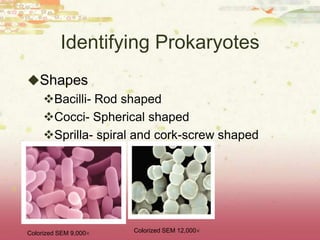
Shapes
 Bacilli- Rod shaped
 Cocci- Spherical shaped
 Sprilla- spiral and cork-screw shaped


Colorized SEM 9,000   Colorized SEM 12,000
Identifying Prokaryotes
Cell walls
 Gram staining used to tell them apart
 Gram+ bacteria look purple
 Gram- bacteria look pink
Identifying Prokaryotes
Movement
 Flagella
 Lash, snake or spiral forward
 They do not move at all
Metabolic Diversity
Heterotrophs
 Chemoheterotrophs: must take in organic
  molecules for energy and carbon

  Photoheterotrophs: Use sunlight for energy
   but need organic compounds for a carbon
   source
Metabolic Diversity
Autotrophs
 Chemoautotrophs: perform
  chemosynthesis to make carbon from
  carbon dioxide. Does not require sunlight

  Photoautotrophs: use light to convert
   carbon dioxide and water into carbon
   compounds and oxygen gas.
Getting Energy
 Bacteria need a constant supply of energy
  Obligate aerobes- require constant supply of
    oxygen

   Obligate anaerobes- need no oxygen, for some
    oxygen will kill it

   Facultative anaerobes- survive with or with out
    oxygen
Growth and Reproduction
Binary fission


Conjugation


Spore formation
Importance of Bacteria
Decomposers
 Break down dead matter
Nitrogen Fixers
 Converts nitrogen into a form plants can
   use
Humans use Bacteria
19.2 Viruses
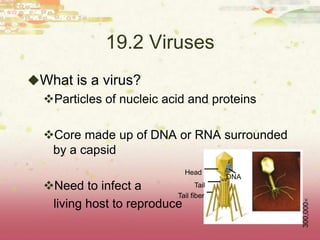
What is a virus?
 Particles of nucleic acid and proteins

  Core made up of DNA or RNA surrounded
   by a capsid
                                Head
                                        DNA
  Need to infect a              Tail
                          Tail fiber
   living host to reproduce
Video on Lytic and Lysogenic
           Cycle
http://www.youtube.com/watch?v=gU8X
 eqI7yts&feature=related
Viral Infection
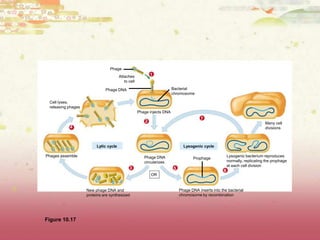
Lytic Cycle
 Virus attaches to host cell
 Injects its DNA
 Host makes RNA from viral DNA
 Cell begins to make copies of virus
 New viruses form
 Host cell bursts
Viral Infection
Lysogenic Cycle
 Virus attaches to host cell
 Injects DNA
 Viral DNA incorporates itself into the host
   DNA
 Viral DNA can be dormant
 Once it becomes active, it follows the 4
   processes in the lytic cycle
Phage


Phage reproductive cycles             Attaches             1
                                          to cell

                              Phage DNA                                 Bacterial
                                                                        chromosome

 Cell lyses,
 releasing phages
                                                    Phage injects DNA
                                                                                        7
                                                        2                                                                     Many cell
           4                                                                                                                  divisions


                         Lytic cycle                                          Lysogenic cycle

Phages assemble                                        Phage DNA                                         Lysogenic bacterium reproduces
                                                                                   Prophage
                                                       circularizes                                      normally, replicating the prophage
                                                                                                         at each cell division
                                             3                          5                            6
                                                            OR


                    New phage DNA and                                       Phage DNA inserts into the bacterial
                    proteins are synthesized                                chromosome by recombination


Figure 10.17
Viral Infections
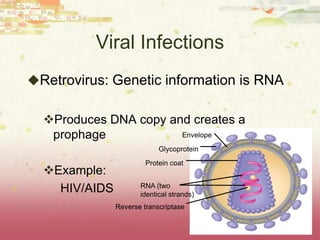
Retrovirus: Genetic information is RNA


  Produces DNA copy and creates a
   prophage            Envelope
                            Glycoprotein
                        Protein coat
  Example:
                      RNA (two
    HIV/AIDS          identical strands)
               Reverse transcriptase
19.3 Diseases Caused by
     Bacteria and Viruses
Pathogens- disease causing agents


Bacterial Disease


Viral Diseases
Diseases Caused by Bacteria
How does bacteria produce disease?


   Damage the cells and tissues by breaking
   down the cells for food

  Releasing toxins (poisons into the body)
Preventing Diseases
Vaccines


Immunity


Antibiotics
Controlling Bacteria
Sterilization


Disinfectants


Proper food storage
Diseases Caused by Viruses
Viruses disrupt the body’s normal
 equilibrium

Cannot be treated with antibiotics


Viruses can infect humans and plants
Viruslike Particles
Viroids- single stranded RNA molecule
 with no capsid
  They cause diseases in plants

  Infect cell and produce more viroids by
   disrupting the plant metabolism
Viruslike Particles
Prions- contain only protein; no DNA or
 RNA
  They cause diseases in animals and
   humans

  Prions clump and cause normal protein to
   clump with it- creating new prions

19 Bacteria And Viruses