HIP JOINT
D R . K R U PA R A I T H AT H A
A S S I S TA N T P R O F E S S O R ,
S C H O O L O F P H Y S I O T H E R A P Y, R K U N I V E R S I T Y.
R A J K O T, G U J R AT, I N D I A .
Index
Introduction
Structure of Hip joint
oStructural adaptation in weight bearing
Function of Hip joint
Hip joint forces and muscle function in stance
Hip joint pathology
INTRODUCTION
COXOFEMORAL JOINT
• Acetabulum of pelvis and head of femur
• Ball and socket joint
• 3 degree of freedom
• Primary function: to support HAT in static
and dynamic posture.
• Open chain- close chain
STRUCTURE OF
HIP JOINT
PROXIMAL ARTICULAR SURFACE
• Acetabulum- concave, at lateral aspect
of hip.
• Acetabulum=1/5 pubis+2/5 ischium
+remaining illium
• Ossification at 20-25 years
• Roundness decreases with age
• (lunate surface, acetabular notch,
acetabular fossa, acetabular labrum)
CENTRAL EDGE ANGLE
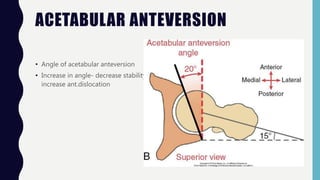
ACETABULAR ANTEVERSION
• Angle of acetabular anteversion
• Increase in angle- decrease stability-
increase ant.dislocation
ACETABULAR LABRUM
• Grasps head of femur
• Concavity- increases
• Not load bearing
• Free nerve endings present
• Lubrication
• Transverse acetabular ligament: serve
as tension band.
DISTAL
ARTICULAR
SURFACE
HEAD OF FEMUR
• Circular in shape.
• Radius of curvature of the femoral
head is smaller in women than in men
in comparison with dimension s of
pelvis.
• Fovea/fovea capitis- not covered with
cartilage, ligament of head of femur.
• Femoral head-
medialy,superiorly,anteriorly
• Femoral neck-5 cm long.
ANGLE OF INCLINATION
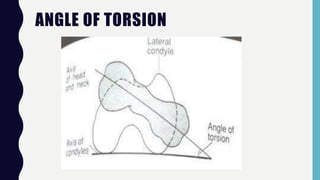
ANGLE OF TORSION
ARTICULAR
CONGRUANCE
• Congruent joint
• Art.surface- head of
femur>acetabulum
• In neutral standing position: head
remains exposed anteriorly and
somewhat superiorly.
• Maximum contact- non wt bearing ,flx,
abd, lat rotation
• Acetabular fossa- non articular and
non weight bearing but stabilizes by
creating vaccum.
HIP JOINT
CAPSULE AND
LIGAMENT
CLOSE PACK POSITION
MAXIMUM ARTICULAR CONGRUANCE
MAXIMUM CHANCES OF INJURY
FUNCTIONS OF
HIP JOINT
MOTION OF
FEMUR ON
ACETABULUM
• Hip Joint Range of Movement - 3D Medical Animation -- ABP ©.mp4
• Anatomy of Movement Of The Hip - Everything You Need To Know - Dr. Nabil
Ebraheim.mp4
Points to remember…
Movements of hip joint and its ROM
Gliding/spinning movements
2 joint muscles
ROM of Normal gait
MOTION OF
PELVIS ON
FEMUR
• Weight bearing,femur fixed-
movement is produced by pelvic
movement.
• distal lever and proximal lever in
opposite direction to produce same
movement.
• Movement of entire pelvic ring in
sagittal plane around coronal axis.
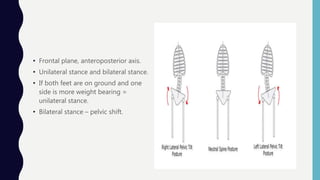
Lateral pelvic tilt
• Frontal plane, anteroposterior axis.
• Unilateral stance and bilateral stance.
• If both feet are on ground and one
side is more weight bearing =
unilateral stance.
• Bilateral stance – pelvic shift.
PELVIC SHIFT
• Pelvic shift, pelvic cannot hike but
drop. Because there is close chain
between two weight bearing feet and
the pelvis.
• If shifted to right, right side adduction
and left side abduction.
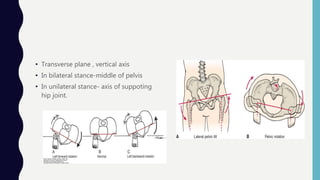
PELVIC ROTATION
• Transverse plane , vertical axis
• In bilateral stance-middle of pelvis
• In unilateral stance- axis of suppoting
hip joint.
ANTERIOR AND POSTERIOR PELVIC
ROTATION
INTERACTION
OF PELVIS AND
LUMBAR SPINE
HIP
JOINTS TRUCTURAL
A DA PTATION TO
W E IGHT -BEARING
• The internal architecture of pelvis and
femur reveal the remarkable
interaction between mechanical
stresses and structural adaptation
created by transmission of forces
between femur and pelvis.
• Trabeculae line up along lines of stress
and forms systems that normally adopt
to stress requirements.
• It can be seen in bony cross section.
• Line of weight bearing :
Vertebrae of spinal column sacral
promontory and SI Joint mostly SI
Joint to acetabulum .
• In standing:
Atleast half of weight of HAT
(gravitational force) passes down
through pelvis to femoral head,
ground reaction force (GRF) travels
upto the shaft.
• These 2 forces are nearly parallel and
in opposite direction  creates force
couple with moment arm(MA) 
bending force  tensile force
superiorly(laterally)
& compressive force
inferiorly(medially).
• A complex set of forces prevents the
rotation and resists the shear forces
that the force couple causes; among
these forces are the structural
resistance of 2 major and 3 minor
trabecular systems.
• The areas in which trabecular systems
cross each other that offer the greatest
resistance to stress and strain .
• The area where trabeculae are thin 
femoral neck  zone of weakness 
easily get #.
• Primary weight bearing surface of
acetabulum- superior portion of
lunate surface.
• Directly over centre of rotation or
related to CE Angle.
• Peak contact area is smaller in women
but peak contact force is higher in
women.
• Primary weight bearing surface of
femoral head-
is its superior portion
• But degeneration is common-Around
or just below fovea or around the
peripheral edges od head’s articular
surface.
THANK YOU..

Hip joint

  • 1.
    HIP JOINT D R. K R U PA R A I T H AT H A A S S I S TA N T P R O F E S S O R , S C H O O L O F P H Y S I O T H E R A P Y, R K U N I V E R S I T Y. R A J K O T, G U J R AT, I N D I A .
  • 2.
    Index Introduction Structure of Hipjoint oStructural adaptation in weight bearing Function of Hip joint Hip joint forces and muscle function in stance Hip joint pathology
  • 3.
  • 4.
    COXOFEMORAL JOINT • Acetabulumof pelvis and head of femur • Ball and socket joint • 3 degree of freedom • Primary function: to support HAT in static and dynamic posture. • Open chain- close chain
  • 6.
  • 7.
    PROXIMAL ARTICULAR SURFACE •Acetabulum- concave, at lateral aspect of hip. • Acetabulum=1/5 pubis+2/5 ischium +remaining illium • Ossification at 20-25 years • Roundness decreases with age • (lunate surface, acetabular notch, acetabular fossa, acetabular labrum)
  • 8.
  • 9.
    ACETABULAR ANTEVERSION • Angleof acetabular anteversion • Increase in angle- decrease stability- increase ant.dislocation
  • 10.
    ACETABULAR LABRUM • Graspshead of femur • Concavity- increases • Not load bearing • Free nerve endings present • Lubrication • Transverse acetabular ligament: serve as tension band.
  • 11.
  • 12.
    HEAD OF FEMUR •Circular in shape. • Radius of curvature of the femoral head is smaller in women than in men in comparison with dimension s of pelvis. • Fovea/fovea capitis- not covered with cartilage, ligament of head of femur. • Femoral head- medialy,superiorly,anteriorly • Femoral neck-5 cm long.
  • 13.
  • 14.
  • 16.
  • 17.
    • Congruent joint •Art.surface- head of femur>acetabulum • In neutral standing position: head remains exposed anteriorly and somewhat superiorly. • Maximum contact- non wt bearing ,flx, abd, lat rotation • Acetabular fossa- non articular and non weight bearing but stabilizes by creating vaccum.
  • 18.
  • 20.
  • 21.
  • 22.
  • 23.
  • 24.
  • 25.
    • Hip JointRange of Movement - 3D Medical Animation -- ABP ©.mp4 • Anatomy of Movement Of The Hip - Everything You Need To Know - Dr. Nabil Ebraheim.mp4
  • 26.
    Points to remember… Movementsof hip joint and its ROM Gliding/spinning movements 2 joint muscles ROM of Normal gait
  • 27.
  • 28.
    • Weight bearing,femurfixed- movement is produced by pelvic movement. • distal lever and proximal lever in opposite direction to produce same movement.
  • 32.
    • Movement ofentire pelvic ring in sagittal plane around coronal axis.
  • 33.
  • 34.
    • Frontal plane,anteroposterior axis. • Unilateral stance and bilateral stance. • If both feet are on ground and one side is more weight bearing = unilateral stance. • Bilateral stance – pelvic shift.
  • 37.
    PELVIC SHIFT • Pelvicshift, pelvic cannot hike but drop. Because there is close chain between two weight bearing feet and the pelvis. • If shifted to right, right side adduction and left side abduction.
  • 38.
  • 39.
    • Transverse plane, vertical axis • In bilateral stance-middle of pelvis • In unilateral stance- axis of suppoting hip joint.
  • 40.
    ANTERIOR AND POSTERIORPELVIC ROTATION
  • 41.
  • 44.
    HIP JOINTS TRUCTURAL A DAPTATION TO W E IGHT -BEARING
  • 46.
    • The internalarchitecture of pelvis and femur reveal the remarkable interaction between mechanical stresses and structural adaptation created by transmission of forces between femur and pelvis.
  • 47.
    • Trabeculae lineup along lines of stress and forms systems that normally adopt to stress requirements. • It can be seen in bony cross section.
  • 49.
    • Line ofweight bearing : Vertebrae of spinal column sacral promontory and SI Joint mostly SI Joint to acetabulum .
  • 50.
    • In standing: Atleasthalf of weight of HAT (gravitational force) passes down through pelvis to femoral head, ground reaction force (GRF) travels upto the shaft.
  • 51.
    • These 2forces are nearly parallel and in opposite direction  creates force couple with moment arm(MA)  bending force  tensile force superiorly(laterally) & compressive force inferiorly(medially).
  • 53.
    • A complexset of forces prevents the rotation and resists the shear forces that the force couple causes; among these forces are the structural resistance of 2 major and 3 minor trabecular systems.
  • 54.
    • The areasin which trabecular systems cross each other that offer the greatest resistance to stress and strain . • The area where trabeculae are thin  femoral neck  zone of weakness  easily get #.
  • 56.
    • Primary weightbearing surface of acetabulum- superior portion of lunate surface. • Directly over centre of rotation or related to CE Angle. • Peak contact area is smaller in women but peak contact force is higher in women.
  • 57.
    • Primary weightbearing surface of femoral head- is its superior portion • But degeneration is common-Around or just below fovea or around the peripheral edges od head’s articular surface.
  • 58.