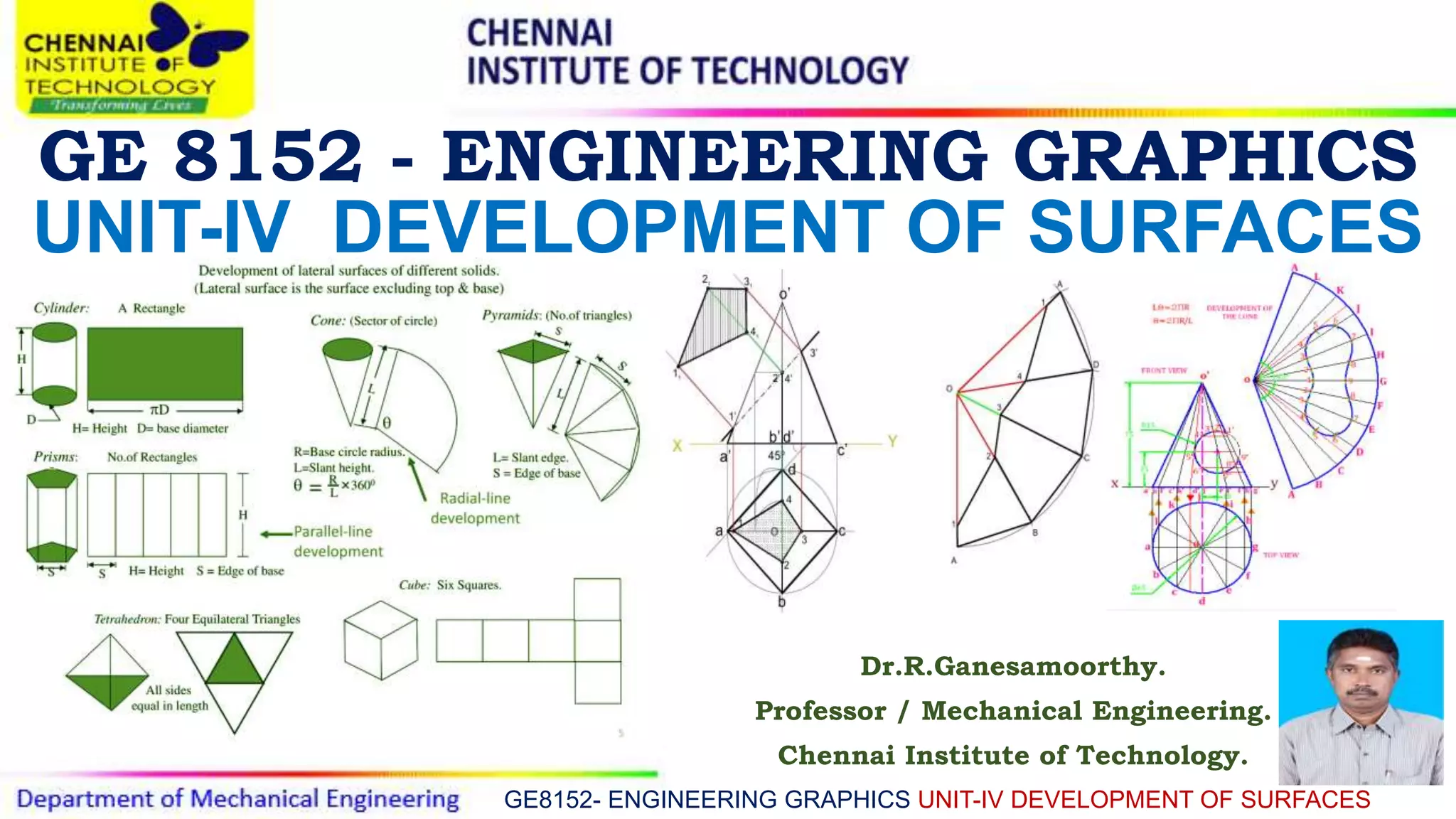
GE 8152 - ENGINEERING GRAPHICS
Dr.R.Ganesamoorthy.
Professor / Mechanical Engineering.
Chennai Institute of Technology.
GE8152- ENGINEERING GRAPHICS UNIT-IV DEVELOPMENT OF SURFACES
UNIT-IV DEVELOPMENT OF SURFACES
GE8152- ENGINEERING GRAPHICS UNIT-IV DEVELOPMENT OF SURFACES
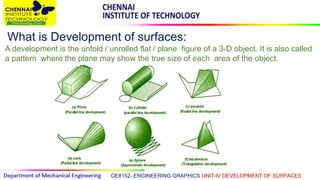
What is Development of surfaces:
A development is the unfold / unrolled flat / plane figure of a 3-D object. It is also called
a pattern where the plane may show the true size of each area of the object.
GE8152- ENGINEERING GRAPHICS UNIT-IV DEVELOPMENT OF SURFACES
Principle &Objectives:
Principle of Development:
Every line on the development should show the true length of the corresponding line
on the surface which is developed.
Objective:
To learn methods of development of surfaces of different solids, their sections and
frustums.
GE8152- ENGINEERING GRAPHICS UNIT-IV DEVELOPMENT OF SURFACES
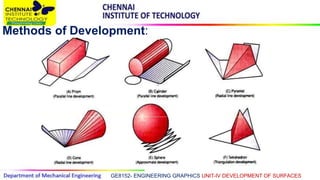
Methods of Development:
The method to be followed for making the development of a solid depends upon the
nature of its lateral surfaces. Based on the classification of solids, the following are
the methods of development.
1. Parallel-line Development
It is used for developing prisms and single curved surfaces like cylinders/prism in
which all the edges / generators of lateral surfaces are parallel to each other.
GE8152- ENGINEERING GRAPHICS UNIT-IV DEVELOPMENT OF SURFACES
Methods of Development:
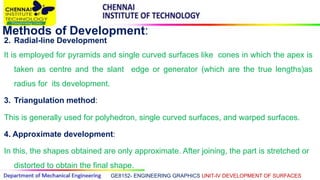
2. Radial-line Development
It is employed for pyramids and single curved surfaces like cones in which the apex is
taken as centre and the slant edge or generator (which are the true lengths)as
radius for its development.
3. Triangulation method:
This is generally used for polyhedron, single curved surfaces, and warped surfaces.
4. Approximate development:
In this, the shapes obtained are only approximate. After joining, the part is stretched or
distorted to obtain the final shape.
GE8152- ENGINEERING GRAPHICS UNIT-IV DEVELOPMENT OF SURFACES
Methods of Development:
GE8152- ENGINEERING GRAPHICS UNIT-IV DEVELOPMENT OF SURFACES
Parallel-line Developments:
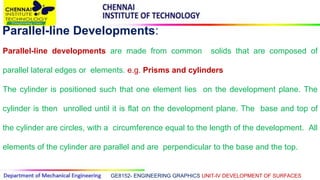
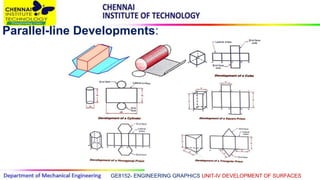
Parallel-line developments are made from common solids that are composed of
parallel lateral edges or elements. e.g. Prisms and cylinders
The cylinder is positioned such that one element lies on the development plane. The
cylinder is then unrolled until it is flat on the development plane. The base and top of
the cylinder are circles, with a circumference equal to the length of the development. All
elements of the cylinder are parallel and are perpendicular to the base and the top.
GE8152- ENGINEERING GRAPHICS UNIT-IV DEVELOPMENT OF SURFACES
Parallel-line Developments:
GE8152- ENGINEERING GRAPHICS UNIT-IV DEVELOPMENT OF SURFACES
Radial-line developments:
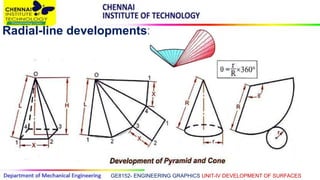
Radial-line developments are made from figures such as cones and pyramids. In the
development, all the elements of the figure become radial lines that have the vertex as
their origin.
The cone is positioned such that one element lies on the development plane. The cone
is then unrolled until it is flat on the development plane. One end of all the elements is
at the vertex of the cone. The other ends describe a curved line.
The base of the cone is a circle, with a circumference equal to the length of the curved
line.
GE8152- ENGINEERING GRAPHICS UNIT-IV DEVELOPMENT OF SURFACES
Radial-line developments:
GE8152- ENGINEERING GRAPHICS UNIT-IV DEVELOPMENT OF SURFACES
Triangulation developments:
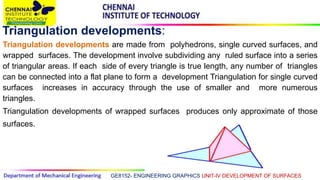
Triangulation developments are made from polyhedrons, single curved surfaces, and
wrapped surfaces. The development involve subdividing any ruled surface into a series
of triangular areas. If each side of every triangle is true length, any number of triangles
can be connected into a flat plane to form a development Triangulation for single curved
surfaces increases in accuracy through the use of smaller and more numerous
triangles.
Triangulation developments of wrapped surfaces produces only approximate of those
surfaces.
GE8152- ENGINEERING GRAPHICS UNIT-IV DEVELOPMENT OF SURFACES
Approximate developments:
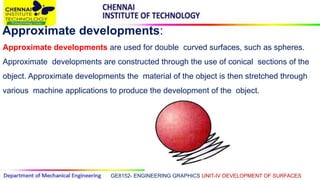
Approximate developments are used for double curved surfaces, such as spheres.
Approximate developments are constructed through the use of conical sections of the
object. Approximate developments the material of the object is then stretched through
various machine applications to produce the development of the object.
GE8152- ENGINEERING GRAPHICS UNIT-IV DEVELOPMENT OF SURFACES
Development of surfaces – Prism Problems:
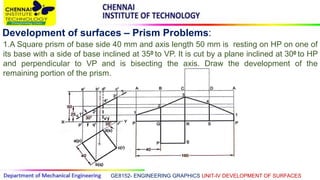
1.A Square prism of base side 40 mm and axis length 50 mm is resting on HP on one of
its base with a side of base inclined at 350 to VP. It is cut by a plane inclined at 300 to HP
and perpendicular to VP and is bisecting the axis. Draw the development of the
remaining portion of the prism.
GE8152- ENGINEERING GRAPHICS UNIT-IV DEVELOPMENT OF SURFACES
Development of surfaces – Prism Problems:
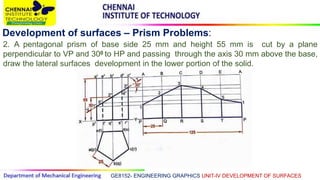
2. A pentagonal prism of base side 25 mm and height 55 mm is cut by a plane
perpendicular to VP and 300 to HP and passing through the axis 30 mm above the base,
draw the lateral surfaces development in the lower portion of the solid.
GE8152- ENGINEERING GRAPHICS UNIT-IV DEVELOPMENT OF SURFACES
Development of surfaces – Prism Problems:
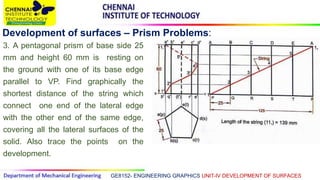
3. A pentagonal prism of base side 25
mm and height 60 mm is resting on
the ground with one of its base edge
parallel to VP. Find graphically the
shortest distance of the string which
connect one end of the lateral edge
with the other end of the same edge,
covering all the lateral surfaces of the
solid. Also trace the points on the
development.
GE8152- ENGINEERING GRAPHICS UNIT-IV DEVELOPMENT OF SURFACES
Development of surfaces – Prism Problems:
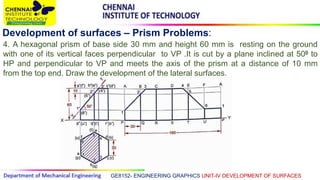
4. A hexagonal prism of base side 30 mm and height 60 mm is resting on the ground
with one of its vertical faces perpendicular to VP .It is cut by a plane inclined at 500 to
HP and perpendicular to VP and meets the axis of the prism at a distance of 10 mm
from the top end. Draw the development of the lateral surfaces.
GE8152- ENGINEERING GRAPHICS UNIT-IV DEVELOPMENT OF SURFACES
Development of surfaces – Cylinder Problems:
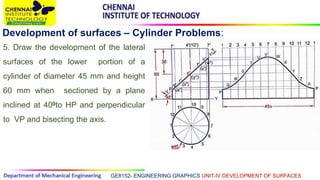
5. Draw the development of the lateral
surfaces of the lower portion of a
cylinder of diameter 45 mm and height
60 mm when sectioned by a plane
inclined at 400to HP and perpendicular
to VP and bisecting the axis.
GE8152- ENGINEERING GRAPHICS UNIT-IV DEVELOPMENT OF SURFACES
Development of surfaces – Cylinder Problems:
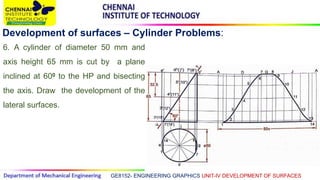
6. A cylinder of diameter 50 mm and
axis height 65 mm is cut by a plane
inclined at 600 to the HP and bisecting
the axis. Draw the development of the
lateral surfaces.
GE8152- ENGINEERING GRAPHICS UNIT-IV DEVELOPMENT OF SURFACES
Development of surfaces – Prism Problems:
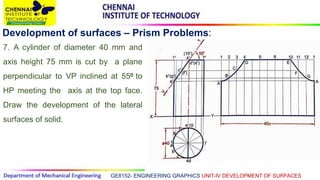
7. A cylinder of diameter 40 mm and
axis height 75 mm is cut by a plane
perpendicular to VP inclined at 550 to
HP meeting the axis at the top face.
Draw the development of the lateral
surfaces of solid.
GE8152- ENGINEERING GRAPHICS UNIT-IV DEVELOPMENT OF SURFACES
Development of surfaces – Pyramids Problems:
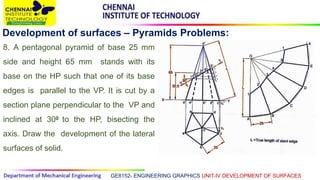
8. A pentagonal pyramid of base 25 mm
side and height 65 mm stands with its
base on the HP such that one of its base
edges is parallel to the VP. It is cut by a
section plane perpendicular to the VP and
inclined at 300 to the HP, bisecting the
axis. Draw the development of the lateral
surfaces of solid.
GE8152- ENGINEERING GRAPHICS UNIT-IV DEVELOPMENT OF SURFACES
Development of surfaces – Pyramids Problems:
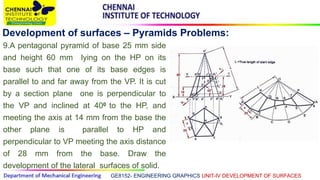
9.A pentagonal pyramid of base 25 mm side
and height 60 mm lying on the HP on its
base such that one of its base edges is
parallel to and far away from the VP. It is cut
by a section plane one is perpendicular to
the VP and inclined at 400 to the HP, and
meeting the axis at 14 mm from the base the
other plane is parallel to HP and
perpendicular to VP meeting the axis distance
of 28 mm from the base. Draw the
development of the lateral surfaces of solid.
GE8152- ENGINEERING GRAPHICS UNIT-IV DEVELOPMENT OF SURFACES
Development of surfaces – Pyramids Problems:
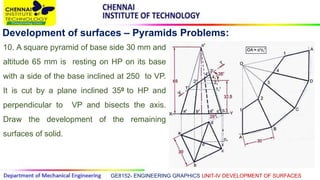
10. A square pyramid of base side 30 mm and
altitude 65 mm is resting on HP on its base
with a side of the base inclined at 250 to VP.
It is cut by a plane inclined 350 to HP and
perpendicular to VP and bisects the axis.
Draw the development of the remaining
surfaces of solid.
GE8152- ENGINEERING GRAPHICS UNIT-IV DEVELOPMENT OF SURFACES
Development of surfaces – Pyramids Problems:
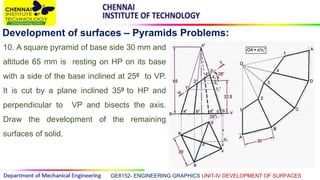
10. A square pyramid of base side 30 mm and
altitude 65 mm is resting on HP on its base
with a side of the base inclined at 250 to VP.
It is cut by a plane inclined 350 to HP and
perpendicular to VP and bisects the axis.
Draw the development of the remaining
surfaces of solid.
GE8152- ENGINEERING GRAPHICS UNIT-IV DEVELOPMENT OF SURFACES
Development of surfaces – Pyramids Problems:
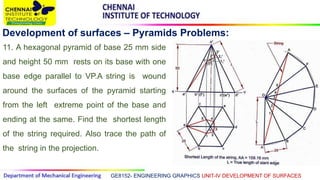
11. A hexagonal pyramid of base 25 mm side
and height 50 mm rests on its base with one
base edge parallel to VP.A string is wound
around the surfaces of the pyramid starting
from the left extreme point of the base and
ending at the same. Find the shortest length
of the string required. Also trace the path of
the string in the projection.
GE8152- ENGINEERING GRAPHICS UNIT-IV DEVELOPMENT OF SURFACES
Development of surfaces – Pyramids Problems:
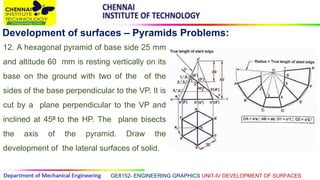
12. A hexagonal pyramid of base side 25 mm
and altitude 60 mm is resting vertically on its
base on the ground with two of the of the
sides of the base perpendicular to the VP. It is
cut by a plane perpendicular to the VP and
inclined at 450 to the HP. The plane bisects
the axis of the pyramid. Draw the
development of the lateral surfaces of solid.
GE8152- ENGINEERING GRAPHICS UNIT-IV DEVELOPMENT OF SURFACES
Development of surfaces – Pyramids Problems:
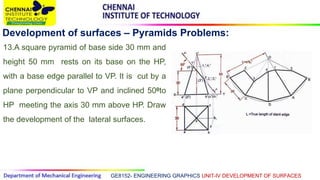
13.A square pyramid of base side 30 mm and
height 50 mm rests on its base on the HP,
with a base edge parallel to VP. It is cut by a
plane perpendicular to VP and inclined 500to
HP meeting the axis 30 mm above HP. Draw
the development of the lateral surfaces.
GE8152- ENGINEERING GRAPHICS UNIT-IV DEVELOPMENT OF SURFACES
Development of surfaces – Pyramids Problems:
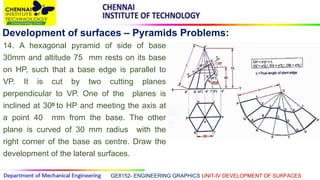
14. A hexagonal pyramid of side of base
30mm and altitude 75 mm rests on its base
on HP, such that a base edge is parallel to
VP. It is cut by two cutting planes
perpendicular to VP. One of the planes is
inclined at 300 to HP and meeting the axis at
a point 40 mm from the base. The other
plane is curved of 30 mm radius with the
right corner of the base as centre. Draw the
development of the lateral surfaces.
GE8152- ENGINEERING GRAPHICS UNIT-IV DEVELOPMENT OF SURFACES
Development of surfaces – Pyramids Problems:
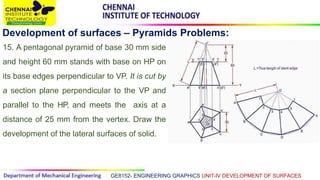
15. A pentagonal pyramid of base 30 mm side
and height 60 mm stands with base on HP on
its base edges perpendicular to VP. It is cut by
a section plane perpendicular to the VP and
parallel to the HP, and meets the axis at a
distance of 25 mm from the vertex. Draw the
development of the lateral surfaces of solid.
GE8152- ENGINEERING GRAPHICS UNIT-IV DEVELOPMENT OF SURFACES
Development of surfaces – Pyramids Problems:
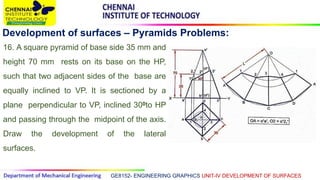
16. A square pyramid of base side 35 mm and
height 70 mm rests on its base on the HP,
such that two adjacent sides of the base are
equally inclined to VP. It is sectioned by a
plane perpendicular to VP, inclined 300to HP
and passing through the midpoint of the axis.
Draw the development of the lateral
surfaces.
GE8152- ENGINEERING GRAPHICS UNIT-IV DEVELOPMENT OF SURFACES
Development of surfaces – Pyramids Problems:
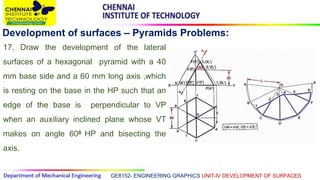
17. Draw the development of the lateral
surfaces of a hexagonal pyramid with a 40
mm base side and a 60 mm long axis ,which
is resting on the base in the HP such that an
edge of the base is perpendicular to VP
when an auxiliary inclined plane whose VT
makes on angle 600 HP and bisecting the
axis.
GE8152- ENGINEERING GRAPHICS UNIT-IV DEVELOPMENT OF SURFACES
Development of surfaces - Cone Problems:
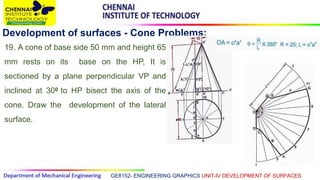
19. A cone of base side 50 mm and height 65
mm rests on its base on the HP, It is
sectioned by a plane perpendicular VP and
inclined at 300 to HP bisect the axis of the
cone. Draw the development of the lateral
surface.
GE8152- ENGINEERING GRAPHICS UNIT-IV DEVELOPMENT OF SURFACES
Development of surfaces - Cone Problems:
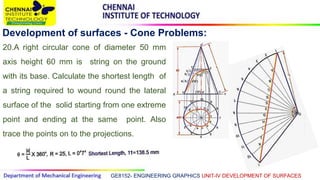
20.A right circular cone of diameter 50 mm
axis height 60 mm is string on the ground
with its base. Calculate the shortest length of
a string required to wound round the lateral
surface of the solid starting from one extreme
point and ending at the same point. Also
trace the points on to the projections.
GE8152- ENGINEERING GRAPHICS UNIT-IV DEVELOPMENT OF SURFACES
Development of surfaces - Cone Problems:
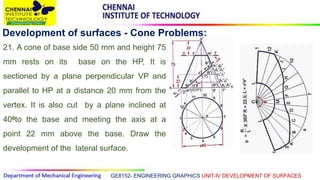
21. A cone of base side 50 mm and height 75
mm rests on its base on the HP, It is
sectioned by a plane perpendicular VP and
parallel to HP at a distance 20 mm from the
vertex. It is also cut by a plane inclined at
400to the base and meeting the axis at a
point 22 mm above the base. Draw the
development of the lateral surface.
GE8152- ENGINEERING GRAPHICS UNIT-IV DEVELOPMENT OF SURFACES
Development of surfaces - Cone Problems:
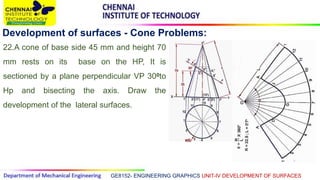
22.A cone of base side 45 mm and height 70
mm rests on its base on the HP, It is
sectioned by a plane perpendicular VP 300to
Hp and bisecting the axis. Draw the
development of the lateral surfaces.
GE8152- ENGINEERING GRAPHICS UNIT-IV DEVELOPMENT OF SURFACES
Development of surfaces - Cone Problems:
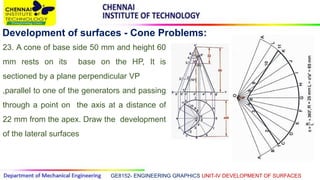
23. A cone of base side 50 mm and height 60
mm rests on its base on the HP, It is
sectioned by a plane perpendicular VP
,parallel to one of the generators and passing
through a point on the axis at a distance of
22 mm from the apex. Draw the development
of the lateral surfaces
GE8152- ENGINEERING GRAPHICS UNIT-IV DEVELOPMENT OF SURFACES
Development of surfaces - Cone Problems:
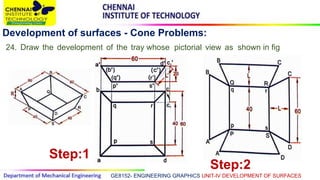
24. Draw the development of the tray whose pictorial view as shown in fig
Step:1
Step:2
GE8152- ENGINEERING GRAPHICS UNIT-IV DEVELOPMENT OF SURFACES
Development of surfaces - Cone Problems:
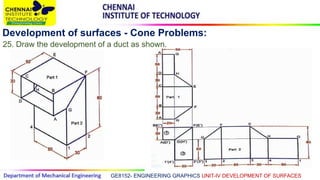
25. Draw the development of a duct as shown.
GE8152- ENGINEERING GRAPHICS UNIT-IV DEVELOPMENT OF SURFACES
Development of surfaces - Cone Problems:
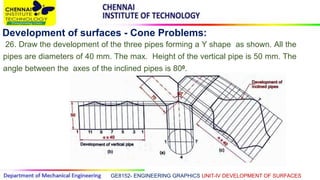
26. Draw the development of the three pipes forming a Y shape as shown. All the
pipes are diameters of 40 mm. The max. Height of the vertical pipe is 50 mm. The
angle between the axes of the inclined pipes is 800.
GE8152- ENGINEERING GRAPHICS UNIT-IV DEVELOPMENT OF SURFACES
Development of surfaces - Cone Problems:
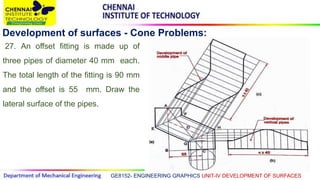
27. An offset fitting is made up of
three pipes of diameter 40 mm each.
The total length of the fitting is 90 mm
and the offset is 55 mm. Draw the
lateral surface of the pipes.
GE8152- ENGINEERING GRAPHICS UNIT-IV DEVELOPMENT OF SURFACES
Development of surfaces - Cone Problems:
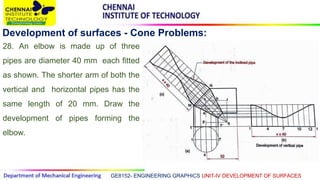
28. An elbow is made up of three
pipes are diameter 40 mm each fitted
as shown. The shorter arm of both the
vertical and horizontal pipes has the
same length of 20 mm. Draw the
development of pipes forming the
elbow.
GE8152- ENGINEERING GRAPHICS UNIT-IV DEVELOPMENT OF SURFACES
Development of surfaces - Cone Problems:
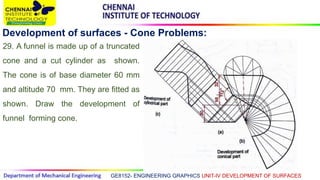
29. A funnel is made up of a truncated
cone and a cut cylinder as shown.
The cone is of base diameter 60 mm
and altitude 70 mm. They are fitted as
shown. Draw the development of
funnel forming cone.
GE8152- ENGINEERING GRAPHICS UNIT-IV SECTION OF SOLIDS

EG UNIT-IV DEVELOPEMENT OF SURFACES.ppt

  • 1.
    GE 8152 -ENGINEERING GRAPHICS Dr.R.Ganesamoorthy. Professor / Mechanical Engineering. Chennai Institute of Technology. GE8152- ENGINEERING GRAPHICS UNIT-IV DEVELOPMENT OF SURFACES UNIT-IV DEVELOPMENT OF SURFACES
  • 2.
    GE8152- ENGINEERING GRAPHICSUNIT-IV DEVELOPMENT OF SURFACES What is Development of surfaces: A development is the unfold / unrolled flat / plane figure of a 3-D object. It is also called a pattern where the plane may show the true size of each area of the object.
  • 3.
    GE8152- ENGINEERING GRAPHICSUNIT-IV DEVELOPMENT OF SURFACES Principle &Objectives: Principle of Development: Every line on the development should show the true length of the corresponding line on the surface which is developed. Objective: To learn methods of development of surfaces of different solids, their sections and frustums.
  • 4.
    GE8152- ENGINEERING GRAPHICSUNIT-IV DEVELOPMENT OF SURFACES Methods of Development: The method to be followed for making the development of a solid depends upon the nature of its lateral surfaces. Based on the classification of solids, the following are the methods of development. 1. Parallel-line Development It is used for developing prisms and single curved surfaces like cylinders/prism in which all the edges / generators of lateral surfaces are parallel to each other.
  • 5.
    GE8152- ENGINEERING GRAPHICSUNIT-IV DEVELOPMENT OF SURFACES Methods of Development: 2. Radial-line Development It is employed for pyramids and single curved surfaces like cones in which the apex is taken as centre and the slant edge or generator (which are the true lengths)as radius for its development. 3. Triangulation method: This is generally used for polyhedron, single curved surfaces, and warped surfaces. 4. Approximate development: In this, the shapes obtained are only approximate. After joining, the part is stretched or distorted to obtain the final shape.
  • 6.
    GE8152- ENGINEERING GRAPHICSUNIT-IV DEVELOPMENT OF SURFACES Methods of Development:
  • 7.
    GE8152- ENGINEERING GRAPHICSUNIT-IV DEVELOPMENT OF SURFACES Parallel-line Developments: Parallel-line developments are made from common solids that are composed of parallel lateral edges or elements. e.g. Prisms and cylinders The cylinder is positioned such that one element lies on the development plane. The cylinder is then unrolled until it is flat on the development plane. The base and top of the cylinder are circles, with a circumference equal to the length of the development. All elements of the cylinder are parallel and are perpendicular to the base and the top.
  • 8.
    GE8152- ENGINEERING GRAPHICSUNIT-IV DEVELOPMENT OF SURFACES Parallel-line Developments:
  • 9.
    GE8152- ENGINEERING GRAPHICSUNIT-IV DEVELOPMENT OF SURFACES Radial-line developments: Radial-line developments are made from figures such as cones and pyramids. In the development, all the elements of the figure become radial lines that have the vertex as their origin. The cone is positioned such that one element lies on the development plane. The cone is then unrolled until it is flat on the development plane. One end of all the elements is at the vertex of the cone. The other ends describe a curved line. The base of the cone is a circle, with a circumference equal to the length of the curved line.
  • 10.
    GE8152- ENGINEERING GRAPHICSUNIT-IV DEVELOPMENT OF SURFACES Radial-line developments:
  • 11.
    GE8152- ENGINEERING GRAPHICSUNIT-IV DEVELOPMENT OF SURFACES Triangulation developments: Triangulation developments are made from polyhedrons, single curved surfaces, and wrapped surfaces. The development involve subdividing any ruled surface into a series of triangular areas. If each side of every triangle is true length, any number of triangles can be connected into a flat plane to form a development Triangulation for single curved surfaces increases in accuracy through the use of smaller and more numerous triangles. Triangulation developments of wrapped surfaces produces only approximate of those surfaces.
  • 12.
    GE8152- ENGINEERING GRAPHICSUNIT-IV DEVELOPMENT OF SURFACES Approximate developments: Approximate developments are used for double curved surfaces, such as spheres. Approximate developments are constructed through the use of conical sections of the object. Approximate developments the material of the object is then stretched through various machine applications to produce the development of the object.
  • 13.
    GE8152- ENGINEERING GRAPHICSUNIT-IV DEVELOPMENT OF SURFACES Development of surfaces – Prism Problems: 1.A Square prism of base side 40 mm and axis length 50 mm is resting on HP on one of its base with a side of base inclined at 350 to VP. It is cut by a plane inclined at 300 to HP and perpendicular to VP and is bisecting the axis. Draw the development of the remaining portion of the prism.
  • 14.
    GE8152- ENGINEERING GRAPHICSUNIT-IV DEVELOPMENT OF SURFACES Development of surfaces – Prism Problems: 2. A pentagonal prism of base side 25 mm and height 55 mm is cut by a plane perpendicular to VP and 300 to HP and passing through the axis 30 mm above the base, draw the lateral surfaces development in the lower portion of the solid.
  • 15.
    GE8152- ENGINEERING GRAPHICSUNIT-IV DEVELOPMENT OF SURFACES Development of surfaces – Prism Problems: 3. A pentagonal prism of base side 25 mm and height 60 mm is resting on the ground with one of its base edge parallel to VP. Find graphically the shortest distance of the string which connect one end of the lateral edge with the other end of the same edge, covering all the lateral surfaces of the solid. Also trace the points on the development.
  • 16.
    GE8152- ENGINEERING GRAPHICSUNIT-IV DEVELOPMENT OF SURFACES Development of surfaces – Prism Problems: 4. A hexagonal prism of base side 30 mm and height 60 mm is resting on the ground with one of its vertical faces perpendicular to VP .It is cut by a plane inclined at 500 to HP and perpendicular to VP and meets the axis of the prism at a distance of 10 mm from the top end. Draw the development of the lateral surfaces.
  • 17.
    GE8152- ENGINEERING GRAPHICSUNIT-IV DEVELOPMENT OF SURFACES Development of surfaces – Cylinder Problems: 5. Draw the development of the lateral surfaces of the lower portion of a cylinder of diameter 45 mm and height 60 mm when sectioned by a plane inclined at 400to HP and perpendicular to VP and bisecting the axis.
  • 18.
    GE8152- ENGINEERING GRAPHICSUNIT-IV DEVELOPMENT OF SURFACES Development of surfaces – Cylinder Problems: 6. A cylinder of diameter 50 mm and axis height 65 mm is cut by a plane inclined at 600 to the HP and bisecting the axis. Draw the development of the lateral surfaces.
  • 19.
    GE8152- ENGINEERING GRAPHICSUNIT-IV DEVELOPMENT OF SURFACES Development of surfaces – Prism Problems: 7. A cylinder of diameter 40 mm and axis height 75 mm is cut by a plane perpendicular to VP inclined at 550 to HP meeting the axis at the top face. Draw the development of the lateral surfaces of solid.
  • 20.
    GE8152- ENGINEERING GRAPHICSUNIT-IV DEVELOPMENT OF SURFACES Development of surfaces – Pyramids Problems: 8. A pentagonal pyramid of base 25 mm side and height 65 mm stands with its base on the HP such that one of its base edges is parallel to the VP. It is cut by a section plane perpendicular to the VP and inclined at 300 to the HP, bisecting the axis. Draw the development of the lateral surfaces of solid.
  • 21.
    GE8152- ENGINEERING GRAPHICSUNIT-IV DEVELOPMENT OF SURFACES Development of surfaces – Pyramids Problems: 9.A pentagonal pyramid of base 25 mm side and height 60 mm lying on the HP on its base such that one of its base edges is parallel to and far away from the VP. It is cut by a section plane one is perpendicular to the VP and inclined at 400 to the HP, and meeting the axis at 14 mm from the base the other plane is parallel to HP and perpendicular to VP meeting the axis distance of 28 mm from the base. Draw the development of the lateral surfaces of solid.
  • 22.
    GE8152- ENGINEERING GRAPHICSUNIT-IV DEVELOPMENT OF SURFACES Development of surfaces – Pyramids Problems: 10. A square pyramid of base side 30 mm and altitude 65 mm is resting on HP on its base with a side of the base inclined at 250 to VP. It is cut by a plane inclined 350 to HP and perpendicular to VP and bisects the axis. Draw the development of the remaining surfaces of solid.
  • 23.
    GE8152- ENGINEERING GRAPHICSUNIT-IV DEVELOPMENT OF SURFACES Development of surfaces – Pyramids Problems: 10. A square pyramid of base side 30 mm and altitude 65 mm is resting on HP on its base with a side of the base inclined at 250 to VP. It is cut by a plane inclined 350 to HP and perpendicular to VP and bisects the axis. Draw the development of the remaining surfaces of solid.
  • 24.
    GE8152- ENGINEERING GRAPHICSUNIT-IV DEVELOPMENT OF SURFACES Development of surfaces – Pyramids Problems: 11. A hexagonal pyramid of base 25 mm side and height 50 mm rests on its base with one base edge parallel to VP.A string is wound around the surfaces of the pyramid starting from the left extreme point of the base and ending at the same. Find the shortest length of the string required. Also trace the path of the string in the projection.
  • 25.
    GE8152- ENGINEERING GRAPHICSUNIT-IV DEVELOPMENT OF SURFACES Development of surfaces – Pyramids Problems: 12. A hexagonal pyramid of base side 25 mm and altitude 60 mm is resting vertically on its base on the ground with two of the of the sides of the base perpendicular to the VP. It is cut by a plane perpendicular to the VP and inclined at 450 to the HP. The plane bisects the axis of the pyramid. Draw the development of the lateral surfaces of solid.
  • 26.
    GE8152- ENGINEERING GRAPHICSUNIT-IV DEVELOPMENT OF SURFACES Development of surfaces – Pyramids Problems: 13.A square pyramid of base side 30 mm and height 50 mm rests on its base on the HP, with a base edge parallel to VP. It is cut by a plane perpendicular to VP and inclined 500to HP meeting the axis 30 mm above HP. Draw the development of the lateral surfaces.
  • 27.
    GE8152- ENGINEERING GRAPHICSUNIT-IV DEVELOPMENT OF SURFACES Development of surfaces – Pyramids Problems: 14. A hexagonal pyramid of side of base 30mm and altitude 75 mm rests on its base on HP, such that a base edge is parallel to VP. It is cut by two cutting planes perpendicular to VP. One of the planes is inclined at 300 to HP and meeting the axis at a point 40 mm from the base. The other plane is curved of 30 mm radius with the right corner of the base as centre. Draw the development of the lateral surfaces.
  • 28.
    GE8152- ENGINEERING GRAPHICSUNIT-IV DEVELOPMENT OF SURFACES Development of surfaces – Pyramids Problems: 15. A pentagonal pyramid of base 30 mm side and height 60 mm stands with base on HP on its base edges perpendicular to VP. It is cut by a section plane perpendicular to the VP and parallel to the HP, and meets the axis at a distance of 25 mm from the vertex. Draw the development of the lateral surfaces of solid.
  • 29.
    GE8152- ENGINEERING GRAPHICSUNIT-IV DEVELOPMENT OF SURFACES Development of surfaces – Pyramids Problems: 16. A square pyramid of base side 35 mm and height 70 mm rests on its base on the HP, such that two adjacent sides of the base are equally inclined to VP. It is sectioned by a plane perpendicular to VP, inclined 300to HP and passing through the midpoint of the axis. Draw the development of the lateral surfaces.
  • 30.
    GE8152- ENGINEERING GRAPHICSUNIT-IV DEVELOPMENT OF SURFACES Development of surfaces – Pyramids Problems: 17. Draw the development of the lateral surfaces of a hexagonal pyramid with a 40 mm base side and a 60 mm long axis ,which is resting on the base in the HP such that an edge of the base is perpendicular to VP when an auxiliary inclined plane whose VT makes on angle 600 HP and bisecting the axis.
  • 31.
    GE8152- ENGINEERING GRAPHICSUNIT-IV DEVELOPMENT OF SURFACES Development of surfaces - Cone Problems: 19. A cone of base side 50 mm and height 65 mm rests on its base on the HP, It is sectioned by a plane perpendicular VP and inclined at 300 to HP bisect the axis of the cone. Draw the development of the lateral surface.
  • 32.
    GE8152- ENGINEERING GRAPHICSUNIT-IV DEVELOPMENT OF SURFACES Development of surfaces - Cone Problems: 20.A right circular cone of diameter 50 mm axis height 60 mm is string on the ground with its base. Calculate the shortest length of a string required to wound round the lateral surface of the solid starting from one extreme point and ending at the same point. Also trace the points on to the projections.
  • 33.
    GE8152- ENGINEERING GRAPHICSUNIT-IV DEVELOPMENT OF SURFACES Development of surfaces - Cone Problems: 21. A cone of base side 50 mm and height 75 mm rests on its base on the HP, It is sectioned by a plane perpendicular VP and parallel to HP at a distance 20 mm from the vertex. It is also cut by a plane inclined at 400to the base and meeting the axis at a point 22 mm above the base. Draw the development of the lateral surface.
  • 34.
    GE8152- ENGINEERING GRAPHICSUNIT-IV DEVELOPMENT OF SURFACES Development of surfaces - Cone Problems: 22.A cone of base side 45 mm and height 70 mm rests on its base on the HP, It is sectioned by a plane perpendicular VP 300to Hp and bisecting the axis. Draw the development of the lateral surfaces.
  • 35.
    GE8152- ENGINEERING GRAPHICSUNIT-IV DEVELOPMENT OF SURFACES Development of surfaces - Cone Problems: 23. A cone of base side 50 mm and height 60 mm rests on its base on the HP, It is sectioned by a plane perpendicular VP ,parallel to one of the generators and passing through a point on the axis at a distance of 22 mm from the apex. Draw the development of the lateral surfaces
  • 36.
    GE8152- ENGINEERING GRAPHICSUNIT-IV DEVELOPMENT OF SURFACES Development of surfaces - Cone Problems: 24. Draw the development of the tray whose pictorial view as shown in fig Step:1 Step:2
  • 37.
    GE8152- ENGINEERING GRAPHICSUNIT-IV DEVELOPMENT OF SURFACES Development of surfaces - Cone Problems: 25. Draw the development of a duct as shown.
  • 38.
    GE8152- ENGINEERING GRAPHICSUNIT-IV DEVELOPMENT OF SURFACES Development of surfaces - Cone Problems: 26. Draw the development of the three pipes forming a Y shape as shown. All the pipes are diameters of 40 mm. The max. Height of the vertical pipe is 50 mm. The angle between the axes of the inclined pipes is 800.
  • 39.
    GE8152- ENGINEERING GRAPHICSUNIT-IV DEVELOPMENT OF SURFACES Development of surfaces - Cone Problems: 27. An offset fitting is made up of three pipes of diameter 40 mm each. The total length of the fitting is 90 mm and the offset is 55 mm. Draw the lateral surface of the pipes.
  • 40.
    GE8152- ENGINEERING GRAPHICSUNIT-IV DEVELOPMENT OF SURFACES Development of surfaces - Cone Problems: 28. An elbow is made up of three pipes are diameter 40 mm each fitted as shown. The shorter arm of both the vertical and horizontal pipes has the same length of 20 mm. Draw the development of pipes forming the elbow.
  • 41.
    GE8152- ENGINEERING GRAPHICSUNIT-IV DEVELOPMENT OF SURFACES Development of surfaces - Cone Problems: 29. A funnel is made up of a truncated cone and a cut cylinder as shown. The cone is of base diameter 60 mm and altitude 70 mm. They are fitted as shown. Draw the development of funnel forming cone.
  • 42.
    GE8152- ENGINEERING GRAPHICSUNIT-IV SECTION OF SOLIDS