SOLIDS
       To understand and remember various solids in this subject properly,
             those are classified & arranged in to two major groups.
                  Group A                                      Group B
  Solids having top and base of same shape         Solids having base of some shape
                                                  and just a point as a top, called
                                                  apex.

    Cylinder                                              Cone


                      Prisms                                     Pyramids


Triangular    Square     Pentagonal Hexagonal   Triangular   Square       Pentagonal Hexagonal

      Cube                                        Tetrahedron
  ( A solid having                                  ( A solid having
  six square faces)                              Four triangular faces)
SOLIDS
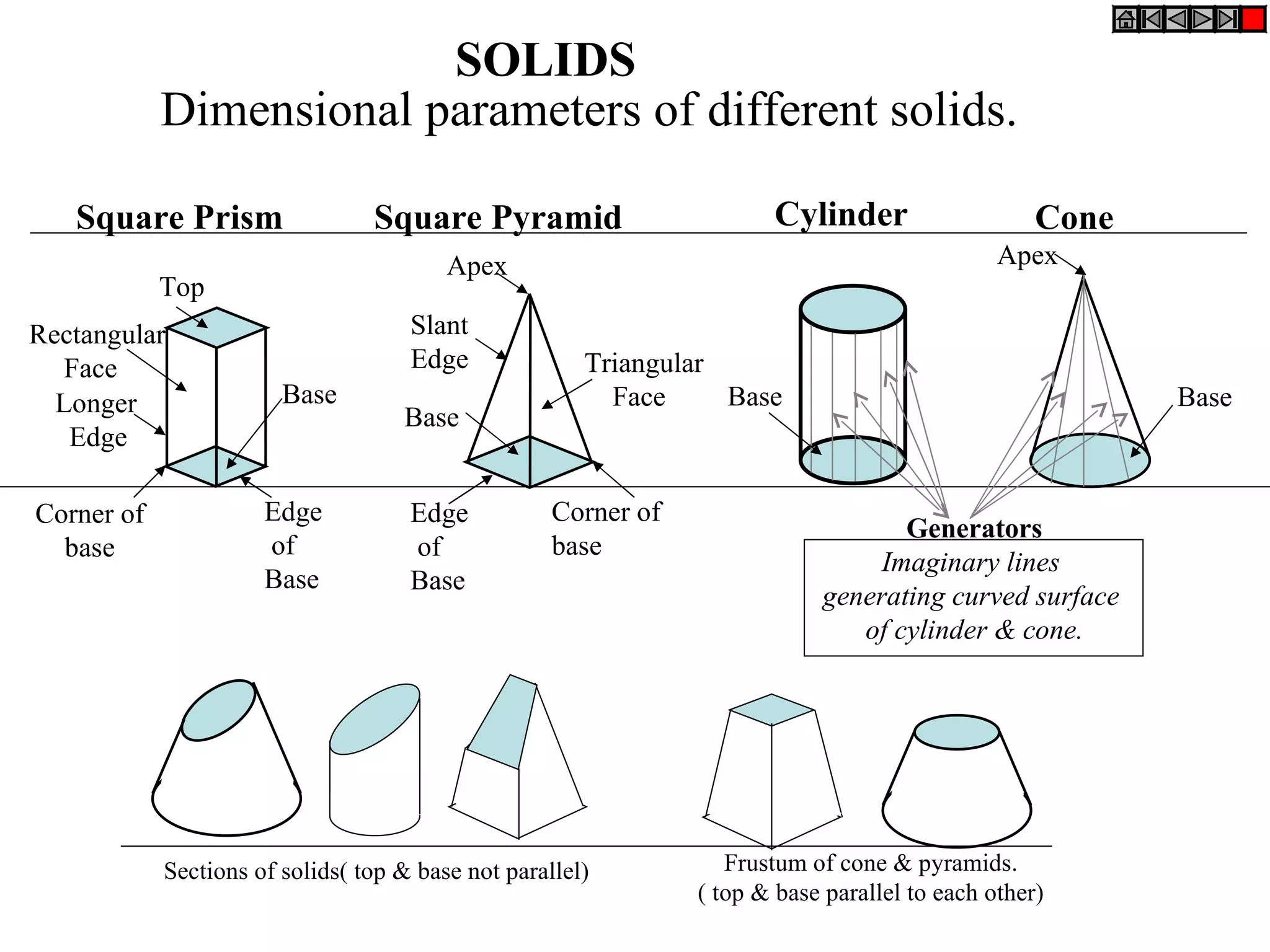
            Dimensional parameters of different solids.

   Square Prism                  Square Pyramid                        Cylinder                    Cone
                                         Apex                                                  Apex
            Top
Rectangular                          Slant
   Face                              Edge              Triangular
  Longer                Base                             Face     Base                                    Base
                                    Base
   Edge

Corner of             Edge           Edge           Corner of
                                                                                   Generators
  base                of             of             base
                                                                                 Imaginary lines
                      Base           Base
                                                                            generating curved surface
                                                                               of cylinder & cone.


            Sections of solids( top & base not parallel)           Frustum of cone & pyramids.
                                                                ( top & base parallel to each other)
STANDING ON H.P              RESTING ON H.P                   LYING ON H.P
             On it’s base.         On one point of base circle.       On one generator.
       (Axis perpendicular to Hp     (Axis inclined to Hp            (Axis inclined to Hp
             And // to Vp.)             And // to Vp)                   And // to Vp)


       F.V.                 F.V.                                  F.V.


X                                                                                           Y
    While observing Fv, x-y line represents Horizontal Plane. (Hp)


X   While observing Tv, x-y line represents Vertical Plane. (Vp)                            Y


       T.V.                 T.V.                                  T.V.

         STANDING ON V.P            RESTING ON V.P                    LYING ON V.P
             On it’s base.       On one point of base circle.        On one generator.
        Axis perpendicular to Vp    Axis inclined to Vp              Axis inclined to Vp
              And // to Hp              And // to Hp                    And // to Hp
STEPS TO SOLVE PROBLEMS IN SOLIDS
                                    Problem is solved in three steps:
      STEP 1: ASSUME SOLID STANDING ON THE PLANE WITH WHICH IT IS MAKING INCLINATION.
      ( IF IT IS INCLINED TO HP, ASSUME IT STANDING ON HP)
      ( IF IT IS INCLINED TO VP, ASSUME IT STANDING ON VP)
                   IF STANDING ON HP - IT’S TV WILL BE TRUE SHAPE OF IT’S BASE OR TOP:
                   IF STANDING ON VP - IT’S FV WILL BE TRUE SHAPE OF IT’S BASE OR TOP.
                   BEGIN WITH THIS VIEW:
               IT’S OTHER VIEW WILL BE A RECTANGLE ( IF SOLID IS CYLINDER OR ONE OF THE PRISMS):
               IT’S OTHER VIEW WILL BE A TRIANGLE ( IF SOLID IS CONE OR ONE OF THE PYRAMIDS):
                   DRAW FV & TV OF THAT SOLID IN STANDING POSITION:
      STEP 2: CONSIDERING SOLID’S INCLINATION ( AXIS POSITION ) DRAW IT’S FV & TV.
      STEP 3: IN LAST STEP, CONSIDERING REMAINING INCLINATION, DRAW IT’S FINAL FV & TV.

                                 GENERAL PATTERN ( THREE STEPS ) OF SOLUTION:
    GROUP B SOLID.                   GROUP A SOLID.                      GROUP B SOLID.                      GROUP A SOLID.
       CONE                            CYLINDER                             CONE                               CYLINDER
                                                                                          AXIS                                 AXIS
                                   AXIS      AXIS                                      INCLINED HP                          INCLINED HP
    AXIS      AXIS               VERTICAL INCLINED HP
  VERTICAL INCLINED HP


                                                                         er                                   er         AXIS
                     AXIS                                         AXIS    TO VP     AXIS
                                                       AXIS                                          AXIS      TO VP
                  INCLINED VP                                                     INCLINED                             INCLINED
                                                    INCLINED VP                      VP                                   VP


       Three steps                       Three steps                       Three steps                             Three steps
If solid is inclined to Hp        If solid is inclined to Hp        If solid is inclined to Vp              If solid is inclined to Vp
                   Study Next Twelve Problems and Practice them separately !!
CATEGORIES OF ILLUSTRATED PROBLEMS!

PROBLEM NO.1, 2, 3, 4   GENERAL CASES OF SOLIDS INCLINED TO HP & VP

PROBLEM NO. 5 & 6       CASES OF CUBE & TETRAHEDRON

PROBLEM NO. 7           CASE   OF FREELY SUSPENDED SOLID WITH SIDE VIEW.

PROBLEM NO. 8           CASE   OF CUBE ( WITH SIDE VIEW)

PROBLEM NO. 9           CASE   OF TRUE LENGTH INCLINATION WITH HP & VP.

PROBLEM NO. 10 & 11     CASES OF COMPOSITE SOLIDS. (AUXILIARY PLANE)

PROBLEM NO. 12          CASE   OF A FRUSTUM (AUXILIARY PLANE)
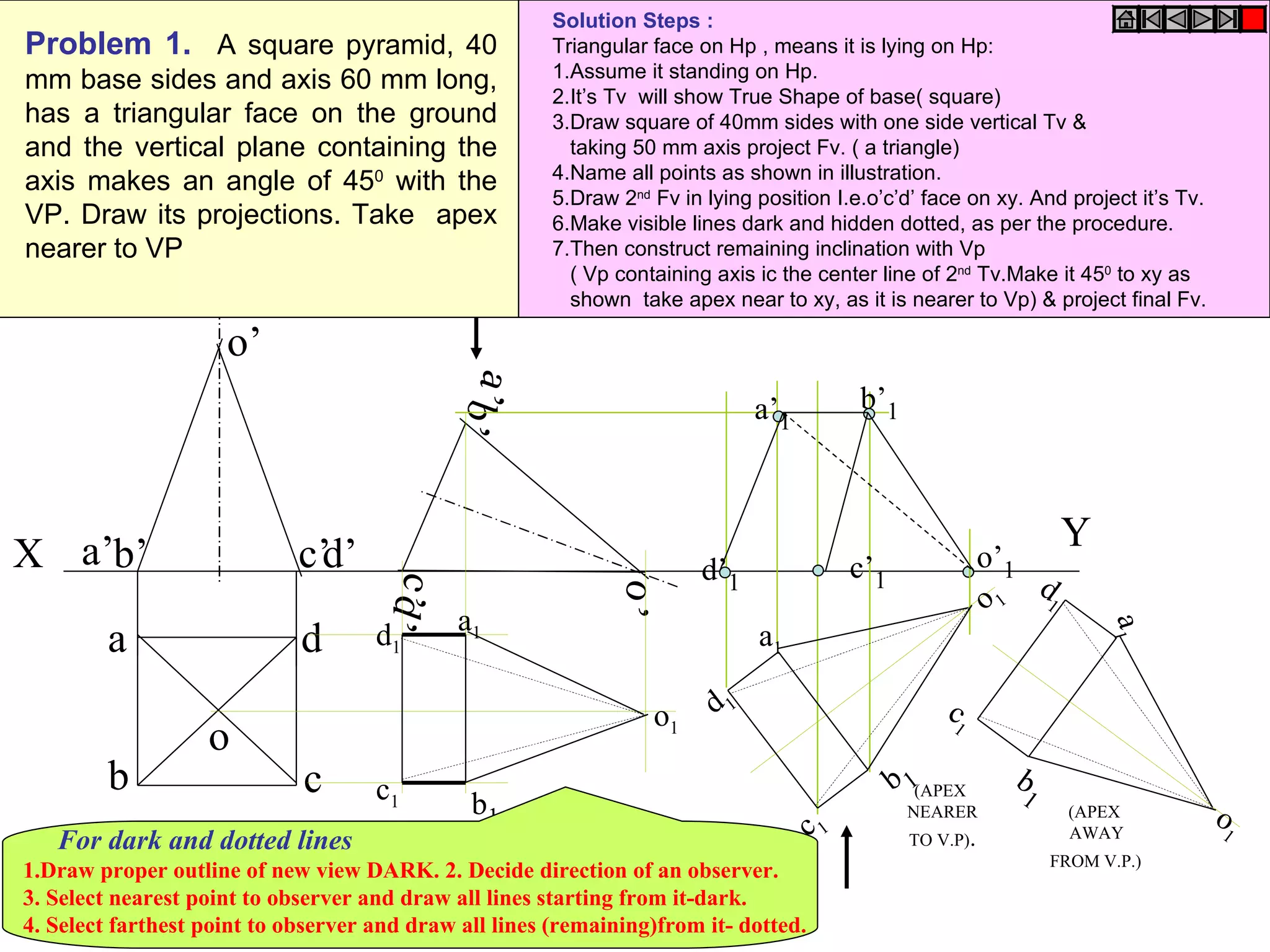
Solution Steps :
Problem 1. A square pyramid, 40                         Triangular face on Hp , means it is lying on Hp:
mm base sides and axis 60 mm long,                      1.Assume it standing on Hp.
                                                        2.It’s Tv will show True Shape of base( square)
has a triangular face on the ground                     3.Draw square of 40mm sides with one side vertical Tv &
and the vertical plane containing the                     taking 50 mm axis project Fv. ( a triangle)
axis makes an angle of 450 with the                     4.Name all points as shown in illustration.
                                                        5.Draw 2nd Fv in lying position I.e.o’c’d’ face on xy. And project it’s Tv.
VP. Draw its projections. Take apex                     6.Make visible lines dark and hidden dotted, as per the procedure.
nearer to VP                                            7.Then construct remaining inclination with Vp
                                                          ( Vp containing axis ic the center line of 2nd Tv.Make it 450 to xy as
                                                          shown take apex near to xy, as it is nearer to Vp) & project final Fv.

                     o’


                                             a’b’
                                                                               a’1         b’1


                                                                                                                    Y
X a’b’                       c’
                              d’                                         d’1              c’1               o’1
                                                                                                                d
                                      c’ ’


                                                               o’                                           o1 1
                                       d


                                              a1
        a                    d       d1


                                                                                                                        a1
                                                                               a1

                                                                   o1     d1                         c1
                   o
         b                   c       c1                                                         b 1(APEX      b
                                                                                                              1
                                               b1                                                NEARER             (APEX             o
   For dark and dotted lines                                                         c1          TO V.P).           AWAY              1
                                                                                                                  FROM V.P.)
1.Draw proper outline of new view DARK. 2. Decide direction of an observer.
3. Select nearest point to observer and draw all lines starting from it-dark.
4. Select farthest point to observer and draw all lines (remaining)from it- dotted.
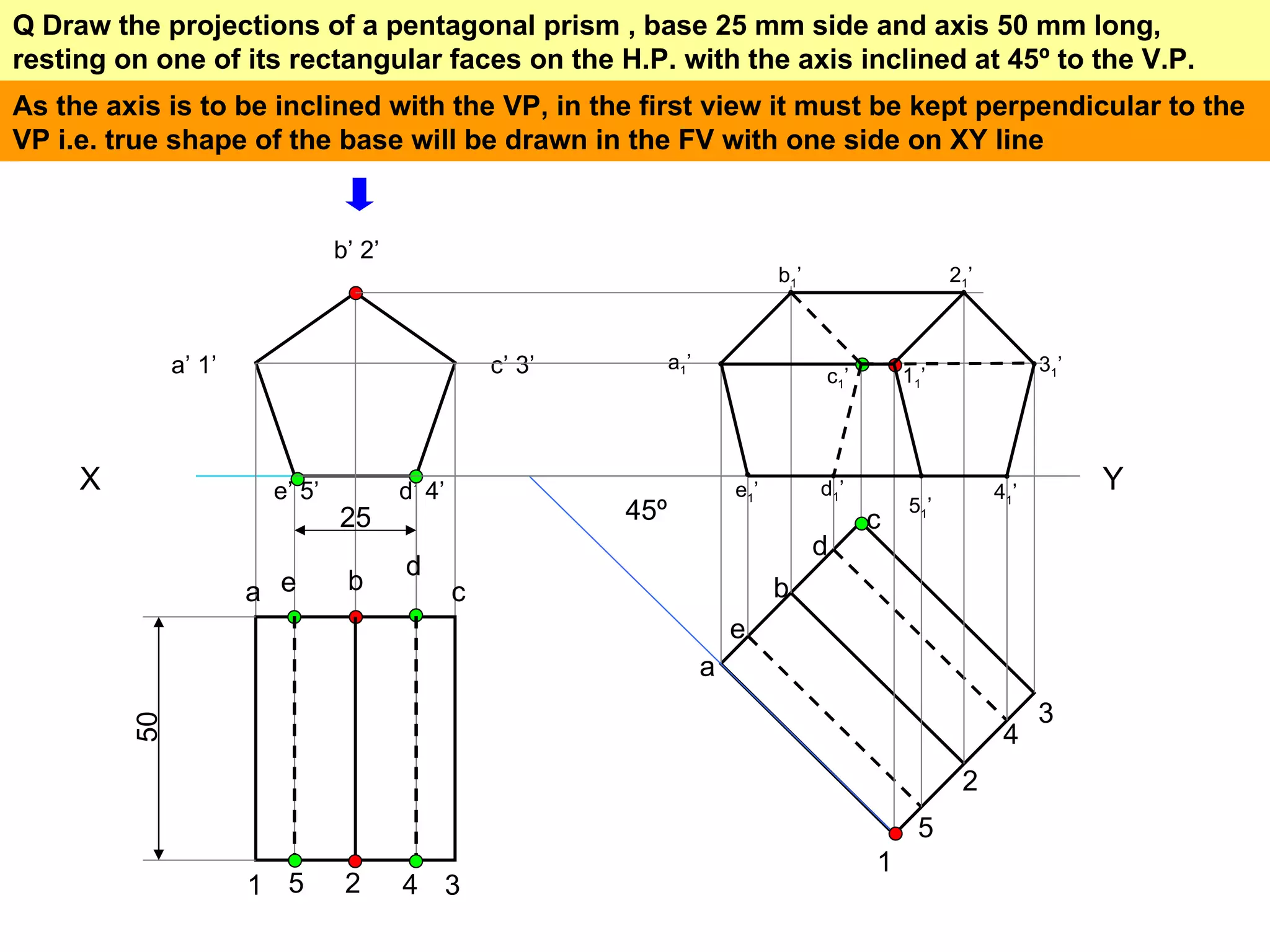
Q Draw the projections of a pentagonal prism , base 25 mm side and axis 50 mm long,
resting on one of its rectangular faces on the H.P. with the axis inclined at 45º to the V.P.
As the axis is to be inclined with the VP, in the first view it must be kept perpendicular to the
VP i.e. true shape of the base will be drawn in the FV with one side on XY line


                               b’ 2’
                                                                                  b1’                    21’


              a’ 1’                                c’ 3’         a1 ’                                                31 ’
                                                                                         c1’       11’


     X                 e’ 5’           d’ 4’                                e1’         d1 ’                   41’          Y
                                                           45º                                     51’
                               25                                                              c
                                                                                        d
                                       d
                      a e       b              c                                  b
                                                                            e
                                                                        a
                                                                                                                     3
         50


                                                                                                                4
                                                                                                          2
                                                                                                     5
                                                                                               1
                      1 5       2      4 3
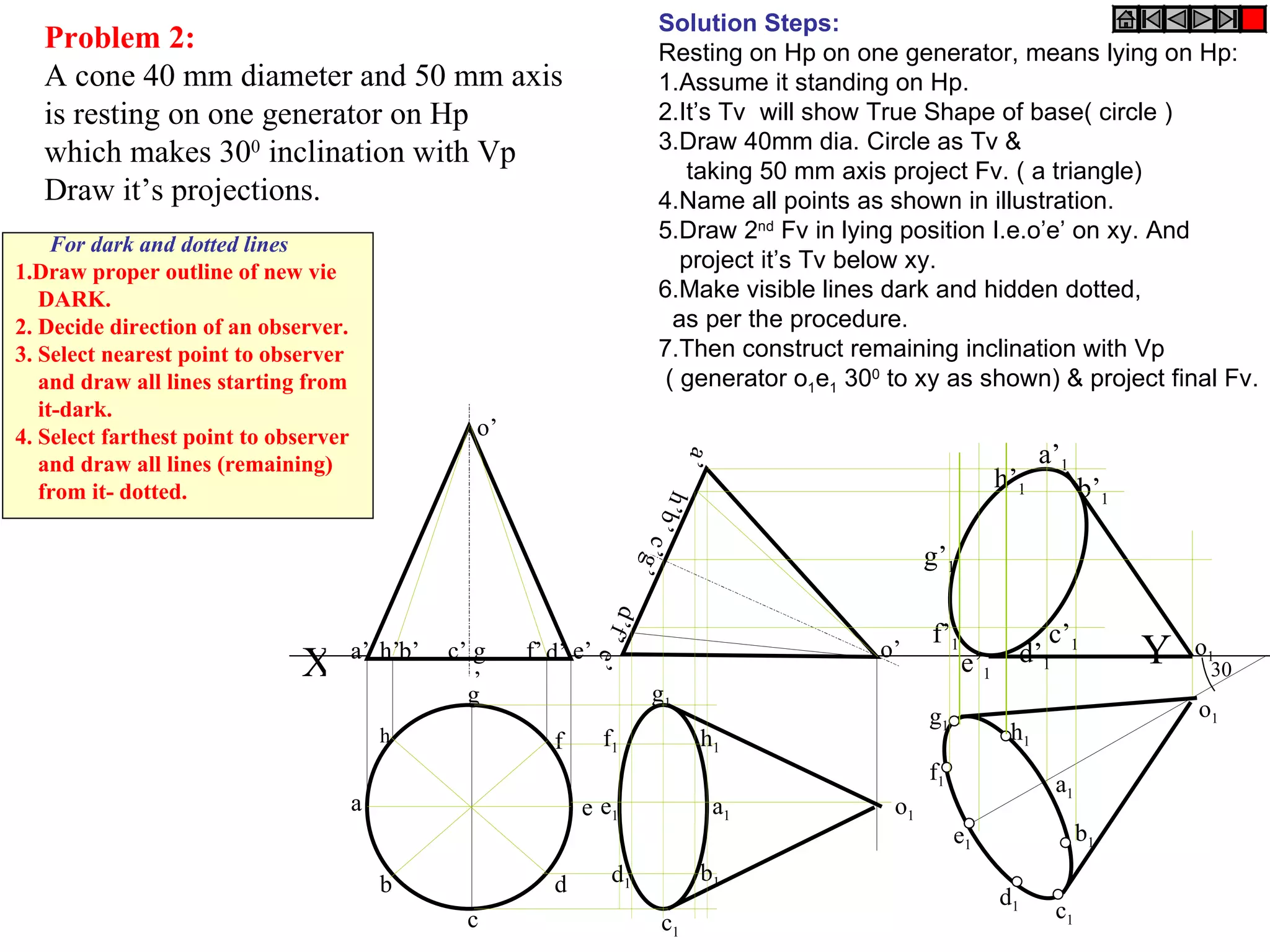
Solution Steps:
   Problem 2:                                                                Resting on Hp on one generator, means lying on Hp:
   A cone 40 mm diameter and 50 mm axis                                      1.Assume it standing on Hp.
   is resting on one generator on Hp                                         2.It’s Tv will show True Shape of base( circle )
                                                                             3.Draw 40mm dia. Circle as Tv &
   which makes 300 inclination with Vp
                                                                                 taking 50 mm axis project Fv. ( a triangle)
   Draw it’s projections.                                                    4.Name all points as shown in illustration.
                                                                             5.Draw 2nd Fv in lying position I.e.o’e’ on xy. And
     For dark and dotted lines
1.Draw proper outline of new vie                                                project it’s Tv below xy.
   DARK.                                                                     6.Make visible lines dark and hidden dotted,
2. Decide direction of an observer.                                            as per the procedure.
3. Select nearest point to observer                                          7.Then construct remaining inclination with Vp
   and draw all lines starting from                                           ( generator o1e1 300 to xy as shown) & project final Fv.
   it-dark.
4. Select farthest point to observer                o’
                                                                                                                          a’1


                                                                                  a’
   and draw all lines (remaining)
   from it- dotted.
                                                                                                                    h’1         b’1


                                                                          ’b ’ h
                                                                               c’
                                                                                                        g’1

                                                                          g’
                                                                    d’ f ’
                                                                                                        f’1              c’
                              X        a’ h’b’   c’ g    f’ d’ e’                                 o’
                                                                                                              e’1     d’1 1           Y   o1
                                                                    e’

                                                                                                                                           30
                                                    ’
                                                   g                         g1
                                                                                                        g1                                o1
                                           h                f       f1              h1                               h1
                                                                                                        f1                 a1
                                       a                        e e1                 a1            o1
                                                                                                             e1                 b1

                                           b                d        d1             b1
                                                                                                                    d1
                                                   c                         c1                                            c1
Solution Steps:
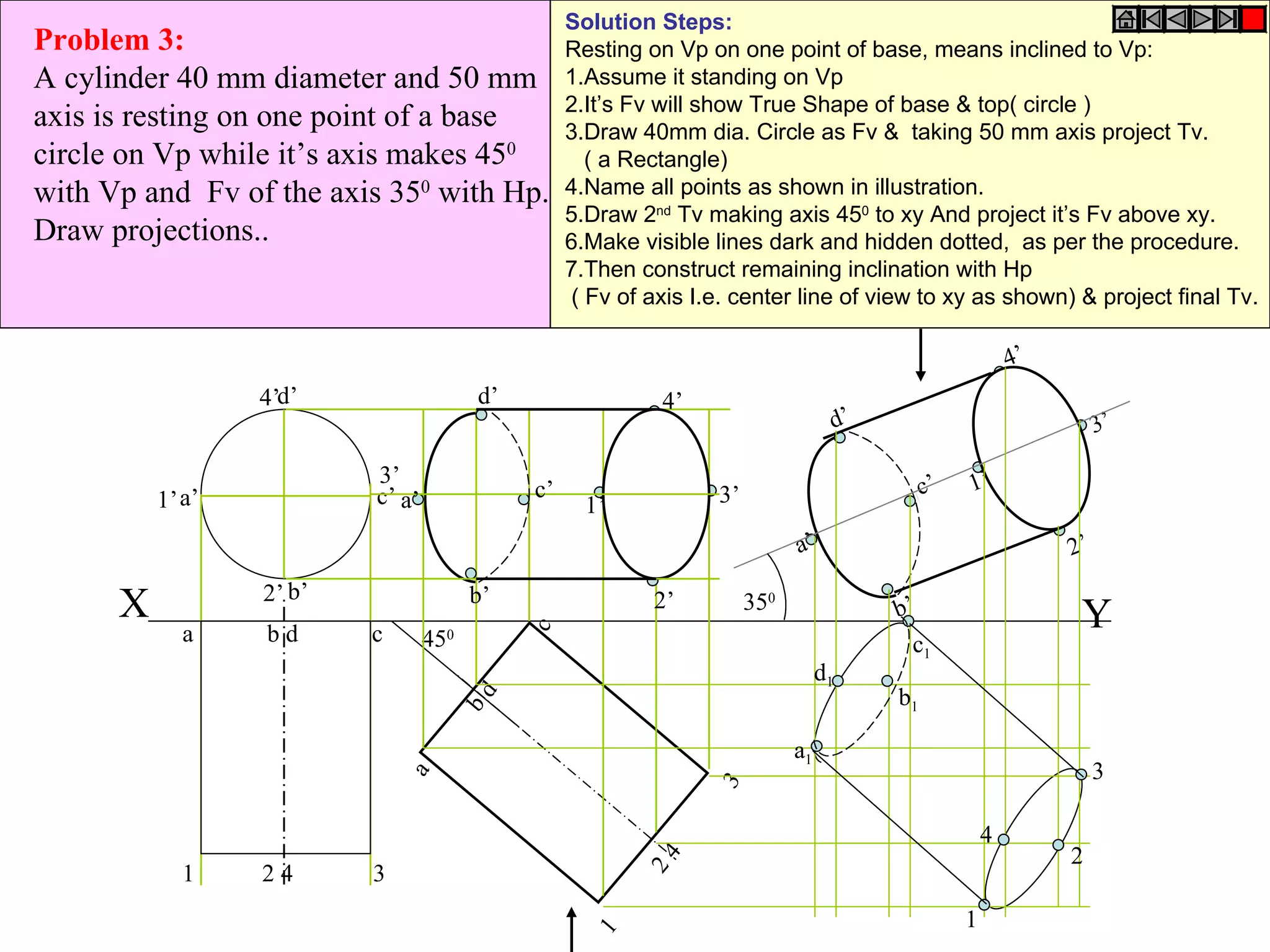
Problem 3:                                         Resting on Vp on one point of base, means inclined to Vp:
A cylinder 40 mm diameter and 50 mm                1.Assume it standing on Vp
                                                   2.It’s Fv will show True Shape of base & top( circle )
axis is resting on one point of a base             3.Draw 40mm dia. Circle as Fv & taking 50 mm axis project Tv.
circle on Vp while it’s axis makes 450               ( a Rectangle)
with Vp and Fv of the axis 350 with Hp.            4.Name all points as shown in illustration.
                                                   5.Draw 2nd Tv making axis 450 to xy And project it’s Fv above xy.
Draw projections..                                 6.Make visible lines dark and hidden dotted, as per the procedure.
                                                   7.Then construct remaining inclination with Hp
                                                   ( Fv of axis I.e. center line of view to xy as shown) & project final Tv.

                                                                                                           4’
                  4’d’                   d’                  4’
                                                                                    d’                               3’

                          3’                                                                       1’
                          c’ a’               c’                   3’                         c’
          1’ a’                                      1’
                                                                              a’                                2’
                  2’ b’
      X                                 b’                  2’          350              b’                      Y
             a    bd      c       450
                                              c


                                                                                           c1
                                                                                   d1
                                                                                         b1
                                        bd


                                                                              a1
                                                                                                                     3
                              a


                                                                  3


                                                                                                       4
                                                                                                                2
                                                          24


             1    24      3
                                                                                                   1
                                                     1
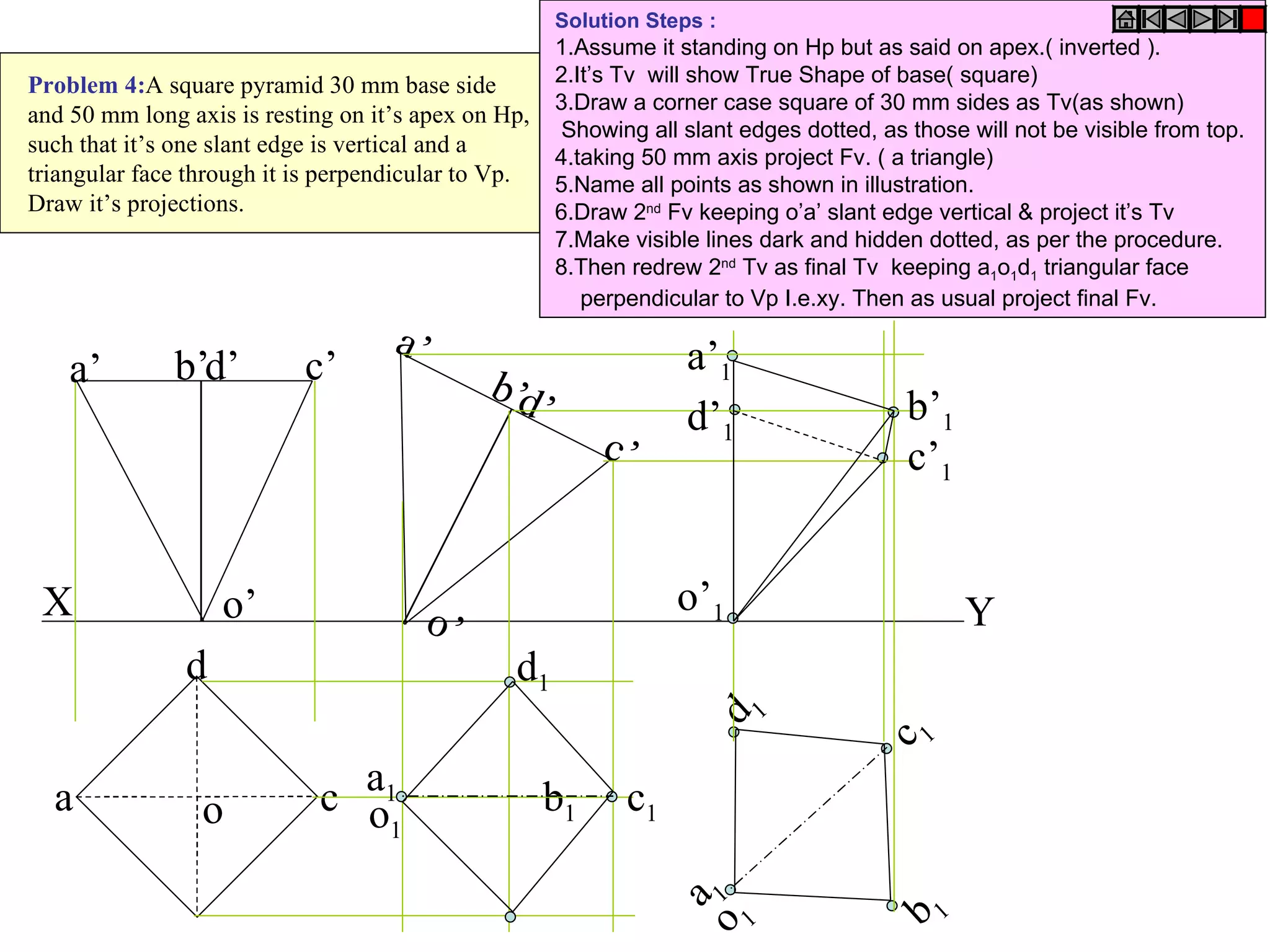
Solution Steps :
                                                         1.Assume it standing on Hp but as said on apex.( inverted ).
Problem 4:A square pyramid 30 mm base side               2.It’s Tv will show True Shape of base( square)
                                                         3.Draw a corner case square of 30 mm sides as Tv(as shown)
and 50 mm long axis is resting on it’s apex on Hp,
                                                         Showing all slant edges dotted, as those will not be visible from top.
such that it’s one slant edge is vertical and a
                                                         4.taking 50 mm axis project Fv. ( a triangle)
triangular face through it is perpendicular to Vp.       5.Name all points as shown in illustration.
Draw it’s projections.                                   6.Draw 2nd Fv keeping o’a’ slant edge vertical & project it’s Tv
                                                         7.Make visible lines dark and hidden dotted, as per the procedure.
                                                         8.Then redrew 2nd Tv as final Tv keeping a1o1d1 triangular face
                                                            perpendicular to Vp I.e.xy. Then as usual project final Fv.
                                    a’                                a’1
    a’        b’d’         c’                 b’d
                                                     ’                d’1                   b’1
                                                             c’                             c’1


 X                 o’                    o’                          o’1                          Y
               d                                d1
                                                                            d1
                                                                                            c1
  a             b
                o            c a1
                               o1                    b1         c1

                                                                       a1 1                  b1
                                                                         o
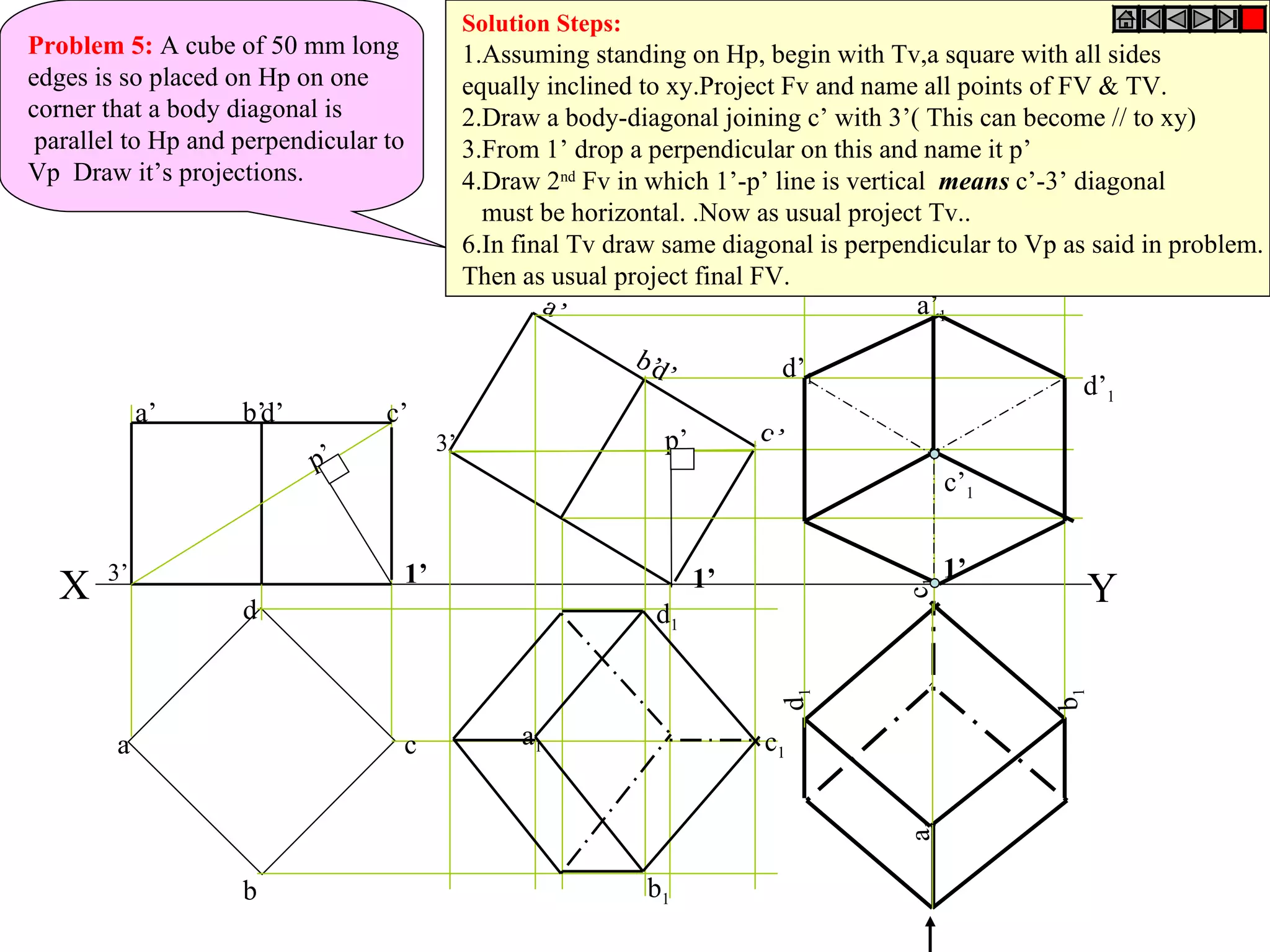
Solution Steps:
Problem 5: A cube of 50 mm long              1.Assuming standing on Hp, begin with Tv,a square with all sides
edges is so placed on Hp on one              equally inclined to xy.Project Fv and name all points of FV & TV.
corner that a body diagonal is               2.Draw a body-diagonal joining c’ with 3’( This can become // to xy)
 parallel to Hp and perpendicular to         3.From 1’ drop a perpendicular on this and name it p’
Vp Draw it’s projections.                    4.Draw 2nd Fv in which 1’-p’ line is vertical means c’-3’ diagonal
                                               must be horizontal. .Now as usual project Tv..
                                             6.In final Tv draw same diagonal is perpendicular to Vp as said in problem.
                                             Then as usual project final FV.
                                                    a’                                    a’1
                                                               b’d                  d’1
                                                                  ’                                    d’1
            a’      b’d’          c’
                                        3’                           p’        c’
                           p’
                                                                                               c’1


       3’                          1’                                                          1’
   X                                                                      1’
                                                                                                       Y


                                                                                          c1
                    d                                            d1


                                                                                    d1


                                                                                                     b1
        a                          c              a1                           c1


                                                                                          a1
                    b                                           b1
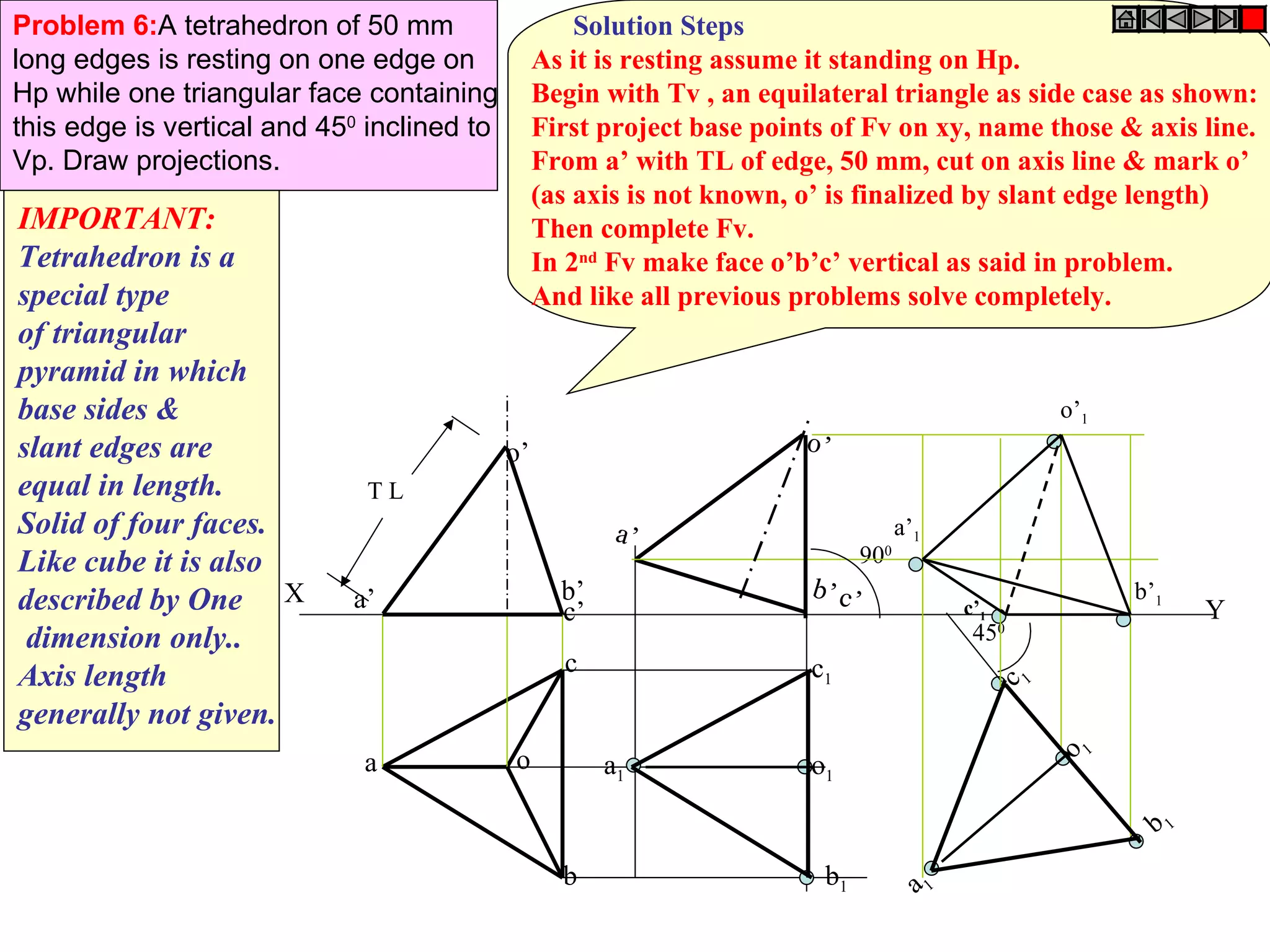
Problem 6:A tetrahedron of 50 mm                     Solution Steps
long edges is resting on one edge on             As it is resting assume it standing on Hp.
Hp while one triangular face containing          Begin with Tv , an equilateral triangle as side case as shown:
this edge is vertical and 450 inclined to        First project base points of Fv on xy, name those & axis line.
Vp. Draw projections.                            From a’ with TL of edge, 50 mm, cut on axis line & mark o’
                                                 (as axis is not known, o’ is finalized by slant edge length)
IMPORTANT:                                       Then complete Fv.
Tetrahedron is a                                 In 2nd Fv make face o’b’c’ vertical as said in problem.
special type                                     And like all previous problems solve completely.
of triangular
pyramid in which
base sides &                                                                                                o’1
slant edges are                             o’                          o’
equal in length.             TL
Solid of four faces.                                     a’                              a’1
Like cube it is also                                                            90   0


described by One X          a’                     b’                   b’ c’                                     b’1
                                                   c’                                           c’1                      Y
 dimension only..                                                                                450
Axis length                                        c                    c1                             c1
generally not given.
                             a              o                                                                o1
                                                        a1              o1

                                                                                                                    b1
                                                   b                      b1               a1
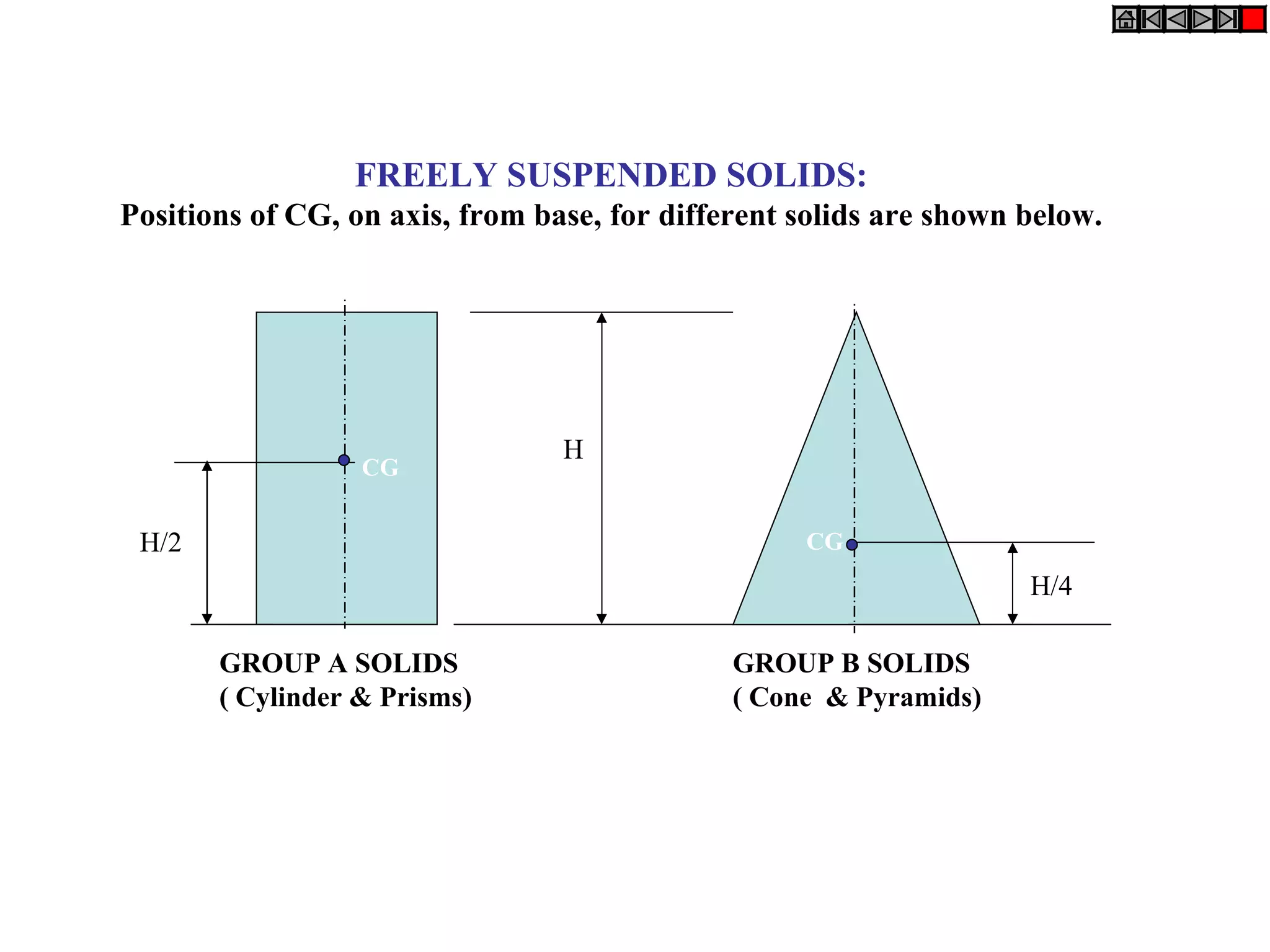
FREELY SUSPENDED SOLIDS:
Positions of CG, on axis, from base, for different solids are shown below.


                                 H
                  CG


 H/2                                               CG
                                                                    H/4

       GROUP A SOLIDS                         GROUP B SOLIDS
       ( Cylinder & Prisms)                   ( Cone & Pyramids)
Solution Steps:
Problem 7: A pentagonal pyramid               In all suspended cases axis shows inclination with Hp.
30 mm base sides & 60 mm long axis,           1.Hence assuming it standing on Hp, drew Tv - a regular pentagon,corner case.
is freely suspended from one corner of        2.Project Fv & locate CG position on axis – ( ¼ H from base.) and name g’ and
 base so that a plane containing it’s axis      Join it with corner d’
remains parallel to Vp.                       3.As 2nd Fv, redraw first keeping line g’d’ vertical.
Draw it’s three views.                        4.As usual project corresponding Tv and then Side View looking from.


                                                                                  LINE   d’g’ VERTICAL                            d”
                                                                o’                                  d’

                                                                                                          c’e’          e”              c”
                                                                         FOR SIDE VIEW
                                                                                                     g’
                                        H                                                                        a’b’
                                                                                                                             a”        b”
                                                           g’
                                             H/4                                                                                  o”
      IMPORTANT:                                   a’ b’        c’ e’        d’                                                             Y
                                    X
      When a solid is freely                                                                              e1
                                                                     e
      suspended from a                                                                                           a1
      corner, then line                         a
                                                                                                d1
      joining point of                                     o                 do
                                                                                1

      contact & C.G.                               b                                                              b1
      remains vertical.                                          c                                   c1
      ( Here axis shows
      inclination with Hp.)
      So in all such cases,
      assume solid standing
      on Hp initially.)
Solution Steps:                                                                   Problem 8:
1.Assuming it standing on Hp begin with Tv, a square of corner case.              A cube of 50 mm long edges is so placed
2.Project corresponding Fv.& name all points as usual in both views.              on Hp on one corner that a body diagonal
3.Join a’1’ as body diagonal and draw 2nd Fv making it vertical (I’ on xy)        through this corner is perpendicular to Hp
4.Project it’s Tv drawing dark and dotted lines as per the procedure.             and parallel to Vp Draw it’s three views.
5.With standard method construct Left-hand side view.
( Draw a 450 inclined Line in Tv region ( below xy).
Project horizontally all points of Tv on this line and
 reflect vertically upward, above xy.After this, draw
horizontal lines, from all points of Fv, to meet these
lines. Name points of intersections and join properly.                                                a’’


                                                                    a’
For dark & dotted lines
locate observer on left side of Fv as shown.)

                                                                                           d’’                  b’’


                                                                             b’d
                       a’        b’d’           c’


                                                                                  ’
                                                                                      c’
                                                                                                     c’’
              X                                  1’
                                                                       1’                                             Y
                                 d                                           d1                         1’


                   a                              c               a1                  c1


                                 b                                           b
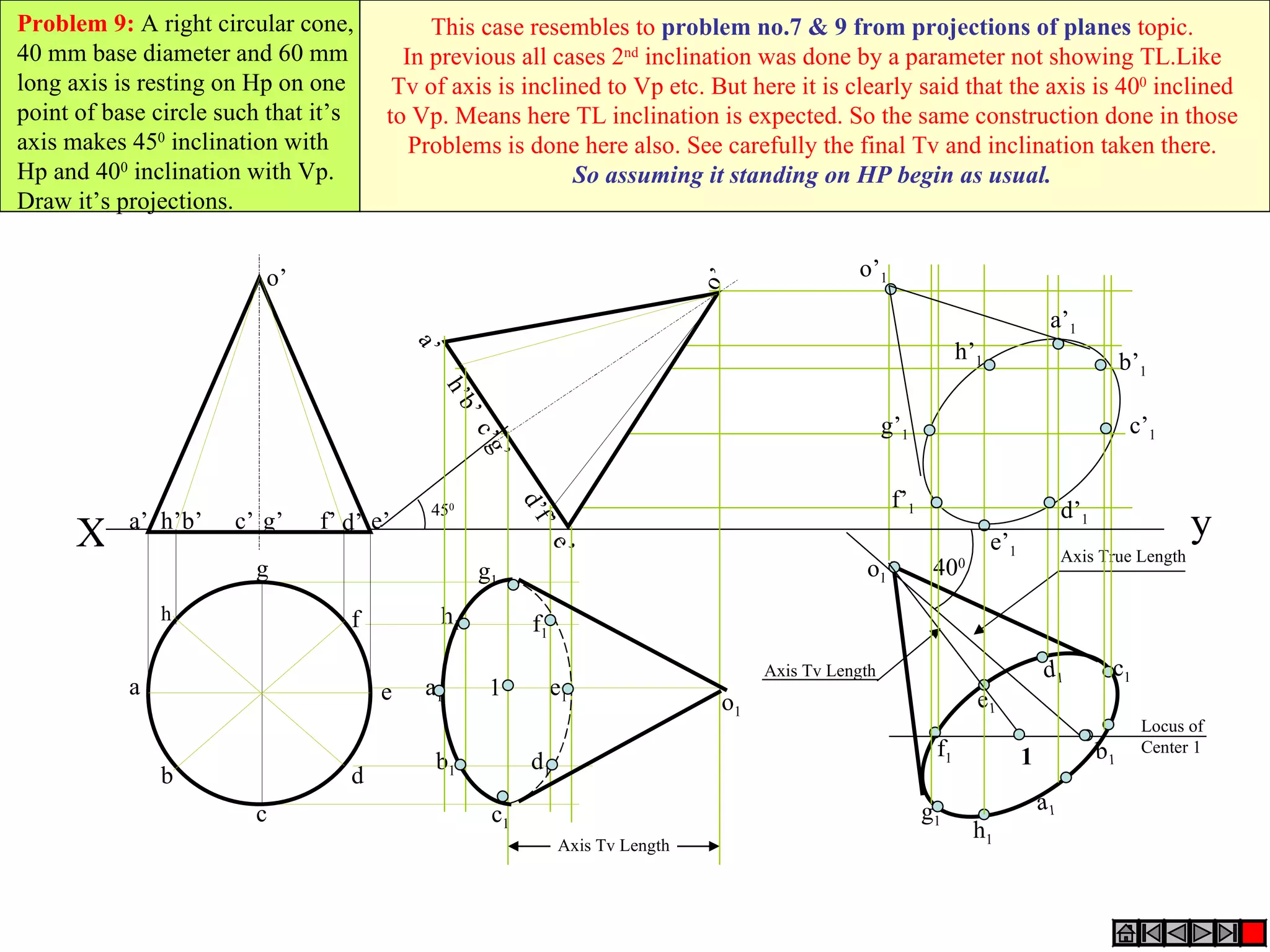
Problem 9: A right circular cone,          This case resembles to problem no.7 & 9 from projections of planes topic.
40 mm base diameter and 60 mm           In previous all cases 2nd inclination was done by a parameter not showing TL.Like
long axis is resting on Hp on one      Tv of axis is inclined to Vp etc. But here it is clearly said that the axis is 400 inclined
point of base circle such that it’s   to Vp. Means here TL inclination is expected. So the same construction done in those
axis makes 450 inclination with          Problems is done here also. See carefully the final Tv and inclination taken there.
Hp and 400 inclination with Vp.                            So assuming it standing on HP begin as usual.
Draw it’s projections.


                         o’                                                                       o’1


                                                                                 o’
                                                                                                                                      a’1
                                                                                                                     h’1

                                          a’
                                                                                                                                                     b’1


                                            h’b
                                                                                                        g’1                                           c’1
                                                 ’c
                                                    ’g’
                                                                                                         f’1                              d’1
      X    a’ h’b’    c’ g’    f’ d’ e’
                                           450            d’f
                                                           ’
                                                            e’                                                             e’1
                                                                                                                                                             y
                                                                                                                                          Axis True Length
                        g                         g1                                               o1           400
               h                  f         h1             f1
                                                                                       Axis Tv Length                                d1          c1
           a                          e   a1        1           e1
                                                                                  o1                                   e1
                                                                                                                                                       Locus of
                                                                                                                f1               1              b1     Center 1
                                           b1              d1
               b                  d
                        c                           c1                                                         g1                    a1
                                                                                                                      h1
                                                                Axis Tv Length
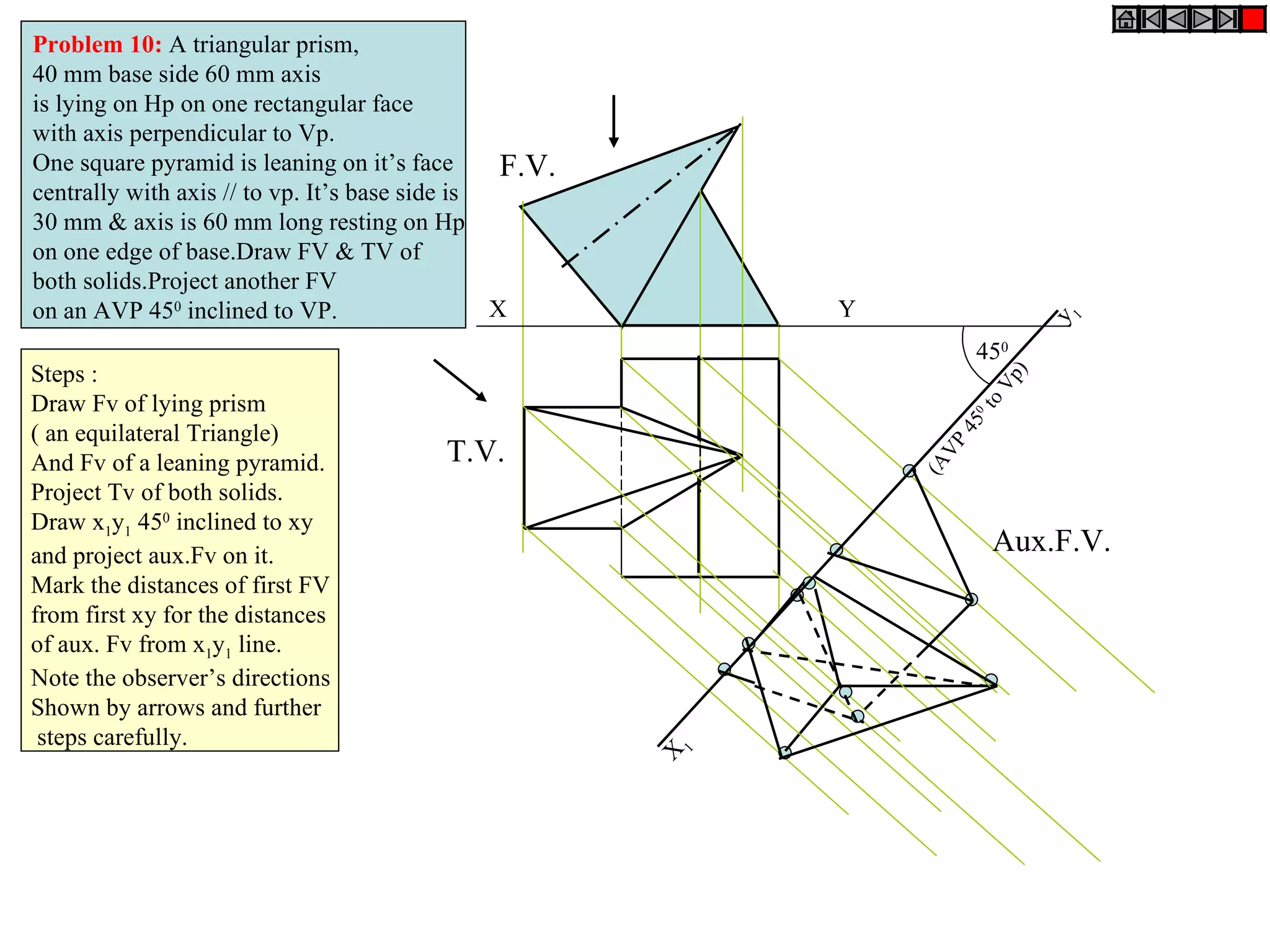
Problem 10: A triangular prism,
40 mm base side 60 mm axis
is lying on Hp on one rectangular face
with axis perpendicular to Vp.
One square pyramid is leaning on it’s face       F.V.
centrally with axis // to vp. It’s base side is
30 mm & axis is 60 mm long resting on Hp
on one edge of base.Draw FV & TV of
both solids.Project another FV
on an AVP 450 inclined to VP.                   X           Y


                                                                                1
                                                                                y
                                                                        450
Steps :


                                                                            )
                                                                         Vp
Draw Fv of lying prism


                                                                       to
                                                                   45 0
( an equilateral Triangle)
                                         T.V.


                                                                   VP
And Fv of a leaning pyramid.


                                                                (A
Project Tv of both solids.
Draw x1y1 450 inclined to xy
and project aux.Fv on it.                                                Aux.F.V.
Mark the distances of first FV
from first xy for the distances
of aux. Fv from x1y1 line.
Note the observer’s directions
Shown by arrows and further
 steps carefully.
                                                        1
                                                        X
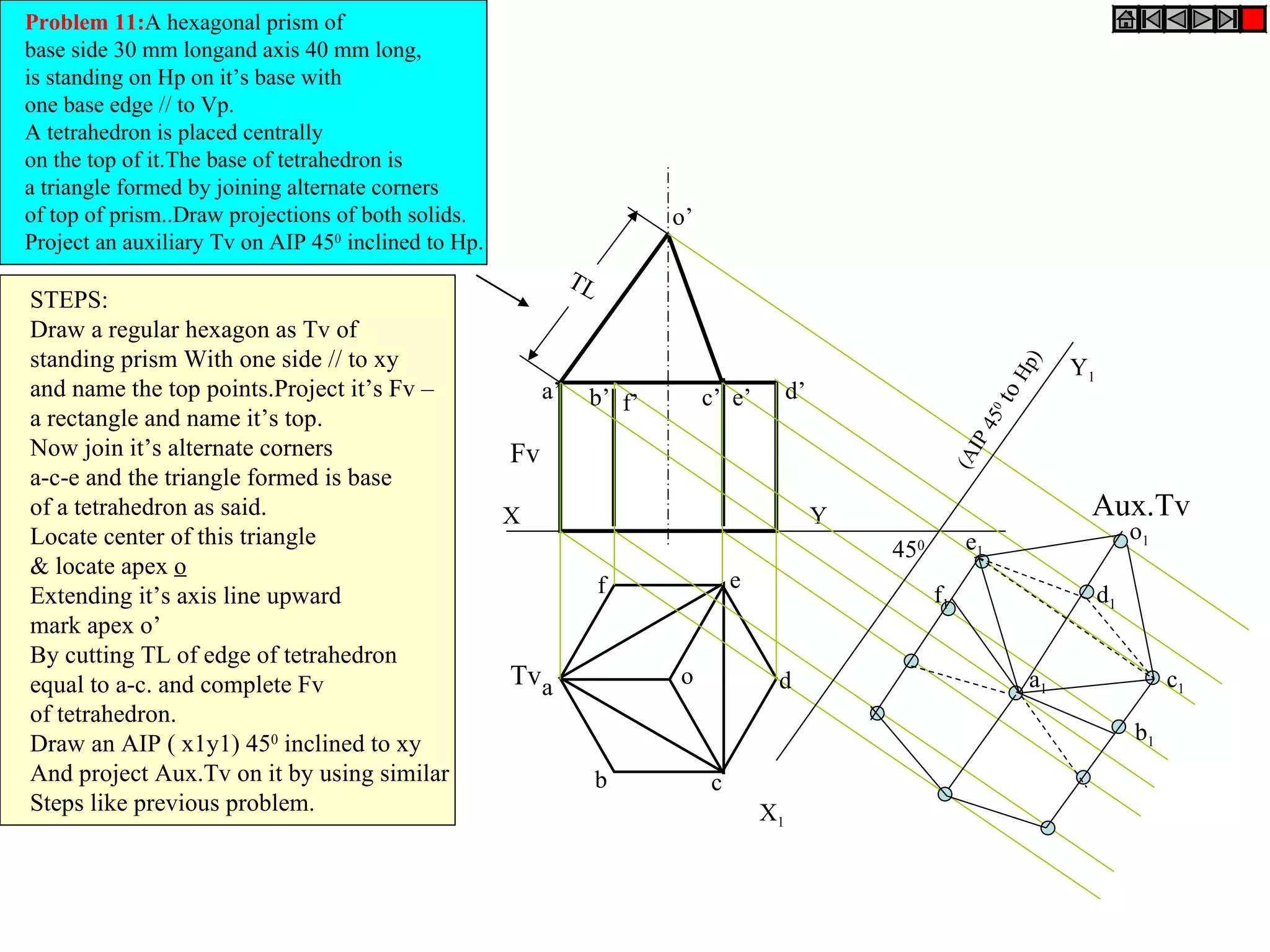
Problem 11:A hexagonal prism of
base side 30 mm longand axis 40 mm long,
is standing on Hp on it’s base with
one base edge // to Vp.
A tetrahedron is placed centrally
on the top of it.The base of tetrahedron is
a triangle formed by joining alternate corners
of top of prism..Draw projections of both solids.                       o’
Project an auxiliary Tv on AIP 450 inclined to Hp.
                                                               TL
STEPS:
Draw a regular hexagon as Tv of
standing prism With one side // to xy                                                                                        Y1


                                                                                                                       )
                                                                                                                    Hp
and name the top points.Project it’s Fv –                 a’    b’ f’        c’ e’        d’


                                                                                                                   to
a rectangle and name it’s top.


                                                                                                               50
                                                                                                                4
Now join it’s alternate corners


                                                                                                             IP
                                                     Fv


                                                                                                          (A
a-c-e and the triangle formed is base
of a tetrahedron as said.                            X                                         Y                              Aux.Tv
Locate center of this triangle                                                                                e1                       o1
                                                                                                   450
& locate apex o
                                                                    f            e
Extending it’s axis line upward                                                                          f1                       d1
mark apex o’
By cutting TL of edge of tetrahedron
equal to a-c. and complete Fv                        Tva                o             d                                 a1                  c1
of tetrahedron.
Draw an AIP ( x1y1) 450 inclined to xy                                                                                                 b1
And project Aux.Tv on it by using similar                           b        c
Steps like previous problem.                                                         X1
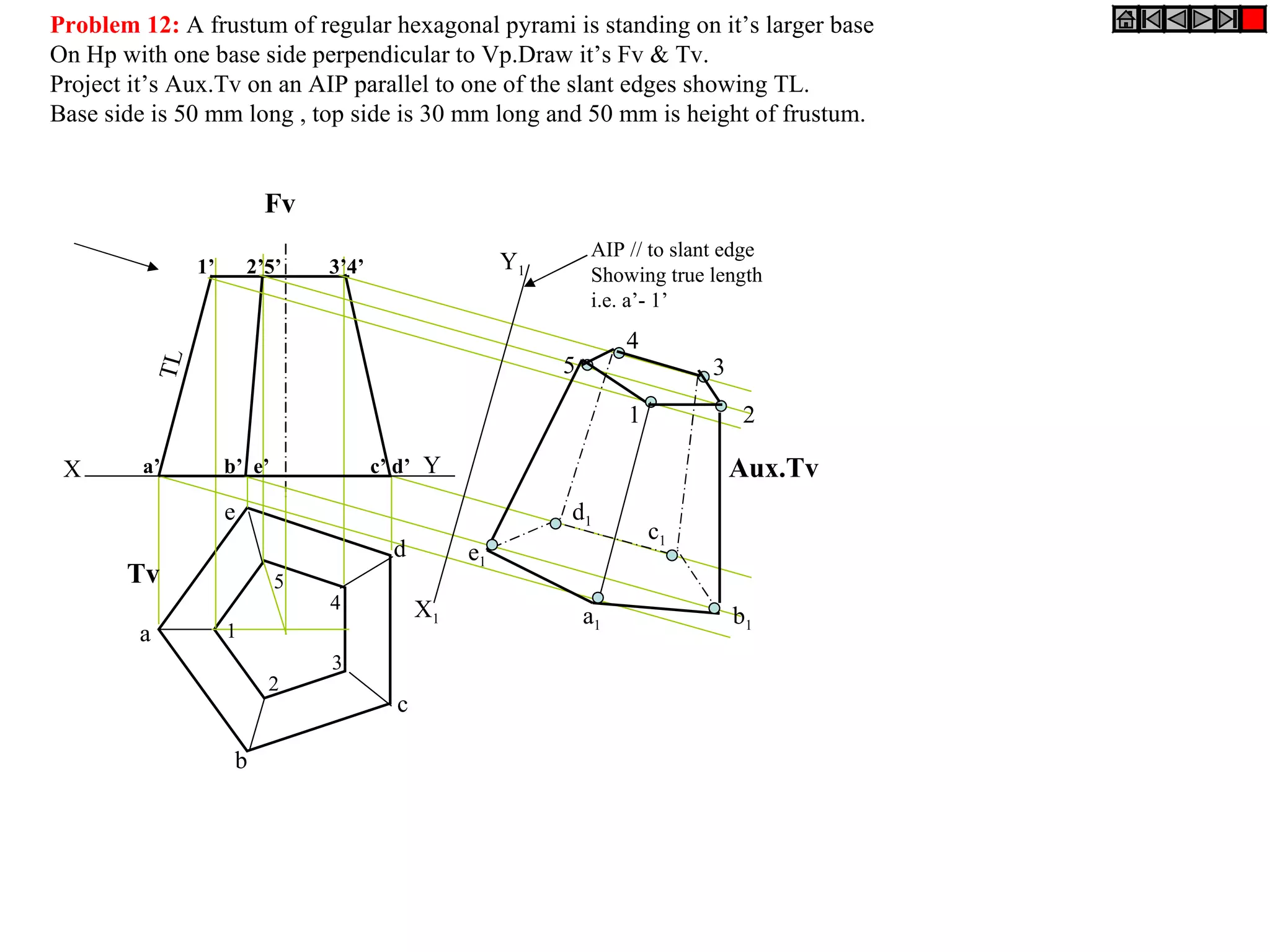
Problem 12: A frustum of regular hexagonal pyrami is standing on it’s larger base
On Hp with one base side perpendicular to Vp.Draw it’s Fv & Tv.
Project it’s Aux.Tv on an AIP parallel to one of the slant edges showing TL.
Base side is 50 mm long , top side is 30 mm long and 50 mm is height of frustum.


                            Fv
                                                                  AIP // to slant edge
                 1’       2’5’    3’4’                   Y1
                                                                  Showing true length
                                                                  i.e. a’- 1’
                                                                       4
                                                              5
            TL


                                                                                3
                                                                       1             2

 X       a’           b’ e’              c’ d’ Y                                    Aux.Tv
                      e                                       d1
                                                                           c1
                                           d        e1
       Tv                     5
                                  4            X1                 a1                b1
        a             1
                                  3
                            2
                                           c

                       b
a’b’                           a1’                         b1’
a’b’      c’d’


                                                c’d’
                                                                            d1 ’                     c1’


                 1’2’                                  11’
                                                                                   21’


                                    450
       3’4’                  3’4’                            41’                         31’
1’2’                                                                               21
                                                                   30   0


b2        c3            21   31      b1    c1
                                                       11
                                                                                         31


                                                                                                b1
                                                             41

a1
        d4              11   41       a1   d1
                                                                   a1
                                                                                                     c1


                                                                            d1
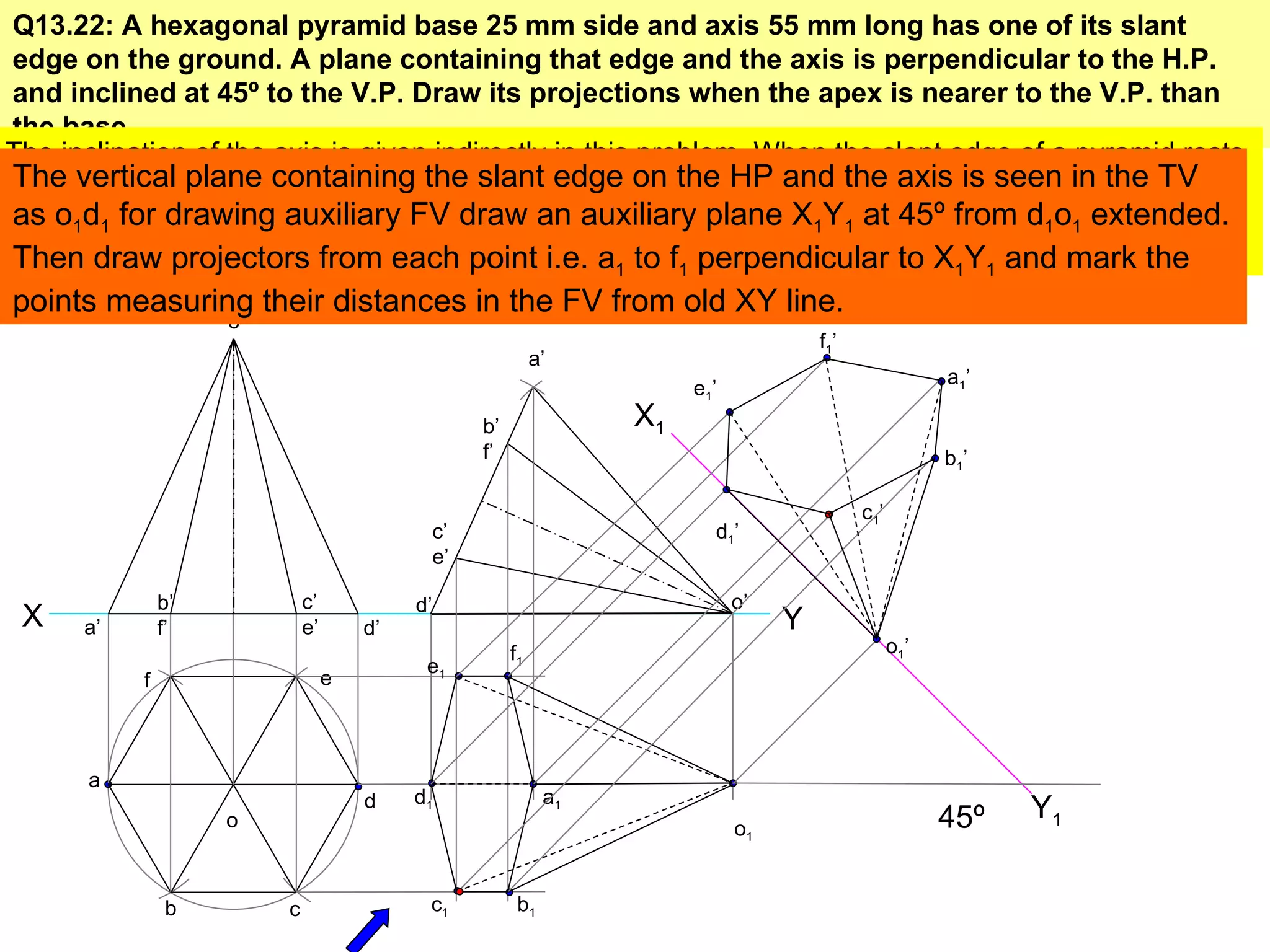
Q13.22: A hexagonal pyramid base 25 mm side and axis 55 mm long has one of its slant
 edge on the ground. A plane containing that edge and the axis is perpendicular to the H.P.
 and inclined at 45º to the V.P. Draw its projections when the apex is nearer to the V.P. than
 the base.
The inclination of the axis is given indirectly in this problem. When the slant edge of a pyramid rests
on the HP its axis is inclined with the HP so edge decidingHP and the axis of the solid the TV
 The vertical plane containing the slant while on the first view the axis is seen in must be
kepto1d1 for drawingHP i.e. true shape of an auxiliary be seen in the TV. Secondlyo1 extended.
 as perpendicular to auxiliary FV draw the base will plane X1Y1 at 45º from d1 when drawing
hexagon in the TV we have to keep the corners a1 to f1 perpendicular to X1Y1 and mark the
 Then draw projectors from each point i.e. at the extreme ends.
points measuring their distances in the FV from old XY line.
                    o’
                                                                                         f1’
                                                               a’
                                                                                                            a1’
                                                                          e1’
                                                     b’              X1
                                                     f’                                                     b1’

                                                                                               c1’
                                                c’                          d1’
                                                e’

               b’            c’            d’                                   o’
 X    a’       f’            e’       d’                                             Y
                                                          f1                                         o1 ’
                                            e1
           f                      e


      a
                                      d    d1                   a1
                    o                                                                                       45º   Y1
                                                                                o1


               b         c                  c1             b1
Projection of solids

Projection of solids

  • 1.
    SOLIDS To understand and remember various solids in this subject properly, those are classified & arranged in to two major groups. Group A Group B Solids having top and base of same shape Solids having base of some shape and just a point as a top, called apex. Cylinder Cone Prisms Pyramids Triangular Square Pentagonal Hexagonal Triangular Square Pentagonal Hexagonal Cube Tetrahedron ( A solid having ( A solid having six square faces) Four triangular faces)
  • 2.
    SOLIDS Dimensional parameters of different solids. Square Prism Square Pyramid Cylinder Cone Apex Apex Top Rectangular Slant Face Edge Triangular Longer Base Face Base Base Base Edge Corner of Edge Edge Corner of Generators base of of base Imaginary lines Base Base generating curved surface of cylinder & cone. Sections of solids( top & base not parallel) Frustum of cone & pyramids. ( top & base parallel to each other)
  • 3.
    STANDING ON H.P RESTING ON H.P LYING ON H.P On it’s base. On one point of base circle. On one generator. (Axis perpendicular to Hp (Axis inclined to Hp (Axis inclined to Hp And // to Vp.) And // to Vp) And // to Vp) F.V. F.V. F.V. X Y While observing Fv, x-y line represents Horizontal Plane. (Hp) X While observing Tv, x-y line represents Vertical Plane. (Vp) Y T.V. T.V. T.V. STANDING ON V.P RESTING ON V.P LYING ON V.P On it’s base. On one point of base circle. On one generator. Axis perpendicular to Vp Axis inclined to Vp Axis inclined to Vp And // to Hp And // to Hp And // to Hp
  • 4.
    STEPS TO SOLVEPROBLEMS IN SOLIDS Problem is solved in three steps: STEP 1: ASSUME SOLID STANDING ON THE PLANE WITH WHICH IT IS MAKING INCLINATION. ( IF IT IS INCLINED TO HP, ASSUME IT STANDING ON HP) ( IF IT IS INCLINED TO VP, ASSUME IT STANDING ON VP) IF STANDING ON HP - IT’S TV WILL BE TRUE SHAPE OF IT’S BASE OR TOP: IF STANDING ON VP - IT’S FV WILL BE TRUE SHAPE OF IT’S BASE OR TOP. BEGIN WITH THIS VIEW: IT’S OTHER VIEW WILL BE A RECTANGLE ( IF SOLID IS CYLINDER OR ONE OF THE PRISMS): IT’S OTHER VIEW WILL BE A TRIANGLE ( IF SOLID IS CONE OR ONE OF THE PYRAMIDS): DRAW FV & TV OF THAT SOLID IN STANDING POSITION: STEP 2: CONSIDERING SOLID’S INCLINATION ( AXIS POSITION ) DRAW IT’S FV & TV. STEP 3: IN LAST STEP, CONSIDERING REMAINING INCLINATION, DRAW IT’S FINAL FV & TV. GENERAL PATTERN ( THREE STEPS ) OF SOLUTION: GROUP B SOLID. GROUP A SOLID. GROUP B SOLID. GROUP A SOLID. CONE CYLINDER CONE CYLINDER AXIS AXIS AXIS AXIS INCLINED HP INCLINED HP AXIS AXIS VERTICAL INCLINED HP VERTICAL INCLINED HP er er AXIS AXIS AXIS TO VP AXIS AXIS AXIS TO VP INCLINED VP INCLINED INCLINED INCLINED VP VP VP Three steps Three steps Three steps Three steps If solid is inclined to Hp If solid is inclined to Hp If solid is inclined to Vp If solid is inclined to Vp Study Next Twelve Problems and Practice them separately !!
  • 5.
    CATEGORIES OF ILLUSTRATEDPROBLEMS! PROBLEM NO.1, 2, 3, 4 GENERAL CASES OF SOLIDS INCLINED TO HP & VP PROBLEM NO. 5 & 6 CASES OF CUBE & TETRAHEDRON PROBLEM NO. 7 CASE OF FREELY SUSPENDED SOLID WITH SIDE VIEW. PROBLEM NO. 8 CASE OF CUBE ( WITH SIDE VIEW) PROBLEM NO. 9 CASE OF TRUE LENGTH INCLINATION WITH HP & VP. PROBLEM NO. 10 & 11 CASES OF COMPOSITE SOLIDS. (AUXILIARY PLANE) PROBLEM NO. 12 CASE OF A FRUSTUM (AUXILIARY PLANE)
  • 6.
    Solution Steps : Problem1. A square pyramid, 40 Triangular face on Hp , means it is lying on Hp: mm base sides and axis 60 mm long, 1.Assume it standing on Hp. 2.It’s Tv will show True Shape of base( square) has a triangular face on the ground 3.Draw square of 40mm sides with one side vertical Tv & and the vertical plane containing the taking 50 mm axis project Fv. ( a triangle) axis makes an angle of 450 with the 4.Name all points as shown in illustration. 5.Draw 2nd Fv in lying position I.e.o’c’d’ face on xy. And project it’s Tv. VP. Draw its projections. Take apex 6.Make visible lines dark and hidden dotted, as per the procedure. nearer to VP 7.Then construct remaining inclination with Vp ( Vp containing axis ic the center line of 2nd Tv.Make it 450 to xy as shown take apex near to xy, as it is nearer to Vp) & project final Fv. o’ a’b’ a’1 b’1 Y X a’b’ c’ d’ d’1 c’1 o’1 d c’ ’ o’ o1 1 d a1 a d d1 a1 a1 o1 d1 c1 o b c c1 b 1(APEX b 1 b1 NEARER (APEX o For dark and dotted lines c1 TO V.P). AWAY 1 FROM V.P.) 1.Draw proper outline of new view DARK. 2. Decide direction of an observer. 3. Select nearest point to observer and draw all lines starting from it-dark. 4. Select farthest point to observer and draw all lines (remaining)from it- dotted.
  • 7.
    Q Draw theprojections of a pentagonal prism , base 25 mm side and axis 50 mm long, resting on one of its rectangular faces on the H.P. with the axis inclined at 45º to the V.P. As the axis is to be inclined with the VP, in the first view it must be kept perpendicular to the VP i.e. true shape of the base will be drawn in the FV with one side on XY line b’ 2’ b1’ 21’ a’ 1’ c’ 3’ a1 ’ 31 ’ c1’ 11’ X e’ 5’ d’ 4’ e1’ d1 ’ 41’ Y 45º 51’ 25 c d d a e b c b e a 3 50 4 2 5 1 1 5 2 4 3
  • 8.
    Solution Steps: Problem 2: Resting on Hp on one generator, means lying on Hp: A cone 40 mm diameter and 50 mm axis 1.Assume it standing on Hp. is resting on one generator on Hp 2.It’s Tv will show True Shape of base( circle ) 3.Draw 40mm dia. Circle as Tv & which makes 300 inclination with Vp taking 50 mm axis project Fv. ( a triangle) Draw it’s projections. 4.Name all points as shown in illustration. 5.Draw 2nd Fv in lying position I.e.o’e’ on xy. And For dark and dotted lines 1.Draw proper outline of new vie project it’s Tv below xy. DARK. 6.Make visible lines dark and hidden dotted, 2. Decide direction of an observer. as per the procedure. 3. Select nearest point to observer 7.Then construct remaining inclination with Vp and draw all lines starting from ( generator o1e1 300 to xy as shown) & project final Fv. it-dark. 4. Select farthest point to observer o’ a’1 a’ and draw all lines (remaining) from it- dotted. h’1 b’1 ’b ’ h c’ g’1 g’ d’ f ’ f’1 c’ X a’ h’b’ c’ g f’ d’ e’ o’ e’1 d’1 1 Y o1 e’ 30 ’ g g1 g1 o1 h f f1 h1 h1 f1 a1 a e e1 a1 o1 e1 b1 b d d1 b1 d1 c c1 c1
  • 9.
    Solution Steps: Problem 3: Resting on Vp on one point of base, means inclined to Vp: A cylinder 40 mm diameter and 50 mm 1.Assume it standing on Vp 2.It’s Fv will show True Shape of base & top( circle ) axis is resting on one point of a base 3.Draw 40mm dia. Circle as Fv & taking 50 mm axis project Tv. circle on Vp while it’s axis makes 450 ( a Rectangle) with Vp and Fv of the axis 350 with Hp. 4.Name all points as shown in illustration. 5.Draw 2nd Tv making axis 450 to xy And project it’s Fv above xy. Draw projections.. 6.Make visible lines dark and hidden dotted, as per the procedure. 7.Then construct remaining inclination with Hp ( Fv of axis I.e. center line of view to xy as shown) & project final Tv. 4’ 4’d’ d’ 4’ d’ 3’ 3’ 1’ c’ a’ c’ 3’ c’ 1’ a’ 1’ a’ 2’ 2’ b’ X b’ 2’ 350 b’ Y a bd c 450 c c1 d1 b1 bd a1 3 a 3 4 2 24 1 24 3 1 1
  • 10.
    Solution Steps : 1.Assume it standing on Hp but as said on apex.( inverted ). Problem 4:A square pyramid 30 mm base side 2.It’s Tv will show True Shape of base( square) 3.Draw a corner case square of 30 mm sides as Tv(as shown) and 50 mm long axis is resting on it’s apex on Hp, Showing all slant edges dotted, as those will not be visible from top. such that it’s one slant edge is vertical and a 4.taking 50 mm axis project Fv. ( a triangle) triangular face through it is perpendicular to Vp. 5.Name all points as shown in illustration. Draw it’s projections. 6.Draw 2nd Fv keeping o’a’ slant edge vertical & project it’s Tv 7.Make visible lines dark and hidden dotted, as per the procedure. 8.Then redrew 2nd Tv as final Tv keeping a1o1d1 triangular face perpendicular to Vp I.e.xy. Then as usual project final Fv. a’ a’1 a’ b’d’ c’ b’d ’ d’1 b’1 c’ c’1 X o’ o’ o’1 Y d d1 d1 c1 a b o c a1 o1 b1 c1 a1 1 b1 o
  • 11.
    Solution Steps: Problem 5:A cube of 50 mm long 1.Assuming standing on Hp, begin with Tv,a square with all sides edges is so placed on Hp on one equally inclined to xy.Project Fv and name all points of FV & TV. corner that a body diagonal is 2.Draw a body-diagonal joining c’ with 3’( This can become // to xy) parallel to Hp and perpendicular to 3.From 1’ drop a perpendicular on this and name it p’ Vp Draw it’s projections. 4.Draw 2nd Fv in which 1’-p’ line is vertical means c’-3’ diagonal must be horizontal. .Now as usual project Tv.. 6.In final Tv draw same diagonal is perpendicular to Vp as said in problem. Then as usual project final FV. a’ a’1 b’d d’1 ’ d’1 a’ b’d’ c’ 3’ p’ c’ p’ c’1 3’ 1’ 1’ X 1’ Y c1 d d1 d1 b1 a c a1 c1 a1 b b1
  • 12.
    Problem 6:A tetrahedronof 50 mm Solution Steps long edges is resting on one edge on As it is resting assume it standing on Hp. Hp while one triangular face containing Begin with Tv , an equilateral triangle as side case as shown: this edge is vertical and 450 inclined to First project base points of Fv on xy, name those & axis line. Vp. Draw projections. From a’ with TL of edge, 50 mm, cut on axis line & mark o’ (as axis is not known, o’ is finalized by slant edge length) IMPORTANT: Then complete Fv. Tetrahedron is a In 2nd Fv make face o’b’c’ vertical as said in problem. special type And like all previous problems solve completely. of triangular pyramid in which base sides & o’1 slant edges are o’ o’ equal in length. TL Solid of four faces. a’ a’1 Like cube it is also 90 0 described by One X a’ b’ b’ c’ b’1 c’ c’1 Y dimension only.. 450 Axis length c c1 c1 generally not given. a o o1 a1 o1 b1 b b1 a1
  • 13.
    FREELY SUSPENDED SOLIDS: Positionsof CG, on axis, from base, for different solids are shown below. H CG H/2 CG H/4 GROUP A SOLIDS GROUP B SOLIDS ( Cylinder & Prisms) ( Cone & Pyramids)
  • 14.
    Solution Steps: Problem 7:A pentagonal pyramid In all suspended cases axis shows inclination with Hp. 30 mm base sides & 60 mm long axis, 1.Hence assuming it standing on Hp, drew Tv - a regular pentagon,corner case. is freely suspended from one corner of 2.Project Fv & locate CG position on axis – ( ¼ H from base.) and name g’ and base so that a plane containing it’s axis Join it with corner d’ remains parallel to Vp. 3.As 2nd Fv, redraw first keeping line g’d’ vertical. Draw it’s three views. 4.As usual project corresponding Tv and then Side View looking from. LINE d’g’ VERTICAL d” o’ d’ c’e’ e” c” FOR SIDE VIEW g’ H a’b’ a” b” g’ H/4 o” IMPORTANT: a’ b’ c’ e’ d’ Y X When a solid is freely e1 e suspended from a a1 corner, then line a d1 joining point of o do 1 contact & C.G. b b1 remains vertical. c c1 ( Here axis shows inclination with Hp.) So in all such cases, assume solid standing on Hp initially.)
  • 15.
    Solution Steps: Problem 8: 1.Assuming it standing on Hp begin with Tv, a square of corner case. A cube of 50 mm long edges is so placed 2.Project corresponding Fv.& name all points as usual in both views. on Hp on one corner that a body diagonal 3.Join a’1’ as body diagonal and draw 2nd Fv making it vertical (I’ on xy) through this corner is perpendicular to Hp 4.Project it’s Tv drawing dark and dotted lines as per the procedure. and parallel to Vp Draw it’s three views. 5.With standard method construct Left-hand side view. ( Draw a 450 inclined Line in Tv region ( below xy). Project horizontally all points of Tv on this line and reflect vertically upward, above xy.After this, draw horizontal lines, from all points of Fv, to meet these lines. Name points of intersections and join properly. a’’ a’ For dark & dotted lines locate observer on left side of Fv as shown.) d’’ b’’ b’d a’ b’d’ c’ ’ c’ c’’ X 1’ 1’ Y d d1 1’ a c a1 c1 b b
  • 16.
    Problem 9: Aright circular cone, This case resembles to problem no.7 & 9 from projections of planes topic. 40 mm base diameter and 60 mm In previous all cases 2nd inclination was done by a parameter not showing TL.Like long axis is resting on Hp on one Tv of axis is inclined to Vp etc. But here it is clearly said that the axis is 400 inclined point of base circle such that it’s to Vp. Means here TL inclination is expected. So the same construction done in those axis makes 450 inclination with Problems is done here also. See carefully the final Tv and inclination taken there. Hp and 400 inclination with Vp. So assuming it standing on HP begin as usual. Draw it’s projections. o’ o’1 o’ a’1 h’1 a’ b’1 h’b g’1 c’1 ’c ’g’ f’1 d’1 X a’ h’b’ c’ g’ f’ d’ e’ 450 d’f ’ e’ e’1 y Axis True Length g g1 o1 400 h f h1 f1 Axis Tv Length d1 c1 a e a1 1 e1 o1 e1 Locus of f1 1 b1 Center 1 b1 d1 b d c c1 g1 a1 h1 Axis Tv Length
  • 17.
    Problem 10: Atriangular prism, 40 mm base side 60 mm axis is lying on Hp on one rectangular face with axis perpendicular to Vp. One square pyramid is leaning on it’s face F.V. centrally with axis // to vp. It’s base side is 30 mm & axis is 60 mm long resting on Hp on one edge of base.Draw FV & TV of both solids.Project another FV on an AVP 450 inclined to VP. X Y 1 y 450 Steps : ) Vp Draw Fv of lying prism to 45 0 ( an equilateral Triangle) T.V. VP And Fv of a leaning pyramid. (A Project Tv of both solids. Draw x1y1 450 inclined to xy and project aux.Fv on it. Aux.F.V. Mark the distances of first FV from first xy for the distances of aux. Fv from x1y1 line. Note the observer’s directions Shown by arrows and further steps carefully. 1 X
  • 18.
    Problem 11:A hexagonalprism of base side 30 mm longand axis 40 mm long, is standing on Hp on it’s base with one base edge // to Vp. A tetrahedron is placed centrally on the top of it.The base of tetrahedron is a triangle formed by joining alternate corners of top of prism..Draw projections of both solids. o’ Project an auxiliary Tv on AIP 450 inclined to Hp. TL STEPS: Draw a regular hexagon as Tv of standing prism With one side // to xy Y1 ) Hp and name the top points.Project it’s Fv – a’ b’ f’ c’ e’ d’ to a rectangle and name it’s top. 50 4 Now join it’s alternate corners IP Fv (A a-c-e and the triangle formed is base of a tetrahedron as said. X Y Aux.Tv Locate center of this triangle e1 o1 450 & locate apex o f e Extending it’s axis line upward f1 d1 mark apex o’ By cutting TL of edge of tetrahedron equal to a-c. and complete Fv Tva o d a1 c1 of tetrahedron. Draw an AIP ( x1y1) 450 inclined to xy b1 And project Aux.Tv on it by using similar b c Steps like previous problem. X1
  • 19.
    Problem 12: Afrustum of regular hexagonal pyrami is standing on it’s larger base On Hp with one base side perpendicular to Vp.Draw it’s Fv & Tv. Project it’s Aux.Tv on an AIP parallel to one of the slant edges showing TL. Base side is 50 mm long , top side is 30 mm long and 50 mm is height of frustum. Fv AIP // to slant edge 1’ 2’5’ 3’4’ Y1 Showing true length i.e. a’- 1’ 4 5 TL 3 1 2 X a’ b’ e’ c’ d’ Y Aux.Tv e d1 c1 d e1 Tv 5 4 X1 a1 b1 a 1 3 2 c b
  • 20.
    a’b’ a1’ b1’ a’b’ c’d’ c’d’ d1 ’ c1’ 1’2’ 11’ 21’ 450 3’4’ 3’4’ 41’ 31’ 1’2’ 21 30 0 b2 c3 21 31 b1 c1 11 31 b1 41 a1 d4 11 41 a1 d1 a1 c1 d1
  • 21.
    Q13.22: A hexagonalpyramid base 25 mm side and axis 55 mm long has one of its slant edge on the ground. A plane containing that edge and the axis is perpendicular to the H.P. and inclined at 45º to the V.P. Draw its projections when the apex is nearer to the V.P. than the base. The inclination of the axis is given indirectly in this problem. When the slant edge of a pyramid rests on the HP its axis is inclined with the HP so edge decidingHP and the axis of the solid the TV The vertical plane containing the slant while on the first view the axis is seen in must be kepto1d1 for drawingHP i.e. true shape of an auxiliary be seen in the TV. Secondlyo1 extended. as perpendicular to auxiliary FV draw the base will plane X1Y1 at 45º from d1 when drawing hexagon in the TV we have to keep the corners a1 to f1 perpendicular to X1Y1 and mark the Then draw projectors from each point i.e. at the extreme ends. points measuring their distances in the FV from old XY line. o’ f1’ a’ a1’ e1’ b’ X1 f’ b1’ c1’ c’ d1’ e’ b’ c’ d’ o’ X a’ f’ e’ d’ Y f1 o1 ’ e1 f e a d d1 a1 o 45º Y1 o1 b c c1 b1