Group Presentation
Environmental Health
7/24/2017NSU/ENVH/C/str
1
Department Of Public Health
North South University
Group C
Members: Dr. Sheikh Tanvir Rahman
Dr. Tahsin Haque
Dr. Arman Hussain
Abeda Saleha Ranesa
Rukhsana Kalim
Dr.Nuzhat-E-Nusrat-Nureen
7/24/2017NSU/ENVH/C/str
2
Description Of Health Hazards
Due To Psychological Hazards
And Its Preventive Measures
Course Teacher: Professor Md. Rezaul Karim,PhD
7/24/2017NSU/ENVH/C/str
3
Presentation Topics
 Health hazards
 Concept of “Ergonomics”
 Psychological Hazards
 Aetiology of Psychological hazards
 Impact of them on workers
 Suggestions to overcome them
7/24/2017NSU/ENVH/C/str
4
Occupational Environment
Three types of interaction are found in workplace.
 Man and physical, chemical and biological agents
 Man and machine
 Man and man
7/24/2017NSU/ENVH/C/str
5
Ergonomics
Fitting the job to the worker
7/24/2017NSU/ENVH/C/str
6
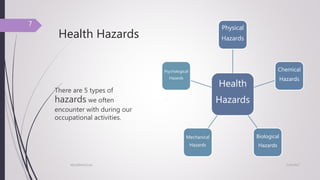
Health Hazards
Health
Hazards
Physical
Hazards
Chemical
Hazards
Biological
Hazards
Mechanical
Hazards
Psychological
Hazards
There are 5 types of
hazards we often
encounter with during our
occupational activities.
7/24/2017NSU/ENVH/C/str
7
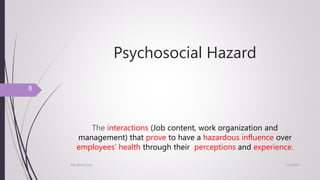
Psychosocial Hazard
The interactions (Job content, work organization and
management) that prove to have a hazardous influence over
employees’ health through their perceptions and experience.
7/24/2017NSU/ENVH/C/str
8
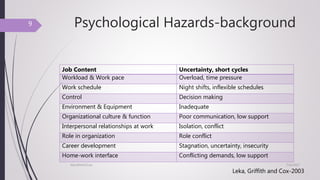
Psychological Hazards-background
Job Content Uncertainty, short cycles
Workload & Work pace Overload, time pressure
Work schedule Night shifts, inflexible schedules
Control Decision making
Environment & Equipment Inadequate
Organizational culture & function Poor communication, low support
Interpersonal relationships at work Isolation, conflict
Role in organization Role conflict
Career development Stagnation, uncertainty, insecurity
Home-work interface Conflicting demands, low support
Leka, Griffith and Cox-2003
7/24/2017NSU/ENVH/C/str
9
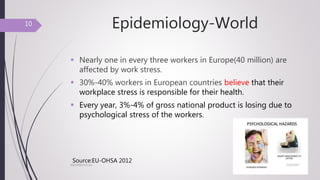
Epidemiology-World
 Nearly one in every three workers in Europe(40 million) are
affected by work stress.
 30%-40% workers in European countries believe that their
workplace stress is responsible for their health.
 Every year, 3%-4% of gross national product is losing due to
psychological stress of the workers.
Source:EU-OHSA 2012
7/24/2017NSU/ENVH/C/str
10
All Professional have
Psychological Hazard
7/24/2017NSU/ENVH/C/str
11
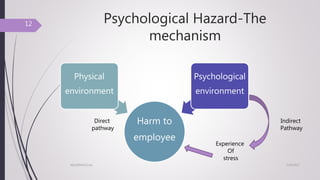
Psychological Hazard-The
mechanism
Harm to
employee
Physical
environment
Psychological
environment
Direct
pathway
Experience
Of
stress
Indirect
Pathway
7/24/2017NSU/ENVH/C/str
12
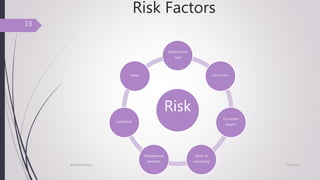
Risk Factors
Risk
Demand and
load
Job control
Co-worker
support
Sense of
community
Management
feedback
Leadership
Stress
7/24/2017NSU/ENVH/C/str
13
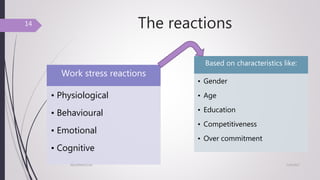
The reactions
Work stress reactions
• Physiological
• Behavioural
• Emotional
• Cognitive
Based on characteristics like:
• Gender
• Age
• Education
• Competitiveness
• Over commitment
7/24/2017NSU/ENVH/C/str
14
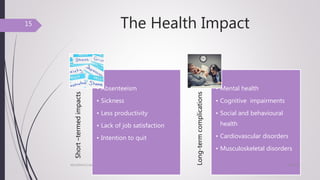
The Health Impact
Short–termedimpacts
• Absenteeism
• Sickness
• Less productivity
• Lack of job satisfaction
• Intention to quit
Long-termcomplications
• Mental health
• Cognitive impairments
• Social and behavioural
health
• Cardiovascular disorders
• Musculoskeletal disorders
7/24/2017NSU/ENVH/C/str
15
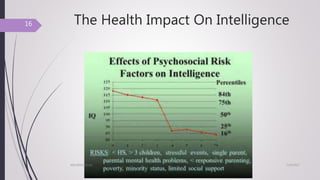
The Health Impact On Intelligence
7/24/2017NSU/ENVH/C/str
16
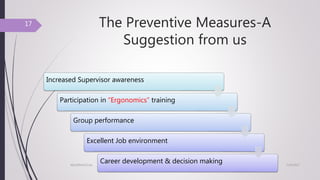
The Preventive Measures-A
Suggestion from us
Increased Supervisor awareness
Participation in “Ergonomics” training
Group performance
Excellent Job environment
Career development & decision making 7/24/2017NSU/ENVH/C/str
17
7/24/2017NSU/ENVH/C/str
18
Thank You
7/24/2017NSU/ENVH/C/str
19

Psychosocial hazards