1
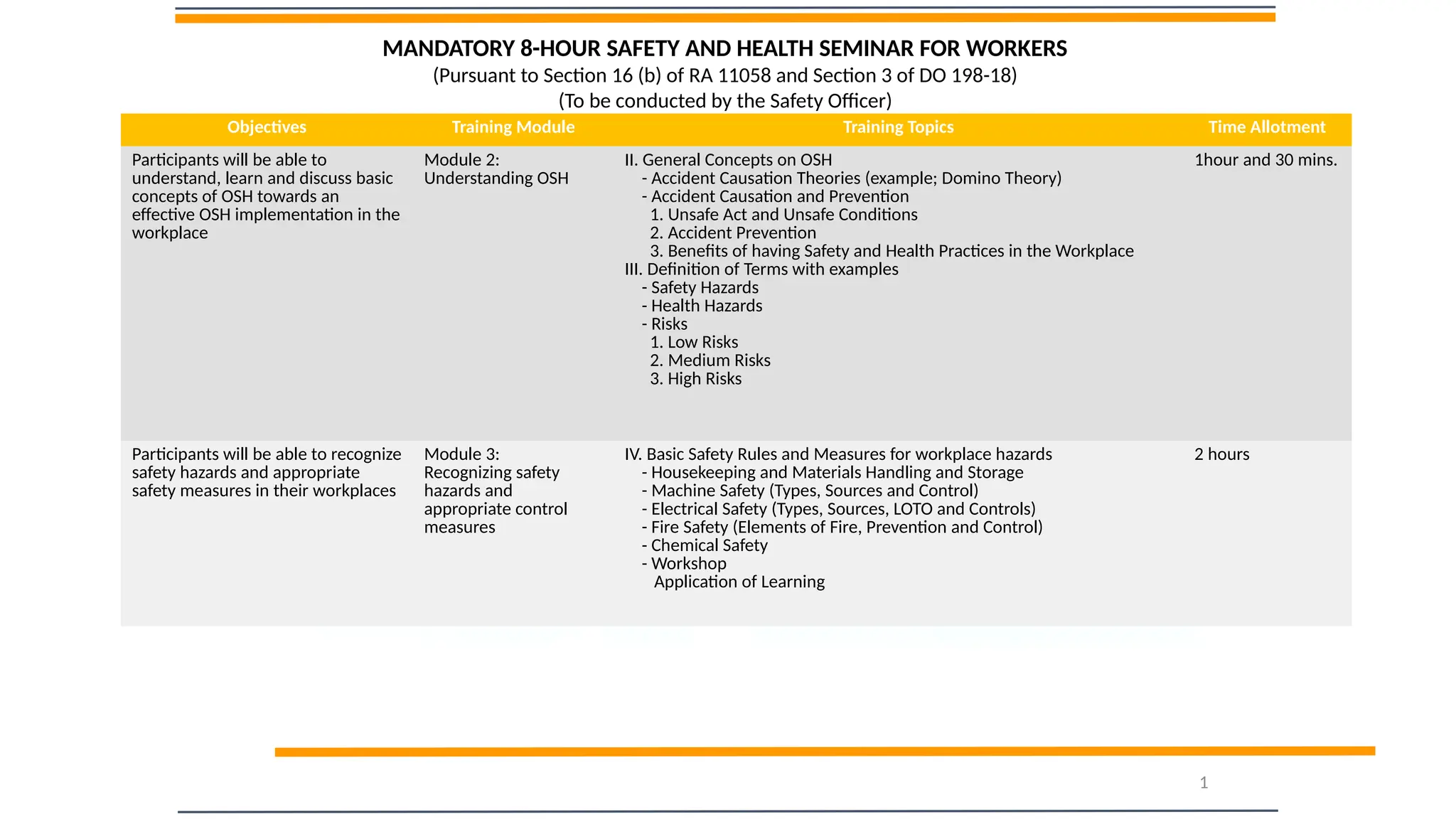
MANDATORY 8-HOUR SAFETY AND HEALTH SEMINAR FOR WORKERS
(Pursuant to Section 16 (b) of RA 11058 and Section 3 of DO 198-18)
(To be conducted by the Safety Officer)
Objectives Training Module Training Topics Time Allotment
Participants will be able to
understand, learn and discuss basic
concepts of OSH towards an
effective OSH implementation in the
workplace
Module 2:
Understanding OSH
II. General Concepts on OSH
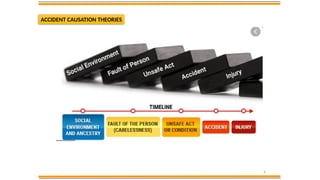
- Accident Causation Theories (example; Domino Theory)
- Accident Causation and Prevention
1. Unsafe Act and Unsafe Conditions
2. Accident Prevention
3. Benefits of having Safety and Health Practices in the Workplace
III. Definition of Terms with examples
- Safety Hazards
- Health Hazards
- Risks
1. Low Risks
2. Medium Risks
3. High Risks
1hour and 30 mins.
Participants will be able to recognize
safety hazards and appropriate
safety measures in their workplaces
Module 3:
Recognizing safety
hazards and
appropriate control
measures
IV. Basic Safety Rules and Measures for workplace hazards
- Housekeeping and Materials Handling and Storage
- Machine Safety (Types, Sources and Control)
- Electrical Safety (Types, Sources, LOTO and Controls)
- Fire Safety (Elements of Fire, Prevention and Control)
- Chemical Safety
- Workshop
Application of Learning
2 hours
2
MANDATORY 8-HOUR SAFETY AND HEALTH SEMINAR FOR WORKERS
(Pursuant to Section 16 (b) of RA 11058 and Section 3 of DO 198-18)
(To be conducted by the Safety Officer)
Objectives Training Module Training Topics Time Allotment
Participants will be able to perform
risks/hazards assessment,
evaluation and recommend
measures of control
Module 4:
Application of Hazards
Identification, Risk
Assessment and Control
(HIRAC)
V. Hazards Identification, Risk Assessment and Control (HIRAC)
- Key steps in recognizing and identifying hazards
1. Safety Hazards
2. Health Hazards
- Risk Assessment and Prioritization
- Application of Controls (Elimination, Substitution, Engineering,
Administrative & PPE)
- Workshop on Accomplishing Risk Assessment Form/Matrix
2 hours
(Noted: SO to
provide practical
examples, applicable
to company
practices/processes)
Participants will be able to know
how to respond in workplace
emergencies and participate during
conduct of emergency drills
Module 5:
Workplace Emergency
Preparedness
VI. Workplace Emergency Preparedness
- Roles of OSH Personnel
- Responses during Emergency
- Conduct of Emergency Drills (i.e. Earthquake/Fire/Ammonia)
1 hour
(Note: SO to discuss
in details the
emergency execution
plan)
Participants will be able to identify
the prescribed administrative
requirements and express
commitment to OSH
Module 6:
Compliance to
Administrative OSH
Requirements
VII. Administrative OSH Requirements
- Reportorial Requirements and Prescriptive Period of Submission
(R1020, AEDR, WAIR, AMR, RSO & Minutes of Meeting)
- Mandatory OSH Programs
- Penalties for violations
30 minutes
(Note: SO to
emphasize the Rights
of Workers)
Commitments Setting
- Re-entry Plan on OSH
(Note: SO to get
commitment from
the workers)
3
II. General Concepts on (OSH) Occupational Safety and Health
Objective:
At the end of the session module, participants will be able to understand, learn
and discuss basic concept of OSH towards an effective OSH implementation in the
workplace.
4
ACCIDENT CAUSATION THEORIES
5
UNSAFE/UNHEALTHY ACT
‱ A human action that departs from a standard or written job
procedure or common practice, safety rules, regulations, or
instructions.
‱ A violation of a commonly-accepted safe procedures and or
processes
6
FACTORS CONTRIBUTING TO UNSAFE/UNHEALTHY ACT
‱ Improper Attitude
‱ Physical Limitations
‱ Lack of Knowledge or Skills
7
FACTORS CONTRIBUTING TO UNSAFE/UNHEALTHY ACT
‱ Using defective equipment
‱ Horse playing
‱ Operating equipment without authority
‱ Disregard of SOP or instructions
‱ Willful intent to injure
‱ Working while under the influence of alcohol or drugs
IMPROPER ATTITUDES
8
FACTORS CONTRIBUTING TO UNSAFE/UNHEALTHY ACT
‱ Defective eyesight
‱ Muscular weakness due to fatigue
‱ Impaired hearing
PHYSICAL LIMITATIONS
9
FACTORS CONTRIBUTING TO UNSAFE/UNHEALTHY ACT
‱ Failure to understand instruction
‱ Unaware of safe practices
‱ Safe practices are not understood
‱ Unskilled or unpracticed
LACK OF KNOWLEDGE OR SKILLS
10
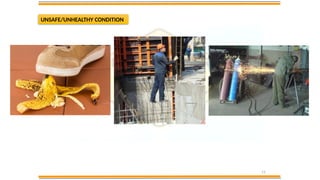
UNSAFE/UNHEALTHY CONDITION
The condition of the selected agency which could and should have been guarded or
corrected.
e.g. Improper guarding, defective agency, hazardous arrangement or Process, Improper
ventilation, Improper dress or apparel
What is the agency of incident?
The Agency (of injury/disease) refers to the object, substance or circumstance directly involved in
inflicting the injury or disease. The user can also record on his screen how the injury was
sustained and what particular chemical, product, process or equipment was involved in the
accident.
11
UNSAFE/UNHEALTHY CONDITION
12
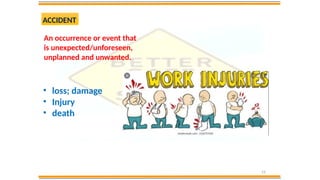
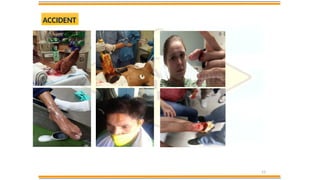
ACCIDENT
An occurrence or event that
is unexpected/unforeseen,
unplanned and unwanted.
‱ loss; damage
‱ Injury
‱ death
13
ACCIDENT
14
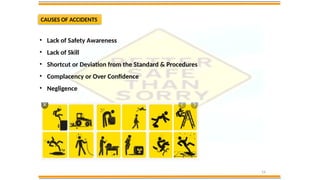
CAUSES OF ACCIDENTS
‱ Lack of Safety Awareness
‱ Lack of Skill
‱ Shortcut or Deviation from the Standard & Procedures
‱ Complacency or Over Confidence
‱ Negligence
15
ACCIDENT PREVENTION
‱ Conduct safety training – all employees should receive training on how to carry out
their job safely.
‱ Evaluate your workplace hazards – every workplace has its own unique set of
possible hazards.
‱ Label hazards – hazards that can’t be removed should be labeled so employees act
with caution.
‱ Use Safety equipment – employers should provide the necessary safety equipment
and require employees to use it.
‱ Discourage shortcuts – many inquiries occur when employees are rushing and skip
over important safety protocols, perhaps because they feel pressured to do so.
‱ Keep the workplace clean and orderly – when the workplace is dirty and cluttered,
employees are more likely to trip over objects or slip on a greasy floor. Keep the
facility clean and well-organized as much as possible.
‱ Have emergency drills – emergency drills can help prepare you and your employees
for potential accidents like workplace fires or chemical spills. Make sure employees
know how to respond in these situations.
16
BENEFITS OF HAVING SAFETY & HEALTH PRACTICES IN THE WORKPLACE
Benefit 1 – Protecting your staff
Following health and safety guidelines is primarily to protect employers and their staff from injury,
illness or coming into any other form of harm in the workplace. One of the main benefits of
following health and safety practices is to prevent common workplaces injuries such as back pain,
falling from height, asthma, injuries from slips and trips.
Benefit 2 – reducing absences
Following health and safety guidelines and maintaining a safe work place will reduce the risk of
work-related illnesses and injuries, and therefore reduce staff absences. Employers therefore also
save money on the direct costs of absences, such as paying salaries.
Benefit 3 – Improving productivity
If your colleagues and employees are able to work in a safe environment, this will improve morale
and overall productivity.
Benefit 4 – Saving money
By maintaining health and safety practices in the workplaces, and therefore reducing absences and
improving productivity, you will be saving money by retaining staff. Money spent on absences and
recruitment processes will decrease, and the business’ profits will increase.
17
III. Definition of Terms w/examples
Safety Hazards – are unsafe working conditions that can cause injury, illness, and
death. Safety hazards are the most common workplace risks.
Safety Hazards include:
‱ Spills on floors or tripping hazards, such as blocked aisles or cords running across
the floor.
‱ Working from heights, including ladders, scaffolds, roofs, or any raised work area.
‱ Unguarded machinery and moving machinery parts, guards removed or moving
parts that a worker can accidentally touch.
18
III. Definition of Terms w/examples
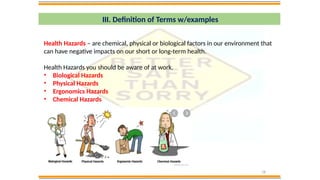
Health Hazards – are chemical, physical or biological factors in our environment that
can have negative impacts on our short or long-term health.
Health Hazards you should be aware of at work.
‱ Biological Hazards
‱ Physical Hazards
‱ Ergonomics Hazards
‱ Chemical Hazards
19
Safety & Health Hazards
o Biological Hazards
- commonly known as biohazards. Can be biological substance that could cause harm to
humans. Biological hazards exposure to harm or disease from working with animals,
people, or infectious
Types of things you may be exposed to for biological hazards:
 Blood and other body fluids
 Fungi/mold
 Bacteria and viruses
 Plants
 Insect bites
 Animal and bird droppings
20
Safety & Health Hazards
o Physical Hazards
- aren’t always something that you can see or touch. Physical hazards affect workers in
extreme weather conditions or harmful working environments. Can be any factors within
the environment that can harm the body without necessary touching it.
Physical hazards include:
 Radiation: including ionizing and non-ionizing (microwaves,
radio waves, etc.) materials
 High exposure to sunlight/ultraviolet rays
 Temperature extremes – hot and cold
 Constant loud noise
21
Safety & Health Hazards
o Ergonomic Hazards
- occur when the type of work, body positions, and working conditions put a strain on
your body. They are the hardest to spot since you don’t always immediately notice the
strain on your body or the harm that these hazards pose. Short-term exposure may result
in “sore muscles” the next day or in the days following the strain, but extended exposure
can result in serious long-term issues.
Ergonomic hazards include:
 Improper adjusted workstations and chairs
 Frequent lifting
 Poor posture
 Awkward movements, especially if they are repetitive
 Having to use too much force, especially if you have to do it
frequently
 Excessive vibration
22
Safety & Health Hazards
o Chemical Hazards
- are present when a worker is exposed to any chemical preparation in the workplace in
any form (solid, liquid or gas). Some are safer than others, but to some workers who are
more sensitive to chemicals, even common solutions can cause illness, skin irritation, or
breathing problems.
Chemical hazards can be present in the following:
 Liquids like cleaning products, paints acids, solvent – particularly if
chemicals are in an unlabeled container
 Vapors and fumes that come from welding or exposure to solvents
 Gases like acetylene, propane, carbon monoxide, helium, h2s gas
 Flammable materials like gasoline solvents, and explosive
chemicals
 Pesticides
23
III. Definition of Terms w/examples
Risk – involves uncertainty about the effects/implications of an activity with respect
to something that humans value (such as health, well-being, wealth, property or the
environment), often focusing on negative, undesirable consequences.
24
III. Definition of Terms w/examples
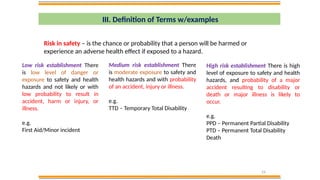
Risk in safety – is the chance or probability that a person will be harmed or
experience an adverse health effect if exposed to a hazard.
Low risk establishment There
is low level of danger or
exposure to safety and health
hazards and not likely or with
low probability to result in
accident, harm or injury, or
illness.
e.g.
First Aid/Minor incident
Medium risk establishment There
is moderate exposure to safety and
health hazards and with probability
of an accident, injury or illness.
e.g.
TTD – Temporary Total Disability
High risk establishment There is high
level of exposure to safety and health
hazards, and probability of a major
accident resulting to disability or
death or major illness is likely to
occur.
e.g.
PPD – Permanent Partial Disability
PTD – Permanent Total Disability
Death

II. UNDERSTANDING Occupational Sa H.pptx

  • 1.
    1 MANDATORY 8-HOUR SAFETYAND HEALTH SEMINAR FOR WORKERS (Pursuant to Section 16 (b) of RA 11058 and Section 3 of DO 198-18) (To be conducted by the Safety Officer) Objectives Training Module Training Topics Time Allotment Participants will be able to understand, learn and discuss basic concepts of OSH towards an effective OSH implementation in the workplace Module 2: Understanding OSH II. General Concepts on OSH - Accident Causation Theories (example; Domino Theory) - Accident Causation and Prevention 1. Unsafe Act and Unsafe Conditions 2. Accident Prevention 3. Benefits of having Safety and Health Practices in the Workplace III. Definition of Terms with examples - Safety Hazards - Health Hazards - Risks 1. Low Risks 2. Medium Risks 3. High Risks 1hour and 30 mins. Participants will be able to recognize safety hazards and appropriate safety measures in their workplaces Module 3: Recognizing safety hazards and appropriate control measures IV. Basic Safety Rules and Measures for workplace hazards - Housekeeping and Materials Handling and Storage - Machine Safety (Types, Sources and Control) - Electrical Safety (Types, Sources, LOTO and Controls) - Fire Safety (Elements of Fire, Prevention and Control) - Chemical Safety - Workshop Application of Learning 2 hours
  • 2.
    2 MANDATORY 8-HOUR SAFETYAND HEALTH SEMINAR FOR WORKERS (Pursuant to Section 16 (b) of RA 11058 and Section 3 of DO 198-18) (To be conducted by the Safety Officer) Objectives Training Module Training Topics Time Allotment Participants will be able to perform risks/hazards assessment, evaluation and recommend measures of control Module 4: Application of Hazards Identification, Risk Assessment and Control (HIRAC) V. Hazards Identification, Risk Assessment and Control (HIRAC) - Key steps in recognizing and identifying hazards 1. Safety Hazards 2. Health Hazards - Risk Assessment and Prioritization - Application of Controls (Elimination, Substitution, Engineering, Administrative & PPE) - Workshop on Accomplishing Risk Assessment Form/Matrix 2 hours (Noted: SO to provide practical examples, applicable to company practices/processes) Participants will be able to know how to respond in workplace emergencies and participate during conduct of emergency drills Module 5: Workplace Emergency Preparedness VI. Workplace Emergency Preparedness - Roles of OSH Personnel - Responses during Emergency - Conduct of Emergency Drills (i.e. Earthquake/Fire/Ammonia) 1 hour (Note: SO to discuss in details the emergency execution plan) Participants will be able to identify the prescribed administrative requirements and express commitment to OSH Module 6: Compliance to Administrative OSH Requirements VII. Administrative OSH Requirements - Reportorial Requirements and Prescriptive Period of Submission (R1020, AEDR, WAIR, AMR, RSO & Minutes of Meeting) - Mandatory OSH Programs - Penalties for violations 30 minutes (Note: SO to emphasize the Rights of Workers) Commitments Setting - Re-entry Plan on OSH (Note: SO to get commitment from the workers)
  • 3.
    3 II. General Conceptson (OSH) Occupational Safety and Health Objective: At the end of the session module, participants will be able to understand, learn and discuss basic concept of OSH towards an effective OSH implementation in the workplace.
  • 4.
  • 5.
    5 UNSAFE/UNHEALTHY ACT ‱ Ahuman action that departs from a standard or written job procedure or common practice, safety rules, regulations, or instructions. ‱ A violation of a commonly-accepted safe procedures and or processes
  • 6.
    6 FACTORS CONTRIBUTING TOUNSAFE/UNHEALTHY ACT ‱ Improper Attitude ‱ Physical Limitations ‱ Lack of Knowledge or Skills
  • 7.
    7 FACTORS CONTRIBUTING TOUNSAFE/UNHEALTHY ACT ‱ Using defective equipment ‱ Horse playing ‱ Operating equipment without authority ‱ Disregard of SOP or instructions ‱ Willful intent to injure ‱ Working while under the influence of alcohol or drugs IMPROPER ATTITUDES
  • 8.
    8 FACTORS CONTRIBUTING TOUNSAFE/UNHEALTHY ACT ‱ Defective eyesight ‱ Muscular weakness due to fatigue ‱ Impaired hearing PHYSICAL LIMITATIONS
  • 9.
    9 FACTORS CONTRIBUTING TOUNSAFE/UNHEALTHY ACT ‱ Failure to understand instruction ‱ Unaware of safe practices ‱ Safe practices are not understood ‱ Unskilled or unpracticed LACK OF KNOWLEDGE OR SKILLS
  • 10.
    10 UNSAFE/UNHEALTHY CONDITION The conditionof the selected agency which could and should have been guarded or corrected. e.g. Improper guarding, defective agency, hazardous arrangement or Process, Improper ventilation, Improper dress or apparel What is the agency of incident? The Agency (of injury/disease) refers to the object, substance or circumstance directly involved in inflicting the injury or disease. The user can also record on his screen how the injury was sustained and what particular chemical, product, process or equipment was involved in the accident.
  • 11.
  • 12.
    12 ACCIDENT An occurrence orevent that is unexpected/unforeseen, unplanned and unwanted. ‱ loss; damage ‱ Injury ‱ death
  • 13.
  • 14.
    14 CAUSES OF ACCIDENTS ‱Lack of Safety Awareness ‱ Lack of Skill ‱ Shortcut or Deviation from the Standard & Procedures ‱ Complacency or Over Confidence ‱ Negligence
  • 15.
    15 ACCIDENT PREVENTION ‱ Conductsafety training – all employees should receive training on how to carry out their job safely. ‱ Evaluate your workplace hazards – every workplace has its own unique set of possible hazards. ‱ Label hazards – hazards that can’t be removed should be labeled so employees act with caution. ‱ Use Safety equipment – employers should provide the necessary safety equipment and require employees to use it. ‱ Discourage shortcuts – many inquiries occur when employees are rushing and skip over important safety protocols, perhaps because they feel pressured to do so. ‱ Keep the workplace clean and orderly – when the workplace is dirty and cluttered, employees are more likely to trip over objects or slip on a greasy floor. Keep the facility clean and well-organized as much as possible. ‱ Have emergency drills – emergency drills can help prepare you and your employees for potential accidents like workplace fires or chemical spills. Make sure employees know how to respond in these situations.
  • 16.
    16 BENEFITS OF HAVINGSAFETY & HEALTH PRACTICES IN THE WORKPLACE Benefit 1 – Protecting your staff Following health and safety guidelines is primarily to protect employers and their staff from injury, illness or coming into any other form of harm in the workplace. One of the main benefits of following health and safety practices is to prevent common workplaces injuries such as back pain, falling from height, asthma, injuries from slips and trips. Benefit 2 – reducing absences Following health and safety guidelines and maintaining a safe work place will reduce the risk of work-related illnesses and injuries, and therefore reduce staff absences. Employers therefore also save money on the direct costs of absences, such as paying salaries. Benefit 3 – Improving productivity If your colleagues and employees are able to work in a safe environment, this will improve morale and overall productivity. Benefit 4 – Saving money By maintaining health and safety practices in the workplaces, and therefore reducing absences and improving productivity, you will be saving money by retaining staff. Money spent on absences and recruitment processes will decrease, and the business’ profits will increase.
  • 17.
    17 III. Definition ofTerms w/examples Safety Hazards – are unsafe working conditions that can cause injury, illness, and death. Safety hazards are the most common workplace risks. Safety Hazards include: ‱ Spills on floors or tripping hazards, such as blocked aisles or cords running across the floor. ‱ Working from heights, including ladders, scaffolds, roofs, or any raised work area. ‱ Unguarded machinery and moving machinery parts, guards removed or moving parts that a worker can accidentally touch.
  • 18.
    18 III. Definition ofTerms w/examples Health Hazards – are chemical, physical or biological factors in our environment that can have negative impacts on our short or long-term health. Health Hazards you should be aware of at work. ‱ Biological Hazards ‱ Physical Hazards ‱ Ergonomics Hazards ‱ Chemical Hazards
  • 19.
    19 Safety & HealthHazards o Biological Hazards - commonly known as biohazards. Can be biological substance that could cause harm to humans. Biological hazards exposure to harm or disease from working with animals, people, or infectious Types of things you may be exposed to for biological hazards:  Blood and other body fluids  Fungi/mold  Bacteria and viruses  Plants  Insect bites  Animal and bird droppings
  • 20.
    20 Safety & HealthHazards o Physical Hazards - aren’t always something that you can see or touch. Physical hazards affect workers in extreme weather conditions or harmful working environments. Can be any factors within the environment that can harm the body without necessary touching it. Physical hazards include:  Radiation: including ionizing and non-ionizing (microwaves, radio waves, etc.) materials  High exposure to sunlight/ultraviolet rays  Temperature extremes – hot and cold  Constant loud noise
  • 21.
    21 Safety & HealthHazards o Ergonomic Hazards - occur when the type of work, body positions, and working conditions put a strain on your body. They are the hardest to spot since you don’t always immediately notice the strain on your body or the harm that these hazards pose. Short-term exposure may result in “sore muscles” the next day or in the days following the strain, but extended exposure can result in serious long-term issues. Ergonomic hazards include:  Improper adjusted workstations and chairs  Frequent lifting  Poor posture  Awkward movements, especially if they are repetitive  Having to use too much force, especially if you have to do it frequently  Excessive vibration
  • 22.
    22 Safety & HealthHazards o Chemical Hazards - are present when a worker is exposed to any chemical preparation in the workplace in any form (solid, liquid or gas). Some are safer than others, but to some workers who are more sensitive to chemicals, even common solutions can cause illness, skin irritation, or breathing problems. Chemical hazards can be present in the following:  Liquids like cleaning products, paints acids, solvent – particularly if chemicals are in an unlabeled container  Vapors and fumes that come from welding or exposure to solvents  Gases like acetylene, propane, carbon monoxide, helium, h2s gas  Flammable materials like gasoline solvents, and explosive chemicals  Pesticides
  • 23.
    23 III. Definition ofTerms w/examples Risk – involves uncertainty about the effects/implications of an activity with respect to something that humans value (such as health, well-being, wealth, property or the environment), often focusing on negative, undesirable consequences.
  • 24.
    24 III. Definition ofTerms w/examples Risk in safety – is the chance or probability that a person will be harmed or experience an adverse health effect if exposed to a hazard. Low risk establishment There is low level of danger or exposure to safety and health hazards and not likely or with low probability to result in accident, harm or injury, or illness. e.g. First Aid/Minor incident Medium risk establishment There is moderate exposure to safety and health hazards and with probability of an accident, injury or illness. e.g. TTD – Temporary Total Disability High risk establishment There is high level of exposure to safety and health hazards, and probability of a major accident resulting to disability or death or major illness is likely to occur. e.g. PPD – Permanent Partial Disability PTD – Permanent Total Disability Death