WELCOME
An International Services Providing Company
NEBOSH IGC
Element 1: Why We Should Manage
Workplace Health and Safety
Learning Outcome
•Discuss the moral, social and financial
reasons for managing health and safety in
the workplace.
•Explain how health and safety is regulated
and the consequences of non-compliance.
•Summarise the main health and safety
duties of different groups of people at work.
•Explain how contractors should be
selected, monitored and managed.
Important Definitions
• Health
The non-existence or absence of disease is termed
as health. It is a condition in which there is no
symptom of illness or sickness. It includes physical
as well as mental health.
• Safety
It means no risk of serious personal harm or injury.
It is a risk-free condition of human life. If you stay
out of the danger area, you are in safety and
protection.
Important Definitions
Continue…
Welfare
It means access to necessities and
facilities of life to employees. It means that
nothing is missing or lacking in basic
facilities and an individual has easy access
to them.
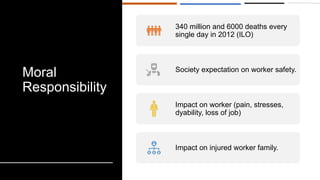
Moral
Responsibility
340 million and 6000 deaths every
single day in 2012 (ILO)
Society expectation on worker safety.
Impact on worker (pain, stresses,
dyability, loss of job)
Impact on injured worker family.
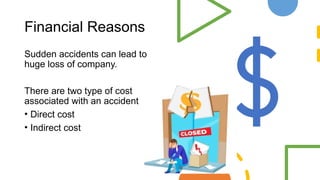
Financial Reasons
Sudden accidents can lead to
huge loss of company.
There are two type of cost
associated with an accident
• Direct cost
• Indirect cost
Direct Cost:
Legal fees, when defending a claim form the injured person for
compensation
• Worker sick pays
• lost production.
• Repairs to, or replacement of, damaged tools,
• Compensation payable to the victim.
• Overtime to meet the production target.
• Costs associated with the recovery of the injured worker.
• Insurance premium increment due to the accident.
Indirect Cost:
Time delay during investigation
Reduction in staff morale
The cost associated with corrective actions.
Lots of time (reports preparation, enforcing agency meetings)
Effects on reputation and the goodwill.
The cost of hiring of new staff and their training etc.
• Fine from court during the legal proceeding.
• Internal Industrial relations
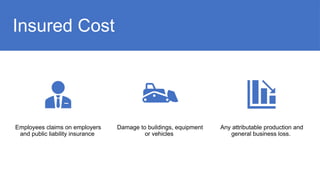
Insured Cost
Employees claims on employers
and public liability insurance
Damage to buildings, equipment
or vehicles
Any attributable production and
general business loss.
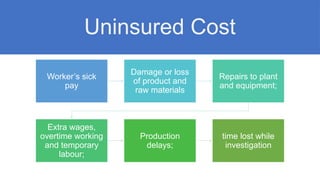
Uninsured Cost
Worker’s sick
pay
Damage or loss
of product and
raw materials
Repairs to plant
and equipment;
Extra wages,
overtime working
and temporary
labour;
Production
delays;
time lost while
investigation
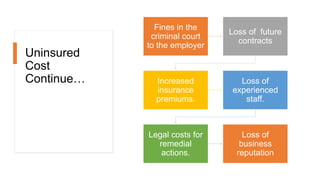
Uninsured
Cost
Continue…
Fines in the
criminal court
to the employer
Loss of future
contracts
Increased
insurance
premiums.
Loss of
experienced
staff.
Legal costs for
remedial
actions.
Loss of
business
reputation
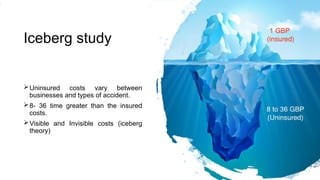
Iceberg study
Uninsured costs vary between
businesses and types of accident.
8- 36 time greater than the insured
costs.
Visible and Invisible costs (iceberg
theory)
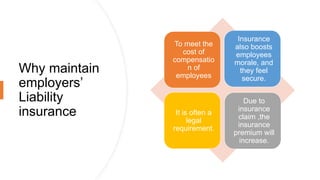
Why maintain
employers’
Liability
insurance
To meet the
cost of
compensatio
n of
employees
Due to
insurance
claim ,the
insurance
premium will
increase.
It is often a
legal
requirement.
Insurance
also boosts
employees
morale, and
they feel
secure.
Legal reason
The majority of countries have regulations regarding how the
organisations must provide health and safety to workers. These are
legal standards that need to be followed; otherwise, strict action can
be taken against that organisation, and imprisonment and
punishments can be given.
• Safe Workplace
• Safe Plant and machinery
• A safe system of work
• Supervision, Training and competency of staff
Explain how health and
safety is regulated and
the consequences of
non-compliance.
The role of national governments and international
bodies
Truly international legal standards of health and safety in workplace do not exist. A great quantity of
countries have enacted their own laws.
The International Labor Organization has developed two basic output;
• Conventions
• Recommendations
which have laid down rules to set international standards.
The role of
national
governments
and international
bodies
Convention (C155): Occupational Safety &
Health Convention
This convention sets out the first line of action
for health and safety. This road-map is drawn
at the national level as well as the level of the
individual organisation. In this way, it may be
termed as a two-pronged plan of action.
Recommendation (R164): Occupational
Safety & Health Recommendation
further adds material to C155 and thoroughly
provides guiding lines to act upon the action
programs of C155. Particularly, it points out
the duties and obligations of both the
employers and employees for achieving the
primary target of a protected and healthy
workplace.
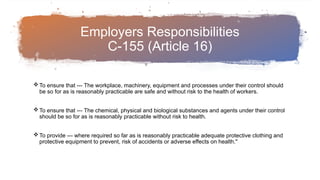
Employers Responsibilities
C-155 (Article 16)
To ensure that --- The workplace, machinery, equipment and processes under their control should
be so for as is reasonably practicable are safe and without risk to the health of workers.
To ensure that --- The chemical, physical and biological substances and agents under their control
should be so for as is reasonably practicable without risk to health.
To provide --- where required so far as is reasonably practicable adequate protective clothing and
protective equipment to prevent, risk of accidents or adverse effects on health."
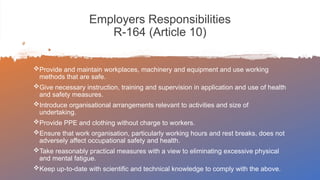
Employers Responsibilities
R-164 (Article 10)
Provide and maintain workplaces, machinery and equipment and use working
methods that are safe.
Give necessary instruction, training and supervision in application and use of health
and safety measures.
Introduce organisational arrangements relevant to activities and size of
undertaking.
Provide PPE and clothing without charge to workers.
Ensure that work organisation, particularly working hours and rest breaks, does not
adversely affect occupational safety and health.
Take reasonably practical measures with a view to eliminating excessive physical
and mental fatigue.
Keep up-to-date with scientific and technical knowledge to comply with the above.
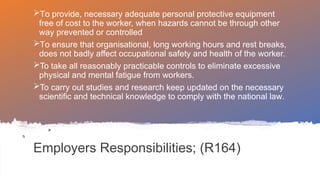
Employers Responsibilities; (R164)
To provide, necessary adequate personal protective equipment
free of cost to the worker, when hazards cannot be through other
way prevented or controlled
To ensure that organisational, long working hours and rest breaks,
does not badly affect occupational safety and health of the worker.
To take all reasonably practicable controls to eliminate excessive
physical and mental fatigue from workers.
To carry out studies and research keep updated on the necessary
scientific and technical knowledge to comply with the national law.
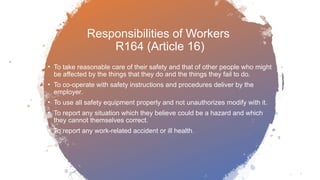
Responsibilities of Workers
R164 (Article 16)
• To take reasonable care of their safety and that of other people who might
be affected by the things that they do and the things they fail to do.
• To co-operate with safety instructions and procedures deliver by the
employer.
• To use all safety equipment properly and not unauthorizes modify with it.
• To report any situation which they believe could be a hazard and which
they cannot themselves correct.
• To report any work-related accident or ill health.
Rights of workers
The convention and Recommendation also give rights
to workers.
• The right of is to provide relevant information on health and safety
matters.
• The right to the necessary training in occupational safety and health.
• The right to be consulted by the employer on all major issues of OSH
• The contribution of worker must be taken regarding health and safety
matters.
• The right to leave a workplace which the workers thinks a present of
danger to his or her life or health and not be forced to return until it is
safe .
Role of
enforcement
agencies
• Provide the information (codes of
practice, guidance notes, and website
information)
• Perform health and safety inspections,
• Investigation after accident/incident and
incidence of ill-health.
• Assessment of arrangements is in place
to reduce risk in the workplace.
• Providing advice or guideline verbally or
in written form
• Issuance of enforcement action, e.g.
• improvement notice
• prohibition notices
• criminal proceedings.
Consequences of
non-compliance
Issuance of warning either verbally or in writing .
Force to the employer to improve workplace
condition in specified period (improvement notice)
Force to stop doing dangerous activities; till reforms
are made (Prohibition notice)
Investigating workplace accidents
Taking proper steps to force the employers to act
upon the law.
Cancellation of a licence of the company.
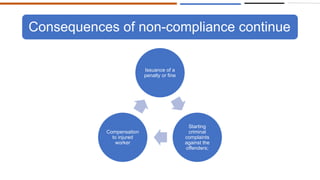
Consequences of non-compliance continue
Issuance of a
penalty or fine
Starting
criminal
complaints
against the
offenders;
Compensation
to injured
worker
Additional Global Standards
The International Organization
for Standardization (ISO) is the
biggest global promoter of
management standards. It has
established and advanced
• ISO 9001 (Quality management
standard)
• ISO 14001 (Environmental
management standard)
• ISO 45001(Health and
Safety management system).
It is notable that these are not
legal papers but they have got
worldwide acceptance by a
large number of states because
they show clearly good and
proper management doing
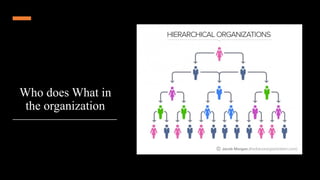
Who does What in
the organization
Directors and Senior
Managers
• Setting priorities and policies
• Ensure aims, and objectives are suitable.
• Ensure risk assessment and control measure application.
• Lead by example, visible leadership at front.
• Allocation of sufficient resources, in term of finance &
competent Personnel.
• Allocation of clear roles and responsibilities.
• Appointment of a senior manager with specific duties for
OSH.
• Regular review of the Organisational health and safety
performance
Responsibilities of Middle Managers and
Supervisors
• Application of OHS standards in the workplace under
their control
• Workplace and equipment are safe to work.
• Risk assessment of workplace is conducted and
revised.
• Safe working procedures are established and
implemented.
• Appropriate coordination between other managers
working in the same area, workers and contractors.
• Management of work progress to ensure long working
hours don't put adverse health effect on workers
They are
responsibl
e for;
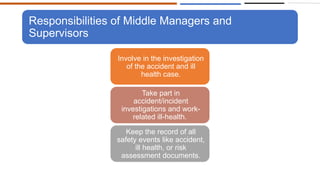
Responsibilities of Middle Managers and
Supervisors
Involve in the investigation
of the accident and ill
health case.
Take part in
accident/incident
investigations and work-
related ill-health.
Keep the record of all
safety events like accident,
ill health, or risk
assessment documents.
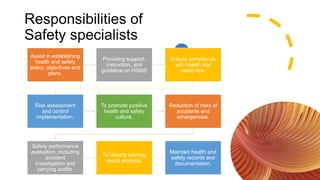
Responsibilities of
Safety specialists
Assist in establishing
health and safety
policy, objectives and
plans.
Providing support,
instruction, and
guideline on HSMS
Ensure compliance
with health and
safety law.
Risk assessment
and control
implementation.
To promote positive
health and safety
culture.
Reduction of risks of
accidents and
emergencies.
Safety performance
evaluation, including
accident
investigation and
carrying audits.
To identify training
needs analysis.
Maintain health and
safety records and
documentation.
The Shared Responsibilities of Joint Occupiers of Premises
• ILO Convention C155 – Article 17
• ILO Recommendation R164 – Recommendation 11
• Employers in shared facilities should communicate to
develop appropriate health and safety standards and
appropriate policies and procedures.
Detailed Description About Joint Occupiers
of Premises
When two employers/contractors join a place of work. They should have to
• Conduct regular meetings of their managers.
• Share information and risk assessments.
• Establish a joint site rules for the workplace.
• Establish joint procedures for control of visitors.
• Develop system of traffic and the vehicle movement.
• Conduct joint inspections of the workplace .
• Draw up joint emergency procedures for fire and other emergencies.
• Conduct joint fire drills
• Procedure for the management of waste
• Develop joint safety committees
Explain how contractors
should be
selected, monitored and
managed.
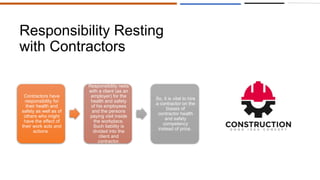
Responsibility Resting
with Contractors
Contractors have
responsibility for
their health and
safety as well as of
others who might
have the effect of
their work acts and
actions.
Responsibility rests
with a client (as an
employer) for the
health and safety
of his employees
and the persons
paying visit inside
the workplace.
Such liability is
divided into the
client and
contractor.
So, it is vital to hire
a contractor on the
biases of
contractor health
and safety
competency
instead of price.
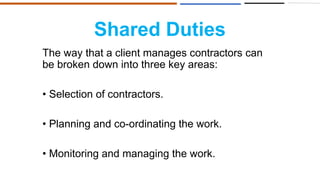
Shared Duties
The way that a client manages contractors can
be broken down into three key areas:
• Selection of contractors.
• Planning and co-ordinating the work.
• Monitoring and managing the work.
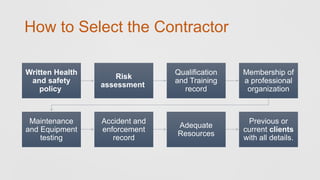
How to Select the Contractor
Written Health
and safety
policy
Risk
assessment
Qualification
and Training
record
Membership of
a professional
organization
Maintenance
and Equipment
testing
Accident and
enforcement
record
Adequate
Resources
Previous or
current clients
with all details.
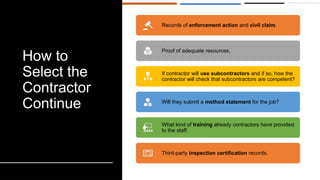
How to
Select the
Contractor
Continue
Records of enforcement action and civil claim.
Proof of adequate resources,
If contractor will use subcontractors and if so, how the
contractor will check that subcontractors are competent?
Will they submit a method statement for the job?
What kind of training already contractors have provided
to the staff.
Third-party inspection certification records.
Planning
and Co-
ordination
of the Work
Client - Provide information about all known hazards in the
workplace.
Contracts - conduct risk assessments and how risk could
be minimized.
Contractor - submit a written safe working (usually called
method statement) method
Communicate with each other and provide information's,
instruction and training
Co-operate and coordinate through regular meetings
Consult the workforce on health and safety matters
The client should Manage and supervise the work.
Monitor and Managing the Work
Clinet should consider
• responsibility for the work
• responsibility for supervising
• what precautions will be taken
• What PPE is to be used procedures, including any permits-to-work
• Work with mutual coordination.
• Prevent from creating any mutual confliction or clash
• The client owns responsibility for the monitoring
• Client can stop work activity until the prevision of agreed
arrangements in case of breach of method statement.

Chpater 01.pptx Nebosh chapter 1 slides (Presentation)

  • 1.
  • 2.
    NEBOSH IGC Element 1:Why We Should Manage Workplace Health and Safety
  • 3.
    Learning Outcome •Discuss themoral, social and financial reasons for managing health and safety in the workplace. •Explain how health and safety is regulated and the consequences of non-compliance. •Summarise the main health and safety duties of different groups of people at work. •Explain how contractors should be selected, monitored and managed.
  • 4.
    Important Definitions • Health Thenon-existence or absence of disease is termed as health. It is a condition in which there is no symptom of illness or sickness. It includes physical as well as mental health. • Safety It means no risk of serious personal harm or injury. It is a risk-free condition of human life. If you stay out of the danger area, you are in safety and protection.
  • 5.
    Important Definitions Continue… Welfare It meansaccess to necessities and facilities of life to employees. It means that nothing is missing or lacking in basic facilities and an individual has easy access to them.
  • 6.
    Moral Responsibility 340 million and6000 deaths every single day in 2012 (ILO) Society expectation on worker safety. Impact on worker (pain, stresses, dyability, loss of job) Impact on injured worker family.
  • 7.
    Financial Reasons Sudden accidentscan lead to huge loss of company. There are two type of cost associated with an accident • Direct cost • Indirect cost
  • 8.
    Direct Cost: Legal fees,when defending a claim form the injured person for compensation • Worker sick pays • lost production. • Repairs to, or replacement of, damaged tools, • Compensation payable to the victim. • Overtime to meet the production target. • Costs associated with the recovery of the injured worker. • Insurance premium increment due to the accident.
  • 9.
    Indirect Cost: Time delayduring investigation Reduction in staff morale The cost associated with corrective actions. Lots of time (reports preparation, enforcing agency meetings) Effects on reputation and the goodwill. The cost of hiring of new staff and their training etc. • Fine from court during the legal proceeding. • Internal Industrial relations
  • 10.
    Insured Cost Employees claimson employers and public liability insurance Damage to buildings, equipment or vehicles Any attributable production and general business loss.
  • 11.
    Uninsured Cost Worker’s sick pay Damageor loss of product and raw materials Repairs to plant and equipment; Extra wages, overtime working and temporary labour; Production delays; time lost while investigation
  • 12.
    Uninsured Cost Continue… Fines in the criminalcourt to the employer Loss of future contracts Increased insurance premiums. Loss of experienced staff. Legal costs for remedial actions. Loss of business reputation
  • 13.
    Iceberg study Uninsured costsvary between businesses and types of accident. 8- 36 time greater than the insured costs. Visible and Invisible costs (iceberg theory)
  • 14.
    Why maintain employers’ Liability insurance To meetthe cost of compensatio n of employees Due to insurance claim ,the insurance premium will increase. It is often a legal requirement. Insurance also boosts employees morale, and they feel secure.
  • 15.
    Legal reason The majorityof countries have regulations regarding how the organisations must provide health and safety to workers. These are legal standards that need to be followed; otherwise, strict action can be taken against that organisation, and imprisonment and punishments can be given. • Safe Workplace • Safe Plant and machinery • A safe system of work • Supervision, Training and competency of staff
  • 16.
    Explain how healthand safety is regulated and the consequences of non-compliance.
  • 17.
    The role ofnational governments and international bodies Truly international legal standards of health and safety in workplace do not exist. A great quantity of countries have enacted their own laws. The International Labor Organization has developed two basic output; • Conventions • Recommendations which have laid down rules to set international standards.
  • 18.
    The role of national governments andinternational bodies Convention (C155): Occupational Safety & Health Convention This convention sets out the first line of action for health and safety. This road-map is drawn at the national level as well as the level of the individual organisation. In this way, it may be termed as a two-pronged plan of action. Recommendation (R164): Occupational Safety & Health Recommendation further adds material to C155 and thoroughly provides guiding lines to act upon the action programs of C155. Particularly, it points out the duties and obligations of both the employers and employees for achieving the primary target of a protected and healthy workplace.
  • 19.
    Employers Responsibilities C-155 (Article16) To ensure that --- The workplace, machinery, equipment and processes under their control should be so for as is reasonably practicable are safe and without risk to the health of workers. To ensure that --- The chemical, physical and biological substances and agents under their control should be so for as is reasonably practicable without risk to health. To provide --- where required so far as is reasonably practicable adequate protective clothing and protective equipment to prevent, risk of accidents or adverse effects on health."
  • 20.
    Employers Responsibilities R-164 (Article10) Provide and maintain workplaces, machinery and equipment and use working methods that are safe. Give necessary instruction, training and supervision in application and use of health and safety measures. Introduce organisational arrangements relevant to activities and size of undertaking. Provide PPE and clothing without charge to workers. Ensure that work organisation, particularly working hours and rest breaks, does not adversely affect occupational safety and health. Take reasonably practical measures with a view to eliminating excessive physical and mental fatigue. Keep up-to-date with scientific and technical knowledge to comply with the above.
  • 21.
    Employers Responsibilities; (R164) Toprovide, necessary adequate personal protective equipment free of cost to the worker, when hazards cannot be through other way prevented or controlled To ensure that organisational, long working hours and rest breaks, does not badly affect occupational safety and health of the worker. To take all reasonably practicable controls to eliminate excessive physical and mental fatigue from workers. To carry out studies and research keep updated on the necessary scientific and technical knowledge to comply with the national law.
  • 22.
    Responsibilities of Workers R164(Article 16) • To take reasonable care of their safety and that of other people who might be affected by the things that they do and the things they fail to do. • To co-operate with safety instructions and procedures deliver by the employer. • To use all safety equipment properly and not unauthorizes modify with it. • To report any situation which they believe could be a hazard and which they cannot themselves correct. • To report any work-related accident or ill health.
  • 23.
    Rights of workers Theconvention and Recommendation also give rights to workers. • The right of is to provide relevant information on health and safety matters. • The right to the necessary training in occupational safety and health. • The right to be consulted by the employer on all major issues of OSH • The contribution of worker must be taken regarding health and safety matters. • The right to leave a workplace which the workers thinks a present of danger to his or her life or health and not be forced to return until it is safe .
  • 24.
    Role of enforcement agencies • Providethe information (codes of practice, guidance notes, and website information) • Perform health and safety inspections, • Investigation after accident/incident and incidence of ill-health. • Assessment of arrangements is in place to reduce risk in the workplace. • Providing advice or guideline verbally or in written form • Issuance of enforcement action, e.g. • improvement notice • prohibition notices • criminal proceedings.
  • 25.
    Consequences of non-compliance Issuance ofwarning either verbally or in writing . Force to the employer to improve workplace condition in specified period (improvement notice) Force to stop doing dangerous activities; till reforms are made (Prohibition notice) Investigating workplace accidents Taking proper steps to force the employers to act upon the law. Cancellation of a licence of the company.
  • 26.
    Consequences of non-compliancecontinue Issuance of a penalty or fine Starting criminal complaints against the offenders; Compensation to injured worker
  • 27.
    Additional Global Standards TheInternational Organization for Standardization (ISO) is the biggest global promoter of management standards. It has established and advanced • ISO 9001 (Quality management standard) • ISO 14001 (Environmental management standard) • ISO 45001(Health and Safety management system). It is notable that these are not legal papers but they have got worldwide acceptance by a large number of states because they show clearly good and proper management doing
  • 28.
    Who does Whatin the organization
  • 29.
    Directors and Senior Managers •Setting priorities and policies • Ensure aims, and objectives are suitable. • Ensure risk assessment and control measure application. • Lead by example, visible leadership at front. • Allocation of sufficient resources, in term of finance & competent Personnel. • Allocation of clear roles and responsibilities. • Appointment of a senior manager with specific duties for OSH. • Regular review of the Organisational health and safety performance
  • 30.
    Responsibilities of MiddleManagers and Supervisors • Application of OHS standards in the workplace under their control • Workplace and equipment are safe to work. • Risk assessment of workplace is conducted and revised. • Safe working procedures are established and implemented. • Appropriate coordination between other managers working in the same area, workers and contractors. • Management of work progress to ensure long working hours don't put adverse health effect on workers They are responsibl e for;
  • 31.
    Responsibilities of MiddleManagers and Supervisors Involve in the investigation of the accident and ill health case. Take part in accident/incident investigations and work- related ill-health. Keep the record of all safety events like accident, ill health, or risk assessment documents.
  • 32.
    Responsibilities of Safety specialists Assistin establishing health and safety policy, objectives and plans. Providing support, instruction, and guideline on HSMS Ensure compliance with health and safety law. Risk assessment and control implementation. To promote positive health and safety culture. Reduction of risks of accidents and emergencies. Safety performance evaluation, including accident investigation and carrying audits. To identify training needs analysis. Maintain health and safety records and documentation.
  • 33.
    The Shared Responsibilitiesof Joint Occupiers of Premises • ILO Convention C155 – Article 17 • ILO Recommendation R164 – Recommendation 11 • Employers in shared facilities should communicate to develop appropriate health and safety standards and appropriate policies and procedures.
  • 34.
    Detailed Description AboutJoint Occupiers of Premises When two employers/contractors join a place of work. They should have to • Conduct regular meetings of their managers. • Share information and risk assessments. • Establish a joint site rules for the workplace. • Establish joint procedures for control of visitors. • Develop system of traffic and the vehicle movement. • Conduct joint inspections of the workplace . • Draw up joint emergency procedures for fire and other emergencies. • Conduct joint fire drills • Procedure for the management of waste • Develop joint safety committees
  • 35.
    Explain how contractors shouldbe selected, monitored and managed.
  • 36.
    Responsibility Resting with Contractors Contractorshave responsibility for their health and safety as well as of others who might have the effect of their work acts and actions. Responsibility rests with a client (as an employer) for the health and safety of his employees and the persons paying visit inside the workplace. Such liability is divided into the client and contractor. So, it is vital to hire a contractor on the biases of contractor health and safety competency instead of price.
  • 37.
    Shared Duties The waythat a client manages contractors can be broken down into three key areas: • Selection of contractors. • Planning and co-ordinating the work. • Monitoring and managing the work.
  • 38.
    How to Selectthe Contractor Written Health and safety policy Risk assessment Qualification and Training record Membership of a professional organization Maintenance and Equipment testing Accident and enforcement record Adequate Resources Previous or current clients with all details.
  • 39.
    How to Select the Contractor Continue Recordsof enforcement action and civil claim. Proof of adequate resources, If contractor will use subcontractors and if so, how the contractor will check that subcontractors are competent? Will they submit a method statement for the job? What kind of training already contractors have provided to the staff. Third-party inspection certification records.
  • 40.
    Planning and Co- ordination of theWork Client - Provide information about all known hazards in the workplace. Contracts - conduct risk assessments and how risk could be minimized. Contractor - submit a written safe working (usually called method statement) method Communicate with each other and provide information's, instruction and training Co-operate and coordinate through regular meetings Consult the workforce on health and safety matters The client should Manage and supervise the work.
  • 41.
    Monitor and Managingthe Work Clinet should consider • responsibility for the work • responsibility for supervising • what precautions will be taken • What PPE is to be used procedures, including any permits-to-work • Work with mutual coordination. • Prevent from creating any mutual confliction or clash • The client owns responsibility for the monitoring • Client can stop work activity until the prevision of agreed arrangements in case of breach of method statement.

Editor's Notes

  • #5 Health Examples: Asbestos is harmful to health, and if someone inhales asbestos dust, he may develop lung cancer at some stage later in life. Mental extreme stress and strain can result in a nervous breakdown. Safety example: Working on high buildings without taking safety measures results in loss of life or severe injury due to fall from height. Walking under a load suspended from a crane is unsafe because the fall of weight may cause severe and fatal damage or death.
  • #6 Example: Provision of Toilet facilities, Handwash stations Restrooms, Hygienic preparation of foodstuff Etc
  • #7 According to the International Labor Organization (ILO), in 2012, about 340 million incidents in occupational health and safety and a total of 6000 deaths recorded every day. According to society, the practice is not acceptable if a worker makes any money to feed his family but gets killed or injured by the job or work he/she is doing. A worker will have to suffer a lot of pain, psychological stress, lifelong injury, permanent disability, with possible job losses due to an accident. A worker may be a single person of their family who is on the job. Because of the accident, not only the worker but also their family have to suffer a financial crisis. So it is the employer's moral duty to protect its workers and provide them with a safe and healthy working environment.
  • #8 There is a commercial aspect of health and safety because unintended accidents and events can cost money. Different governments find that inadequate occupational health and safety management raises additional costs for the economy, such as disabled workers' compensation and the expense of their medical treatment. Due to these sudden accidents, there are direct and indirect costs which organisations may face. Some of these costs insured, but others are not. Insurance means you save something as compensation.
  • #9 Direct costs arise directly from accidents and can easily be calculated. Direct costs could be insured or uninsured, that depends on the reason for the loss. As well, many small costs may not be covered by insurance the company due to their policies, because the insurance company wants the employer to meet some of the costs of losses.
  • #10 These costs are indirectly arising out of the event. Indirect costs cannot be measured frequently. They can hardly be identified.
  • #11 Uninsured costs vary between businesses and types of accident. They are, however, several times more than the insured costs. They can be linked to an iceberg. The costs recoverable through insurance are visible. But hidden beneath the surface are the uninsured costs. Like an iceberg, most of the costs are not immediately apparent.
  • #15 An organisation's employers are liable for all of their workers' health and safety when they are at work. There is a risk that their job may harm workers or that ex-employees organisations may become sick as a result of their previous work. This time employees can claim compensation from employees if employees believe the employer is responsible for the injury or ill health.
  • #16 Its social (legal) reasons are related to the framework of national and international laws. These laws regulate the management of health and safety of Organisations. The majority of countries have regulations regarding how the organisations must provide health and safety to workers. These are legal standards that need to be followed; otherwise, strict action can be taken against that organisation, and imprisonment and punishments can be given. Briefly speaking, it is the employer who is legally responsible for the health and safety of employees at work. An employer is under obligation to provide the following things:
  • #18 Truly international legal standards of health and safety in the workplace do not exist. A great number of countries have adopted their laws, developed evolutionary to solve their affairs and issues regarding health and safety. It is important to note that countries often conclude adopting similar basic ideas to protect public safety and health. The detail of their thoughts and views may vary, but the underlying principles are not different. A prime moving body in the empire of global standards in health and safety is no doubt, the International Labor Organization (ILO), an important institution of the United Nations. A large number of countries have a membership in the International Labor Organization (ILO). "Conventions" and "Recommendations" are two primary outcomes of the ILO which have laid down rules to set international standards. These two simple outputs of ILO can be the foundation to legislate (law-making) in each member state. Consequently, the minimum basic standards of health and safety can be adopted. Each member country enforces the standards in a domestically suitable manner that is why the elaboration of legal provisions and clauses will differ. The International Labor Organization established the Occupational Safety and Health Convention, 1981 (C155). This convention sets out the first line of action for health and safety. This road-map is drawn at the national level as well as the level of the individual organisation. In this way, it may be termed as a two-pronged plan of action. The Occupational Safety and Health Recommendation, 1981 (R164) further adds material to C155 and thoroughly provides guiding lines to act upon the action programs of C155. Particularly, it points out the duties and obligations of both the employers and employees for achieving the primary target of a protected and healthy workplace. Most of the ILO-member countries have confirmed and signed C155, and made their national law according to the requirements of C155 and R164. C155 and R164 define the responsibilities of the employer and individual workers regarding safety and health of staff in the workplace. Legal draft varies in various laws of countries, but the common concepts are that both the parties (employers and workers) are strictly bound to ensure safety and risk-free health with reasonable care.
  • #19 Truly international legal standards of health and safety in the workplace do not exist. A great number of countries have adopted their laws, developed evolutionary to solve their affairs and issues regarding health and safety. It is important to note that countries often conclude adopting similar basic ideas to protect public safety and health. The detail of their thoughts and views may vary, but the underlying principles are not different. A prime moving body in the empire of global standards in health and safety is no doubt, the International Labor Organization (ILO), an important institution of the United Nations. A large number of countries have a membership in the International Labor Organization (ILO). "Conventions" and "Recommendations" are two primary outcomes of the ILO which have laid down rules to set international standards. These two simple outputs of ILO can be the foundation to legislate (law-making) in each member state. Consequently, the minimum basic standards of health and safety can be adopted. Each member country enforces the standards in a domestically suitable manner that is why the elaboration of legal provisions and clauses will differ. The International Labor Organization established the Occupational Safety and Health Convention, 1981 (C155). This convention sets out the first line of action for health and safety. This road-map is drawn at the national level as well as the level of the individual organisation. In this way, it may be termed as a two-pronged plan of action. The Occupational Safety and Health Recommendation, 1981 (R164) further adds material to C155 and thoroughly provides guiding lines to act upon the action programs of C155. Particularly, it points out the duties and obligations of both the employers and employees for achieving the primary target of a protected and healthy workplace. Most of the ILO-member countries have confirmed and signed C155, and made their national law according to the requirements of C155 and R164. C155 and R164 define the responsibilities of the employer and individual workers regarding safety and health of staff in the workplace. Legal draft varies in various laws of countries, but the common concepts are that both the parties (employers and workers) are strictly bound to ensure safety and risk-free health with reasonable care.
  • #20 To ensure that --- The workplace, machinery, equipment and processes under their control should be so for as is reasonably practicable are safe and without risk to the health of workers. To ensure that --- The chemical, physical and biological substances and agents under their control should be so for as is reasonably practicable without risk to health. To provide --- where required so far as is reasonably practicable adequate protective clothing and protective equipment to prevent, risk of accidents or adverse effects on health."
  • #21 To ensure that --- The workplace, machinery, equipment and processes under their control should be so for as is reasonably practicable are safe and without risk to the health of workers. To ensure that --- The chemical, physical and biological substances and agents under their control should be so for as is reasonably practicable without risk to health. To provide --- where required so far as is reasonably practicable adequate protective clothing and protective equipment to prevent, risk of accidents or adverse effects on health."
  • #22 To ensure that --- The workplace, machinery, equipment and processes under their control should be so for as is reasonably practicable are safe and without risk to the health of workers. To ensure that --- The chemical, physical and biological substances and agents under their control should be so for as is reasonably practicable without risk to health. To provide --- where required so far as is reasonably practicable adequate protective clothing and protective equipment to prevent, risk of accidents or adverse effects on health."
  • #23 To take reasonable care of their safety and that of other people who might be affected by the things that they do and the things they fail to do. To co-operate with safety instructions and procedures deliver by the employer. To use all safety equipment properly and not unauthorizes modify with it. To report any situation which they believe could be a hazard and which they cannot themselves correct. To report any work-related accident or ill health.
  • #24 The right of is to provide relevant information on health and safety matters, and about actions the employer has taken to ensure occupational safety and health. The right to the necessary training in occupational safety and health. The right to be consulted by the employer on all significant issues of occupational safety and health relating to their work before implementing. The contribution of worker mast is taken regarding health and safety matters. To contact with labour inspector. The right to leave a workplace which the workers have reason to think presents an expected and severe danger to his or her life or health and not be forced to return until it is safe.
  • #25 To take reasonable care of their safety and that of other people who might be affected by the things that they do and the things they fail to do. To co-operate with safety instructions and procedures deliver by the employer. To use all safety equipment properly and not unauthorizes modify with it. To report any situation which they believe could be a hazard and which they cannot themselves correct. To report any work-related accident or ill health.
  • #26 Issuance of warning either verbally or in writing to organisations. Can force the employer to improve the condition of the workplace within a specified period as demanded (improvement notice) Can force him to stop doing dangerous activities in the premises/within of the workplace as long as and more reforms are made (Prohibition notice) Investigating workplace accidents to find the reason and guilty. Taking proper steps to force the employers to act upon the law. Cancellation of a licence of the company, where it is required to have permission to perform a specific activity. E.g. Dealing with hazardous waste. Issuance of a formal notice to an organisation that highlights the non-compliance and warns them that repetition of offences may result in prosecution. Issuance of a penalty or fine by the enforcement agency with the trial in the court. Starting criminal complaints against the offenders whether they are persons or Organisations and can call in the criminal courts and success of legal proceedings might result in punishment, fine or remedial action. The criminal law also brings judgement in favour of the workers to be appropriately compensated who are injured by accident in the premises of a workplace.
  • #28 The International Organization for Standardization (ISO) is the biggest global promoter of management standards. It has established and advanced ISO 9001 (Quality management standard) ISO 14001 (Environmental management standard) ISO 45001(Health and Safety management system). It is notable that these are not legal papers but they have got worldwide acceptance by a large number of states because they show clearly good and proper management doing
  • #30 Direction and senior managers are appointed by employer to ensure that employer’s responsibilities of health and safety are met. Directors set priorities and play important role in making policies regarding health and safety and their implementation. They make sure that organizational health and safety aims, and objectives are suitable. The make sure that risk assessment is being carried out and suitable control measure are in place to reduce risk. They have to lead by example, e.g. vesting a workplace to assess health and safety performance. They have to ensure sufficient resources are provided for establishing, putting in place and keeping in working order the health and safety management system. This also includes two things: Complete financial strength to deliver the objectives and purposes in the policy. Personnel/employees having competency and required ability to provide helping hands in the delivery of the policy aims and objectives. The faultless framework and mechanism of the Organization showing clear roles and responsibilities of each section are implemented. Appointment of a senior manager with particular duties for health . Appointments of skilled persons for helping the Organization in performing health and safety functions have been made. Regular review of the Organizational health and safety (usually annually) performance ensuring the continual achievement of objectives and validity of objectives and measures in place is completed. They set the role and responsibilities of middle managers and establish machines for accountability against their duties
  • #31 Middle managers and supervisors are responsible for the health and safety standards of the workplace under their control regarding the operational functions because they are involved in the daily Organisational, operational activities. Their functional parts of obligations are usually defined and expressed clearly in the Organization section of the policy. To ensure that workplace and all equipment are under their control are reasonably safe to work. Risk assessment of there is conducted and regularly revised on a suitable interval. Suitable and safe working procedures are established and implemented. Necessary training and instructions to staff under their control are being provided. The team under their supervision is suitably supervised. Workers under their control have provided with personal protective equipment's. They will organise work progress to ensure long working hours don't put adverse health effect on workers. They have to ensure appropriate coordination between other managers working in the same area, workers and contractors. They have to provide consultation with workers under their control. Involve in the investigation of the accident and ill health case. Take part in accident/incident investigations and work-related ill-health. They have to keep the record of all safety events like accident, ill health, or risk assessment documents.
  • #32 Middle managers and supervisors are responsible for the health and safety standards of the workplace under their control regarding the operational functions because they are involved in the daily Organisational, operational activities. Their functional parts of obligations are usually defined and expressed clearly in the Organization section of the policy. To ensure that workplace and all equipment are under their control are reasonably safe to work. Risk assessment of there is conducted and regularly revised on a suitable interval. Suitable and safe working procedures are established and implemented. Necessary training and instructions to staff under their control are being provided. The team under their supervision is suitably supervised. Workers under their control have provided with personal protective equipment's. They will organise work progress to ensure long working hours don't put adverse health effect on workers. They have to ensure appropriate coordination between other managers working in the same area, workers and contractors. They have to provide consultation with workers under their control. Involve in the investigation of the accident and ill health case. Take part in accident/incident investigations and work-related ill-health. They have to keep the record of all safety events like accident, ill health, or risk assessment documents.
  • #33 They assist in establishing health and safety policy, aims, objectives and plans. They provide support, advice, instruction, and guideline on health and safety management system implementation. They assist with top management to ensure compliance with health and safety law. They assist in risk evaluation and control measure implementation to control risk. They promote health and safety culture of positive type and support management in consultation with workers. They advise management for removal of risks of accidents and emergencies. To supervise the risk assessment procedure, also assist in safety performance evaluation, including accident investigation and carrying audits. They identify the requirements and needs of the type of different trainings and its gap with the national recommendation. They maintain health and safety records and documentation of data on health and safety performance, for example, number and type of accidents/incidents Amount and kind of ill health cases. The number of absence due to medical conditions.
  • #35 When two employers/contractors join together a place of work the,m, it is easy to think that the hazards that one employer creates there may affect the workers of the other employer. For example, where two employers take hold of office in the same building, the fire danger produced by one employer may cause-the effect to the safety of the employees of the other in forms of harm, injury, hazard, etc. Therefore, both of them must always co-operate and coordinate their working activities to ensure ethical standards of health and safety. To achieve favourable standards of health and safety,
  • #37 Contractors have responsibility for their health and safety as well as of others who might have the effect of their work acts and actions. For instance, a contractor might be held accountable for bringing an instrument or power tool unsafe and unprotected in nature into the factory of a client. Resultantly it causes injury or harm to any worker or a visitor. Responsibility rests with a client (as an employer) for the health and safety of his employees and the persons paying visit inside the workplace. Such liability is divided into the client and contractor. Most of the countries have established law to ensure that neither contractor nor employer or both could harm their workers and people. So, it is vital to hire a contractor on the biases of contractor health and safety competency instead of price.
  • #39 Following information’s must be collated and assessed for the selection of contractor.   Does contractor have copy of their written health and safety policy – a statement of line of action for insuring health and safety standards? If the contractor has performed similar work risk assessment previously? if yes, request the recorded to assess suitability and competency regarding health and safety. Does the contractor have access to specialist advice on health and safety matters if required? The contractor monitors previous accident rate of workplace and have record? (copy should be submitted) What are qualifications and training of staff within contractor competency? The contractor or they staff member hold membership of a professional Organization like IOSH etc. or they member of a trade association? The contractor has effective procedure for monitoring. What kind of training already contractors have provided to the staff to perform similar job? Third party inspection certification records of of plant and equipment. Names of previous or current clients with all details. Records of enforcement action taken by authorities against and civil claim against them . Proof of adequate resources, for instances, access to specialist safety instruction. Will contractor be use subcontractors and if so how contractor will check that subcontractors are competent? Will they submit method statement for the job?
  • #40 Following information’s must be collated and assessed for the selection of contractor.   Does contractor have copy of their written health and safety policy – a statement of line of action for insuring health and safety standards? If the contractor has performed similar work risk assessment previously? if yes, request the recorded to assess suitability and competency regarding health and safety. Does the contractor have access to specialist advice on health and safety matters if required? The contractor monitors previous accident rate of workplace and have record? (copy should be submitted) What are qualifications and training of staff within contractor competency? The contractor or they staff member hold membership of a professional Organization like IOSH etc. or they member of a trade association? The contractor has effective procedure for monitoring. What kind of training already contractors have provided to the staff to perform similar job? Third party inspection certification records of of plant and equipment. Names of previous or current clients with all details. Records of enforcement action taken by authorities against and civil claim against them . Proof of adequate resources, for instances, access to specialist safety instruction. Will contractor be use subcontractors and if so how contractor will check that subcontractors are competent? Will they submit method statement for the job?
  • #41 To meet their (Client and Contractor) responsibilities, it is very important that they share health and safety information with each other that could affect the work, for example, The client could provide information about all known hazards which exist in the workplace, like asbestos contained cement. The contracts will conduct risk assessments and foresee that how the work activities and those performing in the work interact with each other and how they increase risk and how it could be minimized. The contractor will submit a written safe working (usually called method statement) method to contractor detailing how contractor and their team will perform work and avoid accidents. The client and contractor should communicate with each other and provide information’s, instruction and training to contractor and their employees about the health and safety risk involved in job and control measures, as well emergency procedure. Client and the contractor should have to Cooperate and coordinate through regular meetings with the contractor to make ensure that the work activates can be done safely and without risks to health. They have to Consult the workforce on health and safety matters. This will help to make better decisions on the actual risks and controls. Client should Manage and supervise the work according to the level of risk, ie the highest the risk, the more you need to do. Consider: responsibility for the work responsibility for supervise what precautions will be taken What PPE is to be used procedures, including any permits-to-work   The client and contractor should work with care and mutual co-ordination. They should prevent from creating any mutual confliction or clash. There may be various contractors busy in work on site at any one time and the acts and deeds of one person or Organization must not cause hazard for another in the area. the client own responsibility for the monitoring work activity, if performance of health and safety is not acceptable the client should take action and stop work activity until the prevision of agreed arrangements.  
  • #42 To meet their (Client and Contractor) responsibilities, it is very important that they share health and safety information with each other that could affect the work, for example, The client could provide information about all known hazards which exist in the workplace, like asbestos contained cement. The contracts will conduct risk assessments and foresee that how the work activities and those performing in the work interact with each other and how they increase risk and how it could be minimized. The contractor will submit a written safe working (usually called method statement) method to contractor detailing how contractor and their team will perform work and avoid accidents. The client and contractor should communicate with each other and provide information’s, instruction and training to contractor and their employees about the health and safety risk involved in job and control measures, as well emergency procedure. Client and the contractor should have to Cooperate and coordinate through regular meetings with the contractor to make ensure that the work activates can be done safely and without risks to health. They have to Consult the workforce on health and safety matters. This will help to make better decisions on the actual risks and controls. Client should Manage and supervise the work according to the level of risk, ie the highest the risk, the more you need to do. Consider: responsibility for the work responsibility for supervise what precautions will be taken What PPE is to be used procedures, including any permits-to-work   The client and contractor should work with care and mutual co-ordination. They should prevent from creating any mutual confliction or clash. There may be various contractors busy in work on site at any one time and the acts and deeds of one person or Organization must not cause hazard for another in the area. the client own responsibility for the monitoring work activity, if performance of health and safety is not acceptable the client should take action and stop work activity until the prevision of agreed arrangements.