PLATE TECTONICS
Movements of plate and formation of various types of landforms
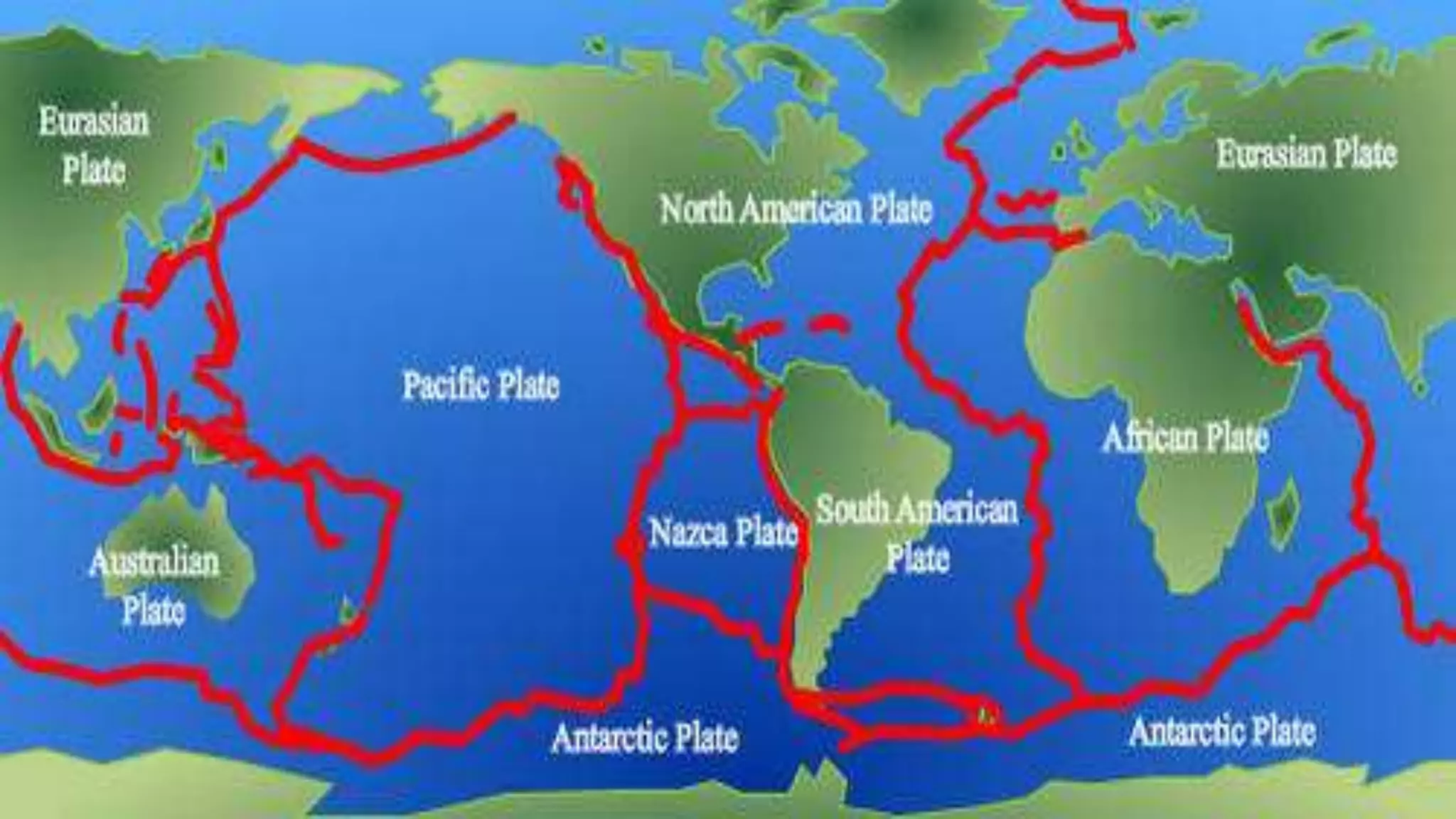
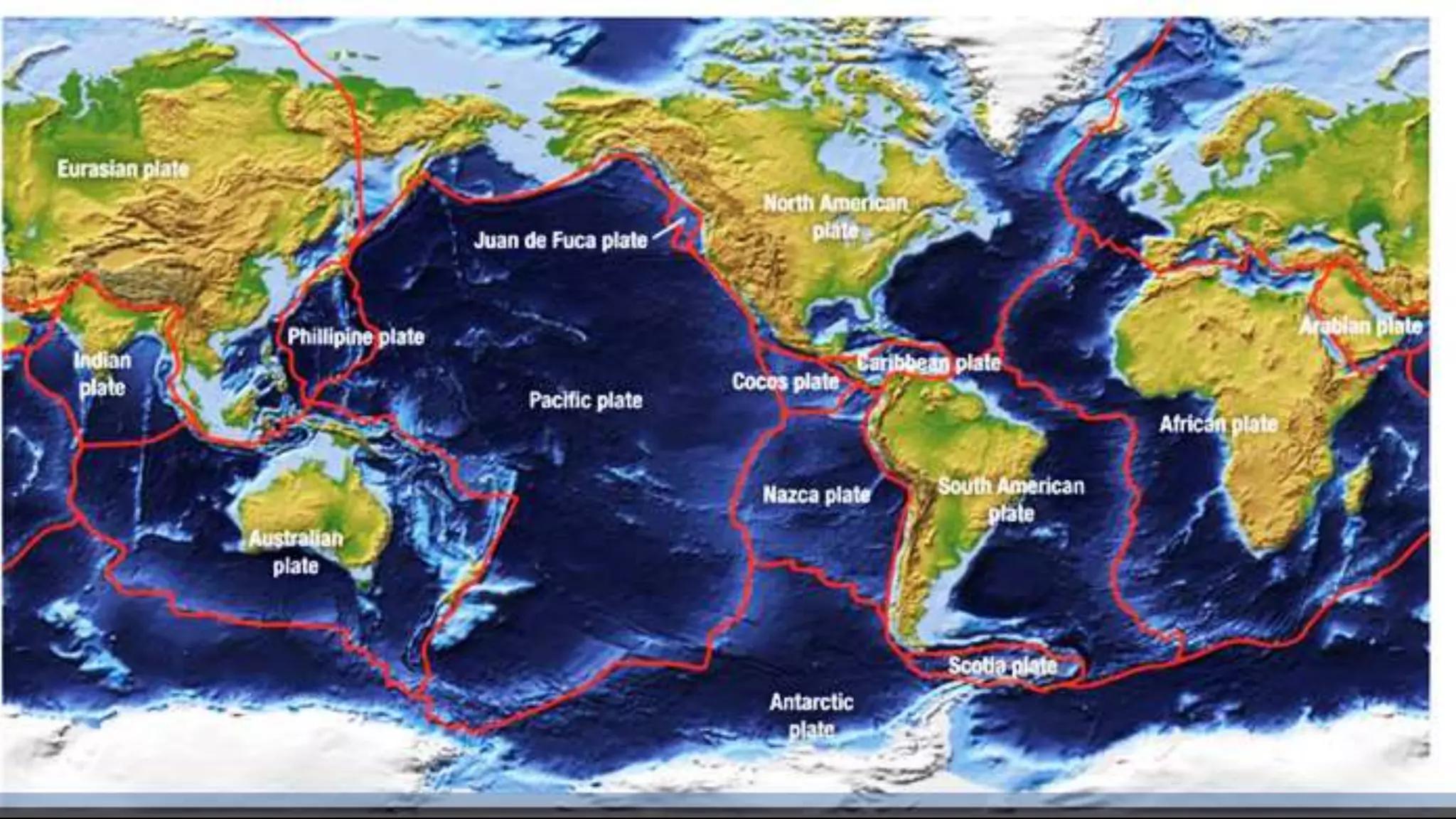
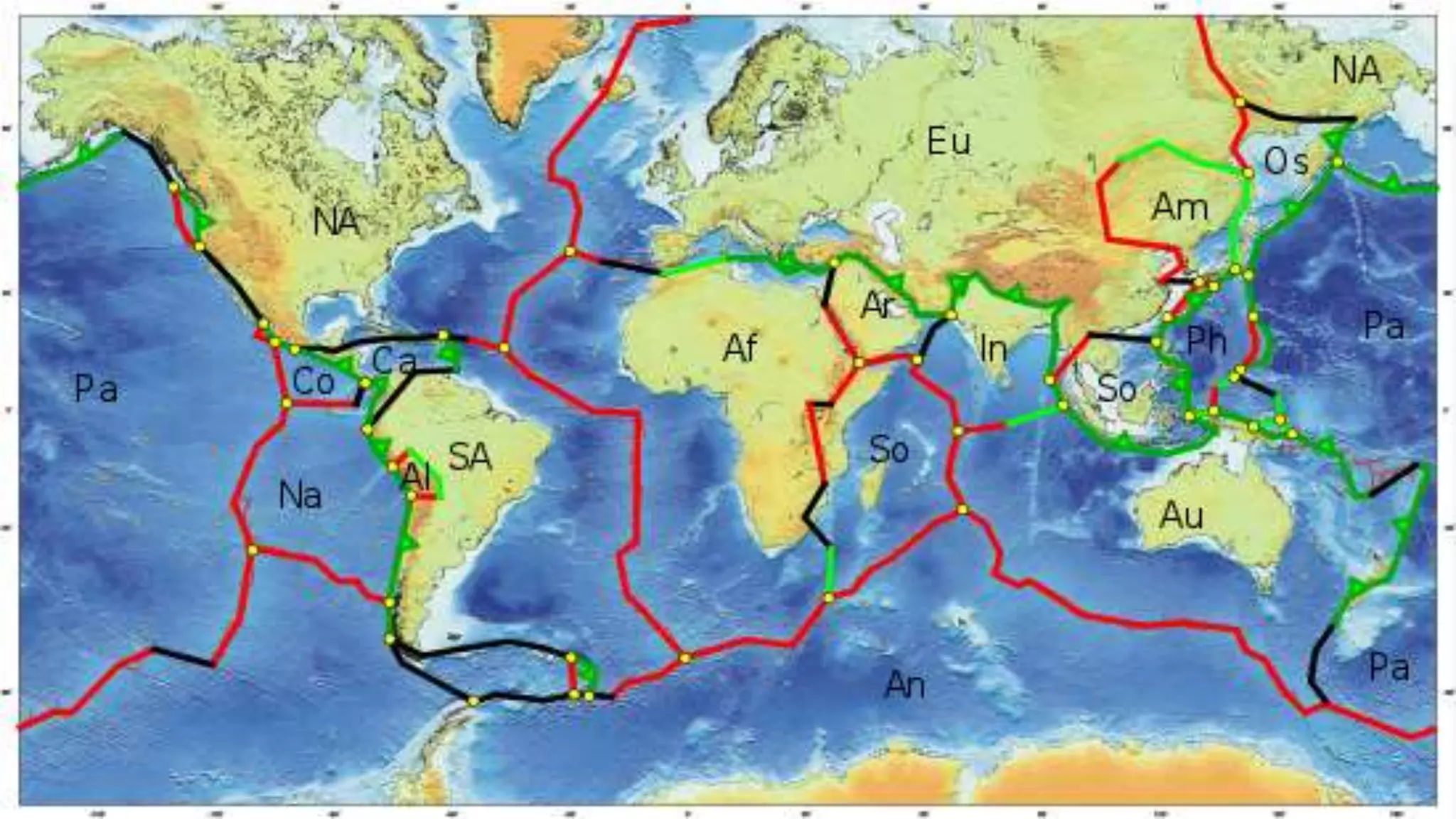
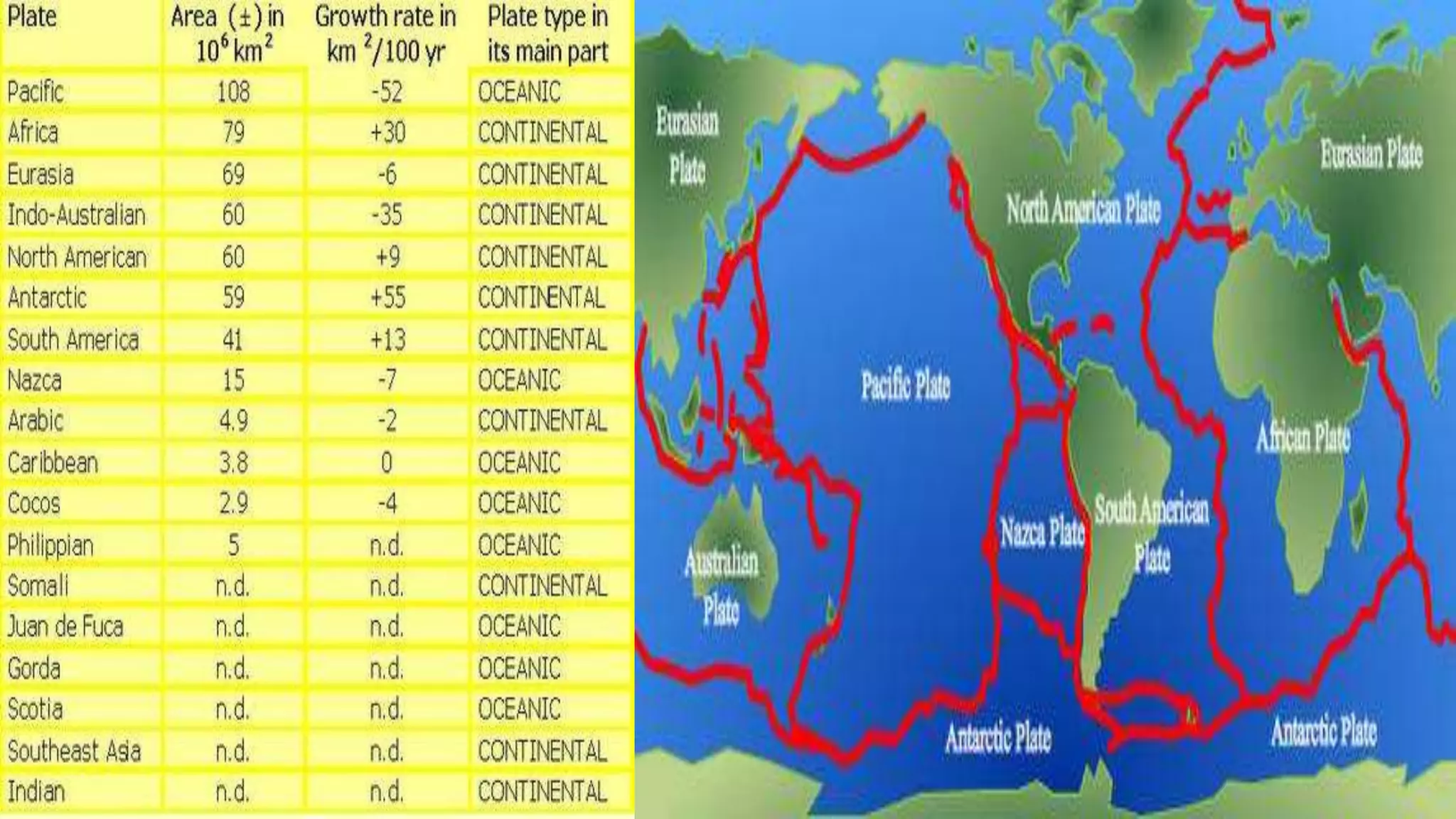
1. MAJOR TECTONICS PLATES
According to the geographical positions of all the plates are covering most of the
regions of the earth and many plates are there who role play in tectonics activities of
the earth
1. African plate
2. Antarctic plate
3. Eurasian plate
4. North-American plate
5. Indo-Austrian plate
6. Pacific plate
7. South-America plate
2. VARIOUS LANDFORM FORMED BY PLATE
MOVEMENT
By plate movements of the earth so many landform occur on the basis of behaviour of the
plate property such as convergent type of movement and divergent type of movement in
between oceanic/tectonic plates also transform type of movement occur
• Continental arc
• Islands arc
• Continent Rift mechanism
• Oceanic Ridge mechanism
• Trench
• Hot-Spot
• Fissure volcanos
• Plateau/Himalayas/Hills
CONTINENTAL ARC
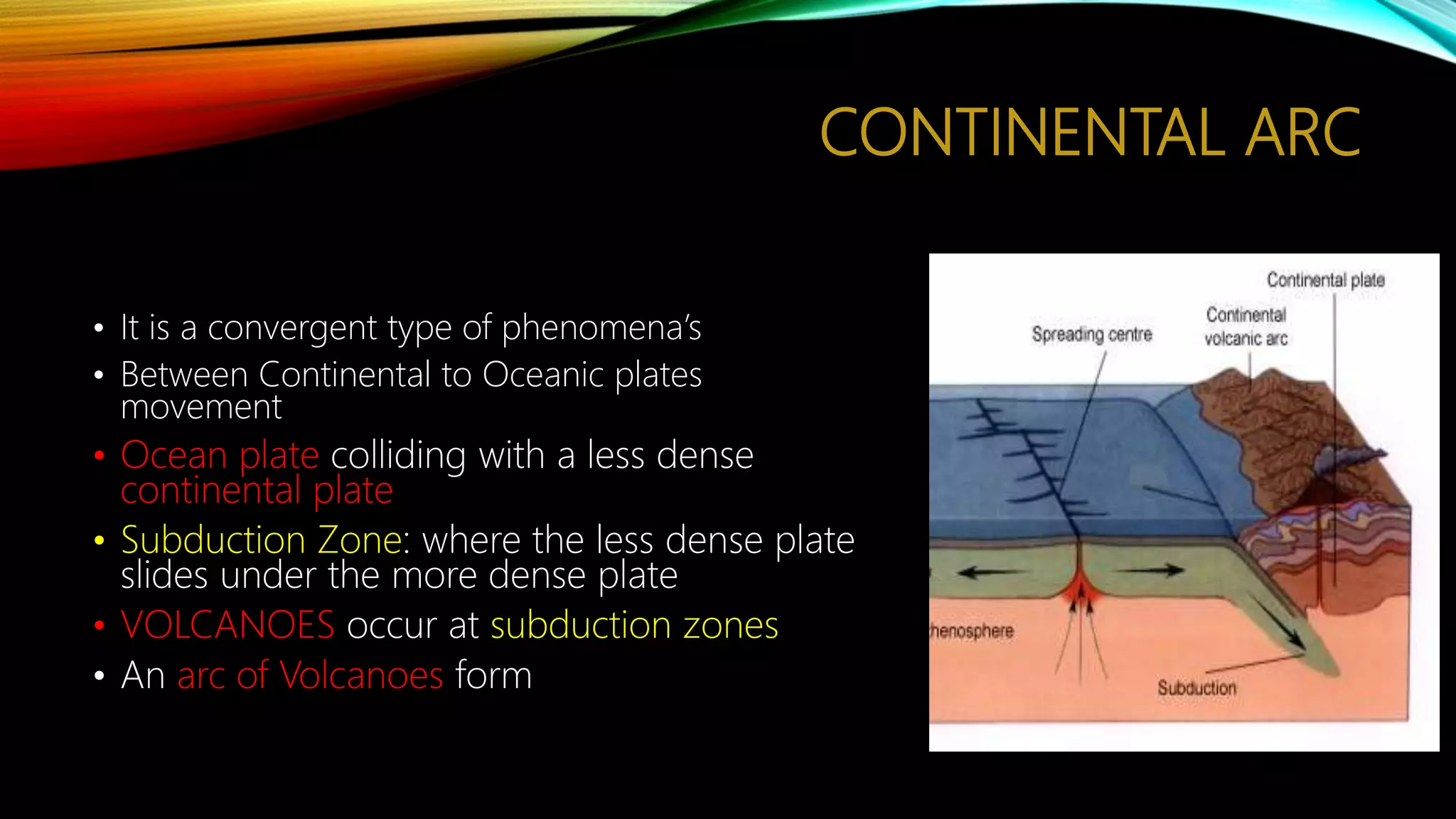
• It is a convergent type of phenomena’s
• Between Continental to Oceanic plates
movement
• Ocean plate colliding with a less dense
continental plate
• Subduction Zone: where the less dense plate
slides under the more dense plate
• VOLCANOES occur at subduction zones
• An arc of Volcanoes form
ISLANDS ARC
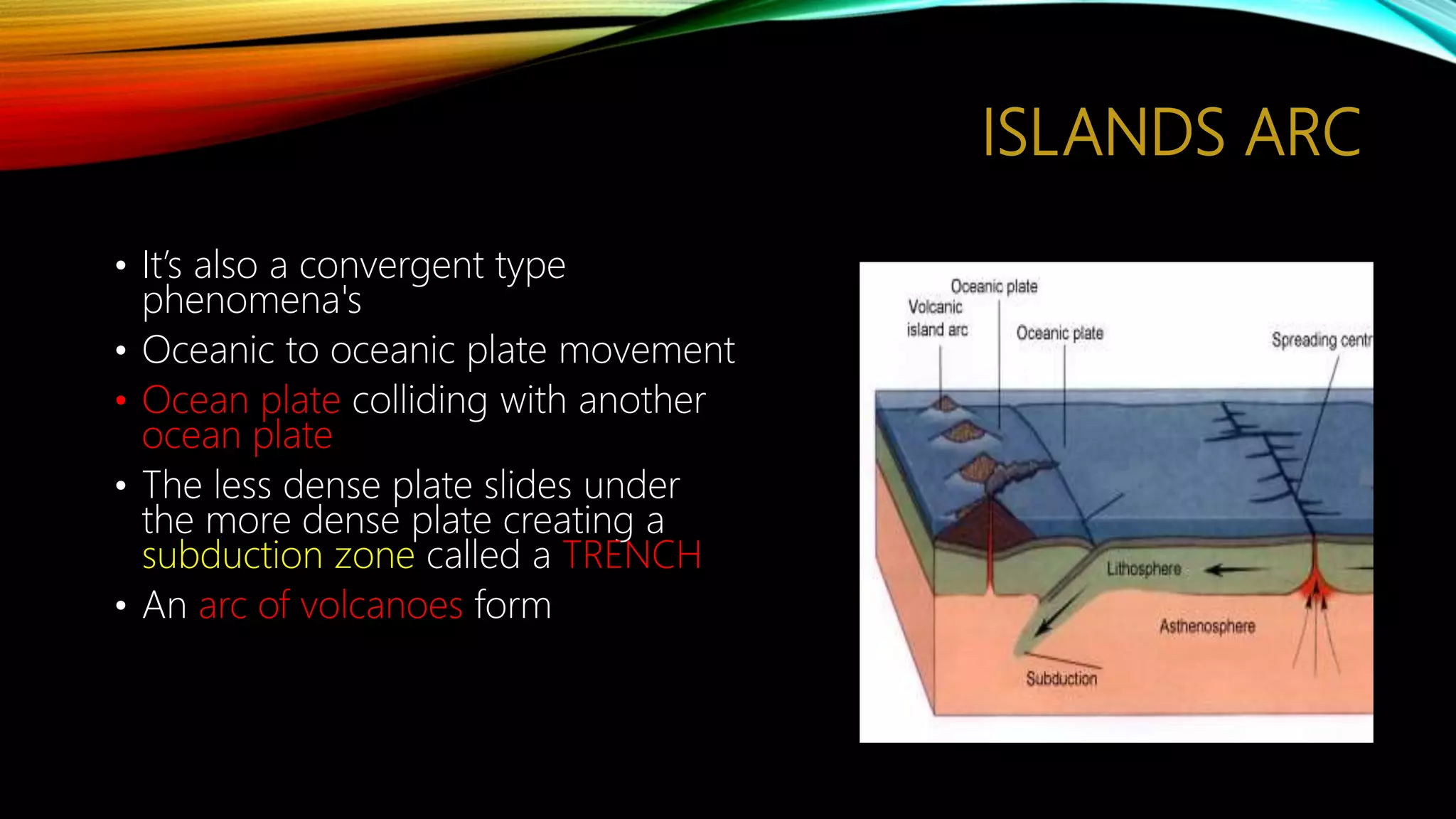
• It’s also a convergent type
phenomena's
• Oceanic to oceanic plate movement
• Ocean plate colliding with another
ocean plate
• The less dense plate slides under
the more dense plate creating a
subduction zone called a TRENCH
• An arc of volcanoes form
CONTINENT RIFT MECHANISM
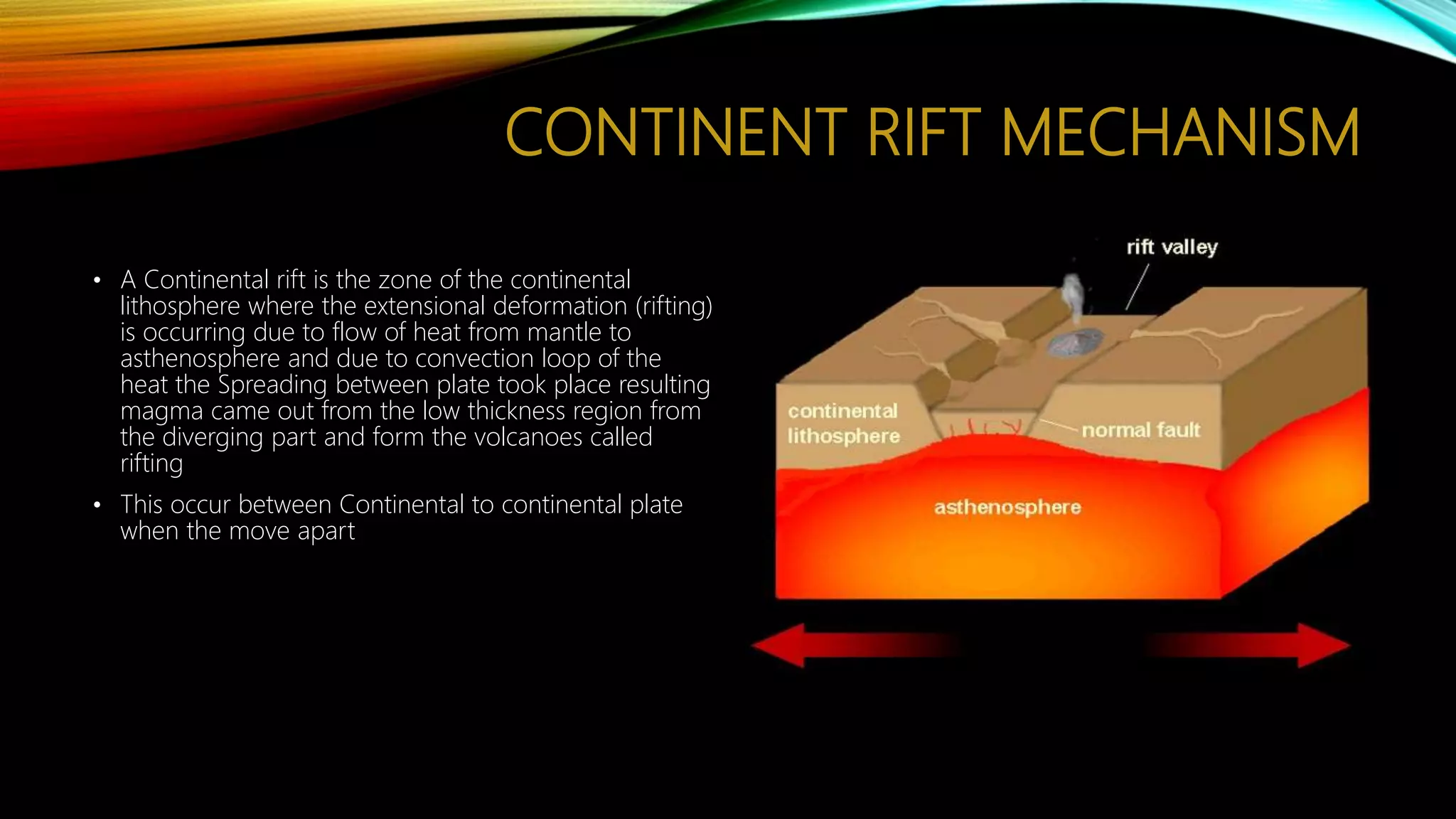
• A Continental rift is the zone of the continental
lithosphere where the extensional deformation (rifting)
is occurring due to flow of heat from mantle to
asthenosphere and due to convection loop of the
heat the Spreading between plate took place resulting
magma came out from the low thickness region from
the diverging part and form the volcanoes called
rifting
• This occur between Continental to continental plate
when the move apart
OCEANIC RIDGE MECHANISM
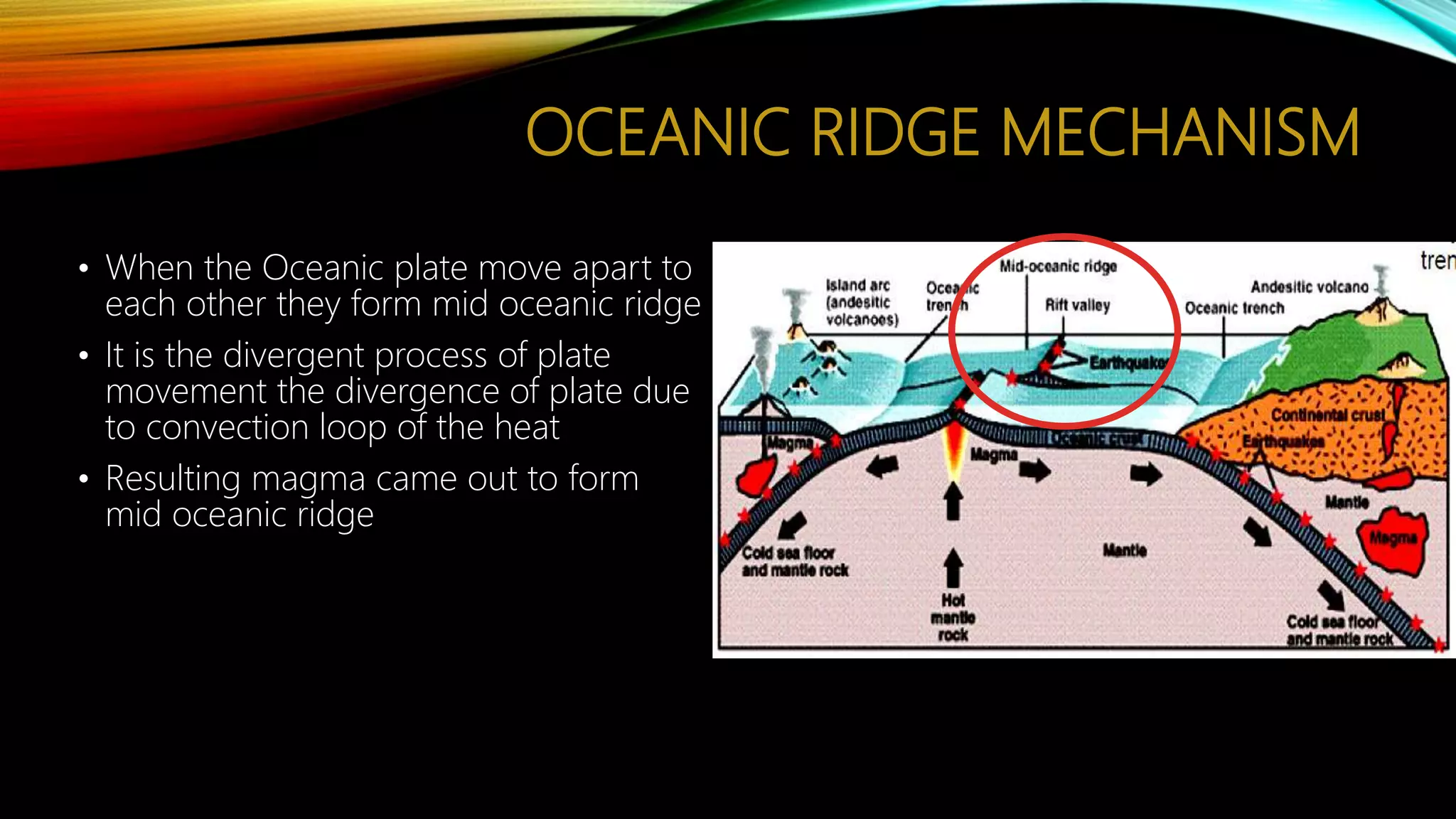
• When the Oceanic plate move apart to
each other they form mid oceanic ridge
• It is the divergent process of plate
movement the divergence of plate due
to convection loop of the heat
• Resulting magma came out to form
mid oceanic ridge
TRENCH
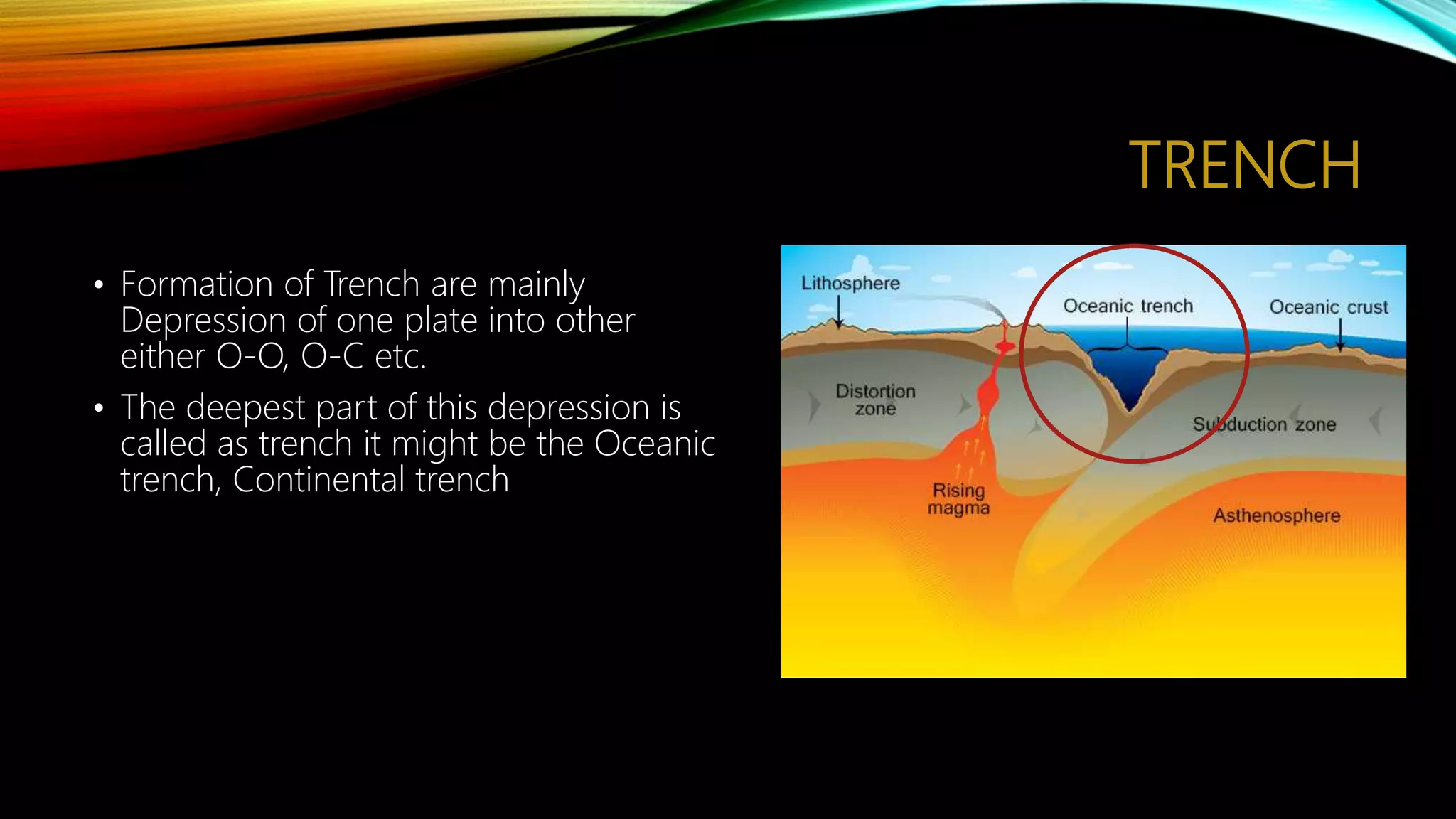
• Formation of Trench are mainly
Depression of one plate into other
either O-O, O-C etc.
• The deepest part of this depression is
called as trench it might be the Oceanic
trench, Continental trench
HOT-SPOT
In geology, the places known as hotspots or hot spots are volcanic regions thought
to be fed by underlying mantle that is anomalously hot compared with the
surrounding mantle.[citation needed] Examples include the Hawaii, Iceland and
Yellowstone hotspots. A hotspot's position on the Earth's surface is independent of
tectonic plate boundaries, and so hotspots may create a chain of volcanoes as the
plates move above them.
FISSURE VOLCANOS
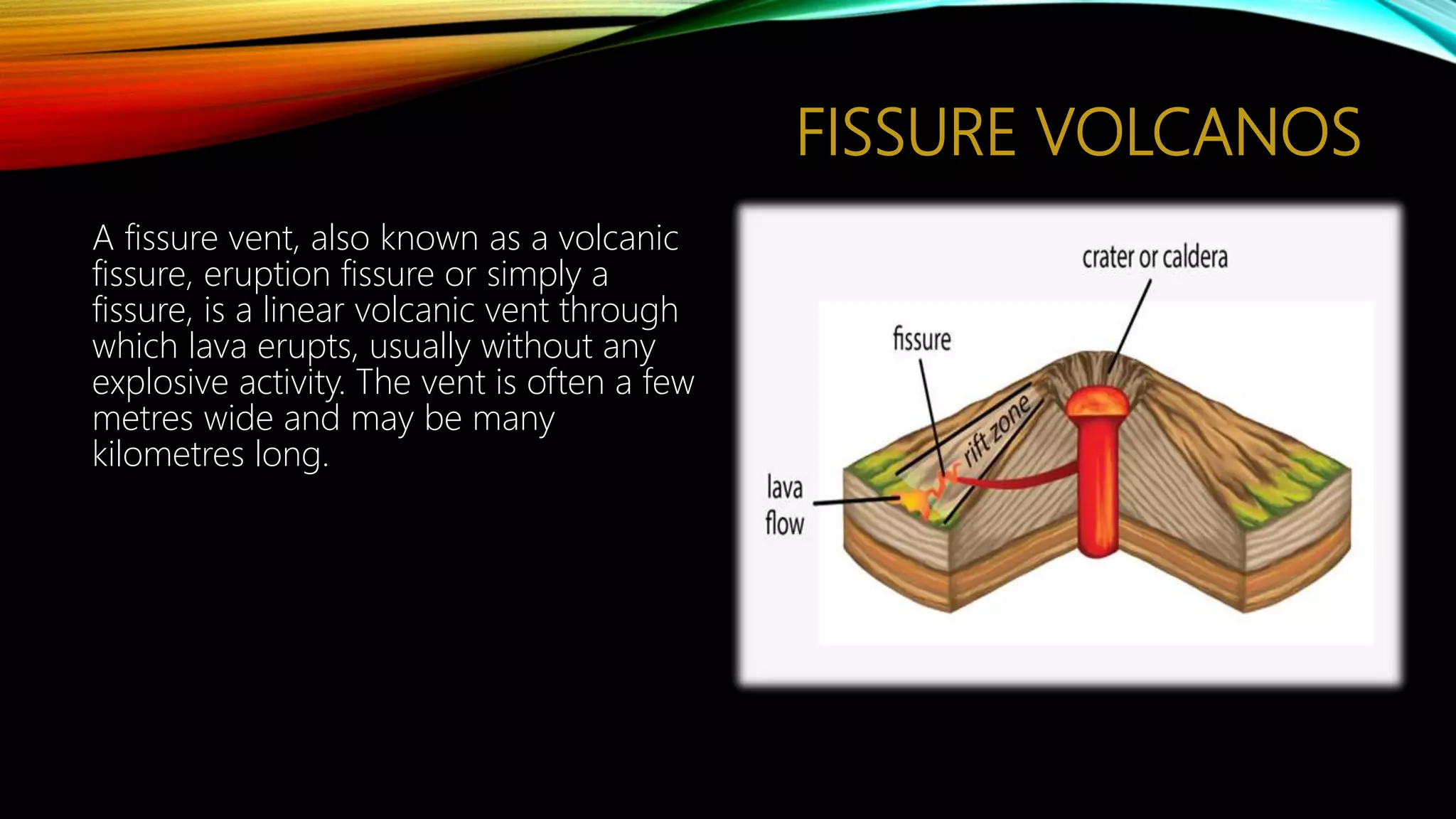
A fissure vent, also known as a volcanic
fissure, eruption fissure or simply a
fissure, is a linear volcanic vent through
which lava erupts, usually without any
explosive activity. The vent is often a few
metres wide and may be many
kilometres long.
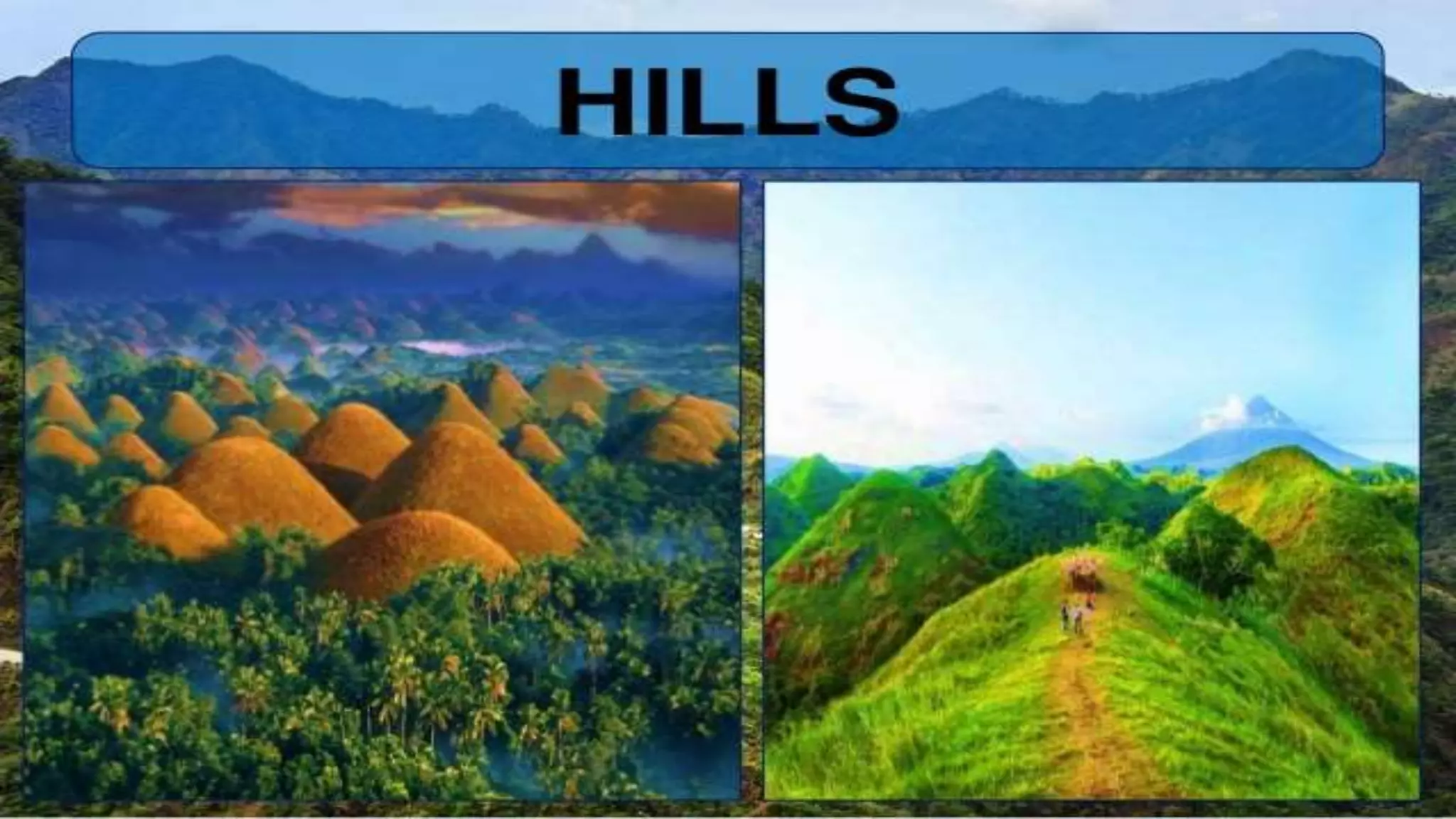
PLATEAU/HIMALAYAS/HILLS
• When the tectonic plates are get converge to each other some up with same
density they will collide and form a high latitudes of zones are called as Himalayas
towards high pressure of collision
• And after that when the pressure get lower towards the opposite side of the
Himalayas they get evolve in same manner but less in hight as compare to
Himalayas so they called Plateau (e.g. Tibetan Plateau)
• Hills are formed by the continuous evolution of Volcanism and due to Convection
cycle loop the plate tectonic region get move continuously and they formed a
large area of high altitudes of volcanoes magmatic eruption which called Hills they
are have less hight than Himalayas
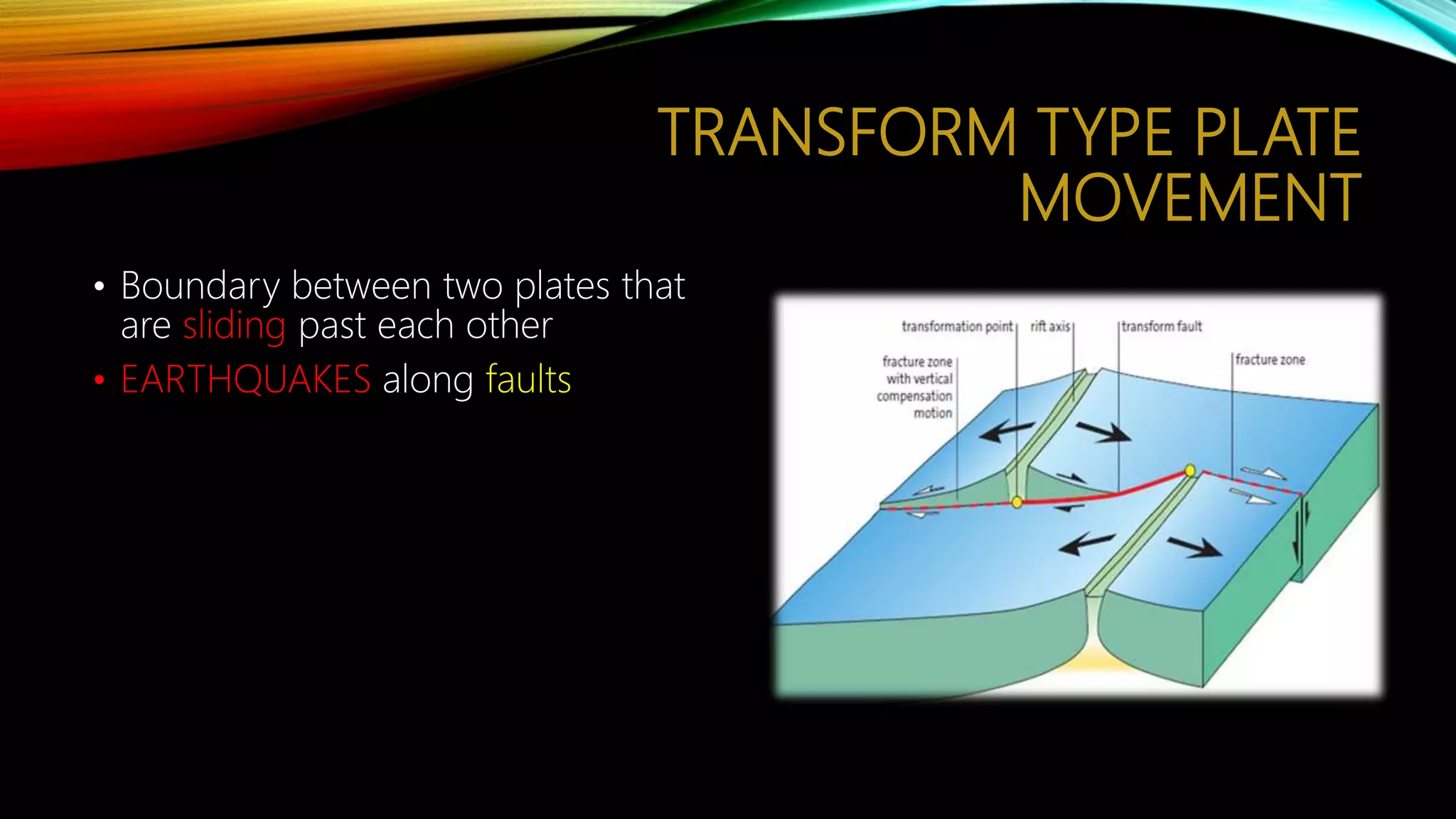
TRANSFORM TYPE PLATE
MOVEMENT
• Boundary between two plates that
are sliding past each other
• EARTHQUAKES along faults
3. DISCUSES THE FOLLOWING CONNECTION
WITH PLATE TECTONIC PROCESS
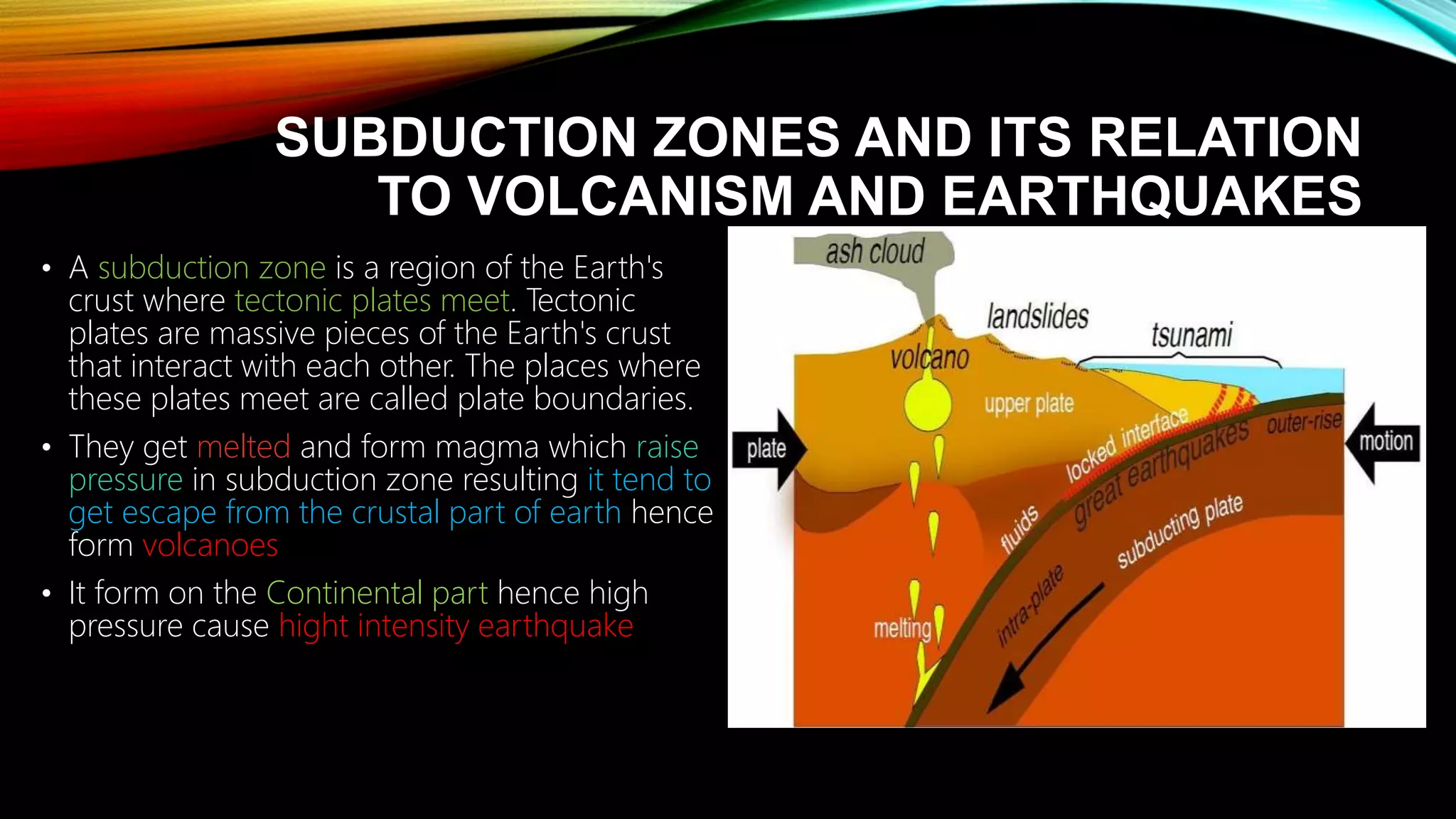
SUBDUCTION ZONES AND ITS RELATION
TO VOLCANISM AND EARTHQUAKES
• A subduction zone is a region of the Earth's
crust where tectonic plates meet. Tectonic
plates are massive pieces of the Earth's crust
that interact with each other. The places where
these plates meet are called plate boundaries.
• They get melted and form magma which raise
pressure in subduction zone resulting it tend to
get escape from the crustal part of earth hence
form volcanoes
• It form on the Continental part hence high
pressure cause hight intensity earthquake
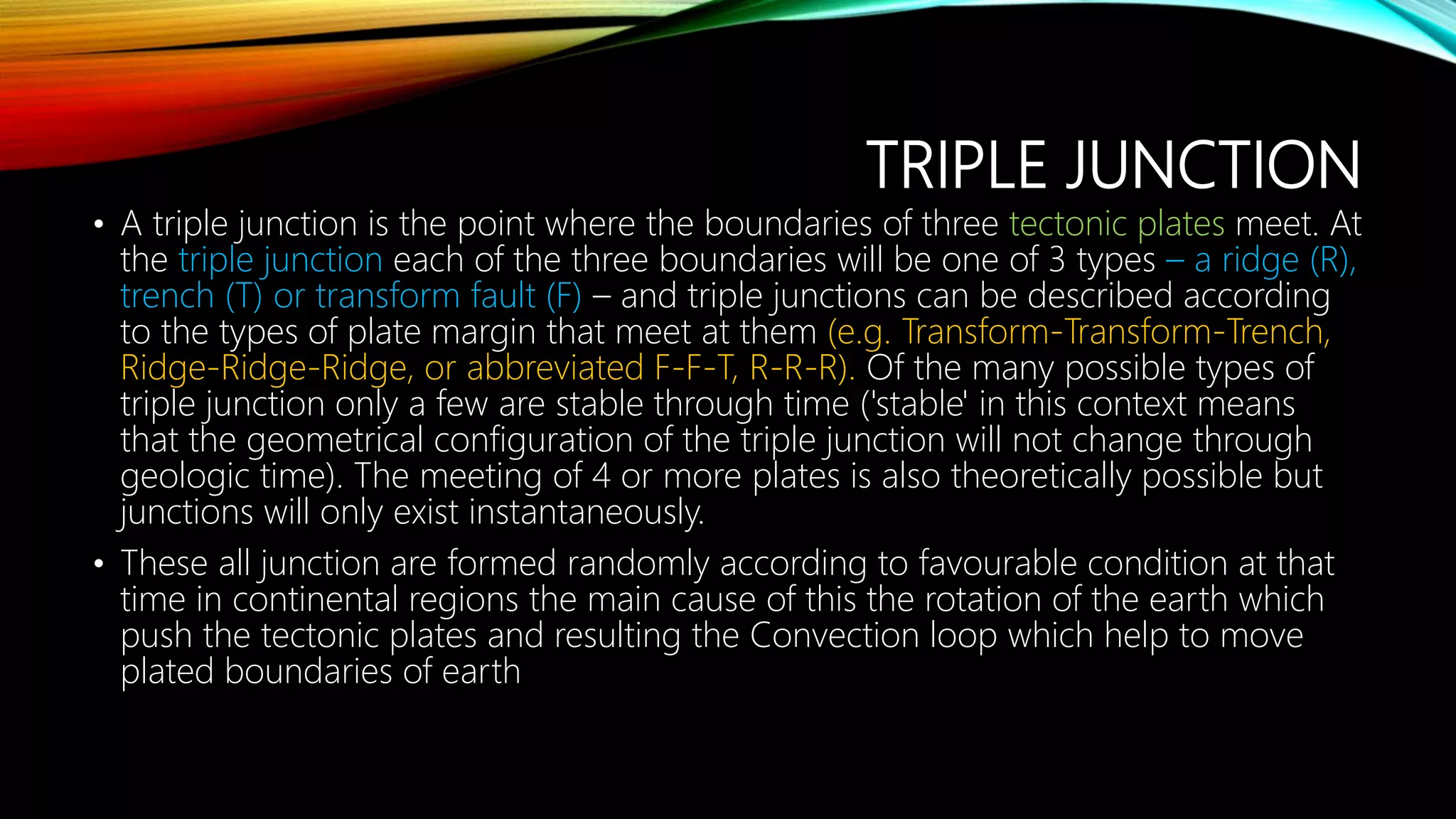
TRIPLE JUNCTION
• A triple junction is the point where the boundaries of three tectonic plates meet. At
the triple junction each of the three boundaries will be one of 3 types – a ridge (R),
trench (T) or transform fault (F) – and triple junctions can be described according
to the types of plate margin that meet at them (e.g. Transform-Transform-Trench,
Ridge-Ridge-Ridge, or abbreviated F-F-T, R-R-R). Of the many possible types of
triple junction only a few are stable through time ('stable' in this context means
that the geometrical configuration of the triple junction will not change through
geologic time). The meeting of 4 or more plates is also theoretically possible but
junctions will only exist instantaneously.
• These all junction are formed randomly according to favourable condition at that
time in continental regions the main cause of this the rotation of the earth which
push the tectonic plates and resulting the Convection loop which help to move
plated boundaries of earth
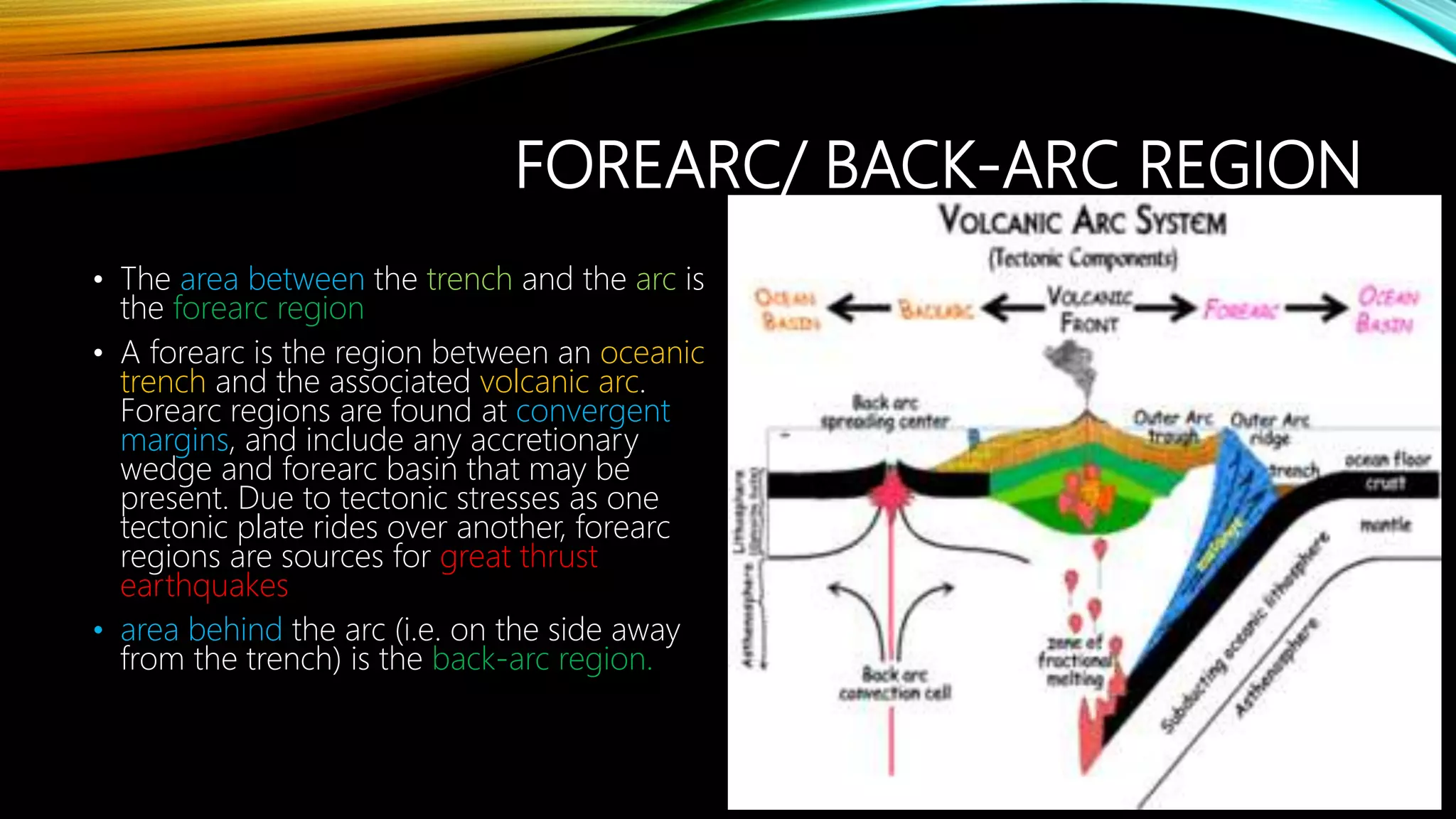
FOREARC/ BACK-ARC REGION
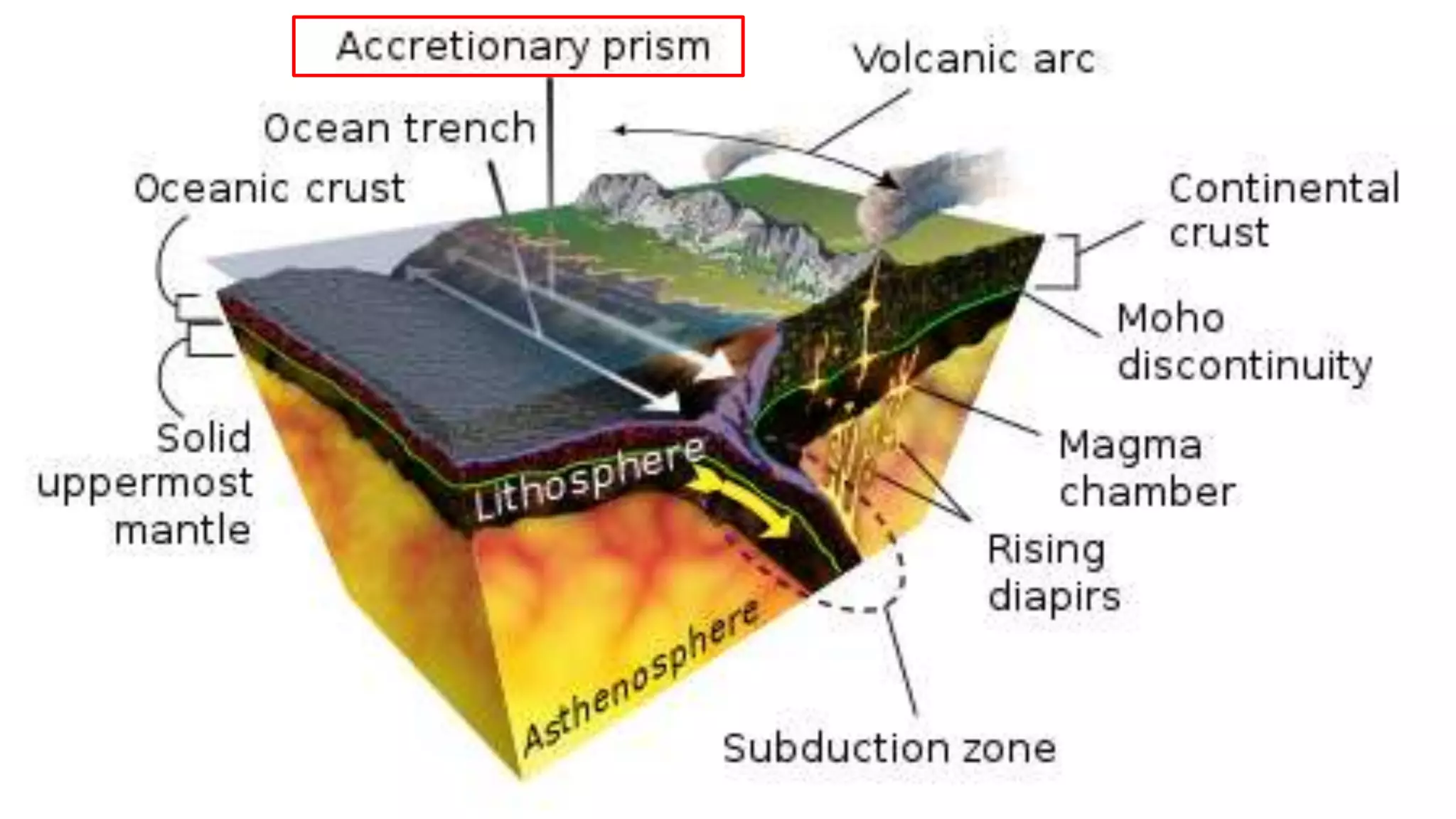
• The area between the trench and the arc is
the forearc region
• A forearc is the region between an oceanic
trench and the associated volcanic arc.
Forearc regions are found at convergent
margins, and include any accretionary
wedge and forearc basin that may be
present. Due to tectonic stresses as one
tectonic plate rides over another, forearc
regions are sources for great thrust
earthquakes
• area behind the arc (i.e. on the side away
from the trench) is the back-arc region.
ACCRETIONARY PRISM
• An accretionary wedge or accretionary prism forms from sediments accreted onto
the non-subducting tectonic plate at a convergent plate boundary. Most of the
material in the accretionary wedge consists of marine sediments scraped off from
the down going slab of oceanic crust, but in some cases the wedge includes the
erosional products of volcanic island arcs formed on the overriding plate.
• An accretionary complex is a current (in modern use) or former accretionary
wedge. Accretionary complexes are typically made up of a mix of turbidites of
terrestrial material, basalts from the ocean floor, and pelagic and hemipelagic
sediments. For example, most of the geological basement of Japan is made up of
accretionary complexes.
THANK YOU
Sunil-SC20M092
Earth System Science
Indian Institute of Space Science & Technology

Plate tectonics and various landforms form by plate movements of earth system

  • 1.
    PLATE TECTONICS Movements ofplate and formation of various types of landforms
  • 2.
    1. MAJOR TECTONICSPLATES According to the geographical positions of all the plates are covering most of the regions of the earth and many plates are there who role play in tectonics activities of the earth 1. African plate 2. Antarctic plate 3. Eurasian plate 4. North-American plate 5. Indo-Austrian plate 6. Pacific plate 7. South-America plate
  • 5.
    2. VARIOUS LANDFORMFORMED BY PLATE MOVEMENT By plate movements of the earth so many landform occur on the basis of behaviour of the plate property such as convergent type of movement and divergent type of movement in between oceanic/tectonic plates also transform type of movement occur • Continental arc • Islands arc • Continent Rift mechanism • Oceanic Ridge mechanism • Trench • Hot-Spot • Fissure volcanos • Plateau/Himalayas/Hills
  • 6.
    CONTINENTAL ARC • Itis a convergent type of phenomena’s • Between Continental to Oceanic plates movement • Ocean plate colliding with a less dense continental plate • Subduction Zone: where the less dense plate slides under the more dense plate • VOLCANOES occur at subduction zones • An arc of Volcanoes form
  • 7.
    ISLANDS ARC • It’salso a convergent type phenomena's • Oceanic to oceanic plate movement • Ocean plate colliding with another ocean plate • The less dense plate slides under the more dense plate creating a subduction zone called a TRENCH • An arc of volcanoes form
  • 8.
    CONTINENT RIFT MECHANISM •A Continental rift is the zone of the continental lithosphere where the extensional deformation (rifting) is occurring due to flow of heat from mantle to asthenosphere and due to convection loop of the heat the Spreading between plate took place resulting magma came out from the low thickness region from the diverging part and form the volcanoes called rifting • This occur between Continental to continental plate when the move apart
  • 9.
    OCEANIC RIDGE MECHANISM •When the Oceanic plate move apart to each other they form mid oceanic ridge • It is the divergent process of plate movement the divergence of plate due to convection loop of the heat • Resulting magma came out to form mid oceanic ridge
  • 10.
    TRENCH • Formation ofTrench are mainly Depression of one plate into other either O-O, O-C etc. • The deepest part of this depression is called as trench it might be the Oceanic trench, Continental trench
  • 11.
    HOT-SPOT In geology, theplaces known as hotspots or hot spots are volcanic regions thought to be fed by underlying mantle that is anomalously hot compared with the surrounding mantle.[citation needed] Examples include the Hawaii, Iceland and Yellowstone hotspots. A hotspot's position on the Earth's surface is independent of tectonic plate boundaries, and so hotspots may create a chain of volcanoes as the plates move above them.
  • 12.
    FISSURE VOLCANOS A fissurevent, also known as a volcanic fissure, eruption fissure or simply a fissure, is a linear volcanic vent through which lava erupts, usually without any explosive activity. The vent is often a few metres wide and may be many kilometres long.
  • 13.
    PLATEAU/HIMALAYAS/HILLS • When thetectonic plates are get converge to each other some up with same density they will collide and form a high latitudes of zones are called as Himalayas towards high pressure of collision • And after that when the pressure get lower towards the opposite side of the Himalayas they get evolve in same manner but less in hight as compare to Himalayas so they called Plateau (e.g. Tibetan Plateau) • Hills are formed by the continuous evolution of Volcanism and due to Convection cycle loop the plate tectonic region get move continuously and they formed a large area of high altitudes of volcanoes magmatic eruption which called Hills they are have less hight than Himalayas
  • 15.
    TRANSFORM TYPE PLATE MOVEMENT •Boundary between two plates that are sliding past each other • EARTHQUAKES along faults
  • 16.
    3. DISCUSES THEFOLLOWING CONNECTION WITH PLATE TECTONIC PROCESS
  • 17.
    SUBDUCTION ZONES ANDITS RELATION TO VOLCANISM AND EARTHQUAKES • A subduction zone is a region of the Earth's crust where tectonic plates meet. Tectonic plates are massive pieces of the Earth's crust that interact with each other. The places where these plates meet are called plate boundaries. • They get melted and form magma which raise pressure in subduction zone resulting it tend to get escape from the crustal part of earth hence form volcanoes • It form on the Continental part hence high pressure cause hight intensity earthquake
  • 18.
    TRIPLE JUNCTION • Atriple junction is the point where the boundaries of three tectonic plates meet. At the triple junction each of the three boundaries will be one of 3 types – a ridge (R), trench (T) or transform fault (F) – and triple junctions can be described according to the types of plate margin that meet at them (e.g. Transform-Transform-Trench, Ridge-Ridge-Ridge, or abbreviated F-F-T, R-R-R). Of the many possible types of triple junction only a few are stable through time ('stable' in this context means that the geometrical configuration of the triple junction will not change through geologic time). The meeting of 4 or more plates is also theoretically possible but junctions will only exist instantaneously. • These all junction are formed randomly according to favourable condition at that time in continental regions the main cause of this the rotation of the earth which push the tectonic plates and resulting the Convection loop which help to move plated boundaries of earth
  • 21.
    FOREARC/ BACK-ARC REGION •The area between the trench and the arc is the forearc region • A forearc is the region between an oceanic trench and the associated volcanic arc. Forearc regions are found at convergent margins, and include any accretionary wedge and forearc basin that may be present. Due to tectonic stresses as one tectonic plate rides over another, forearc regions are sources for great thrust earthquakes • area behind the arc (i.e. on the side away from the trench) is the back-arc region.
  • 22.
    ACCRETIONARY PRISM • Anaccretionary wedge or accretionary prism forms from sediments accreted onto the non-subducting tectonic plate at a convergent plate boundary. Most of the material in the accretionary wedge consists of marine sediments scraped off from the down going slab of oceanic crust, but in some cases the wedge includes the erosional products of volcanic island arcs formed on the overriding plate. • An accretionary complex is a current (in modern use) or former accretionary wedge. Accretionary complexes are typically made up of a mix of turbidites of terrestrial material, basalts from the ocean floor, and pelagic and hemipelagic sediments. For example, most of the geological basement of Japan is made up of accretionary complexes.
  • 24.
    THANK YOU Sunil-SC20M092 Earth SystemScience Indian Institute of Space Science & Technology