Chapter 5 Tissues Four major tissue types Epithelial Connective Muscle Nervous
Epithelial Tissues General characteristics - cover organs and the body forms the inner lining of body cavities line hollow organs has a free surface have a  basement membrane-  anchored to this lack blood vessels-  avascular cells readily divide (Mitosis  ) cells tightly packed
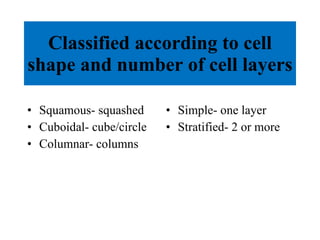
Classified according to cell shape and number of cell layers Squamous- squashed Cuboidal- cube/circle Columnar- columns Simple- one layer Stratified- 2 or more
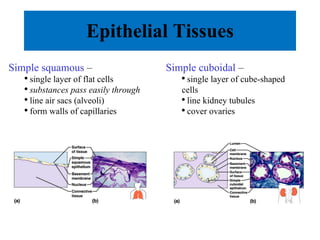
Epithelial Tissues Simple squamous  – single layer of flat cells substances pass easily through line air sacs (alveoli) form walls of capillaries Simple cuboidal  – single layer of cube-shaped cells line kidney tubules cover ovaries
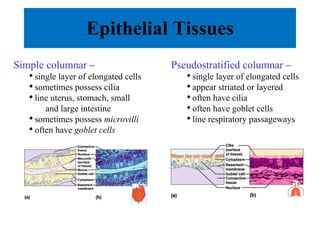
Epithelial Tissues Simple columnar  – single layer of elongated cells sometimes possess cilia line uterus, stomach, small  and large intestine sometimes possess  microvilli often have  goblet cells Pseudostratified columnar  – single layer of elongated cells appear striated or layered often have cilia often have goblet cells line respiratory passageways
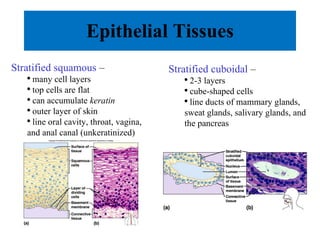
Epithelial Tissues Stratified squamous  –  many cell layers top cells are flat can accumulate  keratin outer layer of skin line oral cavity, throat, vagina, and anal canal (unkeratinized) Stratified cuboidal  –  2-3 layers cube-shaped cells line ducts of mammary glands, sweat glands, salivary glands, and the pancreas
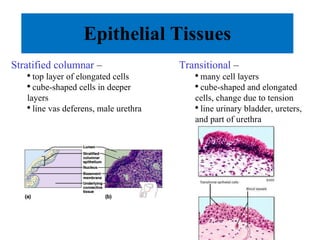
Epithelial Tissues Stratified columnar  – top layer of elongated cells cube-shaped cells in deeper layers line vas deferens, male urethra Transitional  – many cell layers cube-shaped and elongated cells, change due to tension line urinary bladder, ureters, and part of urethra
Connective Tissues General characteristics - most abundant tissue type many functions  bind structures provide support and protection serve as frameworks fill spaces store fat produce blood cells protect against infections help repair tissue damage have a matrix have varying degrees of vascularity have cells that usually divide
Connective Tissue  Major Cell Types Fibroblasts fixed cell most common cell  large, star-shaped produce fibers Macrophages wandering cell phagocytic important in defense Mast cells fixed cell release  heparin - prevents blood clotting release  histamine - promotes some of the reactions associated with inflammation and allergies
Connective Tissue Fibers Collagenous fibers thick composed of collagen great tensile strength  Elastic fibers elastic vocal cords, air passages
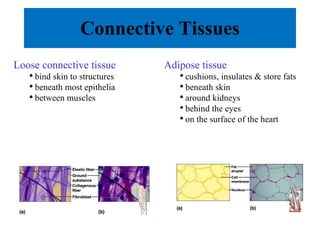
Connective Tissues Loose connective tissue bind skin to structures beneath most epithelia between muscles Adipose tissue cushions, insulates & store fats beneath skin around kidneys behind the eyes on the surface of the heart
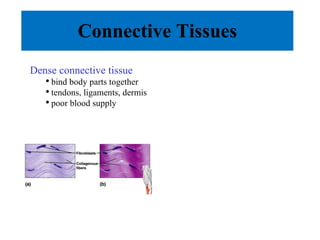
Connective Tissues Dense connective tissue bind body parts together tendons, ligaments, dermis poor blood supply
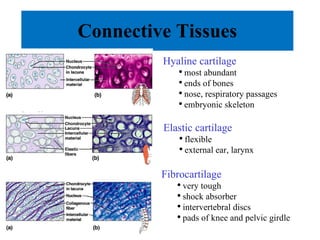
Connective Tissues Cartilage chondrocytes-  cartilage cells poor blood supply Hyaline cartilage most abundant ends of bones nose, respiratory passages embryonic skeleton Elastic cartilage flexible external ear, larynx Fibrocartilage very tough shock absorber intervertebral discs pads of knee and pelvic girdle
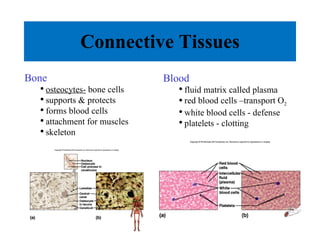
Connective Tissues Blood fluid matrix called plasma red blood cells –transport O 2 white blood cells - defense platelets - clotting Bone osteocytes-  bone cells  supports & protects forms blood cells attachment for muscles skeleton
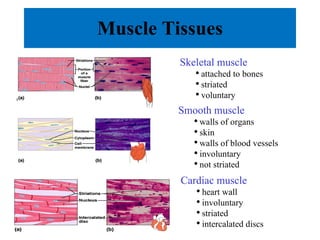
Muscle Tissues General characteristics muscle cells called muscle fibers contractile three types skeletal smooth cardiac Skeletal muscle attached to bones striated voluntary Smooth muscle walls of organs skin walls of blood vessels involuntary not striated Cardiac muscle   heart wall involuntary striated intercalated discs
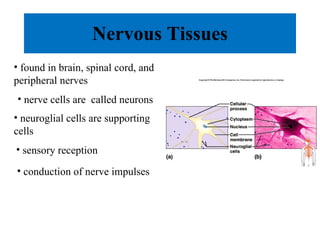
Nervous Tissues found in brain, spinal cord, and peripheral nerves nerve cells are  called neurons neuroglial cells are supporting cells sensory reception conduction of nerve impulses

05 Tissue Notes

  • 1.
  • 2.
    Chapter 5 TissuesFour major tissue types Epithelial Connective Muscle Nervous
  • 3.
    Epithelial Tissues Generalcharacteristics - cover organs and the body forms the inner lining of body cavities line hollow organs has a free surface have a basement membrane- anchored to this lack blood vessels- avascular cells readily divide (Mitosis  ) cells tightly packed
  • 4.
    Classified according tocell shape and number of cell layers Squamous- squashed Cuboidal- cube/circle Columnar- columns Simple- one layer Stratified- 2 or more
  • 5.
    Epithelial Tissues Simplesquamous – single layer of flat cells substances pass easily through line air sacs (alveoli) form walls of capillaries Simple cuboidal – single layer of cube-shaped cells line kidney tubules cover ovaries
  • 6.
    Epithelial Tissues Simplecolumnar – single layer of elongated cells sometimes possess cilia line uterus, stomach, small and large intestine sometimes possess microvilli often have goblet cells Pseudostratified columnar – single layer of elongated cells appear striated or layered often have cilia often have goblet cells line respiratory passageways
  • 7.
    Epithelial Tissues Stratifiedsquamous – many cell layers top cells are flat can accumulate keratin outer layer of skin line oral cavity, throat, vagina, and anal canal (unkeratinized) Stratified cuboidal – 2-3 layers cube-shaped cells line ducts of mammary glands, sweat glands, salivary glands, and the pancreas
  • 8.
    Epithelial Tissues Stratifiedcolumnar – top layer of elongated cells cube-shaped cells in deeper layers line vas deferens, male urethra Transitional – many cell layers cube-shaped and elongated cells, change due to tension line urinary bladder, ureters, and part of urethra
  • 9.
    Connective Tissues Generalcharacteristics - most abundant tissue type many functions bind structures provide support and protection serve as frameworks fill spaces store fat produce blood cells protect against infections help repair tissue damage have a matrix have varying degrees of vascularity have cells that usually divide
  • 10.
    Connective Tissue Major Cell Types Fibroblasts fixed cell most common cell large, star-shaped produce fibers Macrophages wandering cell phagocytic important in defense Mast cells fixed cell release heparin - prevents blood clotting release histamine - promotes some of the reactions associated with inflammation and allergies
  • 11.
    Connective Tissue FibersCollagenous fibers thick composed of collagen great tensile strength Elastic fibers elastic vocal cords, air passages
  • 12.
    Connective Tissues Looseconnective tissue bind skin to structures beneath most epithelia between muscles Adipose tissue cushions, insulates & store fats beneath skin around kidneys behind the eyes on the surface of the heart
  • 13.
    Connective Tissues Denseconnective tissue bind body parts together tendons, ligaments, dermis poor blood supply
  • 14.
    Connective Tissues Cartilagechondrocytes- cartilage cells poor blood supply Hyaline cartilage most abundant ends of bones nose, respiratory passages embryonic skeleton Elastic cartilage flexible external ear, larynx Fibrocartilage very tough shock absorber intervertebral discs pads of knee and pelvic girdle
  • 15.
    Connective Tissues Bloodfluid matrix called plasma red blood cells –transport O 2 white blood cells - defense platelets - clotting Bone osteocytes- bone cells supports & protects forms blood cells attachment for muscles skeleton
  • 16.
    Muscle Tissues Generalcharacteristics muscle cells called muscle fibers contractile three types skeletal smooth cardiac Skeletal muscle attached to bones striated voluntary Smooth muscle walls of organs skin walls of blood vessels involuntary not striated Cardiac muscle heart wall involuntary striated intercalated discs
  • 17.
    Nervous Tissues foundin brain, spinal cord, and peripheral nerves nerve cells are called neurons neuroglial cells are supporting cells sensory reception conduction of nerve impulses