Chapter 7 Skeletal System
Bone Classification Long  Bones Short  Bones Flat  Bones Irregular  Bones Sesamoid  Bones
Parts of a Long Bone epiphysis distal proximal articular  cartilage diaphysis periosteum compact bone spongy bone medullary cavity endosteum marrow red yellow
Compact and Spongy Bone
Microscopic Structure of Compact Bone osteocyte bone cell  osteon central canal w/ blood vessels w/ nerves perforating canal w/ blood vessels w/ nerves
Skeletal Organization Axial Skeleton head  neck  trunk Appendicular Skeleton upper limbs lower limbs pectoral girdle pelvic girdle
The only ‘floating’ bone
Vertebral Column cervical vertebrae  (7) thoracic vertebrae  (12) lumbar vertebrae  (5) sacrum  (5 fused) coccyx  (tailbone)
Cervical Vertebrae Atlas  – 1 st ; supports head Axis  – 2 nd ; dens pivots to turn head
Thoracic Vertebrae long spinous processes rib facets
Lumbar Vertebrae large bodies thick, short spinous processes
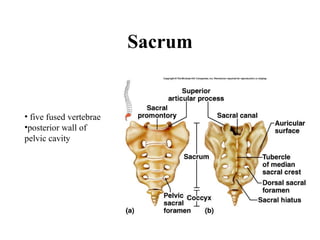
Sacrum five fused vertebrae posterior wall of pelvic cavity
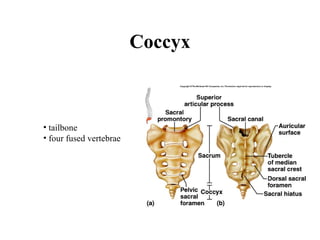
Coccyx tailbone four fused vertebrae
Thoracic Cage Protects viscera Role in breathing Ribs True  ribs (7) False  ribs (5) floating (2) Costal cartilages Sternum Manubrium Body Xiphoid process Thoracic vertebrae
Facial Skeleton Frontal   (1) Parietal   (2) Temporal  (2) Occipital  (1) Maxillary  (2) Mandible  (1) Zygomatic  (2)  Lacrimal  (2) Nasal  (2) Sphenoid  (1) Ethmoid   (1)
Facial Skeleton Frontal   (1) Parietal   (2) Temporal  (2) Occipital  (1) Maxillary  (2) Mandible  (1) Zygomatic  (2)  Lacrimal  (2) Nasal  (2) Sphenoid  (1) Ethmoid   (1) Vomer   (1)
Skull Sphenoid  (1) Ethmoid   (1)
Infantile Skull Fontanels  – fibrous membranes; “soft spots”
Pectoral Girdle shoulder girdle  clavicles scapulae supports upper limbs
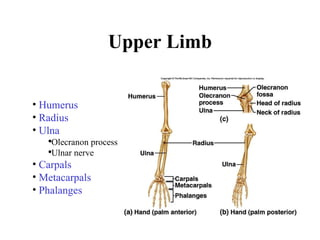
Upper Limb Humerus Radius Ulna Olecranon process Ulnar nerve Carpals Metacarpals Phalanges
Wrist and Hand Carpals  (16) trapezium trapezoid capitate scaphoid pisiform triquetrum hamate lunate Metacarpals  (10) Phalanges  (28) proximal phalanx middle phalanx distal phalanx
Pelvic Girdle Coxae  (2) supports trunk of body protects viscera
Coxae hip bones acetabulum ilium ischium ischial tuberosity pubis
Male and Female Pelvis Female iliac bones more flared broader hips pubic arch angle greater sacral curvature shorter and flatter lighter bones
Lower Limb Femur Longest bone of body Patella Tibia Medial malleolus Fibula Bears no weight Lateral malleolus Tarsals Metatarsals Phalanges
Ankle and Foot Tarsals  (14) calcaneus* talus* navicular cuboid lateral cuneiform intermediate cuneiform medial cuneiform Metatarsals  (10) Phalanges  (28) proximal middle distal
Ankle and Foot
Bone Development Intramembranous Ossification bones originate within sheetlike layers of connective tissues broad, flat bones    skull bones (except mandible) Endochondral Ossification bones begin as hyaline cartilage most bones of the skeleton
Endochondral Ossification
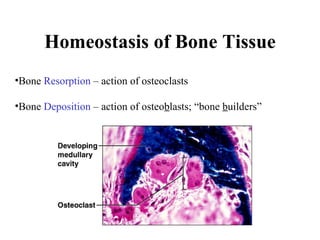
Homeostasis of Bone Tissue Bone  Resorption  – action of osteoclasts  Bone  Deposition  – action of osteo b lasts; “bone  b uilders”
Bone Function Support and Protection gives shape to head, etc. supports body’s weight protects lungs, etc. Body Movement interacts with muscles bones act as rigid bar of a lever Blood Cell Formation hematopoiesis red marrow Inorganic Salt Storage calcium  phosphate magnesium sodium potassium

07 Skeletal

  • 1.
  • 2.
    Bone Classification Long Bones Short Bones Flat Bones Irregular Bones Sesamoid Bones
  • 3.
    Parts of aLong Bone epiphysis distal proximal articular cartilage diaphysis periosteum compact bone spongy bone medullary cavity endosteum marrow red yellow
  • 4.
  • 5.
    Microscopic Structure ofCompact Bone osteocyte bone cell osteon central canal w/ blood vessels w/ nerves perforating canal w/ blood vessels w/ nerves
  • 6.
    Skeletal Organization AxialSkeleton head neck trunk Appendicular Skeleton upper limbs lower limbs pectoral girdle pelvic girdle
  • 7.
  • 8.
    Vertebral Column cervicalvertebrae (7) thoracic vertebrae (12) lumbar vertebrae (5) sacrum (5 fused) coccyx (tailbone)
  • 9.
    Cervical Vertebrae Atlas – 1 st ; supports head Axis – 2 nd ; dens pivots to turn head
  • 10.
    Thoracic Vertebrae longspinous processes rib facets
  • 11.
    Lumbar Vertebrae largebodies thick, short spinous processes
  • 12.
    Sacrum five fusedvertebrae posterior wall of pelvic cavity
  • 13.
    Coccyx tailbone fourfused vertebrae
  • 14.
    Thoracic Cage Protectsviscera Role in breathing Ribs True ribs (7) False ribs (5) floating (2) Costal cartilages Sternum Manubrium Body Xiphoid process Thoracic vertebrae
  • 15.
    Facial Skeleton Frontal (1) Parietal (2) Temporal (2) Occipital (1) Maxillary (2) Mandible (1) Zygomatic (2) Lacrimal (2) Nasal (2) Sphenoid (1) Ethmoid (1)
  • 16.
    Facial Skeleton Frontal (1) Parietal (2) Temporal (2) Occipital (1) Maxillary (2) Mandible (1) Zygomatic (2) Lacrimal (2) Nasal (2) Sphenoid (1) Ethmoid (1) Vomer (1)
  • 17.
    Skull Sphenoid (1) Ethmoid (1)
  • 18.
    Infantile Skull Fontanels – fibrous membranes; “soft spots”
  • 19.
    Pectoral Girdle shouldergirdle clavicles scapulae supports upper limbs
  • 20.
    Upper Limb HumerusRadius Ulna Olecranon process Ulnar nerve Carpals Metacarpals Phalanges
  • 21.
    Wrist and HandCarpals (16) trapezium trapezoid capitate scaphoid pisiform triquetrum hamate lunate Metacarpals (10) Phalanges (28) proximal phalanx middle phalanx distal phalanx
  • 22.
    Pelvic Girdle Coxae (2) supports trunk of body protects viscera
  • 23.
    Coxae hip bonesacetabulum ilium ischium ischial tuberosity pubis
  • 24.
    Male and FemalePelvis Female iliac bones more flared broader hips pubic arch angle greater sacral curvature shorter and flatter lighter bones
  • 25.
    Lower Limb FemurLongest bone of body Patella Tibia Medial malleolus Fibula Bears no weight Lateral malleolus Tarsals Metatarsals Phalanges
  • 26.
    Ankle and FootTarsals (14) calcaneus* talus* navicular cuboid lateral cuneiform intermediate cuneiform medial cuneiform Metatarsals (10) Phalanges (28) proximal middle distal
  • 27.
  • 28.
    Bone Development IntramembranousOssification bones originate within sheetlike layers of connective tissues broad, flat bones  skull bones (except mandible) Endochondral Ossification bones begin as hyaline cartilage most bones of the skeleton
  • 29.
  • 30.
    Homeostasis of BoneTissue Bone Resorption – action of osteoclasts Bone Deposition – action of osteo b lasts; “bone b uilders”
  • 31.
    Bone Function Supportand Protection gives shape to head, etc. supports body’s weight protects lungs, etc. Body Movement interacts with muscles bones act as rigid bar of a lever Blood Cell Formation hematopoiesis red marrow Inorganic Salt Storage calcium phosphate magnesium sodium potassium