Examples of Functions
and Their Graphs
PRECALCULUS
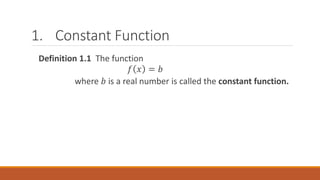
1. Constant Function
Definition 1.1 The function
𝑓 𝑥 = 𝑏
where 𝑏 is a real number is called the constant function.
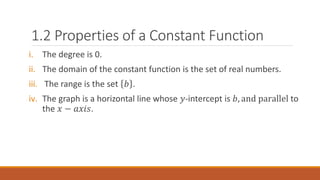
1.2 Properties of a Constant Function
i. The degree is 0.
ii. The domain of the constant function is the set of real numbers.
iii. The range is the set 𝑏 .
iv. The graph is a horizontal line whose 𝑦-intercept is 𝑏, and parallel to
the 𝑥 − 𝑎𝑥𝑖𝑠.
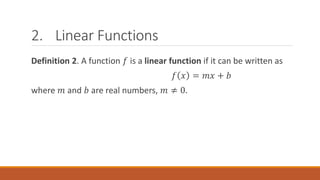
2. Linear Functions
Definition 2. A function 𝑓 is a linear function if it can be written as
𝑓 𝑥 = 𝑚𝑥 + 𝑏
where 𝑚 and 𝑏 are real numbers, 𝑚 ≠ 0.
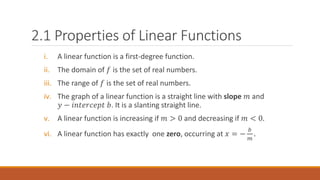
i. A linear function is a first-degree function.
ii. The domain of 𝑓 is the set of real numbers.
iii. The range of 𝑓 is the set of real numbers.
iv. The graph of a linear function is a straight line with slope 𝑚 and
𝑦 − 𝑖𝑛𝑡𝑒𝑟𝑐𝑒𝑝𝑡 𝑏. It is a slanting straight line.
v. A linear function is increasing if 𝑚 > 0 and decreasing if 𝑚 < 0.
vi. A linear function has exactly one zero, occurring at 𝑥 = −
𝑏
𝑚
.
2.1 Properties of Linear Functions
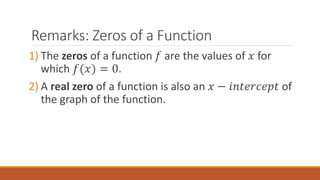
Remarks: Zeros of a Function
1) The zeros of a function 𝑓 are the values of 𝑥 for
which 𝑓(𝑥) = 0.
2) A real zero of a function is also an 𝑥 − 𝑖𝑛𝑡𝑒𝑟𝑐𝑒𝑝𝑡 of
the graph of the function.
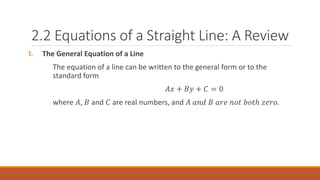
2.2 Equations of a Straight Line: A Review
I. The General Equation of a Line
The equation of a line can be written to the general form or to the
standard form
𝐴𝑥 + 𝐵𝑦 + 𝐶 = 0
where 𝐴, 𝐵 and 𝐶 are real numbers, and 𝐴 𝑎𝑛𝑑 𝐵 𝑎𝑟𝑒 𝑛𝑜𝑡 𝑏𝑜𝑡ℎ 𝑧𝑒𝑟𝑜.
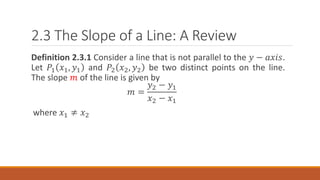
2.3 The Slope of a Line: A Review
Definition 2.3.1 Consider a line that is not parallel to the 𝑦 − 𝑎𝑥𝑖𝑠.
Let 𝑃1 𝑥1, 𝑦1 and 𝑃2 𝑥2, 𝑦2 be two distinct points on the line.
The slope 𝑚 of the line is given by
𝑚 =
𝑦2 − 𝑦1
𝑥2 − 𝑥1
where 𝑥1 ≠ 𝑥2
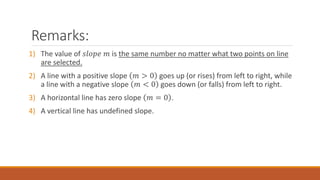
Remarks:
1) The value of 𝑠𝑙𝑜𝑝𝑒 𝑚 is the same number no matter what two points on line
are selected.
2) A line with a positive slope 𝑚 > 0 goes up (or rises) from left to right, while
a line with a negative slope 𝑚 < 0 goes down (or falls) from left to right.
3) A horizontal line has zero slope 𝑚 = 0 .
4) A vertical line has undefined slope.
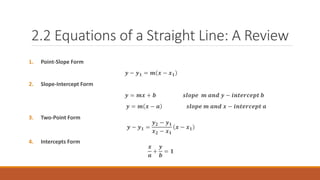
1. Point-Slope Form
𝒚 − 𝒚𝟏 = 𝒎 𝒙 − 𝒙𝟏
2. Slope-Intercept Form
𝒚 = 𝒎𝒙 + 𝒃 𝒔𝒍𝒐𝒑𝒆 𝒎 𝒂𝒏𝒅 𝒚 − 𝒊𝒏𝒕𝒆𝒓𝒄𝒆𝒑𝒕 𝒃
𝒚 = 𝒎 𝒙 − 𝒂 𝒔𝒍𝒐𝒑𝒆 𝒎 𝒂𝒏𝒅 𝒙 − 𝒊𝒏𝒕𝒆𝒓𝒄𝒆𝒑𝒕 𝒂
3. Two-Point Form
𝒚 − 𝒚𝟏 =
𝒚𝟐 − 𝒚𝟏
𝒙𝟐 − 𝒙𝟏
𝒙 − 𝒙𝟏
4. Intercepts Form
𝒙
𝒂
+
𝒚
𝒃
= 𝟏
2.2 Equations of a Straight Line: A Review
Parallel and Perpendicular Lines
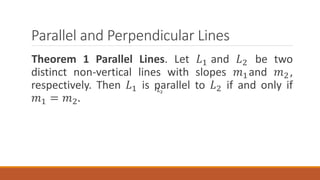
Theorem 1 Parallel Lines. Let 𝐿1 and 𝐿2 be two
distinct non-vertical lines with slopes 𝑚1and 𝑚2,
respectively. Then 𝐿1 is parallel to 𝐿2 if and only if
𝑚1 = 𝑚2.
𝐿2
Parallel and Perpendicular Lines
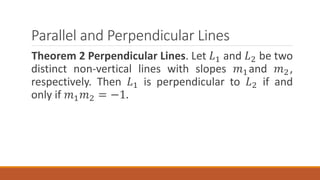
Theorem 2 Perpendicular Lines. Let 𝐿1 and 𝐿2 be two
distinct non-vertical lines with slopes 𝑚1and 𝑚2,
respectively. Then 𝐿1 is perpendicular to 𝐿2 if and
only if 𝑚1𝑚2 = −1.
3. Quadratic Function
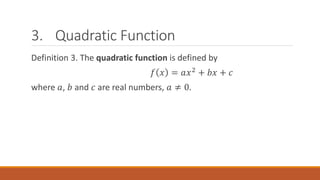
Definition 3. The quadratic function is defined by
𝑓 𝑥 = 𝑎𝑥2 + 𝑏𝑥 + 𝑐
where 𝑎, 𝑏 and 𝑐 are real numbers, 𝑎 ≠ 0.
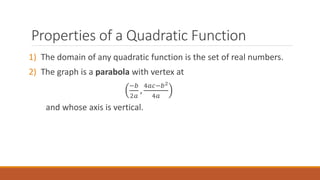
1) The domain of any quadratic function is the set of real numbers.
2) The graph is a parabola with vertex at
−𝑏
2𝑎
,
4𝑎𝑐−𝑏2
4𝑎
and whose axis is vertical.
Properties of a Quadratic Function
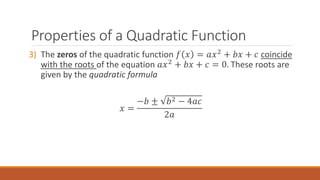
3) The zeros of the quadratic function 𝑓 𝑥 = 𝑎𝑥2
+ 𝑏𝑥 + 𝑐 coincide
with the roots of the equation 𝑎𝑥2 + 𝑏𝑥 + 𝑐 = 0. These roots are
given by the quadratic formula
𝑥 =
−𝑏 ± 𝑏2 − 4𝑎𝑐
2𝑎
Properties of a Quadratic Function
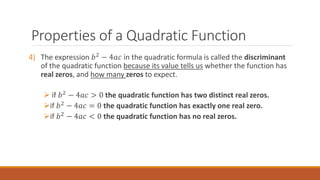
4) The expression 𝑏2
− 4𝑎𝑐 in the quadratic formula is called the discriminant
of the quadratic function because its value tells us whether the function has
real zeros, and how many zeros to expect.
 if 𝑏2
− 4𝑎𝑐 > 0 the quadratic function has two distinct real zeros.
if 𝑏2 − 4𝑎𝑐 = 0 the quadratic function has exactly one real zero.
if 𝑏2 − 4𝑎𝑐 < 0 the quadratic function has no real zeros.
Properties of a Quadratic Function
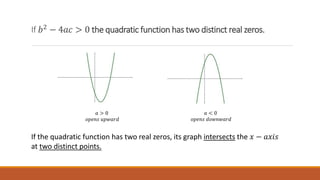
If 𝑏2
− 4𝑎𝑐 > 0 the quadratic function has two distinct real zeros.
If the quadratic function has two real zeros, its graph intersects the 𝑥 − 𝑎𝑥𝑖𝑠
at two distinct points.
𝑎 > 0
𝑜𝑝𝑒𝑛𝑠 𝑢𝑝𝑤𝑎𝑟𝑑
𝑎 < 0
𝑜𝑝𝑒𝑛𝑠 𝑑𝑜𝑤𝑛𝑤𝑎𝑟𝑑
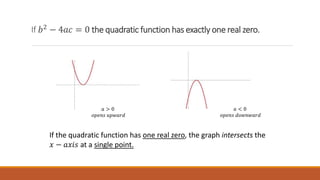
If 𝑏2
− 4𝑎𝑐 = 0 the quadratic function has exactly one real zero.
If the quadratic function has one real zero, the graph intersects the
𝑥 − 𝑎𝑥𝑖𝑠 at a single point.
𝑎 > 0
𝑜𝑝𝑒𝑛𝑠 𝑢𝑝𝑤𝑎𝑟𝑑
𝑎 < 0
𝑜𝑝𝑒𝑛𝑠 𝑑𝑜𝑤𝑛𝑤𝑎𝑟𝑑
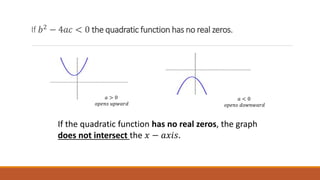
If 𝑏2
− 4𝑎𝑐 < 0 the quadratic function has no real zeros.
𝑎 > 0
𝑜𝑝𝑒𝑛𝑠 𝑢𝑝𝑤𝑎𝑟𝑑
𝑎 < 0
𝑜𝑝𝑒𝑛𝑠 𝑑𝑜𝑤𝑛𝑤𝑎𝑟𝑑
If the quadratic function has no real zeros, the graph
does not intersect the 𝑥 − 𝑎𝑥𝑖𝑠.
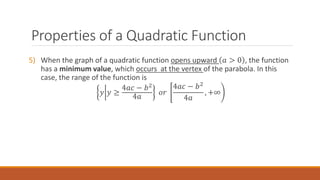
5) When the graph of a quadratic function opens upward 𝑎 > 0 , the function
has a minimum value, which occurs at the vertex of the parabola. In this
case, the range of the function is
𝑦 𝑦 ≥
4𝑎𝑐 − 𝑏2
4𝑎
𝑜𝑟
4𝑎𝑐 − 𝑏2
4𝑎
, +∞
Properties of a Quadratic Function
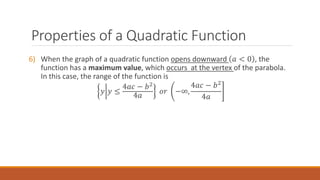
6) When the graph of a quadratic function opens downward 𝑎 < 0 , the
function has a maximum value, which occurs at the vertex of the parabola.
In this case, the range of the function is
𝑦 𝑦 ≤
4𝑎𝑐 − 𝑏2
4𝑎
𝑜𝑟 −∞,
4𝑎𝑐 − 𝑏2
4𝑎
Properties of a Quadratic Function
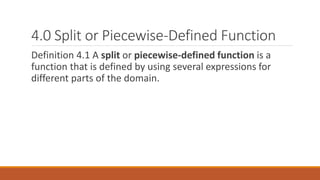
4.0 Split or Piecewise-Defined Function
Definition 4.1 A split or piecewise-defined function is a
function that is defined by using several expressions for
different parts of the domain.
Examples of Functions and Their Graphs.pptx

  • 1.
    Examples of Functions andTheir Graphs PRECALCULUS
  • 2.
    1. Constant Function Definition1.1 The function 𝑓 𝑥 = 𝑏 where 𝑏 is a real number is called the constant function.
  • 3.
    1.2 Properties ofa Constant Function i. The degree is 0. ii. The domain of the constant function is the set of real numbers. iii. The range is the set 𝑏 . iv. The graph is a horizontal line whose 𝑦-intercept is 𝑏, and parallel to the 𝑥 − 𝑎𝑥𝑖𝑠.
  • 4.
    2. Linear Functions Definition2. A function 𝑓 is a linear function if it can be written as 𝑓 𝑥 = 𝑚𝑥 + 𝑏 where 𝑚 and 𝑏 are real numbers, 𝑚 ≠ 0.
  • 5.
    i. A linearfunction is a first-degree function. ii. The domain of 𝑓 is the set of real numbers. iii. The range of 𝑓 is the set of real numbers. iv. The graph of a linear function is a straight line with slope 𝑚 and 𝑦 − 𝑖𝑛𝑡𝑒𝑟𝑐𝑒𝑝𝑡 𝑏. It is a slanting straight line. v. A linear function is increasing if 𝑚 > 0 and decreasing if 𝑚 < 0. vi. A linear function has exactly one zero, occurring at 𝑥 = − 𝑏 𝑚 . 2.1 Properties of Linear Functions
  • 6.
    Remarks: Zeros ofa Function 1) The zeros of a function 𝑓 are the values of 𝑥 for which 𝑓(𝑥) = 0. 2) A real zero of a function is also an 𝑥 − 𝑖𝑛𝑡𝑒𝑟𝑐𝑒𝑝𝑡 of the graph of the function.
  • 7.
    2.2 Equations ofa Straight Line: A Review I. The General Equation of a Line The equation of a line can be written to the general form or to the standard form 𝐴𝑥 + 𝐵𝑦 + 𝐶 = 0 where 𝐴, 𝐵 and 𝐶 are real numbers, and 𝐴 𝑎𝑛𝑑 𝐵 𝑎𝑟𝑒 𝑛𝑜𝑡 𝑏𝑜𝑡ℎ 𝑧𝑒𝑟𝑜.
  • 8.
    2.3 The Slopeof a Line: A Review Definition 2.3.1 Consider a line that is not parallel to the 𝑦 − 𝑎𝑥𝑖𝑠. Let 𝑃1 𝑥1, 𝑦1 and 𝑃2 𝑥2, 𝑦2 be two distinct points on the line. The slope 𝑚 of the line is given by 𝑚 = 𝑦2 − 𝑦1 𝑥2 − 𝑥1 where 𝑥1 ≠ 𝑥2
  • 9.
    Remarks: 1) The valueof 𝑠𝑙𝑜𝑝𝑒 𝑚 is the same number no matter what two points on line are selected. 2) A line with a positive slope 𝑚 > 0 goes up (or rises) from left to right, while a line with a negative slope 𝑚 < 0 goes down (or falls) from left to right. 3) A horizontal line has zero slope 𝑚 = 0 . 4) A vertical line has undefined slope.
  • 10.
    1. Point-Slope Form 𝒚− 𝒚𝟏 = 𝒎 𝒙 − 𝒙𝟏 2. Slope-Intercept Form 𝒚 = 𝒎𝒙 + 𝒃 𝒔𝒍𝒐𝒑𝒆 𝒎 𝒂𝒏𝒅 𝒚 − 𝒊𝒏𝒕𝒆𝒓𝒄𝒆𝒑𝒕 𝒃 𝒚 = 𝒎 𝒙 − 𝒂 𝒔𝒍𝒐𝒑𝒆 𝒎 𝒂𝒏𝒅 𝒙 − 𝒊𝒏𝒕𝒆𝒓𝒄𝒆𝒑𝒕 𝒂 3. Two-Point Form 𝒚 − 𝒚𝟏 = 𝒚𝟐 − 𝒚𝟏 𝒙𝟐 − 𝒙𝟏 𝒙 − 𝒙𝟏 4. Intercepts Form 𝒙 𝒂 + 𝒚 𝒃 = 𝟏 2.2 Equations of a Straight Line: A Review
  • 11.
    Parallel and PerpendicularLines Theorem 1 Parallel Lines. Let 𝐿1 and 𝐿2 be two distinct non-vertical lines with slopes 𝑚1and 𝑚2, respectively. Then 𝐿1 is parallel to 𝐿2 if and only if 𝑚1 = 𝑚2. 𝐿2
  • 12.
    Parallel and PerpendicularLines Theorem 2 Perpendicular Lines. Let 𝐿1 and 𝐿2 be two distinct non-vertical lines with slopes 𝑚1and 𝑚2, respectively. Then 𝐿1 is perpendicular to 𝐿2 if and only if 𝑚1𝑚2 = −1.
  • 13.
    3. Quadratic Function Definition3. The quadratic function is defined by 𝑓 𝑥 = 𝑎𝑥2 + 𝑏𝑥 + 𝑐 where 𝑎, 𝑏 and 𝑐 are real numbers, 𝑎 ≠ 0.
  • 14.
    1) The domainof any quadratic function is the set of real numbers. 2) The graph is a parabola with vertex at −𝑏 2𝑎 , 4𝑎𝑐−𝑏2 4𝑎 and whose axis is vertical. Properties of a Quadratic Function
  • 15.
    3) The zerosof the quadratic function 𝑓 𝑥 = 𝑎𝑥2 + 𝑏𝑥 + 𝑐 coincide with the roots of the equation 𝑎𝑥2 + 𝑏𝑥 + 𝑐 = 0. These roots are given by the quadratic formula 𝑥 = −𝑏 ± 𝑏2 − 4𝑎𝑐 2𝑎 Properties of a Quadratic Function
  • 16.
    4) The expression𝑏2 − 4𝑎𝑐 in the quadratic formula is called the discriminant of the quadratic function because its value tells us whether the function has real zeros, and how many zeros to expect.  if 𝑏2 − 4𝑎𝑐 > 0 the quadratic function has two distinct real zeros. if 𝑏2 − 4𝑎𝑐 = 0 the quadratic function has exactly one real zero. if 𝑏2 − 4𝑎𝑐 < 0 the quadratic function has no real zeros. Properties of a Quadratic Function
  • 17.
    If 𝑏2 − 4𝑎𝑐> 0 the quadratic function has two distinct real zeros. If the quadratic function has two real zeros, its graph intersects the 𝑥 − 𝑎𝑥𝑖𝑠 at two distinct points. 𝑎 > 0 𝑜𝑝𝑒𝑛𝑠 𝑢𝑝𝑤𝑎𝑟𝑑 𝑎 < 0 𝑜𝑝𝑒𝑛𝑠 𝑑𝑜𝑤𝑛𝑤𝑎𝑟𝑑
  • 18.
    If 𝑏2 − 4𝑎𝑐= 0 the quadratic function has exactly one real zero. If the quadratic function has one real zero, the graph intersects the 𝑥 − 𝑎𝑥𝑖𝑠 at a single point. 𝑎 > 0 𝑜𝑝𝑒𝑛𝑠 𝑢𝑝𝑤𝑎𝑟𝑑 𝑎 < 0 𝑜𝑝𝑒𝑛𝑠 𝑑𝑜𝑤𝑛𝑤𝑎𝑟𝑑
  • 19.
    If 𝑏2 − 4𝑎𝑐< 0 the quadratic function has no real zeros. 𝑎 > 0 𝑜𝑝𝑒𝑛𝑠 𝑢𝑝𝑤𝑎𝑟𝑑 𝑎 < 0 𝑜𝑝𝑒𝑛𝑠 𝑑𝑜𝑤𝑛𝑤𝑎𝑟𝑑 If the quadratic function has no real zeros, the graph does not intersect the 𝑥 − 𝑎𝑥𝑖𝑠.
  • 20.
    5) When thegraph of a quadratic function opens upward 𝑎 > 0 , the function has a minimum value, which occurs at the vertex of the parabola. In this case, the range of the function is 𝑦 𝑦 ≥ 4𝑎𝑐 − 𝑏2 4𝑎 𝑜𝑟 4𝑎𝑐 − 𝑏2 4𝑎 , +∞ Properties of a Quadratic Function
  • 21.
    6) When thegraph of a quadratic function opens downward 𝑎 < 0 , the function has a maximum value, which occurs at the vertex of the parabola. In this case, the range of the function is 𝑦 𝑦 ≤ 4𝑎𝑐 − 𝑏2 4𝑎 𝑜𝑟 −∞, 4𝑎𝑐 − 𝑏2 4𝑎 Properties of a Quadratic Function
  • 22.
    4.0 Split orPiecewise-Defined Function Definition 4.1 A split or piecewise-defined function is a function that is defined by using several expressions for different parts of the domain.