QUESTION BANK (HOTS)-- XI (HOTS)
MATHEMATICS
TRIGONOMETRIC FUNCTION
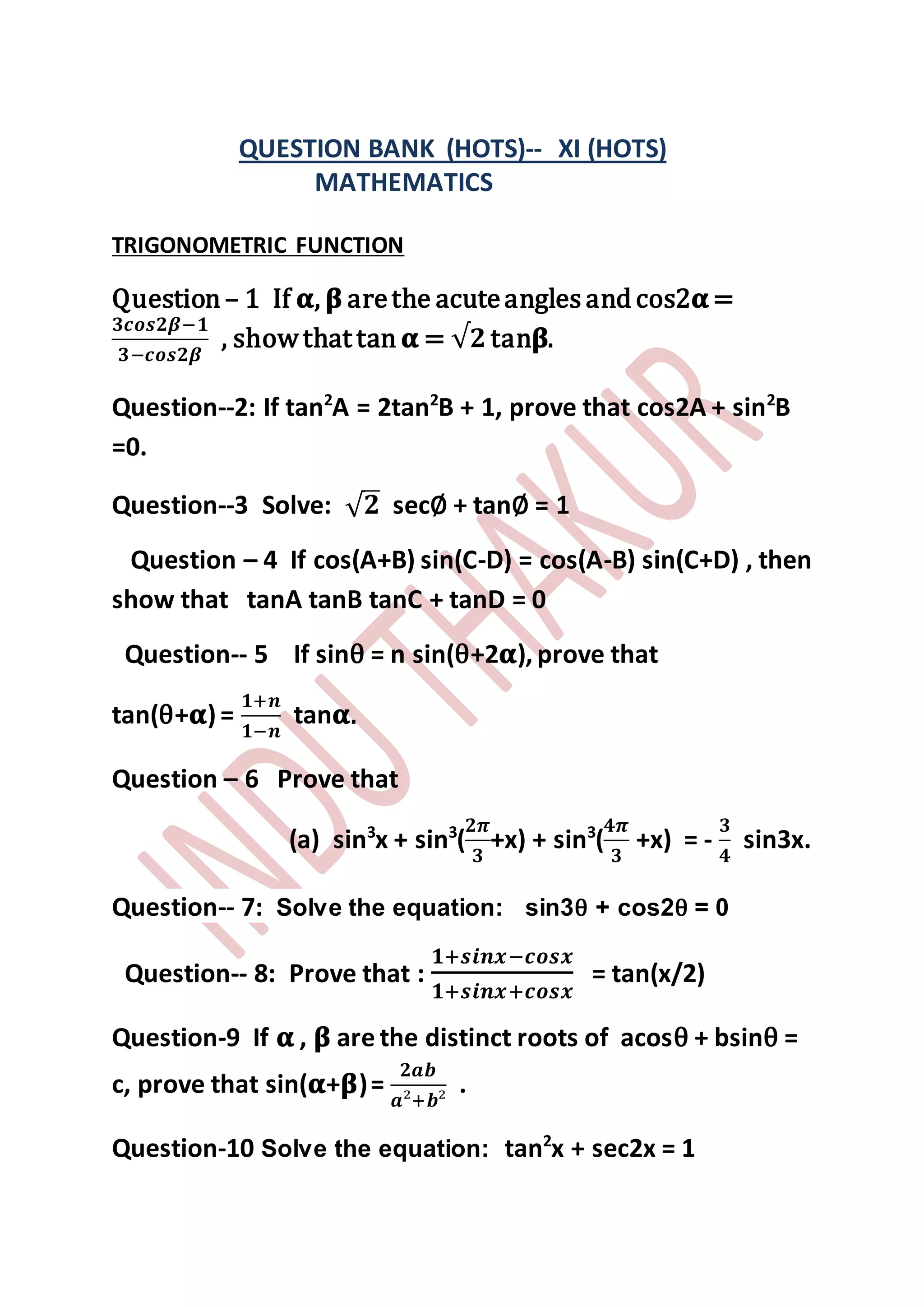
Question – 1 If 𝛂, 𝛃 arethe acuteangles and cos2𝛂 =
𝟑𝒄𝒐𝒔𝟐𝜷−𝟏
𝟑−𝒄𝒐𝒔𝟐𝜷
, showthat tan 𝛂 = √𝟐 tan𝛃.
Question--2: If tan2
A = 2tan2
B + 1, prove that cos2A + sin2
B
=0.
Question--3 Solve: √ 𝟐 sec∅ + tan∅ = 1
Question – 4 If cos(A+B) sin(C-D) = cos(A-B) sin(C+D) , then
show that tanA tanB tanC + tanD = 0
Question-- 5 If sinθ = n sin(θ+2𝛂), prove that
tan(θ+𝛂)=
𝟏+𝒏
𝟏−𝒏
tan𝛂.
Question – 6 Prove that
(a) sin3
x + sin3
(
𝟐𝝅
𝟑
+x) + sin3
(
𝟒𝝅
𝟑
+x) = -
𝟑
𝟒
sin3x.
Question-- 7: Solve the equation: sin3θ + cos2θ = 0
Question-- 8: Prove that :
𝟏+𝒔𝒊𝒏𝒙−𝒄𝒐𝒔𝒙
𝟏+𝒔𝒊𝒏𝒙+𝒄𝒐𝒔𝒙
= tan(x/2)
Question-9 If 𝛂 , 𝛃 are the distinct roots of acosθ + bsinθ =
c, prove that sin(𝛂+𝛃)=
𝟐𝒂𝒃
𝒂²+𝒃²
.
Question-10 Solve the equation: tan2
x + sec2x = 1
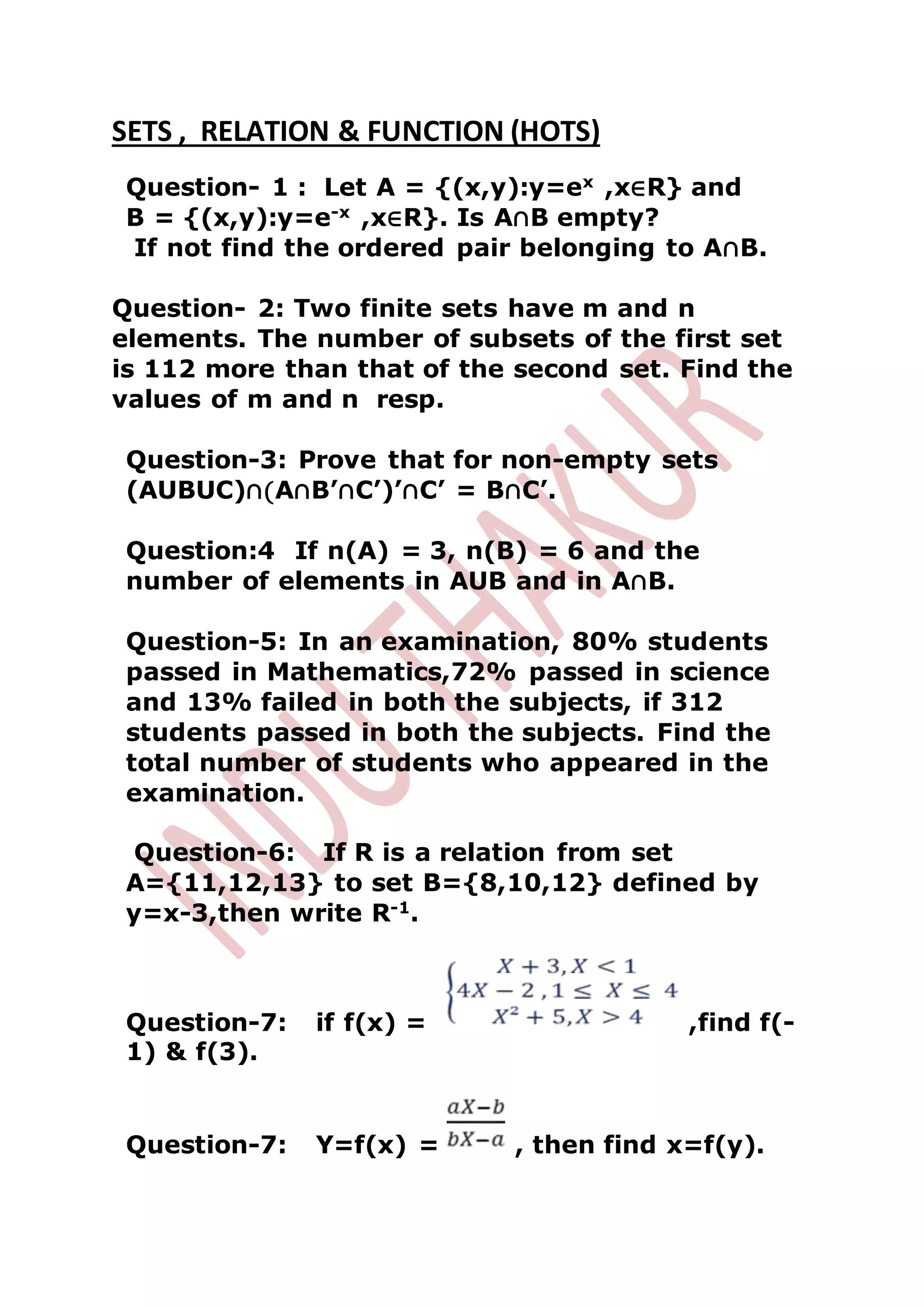
SETS , RELATION & FUNCTION (HOTS)
Question- 1 : Let A = {(x,y):y=ex
,x∈R} and
B = {(x,y):y=e-x
,x∈R}. Is A∩B empty?
If not find the ordered pair belonging to A∩B.
Question- 2: Two finite sets have m and n
elements. The number of subsets of the first set
is 112 more than that of the second set. Find the
values of m and n resp.
Question-3: Prove that for non-empty sets
(AUBUC)∩(A∩B’∩C’)’∩C’ = B∩C’.
Question:4 If n(A) = 3, n(B) = 6 and the
number of elements in AUB and in A∩B.
Question-5: In an examination, 80% students
passed in Mathematics,72% passed in science
and 13% failed in both the subjects, if 312
students passed in both the subjects. Find the
total number of students who appeared in the
examination.
Question-6: If R is a relation from set
A={11,12,13} to set B={8,10,12} defined by
y=x-3,then write R-1.
Question-7: if f(x) = ,find f(-
1) & f(3).
Question-7: Y=f(x) = , then find x=f(y).
Question-8: If f(x) = , find f[f(x)].
COMPLEX NUMBERS (HOTS)
Question-1: If iz3 +z2 – z+ i = 0, then show that |z| = 1.
Question-2: If a+ib =
𝒄+𝒊
𝒄−𝒊
, then a2+b2 = 1 and b/a =
𝟐𝒄
𝒄²−𝟏
Question-3: If x = - 5 +2√(-4) , find the value of
x4+9x3+35x2 – x+4.
Question-4: Show that a real x will satisfy equation
𝟏−𝒊𝒙
𝟏+𝒊𝒙
= a – ib, if a2+b2 = 1 where a, b are real.
Question-5: A variable complex z is such that arg (
𝒛−𝟏
𝒛+𝟏
) =
𝝅
𝟐
, show that x2+y2 – 1=0
Question-6: Find the values of x and y if x2 – 7x +9yi
and y2i+20i – 12 are equal.
Question-7: Prove that arg(𝒛) = 2π – arg(z) ,z ≠0
Question-8: If z =
𝟏
𝟏−𝒄𝒐𝒔𝝋−𝒊𝒔𝒊𝒏𝝋
, then find Re(z).
SEQUENCES & SERIES (HOTS)
Question:1 If the roots of (b-c)x2+(c-a)x+(a-b) = 0 are equal,
then a,b,c are in A.P.
Question:2 There are n A.M.’s between 7 and 85 such that (n-
3)th mean : nth mean is 11 : 24.Find n.
Question:3 If g1, g2 be two G.M.’s between a and b and A is
the A.M. between a & b, then prove that
𝒈𝟏²
𝒈𝟐
+
𝒈𝟐²
𝒈𝟏
= 2A.
Question:4 If a is the A.M. of b, c and two geometric means
between b , c and G1,G2, then prove that G13 = g23
Question:5 An A.P. consists of n(odd)terms and it’s middle
term is m. Prove that Sn = mn.
Question:6 Sum of infinitythe series
𝟏
𝟐
+
𝟏
𝟐+𝟒
+
𝟏
𝟐+𝟒+𝟔
+………..
Question:7 Prove that 23rd term of sequence 17, 16
𝟏
𝟓
, 15
𝟐
𝟓
,
14
𝟑
𝟓
,………is the first negative term.
Question:8 Prove that 1+
𝟐
𝟑
+
𝟔
𝟑²
+
𝟏𝟎
𝟑 𝟑 +
𝟏𝟒
𝟑 𝟒 + ………..∞ = 3.
Question: 9 If there are distinct real numbers a,b,c are in
G.P. and a+b+c = bx , show that x ≤ -1 or x ≥ 3.
Question:10 If first term of H.P. is 1/7 and 2nd term is 1/9,
prove that 12th term is 1/29.
STRAIGHT LINES & CONIC SECTION (HOTS)
Question 1 Find the equation of the straight lines
which pass through the origin and trisect the intercept
of line 3x+4y=12 b/w the axes.
Question 2 Find the equation of the line through the
intersectionof the lines x -3y+1=0 and 2x+5y -9=0 and
whose distant from the origin is √𝟓 .
Question 3 The points (1,3) and (5,1) are the opposite
vertices of a rectangle.The other two vertices lie on
the line y = 2x+c. Find c and the remaining vertices.
Question 4 The consecutive sides of a parallelogram
are 4x+5y=0 and 7x+2y=0. If the equation of one
diagonal be 11x+7y=9, find the equation of other
diagonal.
Question 5 One side of a rectangle lies along the line
4x+7y+5=0. Two of vertices are (-3,1) & (1,1). Find the
equation of other three sides.
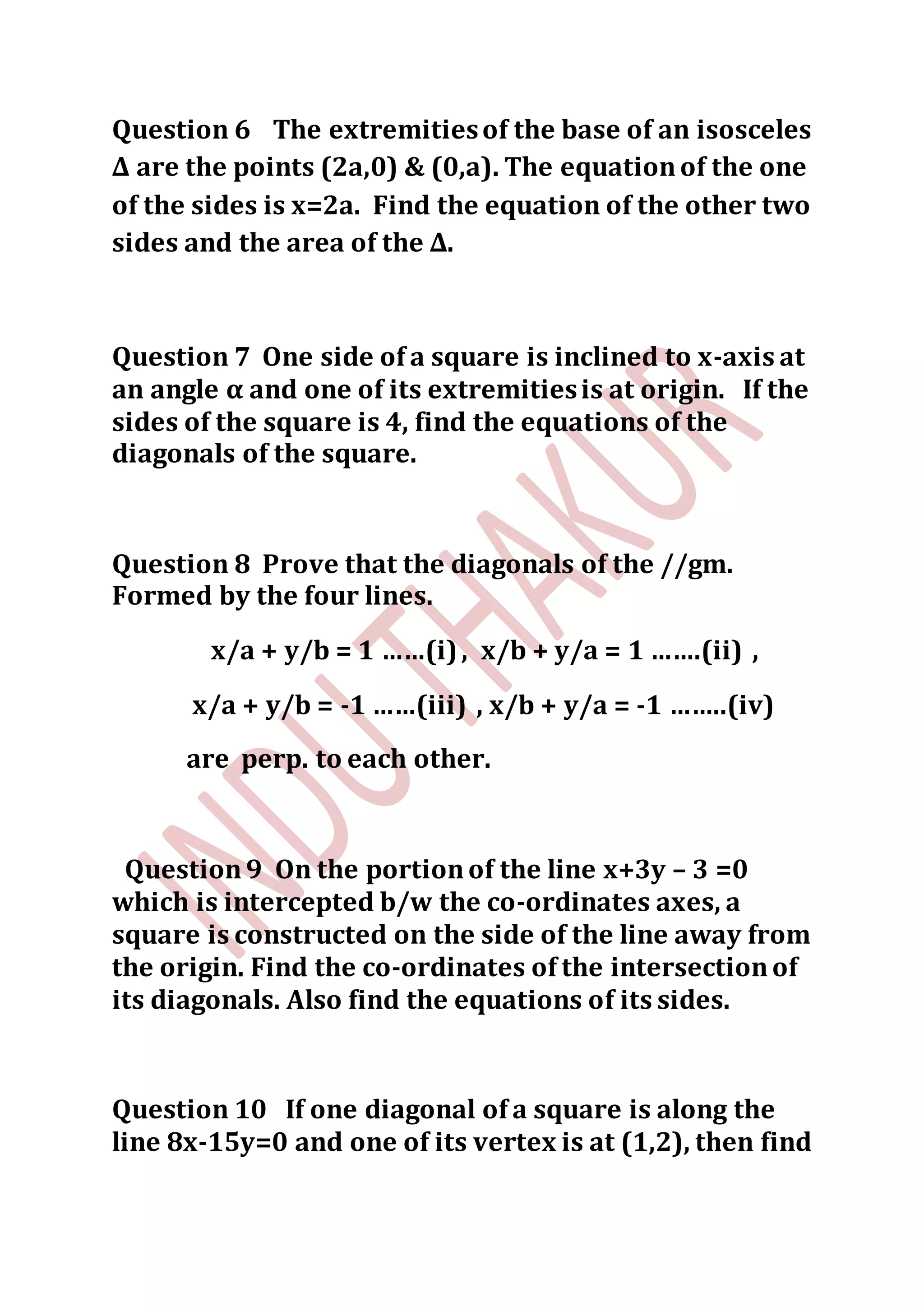
Question 6 The extremitiesof the base of an isosceles
∆ are the points (2a,0) & (0,a). The equationof the one
of the sides is x=2a. Find the equation of the other two
sides and the area of the ∆.
Question 7 One side of a square is inclined to x-axis at
an angle α and one of its extremitiesis at origin. If the
sides of the square is 4, find the equations of the
diagonals of the square.
Question 8 Prove that the diagonals of the //gm.
Formed by the four lines.
x/a + y/b = 1 ……(i), x/b + y/a = 1 …….(ii) ,
x/a + y/b = -1 ……(iii) , x/b + y/a = -1 ……..(iv)
are perp. to each other.
Question9 On the portionof the line x+3y – 3 =0
which is intercepted b/w the co-ordinates axes, a
square is constructed on the side of the line away from
the origin. Find the co-ordinates of the intersectionof
its diagonals. Also find the equations of its sides.
Question 10 If one diagonal of a square is along the
line 8x-15y=0 and one of its vertex is at (1,2), then find
the equation of sides of the square passing through
this vertex.
Question.11 Find the eqn. of parabola whose focus is
at (-1,-2) & the directrix is x – 2y + 3=0.
Question.12 Find the eqn. of ellipse whose axes are
parallel to the coordinate axes having it’s centre at the
point (2,-3) and one vertex at (4,-3) & one focus at (3,-
3).
Question.13 Find the eqn. of hyperbola, the length of
whose latus-rectum is 8 and e = 3√𝟓 .
Question. 14 Find the eqn. of circle whose radius is 5
and which touches the circle x2+y2 – 2x – 4y – 20 = 0
externally at the point (5,5).
Question.15 Find the eqn. of circle of radius 5 which
lies within the circle x2+y2+14x+10y – 26 = 0 and
which touches the given circle at the point (-1,3).
: L.H.S.
𝟏−𝒕𝒂𝒏²𝑨
𝟏+𝒕𝒂𝒏²𝑩
+ sin2
B =
−𝟐𝒕𝒂𝒏²𝑩
𝟐(𝟏+𝒕𝒂𝒏 𝟐 𝑩)
+ sin2
B , by putting above
result and simplify it.
Solution √ 𝟐 + sin∅ = cos∅ ⇨ cos∅ - sin∅ = √ 𝟐 dividing by
√ 𝒂 𝟐 + 𝒃 𝟐 =√ 𝟐 ∵ a=1,b=1
(cos∅ - sin∅ )/ √ 𝟐 = 1 ⇨ cos(п/4) cos∅ - sin(п/4)
sin∅ =1 ⇨ cos(∅+п/4) = cos00
∅+п/4 = 2nп±0, n∈Z ⇨ ∅ = 2nп – п/4.
Hint: According to required result , we have to convert given part
into tangent function By using cos2𝛂 =
𝟏−𝒕𝒂𝒏²𝜶
𝟏+𝒕𝒂𝒏²𝜶
∴ we will get
𝟏−𝒕𝒂𝒏²𝜶
𝟏+𝒕𝒂𝒏²𝜶
=
𝟑(
𝟏−𝒕𝒂𝒏²𝜷
𝟏+𝒕𝒂𝒏²𝜷
)−𝟏
𝟑−
𝟏−𝒕𝒂𝒏²𝜷
𝟏+𝒕𝒂𝒏²𝜷
=
𝟑−𝟑𝒕𝒂𝒏²𝜷−𝟏−𝒕𝒂𝒏²𝜷
𝟑+𝟑𝒕𝒂𝒏²𝜷−𝟏+𝒕𝒂𝒏²𝜷
Hint: We can write above given result as
𝐜𝐨𝐬(𝐀+𝐁)
𝐜𝐨𝐬(𝐀−𝐁)
=
𝐬𝐢𝐧(𝐂+𝐃)
𝐬𝐢𝐧(𝐂−𝐃)
By C & D
𝐜𝐨𝐬( 𝐀+𝐁)+𝐜𝐨𝐬(𝐀−𝐁)
𝐜𝐨𝐬( 𝐀+𝐁)−𝐜𝐨𝐬(𝐀−𝐁)
=
𝐬𝐢𝐧( 𝐂+𝐃)+𝐬𝐢𝐧(𝐂−𝐃)
𝐬𝐢𝐧( 𝐂+𝐃)−𝐬𝐢𝐧(𝐂−𝐃)
(ii)
𝐬𝐢𝐧(𝛉+𝟐𝛂)
𝐬𝐢𝐧𝛉
=
𝟏
𝒏
, by C & D
𝐬𝐢𝐧( 𝛉+𝟐𝛂)+𝐬𝐢𝐧𝛉
𝐬𝐢𝐧(𝛉+𝟐𝛂)−𝐬𝐢𝐧𝛉
=
𝟏+𝒏
𝟏−𝒏
[Hint: Use sin3A = 3sinA – 4sin3
A ⇨ 4sin3
A = 3sinA - sin3A ⇨
sin3
A = ¼[3sinA - sin3A]]
[Answer number of students failed in both the subjects
= n(M’∩S’)=13% of x=0.13x
n(U) – n{(MUS)’} = 1.52x – 312 ⇨x=480.]
Answer: ex
= e-x
⇨ e2x
=1⇨ x=0, for x=0,y=1⇨ A and B
meet on (0,1) and A∩B≠∅.
[ Answer: A ⊆ B ⇨n(AUB)=n(B), n(A∩B)=n(A).]
Answer: 2m
-2n
=112⇨ 2n
(2(m-n)
– 1)= 24
(23
– 1).
Answer: m = mid term = T(n+1)/2 = a+(
𝒏+𝟏
𝟐
- 1)d ⇨ 2m= 2a+(n-
1)d , Sn = n/2[2a+(n-1)d]=mn.
Answer: 2a = b+c , c = ar3 ⇨ r = (
𝒄
𝒃
)
𝟏
𝟑 , put in G1= br & G2= br2
[Hint: 2A = a+b, b/g2 = g2/g1 = g1/a ⇨ a = g12 / g2 , b = g22
/g1.]
[Hint:
𝟏
𝟐+𝟒+𝟔+⋯…….𝒏 𝒕𝒆𝒓𝒎𝒔
=
𝟏
𝟐(𝟏+𝟐+𝟑+⋯……𝒏 𝒕𝒆𝒓𝒎𝒔)
=
𝟏
𝟐
𝒏(𝒏+𝟏)
𝟐
=
𝟏
𝒏(𝒏+𝟏)
⇨ S∞=1 [
𝟏
𝟏.𝟐
+
𝟏
𝟐.𝟑
+......∞ =1 as given short-cut method on blog)].
[Hint: a=17, d=-4/5 and let nth term be first negative term ⇨
17+(n-1)(-4/5) < 0 ⇨ n > 89/4 ⇨ n=23]
Answer: we can write above series as 1 +
𝟐
𝟑
[1+
𝟑
𝟑
+
𝟓
𝟑 𝟐+…….],where a=1,d=2 and r= 1/3, then use formula of
combined A.P.& G.P(Arithmetic –geometric series) [
𝒂
𝟏−𝒓
+
𝒅𝒓
( 𝟏−𝒓)²
]
or you can do by another method S -
𝟏
𝟑
S = {1+
𝟐
𝟑
+
𝟔
𝟑²
+
𝟏𝟎
𝟑 𝟑 +
𝟏𝟒
𝟑 𝟒 +
………..∞} – {
𝟏
𝟑
+
𝟐
𝟑 𝟐 +
𝟔
𝟑 𝟑 +
𝟏𝟎
𝟑 𝟒 +
𝟏𝟒
𝟑 𝟓 + ………..∞}
⇨
𝟐𝑺
𝟑
= 1+ (
𝟐
𝟑
-
𝟏
𝟑
) +
𝟒
𝟑 𝟐 {1+
𝟏
𝟑
+
𝟏
𝟑 𝟐+…..∞} =2 ⇨ S=3
a/(1-r)
[Hint: take D ≥ 0 , a+ar+ar2 = (ar)x ⇨ r2+(1-x)r+1=0]
[Hint: as 1/a,1/b,1/c are in H.P. ⇨ a,b,c are in A.P. therefore first
and second terms are in A.P. will be 7,9
a=7, d= 2 , then find a12]
[Hint: a+arn-1 = 66 , (ar)( arn-2) = 128 and Sn = 126 ⇨ r=2 and n
= 6]
AQ : QB = 2 : 1 ⇨ Q=(4/3 ,2) then equation of line OP
and OQ passingthrough (0,0) is 3x – 8y =0 and 3x – 2y
=0 resp.]
[ Hint: Let the line AB be trisected at P and Q, then AP :
PB = 1:2 , A(4,0) , B(0,3) BY using section formula we
get P(8/3 , 1)
[ Hint: (x -3y+1) +k(2x+5y -9)=0 -------(1) , then
find distant from (0,0) on the line (1) is √𝟓 ⇨ k=7/8
,put in (1)
Answer is 2x+y – 5=0]
[Hint: D(𝜶, 𝜷) C(5,1)
y=2x+c
M (3,2)
A(1,3) B(X,2X-4)
M(3,2) (by mid point formula), it lies on BD ∴ c = -4 ,
use
(AB)2
+ (BC)2
= (AC)2
⇨ x=4 or 2 ∴ B(4,4) then D (2,0),
if B(2,0) then D(4,4)]
11x+7y=9
[ Hint: D C
7x+2y=0 P
O 4x+5y=0 B
B(5/3,-4/3) , D(-2/3,7/3) by solving equations of OB &
BD and OD & BD resp.
Then find point P (1/2,1/2) & equation of OC i.e, OP is
y=x.]
[ Hint:
D slope=-4/7 C(1,1)
Slope=7/4 slope=7/4
A(-3,1) 4x+7y+5=0 B
Equation of BC is 7x – 4y -3=0 , equation of AD &
CD are 7x – 4y +25=0 & 4x+7y=11=0 resp.]
[ Hint: y
C
B(0,a)
x+2y-2a=0
o A(2a,0) X
by solving CA2
= CB2
⇨ Y=(5a)/2 i.e, C is (2a,5a/2),
equation of BC is 3x – 4y+4a=0 & area of ∆ACBis
5a2/2 sq.units.]
[ Hint Y
B(h,k)
(-4sinα, 4cosα)
C 4 4 A(4cosα, 4sinα)
M O L
Angle COM=900-α , angle AOL=α ]
Take ∆OLA , find A as OL/4=cosα & AL/4=sinα and
in ∆OMC ,find point C, then find equation of OB & AC
( by using mid pointof OB & AC) equations of OB
& AC are x(cosα+sinα) – y(cosα – sinα)=0 ,
x(cosα - sinα) + y(cosα+ sinα)=4 resp.]
[Hint: Find all co-ordinates & for perpendicularity of
diagonals show
(
−𝒂𝒃
𝒂+𝒃
,
−𝒂𝒃
𝒂+𝒃
) D line (iii) C (
𝒂𝒃
𝒂−𝒃
,
−𝒂𝒃
𝒂−𝒃
)
Slope=1
Line(iv)
Slope=-1 line(ii)
(
−𝒂𝒃
𝒂−𝒃
,
𝒂𝒃
𝒂−𝒃
) A line(i) B (
𝒂𝒃
𝒂+𝒃
,
𝒂𝒃
𝒂+𝒃
)
product of slopes of AC & BD = -1× 𝟏 = −𝟏]
[Hint:
Y C
D(4,3)
(0,1)B 45 P(2,2)
X+3y-3=0
A(3,0)
P is the mid point of BD
angle ABD=450
, use formula tan 450
=|
𝟑𝒎+𝟏
𝟑−𝒎
|
⇨ m =1/2 or -2 , equations of BD ,AC, CD AD & BC
are x-2y+2=0, 2x+y-6=0, x+3y-13=0, 3x-y-9=0 & 3x-
y+1=0 resp.]
[ Hint: use formula tan 450
=
𝒎 𝟏−
𝟖
𝟏𝟓
𝟏+𝒎 𝟏
𝟖
𝟏𝟓
⇨ m1 = 23/7 ,
(1,2) A B
m1 8x-15y=0
450
m2 =8/15
D C
Equations of AD & AB ( Perp. to each other) are
23x-7y-9=0 , 7x+23y-53=0]
Answer.2 Let (x1,y1) be the pt. of intersection of axis and
directrix. By mid point formula x1=4, y1=-11, A be the
vertex & F is the focus , slope of AF is -4 , then slope of
directrix is ¼
Eqn. of directrix is x-4y-48=0 , . FP2
=PM2
⇨
16x2
+y2
+8xy+96x-554y-1879=0.
Answer.3 same as Q.2 , eqn. of line per. To x-y+1=0 is
x+y+k=0
Required eqn. is x2
+y2
-14x+2y+2xy+17=0.
Answer.1 Let P(x,y) be any point on the parabola whose
focus is F(-1,-2) & the directrix x-2y+3 =0. Draw PM is per.
From P on directrix , by defn. FP2
=PM2
⇨ (X+1)2
+ (Y+2)2
=(
𝑿−𝟐𝒀+𝟑
√ 𝟏+𝟒
)2
Answer.5 Let 2a , 2b be the major & minor axes , it’s eqn. is
(x-2)2
/a2
+ (y+3)2
/b2
= 1, C is the centre , F1, A are the one
focus & vertex resp. , CF1 = ae =1 , CA=a =2 ⇨ e=1/2 , we
know that b2
= a2
(1-e2
) ⇨ b2
= 3, find eqn. of ellipse.
Answer.8 use b2
= a2
(1-e2
), eqn. is x2
/25 – y2
/20 = 1

Question bank -xi (hots)

  • 1.
    QUESTION BANK (HOTS)--XI (HOTS) MATHEMATICS TRIGONOMETRIC FUNCTION Question – 1 If 𝛂, 𝛃 arethe acuteangles and cos2𝛂 = 𝟑𝒄𝒐𝒔𝟐𝜷−𝟏 𝟑−𝒄𝒐𝒔𝟐𝜷 , showthat tan 𝛂 = √𝟐 tan𝛃. Question--2: If tan2 A = 2tan2 B + 1, prove that cos2A + sin2 B =0. Question--3 Solve: √ 𝟐 sec∅ + tan∅ = 1 Question – 4 If cos(A+B) sin(C-D) = cos(A-B) sin(C+D) , then show that tanA tanB tanC + tanD = 0 Question-- 5 If sinθ = n sin(θ+2𝛂), prove that tan(θ+𝛂)= 𝟏+𝒏 𝟏−𝒏 tan𝛂. Question – 6 Prove that (a) sin3 x + sin3 ( 𝟐𝝅 𝟑 +x) + sin3 ( 𝟒𝝅 𝟑 +x) = - 𝟑 𝟒 sin3x. Question-- 7: Solve the equation: sin3θ + cos2θ = 0 Question-- 8: Prove that : 𝟏+𝒔𝒊𝒏𝒙−𝒄𝒐𝒔𝒙 𝟏+𝒔𝒊𝒏𝒙+𝒄𝒐𝒔𝒙 = tan(x/2) Question-9 If 𝛂 , 𝛃 are the distinct roots of acosθ + bsinθ = c, prove that sin(𝛂+𝛃)= 𝟐𝒂𝒃 𝒂²+𝒃² . Question-10 Solve the equation: tan2 x + sec2x = 1
  • 2.
    SETS , RELATION& FUNCTION (HOTS) Question- 1 : Let A = {(x,y):y=ex ,x∈R} and B = {(x,y):y=e-x ,x∈R}. Is A∩B empty? If not find the ordered pair belonging to A∩B. Question- 2: Two finite sets have m and n elements. The number of subsets of the first set is 112 more than that of the second set. Find the values of m and n resp. Question-3: Prove that for non-empty sets (AUBUC)∩(A∩B’∩C’)’∩C’ = B∩C’. Question:4 If n(A) = 3, n(B) = 6 and the number of elements in AUB and in A∩B. Question-5: In an examination, 80% students passed in Mathematics,72% passed in science and 13% failed in both the subjects, if 312 students passed in both the subjects. Find the total number of students who appeared in the examination. Question-6: If R is a relation from set A={11,12,13} to set B={8,10,12} defined by y=x-3,then write R-1. Question-7: if f(x) = ,find f(- 1) & f(3). Question-7: Y=f(x) = , then find x=f(y).
  • 3.
    Question-8: If f(x)= , find f[f(x)]. COMPLEX NUMBERS (HOTS) Question-1: If iz3 +z2 – z+ i = 0, then show that |z| = 1. Question-2: If a+ib = 𝒄+𝒊 𝒄−𝒊 , then a2+b2 = 1 and b/a = 𝟐𝒄 𝒄²−𝟏 Question-3: If x = - 5 +2√(-4) , find the value of x4+9x3+35x2 – x+4. Question-4: Show that a real x will satisfy equation 𝟏−𝒊𝒙 𝟏+𝒊𝒙 = a – ib, if a2+b2 = 1 where a, b are real. Question-5: A variable complex z is such that arg ( 𝒛−𝟏 𝒛+𝟏 ) = 𝝅 𝟐 , show that x2+y2 – 1=0 Question-6: Find the values of x and y if x2 – 7x +9yi and y2i+20i – 12 are equal. Question-7: Prove that arg(𝒛) = 2π – arg(z) ,z ≠0 Question-8: If z = 𝟏 𝟏−𝒄𝒐𝒔𝝋−𝒊𝒔𝒊𝒏𝝋 , then find Re(z).
  • 4.
    SEQUENCES & SERIES(HOTS) Question:1 If the roots of (b-c)x2+(c-a)x+(a-b) = 0 are equal, then a,b,c are in A.P. Question:2 There are n A.M.’s between 7 and 85 such that (n- 3)th mean : nth mean is 11 : 24.Find n. Question:3 If g1, g2 be two G.M.’s between a and b and A is the A.M. between a & b, then prove that 𝒈𝟏² 𝒈𝟐 + 𝒈𝟐² 𝒈𝟏 = 2A. Question:4 If a is the A.M. of b, c and two geometric means between b , c and G1,G2, then prove that G13 = g23 Question:5 An A.P. consists of n(odd)terms and it’s middle term is m. Prove that Sn = mn. Question:6 Sum of infinitythe series 𝟏 𝟐 + 𝟏 𝟐+𝟒 + 𝟏 𝟐+𝟒+𝟔 +……….. Question:7 Prove that 23rd term of sequence 17, 16 𝟏 𝟓 , 15 𝟐 𝟓 , 14 𝟑 𝟓 ,………is the first negative term. Question:8 Prove that 1+ 𝟐 𝟑 + 𝟔 𝟑² + 𝟏𝟎 𝟑 𝟑 + 𝟏𝟒 𝟑 𝟒 + ………..∞ = 3. Question: 9 If there are distinct real numbers a,b,c are in G.P. and a+b+c = bx , show that x ≤ -1 or x ≥ 3. Question:10 If first term of H.P. is 1/7 and 2nd term is 1/9, prove that 12th term is 1/29.
  • 5.
    STRAIGHT LINES &CONIC SECTION (HOTS) Question 1 Find the equation of the straight lines which pass through the origin and trisect the intercept of line 3x+4y=12 b/w the axes. Question 2 Find the equation of the line through the intersectionof the lines x -3y+1=0 and 2x+5y -9=0 and whose distant from the origin is √𝟓 . Question 3 The points (1,3) and (5,1) are the opposite vertices of a rectangle.The other two vertices lie on the line y = 2x+c. Find c and the remaining vertices. Question 4 The consecutive sides of a parallelogram are 4x+5y=0 and 7x+2y=0. If the equation of one diagonal be 11x+7y=9, find the equation of other diagonal. Question 5 One side of a rectangle lies along the line 4x+7y+5=0. Two of vertices are (-3,1) & (1,1). Find the equation of other three sides.
  • 6.
    Question 6 Theextremitiesof the base of an isosceles ∆ are the points (2a,0) & (0,a). The equationof the one of the sides is x=2a. Find the equation of the other two sides and the area of the ∆. Question 7 One side of a square is inclined to x-axis at an angle α and one of its extremitiesis at origin. If the sides of the square is 4, find the equations of the diagonals of the square. Question 8 Prove that the diagonals of the //gm. Formed by the four lines. x/a + y/b = 1 ……(i), x/b + y/a = 1 …….(ii) , x/a + y/b = -1 ……(iii) , x/b + y/a = -1 ……..(iv) are perp. to each other. Question9 On the portionof the line x+3y – 3 =0 which is intercepted b/w the co-ordinates axes, a square is constructed on the side of the line away from the origin. Find the co-ordinates of the intersectionof its diagonals. Also find the equations of its sides. Question 10 If one diagonal of a square is along the line 8x-15y=0 and one of its vertex is at (1,2), then find
  • 7.
    the equation ofsides of the square passing through this vertex. Question.11 Find the eqn. of parabola whose focus is at (-1,-2) & the directrix is x – 2y + 3=0. Question.12 Find the eqn. of ellipse whose axes are parallel to the coordinate axes having it’s centre at the point (2,-3) and one vertex at (4,-3) & one focus at (3,- 3). Question.13 Find the eqn. of hyperbola, the length of whose latus-rectum is 8 and e = 3√𝟓 . Question. 14 Find the eqn. of circle whose radius is 5 and which touches the circle x2+y2 – 2x – 4y – 20 = 0 externally at the point (5,5). Question.15 Find the eqn. of circle of radius 5 which lies within the circle x2+y2+14x+10y – 26 = 0 and which touches the given circle at the point (-1,3).
  • 8.
    : L.H.S. 𝟏−𝒕𝒂𝒏²𝑨 𝟏+𝒕𝒂𝒏²𝑩 + sin2 B= −𝟐𝒕𝒂𝒏²𝑩 𝟐(𝟏+𝒕𝒂𝒏 𝟐 𝑩) + sin2 B , by putting above result and simplify it. Solution √ 𝟐 + sin∅ = cos∅ ⇨ cos∅ - sin∅ = √ 𝟐 dividing by √ 𝒂 𝟐 + 𝒃 𝟐 =√ 𝟐 ∵ a=1,b=1 (cos∅ - sin∅ )/ √ 𝟐 = 1 ⇨ cos(п/4) cos∅ - sin(п/4) sin∅ =1 ⇨ cos(∅+п/4) = cos00 ∅+п/4 = 2nп±0, n∈Z ⇨ ∅ = 2nп – п/4. Hint: According to required result , we have to convert given part into tangent function By using cos2𝛂 = 𝟏−𝒕𝒂𝒏²𝜶 𝟏+𝒕𝒂𝒏²𝜶 ∴ we will get 𝟏−𝒕𝒂𝒏²𝜶 𝟏+𝒕𝒂𝒏²𝜶 = 𝟑( 𝟏−𝒕𝒂𝒏²𝜷 𝟏+𝒕𝒂𝒏²𝜷 )−𝟏 𝟑− 𝟏−𝒕𝒂𝒏²𝜷 𝟏+𝒕𝒂𝒏²𝜷 = 𝟑−𝟑𝒕𝒂𝒏²𝜷−𝟏−𝒕𝒂𝒏²𝜷 𝟑+𝟑𝒕𝒂𝒏²𝜷−𝟏+𝒕𝒂𝒏²𝜷 Hint: We can write above given result as 𝐜𝐨𝐬(𝐀+𝐁) 𝐜𝐨𝐬(𝐀−𝐁) = 𝐬𝐢𝐧(𝐂+𝐃) 𝐬𝐢𝐧(𝐂−𝐃) By C & D 𝐜𝐨𝐬( 𝐀+𝐁)+𝐜𝐨𝐬(𝐀−𝐁) 𝐜𝐨𝐬( 𝐀+𝐁)−𝐜𝐨𝐬(𝐀−𝐁) = 𝐬𝐢𝐧( 𝐂+𝐃)+𝐬𝐢𝐧(𝐂−𝐃) 𝐬𝐢𝐧( 𝐂+𝐃)−𝐬𝐢𝐧(𝐂−𝐃) (ii) 𝐬𝐢𝐧(𝛉+𝟐𝛂) 𝐬𝐢𝐧𝛉 = 𝟏 𝒏 , by C & D 𝐬𝐢𝐧( 𝛉+𝟐𝛂)+𝐬𝐢𝐧𝛉 𝐬𝐢𝐧(𝛉+𝟐𝛂)−𝐬𝐢𝐧𝛉 = 𝟏+𝒏 𝟏−𝒏 [Hint: Use sin3A = 3sinA – 4sin3 A ⇨ 4sin3 A = 3sinA - sin3A ⇨ sin3 A = ¼[3sinA - sin3A]] [Answer number of students failed in both the subjects = n(M’∩S’)=13% of x=0.13x n(U) – n{(MUS)’} = 1.52x – 312 ⇨x=480.]
  • 9.
    Answer: ex = e-x ⇨e2x =1⇨ x=0, for x=0,y=1⇨ A and B meet on (0,1) and A∩B≠∅. [ Answer: A ⊆ B ⇨n(AUB)=n(B), n(A∩B)=n(A).] Answer: 2m -2n =112⇨ 2n (2(m-n) – 1)= 24 (23 – 1). Answer: m = mid term = T(n+1)/2 = a+( 𝒏+𝟏 𝟐 - 1)d ⇨ 2m= 2a+(n- 1)d , Sn = n/2[2a+(n-1)d]=mn. Answer: 2a = b+c , c = ar3 ⇨ r = ( 𝒄 𝒃 ) 𝟏 𝟑 , put in G1= br & G2= br2 [Hint: 2A = a+b, b/g2 = g2/g1 = g1/a ⇨ a = g12 / g2 , b = g22 /g1.] [Hint: 𝟏 𝟐+𝟒+𝟔+⋯…….𝒏 𝒕𝒆𝒓𝒎𝒔 = 𝟏 𝟐(𝟏+𝟐+𝟑+⋯……𝒏 𝒕𝒆𝒓𝒎𝒔) = 𝟏 𝟐 𝒏(𝒏+𝟏) 𝟐 = 𝟏 𝒏(𝒏+𝟏) ⇨ S∞=1 [ 𝟏 𝟏.𝟐 + 𝟏 𝟐.𝟑 +......∞ =1 as given short-cut method on blog)]. [Hint: a=17, d=-4/5 and let nth term be first negative term ⇨ 17+(n-1)(-4/5) < 0 ⇨ n > 89/4 ⇨ n=23] Answer: we can write above series as 1 + 𝟐 𝟑 [1+ 𝟑 𝟑 + 𝟓 𝟑 𝟐+…….],where a=1,d=2 and r= 1/3, then use formula of combined A.P.& G.P(Arithmetic –geometric series) [ 𝒂 𝟏−𝒓 + 𝒅𝒓 ( 𝟏−𝒓)² ] or you can do by another method S - 𝟏 𝟑 S = {1+ 𝟐 𝟑 + 𝟔 𝟑² + 𝟏𝟎 𝟑 𝟑 + 𝟏𝟒 𝟑 𝟒 + ………..∞} – { 𝟏 𝟑 + 𝟐 𝟑 𝟐 + 𝟔 𝟑 𝟑 + 𝟏𝟎 𝟑 𝟒 + 𝟏𝟒 𝟑 𝟓 + ………..∞} ⇨ 𝟐𝑺 𝟑 = 1+ ( 𝟐 𝟑 - 𝟏 𝟑 ) + 𝟒 𝟑 𝟐 {1+ 𝟏 𝟑 + 𝟏 𝟑 𝟐+…..∞} =2 ⇨ S=3 a/(1-r) [Hint: take D ≥ 0 , a+ar+ar2 = (ar)x ⇨ r2+(1-x)r+1=0]
  • 10.
    [Hint: as 1/a,1/b,1/care in H.P. ⇨ a,b,c are in A.P. therefore first and second terms are in A.P. will be 7,9 a=7, d= 2 , then find a12] [Hint: a+arn-1 = 66 , (ar)( arn-2) = 128 and Sn = 126 ⇨ r=2 and n = 6] AQ : QB = 2 : 1 ⇨ Q=(4/3 ,2) then equation of line OP and OQ passingthrough (0,0) is 3x – 8y =0 and 3x – 2y =0 resp.] [ Hint: Let the line AB be trisected at P and Q, then AP : PB = 1:2 , A(4,0) , B(0,3) BY using section formula we get P(8/3 , 1) [ Hint: (x -3y+1) +k(2x+5y -9)=0 -------(1) , then find distant from (0,0) on the line (1) is √𝟓 ⇨ k=7/8 ,put in (1) Answer is 2x+y – 5=0] [Hint: D(𝜶, 𝜷) C(5,1) y=2x+c M (3,2) A(1,3) B(X,2X-4)
  • 11.
    M(3,2) (by midpoint formula), it lies on BD ∴ c = -4 , use (AB)2 + (BC)2 = (AC)2 ⇨ x=4 or 2 ∴ B(4,4) then D (2,0), if B(2,0) then D(4,4)] 11x+7y=9 [ Hint: D C 7x+2y=0 P O 4x+5y=0 B B(5/3,-4/3) , D(-2/3,7/3) by solving equations of OB & BD and OD & BD resp. Then find point P (1/2,1/2) & equation of OC i.e, OP is y=x.] [ Hint: D slope=-4/7 C(1,1) Slope=7/4 slope=7/4 A(-3,1) 4x+7y+5=0 B
  • 12.
    Equation of BCis 7x – 4y -3=0 , equation of AD & CD are 7x – 4y +25=0 & 4x+7y=11=0 resp.] [ Hint: y C B(0,a) x+2y-2a=0 o A(2a,0) X by solving CA2 = CB2 ⇨ Y=(5a)/2 i.e, C is (2a,5a/2), equation of BC is 3x – 4y+4a=0 & area of ∆ACBis 5a2/2 sq.units.] [ Hint Y B(h,k) (-4sinα, 4cosα) C 4 4 A(4cosα, 4sinα) M O L Angle COM=900-α , angle AOL=α ]
  • 13.
    Take ∆OLA ,find A as OL/4=cosα & AL/4=sinα and in ∆OMC ,find point C, then find equation of OB & AC ( by using mid pointof OB & AC) equations of OB & AC are x(cosα+sinα) – y(cosα – sinα)=0 , x(cosα - sinα) + y(cosα+ sinα)=4 resp.] [Hint: Find all co-ordinates & for perpendicularity of diagonals show ( −𝒂𝒃 𝒂+𝒃 , −𝒂𝒃 𝒂+𝒃 ) D line (iii) C ( 𝒂𝒃 𝒂−𝒃 , −𝒂𝒃 𝒂−𝒃 ) Slope=1 Line(iv) Slope=-1 line(ii) ( −𝒂𝒃 𝒂−𝒃 , 𝒂𝒃 𝒂−𝒃 ) A line(i) B ( 𝒂𝒃 𝒂+𝒃 , 𝒂𝒃 𝒂+𝒃 ) product of slopes of AC & BD = -1× 𝟏 = −𝟏] [Hint: Y C D(4,3) (0,1)B 45 P(2,2) X+3y-3=0
  • 14.
    A(3,0) P is themid point of BD angle ABD=450 , use formula tan 450 =| 𝟑𝒎+𝟏 𝟑−𝒎 | ⇨ m =1/2 or -2 , equations of BD ,AC, CD AD & BC are x-2y+2=0, 2x+y-6=0, x+3y-13=0, 3x-y-9=0 & 3x- y+1=0 resp.] [ Hint: use formula tan 450 = 𝒎 𝟏− 𝟖 𝟏𝟓 𝟏+𝒎 𝟏 𝟖 𝟏𝟓 ⇨ m1 = 23/7 , (1,2) A B m1 8x-15y=0 450 m2 =8/15 D C Equations of AD & AB ( Perp. to each other) are 23x-7y-9=0 , 7x+23y-53=0] Answer.2 Let (x1,y1) be the pt. of intersection of axis and directrix. By mid point formula x1=4, y1=-11, A be the
  • 15.
    vertex & Fis the focus , slope of AF is -4 , then slope of directrix is ¼ Eqn. of directrix is x-4y-48=0 , . FP2 =PM2 ⇨ 16x2 +y2 +8xy+96x-554y-1879=0. Answer.3 same as Q.2 , eqn. of line per. To x-y+1=0 is x+y+k=0 Required eqn. is x2 +y2 -14x+2y+2xy+17=0. Answer.1 Let P(x,y) be any point on the parabola whose focus is F(-1,-2) & the directrix x-2y+3 =0. Draw PM is per. From P on directrix , by defn. FP2 =PM2 ⇨ (X+1)2 + (Y+2)2 =( 𝑿−𝟐𝒀+𝟑 √ 𝟏+𝟒 )2 Answer.5 Let 2a , 2b be the major & minor axes , it’s eqn. is (x-2)2 /a2 + (y+3)2 /b2 = 1, C is the centre , F1, A are the one focus & vertex resp. , CF1 = ae =1 , CA=a =2 ⇨ e=1/2 , we know that b2 = a2 (1-e2 ) ⇨ b2 = 3, find eqn. of ellipse. Answer.8 use b2 = a2 (1-e2 ), eqn. is x2 /25 – y2 /20 = 1