Air Dispersion Modeling & ALOHA
Prepared by:
Environment Section, HSEF Department
Haldia Petrochemicals Limited
Bhopal Tragedy: Environmental Perspective
 Incident – Leak of Methyl Isocynate
 Apart from system failure, other important reasons for mass
casualties were –
 Low atmospheric temperature
 Timing of accident
 Wind direction
 Release height
 Molecular weight higher than air
The casualties could have been minimized, if the incident would
have occurred in daytime !!!!
Relevance in HPL Perspective
 Handling of large quantity of hydrocarbons
 Heavier than air
 Highly Flammable in nature
 Large no. of small sources capable to create havoc at local levels
 Handling of highly toxic gas like Chlorine
 Very low TLV
 Heavier than air
What is Dispersion?
 Dispersion is “Diffusion” of air contaminants in air
 Atmospheric dispersion modeling is the mathematical
simulation of how air pollutants disperse in the ambient
atmosphere.
 The dispersion models are used to estimate or to predict
the downwind concentration of air pollutants emitted from
sources such as industrial plants and vehicular traffic.
 The models are typically employed to determine whether
existing or proposed new industrial facilities are or will be
in compliance with the National Ambient Air Quality
Standards (NAAQS)
Influencing Factors to Dispersion
 Meteorology
 Wind Speed
 Wind Direction
 Atmospheric Stability
 Ambient Air Temperature
 Height to the bottom of inversion
Wind
 Wind is the natural horizontal motion of the atmosphere. It
occurs when warm air rises, and cool air comes in to take its
place
 Wind is caused by differences in pressure in the atmosphere. The
pressure is the weight of the atmosphere at a given point. The
height and temperature of a column of air determines the
atmospheric weight.
 Because cool air weighs more than warm air, a high pressure
mass of air is made up of cool and heavy air.
 Conversely, a low pressure mass of air is made up of warmer
and lighter air.
 Differences in pressure cause air to move from high pressure
areas to low pressure areas, resulting in wind.
Atmospheric Stability
 Atmospheric stability refers to the vertical motion of the
atmosphere.
 Unstable atmospheric conditions result in a vertical mixing.
 Typically, the air near the surface of the earth is warmer in the day time
because of the absorption of the sun's energy. The warmer and lighter
air from the surface then rises and mixes with the cooler and heavier
air in the upper atmosphere causing unstable conditions in the
atmosphere.
 This constant turnover also results in dispersal of polluted air.
 Stable atmospheric conditions usually occur when warm air is above
cool air and the mixing depth is significantly restricted.
Atmospheric Stability
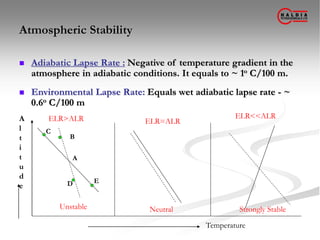
 Adiabatic Lapse Rate : Negative of temperature gradient in the
atmosphere in adiabatic conditions. It equals to ~ 1o C/100 m.
 Environmental Lapse Rate: Equals wet adiabatic lapse rate - ~
0.6o C/100 m
A
B
C
D E
ELR>ALR
Unstable
ELR=ALR
Neutral
ELR<<ALR
Strongly Stable
Temperature
A
l
t
i
t
u
d
e
Stability Class
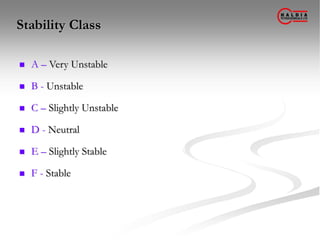
 A – Very Unstable
 B - Unstable
 C – Slightly Unstable
 D - Neutral
 E – Slightly Stable
 F - Stable
Stability Class
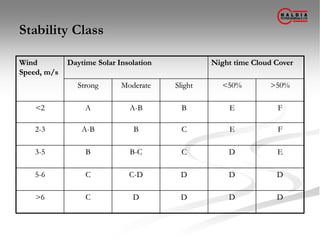
Wind
Speed, m/s
Daytime Solar Insolation Night time Cloud Cover
Strong Moderate Slight <50% >50%
<2 A A-B B E F
2-3 A-B B C E F
3-5 B B-C C D E
5-6 C C-D D D D
>6 C D D D D
Inversion
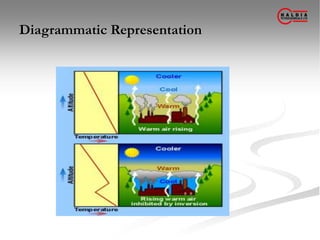
 Stable atmospheric conditions usually occur when warm air is
above cool air and the mixing depth is significantly restricted.
This condition is called a temperature inversion.
 During a temperature inversion, air pollution released into the
atmosphere's lowest layer is trapped there and can be removed
only by strong horizontal winds.
 Because high-pressure systems often combine temperature
inversion conditions and low wind speeds, their long residency
over an industrial area usually results in episodes of severe smog.
Diagrammatic Representation
Influencing Factors
 Emission Parameters
 Source location
 Source height
 Source diameter
 Exit velocity
 Exit Temperature
 Mass flow rate
Influencing Factors
 Terrain Elevation - Both source as well as receptor
 Location, height and width of any obstruction
Building Effects or Downwash
 Building effects or downwash: When an air pollution plume
flows over nearby buildings or other structures, turbulent eddies
are formed in the downwind side of the building.
 Those eddies cause a plume from a stack source located within
about five times the height of a nearby building or structure to
be forced down to the ground much sooner than it would if a
building or structure were not present.
 The effect can greatly increase the resulting near-by ground-level
pollutant concentrations downstream of the building or
structure.
 If the pollutants in the plume are subject to depletion by contact
with the ground (particulates, for example), the concentration
increase just downstream of the building or structure will
decrease the concentrations further downstream
THANK YOU

Air_Dispersion_Modeling_&_ALOHA.ppt

  • 1.
    Air Dispersion Modeling& ALOHA Prepared by: Environment Section, HSEF Department Haldia Petrochemicals Limited
  • 2.
    Bhopal Tragedy: EnvironmentalPerspective  Incident – Leak of Methyl Isocynate  Apart from system failure, other important reasons for mass casualties were –  Low atmospheric temperature  Timing of accident  Wind direction  Release height  Molecular weight higher than air The casualties could have been minimized, if the incident would have occurred in daytime !!!!
  • 3.
    Relevance in HPLPerspective  Handling of large quantity of hydrocarbons  Heavier than air  Highly Flammable in nature  Large no. of small sources capable to create havoc at local levels  Handling of highly toxic gas like Chlorine  Very low TLV  Heavier than air
  • 4.
    What is Dispersion? Dispersion is “Diffusion” of air contaminants in air  Atmospheric dispersion modeling is the mathematical simulation of how air pollutants disperse in the ambient atmosphere.  The dispersion models are used to estimate or to predict the downwind concentration of air pollutants emitted from sources such as industrial plants and vehicular traffic.  The models are typically employed to determine whether existing or proposed new industrial facilities are or will be in compliance with the National Ambient Air Quality Standards (NAAQS)
  • 5.
    Influencing Factors toDispersion  Meteorology  Wind Speed  Wind Direction  Atmospheric Stability  Ambient Air Temperature  Height to the bottom of inversion
  • 6.
    Wind  Wind isthe natural horizontal motion of the atmosphere. It occurs when warm air rises, and cool air comes in to take its place  Wind is caused by differences in pressure in the atmosphere. The pressure is the weight of the atmosphere at a given point. The height and temperature of a column of air determines the atmospheric weight.  Because cool air weighs more than warm air, a high pressure mass of air is made up of cool and heavy air.  Conversely, a low pressure mass of air is made up of warmer and lighter air.  Differences in pressure cause air to move from high pressure areas to low pressure areas, resulting in wind.
  • 7.
    Atmospheric Stability  Atmosphericstability refers to the vertical motion of the atmosphere.  Unstable atmospheric conditions result in a vertical mixing.  Typically, the air near the surface of the earth is warmer in the day time because of the absorption of the sun's energy. The warmer and lighter air from the surface then rises and mixes with the cooler and heavier air in the upper atmosphere causing unstable conditions in the atmosphere.  This constant turnover also results in dispersal of polluted air.  Stable atmospheric conditions usually occur when warm air is above cool air and the mixing depth is significantly restricted.
  • 8.
    Atmospheric Stability  AdiabaticLapse Rate : Negative of temperature gradient in the atmosphere in adiabatic conditions. It equals to ~ 1o C/100 m.  Environmental Lapse Rate: Equals wet adiabatic lapse rate - ~ 0.6o C/100 m A B C D E ELR>ALR Unstable ELR=ALR Neutral ELR<<ALR Strongly Stable Temperature A l t i t u d e
  • 9.
    Stability Class  A– Very Unstable  B - Unstable  C – Slightly Unstable  D - Neutral  E – Slightly Stable  F - Stable
  • 10.
    Stability Class Wind Speed, m/s DaytimeSolar Insolation Night time Cloud Cover Strong Moderate Slight <50% >50% <2 A A-B B E F 2-3 A-B B C E F 3-5 B B-C C D E 5-6 C C-D D D D >6 C D D D D
  • 11.
    Inversion  Stable atmosphericconditions usually occur when warm air is above cool air and the mixing depth is significantly restricted. This condition is called a temperature inversion.  During a temperature inversion, air pollution released into the atmosphere's lowest layer is trapped there and can be removed only by strong horizontal winds.  Because high-pressure systems often combine temperature inversion conditions and low wind speeds, their long residency over an industrial area usually results in episodes of severe smog.
  • 12.
  • 13.
    Influencing Factors  EmissionParameters  Source location  Source height  Source diameter  Exit velocity  Exit Temperature  Mass flow rate
  • 14.
    Influencing Factors  TerrainElevation - Both source as well as receptor  Location, height and width of any obstruction
  • 15.
    Building Effects orDownwash  Building effects or downwash: When an air pollution plume flows over nearby buildings or other structures, turbulent eddies are formed in the downwind side of the building.  Those eddies cause a plume from a stack source located within about five times the height of a nearby building or structure to be forced down to the ground much sooner than it would if a building or structure were not present.  The effect can greatly increase the resulting near-by ground-level pollutant concentrations downstream of the building or structure.  If the pollutants in the plume are subject to depletion by contact with the ground (particulates, for example), the concentration increase just downstream of the building or structure will decrease the concentrations further downstream
  • 20.