Plume Behavior
Introduction
• In meteorology, we generally study about the movement of
air mass (generally horizontal) from one place to the other.
Many times, the particles in the air parcel get transported
vertically by a process called turbulent diffusion or eddy
diffusion (Daly and Zannetti, 2007).
• This horizontal and vertical motion of air parcels is
responsible for various atmospheric processes such as cloud
formation and plume behaviour.
Atmospheric Stability
• The resistance of the atmosphere to vertical motion is called as atmospheric
stability. An air parcel in meteorology refers to an air mass having more or
less uniform properties.
• An air parcel will expand and cool as it rises and will compress and warm as it
sinks. The reason behind this primarily is that as the air parcel rises, it
encounters lower pressure and vice-versa.
• If we assume that the process is adiabatic, which implies that no exchange of
energy of air parcel occurs with the environment; then as the air parcel rises,
it will expand and cool since the internal energy is used up during the process.
The term ‘adiabatic’ is derived from the Greek word ‘impassable’, implying a
system which does not lose or gain energy. Reverse process occurs when the
air parcel sinks and internal energy is released during sinking which warms up
the air parcel.
Lapse rates
• Lapse rate refers to the rate of change of temperature or pressure
with height. In the atmosphere, this rate of change of temperature
with altitude is called as Environmental Lapse Rate (ELR) and
corresponds to 6.5°C km-1. This implies that for every kilometre
increase in altitude, temperature drops by 6.5°C. Actual vertical
temperature gradients in the atmosphere are thus highly variable,
and can even show an increase in temperature with height, a
situation known as a temperature inversion.
• If a dry air parcel is considered instead of environment, a linear
relationship exists between temperature and altitude for rising or
sinking air parcel, which is known as Dry Adiabatic Lapse Rate (DALR)
and is equal to 9.8°C km-1.
• When condensation or evaporation occurs in the air,
however, lapse rates of rising or falling air differ from DALR
value due to effect of latent heat. As is obvious, latent heat
is released by condensation and consumed by evaporation
of water. This leads to change in adiabatic lapse rate since
energy released by condensation compensates the rate of
cooling of rising air.
• This modified lapse rate is termed the Saturated Adiabatic
Lapse Rate (SALR) or Moist Adiabatic Lapse Rate (MALR).
Since the concentration of water vapour in air varies from
place to place, SALR is non-linear in nature. The average
value of SALR in the troposphere is generally 6°C km-1.
Types of Stability
• Stability of the atmosphere is affected by:
1. Temperature of the surrounding environment
2. Temperature of the air parcel
• Accordingly, the types of stability are as follows:
1. Stable: If the air parcel is displaced vertically, and it returns back to its
original position, the atmosphere is said to be stable. It usually occurs
when the ELR is less than the Adiabatic Lapse Rate (ALR), a phenomenon
occurring generally during temperature inversion. If such a parcel of air
is uplifted, it will cool to lower temperatures than its new surroundings
along the ALR; thus, becoming denser than the surroundings. Hence the
air parcel will tend to fall back to its original.
2. Neutrally stable: If the parcel is displaced vertically,
it will acquire a new position and continue to remain
in its new position. This generally occurs when ELR is
more or less equal to ALR.
3. Unstable: If the parcel is displaced vertically, it will
accelerate away from its original position in the
direction of the initial displacement. Such unstable
condition occurs when ELR is greater than ALR.
Plume behavior
• Plume behaviour refers to the dispersal pattern of gaseous
pollutants in atmosphere depending upon wind conditions,
atmospheric stability and vertical temperature profile. It
shows seasonal as well as diurnal variations.
• There are different types of plume behaviour based on the
lapse rates and atmospheric stability.
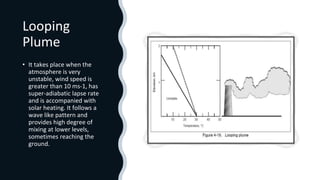
Looping
Plume
• It takes place when the
atmosphere is very
unstable, wind speed is
greater than 10 ms-1, has
super-adiabatic lapse rate
and is accompanied with
solar heating. It follows a
wave like pattern and
provides high degree of
mixing at lower levels,
sometimes reaching the
ground.
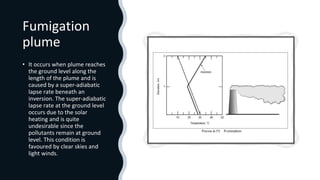
Fumigation
plume
• It occurs when plume reaches
the ground level along the
length of the plume and is
caused by a super-adiabatic
lapse rate beneath an
inversion. The super-adiabatic
lapse rate at the ground level
occurs due to the solar
heating and is quite
undesirable since the
pollutants remain at ground
level. This condition is
favoured by clear skies and
light winds.
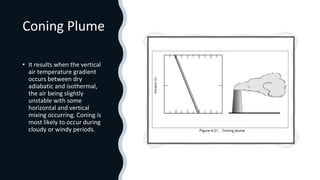
Coning Plume
• It results when the vertical
air temperature gradient
occurs between dry
adiabatic and isothermal,
the air being slightly
unstable with some
horizontal and vertical
mixing occurring. Coning is
most likely to occur during
cloudy or windy periods.
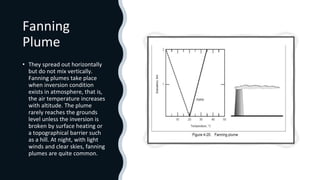
Fanning
Plume
• They spread out horizontally
but do not mix vertically.
Fanning plumes take place
when inversion condition
exists in atmosphere, that is,
the air temperature increases
with altitude. The plume
rarely reaches the grounds
level unless the inversion is
broken by surface heating or
a topographical barrier such
as a hill. At night, with light
winds and clear skies, fanning
plumes are quite common.
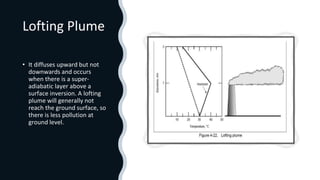
Lofting Plume
• It diffuses upward but not
downwards and occurs
when there is a super-
adiabatic layer above a
surface inversion. A lofting
plume will generally not
reach the ground surface, so
there is less pollution at
ground level.
Wind Rose
Wind Rose
• The wind rose located in the top right corner of each data map shows the
general wind direction and speed for each sampling period.
• The circular format of the wind rose shows the direction the winds blew
from and the length of each "spoke" around the circle shows how often
the wind blew from that direction.
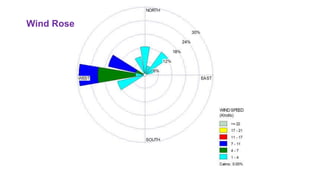
• For example, the wind rose above shows that during this particular
sampling period the wind blew from the west 30% of the time, and from
the north and the northeast 12% of the time, etc
• The different colors of each spoke provide details on the speed, in knots (1
knot=1.15 mph), of the wind from each direction.
• Using the example above, the longest spoke shows the wind blew from the
west at speeds between 1-4 knots (light blue) about 4% of the time, 4-7
knots (dark green) about 18% of the time and 7-11 knots (dark blue) about
7% of the time.
Thank You

Plume and WindRose.pptx

  • 1.
  • 2.
    Introduction • In meteorology,we generally study about the movement of air mass (generally horizontal) from one place to the other. Many times, the particles in the air parcel get transported vertically by a process called turbulent diffusion or eddy diffusion (Daly and Zannetti, 2007). • This horizontal and vertical motion of air parcels is responsible for various atmospheric processes such as cloud formation and plume behaviour.
  • 3.
    Atmospheric Stability • Theresistance of the atmosphere to vertical motion is called as atmospheric stability. An air parcel in meteorology refers to an air mass having more or less uniform properties. • An air parcel will expand and cool as it rises and will compress and warm as it sinks. The reason behind this primarily is that as the air parcel rises, it encounters lower pressure and vice-versa. • If we assume that the process is adiabatic, which implies that no exchange of energy of air parcel occurs with the environment; then as the air parcel rises, it will expand and cool since the internal energy is used up during the process. The term ‘adiabatic’ is derived from the Greek word ‘impassable’, implying a system which does not lose or gain energy. Reverse process occurs when the air parcel sinks and internal energy is released during sinking which warms up the air parcel.
  • 4.
    Lapse rates • Lapserate refers to the rate of change of temperature or pressure with height. In the atmosphere, this rate of change of temperature with altitude is called as Environmental Lapse Rate (ELR) and corresponds to 6.5°C km-1. This implies that for every kilometre increase in altitude, temperature drops by 6.5°C. Actual vertical temperature gradients in the atmosphere are thus highly variable, and can even show an increase in temperature with height, a situation known as a temperature inversion. • If a dry air parcel is considered instead of environment, a linear relationship exists between temperature and altitude for rising or sinking air parcel, which is known as Dry Adiabatic Lapse Rate (DALR) and is equal to 9.8°C km-1.
  • 5.
    • When condensationor evaporation occurs in the air, however, lapse rates of rising or falling air differ from DALR value due to effect of latent heat. As is obvious, latent heat is released by condensation and consumed by evaporation of water. This leads to change in adiabatic lapse rate since energy released by condensation compensates the rate of cooling of rising air. • This modified lapse rate is termed the Saturated Adiabatic Lapse Rate (SALR) or Moist Adiabatic Lapse Rate (MALR). Since the concentration of water vapour in air varies from place to place, SALR is non-linear in nature. The average value of SALR in the troposphere is generally 6°C km-1.
  • 6.
    Types of Stability •Stability of the atmosphere is affected by: 1. Temperature of the surrounding environment 2. Temperature of the air parcel • Accordingly, the types of stability are as follows: 1. Stable: If the air parcel is displaced vertically, and it returns back to its original position, the atmosphere is said to be stable. It usually occurs when the ELR is less than the Adiabatic Lapse Rate (ALR), a phenomenon occurring generally during temperature inversion. If such a parcel of air is uplifted, it will cool to lower temperatures than its new surroundings along the ALR; thus, becoming denser than the surroundings. Hence the air parcel will tend to fall back to its original.
  • 7.
    2. Neutrally stable:If the parcel is displaced vertically, it will acquire a new position and continue to remain in its new position. This generally occurs when ELR is more or less equal to ALR. 3. Unstable: If the parcel is displaced vertically, it will accelerate away from its original position in the direction of the initial displacement. Such unstable condition occurs when ELR is greater than ALR.
  • 8.
    Plume behavior • Plumebehaviour refers to the dispersal pattern of gaseous pollutants in atmosphere depending upon wind conditions, atmospheric stability and vertical temperature profile. It shows seasonal as well as diurnal variations. • There are different types of plume behaviour based on the lapse rates and atmospheric stability.
  • 9.
    Looping Plume • It takesplace when the atmosphere is very unstable, wind speed is greater than 10 ms-1, has super-adiabatic lapse rate and is accompanied with solar heating. It follows a wave like pattern and provides high degree of mixing at lower levels, sometimes reaching the ground.
  • 10.
    Fumigation plume • It occurswhen plume reaches the ground level along the length of the plume and is caused by a super-adiabatic lapse rate beneath an inversion. The super-adiabatic lapse rate at the ground level occurs due to the solar heating and is quite undesirable since the pollutants remain at ground level. This condition is favoured by clear skies and light winds.
  • 11.
    Coning Plume • Itresults when the vertical air temperature gradient occurs between dry adiabatic and isothermal, the air being slightly unstable with some horizontal and vertical mixing occurring. Coning is most likely to occur during cloudy or windy periods.
  • 12.
    Fanning Plume • They spreadout horizontally but do not mix vertically. Fanning plumes take place when inversion condition exists in atmosphere, that is, the air temperature increases with altitude. The plume rarely reaches the grounds level unless the inversion is broken by surface heating or a topographical barrier such as a hill. At night, with light winds and clear skies, fanning plumes are quite common.
  • 13.
    Lofting Plume • Itdiffuses upward but not downwards and occurs when there is a super- adiabatic layer above a surface inversion. A lofting plume will generally not reach the ground surface, so there is less pollution at ground level.
  • 14.
  • 15.
    Wind Rose • Thewind rose located in the top right corner of each data map shows the general wind direction and speed for each sampling period. • The circular format of the wind rose shows the direction the winds blew from and the length of each "spoke" around the circle shows how often the wind blew from that direction. • For example, the wind rose above shows that during this particular sampling period the wind blew from the west 30% of the time, and from the north and the northeast 12% of the time, etc • The different colors of each spoke provide details on the speed, in knots (1 knot=1.15 mph), of the wind from each direction. • Using the example above, the longest spoke shows the wind blew from the west at speeds between 1-4 knots (light blue) about 4% of the time, 4-7 knots (dark green) about 18% of the time and 7-11 knots (dark blue) about 7% of the time.
  • 16.