The Process of Independence

•What were Britain’s colonial policies and
how did the colonists react to them?

•What were the outcomes of the First and
Second Continental Congresses?

•How did American independence come
about, and what were its effects?
British Colonial Policies

•Until the mid-1700s, the colonies were

allowed a great deal of freedom in their
governments by the English monarchy.

•In 1760, King George III imposed new
taxes and laws on the colonists.

•The colonists started a

confederation, proposed an annual
congress, and began to rebel.
British Colonial Policies

•In 1774, PARLIAMENT passed a series of

laws known as the COERCIVE ACTS. One
of the acts closed the port of BOSTON
until the colonists paid for the TEA they
had dumped.

•Another act provided that BRITISH troops
could be quartered in any town in
MASSACHUSETTS---even in private
homes!!!
Growing Colonial Unity
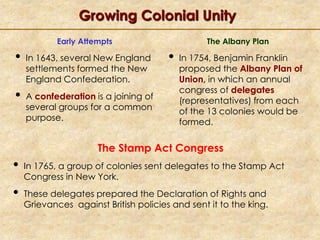
Early Attempts

• In 1643, several New England
settlements formed the New
England Confederation.

• A confederation is a joining of
several groups for a common
purpose.

The Albany Plan

• In 1754, Benjamin Franklin

proposed the Albany Plan of
Union, in which an annual
congress of delegates
(representatives) from each
of the 13 colonies would be
formed.

The Stamp Act Congress

• In 1765, a group of colonies sent delegates to the Stamp Act
Congress in New York.

• These delegates prepared the Declaration of Rights and

Grievances against British policies and sent it to the king.
The Continental Congresses
Second Continental
Congress

First Continental Congress

•

In 1774, in response to the
COERCIVE ACTS, colonial leaders
convened the FIRST CONTINENTAL
CONGRESS. The group approved
a plan to begin ARMING AND
TRAINING A MILITIA The colonists
sent a Declaration of Rights to
King George III.

• The delegates urged each of

the colonies to refuse all trade
with England until British tax
and trade regulations were
repealed, or recalled.

•

•

•

In May 1775, the SECOND
CONTINENTAL CONGRESS met. It
chose GEORGE WASHINGTON to build
a Continental Army and lead it. Each
of the 13 colonies sent representatives
to this gathering in Philadelphia.
The Congress also sent the king an
OLIVE BRANCH PETITION, which asked
him to resolve the crisis before it
escalated. The king ignored the
petition and declared the AMERICANS
to be in rebellion.
The Second Continental Congress
served as the first government of the
United States from 1776 to 1781.
American Independence

•On July 4, 1776, the Second

Continental Congress adopted
the Declaration of
Independence.

•Between 1776 and 1777, most of
the States adopted constitutions
instead of charters.
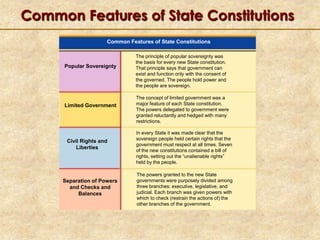
Common Features of State Constitutions

Popular Sovereignty

Limited Government

Civil Rights and
Liberties

Separation of Powers
and Checks and
Balances

The principle of popular sovereignty was
the basis for every new State constitution.
That principle says that government can
exist and function only with the consent of
the governed. The people hold power and
the people are sovereign.
The concept of limited government was a
major feature of each State constitution.
The powers delegated to government were
granted reluctantly and hedged with many
restrictions.
In every State it was made clear that the
sovereign people held certain rights that the
government must respect at all times. Seven
of the new constitutions contained a bill of
rights, setting out the “unalienable rights”
held by the people.
The powers granted to the new State
governments were purposely divided among
three branches: executive, legislative, and
judicial. Each branch was given powers with
which to check (restrain the actions of) the
other branches of the government.

The process of independence

  • 1.
    The Process ofIndependence •What were Britain’s colonial policies and how did the colonists react to them? •What were the outcomes of the First and Second Continental Congresses? •How did American independence come about, and what were its effects?
  • 2.
    British Colonial Policies •Untilthe mid-1700s, the colonies were allowed a great deal of freedom in their governments by the English monarchy. •In 1760, King George III imposed new taxes and laws on the colonists. •The colonists started a confederation, proposed an annual congress, and began to rebel.
  • 3.
    British Colonial Policies •In1774, PARLIAMENT passed a series of laws known as the COERCIVE ACTS. One of the acts closed the port of BOSTON until the colonists paid for the TEA they had dumped. •Another act provided that BRITISH troops could be quartered in any town in MASSACHUSETTS---even in private homes!!!
  • 4.
    Growing Colonial Unity EarlyAttempts • In 1643, several New England settlements formed the New England Confederation. • A confederation is a joining of several groups for a common purpose. The Albany Plan • In 1754, Benjamin Franklin proposed the Albany Plan of Union, in which an annual congress of delegates (representatives) from each of the 13 colonies would be formed. The Stamp Act Congress • In 1765, a group of colonies sent delegates to the Stamp Act Congress in New York. • These delegates prepared the Declaration of Rights and Grievances against British policies and sent it to the king.
  • 5.
    The Continental Congresses SecondContinental Congress First Continental Congress • In 1774, in response to the COERCIVE ACTS, colonial leaders convened the FIRST CONTINENTAL CONGRESS. The group approved a plan to begin ARMING AND TRAINING A MILITIA The colonists sent a Declaration of Rights to King George III. • The delegates urged each of the colonies to refuse all trade with England until British tax and trade regulations were repealed, or recalled. • • • In May 1775, the SECOND CONTINENTAL CONGRESS met. It chose GEORGE WASHINGTON to build a Continental Army and lead it. Each of the 13 colonies sent representatives to this gathering in Philadelphia. The Congress also sent the king an OLIVE BRANCH PETITION, which asked him to resolve the crisis before it escalated. The king ignored the petition and declared the AMERICANS to be in rebellion. The Second Continental Congress served as the first government of the United States from 1776 to 1781.
  • 6.
    American Independence •On July4, 1776, the Second Continental Congress adopted the Declaration of Independence. •Between 1776 and 1777, most of the States adopted constitutions instead of charters.
  • 7.
    Common Features ofState Constitutions Common Features of State Constitutions Popular Sovereignty Limited Government Civil Rights and Liberties Separation of Powers and Checks and Balances The principle of popular sovereignty was the basis for every new State constitution. That principle says that government can exist and function only with the consent of the governed. The people hold power and the people are sovereign. The concept of limited government was a major feature of each State constitution. The powers delegated to government were granted reluctantly and hedged with many restrictions. In every State it was made clear that the sovereign people held certain rights that the government must respect at all times. Seven of the new constitutions contained a bill of rights, setting out the “unalienable rights” held by the people. The powers granted to the new State governments were purposely divided among three branches: executive, legislative, and judicial. Each branch was given powers with which to check (restrain the actions of) the other branches of the government.