Unit 2 Creating the United States
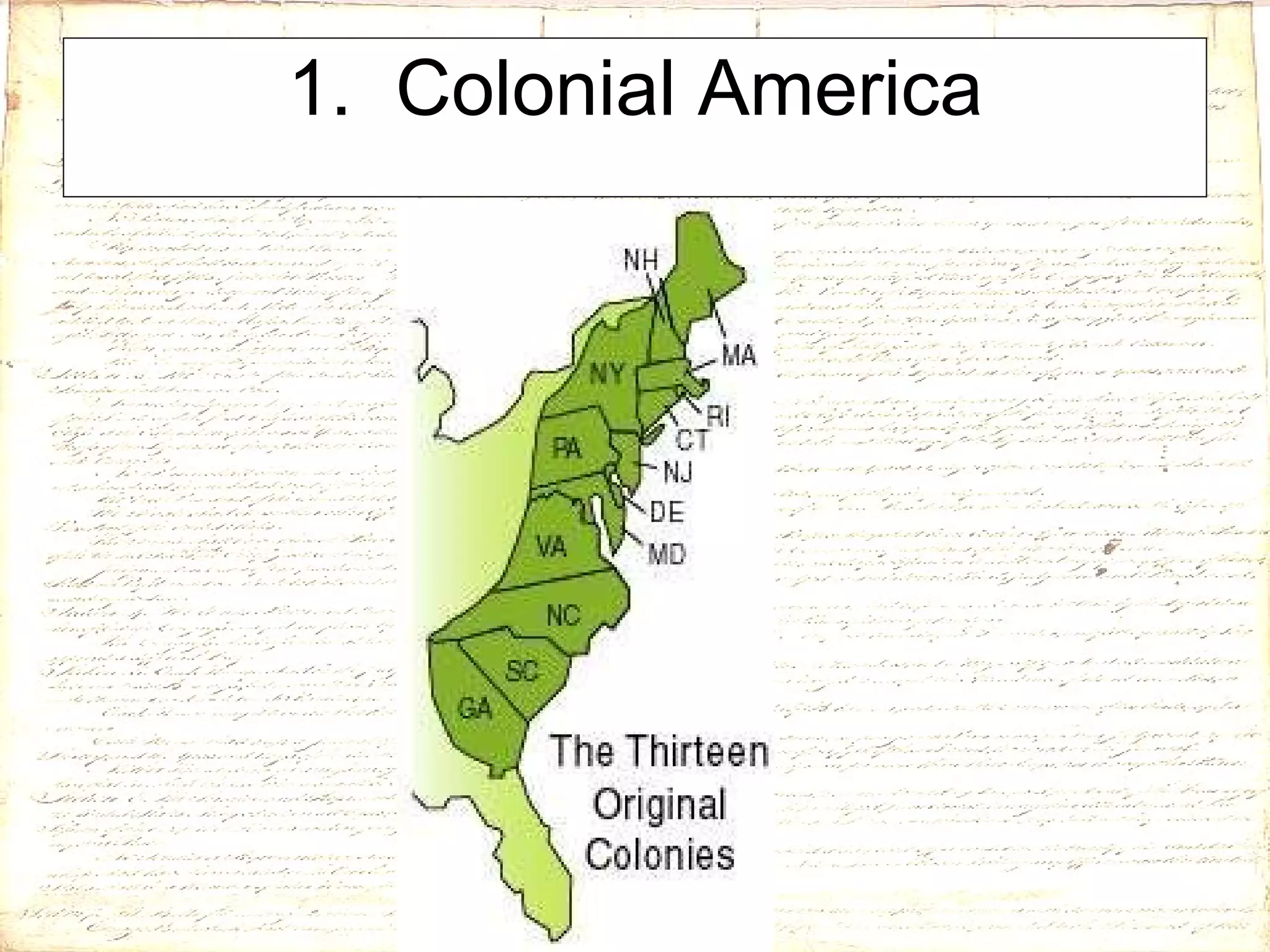
1.  Colonial America
A.  Salutary Neglect Economic benefits Colonies run themselves (and pay for it) Little time or money required of England. Colonial Charters Joint-Stock – Business owned. Royal – controlled by crown. Proprietary – Controlled by person or group.
B. Colonial Examples Pennsylvania 21 yr + white men who paid taxes could vote. Representatives had 1 year terms. Many rights given by proprietor (William Penn) Virginia Originally Jamestown Colony. Joint-stock charter by Virginia Company. First elected legislature – House of Burgess.
Massachusetts Plymouth Bay Colony Originally headed to Virginia, but blown off course. Mayflower Compact signed establishing a right of the majority to rule. Massachusetts Bay Colony Headquarter in Boston. Many locally elected officials. Eventually joined with Plymouth.
2.  Declaration of Independence
A. Cause for Break French and Indian War 1754-1763 French/Indians and British (Americans) attempt to take Ohio River Valley. British Prime Minister William Pitt takes out loans and heavily taxes English to win war. British win. Proclamation of 1763 Peace with Natives. OR Valley is placed under military control. Americans – no moving west.
Who won the war? British - our military. Americans- our militia. British want Americans to shoulder burden of debt.  New taxes & laws to help the Americans take care of the military & debt. A. Cause for Break
vi.  Sugar Act 1764 – 1 st  enforced. Smugglers tried in Naval Court NO JURY Quartering Act 65’– colonists provide food & housing for troops. Stamp Act 65’ – paper products must be stamped (costs $).  A. Cause for Break
B. Break Occurs Stamp Act Congress 65’ – delegates wrote protest to London. Englishman’s rights crushed. No taxation without representation. Boycotts of British products. Tax collectors tarred and feathered. 66’ Parliament repeals Stamp Act Declaratory Act – British can do what ever we want. Townshend Act – tax on tea: 67’.
Boston Massacre, Tea Party. Sons of Liberty had organized boycotts. Coercive Acts – passed in anger to Boston. Closed port at Boston. Eliminates most self-government of MA. Quebec Act – gives Ohio to the French-Canadians! x.  First Continental Congress – Cont. boycotts, asks colonists to arm, sends Declaration of Resolves to plead Englishman’s rights. B. Break Occurs
C.  Violence Occurs April, 1775 – Battles of Lexington and Concord. Second Continental Congress Meets Olive Branch Petition by John Dickinson asks for peace from king. King George III wants rebellion crushed. Declaration of Independence is written by Thomas Jefferson. Inspired by Enlightenment – John Locke’s ideas of basic rights (life, liberty, property).
III.  Articles of Confederation  A.  Alliance of States Created in 1777 and adopted by the Continental Congress Established a national government in 1781. Legislative branch only. No executive State courts only
4.  State Constitution Most states adopted a list of duties of the government Most states also adopted a “bill of rights.”
B.  Trouble with the Articles 1.  Economic hardships faced the nation America had $50 million debt. Continued to print worthless money. Many failed to pay back money owed to wealthy. Wealthy complained average citizens had too much power.
2.  Nationalists Arise Wanted to restrain unpredictable behavior of states. Feared lack of national courts and economic policy. Wrote to newspapers. Included: George Washington James Madison Alexander Hamilton Feared America’s culture of challenging authority. European and Roman Republics had failed. Believed America should be a world model.
3.  Weaknesses of Articles of Confederation One vote for each states. Congress can’t collect taxes Congress can't regulate commerce. Amendments = unanimous approval.  9/13 majority to pass laws. “ Firm league of friendship.”
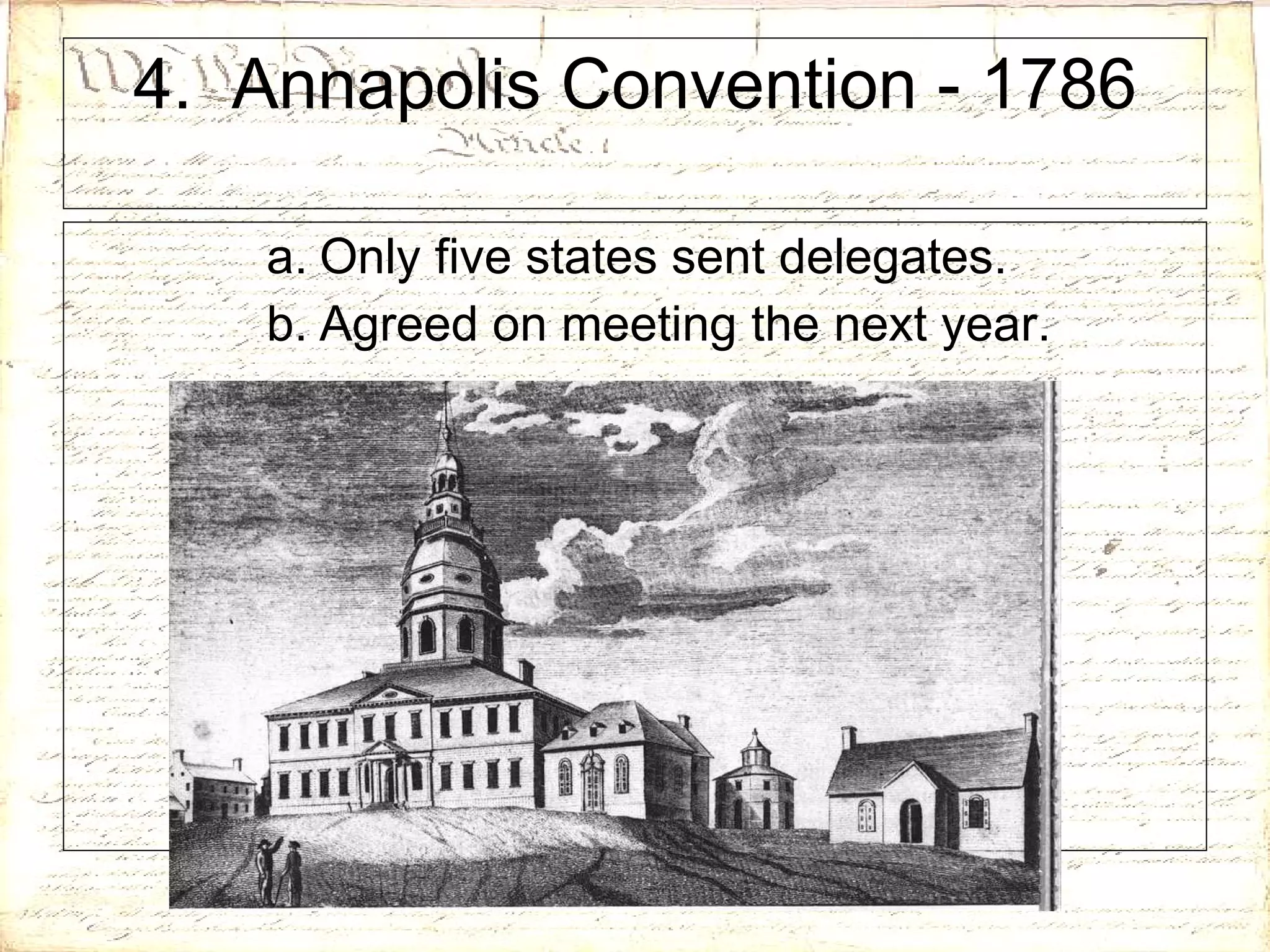
4.  Annapolis Convention - 1786 Only five states sent delegates. Agreed on meeting the next year.
C.  Shays’ Rebellion Daniel Shays the war veteran, led a revolt over unpaid bills and taxes.  Rebellion put down. Prominent Americans saw need for order.
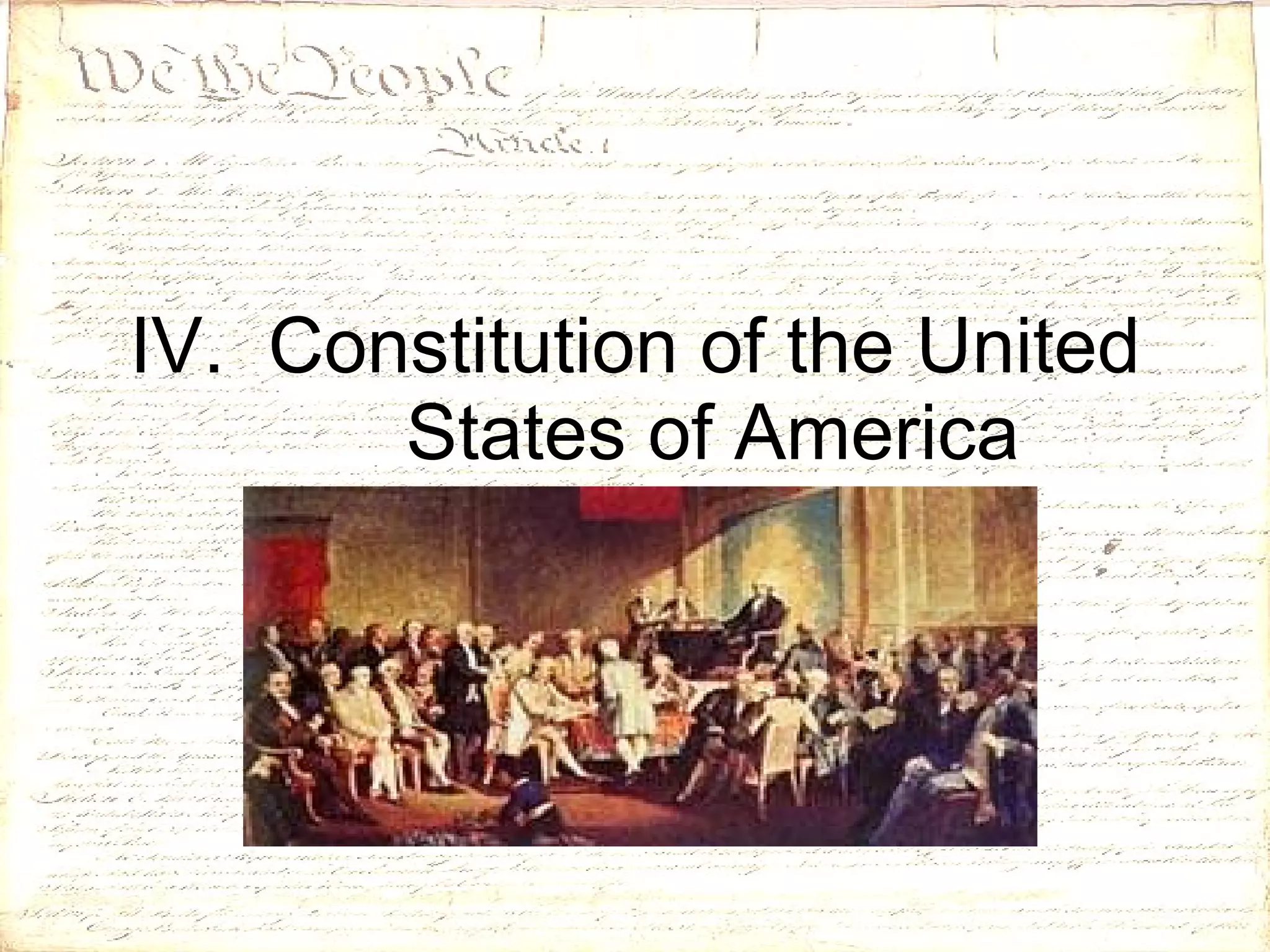
IV.  Constitution of the United States of America
A.  Constitutional Convention May – September 1787 Meetings kept secretive. 55 delegates -  educated
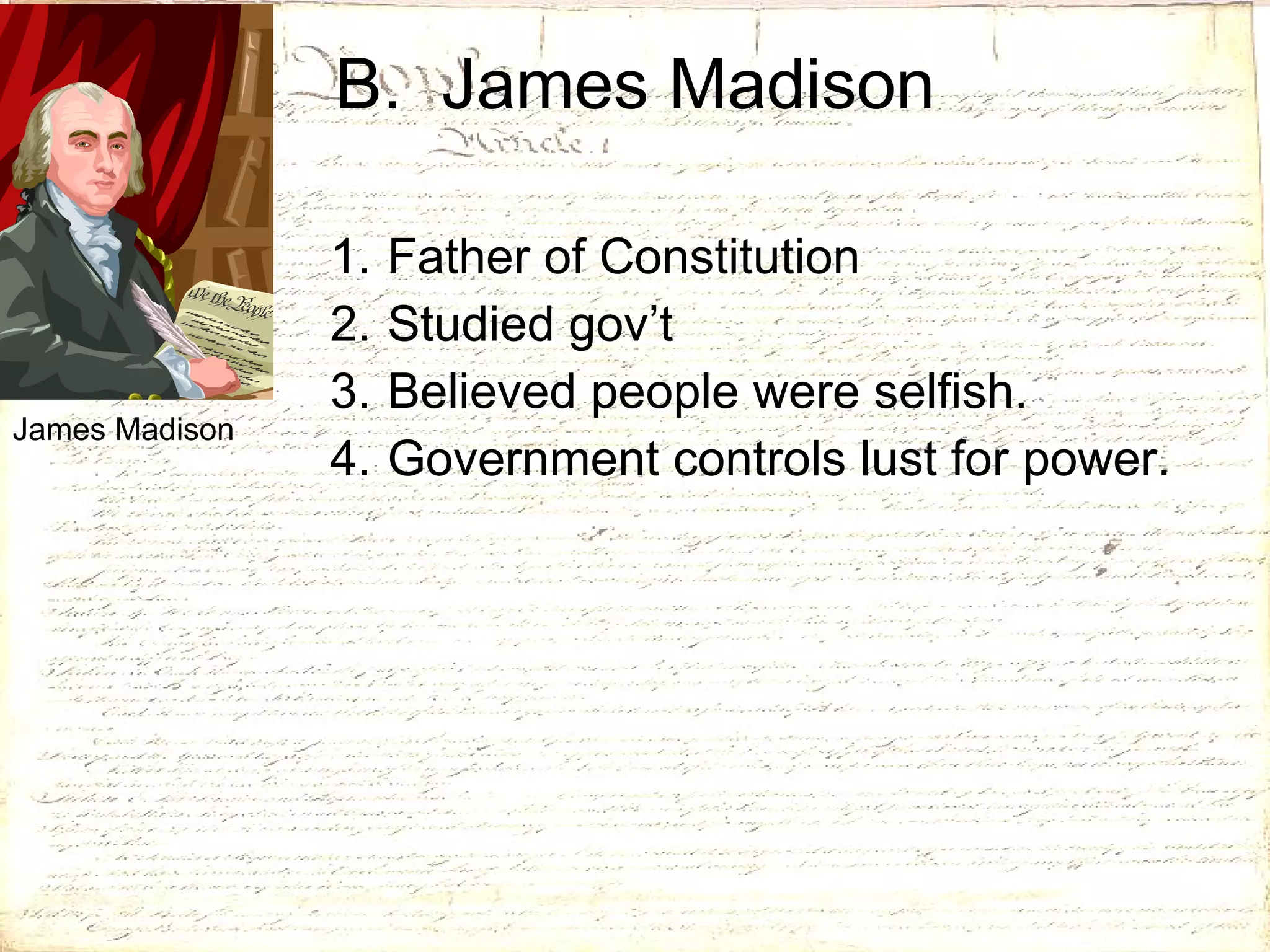
B.  James Madison Father of Constitution Studied gov’t Believed people were selfish.  Government controls lust for power. James Madison
C.  Debate would ensue throughout convention Federalists wanted new, central government Anti-federalists wanted Articles with strong state governments  Federalists won.
D.  Big vs. Small States Virginia Plan- legislature proportional to population New Jersey Plan – every state gets and equal vote.
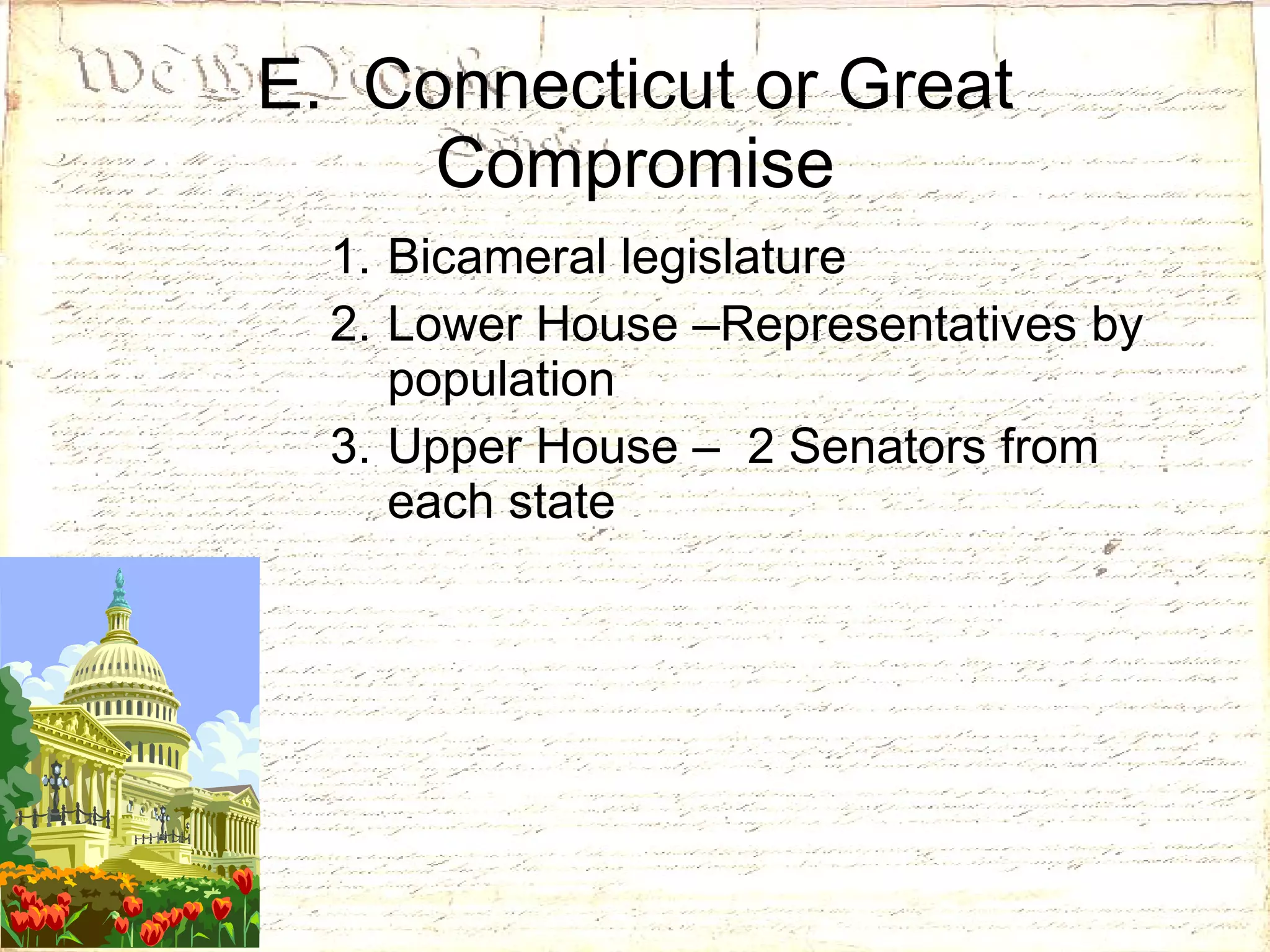
E.  Connecticut or Great Compromise Bicameral legislature Lower House –Representatives by population Upper House –  2 Senators from each state
F.  Slaves to be counted or not? Southerners want slaves counted so representation to House would be greater Northerners opposed  Three-Fifths Compromise :  3/5 counted were counted.
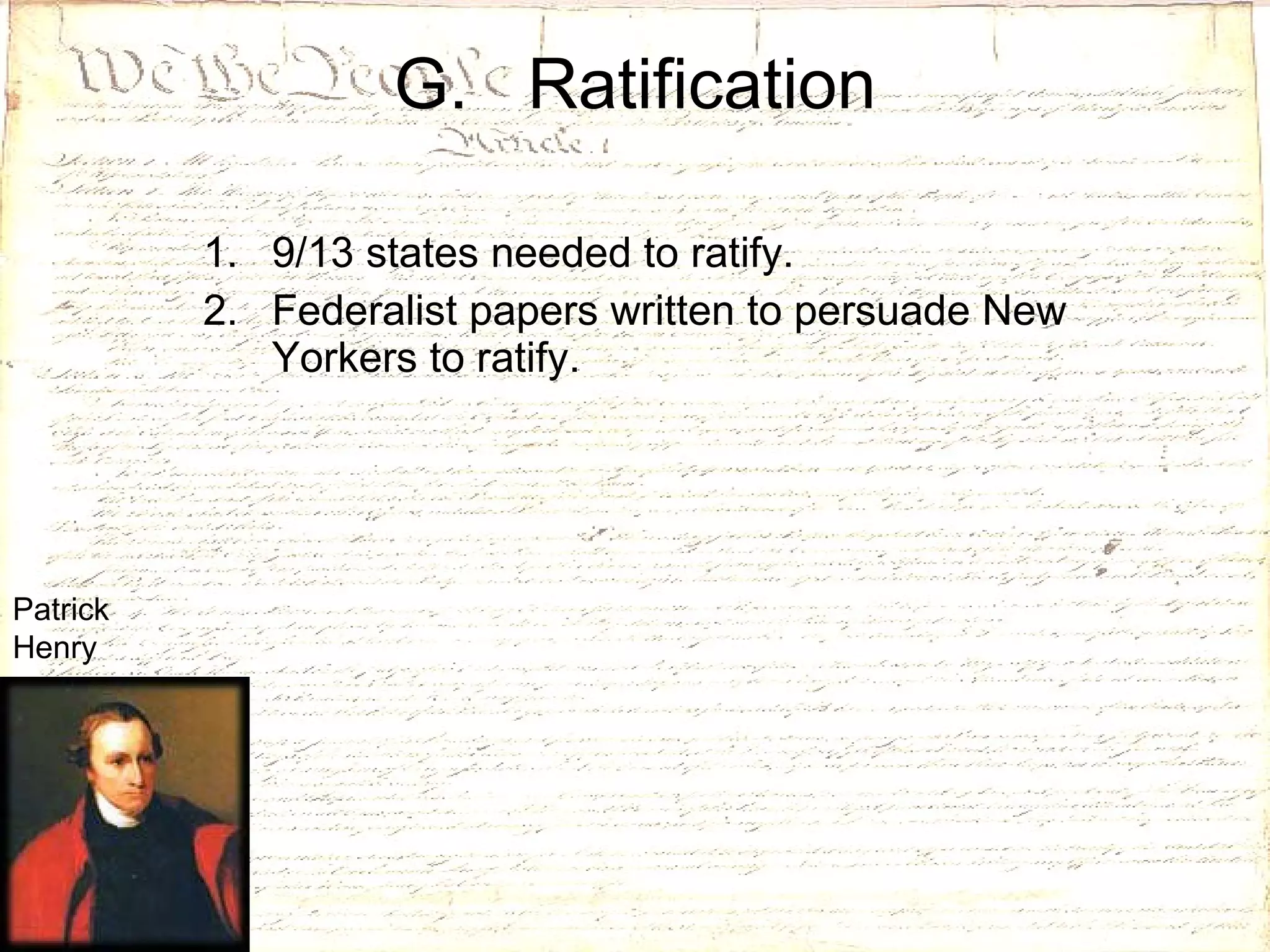
G.  Ratification 9/13 states needed to ratify. Federalist papers written to persuade New Yorkers to ratify. Patrick Henry
H.  Federalists Convince the States Federalists had a plan, were organized. George Washington, national hero, backed Constitution.
I.  Parts of the Constitution Legislative Executive Judicial States recognize each other Amending Supremacy  Ratification
J.  Bill of Rights - Added to appease the Anti-Federalists that freedoms would be protected. Freedom of expression (Speech, Press, Assembly, Petition, Religion) Bear arms No quartering of troops Warrants Remain silent Speedy/public trial, witnesses Jury Cruel & unusual Rights not named Unnamed powers to states
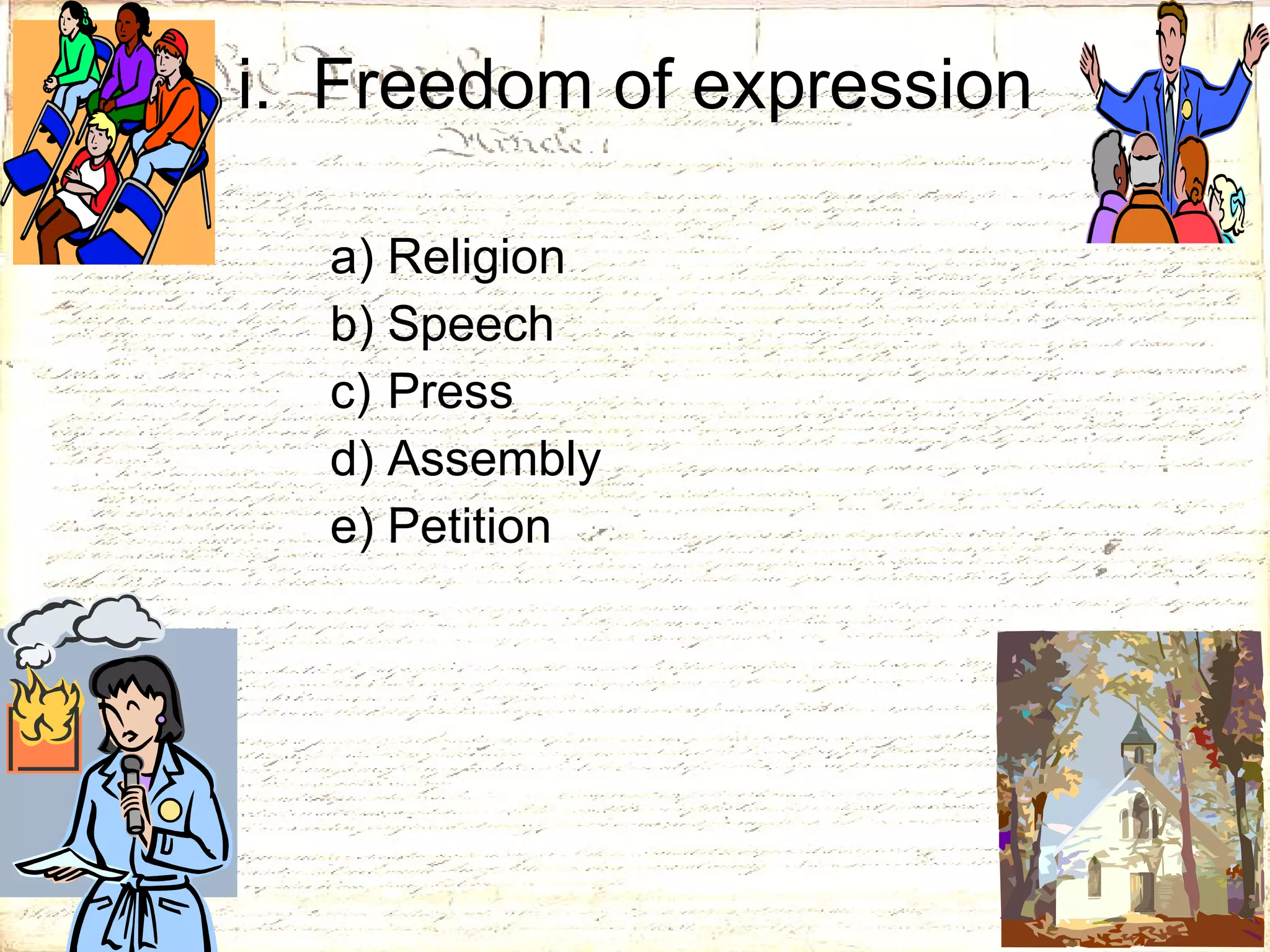
i.  Freedom of expression Religion Speech Press Assembly Petition
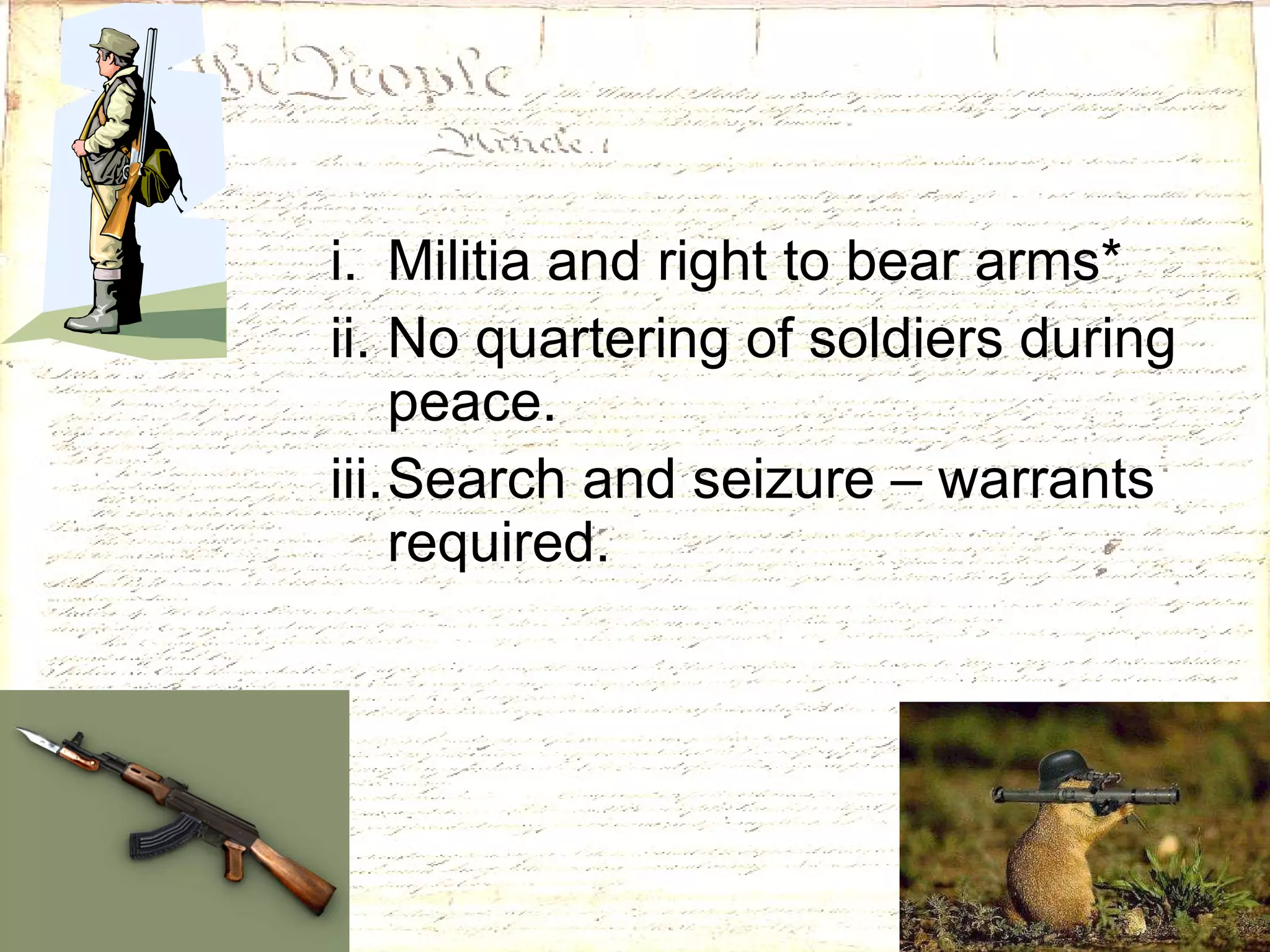
Militia and right to bear arms* No quartering of soldiers during peace. Search and seizure – warrants required.
v.  Cannot testify against oneself, no double jeopardy, natural rights cannot be taken without due process of law, property cannot be taken without payment.
Speedy & public trial, accused, right to examine and provide witnesses, right to counsel. Trial by jury. No excessive fines, bail, or cruel and unusual punishment.
Rights not in the Constitution are allowed. Powers not in the Constitution are for the states.

Unit 2 general

  • 1.
    Unit 2 Creatingthe United States
  • 2.
    1. ColonialAmerica
  • 3.
    A. SalutaryNeglect Economic benefits Colonies run themselves (and pay for it) Little time or money required of England. Colonial Charters Joint-Stock – Business owned. Royal – controlled by crown. Proprietary – Controlled by person or group.
  • 4.
    B. Colonial ExamplesPennsylvania 21 yr + white men who paid taxes could vote. Representatives had 1 year terms. Many rights given by proprietor (William Penn) Virginia Originally Jamestown Colony. Joint-stock charter by Virginia Company. First elected legislature – House of Burgess.
  • 5.
    Massachusetts Plymouth BayColony Originally headed to Virginia, but blown off course. Mayflower Compact signed establishing a right of the majority to rule. Massachusetts Bay Colony Headquarter in Boston. Many locally elected officials. Eventually joined with Plymouth.
  • 6.
    2. Declarationof Independence
  • 7.
    A. Cause forBreak French and Indian War 1754-1763 French/Indians and British (Americans) attempt to take Ohio River Valley. British Prime Minister William Pitt takes out loans and heavily taxes English to win war. British win. Proclamation of 1763 Peace with Natives. OR Valley is placed under military control. Americans – no moving west.
  • 8.
    Who won thewar? British - our military. Americans- our militia. British want Americans to shoulder burden of debt. New taxes & laws to help the Americans take care of the military & debt. A. Cause for Break
  • 9.
    vi. SugarAct 1764 – 1 st enforced. Smugglers tried in Naval Court NO JURY Quartering Act 65’– colonists provide food & housing for troops. Stamp Act 65’ – paper products must be stamped (costs $). A. Cause for Break
  • 10.
    B. Break OccursStamp Act Congress 65’ – delegates wrote protest to London. Englishman’s rights crushed. No taxation without representation. Boycotts of British products. Tax collectors tarred and feathered. 66’ Parliament repeals Stamp Act Declaratory Act – British can do what ever we want. Townshend Act – tax on tea: 67’.
  • 11.
    Boston Massacre, TeaParty. Sons of Liberty had organized boycotts. Coercive Acts – passed in anger to Boston. Closed port at Boston. Eliminates most self-government of MA. Quebec Act – gives Ohio to the French-Canadians! x. First Continental Congress – Cont. boycotts, asks colonists to arm, sends Declaration of Resolves to plead Englishman’s rights. B. Break Occurs
  • 12.
    C. ViolenceOccurs April, 1775 – Battles of Lexington and Concord. Second Continental Congress Meets Olive Branch Petition by John Dickinson asks for peace from king. King George III wants rebellion crushed. Declaration of Independence is written by Thomas Jefferson. Inspired by Enlightenment – John Locke’s ideas of basic rights (life, liberty, property).
  • 13.
    III. Articlesof Confederation A. Alliance of States Created in 1777 and adopted by the Continental Congress Established a national government in 1781. Legislative branch only. No executive State courts only
  • 14.
    4. StateConstitution Most states adopted a list of duties of the government Most states also adopted a “bill of rights.”
  • 15.
    B. Troublewith the Articles 1. Economic hardships faced the nation America had $50 million debt. Continued to print worthless money. Many failed to pay back money owed to wealthy. Wealthy complained average citizens had too much power.
  • 16.
    2. NationalistsArise Wanted to restrain unpredictable behavior of states. Feared lack of national courts and economic policy. Wrote to newspapers. Included: George Washington James Madison Alexander Hamilton Feared America’s culture of challenging authority. European and Roman Republics had failed. Believed America should be a world model.
  • 17.
    3. Weaknessesof Articles of Confederation One vote for each states. Congress can’t collect taxes Congress can't regulate commerce. Amendments = unanimous approval. 9/13 majority to pass laws. “ Firm league of friendship.”
  • 18.
    4. AnnapolisConvention - 1786 Only five states sent delegates. Agreed on meeting the next year.
  • 19.
    C. Shays’Rebellion Daniel Shays the war veteran, led a revolt over unpaid bills and taxes. Rebellion put down. Prominent Americans saw need for order.
  • 20.
    IV. Constitutionof the United States of America
  • 21.
    A. ConstitutionalConvention May – September 1787 Meetings kept secretive. 55 delegates - educated
  • 22.
    B. JamesMadison Father of Constitution Studied gov’t Believed people were selfish. Government controls lust for power. James Madison
  • 23.
    C. Debatewould ensue throughout convention Federalists wanted new, central government Anti-federalists wanted Articles with strong state governments Federalists won.
  • 24.
    D. Bigvs. Small States Virginia Plan- legislature proportional to population New Jersey Plan – every state gets and equal vote.
  • 25.
    E. Connecticutor Great Compromise Bicameral legislature Lower House –Representatives by population Upper House – 2 Senators from each state
  • 26.
    F. Slavesto be counted or not? Southerners want slaves counted so representation to House would be greater Northerners opposed Three-Fifths Compromise : 3/5 counted were counted.
  • 27.
    G. Ratification9/13 states needed to ratify. Federalist papers written to persuade New Yorkers to ratify. Patrick Henry
  • 28.
    H. FederalistsConvince the States Federalists had a plan, were organized. George Washington, national hero, backed Constitution.
  • 29.
    I. Partsof the Constitution Legislative Executive Judicial States recognize each other Amending Supremacy Ratification
  • 30.
    J. Billof Rights - Added to appease the Anti-Federalists that freedoms would be protected. Freedom of expression (Speech, Press, Assembly, Petition, Religion) Bear arms No quartering of troops Warrants Remain silent Speedy/public trial, witnesses Jury Cruel & unusual Rights not named Unnamed powers to states
  • 31.
    i. Freedomof expression Religion Speech Press Assembly Petition
  • 32.
    Militia and rightto bear arms* No quartering of soldiers during peace. Search and seizure – warrants required.
  • 33.
    v. Cannottestify against oneself, no double jeopardy, natural rights cannot be taken without due process of law, property cannot be taken without payment.
  • 34.
    Speedy & publictrial, accused, right to examine and provide witnesses, right to counsel. Trial by jury. No excessive fines, bail, or cruel and unusual punishment.
  • 35.
    Rights not inthe Constitution are allowed. Powers not in the Constitution are for the states.