The Road to Revolution
Our Political Beginnings
• American colonists believed that gov’t
should be:
– Ordered --> organized into offices
– Limited --> it was NOT all-powerful
– Representative --> gov’t was to serve the
people’s interests, not its own
Where Our Gov’t Ideas
Came From
• Magna Carta (1215) - first document that
officially limited the power of the English king
– Basically said that the king did not have unlimited
power
• The Petition of Right (1628) - further limited
the king’s power
– couldn’t throw people in prison without a trial
– couldn’t use the military to rule people in times of
peace
The English Bill of Rights
(1689)
• Said:
– Parliament was in control of taxing, not the
king
– People couldn’t be punished for asking the
king to fix problems
– No cruel and unusual punishment
– Everyone got a fair trial
The Colonies (1607-1733)
• 13 English colonies were established in
America for
– religious freedom
– commercial trading/farming/fishing
– New home for debtors
– All colonies were started with a charter -
written permission from the king
Types of Colonies
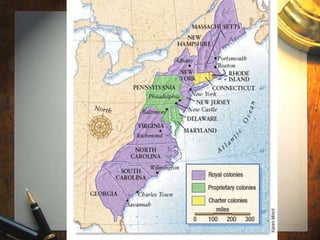
• Royal Colony- under the direct control of the
king
• King named a royal governor to rule the
colony
• Had a bicameral legislature
– “bicameral” = two houses
– “legislature” = group of representatives that make
laws
• Proprietary Colony - king gives land to a
proprietor (overseer/owner), who organized
the colony
– colony was directly controlled by the proprietor,
not the king (still reported to him)
• One colony had a unicameral (one-house)
legislature
• Charter Colony - based on charters
given straight to the colonists
– Mostly governed themselves
– Officials were elected by the people, not
the king or proprietor
Group Work
• Imagine you are subjects under King John
John XXXXVII.
• Create a Bill of Rights listing all the
freedoms you wish to have as the king’s
subject (List at least ten)
– What freedoms do you value? What rights should
all people have?
– Make your list REALISTIC, as if the king were
going to read it.
British Colonial Policies
• Britain was in serious debt after the
French and Indian War
– Decided that the colonies should help pay
the debt
– The colonies had been taxing themselves
and had been left alone for several years
by the Crown
Problems With Britain
• “Taxation Without Representation” -->
American colonists were not given a voice in
Parliament
– saw themselves as British subjects and believed
representation was a right of all Englishmen
– Colonists believed Parliament had no right to tax
them
• Taxes:
– Stamp Act - tax on paper goods and documents
– Other taxes laid on imports like tea, paper, and
glass
• Great Britain also:
– Housed troops in people’s homes
– Left troops to monitor cities
– Cracked down on smuggling and enforced
strict trade rules (colonies could only trade
with Britain)
– Took power from local colonial gov’ts
Response of the
Colonists
• To avoid paying taxes, they would
smuggle (sneak) other goods in
• They boycotted (to protest by not
buying something) British goods until
Parliament lifted taxes
• Protested, petitioned the
King/Parliament, and destroyed British
property
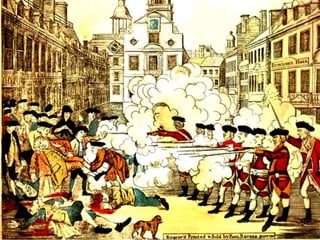
The Boston Massacre
• March 5, 1770 - A mob of Boston colonists
harassed British troops stationed in the city,
and shots were fired in the chaos, leaving 5
people dead
• Used as propaganda against the British to
encourage colonial rebellion
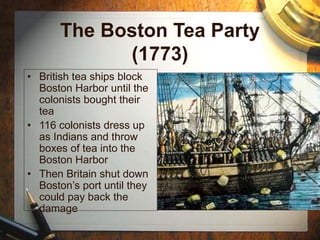
The Boston Tea Party
(1773)
• British tea ships block
Boston Harbor until the
colonists bought their
tea
• 116 colonists dress up
as Indians and throw
boxes of tea into the
Boston Harbor
• Then Britain shut down
Boston’s port until they
could pay back the
damage

Road to Revolution

  • 1.
    The Road toRevolution
  • 2.
    Our Political Beginnings •American colonists believed that gov’t should be: – Ordered --> organized into offices – Limited --> it was NOT all-powerful – Representative --> gov’t was to serve the people’s interests, not its own
  • 3.
    Where Our Gov’tIdeas Came From • Magna Carta (1215) - first document that officially limited the power of the English king – Basically said that the king did not have unlimited power • The Petition of Right (1628) - further limited the king’s power – couldn’t throw people in prison without a trial – couldn’t use the military to rule people in times of peace
  • 4.
    The English Billof Rights (1689) • Said: – Parliament was in control of taxing, not the king – People couldn’t be punished for asking the king to fix problems – No cruel and unusual punishment – Everyone got a fair trial
  • 6.
    The Colonies (1607-1733) •13 English colonies were established in America for – religious freedom – commercial trading/farming/fishing – New home for debtors – All colonies were started with a charter - written permission from the king
  • 7.
    Types of Colonies •Royal Colony- under the direct control of the king • King named a royal governor to rule the colony • Had a bicameral legislature – “bicameral” = two houses – “legislature” = group of representatives that make laws
  • 8.
    • Proprietary Colony- king gives land to a proprietor (overseer/owner), who organized the colony – colony was directly controlled by the proprietor, not the king (still reported to him) • One colony had a unicameral (one-house) legislature
  • 9.
    • Charter Colony- based on charters given straight to the colonists – Mostly governed themselves – Officials were elected by the people, not the king or proprietor
  • 11.
    Group Work • Imagineyou are subjects under King John John XXXXVII. • Create a Bill of Rights listing all the freedoms you wish to have as the king’s subject (List at least ten) – What freedoms do you value? What rights should all people have? – Make your list REALISTIC, as if the king were going to read it.
  • 12.
    British Colonial Policies •Britain was in serious debt after the French and Indian War – Decided that the colonies should help pay the debt – The colonies had been taxing themselves and had been left alone for several years by the Crown
  • 13.
    Problems With Britain •“Taxation Without Representation” --> American colonists were not given a voice in Parliament – saw themselves as British subjects and believed representation was a right of all Englishmen – Colonists believed Parliament had no right to tax them • Taxes: – Stamp Act - tax on paper goods and documents – Other taxes laid on imports like tea, paper, and glass
  • 14.
    • Great Britainalso: – Housed troops in people’s homes – Left troops to monitor cities – Cracked down on smuggling and enforced strict trade rules (colonies could only trade with Britain) – Took power from local colonial gov’ts
  • 15.
    Response of the Colonists •To avoid paying taxes, they would smuggle (sneak) other goods in • They boycotted (to protest by not buying something) British goods until Parliament lifted taxes • Protested, petitioned the King/Parliament, and destroyed British property
  • 16.
    The Boston Massacre •March 5, 1770 - A mob of Boston colonists harassed British troops stationed in the city, and shots were fired in the chaos, leaving 5 people dead • Used as propaganda against the British to encourage colonial rebellion
  • 18.
    The Boston TeaParty (1773) • British tea ships block Boston Harbor until the colonists bought their tea • 116 colonists dress up as Indians and throw boxes of tea into the Boston Harbor • Then Britain shut down Boston’s port until they could pay back the damage