Chip level equalisation for W-CDMA
Stephen McLaughlin
Dave Cruickshank, Sacha Spangenberg
Chip Level Equalisation for W-CDMA
Stephen McLaughlin
10th October 2000 Signals and Systems Group, The University of Edinburgh
Structure of Presentation
Background
Adaptive filters for MUD
Receiver Architectures for MUD
Performance comparison
Conclusions
Chip Level Equalisation for W-CDMA
Stephen McLaughlin
10th October 2000 Signals and Systems Group, The University of Edinburgh
Background
 Work focused on next generation terminals for
mobile communication based on CDMA.
 Integration of new services like
Web browsing
Video conferencing & Real Audio
GPS & Traffic Guidance
and increasing number of subscribers result in
increasing demands on system resources
 Interference (ISI/MAI) will reduce Quality of
Services unless countermeasures are taken.
Chip Level Equalisation for W-CDMA
Stephen McLaughlin
10th October 2000 Signals and Systems Group, The University of Edinburgh
CDMA Systems:
 CDMA multiplexed signals share the same
frequency band, but are separated by their
distinctive spreading codes
 In the ideal case, the spreading codes can be
orthogonal to each other and the transmitted signal
can be received and de-multiplexed using a simple
receiver !
 The communication channel however usually
destroys the orthogonality of the codes resulting in
inter-user interference, an effect more known as
Multiple Access Interference, MAI. This degrades
the systems performance.
Chip Level Equalisation for W-CDMA
Stephen McLaughlin
10th October 2000 Signals and Systems Group, The University of Edinburgh
Received CDMA Signal:
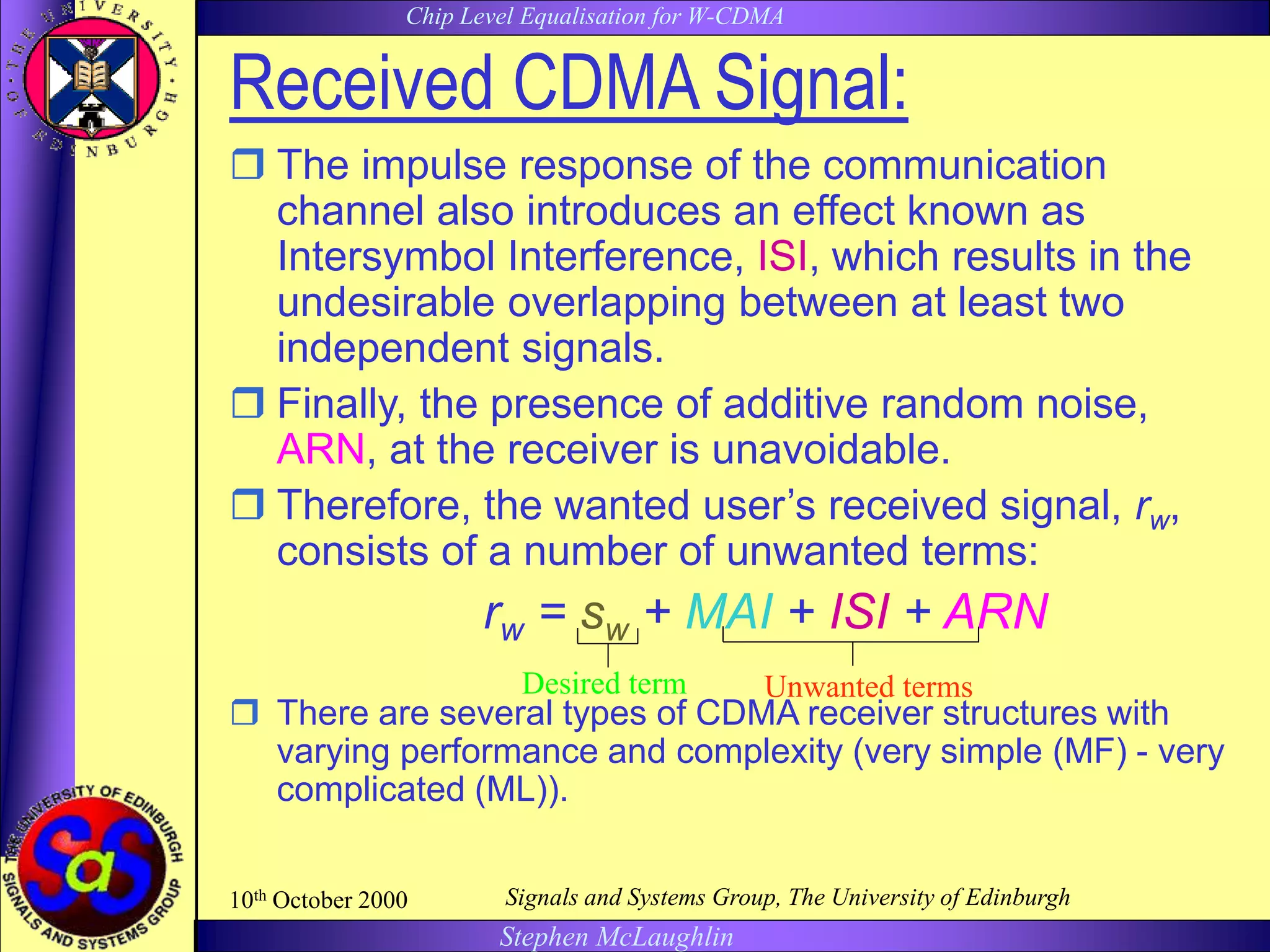
 The impulse response of the communication
channel also introduces an effect known as
Intersymbol Interference, ISI, which results in the
undesirable overlapping between at least two
independent signals.
 Finally, the presence of additive random noise,
ARN, at the receiver is unavoidable.
 Therefore, the wanted user’s received signal, rw,
consists of a number of unwanted terms:
rw = sw + MAI + ISI + ARN
 There are several types of CDMA receiver structures with
varying performance and complexity (very simple (MF) - very
complicated (ML)).
Unwanted termsDesired term
Chip Level Equalisation for W-CDMA
Stephen McLaughlin
10th October 2000 Signals and Systems Group, The University of Edinburgh
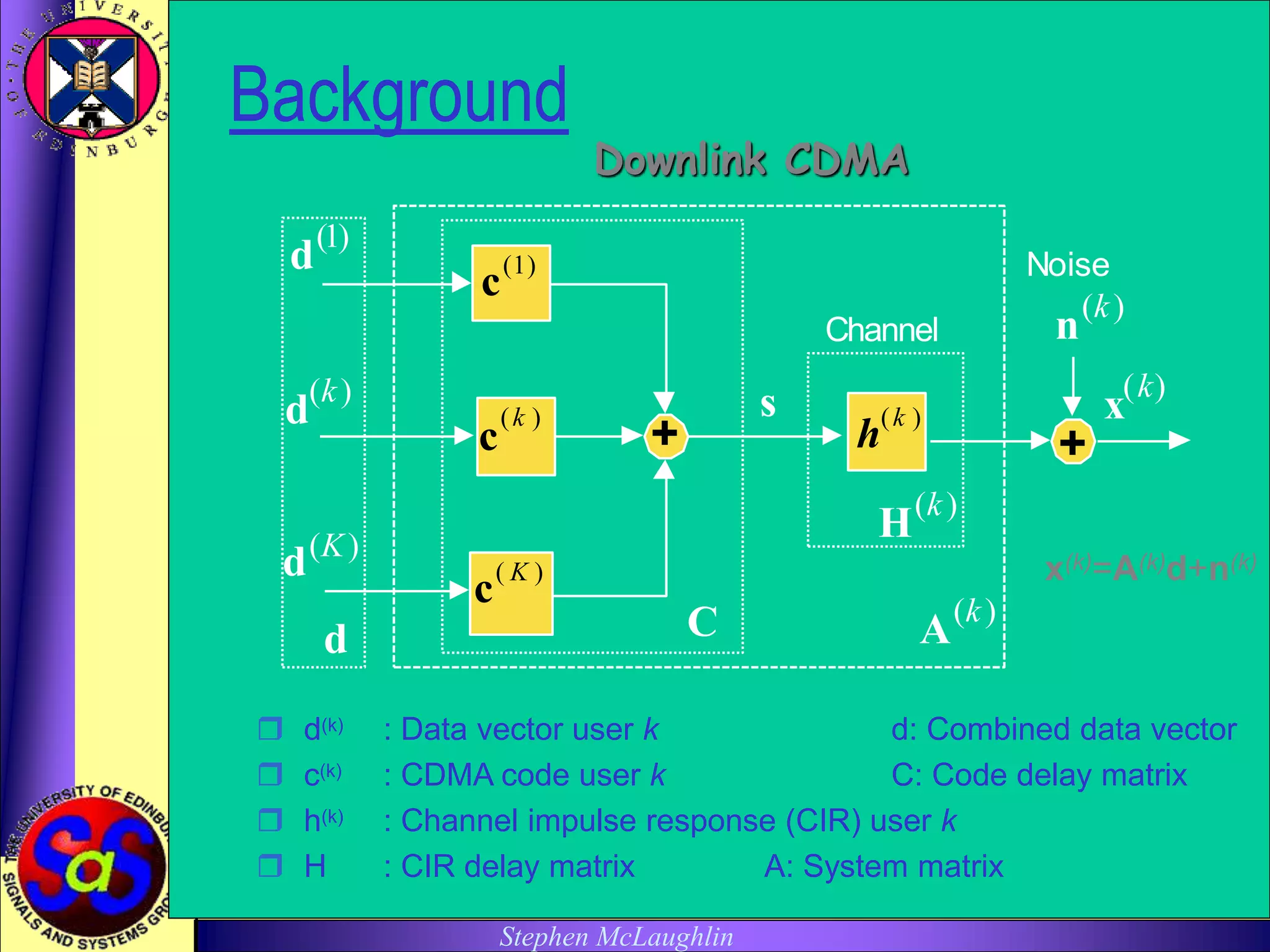
)1(
d
)(k
d
)(K
d
)1(
c
)(k
c
)( K
c
+
C
s )(k
h +
)(k
H
)(k
A
)(k
nChannel
)(k
x
d
Noise
Background
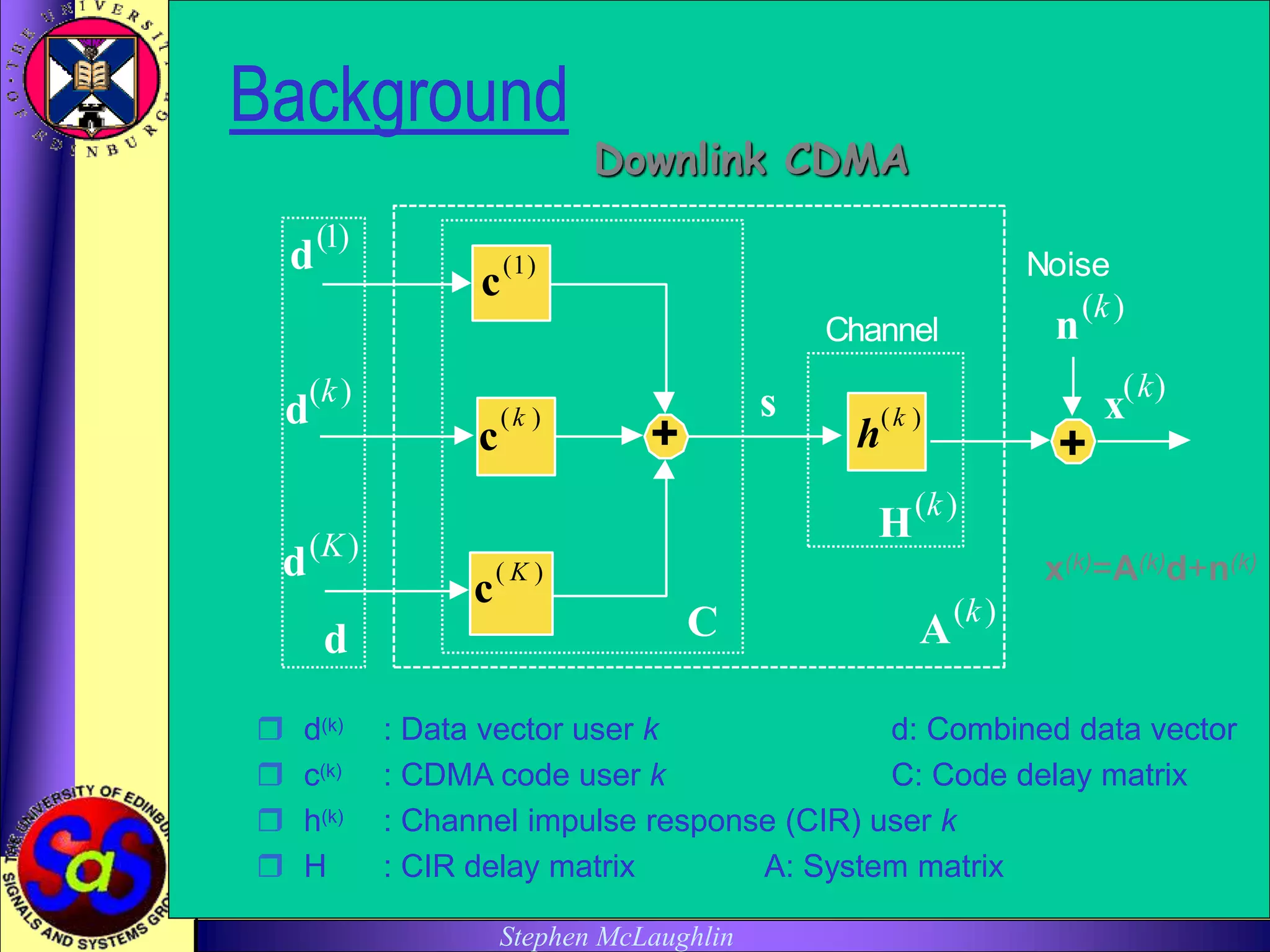
 d(k) : Data vector user k d: Combined data vector
 c(k) : CDMA code user k C: Code delay matrix
 h(k) : Channel impulse response (CIR) user k
 H : CIR delay matrix A: System matrix
x(k)=A(k)d+n(k)
Downlink CDMA
Chip Level Equalisation for W-CDMA
Stephen McLaughlin
10th October 2000 Signals and Systems Group, The University of Edinburgh
MUD basics
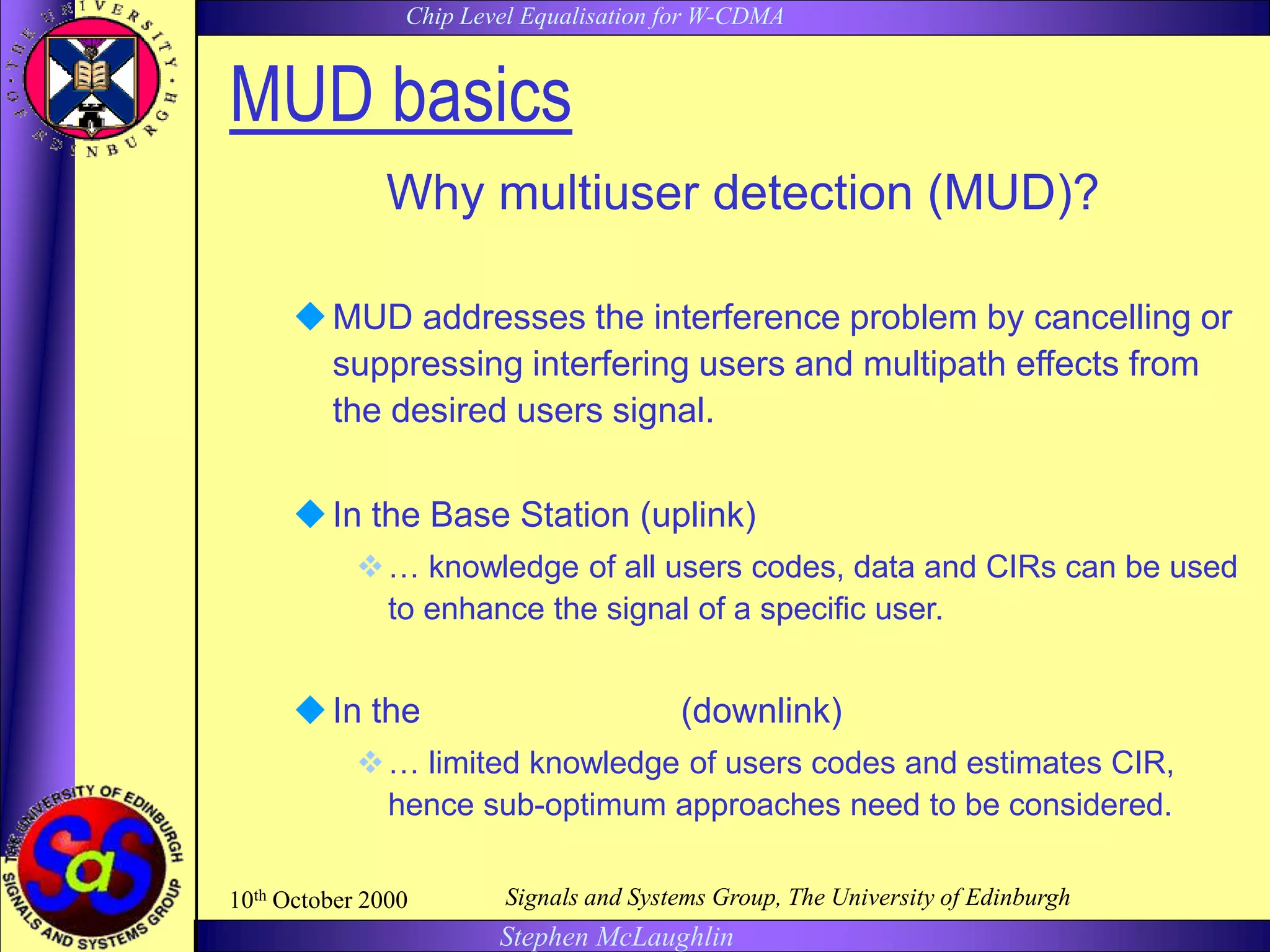
Why multiuser detection (MUD)?
MUD addresses the interference problem by cancelling or
suppressing interfering users and multipath effects from
the desired users signal.
In the Base Station (uplink)
… knowledge of all users codes, data and CIRs can be used
to enhance the signal of a specific user.
In the Mobile Station (downlink)
… limited knowledge of users codes and estimates CIR,
hence sub-optimum approaches need to be considered.
Chip Level Equalisation for W-CDMA
Stephen McLaughlin
10th October 2000 Signals and Systems Group, The University of Edinburgh
MUD basics
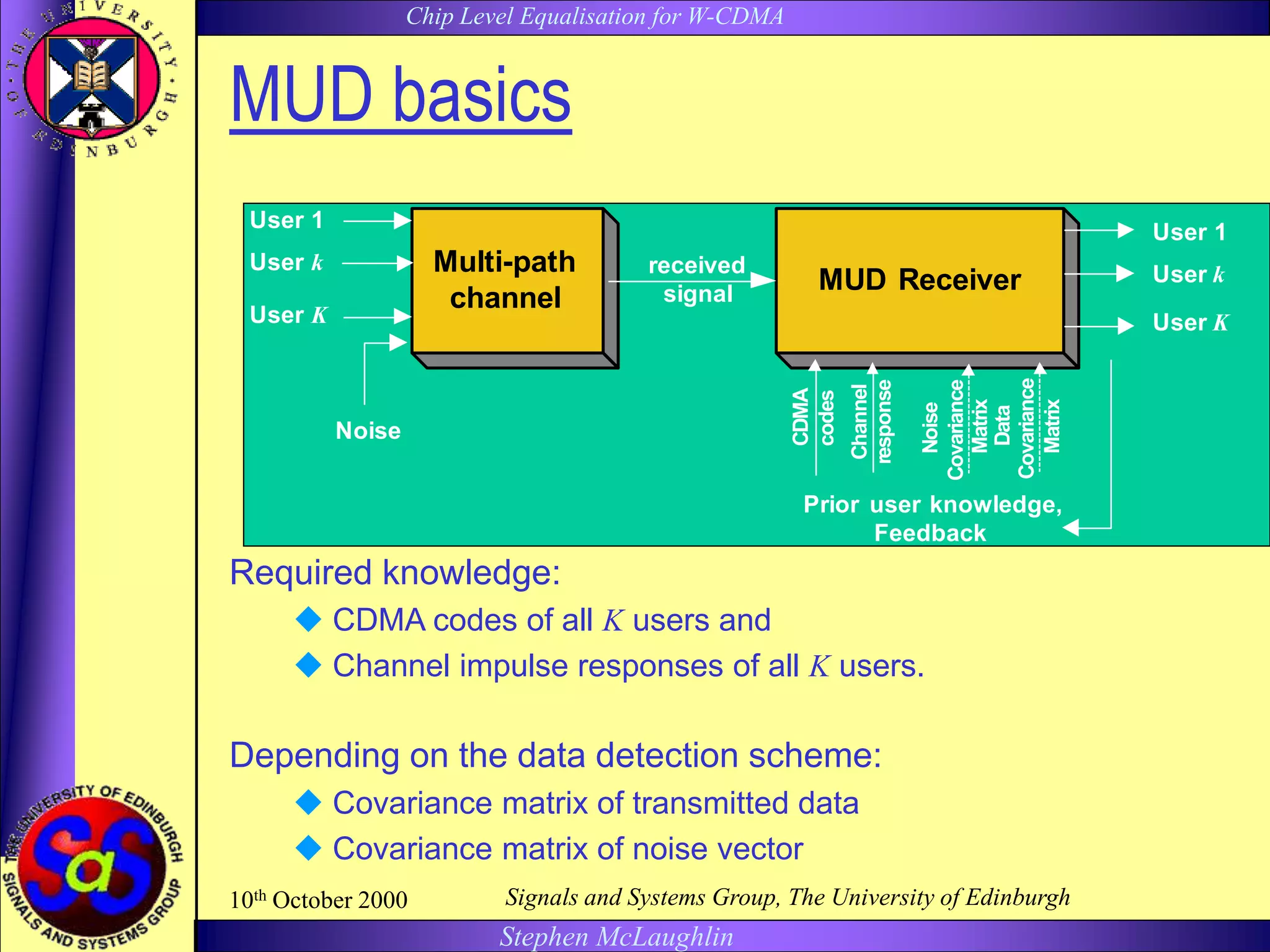
Required knowledge:
 CDMA codes of all K users and
 Channel impulse responses of all K users.
Depending on the data detection scheme:
 Covariance matrix of transmitted data
 Covariance matrix of noise vector
MUD Receiver
User 1
Prior user knowledge,
Feedback
Multi-path
channel
Noise
CDMA
codes
Channel
response
Noise
Covariance
Matrix
Data
Covariance
Matrix
received
signal
User k
User K
User 1
User k
User K
Chip Level Equalisation for W-CDMA
Stephen McLaughlin
10th October 2000 Signals and Systems Group, The University of Edinburgh
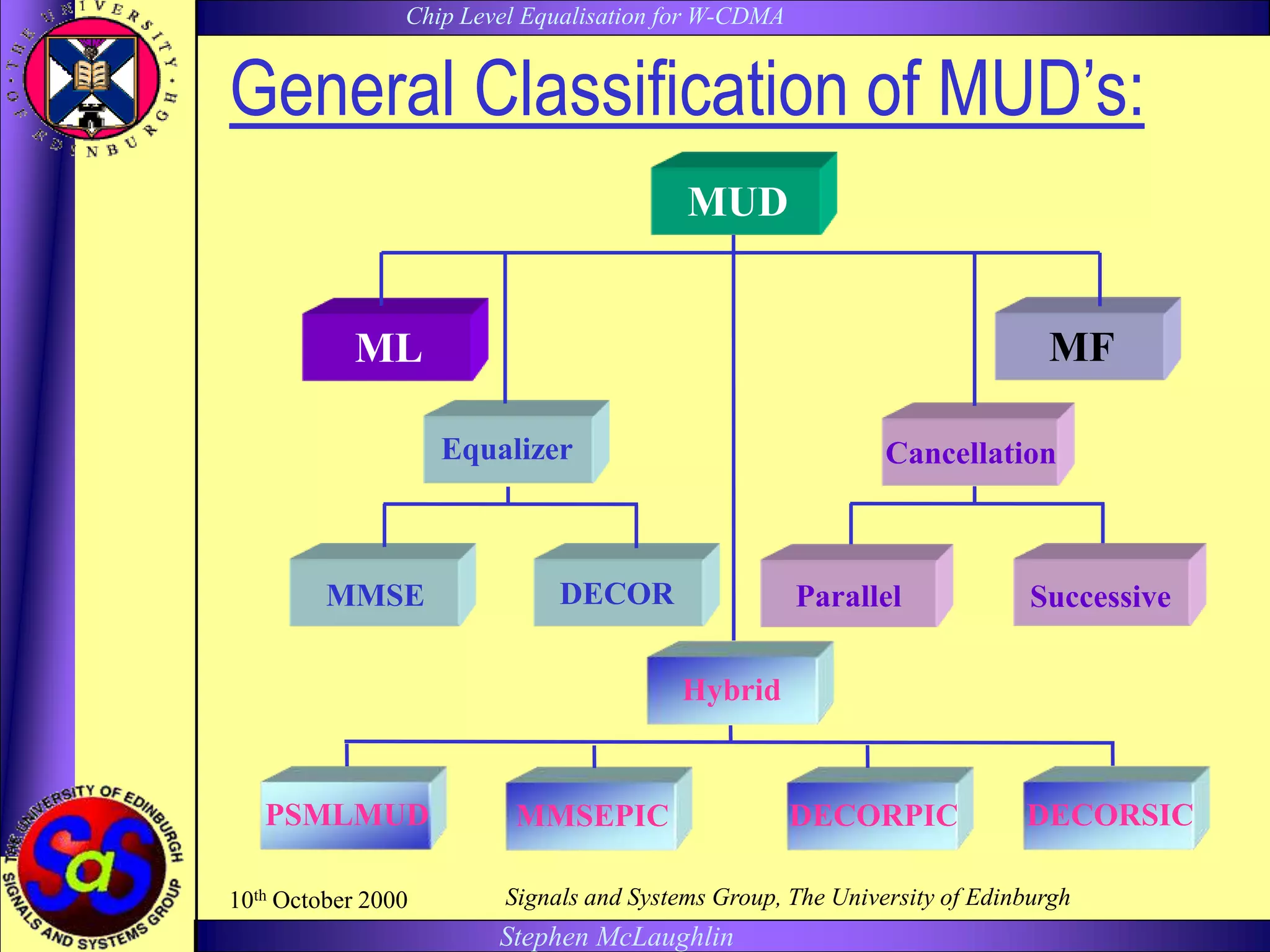
General Classification of MUD’s:
Cancellation
Parallel Successive
Hybrid
DECORPICMMSEPIC DECORSICPSMLMUD
Equalizer
MMSE DECOR
MUD
ML MF
Chip Level Equalisation for W-CDMA
Stephen McLaughlin
10th October 2000 Signals and Systems Group, The University of Edinburgh
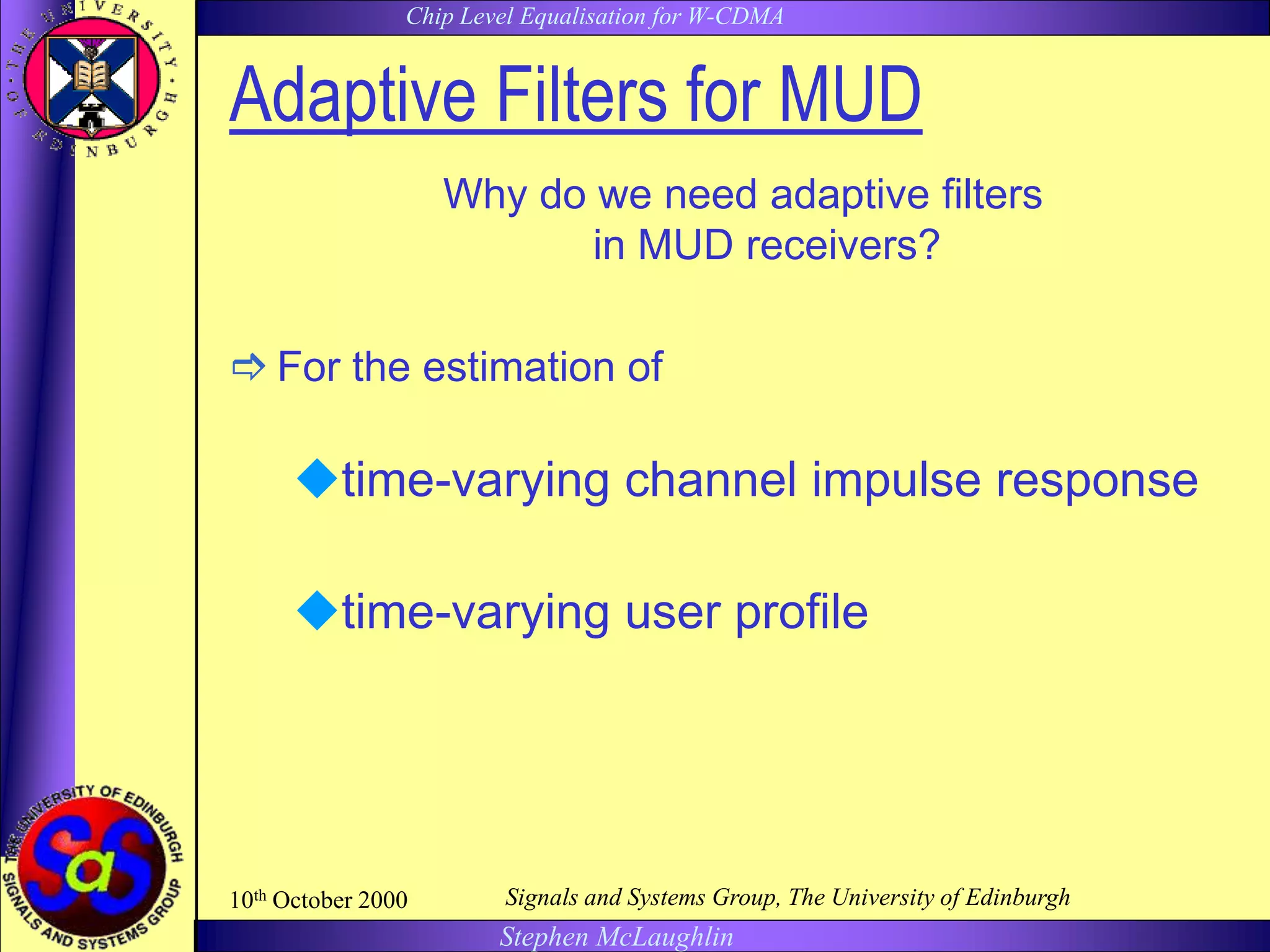
Adaptive Filters for MUD
Why do we need adaptive filters
in MUD receivers?
 For the estimation of
time-varying channel impulse response
time-varying user profile
Chip Level Equalisation for W-CDMA
Stephen McLaughlin
10th October 2000 Signals and Systems Group, The University of Edinburgh
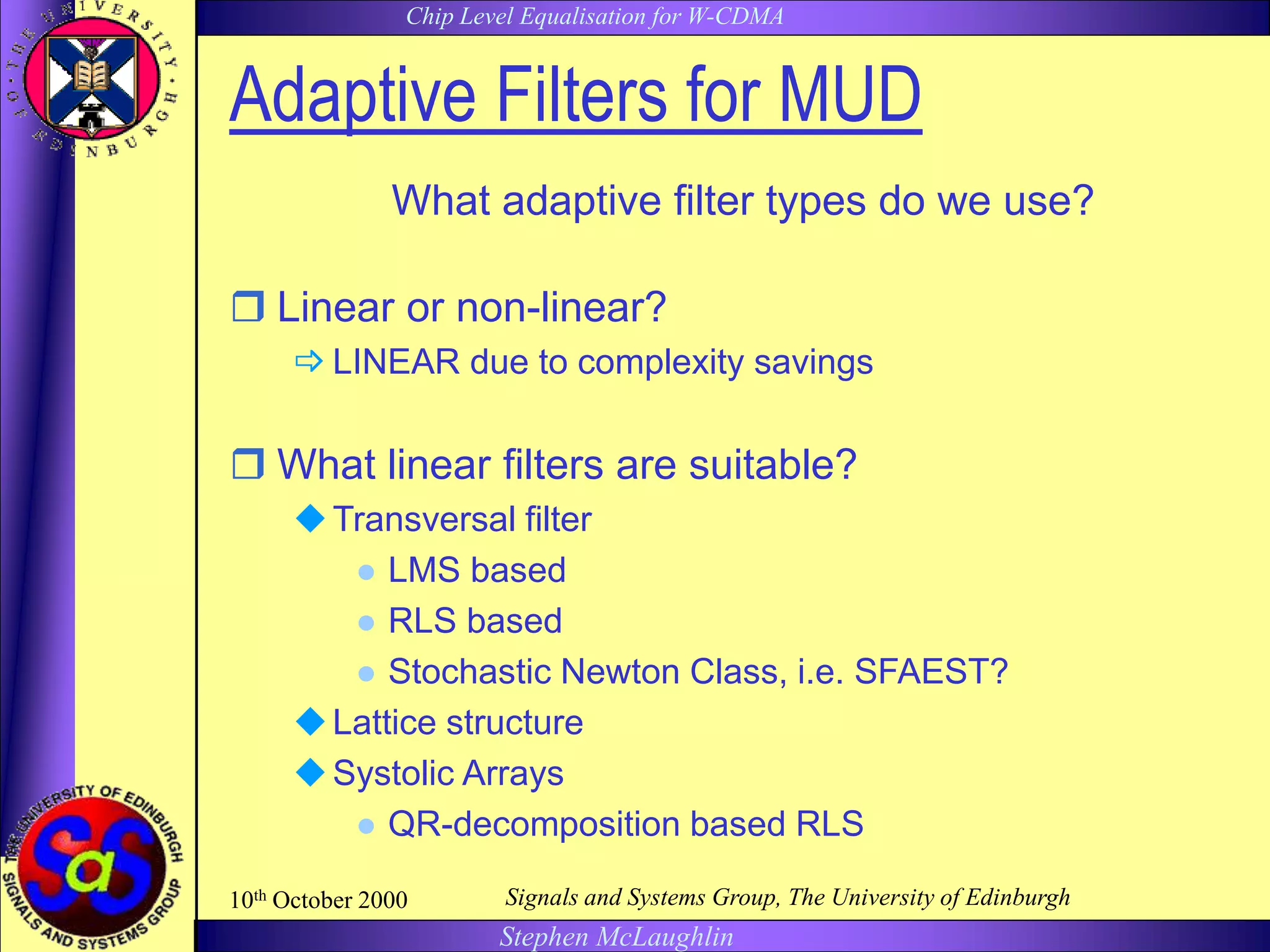
Adaptive Filters for MUD
What adaptive filter types do we use?
 Linear or non-linear?
 LINEAR due to complexity savings
 What linear filters are suitable?
Transversal filter
 LMS based
 RLS based
 Stochastic Newton Class, i.e. SFAEST?
Lattice structure
Systolic Arrays
 QR-decomposition based RLS
Chip Level Equalisation for W-CDMA
Stephen McLaughlin
10th October 2000 Signals and Systems Group, The University of Edinburgh
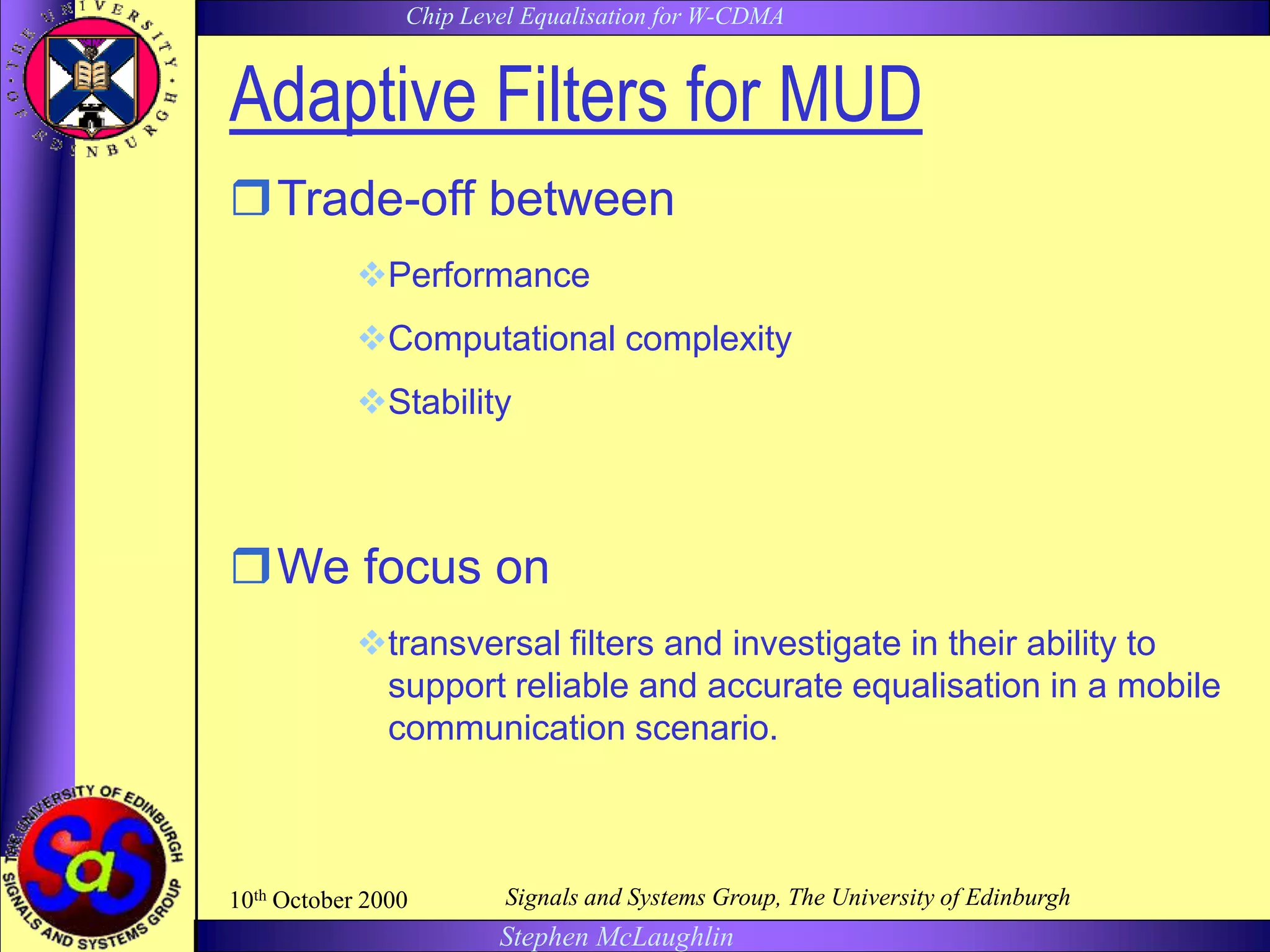
Adaptive Filters for MUD
Trade-off between
Performance
Computational complexity
Stability
We focus on
transversal filters and investigate in their ability to
support reliable and accurate equalisation in a mobile
communication scenario.
Chip Level Equalisation for W-CDMA
Stephen McLaughlin
10th October 2000 Signals and Systems Group, The University of Edinburgh
Adaptive Filters for MUD
Most popular algorithms are used first
Least Mean Square
Recursive Mean Square
Traditionally the combined channel impulse
response (CCIR) is estimated
 one filter that estimates system matrix A
Chip Level Equalisation for W-CDMA
Stephen McLaughlin
10th October 2000 Signals and Systems Group, The University of Edinburgh
)1(
d
)(k
d
)(K
d
)1(
c
)(k
c
)( K
c
+
C
s )(k
h +
)(k
H
)(k
A
)(k
nChannel
)(k
x
d
Noise
Background
 d(k) : Data vector user k d: Combined data vector
 c(k) : CDMA code user k C: Code delay matrix
 h(k) : Channel impulse response (CIR) user k
 H : CIR delay matrix A: System matrix
x(k)=A(k)d+n(k)
Downlink CDMA
Chip Level Equalisation for W-CDMA
Stephen McLaughlin
10th October 2000 Signals and Systems Group, The University of Edinburgh
Receiver Architectures
for MUD (1)
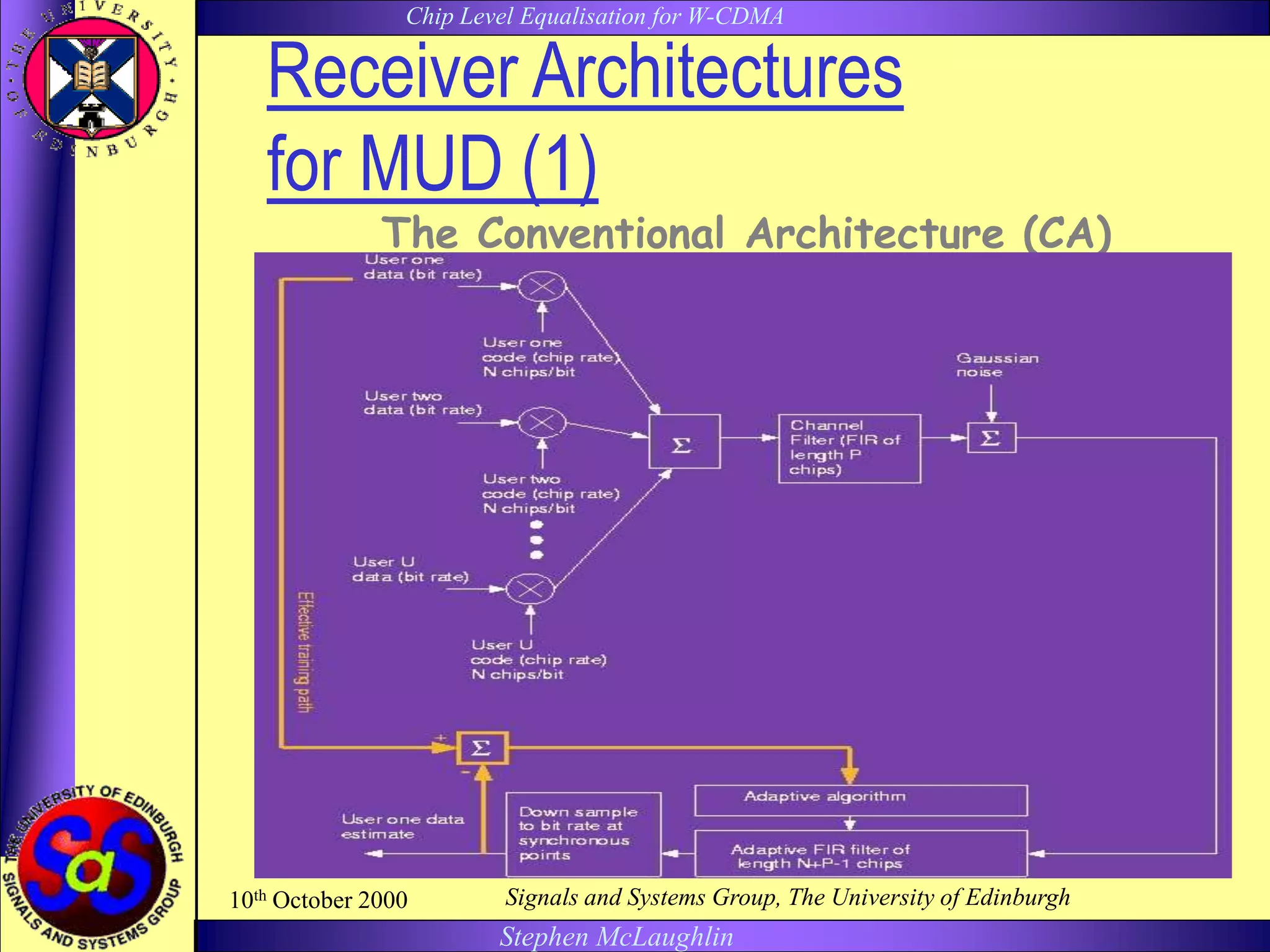
The Conventional Architecture (CA)
Chip Level Equalisation for W-CDMA
Stephen McLaughlin
10th October 2000 Signals and Systems Group, The University of Edinburgh
Performance Evaluation (CA)
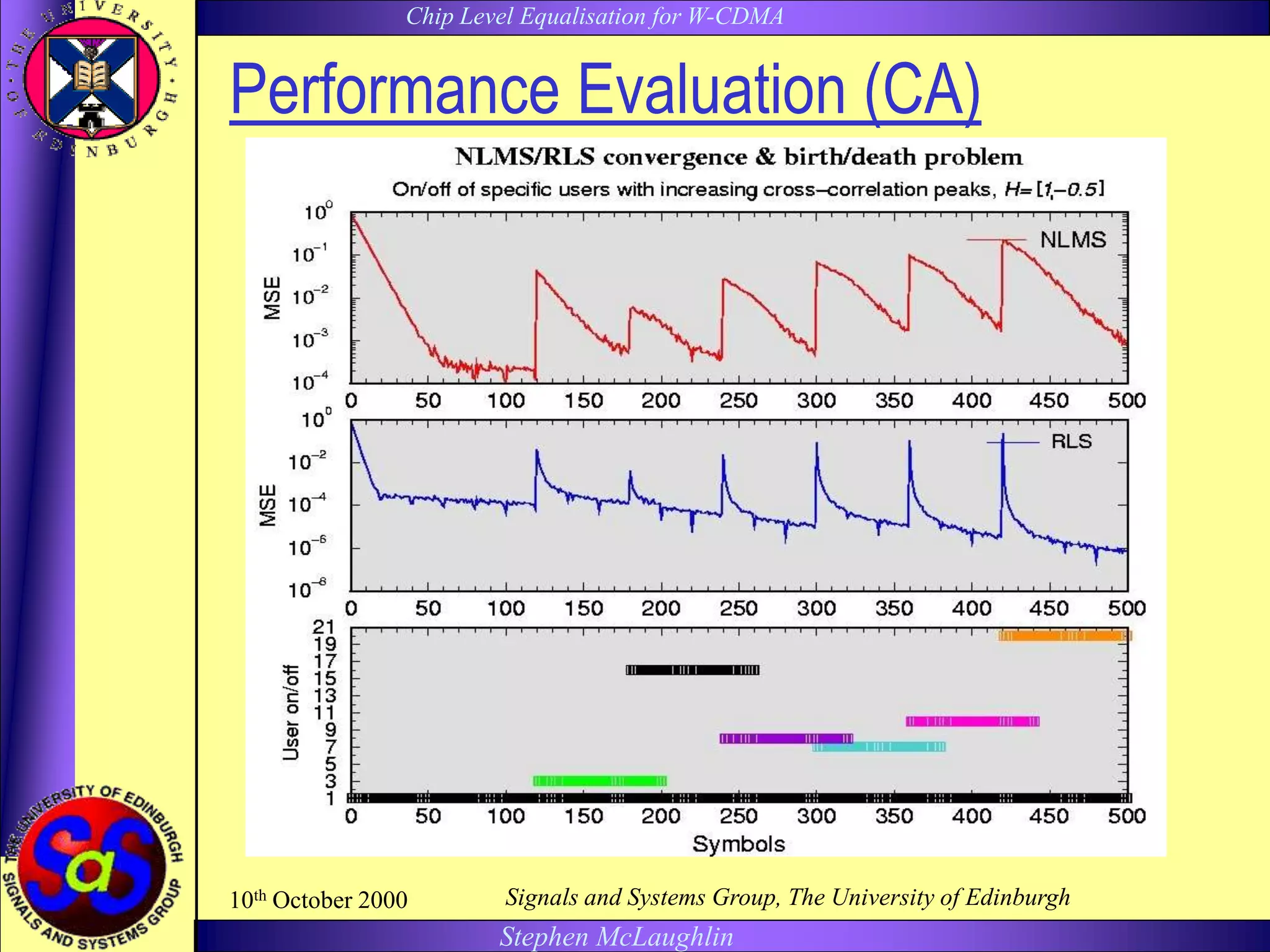
 Apart from the time-varying channel the dynamic
user profile adds to the complexity of the
equalisation task.
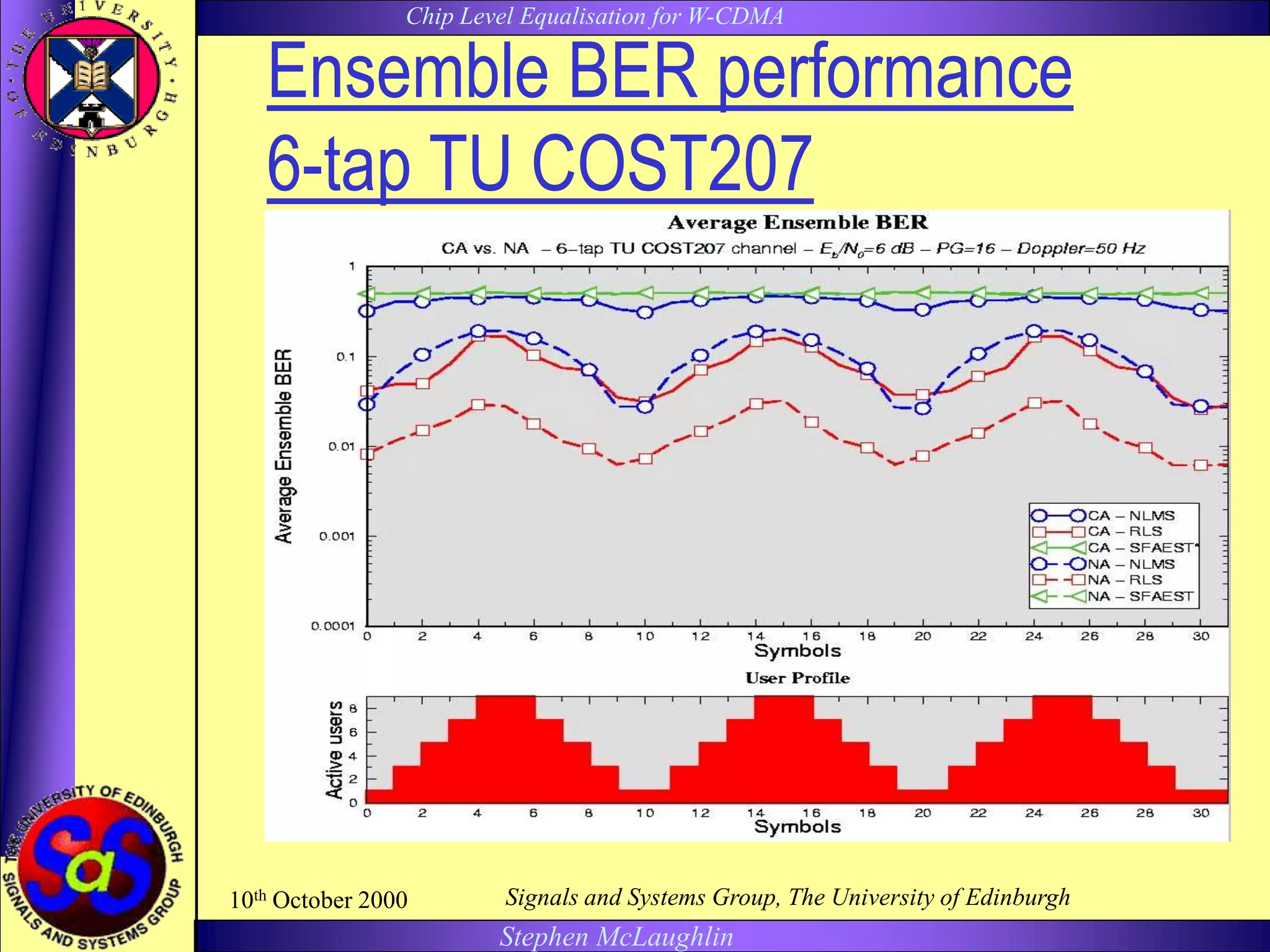
 Users switching on and off can cause error bursts in
the desired users signal as the equaliser needs time
to adapt the filter coefficients. We refer to this as the
birth/death problem.
 Convergence rates of adaptive filter algorithms
therefore are crucial to maintain a suitable bit error
ratio.
Chip Level Equalisation for W-CDMA
Stephen McLaughlin
10th October 2000 Signals and Systems Group, The University of Edinburgh
Performance Evaluation (CA)
Chip Level Equalisation for W-CDMA
Stephen McLaughlin
10th October 2000 Signals and Systems Group, The University of Edinburgh
Performance Evaluation (CA)
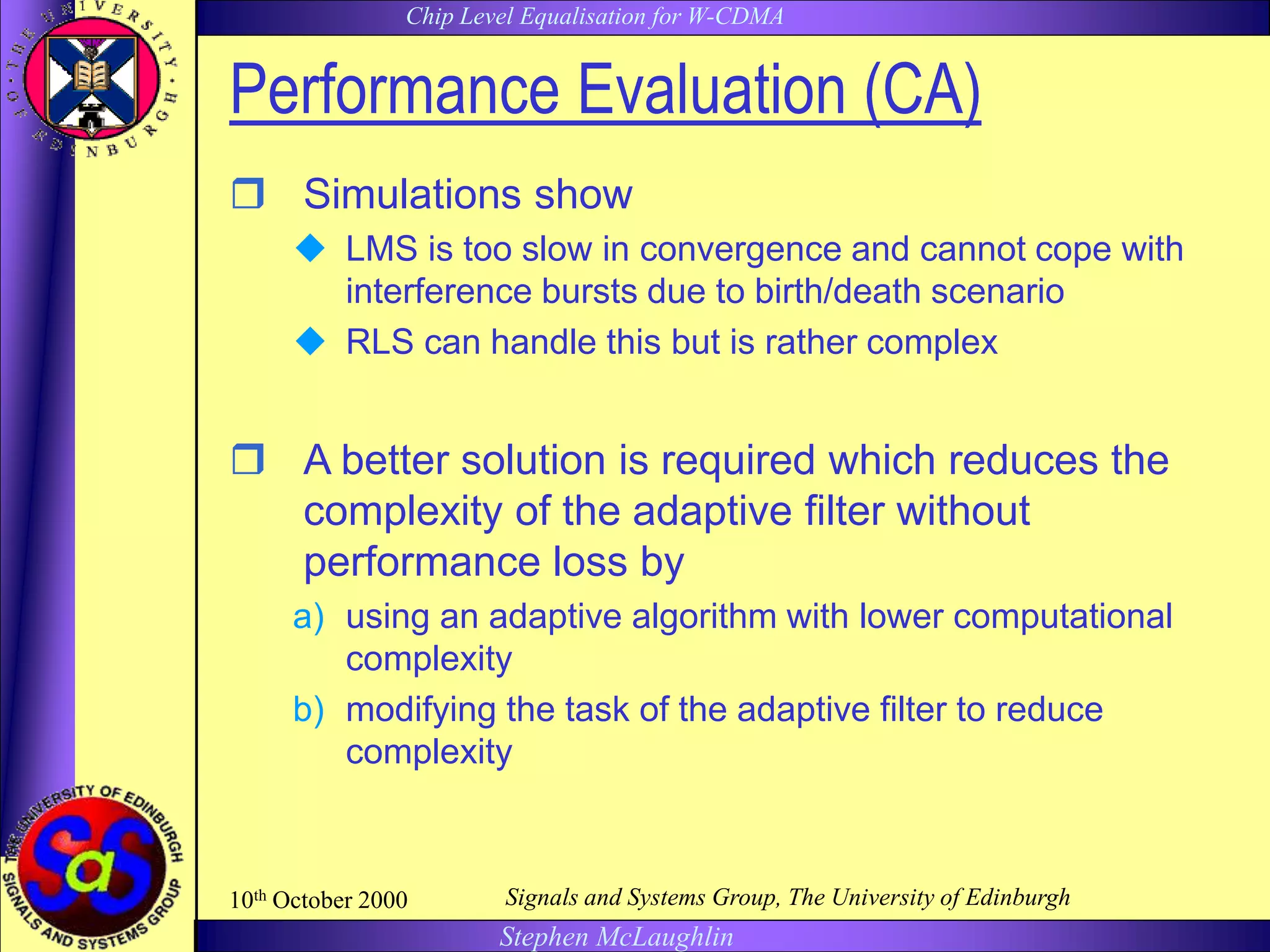
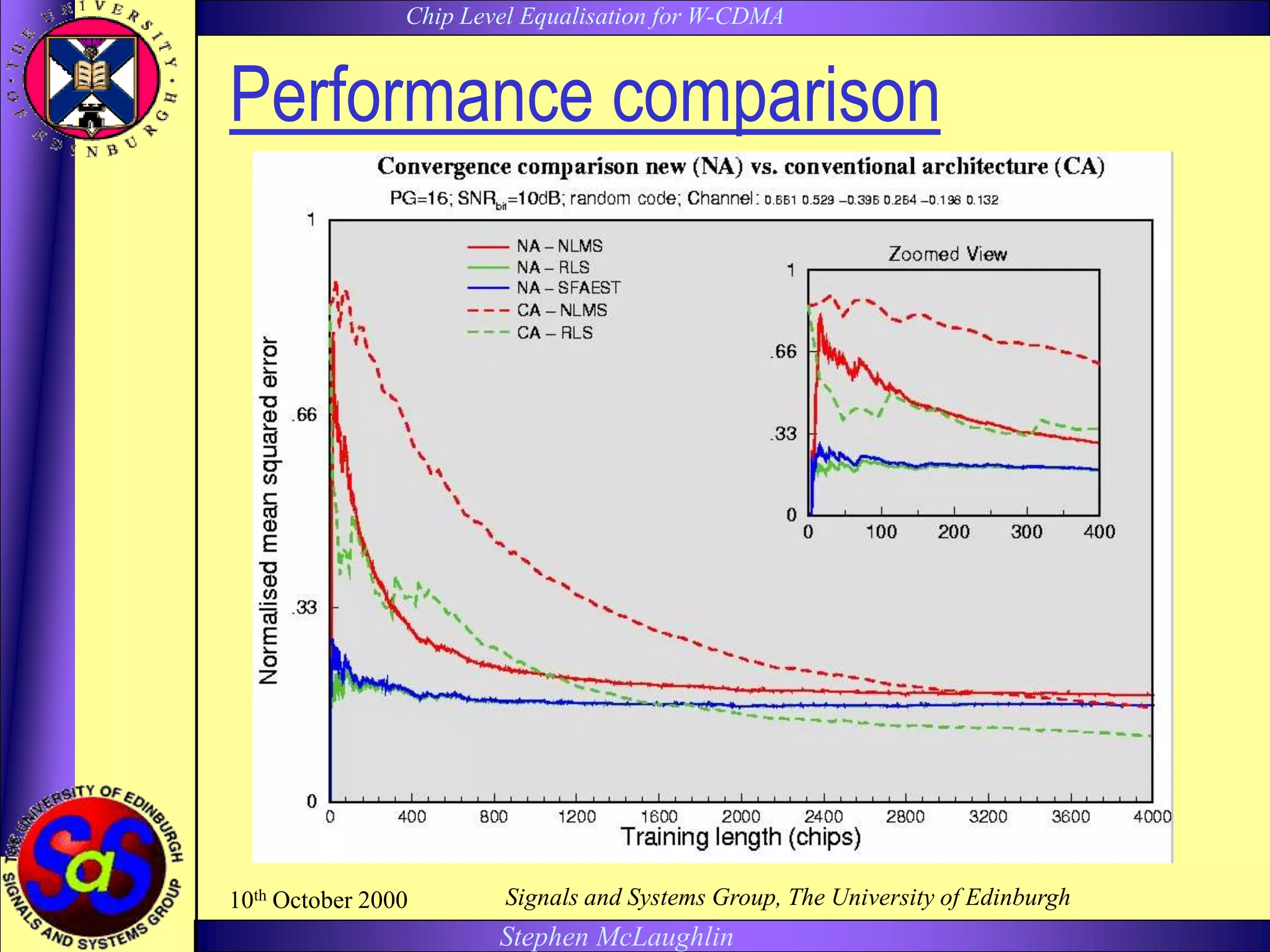
 Simulations show
 LMS is too slow in convergence and cannot cope with
interference bursts due to birth/death scenario
 RLS can handle this but is rather complex
 A better solution is required which reduces the
complexity of the adaptive filter without
performance loss by
a) using an adaptive algorithm with lower computational
complexity
b) modifying the task of the adaptive filter to reduce
complexity
Chip Level Equalisation for W-CDMA
Stephen McLaughlin
10th October 2000 Signals and Systems Group, The University of Edinburgh
Receiver Architectures
for MUD (2)
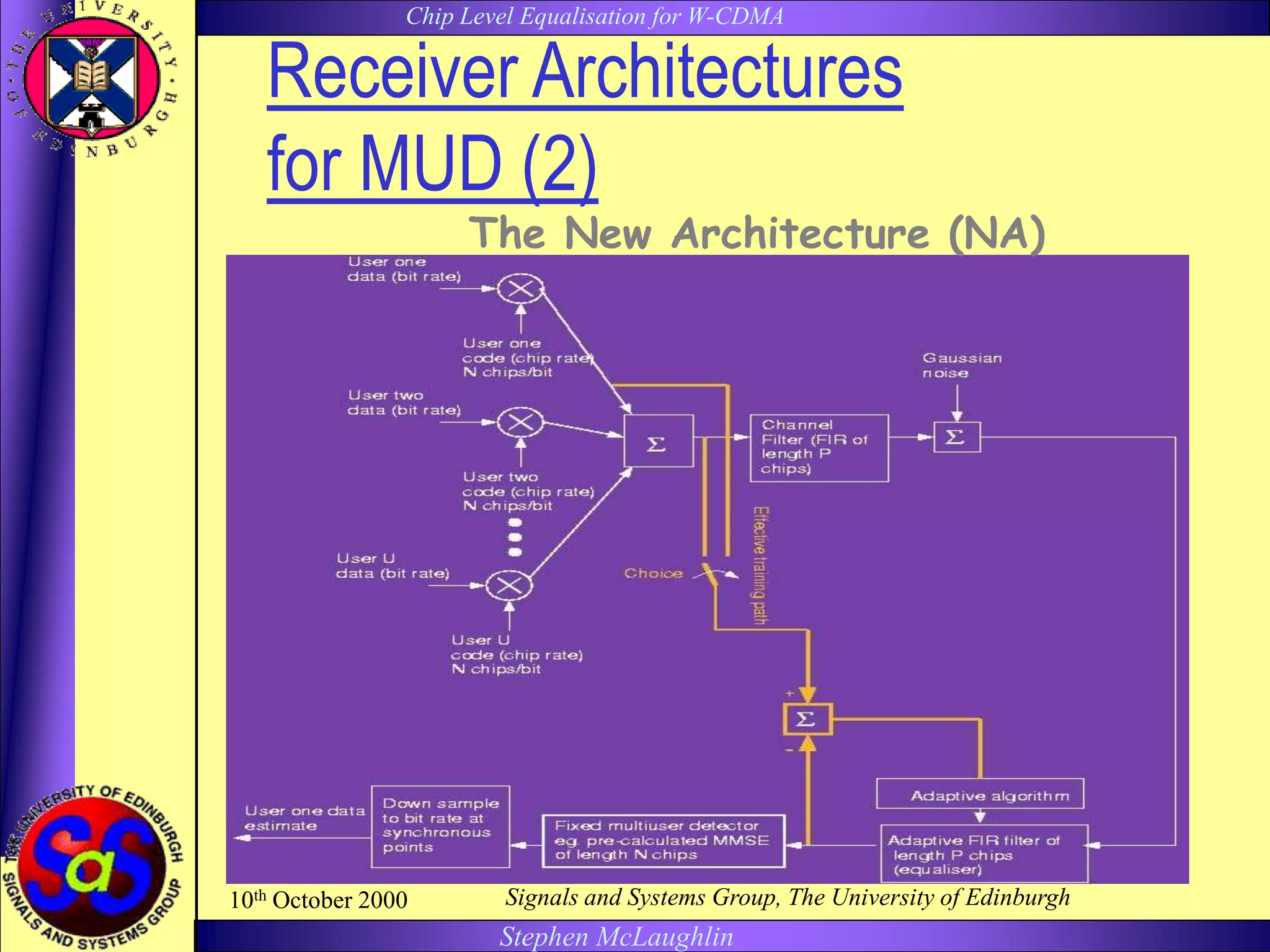
The New Architecture (NA)
Chip Level Equalisation for W-CDMA
Stephen McLaughlin
10th October 2000 Signals and Systems Group, The University of Edinburgh
Architecture comparison
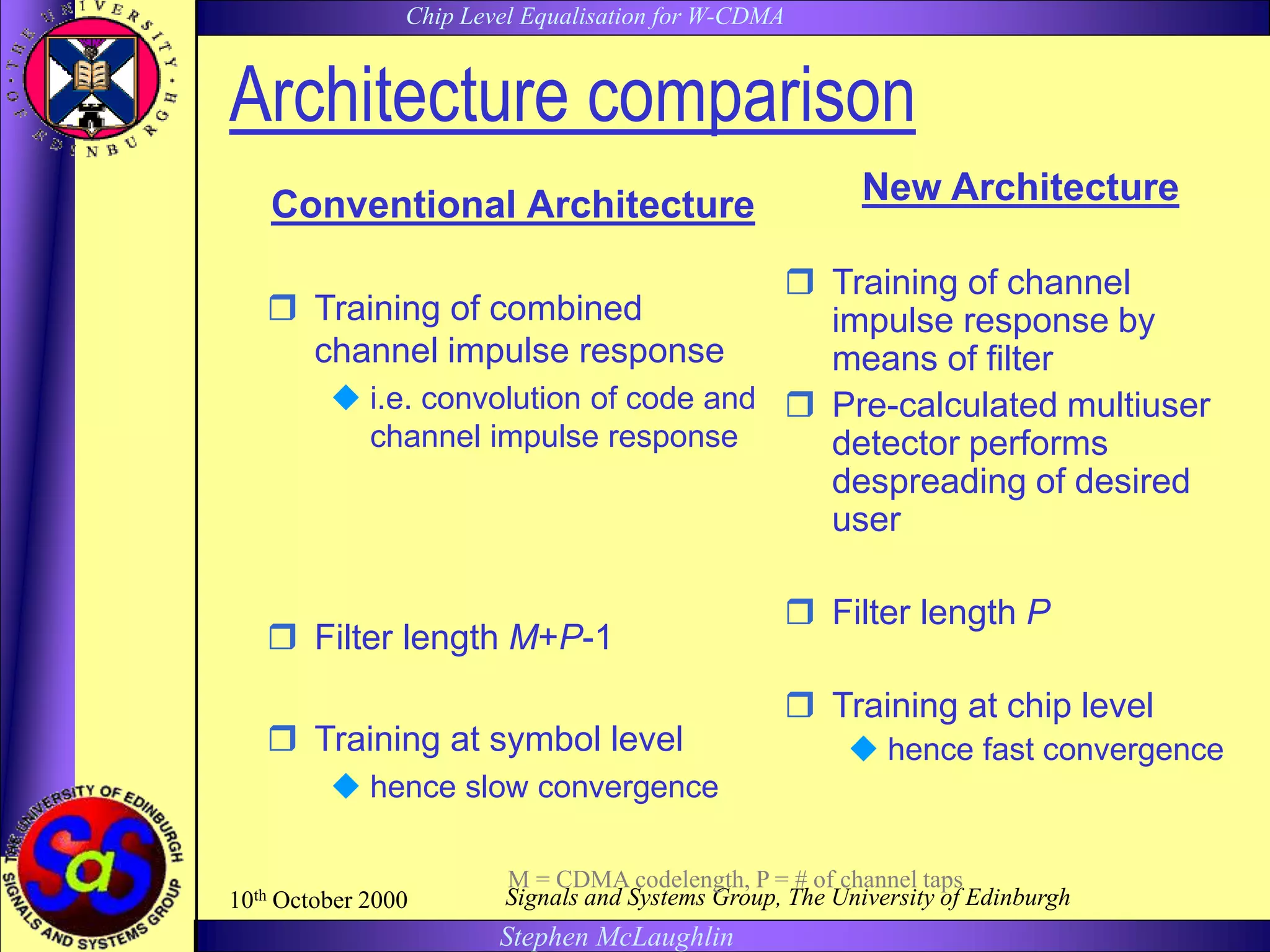
Conventional Architecture
 Training of combined
channel impulse response
 i.e. convolution of code and
channel impulse response
 Filter length M+P-1
 Training at symbol level
 hence slow convergence
New Architecture
 Training of channel
impulse response by
means of filter
 Pre-calculated multiuser
detector performs
despreading of desired
user
 Filter length P
 Training at chip level
 hence fast convergence
M = CDMA codelength, P = # of channel taps
Chip Level Equalisation for W-CDMA
Stephen McLaughlin
10th October 2000 Signals and Systems Group, The University of Edinburgh
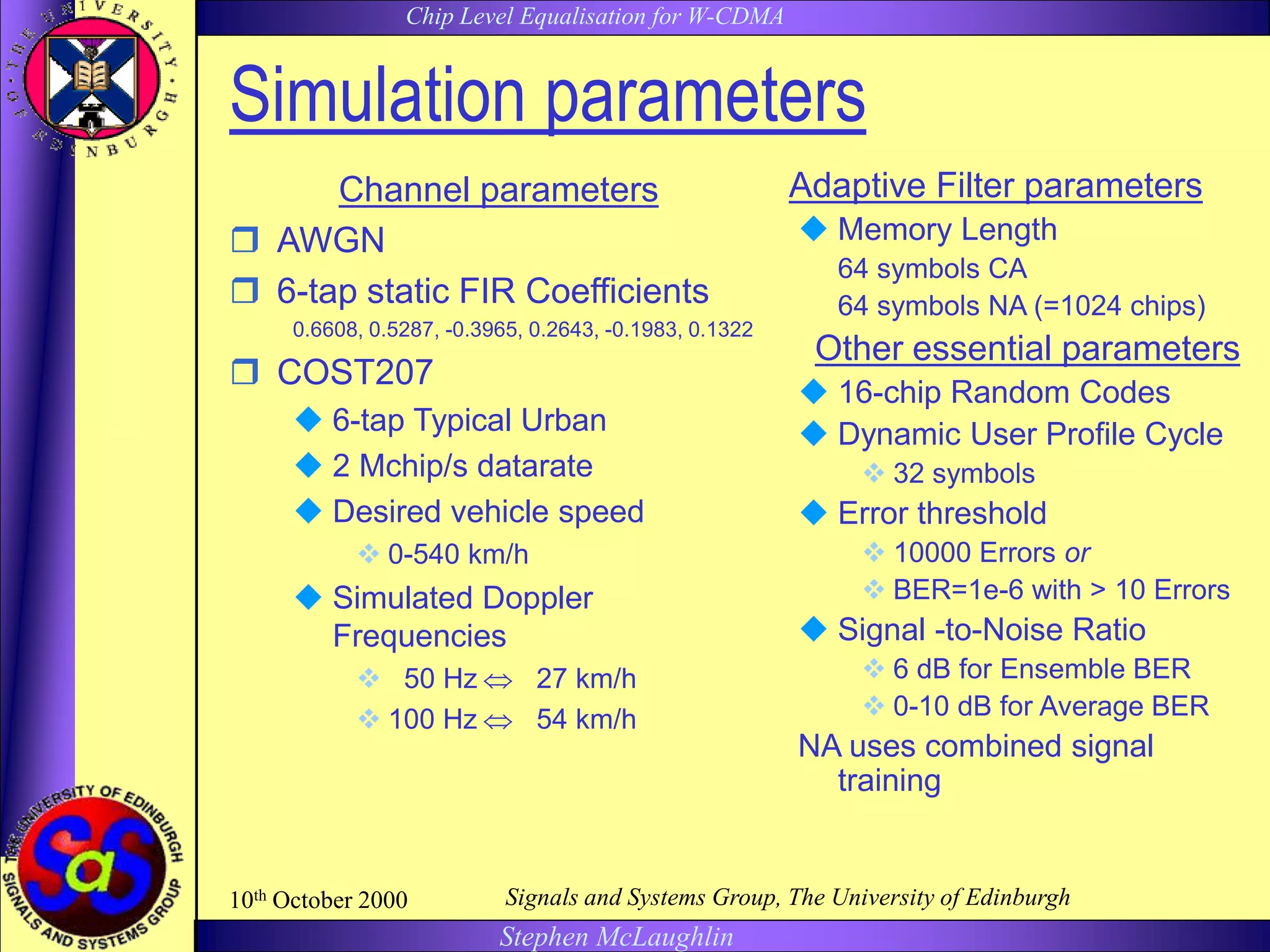
Simulation parameters
Channel parameters
 AWGN
 6-tap static FIR Coefficients
0.6608, 0.5287, -0.3965, 0.2643, -0.1983, 0.1322
 COST207
 6-tap Typical Urban
 2 Mchip/s datarate
 Desired vehicle speed
 0-540 km/h
 Simulated Doppler
Frequencies
 50 Hz  27 km/h
 100 Hz  54 km/h
Adaptive Filter parameters
 Memory Length
64 symbols CA
64 symbols NA (=1024 chips)
Other essential parameters
 16-chip Random Codes
 Dynamic User Profile Cycle
 32 symbols
 Error threshold
 10000 Errors or
 BER=1e-6 with > 10 Errors
 Signal -to-Noise Ratio
 6 dB for Ensemble BER
 0-10 dB for Average BER
NA uses combined signal
training
Chip Level Equalisation for W-CDMA
Stephen McLaughlin
10th October 2000 Signals and Systems Group, The University of Edinburgh
Performance comparison
Chip Level Equalisation for W-CDMA
Stephen McLaughlin
10th October 2000 Signals and Systems Group, The University of Edinburgh
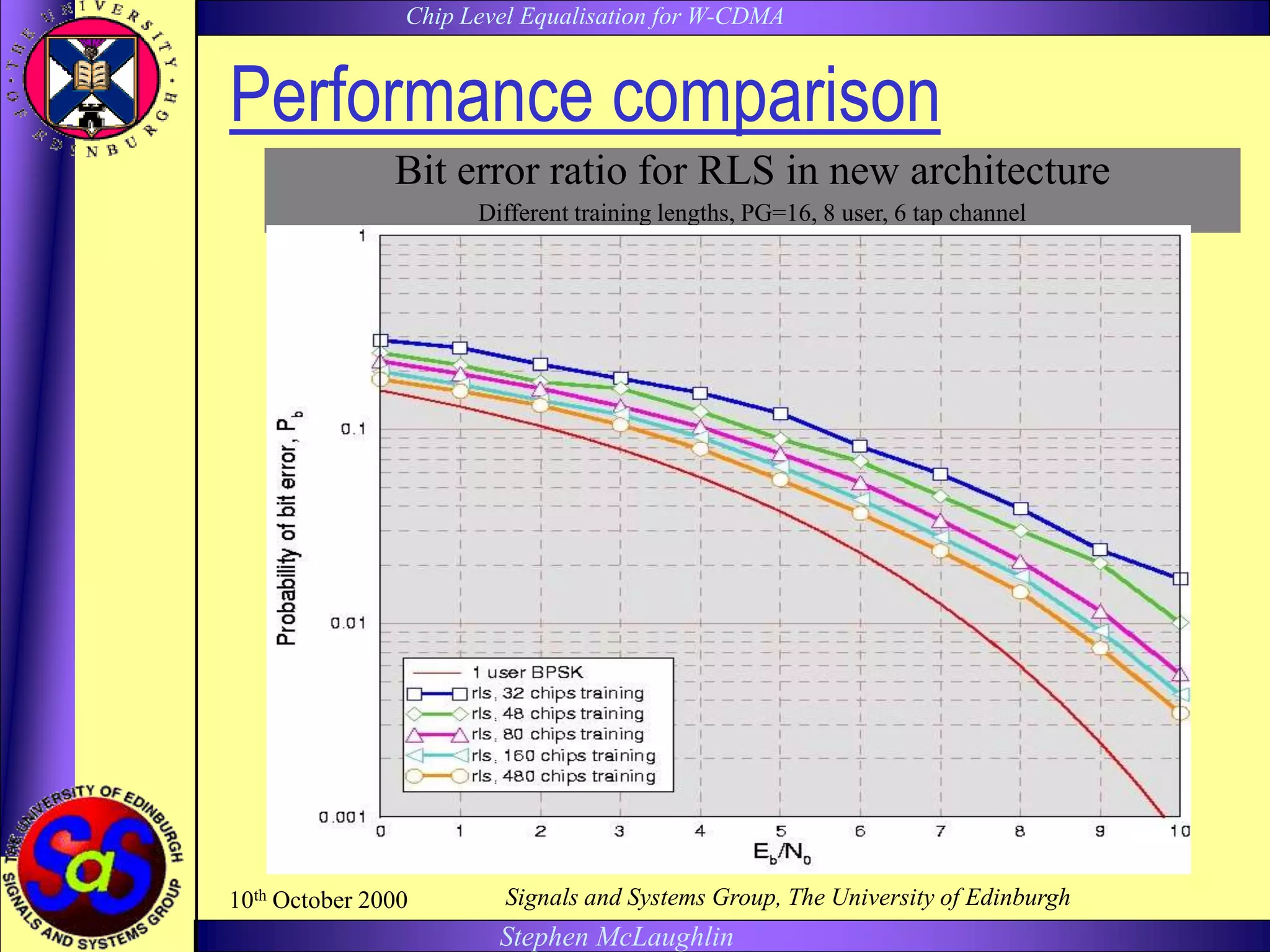
Performance comparison
Bit error ratio for RLS in new architecture
Different training lengths, PG=16, 8 user, 6 tap channel
Chip Level Equalisation for W-CDMA
Stephen McLaughlin
10th October 2000 Signals and Systems Group, The University of Edinburgh
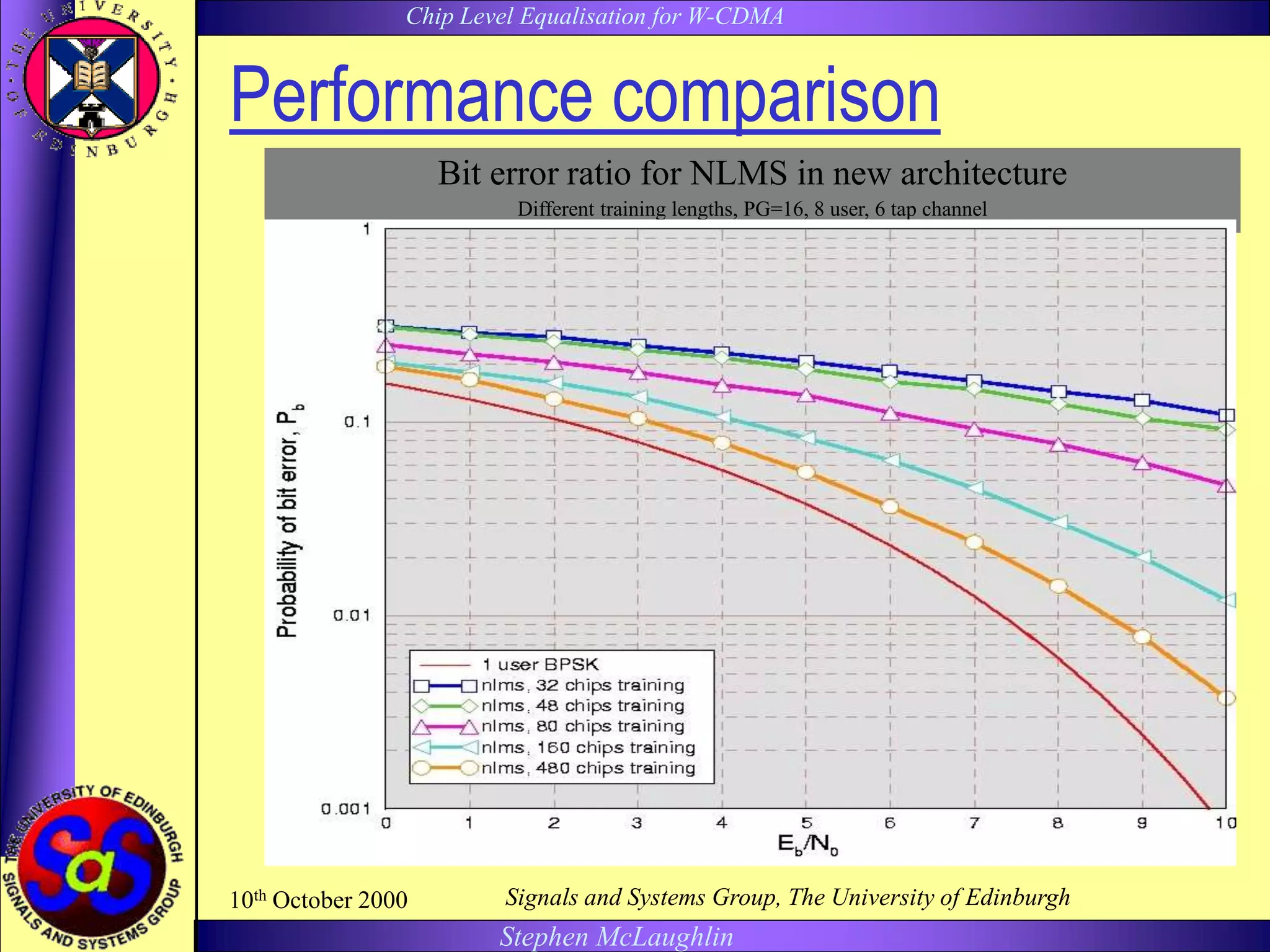
Performance comparison
Bit error ratio for NLMS in new architecture
Different training lengths, PG=16, 8 user, 6 tap channel
Chip Level Equalisation for W-CDMA
Stephen McLaughlin
10th October 2000 Signals and Systems Group, The University of Edinburgh
Ensemble BER performance
6-tap TU COST207
Chip Level Equalisation for W-CDMA
Stephen McLaughlin
10th October 2000 Signals and Systems Group, The University of Edinburgh
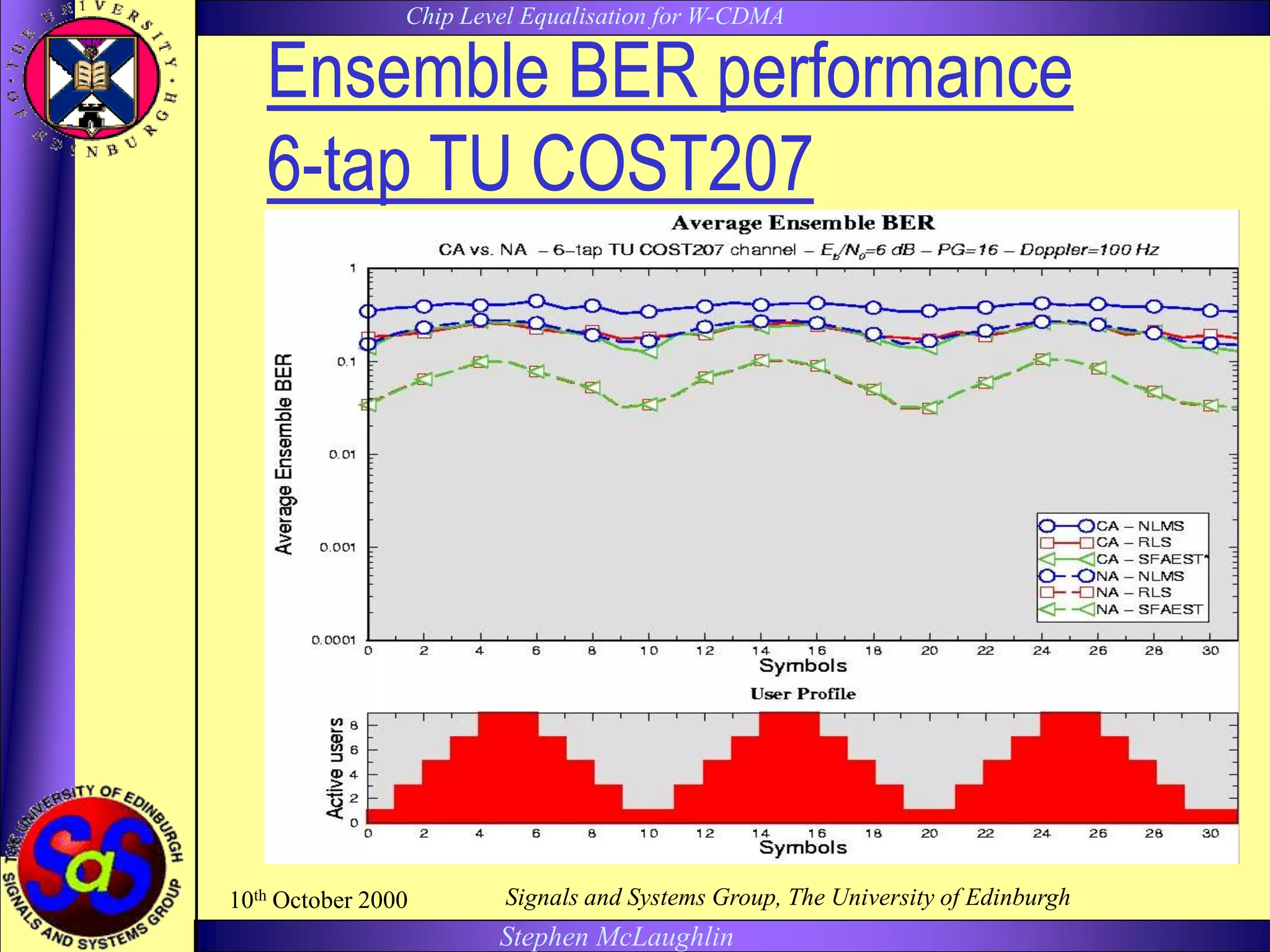
Ensemble BER performance
6-tap TU COST207
Chip Level Equalisation for W-CDMA
Stephen McLaughlin
10th October 2000 Signals and Systems Group, The University of Edinburgh
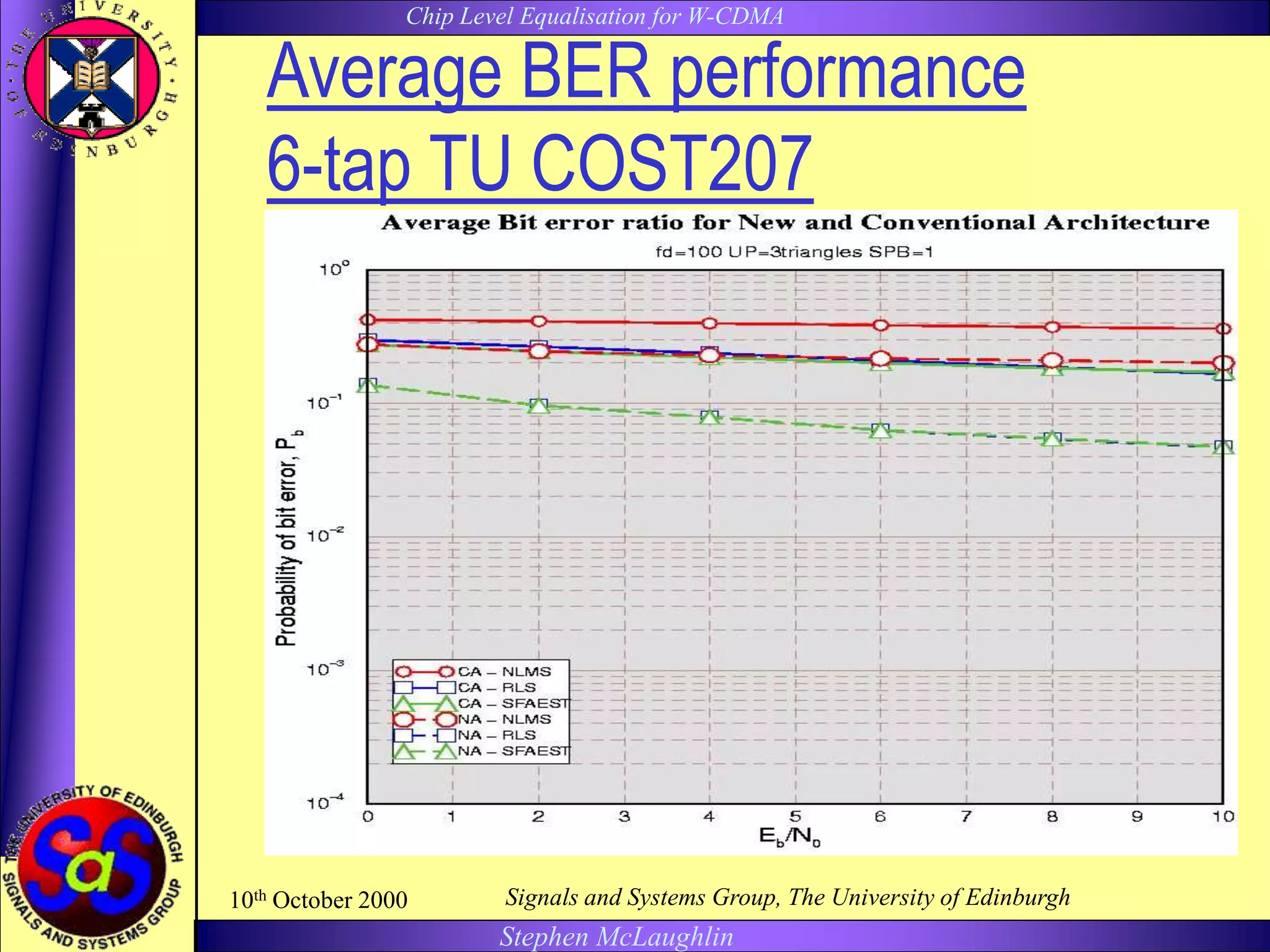
Average BER performance
6-tap TU COST207
Chip Level Equalisation for W-CDMA
Stephen McLaughlin
10th October 2000 Signals and Systems Group, The University of Edinburgh
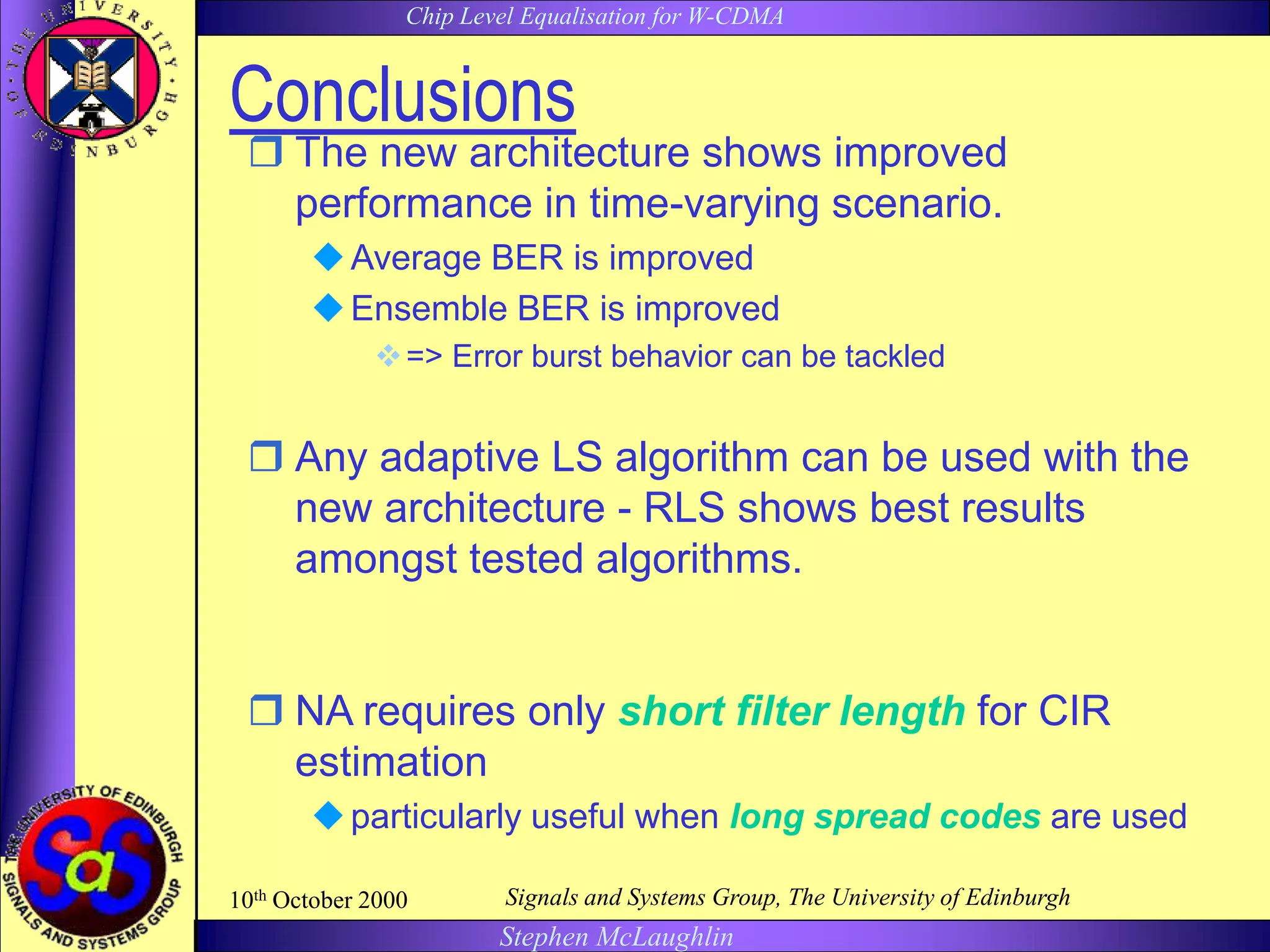
Conclusions
 The new architecture shows improved
performance in time-varying scenario.
Average BER is improved
Ensemble BER is improved
=> Error burst behavior can be tackled
 Any adaptive LS algorithm can be used with the
new architecture - RLS shows best results
amongst tested algorithms.
 NA requires only short filter length for CIR
estimation
particularly useful when long spread codes are used

10 oct00

  • 1.
    Chip level equalisationfor W-CDMA Stephen McLaughlin Dave Cruickshank, Sacha Spangenberg
  • 2.
    Chip Level Equalisationfor W-CDMA Stephen McLaughlin 10th October 2000 Signals and Systems Group, The University of Edinburgh Structure of Presentation Background Adaptive filters for MUD Receiver Architectures for MUD Performance comparison Conclusions
  • 3.
    Chip Level Equalisationfor W-CDMA Stephen McLaughlin 10th October 2000 Signals and Systems Group, The University of Edinburgh Background  Work focused on next generation terminals for mobile communication based on CDMA.  Integration of new services like Web browsing Video conferencing & Real Audio GPS & Traffic Guidance and increasing number of subscribers result in increasing demands on system resources  Interference (ISI/MAI) will reduce Quality of Services unless countermeasures are taken.
  • 4.
    Chip Level Equalisationfor W-CDMA Stephen McLaughlin 10th October 2000 Signals and Systems Group, The University of Edinburgh CDMA Systems:  CDMA multiplexed signals share the same frequency band, but are separated by their distinctive spreading codes  In the ideal case, the spreading codes can be orthogonal to each other and the transmitted signal can be received and de-multiplexed using a simple receiver !  The communication channel however usually destroys the orthogonality of the codes resulting in inter-user interference, an effect more known as Multiple Access Interference, MAI. This degrades the systems performance.
  • 5.
    Chip Level Equalisationfor W-CDMA Stephen McLaughlin 10th October 2000 Signals and Systems Group, The University of Edinburgh Received CDMA Signal:  The impulse response of the communication channel also introduces an effect known as Intersymbol Interference, ISI, which results in the undesirable overlapping between at least two independent signals.  Finally, the presence of additive random noise, ARN, at the receiver is unavoidable.  Therefore, the wanted user’s received signal, rw, consists of a number of unwanted terms: rw = sw + MAI + ISI + ARN  There are several types of CDMA receiver structures with varying performance and complexity (very simple (MF) - very complicated (ML)). Unwanted termsDesired term
  • 6.
    Chip Level Equalisationfor W-CDMA Stephen McLaughlin 10th October 2000 Signals and Systems Group, The University of Edinburgh )1( d )(k d )(K d )1( c )(k c )( K c + C s )(k h + )(k H )(k A )(k nChannel )(k x d Noise Background  d(k) : Data vector user k d: Combined data vector  c(k) : CDMA code user k C: Code delay matrix  h(k) : Channel impulse response (CIR) user k  H : CIR delay matrix A: System matrix x(k)=A(k)d+n(k) Downlink CDMA
  • 7.
    Chip Level Equalisationfor W-CDMA Stephen McLaughlin 10th October 2000 Signals and Systems Group, The University of Edinburgh MUD basics Why multiuser detection (MUD)? MUD addresses the interference problem by cancelling or suppressing interfering users and multipath effects from the desired users signal. In the Base Station (uplink) … knowledge of all users codes, data and CIRs can be used to enhance the signal of a specific user. In the Mobile Station (downlink) … limited knowledge of users codes and estimates CIR, hence sub-optimum approaches need to be considered.
  • 8.
    Chip Level Equalisationfor W-CDMA Stephen McLaughlin 10th October 2000 Signals and Systems Group, The University of Edinburgh MUD basics Required knowledge:  CDMA codes of all K users and  Channel impulse responses of all K users. Depending on the data detection scheme:  Covariance matrix of transmitted data  Covariance matrix of noise vector MUD Receiver User 1 Prior user knowledge, Feedback Multi-path channel Noise CDMA codes Channel response Noise Covariance Matrix Data Covariance Matrix received signal User k User K User 1 User k User K
  • 9.
    Chip Level Equalisationfor W-CDMA Stephen McLaughlin 10th October 2000 Signals and Systems Group, The University of Edinburgh General Classification of MUD’s: Cancellation Parallel Successive Hybrid DECORPICMMSEPIC DECORSICPSMLMUD Equalizer MMSE DECOR MUD ML MF
  • 10.
    Chip Level Equalisationfor W-CDMA Stephen McLaughlin 10th October 2000 Signals and Systems Group, The University of Edinburgh Adaptive Filters for MUD Why do we need adaptive filters in MUD receivers?  For the estimation of time-varying channel impulse response time-varying user profile
  • 11.
    Chip Level Equalisationfor W-CDMA Stephen McLaughlin 10th October 2000 Signals and Systems Group, The University of Edinburgh Adaptive Filters for MUD What adaptive filter types do we use?  Linear or non-linear?  LINEAR due to complexity savings  What linear filters are suitable? Transversal filter  LMS based  RLS based  Stochastic Newton Class, i.e. SFAEST? Lattice structure Systolic Arrays  QR-decomposition based RLS
  • 12.
    Chip Level Equalisationfor W-CDMA Stephen McLaughlin 10th October 2000 Signals and Systems Group, The University of Edinburgh Adaptive Filters for MUD Trade-off between Performance Computational complexity Stability We focus on transversal filters and investigate in their ability to support reliable and accurate equalisation in a mobile communication scenario.
  • 13.
    Chip Level Equalisationfor W-CDMA Stephen McLaughlin 10th October 2000 Signals and Systems Group, The University of Edinburgh Adaptive Filters for MUD Most popular algorithms are used first Least Mean Square Recursive Mean Square Traditionally the combined channel impulse response (CCIR) is estimated  one filter that estimates system matrix A
  • 14.
    Chip Level Equalisationfor W-CDMA Stephen McLaughlin 10th October 2000 Signals and Systems Group, The University of Edinburgh )1( d )(k d )(K d )1( c )(k c )( K c + C s )(k h + )(k H )(k A )(k nChannel )(k x d Noise Background  d(k) : Data vector user k d: Combined data vector  c(k) : CDMA code user k C: Code delay matrix  h(k) : Channel impulse response (CIR) user k  H : CIR delay matrix A: System matrix x(k)=A(k)d+n(k) Downlink CDMA
  • 15.
    Chip Level Equalisationfor W-CDMA Stephen McLaughlin 10th October 2000 Signals and Systems Group, The University of Edinburgh Receiver Architectures for MUD (1) The Conventional Architecture (CA)
  • 16.
    Chip Level Equalisationfor W-CDMA Stephen McLaughlin 10th October 2000 Signals and Systems Group, The University of Edinburgh Performance Evaluation (CA)  Apart from the time-varying channel the dynamic user profile adds to the complexity of the equalisation task.  Users switching on and off can cause error bursts in the desired users signal as the equaliser needs time to adapt the filter coefficients. We refer to this as the birth/death problem.  Convergence rates of adaptive filter algorithms therefore are crucial to maintain a suitable bit error ratio.
  • 17.
    Chip Level Equalisationfor W-CDMA Stephen McLaughlin 10th October 2000 Signals and Systems Group, The University of Edinburgh Performance Evaluation (CA)
  • 18.
    Chip Level Equalisationfor W-CDMA Stephen McLaughlin 10th October 2000 Signals and Systems Group, The University of Edinburgh Performance Evaluation (CA)  Simulations show  LMS is too slow in convergence and cannot cope with interference bursts due to birth/death scenario  RLS can handle this but is rather complex  A better solution is required which reduces the complexity of the adaptive filter without performance loss by a) using an adaptive algorithm with lower computational complexity b) modifying the task of the adaptive filter to reduce complexity
  • 19.
    Chip Level Equalisationfor W-CDMA Stephen McLaughlin 10th October 2000 Signals and Systems Group, The University of Edinburgh Receiver Architectures for MUD (2) The New Architecture (NA)
  • 20.
    Chip Level Equalisationfor W-CDMA Stephen McLaughlin 10th October 2000 Signals and Systems Group, The University of Edinburgh Architecture comparison Conventional Architecture  Training of combined channel impulse response  i.e. convolution of code and channel impulse response  Filter length M+P-1  Training at symbol level  hence slow convergence New Architecture  Training of channel impulse response by means of filter  Pre-calculated multiuser detector performs despreading of desired user  Filter length P  Training at chip level  hence fast convergence M = CDMA codelength, P = # of channel taps
  • 21.
    Chip Level Equalisationfor W-CDMA Stephen McLaughlin 10th October 2000 Signals and Systems Group, The University of Edinburgh Simulation parameters Channel parameters  AWGN  6-tap static FIR Coefficients 0.6608, 0.5287, -0.3965, 0.2643, -0.1983, 0.1322  COST207  6-tap Typical Urban  2 Mchip/s datarate  Desired vehicle speed  0-540 km/h  Simulated Doppler Frequencies  50 Hz  27 km/h  100 Hz  54 km/h Adaptive Filter parameters  Memory Length 64 symbols CA 64 symbols NA (=1024 chips) Other essential parameters  16-chip Random Codes  Dynamic User Profile Cycle  32 symbols  Error threshold  10000 Errors or  BER=1e-6 with > 10 Errors  Signal -to-Noise Ratio  6 dB for Ensemble BER  0-10 dB for Average BER NA uses combined signal training
  • 22.
    Chip Level Equalisationfor W-CDMA Stephen McLaughlin 10th October 2000 Signals and Systems Group, The University of Edinburgh Performance comparison
  • 23.
    Chip Level Equalisationfor W-CDMA Stephen McLaughlin 10th October 2000 Signals and Systems Group, The University of Edinburgh Performance comparison Bit error ratio for RLS in new architecture Different training lengths, PG=16, 8 user, 6 tap channel
  • 24.
    Chip Level Equalisationfor W-CDMA Stephen McLaughlin 10th October 2000 Signals and Systems Group, The University of Edinburgh Performance comparison Bit error ratio for NLMS in new architecture Different training lengths, PG=16, 8 user, 6 tap channel
  • 25.
    Chip Level Equalisationfor W-CDMA Stephen McLaughlin 10th October 2000 Signals and Systems Group, The University of Edinburgh Ensemble BER performance 6-tap TU COST207
  • 26.
    Chip Level Equalisationfor W-CDMA Stephen McLaughlin 10th October 2000 Signals and Systems Group, The University of Edinburgh Ensemble BER performance 6-tap TU COST207
  • 27.
    Chip Level Equalisationfor W-CDMA Stephen McLaughlin 10th October 2000 Signals and Systems Group, The University of Edinburgh Average BER performance 6-tap TU COST207
  • 28.
    Chip Level Equalisationfor W-CDMA Stephen McLaughlin 10th October 2000 Signals and Systems Group, The University of Edinburgh Conclusions  The new architecture shows improved performance in time-varying scenario. Average BER is improved Ensemble BER is improved => Error burst behavior can be tackled  Any adaptive LS algorithm can be used with the new architecture - RLS shows best results amongst tested algorithms.  NA requires only short filter length for CIR estimation particularly useful when long spread codes are used