肺  癌 LUNG CANCER 中山大学肿瘤医院 王 思 愚
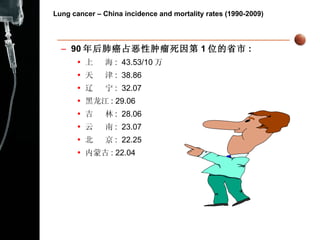
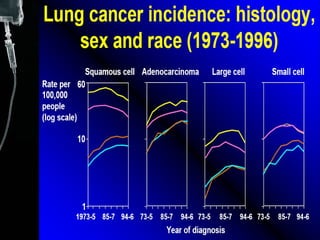
Lung cancer – China incidence and mortality rates (1990-2009) 90 年后肺癌占恶性肿瘤死因第 1 位的省市 : 上  海 :  43.53/10 万 天  津 :  38.86 辽  宁 :  32.07 黑龙江 : 29.06 吉  林 :  28.06 云  南 :  23.07 北  京 :  22.25 内蒙古 : 22.04
 
 
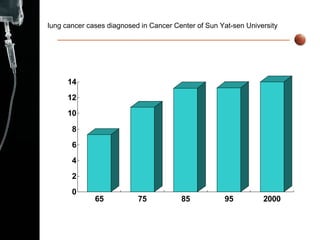
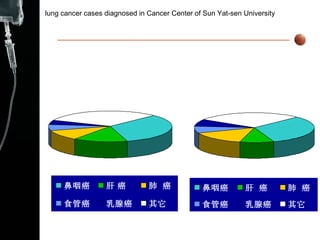
lung cancer cases diagnosed in Cancer Center of Sun Yat-sen University
Etiology of Lung Cancer Cigarette smoking FHIT gene Air pollutions and ionizing radiation Occupational associations asbestos, uranium( in miners), arsenical fumes, nickel, radon gas   Oncogenes and suppressor genes ras,myc,bcl-2,c-erbB-2  p53,RB
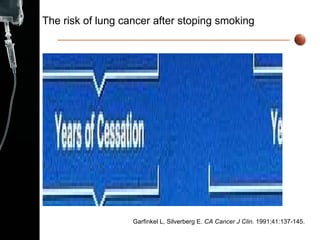
The risk of lung cancer after stoping smoking Garfinkel L, Silverberg E.  CA Cancer J Clin.  1991;41:137-145.
Classifications According to anatomy   Central lung cancer: mostly is squamous and small cell carcinoma.  Peripheral lung cancer: mostly is adenous. According to histologic classification   -- SCLC  (15-20%) --NSCLC  (80-85%) includes squamous 、  large cell,  adenocarcinoma, adenosquamous . Squamous Non-squamous
 
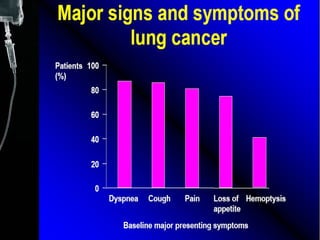
Clinical Manifestations Development  and symptoms usually asymptomatic :early stage of the lung cancer  Cough: invasion of  small bronchi hemoptysis: erosion into  vessels chest pain: invasion of the pleura, chest wall, or mediastinum  dyspnea and fever :obstruct airway: pleural effusion :invasion of the pleura Other symptoms :  inappetence  , weight loss
Clinical Manifestations Paraneoplasic syndromes  associated with brochogenic carcinoma often stem from release of the following hormones: ①     ADH (syndrome of inappropriate antidiuretic hormone reslease). ②     ATCH (Cushing’s syndrome). ③     Parathormone or PGE (hypercalcemia). ④     Calcitionin (hypocalcemia).
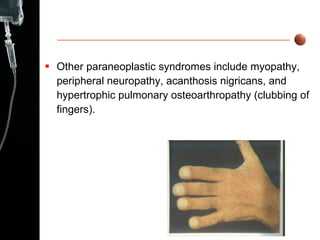
Other paraneoplastic syndromes include myopathy, peripheral neuropathy, acanthosis nigricans, and hypertrophic pulmonary osteoarthropathy (clubbing of fingers).
Diagnosis of lung cancer requires: A: detecting the tumor.  B: establish the cell type.  C: define  the  stage of the tumor.  determing cell type is the most  important  because it  influences  the  treatment !
 
Physical examinations Usually in early stage, most of the patients with lung cancer have no positive physical findings. General findings include abnormal percussion, breath sounds changes, moist rales (when pneumonia happens) Digital clubbing, superior vena cava syndrome, horner’s syndrome (unilaterally constricted pupil, enophthalmos, narrowed palpebral fissure and loss of sweating on the same side of the face.
Physical examinations Endobronchial obstruction may result in a localized wheeze Lobar collapse may  result  in an area of decreased breath sounds and dullness to percussion.
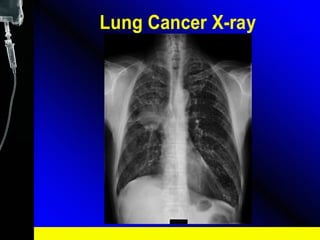
Chest X-ray  It is the most important method to find lung cancer. If a patient with chronic cough, sputum with few blood, and dyspnea, lower fever he should adopt a chest X-ray. The most frequent finding is a mass in the lung field.
chest X-ray Secondary manifestations include lobar collapse, pleural effusion, pneumonitis, elevation of the hemidiaphragm, hilar and mediastinal adenopathy, and erosion of ribs or vertebrae due to metastases.
 
 
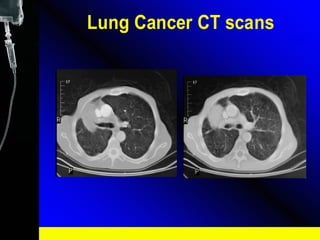
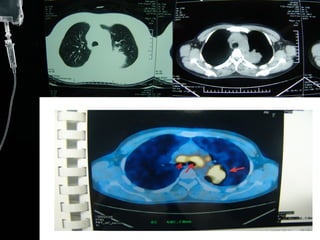
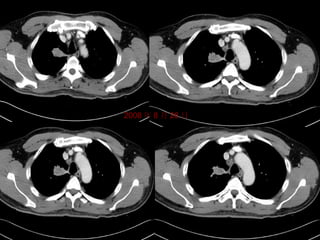
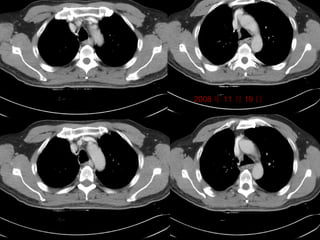
Lung cancer on CT  CT is the most useful in evaluating patients with pulmonary and mediastinal masses. It is also useful for detecting multiple metastases. CT can show a mass to be located in which lobe of lung field and the size of the mass. It also shows the nodule in the mediastinum. Sometimes, when a mass locate behind the heart, chest X-ray can`t detect it .CT can detect some secret sites of lung cancer.
 
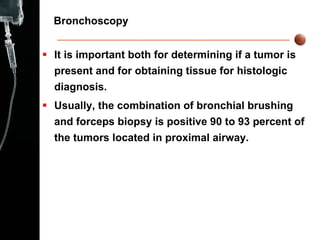
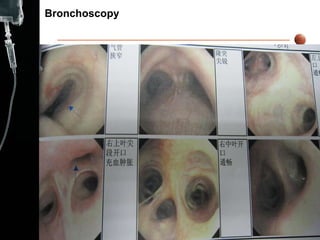
Bronchoscopy  It is important both for   determining if a tumor is present and for obtaining tissue for histologic diagnosis. Usually, the combination of bronchial brushing and forceps biopsy is positive 90 to 93 percent of the tumors located in proximal airway.
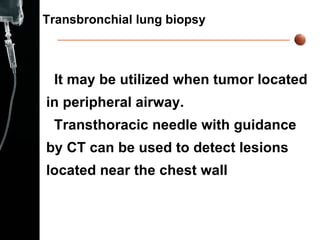
Transbronchial lung biopsy It may be utilized when tumor located  in peripheral airway. Transthoracic needle with guidance  by CT can be used to detect lesions  located near the chest wall
 
2008 年 8 月 28 日
Bronchoscopy
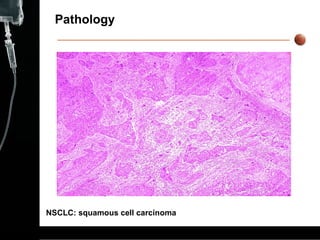
Pathology  NSCLC: squamous cell carcinoma
2008 年 11 月 19 日
What should we do before treament ? Histology classification SCLC NSCLC Staging Treatment based on Evidenced  Medicine Follow up plan
Staging of lung cancer TNM stage: CTNM, PTNM T: Primary Tumor (TX, T0) T1, T2, T3, T4 N: Nodal Involvement N0, N1, N2, N3 M: Distant metastasis M0, M1 The relationship of clinical stage and TNM stage Staging of small cell lung cancer  limited stage extensive stage .
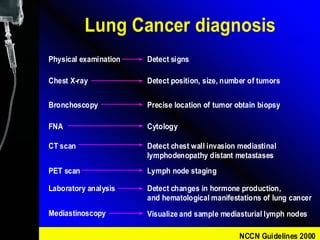
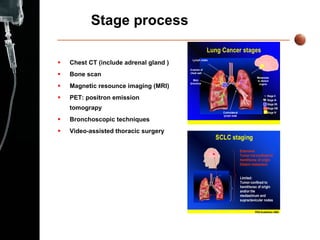
Stage process Chest CT (include adrenal gland ) Bone scan Magnetic resounce imaging (MRI)  PET: positron emission tomograpy Bronchoscopic techniques Video-assisted thoracic surgery
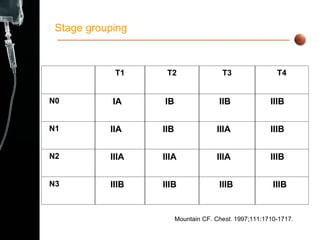
Stage grouping Mountain   CF.  Chest.  1997;111:1710-1717. IIIB IIIB IIIB IIIB N3 IIIB IIIA IIIA IIIA N2 IIIB IIIA IIB IIA N1 IIIB IIB IB IA N0 T4 T3 T2 T1
 
Treatment Including: A: Surgery B: Chemotherapy C: Radiation therapy D: Targeted therapy E: Some other therapy  immunologic therapy chinese medicine
Surgery Non-small cell lung cancer:  patients with stage I and II are considered  candidates for surgical resection, with stage III  cancer may be candidates for surgery.
Surgery More than 90 percent of small cell lung cancer has often metastasized at the time of diagnosis. So these patients usually adopt radiation therapy or chemotherapy before surgery. We must measure pulmonary function before surgical therapy.
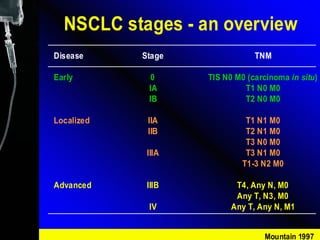
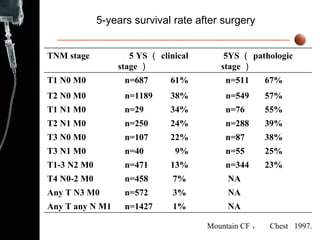
5-years survival rate after surgery Mountain CF ,  Chest  1997. TNM stage 5 YS ( clinical stage ) 5YS ( pathologic stage ) T1 N0 M0 n=687  61% n=511  67% T2 N0 M0 n=1189  38% n=549  57% T1 N1 M0 n=29  34% n=76  55% T2 N1 M0 n=250  24% n=288  39% T3 N0 M0 n=107  22% n=87  38% T3 N1 M0 n=40  9% n=55  25% T1-3 N2 M0 n=471  13% n=344  23% T4 N0-2 M0 n=458  7% NA Any T N3 M0 n=572  3% NA Any T any N M1 n=1427  1% NA
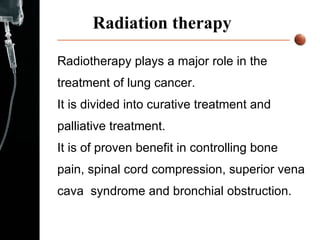
Radiation therapy Radiotherapy plays a major role in the treatment of lung cancer. It is divided into curative treatment and palliative treatment.  It is of proven benefit in controlling bone pain, spinal cord compression, superior vena cava  syndrome and bronchial obstruction.
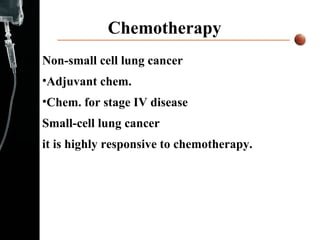
Chemotherapy Non-small cell lung cancer Adjuvant chem. Chem. for stage IV disease  Small-cell lung cancer  it is highly responsive to chemotherapy.
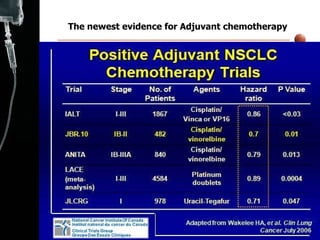
The newest evidence for Adjuvant chemotherapy
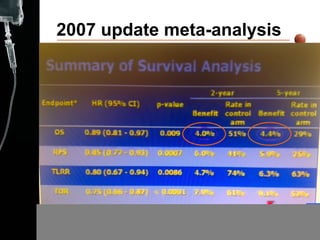
2007 update meta-analysis
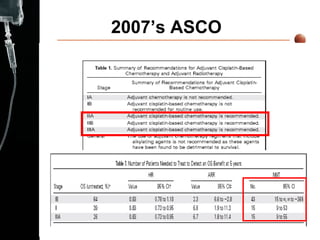
2007’s ASCO
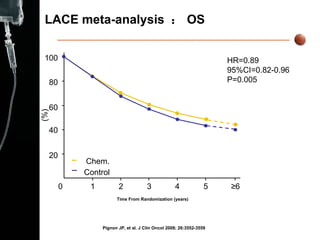
LACE meta-analysis   : OS HR=0.89 95%CI=0.82-0.96 P=0.005 Pignon JP, et al. J Clin Oncol 2008; 26:3552-3559 100 80 60 40 20 0 1 2 3 4 5 ≥ 6 Time From Randomization (years) Chem. Control 总体生存  (%)
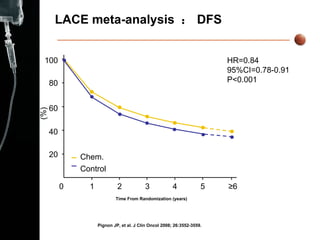
LACE meta-analysis  : DFS HR=0.84 95%CI=0.78-0.91 P<0.001 Pignon JP, et al. J Clin Oncol 2008; 26:3552-3559. Time From Randomization (years) 100 80 60 40 20 0 1 2 3 4 5 ≥ 6 Chem. Control 无病生存  (%)
LACE meta-analysis  : Survival according to type of death. Decreases lung cancer–related death (HR=0.83, 95%CI=0.76-0.90, P<0.001) Increase noncancer-related death (HR=1.36, 95%CI=1.10-1.69, P=0.004) 主要出现在前 6 个月  (HR=2.41, 95%CI=1.64-3.55, P<0.001) Pignon JP, et al. J Clin Oncol 2008; 26:3552-3559.[ 临床肿瘤学杂志中文版  2009; 3(1): 10-17.] 100 80 60 40 20 0 1 2 3 4 5 ≥ 6 Time From Randomization (years) Survival (%) Chem. ( noncancer-related death   ) Cont  (noncancer-related death   ) 化疗 ( 癌症相关死亡 ) 不化疗 ( 癌症相关死亡 )
 
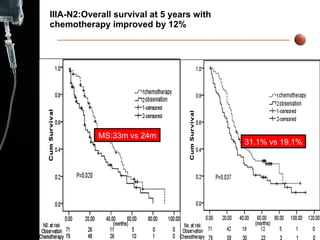
IIIA-N2:Overall survival at 5 years with chemotherapy improved by 12% 31.1% vs 19.1% MS:33m vs 24m
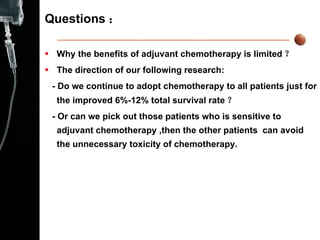
Questions : Why the benefits of adjuvant chemotherapy is limited ? The direction of our following research: - Do we continue to adopt chemotherapy to all patients just for the improved 6%-12% total survival rate ? - Or can we pick out those patients who is sensitive to adjuvant chemotherapy ,then the other patients  can avoid the unnecessary toxicity of chemotherapy.
 
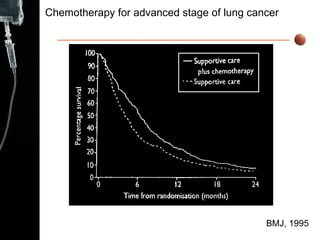
Chemotherapy for advanced stage of lung cancer BMJ, 1995
NSCLC Meta-analyses NSCLC Meta-analyses Collaborative Group. JCO 2008; 26:4617-25 .[ 临床肿瘤学杂志中文版  2009; 3(2): 45.] 16 项 RCT 2714 例患者 IPD 资料 HR=0.77 95%CI=0.71-0.83 P≤0.0001 1YS: 29% vs. 20% 1.0 0.8 0.6 0.4 0.2 0 3 6 9 12 15 18 21 24 时间  ( 月 ) 概率 事件数 患者总数 1240 1293 1315 1399 SC+CT 仅 SC
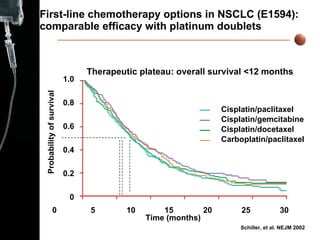
First-line chemotherapy options in NSCLC  (E1594):  comparable efficacy with platinum doublets   Schiller, et al. NEJM 2002 1.0 0.8 0.6 0.4 0.2 0 0 5 10 15 20 25 30 Time (months) Cisplatin/paclitaxel Cisplatin/gemcitabine Cisplatin/docetaxel Carboplatin/paclitaxel Probability of survival Therapeutic plateau: overall survival <12 months
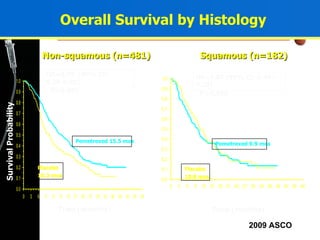
Overall Survival by Histology Non-squamous (n=481) Squamous (n=182) HR=0.70  (95% CI: 0.56-0.88) P  =0.002 HR=1.07 (95% CI: 0.49–0.73) P  =0.678 Survival Probability Time (months)  Time (months)  2009 ASCO Pemetrexed 15.5 mos Pemetrexed 9.9 mos Placebo  10.3 mos Placebo  10.8 mos
Targeted therapy Such as epidermal growth factor receptor inhibitors, angiogenesis inhibitors and apoptosis inducers ects.


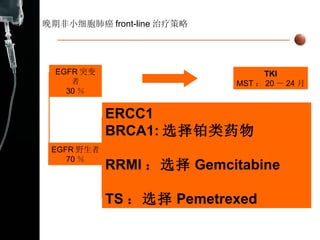
晚期非小细胞肺癌 front-line 治疗策略 EGFR 突变者 30 % TKI MST : 20 - 24 月 EGFR 野生者 70 % 腺癌 35 % 鳞癌 35 % 第三代+铂类 10 月 维持治疗 13 月 培美曲塞+铂类: 11.8 月 西妥昔单抗 或贝伐单抗 12 - 16 月 + ERCC1 BRCA1: 选择铂类药物 RRMI :选择 Gemcitabine TS :选择 Pemetrexed
Treatment of Lung Cancer NSCLC Ⅰ ,Ⅱ,N0N1 of Ⅲa stage: surgery + adjuvant chemotherapy for those patients who is N0-1  and had radical resection of lung cancer, adjuvant radiotherapy is not only inefficacy but do harm to patients. N2 of ⅢA stage: neoadjuvant chemotherapy Ⅲ B stage:  chemotherapy + radiotherapy (surgery when it is needed.) Ⅳ stage: chemotherapy and targeted therapy. SCLC limited stage: chemotherapy + surgery  /  radiotherapy -- chemotherapy extensive stage : chiefly chemotherapy
致谢胸科全体家人!

10 lung cancer

  • 1.
    肺 癌LUNG CANCER 中山大学肿瘤医院 王 思 愚
  • 2.
    Lung cancer –China incidence and mortality rates (1990-2009) 90 年后肺癌占恶性肿瘤死因第 1 位的省市 : 上 海 : 43.53/10 万 天 津 : 38.86 辽 宁 : 32.07 黑龙江 : 29.06 吉 林 : 28.06 云 南 : 23.07 北 京 : 22.25 内蒙古 : 22.04
  • 3.
  • 4.
  • 5.
    lung cancer casesdiagnosed in Cancer Center of Sun Yat-sen University
  • 6.
    lung cancer casesdiagnosed in Cancer Center of Sun Yat-sen University
  • 7.
    Etiology of LungCancer Cigarette smoking FHIT gene Air pollutions and ionizing radiation Occupational associations asbestos, uranium( in miners), arsenical fumes, nickel, radon gas Oncogenes and suppressor genes ras,myc,bcl-2,c-erbB-2 p53,RB
  • 8.
    The risk oflung cancer after stoping smoking Garfinkel L, Silverberg E. CA Cancer J Clin. 1991;41:137-145.
  • 9.
    Classifications According toanatomy Central lung cancer: mostly is squamous and small cell carcinoma. Peripheral lung cancer: mostly is adenous. According to histologic classification -- SCLC (15-20%) --NSCLC (80-85%) includes squamous 、 large cell, adenocarcinoma, adenosquamous . Squamous Non-squamous
  • 10.
  • 11.
    Clinical Manifestations Development and symptoms usually asymptomatic :early stage of the lung cancer Cough: invasion of small bronchi hemoptysis: erosion into vessels chest pain: invasion of the pleura, chest wall, or mediastinum dyspnea and fever :obstruct airway: pleural effusion :invasion of the pleura Other symptoms : inappetence , weight loss
  • 12.
    Clinical Manifestations Paraneoplasicsyndromes associated with brochogenic carcinoma often stem from release of the following hormones: ①    ADH (syndrome of inappropriate antidiuretic hormone reslease). ②    ATCH (Cushing’s syndrome). ③    Parathormone or PGE (hypercalcemia). ④    Calcitionin (hypocalcemia).
  • 13.
    Other paraneoplastic syndromesinclude myopathy, peripheral neuropathy, acanthosis nigricans, and hypertrophic pulmonary osteoarthropathy (clubbing of fingers).
  • 14.
    Diagnosis of lungcancer requires: A: detecting the tumor. B: establish the cell type. C: define the stage of the tumor. determing cell type is the most important because it influences the treatment !
  • 15.
  • 16.
    Physical examinations Usuallyin early stage, most of the patients with lung cancer have no positive physical findings. General findings include abnormal percussion, breath sounds changes, moist rales (when pneumonia happens) Digital clubbing, superior vena cava syndrome, horner’s syndrome (unilaterally constricted pupil, enophthalmos, narrowed palpebral fissure and loss of sweating on the same side of the face.
  • 17.
    Physical examinations Endobronchialobstruction may result in a localized wheeze Lobar collapse may result in an area of decreased breath sounds and dullness to percussion.
  • 18.
    Chest X-ray It is the most important method to find lung cancer. If a patient with chronic cough, sputum with few blood, and dyspnea, lower fever he should adopt a chest X-ray. The most frequent finding is a mass in the lung field.
  • 19.
    chest X-ray Secondarymanifestations include lobar collapse, pleural effusion, pneumonitis, elevation of the hemidiaphragm, hilar and mediastinal adenopathy, and erosion of ribs or vertebrae due to metastases.
  • 20.
  • 21.
  • 22.
    Lung cancer onCT CT is the most useful in evaluating patients with pulmonary and mediastinal masses. It is also useful for detecting multiple metastases. CT can show a mass to be located in which lobe of lung field and the size of the mass. It also shows the nodule in the mediastinum. Sometimes, when a mass locate behind the heart, chest X-ray can`t detect it .CT can detect some secret sites of lung cancer.
  • 23.
  • 24.
    Bronchoscopy Itis important both for determining if a tumor is present and for obtaining tissue for histologic diagnosis. Usually, the combination of bronchial brushing and forceps biopsy is positive 90 to 93 percent of the tumors located in proximal airway.
  • 25.
    Transbronchial lung biopsyIt may be utilized when tumor located in peripheral airway. Transthoracic needle with guidance by CT can be used to detect lesions located near the chest wall
  • 26.
  • 27.
    2008 年 8月 28 日
  • 28.
  • 29.
    Pathology NSCLC:squamous cell carcinoma
  • 30.
    2008 年 11月 19 日
  • 31.
    What should wedo before treament ? Histology classification SCLC NSCLC Staging Treatment based on Evidenced Medicine Follow up plan
  • 32.
    Staging of lungcancer TNM stage: CTNM, PTNM T: Primary Tumor (TX, T0) T1, T2, T3, T4 N: Nodal Involvement N0, N1, N2, N3 M: Distant metastasis M0, M1 The relationship of clinical stage and TNM stage Staging of small cell lung cancer limited stage extensive stage .
  • 33.
    Stage process ChestCT (include adrenal gland ) Bone scan Magnetic resounce imaging (MRI) PET: positron emission tomograpy Bronchoscopic techniques Video-assisted thoracic surgery
  • 34.
    Stage grouping Mountain CF. Chest. 1997;111:1710-1717. IIIB IIIB IIIB IIIB N3 IIIB IIIA IIIA IIIA N2 IIIB IIIA IIB IIA N1 IIIB IIB IB IA N0 T4 T3 T2 T1
  • 35.
  • 36.
    Treatment Including: A:Surgery B: Chemotherapy C: Radiation therapy D: Targeted therapy E: Some other therapy immunologic therapy chinese medicine
  • 37.
    Surgery Non-small celllung cancer: patients with stage I and II are considered candidates for surgical resection, with stage III cancer may be candidates for surgery.
  • 38.
    Surgery More than90 percent of small cell lung cancer has often metastasized at the time of diagnosis. So these patients usually adopt radiation therapy or chemotherapy before surgery. We must measure pulmonary function before surgical therapy.
  • 39.
    5-years survival rateafter surgery Mountain CF , Chest 1997. TNM stage 5 YS ( clinical stage ) 5YS ( pathologic stage ) T1 N0 M0 n=687 61% n=511 67% T2 N0 M0 n=1189 38% n=549 57% T1 N1 M0 n=29 34% n=76 55% T2 N1 M0 n=250 24% n=288 39% T3 N0 M0 n=107 22% n=87 38% T3 N1 M0 n=40 9% n=55 25% T1-3 N2 M0 n=471 13% n=344 23% T4 N0-2 M0 n=458 7% NA Any T N3 M0 n=572 3% NA Any T any N M1 n=1427 1% NA
  • 40.
    Radiation therapy Radiotherapyplays a major role in the treatment of lung cancer. It is divided into curative treatment and palliative treatment. It is of proven benefit in controlling bone pain, spinal cord compression, superior vena cava syndrome and bronchial obstruction.
  • 41.
    Chemotherapy Non-small celllung cancer Adjuvant chem. Chem. for stage IV disease Small-cell lung cancer it is highly responsive to chemotherapy.
  • 42.
    The newest evidencefor Adjuvant chemotherapy
  • 43.
  • 44.
  • 45.
    LACE meta-analysis : OS HR=0.89 95%CI=0.82-0.96 P=0.005 Pignon JP, et al. J Clin Oncol 2008; 26:3552-3559 100 80 60 40 20 0 1 2 3 4 5 ≥ 6 Time From Randomization (years) Chem. Control 总体生存 (%)
  • 46.
    LACE meta-analysis : DFS HR=0.84 95%CI=0.78-0.91 P<0.001 Pignon JP, et al. J Clin Oncol 2008; 26:3552-3559. Time From Randomization (years) 100 80 60 40 20 0 1 2 3 4 5 ≥ 6 Chem. Control 无病生存 (%)
  • 47.
    LACE meta-analysis : Survival according to type of death. Decreases lung cancer–related death (HR=0.83, 95%CI=0.76-0.90, P<0.001) Increase noncancer-related death (HR=1.36, 95%CI=1.10-1.69, P=0.004) 主要出现在前 6 个月 (HR=2.41, 95%CI=1.64-3.55, P<0.001) Pignon JP, et al. J Clin Oncol 2008; 26:3552-3559.[ 临床肿瘤学杂志中文版 2009; 3(1): 10-17.] 100 80 60 40 20 0 1 2 3 4 5 ≥ 6 Time From Randomization (years) Survival (%) Chem. ( noncancer-related death ) Cont (noncancer-related death ) 化疗 ( 癌症相关死亡 ) 不化疗 ( 癌症相关死亡 )
  • 48.
  • 49.
    IIIA-N2:Overall survival at5 years with chemotherapy improved by 12% 31.1% vs 19.1% MS:33m vs 24m
  • 50.
    Questions : Whythe benefits of adjuvant chemotherapy is limited ? The direction of our following research: - Do we continue to adopt chemotherapy to all patients just for the improved 6%-12% total survival rate ? - Or can we pick out those patients who is sensitive to adjuvant chemotherapy ,then the other patients can avoid the unnecessary toxicity of chemotherapy.
  • 51.
  • 52.
    Chemotherapy for advancedstage of lung cancer BMJ, 1995
  • 53.
    NSCLC Meta-analyses NSCLCMeta-analyses Collaborative Group. JCO 2008; 26:4617-25 .[ 临床肿瘤学杂志中文版 2009; 3(2): 45.] 16 项 RCT 2714 例患者 IPD 资料 HR=0.77 95%CI=0.71-0.83 P≤0.0001 1YS: 29% vs. 20% 1.0 0.8 0.6 0.4 0.2 0 3 6 9 12 15 18 21 24 时间 ( 月 ) 概率 事件数 患者总数 1240 1293 1315 1399 SC+CT 仅 SC
  • 54.
    First-line chemotherapy optionsin NSCLC (E1594): comparable efficacy with platinum doublets Schiller, et al. NEJM 2002 1.0 0.8 0.6 0.4 0.2 0 0 5 10 15 20 25 30 Time (months) Cisplatin/paclitaxel Cisplatin/gemcitabine Cisplatin/docetaxel Carboplatin/paclitaxel Probability of survival Therapeutic plateau: overall survival <12 months
  • 55.
    Overall Survival byHistology Non-squamous (n=481) Squamous (n=182) HR=0.70 (95% CI: 0.56-0.88) P =0.002 HR=1.07 (95% CI: 0.49–0.73) P =0.678 Survival Probability Time (months) Time (months) 2009 ASCO Pemetrexed 15.5 mos Pemetrexed 9.9 mos Placebo 10.3 mos Placebo 10.8 mos
  • 56.
    Targeted therapy Suchas epidermal growth factor receptor inhibitors, angiogenesis inhibitors and apoptosis inducers ects.
  • 57.
  • 58.
  • 59.
  • 60.
    晚期非小细胞肺癌 front-line 治疗策略EGFR 突变者 30 % TKI MST : 20 - 24 月 EGFR 野生者 70 % 腺癌 35 % 鳞癌 35 % 第三代+铂类 10 月 维持治疗 13 月 培美曲塞+铂类: 11.8 月 西妥昔单抗 或贝伐单抗 12 - 16 月 + ERCC1 BRCA1: 选择铂类药物 RRMI :选择 Gemcitabine TS :选择 Pemetrexed
  • 61.
    Treatment of LungCancer NSCLC Ⅰ ,Ⅱ,N0N1 of Ⅲa stage: surgery + adjuvant chemotherapy for those patients who is N0-1 and had radical resection of lung cancer, adjuvant radiotherapy is not only inefficacy but do harm to patients. N2 of ⅢA stage: neoadjuvant chemotherapy Ⅲ B stage: chemotherapy + radiotherapy (surgery when it is needed.) Ⅳ stage: chemotherapy and targeted therapy. SCLC limited stage: chemotherapy + surgery / radiotherapy -- chemotherapy extensive stage : chiefly chemotherapy
  • 62.

Editor's Notes

  • #9 Garfinkel L, Silverberg E. Lung cancer and smoking trends in the United States over the past 25 years. CA Cancer J Clin. 1991;41:137-145.
  • #30 Squamous cell carcinoma: These tumours consist of layers of epithelial cells that secrete keratin, and therefore often present as obstructing tumours in the bronchi. They are the most common type of lung cancer representing 30-50% of all cases. The histological type of NSCLC may affect treatment outcome. Non-squamous cell carcinomas were twice as likely as squamous cell carcinomas to recur after surgery in one study (0.088 and 0.042 recurrences per patient per year, respectively), even though all the cancers were the same stage (T1 N0). 1 Bronchoalveolar carcinoma, a sub-type of adenocarcinoma, presents at an earlier stage than other adenocarcinomas, appears to be less aggressive, and is associated with better survival. Early diagnosis and surgical treatment are therefore particularly valuable in nodular bronchoalveolar carcinoma. 2 In contrast with other bronchial carcinomas, survival of patients with bronchoalveolar carcinoma is influenced more by the extent of lung involvement (eg presence of bilateral lesions, production of mucin by tumor cells) than by the extent of lymph node metastases. 3 1. Thomas P, Rubinstein L. Ann Thorac Surg 1990; 49: 242-247. 2. Grover FL, Piantadosi S. Ann Surg 1989; 209: 779-790. 3. Daly RC, et al. Ann Thorac Surg 1991; 51: 368-377.
  • #34 After obtaining the diagnosis of lung cancer through bronchoscopy, transbronchial needle aspiration, transthoracic needle aspiration, or mediastinoscopy, further diagnostic evaluations are directed at evaluating the extension of the disease. Diagnostic evaluation should include a chest X-ray and chest CT that encompasses the liver and adrenal glands.
  • #35 Clinical staging of lung cancer helps to determine the extent of disease and stratify patients into similar prognostic and therapeutic categories. An important goal is to separate patients with potentially resectable disease from those who have unresectable disease. The most recent staging system for lung cancer was published in 1997, replacing the 1986 classification. Mountain CF. Revisions in the International System for Staging Lung Cancer. Chest. 1997; 111:1710-1717.