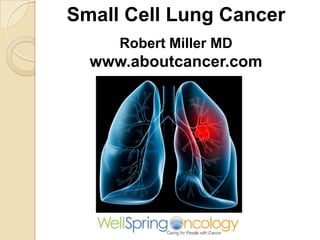
Small Cell Lung Cancer
Robert Miller MD
www.aboutcancer.com
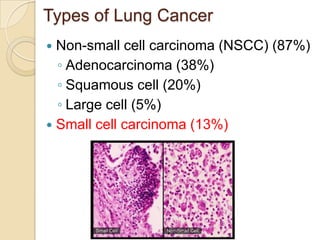
Types of Lung Cancer
 Non-small cell carcinoma (NSCC) (87%)
◦ Adenocarcinoma (38%)
◦ Squamous cell (20%)
◦ Large cell (5%)
 Small cell carcinoma (13%)
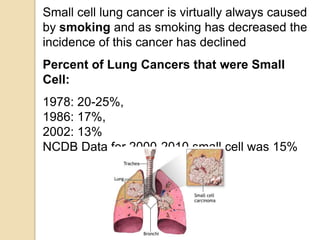
Small cell lung cancer is virtually always caused
by smoking and as smoking has decreased the
incidence of this cancer has declined
Percent of Lung Cancers that were Small
Cell:
1978: 20-25%,
1986: 17%,
2002: 13%
NCDB Data for 2000-2010 small cell was 15%
Since women have
not cut back on smoking as much as men,
the frequency of small cell in women has
increased
Women accounted for 28% in 1973 and in
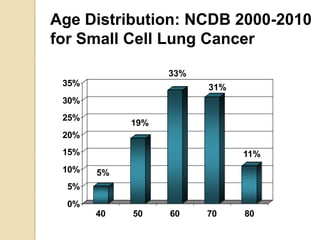
0%
5%
10%
15%
20%
25%
30%
35%
40 50 60 70 80
11%
31%
33%
19%
5%
Age Distribution: NCDB 2000-2010
for Small Cell Lung Cancer
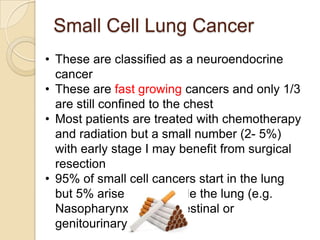
Small Cell Lung Cancer
• These are classified as a neuroendocrine
cancer
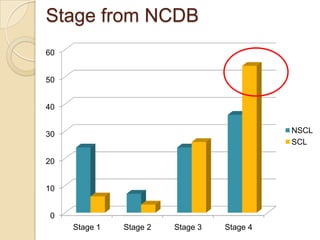
• These are fast growing cancers and only 1/3
are still confined to the chest
• Most patients are treated with chemotherapy
and radiation but a small number (2- 5%)
with early stage I may benefit from surgical
resection
• 95% of small cell cancers start in the lung
but 5% arise from outside the lung (e.g.
Nasopharynx, gastrointestinal or
genitourinary sites
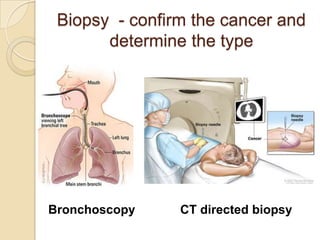
Biopsy - confirm the cancer and
determine the type
Bronchoscopy CT directed biopsy
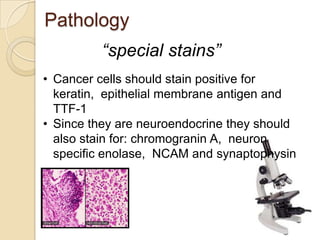
Pathology
• Cancer cells should stain positive for
keratin, epithelial membrane antigen and
TTF-1
• Since they are neuroendocrine they should
also stain for: chromogranin A, neuron
specific enolase, NCAM and synaptophysin
“special stains”
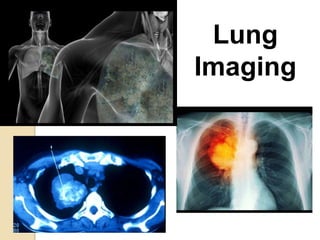
Lung Imaging Lung
Imaging
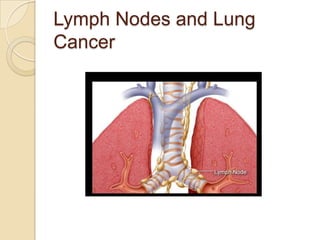
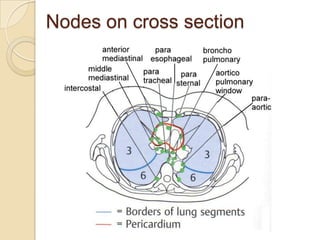
Lymph Nodes and Lung
Cancer
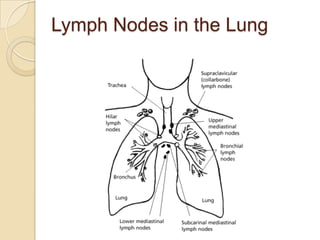
Lymph Nodes in the Lung
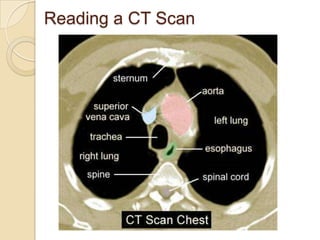
Reading a CT Scan
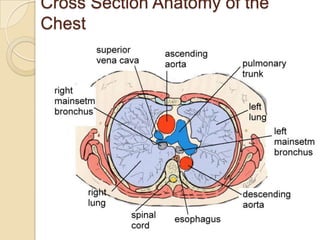
Cross Section Anatomy of the
Chest
Nodes on cross section
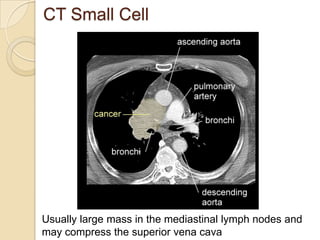
CT Small Cell
Usually large mass in the mediastinal lymph nodes and
may compress the superior vena cava
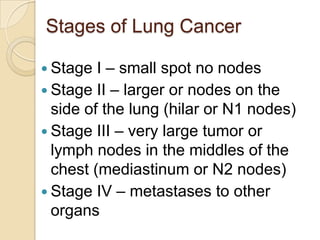
Stages of Lung Cancer
 Stage I – small spot no nodes
 Stage II – larger or nodes on the
side of the lung (hilar or N1 nodes)
 Stage III – very large tumor or
lymph nodes in the middles of the
chest (mediastinum or N2 nodes)
 Stage IV – metastases to other
organs
Stage from NCDB
0
10
20
30
40
50
60
Stage 1 Stage 2 Stage 3 Stage 4
NSCL
SCL
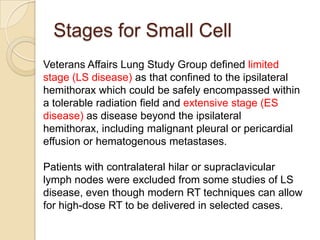
Stages for Small Cell
Veterans Affairs Lung Study Group defined limited
stage (LS disease) as that confined to the ipsilateral
hemithorax which could be safely encompassed within
a tolerable radiation field and extensive stage (ES
disease) as disease beyond the ipsilateral
hemithorax, including malignant pleural or pericardial
effusion or hematogenous metastases.
Patients with contralateral hilar or supraclavicular
lymph nodes were excluded from some studies of LS
disease, even though modern RT techniques can allow
for high-dose RT to be delivered in selected cases.
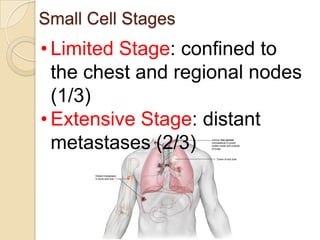
Small Cell Stages
• Limited Stage: confined to
the chest and regional nodes
(1/3)
• Extensive Stage: distant
metastases (2/3)
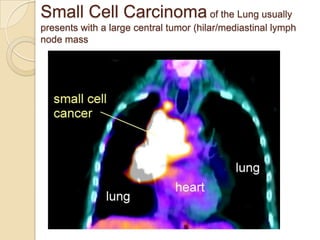
Small Cell Carcinoma of the Lung usually
presents with a large central tumor (hilar/mediastinal lymph
node mass
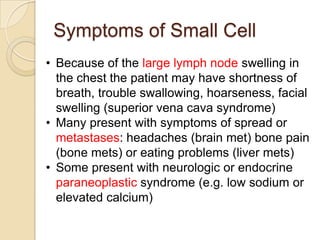
Symptoms of Small Cell
• Because of the large lymph node swelling in
the chest the patient may have shortness of
breath, trouble swallowing, hoarseness, facial
swelling (superior vena cava syndrome)
• Many present with symptoms of spread or
metastases: headaches (brain met) bone pain
(bone mets) or eating problems (liver mets)
• Some present with neurologic or endocrine
paraneoplastic syndrome (e.g. low sodium or
elevated calcium)
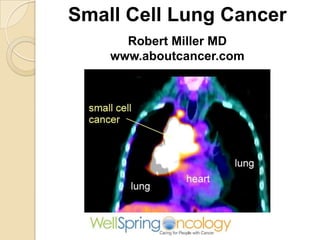
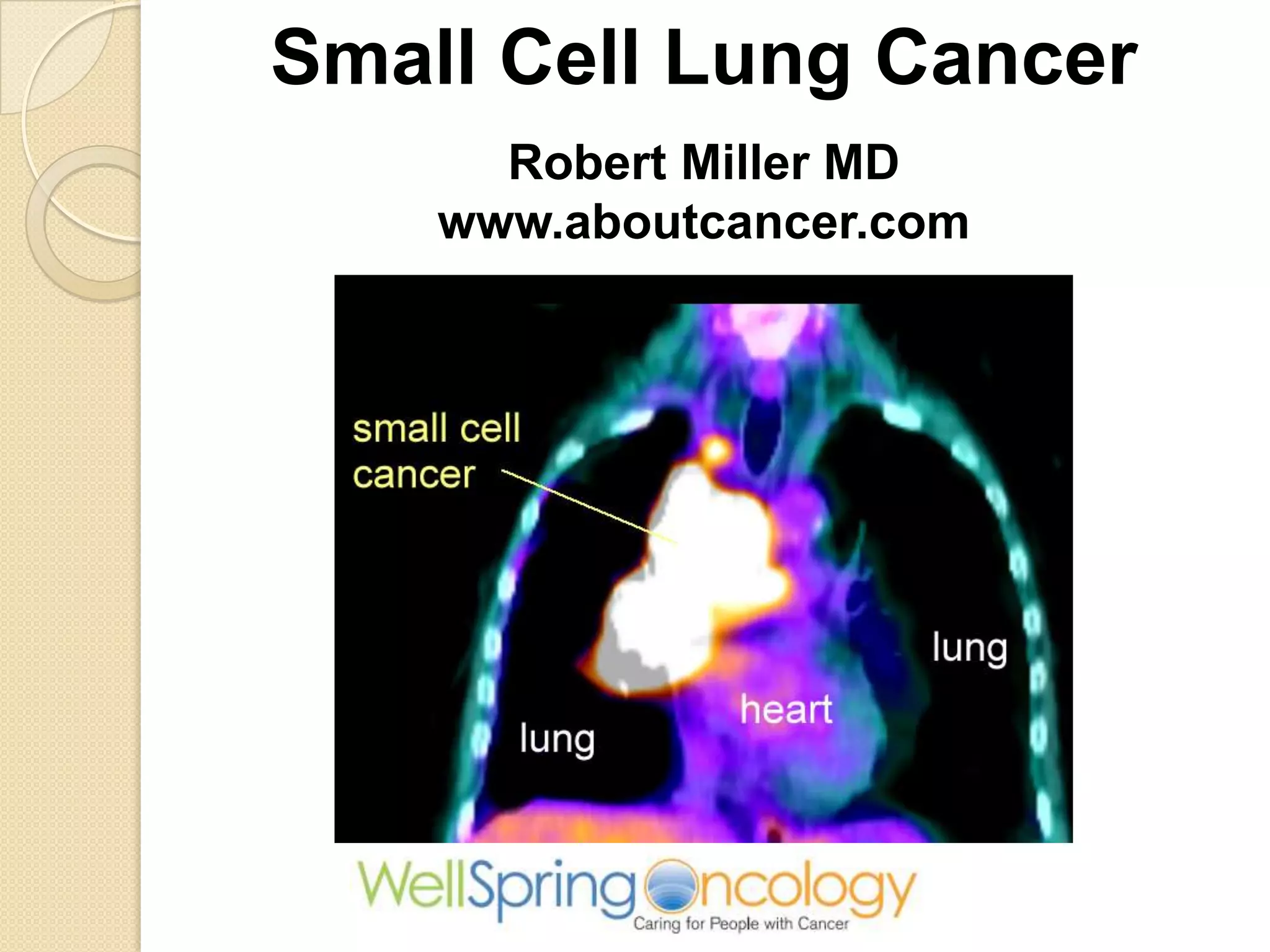
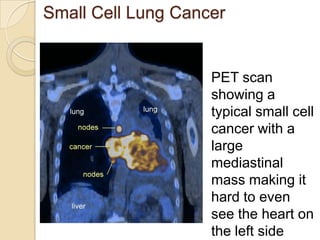
PET scan
showing a
typical small cell
cancer with a
large
mediastinal
mass making it
hard to even
see the heart on
the left side
Small Cell Lung Cancer
NCCN.org
NCCN.com
Treatment for Small Cell
Lung Cancer
Limited Stage: consider surgery
resection for early stage followed by
chemotherapy +/-
radiation, otherwise most patients
get chemotherapy plus radiation
Extensive Stage: unless very weak
consider chemotherapy +/- radiation
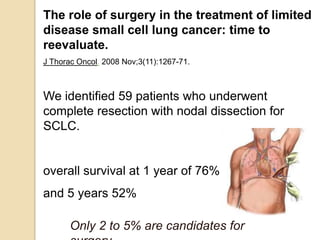
The role of surgery in the treatment of limited
disease small cell lung cancer: time to
reevaluate.
J Thorac Oncol. 2008 Nov;3(11):1267-71.
We identified 59 patients who underwent
complete resection with nodal dissection for
SCLC.
overall survival at 1 year of 76%
and 5 years 52%
Only 2 to 5% are candidates for
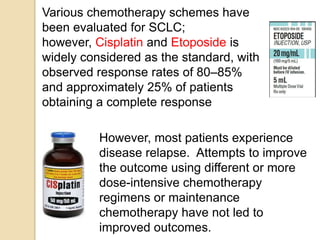
Various chemotherapy schemes have
been evaluated for SCLC;
however, Cisplatin and Etoposide is
widely considered as the standard, with
observed response rates of 80–85%
and approximately 25% of patients
obtaining a complete response
However, most patients experience
disease relapse. Attempts to improve
the outcome using different or more
dose-intensive chemotherapy
regimens or maintenance
chemotherapy have not led to
improved outcomes.
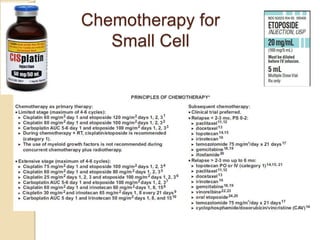
Chemotherapy for
Small Cell
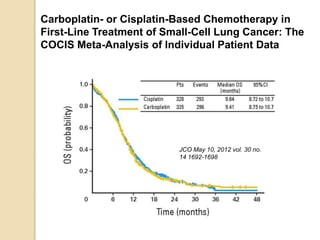
Carboplatin- or Cisplatin-Based Chemotherapy in
First-Line Treatment of Small-Cell Lung Cancer: The
COCIS Meta-Analysis of Individual Patient Data
JCO May 10, 2012 vol. 30 no.
14 1692-1698
Radiation for Small Cell
• Adding radiation to chemotherapy
will lower the risk of lung relapse by
25 to 30% and increase the
survival by 5 to 7%
• Radiation dose to the lung can be
twice a day to 45Gy or daily to 60 –
70 Gy
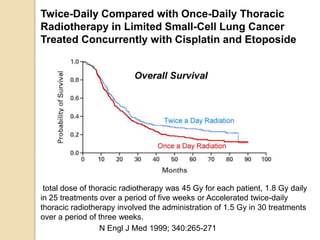
Twice-Daily Compared with Once-Daily Thoracic
Radiotherapy in Limited Small-Cell Lung Cancer
Treated Concurrently with Cisplatin and Etoposide
N Engl J Med 1999; 340:265-271
total dose of thoracic radiotherapy was 45 Gy for each patient, 1.8 Gy daily
in 25 treatments over a period of five weeks or Accelerated twice-daily
thoracic radiotherapy involved the administration of 1.5 Gy in 30 treatments
over a period of three weeks.
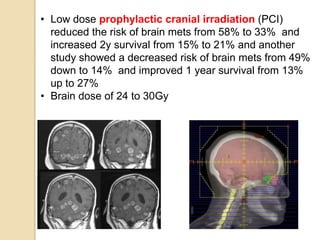
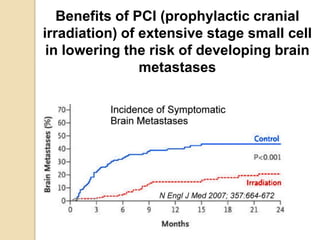
• Low dose prophylactic cranial irradiation (PCI)
reduced the risk of brain mets from 58% to 33% and
increased 2y survival from 15% to 21% and another
study showed a decreased risk of brain mets from 49%
down to 14% and improved 1 year survival from 13%
up to 27%
• Brain dose of 24 to 30Gy
Benefits of PCI (prophylactic cranial
irradiation) of extensive stage small cell
in lowering the risk of developing brain
metastases
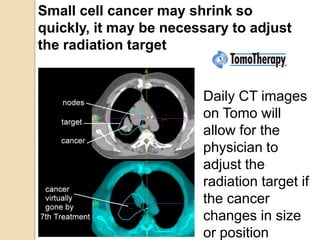
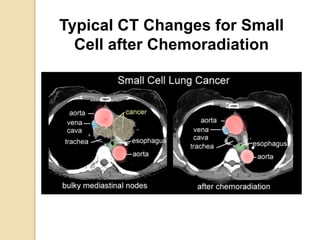
Small cell cancer may shrink so
quickly, it may be necessary to adjust
the radiation target
Daily CT images
on Tomo will
allow for the
physician to
adjust the
radiation target if
the cancer
changes in size
or position
Typical CT Changes for Small
Cell after Chemoradiation
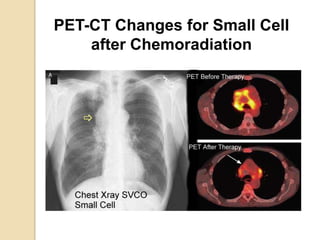
PET-CT Changes for Small Cell
after Chemoradiation
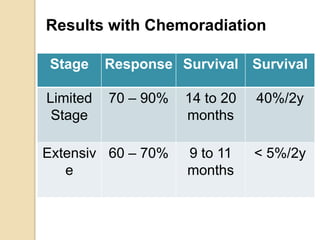
Results with Chemoradiation
Stage Response Survival Survival
Limited
Stage
70 – 90% 14 to 20
months
40%/2y
Extensiv
e
60 – 70% 9 to 11
months
< 5%/2y
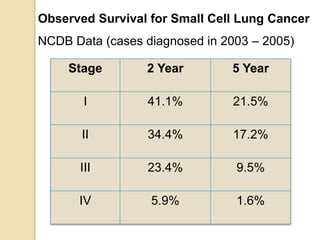
Stage 2 Year 5 Year
I 41.1% 21.5%
II 34.4% 17.2%
III 23.4% 9.5%
IV 5.9% 1.6%
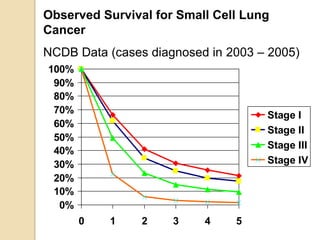
Observed Survival for Small Cell Lung Cancer
NCDB Data (cases diagnosed in 2003 – 2005)
0%
10%
20%
30%
40%
50%
60%
70%
80%
90%
100%
0 1 2 3 4 5
Stage I
Stage II
Stage III
Stage IV
Observed Survival for Small Cell Lung
Cancer
NCDB Data (cases diagnosed in 2003 – 2005)
Small Cell Lung Cancer
Robert Miller MD
www.aboutcancer.com

Small Cell Lung Cancer

  • 1.
    Small Cell LungCancer Robert Miller MD www.aboutcancer.com
  • 2.
    Types of LungCancer  Non-small cell carcinoma (NSCC) (87%) ◦ Adenocarcinoma (38%) ◦ Squamous cell (20%) ◦ Large cell (5%)  Small cell carcinoma (13%)
  • 3.
    Small cell lungcancer is virtually always caused by smoking and as smoking has decreased the incidence of this cancer has declined Percent of Lung Cancers that were Small Cell: 1978: 20-25%, 1986: 17%, 2002: 13% NCDB Data for 2000-2010 small cell was 15%
  • 4.
    Since women have notcut back on smoking as much as men, the frequency of small cell in women has increased Women accounted for 28% in 1973 and in
  • 5.
    0% 5% 10% 15% 20% 25% 30% 35% 40 50 6070 80 11% 31% 33% 19% 5% Age Distribution: NCDB 2000-2010 for Small Cell Lung Cancer
  • 6.
    Small Cell LungCancer • These are classified as a neuroendocrine cancer • These are fast growing cancers and only 1/3 are still confined to the chest • Most patients are treated with chemotherapy and radiation but a small number (2- 5%) with early stage I may benefit from surgical resection • 95% of small cell cancers start in the lung but 5% arise from outside the lung (e.g. Nasopharynx, gastrointestinal or genitourinary sites
  • 7.
    Biopsy - confirmthe cancer and determine the type Bronchoscopy CT directed biopsy
  • 8.
    Pathology • Cancer cellsshould stain positive for keratin, epithelial membrane antigen and TTF-1 • Since they are neuroendocrine they should also stain for: chromogranin A, neuron specific enolase, NCAM and synaptophysin “special stains”
  • 9.
  • 10.
    Lymph Nodes andLung Cancer
  • 11.
  • 12.
  • 13.
  • 14.
  • 15.
    CT Small Cell Usuallylarge mass in the mediastinal lymph nodes and may compress the superior vena cava
  • 16.
    Stages of LungCancer  Stage I – small spot no nodes  Stage II – larger or nodes on the side of the lung (hilar or N1 nodes)  Stage III – very large tumor or lymph nodes in the middles of the chest (mediastinum or N2 nodes)  Stage IV – metastases to other organs
  • 17.
    Stage from NCDB 0 10 20 30 40 50 60 Stage1 Stage 2 Stage 3 Stage 4 NSCL SCL
  • 18.
    Stages for SmallCell Veterans Affairs Lung Study Group defined limited stage (LS disease) as that confined to the ipsilateral hemithorax which could be safely encompassed within a tolerable radiation field and extensive stage (ES disease) as disease beyond the ipsilateral hemithorax, including malignant pleural or pericardial effusion or hematogenous metastases. Patients with contralateral hilar or supraclavicular lymph nodes were excluded from some studies of LS disease, even though modern RT techniques can allow for high-dose RT to be delivered in selected cases.
  • 19.
    Small Cell Stages •Limited Stage: confined to the chest and regional nodes (1/3) • Extensive Stage: distant metastases (2/3)
  • 20.
    Small Cell Carcinomaof the Lung usually presents with a large central tumor (hilar/mediastinal lymph node mass
  • 21.
    Symptoms of SmallCell • Because of the large lymph node swelling in the chest the patient may have shortness of breath, trouble swallowing, hoarseness, facial swelling (superior vena cava syndrome) • Many present with symptoms of spread or metastases: headaches (brain met) bone pain (bone mets) or eating problems (liver mets) • Some present with neurologic or endocrine paraneoplastic syndrome (e.g. low sodium or elevated calcium)
  • 22.
    PET scan showing a typicalsmall cell cancer with a large mediastinal mass making it hard to even see the heart on the left side Small Cell Lung Cancer
  • 24.
  • 25.
  • 26.
    Treatment for SmallCell Lung Cancer Limited Stage: consider surgery resection for early stage followed by chemotherapy +/- radiation, otherwise most patients get chemotherapy plus radiation Extensive Stage: unless very weak consider chemotherapy +/- radiation
  • 27.
    The role ofsurgery in the treatment of limited disease small cell lung cancer: time to reevaluate. J Thorac Oncol. 2008 Nov;3(11):1267-71. We identified 59 patients who underwent complete resection with nodal dissection for SCLC. overall survival at 1 year of 76% and 5 years 52% Only 2 to 5% are candidates for
  • 28.
    Various chemotherapy schemeshave been evaluated for SCLC; however, Cisplatin and Etoposide is widely considered as the standard, with observed response rates of 80–85% and approximately 25% of patients obtaining a complete response However, most patients experience disease relapse. Attempts to improve the outcome using different or more dose-intensive chemotherapy regimens or maintenance chemotherapy have not led to improved outcomes.
  • 29.
  • 30.
    Carboplatin- or Cisplatin-BasedChemotherapy in First-Line Treatment of Small-Cell Lung Cancer: The COCIS Meta-Analysis of Individual Patient Data JCO May 10, 2012 vol. 30 no. 14 1692-1698
  • 31.
    Radiation for SmallCell • Adding radiation to chemotherapy will lower the risk of lung relapse by 25 to 30% and increase the survival by 5 to 7% • Radiation dose to the lung can be twice a day to 45Gy or daily to 60 – 70 Gy
  • 32.
    Twice-Daily Compared withOnce-Daily Thoracic Radiotherapy in Limited Small-Cell Lung Cancer Treated Concurrently with Cisplatin and Etoposide N Engl J Med 1999; 340:265-271 total dose of thoracic radiotherapy was 45 Gy for each patient, 1.8 Gy daily in 25 treatments over a period of five weeks or Accelerated twice-daily thoracic radiotherapy involved the administration of 1.5 Gy in 30 treatments over a period of three weeks.
  • 33.
    • Low doseprophylactic cranial irradiation (PCI) reduced the risk of brain mets from 58% to 33% and increased 2y survival from 15% to 21% and another study showed a decreased risk of brain mets from 49% down to 14% and improved 1 year survival from 13% up to 27% • Brain dose of 24 to 30Gy
  • 34.
    Benefits of PCI(prophylactic cranial irradiation) of extensive stage small cell in lowering the risk of developing brain metastases
  • 35.
    Small cell cancermay shrink so quickly, it may be necessary to adjust the radiation target Daily CT images on Tomo will allow for the physician to adjust the radiation target if the cancer changes in size or position
  • 36.
    Typical CT Changesfor Small Cell after Chemoradiation
  • 37.
    PET-CT Changes forSmall Cell after Chemoradiation
  • 38.
    Results with Chemoradiation StageResponse Survival Survival Limited Stage 70 – 90% 14 to 20 months 40%/2y Extensiv e 60 – 70% 9 to 11 months < 5%/2y
  • 39.
    Stage 2 Year5 Year I 41.1% 21.5% II 34.4% 17.2% III 23.4% 9.5% IV 5.9% 1.6% Observed Survival for Small Cell Lung Cancer NCDB Data (cases diagnosed in 2003 – 2005)
  • 40.
    0% 10% 20% 30% 40% 50% 60% 70% 80% 90% 100% 0 1 23 4 5 Stage I Stage II Stage III Stage IV Observed Survival for Small Cell Lung Cancer NCDB Data (cases diagnosed in 2003 – 2005)
  • 41.
    Small Cell LungCancer Robert Miller MD www.aboutcancer.com