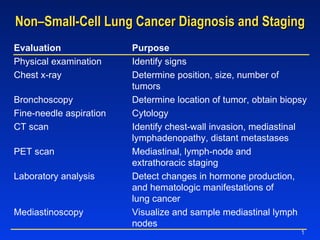
Non–Small-Cell Lung Cancer Diagnosis and Staging Evaluation Purpose Physical examination Identify signs Chest x-ray Determine position, size, number of  tumors Bronchoscopy Determine location of tumor, obtain biopsy Fine-needle aspiration Cytology CT scan Identify chest-wall invasion, mediastinal  lymphadenopathy, distant metastases PET scan Mediastinal, lymph-node and  extrathoracic staging Laboratory analysis Detect changes in hormone production,  and hematologic manifestations of  lung cancer Mediastinoscopy Visualize and sample mediastinal lymph nodes
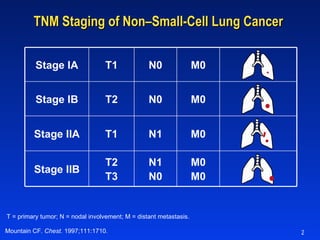
TNM Staging of Non–Small-Cell Lung Cancer  T = primary tumor; N = nodal involvement; M = distant metastasis. Mountain CF.  Chest.  1997;111:1710.  M0 M0 N1 N0 T2 T3 Stage IIB M0 N1 T1 Stage IIA M0 N0 T2 Stage IB M0 N0 T1 Stage IA
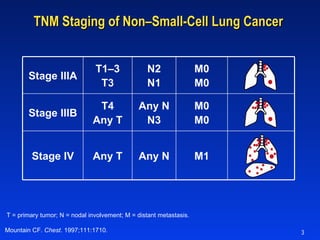
TNM Staging of Non–Small-Cell Lung Cancer  T = primary tumor; N = nodal involvement; M = distant metastasis. Mountain CF.  Chest.  1997;111:1710.  M1 Any N Any T Stage IV M0 M0 Any N N3 T4 Any T Stage IIIB M0 M0 N2 N1 T1–3 T3 Stage IIIA
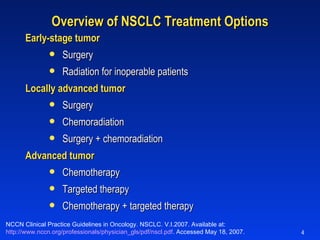
Overview of NSCLC Treatment Options Early-stage tumor Surgery Radiation for inoperable patients Locally advanced tumor Surgery  Chemoradiation Surgery + chemoradiation Advanced tumor Chemotherapy Targeted therapy Chemotherapy + targeted therapy  NCCN Clinical Practice Guidelines in Oncology. NSCLC. V.I.2007. Available at:  http://www.nccn.org/professionals/physician_gls/pdf/nscl.pdf . Accessed May 18, 2007.
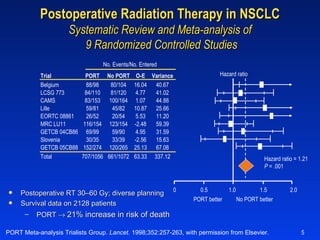
Postoperative RT 30–60 Gy; diverse planning Survival data on 2128 patients PORT     21% increase in risk of death Postoperative Radiation Therapy in NSCLC  Systematic Review and Meta-analysis of  9 Randomized Controlled Studies PORT Meta-analysis Trialists Group.  Lancet.  1998;352:257-263, with permission from Elsevier. Hazard ratio Trial PORT No PORT O-E Variance Belgium 88/98 80/104 16.04 40.67 LCSG 773 84/110 81/120 4.77 41.02 CAMS 83/153 100/164 1.07 44.88 Lille 59/81 45/82 10.87 25.66 EORTC 08861 26/52 20/54 5.53 11.20 MRC LU11 116/154 123/154 -2.48 59.39 GETCB 04CB86 69/99 59/90 4.95 31.59 Slovenia 30/35 33/39 -2.56 15.63 GETCB 05CB88 152/274 120/265 25.13 67.08 Total 707/1056 661/1072 63.33 337.12 No. Events/No. Entered Hazard ratio = 1.21 P  = .001 PORT better No PORT better 0 0.5 1.0 1.5 2.0
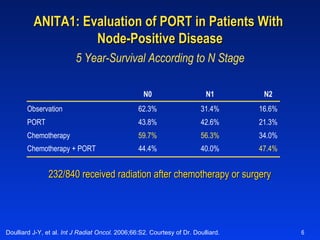
ANITA1: Evaluation of PORT in Patients With  Node-Positive Disease 5 Year-Survival According to N Stage 232/840 received radiation after chemotherapy or surgery Doulliard J-Y, et al.  Int J Radiat Oncol.  2006;66:S2. Courtesy of Dr. Doulliard. 44.4% 59.7% 43.8% 62.3% N0 47.4% 40.0% Chemotherapy + PORT 34.0% 56.3% Chemotherapy 21.3% 42.6% PORT 16.6% 31.4% Observation N2 N1
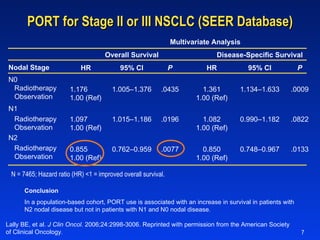
PORT for Stage II or III NSCLC (SEER Database) N = 7465; Hazard ratio (HR) <1 = improved overall survival. Lally BE, et al.  J Clin Oncol.  2006;24:2998-3006. Reprinted with permission from the American Society of Clinical Oncology. Conclusion In a population-based cohort, PORT use is associated with an increase in survival in patients with N2 nodal disease but not in patients with N1 and N0 nodal disease. Multivariate Analysis Overall Survival Disease-Specific Survival HR 95% Cl P HR 95% Cl P 1.176 1.005–1.376 .0435 1.361 1.134–1.633 .0009 1.00 (Ref) 1.00 (Ref) 1.097 1.015–1.186 .0196 1.082 0.990–1.182 .0822 1.00 (Ref) 1.00 (Ref) 0.855 0.762–0.959 .0077 0.850 0.748–0.967 .0133 1.00 (Ref) 1.00 (Ref) Nodal Stage N0   Radiotherapy   Observation N1 Radiotherapy   Observation N2 Radiotherapy   Observation
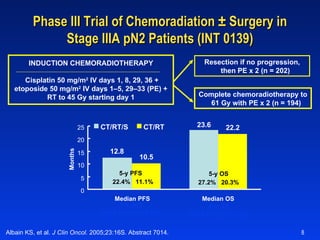
Phase III Trial of Chemoradiation ± Surgery in  Stage IIIA pN2 Patients (INT 0139) Resection if no progression, then PE x 2 (n = 202) Complete chemoradiotherapy to 61 Gy with PE x 2 (n = 194) INDUCTION CHEMORADIOTHERAPY Cisplatin 50 mg/m 2  IV days 1, 8, 29, 36 + etoposide 50 mg/m 2  IV days 1–5, 29–33 (PE) + RT to 45 Gy starting day 1 Albain KS, et al.  J Clin Oncol.  2005;23:16S. Abstract 7014. 10.5 22.2 12.8 23.6 0 5 10 15 20 25 Median PFS Median OS Months CT/RT/S CT/RT P  = .017 HR 0.77 (0.62 –0.96) P  = .24 HR 0.87 (0.70 –1.10) 5-y PFS 22.4%  11.1% 5-y OS 27.2%  20.3%
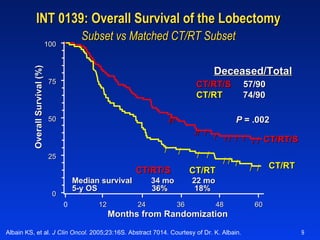
INT 0139: Overall Survival of the Lobectomy  Subset vs Matched CT/RT Subset   Overall Survival (%) 0 25 50 75 100 Months from Randomization 0 12 24 36 48 60 / / / / / / / / / / / / / / / / / / / / / / / P  = .002 CT/RT/S   57/90 CT/RT     74/90 Deceased/Total Median survival  34 mo  22 mo 5-y OS    36%  18% CT/RT/S CT/RT CT/RT/S CT/RT Albain KS, et al.  J Clin Oncol.  2005;23:16S. Abstract 7014. Courtesy of Dr. K. Albain.
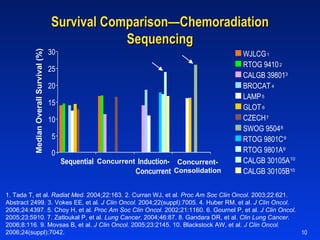
Survival Comparison—Chemoradiation Sequencing 0 5 10 15 20 25 30 Sequential Induction- Concurrent WJLCG RTOG 9410 CALGB 39801 BROCAT LAMP GLOT CZECH SWOG 9504 RTOG 9801C RTOG 9801A CALGB 30105A CALGB 30105B Median Overall Survival (%) Concurrent Concurrent- Consolidation 1. Tada T, et al.  Radiat Med.  2004;22:163. 2. Curran WJ, et al.  Proc Am Soc Clin Oncol.  2003;22:621. Abstract 2499. 3. Vokes EE, et al.  J Clin Oncol.  2004;22(suppl):7005. 4. Huber RM, et al.  J Clin Oncol.  2006;24:4397. 5. Choy H, et al.  Proc Am Soc Clin Oncol.  2002;21:1160. 6. Gournel P, et al.  J Clin Oncol.  2005;23:5910. 7. Zatloukal P, et al.  Lung Cancer.  2004;46:87. 8. Gandara DR, et al.  Clin Lung Cancer.  2006;8:116. 9. Movsas B, et al.  J Clin Oncol.  2005;23:2145. 10. Blackstock AW, et al.  J Clin Oncol.  2006;24(suppl):7042. 1 2 3 4 5 6 7 8 9 9 10 10
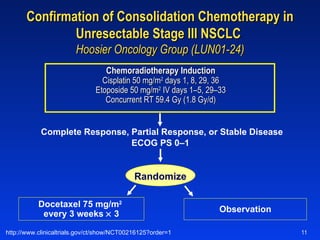
Chemoradiotherapy Induction Cisplatin 50 mg/m 2  days 1, 8, 29, 36 Etoposide 50 mg/m 2  IV days 1–5, 29–33 Concurrent RT 59.4 Gy (1.8 Gy/d) Confirmation of Consolidation Chemotherapy in Unresectable Stage III NSCLC  Hoosier Oncology Group (LUN01-24) Complete Response, Partial Response, or Stable Disease ECOG PS 0–1 Docetaxel 75 mg/m 2   every 3 weeks    3 Observation Randomize  http://www.clinicaltrials.gov/ct/show/NCT00216125?order=1

Non–Small Cell Lung Cancer

  • 1.
    Non–Small-Cell Lung CancerDiagnosis and Staging Evaluation Purpose Physical examination Identify signs Chest x-ray Determine position, size, number of tumors Bronchoscopy Determine location of tumor, obtain biopsy Fine-needle aspiration Cytology CT scan Identify chest-wall invasion, mediastinal lymphadenopathy, distant metastases PET scan Mediastinal, lymph-node and extrathoracic staging Laboratory analysis Detect changes in hormone production, and hematologic manifestations of lung cancer Mediastinoscopy Visualize and sample mediastinal lymph nodes
  • 2.
    TNM Staging ofNon–Small-Cell Lung Cancer T = primary tumor; N = nodal involvement; M = distant metastasis. Mountain CF. Chest. 1997;111:1710. M0 M0 N1 N0 T2 T3 Stage IIB M0 N1 T1 Stage IIA M0 N0 T2 Stage IB M0 N0 T1 Stage IA
  • 3.
    TNM Staging ofNon–Small-Cell Lung Cancer T = primary tumor; N = nodal involvement; M = distant metastasis. Mountain CF. Chest. 1997;111:1710. M1 Any N Any T Stage IV M0 M0 Any N N3 T4 Any T Stage IIIB M0 M0 N2 N1 T1–3 T3 Stage IIIA
  • 4.
    Overview of NSCLCTreatment Options Early-stage tumor Surgery Radiation for inoperable patients Locally advanced tumor Surgery Chemoradiation Surgery + chemoradiation Advanced tumor Chemotherapy Targeted therapy Chemotherapy + targeted therapy NCCN Clinical Practice Guidelines in Oncology. NSCLC. V.I.2007. Available at: http://www.nccn.org/professionals/physician_gls/pdf/nscl.pdf . Accessed May 18, 2007.
  • 5.
    Postoperative RT 30–60Gy; diverse planning Survival data on 2128 patients PORT  21% increase in risk of death Postoperative Radiation Therapy in NSCLC Systematic Review and Meta-analysis of 9 Randomized Controlled Studies PORT Meta-analysis Trialists Group. Lancet. 1998;352:257-263, with permission from Elsevier. Hazard ratio Trial PORT No PORT O-E Variance Belgium 88/98 80/104 16.04 40.67 LCSG 773 84/110 81/120 4.77 41.02 CAMS 83/153 100/164 1.07 44.88 Lille 59/81 45/82 10.87 25.66 EORTC 08861 26/52 20/54 5.53 11.20 MRC LU11 116/154 123/154 -2.48 59.39 GETCB 04CB86 69/99 59/90 4.95 31.59 Slovenia 30/35 33/39 -2.56 15.63 GETCB 05CB88 152/274 120/265 25.13 67.08 Total 707/1056 661/1072 63.33 337.12 No. Events/No. Entered Hazard ratio = 1.21 P = .001 PORT better No PORT better 0 0.5 1.0 1.5 2.0
  • 6.
    ANITA1: Evaluation ofPORT in Patients With Node-Positive Disease 5 Year-Survival According to N Stage 232/840 received radiation after chemotherapy or surgery Doulliard J-Y, et al. Int J Radiat Oncol. 2006;66:S2. Courtesy of Dr. Doulliard. 44.4% 59.7% 43.8% 62.3% N0 47.4% 40.0% Chemotherapy + PORT 34.0% 56.3% Chemotherapy 21.3% 42.6% PORT 16.6% 31.4% Observation N2 N1
  • 7.
    PORT for StageII or III NSCLC (SEER Database) N = 7465; Hazard ratio (HR) <1 = improved overall survival. Lally BE, et al. J Clin Oncol. 2006;24:2998-3006. Reprinted with permission from the American Society of Clinical Oncology. Conclusion In a population-based cohort, PORT use is associated with an increase in survival in patients with N2 nodal disease but not in patients with N1 and N0 nodal disease. Multivariate Analysis Overall Survival Disease-Specific Survival HR 95% Cl P HR 95% Cl P 1.176 1.005–1.376 .0435 1.361 1.134–1.633 .0009 1.00 (Ref) 1.00 (Ref) 1.097 1.015–1.186 .0196 1.082 0.990–1.182 .0822 1.00 (Ref) 1.00 (Ref) 0.855 0.762–0.959 .0077 0.850 0.748–0.967 .0133 1.00 (Ref) 1.00 (Ref) Nodal Stage N0 Radiotherapy Observation N1 Radiotherapy Observation N2 Radiotherapy Observation
  • 8.
    Phase III Trialof Chemoradiation ± Surgery in Stage IIIA pN2 Patients (INT 0139) Resection if no progression, then PE x 2 (n = 202) Complete chemoradiotherapy to 61 Gy with PE x 2 (n = 194) INDUCTION CHEMORADIOTHERAPY Cisplatin 50 mg/m 2 IV days 1, 8, 29, 36 + etoposide 50 mg/m 2 IV days 1–5, 29–33 (PE) + RT to 45 Gy starting day 1 Albain KS, et al. J Clin Oncol. 2005;23:16S. Abstract 7014. 10.5 22.2 12.8 23.6 0 5 10 15 20 25 Median PFS Median OS Months CT/RT/S CT/RT P = .017 HR 0.77 (0.62 –0.96) P = .24 HR 0.87 (0.70 –1.10) 5-y PFS 22.4% 11.1% 5-y OS 27.2% 20.3%
  • 9.
    INT 0139: OverallSurvival of the Lobectomy Subset vs Matched CT/RT Subset Overall Survival (%) 0 25 50 75 100 Months from Randomization 0 12 24 36 48 60 / / / / / / / / / / / / / / / / / / / / / / / P = .002 CT/RT/S 57/90 CT/RT 74/90 Deceased/Total Median survival 34 mo 22 mo 5-y OS 36% 18% CT/RT/S CT/RT CT/RT/S CT/RT Albain KS, et al. J Clin Oncol. 2005;23:16S. Abstract 7014. Courtesy of Dr. K. Albain.
  • 10.
    Survival Comparison—Chemoradiation Sequencing0 5 10 15 20 25 30 Sequential Induction- Concurrent WJLCG RTOG 9410 CALGB 39801 BROCAT LAMP GLOT CZECH SWOG 9504 RTOG 9801C RTOG 9801A CALGB 30105A CALGB 30105B Median Overall Survival (%) Concurrent Concurrent- Consolidation 1. Tada T, et al. Radiat Med. 2004;22:163. 2. Curran WJ, et al. Proc Am Soc Clin Oncol. 2003;22:621. Abstract 2499. 3. Vokes EE, et al. J Clin Oncol. 2004;22(suppl):7005. 4. Huber RM, et al. J Clin Oncol. 2006;24:4397. 5. Choy H, et al. Proc Am Soc Clin Oncol. 2002;21:1160. 6. Gournel P, et al. J Clin Oncol. 2005;23:5910. 7. Zatloukal P, et al. Lung Cancer. 2004;46:87. 8. Gandara DR, et al. Clin Lung Cancer. 2006;8:116. 9. Movsas B, et al. J Clin Oncol. 2005;23:2145. 10. Blackstock AW, et al. J Clin Oncol. 2006;24(suppl):7042. 1 2 3 4 5 6 7 8 9 9 10 10
  • 11.
    Chemoradiotherapy Induction Cisplatin50 mg/m 2 days 1, 8, 29, 36 Etoposide 50 mg/m 2 IV days 1–5, 29–33 Concurrent RT 59.4 Gy (1.8 Gy/d) Confirmation of Consolidation Chemotherapy in Unresectable Stage III NSCLC Hoosier Oncology Group (LUN01-24) Complete Response, Partial Response, or Stable Disease ECOG PS 0–1 Docetaxel 75 mg/m 2 every 3 weeks  3 Observation Randomize http://www.clinicaltrials.gov/ct/show/NCT00216125?order=1

Editor's Notes

  • #2 All patients should undergo a history-taking and physical examination, chest X-ray and chest computed tomography (CT) scans (including the adrenal glands), liver CT scan or abdominal ultrasound. Other evaluations include a complete blood count, electrolytes, liver function tests, calcium, blood urea nitrogen, and creatinine, as well as a baseline ECG. Bone scans and/or brain CT scans may be appropriate in some patients. 1 The extent of the tumor, the involvement of the lymph nodes, and chest wall or mediastinal invasion can be determined with similar efficacy using either CT or MRI. CT is used more commonly, although MRI may be preferable in specific situations, for example in evaluating superior sulcus tumors. 2 Positron emission tomography (PET) with radiolabeled fluoro-2-deoxyglucose combined with CT was significantly more accurate than CT alone in identifying lymph node involvement in NSCLC. 3 1. NCCN Guidelines. 2. Webb WR, et al. Radiology 1991; 178: 705-713. 3. Vansteenkiste JF, et al. J Clin Oncol 1998; 16: 2142-2149.