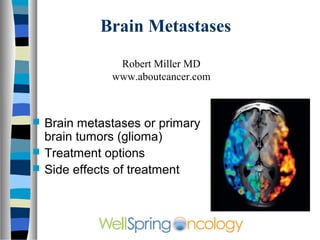
Brain Metastases

                Robert Miller MD
               www.aboutcancer.com


   Brain metastases or primary
    brain tumors (glioma)
   Treatment options
   Side effects of treatment
Brain metastases: cancer
that started elsewhere in the
body (e.g. lung or breast)
and spread to the brain
Brain primary: a normal
brain cell (glial cell)
becomes malignant and is
called a glioma
Brain Metastases


 Most  common intracranial tumors in
  adults
 In patients with stage IV disease , 10 –
  30% will have brain mets
The odds of developing brain metastases
 based on the primary type of cancer

       Lung:       16 to 20%
       Melanoma: 7%
       Kidney:     7 to 10%
       Breast:     5%
       Colorectal: 1 to 2%
The most common causes of brain metastases in adults
with their approximate frequency are:

  Lung —             50 percent
  Breast —           15 to 20 percent
  Unknown primary    10 percent
  Melanoma —         10 percent
  Colon and rectum    5 percent

The distribution of metastases roughly follows the relative
weight of and blood flow to each area.

  Cerebral hemispheres —    80 percent
  Cerebellum —              15 percent
  Brain stem —              5 percent
SYMPTOMS OF BRAIN METASTASES


Symptom               Patients %

Headache                 42
Focal weakness           27
Mental change            31
Seizure                  20
Gait ataxia              17
Sensory disturbance      6
Speech problems          10
Note that tumors may cause symptoms on
the opposite side of the body
Brain Swelling – brain tumor often cause swelling or
edema which creates pressure on the brain, with headaches
and nausea, steroids like Decadron (dexamethasone) will
decrease this pressure
Brain Imaging
Glioblastoma

Certain brain
tumors .e.g.
glioma have a
distinct
appearance on
MRI scan . With
irregular borders
and necrotic
center
Glioblastoma
cells in green,
spread diffusely
through the brain
and are hard to
target accurately
Brain Metastasis as seen on an MRI Scan, the
sharp margins may make this a better case for
highly targeted radiation
Normally the radiologist can tell the difference
between a brain tumor and a stroke (if not
sometimes a biopsy is necessary)
Other Brain Tumors that are NOT cancer


    Both of these are examples of a brain abscess
Multiple Brain Metastases

MRI suggests that in 66 to 75% of the cases,
 there are multiple metastases

Metastases from breast, colon, and renal cell
 carcinoma are more often single,
while lung cancer and malignant melanoma
 have a greater tendency to produce multiple
 metastases
Brain Metastases are usually Multiple
     (66 – 75% of the cases)
Brain Metastases are Usually Multiple
PET Scans and the Brain
Because a PET measures uptake of glucose and the brain uses a lot of
glucose, the normal brain looks very active on a PET scan
PET Scans and the Brain


PET scan showed an abnormal area in the left frontal lobe and MRI
confirmed this as a brain metastasis from breast cancer
Brain Radiation


Depending on the type and number of brain
tumors, the patient may receive radiation to
the whole brain, or partial brain or have
highly targeted radiation (called radiosurgery,
e.g. Cyberknife or gamma knife)
www.nccn.org
Whole brain irradiation
Whole brain radiation
The response or benefit
from whole brain radiation
may take several weeks to
months
Typical Response to Whole Brain Radiation
The small
lesion is no
longer
visible and
the large
lesion is
much
smaller
Typical response for whole brain radiation
Typical response for whole brain radiation,
          small cell lung cancer
Typical response for whole brain radiation
Radio resistant cancer (renal cell) MRI appearance two months after
  whole brain radiation (small lesions gone and large lesion much
                               smaller)
Radiosurgery for Cancer
Typical time
interval to
regression after
radiosurgery
Cyberknife or
Gamma Knife)
For a single lesion, radiosurgery alone may be used,
but there is a higher risk of a new lesion showing up in
the brain


   Jan 2011 - Radiosurgery   Aug 2012 – Treated tumor is virtually gone, but
                             there is a new tumor on the opposite side of the
                             brain
Radiation Doses


 Whole   brain: 20 – 40 Gy in 5 to 20
  fractions
 Radiosurgery: 15Gy (3.1 – 4cm), 18Gy
  (2.1 to 3cm) or 24Gy (2cm or less)
How often does whole brain radiation
help?

• 70 -90% initial response
• > 50% of symptoms of headache, CSF pressure have
  complete response
• 50 -60% have functional improvement

      moderate dysfunction: 1/3 near normal at median
      time of 3 weeks
      severe dysfunction: 2/3 improve at median of 1-2
      weeks
Side Effects of Whole Brain
                          Radiation

1. Hair loss (usually takes two or three weeks to happen)
2. Mild skin itching or irritation
3. Short term more fatigue or slightly more confusion or
   memory problems
4. Mild headache or nausea is uncommon but may require
   medication (Decadron)
5. Occasionally hearing problems (fluid behind the ear
   drums)
Long Term Effects of Radiation on the Brain


This patient had no symptoms, but radiation may effect
memory
Long Term Effects of Radiation on the Brain


      This patient had no symptoms
Long Term Effects of Radiation on the Brain


      This patient had no symptoms
Long Term Effects of Radiation on the Brain


      This patient had no symptoms
Risk of white matter changes (leukoencephalopathy) 1
year after whole brain radiation for brain mets

   U Pitt Study E Monaco (AANS 2012, Medscape Med News 2012-05-01)


                        WB+SRS                        SRS
     1 year             97.3%                         3.2%

So by one year 97% has some changes and
by 2 years 70% had grade 3 changes on the
MRI (but no symptoms)
Radiosurgery for Brain
                                      Metastasis

 Local control Rates of 73 to 94%
 Risk of radiation necrosis of 5 to 10%


Better than whole brain if single lesion and good performance patient in the
RTOG 95-08 Trial
Complications of Radiosurgery

 Short term side effects are uncommon
  (2%) with worsening symptoms or new
  seizures
 About one third mild swelling
  (headaches, nausea)
 Radionecrosis in 5% to 10%
Sometimes the MRI
will look worse after
radiosurgery due to
radionecrosis of the
cancer but with time
this should fade away
Survival and Prognosis for
                People with Brain Metastases


1. Do best if the cancer is confined to the brain only
2. Do better if they are young (< 65y)
3. Do better if they have a good performance score (i.e. a
   high Karnofsky score of 70 or better)


Karnofsky Score (KPS) 70 = Cares for self; unable to carry on normal
activity or do active work
KPS 60 = Requires occasional assistance, but is able to care for most
personal needs
Median Survival Based on RTOG Class for
     People with Brain Metastases

 I (KPS =70, age < 65y, mets to brain only)                = 7.1 to
  10.5 months
 II KPS = 70 = 3.5 to 4.2 months
 III KPS < 70 = 2.0 to 2.3 months


Karnofsky Score (KPS) 70 = Cares for self; unable to carry on normal
activity or do active work
KPS 60 = Requires occasional assistance, but is able to care for most
personal needs
Survival by Treatment (WB whole brain, S
surgery, RS radiosurgery) and Performance
               Score (RTOG)

RTOG        WB           S          RS

  I       7.1 mos    14.8 mos    16.1 mos

  II      4.2 mos     9.9 mos    10.3 mos

 III      2.3 mos     6.0 mos     8.9 mos
Brain Metastases

 Robert Miller MD
www.aboutcancer.com

Brain mets video

  • 1.
    Brain Metastases Robert Miller MD www.aboutcancer.com  Brain metastases or primary brain tumors (glioma)  Treatment options  Side effects of treatment
  • 2.
    Brain metastases: cancer thatstarted elsewhere in the body (e.g. lung or breast) and spread to the brain Brain primary: a normal brain cell (glial cell) becomes malignant and is called a glioma
  • 3.
    Brain Metastases  Most common intracranial tumors in adults  In patients with stage IV disease , 10 – 30% will have brain mets
  • 4.
    The odds ofdeveloping brain metastases based on the primary type of cancer  Lung: 16 to 20%  Melanoma: 7%  Kidney: 7 to 10%  Breast: 5%  Colorectal: 1 to 2%
  • 5.
    The most commoncauses of brain metastases in adults with their approximate frequency are: Lung — 50 percent Breast — 15 to 20 percent Unknown primary 10 percent Melanoma — 10 percent Colon and rectum 5 percent The distribution of metastases roughly follows the relative weight of and blood flow to each area. Cerebral hemispheres — 80 percent Cerebellum — 15 percent Brain stem — 5 percent
  • 6.
    SYMPTOMS OF BRAINMETASTASES Symptom Patients % Headache 42 Focal weakness 27 Mental change 31 Seizure 20 Gait ataxia 17 Sensory disturbance 6 Speech problems 10
  • 7.
    Note that tumorsmay cause symptoms on the opposite side of the body
  • 8.
    Brain Swelling –brain tumor often cause swelling or edema which creates pressure on the brain, with headaches and nausea, steroids like Decadron (dexamethasone) will decrease this pressure
  • 9.
  • 10.
    Glioblastoma Certain brain tumors .e.g. gliomahave a distinct appearance on MRI scan . With irregular borders and necrotic center
  • 11.
    Glioblastoma cells in green, spreaddiffusely through the brain and are hard to target accurately
  • 12.
    Brain Metastasis asseen on an MRI Scan, the sharp margins may make this a better case for highly targeted radiation
  • 13.
    Normally the radiologistcan tell the difference between a brain tumor and a stroke (if not sometimes a biopsy is necessary)
  • 14.
    Other Brain Tumorsthat are NOT cancer Both of these are examples of a brain abscess
  • 15.
    Multiple Brain Metastases MRIsuggests that in 66 to 75% of the cases, there are multiple metastases Metastases from breast, colon, and renal cell carcinoma are more often single, while lung cancer and malignant melanoma have a greater tendency to produce multiple metastases
  • 16.
    Brain Metastases areusually Multiple (66 – 75% of the cases)
  • 17.
    Brain Metastases areUsually Multiple
  • 18.
    PET Scans andthe Brain Because a PET measures uptake of glucose and the brain uses a lot of glucose, the normal brain looks very active on a PET scan
  • 19.
    PET Scans andthe Brain PET scan showed an abnormal area in the left frontal lobe and MRI confirmed this as a brain metastasis from breast cancer
  • 20.
    Brain Radiation Depending onthe type and number of brain tumors, the patient may receive radiation to the whole brain, or partial brain or have highly targeted radiation (called radiosurgery, e.g. Cyberknife or gamma knife)
  • 21.
  • 25.
  • 26.
  • 27.
    The response orbenefit from whole brain radiation may take several weeks to months
  • 28.
    Typical Response toWhole Brain Radiation
  • 29.
    The small lesion isno longer visible and the large lesion is much smaller
  • 31.
    Typical response forwhole brain radiation
  • 32.
    Typical response forwhole brain radiation, small cell lung cancer
  • 33.
    Typical response forwhole brain radiation
  • 34.
    Radio resistant cancer(renal cell) MRI appearance two months after whole brain radiation (small lesions gone and large lesion much smaller)
  • 35.
  • 37.
    Typical time interval to regressionafter radiosurgery Cyberknife or Gamma Knife)
  • 38.
    For a singlelesion, radiosurgery alone may be used, but there is a higher risk of a new lesion showing up in the brain Jan 2011 - Radiosurgery Aug 2012 – Treated tumor is virtually gone, but there is a new tumor on the opposite side of the brain
  • 39.
    Radiation Doses  Whole brain: 20 – 40 Gy in 5 to 20 fractions  Radiosurgery: 15Gy (3.1 – 4cm), 18Gy (2.1 to 3cm) or 24Gy (2cm or less)
  • 40.
    How often doeswhole brain radiation help? • 70 -90% initial response • > 50% of symptoms of headache, CSF pressure have complete response • 50 -60% have functional improvement moderate dysfunction: 1/3 near normal at median time of 3 weeks severe dysfunction: 2/3 improve at median of 1-2 weeks
  • 41.
    Side Effects ofWhole Brain Radiation 1. Hair loss (usually takes two or three weeks to happen) 2. Mild skin itching or irritation 3. Short term more fatigue or slightly more confusion or memory problems 4. Mild headache or nausea is uncommon but may require medication (Decadron) 5. Occasionally hearing problems (fluid behind the ear drums)
  • 42.
    Long Term Effectsof Radiation on the Brain This patient had no symptoms, but radiation may effect memory
  • 43.
    Long Term Effectsof Radiation on the Brain This patient had no symptoms
  • 44.
    Long Term Effectsof Radiation on the Brain This patient had no symptoms
  • 45.
    Long Term Effectsof Radiation on the Brain This patient had no symptoms
  • 46.
    Risk of whitematter changes (leukoencephalopathy) 1 year after whole brain radiation for brain mets U Pitt Study E Monaco (AANS 2012, Medscape Med News 2012-05-01) WB+SRS SRS 1 year 97.3% 3.2% So by one year 97% has some changes and by 2 years 70% had grade 3 changes on the MRI (but no symptoms)
  • 47.
    Radiosurgery for Brain Metastasis  Local control Rates of 73 to 94%  Risk of radiation necrosis of 5 to 10% Better than whole brain if single lesion and good performance patient in the RTOG 95-08 Trial
  • 48.
    Complications of Radiosurgery Short term side effects are uncommon (2%) with worsening symptoms or new seizures  About one third mild swelling (headaches, nausea)  Radionecrosis in 5% to 10%
  • 49.
    Sometimes the MRI willlook worse after radiosurgery due to radionecrosis of the cancer but with time this should fade away
  • 50.
    Survival and Prognosisfor People with Brain Metastases 1. Do best if the cancer is confined to the brain only 2. Do better if they are young (< 65y) 3. Do better if they have a good performance score (i.e. a high Karnofsky score of 70 or better) Karnofsky Score (KPS) 70 = Cares for self; unable to carry on normal activity or do active work KPS 60 = Requires occasional assistance, but is able to care for most personal needs
  • 51.
    Median Survival Basedon RTOG Class for People with Brain Metastases  I (KPS =70, age < 65y, mets to brain only) = 7.1 to 10.5 months  II KPS = 70 = 3.5 to 4.2 months  III KPS < 70 = 2.0 to 2.3 months Karnofsky Score (KPS) 70 = Cares for self; unable to carry on normal activity or do active work KPS 60 = Requires occasional assistance, but is able to care for most personal needs
  • 52.
    Survival by Treatment(WB whole brain, S surgery, RS radiosurgery) and Performance Score (RTOG) RTOG WB S RS I 7.1 mos 14.8 mos 16.1 mos II 4.2 mos 9.9 mos 10.3 mos III 2.3 mos 6.0 mos 8.9 mos
  • 53.
    Brain Metastases RobertMiller MD www.aboutcancer.com