PET/CT
IN ONCOLOGY
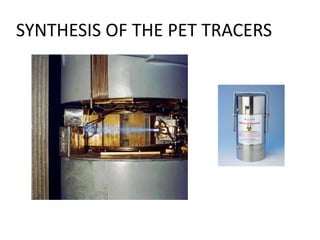
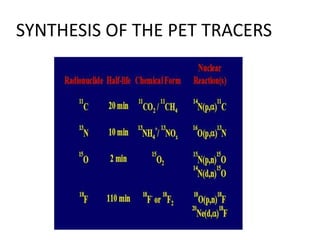
SYNTHESIS OF THE PET TRACERS
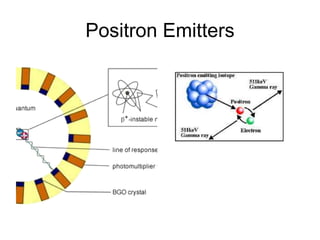
Positron Emitters
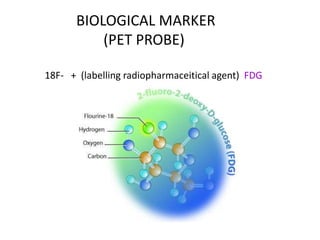
BIOLOGICAL MARKER
(PET PROBE)
18F- + (labelling radiopharmaceitical agent) FDG
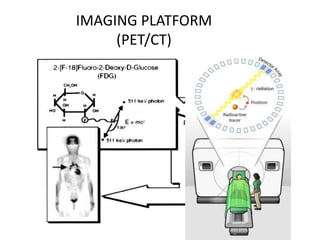
IMAGING PLATFORM
(PET/CT)
Biological tumour
TARGETS
and
the UTILITY of the
PET PROBES
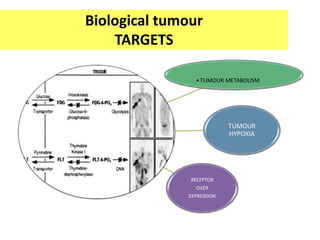
Biological tumour
TARGETS
•TUMOUR METABOLISM
TUMOUR
HYPOXIA
RECEPTOR
OVER
EXPRESSION
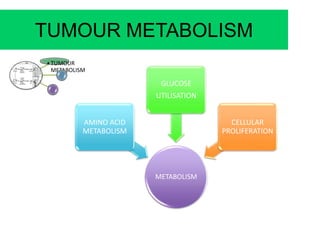
TUMOUR METABOLISM
METABOLISM
AMINO ACID
METABOLISM
GLUCOSE
UTILISATION
CELLULAR
PROLIFERATION
•TUMOUR
METABOLISM
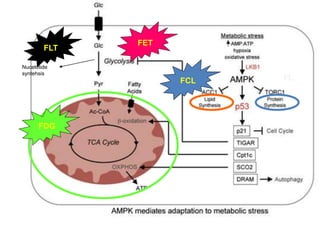
FET
FCLFCL
FDG
FET
FLT
FL
Nucelotide
syntehsis
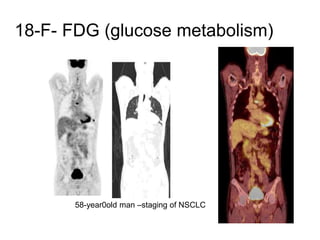
18-F- FDG (glucose metabolism)
58-year0old man –staging of NSCLC
RECIST 1.1
Complete Response (CR): Disappearance of all target lesions. Any
pathological lymph nodes (whether target or non-target) must have
reduction in short axis to <10 mm.
Partial Response (PR): At least a 30% decrease in the sum of
diameters of target lesions, taking as reference the baseline sum
diameters.
Progressive Disease (PD): At least a 20% increase in the sum of
diameters of target lesions, taking as reference the smallest sum on
study (this includes the baseline sum if that is the smallest on study). In
addition to the relative increase of 20%, the sum must also dem-
onstrate an absolute increase of at least 5 mm. (Note: the appearance
of one or more new lesions is also considered progression).
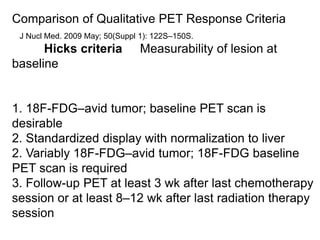
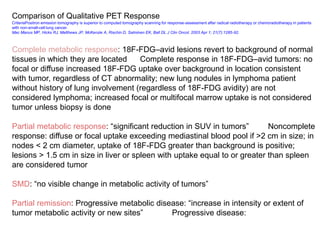
Comparison of Qualitative PET Response Criteria
Hicks criteria Measurability of lesion at
baseline
1. 18F-FDG–avid tumor; baseline PET scan is
desirable
2. Standardized display with normalization to liver
2. Variably 18F-FDG–avid tumor; 18F-FDG baseline
PET scan is required
3. Follow-up PET at least 3 wk after last chemotherapy
session or at least 8–12 wk after last radiation therapy
session
J Nucl Med. 2009 May; 50(Suppl 1): 122S–150S.
Comparison of Qualitative PET Response
CriteriaPositron emission tomography is superior to computed tomography scanning for response-assessment after radical radiotherapy or chemoradiotherapy in patients
with non-small-cell lung cancer.
Mac Manus MP, Hicks RJ, Matthews JP, McKenzie A, Rischin D, Salminen EK, Ball DL J Clin Oncol. 2003 Apr 1; 21(7):1285-92.
Complete metabolic response: 18F-FDG–avid lesions revert to background of normal
tissues in which they are located Complete response in 18F-FDG–avid tumors: no
focal or diffuse increased 18F-FDG uptake over background in location consistent
with tumor, regardless of CT abnormality; new lung nodules in lymphoma patient
without history of lung involvement (regardless of 18F-FDG avidity) are not
considered lymphoma; increased focal or multifocal marrow uptake is not considered
tumor unless biopsy is done
Partial metabolic response: “significant reduction in SUV in tumors” Noncomplete
response: diffuse or focal uptake exceeding mediastinal blood pool if >2 cm in size; in
nodes < 2 cm diameter, uptake of 18F-FDG greater than background is positive;
lesions > 1.5 cm in size in liver or spleen with uptake equal to or greater than spleen
are considered tumor
SMD: “no visible change in metabolic activity of tumors”
Partial remission: Progressive metabolic disease: “increase in intensity or extent of
tumor metabolic activity or new sites” Progressive disease:
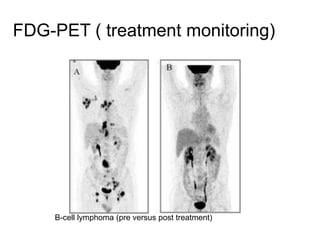
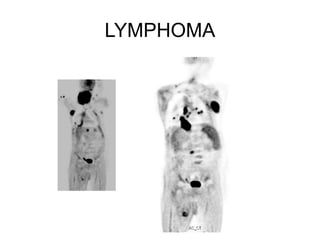
FDG-PET ( treatment monitoring)
B-cell lymphoma (pre versus post treatment)
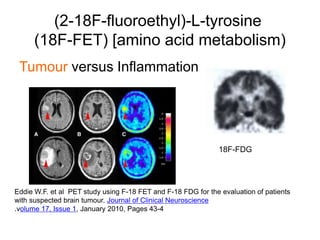
(2-18F-fluoroethyl)-L-tyrosine
(18F-FET) [amino acid metabolism)
Tumour versus Inflammation
Eddie W.F. et al PET study using F-18 FET and F-18 FDG for the evaluation of patients
with suspected brain tumour. Journal of Clinical Neuroscience
.volume 17, Issue 1, January 2010, Pages 43-4
18F-FDG
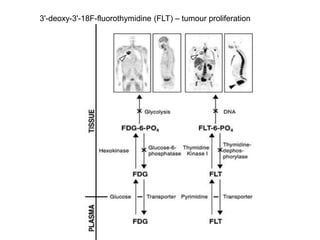
3'-deoxy-3'-18F-fluorothymidine (FLT) – tumour proliferation
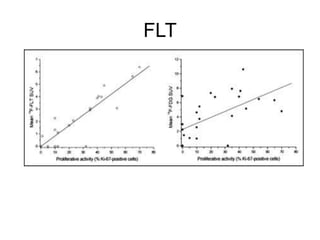
FLT
• Andreas K et al. Imaging Proliferation in Lung Tumors with PET:18F-FLT Versus 18F-FDG. Journal of Nuclear Medicine 2003. Vol. 44 No. 9 1426-1431
TUMOUR HYPOXIA
MORE AGGRESSIVE TUMOUR TYPES
A/W METASTASIS & CHEMOTHERAPY RESISTANCE
- POOR PROGNOSIS
QUANTIFICATION OF TUMOUR HYPOXIA - STUDIES UNDERWAY
•TUMOUR
METABOISM
A
TUMOUR HYPOXIA
•TUMOUR
METABOLISM
[18F]fluoroazomycin arabinoside (FAZA)
Feasibility of of 18F- FMISO PET imaging to measure hypoxia in patient
With glioblastoma
spenser et al.
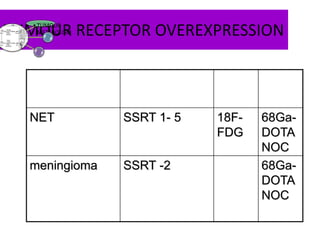
TUMOUR RECEPTOR OVEREXPRESSION•TUMOUR
METABOLISM
NET SSRT 1- 5 18F-
FDG
68Ga-
DOTA
NOC
meningioma SSRT -2 68Ga-
DOTA
NOC
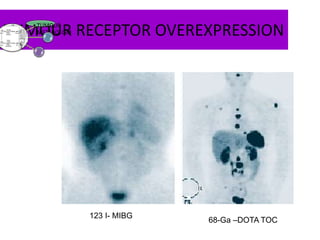
TUMOUR RECEPTOR OVEREXPRESSION•TUMOUR
METABOLISM
123 I- MIBG
68-Ga –DOTA TOC
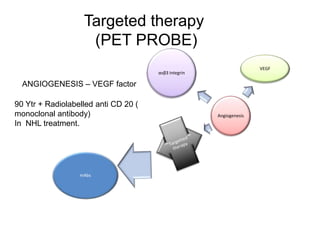
Targeted therapy
(PET PROBE)
Angiogenesis
ανβЗ integrin
VEGF
mAbs
ANGIOGENESIS – VEGF factor
90 Ytr + Radiolabelled anti CD 20 (
monoclonal antibody)
In NHL treatment.
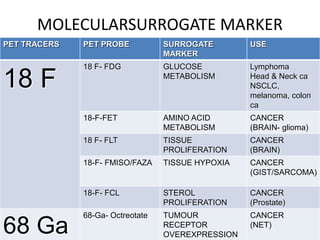
MOLECULARSURROGATE MARKER
PET TRACERS PET PROBE SURROGATE
MARKER
USE
18 F
18 F- FDG GLUCOSE
METABOLISM
Lymphoma
Head & Neck ca
NSCLC,
melanoma, colon
ca
18-F-FET AMINO ACID
METABOLISM
CANCER
(BRAIN- glioma)
18 F- FLT TISSUE
PROLIFERATION
CANCER
(BRAIN)
18-F- FMISO/FAZA TISSUE HYPOXIA CANCER
(GIST/SARCOMA)
18-F- FCL STEROL
PROLIFERATION
CANCER
(Prostate)
68 Ga
68-Ga- Octreotate TUMOUR
RECEPTOR
OVEREXPRESSION
CANCER
(NET)
SUV
– = tracer activity / injected dose normalized to
body weight.
• SUV was a significant and independent
predictor of local control and disease-free
survival . Tatsuo Torizuka et al AJR 2009; 192:W156-W160
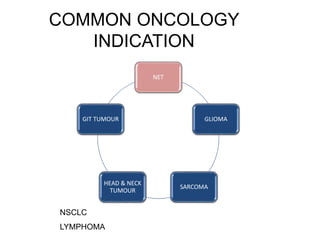
COMMON ONCOLOGY
INDICATION
NET
GLIOMA
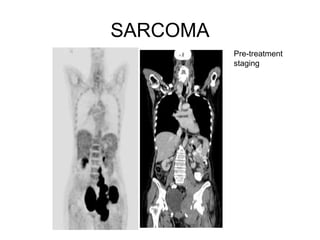
SARCOMA
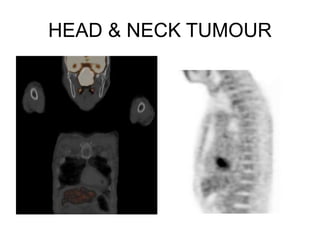
HEAD & NECK
TUMOUR
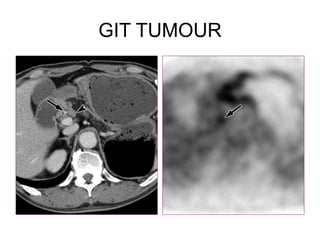
GIT TUMOUR
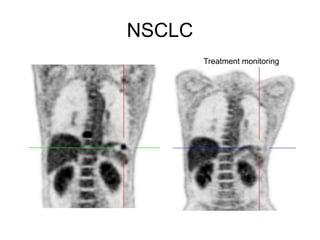
NSCLC
LYMPHOMA
INDICATIONS
• LOCALISATION
• PRETREATMENT STAGING
• TREATMENT MONITORING
• NEGATIVE ON CT OR NUCLEAR
IMAGING
• PREDICTION OF RECURRENCES
• PROGNOSTIC FACTOR
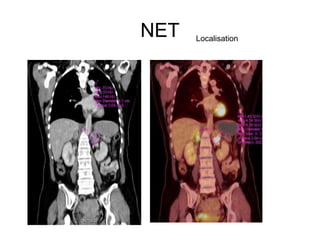
NET Localisation
SARCOMA
Pre-treatment
staging
HEAD & NECK TUMOUR
NSCLC
Treatment monitoring
GIT TUMOUR
LYMPHOMA
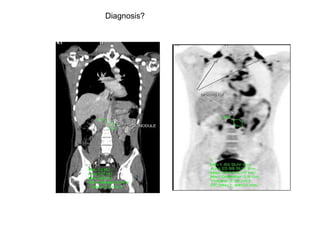
Diagnosis?
PET-CT in Oncology

PET-CT in Oncology