Report on Sampling
Applied Statistics
Dr. Yolanda Evangelista
Professorial Lecturer
Prepared by: AFM
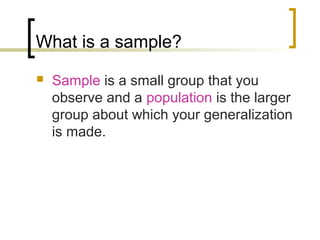
What is a sample?
 Sample is a small group that you
observe and a population is the larger
group about which your generalization
is made.
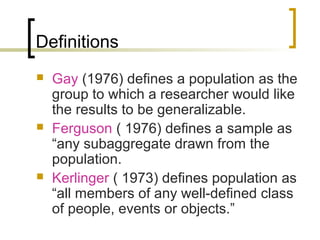
Definitions
 Gay (1976) defines a population as the
group to which a researcher would like
the results to be generalizable.
 Ferguson ( 1976) defines a sample as
“any subaggregate drawn from the
population.
 Kerlinger ( 1973) defines population as
“all members of any well-defined class
of people, events or objects.”
Sampling
 Sampling – the process which involves
taking a part of the population, making
observations on this representative
groups, and then generalizing the
findings to the bigger population.
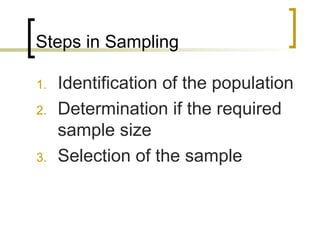
Steps in Sampling
1. Identification of the population
2. Determination if the required
sample size
3. Selection of the sample
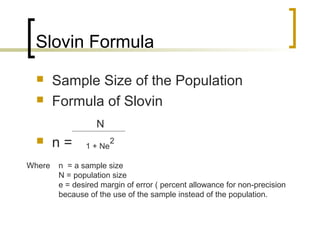
Slovin Formula
 Sample Size of the Population
 Formula of Slovin
 n =
N
1 + Ne
2
Where n = a sample size
N = population size
e = desired margin of error ( percent allowance for non-precision
because of the use of the sample instead of the population.
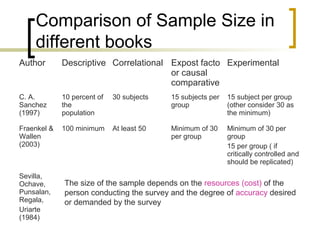
Comparison of Sample Size in
different books
Author Descriptive Correlational Expost facto
or causal
comparative
Experimental
C. A.
Sanchez
(1997)
10 percent of
the
population
30 subjects 15 subjects per
group
15 subject per group
(other consider 30 as
the minimum)
Fraenkel &
Wallen
(2003)
100 minimum At least 50 Minimum of 30
per group
Minimum of 30 per
group
15 per group ( if
critically controlled and
should be replicated)
Sevilla,
Ochave,
Punsalan,
Regala,
Uriarte
(1984)
The size of the sample depends on the resources (cost) of the
person conducting the survey and the degree of accuracy desired
or demanded by the survey
Sample size
 According to Sevilla, Ochave, Punsalan, Regala,
Uriarte ( 1984) the size of the sample depends on
the following:
 Cost
 Determine the cost of the entire survey from the
number of manhours to data analysis
 Time
 The researcher may have a limited amount of
time to complete the survey and to perform the
analyses.
 Accuracy
 The size of the sample depends on the amount
of difference in the percentages and on how
accurate the analyst wishes to be.
Sample size
 WHAT CONSTITUTES AN ADEQUATE OR
SUFFICIENT SIZE FOR A SAMPLE?
Fraenkel & Wallen (2003)
 There is no clear-cut answer to this
question.
 The best answer is that a sample should be
as large as the researcher can obtain with a
reasonable expenditure of time and energy.
Difficulties in Sampling
 According to Parten (1950)
1. If the sampling plan is not correctly
designed and followed, the results may be
incorrect or misleading
2. If the characteristic to be observed occurs
only rarely in the population ( ex. People
over ninety years of age) special problems
arise in securing statistically reliable
information
Difficulties in Sampling
3. When detailed classification of the
sample data is called for precautions
will have to be made in the
breakdown of the data into smaller
number of cases.
4. When sampling requires expert
advice and the area concerned may
be one in which there is a shortage of
competent specialists.
Difficulties in Sampling
5. There are characteristic limitations for
each type of sampling
6. Complicated sampling plans may
prove as laborious as a complete
enumeration of the population.
Planning a sampling survey
The major problems in planning a sampling survey include:
 Statement of the purposes of the
survey
 Definition of the population or universe
 Selection of the sampling unit and the
unit of tabulation
 Location and selection of the source
list
Planning a sampling survey
 Deciding on the type of sampling to be
used.
 Determining the size of the sample of
the sample ratio
 Testing of the sample in pilot of
exploratory surveys
 Interpretation of the data in the light of
the reliability of the sample
Sampling Techniques (Sevilla)
 Non probability Sampling
 Accidental Sample
Ex. Going to a street corner and interview every
person who goes by
Advantage: Easiest to select Disadvantage: not
representative of the population
When do we use accidental sampling?
ALMOST NEVER
If there are no alternative, it may be better to have poor data than no data at all.
Sampling Techniques
 Non probability Sampling
 Quota Sample
Each interviewer is given a number of person of a specific
type. Ex. Farmers, merchants, soldiers, women or
elders
Advantage: It does not require a
population list or dwelling unit maps
needed for probability sampling
Disadvantage: no assurance of
representativeness; the person
to be interviewed is decided
upon by the interviewer in the
fieldWhen do we use accidental sampling?
When the analyst knows exactly what type
of person he wants to interview and the type
is fairly easily recognized.
Sampling Techniques
(Sanchez)
 Random Sampling
 A method of selecting a sample size from
a universe such that each member of the
population has an equal chance of being
included in the sample and all possible
combinations of size has an equal
chance of being selected as a sample.
(Weirsma, 1975)
Random Sampling
1. Prerequisites for Random Sampling:
2. Define your population
3. List all members of your population
4. Select your sample by employing an
adequate procedure where every
member has an equal chance as
samples of investigation
Random Sampling
 Basic Principles in Random Sampling
 EQUI-PROBABILITY
 Every member of the population has an equal
chance of being included in the sample
 INDEPENDENCE
 Refers to the fact that when one member is
selected for the sampling this should not affect
the chances of other members getting chosen.
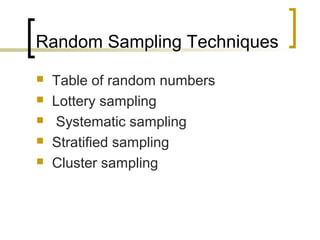
Random Sampling Techniques
 Table of random numbers
 Lottery sampling
 Systematic sampling
 Stratified sampling
 Cluster sampling
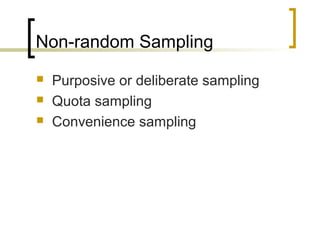
Non-random Sampling
 Purposive or deliberate sampling
 Quota sampling
 Convenience sampling
References
 Methods and Techniques of Research
by C.A. Sanchez PH.D
 An Introduction to Research Methods
by C.G. Sevilla, J. A. Ochave,
T. G. Punsalan, B. P. Regala
and G. G. Uriarte
 How to Design and Evaluate Research in
Education by J. Fraenkel and N. Wallen

Sampling Techniques

  • 1.
    Report on Sampling AppliedStatistics Dr. Yolanda Evangelista Professorial Lecturer Prepared by: AFM
  • 2.
    What is asample?  Sample is a small group that you observe and a population is the larger group about which your generalization is made.
  • 3.
    Definitions  Gay (1976)defines a population as the group to which a researcher would like the results to be generalizable.  Ferguson ( 1976) defines a sample as “any subaggregate drawn from the population.  Kerlinger ( 1973) defines population as “all members of any well-defined class of people, events or objects.”
  • 4.
    Sampling  Sampling –the process which involves taking a part of the population, making observations on this representative groups, and then generalizing the findings to the bigger population.
  • 5.
    Steps in Sampling 1.Identification of the population 2. Determination if the required sample size 3. Selection of the sample
  • 6.
    Slovin Formula  SampleSize of the Population  Formula of Slovin  n = N 1 + Ne 2 Where n = a sample size N = population size e = desired margin of error ( percent allowance for non-precision because of the use of the sample instead of the population.
  • 7.
    Comparison of SampleSize in different books Author Descriptive Correlational Expost facto or causal comparative Experimental C. A. Sanchez (1997) 10 percent of the population 30 subjects 15 subjects per group 15 subject per group (other consider 30 as the minimum) Fraenkel & Wallen (2003) 100 minimum At least 50 Minimum of 30 per group Minimum of 30 per group 15 per group ( if critically controlled and should be replicated) Sevilla, Ochave, Punsalan, Regala, Uriarte (1984) The size of the sample depends on the resources (cost) of the person conducting the survey and the degree of accuracy desired or demanded by the survey
  • 8.
    Sample size  Accordingto Sevilla, Ochave, Punsalan, Regala, Uriarte ( 1984) the size of the sample depends on the following:  Cost  Determine the cost of the entire survey from the number of manhours to data analysis  Time  The researcher may have a limited amount of time to complete the survey and to perform the analyses.  Accuracy  The size of the sample depends on the amount of difference in the percentages and on how accurate the analyst wishes to be.
  • 9.
    Sample size  WHATCONSTITUTES AN ADEQUATE OR SUFFICIENT SIZE FOR A SAMPLE? Fraenkel & Wallen (2003)  There is no clear-cut answer to this question.  The best answer is that a sample should be as large as the researcher can obtain with a reasonable expenditure of time and energy.
  • 10.
    Difficulties in Sampling According to Parten (1950) 1. If the sampling plan is not correctly designed and followed, the results may be incorrect or misleading 2. If the characteristic to be observed occurs only rarely in the population ( ex. People over ninety years of age) special problems arise in securing statistically reliable information
  • 11.
    Difficulties in Sampling 3.When detailed classification of the sample data is called for precautions will have to be made in the breakdown of the data into smaller number of cases. 4. When sampling requires expert advice and the area concerned may be one in which there is a shortage of competent specialists.
  • 12.
    Difficulties in Sampling 5.There are characteristic limitations for each type of sampling 6. Complicated sampling plans may prove as laborious as a complete enumeration of the population.
  • 13.
    Planning a samplingsurvey The major problems in planning a sampling survey include:  Statement of the purposes of the survey  Definition of the population or universe  Selection of the sampling unit and the unit of tabulation  Location and selection of the source list
  • 14.
    Planning a samplingsurvey  Deciding on the type of sampling to be used.  Determining the size of the sample of the sample ratio  Testing of the sample in pilot of exploratory surveys  Interpretation of the data in the light of the reliability of the sample
  • 15.
    Sampling Techniques (Sevilla) Non probability Sampling  Accidental Sample Ex. Going to a street corner and interview every person who goes by Advantage: Easiest to select Disadvantage: not representative of the population When do we use accidental sampling? ALMOST NEVER If there are no alternative, it may be better to have poor data than no data at all.
  • 16.
    Sampling Techniques  Nonprobability Sampling  Quota Sample Each interviewer is given a number of person of a specific type. Ex. Farmers, merchants, soldiers, women or elders Advantage: It does not require a population list or dwelling unit maps needed for probability sampling Disadvantage: no assurance of representativeness; the person to be interviewed is decided upon by the interviewer in the fieldWhen do we use accidental sampling? When the analyst knows exactly what type of person he wants to interview and the type is fairly easily recognized.
  • 17.
    Sampling Techniques (Sanchez)  RandomSampling  A method of selecting a sample size from a universe such that each member of the population has an equal chance of being included in the sample and all possible combinations of size has an equal chance of being selected as a sample. (Weirsma, 1975)
  • 18.
    Random Sampling 1. Prerequisitesfor Random Sampling: 2. Define your population 3. List all members of your population 4. Select your sample by employing an adequate procedure where every member has an equal chance as samples of investigation
  • 19.
    Random Sampling  BasicPrinciples in Random Sampling  EQUI-PROBABILITY  Every member of the population has an equal chance of being included in the sample  INDEPENDENCE  Refers to the fact that when one member is selected for the sampling this should not affect the chances of other members getting chosen.
  • 20.
    Random Sampling Techniques Table of random numbers  Lottery sampling  Systematic sampling  Stratified sampling  Cluster sampling
  • 21.
    Non-random Sampling  Purposiveor deliberate sampling  Quota sampling  Convenience sampling
  • 22.
    References  Methods andTechniques of Research by C.A. Sanchez PH.D  An Introduction to Research Methods by C.G. Sevilla, J. A. Ochave, T. G. Punsalan, B. P. Regala and G. G. Uriarte  How to Design and Evaluate Research in Education by J. Fraenkel and N. Wallen