INTRODUCTION
TO
RESEARCH
THE IMPORTANCE OF RESEARCH
• Research is a valuable tool to produce needed changes .
• It is a pathway to progress and development.
• Research is essential for addressing problems, making
improvements,and adapting to complex human needs.
THE MEANING OF
RESEARCH
• Research is a multi-
faceted human
endeavor
h
WHAT IS REASEARCH?
Aguinaldo(2002,p.2)
Research is a purposive , systematic, and scientific process
of gathering,classifying, organizing, presenting, analyzing
and interpreting data for the solution of a problem, for
prediction, for invention, for the discovery of truth or for
the expansion or verificationof existing knowledge, all for
the preservation and improvement of the quality of life.
WHAT IS REASEARCH?
Sevilla et.al.(1992,p.2) defines “research as
searching for theory, for testing theory or for
solving a problem. It means a problem exist and
has been identified and that the solution of the
problem is neccessary.”
WHAT IS REASEARCH?
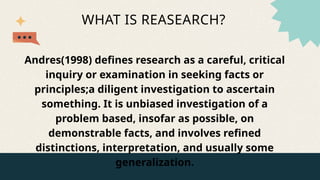
Andres(1998) defines research as a careful, critical
inquiry or examination in seeking facts or
principles;a diligent investigation to ascertain
something. It is unbiased investigation of a
problem based, insofar as possible, on
demonstrable facts, and involves refined
distinctions, interpretation, and usually some
generalization.
WHAT IS REASEARCH?
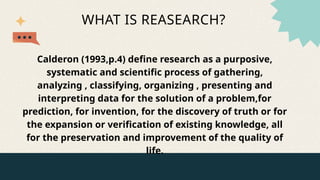
Calderon (1993,p.4) define research as a purposive,
systematic and scientific process of gathering,
analyzing , classifying, organizing , presenting and
interpreting data for the solution of a problem,for
prediction, for invention, for the discovery of truth or for
the expansion or verification of existing knowledge, all
for the preservation and improvement of the quality of
life.
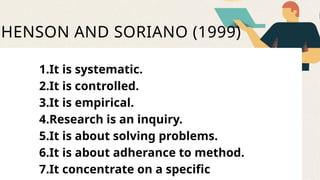
HENSON AND SORIANO (1999)
1.It is systematic.
2.It is controlled.
3.It is empirical.
4.Research is an inquiry.
5.It is about solving problems.
6.It is about adherance to method.
7.It concentrate on a specific
KINDS OF
RESEARCH
ACCORDING TO
PURPOSE
1.BASIC OR PURE RESEARCH
• Research is conducted to
develop theories and
principles, for intellectual
pursuit of knowledge and
acquire learning.
• The inquiry is done for
knowledge sake.
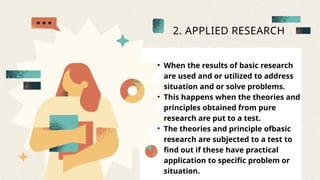
2. APPLIED RESEARCH
• When the results of basic research
are used and or utilized to address
situation and or solve problems.
• This happens when the theories and
principles obtained from pure
research are put to a test.
• The theories and principle ofbasic
research are subjected to a test to
find out if these have practical
application to specific problem or
situation.
THE SCIENTIFIC METHOD OF
RESEARCH
Science is a method of
discovering and acquiring
reliable knowledge.Reliable
knowledge is knowledge
that can be verified because
its veracity has been
established by a reliable
method.
-Schafersman,
1.THE USE OF EMPIRICAL
EVIDENCE(EMPIRICISM)
2. THE PRACTICE OF LOGICAL REASONING
(RATIONALISM)
3. THE POSITION OF SKEPTICAL
ATTITUDE(SKEPTICISM)
THE THREE CENTRAL COMPONENTS
1.The research problem should be clearly identified. This may
be an unexplained discrepancy in one’s field of knowledge or
agap to be closed.
2.Steps should be taken to define the problem more precisely
to establish its scope and limit.
3.Efforts should be exerted to search out every possible
solution. Ideas are considered and one’s imagination and
freedom of thoughts are allowed and should be encourage.
4.Researcher should be able to project the consequences of
each of the possible solutions that have been conceived.
5.Researcher should test the solution to find out what
consequences actually bring results.
FIVE STEPS INVLOVED IN THE
SCIENTIFIC METHOD OF RESEARCH
FORMING RESEARCH GROUP
CHARACTERISTIC
NEEDED TO BE A GOOD
RESEARCHER
1.Knowledge -oriented
2.Open-minded
3.Hardworking
4.Resourceful
5.Scientific in attitude
COMMON PROBLEMS
ENCOUNTERED IN
RESEQARCH
1.Difficulty in finding or conceptualizing a
good research.
2.Scarcity or unavailabilty of updated and
relevant references.
3.Financial(limited budget or funds)
4.Time constraints.
5.How to put into writing one’s own ideas.
6.Lack of teamwork among the group
members or inadequate assistance.
7.Uncooperative respondents or official of
an instituiton.
8.Personal problems get in the wayof a
good research work.
THANK YOU

INTRODUCTION TO RESEARCH.pptx Guide for Making Research

  • 1.
  • 2.
    THE IMPORTANCE OFRESEARCH • Research is a valuable tool to produce needed changes . • It is a pathway to progress and development. • Research is essential for addressing problems, making improvements,and adapting to complex human needs.
  • 3.
    THE MEANING OF RESEARCH •Research is a multi- faceted human endeavor h
  • 4.
    WHAT IS REASEARCH? Aguinaldo(2002,p.2) Researchis a purposive , systematic, and scientific process of gathering,classifying, organizing, presenting, analyzing and interpreting data for the solution of a problem, for prediction, for invention, for the discovery of truth or for the expansion or verificationof existing knowledge, all for the preservation and improvement of the quality of life.
  • 5.
    WHAT IS REASEARCH? Sevillaet.al.(1992,p.2) defines “research as searching for theory, for testing theory or for solving a problem. It means a problem exist and has been identified and that the solution of the problem is neccessary.”
  • 6.
    WHAT IS REASEARCH? Andres(1998)defines research as a careful, critical inquiry or examination in seeking facts or principles;a diligent investigation to ascertain something. It is unbiased investigation of a problem based, insofar as possible, on demonstrable facts, and involves refined distinctions, interpretation, and usually some generalization.
  • 7.
    WHAT IS REASEARCH? Calderon(1993,p.4) define research as a purposive, systematic and scientific process of gathering, analyzing , classifying, organizing , presenting and interpreting data for the solution of a problem,for prediction, for invention, for the discovery of truth or for the expansion or verification of existing knowledge, all for the preservation and improvement of the quality of life.
  • 8.
    HENSON AND SORIANO(1999) 1.It is systematic. 2.It is controlled. 3.It is empirical. 4.Research is an inquiry. 5.It is about solving problems. 6.It is about adherance to method. 7.It concentrate on a specific
  • 9.
  • 10.
    1.BASIC OR PURERESEARCH • Research is conducted to develop theories and principles, for intellectual pursuit of knowledge and acquire learning. • The inquiry is done for knowledge sake.
  • 11.
    2. APPLIED RESEARCH •When the results of basic research are used and or utilized to address situation and or solve problems. • This happens when the theories and principles obtained from pure research are put to a test. • The theories and principle ofbasic research are subjected to a test to find out if these have practical application to specific problem or situation.
  • 12.
    THE SCIENTIFIC METHODOF RESEARCH Science is a method of discovering and acquiring reliable knowledge.Reliable knowledge is knowledge that can be verified because its veracity has been established by a reliable method. -Schafersman,
  • 13.
    1.THE USE OFEMPIRICAL EVIDENCE(EMPIRICISM) 2. THE PRACTICE OF LOGICAL REASONING (RATIONALISM) 3. THE POSITION OF SKEPTICAL ATTITUDE(SKEPTICISM) THE THREE CENTRAL COMPONENTS
  • 14.
    1.The research problemshould be clearly identified. This may be an unexplained discrepancy in one’s field of knowledge or agap to be closed. 2.Steps should be taken to define the problem more precisely to establish its scope and limit. 3.Efforts should be exerted to search out every possible solution. Ideas are considered and one’s imagination and freedom of thoughts are allowed and should be encourage. 4.Researcher should be able to project the consequences of each of the possible solutions that have been conceived. 5.Researcher should test the solution to find out what consequences actually bring results. FIVE STEPS INVLOVED IN THE SCIENTIFIC METHOD OF RESEARCH
  • 15.
  • 16.
    CHARACTERISTIC NEEDED TO BEA GOOD RESEARCHER
  • 17.
  • 18.
  • 19.
    1.Difficulty in findingor conceptualizing a good research. 2.Scarcity or unavailabilty of updated and relevant references. 3.Financial(limited budget or funds) 4.Time constraints. 5.How to put into writing one’s own ideas. 6.Lack of teamwork among the group members or inadequate assistance. 7.Uncooperative respondents or official of an instituiton. 8.Personal problems get in the wayof a good research work.
  • 20.