PPT :Secondary Data And
Its Types.
SUBMITTED BY –
Anubhav Sharma
Central University Of jammu
SUBMITTED To:
Dr. NARESH SHARMA
TYPES OF DATA
 DATA- Data is information in raw or unorganized form(such as
alphabet, number or symbols) that refers to or represent ,ideas,
object. data is limitless and present everywhere in the universe.
TYPES:-
 PRIMARY DATA - collected by the researcher himself
 SECONDARY DATA - collected by others to be "re-used" by
the researcher
SECONDARY DATA
Data collected from a source that has already been
published in any form is called as secondary data.
The review of literature in any research is based on
secondary data. Mostly from books, journals and
periodicals.
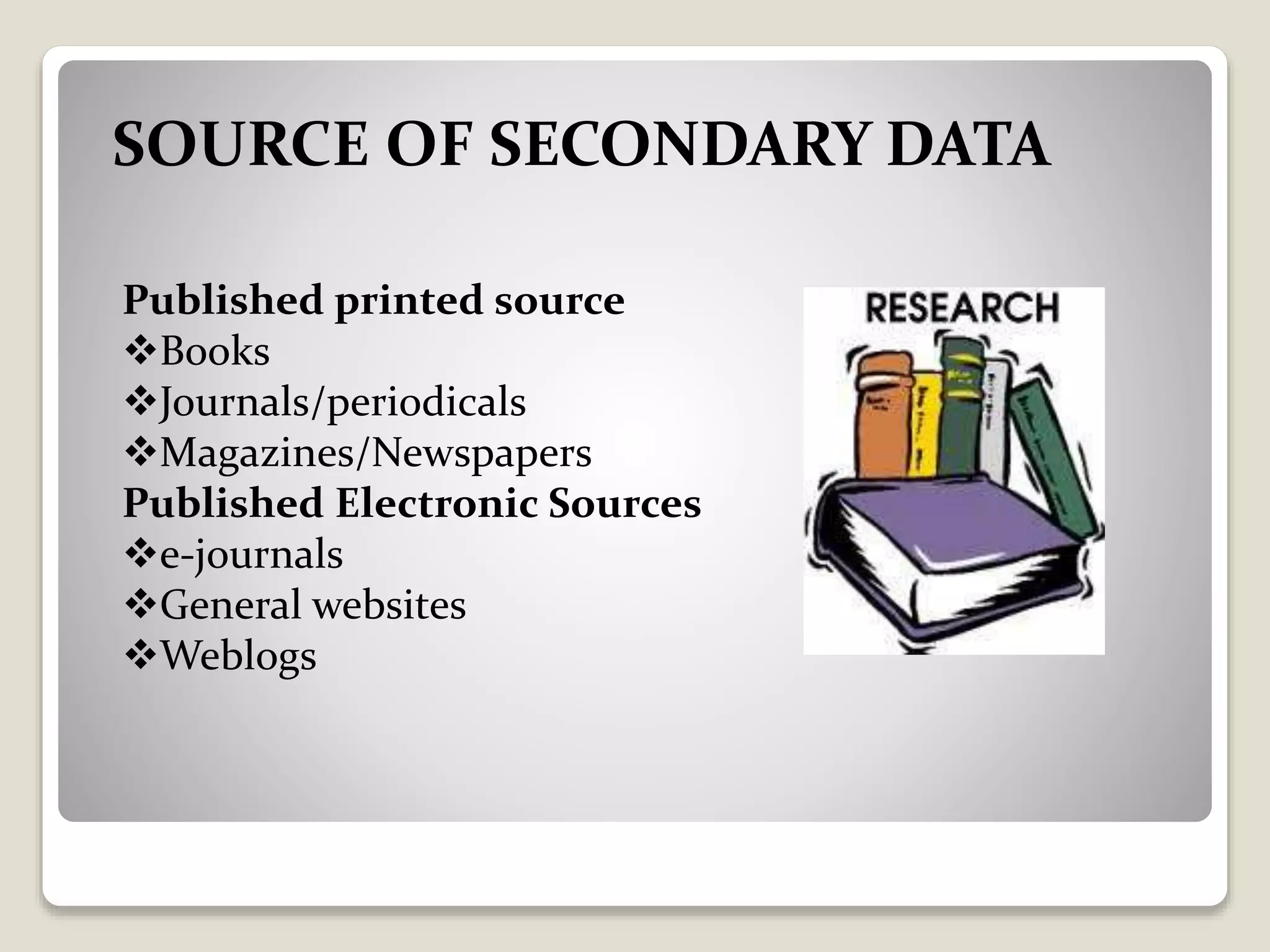
SOURCE OF SECONDARY DATA
Published printed source
Books
Journals/periodicals
Magazines/Newspapers
Published Electronic Sources
e-journals
General websites
Weblogs
Continued…………
Unpublished Personal Records
Diaries
Letters
Government Records
Census Data/population statistics:
Health records
Educational institutes records
Public Sector Records:
NGO's survey data
Other private companies records
MERITS OF SECONDARY DATA
Use is very convenient.
 Saves time and finance.
 In some enquiries primary data cannot be collected.
 Reliable secondary data are generally available for many
investigations.
DEMERITS OF SECONDARY DATA
Very difficult to find sufficiently accurate secondary data.
 Very difficult to find secondary data which exactly fulfils
the need of present investigation.
Extra caution is required to use secondary data.
 Not available for all types of enquiries.
EVALUATION OF SECONDARY DATA
. Evaluation means the following four requirements must be satisfied:-
Availability- It has to be seen that the kind of data you want is available or
not. If it is not available then you have to go for primary data.
Relevance- It should be meeting the requirements of the problem. For
this we have two criterion:-
Units of measurement should be the same.
Concepts used must be same and currency of data should not be
outdated.
Accuracy- In order to find how accurate the data is, the following points
must be considered: -
Specification and methodology used;
Margin of error should be examined;
The dependability of the source must be seen.
Sufficiency- Adequate data should be available.
CONCLUSION
Secondary data can come from sources internal to the
organization or external.
The internet and syndicated firms have, in many
ways,enabled the gathering of secondary data.
Secondary data are generally useful, low-cost, rapidly
available sources of information.
Always look for secondary data first

Ppt secondary data and its types

  • 1.
    PPT :Secondary DataAnd Its Types. SUBMITTED BY – Anubhav Sharma Central University Of jammu SUBMITTED To: Dr. NARESH SHARMA
  • 2.
    TYPES OF DATA DATA- Data is information in raw or unorganized form(such as alphabet, number or symbols) that refers to or represent ,ideas, object. data is limitless and present everywhere in the universe. TYPES:-  PRIMARY DATA - collected by the researcher himself  SECONDARY DATA - collected by others to be "re-used" by the researcher
  • 3.
    SECONDARY DATA Data collectedfrom a source that has already been published in any form is called as secondary data. The review of literature in any research is based on secondary data. Mostly from books, journals and periodicals.
  • 4.
    SOURCE OF SECONDARYDATA Published printed source Books Journals/periodicals Magazines/Newspapers Published Electronic Sources e-journals General websites Weblogs
  • 5.
    Continued………… Unpublished Personal Records Diaries Letters GovernmentRecords Census Data/population statistics: Health records Educational institutes records Public Sector Records: NGO's survey data Other private companies records
  • 6.
    MERITS OF SECONDARYDATA Use is very convenient.  Saves time and finance.  In some enquiries primary data cannot be collected.  Reliable secondary data are generally available for many investigations.
  • 7.
    DEMERITS OF SECONDARYDATA Very difficult to find sufficiently accurate secondary data.  Very difficult to find secondary data which exactly fulfils the need of present investigation. Extra caution is required to use secondary data.  Not available for all types of enquiries.
  • 8.
    EVALUATION OF SECONDARYDATA . Evaluation means the following four requirements must be satisfied:- Availability- It has to be seen that the kind of data you want is available or not. If it is not available then you have to go for primary data. Relevance- It should be meeting the requirements of the problem. For this we have two criterion:- Units of measurement should be the same. Concepts used must be same and currency of data should not be outdated. Accuracy- In order to find how accurate the data is, the following points must be considered: - Specification and methodology used; Margin of error should be examined; The dependability of the source must be seen. Sufficiency- Adequate data should be available.
  • 9.
    CONCLUSION Secondary data cancome from sources internal to the organization or external. The internet and syndicated firms have, in many ways,enabled the gathering of secondary data. Secondary data are generally useful, low-cost, rapidly available sources of information. Always look for secondary data first