Ancient Egyptian
Architecture
Architecture
3000 B.C. – 30 B.C.
Prepared by:
Sucharita Acharya
Lecturer in Architecture
North Calcutta Polytechnic
Geographical Feature
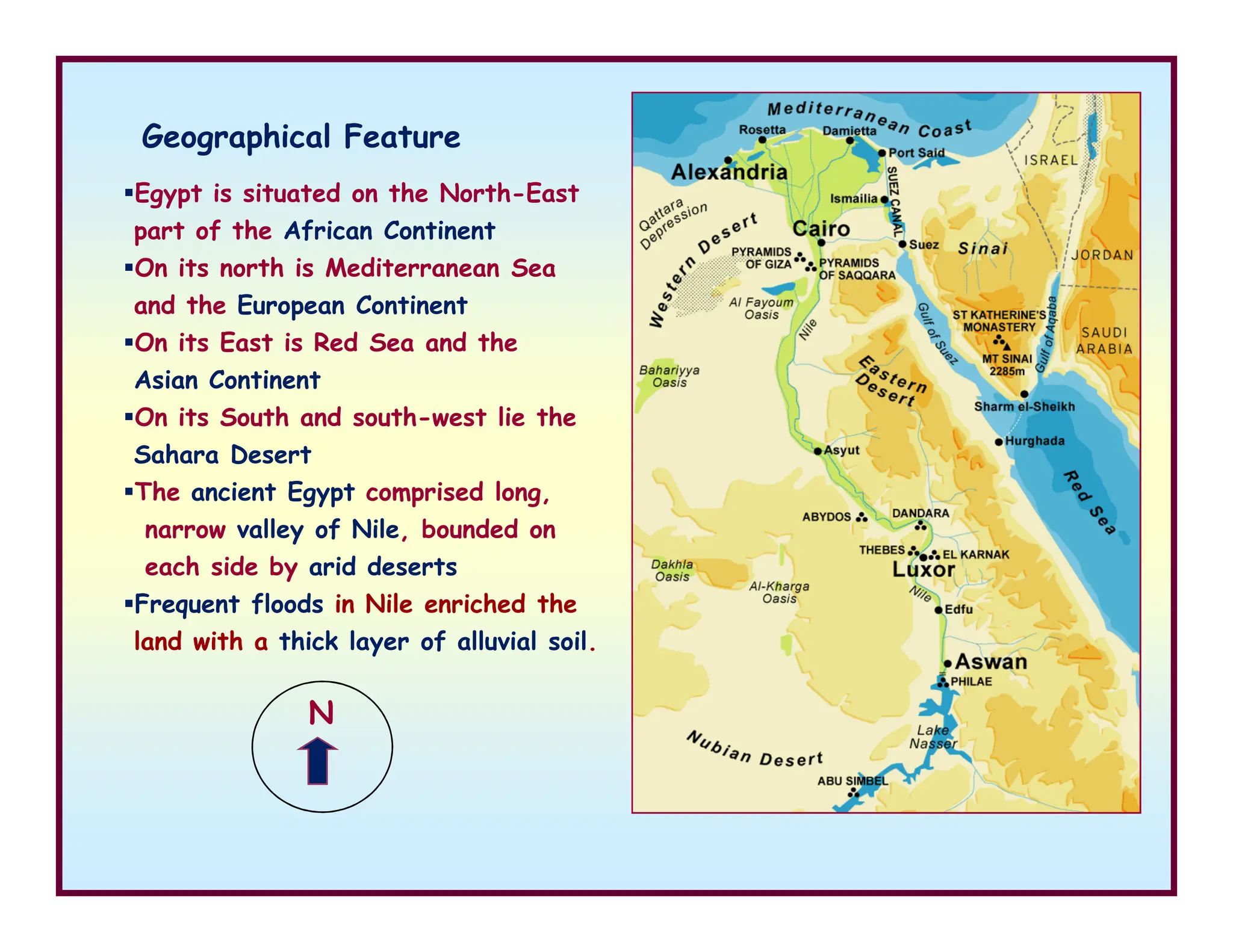
Egypt is situated on the North-East
part of the African Continent
On its north is Mediterranean Sea
and the European Continent
On its East is Red Sea and the
Asian Continent
On its South and south-west lie the
Sahara Desert
The ancient Egypt comprised long,
N
The ancient Egypt comprised long,
narrow valley of Nile, bounded on
each side by arid deserts
Frequent floods in Nile enriched the
land with a thick layer of alluvial soil.
Geological Condition
Rich clay was abundant from Nile delta from which bricks were made
Sun-dried or kiln-burnt bricks were the chief building materials
Reeds, papyrus and palm branch ribs were employed for reinforcement
Due to scarcity of wood, palm logs were employed for roofing
Fine limestone was quarried from Tura in northern or lower Egypt.
Sandstone was employed in construction of temples, sarcophagus.
Red or grey granite was brought from Aswan in southern Egypt.
Climatic Condition
The climate of Egypt was hot and arid
There were only two seasons, spring and summer
Snow and frost were unknown to them
Except on Nile delta, storm and rain were very rare
Historical Background
Earlier Egypt was divided in two kingdoms, Upper kingdom and Lower kingdom
Around 3000 B.C., a highly centralized monarchy emerged in Egypt
Thereon the Pharaohs ruled Egypt for nearly three millennia
The Pharaohs consist of thirty dynasties.
The first ten dynasties were Ancient Kingdom, (B.C. 3000 – 2130)
Eleventh to seventeenth dynasties comprise Middle Kingdom (B.C. 2130 – 1580)
The last thirteen dynasties are New Kingdom (B.C. 1580 – 332)
From 525 B.C., Egypt fell under Persian Empire.
In 332 B.C., Alexander, the Macedonian king conquered Egypt from Persians
After his death, his empire was divided and Egypt fell to his general Ptolemy .
Thereafter it became prosperous under Ptolemaic dynasty (B.C.332-30).
The last ruler of this dynasty, Queen Cleopatra committed suicide in 30 B.C.
Thereafter Egypt came under Roman rule under Emperor Augustus
Social Background
Pharaohs were considered as divine kings who after death joined the pantheon of gods.
The Pharaohs also looked after the religious rites as powerful priests.
Pharaohs owned the whole country and distributed land among their relatives and nobles
There were farmers, craftsmen and herds who were free citizens.
They employed the slaves and prisoners of war for agriculture and building construction
Egypt maintained trading relations with Mesopotamia, ancient Greek islands
The ancient Egyptians were among the first groups of people to invent a writing system.
Cultural Background
The ancient Egyptian writing was hieroglyphics, with pictures representing words
The Egyptians pioneered the use of dams, canals and irrigation channels
The Egyptians made great progress in astronomy. The observation of stars was
important in predicting seasons and determining the annual flooding of the Nile.
The Egyptians devised their highly accurate solar calendar. The Egyptian calendar
contained 365 days, divided into 12 months. Each month had 30 days, and there
were an additional five festival days at the end of each year.
The Egyptians were experts in many applied chemistry fields such as metallurgy,
glass making, paper manufacture, paint pigments, dyes, and pharmaceuticals.
Religious Background
In Egypt, religion had a strong influence on architecture
Egyptian religion had many gods and goddesses.
The principal deity was sun-god or Amon with his consort Ra.
Another deity was Osiris, the god of death and resurrection to eternal life.
The governing idea of the religion was their strong belief in life after death.
To secure immortality of the soul of the Pharaohs, elaborate preparations were
made for the preservation of their bodies after death.
Tombs were the permanent abode, so royal pyramids were constructed out of
enduring stones.
The earthly dwelling houses were regarded as temporary lodging, and hence were
made mostly of sun-dried bricks which were perishable.
Egyptian religious rites were mysterious and very rigid.
These characteristics were reflected in the architecture of tombs and temples
with dark mysterious chambers and accesses.
Thus religious belief in life after death lends the most characteristic effect
in the architecture of ancient Egypt.
Architectural Characteristics
Bricks were made from alluvial soil which were sun-dried or kiln-burnt
Sandstones and lime stones were used for special constructions
Palm logs were used for roofing ordinary houses
Reeds and palm branch ribs were employed for reinforcement
Structure:
Chief building materials:
The structures were essentially columnar & trabeated
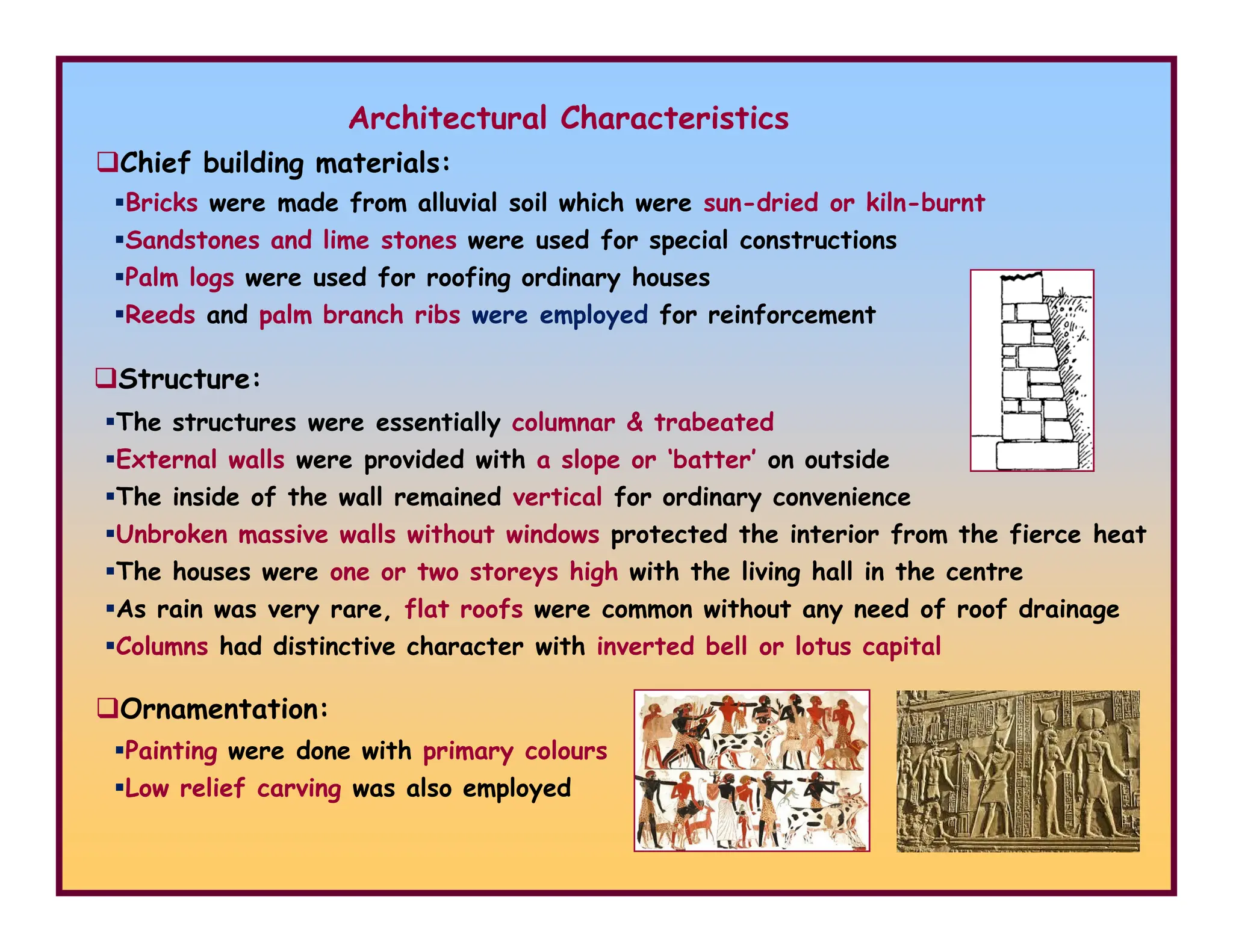
External walls were provided with a slope or ‘batter’ on outside
Ornamentation:
Painting were done with primary colours
Low relief carving was also employed
The inside of the wall remained vertical for ordinary convenience
Unbroken massive walls without windows protected the interior from the fierce heat
The houses were one or two storeys high with the living hall in the centre
As rain was very rare, flat roofs were common without any need of roof drainage
Columns had distinctive character with inverted bell or lotus capital
Architectural Characteristics
Types of buildings and structures:
Mastabas: These were earlier flat topped funerary mounds with battered sides
Pyramids: These were massive masonry structures built as Royal tombs for Pharaohs
Rock-hewn tombs: These were open fronted tombs cut into rock
Tombs:
Temples:
Temples were built for the worship of the gods and religious rituals
Temples were seen as houses for the gods or kings to whom they were dedicated.
Other structures:
Pylons: These were monumental gateways of temples, decorated with carvings
Obelisks: These were tapered monolithic pillars, erected in pairs at the entrances
of temples, with all four sides of the shaft being carved with hieroglyphs
Sphinx: It was a huge statue of a creature with the body of a lion and the head
of a human, most often depicted as a male with a pharaoh headdress
Temples were seen as houses for the gods or kings to whom they were dedicated.
Tomb Architecture
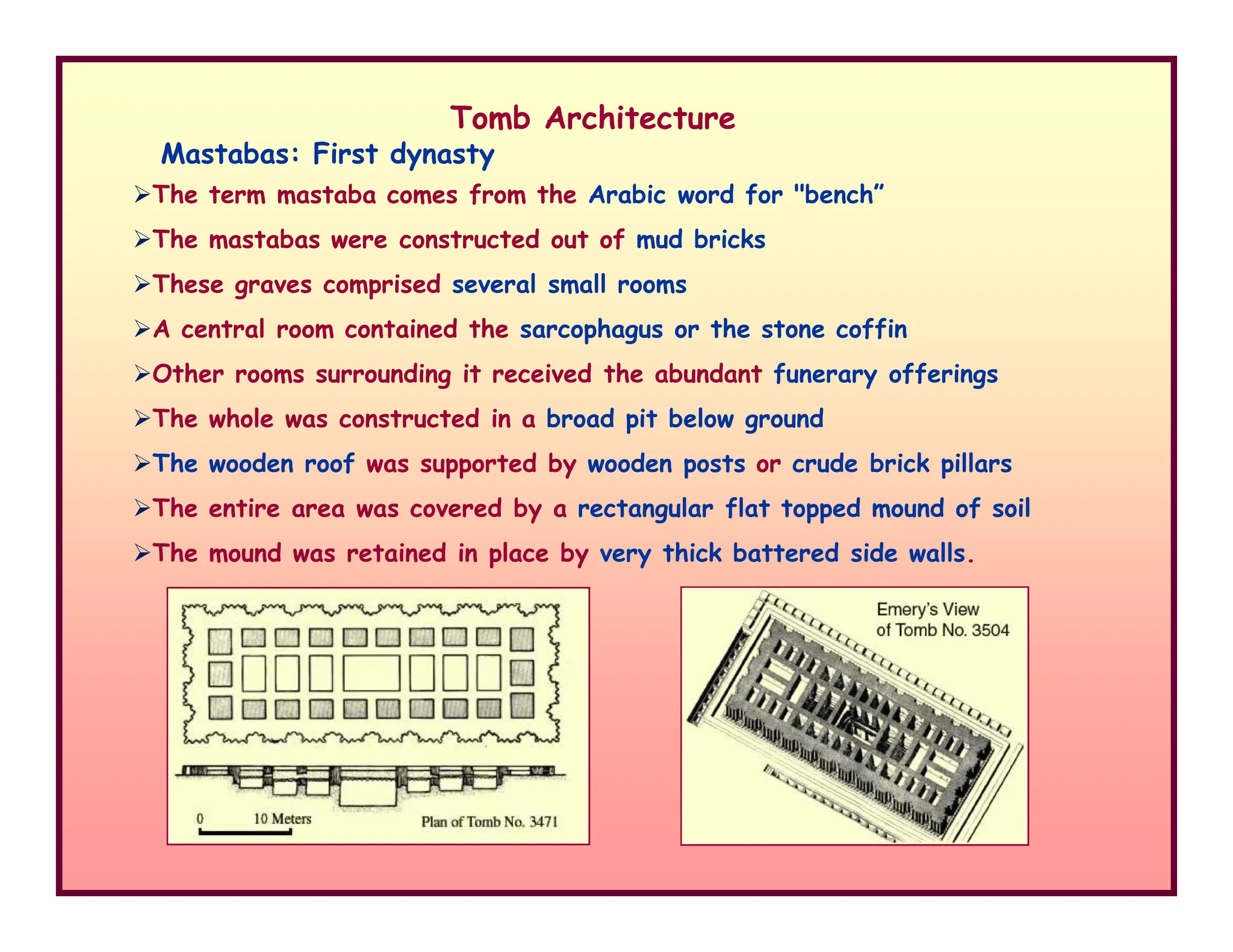
Mastabas: First dynasty
The term mastaba comes from the Arabic word for "bench”
The mastabas were constructed out of mud bricks
These graves comprised several small rooms
A central room contained the sarcophagus or the stone coffin
Other rooms surrounding it received the abundant funerary offerings
The whole was constructed in a broad pit below ground
The wooden roof was supported by wooden posts or crude brick pillars
The entire area was covered by a rectangular flat topped mound of soil
The mound was retained in place by very thick battered side walls.
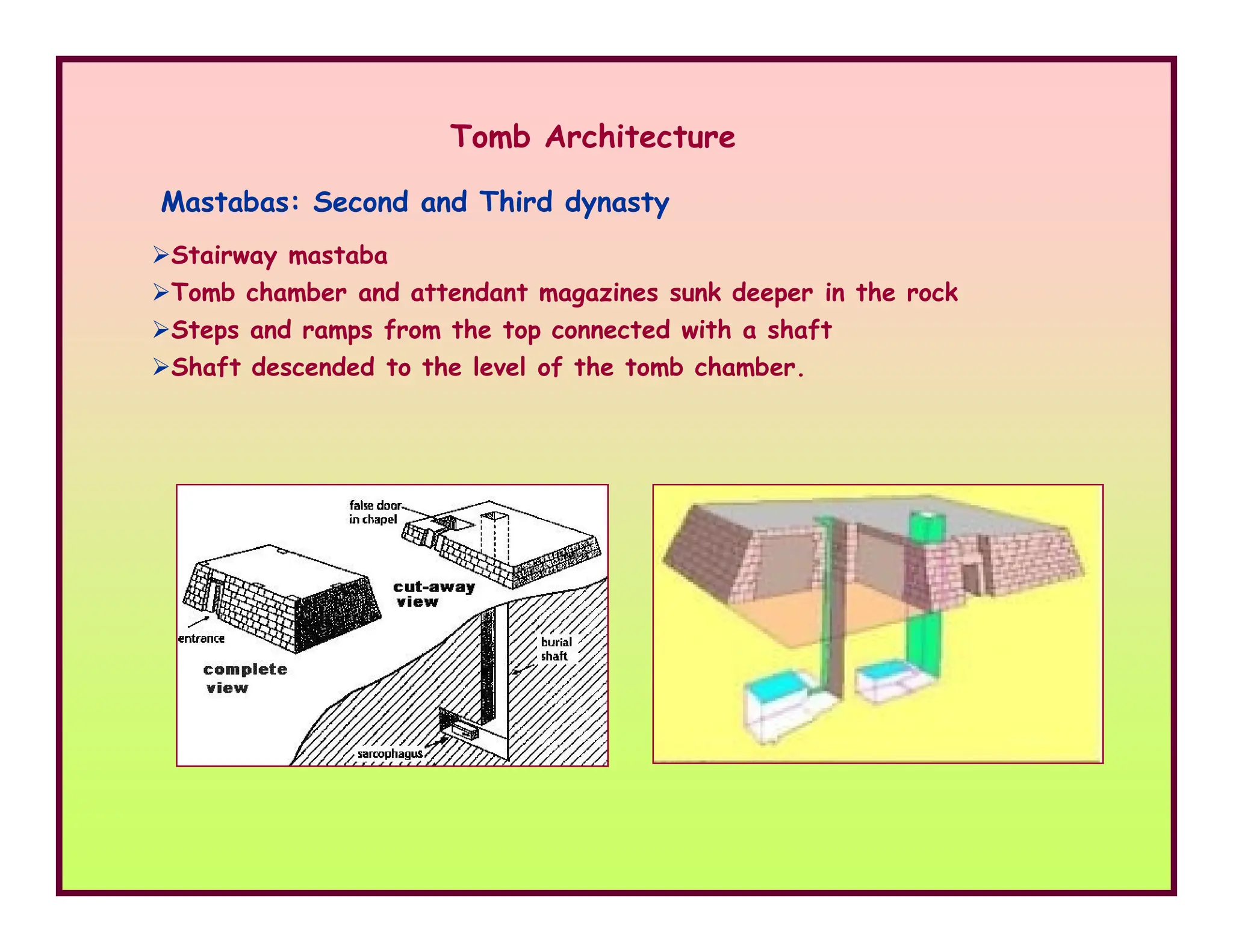
Mastabas: Second and Third dynasty
Stairway mastaba
Tomb chamber and attendant magazines sunk deeper in the rock
Steps and ramps from the top connected with a shaft
Shaft descended to the level of the tomb chamber.
Tomb Architecture
Mastabas: Fourth to Sixth dynasty
a columned hall
‘serdab’- a completely enclosed room except for a slot
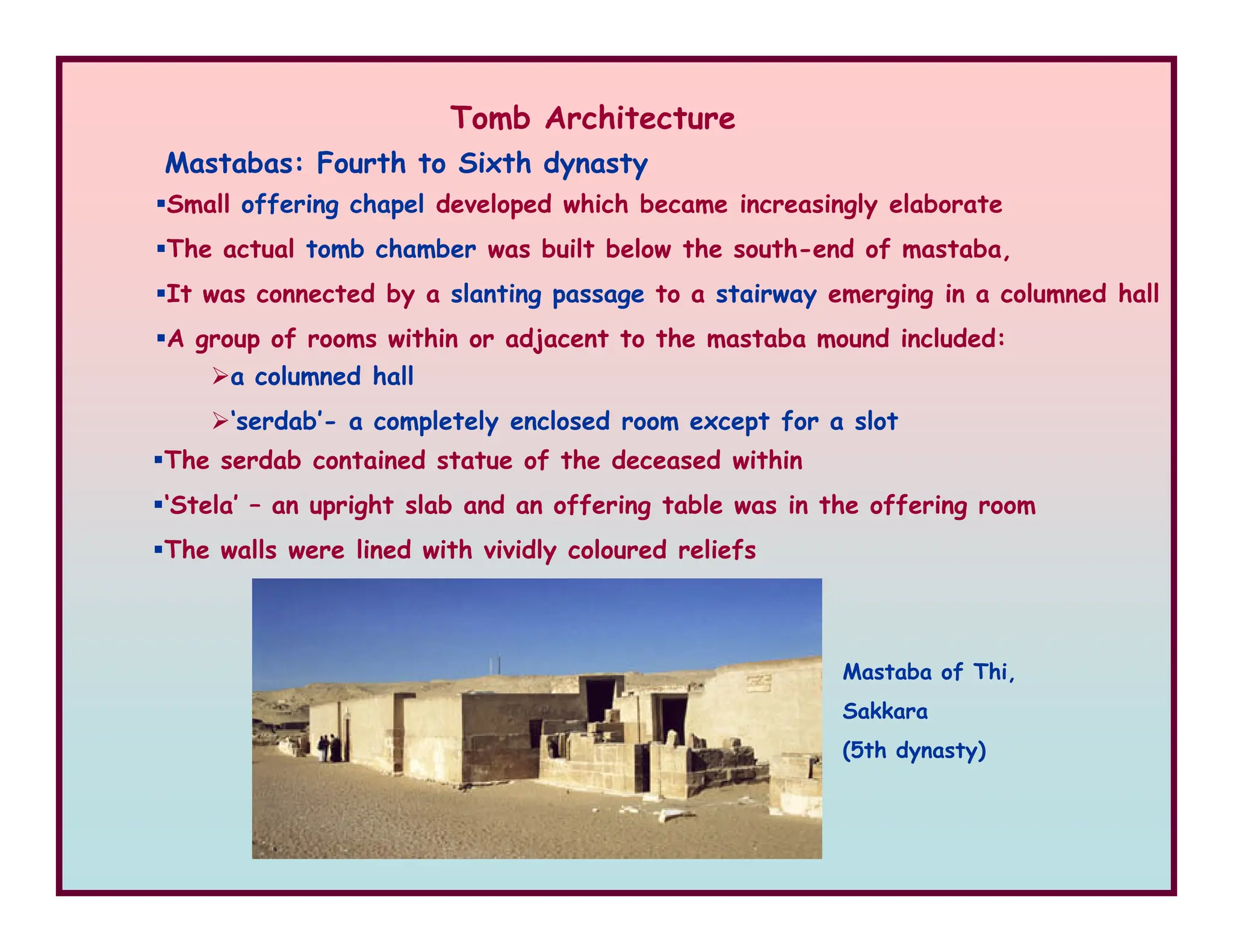
Small offering chapel developed which became increasingly elaborate
The actual tomb chamber was built below the south-end of mastaba,
It was connected by a slanting passage to a stairway emerging in a columned hall
A group of rooms within or adjacent to the mastaba mound included:
The serdab contained statue of the deceased within
Tomb Architecture
‘Stela’ – an upright slab and an offering table was in the offering room
The walls were lined with vividly coloured reliefs
Mastaba of Thi,
Sakkara
(5th dynasty)
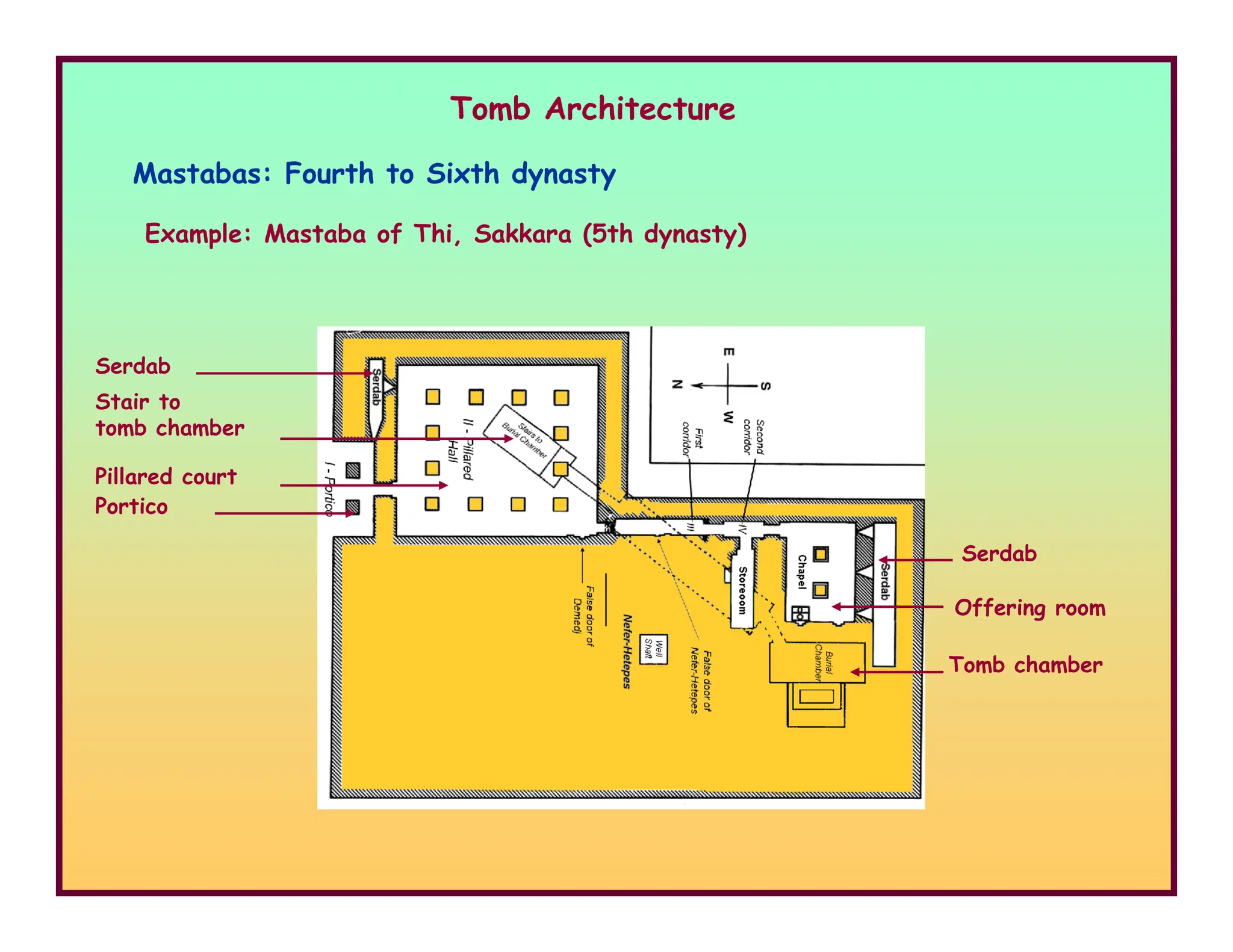
Example: Mastaba of Thi, Sakkara (5th dynasty)
Mastabas: Fourth to Sixth dynasty
Pillared court
Stair to
tomb chamber
Serdab
Tomb Architecture
Serdab
Offering room
Tomb chamber
Pillared court
Portico
Pyramid
Tomb Architecture
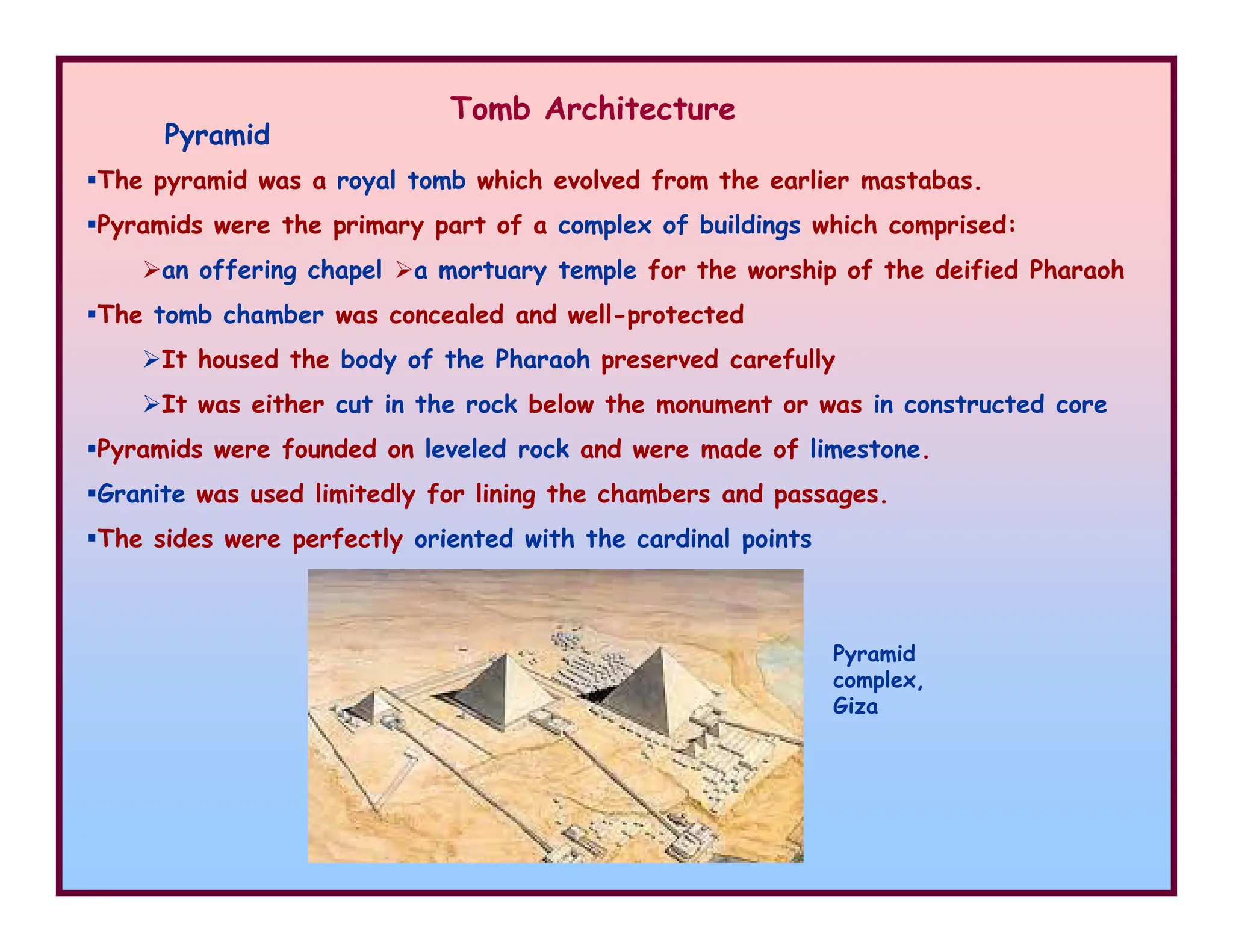
The pyramid was a royal tomb which evolved from the earlier mastabas.
Pyramids were the primary part of a complex of buildings which comprised:
an offering chapel
The tomb chamber was concealed and well-protected
It housed the body of the Pharaoh preserved carefully
It was either cut in the rock below the monument or was in constructed core
Pyramids were founded on leveled rock and were made of limestone.
Granite was used limitedly for lining the chambers and passages.
a mortuary temple for the worship of the deified Pharaoh
Granite was used limitedly for lining the chambers and passages.
The sides were perfectly oriented with the cardinal points
Pyramid
complex,
Giza
Pyramid
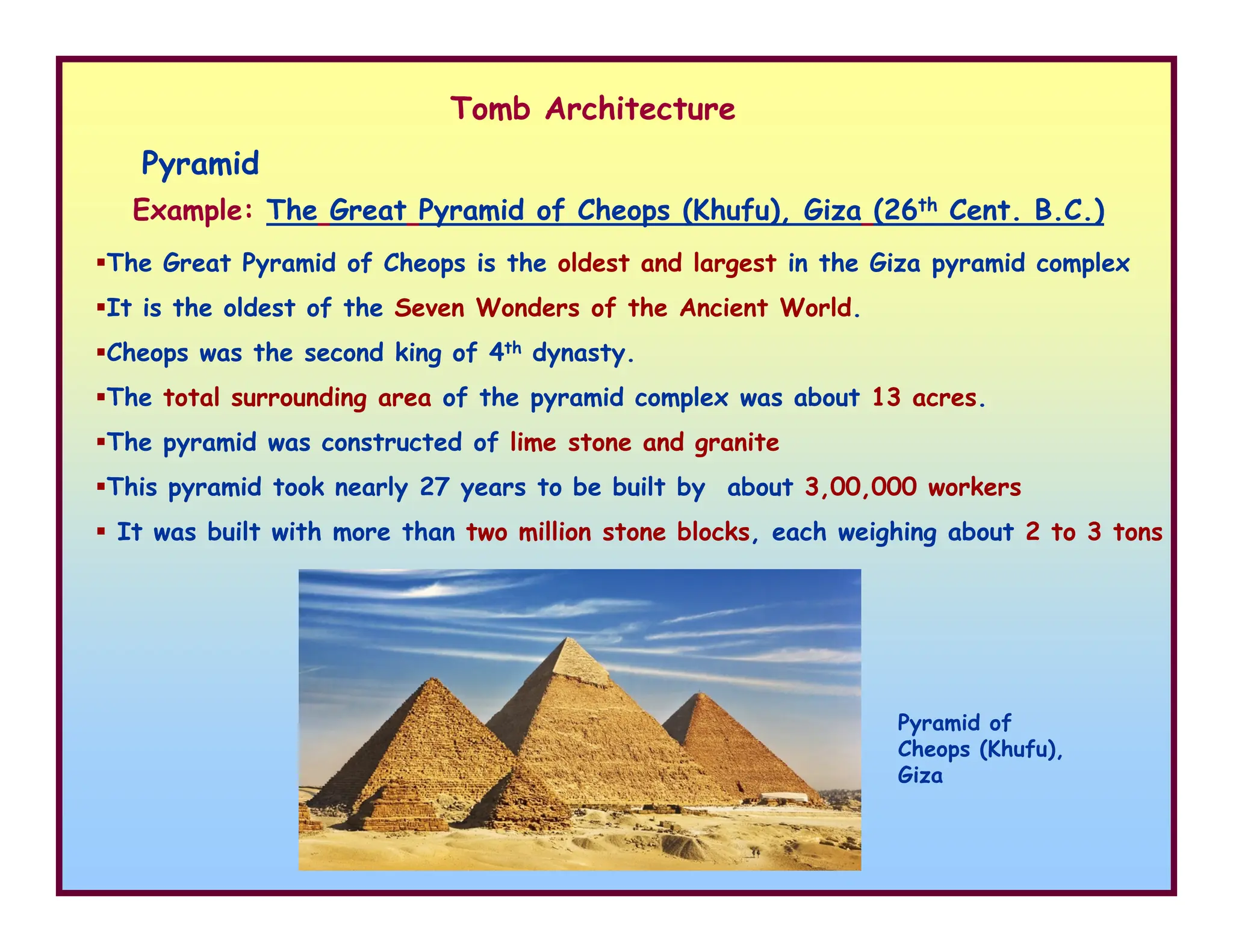
Example: The Great Pyramid of Cheops (Khufu), Giza (26th Cent. B.C.)
The Great Pyramid of Cheops is the oldest and largest in the Giza pyramid complex
It is the oldest of the Seven Wonders of the Ancient World.
Cheops was the second king of 4th dynasty.
The total surrounding area of the pyramid complex was about 13 acres.
The pyramid was constructed of lime stone and granite
This pyramid took nearly 27 years to be built by about 3,00,000 workers
Tomb Architecture
This pyramid took nearly 27 years to be built by about 3,00,000 workers
It was built with more than two million stone blocks, each weighing about 2 to 3 tons
Pyramid of
Cheops (Khufu),
Giza
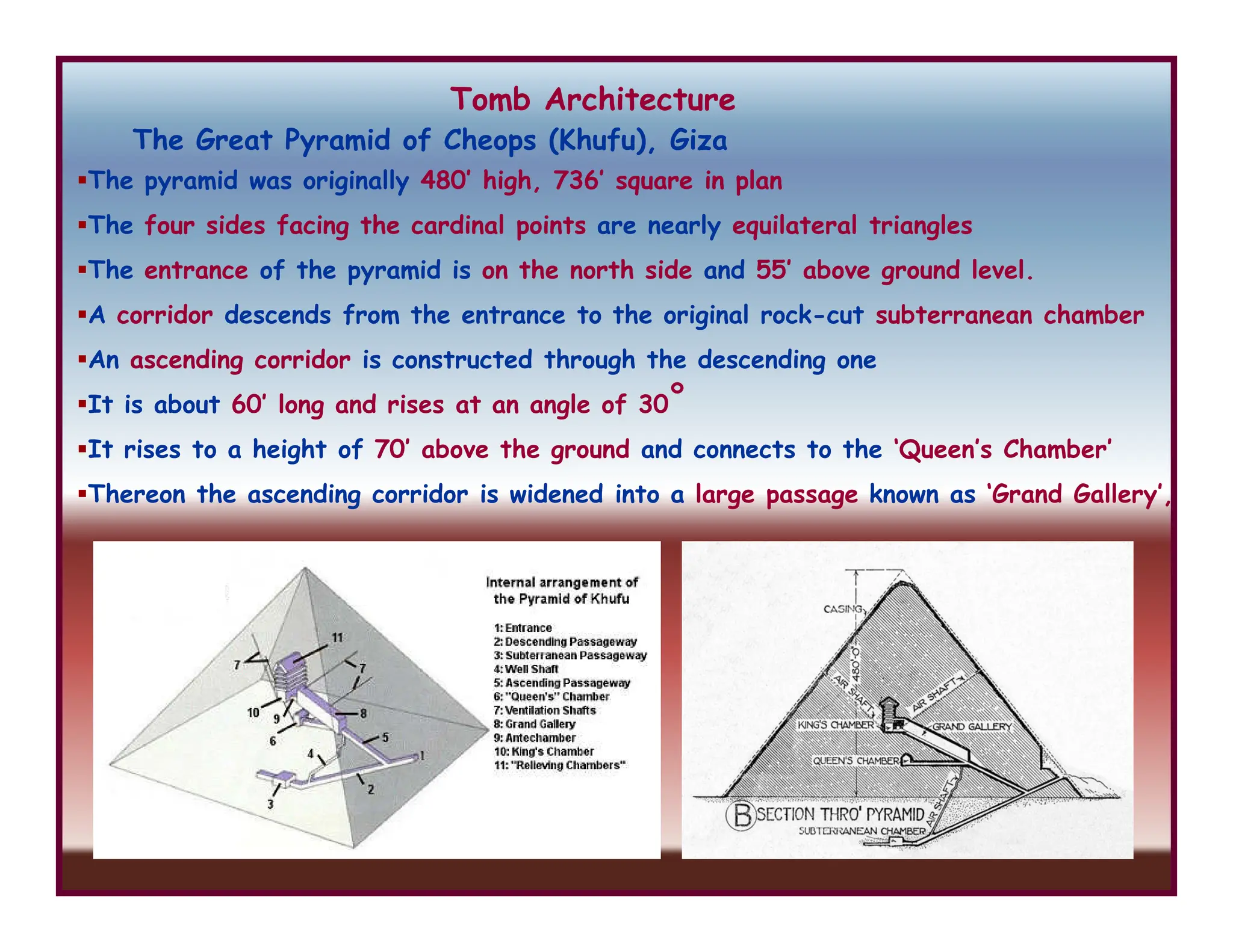
The pyramid was originally 480’ high, 736’ square in plan
The four sides facing the cardinal points are nearly equilateral triangles
The entrance of the pyramid is on the north side and 55’ above ground level.
A corridor descends from the entrance to the original rock-cut subterranean chamber
An ascending corridor is constructed through the descending one
It is about 60’ long and rises at an angle of 30
It rises to a height of 70’ above the ground and connects to the ‘Queen’s Chamber’
Thereon the ascending corridor is widened into a large passage known as ‘Grand Gallery’,
The Great Pyramid of Cheops (Khufu), Giza
Tomb Architecture
Thereon the ascending corridor is widened into a large passage known as ‘Grand Gallery’,
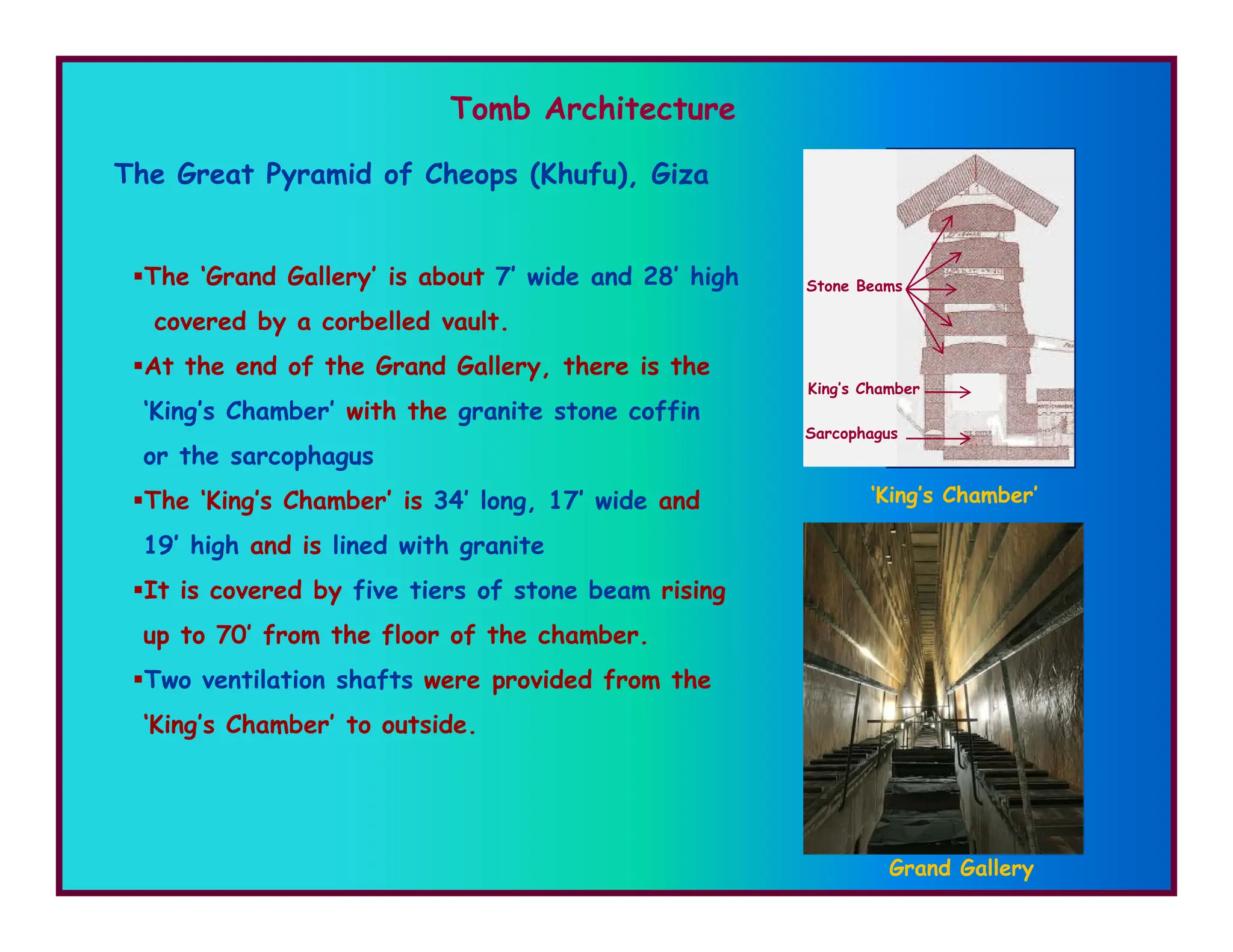
The ‘Grand Gallery’ is about 7’ wide and 28’ high
covered by a corbelled vault.
At the end of the Grand Gallery, there is the
‘King’s Chamber’ with the granite stone coffin
or the sarcophagus
Tomb Architecture
The Great Pyramid of Cheops (Khufu), Giza
Sarcophagus
King’s Chamber
Stone Beams
The ‘King’s Chamber’ is 34’ long, 17’ wide and
19’ high and is lined with granite
It is covered by five tiers of stone beam rising
up to 70’ from the floor of the chamber.
Two ventilation shafts were provided from the
‘King’s Chamber’ to outside.
Grand Gallery
‘King’s Chamber’
Tomb Architecture
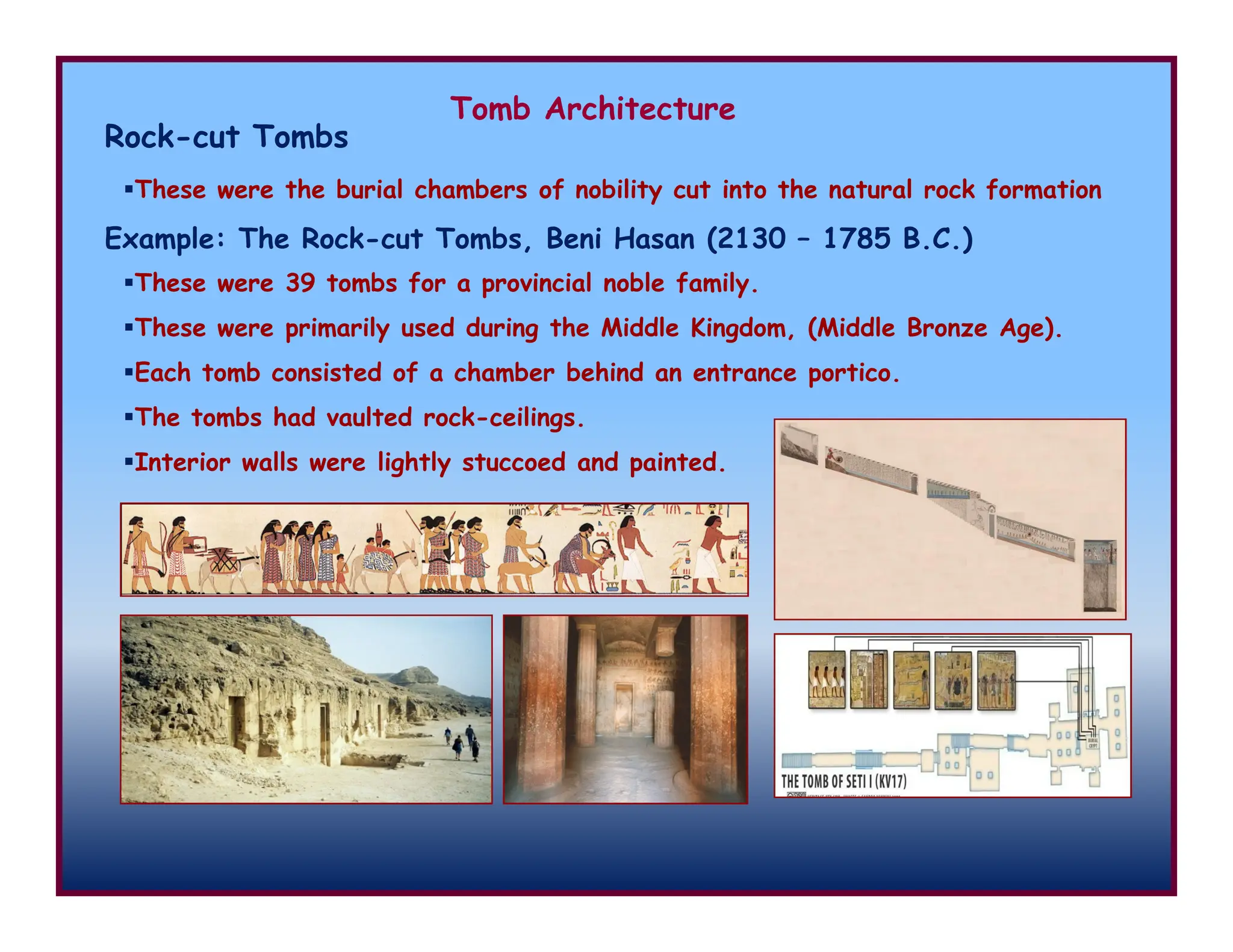
Rock-cut Tombs
These were the burial chambers of nobility cut into the natural rock formation
Example: The Rock-cut Tombs, Beni Hasan (2130 – 1785 B.C.)
These were 39 tombs for a provincial noble family.
These were primarily used during the Middle Kingdom, (Middle Bronze Age).
Each tomb consisted of a chamber behind an entrance portico.
The tombs had vaulted rock-ceilings.
Interior walls were lightly stuccoed and painted.
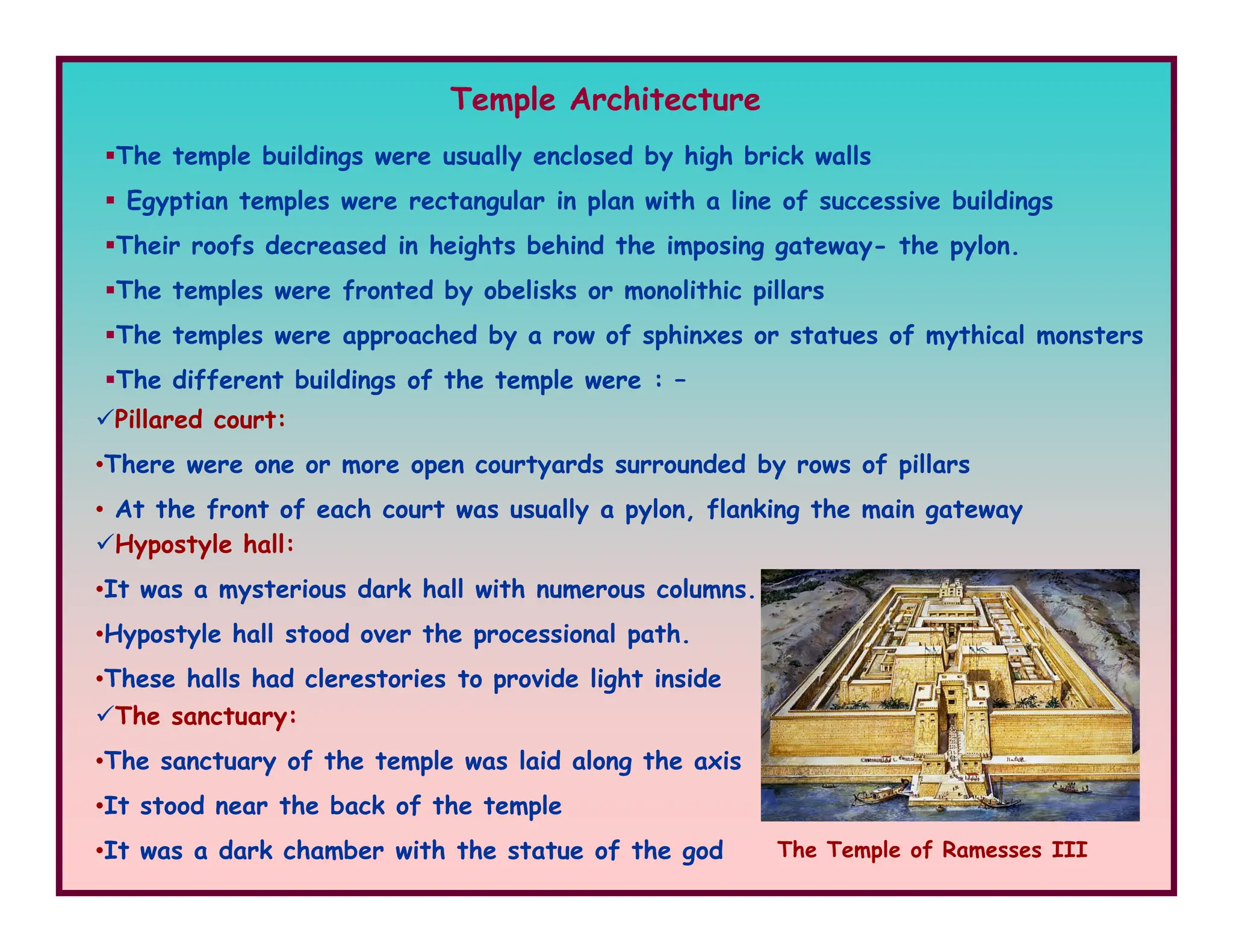
Temple Architecture
The temple buildings were usually enclosed by high brick walls
Egyptian temples were rectangular in plan with a line of successive buildings
Their roofs decreased in heights behind the imposing gateway- the pylon.
The temples were fronted by obelisks or monolithic pillars
The temples were approached by a row of sphinxes or statues of mythical monsters
The different buildings of the temple were : –
Pillared court:
•There were one or more open courtyards surrounded by rows of pillars
• At the front of each court was usually a pylon, flanking the main gateway
Hypostyle hall:
•It was a mysterious dark hall with numerous columns.
•Hypostyle hall stood over the processional path.
•These halls had clerestories to provide light inside
The sanctuary:
•The sanctuary of the temple was laid along the axis
•It stood near the back of the temple
•It was a dark chamber with the statue of the god The Temple of Ramesses III
Temple Architecture
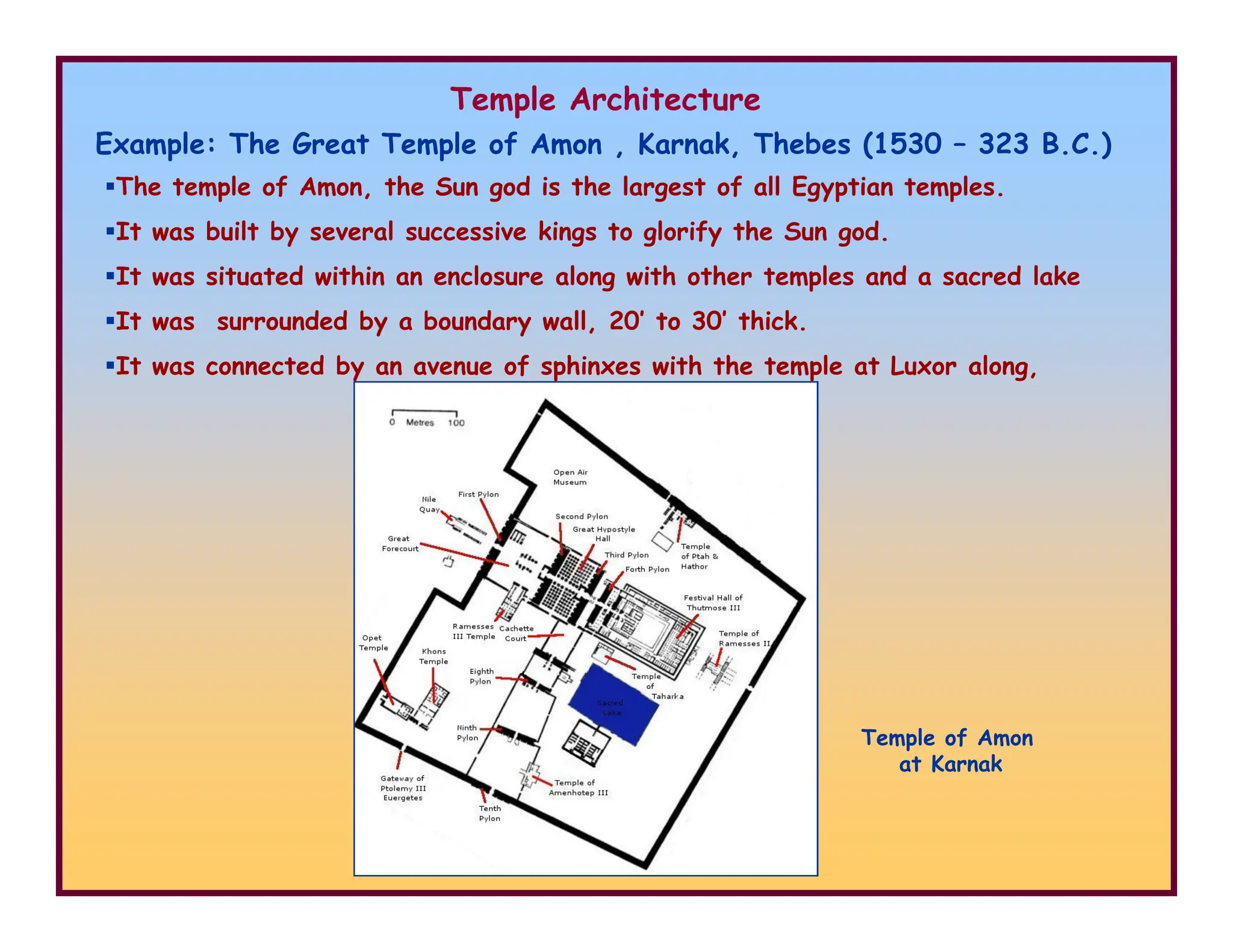
Example: The Great Temple of Amon , Karnak, Thebes (1530 – 323 B.C.)
The temple of Amon, the Sun god is the largest of all Egyptian temples.
It was built by several successive kings to glorify the Sun god.
It was situated within an enclosure along with other temples and a sacred lake
It was surrounded by a boundary wall, 20’ to 30’ thick.
It was connected by an avenue of sphinxes with the temple at Luxor along,
Temple of Amon
at Karnak
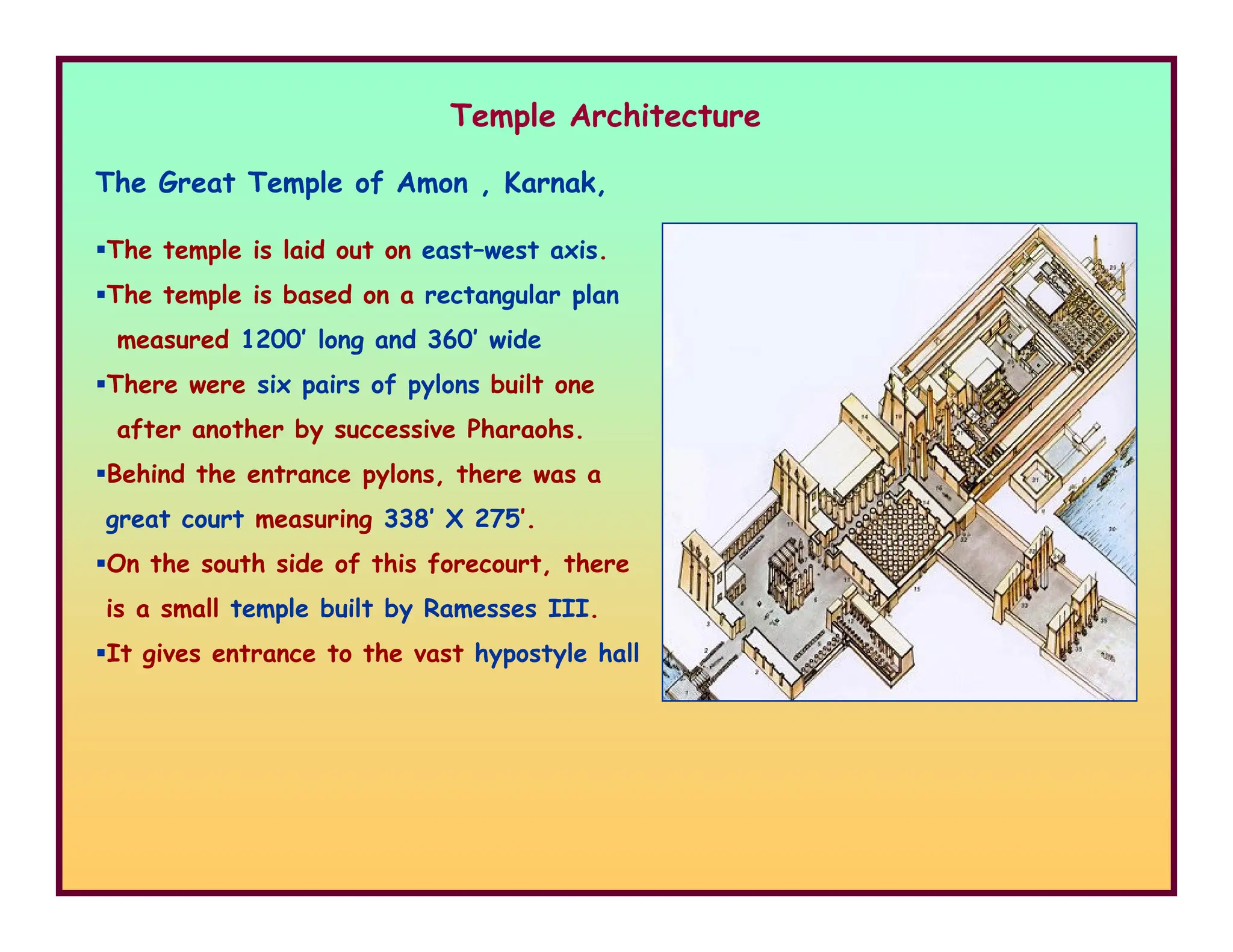
The temple is laid out on east–west axis.
The temple is based on a rectangular plan
measured 1200’ long and 360’ wide
There were six pairs of pylons built one
after another by successive Pharaohs.
Behind the entrance pylons, there was a
Temple Architecture
The Great Temple of Amon , Karnak,
Behind the entrance pylons, there was a
great court measuring 338’ X 275’.
On the south side of this forecourt, there
is a small temple built by Ramesses III.
It gives entrance to the vast hypostyle hall
Temple Architecture
The Great Temple of Amon , Karnak,
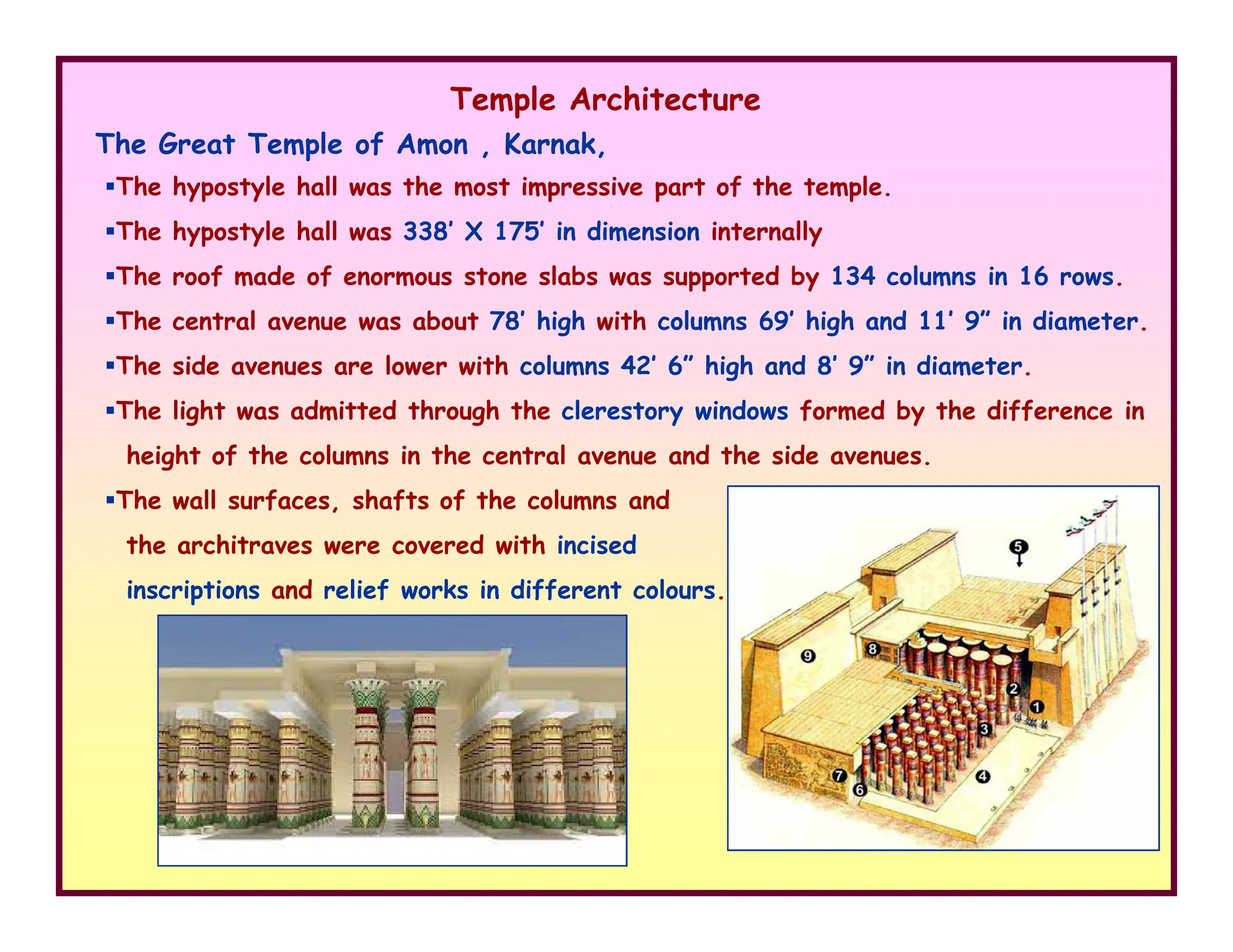
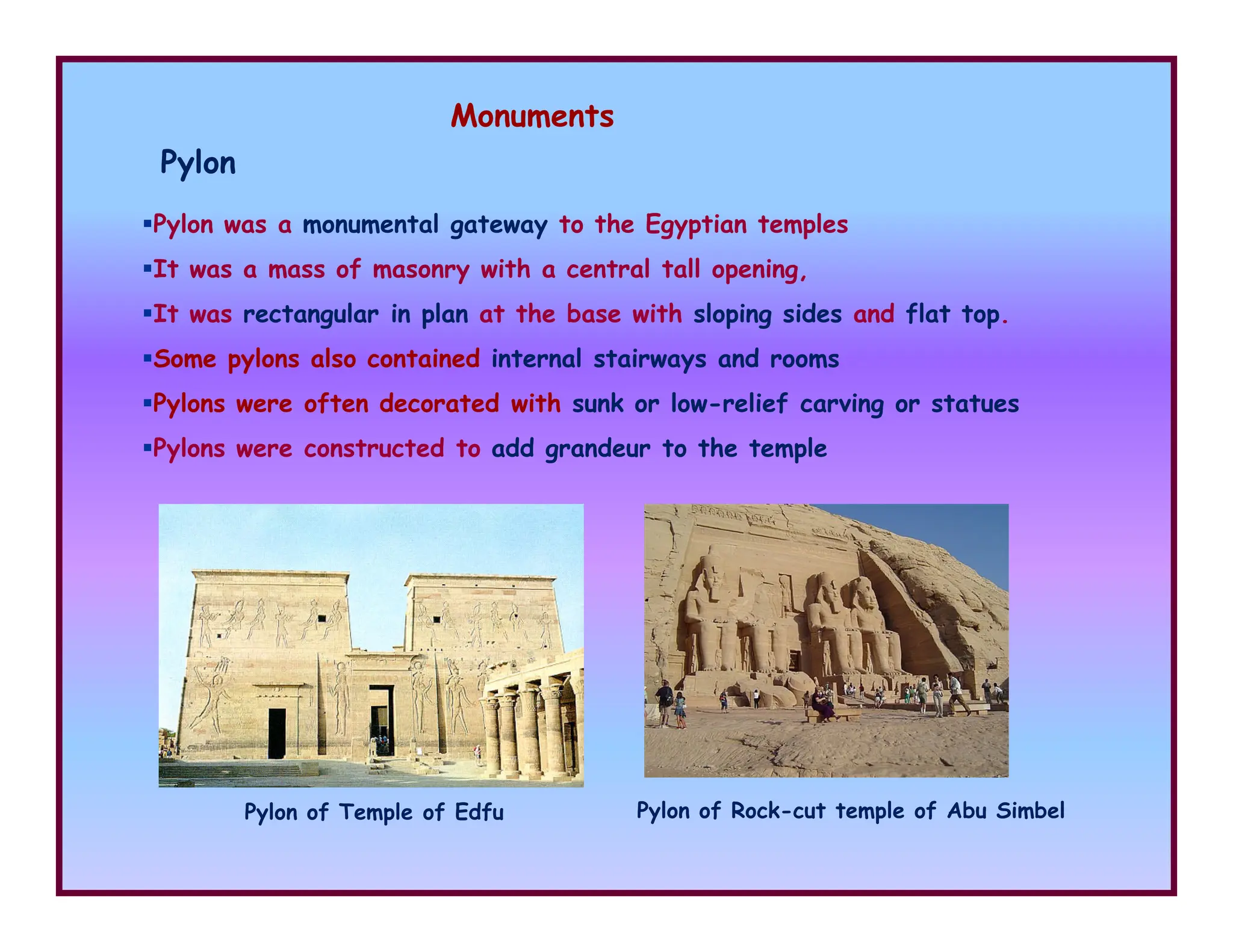
The hypostyle hall was the most impressive part of the temple.
The hypostyle hall was 338’ X 175’ in dimension internally
The roof made of enormous stone slabs was supported by 134 columns in 16 rows.
The central avenue was about 78’ high with columns 69’ high and 11’ 9” in diameter.
The side avenues are lower with columns 42’ 6” high and 8’ 9” in diameter.
The light was admitted through the clerestory windows formed by the difference in
height of the columns in the central avenue and the side avenues.
The wall surfaces, shafts of the columns and
the architraves were covered with incised
inscriptions and relief works in different colours.
Monuments
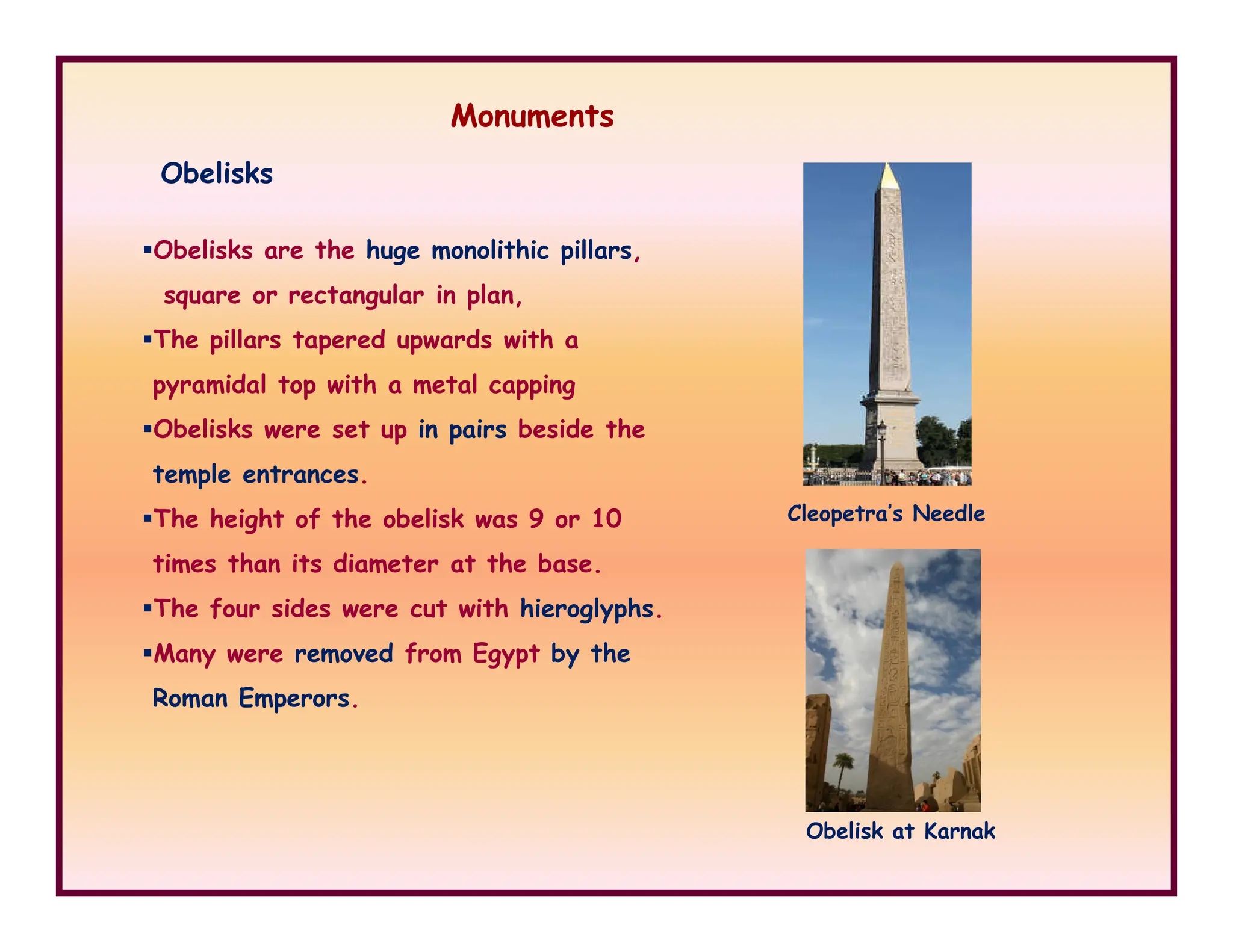
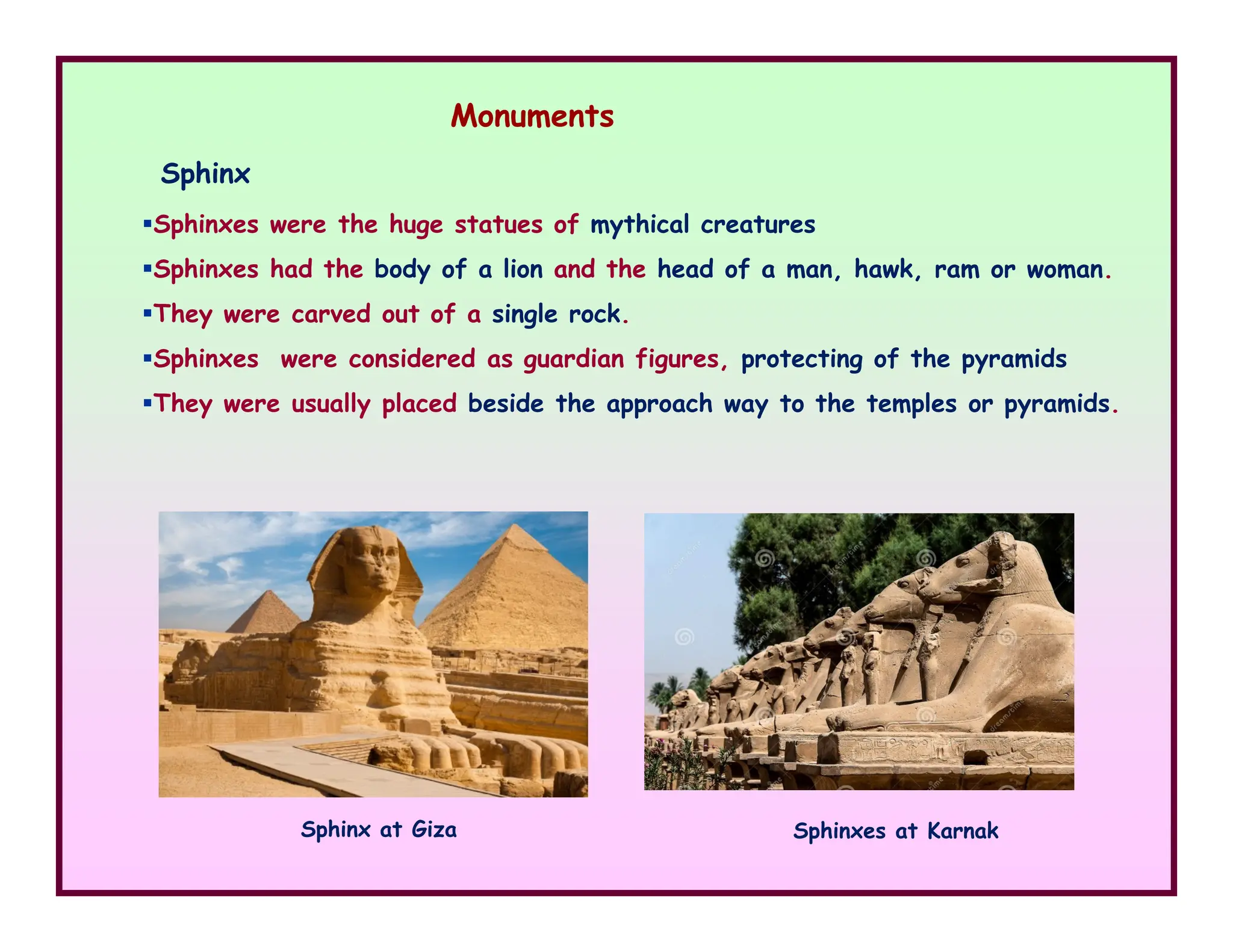
Pylon
Pylon was a monumental gateway to the Egyptian temples
It was a mass of masonry with a central tall opening,
It was rectangular in plan at the base with sloping sides and flat top.
Some pylons also contained internal stairways and rooms
Pylons were often decorated with sunk or low-relief carving or statues
Pylons were constructed to add grandeur to the temple
Pylon of Rock-cut temple of Abu Simbel
Pylon of Temple of Edfu
Obelisks
Monuments
Obelisks are the huge monolithic pillars,
square or rectangular in plan,
The pillars tapered upwards with a
pyramidal top with a metal capping
Obelisks were set up in pairs beside the
temple entrances.
Obelisk at Karnak
Cleopetra’s Needle
temple entrances.
The height of the obelisk was 9 or 10
times than its diameter at the base.
The four sides were cut with hieroglyphs.
Many were removed from Egypt by the
Roman Emperors.
Sphinx
Monuments
Sphinxes were the huge statues of mythical creatures
Sphinxes had the body of a lion and the head of a man, hawk, ram or woman.
They were carved out of a single rock.
Sphinxes were considered as guardian figures, protecting of the pyramids
They were usually placed beside the approach way to the temples or pyramids.
Sphinx at Giza Sphinxes at Karnak
Thank You
Thank You

1~ Egyptian Architecture with details ppt.pdf

  • 1.
    Ancient Egyptian Architecture Architecture 3000 B.C.– 30 B.C. Prepared by: Sucharita Acharya Lecturer in Architecture North Calcutta Polytechnic
  • 2.
    Geographical Feature Egypt issituated on the North-East part of the African Continent On its north is Mediterranean Sea and the European Continent On its East is Red Sea and the Asian Continent On its South and south-west lie the Sahara Desert The ancient Egypt comprised long, N The ancient Egypt comprised long, narrow valley of Nile, bounded on each side by arid deserts Frequent floods in Nile enriched the land with a thick layer of alluvial soil.
  • 3.
    Geological Condition Rich claywas abundant from Nile delta from which bricks were made Sun-dried or kiln-burnt bricks were the chief building materials Reeds, papyrus and palm branch ribs were employed for reinforcement Due to scarcity of wood, palm logs were employed for roofing Fine limestone was quarried from Tura in northern or lower Egypt. Sandstone was employed in construction of temples, sarcophagus. Red or grey granite was brought from Aswan in southern Egypt. Climatic Condition The climate of Egypt was hot and arid There were only two seasons, spring and summer Snow and frost were unknown to them Except on Nile delta, storm and rain were very rare
  • 4.
    Historical Background Earlier Egyptwas divided in two kingdoms, Upper kingdom and Lower kingdom Around 3000 B.C., a highly centralized monarchy emerged in Egypt Thereon the Pharaohs ruled Egypt for nearly three millennia The Pharaohs consist of thirty dynasties. The first ten dynasties were Ancient Kingdom, (B.C. 3000 – 2130) Eleventh to seventeenth dynasties comprise Middle Kingdom (B.C. 2130 – 1580) The last thirteen dynasties are New Kingdom (B.C. 1580 – 332) The last thirteen dynasties are New Kingdom (B.C. 1580 – 332) From 525 B.C., Egypt fell under Persian Empire. In 332 B.C., Alexander, the Macedonian king conquered Egypt from Persians After his death, his empire was divided and Egypt fell to his general Ptolemy . Thereafter it became prosperous under Ptolemaic dynasty (B.C.332-30). The last ruler of this dynasty, Queen Cleopatra committed suicide in 30 B.C. Thereafter Egypt came under Roman rule under Emperor Augustus
  • 5.
    Social Background Pharaohs wereconsidered as divine kings who after death joined the pantheon of gods. The Pharaohs also looked after the religious rites as powerful priests. Pharaohs owned the whole country and distributed land among their relatives and nobles There were farmers, craftsmen and herds who were free citizens. They employed the slaves and prisoners of war for agriculture and building construction Egypt maintained trading relations with Mesopotamia, ancient Greek islands The ancient Egyptians were among the first groups of people to invent a writing system. Cultural Background The ancient Egyptian writing was hieroglyphics, with pictures representing words The Egyptians pioneered the use of dams, canals and irrigation channels The Egyptians made great progress in astronomy. The observation of stars was important in predicting seasons and determining the annual flooding of the Nile. The Egyptians devised their highly accurate solar calendar. The Egyptian calendar contained 365 days, divided into 12 months. Each month had 30 days, and there were an additional five festival days at the end of each year. The Egyptians were experts in many applied chemistry fields such as metallurgy, glass making, paper manufacture, paint pigments, dyes, and pharmaceuticals.
  • 6.
    Religious Background In Egypt,religion had a strong influence on architecture Egyptian religion had many gods and goddesses. The principal deity was sun-god or Amon with his consort Ra. Another deity was Osiris, the god of death and resurrection to eternal life. The governing idea of the religion was their strong belief in life after death. To secure immortality of the soul of the Pharaohs, elaborate preparations were made for the preservation of their bodies after death. Tombs were the permanent abode, so royal pyramids were constructed out of Tombs were the permanent abode, so royal pyramids were constructed out of enduring stones. The earthly dwelling houses were regarded as temporary lodging, and hence were made mostly of sun-dried bricks which were perishable. Egyptian religious rites were mysterious and very rigid. These characteristics were reflected in the architecture of tombs and temples with dark mysterious chambers and accesses. Thus religious belief in life after death lends the most characteristic effect in the architecture of ancient Egypt.
  • 7.
    Architectural Characteristics Bricks weremade from alluvial soil which were sun-dried or kiln-burnt Sandstones and lime stones were used for special constructions Palm logs were used for roofing ordinary houses Reeds and palm branch ribs were employed for reinforcement Structure: Chief building materials: The structures were essentially columnar & trabeated External walls were provided with a slope or ‘batter’ on outside Ornamentation: Painting were done with primary colours Low relief carving was also employed The inside of the wall remained vertical for ordinary convenience Unbroken massive walls without windows protected the interior from the fierce heat The houses were one or two storeys high with the living hall in the centre As rain was very rare, flat roofs were common without any need of roof drainage Columns had distinctive character with inverted bell or lotus capital
  • 8.
    Architectural Characteristics Types ofbuildings and structures: Mastabas: These were earlier flat topped funerary mounds with battered sides Pyramids: These were massive masonry structures built as Royal tombs for Pharaohs Rock-hewn tombs: These were open fronted tombs cut into rock Tombs: Temples: Temples were built for the worship of the gods and religious rituals Temples were seen as houses for the gods or kings to whom they were dedicated. Other structures: Pylons: These were monumental gateways of temples, decorated with carvings Obelisks: These were tapered monolithic pillars, erected in pairs at the entrances of temples, with all four sides of the shaft being carved with hieroglyphs Sphinx: It was a huge statue of a creature with the body of a lion and the head of a human, most often depicted as a male with a pharaoh headdress Temples were seen as houses for the gods or kings to whom they were dedicated.
  • 9.
    Tomb Architecture Mastabas: Firstdynasty The term mastaba comes from the Arabic word for "bench” The mastabas were constructed out of mud bricks These graves comprised several small rooms A central room contained the sarcophagus or the stone coffin Other rooms surrounding it received the abundant funerary offerings The whole was constructed in a broad pit below ground The wooden roof was supported by wooden posts or crude brick pillars The wooden roof was supported by wooden posts or crude brick pillars The entire area was covered by a rectangular flat topped mound of soil The mound was retained in place by very thick battered side walls.
  • 10.
    Mastabas: Second andThird dynasty Stairway mastaba Tomb chamber and attendant magazines sunk deeper in the rock Steps and ramps from the top connected with a shaft Shaft descended to the level of the tomb chamber. Tomb Architecture
  • 11.
    Mastabas: Fourth toSixth dynasty a columned hall ‘serdab’- a completely enclosed room except for a slot Small offering chapel developed which became increasingly elaborate The actual tomb chamber was built below the south-end of mastaba, It was connected by a slanting passage to a stairway emerging in a columned hall A group of rooms within or adjacent to the mastaba mound included: The serdab contained statue of the deceased within Tomb Architecture ‘Stela’ – an upright slab and an offering table was in the offering room The walls were lined with vividly coloured reliefs Mastaba of Thi, Sakkara (5th dynasty)
  • 12.
    Example: Mastaba ofThi, Sakkara (5th dynasty) Mastabas: Fourth to Sixth dynasty Pillared court Stair to tomb chamber Serdab Tomb Architecture Serdab Offering room Tomb chamber Pillared court Portico
  • 13.
    Pyramid Tomb Architecture The pyramidwas a royal tomb which evolved from the earlier mastabas. Pyramids were the primary part of a complex of buildings which comprised: an offering chapel The tomb chamber was concealed and well-protected It housed the body of the Pharaoh preserved carefully It was either cut in the rock below the monument or was in constructed core Pyramids were founded on leveled rock and were made of limestone. Granite was used limitedly for lining the chambers and passages. a mortuary temple for the worship of the deified Pharaoh Granite was used limitedly for lining the chambers and passages. The sides were perfectly oriented with the cardinal points Pyramid complex, Giza
  • 14.
    Pyramid Example: The GreatPyramid of Cheops (Khufu), Giza (26th Cent. B.C.) The Great Pyramid of Cheops is the oldest and largest in the Giza pyramid complex It is the oldest of the Seven Wonders of the Ancient World. Cheops was the second king of 4th dynasty. The total surrounding area of the pyramid complex was about 13 acres. The pyramid was constructed of lime stone and granite This pyramid took nearly 27 years to be built by about 3,00,000 workers Tomb Architecture This pyramid took nearly 27 years to be built by about 3,00,000 workers It was built with more than two million stone blocks, each weighing about 2 to 3 tons Pyramid of Cheops (Khufu), Giza
  • 15.
    The pyramid wasoriginally 480’ high, 736’ square in plan The four sides facing the cardinal points are nearly equilateral triangles The entrance of the pyramid is on the north side and 55’ above ground level. A corridor descends from the entrance to the original rock-cut subterranean chamber An ascending corridor is constructed through the descending one It is about 60’ long and rises at an angle of 30 It rises to a height of 70’ above the ground and connects to the ‘Queen’s Chamber’ Thereon the ascending corridor is widened into a large passage known as ‘Grand Gallery’, The Great Pyramid of Cheops (Khufu), Giza Tomb Architecture Thereon the ascending corridor is widened into a large passage known as ‘Grand Gallery’,
  • 16.
    The ‘Grand Gallery’is about 7’ wide and 28’ high covered by a corbelled vault. At the end of the Grand Gallery, there is the ‘King’s Chamber’ with the granite stone coffin or the sarcophagus Tomb Architecture The Great Pyramid of Cheops (Khufu), Giza Sarcophagus King’s Chamber Stone Beams The ‘King’s Chamber’ is 34’ long, 17’ wide and 19’ high and is lined with granite It is covered by five tiers of stone beam rising up to 70’ from the floor of the chamber. Two ventilation shafts were provided from the ‘King’s Chamber’ to outside. Grand Gallery ‘King’s Chamber’
  • 17.
    Tomb Architecture Rock-cut Tombs Thesewere the burial chambers of nobility cut into the natural rock formation Example: The Rock-cut Tombs, Beni Hasan (2130 – 1785 B.C.) These were 39 tombs for a provincial noble family. These were primarily used during the Middle Kingdom, (Middle Bronze Age). Each tomb consisted of a chamber behind an entrance portico. The tombs had vaulted rock-ceilings. Interior walls were lightly stuccoed and painted. Interior walls were lightly stuccoed and painted.
  • 18.
    Temple Architecture The templebuildings were usually enclosed by high brick walls Egyptian temples were rectangular in plan with a line of successive buildings Their roofs decreased in heights behind the imposing gateway- the pylon. The temples were fronted by obelisks or monolithic pillars The temples were approached by a row of sphinxes or statues of mythical monsters The different buildings of the temple were : – Pillared court: •There were one or more open courtyards surrounded by rows of pillars •There were one or more open courtyards surrounded by rows of pillars • At the front of each court was usually a pylon, flanking the main gateway Hypostyle hall: •It was a mysterious dark hall with numerous columns. •Hypostyle hall stood over the processional path. •These halls had clerestories to provide light inside The sanctuary: •The sanctuary of the temple was laid along the axis •It stood near the back of the temple •It was a dark chamber with the statue of the god The Temple of Ramesses III
  • 19.
    Temple Architecture Example: TheGreat Temple of Amon , Karnak, Thebes (1530 – 323 B.C.) The temple of Amon, the Sun god is the largest of all Egyptian temples. It was built by several successive kings to glorify the Sun god. It was situated within an enclosure along with other temples and a sacred lake It was surrounded by a boundary wall, 20’ to 30’ thick. It was connected by an avenue of sphinxes with the temple at Luxor along, Temple of Amon at Karnak
  • 20.
    The temple islaid out on east–west axis. The temple is based on a rectangular plan measured 1200’ long and 360’ wide There were six pairs of pylons built one after another by successive Pharaohs. Behind the entrance pylons, there was a Temple Architecture The Great Temple of Amon , Karnak, Behind the entrance pylons, there was a great court measuring 338’ X 275’. On the south side of this forecourt, there is a small temple built by Ramesses III. It gives entrance to the vast hypostyle hall
  • 21.
    Temple Architecture The GreatTemple of Amon , Karnak, The hypostyle hall was the most impressive part of the temple. The hypostyle hall was 338’ X 175’ in dimension internally The roof made of enormous stone slabs was supported by 134 columns in 16 rows. The central avenue was about 78’ high with columns 69’ high and 11’ 9” in diameter. The side avenues are lower with columns 42’ 6” high and 8’ 9” in diameter. The light was admitted through the clerestory windows formed by the difference in height of the columns in the central avenue and the side avenues. The wall surfaces, shafts of the columns and the architraves were covered with incised inscriptions and relief works in different colours.
  • 22.
    Monuments Pylon Pylon was amonumental gateway to the Egyptian temples It was a mass of masonry with a central tall opening, It was rectangular in plan at the base with sloping sides and flat top. Some pylons also contained internal stairways and rooms Pylons were often decorated with sunk or low-relief carving or statues Pylons were constructed to add grandeur to the temple Pylon of Rock-cut temple of Abu Simbel Pylon of Temple of Edfu
  • 23.
    Obelisks Monuments Obelisks are thehuge monolithic pillars, square or rectangular in plan, The pillars tapered upwards with a pyramidal top with a metal capping Obelisks were set up in pairs beside the temple entrances. Obelisk at Karnak Cleopetra’s Needle temple entrances. The height of the obelisk was 9 or 10 times than its diameter at the base. The four sides were cut with hieroglyphs. Many were removed from Egypt by the Roman Emperors.
  • 24.
    Sphinx Monuments Sphinxes were thehuge statues of mythical creatures Sphinxes had the body of a lion and the head of a man, hawk, ram or woman. They were carved out of a single rock. Sphinxes were considered as guardian figures, protecting of the pyramids They were usually placed beside the approach way to the temples or pyramids. Sphinx at Giza Sphinxes at Karnak
  • 25.