EARLY CHRISTIAN & BYZANTINE ARCHITECTURE
•Divyanshi trivedi
HISTORICALBACKGROUND
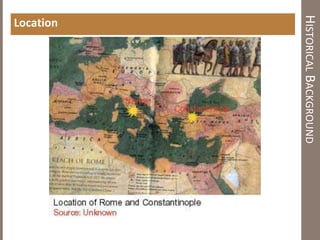
Location
HISTORICALBACKGROUND
Location
• The Early Christian and Byzantine architecture started in two
prominent locations centered at Rome and Byzantium or
Constantinople
• Early Christian architecture occurred in Rome and in areas
around Rome
• Byzantine architecture was centered at Byzantium
• From the two focal points Early Christian and Byzantine
Architecture spread to other areas in the European and Asian
region
HISTORICALBACKGROUND
Period
• The following is a time line of events for the Early Christian and
Byzantine period:
• 29 A.D. Passing of Isa(AS) and beginning of Christian
Religion
• 286 A.D. Emperor Diocletian reorganizes the Roman Empire
splitting it into two; the Eastern and the Western part
• 313 A. D. Emperor Constantine recognizes the Christian
religion and adopts it as a state religion
• 324 A.D. Emperor Constantine reunited the Roman Empire
with a new capital at Byzantium
• 364 A. D. Rome finally splits into two; the Western and
Eastern Empire
• 476 A. D. Rome is sacked by Visgoth and Vandals
• 632 A. D. Muslim begin an advance on the Byzantine
empire
• 1453 A. D .Byzantium falls to Sultan Muhammad II ending
the Byzantine Empire
HISTORICALBACKGROUND
Social Characteristics and Beliefs
 The single most important social phenomenon of the early
Christian and Byzantine period was the spread and
acceptance of the Christian religion
 During the period from the first century to the third century
after the death of Jesus, Christianity was a secret society
 It was considered dangerous and subversive by the
government
 Christians met secretly in tombs and private houses
 Gradually, however, it spread and became widely accepted in
Asia minor and in Rome itself
 By the third century, Rome had a population of 50,000
Christians
 The religion was tolerated but it was still illegal
HISTORICALBACKGROUND
Social Characteristics and Beliefs
 The third century was for the Roman Empire a period of
political instability and decline
 The Empire was split into a Western and Eastern Empires–In
A.D. 313, the Emperor Constantine issued the Edict of Milan
making Christianity legal
 He also adopted it as a state religion and he became the first
Christian emperor
 The acceptance of the religion by the emperor fueled its
expansion
 It also led to the early development of places of worship for
the new religion
 Constantine was able to unite the Roman Empire during his
reign
 He established the capital of the new empire at Byzantium,
renamed Constantinople or the city of Constantine
 After his death, the Empire was again split
Architecture of the Period
 With Christianity widely accepted as a state religion in Rome it
was necessary for architecture to respond to the demands of
the religion for worship space
 Mode of worship was the most important determinant of the
form of the church
 Requirement for church design was centered on worship and
burial
 The requirements include:
 A path for processional entry and exit of the clergy
 An alter area, where the clergy celebrate mass
 A space for the segregation of the clergy from the
congregation during procession and communion
 Burial space
HISTORICALBACKGROUND
Architecture of the Period
 The focus of both Early Christian and Byzantine architecture is
on the Christian church
 Before the legal recognition of the new faith, Christian places
of worship were of necessity inconspicuous with no fixed
architectural form
 Early Christian builders adapted structures that had been used
in the Roman world
 The basilica, consisting of a nave flanked by lower aisles and
terminated by an apse, was adopted as the standard structure
in Christian congregational worship
 This was not however the only form adopted–More centralized
plans which were of round, polygonal, or cruciform shapes
were adopted occasionally
 Martyria were erected on sites connected with certain events
in the life of Jesus and other places held to be sanctified by
the sacrifice of the martyrs
HISTORICALBACKGROUND
Architecture of the Period
 In such buildings the martyrium structure and basilica were
combined, creating a new formal synthesis of great
significance for Christian religious architecture
 Development of the Christian church continued during the
Byzantine era
 In the Byzantine period focus shifted from the rituals or
practices of worship to the building as an embodiment or
symbols of the majesty of the faith
 Innovative structure was combined with light and decoration to
create fascinating interiors
HISTORICALBACKGROUND
Basilica Church Type
 The term early Christian architecture refers to the architecture
of the early Christian churches of the roman era
 This is further divided into two types; the basilica church and
the alternative church plans
 With Christianity accepted as a state religion in Rome and
expanding in influence, it became necessary for architecture
to respond to the space demands of the new religion
 A building used for Christian worship had to provide a path for
the processional entry and exit of the clergy, an alter area,
where the clergy celebrated mass, a space for the segregation
of the clergy from congregation during the procession and
communion
HISTORICALBACKGROUND
Basilica Church Type
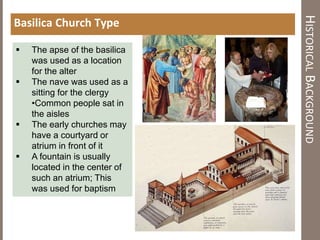
 The apse of the basilica
was used as a location
for the alter
 The nave was used as a
sitting for the clergy
•Common people sat in
the aisles
 The early churches may
have a courtyard or
atrium in front of it
 A fountain is usually
located in the center of
such an atrium; This
was used for baptism
HISTORICALBACKGROUND
Basilica Church Type
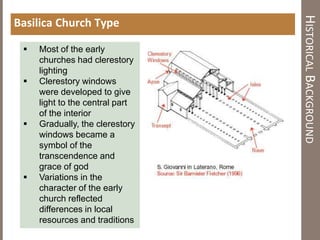
 Most of the early
churches had clerestory
lighting
 Clerestory windows
were developed to give
light to the central part
of the interior
 Gradually, the clerestory
windows became a
symbol of the
transcendence and
grace of god
 Variations in the
character of the early
church reflected
differences in local
resources and traditions
HISTORICALBACKGROUND
Alternative Church Form
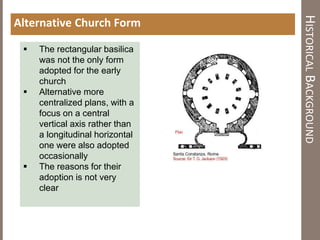
 The rectangular basilica
was not the only form
adopted for the early
church
 Alternative more
centralized plans, with a
focus on a central
vertical axis rather than
a longitudinal horizontal
one were also adopted
occasionally
 The reasons for their
adoption is not very
clear
HISTORICALBACKGROUND
Alternative Church Form
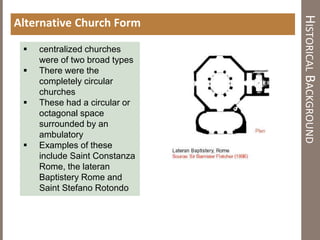
 centralized churches
were of two broad types
 There were the
completely circular
churches
 These had a circular or
octagonal space
surrounded by an
ambulatory
 Examples of these
include Saint Constanza
Rome, the lateran
Baptistery Rome and
Saint Stefano Rotondo
HISTORICALBACKGROUND
Alternative Church Form
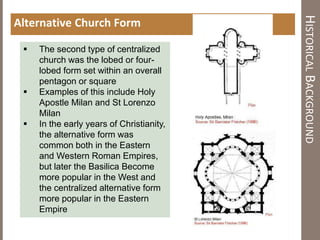
 The second type of centralized
church was the lobed or four-
lobed form set within an overall
pentagon or square
 Examples of this include Holy
Apostle Milan and St Lorenzo
Milan
 In the early years of Christianity,
the alternative form was
common both in the Eastern
and Western Roman Empires,
but later the Basilica Become
more popular in the West and
the centralized alternative form
more popular in the Eastern
Empire

Lec 7 Early christian architecture

  • 1.
    EARLY CHRISTIAN &BYZANTINE ARCHITECTURE •Divyanshi trivedi
  • 2.
  • 3.
    HISTORICALBACKGROUND Location • The EarlyChristian and Byzantine architecture started in two prominent locations centered at Rome and Byzantium or Constantinople • Early Christian architecture occurred in Rome and in areas around Rome • Byzantine architecture was centered at Byzantium • From the two focal points Early Christian and Byzantine Architecture spread to other areas in the European and Asian region
  • 4.
    HISTORICALBACKGROUND Period • The followingis a time line of events for the Early Christian and Byzantine period: • 29 A.D. Passing of Isa(AS) and beginning of Christian Religion • 286 A.D. Emperor Diocletian reorganizes the Roman Empire splitting it into two; the Eastern and the Western part • 313 A. D. Emperor Constantine recognizes the Christian religion and adopts it as a state religion • 324 A.D. Emperor Constantine reunited the Roman Empire with a new capital at Byzantium • 364 A. D. Rome finally splits into two; the Western and Eastern Empire • 476 A. D. Rome is sacked by Visgoth and Vandals • 632 A. D. Muslim begin an advance on the Byzantine empire • 1453 A. D .Byzantium falls to Sultan Muhammad II ending the Byzantine Empire
  • 5.
    HISTORICALBACKGROUND Social Characteristics andBeliefs  The single most important social phenomenon of the early Christian and Byzantine period was the spread and acceptance of the Christian religion  During the period from the first century to the third century after the death of Jesus, Christianity was a secret society  It was considered dangerous and subversive by the government  Christians met secretly in tombs and private houses  Gradually, however, it spread and became widely accepted in Asia minor and in Rome itself  By the third century, Rome had a population of 50,000 Christians  The religion was tolerated but it was still illegal
  • 6.
    HISTORICALBACKGROUND Social Characteristics andBeliefs  The third century was for the Roman Empire a period of political instability and decline  The Empire was split into a Western and Eastern Empires–In A.D. 313, the Emperor Constantine issued the Edict of Milan making Christianity legal  He also adopted it as a state religion and he became the first Christian emperor  The acceptance of the religion by the emperor fueled its expansion  It also led to the early development of places of worship for the new religion  Constantine was able to unite the Roman Empire during his reign  He established the capital of the new empire at Byzantium, renamed Constantinople or the city of Constantine  After his death, the Empire was again split
  • 7.
    Architecture of thePeriod  With Christianity widely accepted as a state religion in Rome it was necessary for architecture to respond to the demands of the religion for worship space  Mode of worship was the most important determinant of the form of the church  Requirement for church design was centered on worship and burial  The requirements include:  A path for processional entry and exit of the clergy  An alter area, where the clergy celebrate mass  A space for the segregation of the clergy from the congregation during procession and communion  Burial space HISTORICALBACKGROUND
  • 8.
    HISTORICALBACKGROUND Architecture of thePeriod  The focus of both Early Christian and Byzantine architecture is on the Christian church  Before the legal recognition of the new faith, Christian places of worship were of necessity inconspicuous with no fixed architectural form  Early Christian builders adapted structures that had been used in the Roman world  The basilica, consisting of a nave flanked by lower aisles and terminated by an apse, was adopted as the standard structure in Christian congregational worship  This was not however the only form adopted–More centralized plans which were of round, polygonal, or cruciform shapes were adopted occasionally  Martyria were erected on sites connected with certain events in the life of Jesus and other places held to be sanctified by the sacrifice of the martyrs
  • 9.
    HISTORICALBACKGROUND Architecture of thePeriod  In such buildings the martyrium structure and basilica were combined, creating a new formal synthesis of great significance for Christian religious architecture  Development of the Christian church continued during the Byzantine era  In the Byzantine period focus shifted from the rituals or practices of worship to the building as an embodiment or symbols of the majesty of the faith  Innovative structure was combined with light and decoration to create fascinating interiors
  • 10.
    HISTORICALBACKGROUND Basilica Church Type The term early Christian architecture refers to the architecture of the early Christian churches of the roman era  This is further divided into two types; the basilica church and the alternative church plans  With Christianity accepted as a state religion in Rome and expanding in influence, it became necessary for architecture to respond to the space demands of the new religion  A building used for Christian worship had to provide a path for the processional entry and exit of the clergy, an alter area, where the clergy celebrated mass, a space for the segregation of the clergy from congregation during the procession and communion
  • 11.
    HISTORICALBACKGROUND Basilica Church Type The apse of the basilica was used as a location for the alter  The nave was used as a sitting for the clergy •Common people sat in the aisles  The early churches may have a courtyard or atrium in front of it  A fountain is usually located in the center of such an atrium; This was used for baptism
  • 12.
    HISTORICALBACKGROUND Basilica Church Type Most of the early churches had clerestory lighting  Clerestory windows were developed to give light to the central part of the interior  Gradually, the clerestory windows became a symbol of the transcendence and grace of god  Variations in the character of the early church reflected differences in local resources and traditions
  • 13.
    HISTORICALBACKGROUND Alternative Church Form The rectangular basilica was not the only form adopted for the early church  Alternative more centralized plans, with a focus on a central vertical axis rather than a longitudinal horizontal one were also adopted occasionally  The reasons for their adoption is not very clear
  • 14.
    HISTORICALBACKGROUND Alternative Church Form centralized churches were of two broad types  There were the completely circular churches  These had a circular or octagonal space surrounded by an ambulatory  Examples of these include Saint Constanza Rome, the lateran Baptistery Rome and Saint Stefano Rotondo
  • 15.
    HISTORICALBACKGROUND Alternative Church Form The second type of centralized church was the lobed or four- lobed form set within an overall pentagon or square  Examples of this include Holy Apostle Milan and St Lorenzo Milan  In the early years of Christianity, the alternative form was common both in the Eastern and Western Roman Empires, but later the Basilica Become more popular in the West and the centralized alternative form more popular in the Eastern Empire