hist
ory
of
archit
ect
ure
History of Architecture
Part I- Ancient Architecture
Lecture - III
hist
ory
of
archit
ect
ure
Egyptian
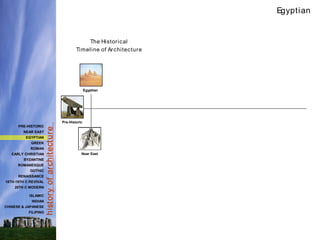
The Historical
Timeline of Architecture
PRE-HISTORIC
NEAR EAST
EGYPTIAN
GREEK
ROMAN
EARLY CHRISTIAN
BYZANTINE
ROMANESQUE
GOTHIC
RENAISSANCE
18TH-19TH C REVIVAL
20TH C MODERN
ISLAMIC
INDIAN
CHINESE & JAPANESE
FILIPINO
Pre-Historic
Egyptian
Near East
hist
ory
of
archit
ect
ure
HISTORY
• Wealthy country despite the desert - every year, Nile
would overflow, leaving the land fertile for growing crops
• Nile River was a trade route
• Gold from Nubia in the south
• Two kingdoms, Lower and Upper Egypt, combined by
King Menes in 3100 BC
• Many small towns, but royal cities at Memphis and
Thebes
• A single kingdom for most of its existence - unified under
the centralized omnipotent authority of the pharaoh (king)
Pharaohs:
• Seen as gods dwelling on earth
• Sole masters of the country and its inhabitants
• Builders and leaders
• Initiated the design, financing, quarrying and transporting
of materials, organization of labor and construction itself
Society:
• Divided into groups, by order of importance: senior
priests, officials, noblemen, and army commanders
• Most ordinary Egyptians were farmers
• Architects, engineers, theologians, masons, sculptors,
painters, laborers, peasants, prisoners
• Weaving, glass-making, pottery, metal, jewelry and
furniture
• Astronomy, mathematics, philosophy, music and writing
literature and history written on papyrus and stone tablets
Egyptian
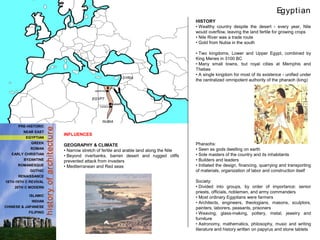
INFLUENCES
GEOGRAPHY & CLIMATE
• Narrow stretch of fertile and arable land along the Nile
• Beyond riverbanks, barren desert and rugged cliffs
prevented attack from invaders
• Mediterranean and Red seas
GIZA
EGYPT
MEMPHIS
THEBES
KARNAK
NUBIA
SYRIA
PRE-HISTORIC
NEAR EAST
EGYPTIAN
GREEK
ROMAN
EARLY CHRISTIAN
BYZANTINE
ROMANESQUE
GOTHIC
RENAISSANCE
18TH-19TH C REVIVAL
20TH C MODERN
ISLAMIC
INDIAN
CHINESE & JAPANESE
FILIPINO
hist
ory
of
archit
ect
ure
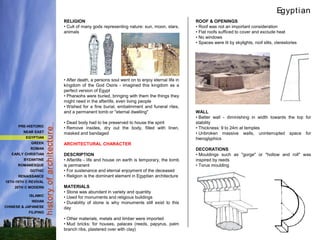
RELIGION
• Cult of many gods representing nature: sun, moon, stars,
animals
• After death, a persons soul went on to enjoy eternal life in
kingdom of the God Osiris - imagined this kingdom as a
perfect version of Egypt
• Pharaohs were buried, bringing with them the things they
might need in the afterlife, even living people
• Wished for a fine burial, embalmment and funeral rites,
and a permanent tomb or "eternal dwelling"
• Dead body had to be preserved to house the spirit
• Remove insides, dry out the body, filled with linen,
masked and bandaged
ARCHITECTURAL CHARACTER
DESCRIPTION
• Afterlife - life and house on earth is temporary, the tomb
is permanent
• For sustenance and eternal enjoyment of the deceased
• Religion is the dominant element in Egyptian architecture
MATERIALS
• Stone was abundant in variety and quantity
• Used for monuments and religious buildings
• Durability of stone is why monuments still exist to this
day
• Other materials, metals and timber were imported
• Mud bricks: for houses, palaces (reeds, papyrus, palm
branch ribs, plastered over with clay)
ROOF & OPENINGS
• Roof was not an important consideration
• Flat roofs sufficed to cover and exclude heat
• No windows
• Spaces were lit by skylights, roof slits, clerestories
WALL
• Batter wall - diminishing in width towards the top for
stability
• Thickness: 9 to 24m at temples
• Unbroken massive walls, uninterrupted space for
hieroglyphics
DECORATIONS
• Mouldings such as "gorge" or "hollow and roll" was
inspired by reeds
• Torus moulding
Egyptian
PRE-HISTORIC
NEAR EAST
EGYPTIAN
GREEK
ROMAN
EARLY CHRISTIAN
BYZANTINE
ROMANESQUE
GOTHIC
RENAISSANCE
18TH-19TH C REVIVAL
20TH C MODERN
ISLAMIC
INDIAN
CHINESE & JAPANESE
FILIPINO
hist
ory
of
archit
ect
ure
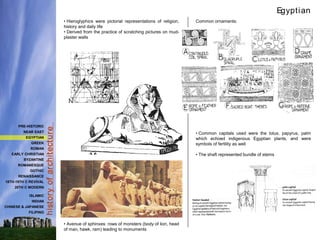
• Hieroglyphics were pictorial representations of religion,
history and daily life
• Derived from the practice of scratching pictures on mud-
plaster walls
• Avenue of sphinxes: rows of monsters (body of lion, head
of man, hawk, ram) leading to monuments
Egyptian
Common ornaments:
• Common capitals used were the lotus, papyrus, palm
which echoed indigenous Egyptian plants, and were
symbols of fertility as well
• The shaft represented bundle of stems
PRE-HISTORIC
NEAR EAST
EGYPTIAN
GREEK
ROMAN
EARLY CHRISTIAN
BYZANTINE
ROMANESQUE
GOTHIC
RENAISSANCE
18TH-19TH C REVIVAL
20TH C MODERN
ISLAMIC
INDIAN
CHINESE & JAPANESE
FILIPINO
hist
ory
of
archit
ect
ure
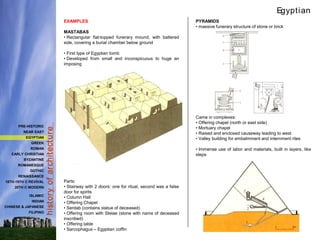
EXAMPLES
MASTABAS
• Rectangular flat-topped funerary mound, with battered
side, covering a burial chamber below ground
• First type of Egyptian tomb
• Developed from small and inconspicuous to huge an
imposing
Parts:
• Stairway with 2 doors: one for ritual, second was a false
door for spirits
• Column Hall
• Offering Chapel
• Serdab (contains statue of deceased)
• Offering room with Stelae (stone with name of deceased
inscribed)
• Offering table
• Sarcophagus – Egyptian coffin
Egyptian
PYRAMIDS
• massive funerary structure of stone or brick
Came in complexes:
• Offering chapel (north or east side)
• Mortuary chapel
• Raised and enclosed causeway leading to west
• Valley building for embalmment and internment rites
• Immense use of labor and materials, built in layers, like
steps
PRE-HISTORIC
NEAR EAST
EGYPTIAN
GREEK
ROMAN
EARLY CHRISTIAN
BYZANTINE
ROMANESQUE
GOTHIC
RENAISSANCE
18TH-19TH C REVIVAL
20TH C MODERN
ISLAMIC
INDIAN
CHINESE & JAPANESE
FILIPINO
hist
ory
of
archit
ect
ure
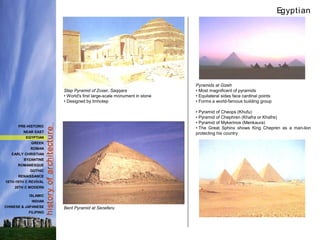
Pyramids at Gizeh
• Most magnificent of pyramids
• Equilateral sides face cardinal points
• Forms a world-famous building group
• Pyramid of Cheops (Khufu)
• Pyramid of Chephren (Khafra or Khafre)
• Pyramid of Mykerinos (Menkaura)
• The Great Sphinx shows King Chepren as a man-lion
protecting his country
Step Pyramid of Zoser, Saqqara
• World's first large-scale monument in stone
• Designed by Imhotep
Bent Pyramid at Seneferu
Egyptian
PRE-HISTORIC
NEAR EAST
EGYPTIAN
GREEK
ROMAN
EARLY CHRISTIAN
BYZANTINE
ROMANESQUE
GOTHIC
RENAISSANCE
18TH-19TH C REVIVAL
20TH C MODERN
ISLAMIC
INDIAN
CHINESE & JAPANESE
FILIPINO
hist
ory
of
archit
ect
ure
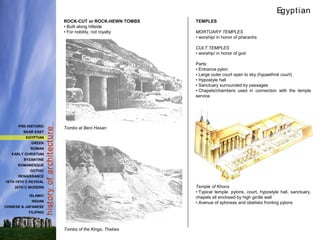
ROCK-CUT or ROCK-HEWN TOMBS
• Built along hillside
• For nobility, not royalty
Tombs at Beni Hasan
Tombs of the Kings, Thebes
Egyptian
TEMPLES
MORTUARY TEMPLES
• worship/ in honor of pharaohs
CULT TEMPLES
• worship/ in honor of god
Parts:
• Entrance pylon
• Large outer court open to sky (hypaethral court)
• Hypostyle hall
• Sanctuary surrounded by passages
• Chapels/chambers used in connection with the temple
service
Temple of Khons
• Typical temple: pylons, court, hypostyle hall, sanctuary,
chapels all enclosed by high girdle wall
• Avenue of sphinxes and obelisks fronting pylons
PRE-HISTORIC
NEAR EAST
EGYPTIAN
GREEK
ROMAN
EARLY CHRISTIAN
BYZANTINE
ROMANESQUE
GOTHIC
RENAISSANCE
18TH-19TH C REVIVAL
20TH C MODERN
ISLAMIC
INDIAN
CHINESE & JAPANESE
FILIPINO
hist
ory
of
archit
ect
ure
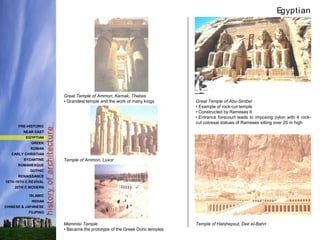
Great Temple of Abu-Simbel
• Example of rock-cut temple
• Constructed by Rameses II
• Entrance forecourt leads to imposing pylon with 4 rock-
cut colossal statues of Rameses sitting over 20 m high
Temple of Hatshepsut, Deir el-Bahri
Great Temple of Ammon, Karnak, Thebes
• Grandest temple and the work of many kings
Temple of Ammon, Luxor
Mammisi Temple
• Became the prototype of the Greek Doric temples
Egyptian
PRE-HISTORIC
NEAR EAST
EGYPTIAN
GREEK
ROMAN
EARLY CHRISTIAN
BYZANTINE
ROMANESQUE
GOTHIC
RENAISSANCE
18TH-19TH C REVIVAL
20TH C MODERN
ISLAMIC
INDIAN
CHINESE & JAPANESE
FILIPINO
hist
ory
of
archit
ect
ure
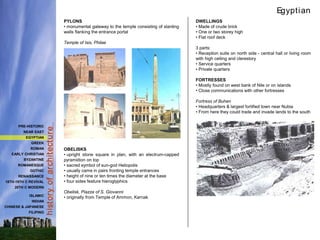
PYLONS
• monumental gateway to the temple consisting of slanting
walls flanking the entrance portal
Temple of Isis, Philae
OBELISKS
• upright stone square in plan, with an electrum-capped
pyramidion on top
• sacred symbol of sun-god Heliopolis
• usually came in pairs fronting temple entrances
• height of nine or ten times the diameter at the base
• four sides feature hieroglyphics
Obelisk, Piazza of S. Giovanni
• originally from Temple of Ammon, Karnak
Egyptian
DWELLINGS
• Made of crude brick
• One or two storey high
• Flat roof deck
3 parts:
• Reception suite on north side - central hall or living room
with high ceiling and clerestory
• Service quarters
• Private quarters
FORTRESSES
• Mostly found on west bank of Nile or on islands
• Close communications with other fortresses
Fortress of Buhen
• Headquarters & largest fortified town near Nubia
• From here they could trade and invade lands to the south
PRE-HISTORIC
NEAR EAST
EGYPTIAN
GREEK
ROMAN
EARLY CHRISTIAN
BYZANTINE
ROMANESQUE
GOTHIC
RENAISSANCE
18TH-19TH C REVIVAL
20TH C MODERN
ISLAMIC
INDIAN
CHINESE & JAPANESE
FILIPINO
hist
ory
of
archit
ect
ure
Egyptian
PRE-HISTORIC
NEAR EAST
EGYPTIAN
GREEK
ROMAN
EARLY CHRISTIAN
BYZANTINE
ROMANESQUE
GOTHIC
RENAISSANCE
18TH-19TH C REVIVAL
20TH C MODERN
ISLAMIC
INDIAN
CHINESE & JAPANESE
FILIPINO

Lec-III_Ancient Egyptian Architecture.pdf

  • 1.
    hist ory of archit ect ure History of Architecture PartI- Ancient Architecture Lecture - III
  • 2.
    hist ory of archit ect ure Egyptian The Historical Timeline ofArchitecture PRE-HISTORIC NEAR EAST EGYPTIAN GREEK ROMAN EARLY CHRISTIAN BYZANTINE ROMANESQUE GOTHIC RENAISSANCE 18TH-19TH C REVIVAL 20TH C MODERN ISLAMIC INDIAN CHINESE & JAPANESE FILIPINO Pre-Historic Egyptian Near East
  • 3.
    hist ory of archit ect ure HISTORY • Wealthy countrydespite the desert - every year, Nile would overflow, leaving the land fertile for growing crops • Nile River was a trade route • Gold from Nubia in the south • Two kingdoms, Lower and Upper Egypt, combined by King Menes in 3100 BC • Many small towns, but royal cities at Memphis and Thebes • A single kingdom for most of its existence - unified under the centralized omnipotent authority of the pharaoh (king) Pharaohs: • Seen as gods dwelling on earth • Sole masters of the country and its inhabitants • Builders and leaders • Initiated the design, financing, quarrying and transporting of materials, organization of labor and construction itself Society: • Divided into groups, by order of importance: senior priests, officials, noblemen, and army commanders • Most ordinary Egyptians were farmers • Architects, engineers, theologians, masons, sculptors, painters, laborers, peasants, prisoners • Weaving, glass-making, pottery, metal, jewelry and furniture • Astronomy, mathematics, philosophy, music and writing literature and history written on papyrus and stone tablets Egyptian INFLUENCES GEOGRAPHY & CLIMATE • Narrow stretch of fertile and arable land along the Nile • Beyond riverbanks, barren desert and rugged cliffs prevented attack from invaders • Mediterranean and Red seas GIZA EGYPT MEMPHIS THEBES KARNAK NUBIA SYRIA PRE-HISTORIC NEAR EAST EGYPTIAN GREEK ROMAN EARLY CHRISTIAN BYZANTINE ROMANESQUE GOTHIC RENAISSANCE 18TH-19TH C REVIVAL 20TH C MODERN ISLAMIC INDIAN CHINESE & JAPANESE FILIPINO
  • 4.
    hist ory of archit ect ure RELIGION • Cult ofmany gods representing nature: sun, moon, stars, animals • After death, a persons soul went on to enjoy eternal life in kingdom of the God Osiris - imagined this kingdom as a perfect version of Egypt • Pharaohs were buried, bringing with them the things they might need in the afterlife, even living people • Wished for a fine burial, embalmment and funeral rites, and a permanent tomb or "eternal dwelling" • Dead body had to be preserved to house the spirit • Remove insides, dry out the body, filled with linen, masked and bandaged ARCHITECTURAL CHARACTER DESCRIPTION • Afterlife - life and house on earth is temporary, the tomb is permanent • For sustenance and eternal enjoyment of the deceased • Religion is the dominant element in Egyptian architecture MATERIALS • Stone was abundant in variety and quantity • Used for monuments and religious buildings • Durability of stone is why monuments still exist to this day • Other materials, metals and timber were imported • Mud bricks: for houses, palaces (reeds, papyrus, palm branch ribs, plastered over with clay) ROOF & OPENINGS • Roof was not an important consideration • Flat roofs sufficed to cover and exclude heat • No windows • Spaces were lit by skylights, roof slits, clerestories WALL • Batter wall - diminishing in width towards the top for stability • Thickness: 9 to 24m at temples • Unbroken massive walls, uninterrupted space for hieroglyphics DECORATIONS • Mouldings such as "gorge" or "hollow and roll" was inspired by reeds • Torus moulding Egyptian PRE-HISTORIC NEAR EAST EGYPTIAN GREEK ROMAN EARLY CHRISTIAN BYZANTINE ROMANESQUE GOTHIC RENAISSANCE 18TH-19TH C REVIVAL 20TH C MODERN ISLAMIC INDIAN CHINESE & JAPANESE FILIPINO
  • 5.
    hist ory of archit ect ure • Hieroglyphics werepictorial representations of religion, history and daily life • Derived from the practice of scratching pictures on mud- plaster walls • Avenue of sphinxes: rows of monsters (body of lion, head of man, hawk, ram) leading to monuments Egyptian Common ornaments: • Common capitals used were the lotus, papyrus, palm which echoed indigenous Egyptian plants, and were symbols of fertility as well • The shaft represented bundle of stems PRE-HISTORIC NEAR EAST EGYPTIAN GREEK ROMAN EARLY CHRISTIAN BYZANTINE ROMANESQUE GOTHIC RENAISSANCE 18TH-19TH C REVIVAL 20TH C MODERN ISLAMIC INDIAN CHINESE & JAPANESE FILIPINO
  • 6.
    hist ory of archit ect ure EXAMPLES MASTABAS • Rectangular flat-toppedfunerary mound, with battered side, covering a burial chamber below ground • First type of Egyptian tomb • Developed from small and inconspicuous to huge an imposing Parts: • Stairway with 2 doors: one for ritual, second was a false door for spirits • Column Hall • Offering Chapel • Serdab (contains statue of deceased) • Offering room with Stelae (stone with name of deceased inscribed) • Offering table • Sarcophagus – Egyptian coffin Egyptian PYRAMIDS • massive funerary structure of stone or brick Came in complexes: • Offering chapel (north or east side) • Mortuary chapel • Raised and enclosed causeway leading to west • Valley building for embalmment and internment rites • Immense use of labor and materials, built in layers, like steps PRE-HISTORIC NEAR EAST EGYPTIAN GREEK ROMAN EARLY CHRISTIAN BYZANTINE ROMANESQUE GOTHIC RENAISSANCE 18TH-19TH C REVIVAL 20TH C MODERN ISLAMIC INDIAN CHINESE & JAPANESE FILIPINO
  • 7.
    hist ory of archit ect ure Pyramids at Gizeh •Most magnificent of pyramids • Equilateral sides face cardinal points • Forms a world-famous building group • Pyramid of Cheops (Khufu) • Pyramid of Chephren (Khafra or Khafre) • Pyramid of Mykerinos (Menkaura) • The Great Sphinx shows King Chepren as a man-lion protecting his country Step Pyramid of Zoser, Saqqara • World's first large-scale monument in stone • Designed by Imhotep Bent Pyramid at Seneferu Egyptian PRE-HISTORIC NEAR EAST EGYPTIAN GREEK ROMAN EARLY CHRISTIAN BYZANTINE ROMANESQUE GOTHIC RENAISSANCE 18TH-19TH C REVIVAL 20TH C MODERN ISLAMIC INDIAN CHINESE & JAPANESE FILIPINO
  • 8.
    hist ory of archit ect ure ROCK-CUT or ROCK-HEWNTOMBS • Built along hillside • For nobility, not royalty Tombs at Beni Hasan Tombs of the Kings, Thebes Egyptian TEMPLES MORTUARY TEMPLES • worship/ in honor of pharaohs CULT TEMPLES • worship/ in honor of god Parts: • Entrance pylon • Large outer court open to sky (hypaethral court) • Hypostyle hall • Sanctuary surrounded by passages • Chapels/chambers used in connection with the temple service Temple of Khons • Typical temple: pylons, court, hypostyle hall, sanctuary, chapels all enclosed by high girdle wall • Avenue of sphinxes and obelisks fronting pylons PRE-HISTORIC NEAR EAST EGYPTIAN GREEK ROMAN EARLY CHRISTIAN BYZANTINE ROMANESQUE GOTHIC RENAISSANCE 18TH-19TH C REVIVAL 20TH C MODERN ISLAMIC INDIAN CHINESE & JAPANESE FILIPINO
  • 9.
    hist ory of archit ect ure Great Temple ofAbu-Simbel • Example of rock-cut temple • Constructed by Rameses II • Entrance forecourt leads to imposing pylon with 4 rock- cut colossal statues of Rameses sitting over 20 m high Temple of Hatshepsut, Deir el-Bahri Great Temple of Ammon, Karnak, Thebes • Grandest temple and the work of many kings Temple of Ammon, Luxor Mammisi Temple • Became the prototype of the Greek Doric temples Egyptian PRE-HISTORIC NEAR EAST EGYPTIAN GREEK ROMAN EARLY CHRISTIAN BYZANTINE ROMANESQUE GOTHIC RENAISSANCE 18TH-19TH C REVIVAL 20TH C MODERN ISLAMIC INDIAN CHINESE & JAPANESE FILIPINO
  • 10.
    hist ory of archit ect ure PYLONS • monumental gatewayto the temple consisting of slanting walls flanking the entrance portal Temple of Isis, Philae OBELISKS • upright stone square in plan, with an electrum-capped pyramidion on top • sacred symbol of sun-god Heliopolis • usually came in pairs fronting temple entrances • height of nine or ten times the diameter at the base • four sides feature hieroglyphics Obelisk, Piazza of S. Giovanni • originally from Temple of Ammon, Karnak Egyptian DWELLINGS • Made of crude brick • One or two storey high • Flat roof deck 3 parts: • Reception suite on north side - central hall or living room with high ceiling and clerestory • Service quarters • Private quarters FORTRESSES • Mostly found on west bank of Nile or on islands • Close communications with other fortresses Fortress of Buhen • Headquarters & largest fortified town near Nubia • From here they could trade and invade lands to the south PRE-HISTORIC NEAR EAST EGYPTIAN GREEK ROMAN EARLY CHRISTIAN BYZANTINE ROMANESQUE GOTHIC RENAISSANCE 18TH-19TH C REVIVAL 20TH C MODERN ISLAMIC INDIAN CHINESE & JAPANESE FILIPINO
  • 11.