ANCIENT EGYPTIAN
(3300 BC to 30 BC)
ANCIENT EGYPTIAN
• Location:- along the Nile
River in northeastern
Africa
• It was the longest-lived
civilization
• Nile River formed the
focus of ancient Egyptian
civilization
• Natural barriers provided
good protection from
other peoples
• The pyramids at Giza and
the lighthouse at
Alexandria.
Geography of the Ancient Nile Valley
•People settled and established farming villages along
the Nile.
•Egyptians depended on annual floods to soak the land
and deposit a layer of silt, or rich soil.
•Egyptians had to cooperate to control the Nile, building
dikes, reservoirs, and irrigation ditches.
•Rulers used the Nile to link and unite Upper and Lower
Egypt.
•The Nile served as a trade route connecting Egypt to
Africa, the Middle East, and the Mediterranean world.
• Processed thin flat sheets from the papyrus
• Their earliest script, now known as hieroglyphs
• Devised a calendar on the basis of their
observations of the Sun and the stars.
• Religion:- worshiped many gods
• Developed one of the first religions to have a
concept of the afterlife.
ANCIENT EGYPTIAN
•Due to the scarcity of lumber, the two predominant
building materials used in ancient Egypt were
sunbaked mud brick and stone, mainly limestone, but
also sandstone and granite in considerable quantities.
•From the Old Kingdom onward, stone was generally
reserved for tombs and temples,
Characteristics of Egyptian Architecture
•while bricks were used even for royal palaces, fortresses, the
walls of temple precincts and towns, and for subsidiary buildings in
temple complexes.
•Egypt houses were made out of mud collected from the Nile
river. It was placed in molds and left to dry in the hot sun to
harden for use in construction.
•Many Egyptian towns have disappeared because they were
situated near the cultivated area of the Nile Valley and were
flooded as the river bed slowly rose during the millennia, or the
mud bricks of which they were built were used by peasants as
fertilizer.
Characteristics of Egyptian Architecture
•Others are inaccessible, new buildings having been erected on
ancient ones. Fortunately, the dry, hot climate of Egypt preserved
some mud brick structures.
•Also, many temples and tombs have survived because they were
built on high ground unaffected by the Nile flood and were
constructed of stone.
PRE-DYNASTIC EGYPT
(5000 – 3000 BC)
• Egypt was not a unified
nation
• The culture of the south
expanded northward
DYNASTIC EGYPT
(3000 – 30 BC)
• when lands along the
Nile River were united
under one ruler
• Egyptian state that
extended roughly 800
km
ANCIENT EGYPTIAN
• Egyptologists have
grouped Egypt's
dynasties into an Early
Dynastic period.
– Old Kingdom
(3400 – 2130 BC)
– Middle Kingdom
(2130 – 1580 BC)
– New Kingdom
(1580 – 332 BC)
• In 332 BC Alexander the
Great, king of Macedonia,
conquered Egypt
• The Romans defeated
Egypt in 31 BC marked the
end of ancient Egypt as an
independent power
ANCIENT EGYPTIAN
•massive structures characterized by thick, sloping walls with
few openings.
•possibly a method of construction used to obtain stability in
mudwalls.
•the incised and flatly modeled surface adornment of the
stone buildings hasderivedfrom mudwall ornamentation.
•the use of the arch was developed during the fourth
dynasty, all monumental buildings are post and lintel
constructions,
•flat roofs are constructed of huge stone blocks supported
by the external walls and the closely spaced columns.
Religious buildings/monuments
•Exterior and interior walls, as well as the columns and
piers, were covered with hieroglyphic and pictorial
frescoes and carvings painted in brilliant colors.
•Many motifs of Egyptian ornamentation are symbolic, such
as the scarab,or sacred beetle
the solar disk the
vulture palm leaves,
the papyrusplant
buds and flowers of the lotus
•Ancient Egyptian temples were aligned with
astronomically significant events,such as solstices and
equinoxes,
Religious buildings/monuments
•required precise measurements at the moment of the
particular event.
•Measurements at the most significant temples may have been
ceremonially undertaken by the Pharaoh himself.
Religious buildings/monuments
Architecture
• Buildings:- temples, tombs, and palaces
– Most buildings were disappeared
– Many ancient Egyptian temples and tombs have
survived
Pyramids and Royal Tombs
• Location:
– On the west bank of the Nile river
– Because they believed that the western desert was the
entrance to the underworld , where the dead dwelled
and through which the sun passed at night.
Pyramids
• Pyramids are large structures with four
triangular sides that meet in a point at
the top.
• Egyptians built more than 90 royal
pyramids 2630 -1530 BC
• From stepped to slopped pyramid
• The Great Pyramid at Giza
• The largest
• By King Khufu
• The only one of the Seven
Wonders of the World that
still survives.
slopped pyramid
Pyramids
• By king Djoser
• The 1st and the oldest – stone
• Designed by the architect Imhotep
stepped Pyramid
Pyramids
The Great Pyramid
• Interior:
– Height 146.7m & side
length 230m(square)
• The entrance is set 17 m
(55 ft.) above ground
level.
– It was intended to be used
only once, during Khufu’s
funeral,
• Descending Passage which
runs down the
Subterranean Chamber
– 18m from the entrance
Ascending Passage that runs
upward for about 39 m (129
ft.), until it levels out and
enters the so-called Queen’s
Chamber
• The Grand Gallery
most probably held
some of the large
stones that were
used to plug
passages after the
king’s funeral
• About 47 m (153 ft.)
long and 8.5 m (28
ft.) high.
The Great Pyramid
• King’s Chamber,
the room in which
Khufu’s body was
placed during his
funeral
The Great Pyramid
Mastaba Tombs
• Tombs of the elites
• underground structure that contained the
burial site and a flat, rectangular mud-brick
structure built over it.
• The long sides of the mastabas had a N-S
orientation.
• Niche
– eastern side
– cut deeper into the solid mastaba
– A place for makings offerings
• false door
– on the west wall of the offering chamber
– intended to connect the worlds of the
dead and the living
– permitted the dead to pass through and
receive offerings
Usage andShape
•Asepulchralstructurebuilt
aboveground.
•Mastabas were built above a shaft
at the bottom ofwhichwas situated
a tomb
•The structure above the ground were
relatively low
•Rectangularinplanwithinward-sloping
walls
•Flat roof.
•Built ofbrickandfacedwithlimestone
slabs.
•sides slopingat an angle of about 75
degrees
Mastaba Tombs
Rock Cut Tombs
• The Valley of the Kings is a
rocky desert area with
high cliffs.
• In the New Kingdom
tombs were mostly
undecorated, except for
the burial chamber
• After the Middle Kingdom ended the Egyptians stopped
building royal pyramids, and in the New Kingdom kings
were buried in tombs at Thebes in the Valley of the Kings.
Temples
• Built as houses for the gods, where the gods
could appear on earth.
• The focal point of any temple was a sanctuary
area that contained a cult statue of the god.
• Most temples were rectangular, with the
entrance on the side nearest the Nile
•Twomainclasses-
mortuarytemples,for ministrations to deified Pharaohs
Cult temples,forthe popular worshipof ancient andmysterious gods
•Royalburials moreimportantthanmortuarytemples
•Theirspecialcharacter merged into thatof thecult temples, lost the
distinctionbetweenthe twotypes.
• Cult temples essentials were
rectangularpalisadedcourt
entered from a narrow end flankedby pennon- poles
centrally within them an emblem of deity
pavilioncomprisingvestibuleandsanctuary
Temples
Temples
• At the entrance -> huge gateway called a pylon leading
into an open court followed by hypostyle hall.
• Beyond hypostyle hall there was the sanctuary, which
contained the cult statue of the god was kept.
• The most inner parts of the temple were restricted to the
king and priests.
• Rock Cut Temple-Queen Hatshepsut's temple
Obelisks
• Are independent tower kind of structures erected with a
single stone in the temple entrances, courtyards and in
city centers.
1. Obelisk in the temple of Amun At Karnak, Thebes
» Symbol of Sun god
» At present this obelisk is in the central piazza
of Rome
2. The Cleopatra’s Needle
» Erected originally in the temple of Ramses II
» Was taken by the British to England, London
Sculpture
• The great Sphinx at Giza
– creatures’ part lion and part human
– carved from the rock on the site
– had a practical purpose--to guard the nearby pyramid
tombs.
1600BC-147BC
• Emerged relatively after the Egypt and
Mesopotamia
• Location: mostly coastal area with many
small and big is lands in the
Mediterranean Sea and in the Aegean
bay.
• Climate: Comfortable with no natural
hazards such as heavy rains and floods
like Egypt and Mesopotamia
• Building materials: are soft stones like
limestone and marble, with a limited
quantity of wood.
The climate and
materials gave
the Greek
craftsmen a wide
scope of
developing their
skills in a
remarkable way.
• Contributions:
» studied various aspects of design
» worked out the mathematical
relations between the dimensions,
equality of ratios
» Developed the three major styles
called Greek orders such as Doric,
Ionic and Corinthian orders.
HISTORICAL DEVELOPMENTS
 Mycenaean culture(1600 BC - 1100 BC)
 The root of Greek culture
 The 1st culture of Aegean civilization (1600
BC - 1100 BC)
 Also called the earliest Greek
 Had a warrior culture that made them
powerful, but their eagerness to fight also
contributed to their downfall
 Time when highly developed monumental
art and architecture first flourished on the
Greek mainland
 Scholars call the Mycenaean's the
“earliest Greeks” because they are the
first people known to have spoken
Greek.
Historical Background
Period
• The period of ancient Greek history can be divided
into four as follows:
» 1100 B. C. – 750 B. C. Greek Dark Ages
» 750 B. C. – 500 B. C. Archaic Period
» 5000 B. C. – 323 B. C. Classical Period
» 323 B. C. – 147 B. C. Hellenistic Period
• The classical and archaic period are sometimes
collectively referred to as Hellenic period
The Dark Age (1100 – 750 BC)
» poverty and political confusion that lasted for more than 200
years
» The Mycenaean kings were replaced by petty chiefs, who had
limited power and wealth
» Disunited land of scattered city-states
» Greek economy collapse
» Called dark age because living conditions were harsh
» Artists stopped drawing people and animals on pots,
restricting their decoration to geometric designs.
• much less land is cultivated
• fewer settlements
• less international trade
The Archaic Period (750 – 480 BC)
Called the Archaic Age because it was
considered archaic, or old-fashioned
Time of recovery so there is a competition
to become culturally superior
Sense of democracy & sharing of power
among small group
Economic improvement
 The Classical Period (480 – 323 BC)
 A very important period in the ancient Greek
history.
 Rivalry between Athens and the city-state of
Sparta
Time for culmination of Greek art and architecture
Great era of Greek philosophy
Alexander the Great extended his father’s empire
The Hellenistic Period (323 – 147 BC)
After Alexander died
Called Hellenistic because the ruling class speak
Greek and the official culture is that of Greek
Architecture in service of religion
Architecture in Greece Started in the
Service of Religions
Temples were the house of gods
The Greeks regarded beauty as an
attribute of the gods and the conscious
pursuit of beauty as a religious exercise.
The most important task for architects
was how to make the temple beautiful
The search for ways to express
architectural beauty made the Greek
civilization among the first to have
established ideals of beauty
Architectural Character
proportions
» The Greeks convinced themselves that the
secrets of beauty lie in proportions
» Man was viewed by the Greeks as having the
most ideal proportions and is the measure of
all things
» Greek developed a system of building
proportion that reflected those of the
human body
» With time, they refined their system of building
proportion, and developed the classical Greek
orders which we will soon explore
Architectural Character
• The ancient Greeks developed three major
styles called Greek Orders.
» Doric order
» Ionic order
» Corinthian order
• Building types
» Religious
» Civic
» Domestic
» Recreational
• Building material
» The principal building material of the
ancient Greeks was stone
» Clay and timber were also used
» Timber was used mostly for roofing
• Doric order, Ionic order,
Corinthian order Named
after three major Greek
tribes: Dorian, Corinthian
and Ionians
Building types
Religious: open air altars,
temples and treasuries.
Civic: council house, law
courts, market place, open
air assembly and roofed
colonnade or portico.
Domestic: houses from one
room type to multiple
rooms organized around a
courtyard, one or even two
stories.
Recreational: Open Air
Theater, roofed concert
hall, gymnasium and
stadium.
Construction
Greek construction was of a simple post and lintel
construction
Their ground plans were always very simple, usually
rectangular
With a combination of simple ground plans and they
were able to create amazing buildings
Buildings were constructed by skilled craftsmen
who were in demand and traveled from one state to
the other for construction work
Designs were done on the ground by measuring out
the foundation
Architectural Character
Construction
» Blocks of stone were ordered from the quarry
» Blocks were given initial preparation on the
building site
» Blocks were large and retained in position by
their own weight; it was not necessary to fix
them together in any way
» Roofs were of wood beams and rafters cut to
square shapes with tile roof
» Carvings and other decorative work were
finished when the building is completed
Architectural Character
The Orders
» Refer to the entire set of form that
makes up the principal elevation of
a temple.
» Composed of a base, an upright
column or support with its capital,
and the horizontal entablature.
» All the parts of an order are
proportionally derived from the size
of the base of the column.
» It determines all aspects of the
elevation of a building including its
shape and the arrangement and
proportion of its parts
Greeks are credited with originating
the three orders of the classical
language of architecture, Doric,
Ionic and Corinthian.
Columns were understood by the
Greeks to be anthropomorphic or
representative of the body of a
human
The base suggests the feet, the
shaft the torso (upper body) and
the capital the head.
The Orders
» Each order had its own
conventions about the design
of the entablature
» The entablature is divided into
three sections; the cornices,
the frieze and the architrave
» According the rules of classical
architecture, the entablature
should always be divisible into
these three zones
The Orders
The Orders
Doric Order
The Doric order was the
earliest to be developed
By the 6th century, a set of
universal proportions for the
Doric temple had been
developed.
The Doric order is made up of
three elements; stylobate,
Column and entablature
The stylobate is a podium
raised three steps on which
the temple sits
The Doric column is further
divided into the shaft and a
square capital
It had a height of between 5 and 6
times its diameter.
The shaft is tapered and made
slightly to provide correction for
optical illusion.
The shaft is usually divided into 20
shallow flutes.
The entablature is divided into an
architrave, a frieze and the cornice.
The Doric column represents the
proportions of a man’s body, its
strength and beauty.
The Orders
Doric Order
Doric Order
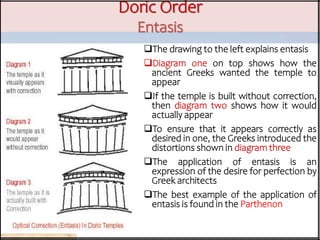
Entasis
A characteristic of the Doric order is the
use of entasis
Entasis refers to the practice of optical
correction in Greek Doric temples
All buildings are arranged with a slight
curve to correct for optical illusion when
they are viewed
This is done to counteract the concave
appearance produced by straight edges in
perspective
The shaft of the column is built to be
slightly convex in shape for optical
correction
Columns were also built with a slight tilt
The drawing to the left explains entasis
Diagram one on top shows how the
ancient Greeks wanted the temple to
appear
If the temple is built without correction,
then diagram two shows how it would
actually appear
To ensure that it appears correctly as
desired in one, the Greeks introduced the
distortions shown in diagram three
The application of entasis is an
expression of the desire for perfection by
Greek architects
The best example of the application of
entasis is found in the Parthenon
Doric Order
Entasis
The Parthenon
The Orders
Ionic Order
The Ionic order evolved and took its
name from Ionia in modern day Turkey
The ionic column including the capital
and base had a height of 9 to 10times its
diameter
It had 24 flutes, which is more than that
of the Doric column, even though it is
smaller in diameter.
The flutes were rounded at the top and
bottom.
The Ionic order had a capital
developed from a pair of volute
about two-thirds the diameter of
the column in height
Ornaments are used to decorate
the area between the capital and
the volute
The Ionic column has a base
One of the limitations of the Ionic
order is that it is designed to be
seen from the front only
The Orders
Ionic Order
At the corner of
rectangular buildings, an
angular volute had to be
used.
Entasis was not applied to
the ionic column
The Ionic column is said to
represent the shape of a
women with its delicacy
and feminine slenderness.
The Orders
Ionic Order
The Orders
Corinthian Order
» The Corinthian order takes its name
from the city of Corinth in Greece
» It however appeared to have been
developed in Athens in the 5th
century BC
» This order is similar in its proportions
to the Ionic order but has a
different capital
» The core of the capital is shaped like
an inverted bell.
» The bell-like capital is decorated
with rows of carved acanthus leaves
The rich decorative effect of the
Corinthian capital made it
attractive.
Because of its symmetry, the
Corinthian capital unlike the ionic
capital is designed to be seen from
all directions
The Corinthian column, the most
beautifully ornate of the three
orders represents the figure of a
maiden
This order was not extensively used
during the Greek period
It became popular during the
ancient Roman period
The Orders
Corinthian Order
Temple Architecture
» The most important Greek
building was the temple
» The temple had the finest
building materials and the
richest decoration.
» It was also the most complex of
architectural form.
» It was designed not to hold
worshippers, but as symbolic
dwelling of the gods
» The temple is usually
rectangular in plan
» It is lifted on a podium, and in
plan has colonnades on all its
external sides
Temple Architecture; Introduction
» The number of columns is always
even to allow the location of the
entrance in the center; temples with
odd number of columns are
uncommon
» Temples with 2 columns in front are
diastyle, 4-tetrastyle, 6-hexastyle, 8-
octastyle and 10-decastyle
» Greek temples usually have twice the
number of columns in front plus one
by the side; A hexastyle temple =six
columns in front & thirteen on side
Colonnades define a portico around the temple
The temple building is made up of four walls
enclosing a rectangular space called the naos or
sanctuary
This was the house of the god to whom the
temple is dedicated
The interior rectangular space of the naos is
framed by a pair of colonnades on the long side
creating a central processional space
At the head of the processional space is the
statue of the god to whom the temple is
dedicated
The temple interior was generally dark, with only
the entrance as a source of light
Temple Architecture
The temple always faced east so that the
rising sun would light the statues inside
Temples were designed to be admired
from the outside rather than used
The Greek temple is believed to originate
from the Mycenaean megaron
From the megaron, it went through
several stages of evolution as shown in
the diagram
By 500 BC, the final form of the Greek
temple had emerged
Temple Architecture
The Doric temple is based on the
Doric order
Both the Doric order and temple
went through a simultaneous
process of evolution
The Basilica at Paestum 550 BC is
an example of early Doric temple
It was built during the archaic
period of Greek civilization
Temple Architecture
Doric Temple
The columns on the front are 9,
while on the sides they are 18
The Doric columns appear
heavy in comparison with later
temples
The columns have a bulge,
pointing to the practice of
optical correction or entasis by
the time of its construction
The capitals are also huge,
heavy and very wide
Temple Architecture
Doric Temple
The Temple of Aphaia at
Aegina 490 BC is a later temple
than the Basilica at Paestum
Temple of Aphaia is much less
heavy than Paestum
The entablature is less thick
The columns are slimmer with
less entasis or bulge
The capitals are also smaller
Temple Architecture
Temple of Aphaia at Aegina
Doric Temple
Temple of Aphaia at Aegina
This temple is hexa style but
has only 12 flanking columns-
early temple
The interior columns are
divided into a row of two
columns separated by an
architrave
This allowed the designers to
avoid using columns with a
large diameter
The temple has triangular
pediment on n the Eastern
and Western sides decorated
with stories from Greek myths
Temple Architecture
Doric Temple
Temple of Hera Argiva at Paestum
The Temple of Hera Argiva (or
Neptune) at Paestum 460 BC was
built later than the Temple of
Aphaia
It is one of the best preserved of
all Greek temples
It is more mature in its
proportions than all the others
examined
The columns are 8.8 meters high
and about 4.3 times their lower
diameter
Temple Architecture
Doric Temple
The temple is hexastyle but
with 24 columns on its flank
It also has a double row of
columns in the interior, and
divided into two separated by
a stone architrave
The most perfect of the Doric
temples is the Parthenon; We
will examine this temple later
Temple Architecture
Temple of Hera Argiva at Paestum
Doric Temple
Ionic Temples
Ionic temples were built using the
Ionic order
The most famous of the Ionic
temples is the temple of Artemis at
Ephesus
It was considered one of the seven
wonders of the ancient World
It was commissioned by Alexander
the Great and was believed to have
been built and destroyed several
times
Unfortunately the temple has not
survived to the present time
Temple Architecture
There are also uncertainties
about its arrangement in plan
The temple stands on a
platform 2.7 meters high
It had 36 columns in its front
and they had an additional
relief sculpture at the base
The best surviving Ionic
temples is the Temple of
Athena located at the
Acropolis at Athens
Temple Architecture
Ionic Temples
Corinthian Temples
The Corinthian order was
not widely used during the
Greek period
Earliest known example is
inside the 5th century
Temple of Apollo at Bassae.
The temple of Olympian
Zeus in Athens was in the
Corinthian order
The column was
constructed in 131 A.D. well
after the Roman conquest
of Greece
The Corinthian order
became very popular
during the Roman period.
Temple Architecture
Civic Architecture
During the Hellenistic period Greeks became very
fascinated by civic buildings
Treatments once reserved for temples and the gods,
were gradually extended to civic and government
buildings.
The Agora or market place also became very
important in Greek cities.
The theater and council chamber are examples of
civic buildings found in every Greek city
Theater Epidarus
The Greeks invented the
theater design that is still used
in movies and auditoriums
today
Every important Greek city had
a theater
Their theater was built into a
hilly landscape
The theater had a bank of
seats steps created from the
landscape
Civic Architecture
The theater had a bank of
seats steps created from
the landscape
It would usually commands
a view to the landscape
The image shown is of
theater Epidaurus
This was the largest theater
in ancient Greece
It is still in use today
Theater Epidarus
Civic Architecture
Council Chamber – Bouleterion, Miletus
The Bouleterion is where the
Boule or council of the city state
met
It was a covered chamber fitted
with banks of seats like a theater
The example shown is from the
city of Miletus
Similar buildings were found in
every Greek or Hellenistic city
Civic Architecture
Assignment
Draw the three Greek orders in detail & while
drawing, carefully identify each parts of the columns
in comparison with each other.
10%
Greek City Planning and Design
Planning and Design Principles
» The ancient Greek civilization had established
principles for planning and designing cities
» City form were of two types
» Old cities such as Athens had irregular street
plans reflecting their gradual organic
development
» New cities, especially colonial cities established
during the Hellenistic period, had a grid-iron
street plan
» Certain things were common among cities
Towns had fixed boundaries and some were
protected by fortifications
Much of the town was devoted to public use
The Greek City was usually divided into three parts;
the acropolis, the agora and the town.
Site planning and design was centered on the
appreciation of buildings from the outside.
The location of buildings was therefore such that it
could command a good view to it.
Greek City Planning and Design
Planning and Design Principles
The Acropolis
The Acropolis was the city of temples
It is the location where all the major temples of a
city are located
It was built to glorify the gods
Greeks considered high places to be important &
sacred
The Acropolis were usually located on the highest
ground
Other public buildings such as gymnasia, stadia,
and theaters were generally regarded as part of
religious rituals
They are normally found attached on lower
ground to the hills of the Acropolis
Greek City Planning and Design
The major
buildings of the
Acropolis Athens
in classical period
are
1. The Parthenon
2. The Propylaea
3. The temple of
Erectheon and
4. Epidaurus
• The Acropolis was called as the temple complex of
any Greek town located on a small hillock or a
mountain from which the entire town is visible.
The Acropolis
The Agora
The Agora was the most important gathering place in a
Greek city
It started as an open area where the council of the city met
to take decisions
With time buildings were constructed to define and enclose
the space
It also transformed into a place for combined social,
commercial and political activities
It emerged as the heart of Greek intellectual life and
discourse.
It was usually located on a flat ground for ease of
communication
It was placed to be easily accessible from all directions
In many cities, it is also located close to the Acropolis
Greek City Planning and Design
The Town
The town was where the people lived
This was the domain of women, who did not have any public role
Early Greek towns had an irregular street pattern, resulting from its
organic growth
Later Hellenistic towns such as Prienne had a formal rectilinear
pattern
The town was made up of only residential houses
Houses were usually constructed of mud bricks
Houses were of the courtyard type, with rooms arranged
around a courtyard
Houses vary according to standing in the society
Houses of poor people were very simple compared to the
house of the rich, which had more rooms and better finishing
Greek City Planning and Design
Greek Architecture in Athens
The Parthenon was the
most prominent building
on the Athenian Acropolis
It was designed by Ictinus
and Callicrates in 447 BC
The Parthenon is the most
perfect Doric temple ever
built.
It was lighter and more
graceful than previous
temples
The Parthenon
It also embodies the
perfection of the Greek
system of proportioning
The proportions of the
Parthenon are based on the
proportions of a man, which
is seven to one
The ideal human body was
seven heads tall
The Parthenon
Greek Architecture in Athens
The Parthenon is an octastyle
temple with 8 columns in front and
17 columns by its side
In the Parthenon we also find the
best example of the application of
entasis
The Parthenon had two rooms in
plan; the treasury, which is most
often empty and the naos or inner
sanctuary
An ivory gold statue of Athena, 11
meters tall carved by Phidas once
stood in the noas or inner
sanctuary of the Parthenon
The Parthenon
Greek Architecture in Athens
The statue reached the wooden
roof of the temple
Parts of the inside and outside of
the Parthenon were once painted
The inside of the temple was
often not used
Processions and ceremonies were
held outside
The temple’s alter was placed on
the Eastern side
During the Christian period, the
Parthenon was used as a church
Greek Architecture in Athens
The Parthenon
Later the Turks converted it into a
Mosque
In 1687, the Turks used it to store
ammunition and when they were
attacked by the Venetians, it
exploded
The images shows what remains of
it
In 1801 An English man gathered
the broken pieces and shipped
them to the British museum in
England
Greek Architecture in Athens
The Parthenon
The Propylaea
The Propylaea (437-432 BC)was a monumental
structure that served as the main gateway to the
Acropolis on its steep western approach.
Like the Parthenon, the Propylaea combine the
Doric and Ionic orders.
• The architect
Mnesicles designed
asymmetrical wings to
the north and south of
the Propylaea’s central
block.
The Erechtheon
• Ionic temple - On the north
side of the Acropolis
• Begun in the 430s or
420s and was mostly
complete by 405BC
• unusual asymmetrical plan
- columns
- porches
• The southern porch, sometimes
called the Porch of the Maidens,
has six marble maidens called
caryatids that support the
entablature in place of columns.
ancient Egyptian.pptx

ancient Egyptian.pptx

  • 1.
  • 2.
    ANCIENT EGYPTIAN • Location:-along the Nile River in northeastern Africa • It was the longest-lived civilization • Nile River formed the focus of ancient Egyptian civilization • Natural barriers provided good protection from other peoples • The pyramids at Giza and the lighthouse at Alexandria.
  • 3.
    Geography of theAncient Nile Valley •People settled and established farming villages along the Nile. •Egyptians depended on annual floods to soak the land and deposit a layer of silt, or rich soil. •Egyptians had to cooperate to control the Nile, building dikes, reservoirs, and irrigation ditches. •Rulers used the Nile to link and unite Upper and Lower Egypt. •The Nile served as a trade route connecting Egypt to Africa, the Middle East, and the Mediterranean world.
  • 4.
    • Processed thinflat sheets from the papyrus • Their earliest script, now known as hieroglyphs • Devised a calendar on the basis of their observations of the Sun and the stars. • Religion:- worshiped many gods • Developed one of the first religions to have a concept of the afterlife. ANCIENT EGYPTIAN
  • 7.
    •Due to thescarcity of lumber, the two predominant building materials used in ancient Egypt were sunbaked mud brick and stone, mainly limestone, but also sandstone and granite in considerable quantities. •From the Old Kingdom onward, stone was generally reserved for tombs and temples, Characteristics of Egyptian Architecture
  • 8.
    •while bricks wereused even for royal palaces, fortresses, the walls of temple precincts and towns, and for subsidiary buildings in temple complexes. •Egypt houses were made out of mud collected from the Nile river. It was placed in molds and left to dry in the hot sun to harden for use in construction. •Many Egyptian towns have disappeared because they were situated near the cultivated area of the Nile Valley and were flooded as the river bed slowly rose during the millennia, or the mud bricks of which they were built were used by peasants as fertilizer. Characteristics of Egyptian Architecture
  • 9.
    •Others are inaccessible,new buildings having been erected on ancient ones. Fortunately, the dry, hot climate of Egypt preserved some mud brick structures. •Also, many temples and tombs have survived because they were built on high ground unaffected by the Nile flood and were constructed of stone.
  • 10.
    PRE-DYNASTIC EGYPT (5000 –3000 BC) • Egypt was not a unified nation • The culture of the south expanded northward DYNASTIC EGYPT (3000 – 30 BC) • when lands along the Nile River were united under one ruler • Egyptian state that extended roughly 800 km ANCIENT EGYPTIAN
  • 11.
    • Egyptologists have groupedEgypt's dynasties into an Early Dynastic period. – Old Kingdom (3400 – 2130 BC) – Middle Kingdom (2130 – 1580 BC) – New Kingdom (1580 – 332 BC) • In 332 BC Alexander the Great, king of Macedonia, conquered Egypt • The Romans defeated Egypt in 31 BC marked the end of ancient Egypt as an independent power ANCIENT EGYPTIAN
  • 12.
    •massive structures characterizedby thick, sloping walls with few openings. •possibly a method of construction used to obtain stability in mudwalls. •the incised and flatly modeled surface adornment of the stone buildings hasderivedfrom mudwall ornamentation. •the use of the arch was developed during the fourth dynasty, all monumental buildings are post and lintel constructions, •flat roofs are constructed of huge stone blocks supported by the external walls and the closely spaced columns. Religious buildings/monuments
  • 13.
    •Exterior and interiorwalls, as well as the columns and piers, were covered with hieroglyphic and pictorial frescoes and carvings painted in brilliant colors. •Many motifs of Egyptian ornamentation are symbolic, such as the scarab,or sacred beetle the solar disk the vulture palm leaves, the papyrusplant buds and flowers of the lotus •Ancient Egyptian temples were aligned with astronomically significant events,such as solstices and equinoxes, Religious buildings/monuments
  • 14.
    •required precise measurementsat the moment of the particular event. •Measurements at the most significant temples may have been ceremonially undertaken by the Pharaoh himself. Religious buildings/monuments
  • 15.
    Architecture • Buildings:- temples,tombs, and palaces – Most buildings were disappeared – Many ancient Egyptian temples and tombs have survived Pyramids and Royal Tombs • Location: – On the west bank of the Nile river – Because they believed that the western desert was the entrance to the underworld , where the dead dwelled and through which the sun passed at night.
  • 16.
    Pyramids • Pyramids arelarge structures with four triangular sides that meet in a point at the top. • Egyptians built more than 90 royal pyramids 2630 -1530 BC • From stepped to slopped pyramid
  • 17.
    • The GreatPyramid at Giza • The largest • By King Khufu • The only one of the Seven Wonders of the World that still survives. slopped pyramid Pyramids
  • 18.
    • By kingDjoser • The 1st and the oldest – stone • Designed by the architect Imhotep stepped Pyramid Pyramids
  • 19.
    The Great Pyramid •Interior: – Height 146.7m & side length 230m(square) • The entrance is set 17 m (55 ft.) above ground level. – It was intended to be used only once, during Khufu’s funeral, • Descending Passage which runs down the Subterranean Chamber – 18m from the entrance Ascending Passage that runs upward for about 39 m (129 ft.), until it levels out and enters the so-called Queen’s Chamber
  • 20.
    • The GrandGallery most probably held some of the large stones that were used to plug passages after the king’s funeral • About 47 m (153 ft.) long and 8.5 m (28 ft.) high. The Great Pyramid
  • 21.
    • King’s Chamber, theroom in which Khufu’s body was placed during his funeral The Great Pyramid
  • 22.
    Mastaba Tombs • Tombsof the elites • underground structure that contained the burial site and a flat, rectangular mud-brick structure built over it. • The long sides of the mastabas had a N-S orientation. • Niche – eastern side – cut deeper into the solid mastaba – A place for makings offerings • false door – on the west wall of the offering chamber – intended to connect the worlds of the dead and the living – permitted the dead to pass through and receive offerings
  • 23.
    Usage andShape •Asepulchralstructurebuilt aboveground. •Mastabas werebuilt above a shaft at the bottom ofwhichwas situated a tomb •The structure above the ground were relatively low •Rectangularinplanwithinward-sloping walls •Flat roof. •Built ofbrickandfacedwithlimestone slabs. •sides slopingat an angle of about 75 degrees Mastaba Tombs
  • 24.
    Rock Cut Tombs •The Valley of the Kings is a rocky desert area with high cliffs. • In the New Kingdom tombs were mostly undecorated, except for the burial chamber • After the Middle Kingdom ended the Egyptians stopped building royal pyramids, and in the New Kingdom kings were buried in tombs at Thebes in the Valley of the Kings.
  • 25.
    Temples • Built ashouses for the gods, where the gods could appear on earth. • The focal point of any temple was a sanctuary area that contained a cult statue of the god. • Most temples were rectangular, with the entrance on the side nearest the Nile
  • 26.
    •Twomainclasses- mortuarytemples,for ministrations todeified Pharaohs Cult temples,forthe popular worshipof ancient andmysterious gods •Royalburials moreimportantthanmortuarytemples •Theirspecialcharacter merged into thatof thecult temples, lost the distinctionbetweenthe twotypes. • Cult temples essentials were rectangularpalisadedcourt entered from a narrow end flankedby pennon- poles centrally within them an emblem of deity pavilioncomprisingvestibuleandsanctuary Temples
  • 27.
    Temples • At theentrance -> huge gateway called a pylon leading into an open court followed by hypostyle hall. • Beyond hypostyle hall there was the sanctuary, which contained the cult statue of the god was kept. • The most inner parts of the temple were restricted to the king and priests. • Rock Cut Temple-Queen Hatshepsut's temple
  • 28.
    Obelisks • Are independenttower kind of structures erected with a single stone in the temple entrances, courtyards and in city centers. 1. Obelisk in the temple of Amun At Karnak, Thebes » Symbol of Sun god » At present this obelisk is in the central piazza of Rome 2. The Cleopatra’s Needle » Erected originally in the temple of Ramses II » Was taken by the British to England, London
  • 29.
    Sculpture • The greatSphinx at Giza – creatures’ part lion and part human – carved from the rock on the site – had a practical purpose--to guard the nearby pyramid tombs.
  • 30.
  • 31.
    • Emerged relativelyafter the Egypt and Mesopotamia • Location: mostly coastal area with many small and big is lands in the Mediterranean Sea and in the Aegean bay. • Climate: Comfortable with no natural hazards such as heavy rains and floods like Egypt and Mesopotamia • Building materials: are soft stones like limestone and marble, with a limited quantity of wood. The climate and materials gave the Greek craftsmen a wide scope of developing their skills in a remarkable way.
  • 32.
    • Contributions: » studiedvarious aspects of design » worked out the mathematical relations between the dimensions, equality of ratios » Developed the three major styles called Greek orders such as Doric, Ionic and Corinthian orders.
  • 33.
    HISTORICAL DEVELOPMENTS  Mycenaeanculture(1600 BC - 1100 BC)  The root of Greek culture  The 1st culture of Aegean civilization (1600 BC - 1100 BC)  Also called the earliest Greek  Had a warrior culture that made them powerful, but their eagerness to fight also contributed to their downfall  Time when highly developed monumental art and architecture first flourished on the Greek mainland  Scholars call the Mycenaean's the “earliest Greeks” because they are the first people known to have spoken Greek.
  • 34.
    Historical Background Period • Theperiod of ancient Greek history can be divided into four as follows: » 1100 B. C. – 750 B. C. Greek Dark Ages » 750 B. C. – 500 B. C. Archaic Period » 5000 B. C. – 323 B. C. Classical Period » 323 B. C. – 147 B. C. Hellenistic Period • The classical and archaic period are sometimes collectively referred to as Hellenic period
  • 35.
    The Dark Age(1100 – 750 BC) » poverty and political confusion that lasted for more than 200 years » The Mycenaean kings were replaced by petty chiefs, who had limited power and wealth » Disunited land of scattered city-states » Greek economy collapse » Called dark age because living conditions were harsh » Artists stopped drawing people and animals on pots, restricting their decoration to geometric designs. • much less land is cultivated • fewer settlements • less international trade
  • 36.
    The Archaic Period(750 – 480 BC) Called the Archaic Age because it was considered archaic, or old-fashioned Time of recovery so there is a competition to become culturally superior Sense of democracy & sharing of power among small group Economic improvement
  • 37.
     The ClassicalPeriod (480 – 323 BC)  A very important period in the ancient Greek history.  Rivalry between Athens and the city-state of Sparta Time for culmination of Greek art and architecture Great era of Greek philosophy Alexander the Great extended his father’s empire The Hellenistic Period (323 – 147 BC) After Alexander died Called Hellenistic because the ruling class speak Greek and the official culture is that of Greek
  • 38.
    Architecture in serviceof religion Architecture in Greece Started in the Service of Religions Temples were the house of gods The Greeks regarded beauty as an attribute of the gods and the conscious pursuit of beauty as a religious exercise. The most important task for architects was how to make the temple beautiful The search for ways to express architectural beauty made the Greek civilization among the first to have established ideals of beauty Architectural Character
  • 39.
    proportions » The Greeksconvinced themselves that the secrets of beauty lie in proportions » Man was viewed by the Greeks as having the most ideal proportions and is the measure of all things » Greek developed a system of building proportion that reflected those of the human body » With time, they refined their system of building proportion, and developed the classical Greek orders which we will soon explore Architectural Character
  • 40.
    Architectural Character • Theancient Greeks developed three major styles called Greek Orders. » Doric order » Ionic order » Corinthian order • Building types » Religious » Civic » Domestic » Recreational • Building material » The principal building material of the ancient Greeks was stone » Clay and timber were also used » Timber was used mostly for roofing • Doric order, Ionic order, Corinthian order Named after three major Greek tribes: Dorian, Corinthian and Ionians Building types Religious: open air altars, temples and treasuries. Civic: council house, law courts, market place, open air assembly and roofed colonnade or portico. Domestic: houses from one room type to multiple rooms organized around a courtyard, one or even two stories. Recreational: Open Air Theater, roofed concert hall, gymnasium and stadium.
  • 41.
    Construction Greek construction wasof a simple post and lintel construction Their ground plans were always very simple, usually rectangular With a combination of simple ground plans and they were able to create amazing buildings Buildings were constructed by skilled craftsmen who were in demand and traveled from one state to the other for construction work Designs were done on the ground by measuring out the foundation Architectural Character
  • 42.
    Construction » Blocks ofstone were ordered from the quarry » Blocks were given initial preparation on the building site » Blocks were large and retained in position by their own weight; it was not necessary to fix them together in any way » Roofs were of wood beams and rafters cut to square shapes with tile roof » Carvings and other decorative work were finished when the building is completed Architectural Character
  • 43.
    The Orders » Referto the entire set of form that makes up the principal elevation of a temple. » Composed of a base, an upright column or support with its capital, and the horizontal entablature. » All the parts of an order are proportionally derived from the size of the base of the column. » It determines all aspects of the elevation of a building including its shape and the arrangement and proportion of its parts
  • 44.
    Greeks are creditedwith originating the three orders of the classical language of architecture, Doric, Ionic and Corinthian. Columns were understood by the Greeks to be anthropomorphic or representative of the body of a human The base suggests the feet, the shaft the torso (upper body) and the capital the head. The Orders
  • 45.
    » Each orderhad its own conventions about the design of the entablature » The entablature is divided into three sections; the cornices, the frieze and the architrave » According the rules of classical architecture, the entablature should always be divisible into these three zones The Orders
  • 46.
    The Orders Doric Order TheDoric order was the earliest to be developed By the 6th century, a set of universal proportions for the Doric temple had been developed. The Doric order is made up of three elements; stylobate, Column and entablature The stylobate is a podium raised three steps on which the temple sits The Doric column is further divided into the shaft and a square capital
  • 47.
    It had aheight of between 5 and 6 times its diameter. The shaft is tapered and made slightly to provide correction for optical illusion. The shaft is usually divided into 20 shallow flutes. The entablature is divided into an architrave, a frieze and the cornice. The Doric column represents the proportions of a man’s body, its strength and beauty. The Orders Doric Order
  • 48.
    Doric Order Entasis A characteristicof the Doric order is the use of entasis Entasis refers to the practice of optical correction in Greek Doric temples All buildings are arranged with a slight curve to correct for optical illusion when they are viewed This is done to counteract the concave appearance produced by straight edges in perspective The shaft of the column is built to be slightly convex in shape for optical correction Columns were also built with a slight tilt
  • 49.
    The drawing tothe left explains entasis Diagram one on top shows how the ancient Greeks wanted the temple to appear If the temple is built without correction, then diagram two shows how it would actually appear To ensure that it appears correctly as desired in one, the Greeks introduced the distortions shown in diagram three The application of entasis is an expression of the desire for perfection by Greek architects The best example of the application of entasis is found in the Parthenon Doric Order Entasis
  • 50.
  • 51.
    The Orders Ionic Order TheIonic order evolved and took its name from Ionia in modern day Turkey The ionic column including the capital and base had a height of 9 to 10times its diameter It had 24 flutes, which is more than that of the Doric column, even though it is smaller in diameter. The flutes were rounded at the top and bottom.
  • 52.
    The Ionic orderhad a capital developed from a pair of volute about two-thirds the diameter of the column in height Ornaments are used to decorate the area between the capital and the volute The Ionic column has a base One of the limitations of the Ionic order is that it is designed to be seen from the front only The Orders Ionic Order
  • 53.
    At the cornerof rectangular buildings, an angular volute had to be used. Entasis was not applied to the ionic column The Ionic column is said to represent the shape of a women with its delicacy and feminine slenderness. The Orders Ionic Order
  • 54.
    The Orders Corinthian Order »The Corinthian order takes its name from the city of Corinth in Greece » It however appeared to have been developed in Athens in the 5th century BC » This order is similar in its proportions to the Ionic order but has a different capital » The core of the capital is shaped like an inverted bell. » The bell-like capital is decorated with rows of carved acanthus leaves
  • 55.
    The rich decorativeeffect of the Corinthian capital made it attractive. Because of its symmetry, the Corinthian capital unlike the ionic capital is designed to be seen from all directions The Corinthian column, the most beautifully ornate of the three orders represents the figure of a maiden This order was not extensively used during the Greek period It became popular during the ancient Roman period The Orders Corinthian Order
  • 56.
    Temple Architecture » Themost important Greek building was the temple » The temple had the finest building materials and the richest decoration. » It was also the most complex of architectural form. » It was designed not to hold worshippers, but as symbolic dwelling of the gods » The temple is usually rectangular in plan » It is lifted on a podium, and in plan has colonnades on all its external sides
  • 57.
    Temple Architecture; Introduction »The number of columns is always even to allow the location of the entrance in the center; temples with odd number of columns are uncommon » Temples with 2 columns in front are diastyle, 4-tetrastyle, 6-hexastyle, 8- octastyle and 10-decastyle » Greek temples usually have twice the number of columns in front plus one by the side; A hexastyle temple =six columns in front & thirteen on side
  • 58.
    Colonnades define aportico around the temple The temple building is made up of four walls enclosing a rectangular space called the naos or sanctuary This was the house of the god to whom the temple is dedicated The interior rectangular space of the naos is framed by a pair of colonnades on the long side creating a central processional space At the head of the processional space is the statue of the god to whom the temple is dedicated The temple interior was generally dark, with only the entrance as a source of light Temple Architecture
  • 59.
    The temple alwaysfaced east so that the rising sun would light the statues inside Temples were designed to be admired from the outside rather than used The Greek temple is believed to originate from the Mycenaean megaron From the megaron, it went through several stages of evolution as shown in the diagram By 500 BC, the final form of the Greek temple had emerged Temple Architecture
  • 60.
    The Doric templeis based on the Doric order Both the Doric order and temple went through a simultaneous process of evolution The Basilica at Paestum 550 BC is an example of early Doric temple It was built during the archaic period of Greek civilization Temple Architecture Doric Temple
  • 61.
    The columns onthe front are 9, while on the sides they are 18 The Doric columns appear heavy in comparison with later temples The columns have a bulge, pointing to the practice of optical correction or entasis by the time of its construction The capitals are also huge, heavy and very wide Temple Architecture Doric Temple
  • 62.
    The Temple ofAphaia at Aegina 490 BC is a later temple than the Basilica at Paestum Temple of Aphaia is much less heavy than Paestum The entablature is less thick The columns are slimmer with less entasis or bulge The capitals are also smaller Temple Architecture Temple of Aphaia at Aegina Doric Temple
  • 63.
    Temple of Aphaiaat Aegina This temple is hexa style but has only 12 flanking columns- early temple The interior columns are divided into a row of two columns separated by an architrave This allowed the designers to avoid using columns with a large diameter The temple has triangular pediment on n the Eastern and Western sides decorated with stories from Greek myths Temple Architecture Doric Temple
  • 64.
    Temple of HeraArgiva at Paestum The Temple of Hera Argiva (or Neptune) at Paestum 460 BC was built later than the Temple of Aphaia It is one of the best preserved of all Greek temples It is more mature in its proportions than all the others examined The columns are 8.8 meters high and about 4.3 times their lower diameter Temple Architecture Doric Temple
  • 65.
    The temple ishexastyle but with 24 columns on its flank It also has a double row of columns in the interior, and divided into two separated by a stone architrave The most perfect of the Doric temples is the Parthenon; We will examine this temple later Temple Architecture Temple of Hera Argiva at Paestum Doric Temple
  • 66.
    Ionic Temples Ionic templeswere built using the Ionic order The most famous of the Ionic temples is the temple of Artemis at Ephesus It was considered one of the seven wonders of the ancient World It was commissioned by Alexander the Great and was believed to have been built and destroyed several times Unfortunately the temple has not survived to the present time Temple Architecture
  • 67.
    There are alsouncertainties about its arrangement in plan The temple stands on a platform 2.7 meters high It had 36 columns in its front and they had an additional relief sculpture at the base The best surviving Ionic temples is the Temple of Athena located at the Acropolis at Athens Temple Architecture Ionic Temples
  • 68.
    Corinthian Temples The Corinthianorder was not widely used during the Greek period Earliest known example is inside the 5th century Temple of Apollo at Bassae. The temple of Olympian Zeus in Athens was in the Corinthian order The column was constructed in 131 A.D. well after the Roman conquest of Greece The Corinthian order became very popular during the Roman period. Temple Architecture
  • 69.
    Civic Architecture During theHellenistic period Greeks became very fascinated by civic buildings Treatments once reserved for temples and the gods, were gradually extended to civic and government buildings. The Agora or market place also became very important in Greek cities. The theater and council chamber are examples of civic buildings found in every Greek city
  • 70.
    Theater Epidarus The Greeksinvented the theater design that is still used in movies and auditoriums today Every important Greek city had a theater Their theater was built into a hilly landscape The theater had a bank of seats steps created from the landscape Civic Architecture
  • 71.
    The theater hada bank of seats steps created from the landscape It would usually commands a view to the landscape The image shown is of theater Epidaurus This was the largest theater in ancient Greece It is still in use today Theater Epidarus Civic Architecture
  • 72.
    Council Chamber –Bouleterion, Miletus The Bouleterion is where the Boule or council of the city state met It was a covered chamber fitted with banks of seats like a theater The example shown is from the city of Miletus Similar buildings were found in every Greek or Hellenistic city Civic Architecture
  • 73.
    Assignment Draw the threeGreek orders in detail & while drawing, carefully identify each parts of the columns in comparison with each other. 10%
  • 74.
    Greek City Planningand Design Planning and Design Principles » The ancient Greek civilization had established principles for planning and designing cities » City form were of two types » Old cities such as Athens had irregular street plans reflecting their gradual organic development » New cities, especially colonial cities established during the Hellenistic period, had a grid-iron street plan » Certain things were common among cities
  • 75.
    Towns had fixedboundaries and some were protected by fortifications Much of the town was devoted to public use The Greek City was usually divided into three parts; the acropolis, the agora and the town. Site planning and design was centered on the appreciation of buildings from the outside. The location of buildings was therefore such that it could command a good view to it. Greek City Planning and Design Planning and Design Principles
  • 76.
    The Acropolis The Acropoliswas the city of temples It is the location where all the major temples of a city are located It was built to glorify the gods Greeks considered high places to be important & sacred The Acropolis were usually located on the highest ground Other public buildings such as gymnasia, stadia, and theaters were generally regarded as part of religious rituals They are normally found attached on lower ground to the hills of the Acropolis Greek City Planning and Design
  • 77.
    The major buildings ofthe Acropolis Athens in classical period are 1. The Parthenon 2. The Propylaea 3. The temple of Erectheon and 4. Epidaurus • The Acropolis was called as the temple complex of any Greek town located on a small hillock or a mountain from which the entire town is visible. The Acropolis
  • 78.
    The Agora The Agorawas the most important gathering place in a Greek city It started as an open area where the council of the city met to take decisions With time buildings were constructed to define and enclose the space It also transformed into a place for combined social, commercial and political activities It emerged as the heart of Greek intellectual life and discourse. It was usually located on a flat ground for ease of communication It was placed to be easily accessible from all directions In many cities, it is also located close to the Acropolis Greek City Planning and Design
  • 79.
    The Town The townwas where the people lived This was the domain of women, who did not have any public role Early Greek towns had an irregular street pattern, resulting from its organic growth Later Hellenistic towns such as Prienne had a formal rectilinear pattern The town was made up of only residential houses Houses were usually constructed of mud bricks Houses were of the courtyard type, with rooms arranged around a courtyard Houses vary according to standing in the society Houses of poor people were very simple compared to the house of the rich, which had more rooms and better finishing Greek City Planning and Design
  • 80.
    Greek Architecture inAthens The Parthenon was the most prominent building on the Athenian Acropolis It was designed by Ictinus and Callicrates in 447 BC The Parthenon is the most perfect Doric temple ever built. It was lighter and more graceful than previous temples The Parthenon
  • 81.
    It also embodiesthe perfection of the Greek system of proportioning The proportions of the Parthenon are based on the proportions of a man, which is seven to one The ideal human body was seven heads tall The Parthenon Greek Architecture in Athens
  • 82.
    The Parthenon isan octastyle temple with 8 columns in front and 17 columns by its side In the Parthenon we also find the best example of the application of entasis The Parthenon had two rooms in plan; the treasury, which is most often empty and the naos or inner sanctuary An ivory gold statue of Athena, 11 meters tall carved by Phidas once stood in the noas or inner sanctuary of the Parthenon The Parthenon Greek Architecture in Athens
  • 83.
    The statue reachedthe wooden roof of the temple Parts of the inside and outside of the Parthenon were once painted The inside of the temple was often not used Processions and ceremonies were held outside The temple’s alter was placed on the Eastern side During the Christian period, the Parthenon was used as a church Greek Architecture in Athens The Parthenon
  • 84.
    Later the Turksconverted it into a Mosque In 1687, the Turks used it to store ammunition and when they were attacked by the Venetians, it exploded The images shows what remains of it In 1801 An English man gathered the broken pieces and shipped them to the British museum in England Greek Architecture in Athens The Parthenon
  • 85.
    The Propylaea The Propylaea(437-432 BC)was a monumental structure that served as the main gateway to the Acropolis on its steep western approach. Like the Parthenon, the Propylaea combine the Doric and Ionic orders. • The architect Mnesicles designed asymmetrical wings to the north and south of the Propylaea’s central block.
  • 86.
    The Erechtheon • Ionictemple - On the north side of the Acropolis • Begun in the 430s or 420s and was mostly complete by 405BC • unusual asymmetrical plan - columns - porches • The southern porch, sometimes called the Porch of the Maidens, has six marble maidens called caryatids that support the entablature in place of columns.

Editor's Notes

  • #32 -CLIMATE: Comfortable with no natural hazards such as heavy rains and floods like Egypt and Mesopotamia. -The climate and materials gave the Greek craftsmen a wide scope of developing their skills in a remarkable way. -studied various aspects of design such as, unity, diversity, proportions, symmetry, rhythm, harmony and modules.
  • #37 The Archaic Period -called the Archaic Age because it was considered archaic, or old-fashioned, in comparison with the Classical Period that followed -New city-states took shape with monumental building programs became part of this competition, as each community attempted to establish itself as culturally superior
  • #38 The Classical Period-A very important period in the ancient Greek history. -Rivalry between Athens and the city-state of Sparta dominated the history of 5th century Greece -Alexander the Great extended his father’s empire into Asia Minor (now Turkey), Syria, Egypt, Persia, Afghanistan and as far as India.