Jain
Architecture …
            By:
            Azizur Khan.
            Nikhil Mehta.
            Swapnil Kanse.
            Akshata Hase.
            Tanvi Gujarathi.
Introduction .
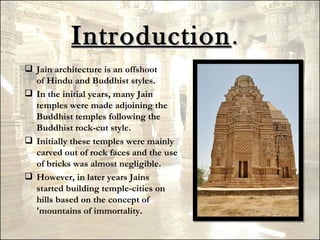
 Jain architecture is an offshoot
  of Hindu and Buddhist styles.
 In the initial years, many Jain
  temples were made adjoining the
  Buddhist temples following the
  Buddhist rock-cut style.
 Initially these temples were mainly
  carved out of rock faces and the use
  of bricks was almost negligible.
 However, in later years Jains
  started building temple-cities on
  hills based on the concept of
  'mountains of immortality.
Elements Of Jain
              Architecture.
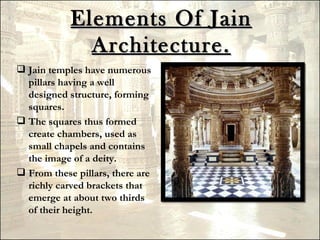
 Jain temples have numerous
  pillars having a well
  designed structure, forming
  squares.
 The squares thus formed
  create chambers, used as
  small chapels and contains
  the image of a deity.
 From these pillars, there are
  richly carved brackets that
  emerge at about two thirds
  of their height.
Elements Of Jain
   Temples. these temples
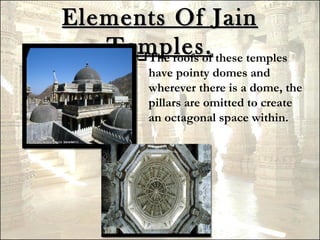
      The roofs of
         have pointy domes and
         wherever there is a dome, the
         pillars are omitted to create
         an octagonal space within.
Elements Of Jain
            Temples.
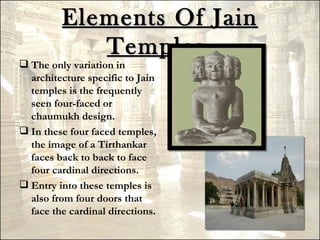
 The only variation in
  architecture specific to Jain
  temples is the frequently
  seen four-faced or
  chaumukh design.
 In these four faced temples,
  the image of a Tirthankar
  faces back to back to face
  four cardinal directions.
 Entry into these temples is
  also from four doors that
  face the cardinal directions.
Jain Temples.
Introduction
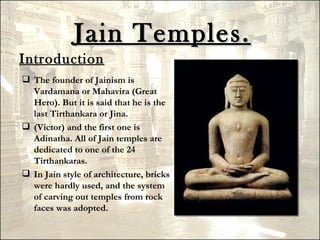
 The founder of Jainism is
  Vardamana or Mahavira (Great
  Hero). But it is said that he is the
  last Tirthankara or Jina.
 (Victor) and the first one is
  Adinatha. All of Jain temples are
  dedicated to one of the 24
  Tirthankaras.
 In Jain style of architecture, bricks
  were hardly used, and the system
  of carving out temples from rock
  faces was adopted.
Jain Temples.
 In later years when Jains discovered the concept
  of mountains of immortality , they proceeded to
  deviate from Hindu and Buddhist sites and build
  on their own.
 An important aspect to be noted is that Hindus
  and Buddhists built temples, Jains built temple-
  cities on hills.
 o put it in their own words, they "ornamented
  these holy hills with a crown of eternal Arhat
  chaityas (tabernacles of saints) shining with the
  splendor of jewels."
The Temple
                Structure
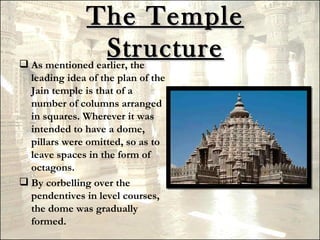
 As mentioned earlier, the
  leading idea of the plan of the
  Jain temple is that of a
  number of columns arranged
  in squares. Wherever it was
  intended to have a dome,
  pillars were omitted, so as to
  leave spaces in the form of
  octagons.
 By corbelling over the
  pendentives in level courses,
  the dome was gradually
  formed.
Interior Layout Of
                      Temple
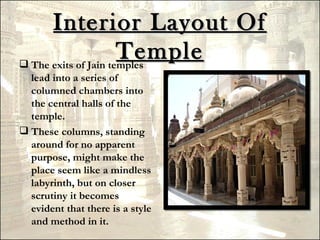
 The exits of Jain temples
  lead into a series of
  columned chambers into
  the central halls of the
  temple.
 These columns, standing
  around for no apparent
  purpose, might make the
  place seem like a mindless
  labyrinth, but on closer
  scrutiny it becomes
  evident that there is a style
  and method in it.
Interior Layout Of
             Temple
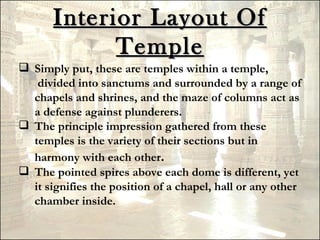
 Simply put, these are temples within a temple,
   divided into sanctums and surrounded by a range of
  chapels and shrines, and the maze of columns act as
  a defense against plunderers.
 The principle impression gathered from these
  temples is the variety of their sections but in
  harmony with each other.
 The pointed spires above each dome is different, yet
  it signifies the position of a chapel, hall or any other
  chamber inside.
The Architecture Splendor Of
       Jain Temples.
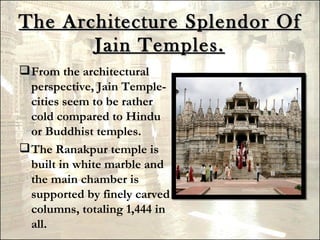
 From the architectural
  perspective, Jain Temple-
  cities seem to be rather
  cold compared to Hindu
  or Buddhist temples.
 The Ranakpur temple is
  built in white marble and
  the main chamber is
  supported by finely carved
  columns, totaling 1,444 in
  all.
Adinath Temple,
            Ranakpur
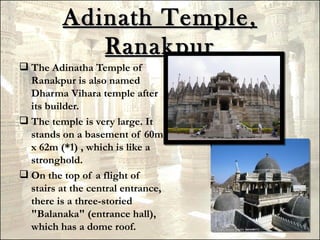
 The Adinatha Temple of
  Ranakpur is also named
  Dharma Vihara temple after
  its builder.
 The temple is very large. It
  stands on a basement of 60m
  x 62m (*1) , which is like a
  stronghold.
 On the top of a flight of
  stairs at the central entrance,
  there is a three-storied
  "Balanaka" (entrance hall),
  which has a dome roof.
Adinath Temple,
            Ranakpur
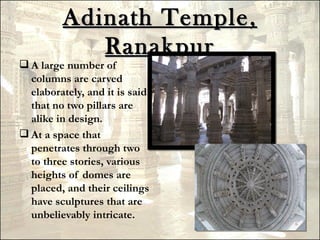
 A large number of
  columns are carved
  elaborately, and it is said
  that no two pillars are
  alike in design.
 At a space that
  penetrates through two
  to three stories, various
  heights of domes are
  placed, and their ceilings
  have sculptures that are
  unbelievably intricate.
Adinath Temple,
            Ranakpur
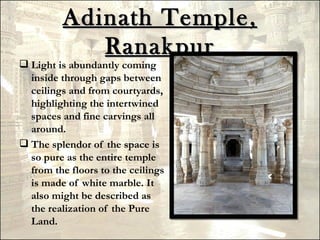
 Light is abundantly coming
  inside through gaps between
  ceilings and from courtyards,
  highlighting the intertwined
  spaces and fine carvings all
  around.
 The splendor of the space is
  so pure as the entire temple
  from the floors to the ceilings
  is made of white marble. It
  also might be described as
  the realization of the Pure
  Land.
PLAN OF THE TEMPLE
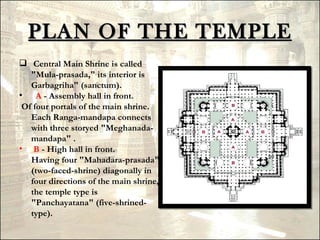
 Central Main Shrine is called
   "Mula-prasada," its interior is
   Garbagriha" (sanctum).
•    A - Assembly hall in front.
 Of four portals of the main shrine.
   Each Ranga-mandapa connects
   with three storyed "Meghanada-
   mandapa" .
• B - High hall in front. 
   Having four "Mahadara-prasada"
   (two-faced-shrine) diagonally in
   four directions of the main shrine,
   the temple type is
   "Panchayatana" (five-shrined-
   type).
PLAN OF THE
           TEMPLE
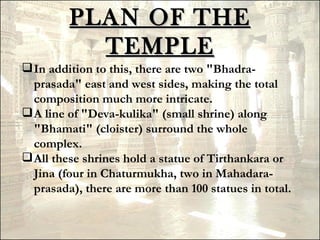
 In addition to this, there are two "Bhadra-
  prasada" east and west sides, making the total
  composition much more intricate.
 A line of "Deva-kulika" (small shrine) along
  "Bhamati" (cloister) surround the whole
  complex.
 All these shrines hold a statue of Tirthankara or
  Jina (four in Chaturmukha, two in Mahadara-
  prasada), there are more than 100 statues in total.
Comparison Between Hindu And
          Jain Temple.
   HINDU TEMPLE                     JAIN TEMPLE
 The basic form of a Hindu  The basic form of Jain
  temple is [garbhagriha +    temple is "Four faced open
  mandapa].                   form" in the temple design.
 The garbhagriha at Hindu  On the other hand, a Jaina
                              temple is not a house of God,
  temples means the "house    but a place where a
  of God"  and accordingly    "Tirthankara" (Jina) gives
  it should be locked         teachings. It is called
  securely as a human         "Samavasarana," and the
  residence.                  doctrine of Jina should be
                              preached in all directions. 
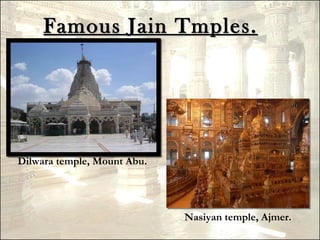
Famous Jain Tmples.


Dilwara temple, Mount Abu.


                             Nasiyan temple, Ajmer.
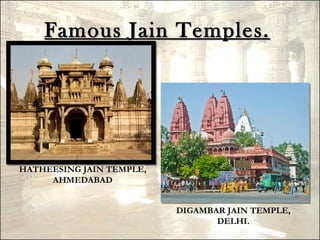
Famous Jain Temples.


HATHEESING JAIN TEMPLE,
     AHMEDABAD


                          DIGAMBAR JAIN TEMPLE,
                                 DELHI.
Overview.
                Overview
 These temple-cities were not built on a specific plan;
  instead they were the results of sporadic construction.
  Natural levels of the hill on which the city was being built
  accommodated various levels so that as one goes higher
  so does the architecture and grandeur increases.
 Each temple, though, followed a set pattern, styles,
  designed on principles of architecture in use during the
  period.
 Compared to the number of Hindu temples in India, Jain
  ones are few and spaced out.
 Jain temples are said to be the richest temples in the
  world, surpassing even Mughal buildings in terms of
  grandeur and material wealth.
Thank you.

Jain architecture final 1

  • 1.
    Jain Architecture … By: Azizur Khan. Nikhil Mehta. Swapnil Kanse. Akshata Hase. Tanvi Gujarathi.
  • 2.
    Introduction .  Jainarchitecture is an offshoot of Hindu and Buddhist styles.  In the initial years, many Jain temples were made adjoining the Buddhist temples following the Buddhist rock-cut style.  Initially these temples were mainly carved out of rock faces and the use of bricks was almost negligible.  However, in later years Jains started building temple-cities on hills based on the concept of 'mountains of immortality.
  • 3.
    Elements Of Jain Architecture.  Jain temples have numerous pillars having a well designed structure, forming squares.  The squares thus formed create chambers, used as small chapels and contains the image of a deity.  From these pillars, there are richly carved brackets that emerge at about two thirds of their height.
  • 4.
    Elements Of Jain Temples. these temples  The roofs of have pointy domes and wherever there is a dome, the pillars are omitted to create an octagonal space within.
  • 5.
    Elements Of Jain Temples.  The only variation in architecture specific to Jain temples is the frequently seen four-faced or chaumukh design.  In these four faced temples, the image of a Tirthankar faces back to back to face four cardinal directions.  Entry into these temples is also from four doors that face the cardinal directions.
  • 6.
    Jain Temples. Introduction  Thefounder of Jainism is Vardamana or Mahavira (Great Hero). But it is said that he is the last Tirthankara or Jina.  (Victor) and the first one is Adinatha. All of Jain temples are dedicated to one of the 24 Tirthankaras.  In Jain style of architecture, bricks were hardly used, and the system of carving out temples from rock faces was adopted.
  • 7.
    Jain Temples.  Inlater years when Jains discovered the concept of mountains of immortality , they proceeded to deviate from Hindu and Buddhist sites and build on their own.  An important aspect to be noted is that Hindus and Buddhists built temples, Jains built temple- cities on hills.  o put it in their own words, they "ornamented these holy hills with a crown of eternal Arhat chaityas (tabernacles of saints) shining with the splendor of jewels."
  • 8.
    The Temple Structure  As mentioned earlier, the leading idea of the plan of the Jain temple is that of a number of columns arranged in squares. Wherever it was intended to have a dome, pillars were omitted, so as to leave spaces in the form of octagons.  By corbelling over the pendentives in level courses, the dome was gradually formed.
  • 9.
    Interior Layout Of Temple  The exits of Jain temples lead into a series of columned chambers into the central halls of the temple.  These columns, standing around for no apparent purpose, might make the place seem like a mindless labyrinth, but on closer scrutiny it becomes evident that there is a style and method in it.
  • 10.
    Interior Layout Of Temple  Simply put, these are temples within a temple, divided into sanctums and surrounded by a range of chapels and shrines, and the maze of columns act as a defense against plunderers.  The principle impression gathered from these temples is the variety of their sections but in harmony with each other.  The pointed spires above each dome is different, yet it signifies the position of a chapel, hall or any other chamber inside.
  • 11.
    The Architecture SplendorOf Jain Temples.  From the architectural perspective, Jain Temple- cities seem to be rather cold compared to Hindu or Buddhist temples.  The Ranakpur temple is built in white marble and the main chamber is supported by finely carved columns, totaling 1,444 in all.
  • 12.
    Adinath Temple, Ranakpur  The Adinatha Temple of Ranakpur is also named Dharma Vihara temple after its builder.  The temple is very large. It stands on a basement of 60m x 62m (*1) , which is like a stronghold.  On the top of a flight of stairs at the central entrance, there is a three-storied "Balanaka" (entrance hall), which has a dome roof.
  • 13.
    Adinath Temple, Ranakpur  A large number of columns are carved elaborately, and it is said that no two pillars are alike in design.  At a space that penetrates through two to three stories, various heights of domes are placed, and their ceilings have sculptures that are unbelievably intricate.
  • 14.
    Adinath Temple, Ranakpur  Light is abundantly coming inside through gaps between ceilings and from courtyards, highlighting the intertwined spaces and fine carvings all around.  The splendor of the space is so pure as the entire temple from the floors to the ceilings is made of white marble. It also might be described as the realization of the Pure Land.
  • 15.
    PLAN OF THETEMPLE  Central Main Shrine is called "Mula-prasada," its interior is Garbagriha" (sanctum). • A - Assembly hall in front. Of four portals of the main shrine. Each Ranga-mandapa connects with three storyed "Meghanada- mandapa" . • B - High hall in front.  Having four "Mahadara-prasada" (two-faced-shrine) diagonally in four directions of the main shrine, the temple type is "Panchayatana" (five-shrined- type).
  • 16.
    PLAN OF THE TEMPLE  In addition to this, there are two "Bhadra- prasada" east and west sides, making the total composition much more intricate.  A line of "Deva-kulika" (small shrine) along "Bhamati" (cloister) surround the whole complex.  All these shrines hold a statue of Tirthankara or Jina (four in Chaturmukha, two in Mahadara- prasada), there are more than 100 statues in total.
  • 17.
    Comparison Between HinduAnd Jain Temple. HINDU TEMPLE JAIN TEMPLE  The basic form of a Hindu  The basic form of Jain temple is [garbhagriha + temple is "Four faced open mandapa]. form" in the temple design.  The garbhagriha at Hindu  On the other hand, a Jaina temple is not a house of God, temples means the "house but a place where a of God"  and accordingly "Tirthankara" (Jina) gives it should be locked teachings. It is called securely as a human "Samavasarana," and the residence. doctrine of Jina should be preached in all directions. 
  • 18.
    Famous Jain Tmples. Dilwaratemple, Mount Abu. Nasiyan temple, Ajmer.
  • 19.
    Famous Jain Temples. HATHEESINGJAIN TEMPLE, AHMEDABAD DIGAMBAR JAIN TEMPLE, DELHI.
  • 20.
    Overview. Overview  These temple-cities were not built on a specific plan; instead they were the results of sporadic construction. Natural levels of the hill on which the city was being built accommodated various levels so that as one goes higher so does the architecture and grandeur increases.  Each temple, though, followed a set pattern, styles, designed on principles of architecture in use during the period.  Compared to the number of Hindu temples in India, Jain ones are few and spaced out.  Jain temples are said to be the richest temples in the world, surpassing even Mughal buildings in terms of grandeur and material wealth.
  • 21.