2–2–11
Philosophies and
Approaches to
Management
Practice
C H A P T E R 2
Jon L. Pierce &
Donald G. Gardner
with Randall B. Dunham
Management
Organizational
Behavior
PowerPoint Presentation
by Charlie Cook
An Integrated Perspective
Copyright © 2002 by South-Western
Copyright © 2002 by South-WesternCopyright © 2002 by South-Western 2–2–22
Learning ObjectivesLearning Objectives
1.1. Identify early pioneers in management and organizationalIdentify early pioneers in management and organizational
behavior and their contributions to the classical theorybehavior and their contributions to the classical theory
of management.of management.
2.2. Discuss the major elements of of Taylor’s approach toDiscuss the major elements of of Taylor’s approach to
scientific management.scientific management.
3.3. Explain the significance of the Hawthorne studies.Explain the significance of the Hawthorne studies.
4.4. Identify the major contributors to the behavioral theory ofIdentify the major contributors to the behavioral theory of
management, their view of organizations, and theirmanagement, their view of organizations, and their
contributions to the management literature.contributions to the management literature.
5.5. Discuss the meaning of the human resources model andDiscuss the meaning of the human resources model and
its relationship to the high involvement approach toits relationship to the high involvement approach to
organizational management.organizational management.
6.6. Identify and discuss several contemporary perspectivesIdentify and discuss several contemporary perspectives
on the nature of organization and management practice.on the nature of organization and management practice.
Copyright © 2002 by South-WesternCopyright © 2002 by South-Western 2–2–33
The Classical School of ManagementThe Classical School of Management
Thought and PracticeThought and Practice
• The Scientific Management MovementThe Scientific Management Movement
 Management which conducts a business or affairs byManagement which conducts a business or affairs by
standards established by facts or truths gained throughstandards established by facts or truths gained through
systematic observation, experiment, or reasoning.systematic observation, experiment, or reasoning.
 Focused on increasing labor efficiency and productivityFocused on increasing labor efficiency and productivity
primarily by managing the work of employees in theprimarily by managing the work of employees in the
organization’s technical core (i.e., shop floor).organization’s technical core (i.e., shop floor).
 Characterized by close forms of supervision andCharacterized by close forms of supervision and
control-oriented management practices.control-oriented management practices.
Copyright © 2002 by South-WesternCopyright © 2002 by South-Western 2–2–44
Scientific Management PioneersScientific Management Pioneers
• Charles Babbage (1792Charles Babbage (1792–1871)–1871)
 Advocated division of labor and job specialization.Advocated division of labor and job specialization.
 Promoted time studies to establish performancePromoted time studies to establish performance
standards and rewards for exceeding standards.standards and rewards for exceeding standards.
• Frederick Taylor (1856Frederick Taylor (1856–1915)–1915)
 Considered the “father of scientific management.”Considered the “father of scientific management.”
 Believed in the “science of work”—the underlying laws,Believed in the “science of work”—the underlying laws,
or principles, that govern various work activities.or principles, that govern various work activities.
 Believed in the economically-motivated “mutuality ofBelieved in the economically-motivated “mutuality of
interest” of employees and managers.interest” of employees and managers.
Copyright © 2002 by South-WesternCopyright © 2002 by South-Western 2–2–55
Fredrick Taylor’s Scientific ManagementFredrick Taylor’s Scientific Management
PrescriptionsPrescriptions
• Develop the science of work (“one best way”).Develop the science of work (“one best way”).
• Emphasize an absolute adherence to workEmphasize an absolute adherence to work
standards.standards.
• Scientifically select, place, and train workersScientifically select, place, and train workers
• Apply a financial incentive system.Apply a financial incentive system.
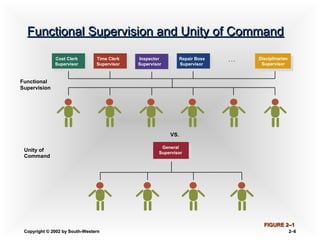
• Utilize specialized functional supervision.Utilize specialized functional supervision.
• Develop and maintain friendly labor-Develop and maintain friendly labor-
management relations.management relations.
Copyright © 2002 by South-WesternCopyright © 2002 by South-Western 2–2–66
Functional Supervision and Unity of CommandFunctional Supervision and Unity of Command
Cost Clerk
Supervisor
Time Clerk
Supervisor
Inspector
Supervisor
Repair Boss
Supervisor
. . .
Functional
Supervision
Unity of
Command
VS.
General
Supervisor
Disciplinarian
Supervisor
FIGURE 2FIGURE 2–1–1
Copyright © 2002 by South-WesternCopyright © 2002 by South-Western 2–2–77
Scientific Management Pioneers (cont’d)Scientific Management Pioneers (cont’d)
• The GilbrethsThe Gilbreths
 Frank Gilbreth (1868–1924) focused on improving workFrank Gilbreth (1868–1924) focused on improving work
methods such as bricklaying to improve effectivenessmethods such as bricklaying to improve effectiveness
and efficiency.and efficiency.
 Lillian Gilbreth (1878–1972) pioneered modern humanLillian Gilbreth (1878–1972) pioneered modern human
resource management.resource management.
 Developed a classification schemeDeveloped a classification scheme
to describe the motions (to describe the motions (therbligstherbligs))
used in the performance ofused in the performance of
a job.a job.
Copyright © 2002 by South-WesternCopyright © 2002 by South-Western 2–2–88
Scientific Management Pioneers (cont’d)Scientific Management Pioneers (cont’d)
• Henry Gantt (1861–1919)Henry Gantt (1861–1919)
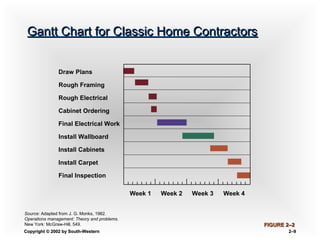
 Developed theDeveloped the GanttGantt chart to summarize work activitieschart to summarize work activities
and identify those tasks that should be performedand identify those tasks that should be performed
simultaneously or sequentially.simultaneously or sequentially.
 Advocated a minimum-wage-based incentive systemAdvocated a minimum-wage-based incentive system
and bonuses for work above and beyond the expectedand bonuses for work above and beyond the expected
standard by employees.standard by employees.
 Proposed a bonus system for supervisors to encourageProposed a bonus system for supervisors to encourage
them to manage subordinates effectively.them to manage subordinates effectively.
Copyright © 2002 by South-WesternCopyright © 2002 by South-Western 2–2–99
Gantt Chart for Classic Home ContractorsGantt Chart for Classic Home Contractors
Draw Plans
Rough Framing
Rough Electrical
Cabinet Ordering
Final Electrical Work
Install Wallboard
Install Cabinets
Install Carpet
Final Inspection
Week 1 Week 2 Week 3 Week 4
FIGURE 2FIGURE 2–2–2
Source: Adapted from J. G. Monks, 1982.
Operations management: Theory and problems.
New York: McGraw-Hill, 549.
Copyright © 2002 by South-WesternCopyright © 2002 by South-Western 2–2–1010
Administrative Management and theAdministrative Management and the
Bureaucratic OrganizationBureaucratic Organization
• Organizations were viewed as giant machinesOrganizations were viewed as giant machines
created to achieve goals.created to achieve goals.
• A basic set of universal laws, or principlesA basic set of universal laws, or principles
should govern organization design and allowshould govern organization design and allow
managers to run those “machines” effectively.managers to run those “machines” effectively.
Copyright © 2002 by South-WesternCopyright © 2002 by South-Western 2–2–1111
Administrative Management (cont’d)Administrative Management (cont’d)
• Henri Fayol (1841Henri Fayol (1841–1925)–1925)
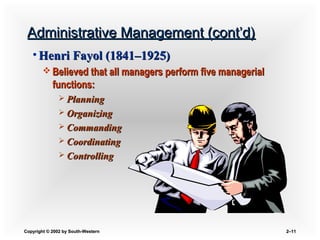
 Believed that all managers perform five managerialBelieved that all managers perform five managerial
functions:functions:
 PlanningPlanning
 OrganizingOrganizing
 CommandingCommanding
 CoordinatingCoordinating
 ControllingControlling
Copyright © 2002 by South-WesternCopyright © 2002 by South-Western 2–2–1212
Fayol’s Fourteen PrinciplesFayol’s Fourteen Principles
1.1. Division of laborDivision of labor
2.2. AuthorityAuthority
3.3. DisciplineDiscipline
4.4. Unity of commandUnity of command
5.5. Unity of directionUnity of direction
6.6. Subordination ofSubordination of
individual interestindividual interest
for common goodfor common good
7.7. RemunerationRemuneration
8.8. CentralizationCentralization
9.9. Scalar chainScalar chain
10.10. OrderOrder
11.11. EquityEquity
12.12. Stability of tenureStability of tenure
13.13. InitiativeInitiative
14.14. Esprit de corpsEsprit de corps
Copyright © 2002 by South-WesternCopyright © 2002 by South-Western 2–2–1313
The Bureaucratic OrganizationThe Bureaucratic Organization
• Max Weber (1864Max Weber (1864–1920)–1920)
 Envisioned an organization managed on an impersonalEnvisioned an organization managed on an impersonal
and rational basis.and rational basis.
 Goals of the bureaucratic model:Goals of the bureaucratic model:
 SpeedSpeed
 PrecisionPrecision
 OrderOrder
 UnambiguityUnambiguity
 ContinuityContinuity
 PredictabilityPredictability
Copyright © 2002 by South-WesternCopyright © 2002 by South-Western 2–2–1414
Structure of the Bureaucratic ModelStructure of the Bureaucratic Model
• Division of labor (functional specialization)Division of labor (functional specialization)
• Well-defined hierarchy of authorityWell-defined hierarchy of authority
(centralization of authority)(centralization of authority)
• Systems of rules for employees and workSystems of rules for employees and work
proceduresprocedures
• Impersonal organizational relationshipsImpersonal organizational relationships
• Selection and promotion solely on competenceSelection and promotion solely on competence
• Career employment and well-defined promotionCareer employment and well-defined promotion
path to top of organizationpath to top of organization
• Organizational transactions extensivelyOrganizational transactions extensively
documenteddocumented
Copyright © 2002 by South-WesternCopyright © 2002 by South-Western 2–2–1515
Contributions and Limitations of theContributions and Limitations of the
Classical SchoolClassical School
ContributionsContributions
Prescriptions for how toPrescriptions for how to
manage organizationsmanage organizations
Search for “one bestSearch for “one best
way” to manage to lead toway” to manage to lead to
greater organizationalgreater organizational
efficiencyefficiency
Spurred additionalSpurred additional
research intoresearch into
management andmanagement and
organizational systemsorganizational systems
LimitationsLimitations
Limited view ofLimited view of
employees as resourcesemployees as resources
without social needswithout social needs
Pursuit of “one best way”Pursuit of “one best way”
(universal principles) to(universal principles) to
managemanage
““Control-oriented”Control-oriented”
approach creates anapproach creates an
inflexible, mechanisticinflexible, mechanistic
organizationorganization
Copyright © 2002 by South-WesternCopyright © 2002 by South-Western 2–2–1616
The Hawthorne StudiesThe Hawthorne Studies
• Worker productivity studies (1924Worker productivity studies (1924–1933)–1933)
carried out at Western Electric.carried out at Western Electric.
 Focused on the relationship of workers’ productivityFocused on the relationship of workers’ productivity
and changes in their work environment.and changes in their work environment.
 Strongly influenced by behavioral management theory.Strongly influenced by behavioral management theory.
 Researchers concluded that social factors wereResearchers concluded that social factors were
powerful determinants of worker productivity.powerful determinants of worker productivity.
 Results were inconsistent with expectations:Results were inconsistent with expectations:
Productivity improved under adverse conditions.Productivity improved under adverse conditions.
 Informal work groups with leaders and normsInformal work groups with leaders and norms
– ““Rate busters” and “chiselers”Rate busters” and “chiselers”
Copyright © 2002 by South-WesternCopyright © 2002 by South-Western 2–2–1717
Behavioral School of ManagementBehavioral School of Management
• An organization was viewed as a social systemAn organization was viewed as a social system
of people-to-people and people-to-workof people-to-people and people-to-work
networks in which employees have both socialnetworks in which employees have both social
needs and the desire to make meaningfulneeds and the desire to make meaningful
contributions toward the accomplishment ofcontributions toward the accomplishment of
organizational goals.organizational goals.
Copyright © 2002 by South-WesternCopyright © 2002 by South-Western 2–2–1818
Behavioral School ContributorsBehavioral School Contributors
• Robert Owen (1771Robert Owen (1771–1858)–1858)
 Progressive industrialist who recognized need for goodProgressive industrialist who recognized need for good
overall management of an organization’s humanoverall management of an organization’s human
resources.resources.
• Hugo Munsterberg (1863–1916)Hugo Munsterberg (1863–1916)
 Father of industrial psychology and its use to enhanceFather of industrial psychology and its use to enhance
organizational effectiveness.organizational effectiveness.
• Walter Dill Scott (1869–1955)Walter Dill Scott (1869–1955)
 Advocated improving employee attitudes andAdvocated improving employee attitudes and
motivation as a means to increase worker productivity.motivation as a means to increase worker productivity.
Copyright © 2002 by South-WesternCopyright © 2002 by South-Western 2–2–1919
Behavioral School Contributors (cont’d)Behavioral School Contributors (cont’d)
• Mary Parker Follett (1868Mary Parker Follett (1868–1933)–1933)
 Asserted that managers’ influence and power shouldAsserted that managers’ influence and power should
flow from their knowledge and skill.flow from their knowledge and skill.
• Chester Barnard (1886–1961)Chester Barnard (1886–1961)
 Provided insight into the concept of formal (consciouslyProvided insight into the concept of formal (consciously
created) and informal (spontaneous) organizationscreated) and informal (spontaneous) organizations
within firms.within firms.
Copyright © 2002 by South-WesternCopyright © 2002 by South-Western 2–2–2020
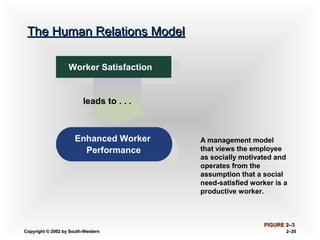
The Human Relations ModelThe Human Relations Model
Worker Satisfaction
leads to . . .
Enhanced Worker
Performance
FIGURE 2FIGURE 2–3–3
A management model
that views the employee
as socially motivated and
operates from the
assumption that a social
need-satisfied worker is a
productive worker.
Copyright © 2002 by South-WesternCopyright © 2002 by South-Western 2–2–2121
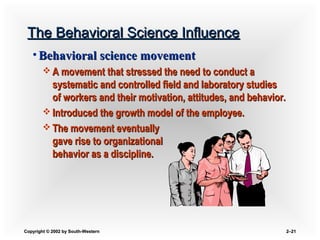
The Behavioral Science InfluenceThe Behavioral Science Influence
• Behavioral science movementBehavioral science movement
 A movement that stressed the need to conduct aA movement that stressed the need to conduct a
systematic and controlled field and laboratory studiessystematic and controlled field and laboratory studies
of workers and their motivation, attitudes, and behavior.of workers and their motivation, attitudes, and behavior.
 Introduced the growth model of the employee.Introduced the growth model of the employee.
 The movement eventuallyThe movement eventually
gave rise to organizationalgave rise to organizational
behavior as a discipline.behavior as a discipline.
Copyright © 2002 by South-WesternCopyright © 2002 by South-Western 2–2–2222
Behavioral Science ContributorsBehavioral Science Contributors
• Abraham Maslow (1908Abraham Maslow (1908–1970)–1970)
 Identified sets of basic human needs and suggestedIdentified sets of basic human needs and suggested
that they could be arranged in a hierarchy based onthat they could be arranged in a hierarchy based on
their importance to the individual.their importance to the individual.
• Douglas McGregor (1906–1964)Douglas McGregor (1906–1964)
 Developed the Theory X (traditional—negative—Developed the Theory X (traditional—negative—
management approach) and Theory Y (positivemanagement approach) and Theory Y (positive
management approach) to workers and workmanagement approach) to workers and work
motivation.motivation.
Copyright © 2002 by South-WesternCopyright © 2002 by South-Western 2–2–2323
Behavioral Science Contributors (cont’d)Behavioral Science Contributors (cont’d)
• Chris ArgysisChris Argysis
 Believed that the conflict between mature individualsBelieved that the conflict between mature individuals
and bureaucratic organizations could be avoided by theand bureaucratic organizations could be avoided by the
development of open and flexible organizations.development of open and flexible organizations.
• Rensis LikertRensis Likert
 Stressed teamwork and a group approach toStressed teamwork and a group approach to
organizational design and management, which he calledorganizational design and management, which he called
System 4.System 4.
Copyright © 2002 by South-WesternCopyright © 2002 by South-Western 2–2–2424
Organizational HumanismOrganizational Humanism
• A system that promoted an interest inA system that promoted an interest in
understanding the psychological forces tyingunderstanding the psychological forces tying
individuals to organizations.individuals to organizations.
• A system that also promoted managementA system that also promoted management
practices that lead to employee satisfactionpractices that lead to employee satisfaction
and well-being.and well-being.
Copyright © 2002 by South-WesternCopyright © 2002 by South-Western 2–2–2525
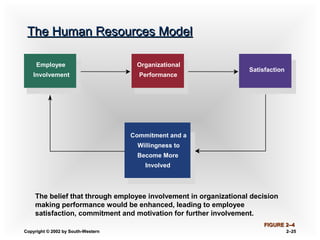
The Human Resources ModelThe Human Resources Model
Employee
Involvement
Organizational
Performance
Satisfaction
Commitment and a
Willingness to
Become More
Involved
FIGURE 2FIGURE 2–4–4
The belief that through employee involvement in organizational decision
making performance would be enhanced, leading to employee
satisfaction, commitment and motivation for further involvement.
Copyright © 2002 by South-WesternCopyright © 2002 by South-Western 2–2–2626
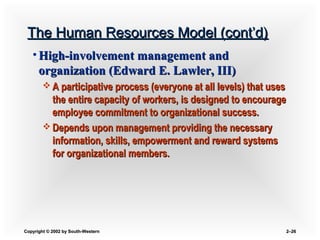
The Human Resources Model (cont’d)The Human Resources Model (cont’d)
• High-involvement management andHigh-involvement management and
organization (Edward E. Lawler, III)organization (Edward E. Lawler, III)
 A participative process (everyone at all levels) that usesA participative process (everyone at all levels) that uses
the entire capacity of workers, is designed to encouragethe entire capacity of workers, is designed to encourage
employee commitment to organizational success.employee commitment to organizational success.
 Depends upon management providing the necessaryDepends upon management providing the necessary
information, skills, empowerment and reward systemsinformation, skills, empowerment and reward systems
for organizational members.for organizational members.
Copyright © 2002 by South-WesternCopyright © 2002 by South-Western 2–2–2727
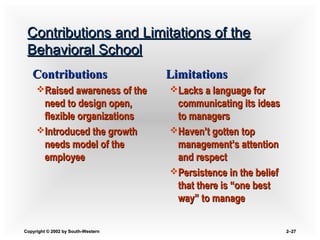
Contributions and Limitations of theContributions and Limitations of the
Behavioral SchoolBehavioral School
ContributionsContributions
Raised awareness of theRaised awareness of the
need to design open,need to design open,
flexible organizationsflexible organizations
Introduced the growthIntroduced the growth
needs model of theneeds model of the
employeeemployee
LimitationsLimitations
Lacks a language forLacks a language for
communicating its ideascommunicating its ideas
to managersto managers
Haven’t gotten topHaven’t gotten top
management’s attentionmanagement’s attention
and respectand respect
Persistence in the beliefPersistence in the belief
that there is “one bestthat there is “one best
way” to manageway” to manage
Copyright © 2002 by South-WesternCopyright © 2002 by South-Western 2–2–2828
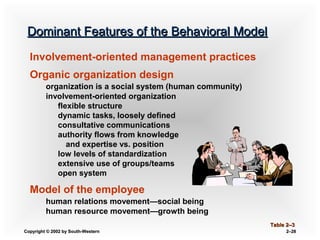
Dominant Features of the Behavioral ModelDominant Features of the Behavioral Model
Involvement-oriented management practices
Organic organization design
organization is a social system (human community)
involvement-oriented organization
flexible structure
dynamic tasks, loosely defined
consultative communications
authority flows from knowledge
and expertise vs. position
low levels of standardization
extensive use of groups/teams
open system
Model of the employee
human relations movement—social being
human resource movement—growth being
Table 2Table 2–3–3
Copyright © 2002 by South-WesternCopyright © 2002 by South-Western 2–2–2929
Other Management PerspectivesOther Management Perspectives
• Contingency perspectiveContingency perspective
 The belief that the techniques appropriate for a managerThe belief that the techniques appropriate for a manager
to use depend (areto use depend (are contingentcontingent) on the specific situation.) on the specific situation.
• Contingency perspectivesContingency perspectives
 Total quality managementTotal quality management
 Systems theorySystems theory
 Theory ZTheory Z
 McKinsey 7-S frameworkMcKinsey 7-S framework
Copyright © 2002 by South-WesternCopyright © 2002 by South-Western 2–2–3030
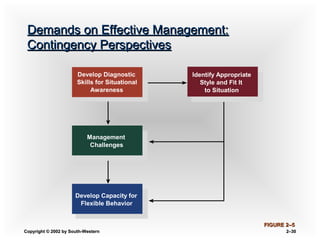
Demands on Effective Management:Demands on Effective Management:
Contingency PerspectivesContingency Perspectives
Develop Diagnostic
Skills for Situational
Awareness
Management
Challenges
Develop Capacity for
Flexible Behavior
Identify Appropriate
Style and Fit It
to Situation
FIGURE 2FIGURE 2–5–5
Copyright © 2002 by South-WesternCopyright © 2002 by South-Western 2–2–3131
Total Quality Management PerspectiveTotal Quality Management Perspective
• Quality management perspectiveQuality management perspective
 An approach to management that has as its goal theAn approach to management that has as its goal the
achievement of customer satisfaction by providingachievement of customer satisfaction by providing
high-quality goods and services.high-quality goods and services.
• Total quality management (TQM)Total quality management (TQM)
 A management philosophy and way of managing withA management philosophy and way of managing with
the goal of getting everyone committed to quality,the goal of getting everyone committed to quality,
continuous improvement, and the attainment ofcontinuous improvement, and the attainment of
customer satisfaction by meeting or exceedingcustomer satisfaction by meeting or exceeding
customer expectations.customer expectations.
 TQM pioneers: Deming, Juran, IshikawaTQM pioneers: Deming, Juran, Ishikawa
Copyright © 2002 by South-WesternCopyright © 2002 by South-Western 2–2–3232
Total Quality Management Perspective (cont’d)Total Quality Management Perspective (cont’d)
• TQM assumptionsTQM assumptions
 Quality products are less costly to produce than poorQuality products are less costly to produce than poor
quality products.quality products.
 People (employees) care about quality and improvingPeople (employees) care about quality and improving
the quality of their work.the quality of their work.
 Organizations are systems of interdependent parts andOrganizations are systems of interdependent parts and
quality problems cut across functional lines.quality problems cut across functional lines.
 Quality and continuous improvement are theQuality and continuous improvement are the
responsibility of top (senior) management.responsibility of top (senior) management.
 Continuous learning and improvement are vital to theContinuous learning and improvement are vital to the
long-term health and survival of an organization.long-term health and survival of an organization.
Copyright © 2002 by South-WesternCopyright © 2002 by South-Western 2–2–3333
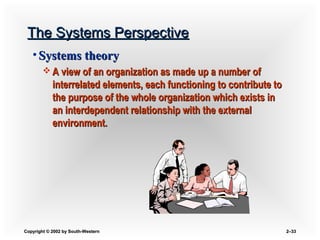
The Systems PerspectiveThe Systems Perspective
• Systems theorySystems theory
 A view of an organization as made up a number ofA view of an organization as made up a number of
interrelated elements, each functioning to contribute tointerrelated elements, each functioning to contribute to
the purpose of the whole organization which exists inthe purpose of the whole organization which exists in
an interdependent relationship with the externalan interdependent relationship with the external
environment.environment.
Copyright © 2002 by South-WesternCopyright © 2002 by South-Western 2–2–3434
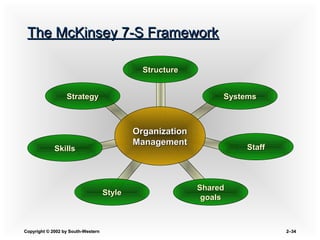
The McKinsey 7-S FrameworkThe McKinsey 7-S Framework
StrategyStrategy
StructureStructure
SystemsSystems
StaffStaff
StyleStyle
SkillsSkills
SharedShared
goalsgoals
OrganizationOrganization
ManagementManagement
Copyright © 2002 by South-WesternCopyright © 2002 by South-Western 2–2–3535
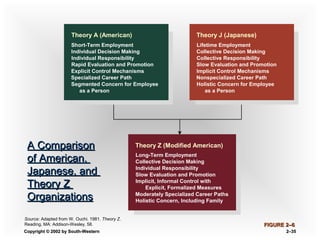
A ComparisonA Comparison
of American,of American,
Japanese, andJapanese, and
Theory ZTheory Z
OrganizationsOrganizations
Short-Term Employment
Individual Decision Making
Individual Responsibility
Rapid Evaluation and Promotion
Explicit Control Mechanisms
Specialized Career Path
Segmented Concern for Employee
as a Person
Theory A (American)
Lifetime Employment
Collective Decision Making
Collective Responsibility
Slow Evaluation and Promotion
Implicit Control Mechanisms
Nonspecialized Career Path
Holistic Concern for Employee
as a Person
Theory J (Japanese)
Long-Term Employment
Collective Decision Making
Individual Responsibility
Slow Evaluation and Promotion
Implicit, Informal Control with
Explicit, Formalized Measures
Moderately Specialized Career Paths
Holistic Concern, Including Family
Theory Z (Modified American)
FIGURE 2FIGURE 2–6–6
Source: Adapted from W. Ouchi. 1981. Theory Z.
Reading, MA: Addison-Wesley, 58.
Copyright © 2002 by South-WesternCopyright © 2002 by South-Western 2–2–3636
Contributions and Limitations of theContributions and Limitations of the
Contemporary SchoolsContemporary Schools
• ContributionsContributions
 Unified the technicalUnified the technical
side (classicists) andside (classicists) and
the social elements ofthe social elements of
organizationsorganizations
(behavioralists).(behavioralists).
 Showed that there is noShowed that there is no
“one best way” to“one best way” to
manage in allmanage in all
circumstances.circumstances.
• LimitationsLimitations
 Contemporary approachesContemporary approaches
to management are moreto management are more
complex than the classicalcomplex than the classical
and behavioraland behavioral
approaches.approaches.
 No contemporaryNo contemporary
management approachmanagement approach
has been thoroughlyhas been thoroughly
researched.researched.

085 0rganizational Behavior

  • 1.
    2–2–11 Philosophies and Approaches to Management Practice CH A P T E R 2 Jon L. Pierce & Donald G. Gardner with Randall B. Dunham Management Organizational Behavior PowerPoint Presentation by Charlie Cook An Integrated Perspective Copyright © 2002 by South-Western
  • 2.
    Copyright © 2002by South-WesternCopyright © 2002 by South-Western 2–2–22 Learning ObjectivesLearning Objectives 1.1. Identify early pioneers in management and organizationalIdentify early pioneers in management and organizational behavior and their contributions to the classical theorybehavior and their contributions to the classical theory of management.of management. 2.2. Discuss the major elements of of Taylor’s approach toDiscuss the major elements of of Taylor’s approach to scientific management.scientific management. 3.3. Explain the significance of the Hawthorne studies.Explain the significance of the Hawthorne studies. 4.4. Identify the major contributors to the behavioral theory ofIdentify the major contributors to the behavioral theory of management, their view of organizations, and theirmanagement, their view of organizations, and their contributions to the management literature.contributions to the management literature. 5.5. Discuss the meaning of the human resources model andDiscuss the meaning of the human resources model and its relationship to the high involvement approach toits relationship to the high involvement approach to organizational management.organizational management. 6.6. Identify and discuss several contemporary perspectivesIdentify and discuss several contemporary perspectives on the nature of organization and management practice.on the nature of organization and management practice.
  • 3.
    Copyright © 2002by South-WesternCopyright © 2002 by South-Western 2–2–33 The Classical School of ManagementThe Classical School of Management Thought and PracticeThought and Practice • The Scientific Management MovementThe Scientific Management Movement  Management which conducts a business or affairs byManagement which conducts a business or affairs by standards established by facts or truths gained throughstandards established by facts or truths gained through systematic observation, experiment, or reasoning.systematic observation, experiment, or reasoning.  Focused on increasing labor efficiency and productivityFocused on increasing labor efficiency and productivity primarily by managing the work of employees in theprimarily by managing the work of employees in the organization’s technical core (i.e., shop floor).organization’s technical core (i.e., shop floor).  Characterized by close forms of supervision andCharacterized by close forms of supervision and control-oriented management practices.control-oriented management practices.
  • 4.
    Copyright © 2002by South-WesternCopyright © 2002 by South-Western 2–2–44 Scientific Management PioneersScientific Management Pioneers • Charles Babbage (1792Charles Babbage (1792–1871)–1871)  Advocated division of labor and job specialization.Advocated division of labor and job specialization.  Promoted time studies to establish performancePromoted time studies to establish performance standards and rewards for exceeding standards.standards and rewards for exceeding standards. • Frederick Taylor (1856Frederick Taylor (1856–1915)–1915)  Considered the “father of scientific management.”Considered the “father of scientific management.”  Believed in the “science of work”—the underlying laws,Believed in the “science of work”—the underlying laws, or principles, that govern various work activities.or principles, that govern various work activities.  Believed in the economically-motivated “mutuality ofBelieved in the economically-motivated “mutuality of interest” of employees and managers.interest” of employees and managers.
  • 5.
    Copyright © 2002by South-WesternCopyright © 2002 by South-Western 2–2–55 Fredrick Taylor’s Scientific ManagementFredrick Taylor’s Scientific Management PrescriptionsPrescriptions • Develop the science of work (“one best way”).Develop the science of work (“one best way”). • Emphasize an absolute adherence to workEmphasize an absolute adherence to work standards.standards. • Scientifically select, place, and train workersScientifically select, place, and train workers • Apply a financial incentive system.Apply a financial incentive system. • Utilize specialized functional supervision.Utilize specialized functional supervision. • Develop and maintain friendly labor-Develop and maintain friendly labor- management relations.management relations.
  • 6.
    Copyright © 2002by South-WesternCopyright © 2002 by South-Western 2–2–66 Functional Supervision and Unity of CommandFunctional Supervision and Unity of Command Cost Clerk Supervisor Time Clerk Supervisor Inspector Supervisor Repair Boss Supervisor . . . Functional Supervision Unity of Command VS. General Supervisor Disciplinarian Supervisor FIGURE 2FIGURE 2–1–1
  • 7.
    Copyright © 2002by South-WesternCopyright © 2002 by South-Western 2–2–77 Scientific Management Pioneers (cont’d)Scientific Management Pioneers (cont’d) • The GilbrethsThe Gilbreths  Frank Gilbreth (1868–1924) focused on improving workFrank Gilbreth (1868–1924) focused on improving work methods such as bricklaying to improve effectivenessmethods such as bricklaying to improve effectiveness and efficiency.and efficiency.  Lillian Gilbreth (1878–1972) pioneered modern humanLillian Gilbreth (1878–1972) pioneered modern human resource management.resource management.  Developed a classification schemeDeveloped a classification scheme to describe the motions (to describe the motions (therbligstherbligs)) used in the performance ofused in the performance of a job.a job.
  • 8.
    Copyright © 2002by South-WesternCopyright © 2002 by South-Western 2–2–88 Scientific Management Pioneers (cont’d)Scientific Management Pioneers (cont’d) • Henry Gantt (1861–1919)Henry Gantt (1861–1919)  Developed theDeveloped the GanttGantt chart to summarize work activitieschart to summarize work activities and identify those tasks that should be performedand identify those tasks that should be performed simultaneously or sequentially.simultaneously or sequentially.  Advocated a minimum-wage-based incentive systemAdvocated a minimum-wage-based incentive system and bonuses for work above and beyond the expectedand bonuses for work above and beyond the expected standard by employees.standard by employees.  Proposed a bonus system for supervisors to encourageProposed a bonus system for supervisors to encourage them to manage subordinates effectively.them to manage subordinates effectively.
  • 9.
    Copyright © 2002by South-WesternCopyright © 2002 by South-Western 2–2–99 Gantt Chart for Classic Home ContractorsGantt Chart for Classic Home Contractors Draw Plans Rough Framing Rough Electrical Cabinet Ordering Final Electrical Work Install Wallboard Install Cabinets Install Carpet Final Inspection Week 1 Week 2 Week 3 Week 4 FIGURE 2FIGURE 2–2–2 Source: Adapted from J. G. Monks, 1982. Operations management: Theory and problems. New York: McGraw-Hill, 549.
  • 10.
    Copyright © 2002by South-WesternCopyright © 2002 by South-Western 2–2–1010 Administrative Management and theAdministrative Management and the Bureaucratic OrganizationBureaucratic Organization • Organizations were viewed as giant machinesOrganizations were viewed as giant machines created to achieve goals.created to achieve goals. • A basic set of universal laws, or principlesA basic set of universal laws, or principles should govern organization design and allowshould govern organization design and allow managers to run those “machines” effectively.managers to run those “machines” effectively.
  • 11.
    Copyright © 2002by South-WesternCopyright © 2002 by South-Western 2–2–1111 Administrative Management (cont’d)Administrative Management (cont’d) • Henri Fayol (1841Henri Fayol (1841–1925)–1925)  Believed that all managers perform five managerialBelieved that all managers perform five managerial functions:functions:  PlanningPlanning  OrganizingOrganizing  CommandingCommanding  CoordinatingCoordinating  ControllingControlling
  • 12.
    Copyright © 2002by South-WesternCopyright © 2002 by South-Western 2–2–1212 Fayol’s Fourteen PrinciplesFayol’s Fourteen Principles 1.1. Division of laborDivision of labor 2.2. AuthorityAuthority 3.3. DisciplineDiscipline 4.4. Unity of commandUnity of command 5.5. Unity of directionUnity of direction 6.6. Subordination ofSubordination of individual interestindividual interest for common goodfor common good 7.7. RemunerationRemuneration 8.8. CentralizationCentralization 9.9. Scalar chainScalar chain 10.10. OrderOrder 11.11. EquityEquity 12.12. Stability of tenureStability of tenure 13.13. InitiativeInitiative 14.14. Esprit de corpsEsprit de corps
  • 13.
    Copyright © 2002by South-WesternCopyright © 2002 by South-Western 2–2–1313 The Bureaucratic OrganizationThe Bureaucratic Organization • Max Weber (1864Max Weber (1864–1920)–1920)  Envisioned an organization managed on an impersonalEnvisioned an organization managed on an impersonal and rational basis.and rational basis.  Goals of the bureaucratic model:Goals of the bureaucratic model:  SpeedSpeed  PrecisionPrecision  OrderOrder  UnambiguityUnambiguity  ContinuityContinuity  PredictabilityPredictability
  • 14.
    Copyright © 2002by South-WesternCopyright © 2002 by South-Western 2–2–1414 Structure of the Bureaucratic ModelStructure of the Bureaucratic Model • Division of labor (functional specialization)Division of labor (functional specialization) • Well-defined hierarchy of authorityWell-defined hierarchy of authority (centralization of authority)(centralization of authority) • Systems of rules for employees and workSystems of rules for employees and work proceduresprocedures • Impersonal organizational relationshipsImpersonal organizational relationships • Selection and promotion solely on competenceSelection and promotion solely on competence • Career employment and well-defined promotionCareer employment and well-defined promotion path to top of organizationpath to top of organization • Organizational transactions extensivelyOrganizational transactions extensively documenteddocumented
  • 15.
    Copyright © 2002by South-WesternCopyright © 2002 by South-Western 2–2–1515 Contributions and Limitations of theContributions and Limitations of the Classical SchoolClassical School ContributionsContributions Prescriptions for how toPrescriptions for how to manage organizationsmanage organizations Search for “one bestSearch for “one best way” to manage to lead toway” to manage to lead to greater organizationalgreater organizational efficiencyefficiency Spurred additionalSpurred additional research intoresearch into management andmanagement and organizational systemsorganizational systems LimitationsLimitations Limited view ofLimited view of employees as resourcesemployees as resources without social needswithout social needs Pursuit of “one best way”Pursuit of “one best way” (universal principles) to(universal principles) to managemanage ““Control-oriented”Control-oriented” approach creates anapproach creates an inflexible, mechanisticinflexible, mechanistic organizationorganization
  • 16.
    Copyright © 2002by South-WesternCopyright © 2002 by South-Western 2–2–1616 The Hawthorne StudiesThe Hawthorne Studies • Worker productivity studies (1924Worker productivity studies (1924–1933)–1933) carried out at Western Electric.carried out at Western Electric.  Focused on the relationship of workers’ productivityFocused on the relationship of workers’ productivity and changes in their work environment.and changes in their work environment.  Strongly influenced by behavioral management theory.Strongly influenced by behavioral management theory.  Researchers concluded that social factors wereResearchers concluded that social factors were powerful determinants of worker productivity.powerful determinants of worker productivity.  Results were inconsistent with expectations:Results were inconsistent with expectations: Productivity improved under adverse conditions.Productivity improved under adverse conditions.  Informal work groups with leaders and normsInformal work groups with leaders and norms – ““Rate busters” and “chiselers”Rate busters” and “chiselers”
  • 17.
    Copyright © 2002by South-WesternCopyright © 2002 by South-Western 2–2–1717 Behavioral School of ManagementBehavioral School of Management • An organization was viewed as a social systemAn organization was viewed as a social system of people-to-people and people-to-workof people-to-people and people-to-work networks in which employees have both socialnetworks in which employees have both social needs and the desire to make meaningfulneeds and the desire to make meaningful contributions toward the accomplishment ofcontributions toward the accomplishment of organizational goals.organizational goals.
  • 18.
    Copyright © 2002by South-WesternCopyright © 2002 by South-Western 2–2–1818 Behavioral School ContributorsBehavioral School Contributors • Robert Owen (1771Robert Owen (1771–1858)–1858)  Progressive industrialist who recognized need for goodProgressive industrialist who recognized need for good overall management of an organization’s humanoverall management of an organization’s human resources.resources. • Hugo Munsterberg (1863–1916)Hugo Munsterberg (1863–1916)  Father of industrial psychology and its use to enhanceFather of industrial psychology and its use to enhance organizational effectiveness.organizational effectiveness. • Walter Dill Scott (1869–1955)Walter Dill Scott (1869–1955)  Advocated improving employee attitudes andAdvocated improving employee attitudes and motivation as a means to increase worker productivity.motivation as a means to increase worker productivity.
  • 19.
    Copyright © 2002by South-WesternCopyright © 2002 by South-Western 2–2–1919 Behavioral School Contributors (cont’d)Behavioral School Contributors (cont’d) • Mary Parker Follett (1868Mary Parker Follett (1868–1933)–1933)  Asserted that managers’ influence and power shouldAsserted that managers’ influence and power should flow from their knowledge and skill.flow from their knowledge and skill. • Chester Barnard (1886–1961)Chester Barnard (1886–1961)  Provided insight into the concept of formal (consciouslyProvided insight into the concept of formal (consciously created) and informal (spontaneous) organizationscreated) and informal (spontaneous) organizations within firms.within firms.
  • 20.
    Copyright © 2002by South-WesternCopyright © 2002 by South-Western 2–2–2020 The Human Relations ModelThe Human Relations Model Worker Satisfaction leads to . . . Enhanced Worker Performance FIGURE 2FIGURE 2–3–3 A management model that views the employee as socially motivated and operates from the assumption that a social need-satisfied worker is a productive worker.
  • 21.
    Copyright © 2002by South-WesternCopyright © 2002 by South-Western 2–2–2121 The Behavioral Science InfluenceThe Behavioral Science Influence • Behavioral science movementBehavioral science movement  A movement that stressed the need to conduct aA movement that stressed the need to conduct a systematic and controlled field and laboratory studiessystematic and controlled field and laboratory studies of workers and their motivation, attitudes, and behavior.of workers and their motivation, attitudes, and behavior.  Introduced the growth model of the employee.Introduced the growth model of the employee.  The movement eventuallyThe movement eventually gave rise to organizationalgave rise to organizational behavior as a discipline.behavior as a discipline.
  • 22.
    Copyright © 2002by South-WesternCopyright © 2002 by South-Western 2–2–2222 Behavioral Science ContributorsBehavioral Science Contributors • Abraham Maslow (1908Abraham Maslow (1908–1970)–1970)  Identified sets of basic human needs and suggestedIdentified sets of basic human needs and suggested that they could be arranged in a hierarchy based onthat they could be arranged in a hierarchy based on their importance to the individual.their importance to the individual. • Douglas McGregor (1906–1964)Douglas McGregor (1906–1964)  Developed the Theory X (traditional—negative—Developed the Theory X (traditional—negative— management approach) and Theory Y (positivemanagement approach) and Theory Y (positive management approach) to workers and workmanagement approach) to workers and work motivation.motivation.
  • 23.
    Copyright © 2002by South-WesternCopyright © 2002 by South-Western 2–2–2323 Behavioral Science Contributors (cont’d)Behavioral Science Contributors (cont’d) • Chris ArgysisChris Argysis  Believed that the conflict between mature individualsBelieved that the conflict between mature individuals and bureaucratic organizations could be avoided by theand bureaucratic organizations could be avoided by the development of open and flexible organizations.development of open and flexible organizations. • Rensis LikertRensis Likert  Stressed teamwork and a group approach toStressed teamwork and a group approach to organizational design and management, which he calledorganizational design and management, which he called System 4.System 4.
  • 24.
    Copyright © 2002by South-WesternCopyright © 2002 by South-Western 2–2–2424 Organizational HumanismOrganizational Humanism • A system that promoted an interest inA system that promoted an interest in understanding the psychological forces tyingunderstanding the psychological forces tying individuals to organizations.individuals to organizations. • A system that also promoted managementA system that also promoted management practices that lead to employee satisfactionpractices that lead to employee satisfaction and well-being.and well-being.
  • 25.
    Copyright © 2002by South-WesternCopyright © 2002 by South-Western 2–2–2525 The Human Resources ModelThe Human Resources Model Employee Involvement Organizational Performance Satisfaction Commitment and a Willingness to Become More Involved FIGURE 2FIGURE 2–4–4 The belief that through employee involvement in organizational decision making performance would be enhanced, leading to employee satisfaction, commitment and motivation for further involvement.
  • 26.
    Copyright © 2002by South-WesternCopyright © 2002 by South-Western 2–2–2626 The Human Resources Model (cont’d)The Human Resources Model (cont’d) • High-involvement management andHigh-involvement management and organization (Edward E. Lawler, III)organization (Edward E. Lawler, III)  A participative process (everyone at all levels) that usesA participative process (everyone at all levels) that uses the entire capacity of workers, is designed to encouragethe entire capacity of workers, is designed to encourage employee commitment to organizational success.employee commitment to organizational success.  Depends upon management providing the necessaryDepends upon management providing the necessary information, skills, empowerment and reward systemsinformation, skills, empowerment and reward systems for organizational members.for organizational members.
  • 27.
    Copyright © 2002by South-WesternCopyright © 2002 by South-Western 2–2–2727 Contributions and Limitations of theContributions and Limitations of the Behavioral SchoolBehavioral School ContributionsContributions Raised awareness of theRaised awareness of the need to design open,need to design open, flexible organizationsflexible organizations Introduced the growthIntroduced the growth needs model of theneeds model of the employeeemployee LimitationsLimitations Lacks a language forLacks a language for communicating its ideascommunicating its ideas to managersto managers Haven’t gotten topHaven’t gotten top management’s attentionmanagement’s attention and respectand respect Persistence in the beliefPersistence in the belief that there is “one bestthat there is “one best way” to manageway” to manage
  • 28.
    Copyright © 2002by South-WesternCopyright © 2002 by South-Western 2–2–2828 Dominant Features of the Behavioral ModelDominant Features of the Behavioral Model Involvement-oriented management practices Organic organization design organization is a social system (human community) involvement-oriented organization flexible structure dynamic tasks, loosely defined consultative communications authority flows from knowledge and expertise vs. position low levels of standardization extensive use of groups/teams open system Model of the employee human relations movement—social being human resource movement—growth being Table 2Table 2–3–3
  • 29.
    Copyright © 2002by South-WesternCopyright © 2002 by South-Western 2–2–2929 Other Management PerspectivesOther Management Perspectives • Contingency perspectiveContingency perspective  The belief that the techniques appropriate for a managerThe belief that the techniques appropriate for a manager to use depend (areto use depend (are contingentcontingent) on the specific situation.) on the specific situation. • Contingency perspectivesContingency perspectives  Total quality managementTotal quality management  Systems theorySystems theory  Theory ZTheory Z  McKinsey 7-S frameworkMcKinsey 7-S framework
  • 30.
    Copyright © 2002by South-WesternCopyright © 2002 by South-Western 2–2–3030 Demands on Effective Management:Demands on Effective Management: Contingency PerspectivesContingency Perspectives Develop Diagnostic Skills for Situational Awareness Management Challenges Develop Capacity for Flexible Behavior Identify Appropriate Style and Fit It to Situation FIGURE 2FIGURE 2–5–5
  • 31.
    Copyright © 2002by South-WesternCopyright © 2002 by South-Western 2–2–3131 Total Quality Management PerspectiveTotal Quality Management Perspective • Quality management perspectiveQuality management perspective  An approach to management that has as its goal theAn approach to management that has as its goal the achievement of customer satisfaction by providingachievement of customer satisfaction by providing high-quality goods and services.high-quality goods and services. • Total quality management (TQM)Total quality management (TQM)  A management philosophy and way of managing withA management philosophy and way of managing with the goal of getting everyone committed to quality,the goal of getting everyone committed to quality, continuous improvement, and the attainment ofcontinuous improvement, and the attainment of customer satisfaction by meeting or exceedingcustomer satisfaction by meeting or exceeding customer expectations.customer expectations.  TQM pioneers: Deming, Juran, IshikawaTQM pioneers: Deming, Juran, Ishikawa
  • 32.
    Copyright © 2002by South-WesternCopyright © 2002 by South-Western 2–2–3232 Total Quality Management Perspective (cont’d)Total Quality Management Perspective (cont’d) • TQM assumptionsTQM assumptions  Quality products are less costly to produce than poorQuality products are less costly to produce than poor quality products.quality products.  People (employees) care about quality and improvingPeople (employees) care about quality and improving the quality of their work.the quality of their work.  Organizations are systems of interdependent parts andOrganizations are systems of interdependent parts and quality problems cut across functional lines.quality problems cut across functional lines.  Quality and continuous improvement are theQuality and continuous improvement are the responsibility of top (senior) management.responsibility of top (senior) management.  Continuous learning and improvement are vital to theContinuous learning and improvement are vital to the long-term health and survival of an organization.long-term health and survival of an organization.
  • 33.
    Copyright © 2002by South-WesternCopyright © 2002 by South-Western 2–2–3333 The Systems PerspectiveThe Systems Perspective • Systems theorySystems theory  A view of an organization as made up a number ofA view of an organization as made up a number of interrelated elements, each functioning to contribute tointerrelated elements, each functioning to contribute to the purpose of the whole organization which exists inthe purpose of the whole organization which exists in an interdependent relationship with the externalan interdependent relationship with the external environment.environment.
  • 34.
    Copyright © 2002by South-WesternCopyright © 2002 by South-Western 2–2–3434 The McKinsey 7-S FrameworkThe McKinsey 7-S Framework StrategyStrategy StructureStructure SystemsSystems StaffStaff StyleStyle SkillsSkills SharedShared goalsgoals OrganizationOrganization ManagementManagement
  • 35.
    Copyright © 2002by South-WesternCopyright © 2002 by South-Western 2–2–3535 A ComparisonA Comparison of American,of American, Japanese, andJapanese, and Theory ZTheory Z OrganizationsOrganizations Short-Term Employment Individual Decision Making Individual Responsibility Rapid Evaluation and Promotion Explicit Control Mechanisms Specialized Career Path Segmented Concern for Employee as a Person Theory A (American) Lifetime Employment Collective Decision Making Collective Responsibility Slow Evaluation and Promotion Implicit Control Mechanisms Nonspecialized Career Path Holistic Concern for Employee as a Person Theory J (Japanese) Long-Term Employment Collective Decision Making Individual Responsibility Slow Evaluation and Promotion Implicit, Informal Control with Explicit, Formalized Measures Moderately Specialized Career Paths Holistic Concern, Including Family Theory Z (Modified American) FIGURE 2FIGURE 2–6–6 Source: Adapted from W. Ouchi. 1981. Theory Z. Reading, MA: Addison-Wesley, 58.
  • 36.
    Copyright © 2002by South-WesternCopyright © 2002 by South-Western 2–2–3636 Contributions and Limitations of theContributions and Limitations of the Contemporary SchoolsContemporary Schools • ContributionsContributions  Unified the technicalUnified the technical side (classicists) andside (classicists) and the social elements ofthe social elements of organizationsorganizations (behavioralists).(behavioralists).  Showed that there is noShowed that there is no “one best way” to“one best way” to manage in allmanage in all circumstances.circumstances. • LimitationsLimitations  Contemporary approachesContemporary approaches to management are moreto management are more complex than the classicalcomplex than the classical and behavioraland behavioral approaches.approaches.  No contemporaryNo contemporary management approachmanagement approach has been thoroughlyhas been thoroughly researched.researched.