All you need
to know
about…
Human Resources, Labour Relations and Payroll Specialists
Implementing and Managing Change
“The People Factor”
May 2014 "People Management Simplified" 2
Definition and Purpose of Change
Definition:
Change is defined as the process of
making something different, i.e.
removing the status quo.
Purpose:
The purpose of change is to
enable an organisation to satisfy
its needs in a more effective and
efficient manner.
May 2014 "People Management Simplified" 3
Why Organisations change - 1
 Crisis:
A major crisis such as the destruction of
the World Trade Towers is a dramatic
example of an international crisis that
caused countless organisations, and even
industries such as airlines and travel, to
change radically.
Organisations change for a number of different reasons, which may either
be proactive or reactive.
These reasons include:
The recent financial crisis resulted in major changes in the financial
services sector, but also had serious repercussions on unrelated
organisations throughout the world.
May 2014 "People Management Simplified" 4
 Mergers & Acquisitions:
Mergers and acquisitions create change
externally, as well as within the
organisations that merge, particularly
where products, processes, policies and
procedures are standardised and
duplication eliminated.
Why Organisations change - 2
 Planned Abandonment:
Changes result from abandoning declining
products, markets, or subsidiaries, and
allocating resources to innovation and new
opportunities.
May 2014 "People Management Simplified" 5
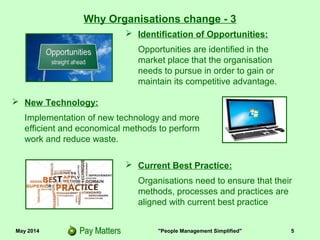
 Identification of Opportunities:
Opportunities are identified in the
market place that the organisation
needs to pursue in order to gain or
maintain its competitive advantage.
Why Organisations change - 3
 New Technology:
Implementation of new technology and more
efficient and economical methods to perform
work and reduce waste.
 Current Best Practice:
Organisations need to ensure that their
processes, methods and practices are
aligned with current best practice
June 2014 "People Management Simplified" 6
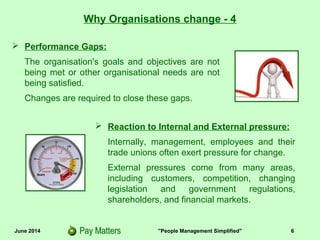
 Performance Gaps:
The organisation's goals and objectives are not
being met or other organisational needs are not
being satisfied.
Changes are required to close these gaps.
Why Organisations change - 4
 Reaction to Internal and External pressure:
Internally, management, employees and their
trade unions often exert pressure for change.
External pressures come from many areas,
including customers, suppliers, competition,
changing legislation and government
regulations, shareholders, and financial
markets.
June 2014 "People Management Simplified" 7
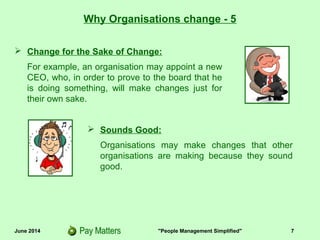
 Change for the Sake of Change:
For example, an organisation may appoint a new
CEO, who, in order to prove to the board that he
is doing something, will make changes just for
their own sake.
Why Organisations change - 5
 Sounds Good:
Organisations may make changes that other
organisations are making because they sound
good.
May 2014 "People Management Simplified" 8
What Organisations can change - 1
 Mission, Vision, & Strategy:
Organisations should regularly ask themselves,
"What is our business and what should it be?",
and, “Have our strategies and plans achieved to
date what they set out to achieve?”
Answers to these questions can lead to changes
in the organisation's mission, vision, and
competitive strategy.
Changes fall into the following broad areas.
It is possible that changes in one of these areas will impact on another
area.
For example, changing technology may require changes in the human-
behavioral area.
May 2014 "People Management Simplified" 9
What Organisations can change - 2
 Technology:
Organisations can change their technology in
order to increase efficiency, reduce costs, and
eliminate waste.
 Task-Job Design:
The way work is performed can be changed
with new procedures and methods for
performing work.
 Human-Behavioral Changes:
Training can be provided to managers and
employees to provide new knowledge, skills, and
behaviours, or employees can be replaced or
downsized.
May 2014 "People Management Simplified" 10
What Organisations can change - 3
 Organisational Structure:
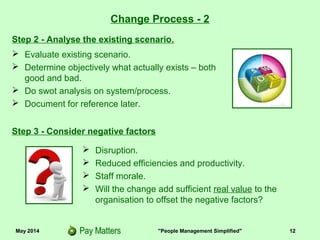
Organisations can change where decisions
are made, (centralised or de-centralised), or
the way they are structured in order to be
more responsive to their external
environment.
 Organisational Culture:
Organisations can attempt to change their
culture, including management and
leadership styles, values and beliefs.
May 2014 "People Management Simplified" 11
Change Process - 1
Step 1 - Clearly identify the need for change.
 Identify the reasons why the existing systems/processes were
established.
 What was the need that had to be satisfied?
 What were the desired outcomes at the time?
 Were the desired outcomes achieved?
 Has the need changed?
 What necessitates the planned change?
 Define the desired outcome clearly, i.e. WHAT must be achieved.
Without a vision, (perception of the future), change efforts
dissolve into a list of costly, time-consuming, incompatible and
confusing projects going in different directions, or nowhere at
all!
 Identify the benefits of the change.
 Be convinced that change is necessary - Don’t fix it if it isn’t broken!
May 2014 "People Management Simplified" 12
Change Process - 2
Step 2 - Analyse the existing scenario.
 Evaluate existing scenario.
 Determine objectively what actually exists – both
good and bad.
 Do swot analysis on system/process.
 Document for reference later.
Step 3 - Consider negative factors
 Disruption.
 Reduced efficiencies and productivity.
 Staff morale.
 Will the change add sufficient real value to the
organisation to offset the negative factors?
May 2014 "People Management Simplified" 13
Change Process - 3
 Is the change confined to only the section
of the business where the change takes
place?
 Is anyone else going to be negatively
affected by the change?
 If so, how will this be overcome?
Step 4 - Establish the affects the change will have on other sections
of the organisation
Step 5 - Establish and evaluate alternatives
 What alternatives are available?
 Gather information and brainstorm to
establish most suitable option.
May 2014 "People Management Simplified" 14
Step 6 - Develop a tentative but detailed plan
The plan must be “SMART” - (specific, measurable, achievable, realistic,
and time bound).
Change Process - 4
 Define each task or element of the
change.
 Arrange the elements in sequence or
parallel relationships for
implementation.
 Construct a timetable.
 Draw up a budget for the plan.
 Associate responsibilities.
 Provide contingencies (critical path
scheduling).
 Determine additional resource requirements.
 Determine utilisation of staff in planning and
implementation.
May 2014 "People Management Simplified" 15
Step 7 - Evaluate the plan.
Change Process - 5
 Do swot analysis.
 Formulate strategies to exploit strengths and opportunities, and
overcome threats and weaknesses.
 What is the likelihood of success?
 Is it practical?
 Is it ethical?
 Is it cost effective?
 Is it not just speculation or wishful thinking?
 What are the risks?
 Are you using proven methodology?
May 2014 "People Management Simplified" 16
Step 8 – Ascertain the potential of outcome.
Change Process - 6
 Compare swot “factors” of existing scenario vs. new scenario.
 Have the areas of concern, (the need for the change), been addressed?
 Does the change result in sufficient improvement?
 Define the benefits and advantages.
 Measure the benefits against the “costs” of the change.
 Will the desired outcome be achieved?
 How will we know that the outcome has been achieved?
 How much of this change can we achieve ourselves, and what parts of
the change do we need help with?
May 2014 "People Management Simplified" 17
Step 9 - Analyse the change in terms of the present and the future.
Change Process - 7
Step 10 - Obtain preliminary approval
 Visualise the change implemented.
 Ask what would happen if you did nothing.
 Does the envisaged change make a worthwhile
contribution?
 Present the plan to board/executive for
preliminary approval.
May 2014 "People Management Simplified" 18
Step 11 - Introduce the plan to stakeholders
Change Process - 8
 It is essential to involve all stakeholders that will be either directly or
indirectly affected by the change – both internal and external.
 Afford employees at all levels of the organisation the opportunity to
participate.
 Encourage comments and suggestions.
 Listen to their concerns and suggestions.
 Modify the plan if required.
Email and written communications are extremely
weak at conveying and developing
understanding and gaining commitment.
Use face-to-face communication at all levels of
the organisation, albeit in workshops if more
practical.
May 2014 "People Management Simplified" 19
Step 12 - Establish implementation plan
Change Process - 9
 Documentation.
 Resources required.
 Responsibilities.
 Time frames.
If you think that you need to make a
change quickly, probe the reasons - is
the urgency real?
Will the effects of agreeing to a more sensible time-frame really
be more disastrous than possibly presiding over a disastrous
change?
 Measures and milestones.
 Communication.
May 2014 "People Management Simplified" 20
Step 14 - Implementation
Change Process - 10
 Implement the change in accordance with the
plan.
Step 13 - Gain final approval
 Present the final plan to board/executive.
 Obtain approval for implementation.
 Ensure required resources are made available.
May 2014 "People Management Simplified" 21
Change Process - 11
 Regularly measure the progress made against the milestones to ensure
that the plan achieves the desired outcomes.
 Fine-tune the plan and take corrective action as required.
Step 15 - Controlling the process
May 2014 "People Management Simplified" 22
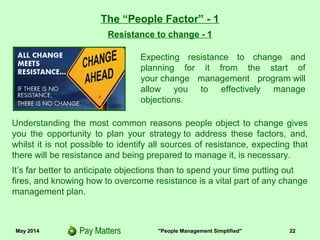
Resistance to change - 1
The “People Factor” - 1
Understanding the most common reasons people object to change gives
you the opportunity to plan your strategy to address these factors, and,
whilst it is not possible to identify all sources of resistance, expecting that
there will be resistance and being prepared to manage it, is necessary.
It’s far better to anticipate objections than to spend your time putting out
fires, and knowing how to overcome resistance is a vital part of any change
management plan.
Expecting resistance to change and
planning for it from the start of
your change management program will
allow you to effectively manage
objections.
May 2014 "People Management Simplified" 23
The “People Factor” - 2
Resistance to change - 2
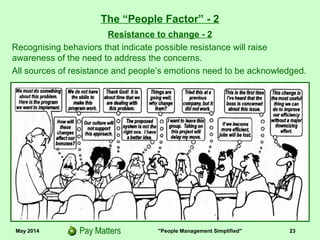
Recognising behaviors that indicate possible resistance will raise
awareness of the need to address the concerns.
All sources of resistance and people’s emotions need to be acknowledged.
May 2014 "People Management Simplified" 24
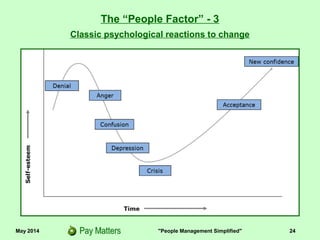
Classic psychological reactions to change
The “People Factor” - 3
May 2014 "People Management Simplified" 25
Typical reasons for resistance to change - 1
The “People Factor” - 4
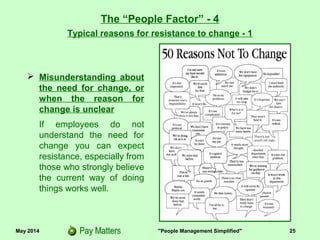
 Misunderstanding about
the need for change, or
when the reason for
change is unclear
If employees do not
understand the need for
change you can expect
resistance, especially from
those who strongly believe
the current way of doing
things works well.
May 2014 "People Management Simplified" 26
 Poor communication
This is probably the most likely cause when
change initiatives fail or are problematic.
When it comes to change management there’s
no such thing as too much communication!
The “People Factor” - 5
Typical reasons for resistance to change - 2
 Not being consulted or involved
If employees are allowed to be part of the
change there is less resistance.
People like to know what’s going on,
especially if their jobs may be affected.
Informed employees tend to have higher
levels of job satisfaction than uninformed
employees
May 2014 "People Management Simplified" 27
 Fear of the unknown
Fear of the unknown is one of the most common reasons for
resistance. People will only confront the unknown if they genuinely
believe that the risks of the status quo are greater than those of
changing.
The “People Factor” - 6
Typical reasons for resistance to change - 3
 Benefits and rewards
Benefits and rewards for making the change are not
seen as adequate for the trouble involved.
 Lack of competence
Change usually necessitates changes in
knowledge, skills and workload, and some
employees lack confidence that they will be able to
cope with the new requirements.
May 2014 "People Management Simplified" 28
 Change in the status quo
Resistance can also stem from perceptions of
the change that people hold.
Self preservation – How does it effect me now
and in the future?
The “People Factor” - 7
Typical reasons for resistance to change - 4
For example, people who feel they’ll be worse off at the end of the
change are unlikely to give it their full support. Similarly, if people
believe the change favours another group/department/person there
may be anger and resentment.
 Conflicts of Ethics and Values
When you ask employees to do things that
they believe are unethical or inconsistent
with their values, you can expect
resistance.
May 2014 "People Management Simplified" 29
Typical reasons for resistance to change - 5
The “People Factor” - 8
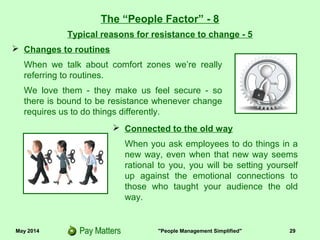
 Changes to routines
When we talk about comfort zones we’re really
referring to routines.
We love them - they make us feel secure - so
there is bound to be resistance whenever change
requires us to do things differently.
 Connected to the old way
When you ask employees to do things in a
new way, even when that new way seems
rational to you, you will be setting yourself
up against the emotional connections to
those who taught your audience the old
way.
May 2014 "People Management Simplified" 30
Typical reasons for resistance to change - 6
The “People Factor” - 9
 Temporary fad
When employees believe that the change is a
temporary fad, or knee-jerk action, they will not
support the initiative.
 Low trust
When employees don’t believe that they, or the
organisation, can competently manage the
change, or that those responsible for the change
can’t be trusted, there is likely to be resistance
May 2014 "People Management Simplified" 31
Typical reasons for resistance to change - 7
The “People Factor” - 10
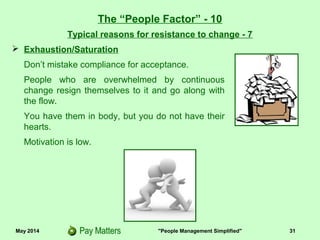
 Exhaustion/Saturation
Don’t mistake compliance for acceptance.
People who are overwhelmed by continuous
change resign themselves to it and go along with
the flow.
You have them in body, but you do not have their
hearts.
Motivation is low.
May 2014 "People Management Simplified" 32
Consider how staff fears might be addressed
 Role reversals - establish emotional state of persons affected – anxiety,
stress, anger etc.
 Accurate and direct communication is essential.
 Ensure clear understanding.
 Dispel their fears.
 Identify their roles in the process.
 Try to turn objections into advantages.
 Sell the benefits.
 Identify challenges, risks and areas of concern, and state how they will
be addressed - Instil confidence.
 Show enthusiasm and confidence.
 Report back regularly on progress – highlight successes.
The “People Factor” - 11
May 2014 "People Management Simplified" 33
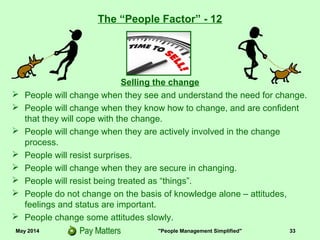
Selling the change
 People will change when they see and understand the need for change.
 People will change when they know how to change, and are confident
that they will cope with the change.
 People will change when they are actively involved in the change
process.
 People will resist surprises.
 People will change when they are secure in changing.
 People will resist being treated as “things”.
 People do not change on the basis of knowledge alone – attitudes,
feelings and status are important.
 People change some attitudes slowly.
The “People Factor” - 12
May 2014 "People Management Simplified" 34
Questions that can increase engagement when leading change
 What do you think about this change?
 Do you know why the changes are taking place?
 Do you think this change is for good?
 Do you think this change is needed?
 Would you change anything about this change?
 What is your experience with past changes of this type?
 If you could tell the CEO one thing about this upcoming change, what
would it be?
 What do you see your role as in this change?
 What are you working on and how will you be impacted by this change?
 What are you already doing that supports the change?
 What areas do you feel will be a challenge for you to adjust?
 What would help you most during these changes?
The “People Factor” - 13
May 2014 "People Management Simplified" 35
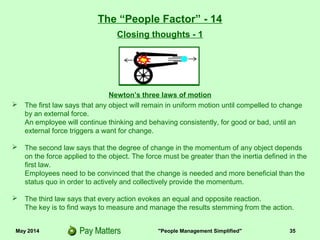
Newton’s three laws of motion
 The first law says that any object will remain in uniform motion until compelled to change
by an external force.
An employee will continue thinking and behaving consistently, for good or bad, until an
external force triggers a want for change.
 The second law says that the degree of change in the momentum of any object depends
on the force applied to the object. The force must be greater than the inertia defined in the
first law.
Employees need to be convinced that the change is needed and more beneficial than the
status quo in order to actively and collectively provide the momentum.
 The third law says that every action evokes an equal and opposite reaction.
The key is to find ways to measure and manage the results stemming from the action.
The “People Factor” - 14
Closing thoughts - 1
May 2014 "People Management Simplified" 36
The “People Factor” - 15
Closing thoughts - 2
May 2014 "People Management Simplified" 37
Conclusion
We hope that you found the information set out in this presentation
useful and that it will assist you to successfully manage change in
your organisation.
Please note that a downloadable copy of this Slideshow is available
to purchase from our website. Click here to learn more!
PAY MATTERS is able to assist you manage change in your
organisation, and we look forward to the opportunity to do so.
Continue viewing the slideshow to learn more about us,
or visit our website
http://www.paym.co.za
Alternatively
Submit your enquiry by e-mail, and we will contact you
info@paym.co.za
or
Call George : Mobile 082 572 0644 - Landline 041 452 3702
May 2014 "People Management Simplified" 38
Who is Pay Matters?
PAY MATTERS is a Human Resources Solutions provider located in Port
Elizabeth, South Africa, that offers a comprehensive range of affordable,
high quality, legally compliant, and reliable shared Human Resources,
Labour Relations, and Payroll solutions to Corporate, SMME and Domestic
employers within the Nelson Mandela Bay Metropole area, (Port Elizabeth,
Uitenhage and Despatch), and surrounds.
May 2014 "People Management Simplified" 39
PAY MATTERS’ Shared Services
Allow us to assist you to administer your Human Resources, Labour
Relations and Payroll while you focus on your core activities.
Enjoy the many benefits of having a professional Human Resources
Department working for you at an affordable cost!
We are confident that, due to our expertise, 39 years of demonstrated on-the-job
experience, flexible range of services, and our method of conducting business, we
can add value to most employers, and look forward to providing a tailor-made
solution for you.
We believe that by entrusting your business to PAY MATTERS you can rest
assured that the services we provide will be legally compliant, and that your
employees will be paid correctly and timeously each payday, while your assets and
business interests will be protected.
May 2014 "People Management Simplified" 40
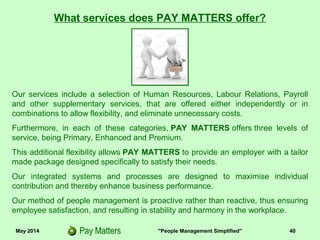
Our services include a selection of Human Resources, Labour Relations, Payroll
and other supplementary services, that are offered either independently or in
combinations to allow flexibility, and eliminate unnecessary costs.
Furthermore, in each of these categories, PAY MATTERS offers three levels of
service, being Primary, Enhanced and Premium.
This additional flexibility allows PAY MATTERS to provide an employer with a tailor
made package designed specifically to satisfy their needs.
Our integrated systems and processes are designed to maximise individual
contribution and thereby enhance business performance.
Our method of people management is proactive rather than reactive, thus ensuring
employee satisfaction, and resulting in stability and harmony in the workplace.
What services does PAY MATTERS offer?
May 2014 "People Management Simplified" 41
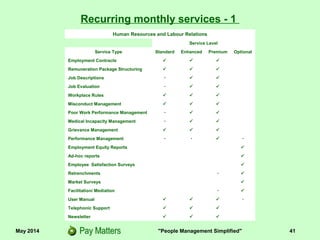
Recurring monthly services - 1
Human Resources and Labour Relations
Service Level
Service Type Standard Enhanced Premium Optional
Employment Contracts   
Remuneration Package Structuring   
Job Descriptions   
Job Evaluation   
Workplace Rules   
Misconduct Management   
Poor Work Performance Management   
Medical Incapacity Management   
Grievance Management   
Performance Management    
Employment Equity Reports 
Ad-hoc reports 
Employee Satisfaction Surveys 
Retrenchments  
Market Surveys 
Facilitation/ Mediation  
User Manual    
Telephonic Support   
Newsletter   
May 2014 "People Management Simplified" 42
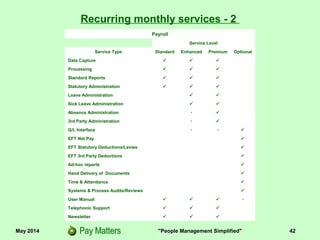
Payroll
Service Level
Service Type Standard Enhanced Premium Optional
Data Capture   
Processing   
Standard Reports   
Statutory Administration   
Leave Administration  
Sick Leave Administration  
Absence Administration  
3rd Party Administration  
G/L Interface   
EFT Net Pay 
EFT Statutory Deductions/Levies 
EFT 3rd Party Deductions 
Ad-hoc reports 
Hand Delivery of Documents 
Time & Attendance 
Systems & Process Audits/Reviews 
User Manual    
Telephonic Support   
Newsletter   
Recurring monthly services - 2
May 2014 "People Management Simplified" 43
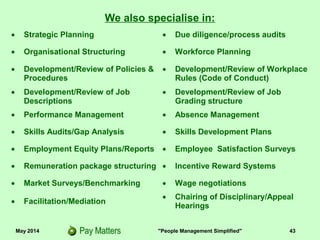
• Strategic Planning • Due diligence/process audits
• Organisational Structuring • Workforce Planning
• Development/Review of Policies &
Procedures
• Development/Review of Workplace
Rules (Code of Conduct)
• Development/Review of Job
Descriptions
• Development/Review of Job
Grading structure
• Performance Management • Absence Management
• Skills Audits/Gap Analysis • Skills Development Plans
• Employment Equity Plans/Reports • Employee Satisfaction Surveys
• Remuneration package structuring • Incentive Reward Systems
• Market Surveys/Benchmarking • Wage negotiations
• Facilitation/Mediation
• Chairing of Disciplinary/Appeal
Hearings
We also specialise in:
May 2014 "People Management Simplified" 44
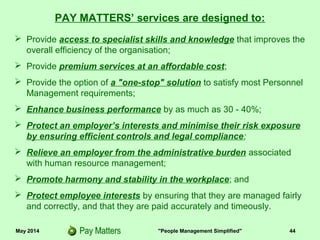
 Provide access to specialist skills and knowledge that improves the
overall efficiency of the organisation;
 Provide premium services at an affordable cost;
 Provide the option of a "one-stop" solution to satisfy most Personnel
Management requirements;
 Enhance business performance by as much as 30 - 40%;
 Protect an employer’s interests and minimise their risk exposure
by ensuring efficient controls and legal compliance;
 Relieve an employer from the administrative burden associated
with human resource management;
 Promote harmony and stability in the workplace; and
 Protect employee interests by ensuring that they are managed fairly
and correctly, and that they are paid accurately and timeously.
PAY MATTERS’ services are designed to:
May 2014 "People Management Simplified" 45
Last but not least
May 2014 "People Management Simplified" 46
Thank you for your time
We look forward to being of service to you!
Managing Change
Human Resources Specialists

All you need to know about Implementing and Managing Change - "The People Factor"

  • 1.
    All you need toknow about… Human Resources, Labour Relations and Payroll Specialists Implementing and Managing Change “The People Factor”
  • 2.
    May 2014 "PeopleManagement Simplified" 2 Definition and Purpose of Change Definition: Change is defined as the process of making something different, i.e. removing the status quo. Purpose: The purpose of change is to enable an organisation to satisfy its needs in a more effective and efficient manner.
  • 3.
    May 2014 "PeopleManagement Simplified" 3 Why Organisations change - 1  Crisis: A major crisis such as the destruction of the World Trade Towers is a dramatic example of an international crisis that caused countless organisations, and even industries such as airlines and travel, to change radically. Organisations change for a number of different reasons, which may either be proactive or reactive. These reasons include: The recent financial crisis resulted in major changes in the financial services sector, but also had serious repercussions on unrelated organisations throughout the world.
  • 4.
    May 2014 "PeopleManagement Simplified" 4  Mergers & Acquisitions: Mergers and acquisitions create change externally, as well as within the organisations that merge, particularly where products, processes, policies and procedures are standardised and duplication eliminated. Why Organisations change - 2  Planned Abandonment: Changes result from abandoning declining products, markets, or subsidiaries, and allocating resources to innovation and new opportunities.
  • 5.
    May 2014 "PeopleManagement Simplified" 5  Identification of Opportunities: Opportunities are identified in the market place that the organisation needs to pursue in order to gain or maintain its competitive advantage. Why Organisations change - 3  New Technology: Implementation of new technology and more efficient and economical methods to perform work and reduce waste.  Current Best Practice: Organisations need to ensure that their processes, methods and practices are aligned with current best practice
  • 6.
    June 2014 "PeopleManagement Simplified" 6  Performance Gaps: The organisation's goals and objectives are not being met or other organisational needs are not being satisfied. Changes are required to close these gaps. Why Organisations change - 4  Reaction to Internal and External pressure: Internally, management, employees and their trade unions often exert pressure for change. External pressures come from many areas, including customers, suppliers, competition, changing legislation and government regulations, shareholders, and financial markets.
  • 7.
    June 2014 "PeopleManagement Simplified" 7  Change for the Sake of Change: For example, an organisation may appoint a new CEO, who, in order to prove to the board that he is doing something, will make changes just for their own sake. Why Organisations change - 5  Sounds Good: Organisations may make changes that other organisations are making because they sound good.
  • 8.
    May 2014 "PeopleManagement Simplified" 8 What Organisations can change - 1  Mission, Vision, & Strategy: Organisations should regularly ask themselves, "What is our business and what should it be?", and, “Have our strategies and plans achieved to date what they set out to achieve?” Answers to these questions can lead to changes in the organisation's mission, vision, and competitive strategy. Changes fall into the following broad areas. It is possible that changes in one of these areas will impact on another area. For example, changing technology may require changes in the human- behavioral area.
  • 9.
    May 2014 "PeopleManagement Simplified" 9 What Organisations can change - 2  Technology: Organisations can change their technology in order to increase efficiency, reduce costs, and eliminate waste.  Task-Job Design: The way work is performed can be changed with new procedures and methods for performing work.  Human-Behavioral Changes: Training can be provided to managers and employees to provide new knowledge, skills, and behaviours, or employees can be replaced or downsized.
  • 10.
    May 2014 "PeopleManagement Simplified" 10 What Organisations can change - 3  Organisational Structure: Organisations can change where decisions are made, (centralised or de-centralised), or the way they are structured in order to be more responsive to their external environment.  Organisational Culture: Organisations can attempt to change their culture, including management and leadership styles, values and beliefs.
  • 11.
    May 2014 "PeopleManagement Simplified" 11 Change Process - 1 Step 1 - Clearly identify the need for change.  Identify the reasons why the existing systems/processes were established.  What was the need that had to be satisfied?  What were the desired outcomes at the time?  Were the desired outcomes achieved?  Has the need changed?  What necessitates the planned change?  Define the desired outcome clearly, i.e. WHAT must be achieved. Without a vision, (perception of the future), change efforts dissolve into a list of costly, time-consuming, incompatible and confusing projects going in different directions, or nowhere at all!  Identify the benefits of the change.  Be convinced that change is necessary - Don’t fix it if it isn’t broken!
  • 12.
    May 2014 "PeopleManagement Simplified" 12 Change Process - 2 Step 2 - Analyse the existing scenario.  Evaluate existing scenario.  Determine objectively what actually exists – both good and bad.  Do swot analysis on system/process.  Document for reference later. Step 3 - Consider negative factors  Disruption.  Reduced efficiencies and productivity.  Staff morale.  Will the change add sufficient real value to the organisation to offset the negative factors?
  • 13.
    May 2014 "PeopleManagement Simplified" 13 Change Process - 3  Is the change confined to only the section of the business where the change takes place?  Is anyone else going to be negatively affected by the change?  If so, how will this be overcome? Step 4 - Establish the affects the change will have on other sections of the organisation Step 5 - Establish and evaluate alternatives  What alternatives are available?  Gather information and brainstorm to establish most suitable option.
  • 14.
    May 2014 "PeopleManagement Simplified" 14 Step 6 - Develop a tentative but detailed plan The plan must be “SMART” - (specific, measurable, achievable, realistic, and time bound). Change Process - 4  Define each task or element of the change.  Arrange the elements in sequence or parallel relationships for implementation.  Construct a timetable.  Draw up a budget for the plan.  Associate responsibilities.  Provide contingencies (critical path scheduling).  Determine additional resource requirements.  Determine utilisation of staff in planning and implementation.
  • 15.
    May 2014 "PeopleManagement Simplified" 15 Step 7 - Evaluate the plan. Change Process - 5  Do swot analysis.  Formulate strategies to exploit strengths and opportunities, and overcome threats and weaknesses.  What is the likelihood of success?  Is it practical?  Is it ethical?  Is it cost effective?  Is it not just speculation or wishful thinking?  What are the risks?  Are you using proven methodology?
  • 16.
    May 2014 "PeopleManagement Simplified" 16 Step 8 – Ascertain the potential of outcome. Change Process - 6  Compare swot “factors” of existing scenario vs. new scenario.  Have the areas of concern, (the need for the change), been addressed?  Does the change result in sufficient improvement?  Define the benefits and advantages.  Measure the benefits against the “costs” of the change.  Will the desired outcome be achieved?  How will we know that the outcome has been achieved?  How much of this change can we achieve ourselves, and what parts of the change do we need help with?
  • 17.
    May 2014 "PeopleManagement Simplified" 17 Step 9 - Analyse the change in terms of the present and the future. Change Process - 7 Step 10 - Obtain preliminary approval  Visualise the change implemented.  Ask what would happen if you did nothing.  Does the envisaged change make a worthwhile contribution?  Present the plan to board/executive for preliminary approval.
  • 18.
    May 2014 "PeopleManagement Simplified" 18 Step 11 - Introduce the plan to stakeholders Change Process - 8  It is essential to involve all stakeholders that will be either directly or indirectly affected by the change – both internal and external.  Afford employees at all levels of the organisation the opportunity to participate.  Encourage comments and suggestions.  Listen to their concerns and suggestions.  Modify the plan if required. Email and written communications are extremely weak at conveying and developing understanding and gaining commitment. Use face-to-face communication at all levels of the organisation, albeit in workshops if more practical.
  • 19.
    May 2014 "PeopleManagement Simplified" 19 Step 12 - Establish implementation plan Change Process - 9  Documentation.  Resources required.  Responsibilities.  Time frames. If you think that you need to make a change quickly, probe the reasons - is the urgency real? Will the effects of agreeing to a more sensible time-frame really be more disastrous than possibly presiding over a disastrous change?  Measures and milestones.  Communication.
  • 20.
    May 2014 "PeopleManagement Simplified" 20 Step 14 - Implementation Change Process - 10  Implement the change in accordance with the plan. Step 13 - Gain final approval  Present the final plan to board/executive.  Obtain approval for implementation.  Ensure required resources are made available.
  • 21.
    May 2014 "PeopleManagement Simplified" 21 Change Process - 11  Regularly measure the progress made against the milestones to ensure that the plan achieves the desired outcomes.  Fine-tune the plan and take corrective action as required. Step 15 - Controlling the process
  • 22.
    May 2014 "PeopleManagement Simplified" 22 Resistance to change - 1 The “People Factor” - 1 Understanding the most common reasons people object to change gives you the opportunity to plan your strategy to address these factors, and, whilst it is not possible to identify all sources of resistance, expecting that there will be resistance and being prepared to manage it, is necessary. It’s far better to anticipate objections than to spend your time putting out fires, and knowing how to overcome resistance is a vital part of any change management plan. Expecting resistance to change and planning for it from the start of your change management program will allow you to effectively manage objections.
  • 23.
    May 2014 "PeopleManagement Simplified" 23 The “People Factor” - 2 Resistance to change - 2 Recognising behaviors that indicate possible resistance will raise awareness of the need to address the concerns. All sources of resistance and people’s emotions need to be acknowledged.
  • 24.
    May 2014 "PeopleManagement Simplified" 24 Classic psychological reactions to change The “People Factor” - 3
  • 25.
    May 2014 "PeopleManagement Simplified" 25 Typical reasons for resistance to change - 1 The “People Factor” - 4  Misunderstanding about the need for change, or when the reason for change is unclear If employees do not understand the need for change you can expect resistance, especially from those who strongly believe the current way of doing things works well.
  • 26.
    May 2014 "PeopleManagement Simplified" 26  Poor communication This is probably the most likely cause when change initiatives fail or are problematic. When it comes to change management there’s no such thing as too much communication! The “People Factor” - 5 Typical reasons for resistance to change - 2  Not being consulted or involved If employees are allowed to be part of the change there is less resistance. People like to know what’s going on, especially if their jobs may be affected. Informed employees tend to have higher levels of job satisfaction than uninformed employees
  • 27.
    May 2014 "PeopleManagement Simplified" 27  Fear of the unknown Fear of the unknown is one of the most common reasons for resistance. People will only confront the unknown if they genuinely believe that the risks of the status quo are greater than those of changing. The “People Factor” - 6 Typical reasons for resistance to change - 3  Benefits and rewards Benefits and rewards for making the change are not seen as adequate for the trouble involved.  Lack of competence Change usually necessitates changes in knowledge, skills and workload, and some employees lack confidence that they will be able to cope with the new requirements.
  • 28.
    May 2014 "PeopleManagement Simplified" 28  Change in the status quo Resistance can also stem from perceptions of the change that people hold. Self preservation – How does it effect me now and in the future? The “People Factor” - 7 Typical reasons for resistance to change - 4 For example, people who feel they’ll be worse off at the end of the change are unlikely to give it their full support. Similarly, if people believe the change favours another group/department/person there may be anger and resentment.  Conflicts of Ethics and Values When you ask employees to do things that they believe are unethical or inconsistent with their values, you can expect resistance.
  • 29.
    May 2014 "PeopleManagement Simplified" 29 Typical reasons for resistance to change - 5 The “People Factor” - 8  Changes to routines When we talk about comfort zones we’re really referring to routines. We love them - they make us feel secure - so there is bound to be resistance whenever change requires us to do things differently.  Connected to the old way When you ask employees to do things in a new way, even when that new way seems rational to you, you will be setting yourself up against the emotional connections to those who taught your audience the old way.
  • 30.
    May 2014 "PeopleManagement Simplified" 30 Typical reasons for resistance to change - 6 The “People Factor” - 9  Temporary fad When employees believe that the change is a temporary fad, or knee-jerk action, they will not support the initiative.  Low trust When employees don’t believe that they, or the organisation, can competently manage the change, or that those responsible for the change can’t be trusted, there is likely to be resistance
  • 31.
    May 2014 "PeopleManagement Simplified" 31 Typical reasons for resistance to change - 7 The “People Factor” - 10  Exhaustion/Saturation Don’t mistake compliance for acceptance. People who are overwhelmed by continuous change resign themselves to it and go along with the flow. You have them in body, but you do not have their hearts. Motivation is low.
  • 32.
    May 2014 "PeopleManagement Simplified" 32 Consider how staff fears might be addressed  Role reversals - establish emotional state of persons affected – anxiety, stress, anger etc.  Accurate and direct communication is essential.  Ensure clear understanding.  Dispel their fears.  Identify their roles in the process.  Try to turn objections into advantages.  Sell the benefits.  Identify challenges, risks and areas of concern, and state how they will be addressed - Instil confidence.  Show enthusiasm and confidence.  Report back regularly on progress – highlight successes. The “People Factor” - 11
  • 33.
    May 2014 "PeopleManagement Simplified" 33 Selling the change  People will change when they see and understand the need for change.  People will change when they know how to change, and are confident that they will cope with the change.  People will change when they are actively involved in the change process.  People will resist surprises.  People will change when they are secure in changing.  People will resist being treated as “things”.  People do not change on the basis of knowledge alone – attitudes, feelings and status are important.  People change some attitudes slowly. The “People Factor” - 12
  • 34.
    May 2014 "PeopleManagement Simplified" 34 Questions that can increase engagement when leading change  What do you think about this change?  Do you know why the changes are taking place?  Do you think this change is for good?  Do you think this change is needed?  Would you change anything about this change?  What is your experience with past changes of this type?  If you could tell the CEO one thing about this upcoming change, what would it be?  What do you see your role as in this change?  What are you working on and how will you be impacted by this change?  What are you already doing that supports the change?  What areas do you feel will be a challenge for you to adjust?  What would help you most during these changes? The “People Factor” - 13
  • 35.
    May 2014 "PeopleManagement Simplified" 35 Newton’s three laws of motion  The first law says that any object will remain in uniform motion until compelled to change by an external force. An employee will continue thinking and behaving consistently, for good or bad, until an external force triggers a want for change.  The second law says that the degree of change in the momentum of any object depends on the force applied to the object. The force must be greater than the inertia defined in the first law. Employees need to be convinced that the change is needed and more beneficial than the status quo in order to actively and collectively provide the momentum.  The third law says that every action evokes an equal and opposite reaction. The key is to find ways to measure and manage the results stemming from the action. The “People Factor” - 14 Closing thoughts - 1
  • 36.
    May 2014 "PeopleManagement Simplified" 36 The “People Factor” - 15 Closing thoughts - 2
  • 37.
    May 2014 "PeopleManagement Simplified" 37 Conclusion We hope that you found the information set out in this presentation useful and that it will assist you to successfully manage change in your organisation. Please note that a downloadable copy of this Slideshow is available to purchase from our website. Click here to learn more! PAY MATTERS is able to assist you manage change in your organisation, and we look forward to the opportunity to do so. Continue viewing the slideshow to learn more about us, or visit our website http://www.paym.co.za Alternatively Submit your enquiry by e-mail, and we will contact you info@paym.co.za or Call George : Mobile 082 572 0644 - Landline 041 452 3702
  • 38.
    May 2014 "PeopleManagement Simplified" 38 Who is Pay Matters? PAY MATTERS is a Human Resources Solutions provider located in Port Elizabeth, South Africa, that offers a comprehensive range of affordable, high quality, legally compliant, and reliable shared Human Resources, Labour Relations, and Payroll solutions to Corporate, SMME and Domestic employers within the Nelson Mandela Bay Metropole area, (Port Elizabeth, Uitenhage and Despatch), and surrounds.
  • 39.
    May 2014 "PeopleManagement Simplified" 39 PAY MATTERS’ Shared Services Allow us to assist you to administer your Human Resources, Labour Relations and Payroll while you focus on your core activities. Enjoy the many benefits of having a professional Human Resources Department working for you at an affordable cost! We are confident that, due to our expertise, 39 years of demonstrated on-the-job experience, flexible range of services, and our method of conducting business, we can add value to most employers, and look forward to providing a tailor-made solution for you. We believe that by entrusting your business to PAY MATTERS you can rest assured that the services we provide will be legally compliant, and that your employees will be paid correctly and timeously each payday, while your assets and business interests will be protected.
  • 40.
    May 2014 "PeopleManagement Simplified" 40 Our services include a selection of Human Resources, Labour Relations, Payroll and other supplementary services, that are offered either independently or in combinations to allow flexibility, and eliminate unnecessary costs. Furthermore, in each of these categories, PAY MATTERS offers three levels of service, being Primary, Enhanced and Premium. This additional flexibility allows PAY MATTERS to provide an employer with a tailor made package designed specifically to satisfy their needs. Our integrated systems and processes are designed to maximise individual contribution and thereby enhance business performance. Our method of people management is proactive rather than reactive, thus ensuring employee satisfaction, and resulting in stability and harmony in the workplace. What services does PAY MATTERS offer?
  • 41.
    May 2014 "PeopleManagement Simplified" 41 Recurring monthly services - 1 Human Resources and Labour Relations Service Level Service Type Standard Enhanced Premium Optional Employment Contracts    Remuneration Package Structuring    Job Descriptions    Job Evaluation    Workplace Rules    Misconduct Management    Poor Work Performance Management    Medical Incapacity Management    Grievance Management    Performance Management     Employment Equity Reports  Ad-hoc reports  Employee Satisfaction Surveys  Retrenchments   Market Surveys  Facilitation/ Mediation   User Manual     Telephonic Support    Newsletter   
  • 42.
    May 2014 "PeopleManagement Simplified" 42 Payroll Service Level Service Type Standard Enhanced Premium Optional Data Capture    Processing    Standard Reports    Statutory Administration    Leave Administration   Sick Leave Administration   Absence Administration   3rd Party Administration   G/L Interface    EFT Net Pay  EFT Statutory Deductions/Levies  EFT 3rd Party Deductions  Ad-hoc reports  Hand Delivery of Documents  Time & Attendance  Systems & Process Audits/Reviews  User Manual     Telephonic Support    Newsletter    Recurring monthly services - 2
  • 43.
    May 2014 "PeopleManagement Simplified" 43 • Strategic Planning • Due diligence/process audits • Organisational Structuring • Workforce Planning • Development/Review of Policies & Procedures • Development/Review of Workplace Rules (Code of Conduct) • Development/Review of Job Descriptions • Development/Review of Job Grading structure • Performance Management • Absence Management • Skills Audits/Gap Analysis • Skills Development Plans • Employment Equity Plans/Reports • Employee Satisfaction Surveys • Remuneration package structuring • Incentive Reward Systems • Market Surveys/Benchmarking • Wage negotiations • Facilitation/Mediation • Chairing of Disciplinary/Appeal Hearings We also specialise in:
  • 44.
    May 2014 "PeopleManagement Simplified" 44  Provide access to specialist skills and knowledge that improves the overall efficiency of the organisation;  Provide premium services at an affordable cost;  Provide the option of a "one-stop" solution to satisfy most Personnel Management requirements;  Enhance business performance by as much as 30 - 40%;  Protect an employer’s interests and minimise their risk exposure by ensuring efficient controls and legal compliance;  Relieve an employer from the administrative burden associated with human resource management;  Promote harmony and stability in the workplace; and  Protect employee interests by ensuring that they are managed fairly and correctly, and that they are paid accurately and timeously. PAY MATTERS’ services are designed to:
  • 45.
    May 2014 "PeopleManagement Simplified" 45 Last but not least
  • 46.
    May 2014 "PeopleManagement Simplified" 46 Thank you for your time We look forward to being of service to you! Managing Change Human Resources Specialists