THE EVOLUTION OFMANAGEMENT
THOUGHT/APPROACHES/ THEORIES
OF MANAGEMENT
2.
Unit
Learning Objectives:
To explorethe relationships between
management theory and practice
Identify the major trends in the development
of management thinking
Evaluate the relevance of these different
approaches to the present-day management
of organizations
3.
The Importance ofPast
Management History
Every managerial act rests on assumptions,
generalizations, and hypotheses – that is to
say, on theory.
Our assumptions are frequently implicit,
sometimes quite unconscious, often
conflicting; nevertheless, they determine our
predictions that if we do a, b will occur.
Theory and practice are inseparable --- Douglas
McGregor, The Human Side of the Enterprise.
4.
The Importance ofPast
Management History
• Although the systematic recording of management
practice is a primarily a 20th
century phenomenon, the
history of management as a practice goes as far back
as 4000BC in Africa. (The most significant feature of
management practice and the application of
management principles is probably the construction
of Egyptian pyramid. The planning, organizing,
leading and control were applied to the work of over
100,000 people constructing the great pyramid of
Cheops)
5.
The Importance ofPast
Management History
• Knowledge of past management history is
important for the following reasons:
• Historical perspective is the study of a subject in
the light of its earliest phases and subsequent
evolution. Historical perspective differs from
history in that the object of historical perspective
is to sharpen one’s vision of the present, not the
past. Alonso Mcdonald, “Why history Matters to
Managers”, Harvard Business Review, Jan/Feb
1986, p.82
6.
The Importance ofPast
Management History
1. Knowledge of the history helps in understanding the
principles underlying the process of management
2. A number of contributors, approaches an practices of
the past provide important insight, lessons and
techniques to improve in quality and competitiveness
3. Many earlier ideas on management are of continuing
importance to managers and later ideas on
management tend to incorporate earlier ideas and
conclusions
•
7.
CLASSICAL MANAGEMENT
APPROACH
• Thecritical problem facing management of the
20th
century was how to increase efficiency
and productivity of the workforce. It has been
labeled classical because it marks the first
formalized approach to management.
• They place particular attention on planning of
work, the technical requirements of work and
common principles of organization, notably:-
8.
CLASSICAL MANAGEMENT
APPROACH
• Theprinciple of co-ordination: the need for
people to act together with unity of action, the
exercise of authority and the need for discipline;
• The scalar principle – the hierarchy of
organization, the grading of duties and the
process of delegation;
• The functional principle – i.e., specialization and
the distinction between different kinds of duties
9.
CLASSICAL MANAGEMENT
APPROACH
• Thereare two main perspectives (sub-
groupings) to this approach:
• (a) Scientific Management and
• (b) Functional Management
Approach/Classical Organization Theory
10.
The Scientific Management
Approach
•This refers to the principles and practices of
management introduced by Frederick Winslow
Taylor in his work, “The Principles of Scientific
Management” of 1911. Taylor, an engineer by
training, believed that just as there is a best
machine for each job, so there is a best
working method by which people should
undertake their job.
11.
The Scientific Management
Approach
•He underlined that management’s principal
object is to secure the maximum prosperity for
the employer and maximum prosperity of each
employee. Accordingly, he set up the following
principles to guide management:
12.
Frederick Winslow Taylor’sprinciples
1. The development of a true science for each
person’s work. Taylor believed that inefficient
rules of thumb of management inevitably lead to
inefficiency, low productivity and low quality of
work. He recommended that large daily tasks
be scientifically investigated, to establish the
amount of work an individual can do under
certain conditions.
• NB. By ‘science’ is meant the systematic
observation and measurement of workers’
activities.
13.
Frederick Winslow Taylor’s
principles
2.The scientific selection, training and
development of the workers as opposed to the
apprenticeship systems. One of the key
responsibilities of management is to develop
‘first class’ workers, by offering them
opportunities for advancement.
14.
Frederick Winslow Taylor’s
principles
3.Cooperation with the workers to ensure work
is carried out in the prescribed way. Taylor
believed that cooperation would replace
conflict if workers and managers knew what
was expected and saw the positive benefits
achieving mutual expectations
5. The division of work and responsibility
between management and workers.
15.
Relevance of Scientific
Management:
1.The school’s main concern was with the
efficiency of both workers and management
2. The adoption of an instrumental view of
human behavior with the application of
standard procedures for work
3. The viewing of workers as ‘rational’ economic
agents, motivated directly by monetary
incentives.
16.
Relevance of Scientific
Management:
1.The importance of proper compensation
management for productivity
2. The need of proper job placement and
employees development/training.
3. The view of workers as isolated individuals
and units of production to be handled almost
as machines.
17.
Criticisms of Taylor’sscientific
management:
1. The school failed to appreciate fully the
psychological and social aspects of work. For
example, the assumption that people are
motivated to work primarily by money is not
always true. Also the concept of a fair day’s pay
for a fair day’s work is not primarily a technical
matter. It is also a matter of social equity
2. The reduction of physical movement to find one
best way is not always beneficial. It can cause
stress and undermine creativity.
18.
Criticisms of Taylor’sscientific
management:
1. The approach promotes more individualism
than team work
2. The disadvantages of the proposed
specialization include the inability to increase
job satisfaction through job rotation, the stress
and monotony created by repetitive machine-
like work.
3. Views the worker as a machine at the mercy
of the manager
19.
Analyzed work usingscientific methods to determine the “one best way” to
complete production tasks.
Emphasized study of tasks, selection and training of workers, and
cooperation between workers and management.
Improved factory productivity and efficiency.
Introduced scientific analysis to the workplace.
Piece rate system equated worker rewards and performance.
Instilled cooperation between management and workers.
Limitations
Simplistic motivational assumptions
Workers viewed as machines
Potential for exploitation of labour
Excluded senior management tasks
Ignored the relationship between the organization and its environment
Scientific management at a
glance
20.
The Functional ManagementApproach
• This school of thought is also called Classical
Management theory or Process approach or
Operational-Management theory and is based on
the teachings of the French industrialist Henry
Fayol (1841-1925). Other contributors to this
approach include: Follet Mary Parker (1868-1933)
and Urwick Lyndall.
• This school of thought views management from the
perspective of the various functions, operations,
processes and administrative activities that management
entails. It asserts that these processes can be broken
down into separate but interdependent areas of
responsibility
21.
b) The FunctionalManagement Approach
Types of organizational activities. Fayol divided
administrative activities into six:
1.Technical/ production: focused on
producing/manufacturing products
2.Commercial: buying & selling of raw materials
and products respectively
3.Financial: search for and optimal use of capital
in all other functions
4.Security: protection of property and persons
5.Accounting /statistics: recording, stocktaking
and compiling accounting statistics
22.
The Functional ManagementApproach cont..
7. Managerial: This was the kernel/ inner part of
Fayol’s teachings and he held that the
managerial activity of organizations comprise
of five basic functions:
– Planning
– Organizing
– Command
– Coordination
– Control
•
23.
Fayol’s 14 Principlesof
Management
1. Division of Labor (job specialization) - noted
firms can have too much specialization leading
to poor quality and worker dissatisfaction
2. Authority and Responsibility (included both
formal and informal authority resulting from
special expertise)
1. Unity of Command (employees should have
24.
1. Line ofAuthority (a clear chain of
command from top to bottom of the
firm)
1. Centralization (the degree to which
authority rests at the top of the
organization)
3. Unity of Direction (a single plan of
25.
1. Equity (theprovision of justice and the fair and
impartial treatment of all employees)
1. Order (the arrangement of employees where
they will be of most value to the organization
and to provide career opportunities)
1. Initiative (fostering of creativity and innovation
by encouraging employees to act on their own)
26.
1. Discipline (obedient,applied, respectful
employees are necessary for the organization to
function)
1. Remuneration of Personnel (an equitable
uniform payment system that motivates &
contributes to organizational success)
1. Stability of Tenure of Personnel (long-term
employment is important for the development of
27.
1. Subordination ofIndividual Interest to the
Common Interest (the interest of the
organization takes precedence over that of the
individual employee)
1. Esprit de corps (comradeship, shared
enthusiasm foster devotion to the common
cause of the organization
28.
Behavioral Management
Theory
Study ofhow managers should behave to
motivate employees and encourage them to
perform at high levels and be committed to the
achievement of organizational goals
Focuses on the way a manager should personally
manage to motivate employees
29.
Mary Parker Follett(an influential leader in early
managerial theory)
Held a horizontal view of power and authority in
organizations
Suggested workers should help in analyzing their jobs for improvements
- the worker knows the best way to improve the job
If workers have relevant knowledge of the task, then they should control
the task
30.
Theory X andTheory Y
Douglas McGregor proposed the two different sets
of assumptions about workers
Theory X assumes the average worker is lazy,
dislikes work and will do as little as possible
Managers must closely supervise and control
employees through reward and punishment
31.
Theory Y assumesworkers are not lazy, want to
do a good job and the job itself will determine if
the worker likes the work
Managers should allow workers greater latitude,
and create an organization to stimulate the
workers
33.
Theory Z
William Ouchiresearched the cultural differences
between Japan and USA
USA culture emphasizes the individual, and
managers tend to feel workers follow the Theory X
model
Japan culture expects worker commitment to the
organization first and thus behave differently from
USA workers (Theory Y)
34.
Theory Zcombines parts of both the USA and
Japan structure
Managers stress long-term employment, work-
group, and organizational focus
35.
Abraham Maslow
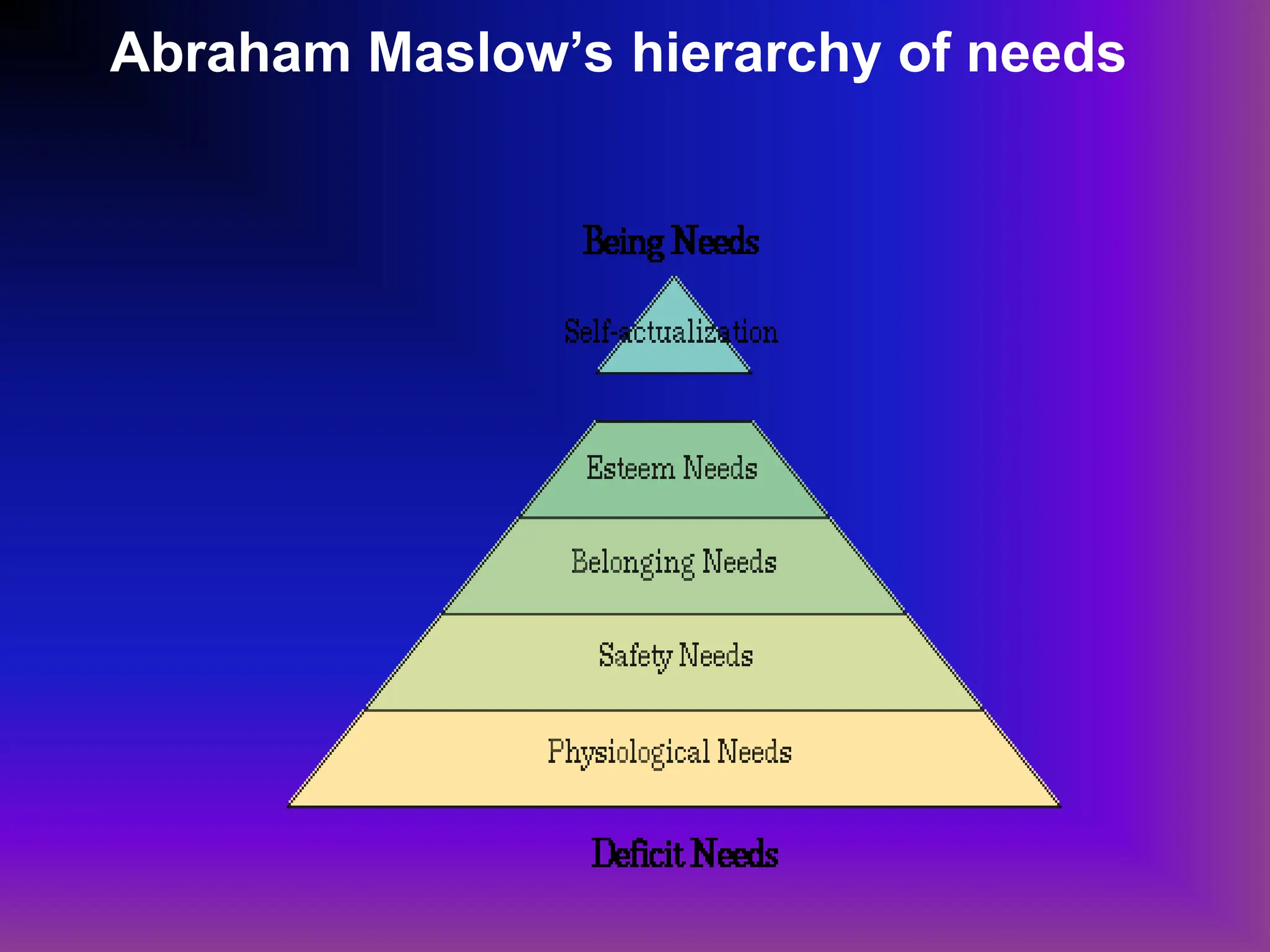
• Insupport of Mayo’s findings Maslow
developed a theory of individual needs that he
believed is at the root of workers’ motivation in
organizations. He asserted that productivity
and effectiveness in organizations could be
greatly improved by understanding and taking
care of the needs of individual workers. He
identified physiological and psychological
needs and placed them in a hierarchy
emphasizing that the lower level needs be
satisfied before higher-level ones.
Abraham Maslow’s hierarchyof needs
• 1. The physiological needs. These include
the needs we have for oxygen, water, protein,
salt, sugar, calcium, and other minerals and
vitamins.
• 2. The safety and security needs. When the
physiological needs are largely taken care of,
this second layer of needs comes into play.
You will become increasingly interested in
finding safe circumstances, stability,
protection.
38.
Abraham Maslow’s hierarchyof needs
3. The love and belonging needs. When
physiological needs and safety needs are, by and
large, taken care of, a third layer starts to show up.
You begin to feel the need for friends, a sweetheart,
children, affectionate relationships in general, even a
sense of community.
4. The esteem needs. Next, we begin to look for a
little self-esteem. Maslow noted two versions of
esteem needs, a lower one and a higher one. The
lower one is the need for the respect of others, the
need for status, fame, glory, recognition, attention,
reputation, appreciation, dignity
39.
Abraham Maslow’s hierarchyof needs
5. Self-actualization
• The last level is a bit different. Maslow has used a
variety of terms to refer to this level: He has called it
growth motivation (in contrast to deficit motivation),
being needs (or B-needs, in contrast to D-needs),
and self-actualization
40.
Contributions of theHuman relations
school
• It introduce the need for participative management
style, since employees’ needs, contribution, and
social factors had to be considered in enhancing
productivity
• It re-envisioned the corporation as a human and
thereby rational and moral entity
• It helped in understanding corporations as
complex realities with various dimensions to their
lives.
•
41.
Criticism of theHuman
Relations School
• Today scholars whether it is really true that the worker
is a “social man”. They think s/he is more “economic
man” than social
• There is difficulty in identifying the right
sociological/psychological factors that have the
greatest impact on workers’ motivation in productivity:
is it needs, expectations, values, etc.
• Research results generally do not support the
contention of behaviour scientists that increased job
satisfaction alone leads to higher productivity.
•
42.
THE MATHEMATICAL SCHOOLOF
THOUGHT
• This is a school of management thought that believes
that management problem-solving activity can best be
enhanced using quantitative, mathematical techniques
and models. The belief is that if managerial operations
are logical activities then they can be expressed using
logical formulas of symbols, concepts, models and
relationships. These techniques help management by:
assisting in objective analysis of available information
to management; helping in evaluation of risks and
possible results of managerial actions; helping balance
the many diverse elements in any organization.
43.
The types oftechniques used include:
• Linear programming: used to calculate how to
optimally allocate scarce resources among
competing usages
• Queuing Theory: used in planning the optimal
number of service stations in order to minimize
service costs and customers’ waiting time in the
queue.
• Inventory modeling: used to determine optimal level
of stock, when to reorder so as to reduce costs
• Regression analysis: used to predict relationships
among variables, forecast demands and supply, etc.
44.
The types oftechniques used include:
• Simulation: building models, creating future scenarios
in order to understand the possible impact of
changing variables on outcomes and how to react to
these changes
• Game theory: used to evaluate possible actions by
the enemy and the possible optimal responses.
45.
OTHER MANAGEMENT SCHOOLSOF
THOUGHT
• CONTINGENCY OR SITUATIONAL APPROACH:
This is an approach that holds that there is no best
way or approach to carry out a managerial job or
solve a problem. It all depends on the situation.
Managers should therefore diagnose a situation and
make decisions relative to the circumstances. Albeit
the truth in this approach, the problem with it is the
difficulty/ impossibility of determining all factors that
impact on a situation. Situations are often too
complex to identify all variables at work.
46.
OTHER MANAGEMENT SCHOOLSOF
THOUGHT
• SOCIOTECHNICAL SYSTEMS APPROACH: based
on studies by Trist E.L., at the Tavistock Institute in
England, asserts that there is a very close inter-
relationship between men and machines such that
technological operations (machines and methods)
have a strong influence on individual attitudes and
group behaviour. In solving any problem
management must consider the social and technical
systems together and ensure they both operate in
harmony.
47.
OTHER MANAGEMENT SCHOOLSOF
THOUGHT
• SYSTEMS APPROACH: This believes that
organization operate as systems consisting of parts
logically linked and working towards common goals.
Systems have subsystems, boundaries, and
environments that have an impact on them and on
which they have impact. To manage effectively
considerations must be made for the systemic, sub
systemic and environmental factors at work in any
situation of planning, organizing, decision-making,
controlling and directing. All these activities together
constitute a system
48.
Four characteristics ofthe modern organization
underscore the need for planning:
• Increased Global Competition
• New customers, new markets, and new parts of the
world pose both opportunities and competitive threats
to a firm. Planning is vital to survival in this expanded
marketplace.
• Impact on other managerial functions
• Unplanned activities can cause a firm to tamper with
the entire system. Plans direct the key functions of
the organization—selling, training, producing, etc.
49.
MANAGEMENT AS ASCIENCE
For any branch to be considered as a science, it should fulfill the
following:
a)Should have a systematic body of knowledge with its own
principles(independent)
b) The principles have to be evolved on the basis of constant
inquiry and examination(research)
c)The principles must explain a phenomenon by establishing a
cause effect relationship.
d)The principle should be available for verification to be
universally acceptable.
But management isn't an exact science because:
A)it concerned with the future which is complex and unpredictable so
that if there are changes in the environment, the management plans will
be affected.
B)Management plans are prone to changes in the external environment
e.g technological, social and economic changes.
C)The behavior of people cannot be predicted accurately and therefore
standards and ready made solutions cannot be prescribed.
50.
Management as adiscipline fulfill the
above because:
i)It has emerged as a systematic body
of knowledge with its own principles.
ii)The application of these principles
helps any practising manager to
achieve the desired goals.
iii)Management is dynamic since it has
borrowed heavily from other disciplines
to help solve management problems,
disciplines e.g psychology, sociology,
philosophy, religion, Economics
51.
Practical Guidelines forEffective Planning
• 4. Allocate Resources.Resources should be
budgeted for each important plan. A budget is a
predetermined amount of resources linked to an
activity.
• Implementation: concerns the delegation of tasks,
objective-driven action and collection of feedback
data
• Control the Implementation. Controlling includes all
managerial activities dedicated to ensuring that the
actual results conform to planned results
52.
Management as anart
i) The word art refers to the know how or
ways of doing to accomplish the desired
results.
ii) The focus is on the skill with which the
activities are performed.
iii) The constant practice of the theoretical
concept(knowledge base) contributes to
the formation and sharpening of the
skills.
iv) I Management as an art stresses the
need for practice where in management
graduate from the best institute may not
be very effective and therefore requires
creativity and practice.